
Managed SOAR Services Market Size and Share
Market Overview
| Study Period | 2021 - 2032 |
|---|---|
| Market Size (2027) | USD 1.39 Billion |
| Market Size (2032) | USD 2.88 Billion |
| Growth Rate (2027 - 2032) | 15.68 % |
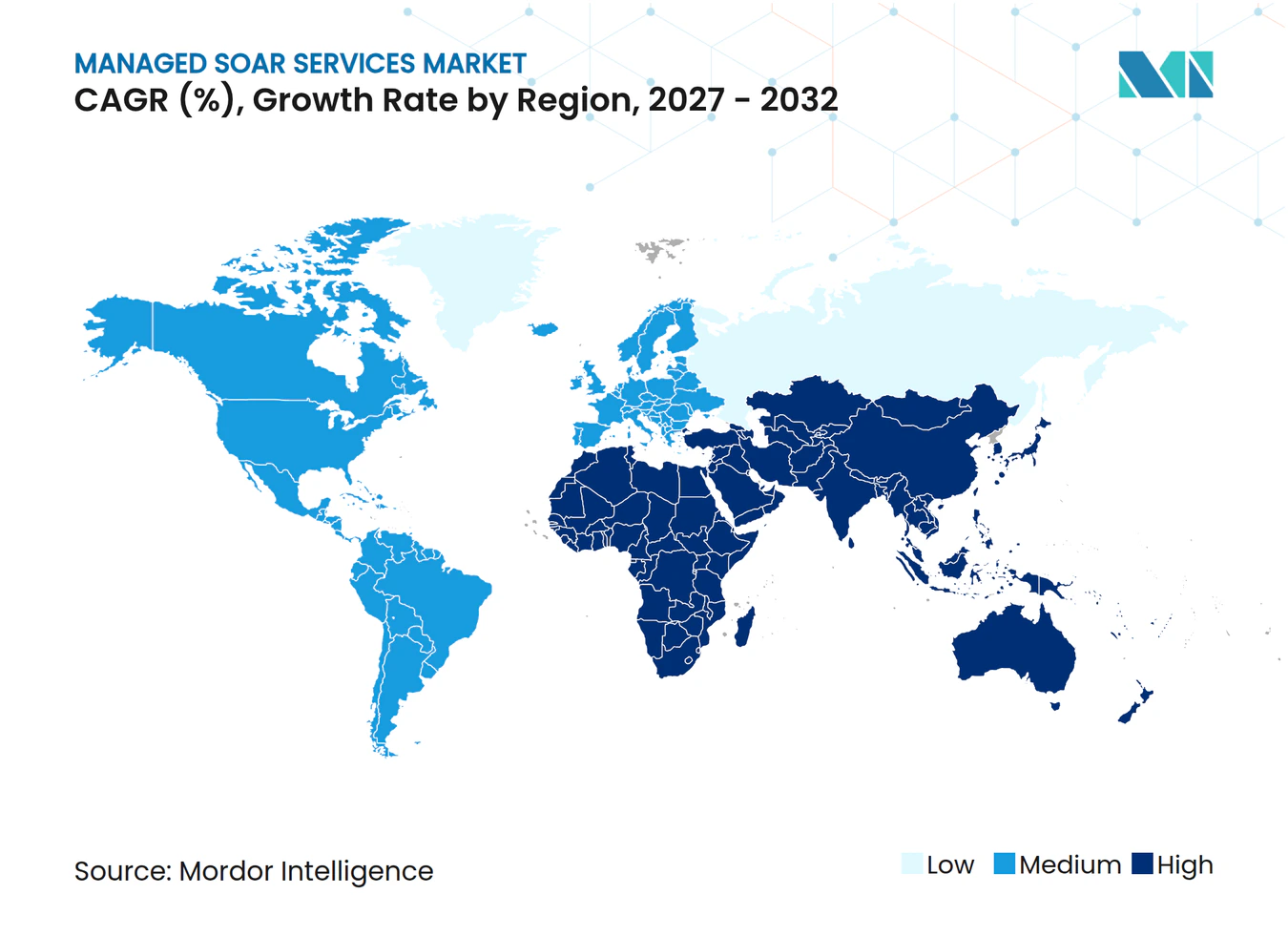
| Fastest Growing Market | Asia-Pacific |
| Largest Market | North America |
| Market Concentration | Medium |
Major Players *Disclaimer: Major Players sorted in no particular order Image © Mordor Intelligence. Reuse requires attribution under CC BY 4.0. | |
Managed SOAR Services Market Analysis by Mordor Intelligence
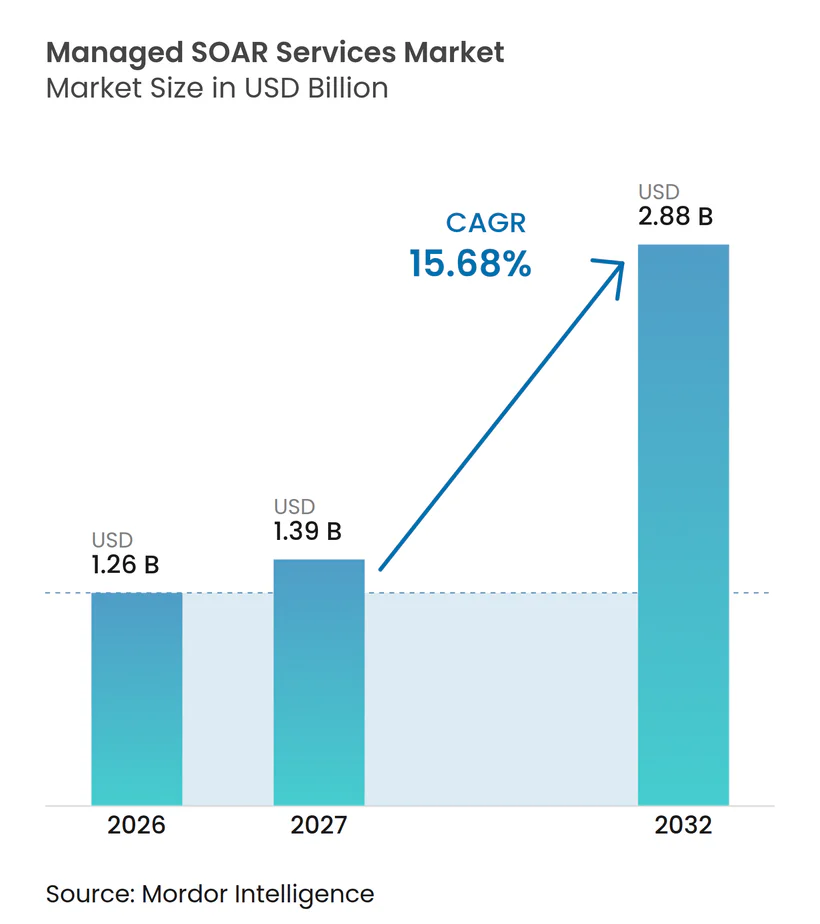
The managed SOAR services market size is projected to expand from USD 1.26 billion in 2026 and USD 1.39 billion in 2027 to USD 2.88 billion by 2032, registering a CAGR of 15.68% between 2027 to 2032. The managed SOAR services market is growing as security teams face more alerts than their available analysts can investigate, which makes outsourced automation a practical operating choice. Compliance requirements are also increasing demand for recorded response actions and auditable evidence. Cloud, hybrid, and multicloud environments add more tools, logs, and identity contexts for security teams to manage. Providers are responding through agentic AI, multitenant delivery platforms, and compliance modules that reduce manual work for clients. Integration debt, recurring playbook maintenance, and data residency needs continue to shape provider selection and deployment schedules.
Key Report Takeaways
- By service type, Managed SOAR Platform Operations held 27.83% of the managed SOAR services market in 2026, while Managed Incident Triage and Response is projected to expand at a CAGR of 16.27% through 2032.
- By delivery model, Fully Managed SOAR Services held 41.62% of revenue in 2026, while White-Label SOAR Services for MSSPs are projected to expand at a CAGR of 16.84% through 2032.
- By deployment mode, cloud-based deployment accounted for 63.47% of revenue in 2026 and is projected to grow at a CAGR of 16.21% through 2032.
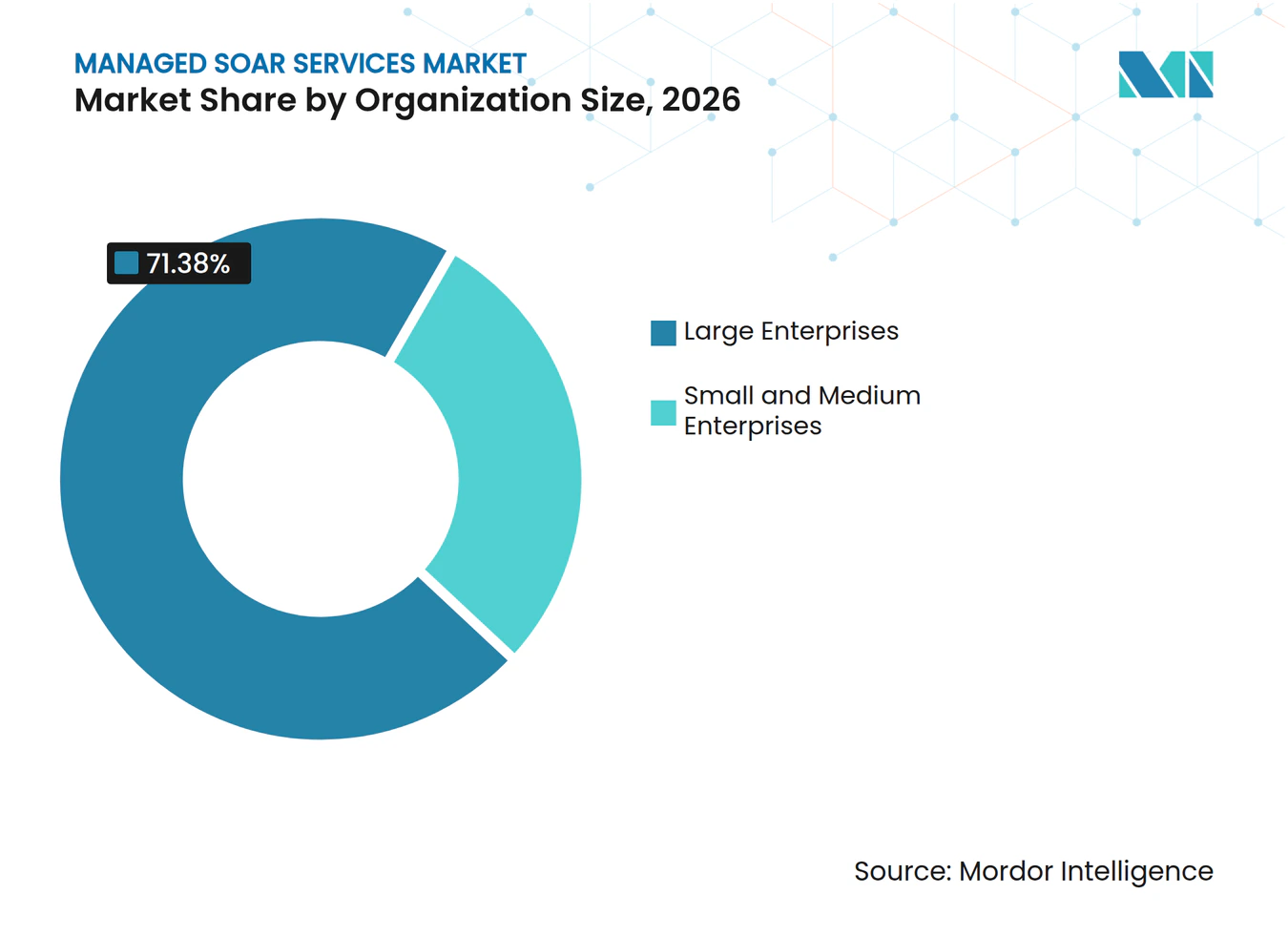
- By organization size, large enterprises accounted for 71.38% of revenue in 2026, while SMEs are projected to grow at a CAGR of 16.74% through 2032.
- By end-user industry, BFSI held 24.13% of revenue in 2026, while healthcare is projected to expand at a CAGR of 16.47% through 2032.
Note: Market numbers in this report are based on Mordor Intelligence's proprietary estimation framework, which combines nine months of actuals with Q4 projections for base year 2026.
Market Trends and Insights
Drivers Impact Analysis of Managed SOAR Services Market*
| Driver | (~) % Impact on CAGR Forecast | Geographic Relevance | Impact Timeline |
|---|---|---|---|
| Escalating Alert Volumes and Analyst Capacity Constraints | +3.2% | Global | Short term (≤ 2 years) |
| Compliance-Driven Automation and Evidence Requirements | +2.8% | North America and EU | Short term (≤ 2 years) |
| Cloud, Hybrid, and Multicloud Attack-Surface Expansion | +2.3% | Global | Medium term (2-4 years) |
| Cyber-Insurance and Board-Level Resilience Requirements | +1.9% | North America and EU | Short term (≤ 2 years) |
| MSSP Margin Expansion Through Multitenant Automation | +1.6% | Asia-Pacific and North America | Medium term (2-4 years) |
| Sovereign and Local-Language Security Operations Demand | +1.0% | Middle East and Africa and Asia-Pacific | Long term (≥ 4 years) |
| Source: Mordor Intelligence | |||
Escalating Alert Volumes and Analyst Capacity Constraints Create Structural Outsourcing Demand
Security operations teams receive more detection signals than standard staffing models can manage. Vectra AI reported that organizations received an average of 2,992 security alerts each day in 2026, and 63% were not addressed because teams lacked investigation capacity.[1]Tines reported in 2025 that 40% of alerts were not investigated, and 60% of teams said an ignored alert had contributed to an incident. The managed SOAR services market benefits when providers take on Tier 1 and Tier 2 triage work that internal teams cannot sustain. The gap is likely to persist because attack methods are increasingly automated, and security budgets do not keep pace with analyst requirements.
Compliance-Driven Automation and Evidence Requirements Raise the Mandatory Audit Bar
Regulators increasingly expect organizations to retain reliable evidence of how incidents were detected, assessed, and handled. NIS2 requires entities to maintain incident-handling procedures, while DORA requires financial entities to classify and report ICT incidents through formal processes. CISA and the Australian Signals Directorate identified SIEM and SOAR integration as an important part of mature security operations in their May 2025 guidance. NIST SP 800-61 Revision 3 encourages the use of automation for alerting, ticketing, and information sharing in incident-response planning. These requirements shorten procurement discussions for the managed SOAR services market in financial services and other regulated sectors. Providers with ready-made compliance evidence modules and sovereign deployment options are better positioned to serve organizations with multiple reporting obligations.
Cloud, Hybrid, and Multicloud Attack-Surface Expansion Overwhelms In-House Response Capacity
Organizations must correlate growing volumes of logs, identities, and control-plane activity across cloud and on-premises systems. IBM and Palo Alto Networks reported that enterprises manage an average of 83 security tools from 29 vendors, creating a wide integration burden for security teams. Splunk made its SOAR platform available on Google Cloud Marketplace in February 2026, featuring more than 2,800 automated actions across 300 integrations. This supports cloud-native delivery models in the managed SOAR services market by enabling providers to apply integration expertise across multiple clients. The resulting operating model reduces the cost of normalizing security data when compared with maintaining separate in-house integrations.
Cyber-Insurance and Board-Level Resilience Requirements Formalize SOAR as a Baseline Control
Cyber-insurance underwriting increasingly examines whether organizations can document their incident-response controls. In 2026, IRONSCALES reported that insurers require integrated SOC and managed detection and response workflows with documented playbooks for commercial cyber coverage. Torq also identified SOAR workflow documentation as a common item on cyber-insurance checklists in 2025. Managed SOAR can provide buyers with a documented operating process as they prepare for policy renewal. This creates a purchase route that is linked to insurance timing rather than a lengthy standalone technology evaluation. Board scrutiny of cyber risk in North America and Europe reinforces demand for demonstrable containment procedures.
Restraints Impact Analysis of Managed SOAR Services Market*
| Restraint | (~) % Impact on CAGR Forecast | Geographic Relevance | Impact Timeline |
|---|---|---|---|
| Legacy SIEM and Heterogeneous Tool Integration Debt | -2.3% | Global | Medium term (2-4 years) |
| Automation Engineering and Playbook Maintenance Costs | -1.8% | Global | Medium term (2-4 years) |
| Customer Approval Requirements for High-Impact Actions | -1.3% | North America and EU | Short term (≤ 2 years) |
| Data Residency, Third-Party Trust, and AI Confidentiality Concerns | -1.0% | Asia-Pacific, Middle East and Africa, and EU | Long term (≥ 4 years) |
| Source: Mordor Intelligence | |||
Legacy SIEM and Heterogeneous Tool Integration Debt Delays Value Realization
Legacy SIEM systems and proprietary connectors slow the move from contract signature to live automation. Some environments use data lake architectures that lack the application interfaces needed for direct orchestration. This can extend deployment by 3 to 6 months and delay the savings included in the buyer's original business case. Providers with pre-built connectors for SIEM, endpoint detection and response, and identity platforms can reduce this delay. Palo Alto Networks describes multitenant Cortex XSOAR capabilities that use pre-integrated connections for managed security service providers. Integration depth, therefore, remains a central selection factor in the managed SOAR services market.
Automation Engineering and Playbook Maintenance Costs Constrain Provider Margins
Providers must continually build, test, and update playbooks as threats, integrations, and cloud configurations change. This work is an ongoing operating cost rather than a one-time implementation task. Smaller providers can experience margin pressure because engineering effort does not always track with per-alert or per-endpoint contract pricing. Pre-built playbook libraries can help providers standardize repetitive work across accounts. Swimlane introduced its AI SOC platform in February 2026 and reported 94% automation for Tier 1 and Tier 2 work. The platform approach illustrates why scalable automation engineering is important to the managed SOAR services market.
*Our forecasts treat driver/restraint impacts as directional, not additive. The impact forecasts reflect baseline growth, mix effects, and variable interactions.
Managed SOAR Services Market Segment Analysis
By Service Type:
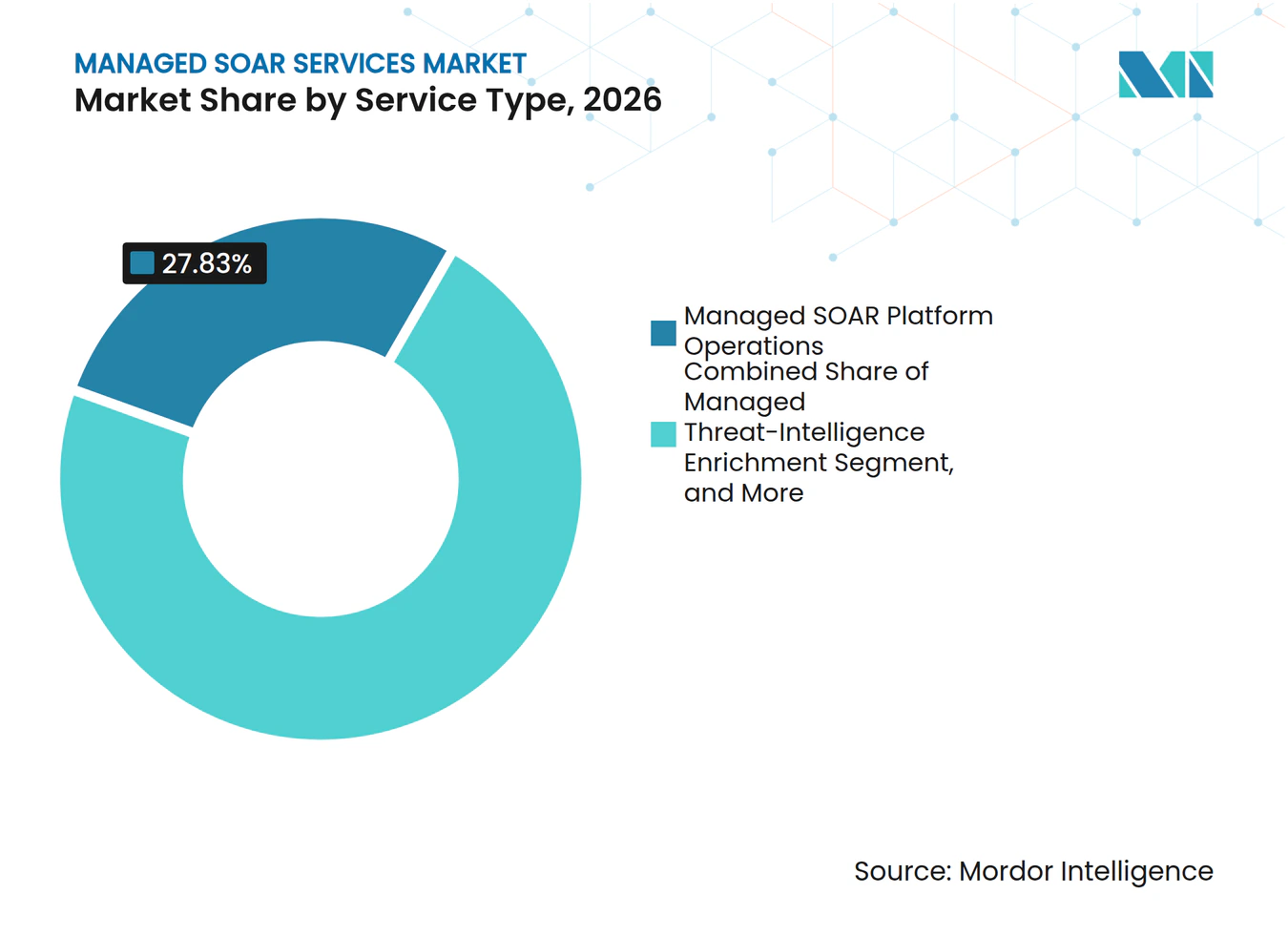
Platform Operations Establish the Initial Managed ScopeManaged SOAR Platform Operations held 27.83% of the managed SOAR services market share in 2026, making it the largest service category and an important entry point for managed engagements. Buyers commonly start by outsourcing routine governance before allowing external teams to handle autonomous response actions with defined approval controls. The service includes platform administration, connector management, version updates, performance monitoring, access administration, and routine workflow oversight across the client's security tooling. These activities require specialist skills but have a defined scope that suits managed contracts and gives clients a predictable operating model. The model allows clients to retain control over high-impact security decisions during early engagement stages while improving the reliability of core platform operations.
Managed Incident Triage and Response is projected to grow at a CAGR of 16.27% through 2032 as organizations widen the scope of work assigned to their service providers. Clients often expand into this service after building confidence in provider controls, escalation procedures, and response boundaries during platform operations. A 2026 systematic review noted that full-lifecycle managed SOAR arrangements can improve mean time to respond when compared with partial outsourcing. Managed playbook development creates repeat work as threat methods change and as clients add new systems to their monitoring environments. Threat-intelligence enrichment provides context for clients without dedicated intelligence teams, while reporting, governance, compliance evidence, training, and analyst enablement support different stages of adoption.



By Delivery Model:
White-Label Services Change MSSP EconomicsFully Managed SOAR Services held 41.62% of revenue in 2026, supported by large enterprises and regulated institutions that prefer clear end-to-end delivery accountability. These buyers often want one provider to take responsibility for playbooks, threat intelligence, reporting, and daily operations across a complex security environment. The model suits organizations with limited internal cybersecurity capacity and complex environments that would otherwise need several specialist teams. Co-Managed SOAR Services remain relevant for mid-size companies that retain internal security teams and want to maintain operational visibility. These organizations use outside providers to supplement their skills and capacity rather than replace their internal functions.
White-Label SOAR Services for MSSPs is projected to grow at a CAGR of 16.84% through 2032. The model lets regional and mid-tier providers offer advanced automation without duplicating a full software engineering investment or building an orchestration platform from the ground up. Anomali launched its MSSP Program in November 2025 with multitenant architecture, tenant isolation, and custom branding options. SOAR-as-a-Service also appeals to buyers that prefer consumption-based spending, rapid implementation, and lower-complexity deployments. Growth in white-label delivery gives platform providers a wider route to market through service partners and gives MSSPs a faster way to broaden their managed portfolio. The managed SOAR services industry is moving toward delivery structures that support both direct and partner-led sales.
By Deployment Mode:
Cloud Delivery Strengthens Its Operating PositionCloud-based deployment held 63.47% of managed SOAR services market revenue in 2026 and is projected to grow at a CAGR of 16.21% through 2032. This combination of leading scale and fastest growth reflects active migration to cloud-native SOC operations rather than a settled deployment mix. Cloud platforms can synchronize playbook versions across distributed teams, aggregate alerts from several locations, and provide a common environment for service delivery. They can also scale during periods of high attack activity without adding on-premises hardware or waiting for local infrastructure changes. Splunk's February 2026 Google Cloud Marketplace release provided more than 2,800 automated actions across 300 integrations.
On-premises deployment remains necessary for defense contractors and critical infrastructure operators with strict controls on data movement and third-party processing. Hybrid deployment combines cloud-based orchestration with on-premises collection agents for multinational organizations that must retain selected telemetry locally. This approach can support different data residency obligations across jurisdictions while providing teams with centralized playbook management. Cloud-native SOC adoption is also increasing across Asia-Pacific, the Middle East, and Africa as cloud infrastructure becomes more available to enterprises. The managed SOAR services market continues to favor cloud delivery for new contracts because it avoids some legacy capacity limits and supports multitenant operations. On-premises and hybrid designs remain important where regulatory or operational limits prevent full cloud migration.
By Organization Size:
SME Growth Broadens the Customer BaseLarge enterprises held 71.38% of revenue in 2026. Their security environments generate sufficient telemetry that manual SOC operations become difficult to sustain without extensive internal staffing and specialized tools. Early commercial SOAR deployments were concentrated in large financial institutions and government agencies with established managed security relationships. These buyers established relationships with specialist integrators and managed security providers before smaller organizations adopted similar services. Their continued spending supports the large-enterprise base of the managed SOAR services market and funds demand for complex, tailored service models.
SMEs are projected to grow at a CAGR of 16.74% through 2032. Consumption-priced SOAR-as-a-Service offers reduce the capital barrier that previously limited adoption and allow buyers to begin with a smaller operating scope. Smaller organizations often begin with defined use cases, including phishing triage and endpoint quarantine, before extending their managed service contract. Insurance requirements can also encourage adoption when a managed service offers better underwriting conditions and provides the client with documented controls. Providers must balance higher client volume with lower average contract values in this segment. The managed SOAR services industry will favor standardized SME service tiers that preserve engineering capacity for larger accounts.

By End-User Industry:
BFSI Leads While Healthcare Expands FasterBFSI held 24.13% of revenue in 2026, the largest end-user share in the managed SOAR services market. Financial institutions operate valuable transaction systems, face regular regulatory review, and need to protect customer activity with limited tolerance for service disruption. These conditions support investment in fast detection, documented response, and high service availability throughout the security operations process. SBI Capital Markets issued a request for proposal in August 2025 for a managed SOC that included SIEM, SOAR, and user entity behavior analytics capabilities.[2] IT and telecommunications providers also use managed SOAR to coordinate responses across several customer environments and reduce repetitive analyst work.
Healthcare is projected to grow at a CAGR of 16.47% through 2032. Connected electronic health records, telemedicine services, and medical-device networks increase the security environment that providers must monitor, as well as the consequences of response delays. Government, defense, manufacturing, energy, utilities, transportation, and logistics add further demand as IT and operational systems become more connected. Healthcare-specific playbooks remain a potential area for provider specialization, particularly where clinical systems require cautious response procedures.
Geography Analysis
North America Managed SOAR Services Market
North America accounted for 44.63% of revenue in 2026, giving the region the largest share of the managed SOAR services market. Financial services, federal agencies, and healthcare networks were early adopters of commercial SOAR contracts because manual response workflows could not consistently meet their notification and evidence requirements. NIST published SP 800-61 Revision 3 in April 2025, which encourages organizations to integrate automation into incident-response planning and links those activities to broader risk-management processes. CISA guidance also supports the use of SIEM and SOAR capabilities in mature security operations, particularly for organizations managing complex critical infrastructure environments. Insurers and boards face increased pressure to document response processes, while Canadian financial services and healthcare organizations contribute to the demand for cross-border delivery.
Europe Managed SOAR Services Market
Europe is the second-largest regional position because NIS2 and DORA increase the need for formal incident classification, reporting, and accountable operational processes. France has seen managed SOC providers incorporate automation and SOAR into higher-maturity service offerings for clients who need a clearer division of operational responsibility. Germany and the Netherlands are important for localized offerings that address critical-infrastructure expectations, while Southern and Eastern Europe offer opportunity as organizations respond to stronger enforcement of European requirements.
APAC, South America and MEA Managed SOAR Services Market
Asia-Pacific is projected to grow at a CAGR of 16.92% through 2032, making it the fastest-growing geography in the managed SOAR services market. Sovereign security mandates and first-time adoption of managed services support demand across Southeast Asia, where buyers seek local control over sensitive security telemetry. The supplied research identifies SOAR-SIEM integration as a key growth area. IOH and Cisco deployed an Indonesian sovereign SOC in August 2025 using Splunk Cloud within the country's jurisdictional boundaries. South America, the Middle East, and Africa remain smaller demand areas, but their financial and cybersecurity requirements are creating new opportunities for providers that can offer localized and sovereign service models.
Competitive Landscape
Market Concentration
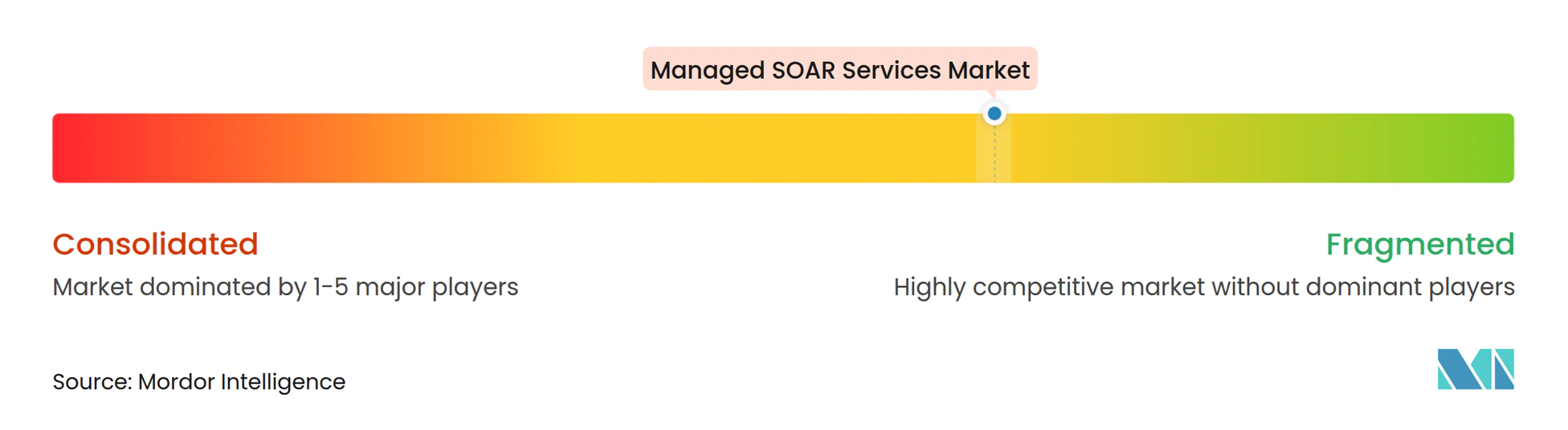
The managed SOAR services market is moderately fragmented in 2026 because no provider leads every service type, delivery model, and geography. Consulting-led managed security providers include Deloitte, Accenture, and IBM, while platform vendors include Palo Alto Networks, Swimlane, Tines, and Fortinet. Regional MSSPs use white-label platforms to serve local requirements in Asia-Pacific, Europe, and the Middle East. Providers compete on automation depth, multitenant capabilities, integration coverage, and support for regulated operating models, all of which can be verified during procurement.
Swimlane raised USD 45 million in March 2026 after a record 2025 performance and reported 94% automation across Tier 1 and Tier 2 work, with more than 60,000 daily virtual analyst interactions.[3] Palo Alto Networks and Google Cloud formalized a strategic partnership in December 2025, with combined cloud security services approaching USD 10 billion. Fortinet previewed FortiSOC in May 2026, combining FortiSIEM, FortiSOAR, and FortiTIP into a single cloud platform with agentic AI workflows to simplify service attachment for MSSP partners. Tines launched Tines 3B in July 2026 as an AI-native security automation environment for security operations organizations. These actions show that leading providers are combining automation, data, and delivery capabilities rather than selling separate tools.
New competitors also arrive from workflow automation, AI agents, and extended detection and response, widening the choice of automation approaches for buyers. Their offerings can place pricing pressure on standalone services that are not part of a wider managed security contract. Opportunities remain in mid-market SOAR-as-a-Service, sovereign-compliant deployment, and healthcare-specific triage where sector-specific response playbooks are less established. Swimlane achieved ISO 42001 certification for its AI management system, which supports procurement requirements related to AI governance and controlled AI use. Providers that show reliable integration across cloud, hybrid, and sovereign configurations can improve their position in regulated accounts within the managed SOAR services market.
Managed SOAR Services Industry Leaders
-
IBM Corporation
-
Palo Alto Networks, Inc.
-
Microsoft Corporation
-
Fortinet, Inc.
-
Rapid7, Inc.
- *Disclaimer: Major Players sorted in no particular order
Managed SOAR Services Market Companies Covered in this Report
- IBM Corporation
- Palo Alto Networks, Inc.
- Microsoft Corporation
- Fortinet, Inc.
- Rapid7, Inc.
- Splunk Inc.
- Cisco Systems, Inc.
- Swimlane LLC
- Tines Security Limited
- ServiceNow, Inc.
- Google LLC
- Accenture plc
- Deloitte Touche Tohmatsu Limited
- Capgemini SE
- Tata Consultancy Services Limited
- Wipro Limited
- NTT DATA Group Corporation
- Kyndryl Holdings, Inc.
- Orange S.A.
- Optiv Security Inc.
Recent Industry Developments in Managed SOAR Services Market
- July 2026: Tines launched Tines 3B, an AI-native security automation environment designed as a third-generation orchestration runtime. Early enterprise adopters included Headspace and Fin (Intercom), validating agentic AI uptake among technology-forward security operations organizations at commercial scale.
- May 2026: Fortinet previewed FortiSOC, a unified cloud platform merging FortiSIEM, FortiSOAR, and FortiTIP with agentic AI-driven workflow capabilities. The consolidation of 3 previously discrete product lines into a single managed service architecture reduced multi-product dependency for MSSP partners and streamlined managed service delivery economics.
- March 2026: Swimlane raised USD 45 million in growth capital following record 2025 performance, reporting a 94% Tier 1 and Tier 2 automation rate and daily virtual analyst capacity exceeding 60,000 interactions across its customer base.
- February 2026: Kyndryl opened a Cyber Defense Operations Center in Bengaluru, India on February 19, 2026, establishing dedicated SOAR-integrated incident response capacity in South Asia to serve enterprise and public-sector clients across the region.
Global Managed SOAR Services Market Report Scope
The Managed Security Orchestration, Automation, and Response (SOAR) Services Market comprises third-party providers that deliver managed cybersecurity services using SOAR platforms. These services help organizations integrate security tools, automate repetitive security operations, orchestrate incident response workflows, and improve threat detection, investigation, and remediation.
The Managed SOAR Services Market Report is Segmented by Service Type (Managed SOAR Platform Operations, Managed Playbook Development and Optimization, Managed Incident Triage and Response, Managed Threat-Intelligence Enrichment, Managed SOAR Reporting, Governance, and Compliance Evidence, and Managed SOAR Training and Analyst Enablement), Delivery Model (Fully Managed SOAR Services, Co-Managed SOAR Services, SOAR-as-a-Service, and White-Label SOAR Services for MSSPs), Deployment Mode (Cloud-Based, On-Premises, and Hybrid), Organization Size (Small and Medium Enterprises and Large Enterprises), End-User Industry (Information Technology and Telecommunications, BFSI, Healthcare, Retail and E-Commerce, Government and Defense, Education, and Other End-User Industries), and Geography (North America, South America, Europe, Asia-Pacific, Middle East, and Africa). The Market Forecasts are Provided in Terms of Value (USD).
Segmentation Overview
| Managed SOAR Platform Operations |
| Managed Playbook Development and Optimization |
| Managed Incident Triage and Response |
| Managed Threat-Intelligence Enrichment |
| Managed SOAR Reporting, Governance, and Compliance Evidence |
| Managed SOAR Training and Analyst Enablement |
| Fully Managed SOAR Services |
| Co-Managed SOAR Services |
| SOAR-as-a-Service |
| White-Label SOAR Services for MSSPs |
| Cloud-Based |
| On-Premises |
| Hybrid |
| Small and Medium Enterprises |
| Large Enterprises |
| Information Technology and Telecommunications |
| BFSI |
| Healthcare |
| Retail and E-Commerce |
| Government and Defense |
| Education |
| Other End-User Industries |
| North America | United States |
| Canada | |
| Mexico | |
| South America | Brazil |
| Argentina | |
| Rest of South America | |
| Europe | Germany |
| United Kingdom | |
| France | |
| Italy | |
| Spain | |
| Russia | |
| Rest of Europe | |
| Asia-Pacific | China |
| India | |
| Japan | |
| South Korea | |
| Australia | |
| Rest of Asia-Pacific | |
| Middle East | Saudi Arabia |
| United Arab Emirates | |
| Turkey | |
| Rest of Middle East | |
| Africa | South Africa |
| Egypt | |
| Nigeria | |
| Rest of Africa |
| By Service Type | Managed SOAR Platform Operations | |
| Managed Playbook Development and Optimization | ||
| Managed Incident Triage and Response | ||
| Managed Threat-Intelligence Enrichment | ||
| Managed SOAR Reporting, Governance, and Compliance Evidence | ||
| Managed SOAR Training and Analyst Enablement | ||
| By Delivery Model | Fully Managed SOAR Services | |
| Co-Managed SOAR Services | ||
| SOAR-as-a-Service | ||
| White-Label SOAR Services for MSSPs | ||
| By Deployment Mode | Cloud-Based | |
| On-Premises | ||
| Hybrid | ||
| By Organization Size | Small and Medium Enterprises | |
| Large Enterprises | ||
| By End-User Industry | Information Technology and Telecommunications | |
| BFSI | ||
| Healthcare | ||
| Retail and E-Commerce | ||
| Government and Defense | ||
| Education | ||
| Other End-User Industries | ||
| By Geography | North America | United States |
| Canada | ||
| Mexico | ||
| South America | Brazil | |
| Argentina | ||
| Rest of South America | ||
| Europe | Germany | |
| United Kingdom | ||
| France | ||
| Italy | ||
| Spain | ||
| Russia | ||
| Rest of Europe | ||
| Asia-Pacific | China | |
| India | ||
| Japan | ||
| South Korea | ||
| Australia | ||
| Rest of Asia-Pacific | ||
| Middle East | Saudi Arabia | |
| United Arab Emirates | ||
| Turkey | ||
| Rest of Middle East | ||
| Africa | South Africa | |
| Egypt | ||
| Nigeria | ||
| Rest of Africa | ||
Key Questions Answered in the Report
What is the managed SOAR services market size?
The managed SOAR services market is projected to increase from USD 1.39 billion in 2027 to USD 2.88 billion by 2032 at a CAGR of 15.68%.
What is driving demand for managed SOAR services?
High alert volumes, limited analyst capacity, compliance evidence needs, and more complex cloud environments are supporting adoption.
Which deployment mode leads managed SOAR adoption?
Cloud-based deployment held 63.47% of revenue in 2026 and is projected to grow at a CAGR of 16.21% through 2032.
Which end-user sector has the largest share of managed SOAR spending?
BFSI held 24.13% of revenue in 2026 because of high-value systems, regulatory scrutiny, and the need for reliable response processes.
Which region is expanding fastest for managed SOAR services?
Asia-Pacific is projected to grow at a CAGR of 16.92% through 2032, supported by sovereign security requirements and cloud investment.
Why do organizations choose a managed SOAR provider?
A provider can operate playbooks, manage integrations, produce compliance evidence, and help internal security teams handle routine triage work.