
Managed IT Hardware Maintenance and Support Services Market Size and Share
Market Overview
| Study Period | 2021 - 2032 |
|---|---|
| Market Size (2027) | USD 16.60 Billion |
| Market Size (2032) | USD 23.89 Billion |
| Growth Rate (2027 - 2032) | 7.55 % |
| Fastest Growing Market | Asia-Pacific |
| Largest Market | North America |
| Market Concentration | Medium |
Major Players *Disclaimer: Major Players sorted in no particular order Image © Mordor Intelligence. Reuse requires attribution under CC BY 4.0. | |
Managed IT Hardware Maintenance and Support Services Market Analysis by Mordor Intelligence
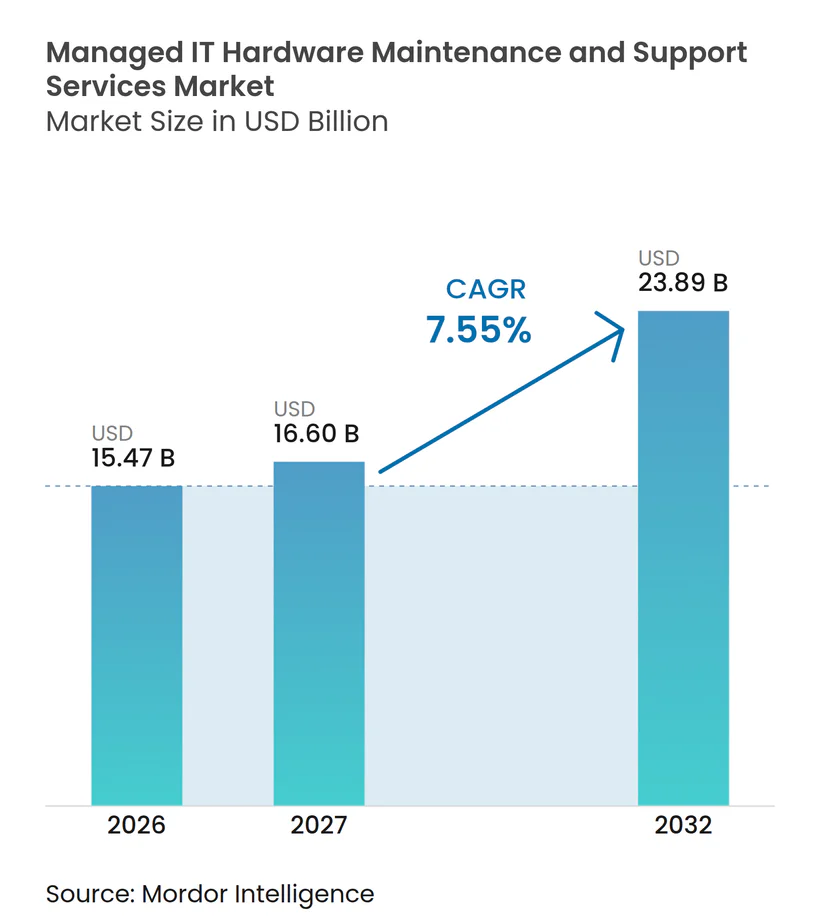
The managed IT hardware maintenance and support services market size is projected to expand from USD 15.47 billion in 2026 to USD 16.60 billion in 2027, and to USD 23.89 billion by 2032, registering a CAGR of 7.55% between 2027 and 2032. Enterprises are separating software renewal choices from physical infrastructure support, which lets them retain capable servers, storage systems, and network equipment after original equipment manufacturer support ends. This approach frees up funding for cloud programs and AI infrastructure while preserving existing assets suitable for operational workloads. Demand also reflects the rising administrative burden of managing equipment purchased through different refresh cycles and covered by separate service contracts. Providers are responding with single-service arrangements, broader field coverage, and monitoring tools that help clients plan replacements before a failure affects operations. The managed IT hardware maintenance and support services market is therefore moving beyond break-fix work toward longer-term lifecycle planning and co-managed support.
Key Report Takeaways
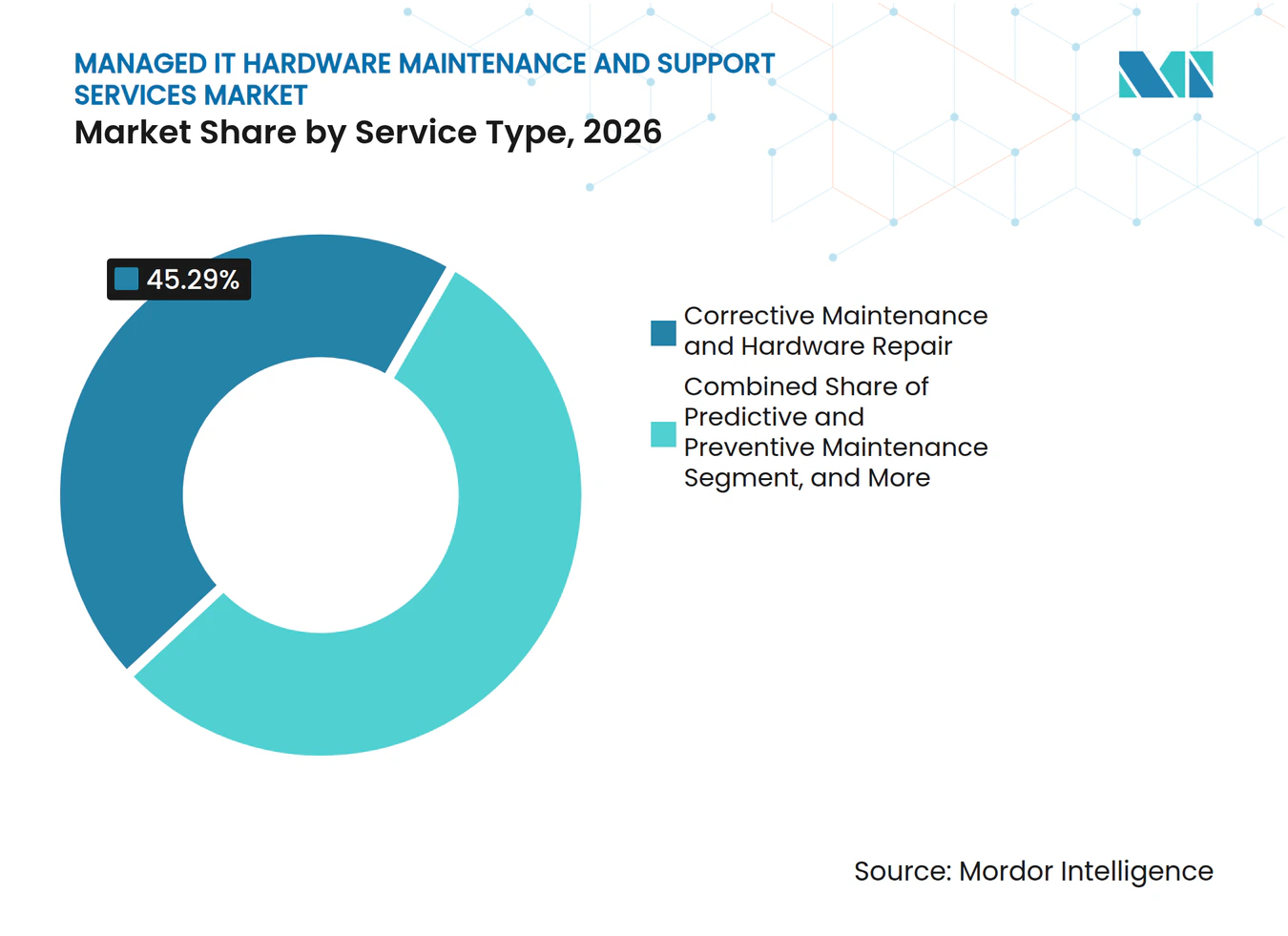
- By service type, corrective maintenance and hardware repair accounted for 45.29% of revenue in the managed IT hardware maintenance and support services market in 2026, while predictive and preventive maintenance are expected to expand at an 8.82% CAGR through 2032.
- By service model, OEM maintenance accounted for 68.44% of the managed IT hardware maintenance and support services market revenue in 2026, while third-party maintenance is projected to advance at a 9.23% CAGR through 2032.
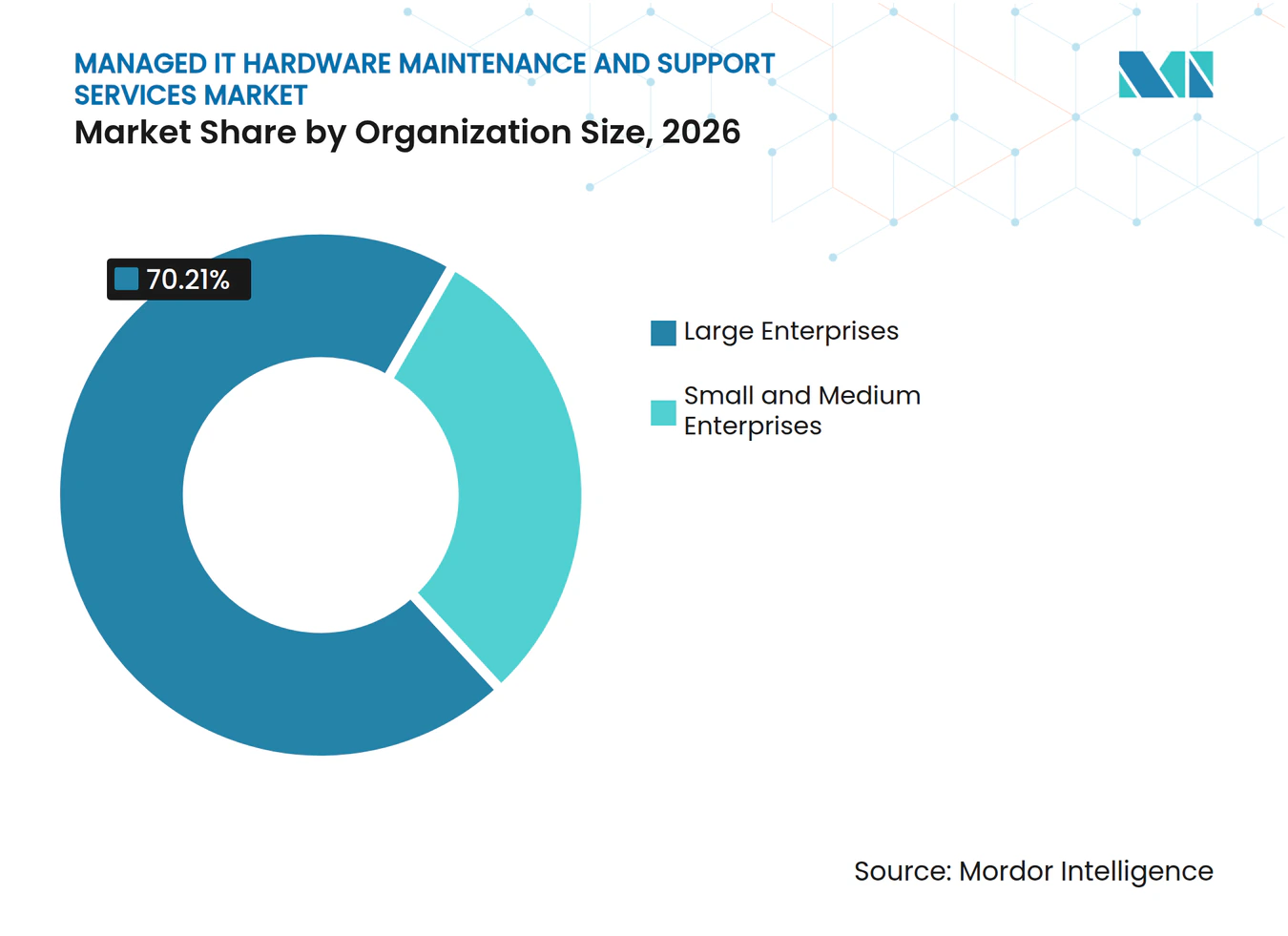
- By organization size, large enterprises represented 70.21% of the managed IT hardware maintenance and support services market revenue in 2026, while small and medium enterprises are expected to record a 9.59% CAGR through 2032.
- By end-user industry, IT and telecommunications accounted for 30.11% of the managed IT hardware maintenance and support services market revenue in 2026, while healthcare and life sciences are projected to expand at an 8.21% CAGR through 2032.
- By geography, North America accounted for 37.86% of the managed IT hardware maintenance and support services market revenue in 2026, while Asia-Pacific is forecast to register an 8.56% CAGR through 2032.
Note: Market numbers in this report are based on Mordor Intelligence's proprietary estimation framework, which combines nine months of actuals with Q4 projections for base year 2026.
Global Managed IT Hardware Maintenance and Support Services Market Trends and Insights
Drivers Impact Analysis*
| Driver | (~) % Impact on CAGR Forecast | Geographic Relevance | Impact Timeline |
|---|---|---|---|
| Multi-Vendor Infrastructure Complexity | +2.0% | Global, most acute in North America and Europe | Medium term (2-4 years) |
| Growing Installed Base of EOL and EOSL Hardware | +1.8% | Global, strong in North America, Europe, and Asia-Pacific | Short term (≤ 2 years) |
| Enterprise Demand for Lifecycle Cost Optimization | +1.5% | Global | Short term (≤ 2 years) |
| Expansion of Cloud, Edge, and Hybrid IT Environments | +1.2% | Global, largest effect in North America and Asia-Pacific | Medium term (2-4 years) |
| AI Infrastructure Expansion Alongside Legacy Hardware Fleets | +0.9% | North America and Asia-Pacific core, spillover to Europe | Medium term (2-4 years) |
| Telemetry-Led Predictive Maintenance and Spare-Parts Planning | +0.6% | North America and Europe, expanding to Asia-Pacific | Long term (≥ 4 years) |
| Source: Mordor Intelligence | |||
Multi-Vendor Infrastructure Complexity Fuels Unified Support Demand
Organizations with equipment from several original equipment manufacturers face overlapping support contracts, inconsistent service-level terms, and unclear responsibility when an incident affects more than 1 system. Separate support arrangements also make it harder to compare service performance across systems. Server, storage, and network issues may require expertise that a single-manufacturer service desk does not provide. This makes consolidated support attractive for enterprises operating mixed estates across the managed IT hardware maintenance and support services market. Research on multiparty IT service management found that integrated governance structures improved the efficiency of incident resolution and service-level compliance. The managed IT hardware maintenance and support services market benefits when providers can take responsibility for multiple hardware platforms under a single accountable service arrangement.
Growing Installed Base of EOL and EOSL Hardware Creates Immediate Maintenance Demand
Hardware reaching end-of-life and end-of-service-life dates gives enterprises an immediate reason to consider alternative support. Spectra Technologies listed Cisco UCS C220 and C240 M5 servers and NetApp AFF A220, A300, and FAS 8200 storage systems among platforms reaching EOSL by November 2026. These dates can concentrate contract expirations and force a choice between an expensive renewal, a replacement, or independent maintenance. TD SYNNEX reported in March 2026 that nearly 50% of enterprise servers in active operation were Gen9 or older. Older systems can remain useful for stable workloads when covered by reliable parts and field-service arrangements. The managed IT hardware maintenance and support services market gains from this installed base because many clients prefer to defer a full refresh while keeping systems operational.
Enterprise Demand for Lifecycle Cost Optimization Accelerates Third-Party Adoption
Enterprises are seeking more control over when they refresh equipment and how they allocate support spending. This changes maintenance from an automatic manufacturer renewal into a planned operating expense with defined service outcomes. A 2025 report citing IDC research stated that 60% of customers used third-party maintenance providers more often than before, citing cost consolidation, flexible service-level agreements, and ease of doing business. A 2025 Servnet UK total cost of ownership analysis found that shifting part of Cisco support coverage from OEM contracts to third-party maintenance yielded operating cost savings while preserving service-level performance. Savings can be redirected to AI, cloud, or cybersecurity programs rather than being locked into a broad replacement cycle. The managed IT hardware maintenance and support services market benefits when maintenance is integrated into capital-allocation planning rather than treated as a narrow repair purchase.
Expansion of Cloud, Edge, and Hybrid IT Environments Multiplies Support Needs
Cloud, edge, and hybrid environments increase the number of devices that must be monitored, maintained, and replaced across dispersed locations. Edge sites often lack resident engineers, which makes dependable field response and local parts availability important. SAP reported in 2025 that vendor consolidation was a leading operational priority for CIOs.[1] Providers with technician networks and parts depots can support remote installations more consistently than providers dependent on a limited service zone. The managed IT hardware maintenance and support services market is supported by clients that want 1 provider to manage infrastructure across core data centers, branch sites, and edge locations.
Restraints Impact Analysis*
| Restraint | (~) % Impact on CAGR Forecast | Geographic Relevance | Impact Timeline |
|---|---|---|---|
| OEM Software, Firmware, and Licensing Lock-In | -1.0% | Global, strongest in North America and Europe | Medium term (2-4 years) |
| Shortage of Multi-Vendor Hardware Engineering Talent | -0.7% | Global, most acute in North America and Asia-Pacific | Long term (≥ 4 years) |
| Replacement-Part Traceability and Counterfeit Risk | -0.4% | Global, concentrated in Asia-Pacific and Middle East procurement channels | Medium term (2-4 years) |
| Remote-Site Logistics and SLA Economics | -0.3% | Asia-Pacific and Africa, spillover to Middle East | Long term (≥ 4 years) |
| Source: Mordor Intelligence | |||
OEM Software, Firmware, and Licensing Lock-In Constrains Third-Party Coverage
Firmware updates, security patches, and advanced monitoring tools can be tied to active manufacturer support contracts. This limits the scope of independent coverage for hardware that relies on proprietary software or policy management tools. Enterprises may retain original equipment manufacturer coverage for systems that handle security-sensitive workloads, even when other equipment transitions to third-party support. A 2025 legal analysis described firmware locking as a barrier to repair and examined its connection to the Digital Millennium Copyright Act. The managed IT hardware maintenance and support services market must therefore accommodate mixed support plans rather than assume that all mature equipment can be transferred to independent providers. Clearer access to diagnostics and firmware for certified repair firms would widen the range of systems that can be supported outside manufacturer channels.
Shortage of Multi-Vendor Hardware Engineering Talent Limits Field Capacity and Response Quality
Multi-vendor maintenance requires engineers who can diagnose equipment from several product families and work across server, storage, and network environments. Uptime Institute data reported by Network World showed that 46% of data center operators had difficulty finding qualified candidates in 2025. The constraint becomes more serious when experienced field engineers retire faster than new technicians complete cross-vendor training. Short staffing can lengthen on-site response times and make service-level commitments harder to meet in less populated areas. AI-assisted triage and remote diagnostics can reduce unnecessary site visits, but they do not replace the need for skilled field engineers. The managed IT hardware maintenance and support services market depends on sustained investment in training, retention, and regional service capacity.
*Our forecasts treat driver/restraint impacts as directional, not additive. The impact forecasts reflect baseline growth, mix effects, and variable interactions.
Segment Analysis
By Service Type: Corrective Maintenance Remains Largest While Predictive Models Expand
Corrective maintenance and hardware repair accounted for 45.29% of the managed IT hardware maintenance and support services market share in 2026. The segment reflects the continuing need to resolve break-fix incidents across multi-vendor estates where clients have delayed equipment refreshes. It remains essential for systems that support daily processing, network connectivity, and storage access, with field engineers restoring service in line with defined response commitments. Demand is particularly durable where companies maintain hardware beyond the original warranty period. The segment also provides a practical entry point for clients moving from separate manufacturer agreements to consolidated support.
Predictive and preventive maintenance is projected to record an 8.82% CAGR through 2032. This service type uses telemetry to assess CPU utilization, storage endurance, power condition, and other operating indicators before a fault disrupts service. A 2025 IEEE paper showed that anomaly detection using solid-state-drive telemetry can identify drives at risk of failure in data center fleets. Hardware lifecycle and configuration management track asset health, EOL dates, and parts availability, while technical support and field engineering serve distributed facilities that need rapid on-site help. Other services, including secure decommissioning and certified data sanitization, support documented handling at the end of an asset’s life in the managed IT hardware maintenance and support services market.



By Service Model: OEM Coverage Leads While Third-Party Maintenance Gains
OEM maintenance held 68.44% of revenue in 2026. Manufacturer coverage remains important for newer systems, active warranties, firmware access, and audited support arrangements. This is especially relevant for BFSI and government users who need documented vendor support chains. OEM providers retain access to product engineering teams and proprietary technical information, thereby supporting demand in software-dependent or mission-critical platforms. The large installed base of equipment under manufacturer support keeps this model central to the managed IT hardware maintenance and support services industry.
Third-party maintenance is expected to advance at a 9.23% CAGR through 2032. The model is attractive for post-EOSL systems where clients seek reliable coverage without renewing broad manufacturer contracts. An Evernex case study published in January 2026 described a Netherlands automotive financial services company that extended equipment life during a cloud migration while retaining compliance flexibility.[2] Hybrid and co-managed arrangements retain OEM support for new or software-dependent assets and use third-party coverage for stable, mature platforms. A single contract can align these models, reduce administration, and offer a measured transition for mid-market buyers in the managed IT hardware maintenance and support services market.
By Organization Size: Large Enterprises Anchor Revenue While SMEs Add Demand
Large enterprises accounted for 70.21% of revenue in 2026. Their multi-site estates, strict response requirements, and staggered contract dates create a substantial need for managed support. Large organizations also operate equipment across server, storage, and network categories, making supplier coordination difficult in the managed IT hardware maintenance and support services market. Maintech reported maintaining servers for global banks in Singapore, Hong Kong, Tokyo, and Sydney under arrangements that can extend hardware life for up to 5 years beyond the original warranty. The company described alignment with NIST, ITIL, and ISO 9001 requirements, which makes formal maintenance contracts more practical than ad hoc repair services.
Small and medium enterprises are projected to register a 9.59% CAGR through 2032. Their cloud-hybrid environments and expanding device mix make reactive repair arrangements less suitable as downtime costs rise. Per-device pricing and tiered service-level agreements help providers address smaller estates with a predictable commercial model. Outsourcing gives these firms access to cross-vendor skills and pre-positioned parts without requiring an in-house engineering team. This customer group broadens the managed IT hardware maintenance and support services market beyond its traditional large-enterprise base.

By End-User Industry: IT and Telecommunication Leads While Healthcare Accelerates
IT and telecommunications accounted for 30.11% of revenue in 2026. The segment depends on network switching, server infrastructure, and access hardware, where interruptions can directly affect customers and enterprise users. BFSI is another major user in the managed IT hardware maintenance and support services market because it requires audit trails, controlled change processes, and dependable uptime. Government, industrial manufacturing, retail and e-commerce, and education and research institutions also require support for complex hardware estates. In manufacturing, the overlap between operational technology and IT creates demand for providers capable of working across both hardware environments.
Healthcare and life sciences are expected to expand at an 8.21% CAGR through 2032. Connected clinical devices are increasing the range of hardware that hospitals must maintain and govern. ITU-T Recommendation F.780.7, published in August 2025, sets out requirements for preventive and corrective maintenance modules in digital hospital medical equipment management platforms. This supports the managed IT hardware maintenance and support services market by providing documented maintenance for connected equipment and the underlying IT infrastructure.
Geography Analysis
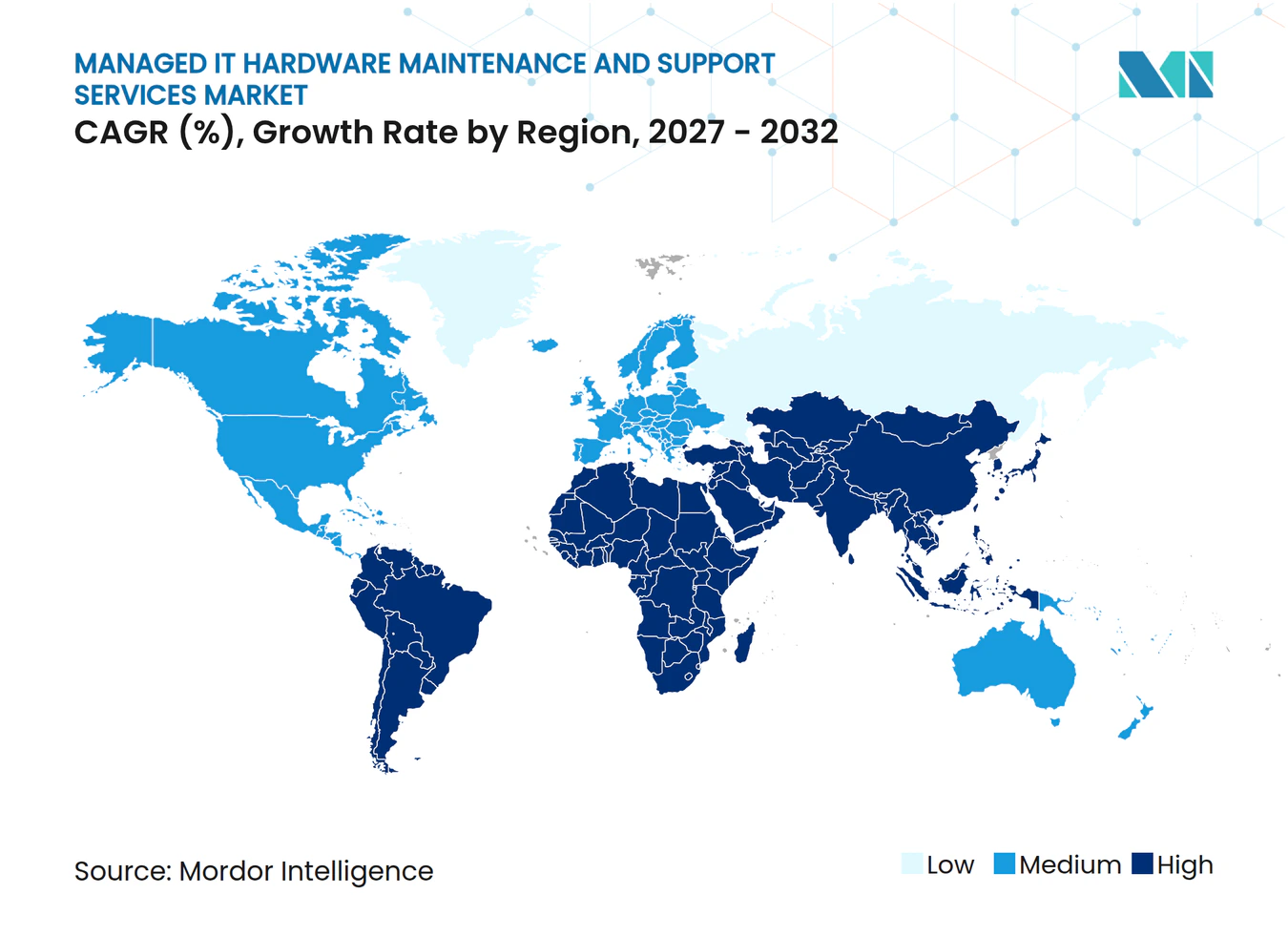
North America held 37.86% of managed IT hardware maintenance and support services market share in 2026. The United States has a large installed base of multi-generational hardware in financial services, healthcare, and government, where assets often operate beyond published manufacturer service dates. The region also contains many specialist third-party maintenance providers, giving buyers access to established independent support networks. Park Place Technologies launched ParkView Asset Intelligence in September 2026, a platform that scores device lifecycle health against 1 million telemetry benchmarks.[3] Canada contributes demand from financial services and energy clients, while Mexico gains relevance as nearshoring supports additional data center investment.
Asia-Pacific is projected to record an 8.56% CAGR through 2032. Enterprise digitalization in India, China, South Korea, and ASEAN countries is increasing the number of deployed systems that require lifecycle planning and field support. India’s data center construction is creating hardware estates that may require maintenance over the forecast period, while China’s sovereign cloud requirements can favor local providers with established delivery capabilities. Transcosmos launched global lifecycle management services with an initial focus on ASEAN in February 2025, reflecting growing attention to organized asset management in the managed IT hardware maintenance and support services market.
Europe remains an active region for managed hardware support because data-handling and service-location requirements influence provider selection. Germany, the United Kingdom, and France accounted for much of the region’s demand in 2026, with Germany supporting hybrid-maintenance specialists that serve industrial clients. In March 2026, the European Central Bank selected DXC Technology Deutschland for infrastructure managed services and end-user computing under an initial 5-year framework delivered from European Economic Area centers. South America, the Middle East, and Africa remain earlier-stage areas, with Brazil, the United Arab Emirates, and South Africa emerging as demand centers as enterprise infrastructure expands.
Competitive Landscape
Market Concentration
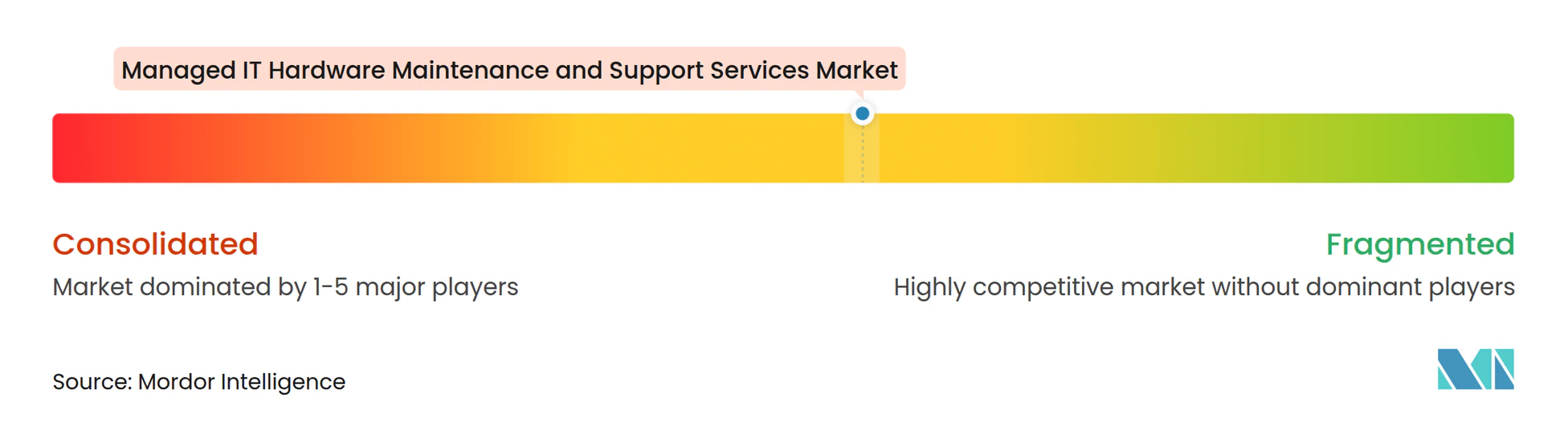
The managed IT hardware maintenance and support services market is moderately fragmented. Globally scaled independent providers compete with regional specialists in multi-vendor engineering expertise, parts availability, field service reach, and monitoring tools. Park Place Technologies completed its merger with Service Express in January 2026. The combined business reported more than 20,000 customers across 4 continents. This transaction shows how geographic coverage and a broader client base can strengthen a maintenance provider’s position.
Park Place Technologies also introduced ParkView Asset Intelligence in September 2026. The company stated that the platform assigns lifecycle health scores using out-of-band telemetry and 1 million historical benchmarks. This shifts competition in the managed IT hardware maintenance and support services market toward lifecycle information and field repair capabilities. Evernex, CXtec, Maintech, Ensure Services, and Brocent Asia compete through local service coverage, post-EOSL support libraries, and multi-vendor expertise. Providers are also extending attention to GPU maintenance and liquid cooling, areas that remain less mature for third-party maintenance than established server and storage support.
Co-managed maintenance is a relevant opportunity for providers to align OEM-authorized and independent services under a single service-level structure. This model serves clients who need manufacturer coverage for certain systems and alternative support for mature equipment, including mid-market accounts not fully served by large OEM channels or by standalone third-party providers. ISO 9001 certification, ITIL alignment, parts traceability, and technician availability influence provider credibility in regulated tenders. The managed IT hardware maintenance and support services market remains open to regional specialists that can deliver reliable response times and local inventory.
Managed IT Hardware Maintenance and Support Services Industry Leaders
-
Park Place Technologies, LLC
-
Evernex SAS
-
CXtec, Inc.
-
Smart 3rd Party Maintenance, Inc.
-
M Global Services, Inc.
- *Disclaimer: Major Players sorted in no particular order
Recent Industry Developments
- October 2026: Park Place Technologies introduced category-exclusive third-party maintenance for Pure Storage Everypure M and X Series FlashArrays, covering hardware break-fix, current-generation parts, and Purity file system support, making it the only third-party provider of this coverage tier for those platforms.
- September 2026: Park Place Technologies launched ParkView Asset Intelligence, an AI platform assigning lifecycle health scores from 0 to 100 to servers, storage, network devices, and hyperconverged infrastructure via out-of-band telemetry. The platform benchmarks each device against approximately 1 million historical assessments and flags about 1 in 50 as high risk, giving IT teams OEM-grade decision intelligence without requiring an active OEM support contract.
- July 2026: Brocent Asia Limited published a practical IT hardware maintenance guide for Hong Kong, mainland China, Singapore, and Malaysia, documenting SLA tiers, OEM versus TPM cost comparisons, and service coverage, formalizing competitive positioning in a region where mid-market demand is accelerating.
- June 2026: Evernex SAS expanded third-party maintenance coverage for post-EOSL Cisco and HPE products, including Cisco ASA 5500 equipment, Nexus 9500 components, and HPE ProLiant ML30 G9 systems, staging parts inventory and engineering expertise around known lifecycle milestones to capture OEM contract expiry pipeline.
Global Managed IT Hardware Maintenance and Support Services Market Report Scope
The Managed IT Hardware Maintenance and Support Services Market comprises outsourced services that provide maintenance, repair, technical support, lifecycle management, monitoring, and operational support for enterprise IT hardware assets, including servers, storage systems, network infrastructure, and endpoint devices. These services are designed to improve hardware reliability, extend asset lifecycles, optimize operational costs, and ensure business continuity across enterprise IT environments.
The Managed IT Hardware Maintenance and Support Services Market Report is Segmented by Service Type (Corrective Maintenance and Hardware Repair, Predictive and Preventive Maintenance, Hardware Lifecycle and Configuration Management, Technical Support and Field Engineering, and Other Service Types), Service Model (OEM Maintenance, Third-Party Maintenance, and Hybrid and Co-Managed Maintenance), Organization Size (Large Enterprises, and Small and Medium Enterprises), End-User Industry (Banking, Financial Services, and Insurance [BFSI], Government and Public Administration, Healthcare and Life Sciences, IT and Telecommunication, Industrial Manufacturing, Retail and E-commerce, Education and Research Institutions, and Other End-User Industries), and Geography (North America, South America, Europe, Asia-Pacific, Middle East, and Africa). The Market Forecasts are Provided in Terms of Value (USD).
| Corrective Maintenance and Hardware Repair |
| Predictive and Preventive Maintenance |
| Hardware Lifecycle and Configuration Management |
| Technical Support and Field Engineering |
| Other Service Types |
| OEM Maintenance |
| Third-Party Maintenance |
| Hybrid and Co-Managed Maintenance |
| Large Enterprises |
| Small and Medium Enterprises |
| Banking, Financial Services, and Insurance (BFSI) |
| Government and Public Administration |
| Healthcare and Life Sciences |
| IT and Telecommunication |
| Industrial Manufacturing |
| Retail and E-commerce |
| Education and Research Institutions |
| Other End-User Industries |
| North America | United States |
| Canada | |
| Mexico | |
| South America | Brazil |
| Argentina | |
| Rest of South America | |
| Europe | Germany |
| United Kingdom | |
| France | |
| Italy | |
| Russia | |
| Rest of Europe | |
| Asia-Pacific | China |
| Japan | |
| India | |
| South Korea | |
| Rest of Asia-Pacific | |
| Middle East | Saudi Arabia |
| United Arab Emirates | |
| Rest of Middle East | |
| Africa | South Africa |
| Nigeria | |
| Rest of Africa |
| By Service Type | Corrective Maintenance and Hardware Repair | |
| Predictive and Preventive Maintenance | ||
| Hardware Lifecycle and Configuration Management | ||
| Technical Support and Field Engineering | ||
| Other Service Types | ||
| By Service Model | OEM Maintenance | |
| Third-Party Maintenance | ||
| Hybrid and Co-Managed Maintenance | ||
| By Organization Size | Large Enterprises | |
| Small and Medium Enterprises | ||
| By End-User Industry | Banking, Financial Services, and Insurance (BFSI) | |
| Government and Public Administration | ||
| Healthcare and Life Sciences | ||
| IT and Telecommunication | ||
| Industrial Manufacturing | ||
| Retail and E-commerce | ||
| Education and Research Institutions | ||
| Other End-User Industries | ||
| By Geography | North America | United States |
| Canada | ||
| Mexico | ||
| South America | Brazil | |
| Argentina | ||
| Rest of South America | ||
| Europe | Germany | |
| United Kingdom | ||
| France | ||
| Italy | ||
| Russia | ||
| Rest of Europe | ||
| Asia-Pacific | China | |
| Japan | ||
| India | ||
| South Korea | ||
| Rest of Asia-Pacific | ||
| Middle East | Saudi Arabia | |
| United Arab Emirates | ||
| Rest of Middle East | ||
| Africa | South Africa | |
| Nigeria | ||
| Rest of Africa | ||
Key Questions Answered in the Report
What is the managed IT hardware maintenance and support services market size?
The managed IT hardware maintenance and support services market is projected to move from USD 15.47 billion in 2026 and USD 16.60 billion in 2027 to USD 23.89 billion by 2032, at a 7.55% CAGR from 2027 to 2032.
Which service type has the largest revenue position?
Corrective maintenance and hardware repair accounted for 45.29% of revenue in 2026 because enterprises continue to need break-fix support for mixed hardware estates. It is relevant where mature systems remain central to everyday processing and connectivity.
Why are enterprises adopting third-party maintenance?
Third-party maintenance can support post-EOSL equipment, give clients more control over refresh timing, and offer a practical alternative for mature assets. It can also provide access to specialist field skills without expanding internal teams.
Which customer group is expanding fastest?
Small and medium enterprises are expected to record a 9.59% CAGR through 2032 as tiered service-level agreements and per-device pricing improve access to managed support. These arrangements can make multi-vendor service easier to procure for smaller estates.
Which end-user sector is expected to expand fastest?
Healthcare and life sciences is projected to expand at an 8.21% CAGR through 2032 as connected clinical device fleets increase maintenance and governance needs. Providers must support the equipment records and service documentation required in regulated settings.
Which region is expected to expand fastest?
Asia-Pacific is forecast to record an 8.56% CAGR through 2032, supported by enterprise digitalization and expanding data center infrastructure. Lifecycle management needs increase as these estates spread across more locations and hardware categories.