
Managed Network Hardware Maintenance Services Market Size and Share
Market Overview
| Study Period | 2021 - 2032 |
|---|---|
| Market Size (2027) | USD 18.14 Billion |
| Market Size (2032) | USD 25.93 Billion |
| Growth Rate (2027 - 2032) | 7.41 % |
| Fastest Growing Market | Asia-Pacific |
| Largest Market | North America |
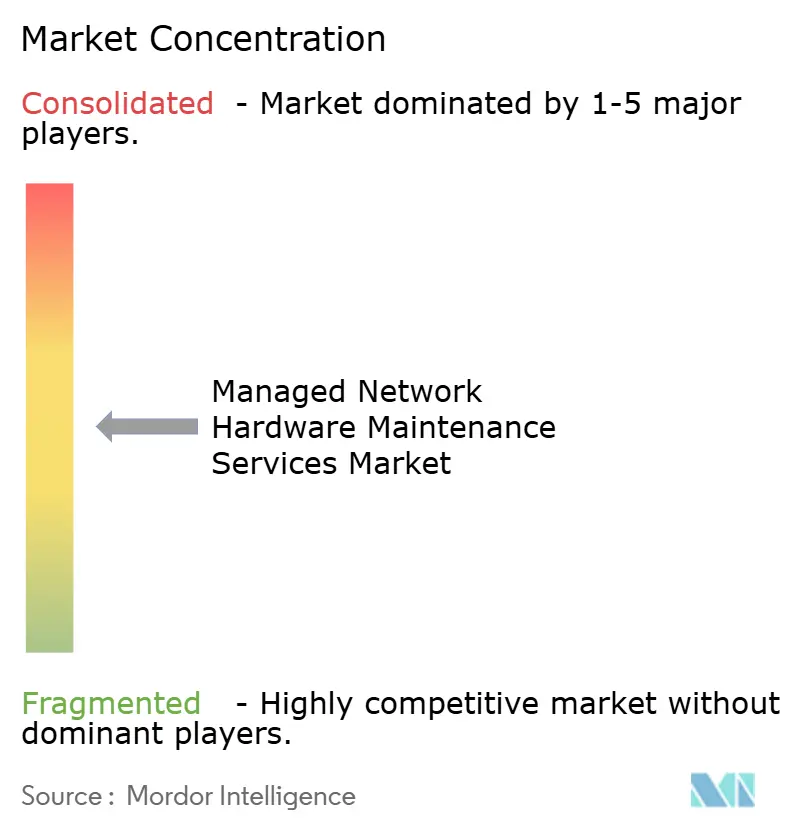
| Market Concentration | Medium |
Major Players *Disclaimer: Major Players sorted in no particular order Image © Mordor Intelligence. Reuse requires attribution under CC BY 4.0. | |
Managed Network Hardware Maintenance Services Market Analysis by Mordor Intelligence
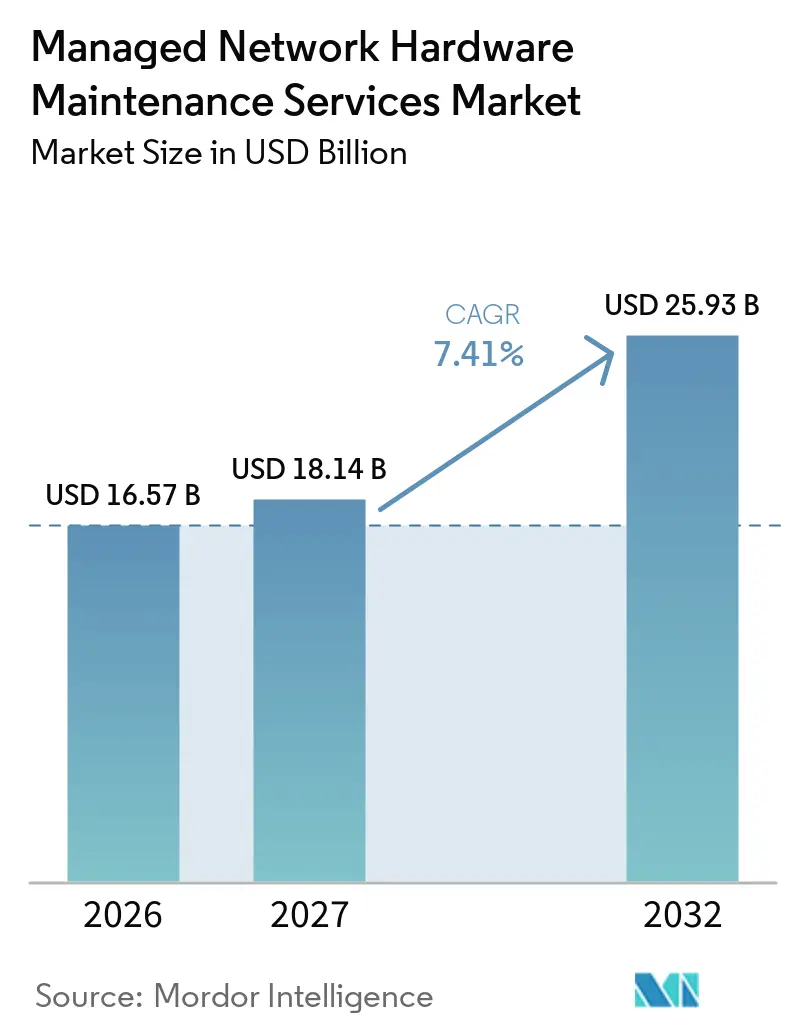
The Managed Network Hardware Maintenance Services Market size is projected to expand from USD 16.57 billion in 2026 and USD 18.14 billion in 2027 to USD 25.93 billion by 2032, registering a CAGR of 7.41% between 2027 and 2032. The managed network hardware maintenance services market is changing as enterprises replace fixed OEM renewal cycles with service agreements that cover equipment from several vendors. The managed network hardware maintenance services market also reflects a wider change in IT spending, where organizations separate essential software access from support for reliable physical equipment. Cloud, edge, and hybrid systems increase the number of devices that must be supported and make a single-vendor model less practical. Organizations are also seeking lower operating costs while they retain usable hardware for longer periods. AI infrastructure refreshes add new hardware while older network fleets remain essential to daily operations. Providers that combine multi-vendor support, predictive monitoring, sound spare-parts planning, and clear service-level agreements have a wider opportunity to address this need.
Key Report Takeaways
- By service model, OEM Maintenance held 56.73% of managed network hardware maintenance services market revenue share in 2026, while Third-Party Maintenance is projected to expand at a 10.23% CAGR through 2032.
- By service type, Break-Fix and Hardware Replacement Services accounted for 41.57% of the managed network hardware maintenance services market size in 2026, while Proactive Monitoring, Predictive, and Preventive Maintenance is projected to expand at a 9.79% CAGR through 2032.
- By organization size, Large Enterprises held 69.76% of managed network hardware maintenance services market revenue in 2026, while Small and Medium Enterprises are projected to expand at a 10.43% CAGR through 2032.
- By end-user industry, IT and Telecommunications accounted for 32.17% of revenue in 2026, while Healthcare and Life Sciences are projected to expand at a 9.29% CAGR through 2032.
- By geography, North America held 35.43% of managed network hardware maintenance services market revenue in 2026, while Asia-Pacific is projected to expand at a 10.71% CAGR through 2032.
Note: Market numbers in this report are based on Mordor Intelligence's proprietary estimation framework, which combines nine months of actuals with Q4 projections for base year 2026.
Market Trends and Insights
Drivers Impact Analysis of Managed Network Hardware Maintenance Services Market*
| Driver | (~) % Impact on CAGR Forecast | Geographic Relevance | Impact Timeline |
|---|---|---|---|
| Multi-Vendor Network Complexity and Outsourcing Demand | +2.5% | Global, concentrated in North America and Europe | Medium term (≤ 2 years) |
| Cloud, Edge, and Hybrid IT Infrastructure Expansion | +2.0% | Global, with Asia-Pacific core and spill-over to Middle East and Africa | Long term (≥ 4 years) |
| Cost Optimization Through Lifecycle Extension | +1.8% | Global, strongest in North America and Europe | Short term (≤ 2 years) |
| Growing Installed Base of EOL and EOSL Network Hardware | +1.5% | Global, concentrated in North America and Europe | Short term (≤ 2 years) |
| AI-Workload Refresh Cycles Creating Coexisting Legacy Fleets | +0.9% | North America and Asia-Pacific core | Medium term (2-4 years) |
| Telemetry-Led Spare-Parts Planning for Aging Network Assets | +0.6% | Global, early gains in North America | Long term (≥ 4 years) |
| Source: Mordor Intelligence | |||
Multi-Vendor Network Complexity Driving Outsourcing at Scale
The managed network hardware maintenance services market benefits from more complex networks that combine SD-WAN, campus wireless, and data center switching across several vendors. These systems require support staff who can diagnose issues across different hardware and software environments. Cisco reported that 97% of surveyed organizations considered a modernized network critical to AI, IoT, and cloud deployments, which indicates why network support requirements are broadening. A maintenance provider can reduce the number of contracts, contacts, and escalation paths that an enterprise must manage. This is valuable for organizations with geographically distributed sites and equipment from different OEM generations. The service proposition, therefore, extends beyond repair activity to coordinated risk management and operational continuity.
Cloud, Edge, and Hybrid IT Infrastructure Expansion
Cloud, edge, and hybrid deployments expand the installed base that requires support in the managed network hardware maintenance services market. Cisco found that 71% of surveyed organizations said their data centers could not scale AI workloads, while 88% planned to increase capacity for those workloads. New AI equipment is often deployed alongside older campus, branch, and data center networks that still carry business traffic. This creates an environment in which maintenance teams must support both newer equipment and long-serving systems. Edge sites can be especially difficult because they may not have resident IT staff. Contracts that combine remote monitoring, on-site response, and spare-parts availability can address this operational gap.
Cost Optimization Through Lifecycle Extension
Cost control supports demand in the managed network hardware maintenance services market because enterprises can retain reliable equipment after OEM support ends. Park Place Technologies states that third-party network maintenance can provide an alternative to OEM support for multivendor network environments.[1] This approach can shift the purchasing decision from a fixed replacement date toward an assessment of hardware condition, operational risk, and required software access. It can be relevant for organizations that need to preserve capital for cloud, security, or AI investments. The approach also requires disciplined inventory planning and verified replacement parts. Providers that can show clear response commitments and a documented component supply process are better placed to win cost-conscious contracts.
Growing Installed Base of EOL and EOSL Network Hardware
End-of-life and end-of-service-life milestones create a direct need for maintenance coverage when enterprises delay equipment replacement. Evernex expanded support in June 2026 for several Cisco and HPE references after their OEM support periods, including Cisco ASA 5500 equipment, Cisco RV Series routers, Cisco Nexus 9500 components, and HPE ProLiant ML30 G9 systems. Such announcements show that service providers prepare capacity around known lifecycle events. Enterprises with stable equipment can use this support to avoid a forced refresh when the hardware remains fit for purpose. The decision remains more difficult where firmware, patches, or feature licenses are tied to an OEM agreement. Demand is therefore strongest where the operating value of the equipment exceeds the benefit of immediate replacement.
Restraints Impact Analysis of Managed Network Hardware Maintenance Services Market*
| Restraint | (~) % Impact on CAGR Forecast | Geographic Relevance | Impact Timeline |
|---|---|---|---|
| OEM Software, Licensing, and Warranty Lock-In | -1.0% | Global, strongest in North America and Europe | Medium term (2-4 years) |
| Shortage of Multi-Vendor Network Engineering Talent | -0.7% | Global, most acute in North America and Asia-Pacific | Long term (≥ 4 years) |
| Counterfeit and Traceability Risk in Replacement Parts | -0.4% | Global, concentrated in Asia-Pacific and Middle East and Africa procurement channels | Medium term (2-4 years) |
| Remote-Site Logistics and SLA Economics | -0.3% | Asia-Pacific and Africa, spill-over to Middle East and Africa | Long term (≥ 4 years) |
| Source: Mordor Intelligence | |||
OEM Software, Licensing, and Warranty Lock-In
OEM licensing practices restrain the managed network hardware maintenance services market because some functions remain available only under vendor-authorized support. Security patches, advanced telemetry, SD-WAN policy management, and other software-defined capabilities may depend on active OEM coverage. This limits the range of devices on which third-party providers can offer a complete service. The limitation is most significant for newer systems that have active software dependencies. It creates a two-part support environment where third-party maintenance is more suitable for stable hardware, while OEM contracts remain necessary for equipment that needs continuing vendor software access. Hybrid agreements can reduce this constraint by separating the equipment that requires OEM coverage from equipment that does not.
Shortage of Multi-Vendor Network Engineering Talent
A shortage of engineers with multi-vendor skills can limit field capacity and response quality for maintenance providers. Support work requires knowledge of legacy routing and switching protocols as well as current automation, cloud-management, and observability tools. The problem can be more severe when incidents require on-site work in several locations. Providers may face higher hiring costs and longer restoration times if experienced staff are unavailable. Smaller providers can be more exposed because they cannot spread specialist labor costs across a large customer base. This constraint also strengthens the case for remote diagnostics and standardized processes, but it does not remove the need for qualified field engineers.
*Our forecasts treat driver/restraint impacts as directional, not additive. The impact forecasts reflect baseline growth, mix effects, and variable interactions.
Managed Network Hardware Maintenance Services Market Segment Analysis
By Service Model:
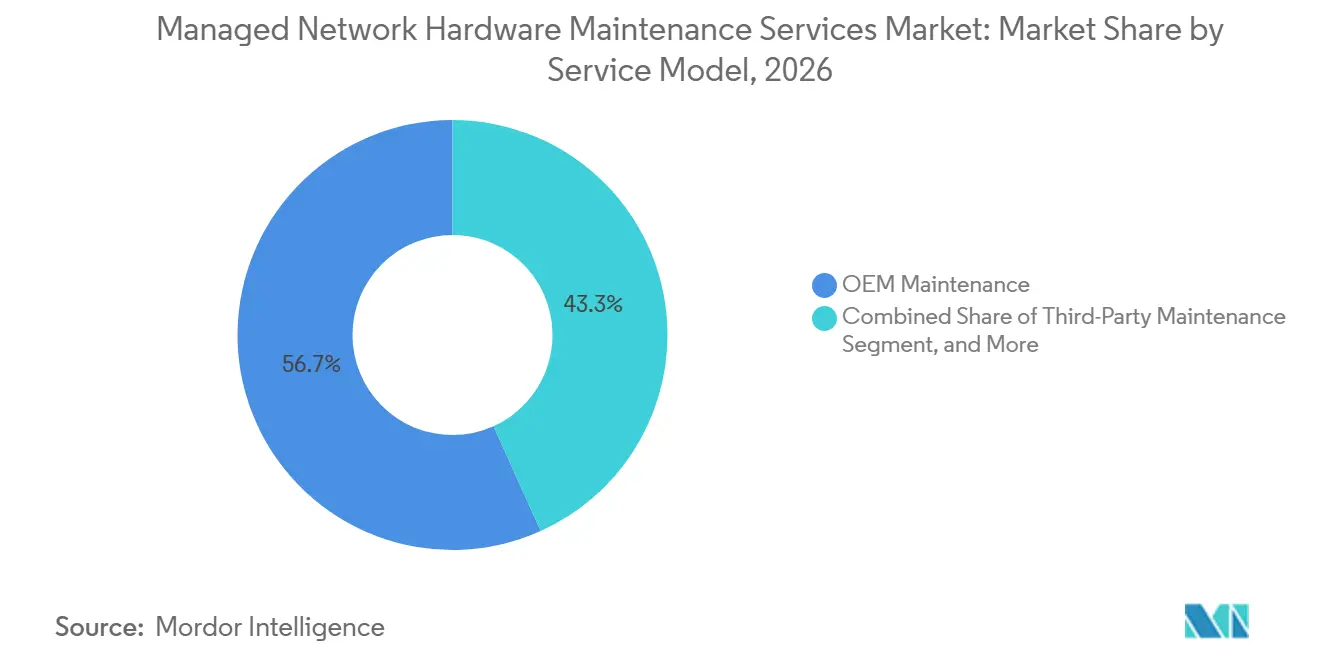
OEM Leadership Continues Alongside Third-Party AdoptionOEM Maintenance held 56.73% of the revenue share in 2026. Enterprises often retain OEM agreements for systems that remain in an active product lifecycle. This is common where firmware updates, security patches, and software licenses are included in the service agreement. Regulated organizations in banking, financial services, insurance, and healthcare may prioritize clear vendor accountability for critical routing and switching infrastructure. The OEM model offers a defined escalation route when a device failure is linked to proprietary software or hardware functions.
Third-Party Maintenance is projected to expand at a 10.23% CAGR through 2032. The managed network hardware maintenance services market size for this model is supported by post-EOSL hardware that remains operationally useful. Organizations can use third-party coverage for stable equipment while retaining OEM support only where software dependencies require it. Hybrid and co-managed arrangements allow procurement teams to make that distinction at the asset level. Evernex’s 2026 additions to its coverage portfolio show how providers align their support offers with approaching lifecycle milestones. This structure can balance compliance requirements, uptime needs, and operating-cost discipline.

By Service Type:
Break-Fix Remains Central as Proactive Support ExpandsBreak-Fix and Hardware Replacement Services accounted for 41.57% of revenue share in 2026. Physical replacement remains necessary for widely distributed networks and for sites that need an engineer to restore service quickly. The segment reflects the historical foundation of network maintenance contracts. It also remains important for remote sites where equipment failures can disrupt operations for long periods. Customers commonly use response-time commitments and spare-parts availability to assess these services.
Proactive Monitoring, Predictive and Preventive Maintenance is projected to expand at a 9.79% CAGR through 2032. Telemetry-capable equipment can provide health and event information through network management data. Providers can use this information to identify failure patterns and plan parts before a critical incident occurs. IEEE research has examined approaches that jointly optimize predictive maintenance scheduling and spare-parts decisions.[2] These services can reduce dependence on reactive work, although they require credible data handling and established operating procedures. Lifecycle, firmware, and configuration management can also be valuable where customers need consistent governance across several vendor environments.
By Organization Size:
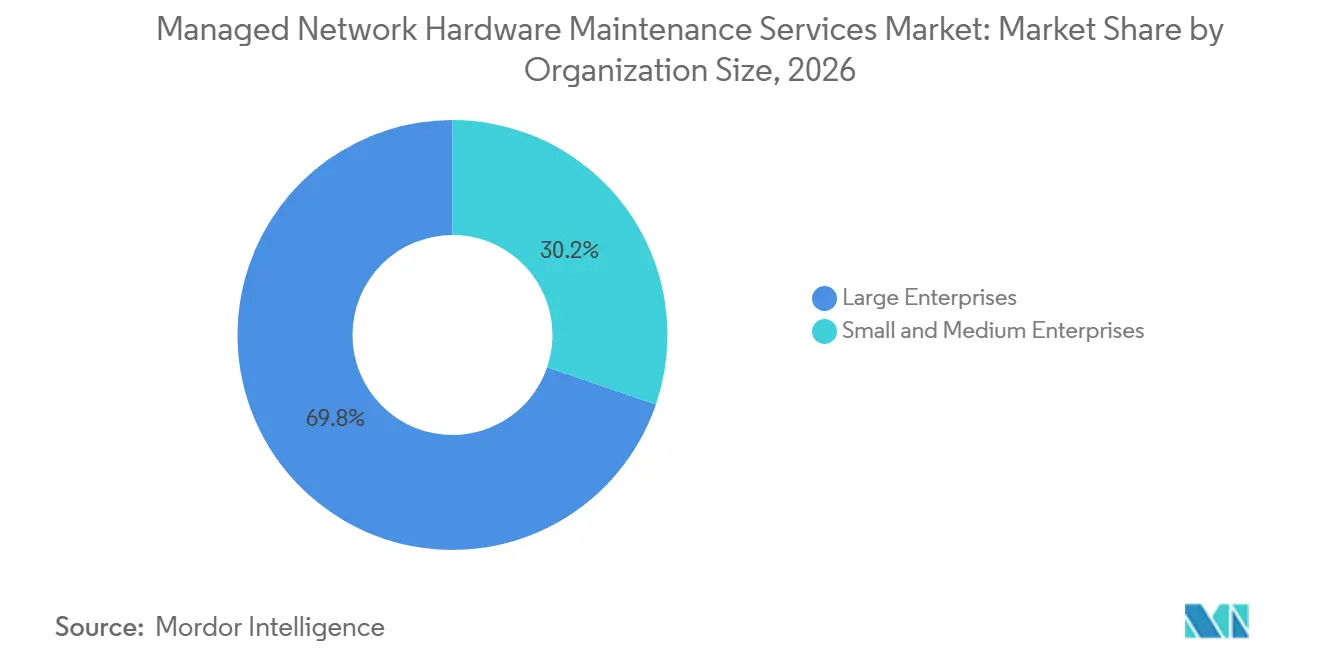
Large Enterprises Lead While SMEs Expand FasterLarge Enterprises held 69.76% of revenue in 2026. These organizations often operate complex network estates across offices, data centers, branches, and industrial locations. They may manage several service-level agreements across different vendors and equipment generations. Established vendor-selection processes have historically favored OEM support as a risk-management measure. Their scale also creates a large installed base that requires inventory planning, reporting, and defined escalation paths.
Small and Medium Enterprises are projected to expand at a 10.43% CAGR through 2032. The managed network hardware maintenance services market provides these organizations access to specialized support without building a large internal engineering function. Cloud adoption and remote-work arrangements have made smaller network environments more distributed and difficult to manage. Scalable contract designs can bring third-party maintenance within sub-enterprise budgets. The service can include response support, configuration oversight, and lifecycle planning. This makes the contract a practical way to secure skills that the organization may not employ internally.
By End-User Industry:
IT and Telecommunications Lead While Healthcare AdvancesIT and Telecommunications held 32.17% of revenue in 2026. The sector relies on dense networks of switching, routing, and wireless systems to provide services continuously. Telecom operators face maintenance needs as newer 5G transport equipment moves through warranty cycles while older core assets approach EOSL dates. Downtime can have direct service and customer consequences. This keeps response commitments and multi-level escalation paths important within the managed network hardware maintenance services market.
North America has a large concentration of enterprise data centers and established procurement practices for third-party maintenance. Healthcare, financial services, and defense organizations often require strict uptime and auditability standards. The United States provides most regional demand because it has broad deployments of Cisco, Juniper, and HPE networking equipment. Canada adds demand through public-sector managed services programs, while Mexico offers an emerging opportunity tied to manufacturing and logistics networks.
Geography Analysis
North America Managed Network Hardware Maintenance Services Market
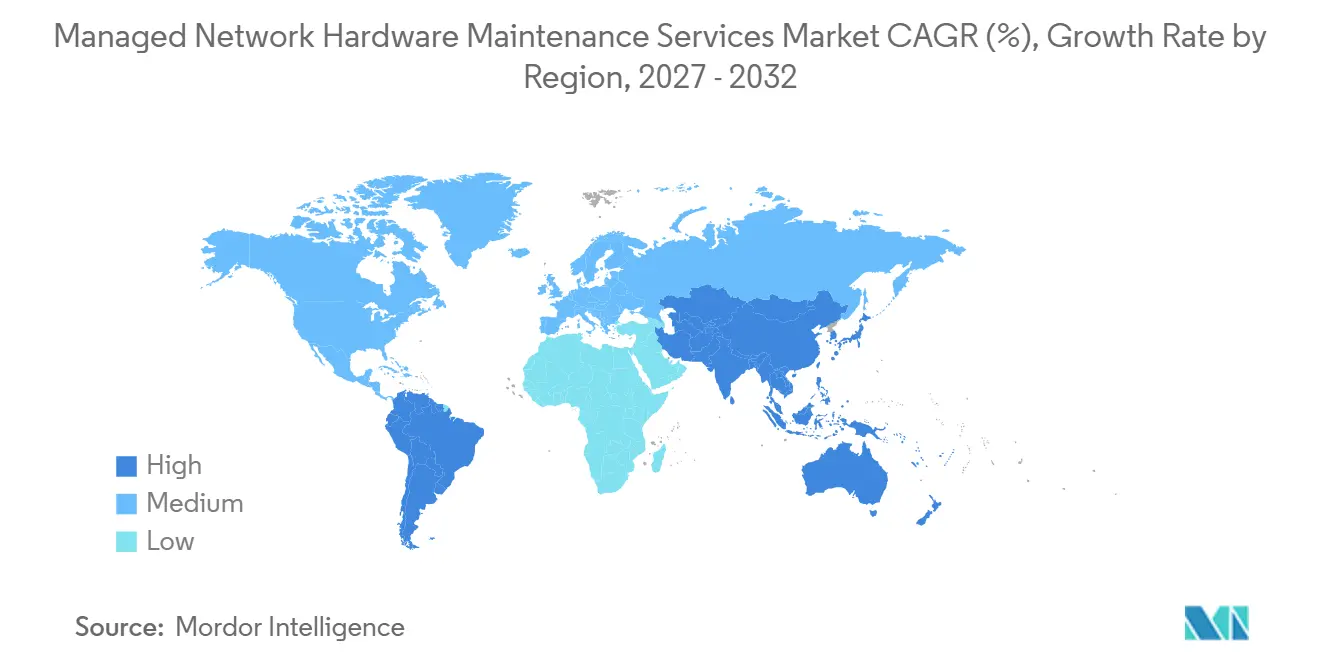
North America held 35.43% of the revenue share in 2026. The region has a large concentration of enterprise data centers and established procurement practices for third-party maintenance. Healthcare, financial services, and defense organizations often require strict uptime and auditability standards. The United States provides most regional demand because it has broad deployments of Cisco, Juniper, and HPE networking equipment. Canada adds demand through public-sector managed services programs, while Mexico offers an emerging opportunity tied to manufacturing and logistics networks.
APAC Managed Network Hardware Maintenance Services Market
Asia-Pacific is projected to expand at a 10.71% CAGR through 2032. The managed network hardware maintenance services market size in the region is supported by digital infrastructure investment in China and India and by data center activity in Singapore, Japan, and South Korea. Enterprises are becoming more aware of the operational value of lifecycle extension as network estates become larger. India’s digital programs are expanding government and enterprise hardware deployments that will eventually move beyond warranty coverage. Singapore’s technology-risk guidance and India’s Digital Personal Data Protection Act 2023 also strengthen the need for governed infrastructure management.
EMEA and South America Managed Network Hardware Maintenance Services Market
Europe holds a significant revenue position, supported by Germany, the United Kingdom, and France. Dense enterprise network estates, GDPR obligations, and sustainability priorities encourage organized lifecycle services. The International Telecommunication Union’s L.1071 recommendation supports lifecycle tracking for digital equipment and aligns with interest in longer hardware use.[3] South America, the Middle East, and Africa remain lower-penetration regions with developing demand. Brazil and the United Arab Emirates benefit from financial services, agribusiness, and data center activity, while South Africa, Egypt, and Nigeria show emerging demand from telecommunications providers and financial institutions. Remote-site logistics remain a practical limitation in parts of Africa because they affect service costs and response commitments.
Competitive Landscape
The managed network hardware maintenance services market is moderately fragmented. Park Place Technologies, Evernex, and Curvature have established positions in third-party maintenance and hybrid support arrangements. Cisco Systems, Dell Technologies, Hewlett-Packard Enterprise, and IBM retain strong positions in OEM Maintenance through integrated hardware, software, and service agreements. This creates different competitive positions based on the customer’s need for software access, field coverage, and multivendor support. Suppliers compete on response time, coverage of older equipment, spare parts availability, and the ability to manage several vendors under a single contract.
Consolidation has increased the scale available to independent providers. Park Place Technologies completed its merger with Service Express in January 2026, creating a combined company with more than 3,000 employees and 25,000 customers across North America, Europe, Asia, and South America. The company also expanded its multi-cloud services through the May 2025 acquisition of CSI, adding support capabilities for hybrid multi-cloud and IBM legacy systems. Evernex broadened its portfolio around known Cisco and HPE EOSL events, allowing it to approach customers before OEM support ended. These actions show that geographic coverage, engineering capacity, and lifecycle timing are core competitive tools.
Telemetry-led maintenance platforms are another area of competition. Park Place Technologies uses ParkView Automated Support to identify hardware events and initiate support activity, which can improve incident handling for covered equipment. Providers also seek to differentiate through health scoring, firmware governance, and multi-vendor inventory management. AI-era infrastructure creates demand for support that covers older front-end network systems alongside newer AI fabrics. Quality management and traceability practices matter in government and financial-services tenders where replacement-part control is closely examined. Software licensing remains an advantage for OEM-aligned providers on newer hardware. Independent providers are strongest where hardware is stable, asset life can be extended, and customers need support across several vendors.
Managed Network Hardware Maintenance Services Industry Leaders
-
Park Place Technologies
-
Service Express, Inc.
-
Cisco Systems, Inc.
-
DataSpan, Inc.
-
Evernex
- *Disclaimer: Major Players sorted in no particular order
Managed Network Hardware Maintenance Services Market Companies Covered in this Report
- Park Place Technologies
- Evernex
- Service Express, Inc.
- Curvature, LLC
- Maintech, Inc.
- Capgemini SE
- Cisco Systems, Inc.
- DataSpan, Inc.
- Dell Technologies Inc.
- Fujitsu Limited
- HCL Technologies Limited
- Hewlett Packard Enterprise Company
- Hitachi, Ltd.
- Huawei Technologies Co., Ltd.
- International Business Machines Corporation
- Kyndryl, Inc.
- Lenovo Group Limited
- Nokia Corporation
- NTT Communications Corporation
- Schneider Electric SE
- Siemens AG
- Sify Technologies Limited
Recent Industry Developments in Managed Network Hardware Maintenance Services Market
- October 2026: Evernex announced third-party maintenance coverage for Cisco Nexus 7000 Series switches ahead of their EOSL date of February 28, 2027, enabling enterprises to extend lifecycle management of Nexus 7000 hardware beyond OEM support termination. This development positions Evernex to capture a significant cohort of enterprise customers facing forced refresh decisions on proven Nexus 7000 deployments.
- June 2026: Evernex expanded its TPM portfolio to cover Cisco ASA 5500 Security Appliances, Cisco RV Series routers, Cisco Nexus 9500 linecards and fabric modules, and HPE ProLiant ML30 G9, providing enterprises with a post-OEM support alternative ahead of EOSL milestones.
- January 2026: Park Place Technologies completed its merger with Service Express, creating a global data center services company with 3,000+ employees and 25,000+ customers across North America, Europe, Asia, and South America. The combined entity expanded capabilities across GPU maintenance, liquid cooling, and managed infrastructure services.
- May 2025: Park Place Technologies acquired CSI Ltd., a United Kingdom-based IT managed services provider specializing in hybrid multi-cloud solutions for legacy IBM systems. The acquisition expanded Park Place’s European footprint and added IBM legacy infrastructure management capability.
Global Managed Network Hardware Maintenance Services Market Report Scope
A managed network hardware maintenance service refers to a long-term, subscription-based agreement that delegates the surveillance, optimization, upkeep, and repair of physical network architecture to a specialized third-party provider like a Managed Service Provider (MSP) or Managed Network Service Provider (MNSP).
The Managed Network Hardware Maintenance Services Market Report is Segmented by Service Model (OEM Maintenance, Third-Party Maintenance, and Hybrid / Co-Managed Maintenance), Service Types (Break-Fix & Hardware Replacement Services, Proactive Monitoring, Predictive & Preventive Maintenance, Lifecycle, Firmware, & Configuration Management, and Other Service Types), Organization Size (Large Enterprises and Small and Medium Enterprises), End-User Industry (IT and Telecommunications, Banking, Financial Services, & Insurance [BFSI], Healthcare and Life Sciences, Government and Public Sector, Manufacturing and Industrial, Retail and E-commerce, and Other End-User Industries), and Geography (North America, South America, Europe, Asia-Pacific, Middle East, and Africa). The Market Forecasts are Provided in Terms of Value (USD).
Segmentation Overview
| OEM Maintenance |
| Third-Party Maintenance |
| Hybrid / Co-Managed Maintenance |
| Break-Fix & Hardware Replacement Services |
| Proactive Monitoring, Predictive & Preventive Maintenance |
| Lifecycle, Firmware, & Configuration Management |
| Other Service Types |
| Large Enterprises |
| Small and Medium Enterprises |
| IT and Telecommunications |
| Banking, Financial Services, & Insurance (BFSI) |
| Healthcare and Life Sciences |
| Government and Public Sector |
| Manufacturing and Industrial |
| Retail and E-commerce |
| Other End-User Industries |
| North America | United States |
| Canada | |
| Mexico | |
| Rest of North America | |
| South America | Brazil |
| Argentina | |
| Rest of South America | |
| Europe | Germany |
| United Kingdom | |
| France | |
| Italy | |
| Spain | |
| Rest of Europe | |
| Asia-Pacific | China |
| India | |
| Japan | |
| South Korea | |
| Rest of Asia-Pacific | |
| Middle East | Saudi Arabia |
| United Arab Emirates | |
| Turkey | |
| Rest of Middle East | |
| Africa | South Africa |
| Egypt | |
| Nigeria | |
| Rest of Africa |
| By Service Model | OEM Maintenance | |
| Third-Party Maintenance | ||
| Hybrid / Co-Managed Maintenance | ||
| By Service Type | Break-Fix & Hardware Replacement Services | |
| Proactive Monitoring, Predictive & Preventive Maintenance | ||
| Lifecycle, Firmware, & Configuration Management | ||
| Other Service Types | ||
| By Organization Size | Large Enterprises | |
| Small and Medium Enterprises | ||
| By End-User Industry | IT and Telecommunications | |
| Banking, Financial Services, & Insurance (BFSI) | ||
| Healthcare and Life Sciences | ||
| Government and Public Sector | ||
| Manufacturing and Industrial | ||
| Retail and E-commerce | ||
| Other End-User Industries | ||
| By Geography | North America | United States |
| Canada | ||
| Mexico | ||
| Rest of North America | ||
| South America | Brazil | |
| Argentina | ||
| Rest of South America | ||
| Europe | Germany | |
| United Kingdom | ||
| France | ||
| Italy | ||
| Spain | ||
| Rest of Europe | ||
| Asia-Pacific | China | |
| India | ||
| Japan | ||
| South Korea | ||
| Rest of Asia-Pacific | ||
| Middle East | Saudi Arabia | |
| United Arab Emirates | ||
| Turkey | ||
| Rest of Middle East | ||
| Africa | South Africa | |
| Egypt | ||
| Nigeria | ||
| Rest of Africa | ||
Key Questions Answered in the Report
What is the size of the managed network hardware maintenance services market?
The managed network hardware maintenance services market is projected to expand from USD 16.57 billion in 2026 and USD 18.14 billion in 2027 to USD 25.93 billion by 2032, at a 7.41% CAGR.
Why are enterprises using third-party network hardware maintenance?
Enterprises use third-party network hardware maintenance to retain dependable post-EOSL equipment, coordinate multi-vendor environments, and control operating costs without weakening uptime commitments.
Which service model leads managed network hardware maintenance services?
OEM Maintenance led with 56.73% revenue share in 2026, while Third-Party Maintenance is projected to expand at a 10.23% CAGR through 2032. OEM support remains important for systems that depend on vendor-controlled software access, firmware releases, or security patches.
Which service type is expanding fastest in network hardware support?
Proactive Monitoring, Predictive and Preventive Maintenance is projected to expand at a 9.79% CAGR through 2032 as telemetry use increases.
Which end-user sector is expected to expand fastest?
Healthcare and Life Sciences is projected to expand at a 9.29% CAGR through 2032, supported by connected clinical systems and strict network continuity requirements.
Which region is expected to expand fastest?
Asia-Pacific is projected to expand at a 10.71% CAGR through 2032, supported by digital infrastructure investments and expanding data center activity.