
Managed Secure Web Gateway Services Market Size and Share
Market Overview
| Study Period | 2021 - 2032 |
|---|---|
| Market Size (2027) | USD 3.97 Billion |
| Market Size (2032) | USD 7.48 Billion |
| Growth Rate (2027 - 2032) | 13.51 % |
| Fastest Growing Market | Asia-Pacific |
| Largest Market | North America |
| Market Concentration | Medium |
Major Players *Disclaimer: Major Players sorted in no particular order Image © Mordor Intelligence. Reuse requires attribution under CC BY 4.0. | |
Managed Secure Web Gateway Services Market Analysis by Mordor Intelligence
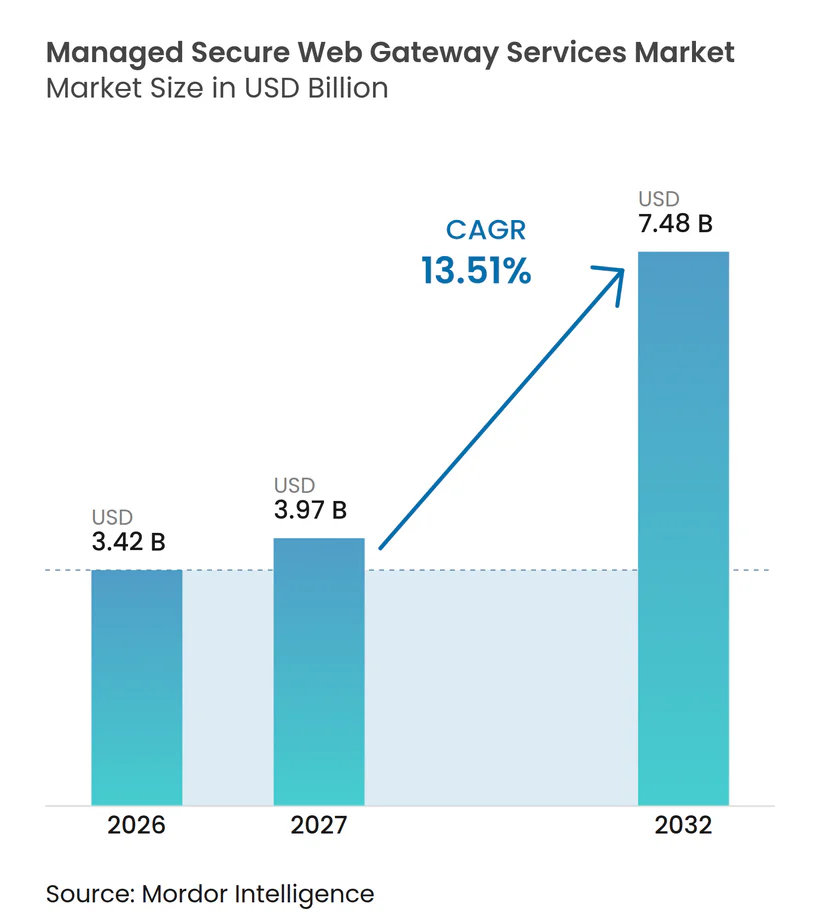
The managed secure web gateway services market size is projected to expand from USD 3.42 billion in 2026 and USD 3.97 billion in 2027 to USD 7.48 billion by 2032, registering a CAGR of 13.51% between 2027 to 2032. Web-based threats and the spread of cloud applications have moved web security from a point product toward a continuously managed service. Buyers increasingly seek providers that can operate gateways, refine policies, and respond to threats without adding work for internal teams. Cloud-delivered security service edge platforms have also shortened the path from detection to response, which supports the managed secure web gateway services market. The value of a provider now depends on practical policy execution, inspection performance, and integration with broader security controls. The managed secure web gateway services market also faces constraints from legacy infrastructure, privacy rules, and policies that are difficult to move between vendors.
Key Report Takeaways
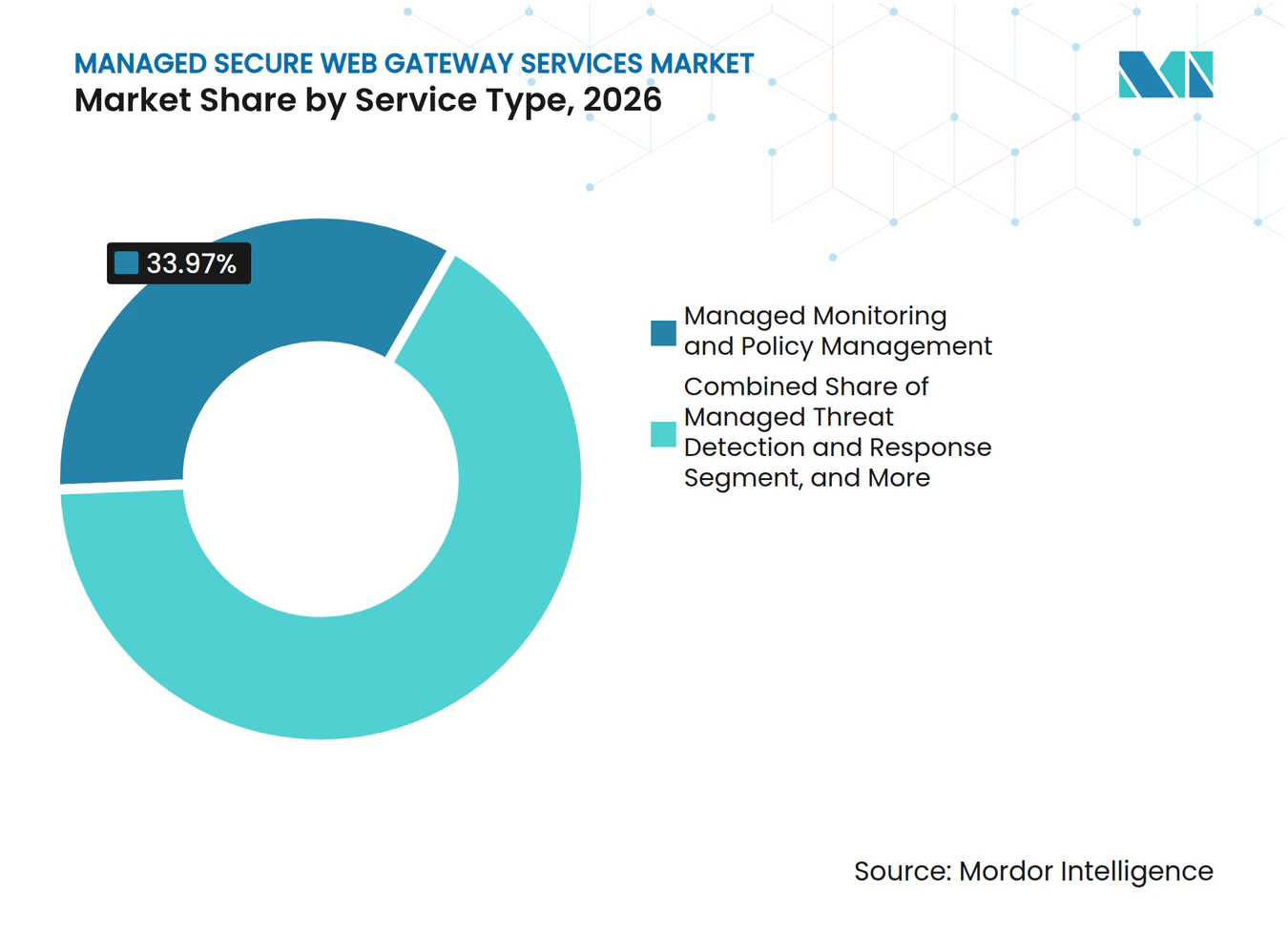
- By service type, managed monitoring and policy management held 33.97% of the managed secure web gateway services market share in 2026, while managed threat detection and response is projected to expand at a 15.31% CAGR through 2032.
- By deployment mode, cloud-based delivery accounted for 64.89% of revenue in 2026 and is projected to expand at a 15.47% CAGR through 2032.
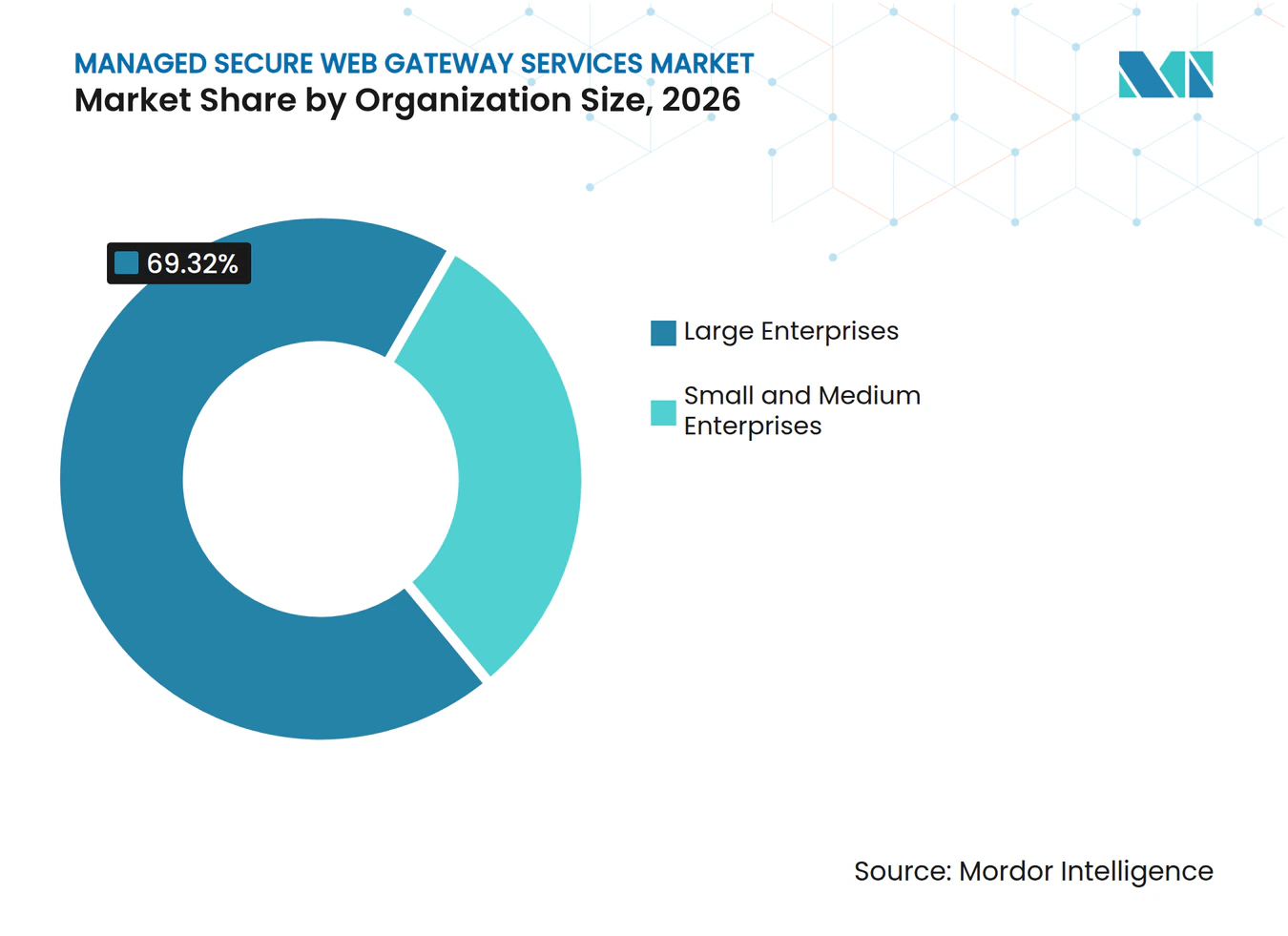
- By organization size, large enterprises accounted for 69.32% of the managed secure web gateway services market share in 2026, while small and medium enterprises are projected to expand at a 15.78% CAGR through 2032.
- By end-user vertical, BFSI held 28.17% of revenue in 2026, while healthcare and life sciences are projected to expand at a 16.17% CAGR through 2032.
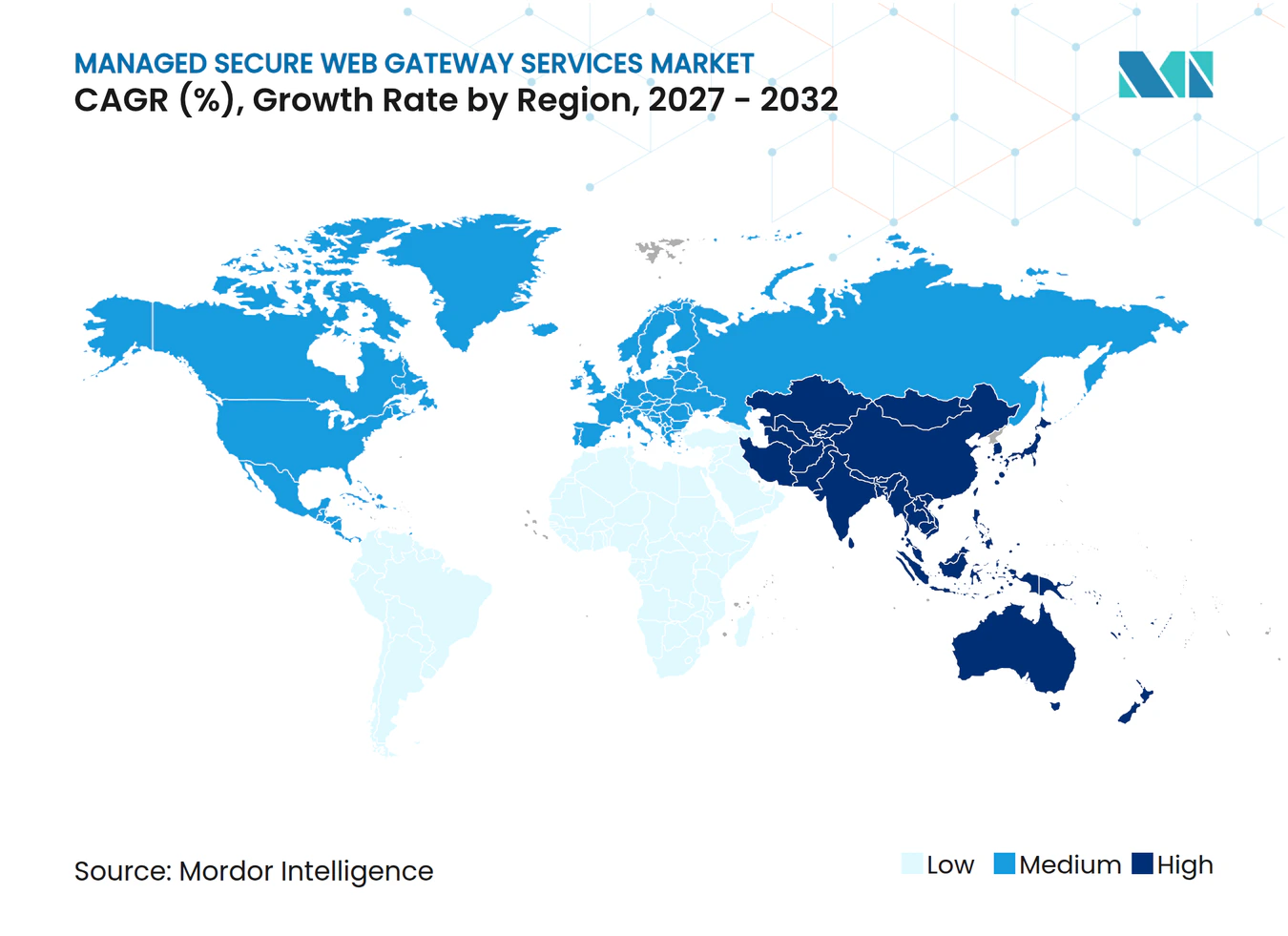
- By geography, North America accounted for 35.41% of the managed secure web gateway services market share in 2026, while Asia-Pacific is projected to expand at a 16.53% CAGR through 2032.
Note: Market numbers in this report are based on Mordor Intelligence's proprietary estimation framework, which combines nine months of actuals with Q4 projections for base year 2026.
Market Trends and Insights
Drivers Impact Analysis of Managed Secure Web Gateway Services Market*
| Driver | (~) % Impact on CAGR Forecast | Geographic Relevance | Impact Timeline |
|---|---|---|---|
| Escalating Web-Borne Threats and AI-Enabled Malware | +4.2% | Global, with early intensity in North America and Asia-Pacific | Short term (≤ 2 years) |
| Cloud Migration and Hybrid Workforce Expansion | +3.1% | Global, with highest relevance in North America, Europe, and Asia-Pacific | Short term (≤ 2 years) |
| SASE and Zero Trust Architecture Refresh Cycles | +2.8% | North America and Europe, with spillover to Asia-Pacific and the Middle East | Medium term (2-4 years) |
| Cybersecurity Skills Shortages Increasing Outsourcing | +2.0% | Global, with greatest pressure in North America, Europe, and Asia-Pacific | Medium term (2-4 years) |
| Regulatory Requirements for Continuous Monitoring and Data Protection | +1.5% | Europe and North America, with expansion to Asia-Pacific and the Middle East | Medium term (2-4 years) |
| Managed Policy Tuning for Encrypted and Non-Human Traffic | +0.8% | Global, concentrated in large enterprises | Long term (≥ 4 years) |
| Source: Mordor Intelligence | |||
Escalating Web-Borne Threats and AI-Enabled Malware
Web-layer attacks are becoming harder to separate from legitimate user activity. Check Point Research showed that web-enabled AI services can be misused as command-and-control relays, allowing attacker activity to blend with normal enterprise traffic. ESET reported that PromptSpy used generative AI within its execution flow to interpret on-screen elements and improve persistence across device configurations. These methods limit the usefulness of static categories and simple URL blocking. Managed providers can respond by applying behavioral analysis and policy changes as part of daily operations. This capability matters in financial services and healthcare, where missed detections can have direct service and compliance consequences.
The managed secure web gateway services market benefits when buyers require more than basic traffic filtering. Continuous monitoring gives providers a clearer view of changing attack paths and unusual application behavior. Providers that attach AI-assisted analysis to their service operations can act on findings without waiting for a customer to configure a separate feature. This shifts competitive attention toward the provider’s operating model, not only its underlying gateway platform. It also increases the importance of clear escalation processes, especially when an alert affects business-critical applications. Managed policy tuning for encrypted and non-human traffic becomes more valuable as more traffic originates from automated systems.
Cloud Migration and Hybrid Workforce Expansion
Hybrid work has made the user, device, and application more important than the office network boundary. Parallels found that 44.2% of organizations used a hybrid workforce, 33.5% operated mainly remotely, and 16.4% remained fully on-site in 2026.[1] The same research found that 72.4% of organizations saw employees frequently use unauthorized SaaS tools. These working patterns weaken the coverage of gateway designs that depend on a central office or data center. The managed secure web gateway services market, therefore, favors services that apply consistent controls across remote users, personal devices, and branch sites.
Cloud delivery also changes what clients measure during a provider evaluation. Buyers look closely at inspection delay because a security control that slows common productivity tools can damage user acceptance. Global points of presence and predictable inspection performance have become practical requirements rather than secondary technical details. Managed services can address this concern by selecting policies that fit application sensitivity and geographic location. They can also identify shadow IT without forcing internal teams to review every new cloud application. This creates a service opportunity in the managed secure web gateway services market around ongoing governance, rather than only initial gateway deployment.
SASE and Zero Trust Architecture Refresh Cycles
Many organizations are extending zero-trust programs to devices, automated identities, and AI-related traffic. Open Systems and Cybersecurity Insiders found that fewer than 1 in 10 organizations had fully integrated zero trust, while nearly 4 in 5 preferred co-managed or fully managed SASE approaches. The finding supports a role for providers that operate the policy layer after technology deployment. Zero-trust programs often involve several legacy rules, identity systems, and access paths that cannot be changed at once. Managed services can reduce this transition burden by translating older rules into cloud-based controls. The managed secure web gateway services market gains from this second phase of security architecture renewal.
A vendor-neutral policy overlay can be useful where a client is moving between established security tools. It allows providers to focus on the migration process instead of requiring the immediate replacement of every platform. This approach is relevant for organizations that need to protect internet traffic while broader identity and network changes remain in progress. It can also give clients a clearer route to consistent enforcement across applications and users. The managed secure web gateway services market has an opportunity where internal teams want external help but still need control over security decisions. Providers must show that managed operations will reduce complexity instead of adding another administrative layer.
Cybersecurity Skills Shortages Increasing Outsourcing
Skills shortages are moving managed gateway adoption beyond smaller organizations. ISC2 found that 59% of respondents reported critical or significant skills needs in 2025, compared with 44% in 2024. AI security and cloud security were identified as leading skill gaps. These gaps make it difficult for internal teams to keep rules current, investigate alerts, and manage exceptions across multiple security products. The managed secure web gateway services market offers clients access to staff who focus on these operating tasks every day.
Logpoint found that 60% of managed security service buyers cited missing skills and 48% cited hiring difficulty as outsourcing drivers. The results indicate that capability needs can outweigh simple cost concerns in purchasing decisions. Clients may delegate decisions on inspection scope, exception handling, and threat escalation when their own teams lack specialist capacity. This expands the value of a managed engagement beyond basic monitoring. Providers that can explain who makes each policy decision are better placed to build trust with larger clients. Clear accountability is particularly important where web security affects privacy, application access, and incident response.
Restraints Impact Analysis of Managed Secure Web Gateway Services Market*
| Restraint | (~) % Impact on CAGR Forecast | Geographic Relevance | Impact Timeline |
|---|---|---|---|
| Integration Complexity Across Legacy and Hybrid Infrastructure | -3.2% | Global, most pronounced in manufacturing and government | Medium term (2-4 years) |
| Privacy Constraints on SSL/TLS Inspection | -2.1% | Europe, with expansion to Asia-Pacific data-protection regimes | Short term (≤ 2 years) |
| Latency and User-Experience Risk at Cloud Inspection Points | -1.4% | Global, with highest relevance in Asia-Pacific and Africa | Medium term (2-4 years) |
| Proprietary Policy Languages and Vendor Lock-In | -0.8% | Global, concentrated in large enterprises and regulated sectors | Long term (≥ 4 years) |
| Source: Mordor Intelligence | |||
Integration Complexity Across Legacy and Hybrid Infrastructure
Legacy gateway systems often remain in place longer than planned. Older appliances can use rules that do not match cloud-delivered controls, which creates inconsistent enforcement across traffic paths. The challenge is especially significant where audits require evidence that a policy applies to every relevant connection. The managed secure web gateway services market can be slowed when a client must operate both legacy and cloud systems before a complete transition. Providers need unified visibility across these environments to lower the perceived risk of a migration. They also need realistic plans for moving policies and handling systems that cannot be retired immediately.
Managed deployment and integration services can reduce this barrier, but they must address business dependencies as well as technical settings. Manufacturers and government organizations may have isolated networks or older applications that cannot accept the same inspection rules as standard office traffic. A hybrid design can preserve protection for general users while maintaining special treatment for sensitive workloads. This can increase service complexity and delay wider adoption in the managed secure web gateway services market. It also gives providers an opportunity to package migration support as a defined service rather than an informal implementation task. Buyers will assess whether that support produces a consistent operating model after the transition.
Privacy Constraints on SSL/TLS Inspection
Full SSL/TLS inspection is becoming harder to apply without limits. NIST documented visibility challenges associated with TLS 1.3 and described the need for architectural measures to preserve enterprise inspection capability.[2] The Dutch National Cyber Security Center stated that organizations should assess the necessity and proportionality of TLS interception and complete a GDPR review before using TLS proxies. These requirements make broad decryption policies difficult to justify in every case. They also increase the policy management work required of service providers. The restraint is particularly important in Europe and in jurisdictions with similar privacy expectations.
Selective inspection can help organizations balance security monitoring with privacy and data-residency requirements. It requires providers to understand which user groups, applications, and data types should be treated differently. This can raise delivery costs and lengthen implementation discussions. It can also distinguish providers that build jurisdiction-aware bypass designs and maintain clear records of their choices. The managed secure web gateway services market will benefit only where clients are confident that a service can meet both security and privacy needs. Providers that rely on broad, uniform policies may find it harder to win regulated accounts.
*Our forecasts treat driver/restraint impacts as directional, not additive. The impact forecasts reflect baseline growth, mix effects, and variable interactions.
Managed Secure Web Gateway Services Market Segment Analysis
By Service Type:
Policy Management Anchors Revenue, Threat Detection Drives GrowthManaged monitoring and policy management held 33.97% of the managed secure web gateway services market size in 2026. The segment leads because gateway rules require routine attention after deployment. New SaaS applications, unauthorized tools, and changing threat patterns can make an existing rule set less effective. Many organizations do not have enough staff to review this activity at the necessary pace. Ongoing monitoring allows a provider to identify traffic changes and adjust controls before they become persistent gaps. Policy management also creates a regular operating relationship between the provider and the client. This supports recurring service revenue rather than a one-time implementation project. The segment remains relevant even when a client owns the core web gateway technology. It is built around the practical task of keeping controls aligned with daily business activity.
Managed threat detection and response is projected to expand at a 15.31% CAGR through 2032. The service responds to demand for behavioral analysis, automated response steps, and clear handling of significant alerts. Buyers are moving away from contracts that only generate notifications for internal teams. They increasingly expect the provider to take responsibility for defined response actions and escalation times. This model shifts attention from mean time to detect toward mean time to respond. Consulting and optimization can serve as an entry point because clients often begin with a gap assessment. Managed deployment and integration addresses the move from legacy infrastructure to cloud controls. Support and maintenance remains relevant for organizations that retain governance internally but outsource operational assistance. The European certification framework may favor providers that already demonstrate staff competence, service quality, and data protection controls.



By Deployment Mode:
Cloud Leads Both Share and GrowthCloud-based delivery accounted for 64.89% of revenue in 2026 and is projected to expand at a 15.47% CAGR through 2032. This model gives organizations a way to enforce policies across remote users, contractor devices, personal devices, and branch locations. It also avoids the need to place dedicated gateway hardware at every location. Each additional point of presence can improve user access by reducing the distance to an inspection point. Cloud delivery is therefore well-suited to distributed workforces and applications that are already outside the corporate data center. The model also makes it easier to apply one policy framework across locations. For these reasons, cloud-based delivery leads the managed secure web gateway services market. Providers still need to show that their service can meet latency, privacy, and data-location requirements.
On-premises delivery remains important in selected regulated settings. Financial market infrastructure, defense contractors, and healthcare systems may need tighter control over sensitive traffic or isolated networks. These organizations may restrict the routing of certain connections through shared cloud enforcement nodes. Hybrid delivery can offer a practical transition path by retaining local gateways for sensitive workloads while routing general employee traffic through cloud points. The model can reduce disruption during a migration, but it also leaves the client with 2 policy environments to manage. This complexity can become a managed service opportunity in the managed secure web gateway services market when providers offer a dedicated hybrid-migration engagement. Such engagements must show how rules will remain consistent across both environments. The future role of on-premises and hybrid delivery depends on the pace of regulatory, operational, and architectural change.
By Organization Size:
Large Enterprises Lead, SMEs Close the GapLarge enterprises accounted for 69.32% of revenue in 2026. Their leading position reflects broad geographic footprints, substantial transaction volumes, and demanding compliance responsibilities. These organizations often use several identity, endpoint, and security information systems alongside web gateways. A managed provider must integrate with this environment rather than operate in isolation. Multi-year service arrangements can create high switching costs because policies and procedures become linked to existing tools. Large clients also seek 24/7 security operations center support, AI-assisted triage, and contractual response commitments. These requirements support premium service contracts rather than basic monitoring arrangements. The segment’s scale makes it central to provider revenue and reference-account strategies.
Small and medium enterprises are projected to expand at a 15.78% CAGR through 2032. Per-user subscriptions reduce the minimum commitment that once limited managed web security to organizations with appliance-scale needs. This supports demand among larger, small, and medium organizations that need specialist coverage without building a separate security team. The key provider challenge is price pressure in basic threat blocking. Low-cost automated controls can make entry-level offers hard to distinguish. Providers can respond with policy governance, compliance reporting, and practical help with application exceptions. These additions make the service more relevant to organizations that have limited internal security capacity.

By End-User Vertical:
BFSI Leads, Healthcare AcceleratesBFSI held 28.17% of the managed secure web gateway services market share in 2026. Financial organizations operate under high requirements for continuous monitoring, traceable controls, and third-party oversight. DORA has been applied since January 2025 and strengthens the focus on operational resilience and ICT risk management. PCI DSS 4.0 and Financial Institutions Examination Council expectations also support a need for documented monitoring of web traffic and managed service providers. This creates a baseline need that is less tied to discretionary technology spending. BFSI clients will assess how a provider handles audit evidence, policy exceptions, and incident escalation. These needs favor services that connect web security controls with reporting and governance. Regulated transactions and complex user populations further increase the value of consistent enforcement.
Healthcare and life sciences are projected to expand at a 16.17% CAGR through 2032. Patient portals, medical-device telemetry, and clinical SaaS applications create more web-facing traffic across healthcare networks. These connections are difficult to protect through older air-gap approaches alone. NHS Wales Hywel Dda Health Board awarded iboss a SASE contract in February 2025, replacing Forcepoint Cloud SWG licenses with a package that included SWG, CASB, ZTNA, remote browser isolation, and DLP.[3] The example shows how healthcare buyers can move from a standalone web gateway to an integrated service model. Government and defense organizations need sovereign delivery and restricted data handling. Manufacturing is adding web inspection as IT and operational technology environments become more connected. Retail, e-commerce, IT, and telecommunications are also increasing use as customer-data obligations and 5G-related traffic expand.
Geography Analysis
North America Managed Secure Web Gateway Services Market
North America accounted for 35.41% of revenue in 2026. The region has a high concentration of cloud-first enterprises and a mature base of managed security service providers. Federal zero-trust requirements also support demand from government contractors and critical infrastructure operators. U.S. federal agencies working under zero-trust directives require stronger controls over access and network activity. These requirements can support managed service contracts with broader operational responsibilities. Canada also has demand from financial institutions that must manage technology and cyber risks from third parties. Mexico’s adoption is concentrated in multinational manufacturing operations that follow global security standards. The managed secure web gateway services market has a broad base in North America because the region combines technology adoption, regulatory needs, and established service ecosystems.
Europe and South America Managed Secure Web Gateway Services Market
Europe is the second-largest regional cluster and is shaped by a strong compliance environment. DORA’s requirements for financial entities create demand for continuous ICT risk monitoring and visibility into third-party service providers. The European Union’s managed security services certification scheme adds a further focus on service quality, competence, and data protection. Germany, the United Kingdom, and France are important national markets within the region. Buyers in these countries can place greater weight on local security operations centers and jurisdiction-aware processing. Such requirements can make sovereign delivery a core procurement requirement instead of an optional feature. South America remains an emerging area, where Brazil’s LGPD and financial-sector digitalization support early demand among financial institutions and telecom operators. The scale of deployment depends on providers that can meet country-specific data handling expectations.
APAC and MEA Managed Secure Web Gateway Services Market
Asia-Pacific is projected to expand at a 16.53% CAGR through 2032. The region combines government-led digital transformation with a widening base of managed security providers and data-protection requirements. India, Singapore, and Australia are important for service demand because their organizations are increasing cloud adoption and formalizing security governance. Japan adds specific demand through privacy rules and continuous monitoring expectations in financial services. The Middle East is supported by cloud infrastructure investment in Saudi Arabia and the United Arab Emirates. These investments widen the web-layer attack surface and increase the need for managed controls. Africa is at an earlier stage of adoption, with activity centered on banking and telecom organizations in South Africa and Nigeria. The managed secure web gateway services market requires stronger local presence in these regions because inspection performance and data-handling expectations can vary materially by location.
Competitive Landscape
Market Concentration
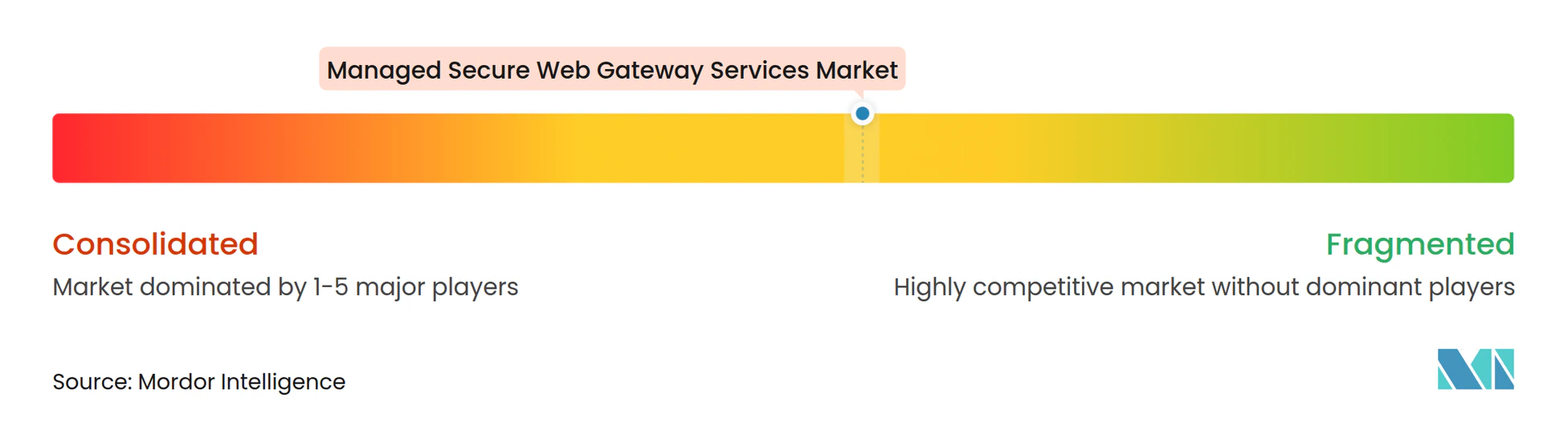
The managed secure web gateway services market is moderately concentrated at the platform level and fragmented in managed operations. Zscaler, Netskope, Palo Alto Networks, and Cloudflare set important platform and pricing expectations. Regional managed security service providers, systems integrators, and telecom-linked providers compete by operating and supporting these platforms for clients. This structure means that a leading gateway platform does not automatically translate into leadership in managed operations. Providers need technical capability, local service coverage, and a clear operating process. They also need to coordinate policy changes across web security, data loss prevention, identity controls, and cloud applications. The competitive result is a broad field of service providers built around a smaller group of major security platforms.
Differentiation is moving beyond basic secure web gateway functions. Netskope’s One DLP for GenAI and Palo Alto Networks’ AI Access Security module illustrate the move toward controls for generative AI application use. These capabilities embed policy decisions in a broader security platform and can be difficult for smaller providers to replicate without a licensing relationship. The European Union’s managed security services certification scheme can also influence competitive outcomes in public-sector procurement. Providers that can document compliance with these expectations may be better placed for regulated opportunities. Smaller providers compete through simplified onboarding and predictable per-user pricing. This pressure encourages major providers to combine platform features with easier managed delivery.
Several opportunity areas remain less mature. Hybrid-migration management is important for clients that need to operate legacy and cloud controls together. Industrial clients may require inspection approaches that recognize operational technology needs. Government accounts may prioritize sovereign deployment and jurisdiction-restricted data handling. JFrog integrated its Software Supply Chain Traffic Controller with Zscaler, Cloudflare, and Netskope in August 2026, enabling network-layer controls for software package requests. This expands the potential role of web gateway controls into software supply chain activity. Providers that can operate these broader controls without making service delivery difficult will have a clearer way to differentiate. The overall competitive position depends on reliable operations, not only on feature announcements.
Managed Secure Web Gateway Services Industry Leaders
-
Zscaler, Inc.
-
Cisco Systems, Inc.
-
Broadcom Inc.
-
Fortinet, Inc.
-
Cloudflare, Inc.
- *Disclaimer: Major Players sorted in no particular order
Managed Secure Web Gateway Services Market Companies Covered in this Report
- Zscaler, Inc.
- Cisco Systems, Inc.
- Broadcom Inc.
- Netskope, Inc.
- Fortinet, Inc.
- Palo Alto Networks, Inc.
- Cloudflare, Inc.
- Check Point Software Technologies Ltd.
- Forcepoint LLC
- Trend Micro Incorporated
- Sophos Ltd
- McAfee LLC
- Skyhigh Security
- Menlo Security, Inc.
- iboss, Inc.
- Akamai Technologies, Inc.
- Barracuda Networks, Inc.
- Proofpoint, Inc.
- Aryaka Networks, Inc.
- Cato Networks Ltd.
Recent Industry Developments in Managed Secure Web Gateway Services Market
- October 2026: Cloudflare launched a fully programmable secure web gateway, integrating Gateway and Data Loss Prevention with its Workers edge-computing platform to enable custom validation logic inline at the policy-enforcement point.
- August 2026: JFrog integrated its Software Supply Chain Traffic Controller with Zscaler, Cloudflare, and Netskope, enabling SASE enforcement nodes to reroute software package requests through JFrog Artifactory and block malicious packages at the network layer before they reach developer machines.
- June 2026: LTM launched its new Managed Secure Service Edge (SSE) solution at Cisco Live 2026. Built on Cisco Secure Access, this offering protects cloud-first and hybrid work environments while enabling the secure use of AI models. The cloud-native, zero-trust framework unifies Zero Trust Network Access (ZTNA), Secure Web Gateway (SWG), and Cloud Access Security Broker (CASB) capabilities. Backed by LTM's AI-powered managed services, it provides identity-aware access, simplifies operations, and delivers end-to-end enterprise visibility
- February 2026: Zscaler announced the acquisition of Symmetry Systems, combining zero trust controls with access graph technology to map and secure AI agent communication across enterprise environments.
Global Managed Secure Web Gateway Services Market Report Scope
Managed Secure Web Gateway (SWG) Services are outsourced, third-party cybersecurity solutions that monitor, filter, and secure an organization's outbound internet traffic. By operating as a cloud-delivered or hybrid checkpoint between internal users and the public internet, these services block web-based threats, prevent unauthorized data exfiltration, and enforce corporate compliance policies.
The Managed Secure Web Gateway Services Market Report is Segmented by Service Type (Managed Deployment and Integration, Managed Monitoring and Policy Management, Managed Threat Detection and Response, Consulting and Optimization, and Support and Maintenance), Deployment Mode (Cloud-Based, On-Premises, and Hybrid), Organization Size (Large Enterprises and Small and Medium-Sized Enterprises), End-User Vertical (BFSI, IT and Telecommunications, Healthcare and Life Sciences, Government and Defense, Manufacturing, Retail and E-Commerce, and Other End-User Verticals), and Geography (North America, South America, Europe, Asia-Pacific, Middle East, and Africa). The Market Forecasts are Provided in Terms of Value (USD).
Segmentation Overview
| Managed Deployment and Integration |
| Managed Monitoring and Policy Management |
| Managed Threat Detection and Response |
| Consulting and Optimization |
| Support and Maintenance |
| Cloud-Based |
| On-Premises |
| Hybrid |
| Large Enterprises |
| Small and Medium Enterprises |
| BFSI |
| IT and Telecommunications |
| Healthcare and Life Sciences |
| Government and Defense |
| Manufacturing |
| Retail and E-Commerce |
| Other End-User Verticals |
| North America | United States |
| Canada | |
| Mexico | |
| South America | Brazil |
| Argentina | |
| Rest of South America | |
| Europe | Germany |
| United Kingdom | |
| France | |
| Italy | |
| Spain | |
| Rest of Europe | |
| Asia-Pacific | China |
| Japan | |
| India | |
| South Korea | |
| Rest of Asia-Pacific | |
| Middle East | Saudi Arabia |
| United Arab Emirates | |
| Rest of Middle East | |
| Africa | South Africa |
| Nigeria | |
| Rest of South Africa |
| By Service Type | Managed Deployment and Integration | |
| Managed Monitoring and Policy Management | ||
| Managed Threat Detection and Response | ||
| Consulting and Optimization | ||
| Support and Maintenance | ||
| By Deployment Mode | Cloud-Based | |
| On-Premises | ||
| Hybrid | ||
| By Organization Size | Large Enterprises | |
| Small and Medium Enterprises | ||
| By End-User Vertical | BFSI | |
| IT and Telecommunications | ||
| Healthcare and Life Sciences | ||
| Government and Defense | ||
| Manufacturing | ||
| Retail and E-Commerce | ||
| Other End-User Verticals | ||
| By Geography | North America | United States |
| Canada | ||
| Mexico | ||
| South America | Brazil | |
| Argentina | ||
| Rest of South America | ||
| Europe | Germany | |
| United Kingdom | ||
| France | ||
| Italy | ||
| Spain | ||
| Rest of Europe | ||
| Asia-Pacific | China | |
| Japan | ||
| India | ||
| South Korea | ||
| Rest of Asia-Pacific | ||
| Middle East | Saudi Arabia | |
| United Arab Emirates | ||
| Rest of Middle East | ||
| Africa | South Africa | |
| Nigeria | ||
| Rest of South Africa | ||
Key Questions Answered in the Report
What is the managed secure web gateway services market size?
The market is projected to expand from USD 3.42 billion in 2026 and USD 3.97 billion in 2027 to USD 7.48 billion by 2032, at a 13.51% CAGR.
What is driving demand for managed secure web gateway services?
Web-based threats, hybrid work, cloud application use, security staffing gaps, and regulatory monitoring requirements support demand.
Which deployment model leads secure web gateway services?
Cloud-based delivery accounted for 64.89% of revenue in 2026 and is projected to expand at a 15.47% CAGR through 2032.
Which end-user vertical has the highest demand?
BFSI held 28.17% of revenue in 2026 because financial organizations need continuous monitoring, third-party oversight, and documented controls.
Which end-user vertical is expanding fastest?
Healthcare and life sciences is projected to expand at a 16.17% CAGR through 2032 as patient portals, clinical SaaS, and medical-device traffic widen web-layer exposure.
Which region is expanding fastest for managed secure web gateway services?
Asia-Pacific is projected to expand at a 16.53% CAGR through 2032, supported by digital transformation, local service ecosystems, and data-protection requirements.