
Managed CASB Services Market Size and Share
Market Overview
| Study Period | 2021 - 2032 |
|---|---|
| Market Size (2027) | USD 1.36 Billion |
| Market Size (2032) | USD 3.13 Billion |
| Growth Rate (2027 - 2032) | 18.10 % |
| Fastest Growing Market | Asia-Pacific |
| Largest Market | North America |
| Market Concentration | Medium |
Major Players *Disclaimer: Major Players sorted in no particular order Image © Mordor Intelligence. Reuse requires attribution under CC BY 4.0. | |
Managed CASB Services Market Analysis by Mordor Intelligence
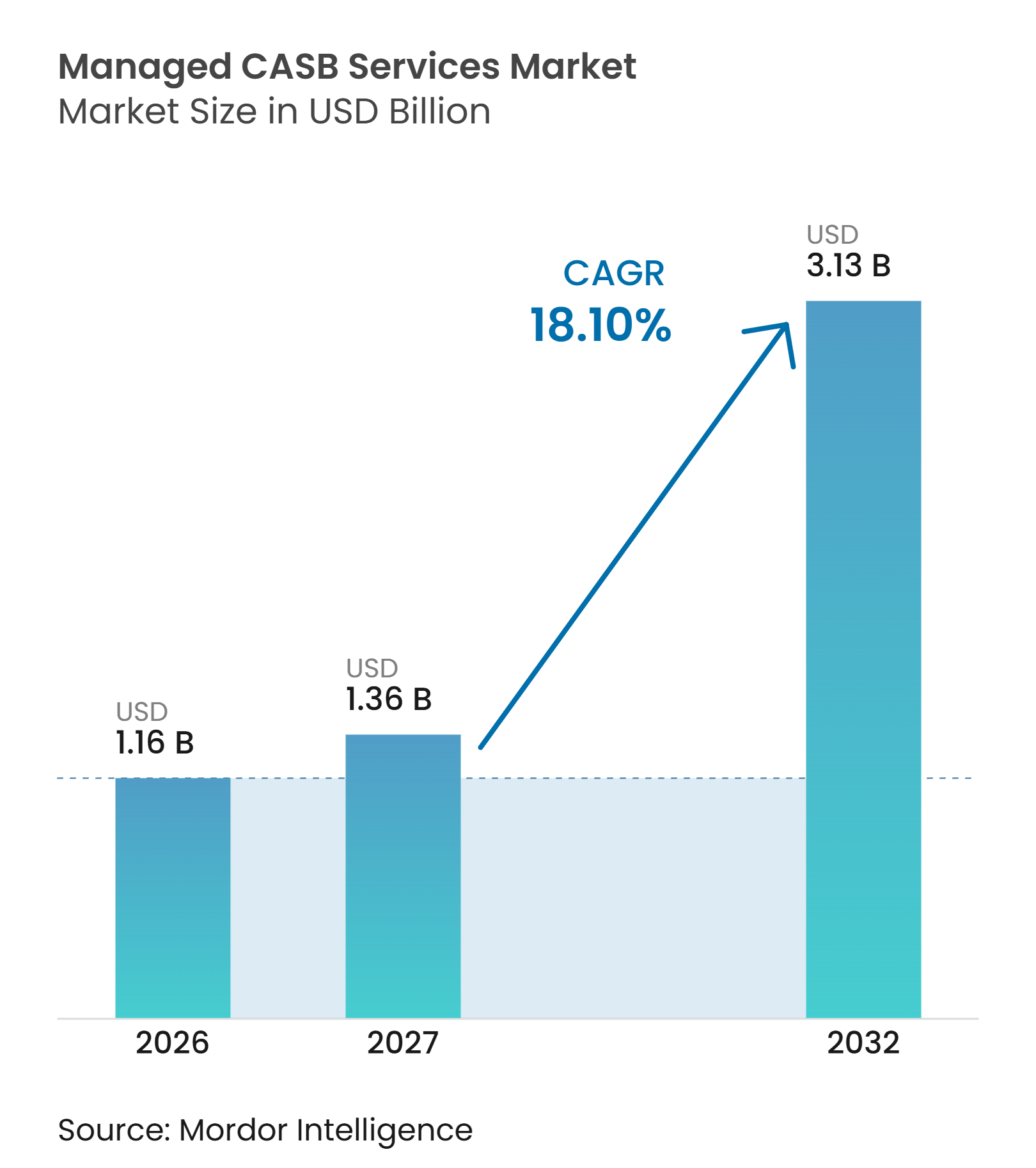
The managed CASB services market size is projected to expand from USD 1.16 billion in 2026 and USD 1.36 billion in 2027 to USD 3.13 billion by 2032, registering a CAGR of 18.10% between 2027 and 2032. The managed CASB services market is growing because organizations are assigning cloud policy design, monitoring, and incident response to specialized providers rather than developing all capabilities internally, particularly where internal teams cannot provide continuous oversight across application discovery, configuration enforcement, incident handling, reporting, routine policy updates, and the review of permitted third-party application connections. Partner-supported cloud security operations are becoming increasingly important as SaaS use expands, compliance expectations tighten, and AI applications create additional routes for sensitive data to flow between approved platforms and third-party applications. Zero Trust requirements, data-residency obligations, financial-sector operational resilience rules, and cyber-insurance review practices are increasing the need for documented cloud access controls that can be verified over time. Providers in the managed CASB services market are responding by combining CASB capabilities with secure access service edge platforms, AI-based policy automation, API connections to SaaS applications, managed alert triage, secure web gateway functions, Zero Trust network access, and firewall services under a more unified policy framework. Competition is also moving toward managed delivery that can operate these controls continuously and keep application risk information current, although policy complexity can make it difficult to keep multicloud settings consistent, raise the cost of service delivery, require providers to reconcile policy changes across cloud platforms before gaps affect security posture, and allow configuration drift to erode protections faster than ordinary service review cycles can resolve it.
Key Report Takeaways
- By service model, fully managed services held 67.44% of the managed CASB services market share in 2026, while co-managed services are projected to expand at a 19.06% CAGR through 2032.
- By deployment model, public cloud accounted for 65.31% of managed CASB services market revenue in 2026, while hybrid cloud is projected to expand at a 19.37% CAGR through 2032.
- By organization size, large enterprises held 70.28% of the managed CASB services market revenue in 2026, while SMEs are projected to expand at a 19.64% CAGR through 2032.
- By end-user industry, BFSI accounted for 29.14% of managed CASB services market revenue in 2026, while government and public administration are projected to expand at an 18.45% CAGR through 2032.
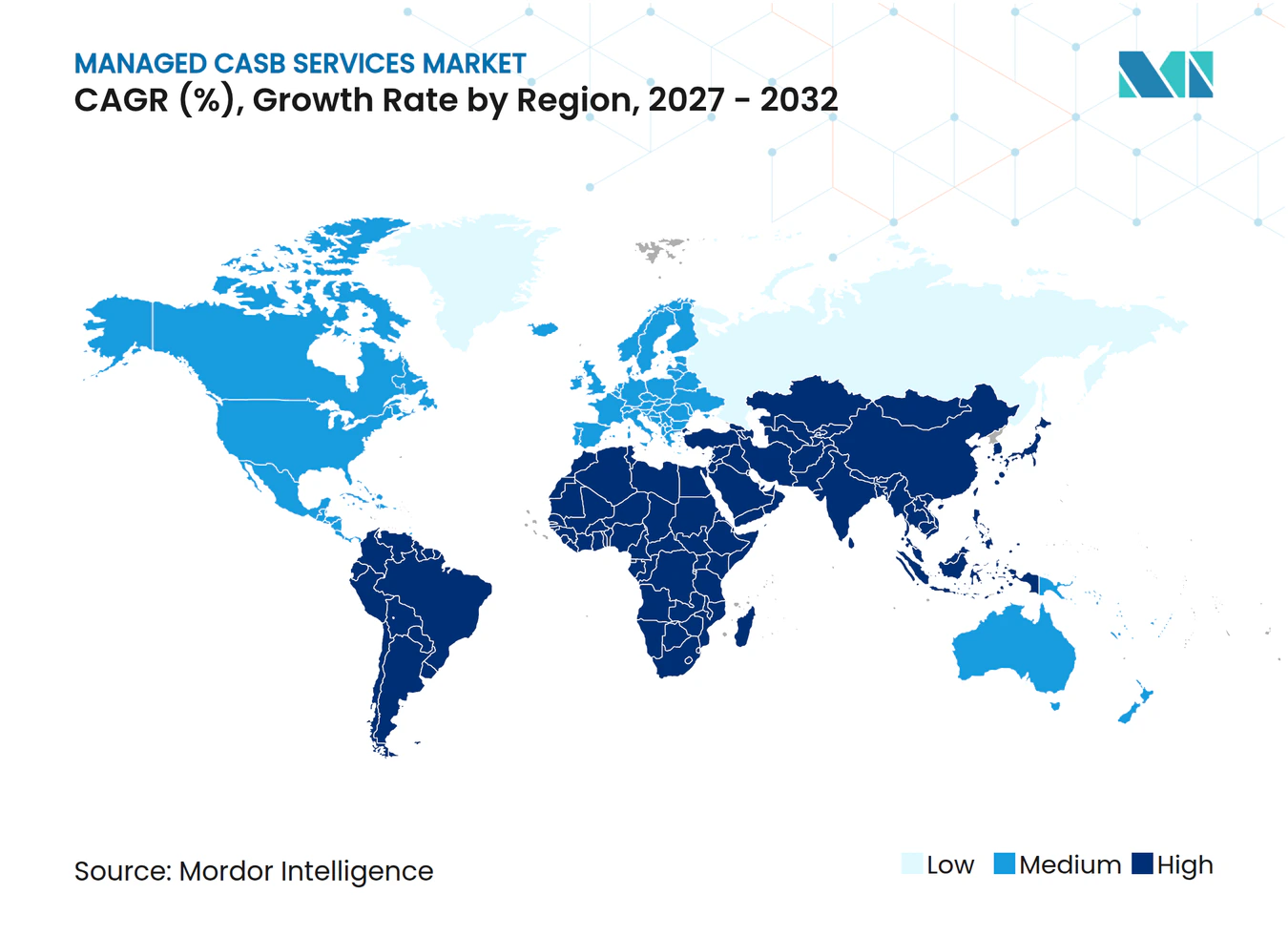
- By geography, North America accounted for 36.12% of the managed CASB services market revenue in 2026, while Asia-Pacific is projected to expand at an 18.79% CAGR through 2032.
Note: Market numbers in this report are based on Mordor Intelligence's proprietary estimation framework, which combines nine months of actuals with Q4 projections for base year 2026.
Market Trends and Insights
Drivers Impact Analysis of Managed CASB Services Market*
| Driver | (~) % Impact on CAGR Forecast | Geographic Relevance | Impact Timeline |
|---|---|---|---|
| Accelerating SaaS and Multicloud Adoption | +4.5% | Global, highest intensity in North America and Asia-Pacific | Short term (≤ 2 years) |
| Zero Trust and Data-Residency Mandates | +3.5% | North America and EU, spill-over to Asia-Pacific and Middle East | Short term (≤ 2 years) |
| Cybersecurity Skills Shortages and 24/7 Operations Demand | +3.0% | Global | Medium term (2-4 years) |
| SASE Convergence and API-First CASB Integrations | +2.5% | Global, led by North America and Europe | Medium term (2-4 years) |
| Generative AI and SaaS-to-SaaS Data-Flow Governance | +2.0% | Global, with early adoption in North America and EU | Short term (≤ 2 years) |
| Cyber-Insurance and Auditability Requirements | +1.5% | North America and EU, growing in Asia-Pacific | Medium term (2-4 years) |
| Source: Mordor Intelligence | |||
Accelerating SaaS and Multicloud Adoption Widens the Governance Gap
Enterprise SaaS portfolios have become harder for internal governance teams to oversee through periodic reviews. The 2025 Cloud Security Alliance research found that 48% of organizations still managed SaaS risk through manual processes, while only 28% automated configuration enforcement across all approved applications. This gap between exposure and control drives demand in the managed CASB services market, as providers maintain cloud application risk catalogs and continuously apply API inspections and data loss prevention controls. The issue extends beyond individual applications, as employees can authorize third-party tools to access corporate Microsoft 365 or Google Workspace data without IT teams' knowledge. These SaaS-to-SaaS connections can create data flows that inline controls cannot manage on their own without continuous API-mode coverage. Multicloud estates that use 3 or more platforms further enlarge the policy surface that providers must monitor.
Zero Trust and Data-Residency Mandates Cement CASB as a Compliance Requirement
Regulatory requirements are making managed CASB services more relevant to organizations that need auditable cloud controls. CISA’s Zero Trust Maturity Model directs federal agencies toward cloud access controls that align with CASB capabilities. This direction can extend to suppliers that support federal environments and must demonstrate comparable cloud security practices. The Digital Operational Resilience Act has been applied in the European Union since January 2025 and places operational resilience obligations on financial entities that use ICT services. Data residency requirements add another layer, as cloud controls must support local processing and documented governance for sensitive workloads. These requirements make it more important for the managed CASB services market to provide consistent evidence of policy enforcement across jurisdictions.
Cybersecurity Skills Shortages Make 24/7 Managed Operations the Rational Alternative
Cloud security operations remain difficult to staff with specialists capable of supporting continuous monitoring. The ISC2 2025 study of 16,029 security professionals found that 95% of teams had at least 1 skills gap, and 36% identified cloud security as their leading technical need. The study also reported that 59% of teams faced critical or significant shortages, compared with 44% in the prior year. ISACA reported that 55% of cybersecurity teams were understaffed, 65% had unfilled roles, and 70% expected demand for technical cybersecurity capabilities to rise. Maintaining cloud policy enforcement, data loss prevention tuning, and current SaaS risk scores requires expertise that many organizations cannot sustain internally at all hours. Managed providers can therefore support buyers that need continuity without building a large internal cloud security operations team, which remains an important demand factor for the managed CASB services market.
SASE Convergence and API-First CASB Integrations Embed CASB Into the Security Environment
CASB is increasingly delivered as part of a SASE environment that also includes a secure web gateway, Zero Trust network access, and firewall services. This structure gives enterprises a single policy approach across cloud access and data protection functions. API-first CASB connections can apply controls to data at rest in SaaS services and can monitor third-party application permissions. Netskope’s Cloud Confidence Index contains risk information on more than 80,000 cloud applications, showing the breadth of applications that API-based controls can cover. The scale of this application universe makes manual review difficult for most internal teams. The managed CASB services market benefits when providers update integrations and policy settings as new applications and permissions emerge.
Restraints Impact Analysis of Managed CASB Services Market*
| Restraint | (~) % Impact on CAGR Forecast | Geographic Relevance | Impact Timeline |
|---|---|---|---|
| Configuration Drift Across Multicloud Policy Stacks | -3.5% | Global, most acute in North America and EU | Medium term (2-4 years) |
| False Positives and SOC Alert-Fatigue Costs | -2.5% | Global | Short term (≤ 2 years) |
| Scarcity of CASB Policy Engineering Expertise | -2.0% | Global, with acute shortages in Asia-Pacific and South America | Medium term (2-4 years) |
| Data Sovereignty and Vendor Lock-In Concerns | -1.5% | EU, Asia-Pacific, Middle East | Long term (≥ 4 years) |
| Source: Mordor Intelligence | |||
Configuration Drift Across Multicloud Policy Stacks Undermines Service Consistency
Configuration drift occurs when running settings diverge from intended security baselines across cloud environments. AWS, Azure, Google Cloud, and private cloud environments each use different access-control models and data classification approaches. A policy change in 1 environment can therefore create an unplanned access path in another environment. Drift becomes harder to detect as organizations operate more cloud providers and more policy variations. Customers may assume that their policies are enforced consistently, even when settings have diverged between platforms. Providers must invest in continuous automated drift detection, which raises delivery costs and can make standardized service agreements more difficult to manage.
False Positives and SOC Alert-Fatigue Costs Erode Managed Service Economics
False positives can create a substantial operational cost for managed cloud security operations. The SANS 2025 Detection and Response Report found that 60% of organizations encountered false positives frequently or very frequently. Palo Alto Networks reported that SOC analysts process more than 11,000 alerts each day across multiple dashboards.[1] At this volume, analysts can overlook genuine threats even when teams are adequately staffed. Research published in the Journal of Internet Services and Information Security found that context-aware, behavior-based policy frameworks reduced false positives by up to 36% compared with threshold-based approaches. Providers that absorb the costs of developing and operating these approaches may face margin pressure in lower-priced managed service tiers, which can limit the pace of expansion in the managed CASB services market.
*Our forecasts treat driver/restraint impacts as directional, not additive. The impact forecasts reflect baseline growth, mix effects, and variable interactions.
Managed CASB Services Market Segment Analysis
By Service Model:
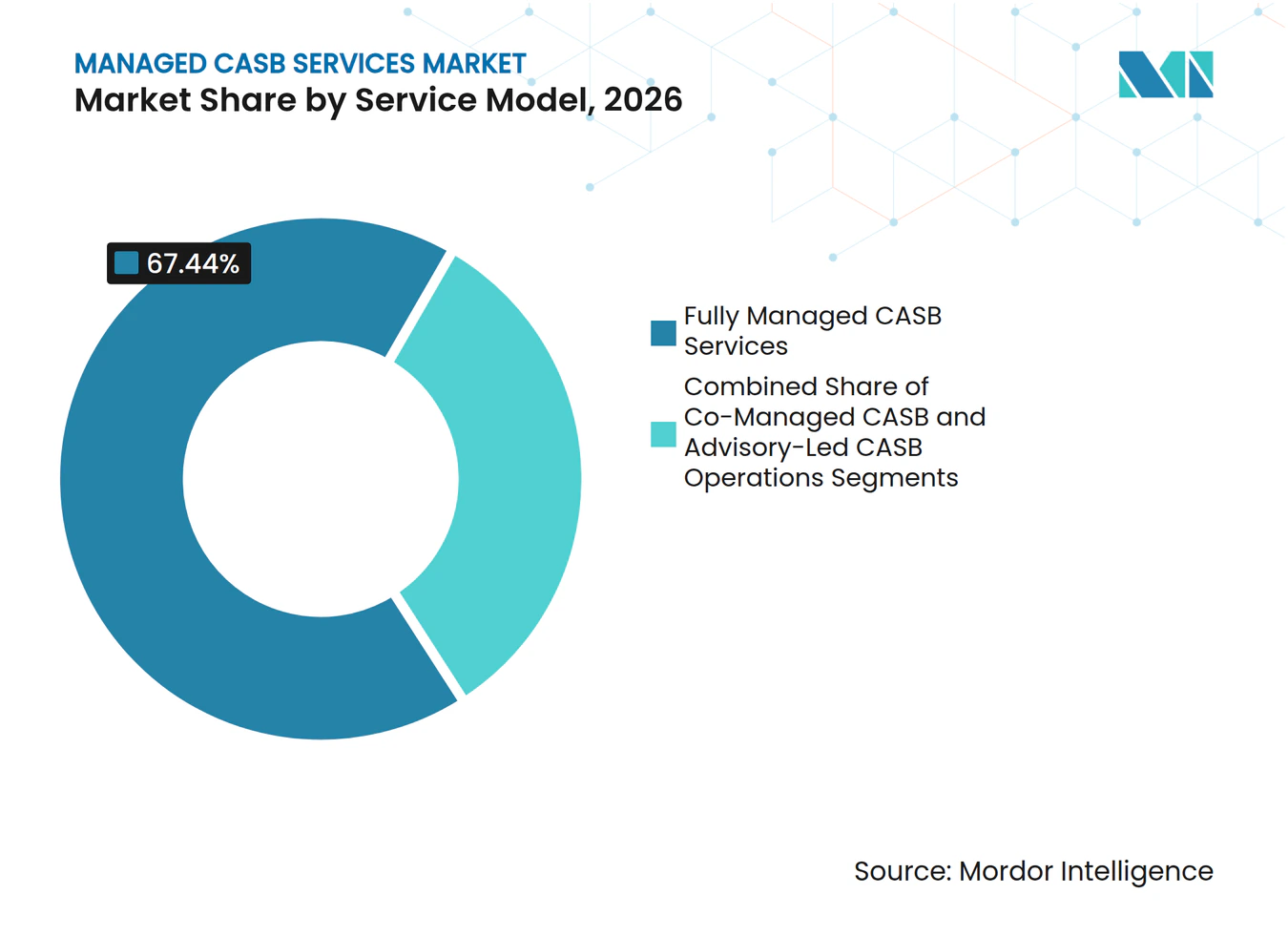
Fully Managed Services Lead, While Co-Managed Delivery Gains MomentumFully managed services held 67.44% of the managed CASB services market share in 2026. Organizations in this model delegate discovery, configuration, monitoring, incident response, and reporting to external providers. The format is particularly relevant to BFSI and healthcare organizations that need continuous cloud oversight. Fully managed delivery lets customers access specialized operations without maintaining every CASB capability internally, while providers assume routine policy administration and monitoring activity.
Co-managed services are projected to grow at a 19.06% CAGR through 2032 in the managed CASB services market. This approach allows organizations to retain ownership of governance decisions while providers manage 24/7 enforcement and alert triage. The model keeps enterprise security architects involved in higher-level policy choices while transferring routine operational work. It can also reduce concerns about vendor lock-in by keeping internal teams connected to the policy process. Advisory-led services address organizations that are developing internal capability but still require specialist help with SASE platforms and CASB modules.



By Deployment Model:
Public Cloud Holds the Largest Share, While Hybrid Cloud Grows FasterPublic cloud deployment accounted for 65.31% of revenue in the managed CASB services market in 2026. This position reflects the concentration of enterprise SaaS workloads on AWS, Azure, and Google Cloud. API-based CASB controls can connect with cloud-native identity and access management services in these settings. These connections support policy enforcement and visibility across data stored in SaaS applications. The broad use of public cloud collaboration tools creates a sustained need to monitor permissions and data movement as application counts increase.
Hybrid cloud deployment is projected to expand at a 19.37% CAGR through 2032 within the managed CASB services market. Regulated organizations often keep sensitive workloads in on-premises systems while using public cloud services for collaboration and other functions. They need controls that can cover both environments without opening governance gaps at the boundary. Data residency requirements are an important reason to retain this mixed model. Private cloud remains the smallest deployment segment, but government agencies and defense contractors use it for geographically restricted or air-gapped workloads, supported by Zscaler’s March 2026 sovereignty expansion.
By Organization Size:
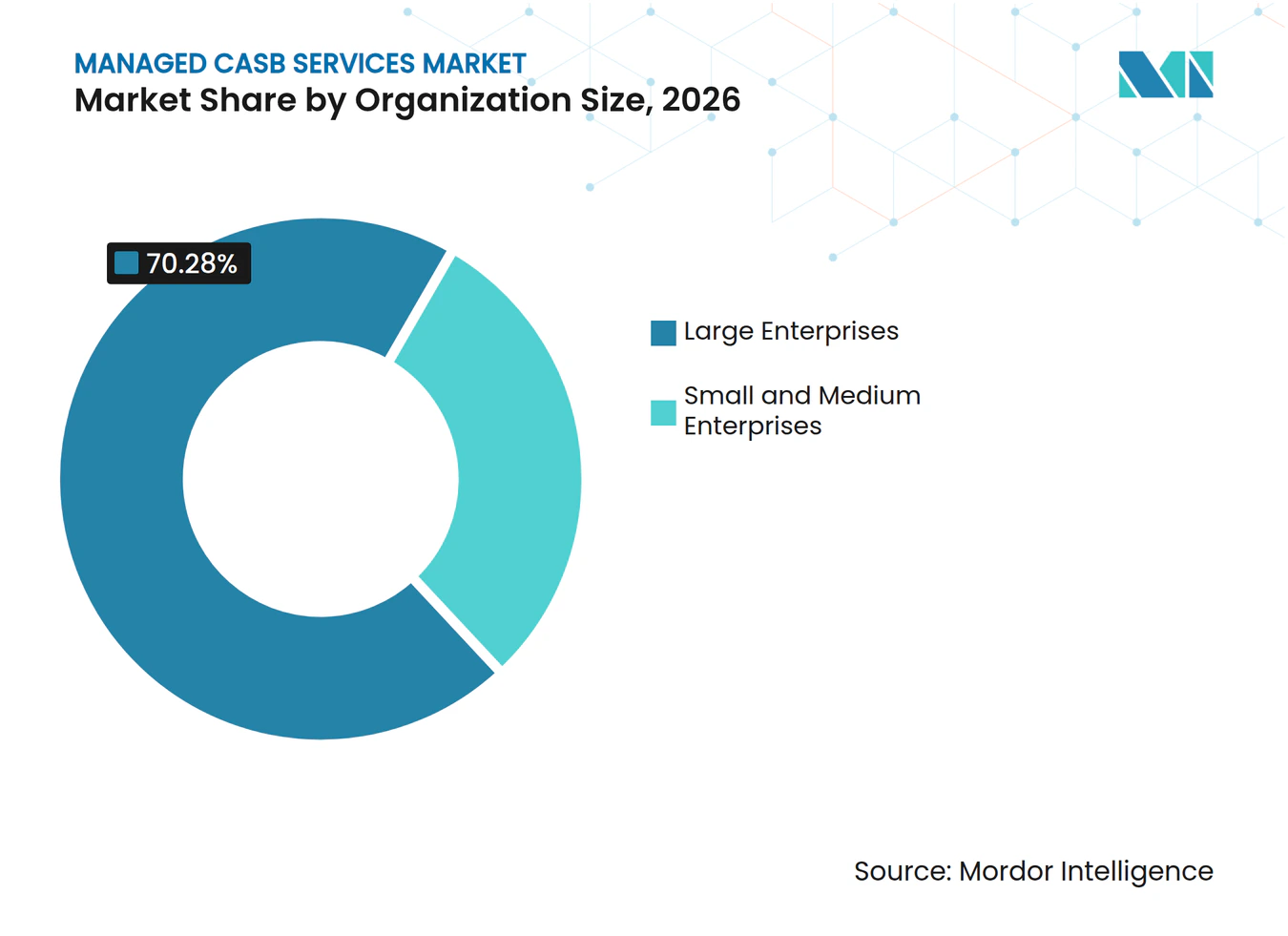
Large Enterprises Lead, While SMEs Gain Access to Managed ServicesLarge enterprises accounted for 70.28% of revenue in the managed CASB services market in 2026. Their multicloud estates, large SaaS portfolios, and compliance responsibilities create a broad control environment. Organizations operating in several jurisdictions also need policies that can work across varied regulatory requirements. A unified control plane can help these enterprises manage cloud access and data protection more consistently. Replicating this capacity internally may require a dedicated group of specialist engineers, which can favor managed services to ensure continuous operational coverage.
SMEs are projected to grow at a 19.64% CAGR through 2032 within the managed CASB services market. Platform economics and wider compliance obligations are making advanced cloud security more accessible to smaller organizations. iboss launched its MSSP SASE Platform in October 2025 to provide enterprise-grade CASB and Zero Trust capabilities to managed service providers serving mid-market customers. SMEs in fintech, e-commerce, and professional services also face cyber-insurance questions regarding cloud application visibility and data loss prevention. These questions can prompt adoption of managed control before a business develops an internal security operations function, thereby widening the customer base beyond large enterprises.

By End-User Industry:
BFSI Leads Spending, While Government Demand RisesBFSI accounted for 29.14% of the managed CASB services market in 2026. Financial organizations manage sensitive information across treasury systems, risk analytics platforms, and customer relationship applications. Connections among these SaaS applications can create data flows that require more than basic shadow IT discovery can provide. DORA has applied to European financial entities since January 2025 and has increased attention on documented ICT risk management. These organizations need cloud access controls that can be monitored and demonstrated during oversight activity, supporting BFSI spending on managed cloud security services.
Government and public administration is projected to expand at an 18.45% CAGR through 2032 in the managed CASB services market. Public-sector requirements increasingly emphasize Zero Trust practices and secure cloud access. Australia’s Protective Security Policy Framework Requirement 0214 requires CASB-integrated SSE gateway deployment by July 2026.[2] Such requirements can move spending from general cloud security planning toward formal managed deployments. Healthcare and life sciences need controls for sensitive patient information, while IT and telecommunications, industrial manufacturing, retail and e-commerce, and energy and utilities add revenue as cloud use outpaces internal governance capacity.
Geography Analysis
North America Managed CASB Services Market
North America held 36.12% of the managed CASB services market share in 2026. The United States combines federal Zero Trust requirements, established SaaS adoption, and cyber-insurance expectations that support demand for managed cloud controls. CISA’s Zero Trust Maturity Model provides a federal reference point for cloud access control practices. California cybersecurity audit requirements took effect in January 2026 and increased the need for documented cybersecurity practices among covered organizations. Canada and Mexico add to demand through financial services digitalization and expanded use of technology-sector SaaS.
APAC Managed CASB Services Market
Asia-Pacific is projected to expand at an 18.79% CAGR through 2032 in the managed CASB services market. Japan has developed managed CASB capacity through IT service providers and telecommunications carriers. NTT Data offers its BXO Managed CASB/SWG service in Japan.[3] SoftBank’s managed Zscaler service was recognized as Japan’s Partner of the Year for 3 consecutive years through 2026. India’s fintech and IT services sectors use hybrid cloud environments across public cloud providers, while China’s cybersecurity and personal information rules support local data processing requirements for cloud security providers.
EMEA and South America Managed CASB Services Market
Europe is shaped by NIS2, DORA, and GDPR requirements that cover financial services, critical infrastructure, and data controllers. Skyhigh Security received BSI C5 certification in April 2026 for its SSE portfolio, including CASB, secure web gateway, Zero Trust network access, and data loss prevention. The Middle East is developing demand alongside digitalization programs in Saudi Arabia and the UAE. South America remains earlier in development, with Brazil and Argentina leading financial services digitalization, while Africa has an emerging opportunity in South Africa and Nigeria as banking-sector SaaS use advances faster than local cloud security staffing.
Competitive Landscape
Market Concentration
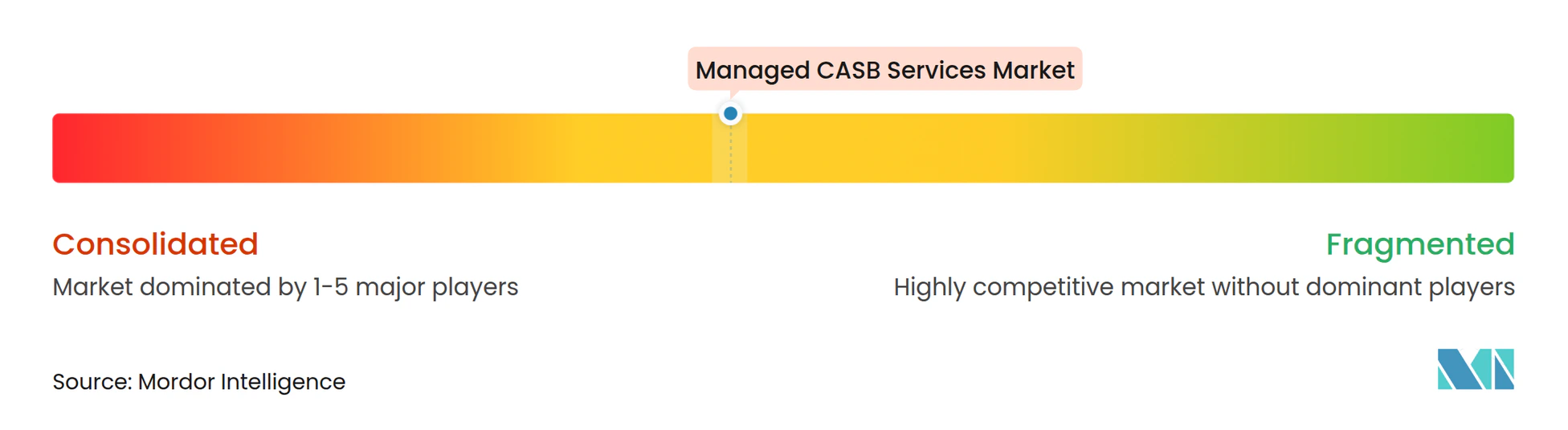
The managed CASB services market is moderately consolidated at the platform layer. Zscaler, Netskope, and Palo Alto Networks are the leading platform providers in the draft’s competitive set. Below the platform layer, managed security service providers resell or white-label capabilities from these vendors. This creates a more fragmented provider base for managed delivery. Vendors are differentiating through AI-based policy automation, data loss prevention, and multicloud policy orchestration that help customers govern more SaaS applications and data flows.
In the managed CASB services market, Netskope introduced Agent Action Control in September 2026 to classify and block risky agentic AI actions before they are executed. Zscaler launched Agentic SOC in September 2026, featuring autonomous AI agents designed to detect, contain, and remediate threats.[4] Zscaler also acquired SPLX in November 2025 and SquareX in February 2026. In May 2026, the company announced plans to acquire Symmetry Systems to add access graph technology for mapping AI agent communications. This sequence adds AI asset governance, browser-layer enforcement, and access mapping, while iboss serves the SME opportunity through its MSSP SASE Platform for service providers and IT resellers.
Sovereign cloud security is another area of competition where local processing and compliance requirements matter. Zscaler partnered with Schwarz Digits in July 2026 to provide a sovereign cloud security platform for Europe. Certifications such as FedRAMP, ISO 27001, and BSI C5 can serve as market access requirements in regulated sectors. Skyhigh Security obtained FedRAMP High Authorization for its Data Security Posture Management product in January 2026, while managed delivery remains more dispersed among service providers.
Managed CASB Services Industry Leaders
-
Palo Alto Networks, Inc.
-
Cloudflare, Inc.
-
Proofpoint, Inc.
-
Zscaler, Inc.
-
Akamai Technologies, Inc.
- *Disclaimer: Major Players sorted in no particular order
Managed CASB Services Market Companies Covered in this Report
- Zscaler, Inc.
- Netskope, Inc.
- Palo Alto Networks, Inc.
- Cato Networks, Ltd.
- Skyhigh Security, LLC
- Forcepoint LLC
- iboss, Inc.
- Lookout, Inc.
- Cloudflare, Inc.
- Akamai Technologies, Inc.
- Versa Networks, Inc.
- Menlo Security, Inc.
- Island Technology, Inc.
- Appgate, Inc.
- Open Systems AG
- Cloudbrink, Inc.
- Aryaka Networks, Inc.
- Broadcom Inc.
- Proofpoint, Inc.
- Imperva, Inc.
Recent Industry Developments in Managed CASB Services Market
- October 2026: Zscaler collaborated with IBM and Red Hat to protect private applications from frontier AI-powered threats, extending AI-native detection and response within the Zero Trust Exchange to cover AI-driven lateral movement scenarios.
- October 2026: Netskope and BT International expanded their partnership to deliver integrated SSE, including CASB, ZTNA, and SWG, across BT's Global Fabric network, enabling secure access to cloud and AI applications for multinational enterprise customers.
- September 2026: Zscaler launched its Agentic SOC, deploying autonomous AI agents to detect, contain, and remediate cloud threats without requiring manual analyst escalation, thereby directly addressing SOC alert fatigue in managed CASB environments.
- September 2026: Netskope released Agent Action Control within Netskope Skylight AI Security, which classifies risky agentic AI actions by risk level and blocks them before execution across sanctioned SaaS environments.
Global Managed CASB Services Market Report Scope
The Managed CASB Services Market comprises outsourced cloud security services that monitor, manage, configure, optimize, and govern Cloud Access Security Broker (CASB) environments across enterprise cloud ecosystems. The market includes managed CASB operations, policy administration, SaaS visibility, cloud data protection, user activity monitoring, compliance management, threat detection, access governance, advisory services, ongoing optimization, and operational support services delivered by managed security service providers.
The Managed CASB Services Market Report is Segmented by Service Model (Fully Managed CASB Services, Co-Managed CASB Services, and Advisory-Led CASB Operations Services), Deployment Model (Public Cloud, Private Cloud, and Hybrid Cloud), Organization Size (Large Enterprises, and Small and Medium Enterprises), End-User Industry (Banking, Financial Services, and Insurance [BFSI], Government and Public Administration, Healthcare and Life Sciences, IT and Telecommunication, Industrial Manufacturing, Retail and E-commerce, Energy and Utilities, and Other End-User Industries), and Geography (North America, South America, Europe, Asia-Pacific, Middle East, and Africa). The Market Forecasts are Provided in Terms of Value (USD).
Segmentation Overview
| Fully Managed CASB Services |
| Co-Managed CASB Services |
| Advisory-Led CASB Operations Services |
| Public Cloud |
| Private Cloud |
| Hybrid Cloud |
| Large Enterprises |
| Small and Medium Enterprises |
| Banking, Financial Services, and Insurance (BFSI) |
| Government and Public Administration |
| Healthcare and Life Sciences |
| IT and Telecommunication |
| Industrial Manufacturing |
| Retail and E-commerce |
| Energy and Utilities |
| Other End-User Industries |
| North America | United States |
| Canada | |
| Mexico | |
| South America | Brazil |
| Argentina | |
| Rest of South America | |
| Europe | Germany |
| United Kingdom | |
| France | |
| Italy | |
| Russia | |
| Rest of Europe | |
| Asia-Pacific | China |
| Japan | |
| India | |
| South Korea | |
| Rest of Asia-Pacific | |
| Middle East | Saudi Arabia |
| United Arab Emirates | |
| Rest of Middle East | |
| Africa | South Africa |
| Nigeria | |
| Rest of Africa |
| By Service Model | Fully Managed CASB Services | |
| Co-Managed CASB Services | ||
| Advisory-Led CASB Operations Services | ||
| By Deployment Model | Public Cloud | |
| Private Cloud | ||
| Hybrid Cloud | ||
| By Organization Size | Large Enterprises | |
| Small and Medium Enterprises | ||
| By End-User Industry | Banking, Financial Services, and Insurance (BFSI) | |
| Government and Public Administration | ||
| Healthcare and Life Sciences | ||
| IT and Telecommunication | ||
| Industrial Manufacturing | ||
| Retail and E-commerce | ||
| Energy and Utilities | ||
| Other End-User Industries | ||
| By Geography | North America | United States |
| Canada | ||
| Mexico | ||
| South America | Brazil | |
| Argentina | ||
| Rest of South America | ||
| Europe | Germany | |
| United Kingdom | ||
| France | ||
| Italy | ||
| Russia | ||
| Rest of Europe | ||
| Asia-Pacific | China | |
| Japan | ||
| India | ||
| South Korea | ||
| Rest of Asia-Pacific | ||
| Middle East | Saudi Arabia | |
| United Arab Emirates | ||
| Rest of Middle East | ||
| Africa | South Africa | |
| Nigeria | ||
| Rest of Africa | ||
Key Questions Answered in the Report
What is the managed CASB services market size?
The managed CASB services market size is projected to grow from USD 1.16 billion in 2026 and USD 1.36 billion in 2027 to USD 3.13 billion by 2032.
What is driving demand for managed CASB services?
SaaS and multicloud use, Zero Trust obligations, data-residency requirements, and shortages in cloud security skills are increasing demand for managed delivery.
Which managed CASB service model has the largest share?
Fully managed services held 67.44% of revenue in 2026 because customers can delegate policy management, monitoring, incident response, and reporting.
Which deployment model is growing fastest for managed CASB services?
Hybrid cloud is projected to grow at a 19.37% CAGR through 2032 as regulated organizations need controls across public and on-premises environments.
Which end-user sector leads spending on managed CASB services?
BFSI held 29.14% of revenue in 2026, supported by sensitive data handling and documented cloud access control requirements.
Which region is growing fastest for managed CASB services?
Asia-Pacific is projected to grow at an 18.79% CAGR through 2032, supported by managed security capacity in Japan and hybrid cloud demand in India.