
Managed Secure SD-WAN Services Market Size and Share
Market Overview
| Study Period | 2021 - 2032 |
|---|---|
| Market Size (2027) | USD 22.93 Billion |
| Market Size (2032) | USD 45.26 Billion |
| Growth Rate (2027 - 2032) | 14.57 % |
| Fastest Growing Market | Asia-Pacific |
| Largest Market | North America |
| Market Concentration | Low |
Major Players *Disclaimer: Major Players sorted in no particular order Image © Mordor Intelligence. Reuse requires attribution under CC BY 4.0. | |
Managed Secure SD-WAN Services Market Analysis by Mordor Intelligence
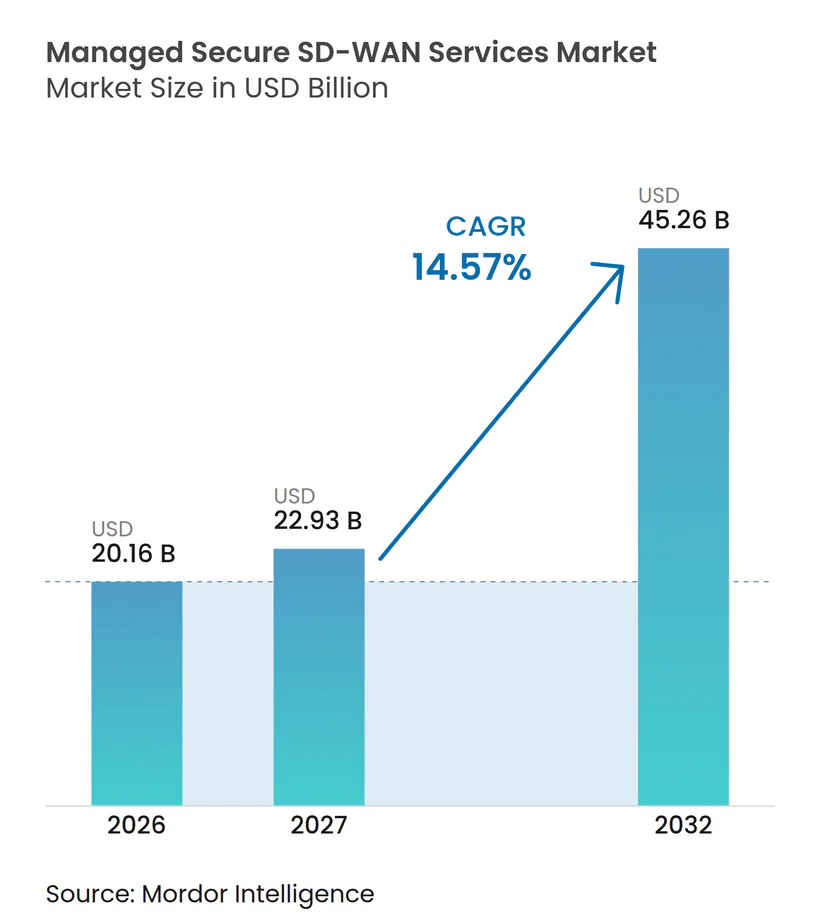
The managed secure SD-WAN services market size is valued at USD 20.16 billion in 2026 and is forecast to reach USD 45.26 billion by 2032, advancing at a CAGR of 14.57% during 2027-2032. The managed secure SD-WAN services market is benefiting as enterprises replace aging MPLS networks with internet-first overlays for cloud applications. Direct internet access reached 49% of surveyed enterprise WAN sites, while MPLS accounted for 41%, which changes the opportunity for providers that manage broadband-based overlays. The convergence of SD-WAN, secure access service edge, and zero-trust security is making security capabilities a standard procurement requirement. Providers can expand contract value when they combine network operations, security management, cloud access, and incident response under one service agreement. A dispersed provider base also leaves room for capable providers to win clients in the managed secure SD-WAN services market through vertical expertise, flexible service models, and stronger automation.
Key Report Takeaways
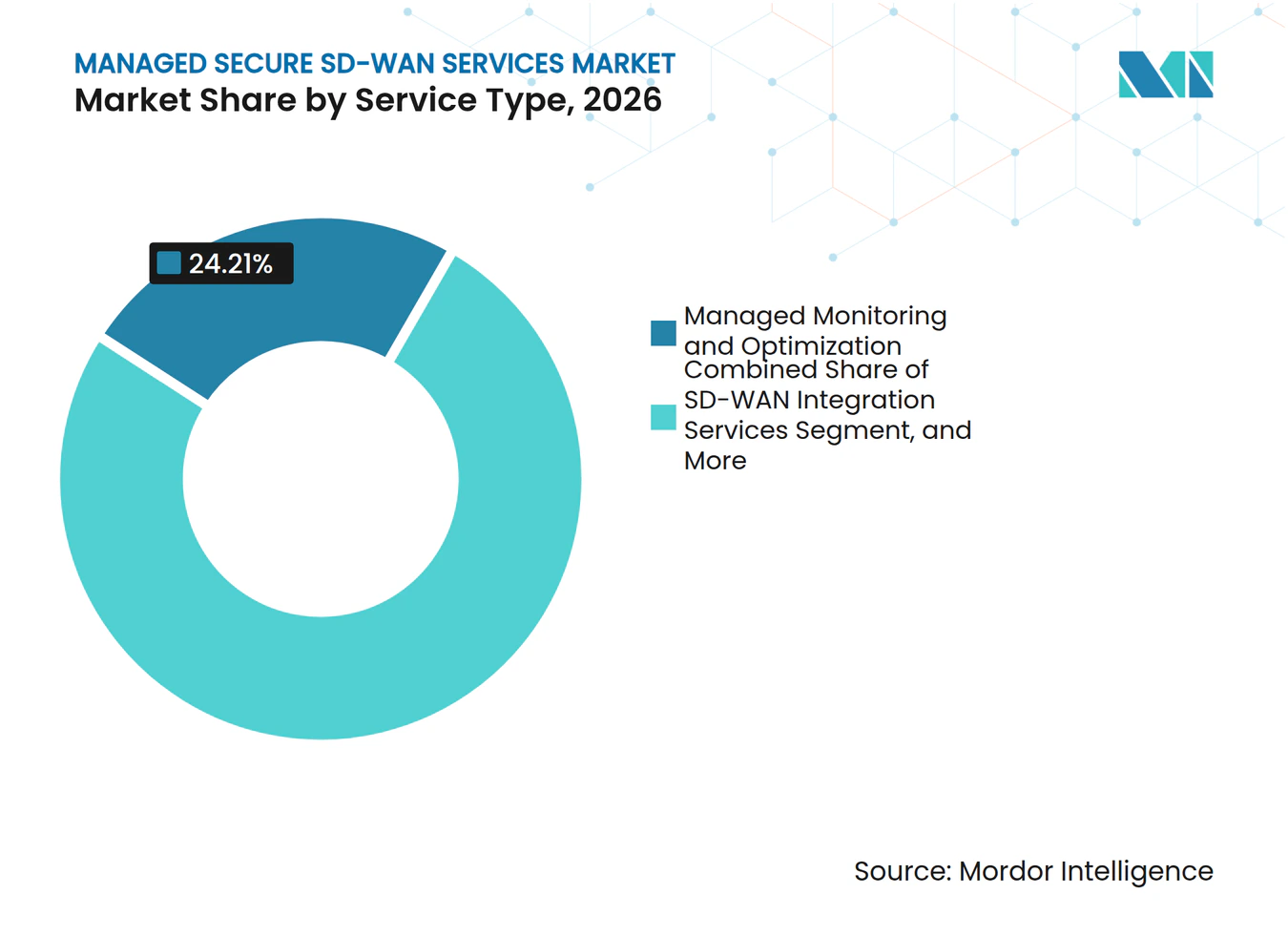
- By service type, Managed Monitoring and Optimization held 24.21% of the managed secure SD-WAN services market share in 2026, while Managed Security and SASE Services is projected to expand at a 14.88% CAGR through 2032.
- By deployment model, Cloud-Delivered SD-WAN accounted for 41.26% of revenue in 2026 and is projected to expand at a 14.94% CAGR through 2032.
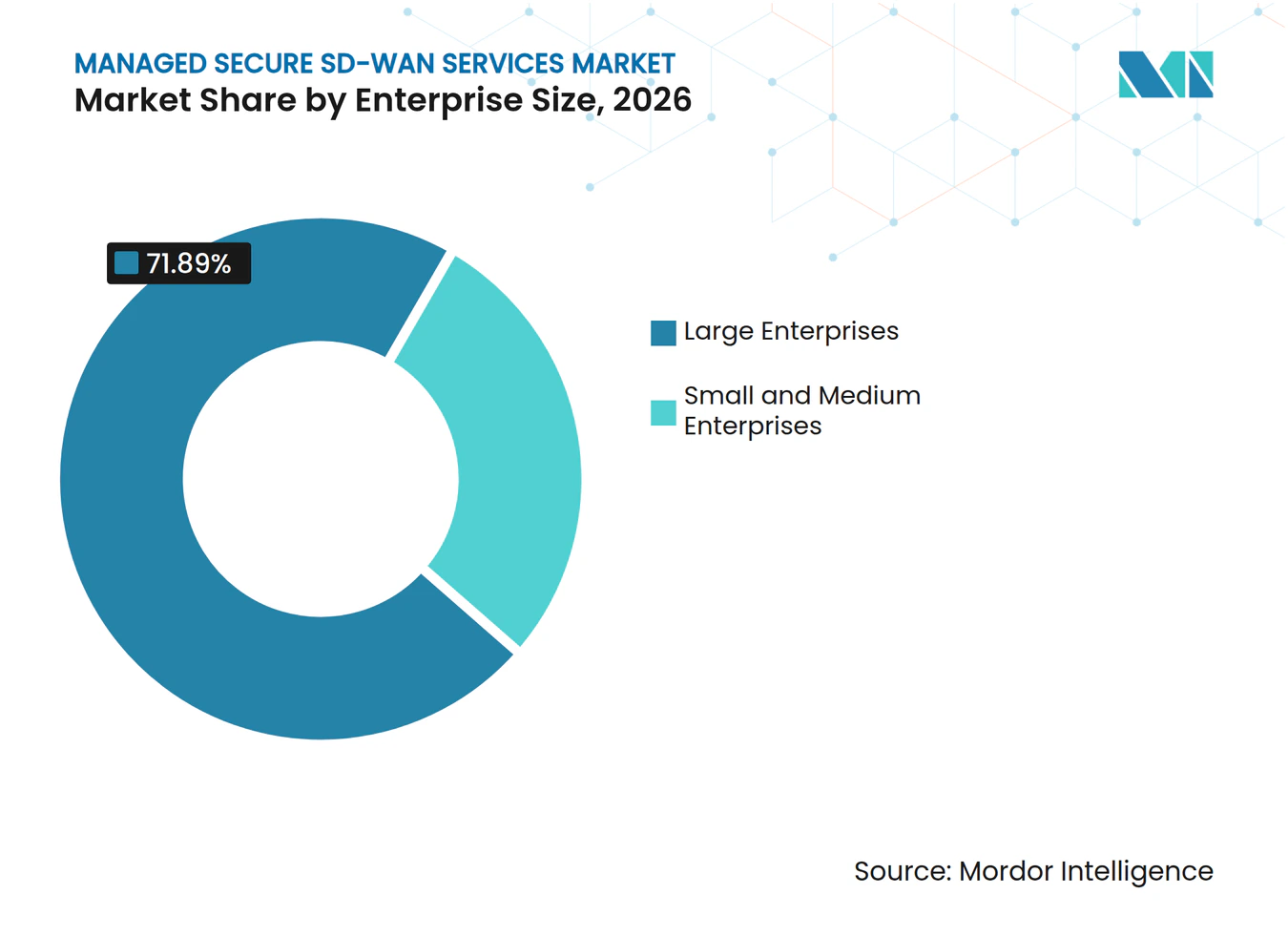
- By enterprise size, Large Enterprises held 71.89% of revenue in 2026, while SMEs are projected to expand at a 14.72% CAGR through 2032.
- By end-user industry, BFSI accounted for 21.54% of revenue in 2026, while Manufacturing is projected to expand at a 15.14% CAGR through 2032.
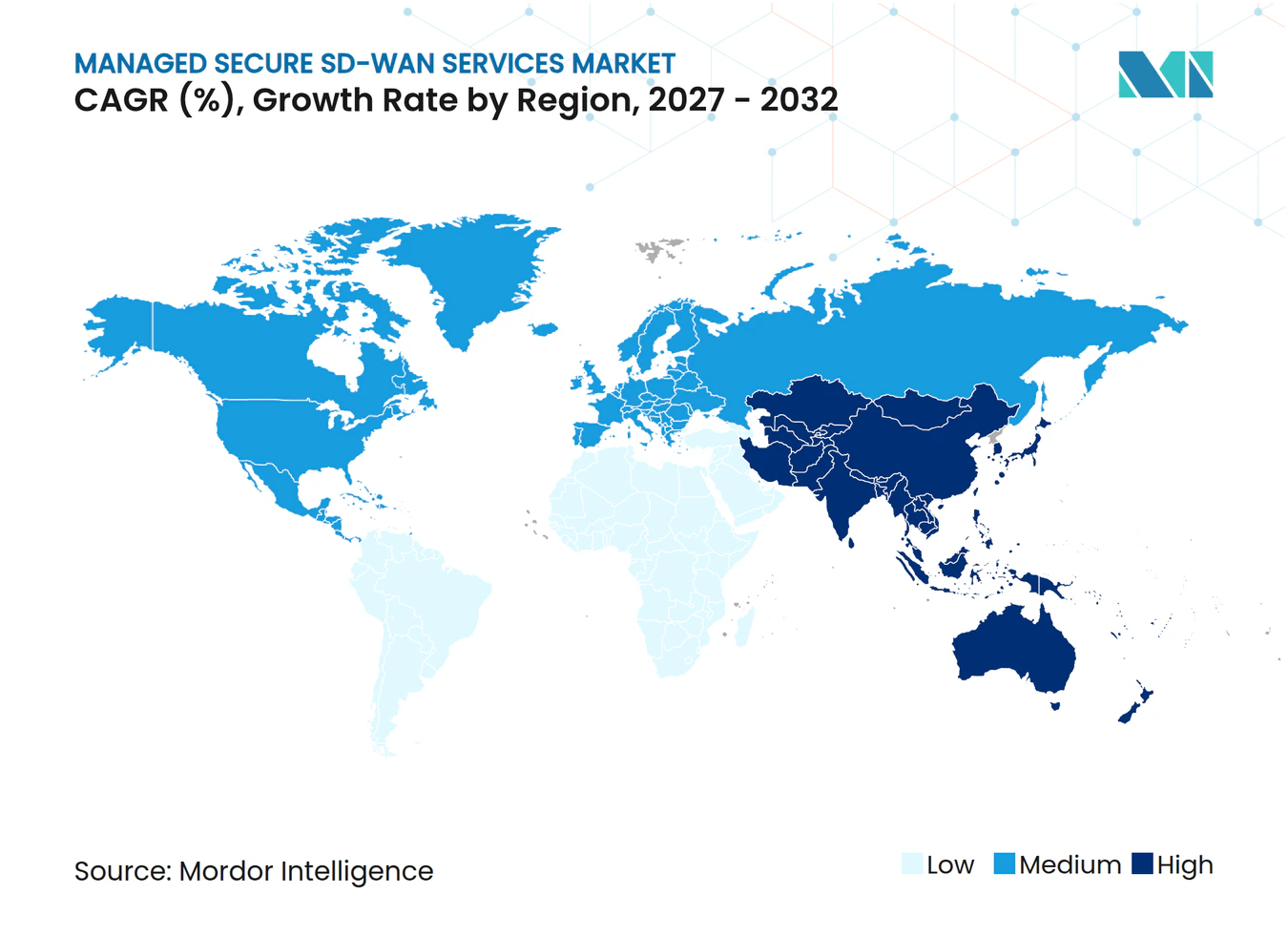
- By geography, North America held 38.16% of revenue in 2026, while Asia-Pacific is projected to expand at a 15.11% CAGR through 2032.
Note: Market numbers in this report are based on Mordor Intelligence's proprietary estimation framework, which combines nine months of actuals with Q4 projections for base year 2026.
Global Managed Secure SD-WAN Services Market Trends and Insights
Drivers Impact Analysis*
| Driver | (~) % Impact on CAGR Forecast | Geographic Relevance | Impact Timeline |
|---|---|---|---|
| Cloud and SaaS Traffic Across Distributed Branches | +4.1% | Global, highest concentration in North America and Asia-Pacific | Short term (≤ 2 years) |
| SD-WAN, SASE, and Zero-Trust Convergence | +2.9% | Global, accelerated in North America and Europe | Medium term (2-4 years) |
| Outsourcing Scarce Network and Security Skills | +2.5% | Global, particularly Asia-Pacific and South America | Short term (≤ 2 years) |
| MPLS-to-Broadband and DIA Migration | +2.1% | North America, Europe, and Asia-Pacific core, with spillover to Middle East and Africa | Medium term (2-4 years) |
| AI-Assisted Network Assurance Demand | +1.1% | North America and Europe, with early gains in Japan and South Korea | Long term (≥ 4 years) |
| Industrial IoT and Edge-Connected Site Expansion | +0.7% | Asia-Pacific core, with spillover to Middle East and Africa | Medium term (2-4 years) |
| Source: Mordor Intelligence | |||
Cloud and SaaS Traffic Growth Across Distributed Branches
Multi-cloud adoption makes backhauling branch traffic through data centers less suitable for many cloud workloads. Local internet breakout can direct traffic nearer to cloud applications and reserve private links for internal workloads. Best Buy Health integrated Fortinet SD-WAN with AWS Cloud WAN to support its distributed care-center network.[1] The managed secure SD-WAN services market therefore benefits when providers include cloud on-ramps and application-aware routing. These capabilities can increase switching costs when a provider manages connectivity, policy, and application performance together. Enterprises with legacy MPLS contracts also have a clear reason to assess lower-cost broadband and direct internet access options.
SD-WAN, SASE, and Zero-Trust Security Convergence
The managed secure SD-WAN services market is moving toward services that combine networking and security operations. This model can reduce the number of vendors that an enterprise must coordinate. Palo Alto Networks introduced an autonomous Prisma SD-WAN troubleshooting agent that develops troubleshooting plans from real-time telemetry and performs root-cause analysis.[2] Providers can extend zero-trust policies to branch devices, including IoT equipment and unmanaged endpoints. Unified policy across cloud, branch, and operational technology environments can support higher-value contracts. Security integration also makes managed WAN services more relevant to compliance-led buying decisions.
Outsourcing Scarce Network and Security Expertise
Enterprises often need specialized skills to operate multivendor networks and security tools. This requirement supports demand for managed and co-managed service models. Managed providers can pool specialists across many customer environments and make advanced operations accessible to smaller teams. Self-service portals and automated provisioning can reduce the cost of supporting each managed site. The managed secure SD-WAN services market can therefore serve smaller organizations more effectively through consumption-based offers. Providers that simplify ordering and operations may be better positioned to capture underserved SME demand.
MPLS-to-Broadband and DIA Migration
MPLS use declined from 82% of surveyed enterprise sites in 2018 to 41% in 2023, while direct internet access reached 49%.[3] This shift expands the need for overlays that can manage performance across internet-based underlays. Tata Communications deployed IZO SD-WAN for WACKER Chemie across more than 110 sites in more than 30 countries. The deployment combined DIA, broadband, 5G, and low-Earth-orbit satellite links under a managed layer. Some regulated industries will retain private connectivity where compliance and service guarantees demand it. Providers must therefore support hybrid architectures rather than treat every migration as a full replacement.
Restraints Impact Analysis*
| Restraint | (~) % Impact on CAGR Forecast | Geographic Relevance | Impact Timeline |
|---|---|---|---|
| Legacy WAN and Multivendor Security Integration Complexity | -1.8% | Global, highest friction in North America and Europe with large MPLS bases | Medium term (2-4 years) |
| Reluctance to Outsource Sensitive Network Operations | -1.4% | North America and Europe, particularly BFSI and government | Long term (≥ 4 years) |
| Upfront Transformation Costs and Skills Requirements | -1.0% | South America and Middle East and Africa | Short term (≤ 2 years) |
| Carrier Interoperability and Policy-Portability Constraints | -0.7% | Global, sharpest friction in multinational deployments | Long term (≥ 4 years) |
| Source: Mordor Intelligence | |||
Legacy WAN and Multivendor Security Integration Complexity
Overlay-first rollouts allow enterprises to preserve existing circuits, but they can extend migration schedules. Providers must support heterogeneous network and security environments during these transitions. Manufacturing and energy organizations also need separate policies for information technology and operational technology traffic. A peer-reviewed assessment found that SD-WAN had the lowest operational technology security risk score among 9 WAN technologies studied. The assessment still highlights the importance of careful segmentation and implementation. For the managed secure SD-WAN services market, pre-validated designs can help providers reduce this implementation burden for customers.
Reluctance to Outsource Sensitive Network Operations
Organizations in regulated sectors may hesitate to transfer full control of network operations to an external provider. Sensitive data, compliance requirements, and confidence in provider-operated analytics can influence that decision. A co-managed approach allows the enterprise to retain policy ownership while outsourcing monitoring, provisioning, and incident response. This approach creates a smaller starting engagement instead of forcing a full operational handoff. The managed secure SD-WAN services market can benefit when providers offer clear tiers between self-management and full outsourcing. Self-service portals can also give customers direct visibility without removing provider accountability.
*Our forecasts treat driver/restraint impacts as directional, not additive. The impact forecasts reflect baseline growth, mix effects, and variable interactions.
Segment Analysis
By Service Type: Monitoring and Optimization Support Ongoing Operations
Managed Monitoring and Optimization captured 24.21% of service-type revenue in 2026. The managed secure SD-WAN services market size for this service type is supported by enterprises that have deployed overlays but still need operational expertise. These contracts can create recurring revenue because performance management remains necessary after deployment. Managed Security and SASE Services is projected to expand at a 14.88% CAGR through 2032. Organizations are combining security service edge functions with WAN operations to reduce vendor coordination.
Deployment Services and Integration Services support initial migration activity and tend to produce project-based revenue. Managed Connectivity and Underlay Services remain strategically important for providers that can bundle access procurement with overlay operations. Technical Support and Lifecycle Services gain relevance as the installed base of edge devices expands. In the managed secure SD-WAN services market, this demand follows the number of deployed devices rather than the number of new projects. This helps providers use automation to improve operating leverage as the customer base matures.



By Deployment Model: Cloud Delivery Leads Scale and Momentum
Cloud-Delivered SD-WAN held 41.26% of deployment-model revenue in 2026. It is also projected to expand at a 14.94% CAGR through 2032, giving it the leading managed secure SD-WAN services market share and the fastest forecast pace in this segmentation. Arista Networks acquired the VeloCloud portfolio from Broadcom in July 2025 ARISTA NETWORKS. The transaction placed a widely deployed cloud-delivered platform within Arista's campus and data center networking portfolio. This ownership change reinforces the strategic importance of branch-to-cloud connectivity.
On-premise managed edge deployments remain relevant for government, defense, and financial-services users with strict data sovereignty requirements. These users may limit cloud control-plane use for sensitive traffic classes. Hybrid delivery enables gradual migration while retaining local management for selected applications. The managed secure SD-WAN services market also retains a role for hybrid architectures during these transitions. Providers that support cloud-delivered, on-premise, and hybrid models can reduce disruption during a customer's transition.
By Enterprise Size: Large Enterprises Provide Revenue While SMEs Add Opportunity
Large Enterprises accounted for 71.89% of revenue in 2026. Their higher per-site spending, multi-cloud needs, and multi-year service agreements support that concentration. SMEs are projected to expand at a 14.72% CAGR through 2032. Lower edge-device costs and consumption-based pricing reduce the need for major upfront commitments. The managed secure SD-WAN services market offers SMEs an alternative to building dedicated WAN engineering teams.
Smaller organizations often prefer a packaged networking and security service over separate specialist products. Fortinet offers SD-WAN Manager capabilities for centralized management of SD-WAN deployments. Cato Networks offers a cloud-native platform that combines networking and security services. Providers that automate fulfillment and customer support can address SME demand without matching increases in field engineering staff. This operating model may favor software-centric service platforms in the managed secure SD-WAN services market.

By End-User Industry: BFSI Anchors Spending and Manufacturing Adds Demand
BFSI held 21.54% of end-user revenue in 2026. Branch density, transaction sensitivity, and regulatory obligations create demand for encrypted connectivity and continuous network monitoring. The managed secure SD-WAN services market size in BFSI is also supported by requirements for segmentation, redundant underlays, and security event logging. Tata Tele Business described a managed SD-WAN deployment for a financial services customer with micro-segmentation, URL filtering, and firewall functions. These needs can raise the value of each managed site.
Manufacturing is projected to expand at a 15.14% CAGR through 2032. Industrial IoT connects production sites, logistics operations, and supplier networks, increasing the need for secure and reliable connectivity. The Journal of Cybersecurity and Privacy assessment found SD-WAN had the lowest risk score across the 9 WAN technologies evaluated for operational technology MDPI. Palo Alto Networks published a manufacturing-specific design guide for secure enterprise connectivity in October 2025. Within the managed secure SD-WAN services market, this sector requires tailored security and performance policies.
Geography Analysis
North America held 38.16% of revenue in 2026. Large enterprise budgets and a mature provider ecosystem support the regional position in the managed secure SD-WAN services market. AT&T Business launched a post-quantum cryptography-enabled SD-WAN service in May 2026. The release raised the importance of quantum-resilient security in provider roadmaps. The region also supports carrier and technology-provider partnerships that make integrated services available to mid-market customers.
Asia-Pacific is projected to expand at a 15.11% CAGR through 2032. Network modernization across China, Japan, India, South Korea, and Southeast Asia is supporting adoption. Tata Communications was named a Leader in the IDC MarketScape for Asia-Pacific managed SD-WAN and SASE services for 2025-2026. The company cited its Digital Fabric strategy and automation-led delivery. The region presents opportunities for providers that support incremental modernization and API-led consumption models.
Europe remains a major enterprise region, led by Germany, the United Kingdom, France, and Benelux. Privacy, resilience, and security requirements can shift WAN procurement toward integrated offerings. In South America and the Middle East and Africa, the managed secure SD-WAN services market can benefit from new backbone capacity. GTT expanded its EnvisionCORE backbone to points of presence in Argentina, Chile, Colombia, Saudi Arabia, and South Africa in 2025. Providers must still account for local access conditions, compliance requirements, and customer readiness across these regions.
Competitive Landscape
Market Concentration
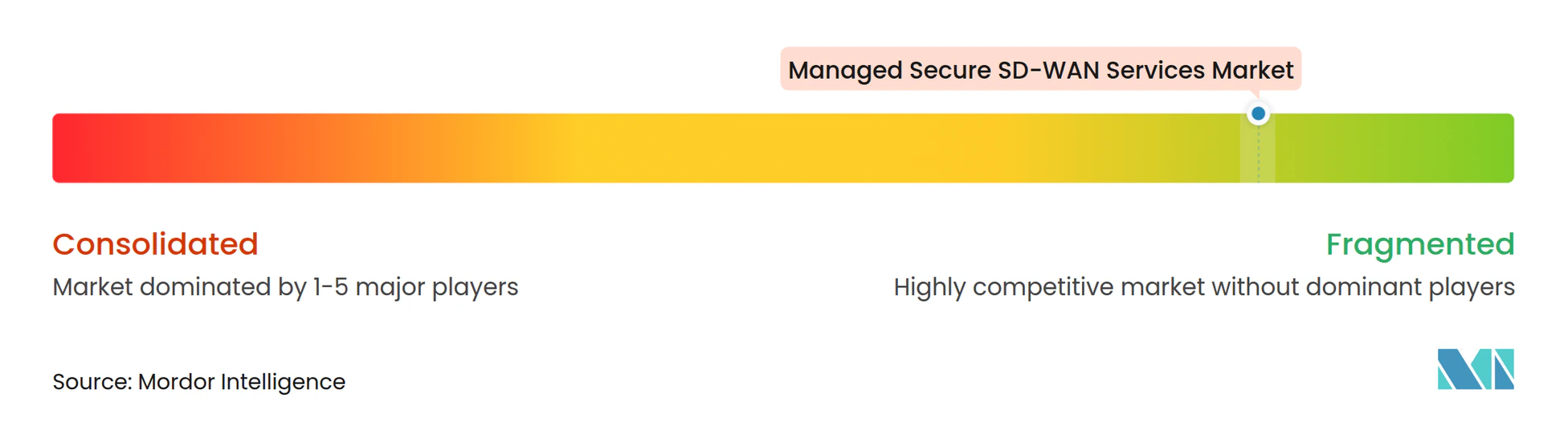
The managed secure SD-WAN services market includes global telecom operators, specialist managed service providers, and technology vendors that offer managed capabilities. Large telecom operators include AT&T, Verizon, Orange, Vodafone, BT, Telefónica, NTT, Deutsche Telekom, and Singtel. Specialist providers include GTT, Aryaka, Colt, Comcast, PCCW Global, and Tata Communications. Technology providers include Cisco, Fortinet, Palo Alto Networks, HPE, Versa Networks, and Cato Networks. Competition centers on integrated SASE delivery, automation, cloud connectivity, and vertical-specific security.
AT&T Business launched its post-quantum cryptography-enabled SD-WAN service with Cisco technology in May 2026. The offering adds a security-oriented differentiation point beyond bandwidth and basic overlay management. Arista's July 2025 acquisition of VeloCloud added cloud-delivered branch networking to its existing portfolio. GTT stated that its 2026 strategy prioritizes AI-enabled security, single-vendor SASE, and hybrid-cloud services. These moves show that competition in the managed secure SD-WAN services market centers on platform breadth and security integration.
Cato Networks reported USD 350 million in annual recurring revenue and 43% year-over-year growth in 2025. It also acquired Aim Security to extend enterprise data-protection capabilities. Colt and Versa Networks reduced SD-WAN provisioning time from 90 minutes to 12 seconds across 1,000 services in 55 countries. The managed secure SD-WAN services market remains fragmented, with opportunities in SMEs, industrial operational technology settings, and regions gaining backbone capacity.
Managed Secure SD-WAN Services Industry Leaders
-
AT&T Inc.
-
Verizon Communications Inc.
-
Hughes Network Systems, LLC
-
Orange S.A.
-
Vodafone Group plc
- *Disclaimer: Major Players sorted in no particular order
Recent Industry Developments
- May 2026: AT&T Business launched the first major North American post-quantum cryptography-enabled SD-WAN service, powered by the Cisco 8000 Series Secure Router. The offering delivers next-generation cryptographic defenses against threats posed by quantum computing and is planned for global availability later in 2026, setting a new security benchmark for managed WAN services.
- April 2026: Orange Business expanded its Flexible SD-WAN security offering by incorporating Cisco Catalyst SD-WAN features, strengthening the security capabilities of its managed SD-WAN portfolio. The solution targets on-premises sites and integrates networking and security capabilities.
- April 2026: GTT Communications announced its 2026 strategy following 2025 investments that grew its global Tier 1 IP backbone to the world's third-largest at 700+ terabits of capacity. The strategy prioritizes AI-enabled network security through the GTT Envision platform, expanded single-vendor SASE offerings, and hybrid cloud services spanning edge and core nodes.
- February 2026: Scale Computing acquired Adaptiv Networks, a cloud-native SD-WAN and SASE provider, extending its managed network solutions with integrated SD-WAN connectivity and centralized orchestration for distributed environments. The combined entity serves 9,000+ customers across quick-service restaurant, retail, and distributed enterprise sectors.
Global Managed Secure SD-WAN Services Market Report Scope
The Managed Secure SD-WAN Services Market comprises outsourced, subscription-based services in which a third-party provider designs, deploys, operates, monitors, and secures an organization’s software-defined wide area network (SD-WAN) with integrated security capabilities combining intelligent application-aware routing, centralized policy management, and cloud-delivered security functions such as next-generation firewall (NGFW), secure web gateway (SWG), zero-trust network access (ZTNA), and cloud access security broker (CASB).
The Managed Secure SD-WAN Services Market Report is Segmented by Service Type (SD-WAN Deployment Services, SD-WAN Integration Services, Managed Monitoring and Optimization Services, Managed Security and SASE Services, Managed Connectivity and Underlay Services, and Technical Support and Lifecycle Services), Deployment Model (On-Premise Managed Edge, Cloud-Delivered SD-WAN, and Hybrid Deployment), Enterprise Size (Small and Medium Enterprises and Large Enterprises), End-User Industry (BFSI, IT and Telecom, Manufacturing, Healthcare and Life Sciences, Retail and E-Commerce, Government and Public Sector, Energy and Utilities, and Other End-user Industries), and Geography (North America, South America, Europe, Asia-Pacific, and Middle East and Africa). The Market Forecasts Are Provided in Terms of Value (USD).
| SD-WAN Deployment Services |
| SD-WAN Integration Services |
| Managed Monitoring and Optimization Services |
| Managed Security and SASE Services |
| Managed Connectivity and Underlay Services |
| Technical Support and Lifecycle Services |
| On-Premise Managed Edge |
| Cloud-Delivered SD-WAN |
| Hybrid Deployment |
| Small and Medium Enterprises |
| Large Enterprises |
| BFSI |
| IT and Telecom |
| Manufacturing |
| Healthcare and Life Sciences |
| Retail and E-Commerce |
| Government and Public Sector |
| Energy and Utilities |
| Other End-user Industries |
| North America | United States |
| Canada | |
| Mexico | |
| South America | Brazil |
| Argentina | |
| Chile | |
| Rest of South America | |
| Europe | United Kingdom |
| Germany | |
| France | |
| Italy | |
| Spain | |
| Rest of Europe | |
| Asia-Pacific | China |
| Japan | |
| India | |
| South Korea | |
| Rest of Asia-Pacific | |
| Middle East and Africa | Saudi Arabia |
| United Arab Emirates | |
| South Africa | |
| Egypt | |
| Rest of Middle East and Africa |
| By Service Type | SD-WAN Deployment Services | |
| SD-WAN Integration Services | ||
| Managed Monitoring and Optimization Services | ||
| Managed Security and SASE Services | ||
| Managed Connectivity and Underlay Services | ||
| Technical Support and Lifecycle Services | ||
| By Deployment Model | On-Premise Managed Edge | |
| Cloud-Delivered SD-WAN | ||
| Hybrid Deployment | ||
| By Enterprise Size | Small and Medium Enterprises | |
| Large Enterprises | ||
| By End-User Industry | BFSI | |
| IT and Telecom | ||
| Manufacturing | ||
| Healthcare and Life Sciences | ||
| Retail and E-Commerce | ||
| Government and Public Sector | ||
| Energy and Utilities | ||
| Other End-user Industries | ||
| By Geography | North America | United States |
| Canada | ||
| Mexico | ||
| South America | Brazil | |
| Argentina | ||
| Chile | ||
| Rest of South America | ||
| Europe | United Kingdom | |
| Germany | ||
| France | ||
| Italy | ||
| Spain | ||
| Rest of Europe | ||
| Asia-Pacific | China | |
| Japan | ||
| India | ||
| South Korea | ||
| Rest of Asia-Pacific | ||
| Middle East and Africa | Saudi Arabia | |
| United Arab Emirates | ||
| South Africa | ||
| Egypt | ||
| Rest of Middle East and Africa | ||
Key Questions Answered in the Report
What is the managed secure SD-WAN services market size?
The market is valued at USD 20.16 billion in 2026 and is forecast to reach USD 45.26 billion by 2032, at a 14.57% CAGR during 2027-2032.
What is driving adoption of managed secure SD-WAN services?
The managed secure SD-WAN services market is supported by cloud traffic, MPLS migration, security convergence, and shortages of network and security skills. Providers can address these needs through managed and co-managed delivery models.
Which service type holds the largest revenue share?
Managed Monitoring and Optimization holds 24.21% of service-type revenue in 2026. Managed Security and SASE Services is projected to expand at a 14.88% CAGR through 2032.
Which deployment model has the strongest outlook?
Cloud-Delivered SD-WAN holds 41.26% of revenue in 2026 and is projected to expand at a 14.94% CAGR through 2032.
Which customer segment is expanding fastest?
SMEs are projected to expand at a 14.72% CAGR through 2032 as providers introduce simpler consumption-based services.
Which region has the fastest projected expansion?
Asia-Pacific is projected to expand at a 15.11% CAGR through 2032 as enterprises modernize legacy networks.