
Managed Ransomware Prevention Services Market Size and Share
Market Overview
| Study Period | 2021 - 2032 |
|---|---|
| Market Size (2027) | USD 3.32 Billion |
| Market Size (2032) | USD 7.26 Billion |
| Growth Rate (2027 - 2032) | 16.94 % |
| Fastest Growing Market | Asia-Pacific |
| Largest Market | North America |
| Market Concentration | Medium |
Major Players *Disclaimer: Major Players sorted in no particular order Image © Mordor Intelligence. Reuse requires attribution under CC BY 4.0. | |
Managed Ransomware Prevention Services Market Analysis by Mordor Intelligence
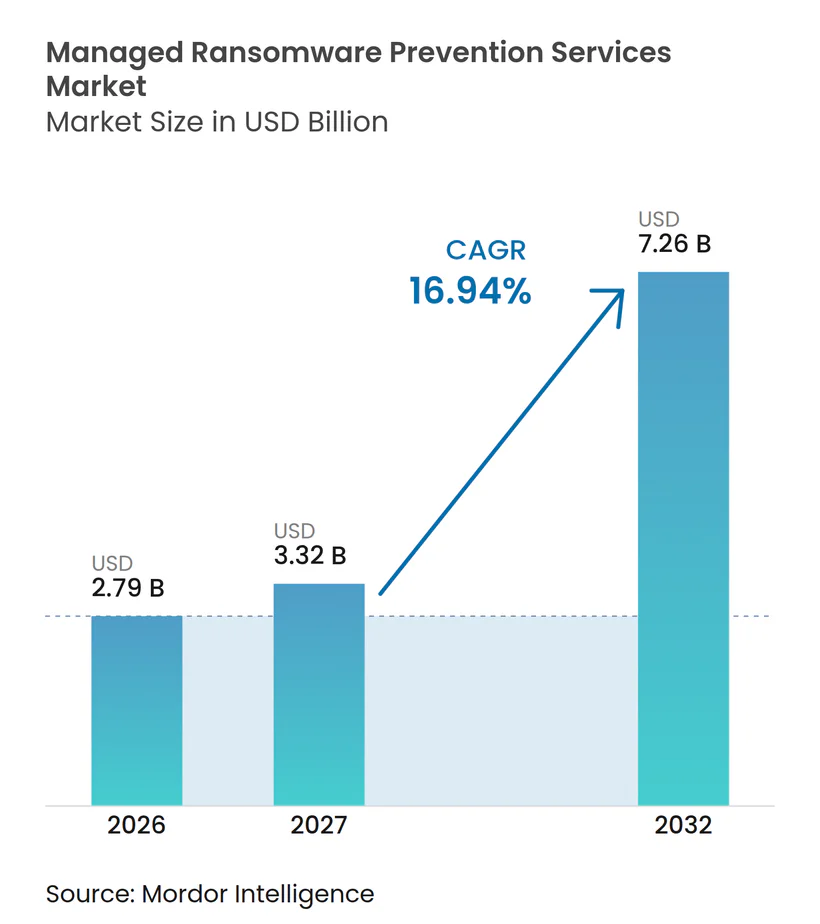
The managed ransomware prevention services market size is projected to expand from USD 2.79 billion in 2026 and USD 3.26 billion in 2027 to USD 7.26 billion by 2032, registering a CAGR of 16.94% between 2027 to 2032. Demand is shifting from separate security products toward external teams that monitor, detect, and respond to threats across the full security lifecycle, as buyers look for a service that can take responsibility for routine operations as well as support a coordinated response when a serious event occurs. Ransomware now combines encryption with data theft, so reliable backups alone do not remove the need for early detection and response, because the potential exposure of sensitive information can create legal, operational, customer, and reputational challenges even after systems are restored. Buyers are placing more value on providers that can combine cloud, identity, endpoint, and network signals in a single operating model, allowing security staff to assess related activity together and prioritize the actions most likely to reduce immediate exposure. Regulation, insurance requirements, and limited cyber skills are making continuous protection a more formal business requirement, especially for organizations that must demonstrate how they monitor critical systems, control access, handle incidents, and oversee important third-party relationships. The Managed ransomware prevention services market also favors providers that can demonstrate local data handling, clear accountability, and consistent service quality, because procurement teams need confidence that their provider can meet operational, contractual, and regulatory expectations across the full term of the relationship.
Key Report Takeaways
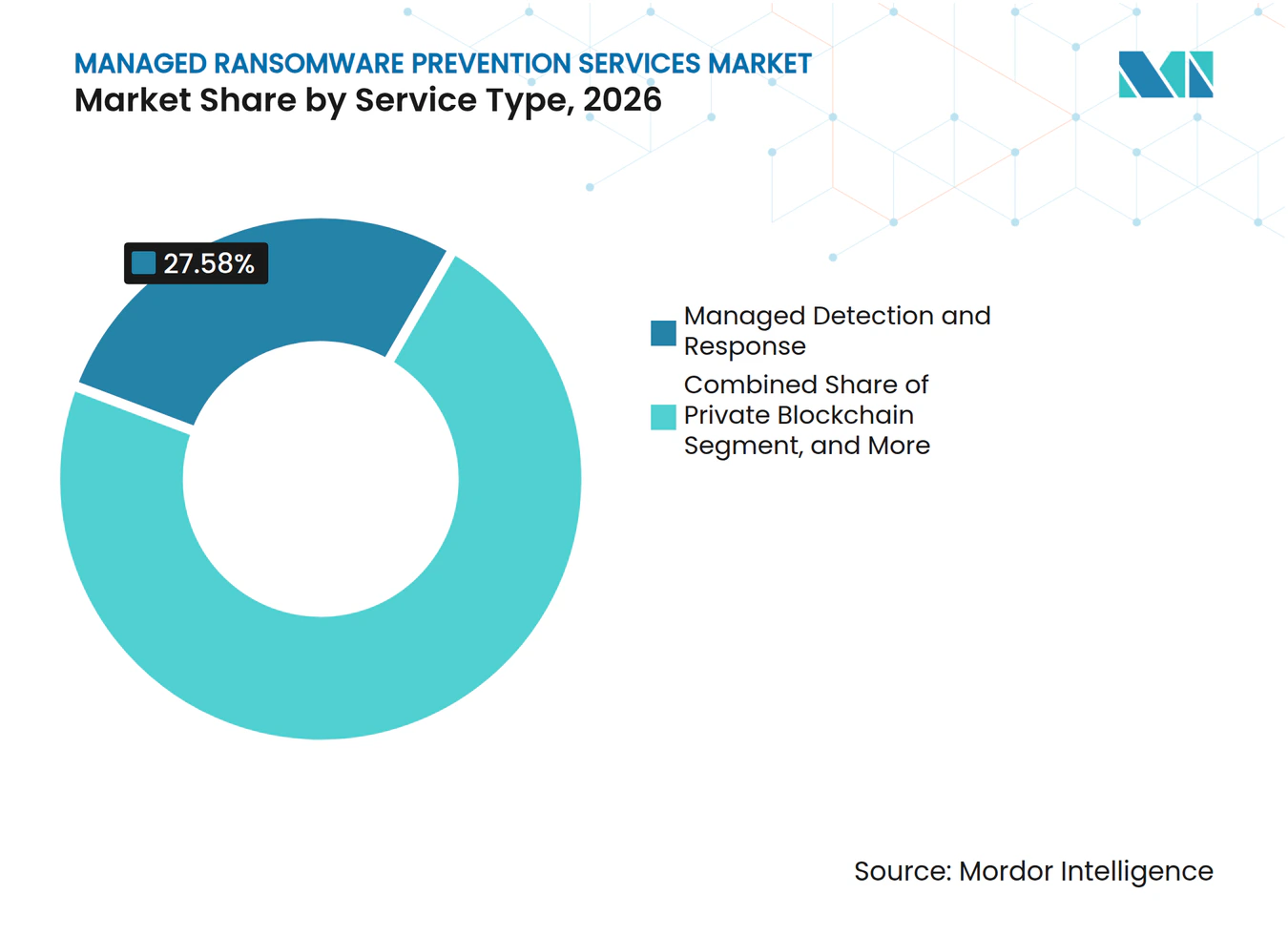
- By service type, Managed Detection and Response held 27.58% of the managed ransomware prevention services market share in 2026, while Managed Identity and Access Security is projected to expand at a 19.73% CAGR through 2032.
- By deployment mode, cloud-based deployment accounted for 68.91% of the managed ransomware prevention services market size in 2026 and is projected to expand at an 18.92% CAGR through 2032.
- By service delivery model, Fully Managed Services held 46.52% revenue share in 2026, while Co-Managed Services is projected to expand at a 19.92% CAGR through 2032.
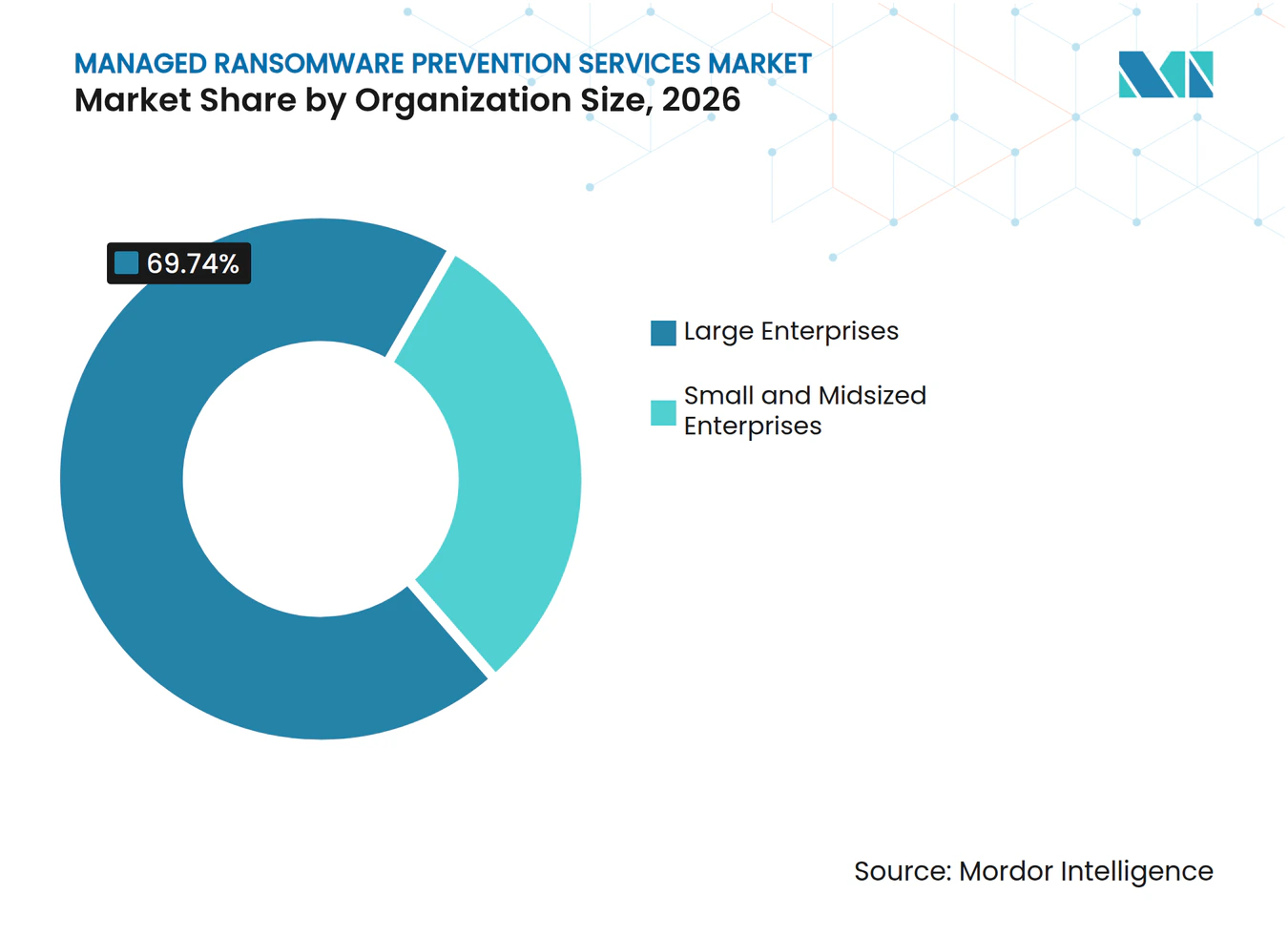
- By organization size, large enterprises held 69.74% revenue share in 2026, while SMEs are projected to expand at an 18.82% CAGR through 2032.
- By end-user industry, BFSI held a 26.69% revenue share of the managed ransomware prevention services market in 2026, while the healthcare and life sciences industry is projected to expand at a 20.86% CAGR through 2032.
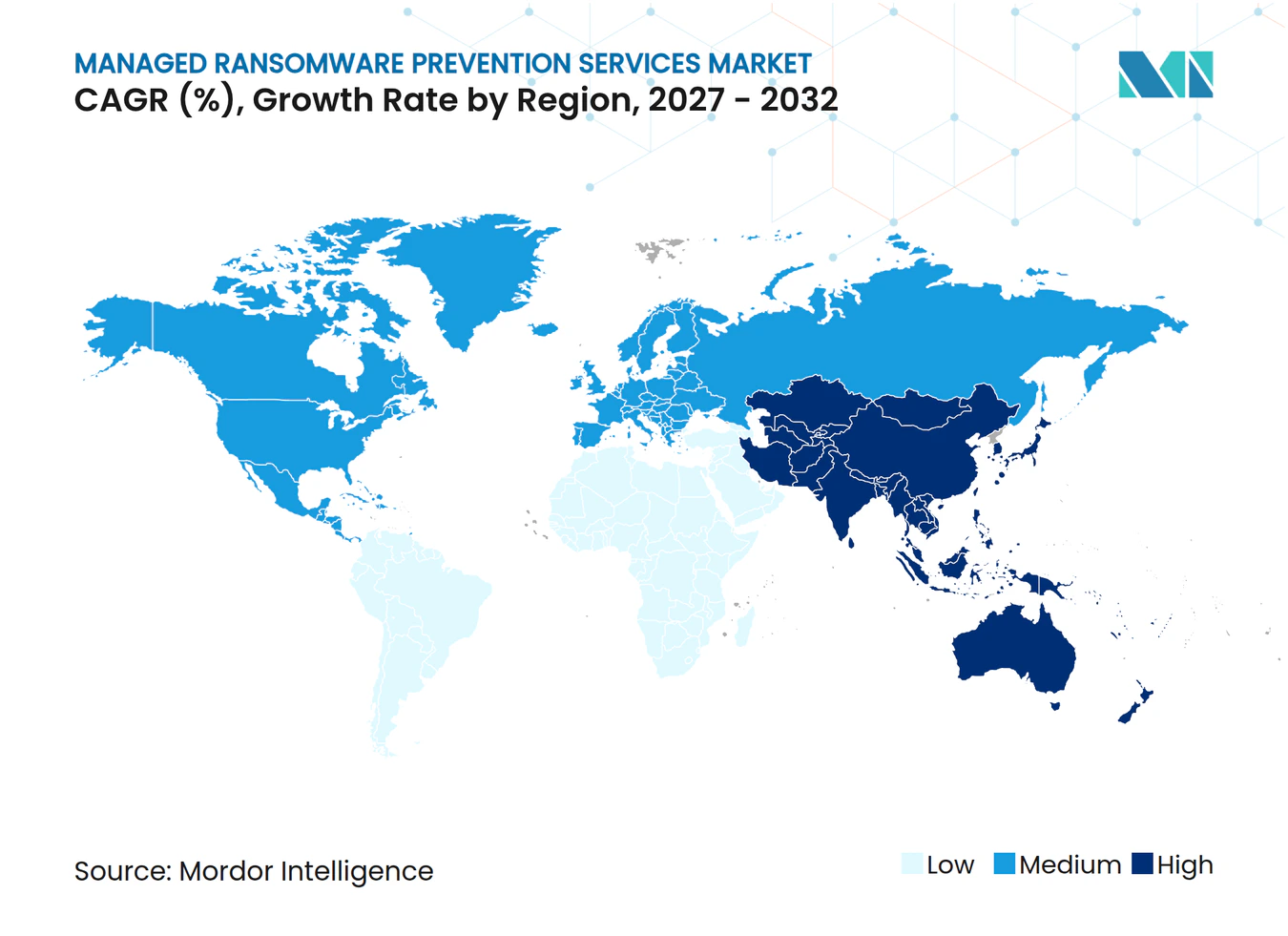
- By geography, North America held 38.64% revenue share in 2026, while Asia-Pacific is projected to expand at a 19.86% CAGR through 2032, supported by a combination of expanding digital operations, rising security needs, and the appeal of managed services for organizations seeking specialized protection without adding equivalent internal headcount, while different national data rules and technology environments create demand for providers with local delivery capacity and flexible operating models.
Note: Market numbers in this report are based on Mordor Intelligence's proprietary estimation framework, which combines nine months of actuals with Q4 projections for base year 2026.
Market Trends and Insights
Drivers Impact Analysis of Managed Ransomware Prevention Services Market*
| Driver | (~) % Impact on CAGR Forecast | Geographic Relevance | Impact Timeline |
|---|---|---|---|
| Escalating Ransomware-as-a-Service Activity | +4.1% | Global, most acute in North America and Europe | Short term (≤ 2 years) |
| Regulatory and Cyber-Insurance Requirements for Continuous Protection | +3.5% | North America and EU core, spillover to Asia-Pacific | Medium term (2-4 years) |
| Expansion of Cloud, Hybrid, and Remote Work Attack Surfaces | +2.9% | Global | Short term (≤ 2 years) |
| Cybersecurity Talent Shortages and Demand for 24/7 Monitoring | +2.6% | Global, most acute in North America, Europe, and Asia-Pacific | Long term (≥ 4 years) |
| Identity-Centric Ransomware Attacks Across Hybrid Environments | +1.7% | North America, Europe, and Asia-Pacific | Medium term (2-4 years) |
| Backup Targeting and the Need for Managed Recovery Assurance | +0.8% | Global | Short term (≤ 2 years) |
| Source: Mordor Intelligence | |||
Escalating Ransomware-as-a-Service Activity
Ransomware-as-a-service has made attack tools and affiliate networks more accessible to criminal groups, allowing attackers to obtain technical capabilities, payment arrangements, and supporting infrastructure without developing every component themselves. Google reported that 77% of ransomware intrusions in 2025 involved suspected data theft, which raises the cost of relying on backup recovery alone during serious incidents.[1] This pattern increases the need to identify lateral movement and data staging before encryption begins, since an organization can still face extortion, disclosure, and operational disruption even when it can restore its systems from backups. The Managed ransomware prevention services market benefits because specialist teams can maintain round-the-clock monitoring and connect threat intelligence across customer environments. Mid-sized organizations have a strong reason to use external services when they cannot build a full security operations center, hire specialists for every shift, or maintain current threat intelligence across a rapidly changing attack environment. Providers that combine detection, containment, and recovery support can address the wider operational impact of a ransomware event, and the managed ransomware prevention services market can reward the firms that can make these responsibilities clear before an incident takes place.
Regulatory and Cyber-Insurance Requirements for Continuous Protection
Regulation (EU) 2025/37 entered into force on February 4, 2025, and enables European cybersecurity certification schemes for managed security services, creating a clearer framework for assessing security service provision in regulated environments.[2] The regulation also supports a more defined role for managed security service providers under the EU cybersecurity framework. Organizations subject to NIS2 and the Digital Operational Resilience Act need stronger evidence that critical security functions can continue during an incident, including defined roles, documented processes, and effective oversight of important third parties. This requirement moves outsourced protection beyond a discretionary technology purchase for many regulated buyers. Cyber-insurance underwriting similarly places value on verifiable monitoring and response controls, which strengthens demand for documented service levels and makes a provider's response processes relevant to both risk reduction and coverage discussions. The Managed ransomware prevention services market can therefore reward providers that offer auditable processes, clear contract terms, and recognized certification, particularly when buyers need evidence that an outsourced function is operating as intended.
Expansion of Cloud, Hybrid, and Remote Work Attack Surfaces
Cisco found that 84% of organizations reported a higher security risk from employees using unmanaged devices in 2025. The same study found that 60% of IT teams lacked awareness of employee interactions with generative AI tools. Cloud services, remote access, containers, and edge systems increase the number of identities, devices, and workloads that require oversight, while the organization may have less visibility into where activity occurs or which assets hold sensitive data. The Managed ransomware prevention services market is well placed to support this distributed environment because cloud-delivered monitoring can scale with changing workloads. The use of many point products can delay investigation when their data is not connected, because analysts may have to reconcile separate alerts, interfaces, and information sources before they can determine what happened. Service providers that maintain continuous asset discovery and cross-platform telemetry can reduce these blind spots, which gives the managed ransomware prevention services market a role in helping buyers maintain visibility as their environments become more distributed.
Cybersecurity Talent Shortages and Demand for 24/7 Monitoring
Many organizations face moderate-to-critical cybersecurity skill gaps as their security needs become more specialized. Leadership teams can lack confidence that they have enough people with the practical skills needed to maintain effective coverage across all of their environments. The gap includes expertise in cloud security, AI security, threat hunting, and operational technology security, areas where effective work requires both technical knowledge and familiarity with the business environment being protected. Internal teams can struggle to sustain 24/7 coverage while also completing governance and remediation work, particularly when a small group must respond to alerts, improve controls, report to leadership, and support day-to-day technology projects. The Managed ransomware prevention services market provides buyers with access to specialized expertise and established operational processes without having to build each capability internally, allowing internal teams to focus their limited time on risk priorities, control improvement, and coordination with business leaders. This reliance is likely to persist because high-skill security roles require lengthy training and practical experience, which supports the managed ransomware prevention services market, where organizations need access to skills that are difficult to recruit and retain internally.
Restraints Impact Analysis of Managed Ransomware Prevention Services Market*
| Restraint | (~) % Impact on CAGR Forecast | Geographic Relevance | Impact Timeline |
|---|---|---|---|
| Data Sovereignty and Third-Party Trust Concerns | -1.9% | EU, Asia-Pacific, including China and India, and Middle East | Long term (≥ 4 years) |
| Integration Complexity Across Heterogeneous Security Stacks | -1.4% | Global | Medium term (2-4 years) |
| Liability and Accountability Concerns for Managed Providers | -1.0% | North America and EU | Medium term (2-4 years) |
| Budget Constraints Among Small and Midsized Organizations | -0.6% | Global, highest in South America and Africa | Short term (≤ 2 years) |
| Source: Mordor Intelligence | |||
Data Sovereignty and Third-Party Trust Concerns
Third-party access can reduce internal workload while extending the set of parties that handle sensitive data, administrative accounts, system telemetry, and sometimes information needed to investigate and contain an incident. ENISA reported that European critical-security infrastructure has material reliance on providers headquartered outside Europe. Data residency rules in Europe, Asia-Pacific, and the Middle East can require providers to use regional infrastructure and in-country processing. These requirements increase operating costs and can restrict the efficiency of global delivery models, because providers may need separate regional infrastructure, localized processes, and personnel arrangements that meet national requirements. The Managed ransomware prevention services market must address this concern through transparent data practices, local delivery capacity, and controls over privileged access. Certification frameworks can support procurement confidence, but buyers will still assess where data is stored and who can access it, how access is controlled, and whether a provider can meet contractual commitments during an investigation.
Integration Complexity Across Heterogeneous Security Stacks
Cisco reported that 77% of organizations using more than 10 security solutions believed this impaired rapid threat response. Providers must collect and interpret data from security information and event management tools, endpoints, identity systems, cloud services, and network products that may not work together by design. Complex organizations can require extended onboarding when they operate multiple clouds, legacy systems, and operational technology, because service teams need to understand the dependencies, collection methods, ownership, and security priorities across the environment. This can delay the benefits buyers expect from external monitoring, especially if data sources are incomplete or if the customer and provider must agree on incident-response authority before the service becomes fully operational. Platform-native providers can have an advantage when their workflows already connect detection, response, and identity controls. The Managed ransomware prevention services market also leaves room for service providers that can integrate mixed environments without forcing a complete technology replacement.
*Our forecasts treat driver/restraint impacts as directional, not additive. The impact forecasts reflect baseline growth, mix effects, and variable interactions.
Managed Ransomware Prevention Services Market Segment Analysis
By Service Type:
Identity and Access Security Reshapes the MDR BaselineManaged Detection and Response held 27.58% share in 2026, making it the principal managed offering within the managed ransomware prevention services market. It combines continuous monitoring, alert investigation, containment, and response in a service model that is useful for organizations without a fully staffed security operations center, particularly when alert volumes rise faster than internal staffing and operating budgets. The category is moving toward proactive threat hunting and analyst workflows supported by automation, so teams can prioritize high-risk activity rather than work through every alert in isolation, while retaining human review for actions that can affect business operations. Managed Extended Detection and Response is gaining ground because it joins endpoint, network, cloud, and identity telemetry in a common investigative process, helping analysts follow a threat across systems rather than treating each signal as a separate event. This role keeps MDR at the center of the managed ransomware prevention services market, even as buyers add adjacent services and expect their provider to support a coordinated response when an alert becomes a confirmed incident.
Managed Identity and Access Security is projected to expand at a 19.73% CAGR through 2032, reflecting the larger access governance burden created by cloud systems and non-human identities. Google and Mandiant stated that suspected data theft occurred in 77% of ransomware intrusions in 2025, which makes credential protection and visibility into access paths especially important before data is staged.[3] Managed Endpoint and Application Security remains relevant where the number of devices exceeds available analyst capacity, while Managed Email and Collaboration Security addresses phishing that can use AI-generated content. Managed Network and Perimeter Security and Managed Cloud and Workload Security are increasingly distinguished by continuous posture management instead of basic uptime commitments. Together, these categories move the Managed ransomware prevention services industry from reactive monitoring toward an operating model built around continuous risk reduction, where teams seek to identify weak access controls, unmanaged assets, and suspicious behavior before an attacker can disrupt a critical system.



By Deployment Mode:
Cloud Dominates, Hybrid Preserves ComplexityCloud-based deployment accounted for 68.91% of the managed ransomware prevention services market size in 2026 and is projected to expand at an 18.92% CAGR through 2032. This is the only category in the report that shows both current share and forecast expansion, indicating that buyers are extending an already established delivery preference rather than moving from a small base. Cloud-delivered services suit organizations that are adding multi-cloud applications, distributed workloads, and remote access paths, while centralized analytics can serve multiple locations. Consumption-based pricing, elastic capacity, and the absence of on-premises security hardware make the model practical for both large buyers and smaller organizations. The managed ransomware prevention services market therefore benefits when security consumption is aligned with the changing scale of a customer's cloud estate, because capacity can be adjusted as workloads, users, and applications are added or retired, and because the service can be extended across locations without duplicating the full operations center model at every site.
On-premises deployment remains necessary for air-gapped systems and high-security environments, including government defense networks and financial institutions with strict data residency or classification requirements. Hybrid deployment is relevant when customers need cloud-based security operations center analytics but must keep collection or control functions on-site due to latency, legacy architecture, or local handling needs. This approach can preserve existing investments while allowing providers to use broader threat intelligence and analytics services, a balance that can matter when replacement projects would disrupt critical operations or create avoidable compliance work. Providers that can connect cloud platforms, on-premises agents, and operational technology sensors without demanding a single architectural model can reduce the burden of hybrid security. The continued spread of 5G-enabled edge computing may create more distributed workloads for these providers to monitor, including assets that sit outside a central data center yet still connect to core business services.
By Service Delivery Model:
Co-Managed Services Emerge as the Security-Mature ChoiceFully Managed Services accounted for 46.52% of revenue in 2026 and remains the principal model for customers who want the provider to assume end-to-end operational responsibility. The arrangement covers monitoring, detection, and response, while providing boards with a defined cost structure and a documented accountability framework that clarifies who is responsible for action during an incident. It is particularly relevant when internal security coverage is limited or when the organization needs clear evidence of active security governance for regulators and insurers, without asking a small internal team to handle every operational task. The service can standardize routine security operations across large, complex environments, creating consistent processes for alert handling, escalation, reporting, and review across multiple business units. This helps a large organization apply a common minimum operating standard while recognizing that individual divisions may still have different regulatory or risk priorities. It remains a primary route into the managed ransomware prevention services market for buyers that seek a complete outsourced operating model.
Co-Managed Services is projected to expand at a 19.92% CAGR through 2032, indicating that some security-mature organizations prefer shared responsibility over full outsourcing. Customers can keep internal analysts focused on strategic, regulatory, and business coordination work while external teams run automation-heavy monitoring and response processes at scale, allowing each group to concentrate on the work it is best positioned to perform. Advisory-Led Managed Services addresses demand for guidance on cyber risk, compliance, and insurance, while Incident-Triggered Managed Services provides specialist capacity for complex events requiring forensic rigor. Shared dashboards, regular operational reviews, and client skills development can make the working relationship more effective, because both parties can assess priorities, review incidents, and adjust responsibilities as risks or business needs change. Providers that invest in these governance practices may be better positioned than those focused only on service automation.
By Organization Size:
SME Demand Expands as Pricing Models EvolveLarge enterprises held 69.74% of spending in 2026 because their technology environments require broad and continuous coverage across diverse applications, user groups, geographies, and internal business units. Their contracts often combine MDR, identity, and cloud security within arrangements linked to platform vendors already used across their operations, which can simplify service governance and reduce the number of separate operational relationships. They also require formal reporting, regional service capability, and controls tailored to regulated business units, particularly where business continuity, audit readiness, and sensitive data handling are central procurement considerations. The data volume and alert volume across these environments support substantial service provider revenue. Procurement requirements favor providers that can demonstrate integration capability, global delivery, and relevant vertical knowledge.
SMEs are projected to expand at an 18.82% CAGR through 2032 as per-user and subscription pricing make modular security services more accessible to organizations with fewer than 500 employees. This pricing approach separates essential monitoring, incident support, and vulnerability management from larger enterprise bundles, reducing an earlier cost barrier. The Managed ransomware prevention services market can serve this group with clear packages that are simpler to procure and operate, giving smaller teams defined coverage without forcing them to select and coordinate many separate security products, negotiate multiple service agreements, or build their own always-on monitoring function before they can address a basic level of ransomware exposure. Public-sector organizations remain a distinct buyer group because they have longer procurement cycles, fixed budgets, and strong sovereignty requirements, which can shape the location of operations centers and the qualifications expected of service personnel. Public-sector organizations can be under-resourced relative to their security goals, which supports the case for dedicated security operations centers and cleared personnel where the service model must meet specific government requirements.

By End User Industry:
BFSI Anchors While Healthcare AcceleratesBFSI held 26.69% of end-user spending in 2026, supported by compliance frameworks that require strong monitoring, clear audit trails, and timely response. Financial institutions use managed protection to maintain continuous oversight across complex systems that handle customer information and transactions, including services that must remain available while security teams investigate suspicious activity. They also need providers that can support identity protection, fraud detection, and secure handling of sensitive data, while producing records that can be used in internal governance and regulatory reviews. Regulatory expectations and cyber-insurance requirements add weight to decisions to outsource selected security functions. The Managed ransomware prevention services market has a strong base in BFSI because incidents can lead to material operational, financial, and reputational consequences.
The healthcare and life sciences industry is projected to expand at a 20.86% CAGR through 2032 as connected medical devices, telemedicine systems, and patient records widen the scope of security operations. Ransomware can interrupt clinical activity and affect patient safety, making rapid containment particularly valuable in this sector, where delayed access to systems or records can have consequences beyond financial loss. HIPAA-aligned security operations capabilities have become a basic provider requirement for United States healthcare customers, alongside the ability to work with diverse clinical, administrative, and connected-device environments. Government and Defense needs air-gapped operations centers, personnel clearances, and tailored delivery arrangements, while Manufacturing and Industrial needs protection for networked operational technology. Energy and Utilities values IEC 62443 expertise, while Retail and eCommerce, Transportation and Logistics, Education, IT and Telecommunications, and Professional Services add demand related to fraud, supply chains, customer data, and network availability, with each buyer group seeking a service approach that reflects its particular mix of business systems, external connections, regulatory expectations, and interruption risk.
Geography Analysis
North America Managed Ransomware Prevention Services Market
North America held 38.64% of the managed ransomware prevention services market share in 2026, supported by mature managed service procurement practices and a large base of organizations that use external security providers for selected or full operational coverage. The United States supports much of the region's spending through federal cyber guidance, state privacy requirements, and insurance expectations for continuous monitoring. Canada and Mexico add demand as mid-sized financial services and critical infrastructure organizations make greater use of managed providers. The Managed ransomware prevention services market in North America also benefits from buyers who are familiar with outsourced technology operations and can extend those procurement practices to security monitoring, response, and incident support. The region's high competitive density puts pressure on generalist providers. At the same time, buyers reduce the number of vendors and favor services aligned with established platform ecosystems. This preference can make integrated telemetry, workflow familiarity, and clear responsibility models more important during provider selection and renewal discussions. This gives integrated providers an advantage through lower switching costs, more connected operations, and access to security telemetry already used in customer environments, while generalist providers need to demonstrate comparable integration and service quality.
Europe and South America Managed Ransomware Prevention Services Market
Europe is shaped by NIS2 and DORA compliance requirements that became operationally important from early 2025. Regulation (EU) 2025/37 supports certification schemes for managed security services, which give buyers a clearer route to compare providers' capabilities. Germany, the United Kingdom, and France lead in regional spending, while Spain and Italy are increasing investment in digital transformation and need security arrangements that can keep pace with the greater use of cloud applications, connected services, and data-driven operations. ENISA has stated that its managed security services certification work is intended to strengthen trusted service provision in Europe, so that certified providers may be better placed to secure public-sector and highly regulated contracts. South America is still emerging, with Brazil driving demand and scalable, partner-led delivery often more relevant than the depth of enterprise service portfolios, as buyers can prioritize accessible managed coverage over complex, highly customized arrangements.
APAC and MEA Managed Ransomware Prevention Services Market
Asia-Pacific is projected to expand at a 19.86% CAGR through 2032, supported by a combination of expanding digital operations, rising security needs, and the appeal of managed services for organizations seeking specialized protection without adding equivalent internal headcount, while different national data rules and technology environments create demand for providers with local delivery capacity and flexible operating models. India has an increasing demand for MDR as enterprises manage greater threat complexity while controlling internal staffing costs, a combination that can make an external operating model more practical than building an equally broad set of specialist capabilities inside every organization. Japan's manufacturing base supports managed operational technology security after supply-chain breaches, while China is adding domestic provider capacity under data-localization rules. Saudi Arabia and the UAE are expanding addressable demand through Vision 2030 digital transformation programs, and Africa has a lower spending base with South Africa, Nigeria, and Egypt as important centers of demand, where the service opportunity is shaped by the need for accessible protection that can work across differing levels of technology maturity.
Competitive Landscape
Market Concentration
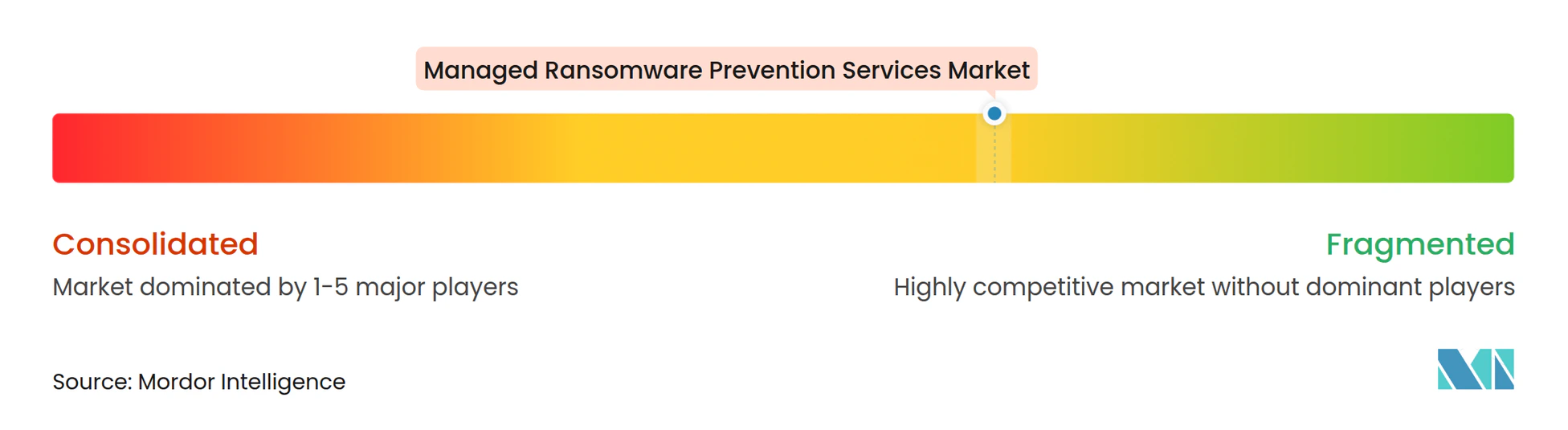
The managed ransomware prevention services market is moderately fragmented at the service-provider level and more concentrated at the platform level, where a smaller group of vendors influences the tools, telemetry, and operating workflows used by many service providers. Microsoft, CrowdStrike, and Palo Alto Networks shape enterprise consolidation decisions because their platforms supply much of the security telemetry and tooling used in managed operations. Accenture, IBM, Tata Consultancy Services, and Capgemini compete through service integration, global security operations centers, and vertical knowledge. Trustwave, Rapid7, Sophos, and Arctic Wolf compete through managed detection and response, incident response, and service commitments. Buyers choose between platform-led operating models and independent providers with multi-vendor integration, which preserves space for specialists while increasing the importance of platform alignment for large accounts seeking fewer operational interfaces and more consistent data flows.
A central competitive tension arises when platform vendors expand their own managed offerings while also supporting channel partners that operate those platforms. Independent service providers can use leading platforms to scale operations, although this can create operational dependency rather than architectural differentiation. Open opportunities remain in operational technology and industrial control system protection for manufacturing and energy utilities, where specialized expertise is important. Sovereign-cloud delivery models can appeal to government customers that need local control, data residency, and dedicated operations. Security services for AI governance may become more relevant as organizations deploy autonomous agents and need stronger visibility into their use, including the identities, data access, and operating permissions connected to those systems.
Palo Alto Networks and Wipro expanded their partnership in June 2026 to deliver AI-driven MDR services across 8 global Cyber Defense Centers. The offering combines Cortex XSIAM with Wipro's CyberShield platform and uses machine learning and automation to substantially and materially reduce alert-to-response cycles. Verizon Business and Accenture announced a partnership in March 2025 that combined identity and access management, Managed Extended Detection and Response, and cyber risk services. These moves show competition based on integrated platforms, delivery scale, and advisory support, rather than on monitoring capacity alone, because customers increasingly want technology, operations, and risk guidance to work together. The Managed ransomware prevention services market remains open to global integrators and specialist providers even as platform families influence procurement, since customers can still seek independent incident response, industry-specific knowledge, regional delivery, or multi-vendor integration that does not depend on a single technology supplier or one standard service model.
Managed Ransomware Prevention Services Industry Leaders
-
Accenture plc
-
Atos SE
-
AT&T Inc.
-
Broadcom Inc.
-
Capgemini SE
- *Disclaimer: Major Players sorted in no particular order
Managed Ransomware Prevention Services Market Companies Covered in this Report
- Accenture plc
- Atos SE
- AT&T Inc.
- Broadcom Inc.
- Capgemini SE
- Cisco Systems, Inc.
- CrowdStrike Holdings, Inc.
- Dell Technologies Inc.
- Deloitte Touche Tohmatsu Limited
- ESET, spol. s r.o.
- Fortinet, Inc.
- Fujitsu Limited
- International Business Machines Corporation
- Kaspersky Lab
- Kroll, LLC
- Lumen Technologies, Inc.
- Microsoft Corporation
- NTT DATA Group Corporation
- Orange SA
- Palo Alto Networks, Inc.
- Rapid7, Inc.
- SentinelOne, Inc.
- Sophos Limited
- Tata Consultancy Services Limited
- Trend Micro Incorporated
- Trustwave Holdings, Inc.
- Verizon Communications Inc.
Recent Industry Developments in Managed Ransomware Prevention Services Market
- June 2026: Palo Alto Networks and Wipro expanded their partnership to deliver AI-driven MDR services, combining Cortex XSIAM with Wipro's CyberShield managed security platform across 8 global Cyber Defense Centers. The offering uses machine learning and automation to reduce alert-to-response cycles from days to minutes.
- June 2026: Accenture announced its agreement to acquire a majority stake in Dragos and all of runZero and NetRise at a combined enterprise value of USD 4.175 billion, building on its existing USD 10 billion cybersecurity business to deliver an end-to-end OT security platform for critical infrastructure operators, the largest single strategic investment in managed OT cybersecurity in market history.
- September 2025: Proofpoint launched Data Security Complete on September 23, 2025, a unified platform integrating multichannel DLP, insider threat management, ITM, and data security posture management, DSPM, across email, cloud, web, and endpoints, with claimed administration cost reductions of up to 58%.
- March 2025: Verizon Business and Accenture announced a strategic partnership to deliver IAM, Managed Extended Detection and Response, and cyber risk services for organizations of all sizes, integrating Accenture's global threat-intelligence capabilities with Verizon's network security infrastructure.
Global Managed Ransomware Prevention Services Market Report Scope
Managed ransomware prevention services are outsourced offerings that help organizations reduce ransomware exposure through continuous monitoring, vulnerability and exposure management, email and endpoint protection, identity hardening, backup validation, threat intelligence, and incident readiness. Providers may also support early detection, containment, recovery planning, and post-incident hardening to limit business disruption.
The Managed Ransomware Prevention Services Market Report is Segmented by Service Type (Managed Detection and Response, Managed Extended Detection and Response, Managed Endpoint and Application Security, Managed Identity and Access Security, Managed Email and Collaboration Security, Managed Network and Perimeter Security, Managed Cloud and Workload Security, and Other Service Types), Deployment Mode (Cloud-Based, On-Premises, and Hybrid), Service Delivery Model (Fully Managed Services, Co-Managed Services, Advisory-Led Managed Services, and Incident-Triggered Managed Services), Organization Size (Large Enterprises, and Small and Midsized Enterprises), End User Industry (Banking, Financial Services and Insurance (BFSI), IT and Telecommunications, Healthcare and Life Sciences, Government and Public Sector, Industrial Manufacturing, Retail and E-Commerce, and Other End-User Industries), and Geography (North America, South America, Europe, Asia-Pacific, Middle East, and Africa). The Market Forecasts are Provided in Terms of Value (USD).
Segmentation Overview
| Managed Detection and Response |
| Managed Extended Detection and Response |
| Managed Endpoint and Application Security |
| Managed Identity and Access Security |
| Managed Email and Collaboration Security |
| Managed Network and Perimeter Security |
| Managed Cloud and Workload Security |
| Other Service Types |
| Cloud-Based |
| On-Premises |
| Hybrid |
| Fully Managed Services |
| Co-Managed Services |
| Advisory-Led Managed Services |
| Incident-Triggered Managed Services |
| Large Enterprises |
| Small and Midsized Enterprises |
| Banking, Financial Services and Insurance (BFSI) |
| IT and Telecommunications |
| Healthcare and Life Sciences |
| Government and Public Sector |
| Industrial Manufacturing |
| Retail and E-Commerce |
| Other End-User Industries |
| North America | United States |
| Canada | |
| Mexico | |
| South America | Brazil |
| Argentina | |
| Rest of South America | |
| Europe | Germany |
| United Kingdom | |
| France | |
| Italy | |
| Rest of Europe | |
| Asia-Pacific | China |
| Japan | |
| India | |
| South Korea | |
| Rest of Asia-Pacific | |
| Middle East | Saudi Arabia |
| United Arab Emirates | |
| Turkey | |
| Rest of Middle East | |
| Africa | South Africa |
| Nigeria | |
| Rest of Africa |
| By Service Type | Managed Detection and Response | |
| Managed Extended Detection and Response | ||
| Managed Endpoint and Application Security | ||
| Managed Identity and Access Security | ||
| Managed Email and Collaboration Security | ||
| Managed Network and Perimeter Security | ||
| Managed Cloud and Workload Security | ||
| Other Service Types | ||
| By Deployment Mode | Cloud-Based | |
| On-Premises | ||
| Hybrid | ||
| By Service Delivery Model | Fully Managed Services | |
| Co-Managed Services | ||
| Advisory-Led Managed Services | ||
| Incident-Triggered Managed Services | ||
| By Organization Size | Large Enterprises | |
| Small and Midsized Enterprises | ||
| By End User Industry | Banking, Financial Services and Insurance (BFSI) | |
| IT and Telecommunications | ||
| Healthcare and Life Sciences | ||
| Government and Public Sector | ||
| Industrial Manufacturing | ||
| Retail and E-Commerce | ||
| Other End-User Industries | ||
| By Geography | North America | United States |
| Canada | ||
| Mexico | ||
| South America | Brazil | |
| Argentina | ||
| Rest of South America | ||
| Europe | Germany | |
| United Kingdom | ||
| France | ||
| Italy | ||
| Rest of Europe | ||
| Asia-Pacific | China | |
| Japan | ||
| India | ||
| South Korea | ||
| Rest of Asia-Pacific | ||
| Middle East | Saudi Arabia | |
| United Arab Emirates | ||
| Turkey | ||
| Rest of Middle East | ||
| Africa | South Africa | |
| Nigeria | ||
| Rest of Africa | ||
Key Questions Answered in the Report
What is the managed ransomware prevention services market size?
The managed ransomware prevention services market size is projected to expand from USD 2.79 billion in 2026 and USD 3.26 billion in 2027 to USD 7.26 billion by 2032, registering a CAGR of 16.94% between 2027 to 2032.
Which service type leads managed ransomware prevention services?
Managed Detection and Response leads with 27.58% share in 2026, while Managed Identity and Access Security has the highest projected CAGR at 19.73%.
Why are organizations outsourcing ransomware prevention services?
Ransomware increasingly involves data theft, while cloud complexity and cyber skills gaps make continuous internal monitoring difficult.
Which deployment model is preferred for managed ransomware prevention?
Cloud-based deployment leads with 68.91% share in 2026 and is projected to expand at an 18.92% CAGR through 2032.
Which end-user sector is expanding fastest for these services?
Healthcare and Life Sciences is projected to expand at a 20.86% CAGR through 2032 because connected care environments need rapid protection and response.
Which region is projected to expand fastest?
Asia-Pacific is projected to expand at a 19.86% CAGR through 2032, supported by rising demand for managed detection and response capabilities.