
Managed Ransomware Recovery Services Market Size and Share
Market Overview
| Study Period | 2021 - 2032 |
|---|---|
| Market Size (2027) | USD 2.15 Billion |
| Market Size (2032) | USD 3.97 Billion |
| Growth Rate (2027 - 2032) | 13.05 % |
| Fastest Growing Market | Asia-Pacific |
| Largest Market | North America |
| Market Concentration | Medium |
Major Players *Disclaimer: Major Players sorted in no particular order Image © Mordor Intelligence. Reuse requires attribution under CC BY 4.0. | |
Managed Ransomware Recovery Services Market Analysis by Mordor Intelligence
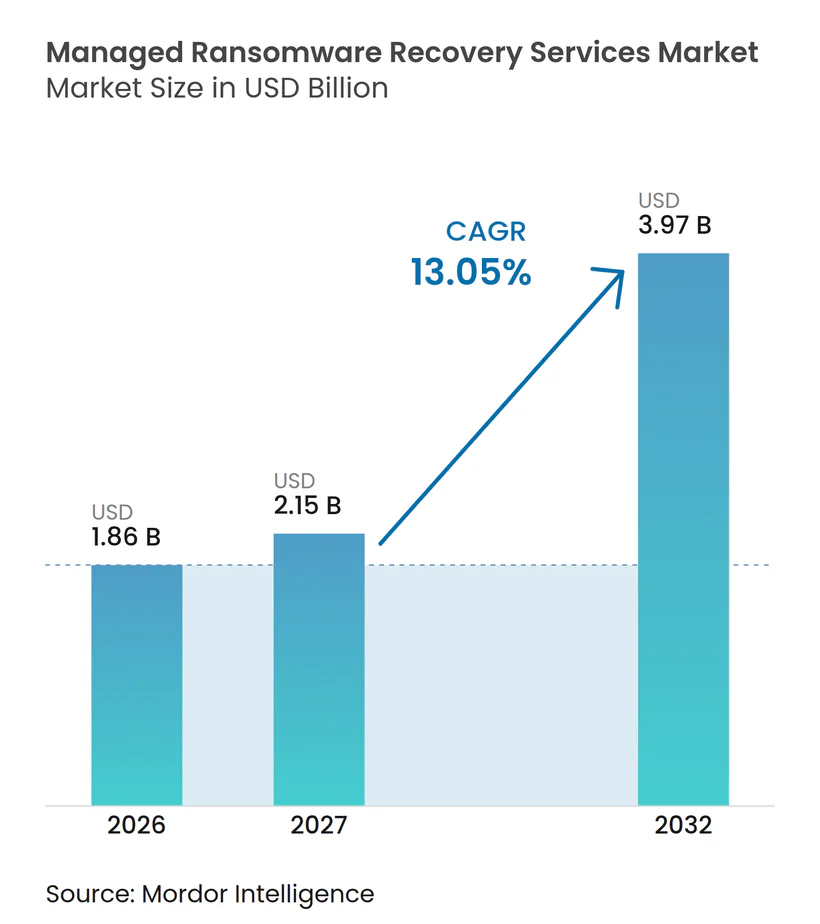
The Managed ransomware recovery services market size is projected to expand from USD 1.86 billion in 2026 and USD 2.15 billion in 2027 to USD 3.97 billion by 2032, registering a CAGR of 13.05% between 2027 and 2032. The Managed ransomware recovery services market is supported by organizations moving recovery work from internal IT teams to specialist providers that can restore systems, preserve evidence, and manage the wider effects of an attack. Ransomware events now commonly combine encryption, data theft, and pressure on customers or other stakeholders, which makes a file restore alone insufficient. The Managed ransomware recovery services market also benefits from regulations and insurance requirements that call for tested recovery procedures, immutable backups, and documented recovery objectives. Vendors are responding by combining threat detection, containment, identity recovery, and restoration in a single service, while smaller providers face cost and talent pressures. These conditions create room for repeatable, automation-supported recovery services, particularly where organizations have limited in-house forensic capacity. The Managed ransomware recovery services market rewards providers that can make complex recovery work easier to test and manage.
Key Report Takeaways
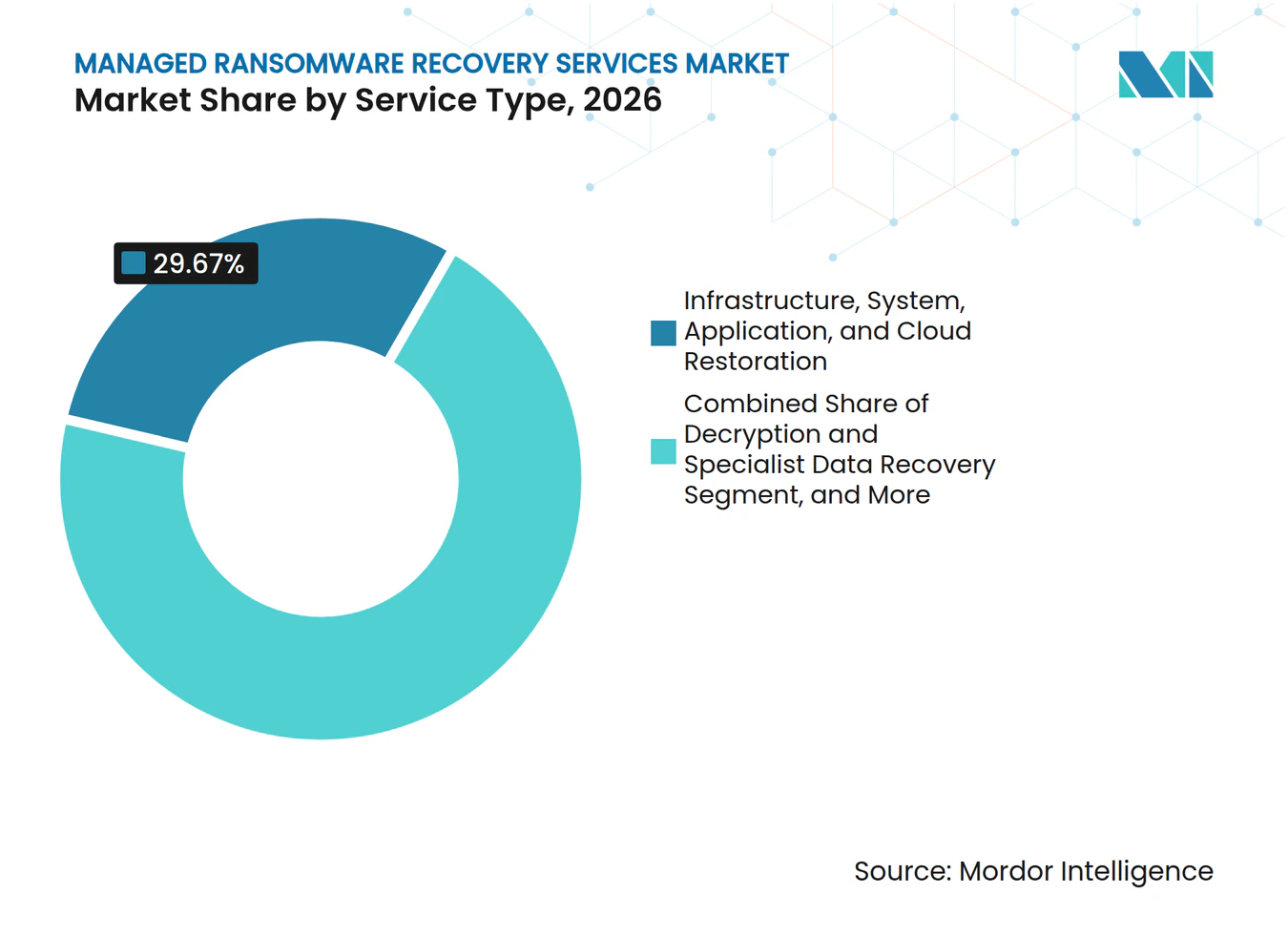
- By service type, Infrastructure, System, Application, and Cloud Restoration held 29.67% of the Managed ransomware recovery services market in 2026 and is projected to expand at a 14.43% CAGR through 2032.
- By delivery model, Remote Incident Response held 46.32% share in 2026, while Hybrid Delivery is projected to expand at a 14.73% CAGR through 2032.
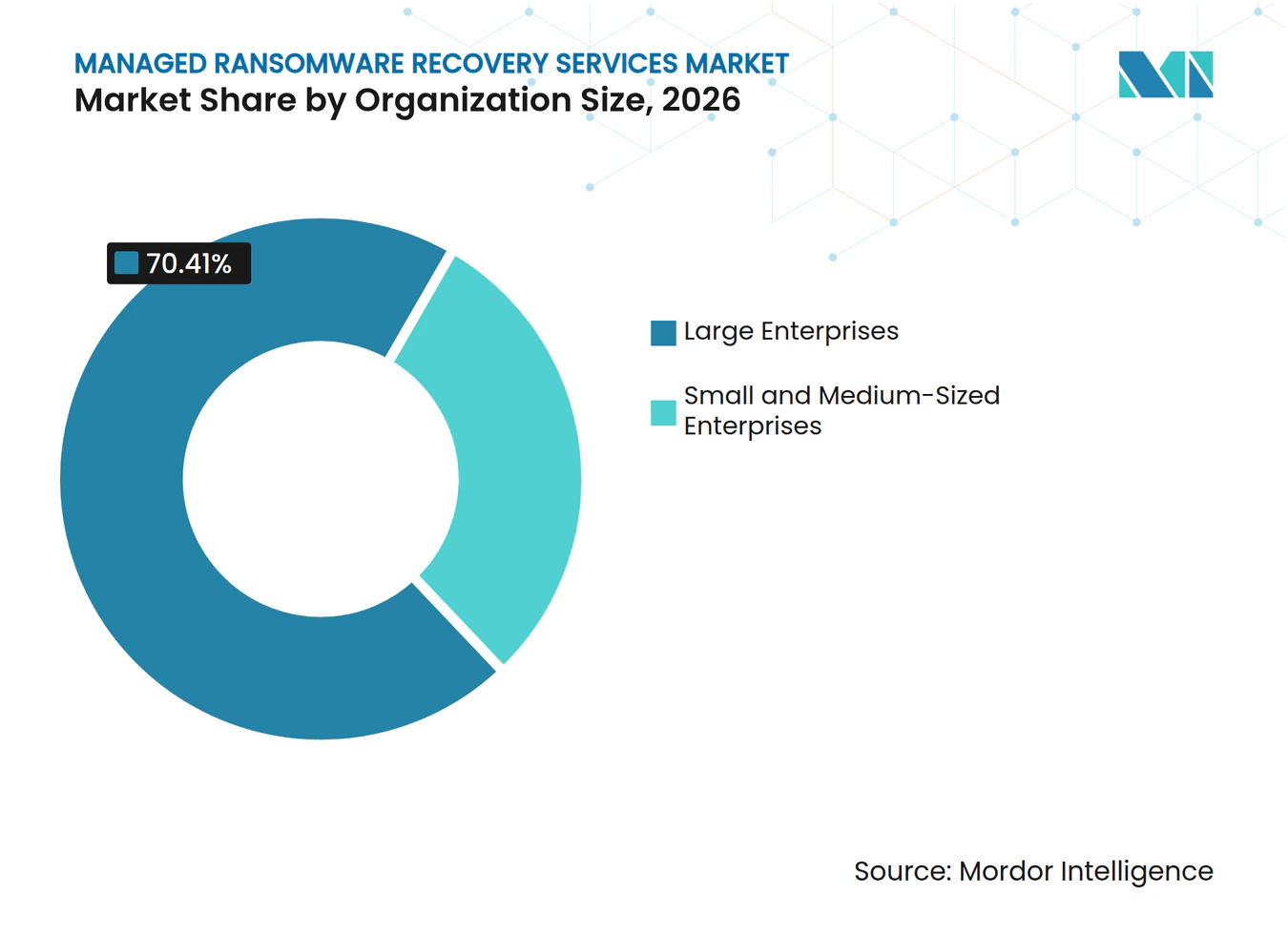
- By organization size, Large Enterprises accounted for 70.41% of the managed ransomware recovery services market in 2026, while Small and Medium-Sized Enterprises are projected to expand at a 15.03% CAGR through 2032.
- By industry vertical, BFSI held 26.57% share in 2026, while Healthcare and Life Sciences are projected to expand at a 15.33% CAGR through 2032.
- By geography, North America accounted for 36.21% of the managed ransomware recovery services market in 2026, while Asia-Pacific is projected to expand at a 16.63% CAGR through 2032.
Note: Market numbers in this report are based on Mordor Intelligence's proprietary estimation framework, which combines nine months of actuals with Q4 projections for base year 2026.
Market Trends and Insights
Drivers Impact Analysis of Managed Ransomware Recovery Services Market*
| Driver | (~) % Impact on CAGR Forecast | Geographic Relevance | Impact Timeline |
|---|---|---|---|
| Escalation of Double- and Triple-Extortion Attacks | +4.2% | Global, with North America and Europe most exposed | Short term (≤ 2 years) |
| Regulatory Pressure for Tested Cyber Recovery | +2.8% | EU, North America, Asia-Pacific core, including Australia and India, with spill-over to Middle East and Africa | Medium term (2-4 years) |
| Cloud and Multicloud Workload Expansion | +2.1% | Global, highest in North America and Asia-Pacific | Medium term (2-4 years) |
| Backup Targeting Creates Demand for Immutable Recovery | +1.8% | Global, most acute in North America and Europe | Short term (≤ 2 years) |
| Identity-Centric Attack Paths Increase Recovery Complexity | +1.1% | Global, primarily large-enterprise environments | Medium term (2-4 years) |
| Recovery Readiness Becomes a Board-Level and Insurance Requirement | +0.9% | North America and EU, with spill-over to Asia-Pacific | Long term (≥ 4 years) |
| Source: Mordor Intelligence | |||
Escalation of Double- and Triple-Extortion Attacks
The Managed ransomware recovery services market is shaped by extortion methods that require far more than decrypting files. Arctic Wolf reported that 96% of ransomware cases involved data theft, which means a successful system restore may still leave an organization facing disclosure and reputational risks. Clients, therefore, need forensic preservation, dark-web monitoring, legal coordination, and support for communication decisions alongside technical recovery. Check Point Research identified 85 active ransomware groups and 45 newly observed actors in 2025, adding uncertainty to negotiations and incident planning. The wider scope of these events favors retained providers that can contain an attack and guide the recovery process from the first response through restoration. The Managed ransomware recovery services market increasingly values this broad incident capability and the clear accountability that comes with it.
Regulatory Pressure for Tested Cyber Recovery
The Managed ransomware recovery services market is also being influenced by rules that turn recovery readiness into a documented obligation. The European Union's Digital Operational Resilience Act has been applied since January 17, 2025, and requires financial entities to maintain and test ICT business continuity, backup, and recovery procedures. Australia's ransomware payment reporting framework requires certain entities to report a payment or the receipt of a demand within 72 hours, strengthening the need for organized incident handling. New York expanded cybersecurity incident reporting and ransomware payment disclosure requirements for municipal corporations and public authorities from July 26, 2025. These obligations make a one-time recovery assessment less useful than an ongoing relationship that includes testing, records, and defined responsibilities. DORA and related European rules are especially important for financial services and critical infrastructure organizations that must show supervisors that recovery procedures work in practice. The Managed ransomware recovery services market gains recurring demand when recovery evidence must be maintained.
Cloud and Multicloud Workload Expansion
Cloud and multicloud estates are increasing the number of systems that must be recovered together after an attack. Microsoft documented a Storm-0501 attack path in which compromised synchronization accounts enabled movement from Active Directory to Microsoft Entra ID and then to broader cloud privileges. A recovery team must therefore address on-premises infrastructure, cloud identities, applications, and linked services rather than treating them as separate tasks. Commvault extended Cleanroom Recovery to AWS in 2025 alongside existing Azure support, offering isolated recovery environments for cloud workloads. ITR reported that Japan's backup and recovery sector expanded 9.7% in fiscal year 2025 as hybrid, multicloud, and SaaS environments increased recovery complexity. KDDI iret's 2026 launch of 3 Oracle Cloud Infrastructure recovery services shows how regional providers are adapting their services where enterprises cannot build resilient multicloud backup architectures internally. The Managed ransomware recovery services market, therefore, has a growing need for providers that coordinate recovery across environments.
Backup Targeting Creates Demand for Immutable Recovery
Attackers increasingly target the backup environment that organizations expect to use for restoration. The targeting of backup systems can leave organizations unable to restore critical operations even when backup copies exist. Immutable storage and isolated recovery environments are therefore becoming central requirements for a reliable recovery plan. Sophos found that 54% of attacked organizations used backups to restore data, showing that having a backup does not ensure a usable recovery process.[1] This gap supports services that verify backup integrity, isolate clean copies, and perform restoration under incident conditions. It also favors providers that make recovery testing part of a regular service rather than an emergency-only activity. The Managed ransomware recovery services market is strengthened when those tests identify weaknesses before an attack.
Restraints Impact Analysis of Managed Ransomware Recovery Services Market*
| Restraint | (~) % Impact on CAGR Forecast | Geographic Relevance | Impact Timeline |
|---|---|---|---|
| Shortage of Recovery Engineers and Forensic Specialists | -1.8% | Global, most acute in North America and EU | Short term (≤ 2 years) |
| High Cost and Uncertain Economics of Complex Recovery Engagements | -1.2% | Global, disproportionate for SME segments | Medium term (2-4 years) |
| Evidence-Integrity and Cross-Border Data-Access Constraints | -0.7% | EU, Asia-Pacific core, with spill-over to North America | Medium term (2-4 years) |
| Recovery-Runbook Drift Across SaaS and Cloud-Native Dependencies | -0.5% | Global, especially multicloud-heavy environments | Long term (≥ 4 years) |
| Source: Mordor Intelligence | |||
Shortage of Recovery Engineers and Forensic Specialists
The Managed ransomware recovery services market faces a limited supply of people who can lead complex recovery work. Fortinet reported a global cybersecurity workforce gap of 4.7 million professionals in 2025. ISACA found that 55% of cybersecurity teams were understaffed and 65% had unfilled roles. The UK government's 2025 study found that 30% of businesses had advanced skills gaps that included forensic analysis.[2] Recovery work requires scarce capabilities in evidence handling, Active Directory reconstruction, cloud identity recovery, and insurer-ready documentation. Providers that scale too quickly may place less experienced staff on difficult cases, which can extend the recovery and create mistakes in evidence handling. This constraint is encouraging standardized runbooks and automation-assisted triage that reserve senior specialists for the tasks that require their judgment.
High Cost and Uncertain Economics of Complex Recovery Engagements
Complex recovery work remains difficult to budget because the final scope often appears only after an incident begins. Ransom demands, professional services, legal advice, customer notification, and crisis communications can create substantial costs for a buyer. Legal advice, customer notification, crisis communications, and restoration services can add substantial costs to the response. For small and medium-sized enterprises, a full retainer or recovery engagement can use a material share of the IT budget. Buyers also struggle to compare proposals when providers define recovery scope differently, and hidden SaaS or cloud dependencies appear after the contract is signed. These conditions can delay purchase decisions even when buyers recognize the operational risks of relying on self-managed recovery.
*Our forecasts treat driver/restraint impacts as directional, not additive. The impact forecasts reflect baseline growth, mix effects, and variable interactions.
Managed Ransomware Recovery Services Market Segment Analysis
By Service Type:
Cloud Restoration Supports Share and ExpansionInfrastructure, System, Application, and Cloud Restoration held 29.67% of the managed ransomware recovery services market share in 2026 and is projected to expand at a 14.43% CAGR through 2032. Its position reflects the need to rebuild full environments across hybrid infrastructure and cloud assets after a ransomware incident. The work often includes servers, applications, virtual machines, cloud configurations, and the identity services that connect them. Organizations increasingly require a clean, isolated location where restored systems can be tested before they return to production. Google Cloud, Rubrik, and Commvault have promoted cloud-isolated recovery environments that support this approach. The managed ransomware recovery services market consequently places more value on providers that can restore a business service, not simply recover individual files.
Emergency Assessment, Triage, Containment, and Eradication remain the first stage of a recovery engagement and can command premium pricing because the organization needs urgent direction. Retainer programs turn some of this work into a planned recurring service by establishing contacts, procedures, and access before an attack. Digital Forensics and Evidence Preservation has become more important where reporting rules require a record of the incident and a reliable chain of custody. Decryption and Specialist Data Recovery remains relevant when immutable copies are missing or incomplete, although wider use of protected backups may limit its long-term role. Identity, Directory, and Access Recovery is becoming a separate specialty because an attacker can retain access through directory and identity systems after an infrastructure restore. Rubrik's Okta Recovery launch in 2025 extended its identity recovery support across Active Directory, Entra ID, and Okta. Documented recovery roles across these services help buyers move from a break-fix approach to a defined managed recovery arrangement.



By Delivery Model:
Hybrid Delivery Combines Remote and On-Site WorkRemote Incident Response accounted for 46.32% of the managed ransomware recovery services market share in 2026. It appeals to buyers because a specialist can begin triage quickly through a secure portal without waiting to travel to the affected location. Remote tools also fit recovery platforms that are connected to cloud systems, backup copies, and centralized security data. Many retained engagements begin this way, allowing organizations to activate an agreed response process soon after an alert. The model can reduce the cost of an initial assessment and containment phase. It remains particularly practical when enterprise systems are accessible, and the recovery work does not require physical intervention.
Hybrid Delivery is projected to expand at a 14.73% CAGR through 2032, the highest rate among delivery models. It combines remote forensic triage with targeted on-site work for evidence preservation, hardware recovery, or operational technology environments. On-Site Field Deployment remains necessary in manufacturing, healthcare, and other settings where network isolation prevents remote access or where evidence must be collected in person. NCC Group and Dragos launched an IT and OT convergence retainer in November 2025, combining digital forensics and incident response with operational technology knowledge.[3] The Managed ransomware recovery services market benefits from this model because clients can avoid an extended on-site team while retaining access to physical intervention for the critical stages. Providers that can transfer work between remote and on-site teams across jurisdictions can offer more consistent service quality. The Managed ransomware recovery services market rewards a delivery model that keeps decision-making consistent through these transfers. The approach is especially relevant where the recovery must cover corporate systems and operational assets in the same event.
By Organization Size:
Managed Services Extend to Smaller BusinessesLarge Enterprises held 70.41% share in 2026. These organizations have broad attack surfaces, high exposure to ransom demands, and established budgets for incident response retainers. They also manage complex environments that can include large Active Directory forests, several cloud providers, SaaS applications, and supply-chain links. A recovery failure can interrupt customer services, regulated activities, and operations across several locations. Large enterprises are therefore more likely to maintain readiness assessments and defined recovery objectives before an incident. Their requirements sustain demand for providers that can coordinate technical recovery, evidence preservation, executive reporting, and regulator-facing documentation.
Small and Medium-Sized Enterprises are projected to expand at a 15.03% CAGR through 2032. Subscription and modular services make specialist recovery capabilities more accessible than a fully staffed in-house program. Commvault Guardian is an example of a retainer-based offering designed to bring defined readiness services to a broader client base. Insurers also increasingly ask businesses to document recovery plans and tested backup processes as part of coverage discussions. JIPDEC reported that 45.8% of Japanese enterprises experienced a ransomware infection in 2026, while recovery success was 44.2%, down from 46% in 2025. This leaves many smaller organizations with a practical reason to seek a provider that can validate recovery capability before an event. Service models that use standardized playbooks can improve access without requiring the customer to employ a large specialist team.

By Industry Vertical:
BFSI Leads While Healthcare Gains PaceBFSI held 26.57% share in 2026. Financial organizations have long invested in incident response, business continuity, and the controls needed to protect customer and transaction data. DORA added a requirement for many EU financial entities to test their ICT recovery arrangements, reinforcing the case for prepared external recovery support. Recovery failures in this sector can lead to operational disruption, supervisory attention, and loss of confidence among customers and counterparties. These organizations often prefer retainers that provide defined roles, tested procedures, and a clear record of each response step. The Managed ransomware recovery services market benefits from the sector's need to keep critical systems available while meeting strict reporting and evidence requirements.
Healthcare and Life Sciences are projected to expand at a 15.33% CAGR through 2032. Electronic health records and connected clinical systems can be difficult to restore because they support time-sensitive patient care. Check Point Research reported that healthcare represented 8% of publicly listed ransomware victims in the third quarter of 2025. The cost of downtime is high because interruptions can affect care delivery as well as administrative processes. IT and Telecommunications organizations also need broad recovery support because their environments contain extensive cloud and identity infrastructure. Manufacturing remains a significant buyer as ransomware can affect both information technology and operational technology systems. Energy, utilities, retail, and e-commerce create further demand where critical services or busy trading periods make prolonged disruption unacceptable.
Geography Analysis
North America Managed Ransomware Recovery Services Market
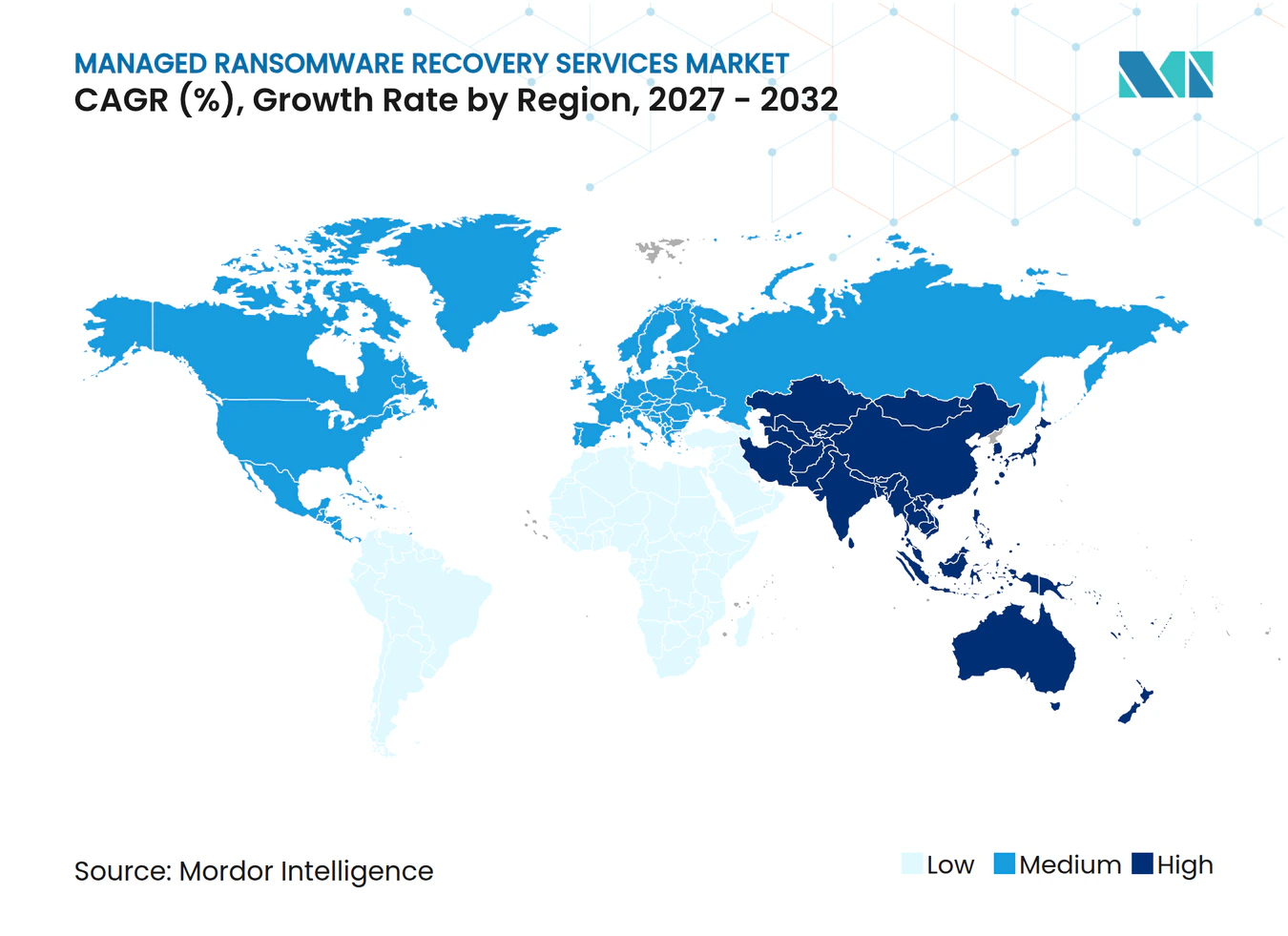
North America accounted for 36.21% of the managed ransomware recovery services market size in 2026. The United States has a large concentration of regulated organizations and a well-developed market for retained incident response services. Check Point Research reported that the United States represented 51% of publicly listed ransomware victims in the third quarter of 2025.[4] Canada also contributes to the regional demand for managed recovery support. Reporting requirements for critical infrastructure and public companies also reinforce demand for structured recovery support. New York's reporting requirements extend this compliance focus to municipal corporations and public authorities.
Europe and South America Managed Ransomware Recovery Services Market
Europe remains a major demand center because compliance and industrial exposure make tested recovery procedures important. DORA has strengthened the formal procurement of recovery services among financial entities since January 2025. Germany, the United Kingdom, France, Italy, and Spain have substantial demand from industrial, financial, and telecommunications organizations. NCC Group reported that Europe represented 26% of global ransomware attacks in June 2026. The NIS2 Directive also supports recovery readiness requirements for essential and important entities across the European Union. South America is an emerging demand area, with attacks against BFSI and energy organizations in Brazil and Argentina increasing interest in specialist recovery services.
APAC and MEA Managed Ransomware Recovery Services Market
Asia-Pacific is projected to expand at a 16.63% CAGR through 2032. India recorded 77 confirmed ransomware incidents in the first half of 2026, placing it second in Asia-Pacific according to the supplied Mordor Intelligence research synthesis. CERT-In's 6-hour reporting requirement increases the value of a retained provider that can mobilize quickly. ITR reported a 9.7% increase in Japan's backup and recovery sector during fiscal year 2025 and forecast a 12.0% CAGR through fiscal year 2030. The Middle East and Africa also present demand from Gulf digital infrastructure programs and expanding digital economies in Nigeria and South Africa, although the availability of local specialist providers remains limited.
Competitive Landscape
Market Concentration
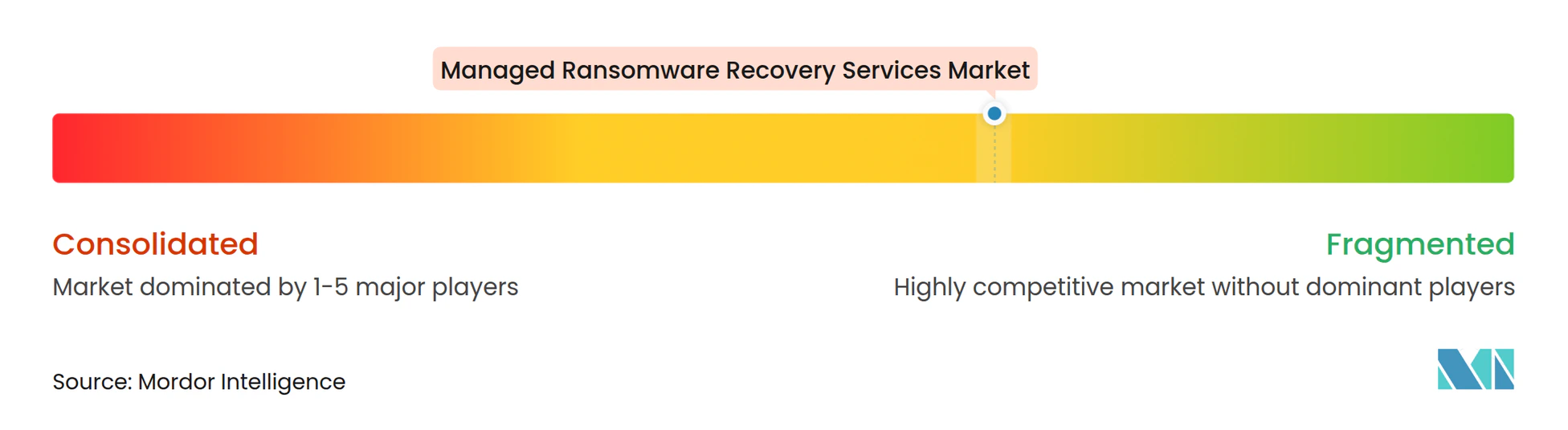
The Managed ransomware recovery services market is moderately fragmented, with no single provider holding a dominant position across every service type. Competition comes from cybersecurity platforms with incident response capability, data protection providers moving into response services, and specialist digital forensics firms. CrowdStrike, Palo Alto Networks, and SentinelOne compete alongside Veeam, Commvault, Rubrik, and Cohesity, while Kroll, NCC Group, and Arete Advisors bring specialist response expertise. The most visible pattern is convergence between detection, containment, data protection, and recovery. Buyers increasingly expect a provider to coordinate these stages rather than pass the incident between separate vendors. This favors companies that can combine security telemetry with isolated restoration and tested recovery procedures.
Commvault's partnership with CrowdStrike was expanded in April 2025 to combine CrowdStrike's incident response with Commvault's recovery services and its Guardian readiness offering. The arrangement links real-time threat detection with cleanroom restoration, allowing clients to move from containment to recovery through a more connected workflow. Rubrik acquired Strata.io in June 2026 to add identity continuity and identity roll-forward capabilities for hybrid and multicloud environments. This move addresses the risk that an organization restores systems but leaves identity services exposed to an attacker's persistence. NCC Group and Dragos introduced their joint IT and OT retainer in November 2025, offering a model for vendors that differentiate through sector-specific response expertise. These moves show that service depth and coordinated execution are as important as the underlying backup technology.
The Managed ransomware recovery services market has a clear opening for automation-first offerings aimed at smaller organizations that cannot support a large retainer. The Managed ransomware recovery services market can benefit when those offerings reduce the dependence on scarce specialist time. WORM storage certification and ISO 27001 attestation are becoming more relevant in enterprise procurement because buyers seek evidence that recovery data and service processes meet recognized requirements. Providers can differentiate by testing recoverability, automating routine triage, and making recovery status easier for executives and insurers to understand. Specialist firms can remain competitive through experience in regulated sectors and environments where operational technology is involved. Larger platforms have an advantage where clients want one provider across detection, data protection, and restoration. Smaller providers can still compete where they offer a focused response service, local knowledge, or strong forensic skills. Market concentration score: 3 out of 10, because the draft identifies no combined share of the top providers and describes a fragmented field spanning platforms, backup specialists, and specialist responders.
Managed Ransomware Recovery Services Industry Leaders
-
Veeam Software Group GmbH
-
Rubrik, Inc.
-
Cohesity, Inc.
-
Alvaka Networks, Inc.
-
CrowdStrike Holdings, Inc.
- *Disclaimer: Major Players sorted in no particular order
Managed Ransomware Recovery Services Market Companies Covered in this Report
- Veeam Software Group GmbH
- Rubrik, Inc.
- Cohesity, Inc.
- Druva Inc.
- Proven Data Recovery, LLC
- Acronis International GmbH
- Alvaka Networks, Inc.
- Arete Advisors, Inc.
- Bitdefender SRL
- Commvault Systems, Inc.
- Coveware, Inc.
- CrowdStrike Holdings, Inc.
- DriveSavers, Inc.
- Gillware, Inc.
- Kroll, LLC
- NCC Group plc
- Palo Alto Networks, Inc.
- Secure Data Recovery Services, Inc.
- SentinelOne, Inc.
- Sophos Limited
- STORM Guidance, LLC
- Halcyon
- Verizon Communications Inc.
- Mandiant, Inc.
- WithSecure Corporation
- 11:11 Systems
- Recovery Point Systems
- Iron Mountain Incorporated
Recent Industry Developments in Managed Ransomware Recovery Services Market
- October 2026: EXA Corporation launched its "Ransomware Backup Recovery Diagnostic Service" in Japan, offering a full-spectrum assessment of backup recoverability through backup, restore, and recovery lenses and delivering an improvement roadmap to clients. The service responds to documented cases where organizations with backup environments still failed to restore systems promptly due to procedural and architectural gaps, and targets Japan's expanding enterprise demand for recovery validation services.
- October 2026: Arcserve announced the immediate availability of Arcserve Ransomware Protection and Recovery Suites, new affordable solutions for small and mid-market organizations to defend data from ransomware attacks, validate recoverability, and coordinate data recovery with less operational complexity.
- June 2026: Rubrik acquired Strata.io, a specialist in identity orchestration for hybrid and multicloud environments, to introduce Identity Continuity, automated failover to a secondary identity provider during an incident, and Identity Roll Forward, enabling organizations to reconstruct Active Directory while preserving legitimate credential changes without reintroducing attacker persistence. Terms were not disclosed, and the capabilities entered private preview at the Rubrik FORWARD event.
- May 2026: KDDI iret launched 3 new ransomware recovery services using Oracle Cloud Infrastructure. The services address the difficulty Japanese enterprises face in building tamper-proof multicloud backup architectures. They include near-zero RPO recovery using Oracle Database Zero Data Loss Autonomous Recovery Service, real-time database synchronization through Oracle GoldenGate, and a private-circuit multicloud connection that meets FISC and healthcare-sector standards.
Global Managed Ransomware Recovery Services Market Report Scope
Managed ransomware recovery services provide end-to-end, expert-led solutions designed to isolate cyberattacks, safely restore compromised data, and rebuild affected IT infrastructure following a ransomware incident. These specialized, third-party services minimize business downtime and mitigate financial impact through rapid containment, forensic analysis, and secure backup restoration.
The Managed Ransomware Recovery Services Market Report is Segmented by Service Type (Emergency Assessment, Triage, Containment, and Eradication, Digital Forensics and Evidence Preservation, Decryption and Specialist Data Recovery, Infrastructure, System, Application, and Cloud Restoration, Identity, Directory, and Access Recovery, and Other Service Types), Delivery Model (Remote Incident Response, On-Site Field Deployment, and Hybrid Delivery), Organization Size (Large Enterprises and Small and Medium-Sized Enterprises), Industry Vertical (Banking, Financial Services, and Insurance [BFSI], Healthcare and Life Sciences, IT and Telecommunications, Manufacturing, Energy and Utilities, Retail and E-Commerce, and Other Industry Verticals), and Geography (North America, South America, Europe, Asia-Pacific, Middle East, and Africa). The Market Forecasts are Provided in Terms of Value (USD).
Segmentation Overview
| Emergency Assessment, Triage, Containment, and Eradication |
| Digital Forensics and Evidence Preservation |
| Decryption and Specialist Data Recovery |
| Infrastructure, System, Application, and Cloud Restoration |
| Identity, Directory, and Access Recovery |
| Other Service Types |
| Remote Incident Response |
| On-Site Field Deployment |
| Hybrid Delivery |
| Large Enterprises |
| Small and Medium-Sized Enterprises |
| Banking, Financial Services, and Insurance (BFSI) |
| Healthcare and Life Sciences |
| IT and Telecommunications |
| Manufacturing |
| Energy and Utilities |
| Retail and E-Commerce |
| Other Industry Verticals |
| North America | United States |
| Canada | |
| Mexico | |
| South America | Brazil |
| Argentina | |
| Rest of South America | |
| Europe | Germany |
| United Kingdom | |
| France | |
| Italy | |
| Spain | |
| Rest of Europe | |
| Asia-Pacific | China |
| Japan | |
| India | |
| South Korea | |
| Rest of Asia-Pacific | |
| Middle East | United Arab Emirates |
| Saudi Arabia | |
| Rest of Middle East | |
| Africa | South Africa |
| Nigeria | |
| Rest of Africa |
| By Service Type | Emergency Assessment, Triage, Containment, and Eradication | |
| Digital Forensics and Evidence Preservation | ||
| Decryption and Specialist Data Recovery | ||
| Infrastructure, System, Application, and Cloud Restoration | ||
| Identity, Directory, and Access Recovery | ||
| Other Service Types | ||
| By Delivery Model | Remote Incident Response | |
| On-Site Field Deployment | ||
| Hybrid Delivery | ||
| By Organization Size | Large Enterprises | |
| Small and Medium-Sized Enterprises | ||
| By Industry Vertical | Banking, Financial Services, and Insurance (BFSI) | |
| Healthcare and Life Sciences | ||
| IT and Telecommunications | ||
| Manufacturing | ||
| Energy and Utilities | ||
| Retail and E-Commerce | ||
| Other Industry Verticals | ||
| By Geography | North America | United States |
| Canada | ||
| Mexico | ||
| South America | Brazil | |
| Argentina | ||
| Rest of South America | ||
| Europe | Germany | |
| United Kingdom | ||
| France | ||
| Italy | ||
| Spain | ||
| Rest of Europe | ||
| Asia-Pacific | China | |
| Japan | ||
| India | ||
| South Korea | ||
| Rest of Asia-Pacific | ||
| Middle East | United Arab Emirates | |
| Saudi Arabia | ||
| Rest of Middle East | ||
| Africa | South Africa | |
| Nigeria | ||
| Rest of Africa | ||
Key Questions Answered in the Report
What is the size of the managed ransomware recovery services market?
The managed ransomware recovery services market is projected to increase from USD 1.86 billion in 2026 to USD 3.97 billion by 2032, at a 13.05% CAGR from 2027 to 2032.
Which service type leads managed ransomware recovery services?
Infrastructure, System, Application, and Cloud Restoration leads with 29.67% share in 2026 and is projected to expand at a 14.43% CAGR through 2032.
Why are companies using managed ransomware recovery providers?
Providers help organizations coordinate containment, forensic preservation, identity recovery, backup validation, and clean restoration when internal teams cannot cover every task.
Which delivery model is expanding fastest for ransomware recovery?
Hybrid Delivery is projected to expand at a 14.73% CAGR through 2032 because it combines remote triage with on-site work when physical intervention is needed.
Which organizations create the strongest demand for recovery services?
Large Enterprises held 70.41% share in 2026, while small and medium-sized enterprises are projected to expand at a 15.03% CAGR through 2032.
Which region has the fastest projected expansion?
Asia-Pacific is projected to expand at a 16.63% CAGR through 2032, supported by digital adoption, reporting requirements, and a limited supply of specialist recovery capability.