
Managed Endpoint Security Monitoring Services Market Size and Share
Market Overview
| Study Period | 2021 - 2032 |
|---|---|
| Market Size (2027) | USD 4.39 Billion |
| Market Size (2032) | USD 8.18 Billion |
| Growth Rate (2027 - 2032) | 13.22 % |
| Fastest Growing Market | Asia-Pacific |
| Largest Market | North America |
| Market Concentration | Medium |
Major Players *Disclaimer: Major Players sorted in no particular order Image © Mordor Intelligence. Reuse requires attribution under CC BY 4.0. | |
Managed Endpoint Security Monitoring Services Market Analysis by Mordor Intelligence
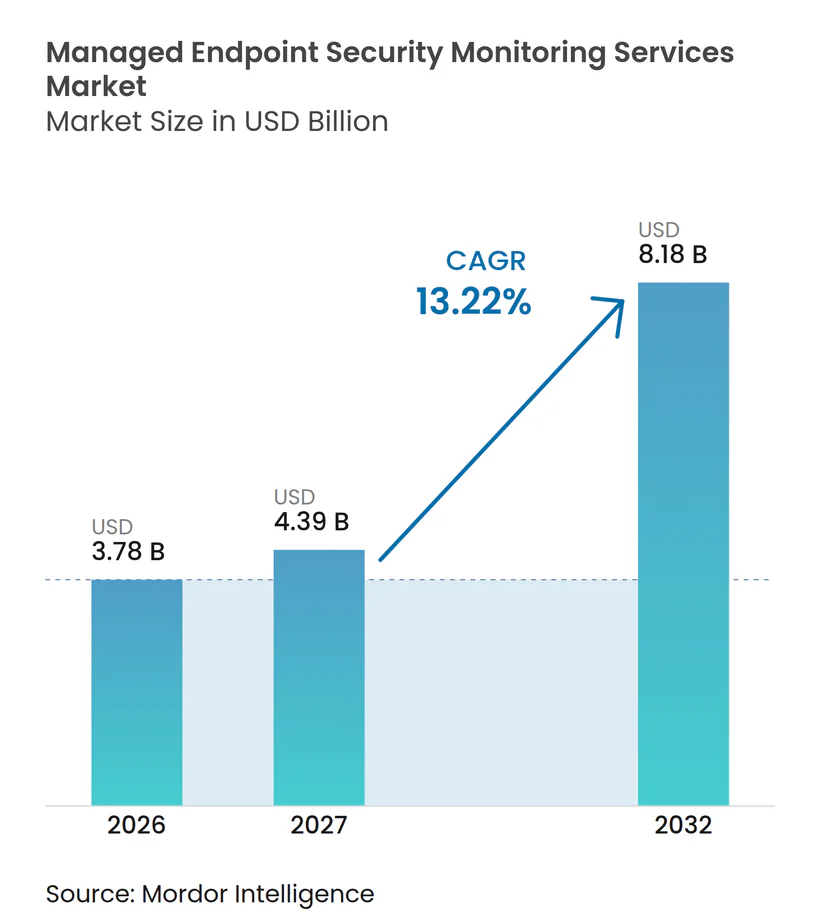
The Managed Endpoint Security Monitoring Services Market size is projected to expand from USD 3.78 billion in 2026 and USD 4.39 billion in 2027 to USD 8.18 billion by 2032, registering a CAGR of 13.22% between 2027 to 2032. The Managed Endpoint Security Monitoring Services Market is seeing higher demand because ransomware activity is escalating, qualified security operations staff are scarce, and organizations are increasingly using outsourced endpoint protection to maintain continuous coverage. Within the Managed Endpoint Security Monitoring Services Market, remote and hybrid work, together with cloud adoption, have increased the number and variety of devices that organizations must protect, often across several locations and operating environments. For the Managed Endpoint Security Monitoring Services Market, these changes have made endpoint monitoring a regular board-level risk topic and increased interest in providers that can operate around the clock with clear investigation and response procedures. Competitive strategy in the Managed Endpoint Security Monitoring Services Market is shifting toward integrated XDR platforms that combine endpoint, identity, network, and cloud telemetry, raising the delivery standard for specialist providers. Providers in the Managed Endpoint Security Monitoring Services Market that automate routine investigations, improve containment speed, and preserve informed human oversight are better placed to retain clients as adversaries also adopt AI-enabled tools.
Key Report Takeaways
- By managed service type, Managed Endpoint Detection and Response Services held 42.84% of the Managed Endpoint Security Monitoring Services market share in 2026, while Managed Endpoint Incident Response and Remediation is projected to expand at a 17.37% CAGR through 2032.
- By deployment mode, cloud-based deployment accounted for 56.91% of the Managed Endpoint Security Monitoring Services market size in 2026 and is projected to expand at a 16.29% CAGR through 2032.
- By service model, fully managed services commanded 39.53% of revenue in 2026, while co-managed services are projected to expand at a 16.03% CAGR through 2032.
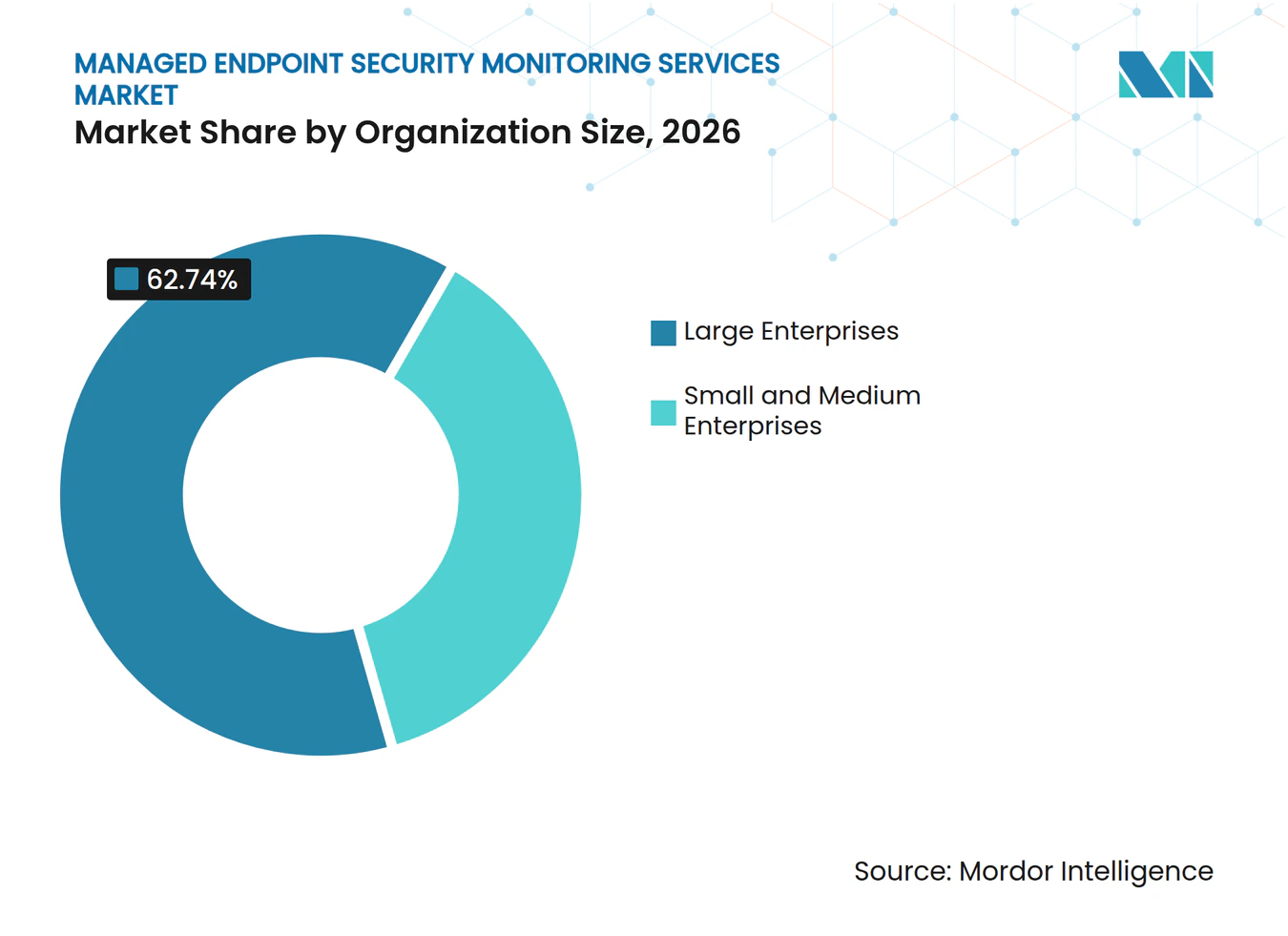
- By organization size, large enterprises held 62.74% of revenue in 2026, while SMEs are projected to expand at a 14.18% CAGR through 2032.
- By end-user industry, BFSI accounted for 21.32% of revenue in 2026, while energy and utilities are projected to expand at a 14.71% CAGR through 2032.
- By geography, North America held 42.87% of revenue in 2026, while Asia-Pacific is projected to expand at a 14.24% CAGR through 2032.
Note: Market numbers in this report are based on Mordor Intelligence's proprietary estimation framework, which combines nine months of actuals with Q4 projections for base year 2026.
Market Trends and Insights
Drivers Impact Analysis of Managed Endpoint Security Monitoring Services Market*
| Driver | (~) % Impact on CAGR Forecast | Geographic Relevance | Impact Timeline |
|---|---|---|---|
| Escalating Ransomware and Endpoint Attack Complexity | +3.8% | Global, highest density in North America and Europe | Short term (≤ 2 years) |
| AI-Enabled Threat Hunting and Response Automation | +2.9% | Global, strongest early adoption in North America and Asia-Pacific | Medium term (2-4 years) |
| Shortage of Skilled Security Operations Personnel | +2.6% | Global, most acute in Europe, India, and Southeast Asia | Long term (≥ 4 years) |
| Cyber-Insurance and Regulatory Readiness Requirements | +2.1% | North America and EU, spillover to Middle East and Africa | Medium term (2-4 years) |
| Cloud and Hybrid-Work Endpoint Proliferation | +1.7% | Global, notably Asia-Pacific core | Medium term (2-4 years) |
| Endpoint Telemetry Consolidation Into XDR Platforms | +1.4% | North America and EU, early gains in Singapore and Tokyo | Long term (≥ 4 years) |
| Source: Mordor Intelligence | |||
Escalating Ransomware and Endpoint Attack Complexity
Ransomware volume and technical sophistication are driving sustained demand for managed endpoint monitoring across the Managed Endpoint Security Monitoring Services Market. Zscaler documented a 275% year-over-year rise in ransomware activity from April 2025 through March 2026, along with USD 328 million in verified ransomware payments. The same research reported 896.2 terabytes of stolen data and found that manager-level roles and above represented 62% of targeted individuals. This focus on higher-privilege users increases the cost of missed alerts and reinforces demand for continuous behavioral analysis. AI-scripted payloads, AI-developed lateral movement tools, and misuse of workplace platforms such as Microsoft Teams reduce the usefulness of signature-based defenses. Providers that combine behavioral telemetry, current threat intelligence, rapid containment playbooks, clear escalation procedures, post-incident evidence, and support outside normal working hours can address the gap between alert volume and internal investigation capacity, strengthening the case for specialist coverage.
AI-Enabled Threat Hunting and Response Automation
AI-enabled automation is changing the economics of service delivery by helping providers extend analyst coverage without matching increases in staffing. CrowdStrike introduced Agentic MDR through Falcon Complete in March 2026 and reported up to 5x faster threat investigations and 3x higher triage accuracy in its stated benchmarks. SentinelOne launched Wayfinder Threat Detection and Response with Google Cloud in November 2025, combining AI-powered managed threat hunting with 24x7x365 MDR across endpoints, cloud workloads, and identities. These offerings raise expectations that low-signal alerts will be resolved automatically and serious incidents will be escalated with useful context. ReliaQuest reported average containment times of 4 minutes in its 2026 annual threat report, illustrating the response standard associated with greater automation. The Managed Endpoint Security Monitoring Services Market favors providers that can apply automated triage, reliably process endpoint, cloud, and identity data, and still retain human review where complex incidents require judgment rather than automated action alone.
Shortage of Skilled Security Operations Personnel
The shortage of security operations talent remains a durable reason for organizations to outsource endpoint monitoring. SANS found that 60% of surveyed organizations identified the skills gap as their leading workforce challenge in 2026, compared with 52% in the prior year. The report also found that 27% of organizations had experienced a breach linked directly to workforce skills gaps. Senior security roles took 6 or more months to fill in 55% of organizations, while 32% had reduced SOC and analyst roles as AI took on repetitive tasks. ISACA reported that 58% of organizations considered their teams understaffed and 61% had open cybersecurity positions. Managed services provide complex endpoint environments with access to specialized investigation and response skills when they cannot recruit, train, and retain dedicated specialists for every endpoint function.
Cyber-Insurance and Regulatory Readiness Requirements
Cyber-insurance and regulatory requirements are turning endpoint detection and response into an auditable control rather than an optional purchase. The New York Department of Financial Services' regulatory enhancements, which took effect in November 2025, require Class A companies to use EDR on endpoints and maintain continuous monitoring.[1] DORA has been applied across the European Union since January 2025 and brings ICT risk management and third-party oversight into financial services compliance programs. NIS2, effective in October 2026, broadens cybersecurity obligations across 18 sectors in the European Union. These rules increase the value of documented response processes, configuration logs, and provider attestations. The Managed Endpoint Security Monitoring Services Market benefits when providers can demonstrate to insurers and auditors how alerts were handled, which controls were in place, and whether the response followed an agreed-upon process.
Restraints Impact Analysis of Managed Endpoint Security Monitoring Services Market*
| Restraint | (~) % Impact on CAGR Forecast | Geographic Relevance | Impact Timeline |
|---|---|---|---|
| Alert Fatigue and False-Positive Burden | -0.7% | Global | Short term (≤ 2 years) |
| Data Sovereignty and Cross-Border Monitoring Constraints | -0.5% | EU, Asia-Pacific, Middle East and Africa | Medium term (2-4 years) |
| Outsourcing Control and Trust Concerns | -0.1% | Global | Long term (≥ 4 years) |
| Multi-Vendor Integration and Switching-Cost Friction | -0.1% | North America and EU | Medium term (2-4 years) |
| Source: Mordor Intelligence | |||
Alert Fatigue and False-Positive Burden
Alert fatigue can limit the practical value that clients receive from a managed monitoring contract. Microsoft reported that 46% of alerts were false positives, 42% were not investigated, and analysts spent 20% of their working week aggregating data across an average of 10.9 consoles in a study of 300 SOC professionals. Large volumes of low-value alerts can delay investigation of real threats and reduce trust in the detection queue. They also add pressure to client-facing SOC teams and can weaken contract renewal prospects. Providers can reduce this burden by tuning, using context-rich correlation, and implementing systems that leverage prior analyst decisions to identify repetitive noise. Expel released its Ruxie Precedent Engine in September 2026 to recognize alerts that resemble earlier cases and route repeat noise away from primary analyst queues, helping direct analyst time to incidents with clearer security consequences.
Data Sovereignty and Cross-Border Monitoring Constraints
Data sovereignty rules can conflict with the centralized telemetry model used by many managed monitoring platforms. The Bank for International Settlements stated that fragmented privacy laws and regulatory frameworks can limit cybersecurity data sharing across borders. GDPR Chapter V, China’s Personal Information Protection Law, and India’s Digital Personal Data Protection Act can limit how multinational organizations route endpoint data. Providers may need sovereign monitoring configurations that process telemetry within a client’s jurisdiction. That requirement raises per-customer infrastructure costs and reduces the scale advantages of a standardized service. Bitdefender’s 2025 partnership with secunet, which supports GravityZone processing within the European Union, shows how providers can address the constraint while maintaining continuous endpoint visibility.
*Our forecasts treat driver/restraint impacts as directional, not additive. The impact forecasts reflect baseline growth, mix effects, and variable interactions.
Managed Endpoint Security Monitoring Services Market Segment Analysis
By Managed Service Type, Behavioral Detection Holds The Largest Revenue Position
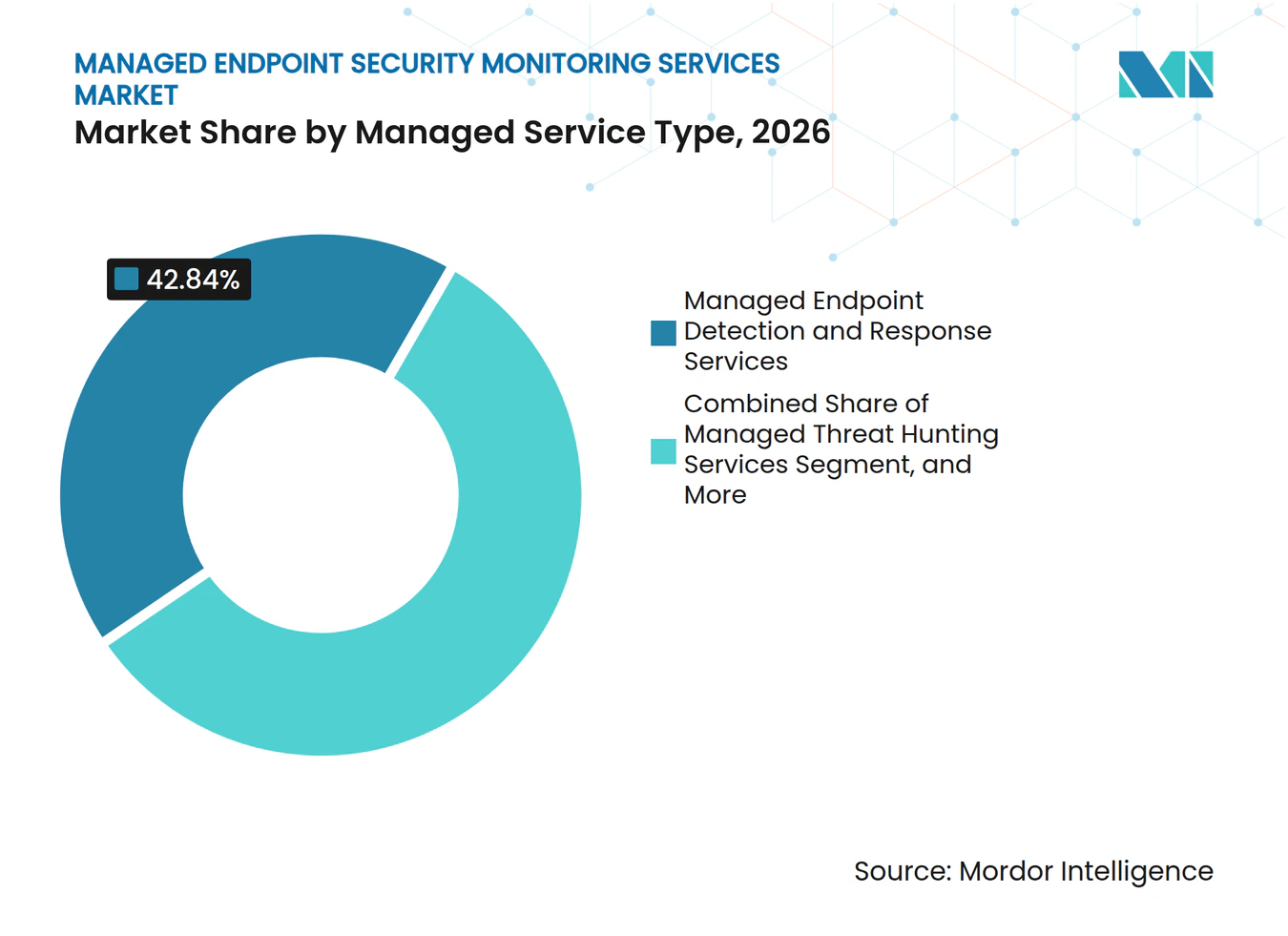
Managed Endpoint Detection and Response Services accounted for 42.84% of 2026 revenue. The segment benefits from enterprise demand for continuous behavioral telemetry analysis and from insurance requirements that favor documented EDR coverage. It also provides security teams with a managed process for reviewing suspicious activity, rather than relying on endpoint software alone. Managed Endpoint Incident Response and Remediation is projected to grow at a 17.37% CAGR from 2027 to 2032 as buyers seek contracts with clear commitments to containment, root cause analysis, and recovery. The change indicates that many buyers now want an operational outcome rather than detection alerts alone.
Managed Antivirus and Antimalware Services face margin pressure because prevention tools are increasingly included within managed EDR and XDR service packages. Managed Threat Hunting Services are gaining interest among large enterprises because proactive, hypothesis-based activity can identify attacker behavior before compromise is confirmed. Managed Vulnerability and Patch Services remain tied closely to audit cycles and insurer requirements for patch-management service levels. Clients can use these services to connect routine software maintenance with their broader incident-prevention process. Together, these needs encourage providers in the Managed Endpoint Security Monitoring Services Market to combine several services around a single detection and response workflow.



By Deployment Mode, Cloud-Native Delivery Supports Faster Service Updates
Cloud-based deployment accounted for 56.91% of the Managed Endpoint Security Monitoring Services market in 2026 and is projected to grow at a 16.29% CAGR through 2032. Its leading position reflects elastic scaling, multi-tenant detection engineering, and rapid distribution of threat intelligence. Cloud delivery enables providers to distribute updated detection rules and behavioral models to client endpoints shortly after new intelligence becomes available. This speed matters when attacker tools and techniques can change within days. It also allows providers to maintain common monitoring processes across distributed client environments.
On-premises deployment remains relevant for organizations facing strict localization requirements or operating air-gapped technology environments. Government, defense, and critical-infrastructure users may maintain these environments because they require direct control over data processing. Hybrid deployment provides a transition path for large organizations that retain regulated workloads on premises while extending cloud-based monitoring to remote employees and distributed devices. This design supports different security needs within the same enterprise without requiring a complete change to existing systems. The Managed Endpoint Security Monitoring Services Market, therefore, includes cloud-first demand alongside persistent specialist demand for on-premises and hybrid architectures.
By Service Model, Co-Managed Services Gain From More Mature Buyers
Fully managed services held 39.53% of revenue in 2026, reflecting the number of organizations that prefer comprehensive outsourcing because their internal security operations capacity is limited. This model provides clients with access to monitoring, investigation, escalation, and response functions through a single external provider. Co-managed services are projected to expand at a 16.03% CAGR from 2027 to 2032. Their expansion reflects organizations that have built security teams and now want to supplement internal analysts with outside expertise and specialized tools.
The co-managed model can create durable client relationships because investigation playbooks, escalation procedures, and detection engineering are integrated into client operations. These operational links can make changing providers more difficult than under a fully outsourced arrangement. Managed service provider-delivered models are also expanding through the channel, giving smaller providers a way to offer dedicated monitoring services to their own customers. eSentire launched Atlas Nexus Network in March 2025 to enable MSPs and systems integrators to operate dedicated Atlas XDR instances with generative AI and agentic detection capabilities. This channel approach broadens the Managed Endpoint Security Monitoring Services Market beyond direct enterprise contracts, reaching more SME buyers.
By Organization Size, Large Enterprises Lead Spending While SMEs Expand Faster
Large enterprises generated 62.74% of 2026 revenue, the largest share by organization size in the Managed Endpoint Security Monitoring Services market. Regulatory audit obligations, complex multi-site endpoint estates, and larger contract volumes support their spending. SMEs are projected to expand at a 14.18% CAGR from 2027 to 2032 from a smaller base. Cloud-native delivery, fixed-price subscriptions, and MSP channel models lower the entry threshold for organizations with fewer than 500 endpoints.
OpenText reported that 71% of SMBs preferred all-in-one prevention, detection, and response bundles, while 92% of MSPs were seeing growth linked to AI-related security interest among customers. Datto reported that 97% of top-performing MSPs delivered endpoint detection and threat hunting as standard service components in 2025. These findings show that endpoint monitoring is becoming part of standard managed security bundles for smaller organizations. Cyber-insurance requirements remain an important commercial trigger for SME adoption. Providers that package prevention, detection, and response clearly can make managed monitoring easier for smaller clients to procure and operate.

By End-User Industry, BFSI Leads Spending And Energy And Utilities Expands Fastest
BFSI accounted for 21.32% of 2026 revenue, the largest end-user share in the Managed Endpoint Security Monitoring Services market. PCI-DSS, GLBA, DORA, and NYDFS Part 500 create strong requirements for continuous endpoint oversight and documented incident response. Healthcare and life sciences also represent a high-spending group due to HIPAA Security Rule obligations and the financial consequences of ransomware incidents. These sectors place a high value on monitoring that can produce evidence for compliance and response reviews. Their needs also favor providers that can link technical monitoring with well-defined escalation and reporting procedures.
Energy and utilities are projected to expand at a 14.71% CAGR from 2027 to 2032, the highest growth rate among end-user industries. Zscaler reported a 622% year-over-year rise in ransomware targeting of utilities from April 2025 through March 2026. IT and telecommunications, government and defense, retail and e-commerce, and manufacturing have different detection priorities. Manufacturing needs awareness of operational technology; government users may require sovereign cloud configurations; and retailers need to manage seasonal increases in attacks. These different needs support more tailored offerings across the Managed Endpoint Security Monitoring Services industry.
Geography Analysis
North America Managed Endpoint Security Monitoring Services Market
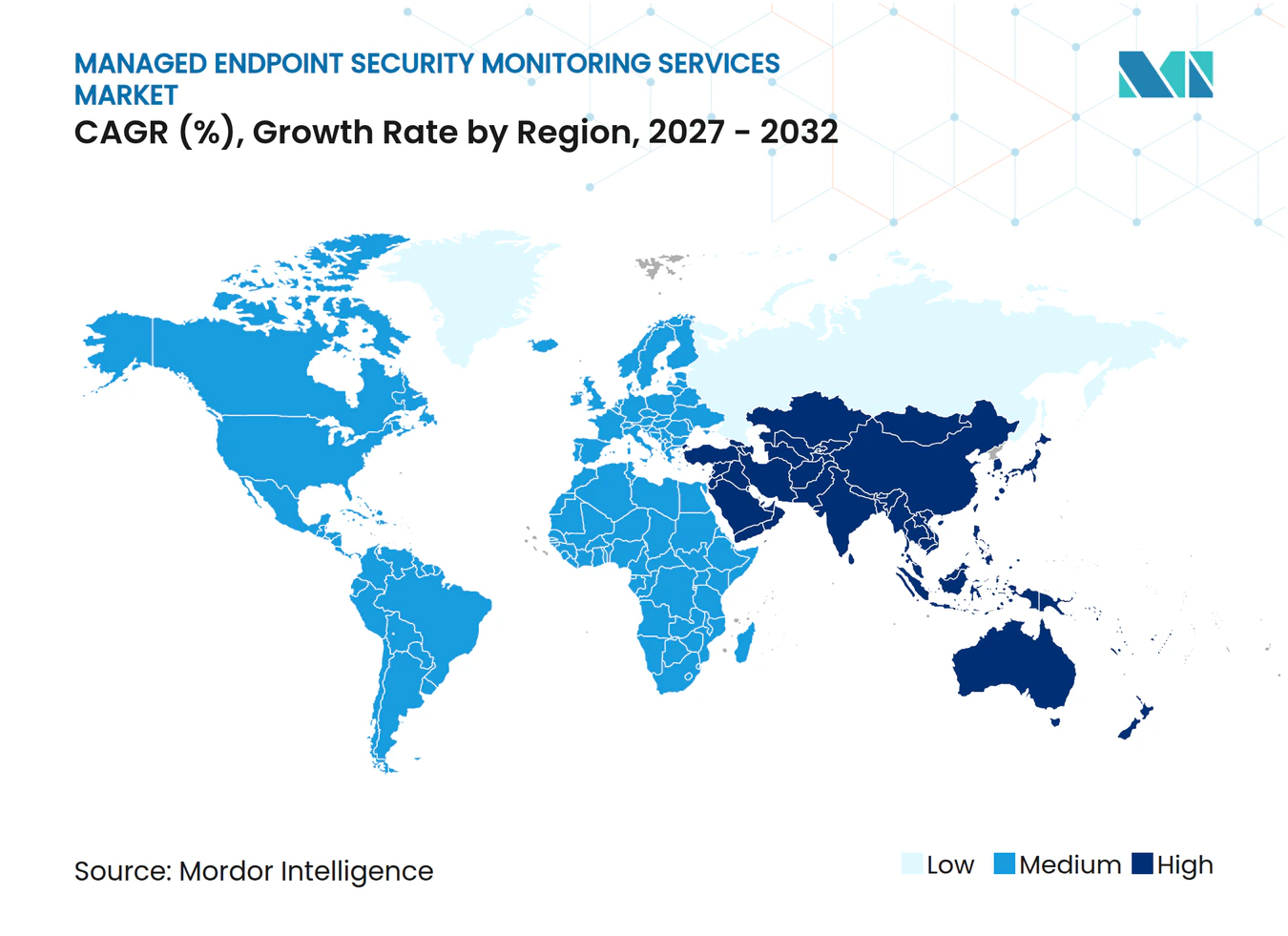
North America held 42.87% of the Managed Endpoint Security Monitoring Services market share in 2026, making it the largest regional market. The region combines a high concentration of large technology buyers with a mature cyber-insurance environment, and large organizations also manage complex endpoint estates across offices, remote workforces, and cloud services. NYDFS rules that took effect in November 2025 created added procurement pressure for mid-sized financial institutions that previously operated below the Class A threshold, increasing attention to documented monitoring and response procedures. Canada is strengthening demand in line with U.S. regulatory practices and government cybersecurity investment. Mexico is also becoming an important destination for demand as nearshoring increases technology infrastructure without creating a comparable supply of security operations talent.
APAC Managed Endpoint Security Monitoring Services Market
Asia-Pacific is projected to expand at a 14.24% CAGR from 2027 to 2032, the fastest regional rate in the Managed Endpoint Security Monitoring Services Market, supported by digital investment, rising breach frequency, and new cybersecurity obligations. India’s Digital Personal Data Protection Act and China’s Personal Information Protection Law influence endpoint telemetry configurations for multinational organizations, making regional monitoring designs more important. Australia’s Cyber Security Act 2024 became operational in 2025 and requires breach reporting and minimum security standards for critical-infrastructure operators, increasing the value of services that can offer local data handling and effective detection coverage. South Korea and Japan are expanding adoption of managed security across enterprise and SME customers, while Singapore, Malaysia, and Indonesia have large, digitally active SME bases that can increasingly access cloud-delivered monitoring. The Managed Endpoint Security Monitoring Services Market in Asia-Pacific also requires providers to adapt their delivery models to different national privacy rules and technology environments.
EMEA and South America Managed Endpoint Security Monitoring Services Market
Europe held the third-largest regional position in 2026, led by Germany, the United Kingdom, and France. DORA has created a pipeline of endpoint security requirements in financial services, while NIS2 extended cybersecurity requirements across 18 sectors in October 2026, placing greater focus on technical coverage and reporting discipline.[2] The Middle East, especially Saudi Arabia and the United Arab Emirates, is seeing faster adoption as national digitization programs and energy-sector targeting increase security needs, including the need for data-localization options. South America, led by Brazil and Argentina, and Africa, where demand is emerging in South Africa and Nigeria, remain smaller but developing markets.
Competitive Landscape
Market Concentration
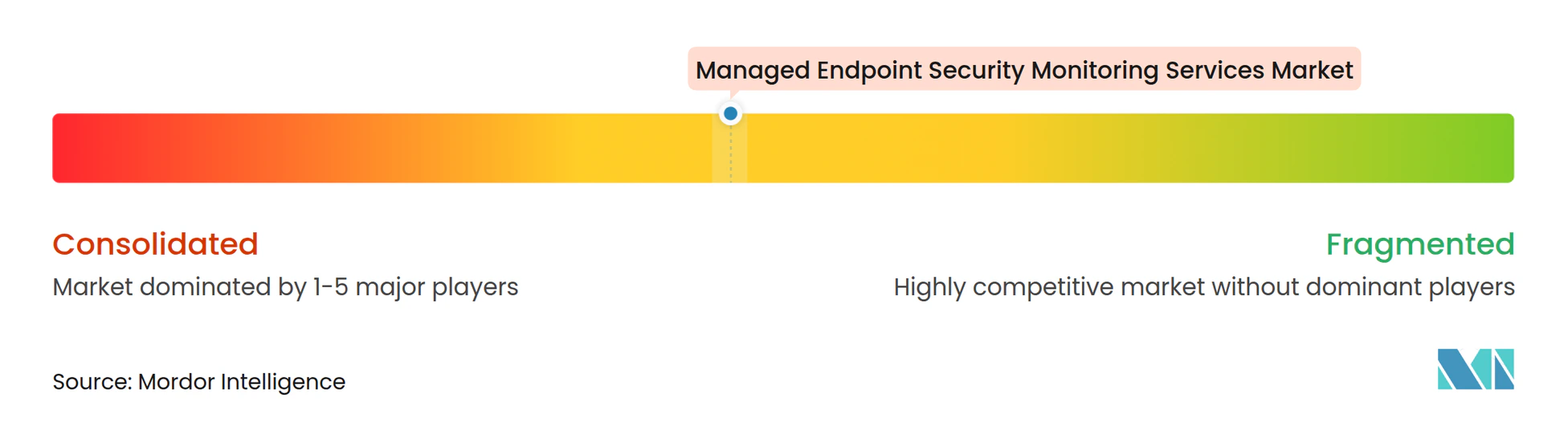
The Managed Endpoint Security Monitoring Services Market is moderately concentrated at the enterprise tier, where CrowdStrike, SentinelOne, Sophos, and Arctic Wolf have strong brand recognition and significant delivery infrastructure. The broader supplier field remains fragmented, with Huntress, Expel, ReliaQuest, eSentire, Deepwatch, and Proficio competing for mid-market and SME accounts. This combination means enterprise clients often compare global scale and platform breadth, while smaller clients may prioritize practical service support and channel availability. Providers differentiate through service-model flexibility, detection quality, containment speed, and their ability to reach customers through partners. Competition is also moving toward agentic SOC features, multi-tenant designs for MSPs, and sovereign or regional cloud options for regulated customers, favoring firms that can connect endpoint data with identity, network, and cloud signals.
Arctic Wolf completed its acquisition of Sevco Security in February 2026 and integrated continuous exposure management into the Aurora Platform. The transaction expanded its offering from detection-focused monitoring toward attack-surface and risk-quantification services, reflecting buyer interest in identifying weak points before they become confirmed endpoint incidents. CrowdStrike introduced Agentic MDR in March 2026, adding intelligent agents intended to automate alert triage, investigation, and containment within Falcon Complete. These moves show that providers are competing on the ability to identify exposure before an incident and respond rapidly when one occurs. Providers with endpoint-only offerings may face pressure when buyers prefer a broader operational security platform that joins detection workflows with identity and cloud telemetry.
Sophos completed its Secureworks acquisition in February 2025 for USD 859 million and integrated Sophos Endpoint into Taegis XDR and MDR subscriptions in September 2025.[3] The integration maintained telemetry ingestion from third-party EDR tools, including CrowdStrike, SentinelOne, and Microsoft Defender, positioning Taegis as an open platform for customers that retain existing endpoint tools. Bitdefender launched GravityZone PHASR globally in April 2025, using behavioral profiling and privilege alignment to tailor endpoint hardening configurations by user. These strategies reflect demand for consolidated platforms that can accept diverse telemetry and improve prevention and response, while specialists can still differentiate through service quality, vertical focus, and channel execution. The Managed Endpoint Security Monitoring Services Market, therefore, accommodates both platform-scale and focused service delivery to meet different customer requirements.
Managed Endpoint Security Monitoring Services Industry Leaders
-
CrowdStrike Holdings, Inc.
-
Sophos Limited
-
Arctic Wolf Networks, Inc.
-
SentinelOne, Inc.
-
Rapid7, Inc.
- *Disclaimer: Major Players sorted in no particular order
Managed Endpoint Security Monitoring Services Market Companies Covered in this Report
- Arctic Wolf Networks, Inc.
- Bitdefender SRL
- Binary Defense Systems, Inc.
- Blackpoint Cyber, Inc.
- CrowdStrike Holdings, Inc.
- Critical Start, Inc.
- Cybereason Inc.
- Cynet Systems Ltd.
- Deepwatch, Inc.
- ESET, spol. s r.o.
- eSentire, Inc.
- Expel, Inc.
- Huntress Labs Incorporated
- Malwarebytes Inc.
- Proficio, Inc.
- Rapid7, Inc.
- Red Canary, Inc.
- ReliaQuest, LLC
- SentinelOne, Inc.
- Seceon Inc.
- Sophos Limited
- ThreatLocker, Inc.
- WithSecure Corporation
Recent Industry Developments in Managed Endpoint Security Monitoring Services Market
- September 2026: Blackpoint Cyber released a broad set of new Identity Threat Detection and Response capabilities in CompassOne, including 6 new detection modules for Microsoft environments, an AI-generated Forensic Report with a complete attacker timeline, and a Historical Scan Report covering up to 180 days of Microsoft 365 activity with MITRE ATT&CK mappings. The release strengthened Blackpoint's competitive position for MSP-focused managed endpoint monitoring contracts where identity-endpoint correlation is a critical defense capability gap.
- September 2026: Expel released the Ruxie Precedent Engine, an AI capability that automatically recognizes when a new alert matches previously triaged historical cases and routes repeat noise out of primary analyst queues, reducing decision latency for recurring alert patterns within its managed security platform.
- April 2026: eSentire's Threat Response Unit detected active exploitation of Citrix NetScaler ADC and Gateway devices on April 2, 2026, 6 days before industry-standard network detection rules were published, correlating activity from 28 attacker source IPs and blocking the campaign across managed customer environments in real time.
- March 2026: CrowdStrike unveiled Agentic MDR through its Falcon Complete program at RSA 2026 in San Francisco, enabling analysts to build and deploy intelligent agents that automate alert triage, investigation, and containment. Internal benchmarks indicated up to 5x faster investigations and 3x higher triage accuracy using NVIDIA Nemotron models, and the launch included SOC Transformation Services to support enterprise migration to Falcon Next-Gen SIEM.
Global Managed Endpoint Security Monitoring Services Market Report Scope
The managed endpoint security monitoring services market comprises the provision of outsourced security monitoring, detection, investigation, threat hunting, vulnerability management, and incident response services designed to protect endpoint devices, including desktops, laptops, servers, mobile devices, and other connected endpoints, from cyber threats. These services are delivered by managed security service providers (MSSPs), managed detection and response (MDR) providers, and specialized cybersecurity firms that leverage security technologies, threat intelligence, automation, and security operations center (SOC) capabilities to identify, assess, and mitigate endpoint-related security risks.
The Managed Endpoint Security Monitoring Services Market Report is Segmented by Managed Service Type (Managed Endpoint Detection and Response Services, Managed Antivirus and Antimalware Services, Managed Threat Hunting Services, Managed Vulnerability and Patch Services, and Managed Endpoint Incident Response and Remediation), Deployment Mode (Cloud-Based, On-Premises, and Hybrid), Service Model (Fully Managed, Co-Managed, and Managed Service Provider Delivered), Organization Size (Large Enterprises and Small and Medium Enterprises), End-User Industry (BFSI, Healthcare and Life Sciences, IT and Telecommunications, Government and Defense, Retail and E-Commerce, Manufacturing, Energy and Utilities, and Other End-User Industries), and Geography (North America, South America, Europe, Asia-Pacific, Middle East, and Africa). The Market Forecasts are Provided in Terms of Value (USD).
Segmentation Overview
| Managed Endpoint Detection and Response Services |
| Managed Antivirus and Antimalware Services |
| Managed Threat Hunting Services |
| Managed Vulnerability and Patch Services |
| Managed Endpoint Incident Response and Remediation |
| Cloud-Based |
| On-Premises |
| Hybrid |
| Fully Managed |
| Co-Managed |
| Managed Service Provider Delivered |
| Large Enterprises |
| Small and Medium Enterprises |
| BFSI |
| Healthcare and Life Sciences |
| IT and Telecommunications |
| Government and Defense |
| Retail and E-Commerce |
| Manufacturing |
| Energy and Utilities |
| Other End-User Industries |
| North America | United States |
| Canada | |
| Mexico | |
| South America | Brazil |
| Argentina | |
| Rest of South America | |
| Europe | Germany |
| United Kingdom | |
| France | |
| Italy | |
| Spain | |
| Russia | |
| Rest of Europe | |
| Asia-Pacific | China |
| Japan | |
| India | |
| South Korea | |
| Australia | |
| Rest of Asia-Pacific | |
| Middle East | Saudi Arabia |
| United Arab Emirates | |
| Turkey | |
| Rest of Middle East | |
| Africa | South Africa |
| Nigeria | |
| Rest of Africa |
| By Managed Service Type | Managed Endpoint Detection and Response Services | |
| Managed Antivirus and Antimalware Services | ||
| Managed Threat Hunting Services | ||
| Managed Vulnerability and Patch Services | ||
| Managed Endpoint Incident Response and Remediation | ||
| By Deployment Mode | Cloud-Based | |
| On-Premises | ||
| Hybrid | ||
| By Service Model | Fully Managed | |
| Co-Managed | ||
| Managed Service Provider Delivered | ||
| By Organization Size | Large Enterprises | |
| Small and Medium Enterprises | ||
| By End-User Industry | BFSI | |
| Healthcare and Life Sciences | ||
| IT and Telecommunications | ||
| Government and Defense | ||
| Retail and E-Commerce | ||
| Manufacturing | ||
| Energy and Utilities | ||
| Other End-User Industries | ||
| By Geography | North America | United States |
| Canada | ||
| Mexico | ||
| South America | Brazil | |
| Argentina | ||
| Rest of South America | ||
| Europe | Germany | |
| United Kingdom | ||
| France | ||
| Italy | ||
| Spain | ||
| Russia | ||
| Rest of Europe | ||
| Asia-Pacific | China | |
| Japan | ||
| India | ||
| South Korea | ||
| Australia | ||
| Rest of Asia-Pacific | ||
| Middle East | Saudi Arabia | |
| United Arab Emirates | ||
| Turkey | ||
| Rest of Middle East | ||
| Africa | South Africa | |
| Nigeria | ||
| Rest of Africa | ||
Key Questions Answered in the Report
What is the size of the Managed Endpoint Security Monitoring Services Market?
The market is projected at USD 3.78 billion in 2026, USD 4.39 billion in 2027, and USD 8.18 billion by 2032, with a 13.22% CAGR for 2027-2032, supported by demand for continuous outsourced endpoint monitoring.
Which managed endpoint service has the largest revenue share?
Managed Endpoint Detection and Response Services led with a 42.84% revenue share in 2026, reflecting enterprise preference for continuous behavioral telemetry analysis and documented EDR coverage.
Which deployment approach is expanding most quickly?
Cloud-based deployment is the largest mode at 56.91% of 2026 revenue and is projected to expand at a 16.29% CAGR through 2032, supported by elastic scaling and rapid threat-intelligence distribution.
Which organizations are increasing spending most quickly?
SMEs are projected to expand at a 14.18% CAGR through 2032, supported by cloud-based delivery, fixed-price subscriptions, MSP channels, and the increasing importance of cyber-insurance requirements.
Which end-user sector has the fastest projected expansion?
Energy and utilities is projected to expand at a 14.71% CAGR through 2032 as ransomware targeting and IT-OT security needs intensify across renewable and conventional power infrastructure.
Which region has the fastest projected expansion?
Asia-Pacific is projected to expand at a 14.24% CAGR through 2032, supported by digital investment, security regulation, rising breach frequency, and demand from enterprise and SME customers.