
Managed Production Print Operations Services Market Size and Share
Market Overview
| Study Period | 2021 - 2032 |
|---|---|
| Market Size (2027) | USD 6.24 Billion |
| Market Size (2032) | USD 8.58 Billion |
| Growth Rate (2027 - 2032) | 6.58 % |
| Fastest Growing Market | Asia-Pacific |
| Largest Market | North America |
| Market Concentration | Medium |
Major Players *Disclaimer: Major Players sorted in no particular order Image © Mordor Intelligence. Reuse requires attribution under CC BY 4.0. | |
Managed Production Print Operations Services Market Analysis by Mordor Intelligence
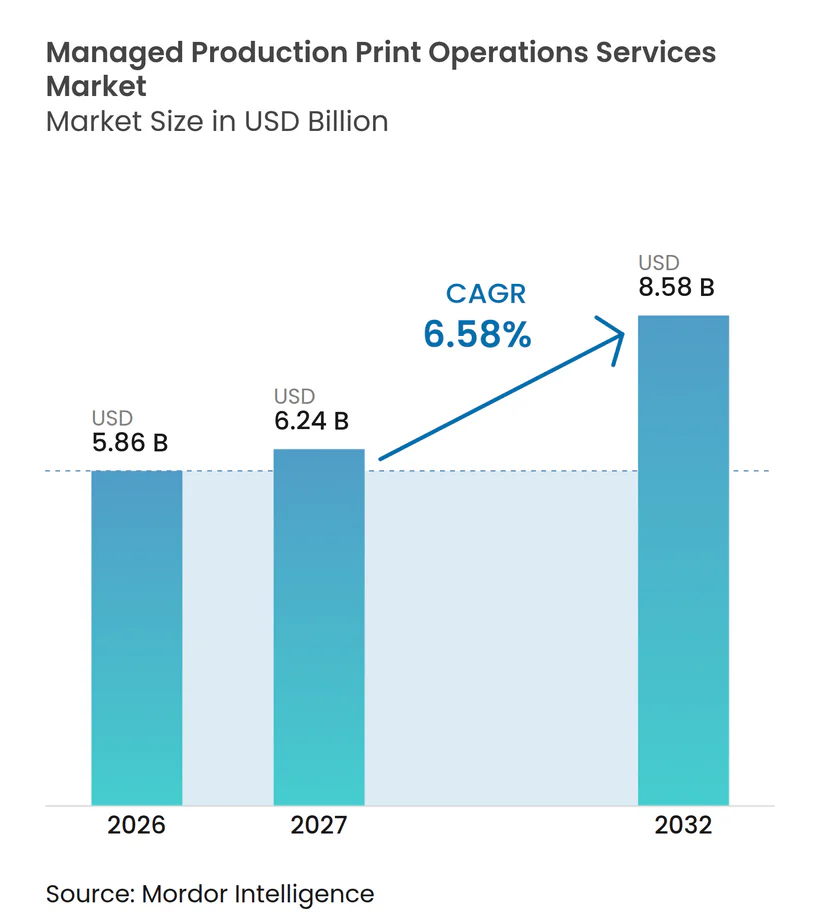
The Managed Production Print Operations Services market size is projected to expand from USD 5.86 billion in 2026 to USD 6.24 billion in 2027, and to USD 8.58 billion by 2032, registering a CAGR of 6.58% between 2027 and 2032. The managed production print operations services market is moving from device-led purchasing toward contracts that combine fleet oversight, security controls, document workflows, predictable service charges, regular reporting, and accountability for day-to-day performance. Hybrid work has made distributed print access harder to govern because employees need dependable access from offices, homes, and shared work locations without weakening security requirements. Cloud migration is changing the basis of competition because providers can replace local print servers with centrally managed platforms while retaining hybrid options for regulated workloads and clients with specific data handling needs. Security, data residency, auditability, implementation quality, and workflow integration now influence provider selection alongside uptime, device availability, supplies, and the speed of operational support. The managed production print operations services market also faces lower office print volumes, so providers are extending contracts to include document capture, workflow automation, analytics, secure access, and other services that are not directly tied to page-based revenue.
Key Report Takeaways
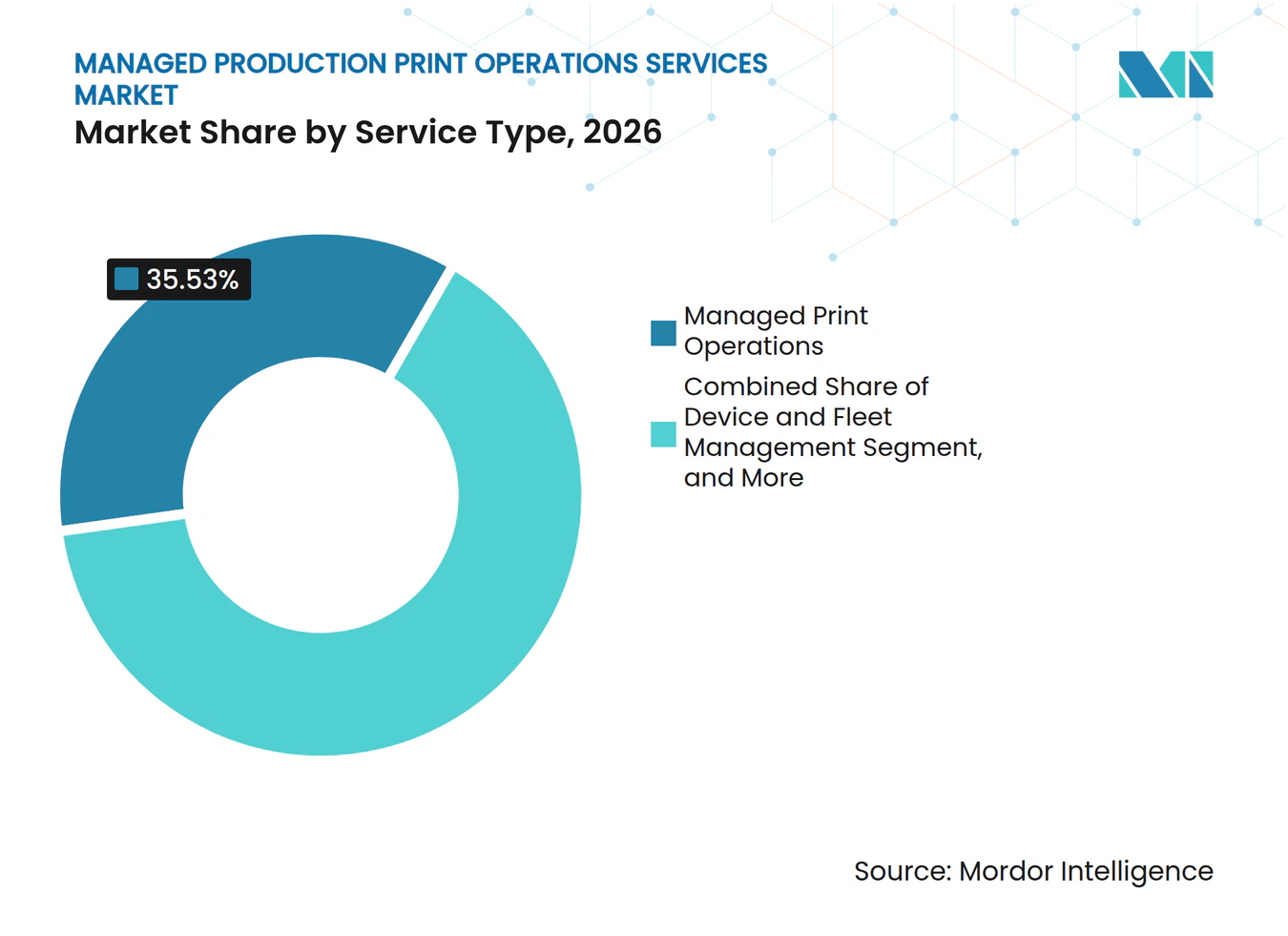
- By service type, Managed Print Operations held 35.53% of the managed production print operations services market share in 2026, while Cloud Print Services are projected to expand at a 7.11% CAGR through 2032.
- By channel type, Printer and Copier Manufacturers accounted for 48.89% of revenue in 2026, while Independent Software Vendors are projected to record a 6.71% CAGR through 2032.
- By deployment mode, On-Premise held 43.96% of revenue in 2026, while Cloud-Based deployment is projected to expand at a 6.69% CAGR through 2032.
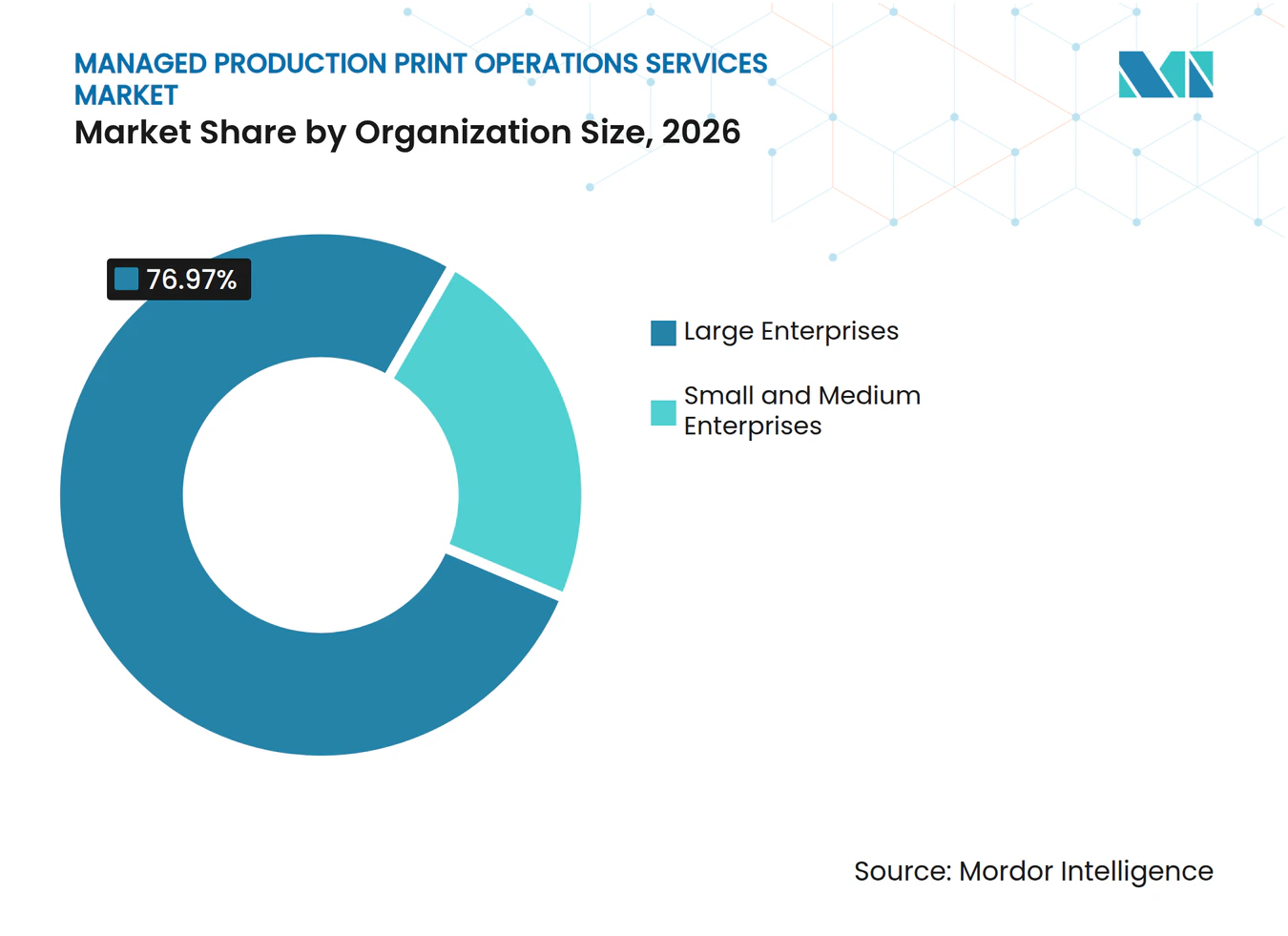
- By organization size, Large Enterprises held 76.97% of revenue in 2026, while Small and Medium Enterprises are projected to advance at a 6.52% CAGR through 2032.
- By end-user vertical, BFSI accounted for 15.03% of revenue in 2026, while Healthcare is projected to record a 7.89% CAGR through 2032.
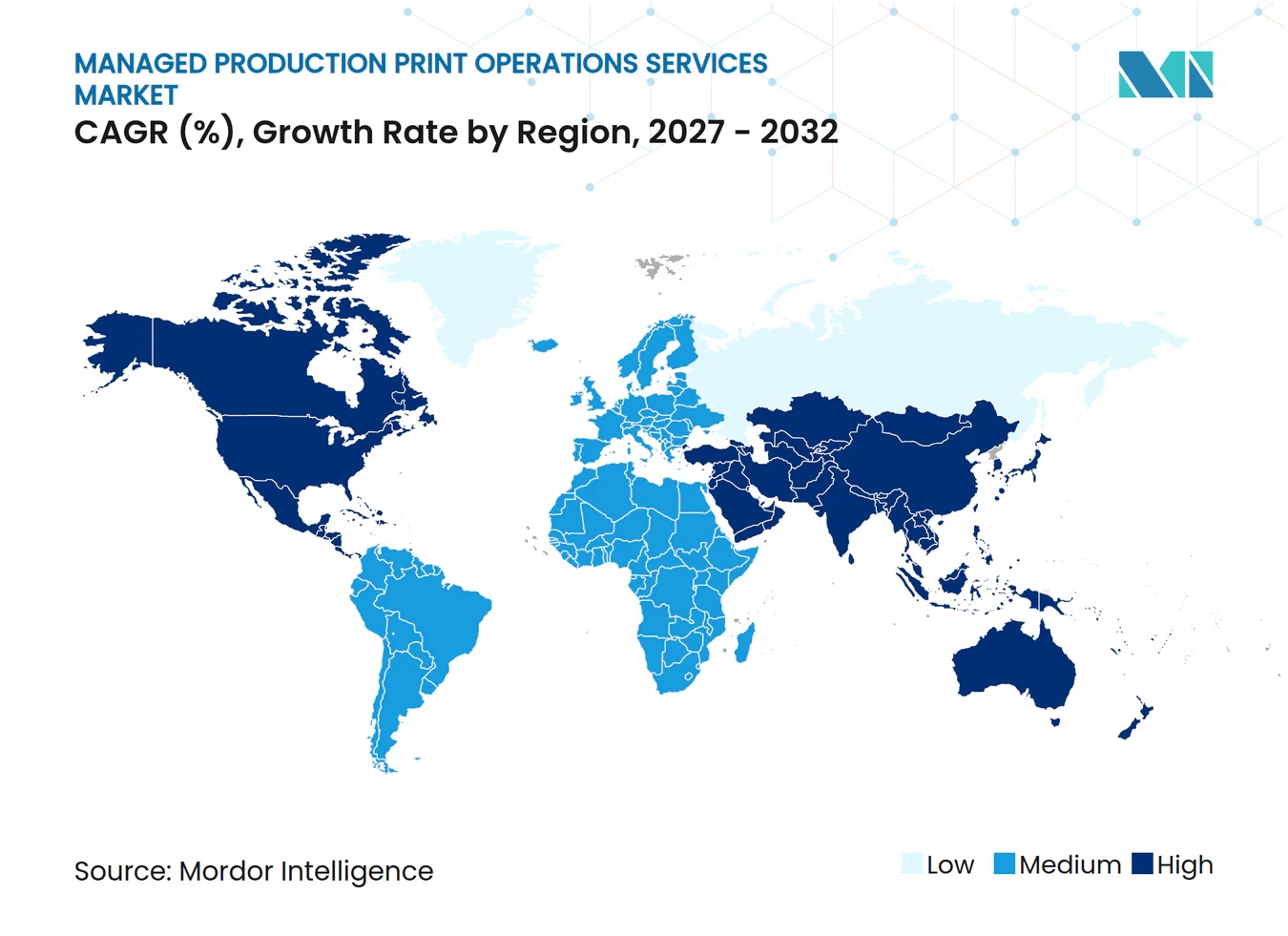
- By geography, North America held 39.04% of revenue in 2026, while Asia-Pacific is projected to expand at a 7.09% CAGR through 2032.
Note: Market numbers in this report are based on Mordor Intelligence's proprietary estimation framework, which combines nine months of actuals with Q4 projections for base year 2026.
Market Trends and Insights
Drivers Impact Analysis of Managed Production Print Operations Services Market*
| Driver | (~) % Impact on CAGR Forecast | Geographic Relevance | Impact Timeline |
|---|---|---|---|
| Hybrid-Work Print Infrastructure Optimization | +1.8% | Global, concentrated in North America and Western Europe | Short term (≤ 2 years) |
| Cloud and Subscription-Based MPS Adoption | +1.6% | Global, highest in North America, the United Kingdom, and Asia-Pacific core markets | Medium term (2-4 years) |
| Print Security and Compliance Requirements | +1.3% | North America and Europe, with spillover to Asia-Pacific financial centers | Medium term (2-4 years) |
| Workflow Digitization and Intelligent Document Processing | +1.1% | Global, with early gains in the United States, the United Kingdom, and Australia | Medium term (2-4 years) |
| Page-Level Carbon Accounting in Procurement | +0.6% | Europe-led, with early adoption in Japan and South Korea | Long term (≥ 4 years) |
| Predictive Uptime Guarantees for High-Volume Production Fleets | +0.5% | Global, with strong demand in industrial manufacturing hubs | Long term (≥ 4 years) |
| Source: Mordor Intelligence | |||
Hybrid-Work Print Infrastructure Optimization
Distributed printing creates inconsistent access policies, security gaps, unclear ownership, and rising support work when offices, home locations, and shared sites use separate print controls. The managed production print operations services market benefits when providers centralize authentication, job release, queue visibility, device status, and reporting across those locations. CISA has published guidance on printing while working remotely, which supports the use of managed processes for remote print environments.[1] Providers can make these controls part of a broader security service instead of positioning them as an optional device feature or a stand-alone software purchase. This approach changes renewal discussions from periodic device replacement to the continuing management of access rules, print activity, service quality, and security settings. The managed production print operations services market benefits from hybrid work, even as enterprise page volumes remain under pressure.
Cloud and Subscription-Based MPS Adoption
Cloud platforms reduce dependence on local print servers and allow providers to set common policies for users across multiple locations, business units, and device types. Subscription plans also make print costs easier to track because clients can link charges to users, devices, departments, or measured consumption. Y Soft reported that 64.8% of new print deployments worldwide were cloud-based and that 76% of IT teams had moved, or planned to move, print infrastructure to the cloud within 3 years. The managed production print operations services market uses this change to offer serverless administration, secure release, reporting, and centralized support as recurring services. Cloud adoption can also support document automation by enabling print, capture, routing, and policy enforcement to operate through a common platform. Providers still need hybrid architectures for clients that cannot place sensitive print information in a fully cloud-based environment.
Print Security and Compliance Requirements
Print jobs can contain patient records, financial documents, employee information, and other sensitive content, so the print layer needs controls that align with broader cybersecurity requirements. The managed production print operations services market gains when customers require encryption, authentication, audit trails, secure release, and clear data residency policies as contractual commitments. CISA identifies the need to secure remote printing processes and manage exposure when employees print outside traditional office locations. Healthcare, BFSI, and public-sector buyers increasingly seek documented controls that integrate with their existing security, identity, and incident management systems. Providers with established evidence of compliance can enter procurement processes more easily than firms that offer only fleet maintenance and basic supply management. This requirement raises the importance of security design, implementation discipline, and auditable delivery in the managed production print operations services market.
Workflow Digitization and Intelligent Document Processing
Clients increasingly expect managed providers to improve information flow rather than only maintain devices, replenish supplies, or respond to service calls. The managed production print operations services market is consequently extending into document capture, optical character recognition, classification, routing, and exception management. These services can reduce duplicate handling when printed and digital records move through the same business process and require the same approvals. They also allow a provider to combine print operations with higher-value document services under one agreement, which can simplify vendor governance for the client. Xerox describes Workflow Central as part of the portfolio extended to Lexmark clients following the integration of the two organizations. The move shows how established providers are broadening their service offerings beyond device support to include workflow, cloud tools, and information handling.
Restraints Impact Analysis of Managed Production Print Operations Services Market*
| Restraint | (~) % Impact on CAGR Forecast | Geographic Relevance | Impact Timeline |
|---|---|---|---|
| Structural Decline in Office Print Volumes | -0.8% | Global, most acute in North America and Western Europe | Short term (≤ 2 years) |
| High Integration and Change-Management Complexity | -0.6% | Global, most severe in organizations with legacy ERP and document management stacks | Medium term (2-4 years) |
| Data Sovereignty Limits on Cloud Print Operations | -0.4% | Europe, especially Germany and France, with spillover to Japan and India | Medium term (2-4 years) |
| Skilled Production-Print Operator Shortages | -0.3% | Global, most critical in North America and Western Europe | Long term (≥ 4 years) |
| Source: Mordor Intelligence | |||
Structural Decline in Office Print Volumes
Lower office output reduces the revenue base for contracts priced mainly on pages or installed devices, especially where clients have consolidated sites. The managed production print operations services market must therefore replace volume-linked income with recurring charges for security, workflow, analytics, and infrastructure services. Clients are also reducing fleet counts as they revise office footprints, remove underused devices, and move discretionary work into digital channels. This creates demand for smaller contracts with higher service content, rather than broad fleet management programs built around device volume. Providers that maintain only a cost-per-copy model face more frequent price pressure at renewal and fewer opportunities to expand account value. The managed production print operations services market is better placed when its services cover document processes that remain important after print volumes decline.
High Integration and Change-Management Complexity
Large organizations can have mixed fleets, legacy enterprise systems, several identity platforms, separate cloud environments, and locally developed printing procedures. Connecting these systems can extend implementation schedules and increase professional service costs beyond the scope of the original contract. The managed production print operations services market also faces resistance when new workflows change established departmental routines or require employees to use new release methods. Printing disruptions are highly visible to employees, so clients may attribute early disruption to the provider even when internal process changes are the main cause. Providers need phased migration plans, detailed testing, user communication, and continuous service commitments to limit this risk during transition. The complexity can slow replacement decisions among accounts that would otherwise benefit most from modernization and centralized management.
*Our forecasts treat driver/restraint impacts as directional, not additive. The impact forecasts reflect baseline growth, mix effects, and variable interactions.
Managed Production Print Operations Services Market Segment Analysis
By Service Type:
Operations Management Anchors Revenue While Cloud Shifts Value CreationManaged Print Operations accounted for 35.53% of the managed production print operations services market in 2026, making it the largest service category. This category combines fleet oversight, supply management, device monitoring, field service dispatch, and agreed-upon uptime commitments under a single operating model. Print Infrastructure Assessment gives clients an early view of device requirements, document flows, access controls, and the practical condition of their existing fleet. Device and Fleet Management then provides regular monitoring and service coordination, which keeps providers involved throughout the contract term. Document Workflow Optimization is becoming more important as buyers seek measurable process efficiency, lower manual handling, and stronger control over exceptions.
Cloud Print Services are projected to record a 7.11% CAGR through 2032, the fastest rate within this segmentation. Cloud platforms remove much of the local server work and can apply the same policies to users across offices, home locations, and shared workplaces. Y Soft reported that cloud-based systems represented 64.8% of new worldwide print deployments in 2026. Providers still need to combine secure cloud functions with local infrastructure for clients with strict data-handling requirements. The managed production print operations services industry is dividing between mature operational services and platform-led services that extend contract value into workflow and security.



By Channel Type:
Hardware Incumbents Defend Volume While Software Vendors Gain MomentumPrinter and Copier Manufacturers held 48.89% of revenue in 2026, supported by bundled hardware, software, supplies, and service agreements. Direct relationships with large enterprises help these suppliers retain customers across multi-year device refresh cycles and formal procurement periods. System Integrators and Resellers remain important because they can bring together mixed fleets, local implementation resources, and specialized compliance support. Their position is useful in mid-market and public-sector accounts where global OEM sales teams may not provide detailed local coverage. This channel structure gives established OEMs a broad reach in the managed production print operations services market while preserving a role for local service partners.
Independent Software Vendors are projected to record a 6.71% CAGR through 2032, the fastest channel growth rate. Their device-neutral platforms allow organizations to apply common policies, manage users, and collect reporting data across fleets from several brands. Konica Minolta introduced the KPAX managed print solution to its dealer network in January 2025 through an expanded partnership with ACDI. KPAX centralizes fleet management, customer invoicing, and proactive maintenance visibility, showing why OEMs are adding software-led capabilities to protect dealer relationships. Contract decisions are increasingly shaped by analytics, policy management, workflow functionality, and implementation quality rather than device hardware alone.
By Deployment Mode:
On-Premise Installed Base Masks a Structural Pivot to CloudOn-Premise deployment held 43.96% of the managed production print operations services market in 2026, reflecting established print-server infrastructure in large enterprises and regulated sectors. Many organizations retain local systems because proprietary device controls and internal operating procedures have accumulated over several technology cycles. Local deployment also helps clients meet strict data-handling requirements when they cannot store sensitive content in fully cloud-based systems. Hybrid deployment combines local print functions with cloud-based policy management, reporting, and analytics, helping preserve operational control during the transition. This approach gives organizations a workable path from traditional server estates toward more centralized administration without forcing an immediate full migration.
Cloud-Based deployment is projected to expand at a 6.69% CAGR through 2032. It can reduce administrative work, ensure consistent policy enforcement, and support users regardless of their device's location. The European Commission’s Cloud Sovereignty Framework addresses conditions for protecting European data and retaining operational control in cloud use.[2] These requirements can favor hybrid architectures for financial services and public-sector contracts that must document data handling practices. Providers with flexible deployment options can serve cloud-oriented clients while also supporting buyers who prioritize sovereignty and local control.
By Organization Size:
Large Enterprise Spending Dominant as SME Adoption AcceleratesLarge Enterprises accounted for 76.97% of revenue in 2026, making them the largest organization-size category. Multi-site fleets, formal procurement processes, security obligations, and complex document procedures make long-term managed agreements practical for these buyers. Government and BFSI customers contribute to this concentration because their processes require documented controls, supplier accountability, and ongoing operational oversight. The United Kingdom awarded a 4-year framework for print and managed print services in September 2025, covering hospitals, councils, schools, and central government departments. These frameworks support providers who can demonstrate service continuity, compliance controls, and the ability to manage large, diverse device estates.
Small and Medium Enterprises are projected to advance at a 6.52% CAGR through 2032. Cloud-native platforms allow these businesses to use secure release, reporting, and centralized administration without hiring dedicated print infrastructure teams. Per-seat pricing can make managed services accessible to buyers that lack the capital budgets or specialist staff associated with traditional implementations. Providers need lower-touch sales models, practical onboarding, and channel partnerships to efficiently reach this customer group. This opportunity adds previously underserved accounts to the managed production print operations services market, rather than simply transferring large-enterprise contracts to smaller suppliers.

By End-User Vertical:
BFSI Anchors Revenue While Healthcare Leads GrowthBFSI held 15.03% of the managed production print operations services market share in 2026, supported by document-intensive loan processing, know-your-customer records, compliance reporting, and client communications. These organizations need reliable, auditable handling of printed financial information and personal data throughout the printing process. Security requirements can make encryption, controlled release, access logging, and event records mandatory parts of a managed service agreement. The European Commission’s cloud sovereignty guidance emphasizes the importance of control, transparency, and protection for sensitive cloud workloads. This environment favors providers that can demonstrate how print controls integrate with the client’s broader risk, identity, and compliance systems.
Healthcare is projected to record a 7.89% CAGR through 2032, the fastest rate among end-user verticals. Hospitals and clinics need secure print release, encryption, and audit trails for patient records at clinical and administrative locations. IT and Telecom buyers need centralized fleet management across distributed infrastructure sites, while government organizations emphasize localization and compliance-verified services. Educational organizations use cloud printing for mobile users and device-neutral access, which can reduce wasted output and routine administrative tasks. Industrial Manufacturing and Retail and Consumer Goods remain smaller user groups where telemetry, supply visibility, and predictive uptime are gaining operational relevance.
Geography Analysis
North America Managed Production Print Operations Services Market
North America held 39.04% of the managed production print operations services market in 2026, the highest regional share. Large enterprises, government buyers, and healthcare organizations support demand for managed fleet operations, authentication controls, service reporting, and security-focused contract terms. The United States remains central to regional demand because organizations operate extensive multi-site print estates, work with mixed equipment portfolios, and face strict expectations for data handling. CISA guidance on remote printing supports managed authentication and controlled printing practices for employees operating outside traditional offices. Canada follows a similar adoption pattern, while Mexico benefits from manufacturing activity linked to nearshoring, cross-border supply chains, and production sites that require reliable device availability.
APAC Managed Production Print Operations Services Market
Asia-Pacific is projected to expand at a 7.09% CAGR through 2032, the fastest regional rate. Japan has a mature base of managed print contracts across financial and public-sector institutions, supported by domestic providers with established service capabilities and experience in complex document environments. China is incorporating IoT-enabled fleet monitoring into enterprise modernization programs and more structured production environments, which expands the relevance of data-led maintenance. India’s Digital India initiative is supporting technology procurement in banking and government environments that have historically used fragmented print arrangements and local support models. South Korea’s technology-intensive enterprise base supports cloud print adoption, while differing regional data rules and service expectations make hybrid deployment an important option.
EMEA and South America Managed Production Print Operations Services Market
Europe is shaped by compliance requirements that affect architecture, supplier selection, implementation planning, and the treatment of sensitive information. The European Commission has established a Cloud Sovereignty Framework that addresses operational control and protection of European data in cloud services. The United Kingdom’s September 2025 public-sector print framework included Canon, Ricoh, Xerox, HP, Konica Minolta, and Kyocera. France retains an established on-premise culture in parts of the public sector, while the Nordic countries, the Middle East, Africa, and South America show varied demand shaped by digital infrastructure, public programs, outsourcing, manufacturing modernization, and the availability of local service partners.
Competitive Landscape
Market Concentration
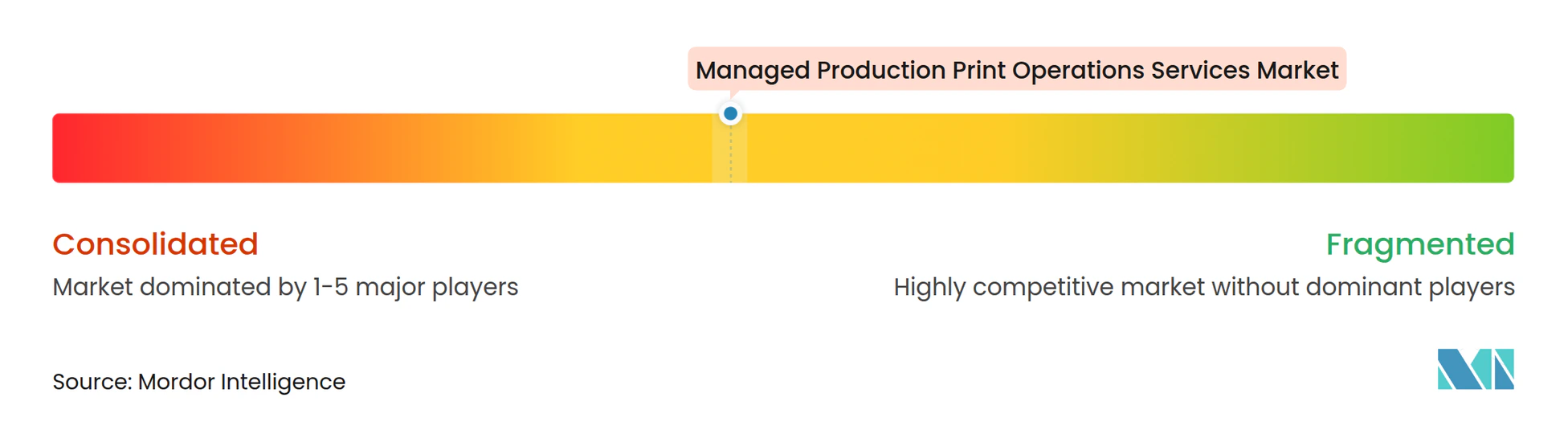
The managed production print operations services market is moderately concentrated around OEM-integrated providers, including Canon, Ricoh, Xerox, HP, and Konica Minolta. These firms combine devices, managed operations, security services, document capabilities, supplies, remote monitoring, and ongoing support within multi-year client agreements. Brother, Epson, and Toshiba also hold positions in the broader print technology landscape and compete across relevant device categories. Large OEMs have an advantage because clients prefer a single provider to manage device replacement, maintenance, service response, supply logistics, and security requirements. The managed production print operations services market remains open to platform providers because many customers operate mixed hardware fleets and want flexibility in their software layer.
Xerox completed its acquisition of Lexmark in July 2025 for USD 1.5 billion, including net debt and assumed liabilities.[3] Xerox later integrated the Xerox and Lexmark sales forces and extended its managed print, workflow, and cloud offerings to Lexmark clients in March 2026. Canon expanded its imageFORCE range in September 2025 with AI-enabled security assessment, predictive maintenance, and cloud-ready integration. Konica Minolta expanded dealer capabilities through its KPAX relationship with ACDI, adding centralized management, customer invoicing, and proactive service visibility. These actions show how leading companies use acquisition, product integration, and channel software to deepen contract value, improve customer retention, and broaden their service portfolios.
Competition is moving toward cloud orchestration, workflow automation, and compliance-focused delivery across both large enterprises and smaller distributed customers. Tungsten Automation, Vasion, and Pharos offer device-neutral tools that can manage mixed fleets, support document workflows, and reduce dependence on a single hardware brand. These providers can appeal to clients who do not want to tie analytics, security, policy management, and information handling to a single equipment supplier. The managed production print operations services market will favor providers that connect print, capture, analytics, workflow, security, and dependable implementation in a documented service structure.
Managed Production Print Operations Services Industry Leaders
-
Ricoh Company, Ltd.
-
Xerox Holdings Corporation
-
Canon Inc.
-
HP Inc.
-
Konica Minolta, Inc.
- *Disclaimer: Major Players sorted in no particular order
Managed Production Print Operations Services Market Companies Covered in this Report
- Canon Inc.
- Ricoh Company, Ltd.
- Xerox Holdings Corporation
- HP Inc.
- Konica Minolta, Inc.
- FUJIFILM Holdings Corporation
- Seiko Epson Corporation
- Brother Industries, Ltd.
- Kyocera Corporation
- Sharp Corporation
- Toshiba Tec Corporation
- RISO KAGAKU CORPORATION
- Eastman Kodak Company
- Heidelberger Druckmaschinen AG
- Agfa-Gevaert N.V.
- SCREEN Holdings Co., Ltd.
- Mimaki Engineering Co., Ltd.
- Roland DG Corporation
- Durst Group AG
- Electronics For Imaging, Inc.
Recent Industry Developments in Managed Production Print Operations Services Market
- March 2026: HP Indigo announced a major strategic agreement with Shutterfly for the deployment of 35 HP Indigo 120K digital presses, HP Indigo's most advanced industrial-scale, high-volume production platform, at HP Imagine 2026 on March 24, 2026. The multi-year deal builds on a 25-year collaboration and encompasses Shutterfly's full fleet upgrade, with first-phase installations set for 2026, demonstrating the durability of large-volume production print investment in commercial personalization segments.
- March 2026: Xerox further unified its print go-to-market structure on March 2, 2026, integrating the Xerox and Lexmark salesforces and extending Xerox Managed Print Services, Workflow Central, and cloud solutions to the Lexmark client base globally. The unified portfolio now delivers Lexmark's 9-Series A3 printers alongside Xerox's managed services stack, accelerating the target of more than USD 300 million in run-rate synergies by end of 2027.
- January 2026: Ricoh UK expanded its partnership with CPI, one of Europe's largest book printing groups, effective January 6, 2026, adding 2 Ricoh Pro C9500 toner presses across CPI's European production operations. The investment supports CPI's zero-inventory print-on-demand model across 16 manufacturing plants in the United Kingdom, France, Germany, the Czech Republic, and Spain, reinforcing Ricoh's role as a preferred managed production print partner for short-run digital publishing.
- November 2025: Electronics For Imaging and Fiery, LLC, reached an agreement on November 12, 2025, for Fiery to acquire Inèdit Software, the leading RIP and color management software company serving digital textile and specialty print markets. The transaction enables EFI to concentrate on production print systems, software, and ink, while Fiery extends its DFE and workflow suite into textile and specialty segments, a strategic unbundling that sharpens both companies' competitive focus.
Global Managed Production Print Operations Services Market Report Scope
The managed production print operations services market refers to the provision of outsourced and professionally managed printing infrastructure, services, and solutions that help organizations optimize print environments, streamline document workflows, improve operational efficiency, and reduce printing-related costs.
The Managed Production Print Operations Services Report is Segmented by Service Type (Managed Print Operations, Cloud Print Services, Device and Fleet Management, Document Workflow Optimization, and Print Infrastructure Assessment), Channel Type (Printer and Copier Manufacturers, System Integrators and Resellers, and Independent Software Vendors), Deployment Mode (On-Premise, Cloud-Based, and Hybrid), Organization Size (Large Enterprises and Small and Medium Enterprises), End-User Vertical (BFSI, Healthcare, IT and Telecom, Government, Education, Industrial Manufacturing, Retail and Consumer Goods, and Other End-User Verticals) and Geography (North America, South America, Europe, Asia-Pacific, Middle East, and Africa). The Market Forecasts are Provided in Terms of Value (USD).
Segmentation Overview
| Print Infrastructure Assessment |
| Managed Print Operations |
| Device and Fleet Management |
| Document Workflow Optimization |
| Cloud Print Services |
| Printer and Copier Manufacturers |
| System Integrators and Resellers |
| Independent Software Vendors |
| On-Premise |
| Cloud-Based |
| Hybrid |
| Small and Medium Enterprises |
| Large Enterprises |
| BFSI |
| Healthcare |
| IT and Telecom |
| Government |
| Education |
| Industrial Manufacturing |
| Retail and Consumer Goods |
| Rest of End-User Verticals |
| North America | United States |
| Canada | |
| Mexico | |
| South America | Brazil |
| Argentina | |
| Rest of South America | |
| Europe | Germany |
| United Kingdom | |
| France | |
| Russia | |
| Nordics | |
| Rest of Europe | |
| Asia-Pacific | China |
| Japan | |
| India | |
| South Korea | |
| Rest of Asia-Pacific | |
| Middle East | Saudi Arabia |
| United Arab Emirates | |
| Qatar | |
| Turkey | |
| Rest of Middle East | |
| Africa | South Africa |
| Nigeria | |
| Rest of Africa |
| By Service Type | Print Infrastructure Assessment | |
| Managed Print Operations | ||
| Device and Fleet Management | ||
| Document Workflow Optimization | ||
| Cloud Print Services | ||
| By Channel Type | Printer and Copier Manufacturers | |
| System Integrators and Resellers | ||
| Independent Software Vendors | ||
| By Deployment Mode | On-Premise | |
| Cloud-Based | ||
| Hybrid | ||
| By Organization Size | Small and Medium Enterprises | |
| Large Enterprises | ||
| By End-User Vertical | BFSI | |
| Healthcare | ||
| IT and Telecom | ||
| Government | ||
| Education | ||
| Industrial Manufacturing | ||
| Retail and Consumer Goods | ||
| Rest of End-User Verticals | ||
| By Geography | North America | United States |
| Canada | ||
| Mexico | ||
| South America | Brazil | |
| Argentina | ||
| Rest of South America | ||
| Europe | Germany | |
| United Kingdom | ||
| France | ||
| Russia | ||
| Nordics | ||
| Rest of Europe | ||
| Asia-Pacific | China | |
| Japan | ||
| India | ||
| South Korea | ||
| Rest of Asia-Pacific | ||
| Middle East | Saudi Arabia | |
| United Arab Emirates | ||
| Qatar | ||
| Turkey | ||
| Rest of Middle East | ||
| Africa | South Africa | |
| Nigeria | ||
| Rest of Africa | ||
Key Questions Answered in the Report
What is the managed production print operations services market size?
The managed production print operations services market is projected to expand from USD 5.86 billion in 2026 and USD 6.24 billion in 2027 to USD 8.58 billion by 2032, at a 6.58% CAGR. Demand is increasingly linked to managed security, workflow, cloud administration, and predictable service terms rather than rising page volumes.
Which service category leads managed production print operations services?
Managed Print Operations leads with 35.53% of revenue in 2026. It covers daily fleet oversight, supplies, monitoring, service dispatch, and contractual uptime, while Cloud Print Services are projected to record the fastest service CAGR of 7.11% through 2032.
Why are cloud print services gaining adoption?
Cloud systems can remove local server administration, apply common controls across locations, and support hybrid work. Cloud-Based deployment is projected to expand at a 6.69% CAGR through 2032 because centralized policy management, reporting, and secure release can operate across distributed user groups.
Which end-user vertical has the fastest projected expansion?
Healthcare is projected to record a 7.89% CAGR through 2032. Hospitals and clinics require secure print release, encryption, audit trails, and controlled handling of patient documentation at both clinical and administrative locations.
Which region leads the managed production print operations services market?
North America leads with 39.04% of revenue in 2026, supported by large organizations, government buyers, healthcare demand, and security-focused contracts. Asia-Pacific is projected to record the fastest regional CAGR of 7.09% through 2032.
How are software vendors affecting managed print operations?
Independent Software Vendors are projected to record a 6.71% CAGR through 2032 by offering device-neutral platforms for mixed fleets, policy management, reporting, document workflows, and centralized administration. Their growth encourages OEMs to add more cloud, analytics, and workflow capabilities to their own service portfolios.