
Managed Print Analytics Services Market Size and Share
Market Overview
| Study Period | 2021 - 2032 |
|---|---|
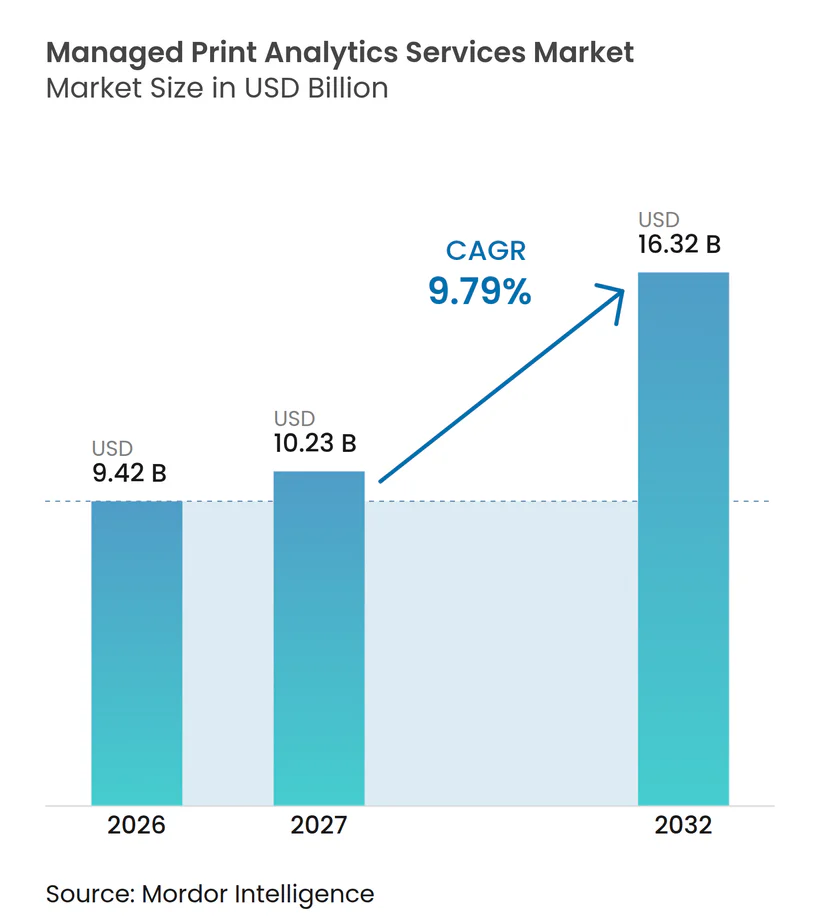
| Market Size (2027) | USD 10.23 Billion |
| Market Size (2032) | USD 16.32 Billion |
| Growth Rate (2027 - 2032) | 9.79 % |
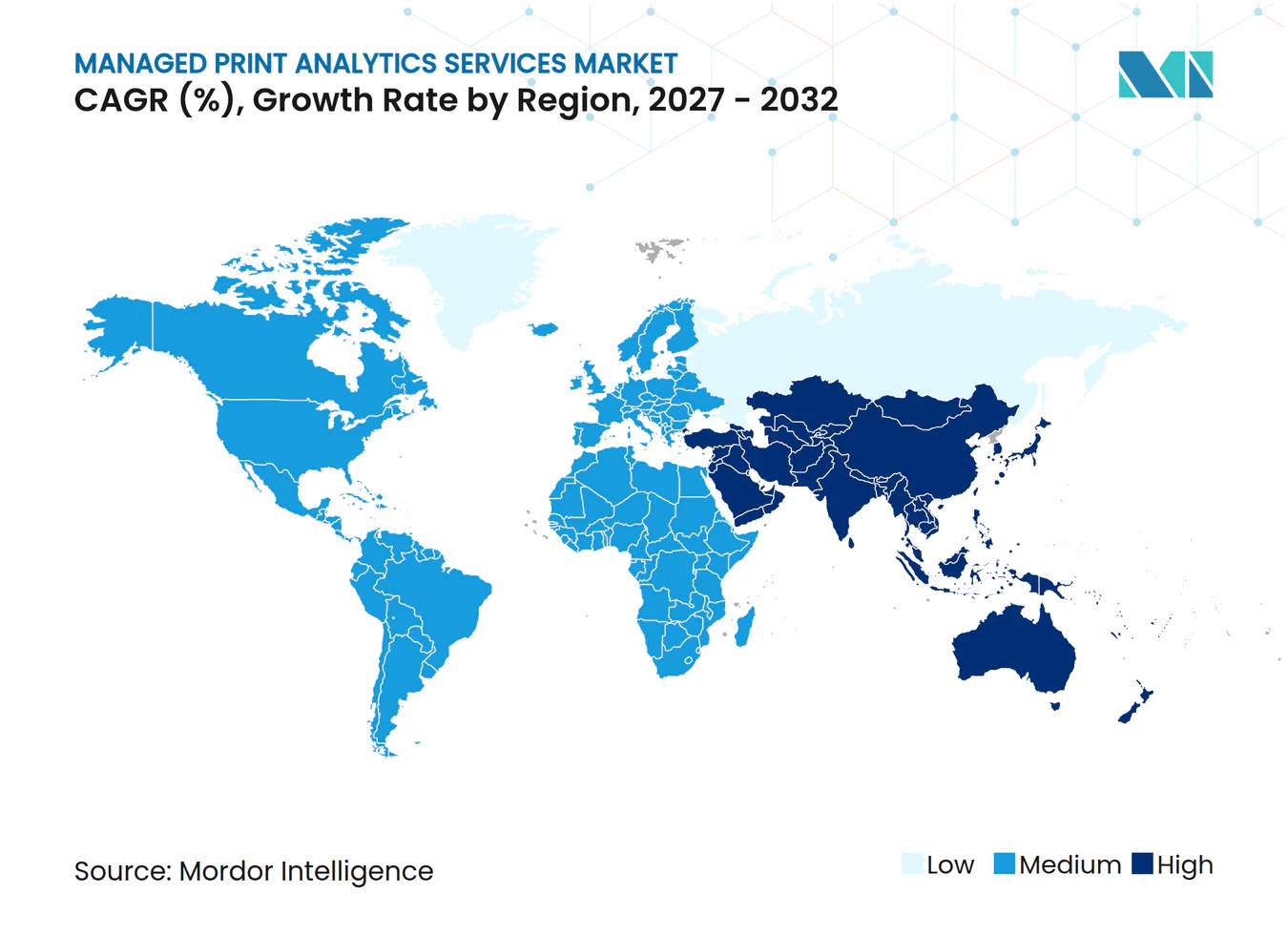
| Fastest Growing Market | Asia-Pacific |
| Largest Market | North America |
| Market Concentration | Medium |
Major Players *Disclaimer: Major Players sorted in no particular order Image © Mordor Intelligence. Reuse requires attribution under CC BY 4.0. | |
Managed Print Analytics Services Market Analysis by Mordor Intelligence
The Managed print analytics services market size is projected to expand from USD 9.42 billion in 2026 and USD 10.23 billion in 2027 to USD 16.32 billion by 2032, registering a CAGR of 9.79% between 2027 to 2032. The Managed print analytics services market is moving from basic fleet oversight to services that integrate device data, maintenance records, security controls, and document workflow information into a single management process. Cloud connections are broadening the information available from distributed fleets, while hybrid models remain important where customers need local processing or tighter control of document data. Reporting rules and security expectations are changing purchasing criteria, because buyers increasingly require audit trails and emissions data alongside predictable operating costs. The Managed print analytics services market also faces lower office print volumes and jurisdictional limits on cloud data handling, which favor providers that can shift contracts toward analytics, scanning, security, and workflow support.
Key Report Takeaways
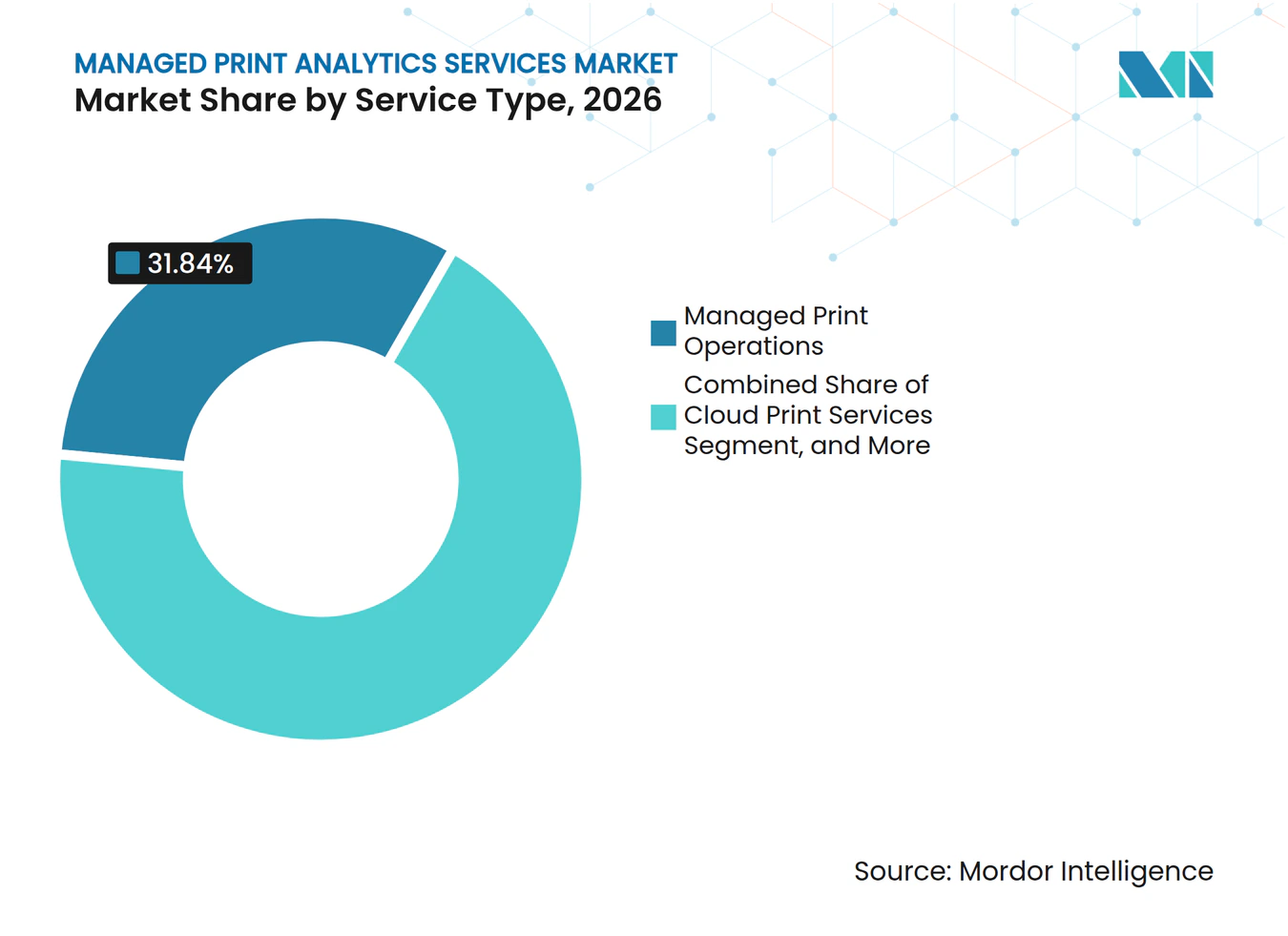
- By service type, Managed Print Operations held 31.84% of the managed print analytics services market share in 2026, while Sustainability and Carbon Analytics is projected to expand at an 11.19% CAGR through 2032.
- By deployment mode, cloud-based deployment accounted for 55.19% of revenue in 2026 and is expected to expand at a 10.37% CAGR through 2032.
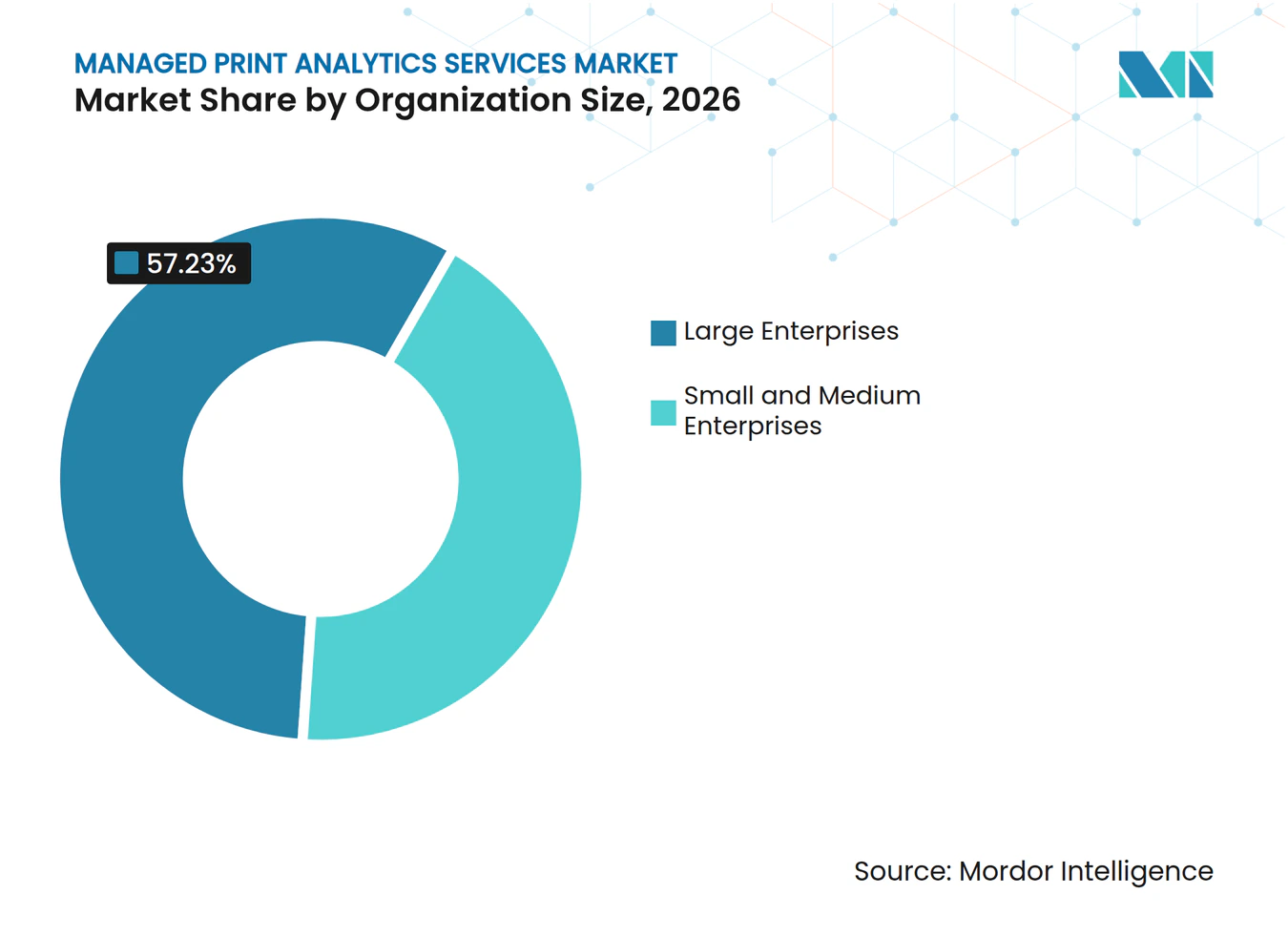
- By organization size, large enterprises held 57.23% of revenue in 2026, while small and medium enterprises are projected to expand at a 10.18% CAGR through 2032.
- By end-user vertical, BFSI accounted for 19.96% of revenue in the managed print analytics services market in 2026, while healthcare is projected to expand at an 11.21% CAGR through 2032.
- By geography, North America held 38.94% of revenue in 2026, while Asia-Pacific is projected to expand at a 10.77% CAGR through 2032.
Note: Market numbers in this report are based on Mordor Intelligence's proprietary estimation framework, which combines nine months of actuals with Q4 projections for base year 2026.
Market Trends and Insights
Drivers Impact Analysis of Managed Print Analytics Services Market*
| Driver | (~) % Impact on CAGR Forecast | Geographic Relevance | Impact Timeline |
|---|---|---|---|
| Cloud-Based Print Infrastructure Adoption | +2.4% | Global | Short term (≤ 2 years) |
| AI-Enabled Predictive Maintenance and Automated Replenishment | +1.8% | Global, Asia-Pacific core, spill-over to Middle East and Africa | Medium term (2-4 years) |
| Print Security and Compliance Requirements | +1.5% | North America and Europe | Short term (≤ 2 years) |
| Sustainability Reporting and Page-Level Carbon Analytics | +1.2% | Europe core, spill-over to Asia-Pacific | Medium term (2-4 years) |
| Hybrid Workforce Print Infrastructure Optimization | +0.9% | North America, Europe, Asia-Pacific | Short term (≤ 2 years) |
| Subscription-Based Managed Services Adoption Among SMEs | +0.7% | Global | Medium term (2-4 years) |
| Source: Mordor Intelligence | |||
Cloud-Based Print Infrastructure Adoption Crosses the Enterprise Tipping Point
Cloud print management has become a core route into the managed print analytics services market, as connected fleets can send operating data to a central service layer. Y Soft reported that 64.8% of new print deployments were cloud-first and that 76% of IT teams had migrated print to the cloud or planned to do so within 3 years. The same research identified 98% cloud share in the Netherlands, 94% in the United Kingdom, 90% in Denmark, and 79% of new projects in North America. A cloud connection gives service teams access to page-level usage records, supply status, device alerts, and cross-site comparisons without requiring a separate analytics appliance at every location. The Managed print analytics services market benefits when providers include these capabilities in migration contracts, because ongoing fleet data supports recurring service relationships. Hybrid architectures remain relevant because 70% of current deployments combine cloud and local elements, leaving room for providers that can connect existing fleets without disrupting local workflows
AI-Enabled Predictive Maintenance Redefines Print Service Economics
AI-based monitoring is making maintenance planning and consumables management more central to the managed print analytics services market. A 2025 scientific study found that LSTM workload prediction and XGBoost failure forecasting can identify early device issues, reroute jobs, schedule maintenance, and flag security anomalies. Sharp launched an enhanced Synappx Manage platform on October 9, 2025, featuring AI-guided troubleshooting, predictive parts-replacement analytics, and end-of-life forecasting. These functions help service teams address a device condition before it interrupts a customer workflow. Larger providers can use data from their installed fleets to refine maintenance models over time, thereby strengthening the value of their service platforms. This advantage is most relevant where customers operate many devices across sites and expect service providers to improve uptime and reduce manual intervention.
Print Security and Compliance Requirements Elevate Analytics From Feature to Foundation
Print endpoints require the same level of security attention as other connected devices because they handle documents, metadata, user identities, and network traffic. The HIPAA Security Rule requires covered entities and business associates to use administrative, physical, and technical safeguards for electronic protected health information.[1] Secure release, encrypted routing, identity checks, and auditable logs make those safeguards more practical in printed-document workflows. The Managed print analytics services market is gaining relevance in health care, finance, and public-sector settings where organizations must demonstrate control over access to sensitive documents. Mopria Alliance published guidance on compliance automation and standardized print auditing in June 2026, showing the value of consistent device controls across varied printer fleets. Providers that connect security records to fleet operations can position print oversight as part of broader endpoint governance rather than as a separate office services contract.
Sustainability Reporting and Page-Level Carbon Analytics Become Contractual Baselines
Sustainability reporting is expanding the scope of the managed print analytics services market, as organizations need records that link document output to environmental reporting processes. The European Commission states that the Corporate Sustainability Reporting Directive requires in-scope companies to report sustainability information, with the first companies applying the rules to fiscal year 2024 information published in 2025. A 2025 study of the printing sector described how AI-supported analytics can support both economic and ecological objectives across the print value chain. Team Printers and SGS signed an S-Carbon Platform Partnership Agreement in January 2026 that aligns reporting with GHG Protocol, ISO 14064-1:2018, and Science-Based Targets initiative requirements. Page-level information can help organizations allocate print-related emissions, identify inefficient device use, and prepare consistent internal reporting. Providers without this level of reporting may be less relevant in procurement processes that require sustainability evidence.
Restraints Impact Analysis of Managed Print Analytics Services Market*
| Restraint | (~) % Impact on CAGR Forecast | Geographic Relevance | Impact Timeline |
|---|---|---|---|
| Declining Office Print Volumes From Digital Document Substitution | -1.2% | Global | Long term (≥ 4 years) |
| Data Sovereignty and Privacy Restrictions on Cloud Fleet Analytics | -0.8% | Europe core, spill-over to Asia | Medium term (2-4 years) |
| Complexity of Multi-Vendor Edge and Zero-Trust Architectures | -0.5% | North America and Europe | Medium term (2-4 years) |
| Technician Scarcity and Distributed-Service Coverage Constraints | -0.3% | Asia-Pacific, Middle East and Africa, South America | Long term (≥ 4 years) |
| Source: Mordor Intelligence | |||
Declining Print Volumes Compress the Revenue Baseline for Operations-Focused Providers
Digital document substitution puts pressure on contracts that depend mainly on cost-per-page billing, because lower printed output can reduce revenue even when a fleet remains installed. This constraint affects the managed print analytics services market most directly, where service offers remain focused on routine device management and consumables. Providers can reduce this exposure by making scanning, capture, workflow management, security controls, and analytics a larger part of the contract. That approach keeps the service relationship relevant as customers move more document processes into digital channels. It also changes the discussion from the number of pages printed to the reliability, traceability, and handling of documents across a workflow. The restraint, therefore, favors providers that can support both physical print environments and the digital processes that increasingly surround them.
Data Sovereignty and Jurisdictional Constraints Fragment Cloud Fleet Analytics
Cloud-based print management can involve device telemetry, document metadata, and audit logs, so customers often assess where data is processed and who can access it. The European Data Act has been applied since September 12, 2025, and the European Commission describes its purpose as increasing access to and use of data generated in the European Union.[2] The Spanish Data Protection Authority warned in February 2026 that operational dependence on infrastructure outside the European Union can affect access to data and services. These requirements can raise delivery costs where providers need local hosting, portable data exports, local support arrangements, or separated regional operations. They can also slow cloud adoption in government, financial services, and other regulated environments. Hybrid services that keep sensitive processing local while centralizing less-sensitive fleet analytics can help providers address these concerns.
*Our forecasts treat driver/restraint impacts as directional, not additive. The impact forecasts reflect baseline growth, mix effects, and variable interactions.
Managed Print Analytics Services Market Segment Analysis
By Service Type:
Analytics Services Outpace Operational Incumbents in GrowthManaged Print Operations held 31.84% of the managed print analytics services market share in 2026, reflecting the continuing need for outsourced daily fleet oversight. Organizations use these services to reduce internal effort associated with printer monitoring, supplies, device availability, and help desk requests. Print Infrastructure Assessment and Device and Fleet Management establish the information base that later supports analytics services. They help providers inventory devices, track usage, and identify gaps in service coverage. Document Workflow Optimization and Cloud Print Services connect this operational foundation with wider workplace and document processes.
Sustainability and Carbon Analytics is projected to expand at an 11.19% CAGR through 2032, the fastest rate among service types. The Managed print analytics services market size for this service area is supported by customer demand for emissions data that can be used in reporting and supplier discussions. Print Security and Compliance Analytics is also becoming more important in regulated settings, where customers require records of user activity, job handling, and device status. Customers increasingly assess contracts by operating outcomes such as security readiness, workflow quality, and environmental reporting, rather than solely by device counts and cost-per-page charges. Managed Print Operations is expected to retain a substantial role, although higher-value analytics, security, and sustainability services can take a larger portion of contract spending.



By Deployment Mode:
Cloud Architecture Consolidates as Hybrid Bridges the TransitionCloud-based deployment accounted for 55.19% of the managed print analytics services market share in 2026 and is projected to expand at a 10.37% CAGR through 2032. Connected cloud fleets support the ongoing collection of device telemetry, job data, supply status, and operational alerts. This information can be used for predictive maintenance, consumables management, anomaly detection, and fleet comparison across sites. Y Soft found that 64.8% of new worldwide deployments were cloud-first, and that the United States and Canada recorded 79% cloud-first deployment for new projects. The deployment model is therefore central to providers' ability to deliver continuous analytics rather than periodic fleet reviews.
On-premise deployment continues to matter where organizations cannot send document metadata or audit information through cloud infrastructure. This is especially relevant to European government and financial services organizations that operate under strict data handling and security requirements. Hybrid deployment combines cloud-based management features with local job processing and secure release, offering a practical transition path for existing fleets. It can provide fleet-wide oversight while retaining greater local control over sensitive document information. Providers that can offer secure hybrid designs have an advantage in government and regulated-enterprise procurement across Europe and Asia-Pacific.
By Organization Size:
SME Subscription Models Accelerate the Addressable MarketLarge enterprises held 57.23% of the Managed print analytics services market share in 2026, supported by distributed fleets that often include multiple sites, device types, and suppliers. These environments need centralized reporting because local teams may otherwise manage printing through separate processes, resulting in incomplete data. Enterprise buyers also seek greater service reliability, stronger security controls, and lower consumables costs from managed service arrangements. Vendor-agnostic management is valuable in these settings because it can bring different original equipment manufacturer fleets into a common operating view. The managed print analytics services industry is, therefore, closely tied to large enterprises' needs for consistent governance across complex print estates.
Small and medium enterprises are projected to expand at a 10.18% CAGR through 2032, the fastest rate by organization size. Subscription models reduce the need for upfront hardware and service commitments by bundling devices, toner, maintenance, and support into a recurring fee. This model makes it easier to evaluate managed services against a predictable operating budget. Flexible contract terms can also better suit businesses that need to adjust device coverage as their office needs change. Cloud-native delivery further reduces the specialist IT support that small organizations would otherwise need to manage fleets themselves.

By End-User Vertical:
Healthcare Analytics Pull Broadens BFSI-Led Demand BaseBFSI accounted for 19.96% of Managed print analytics services market share in 2026, led by document-intensive activities that require traceability across printing, scanning, copying, and faxing. Financial institutions need clear access controls and records because documents frequently contain customer, transaction, and regulatory information. Secure release and identity authentication can reduce the risk that sensitive pages remain unattended or are collected by the wrong user. Audit-ready logging also supports internal control processes for large, distributed finance organizations. These requirements keep BFSI at the center of demand for analytics-enriched managed print services.
Healthcare is projected to expand at an 11.21% CAGR through 2032, supported by electronic health record workflows and heightened expectations for secure handling of printed information. Hospitals and health systems need print environments that let clinicians work across multiple facilities while maintaining user authentication and encrypted job routing. The HIPAA Security Rule provides a clear framework for controls that protect electronic protected health information. IT and telecommunications, government and public sector, education, and manufacturing provide the remaining demand base for the Managed print analytics services market. Government procurement activity in Asia-Pacific and the Middle East also points to interest in outsourced print services that combine operational support with governance requirements.
Geography Analysis
North America Managed Print Analytics Services Market
North America held 38.94% of the managed print analytics services market share in 2026, supported by deep enterprise IT spending and a strong focus on print endpoint security. The United States is the largest national market, where financial institutions and health systems are major users of analytics-supported managed print contracts. HP announced WXP Print Management enhancements in January 2026 that enable multi-vendor fleet monitoring from a single IT console across PCs and collaboration devices. Canada recorded a 79% cloud-first deployment rate for new print projects, expanding the base of connected devices that can generate fleet data. These conditions make the region an important location for converged endpoint, security, and print management services.
Europe Managed Print Analytics Services Market
Europe has a compliance-led demand profile shaped by sustainability reporting, data access rules, and security requirements. The European Commission notes that the CSRD and related sustainability reporting requirements are changing reporting duties for in-scope companies. The United Kingdom recorded a 94% cloud share, and the Nordic countries reached up to 98%, indicating widespread use of connected print environments. Ricoh was re-appointed to the United Kingdom Crown Commercial Service framework in September 2025, with a new lot for pan-government GovPrint managed print provision.
South America, APAC and MEA Managed Print Analytics Services Market
Asia-Pacific is projected to expand at a 10.77% CAGR through 2032, the fastest rate among regions in the managed print analytics services market. Demand is supported by first-time enterprise procurement as manufacturers, public agencies, and export-oriented organizations move from owned infrastructure to outsourced service models. The region also includes diverse requirements for local data handling, language support, channel coverage, and government procurement. South America, the Middle East, and Africa remain smaller markets but are becoming more active through digital government programs and manufacturing modernization. Ricoh introduced CloudStream in South America as a serverless cloud print service with zero-trust security, showing how providers can serve locations with limited on-premise print-server infrastructure.
Competitive Landscape
Market Concentration
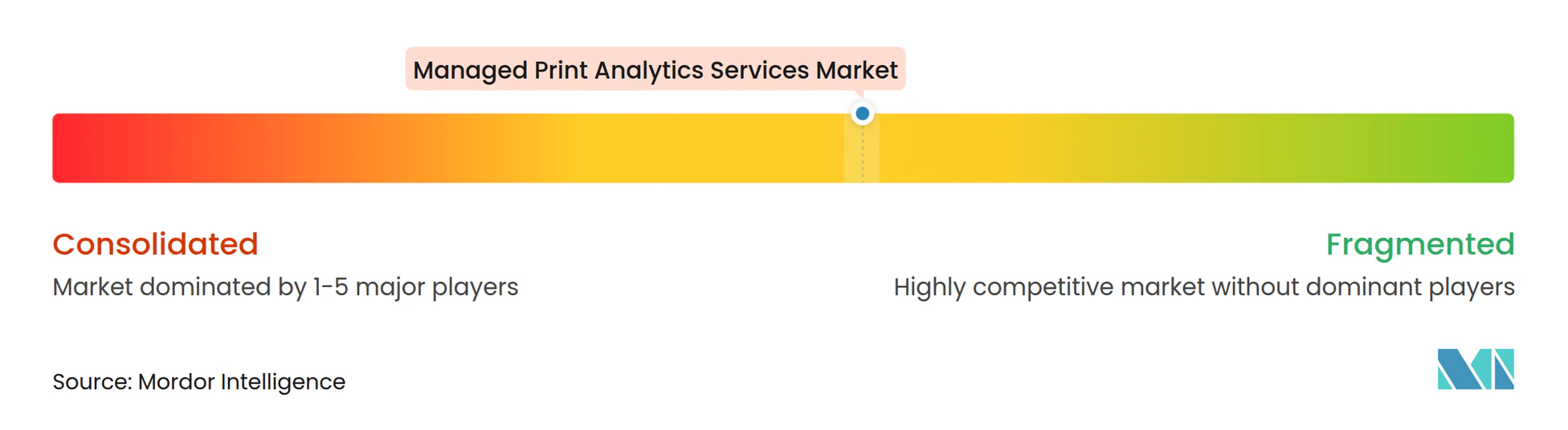
The Managed print analytics services market has moderate concentration in premium analytics, while routine device management remains more fragmented. HP, Ricoh, Xerox, Canon, and Konica Minolta have broad installed bases, device portfolios, and service organizations that support their positions in enterprise accounts. Their scale provides access to fleet data that can improve support models and service planning over time. Xerox completed its acquisition of Lexmark International on July 1, 2025, in a transaction valued at USD 1.5 billion, including net debt and assumed liabilities. The combined organization serves more than 200,000 clients in over 170 countries and is targeting more than USD 300 million in run-rate synergies by the end of 2027.
Xerox is integrating Lexmark's device management and IoT capabilities with its cloud, AI, and workflow offerings. The company also unified its print go-to-market structure in March 2026 and extended its A3 portfolio with the Lexmark 9-Series printer line. HP launched Managed Print Cloud Services in June 2025 with zero-trust architecture, remote telemetry-driven diagnostics, and a security advisory service. Ricoh announced a collaboration with ServiceNow in May 2025 to standardize service management processes across its European operations and to apply generative AI to knowledge management.[3]
Independent software vendors such as PaperCut, Vasion, and Tungsten Automation compete with cloud-native, fleet-agnostic tools that appeal to customers seeking less dependence on a device manufacturer. Original equipment manufacturers are responding by expanding the software and security layers around their installed fleets. Konica Minolta offers cloud security and information management capabilities that support this blended hardware-and-software position. Standardization programs can also matter in regulated procurement because they make it easier to apply common rules across different models and sites. The strongest opening remains among mid-market customers seeking sustainability reporting, predictive maintenance, security, and document workflow support at subscription prices that fit smaller operating budgets.
Managed Print Analytics Services Industry Leaders
-
Xerox Corporation
-
HP Inc.
-
Ricoh Company, Ltd.
-
Canon Inc.
-
Konica Minolta, Inc.
- *Disclaimer: Major Players sorted in no particular order
Managed Print Analytics Services Market Companies Covered in this Report
- HP Inc.
- Canon Inc.
- Ricoh Company, Ltd.
- Xerox Corporation
- Konica Minolta, Inc.
- Kyocera Document Solutions Inc.
- FUJIFILM Business Innovation Corp.
- Brother Industries, Ltd.
- Seiko Epson Corporation
- Lexmark International, Inc.
- Toshiba Tec Corporation
- Sharp Corporation
- OKI Electric Industry Co., Ltd.
- RISO KAGAKU CORPORATION
- Sindoh Co., Ltd.
- Pantum International Limited
- Kodak Alaris Inc.
- Ninestar Corporation
- Star Micronics Co., Ltd.
- Citizen Systems Japan Co., Ltd.
Recent Industry Developments in Managed Print Analytics Services Market
- July 2026: Visual Edge IT expanded its nationwide strategic partnership with Konica Minolta, strengthening capabilities across production print, A3, A4, and managed print services for healthcare, government, K-12 education, and other key verticals.
- March 2026: Xerox unified its global print go-to-market structure following the Lexmark acquisition, integrating the two companies' sales forces and extending the A3 platform with the Lexmark 9-Series printer line across enterprise and departmental environments, including healthcare and retail.
- January 2026: Ricoh USA renewed a 5-year UC System-wide agreement with the University of California, covering managed print services, cloud analytics, and IT services across 10 campuses and 6 health centers, available through OMNIA Partners to public-sector agencies nationally through January 25, 2031.
- January 2026: HP announced WXP Print Management enhancements at CES 2026, enabling unified multi-vendor fleet monitoring within a single IT console alongside PCs and collaboration devices, with Microsoft 365 Copilot integration targeted for managed HP Workpath-enabled printers in Spring 2026.
Global Managed Print Analytics Services Market Report Scope
The Managed Print Analytics Services Market is defined as the market for services that enable organizations to monitor, analyze, optimize, and manage their printing infrastructure and document-related operations using data analytics, automation, and centralized management solutions. These services help organizations assess print infrastructure, manage print operations and device fleets, optimize document workflows, implement cloud printing solutions, strengthen print security and regulatory compliance, and track sustainability performance and carbon emissions.
The Managed Print Analytics Services Market Report is Segmented by Service Type (Print Infrastructure Assessment, Managed Print Operations, Device and Fleet Management, Document Workflow Optimization, Cloud Print Services, Print Security and Compliance Analytics, and Sustainability and Carbon Analytics), Deployment Mode (Cloud-Based, On-Premise, and Hybrid), Organization Size (Large Enterprises and Small and Medium Enterprises), End-User Vertical (BFSI, Healthcare, IT and Telecommunications, Government and Public Sector, Education, Manufacturing, and Other End-User Verticals), and Geography (North America, South America, Europe, Asia-Pacific, Middle East, and Africa). The Market Forecasts are Provided in Terms of Value (USD).
Segmentation Overview
| Print Infrastructure Assessment |
| Managed Print Operations |
| Device and Fleet Management |
| Document Workflow Optimization |
| Cloud Print Services |
| Print Security and Compliance Analytics |
| Sustainability and Carbon Analytics |
| Cloud-Based |
| On-Premise |
| Hybrid |
| Large Enterprises |
| Small and Medium Enterprises |
| BFSI |
| Healthcare |
| IT and Telecommunications |
| Government and Public Sector |
| Education |
| Manufacturing |
| Other End-User Verticals |
| North America | United States |
| Canada | |
| Mexico | |
| South America | Brazil |
| Argentina | |
| Colombia | |
| Rest of South America | |
| Europe | Germany |
| United Kingdom | |
| France | |
| Italy | |
| Spain | |
| Russia | |
| Nordics | |
| Rest of Europe | |
| Asia-Pacific | China |
| Japan | |
| India | |
| South Korea | |
| Australia | |
| Singapore | |
| Rest of Asia-Pacific | |
| Middle East | Saudi Arabia |
| United Arab Emirates | |
| Qatar | |
| Turkey | |
| Rest of Middle East | |
| Africa | South Africa |
| Nigeria | |
| Egypt | |
| Rest of Africa |
| By Service Type | Print Infrastructure Assessment | |
| Managed Print Operations | ||
| Device and Fleet Management | ||
| Document Workflow Optimization | ||
| Cloud Print Services | ||
| Print Security and Compliance Analytics | ||
| Sustainability and Carbon Analytics | ||
| By Deployment Mode | Cloud-Based | |
| On-Premise | ||
| Hybrid | ||
| By Organization Size | Large Enterprises | |
| Small and Medium Enterprises | ||
| By End-User Vertical | BFSI | |
| Healthcare | ||
| IT and Telecommunications | ||
| Government and Public Sector | ||
| Education | ||
| Manufacturing | ||
| Other End-User Verticals | ||
| By Geography | North America | United States |
| Canada | ||
| Mexico | ||
| South America | Brazil | |
| Argentina | ||
| Colombia | ||
| Rest of South America | ||
| Europe | Germany | |
| United Kingdom | ||
| France | ||
| Italy | ||
| Spain | ||
| Russia | ||
| Nordics | ||
| Rest of Europe | ||
| Asia-Pacific | China | |
| Japan | ||
| India | ||
| South Korea | ||
| Australia | ||
| Singapore | ||
| Rest of Asia-Pacific | ||
| Middle East | Saudi Arabia | |
| United Arab Emirates | ||
| Qatar | ||
| Turkey | ||
| Rest of Middle East | ||
| Africa | South Africa | |
| Nigeria | ||
| Egypt | ||
| Rest of Africa | ||
Key Questions Answered in the Report
What is the managed print analytics services market size?
The Managed print analytics services market size is projected to expand from USD 9.42 billion in 2026 and USD 10.23 billion in 2027 to USD 16.32 billion by 2032, at a 9.79% CAGR. The forecast covers 2027 through 2032 and reflects customer demand for connected fleet oversight, security controls, workflow support, and environmental reporting, with cloud and hybrid delivery models supporting centralized information management across distributed print locations.
Which service type leads managed print analytics services?
Managed Print Operations leads with a 31.84% revenue share in 2026, while Sustainability and Carbon Analytics is projected to post the fastest service-type CAGR at 11.19% through 2032. Core operations remain essential because customers still need day-to-day device coverage, while analytics services address reporting, security, and measurable operating outcomes that can support contract renewal decisions and broader IT governance requirements.
Why are cloud-based print services important to enterprise buyers?
Cloud-based deployment held 55.19% of revenue in 2026 and is projected to expand at a 10.37% CAGR, because connected fleets support centralized telemetry, security oversight, and service automation. It allows organizations to compare operating conditions across sites from a common management layer and gives providers a basis for predictive maintenance, replenishment support, cross-site service planning, and earlier identification of unusual device behavior.
Which organizations are increasing adoption most quickly?
Small and medium enterprises are projected to expand at a 10.18% CAGR through 2032 as subscription models reduce upfront commitments and cloud delivery reduces IT support needs. Fixed recurring fees can make service costs easier for smaller organizations to plan, particularly where they lack dedicated staff to manage supplies, devices, users, service requests, local print servers, and supplier coordination.
Which end-user vertical has the strongest outlook?
Healthcare is projected to expand at an 11.21% CAGR through 2032, supported by electronic health record workflows and secure handling needs for printed information. Authentication, secure release, audit records, and encrypted routing support document handling across care locations while helping organizations control access to sensitive patient information, maintain consistent policies, and reduce risks from unattended output.
Which region has the strongest outlook for managed print analytics services?
Asia-Pacific is projected to expand at a 10.77% CAGR through 2032, supported by outsourced service adoption among enterprises and public agencies. The Managed print analytics services market in the region also requires local delivery approaches, because data handling, procurement practices, language needs, channel coverage, public-sector tendering processes, and the maturity of managed services vary among countries and customer types.