
Managed Print Operations Market Size and Share
Market Overview
| Study Period | 2021 - 2032 |
|---|---|
| Market Size (2027) | USD 19.65 Billion |
| Market Size (2032) | USD 29.68 Billion |
| Growth Rate (2027 - 2032) | 8.60 % |
| Fastest Growing Market | Asia-Pacific |
| Largest Market | North America |
| Market Concentration | Medium |
Major Players *Disclaimer: Major Players sorted in no particular order Image © Mordor Intelligence. Reuse requires attribution under CC BY 4.0. | |
Managed Print Operations Market Analysis by Mordor Intelligence
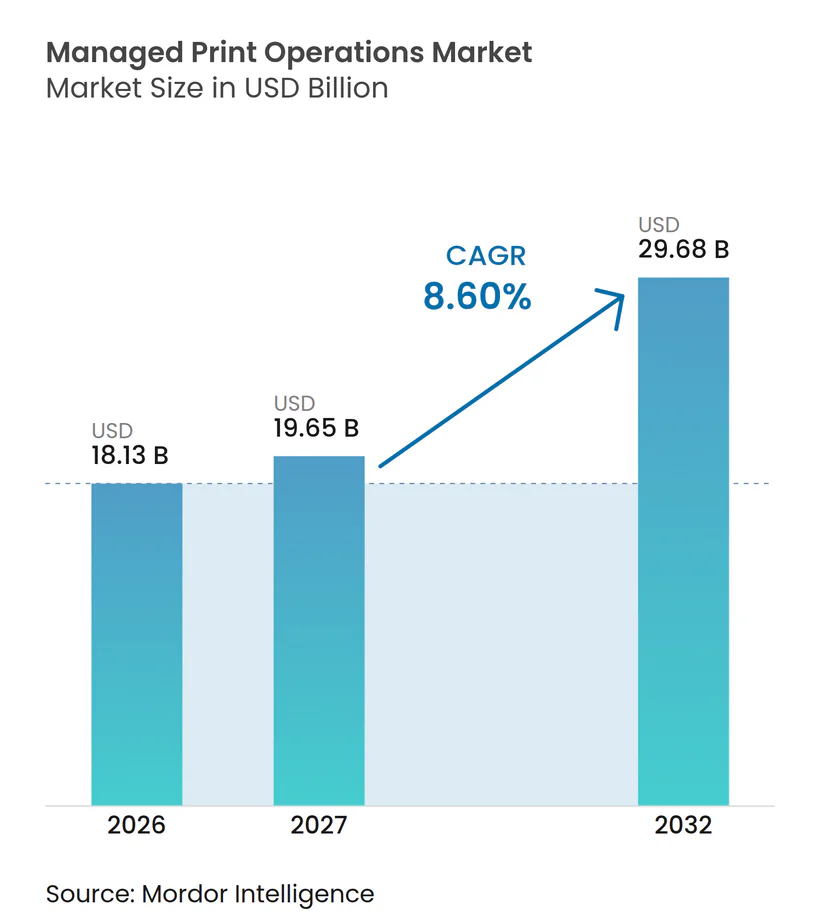
The managed print operations market size was valued at USD 18.13 billion in 2026 and estimated to expand from USD 19.65 billion in 2027 to reach USD 29.68 billion by 2032, at a CAGR of 8.60% during the forecast period 2027-2032. The managed print operations market is moving beyond reactive equipment maintenance toward continuous oversight of distributed device fleets and document environments, in which users may print from multiple locations. Buyers increasingly combine fleet services with identity controls, usage reporting, environmental reporting, and clearer accountability for service outcomes across business units. Cloud-based administration and zero-trust security practices are changing how providers structure their offerings and how clients assess vendor capabilities, implementation quality, and ongoing support. Providers can build longer-term client relationships by supporting security, workflow, device reliability, and cost control in a single service, rather than treating printing as a separate equipment issue. Hybrid configurations remain important because many organizations need centralized analytics while retaining local processing for confidential or operationally sensitive documents, especially in regulated settings.
Key Report Takeaways
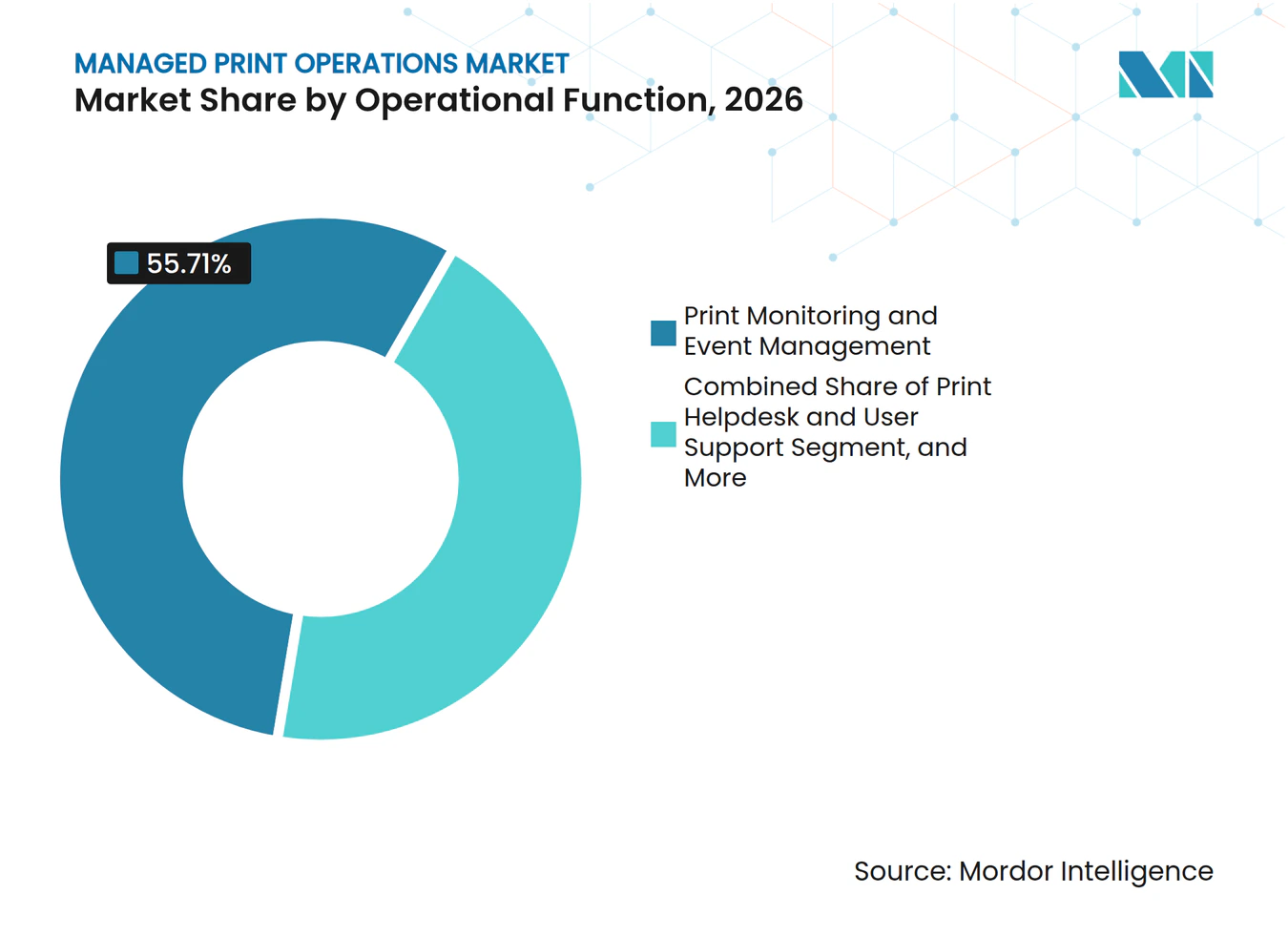
- By operational function, Print Monitoring and Event Management held 55.71% of the managed print operations market revenue in 2026, while Print Performance and Usage Management is projected to expand at a 9.45% CAGR through 2032.
- By deployment mode, On-Premise accounted for 65.28% of the managed print operations market revenue in 2026, while Cloud-Based deployment is expected to expand at a 9.77% CAGR through 2032.
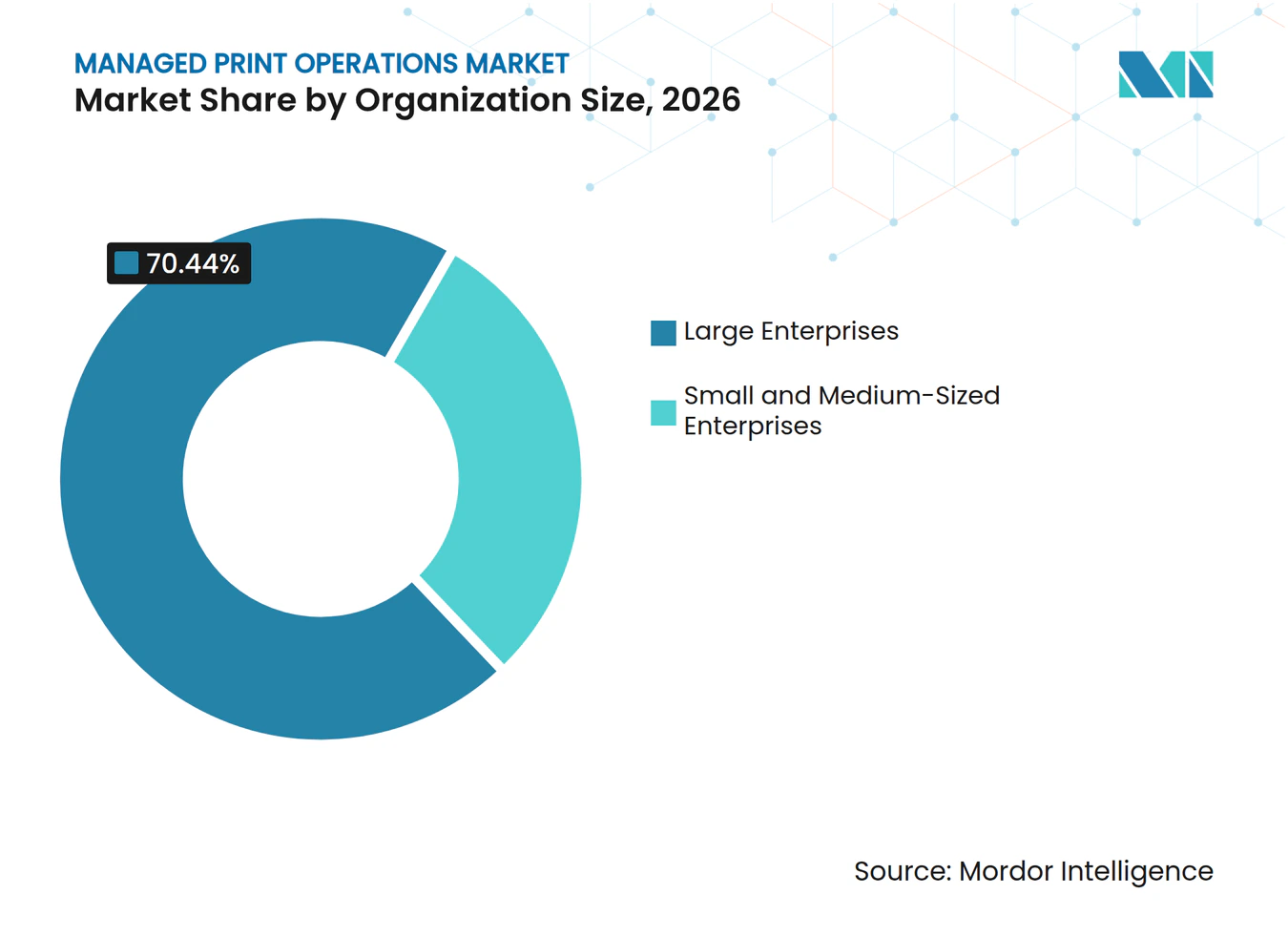
- By organization size, Large Enterprises accounted for 70.44% of managed print operations market revenue in 2026, while small and medium-sized enterprises are projected to expand at a 10.02% CAGR through 2032.
- By end-user industry, Government and Public Administration accounted for 27.88% of managed print operations market revenue, while Healthcare and Life Sciences are projected to expand at an 8.91% CAGR through 2032.
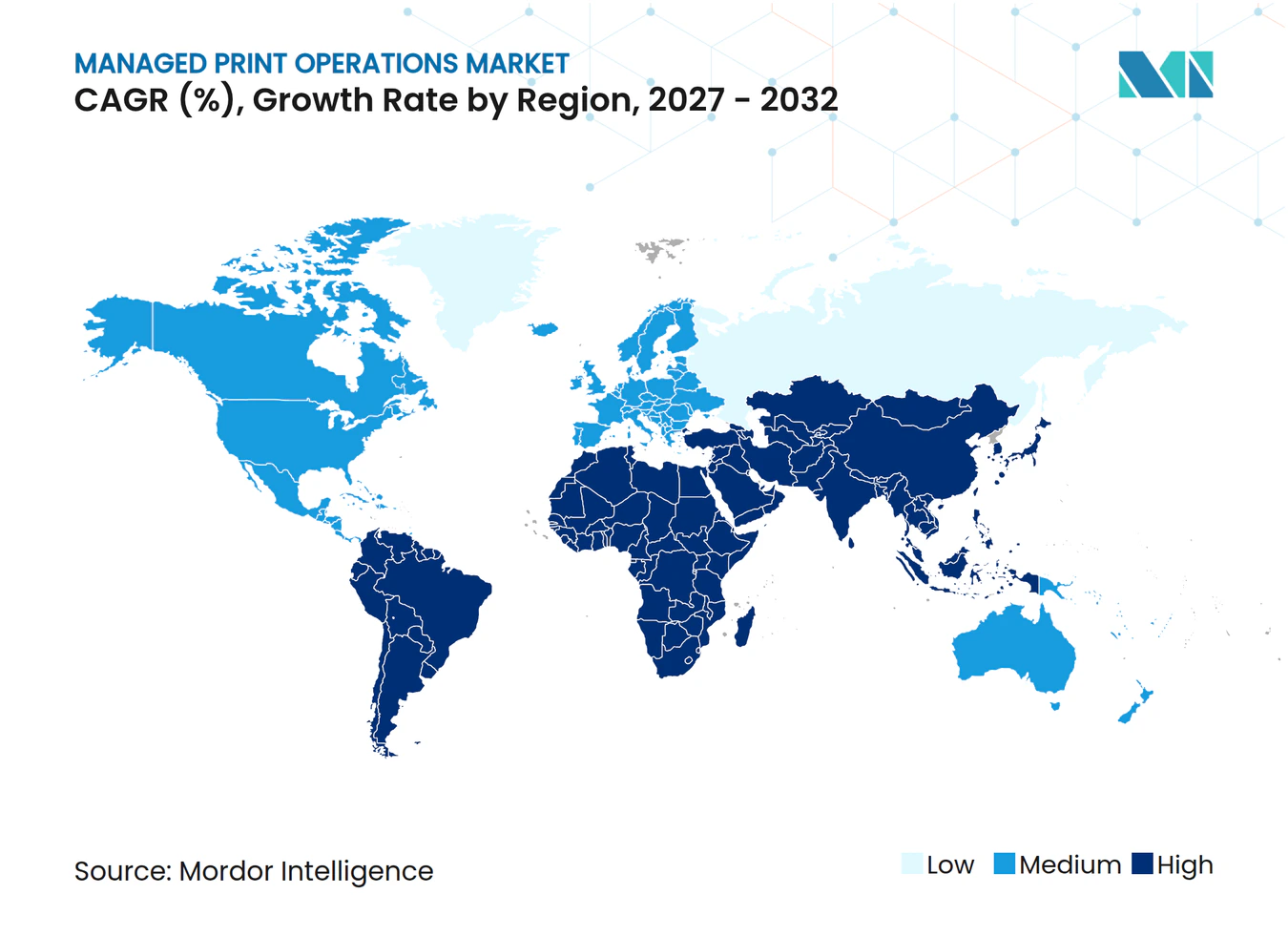
- By geography, North America accounted for 36.18% of the managed print operations market revenue, while Asia-Pacific is expected to expand at a 9.26% CAGR through 2032.
Note: Market numbers in this report are based on Mordor Intelligence's proprietary estimation framework, which combines nine months of actuals with Q4 projections for base year 2026.
Market Trends and Insights
Drivers Impact Analysis of Managed Print Operations Market*
| Driver | (~) % Impact on CAGR Forecast | Geographic Relevance | Impact Timeline |
|---|---|---|---|
| Secure Print and Identity-Centric Authentication | +2.1% | Global, with strong relevance in North America, Europe, and Asia-Pacific financial and healthcare sectors | Medium term (2-4 years) |
| Cloud and Hybrid-Workplace Fleet Administration | +1.9% | Global, led by North America and Europe, with Asia-Pacific as a growth area | Short term (≤ 2 years) |
| Predictive Maintenance and Automated Consumables Replenishment | +1.4% | Global, with North America and Asia-Pacific leading broad deployment | Short term (≤ 2 years) |
| Sustainability, Circularity, and Page-Level Carbon Accounting | +0.9% | North America, Western Europe, and Australia, with expansion into Asia-Pacific and the Middle East | Medium term (2-4 years) |
| Subscription-Based Print Infrastructure for SMEs | +0.7% | Global, particularly Asia-Pacific and Europe, with early adoption in the United Kingdom and India | Medium term (2-4 years) |
| Intelligent Document Processing and Workflow Automation | +0.6% | Global, with advanced deployment in North America, the United Kingdom, and Germany | Long term (≥ 4 years) |
| Source: Mordor Intelligence | |||
Secure Print and Identity-Centric Authentication Requirements
Networked printers and multifunction devices now require the same attention as other cybersecurity endpoints because they receive, store, and process business information. This is a central driver for the managed print operations market because print jobs can contain confidential business and personal information across shared work settings. Zero-trust practices require user authentication, verified device connections, encryption of information in transit, and restricted access to released output. The Mopria Alliance stated that encryption and authenticated access should be baseline policies for mixed-vendor printing environments. Providers can help clients manage firmware risks, protocol changes, and device settings without having to maintain specialized internal teams. Financial services, healthcare, and legal organizations have a strong need for secure release, audit logs, documented service levels, and clear responsibility for incidents.
Cloud and Hybrid-Workplace Fleet Administration
Hybrid work has made device management harder for organizations with users across offices, homes, branches, and remote sites. Cloud administration gives IT teams one place to apply policies, update firmware, review usage data, and maintain consistent print rules. This approach can reduce the operational burden of maintaining many local print servers and disconnected support processes. The managed print operations market also gains recurring software revenue as cloud tools sit alongside device services, supplies management, and ongoing user-support requirements. Canon expanded uniFLOW Online support to HP Workpath devices in April 2026, illustrating a move toward multi-vendor cloud administration. Regulated organizations often favor hybrid designs that use cloud analytics while keeping job rendering and sensitive data processing within their own facilities.
Predictive Maintenance and Automated Consumables Replenishment
Predictive maintenance changes service delivery from unplanned repair visits to scheduled intervention based on device condition. Connected devices can continuously provide toner data, component condition, usage patterns, and error information to service teams. Providers can use these records to plan technician visits, stock appropriate parts, and avoid urgent orders that disrupt business operations. A 2025 Ricoh Europe case study reported that digital maintenance services reduced climate-change-related impacts by 47% to 85% in consumables management and by up to 97% in fault and incident management. Automated replenishment can also combine deliveries, reduce freight activity, and limit unnecessary stock of consumables at client sites. These capabilities make service efficiency, consistent availability, and measurable environmental performance part of the provider selection process in the managed print operations market for complex fleet contracts.
Sustainability, Circularity, and Page-Level Carbon Accounting
Sustainability reporting has made print activity more visible to procurement, facilities, finance, and operational teams. Page-level measurement can connect paper use, device energy demand, consumables handling, and disposal to individual printing activity and organizational policies. This supports decisions on device placement, print rules, fleet rationalization, and reporting on indirect operational impacts. Ricoh Australia partnered with PrintReleaf in March 2025 to integrate paper-footprint tracking and reforestation offsets into managed print monitoring.[1] The program stated that 8,333 A4 sheets correspond to 1 standard tree for its tracking method. Canon also reported working with suppliers to use actual CO₂ emissions data for office multifunction devices rather than estimated figures.
Restraints Impact Analysis of Managed Print Operations Market*
| Restraint | (~) % Impact on CAGR Forecast | Geographic Relevance | Impact Timeline |
|---|---|---|---|
| Structural Decline in Office Print Volumes | -1.5% | Global, strongest in Western Europe and North America, with a slower effect in Asia-Pacific | Long term (≥ 4 years) |
| Data Sovereignty and Latency Constraints on Cloud Managed Print Services | -1.0% | Europe, Asia-Pacific markets with data-residency rules, and emerging markets | Medium term (2-4 years) |
| Vendor Lock-In and Contract-Exit Complexity | -0.7% | Global, particularly large enterprises with multiyear fleet agreements | Medium term (2-4 years) |
| Cybersecurity Exposure Across Distributed Print Endpoints | -0.5% | Global, particularly distributed and hybrid-work environments | Short term (≤ 2 years) |
| Source: Mordor Intelligence | |||
Structural Decline in Office Print Volumes
The managed print operations market continues to see declining physical print volumes in many developed economies, even as organizations maintain a need for managed devices, secure document release, and reliable operational support. Digital workflows, hybrid work, and sustainability programs reduce the page volumes that have supported traditional cost-per-page agreements and predictable demand for consumables. The Office Products International Industry Council reported that 86% of surveyed organizations saw demand for ink and toner decline in 2025. Providers must therefore reduce reliance on page-volume economics and explain value through security, availability, workflow support, and reporting. Subscription and outcome-based agreements can place greater emphasis on those service outcomes and reduce direct exposure to fluctuating print volumes. This transition is most evident in Western Europe and North America, where paperless processes and hybrid working practices are more established.
Data Sovereignty and Latency Constraints on Cloud Managed Print Services
Cloud services can be harder to adopt when print data, device telemetry, and user logs are subject to local data-residency rules. European organizations must assess how personal data moving through networked endpoints is protected under GDPR requirements and internal security policies. Sensitive public-sector and financial-services buyers may require local job processing even when they adopt cloud reporting and fleet analytics. High-volume and time-sensitive environments also need reliable job release with minimal delay for users handling clinical, legal, or financial documents. These factors extend procurement, technical validation, and implementation timelines for cloud-only platforms. They also support hybrid designs that join locally processed print jobs with centrally managed analytics in the managed print operations market, particularly for regulated organizations.
*Our forecasts treat driver/restraint impacts as directional, not additive. The impact forecasts reflect baseline growth, mix effects, and variable interactions.
Managed Print Operations Market Segment Analysis
By Operational Function:
Print Monitoring Leads Revenue, While Usage Management Advances FastestPrint Monitoring and Event Management accounted for 55.71% of the managed print operations market in 2026. Real-time visibility, alert routing, and anomaly identification form the base layer of most managed fleet agreements. Service providers use these records to identify unavailable devices, recurring faults, and consumable requirements before they disrupt users. This function is relevant across client sizes because it provides the operational data needed to meet availability commitments, supports early intervention by service teams, and gives client administrators a clearer record of how devices perform across locations. Print Consumables Lifecycle Management also remains important because purchasing and delivery activity affects cost control and service continuity, especially when distributed sites depend on reliable supplies without holding excessive stock.
Print Performance and Usage Management is projected to expand at a 9.45% CAGR through 2032. Buyers increasingly want visibility into departmental use, print costs, and document controls rather than simple device uptime data. Usage information supports print rules, cost allocation, and audit records for regulated workflows, while enabling managers to identify patterns indicating avoidable printing or uneven device utilization. The Ricoh Europe case study found that digitalization of maintenance services reduced climate-change impacts across consumables and incident-management activities. Helpdesk, user support, configuration, and fleet assessments remain relevant additions for organizations starting managed print engagements.



By Deployment Mode:
On-Premise Retains Control, While Cloud Platforms ExpandOn-Premise deployment accounted for 65.28% of 2026 revenue. Many organizations retain local print processing because of data-sovereignty policies and existing device lease arrangements. Government agencies and financial institutions often use this approach for classified or sensitive documents. Local processing can also address concerns about connectivity and job-release speed. The installed base of multiyear hardware agreements slows a complete transition away from local infrastructure because equipment financing, device replacement schedules, and established service practices remain tied to local fleets.
Cloud-Based deployment is expected to expand at a 9.77% CAGR through 2032. Centralized platforms can simplify policy administration, firmware management, and usage reporting across dispersed locations. They can also reduce print-server hardware requirements and support remote users more consistently, which matters for organizations that need standard policies across offices, home workers, and smaller satellite locations. Canon broadened uniFLOW Online support for HP Workpath devices during 2026, showing how interoperability can help mixed fleets use cloud administration.[2] Hybrid deployment remains a practical option where organizations need cloud visibility and local job rendering.
By Organization Size:
Large Enterprises Lead, While SMEs Gain Access Through SubscriptionsLarge Enterprises held 70.44% of 2026 revenue. Their fleet sizes, multiple locations, and formal procurement systems support broad managed-service agreements. Government agencies, hospital networks, and multinational companies need monitoring, user support, consumables management, and reporting across many devices. These requirements lead to larger contract values and higher security expectations because a failure can affect many users, facilities, departments, and document types within a single agreement. Xerox stated that its Lexmark acquisition was expected to generate more than USD 300 million in run-rate synergies by the end of 2027, with a focus on integrating sales and service capabilities.
Small and medium-sized enterprises are projected to expand at a 10.02% CAGR through 2032. Subscription and pay-per-print models reduce upfront costs that can limit adoption among organizations without specialist procurement teams. These models can provide managed security, supplies, and support through a recurring payment, helping smaller organizations use structured services without building a large internal team for procurement and fleet administration. Cloud-enabled administration is useful when employees work across several sites without local IT support. Providers that simplify onboarding and offer standard service packages can address this segment of the managed print operations market, particularly for smaller businesses that need predictable costs and minimal administrative effort.

By End-User Industry:
Government Provides Scale, While Healthcare Adds Security DemandGovernment and Public Administration held 27.88% of 2026 revenue. Large agency fleets and ongoing physical-document requirements support centralized fleet contracts. Cooperative purchasing systems can simplify procurement for public bodies. The University of California renewed a 5-year agreement with Ricoh USA in January 2026 for 10 campuses, 6 health centers, and Lawrence Berkeley National Laboratory. Government buyers commonly require secure printing, network integration, service records, and sustained device availability.
Healthcare and Life Sciences are projected to expand at an 8.91% CAGR through 2032. Patient safety and confidential records create strong requirements for secure release and traceable document processes. Healthcare systems also need print activity to work with electronic health record workflows. These needs support contracts that combine equipment oversight, user authentication, operational reporting, and defined processes for handling documents that move through clinical departments and patient-facing locations. Banking, financial services, insurance, IT and telecommunications, manufacturing, retail and e-commerce, and education also need auditable document workflows and controlled user access.
Geography Analysis
North America Managed Print Operations Market
North America held 36.18% of 2026 revenue. Large enterprises and public-sector organizations in the region have mature IT governance practices and established managed-service ecosystems. Cooperative purchasing arrangements can make fleet outsourcing easier for institutional buyers by reducing repetitive sourcing and providing eligible public bodies with access to established terms and service structures. The University of California agreement with Ricoh USA began in January 2026 and covered 10 campuses, 6 health centers, and Lawrence Berkeley National Laboratory.
Europe Managed Print Operations Market
Europe remains an established managed print operations market with substantial public-sector demand, supported by formal procurement procedures and the need to align device management with data-protection expectations. Government digitization goals and GDPR-related security requirements influence procurement decisions, particularly when buyers need evidence of how devices, user identities, and documents are protected in day-to-day operations. The United Kingdom awarded a framework for multifunction devices, managed print, and digital workflow software services valued at up to GBP 350 million (USD 442.75 million) through June 2030. The appointed suppliers included Kyocera Document Solutions UK, Ricoh UK Limited, and Sharp Business Systems UK. Germany, France, and Italy remain important centers for private-sector financial services, manufacturing, and pharmaceuticals.
APAC, MEA and South America Managed Print Operations Market
Asia-Pacific is expected to expand at a 9.26% CAGR through 2032. Government digitization programs in India, smart-factory activity in China, and technology spending by Japanese and South Korean enterprises support demand. Japanese public agencies are formalizing longer-term outsourced print arrangements that include information-security requirements. Fujifilm Business Innovation reported that its MPS Guardia service analyzes output conditions to inform device selection, placement, electricity use, and paper use.[3] South America, the Middle East, and Africa remain emerging areas, where modernization, multinational standardization, and enterprise IT formalization support demand.
Competitive Landscape
Market Concentration
The managed print operations market includes hardware-and-services providers and independent software firms, with competition shaped by installed fleet size, software capabilities, field-service coverage, and customer relationships. Xerox, Ricoh, HP, Canon, and Konica Minolta have established positions through device portfolios and service delivery capabilities. PaperCut, Vasion, and Tungsten Automation compete with device-agnostic platforms for fleet monitoring and secure release. Xerox completed its Lexmark acquisition in July 2025 for USD 1.5 billion, including net debt and assumed liabilities.
The combined company served more than 200,000 clients in over 170 countries after completion.[4] Xerox unified its sales forces with Lexmark's in March 2026 around an integrated portfolio. It extended the Lexmark 9-Series line to Xerox clients and enabled Lexmark devices to work with Xerox Managed Print Services and Workflow Central. Ricoh is building differentiation through its partnership with ServiceNow for unified service delivery, an approach that links incident handling and device support to broader enterprise service-management processes.
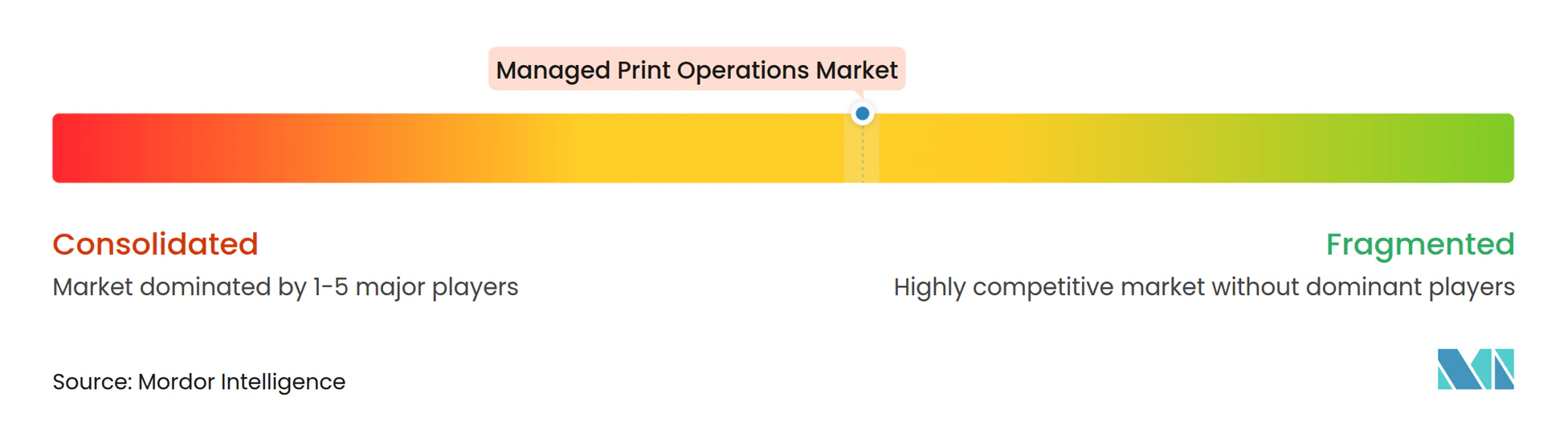
Toshiba acquired Youmebee to strengthen cloud-based AI print management capabilities, reflecting an effort to improve administration and support through software rather than relying solely on device specifications. Canon has also introduced security tools that assess the network environment associated with each device and recommend security configurations, supporting clients that need repeatable controls across larger fleets. Software-led competition is expanding as organizations seek simpler serverless deployment and mixed-fleet management, particularly when they want to manage multiple device brands without rebuilding their print environment around a single hardware supplier. PaperCut released its cloud-based Print Queue Deployment capability in February 2026, allowing direct configuration without on-site agents. The competitive landscape remains moderately concentrated, while platform interoperability creates space for specialized software suppliers that can complement incumbent device portfolios and serve clients with heterogeneous technology estates.
Managed Print Operations Industry Leaders
-
Xerox Corporation
-
Ricoh Company, Ltd.
-
HP Inc.
-
Canon Inc.
-
Konica Minolta, Inc.
- *Disclaimer: Major Players sorted in no particular order
Managed Print Operations Market Companies Covered in this Report
- Xerox Corporation
- Ricoh Company, Ltd.
- HP Inc.
- Canon Inc.
- Brother Industries, Ltd.
- Lexmark International, Inc.
- Konica Minolta, Inc.
- Kyocera Document Solutions Inc.
- Sharp Corporation
- Seiko Epson Corporation
- Toshiba Tec Corporation
- Fujifilm Business Innovation Corp.
- OKI Electric Industry Co., Ltd.
- Samsung Electronics Co., Ltd.
- Zhuhai Pantum Electronics Co., Ltd.
- RISO KAGAKU CORPORATION
- Sindoh Co., Ltd.
- Zebra Technologies Corporation
- Kodak Alaris Inc.
- SATO Holdings Corporation
Recent Industry Developments in Managed Print Operations Market
- October 2026: The City of Henderson, Nevada, awarded Konica Minolta Business Solutions USA Inc. a technology contract for managed print services, multifunction device leasing, maintenance, support, and transition services through June 2032, reinforcing Konica Minolta's presence in U.S. municipal government managed print.
- August 2026: The U.S. Department of Veterans Affairs issued a solicitation for Managed Print Services and Hardware Installation to support prime contractors at VA healthcare facilities, specifying devices that meet or exceed 55 ppm and 1,200 x 2,400 dpi, with secure printing, scanning-to-email, and full networked integration requirements.
- June 2026: The U.K. government awarded a multifunction device, managed print, and digital workflow software framework worth up to GBP 350 million (USD 442.75 million) through June 2030, with Kyocera Document Solutions UK, Ricoh UK, and Sharp Business Systems UK among the 5 appointed suppliers.
- March 2026: Xerox unified its Lexmark and Xerox sales forces, extending the Lexmark 9-Series printer line to existing Xerox clients and enabling compatibility between Lexmark devices and Xerox Managed Print Services, print solutions, and Workflow Central, accelerating post-acquisition commercial integration across enterprise and departmental environments.
Global Managed Print Operations Market Report Scope
The Managed Print Operations Market comprises outsourced operational services focused on the day-to-day administration, monitoring, support, maintenance, optimization, and performance management of enterprise print environments. These services include print helpdesk support, print fleet monitoring, consumables management, incident management, operational analytics, usage optimization, and continuous management of printing infrastructure to ensure availability, efficiency, cost control, and service-level compliance.
The Managed Print Operations Market Report is Segmented by Operational Function (Print Helpdesk and User Support, Print Consumables Lifecycle Management, Print Monitoring and Event Management, Print Performance and Usage Management, and Other Operational Functions), Deployment Mode (On-Premise, Cloud-Based, and Hybrid), Organization Size (Large Enterprises, and Small and Medium-Sized Enterprises), End-User Industry (Banking, Financial Services, and Insurance [BFSI], Government and Public Administration, Healthcare and Life Sciences, IT and Telecommunication, Industrial Manufacturing, Retail and E-commerce, Education and Research Institutions, and Other End-User Industries), and Geography (North America, South America, Europe, Asia-Pacific, Middle East, and Africa). The Market Forecasts are Provided in Terms of Value (USD).
Segmentation Overview
| Print Helpdesk and User Support |
| Print Consumables Lifecycle Management |
| Print Monitoring and Event Management |
| Print Performance and Usage Management |
| Other Operational Functions |
| On-Premise |
| Cloud-Based |
| Hybrid |
| Large Enterprises |
| Small and Medium-Sized Enterprises |
| Banking, Financial Services, and Insurance (BFSI) |
| Government and Public Administration |
| Healthcare and Life Sciences |
| IT and Telecommunication |
| Industrial Manufacturing |
| Retail and E-commerce |
| Education and Research Institutions |
| Other End-User Industries |
| North America | United States |
| Canada | |
| Mexico | |
| South America | Brazil |
| Argentina | |
| Rest of South America | |
| Europe | Germany |
| United Kingdom | |
| France | |
| Italy | |
| Russia | |
| Rest of Europe | |
| Asia-Pacific | China |
| Japan | |
| India | |
| South Korea | |
| Rest of Asia-Pacific | |
| Middle East | Saudi Arabia |
| United Arab Emirates | |
| Rest of Middle East | |
| Africa | South Africa |
| Nigeria | |
| Rest of Africa |
| By Operational Function | Print Helpdesk and User Support | |
| Print Consumables Lifecycle Management | ||
| Print Monitoring and Event Management | ||
| Print Performance and Usage Management | ||
| Other Operational Functions | ||
| By Deployment Mode | On-Premise | |
| Cloud-Based | ||
| Hybrid | ||
| By Organization Size | Large Enterprises | |
| Small and Medium-Sized Enterprises | ||
| By End-User Industry | Banking, Financial Services, and Insurance (BFSI) | |
| Government and Public Administration | ||
| Healthcare and Life Sciences | ||
| IT and Telecommunication | ||
| Industrial Manufacturing | ||
| Retail and E-commerce | ||
| Education and Research Institutions | ||
| Other End-User Industries | ||
| By Geography | North America | United States |
| Canada | ||
| Mexico | ||
| South America | Brazil | |
| Argentina | ||
| Rest of South America | ||
| Europe | Germany | |
| United Kingdom | ||
| France | ||
| Italy | ||
| Russia | ||
| Rest of Europe | ||
| Asia-Pacific | China | |
| Japan | ||
| India | ||
| South Korea | ||
| Rest of Asia-Pacific | ||
| Middle East | Saudi Arabia | |
| United Arab Emirates | ||
| Rest of Middle East | ||
| Africa | South Africa | |
| Nigeria | ||
| Rest of Africa | ||
Key Questions Answered in the Report
What is the managed print operations market size?
The managed print operations market size is USD 18.13 billion in 2026 and is estimated to reach USD 29.68 billion by 2032, at an 8.60% CAGR from 2027 to 2032.
Which operational function leads managed print operations?
Within the managed print operations market, Print Monitoring and Event Management leads with 55.71% of 2026 revenue because fleet visibility, alert routing, and anomaly detection support most managed agreements.
What deployment approach is most widely used for managed print services?
In the managed print operations market, On-premise deployment holds 65.28% of 2026 revenue, supported by local processing needs, data controls, and existing hardware arrangements.
Why are managed print services important for healthcare organizations?
In the managed print operations market, healthcare organizations need secure release, audit trails, and printing that works with electronic health record workflows.
Which region has the fastest projected expansion?
Asia-Pacific is expected to expand at a 9.26% CAGR through 2032, supported by digitization programs and enterprise technology investment.
How are providers adapting to declining office print volumes?
Providers are using subscription and outcome-based agreements that place more value on security, workflow support, availability, and reporting than on page volume alone.