
Managed Privileged Access Management Services Market Size and Share
Market Overview
| Study Period | 2021 - 2032 |
|---|---|
| Market Size (2027) | USD 3.01 Billion |
| Market Size (2032) | USD 5.41 Billion |
| Growth Rate (2027 - 2032) | 12.47 % |
| Fastest Growing Market | Asia-Pacific |
| Largest Market | North America |
| Market Concentration | Medium |
Major Players *Disclaimer: Major Players sorted in no particular order Image © Mordor Intelligence. Reuse requires attribution under CC BY 4.0. | |
Managed Privileged Access Management Services Market Analysis by Mordor Intelligence
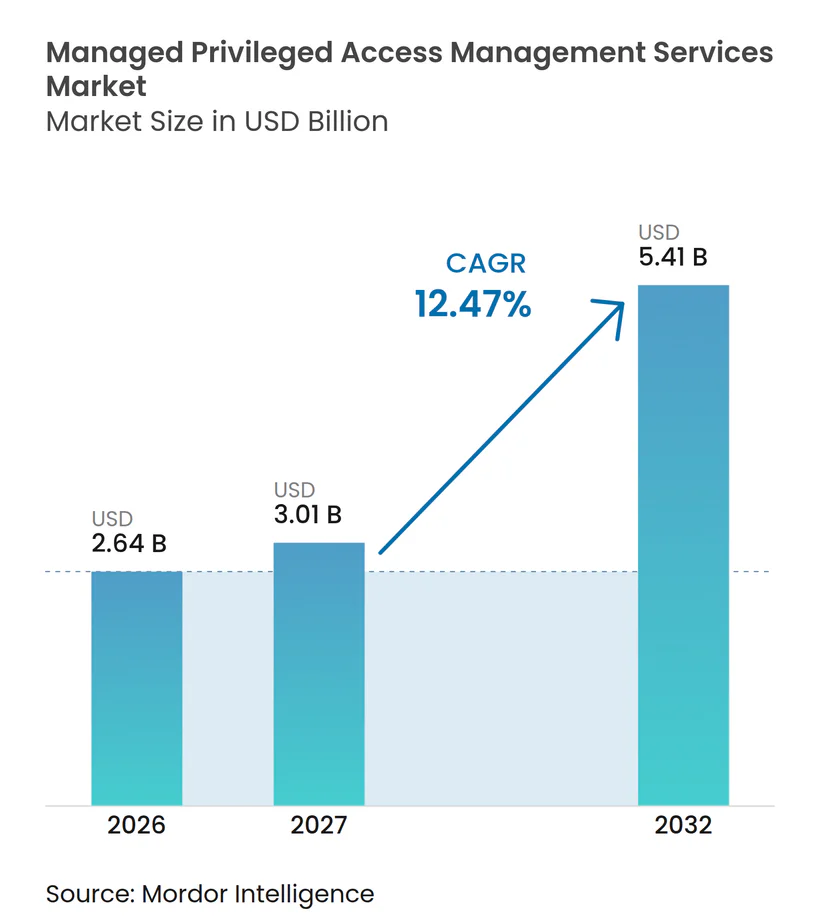
The managed privileged access management services market size is valued at USD 2.64 billion in 2026 and is projected to reach USD 5.41 billion by 2032, expanding at a CAGR of 12.47% during 2027-2032. Identity has become a central security concern as organizations use more cloud systems, connected applications, and external administrators. The managed privileged access management services market benefits when companies need continuous control of sensitive accounts but cannot maintain a specialized internal team around the clock. Insurance requirements and compliance reviews are also making privileged access controls a broader business requirement, rather than a discretionary technology purchase. Providers are responding by combining platform access, monitoring, audit records, and policy management in subscription contracts. The managed privileged access management services market also faces delivery limits in older industrial environments and in locations where session data must remain within national borders.
Key Report Takeaways
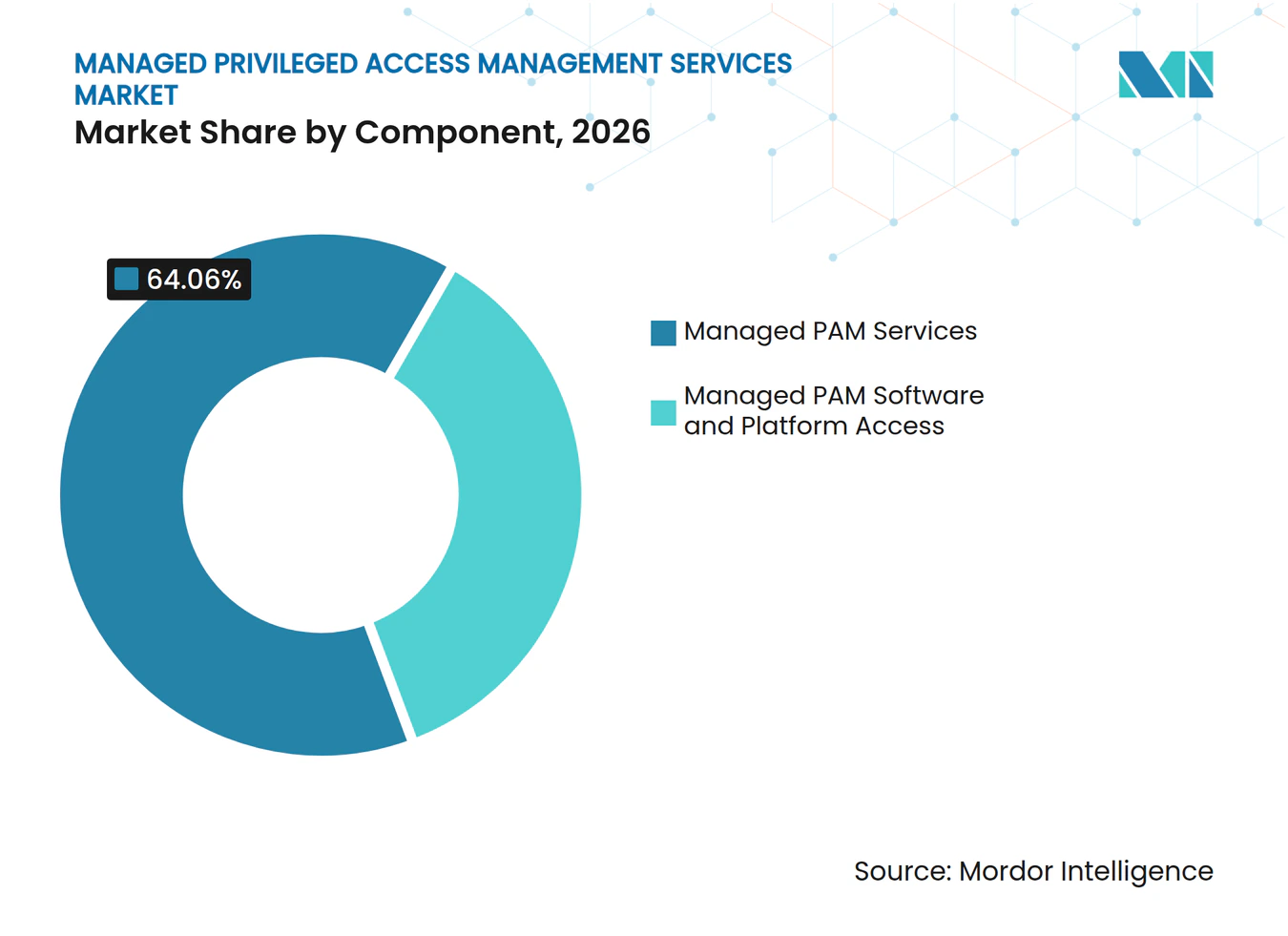
- By component, Managed PAM Services held 64.06% of revenue in 2026, while Managed PAM Software and Platform Access is projected to expand at a 13.91% CAGR through 2032.
- By service type, 24/7 Monitoring and Managed Detection accounted for 19.70% of revenue in 2026, while Managed Just-in-Time Access and Privilege Elevation is projected to expand at a 13.62% CAGR through 2032.
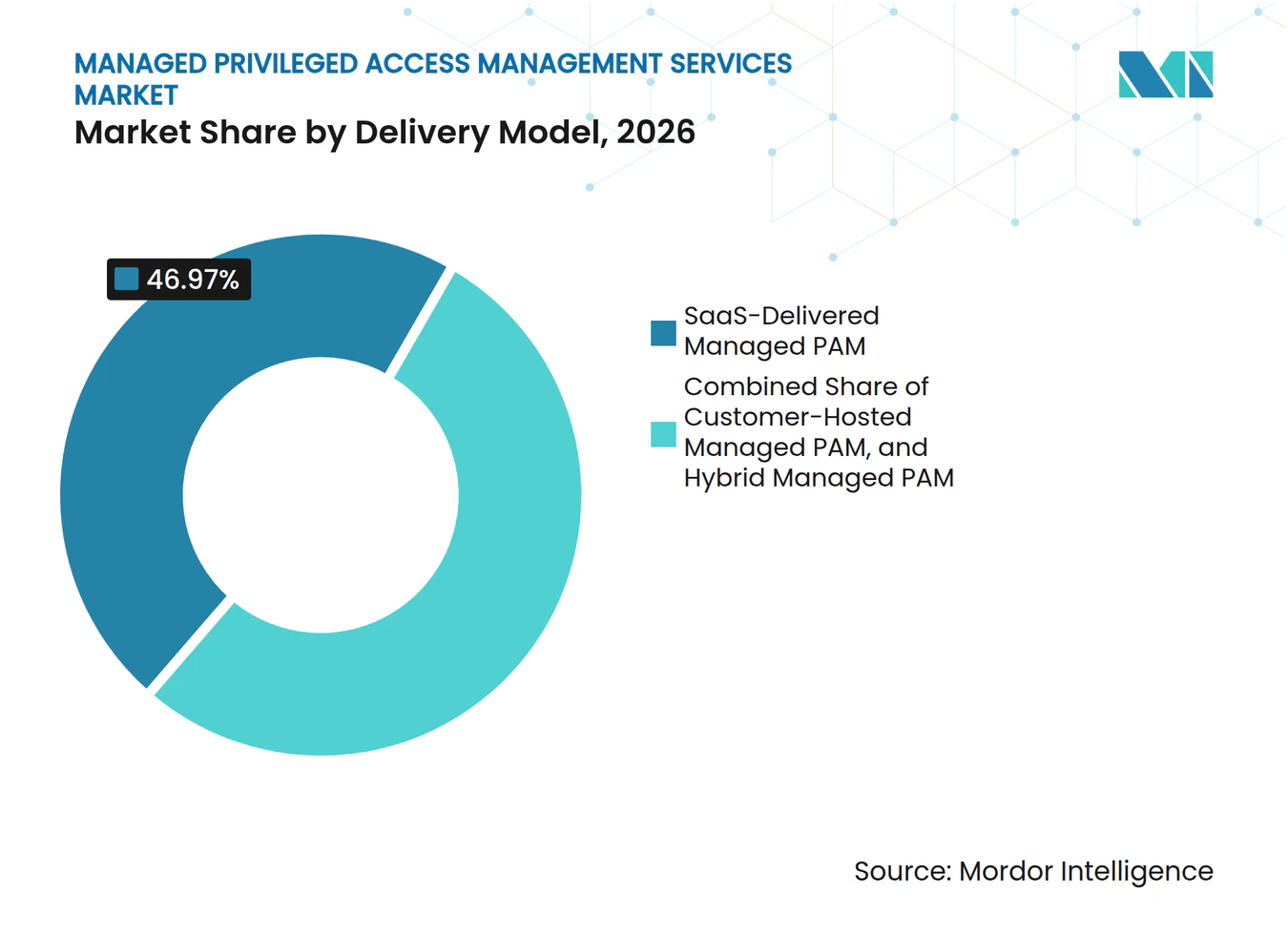
- By delivery model, SaaS-Delivered Managed PAM held 46.97% of revenue in 2026 and is projected to expand at a 13.86% CAGR through 2032.
- By organization size, Large Enterprises held 78.95% of revenue in 2026, while SMEs are projected to expand at a 13.49% CAGR through 2032.
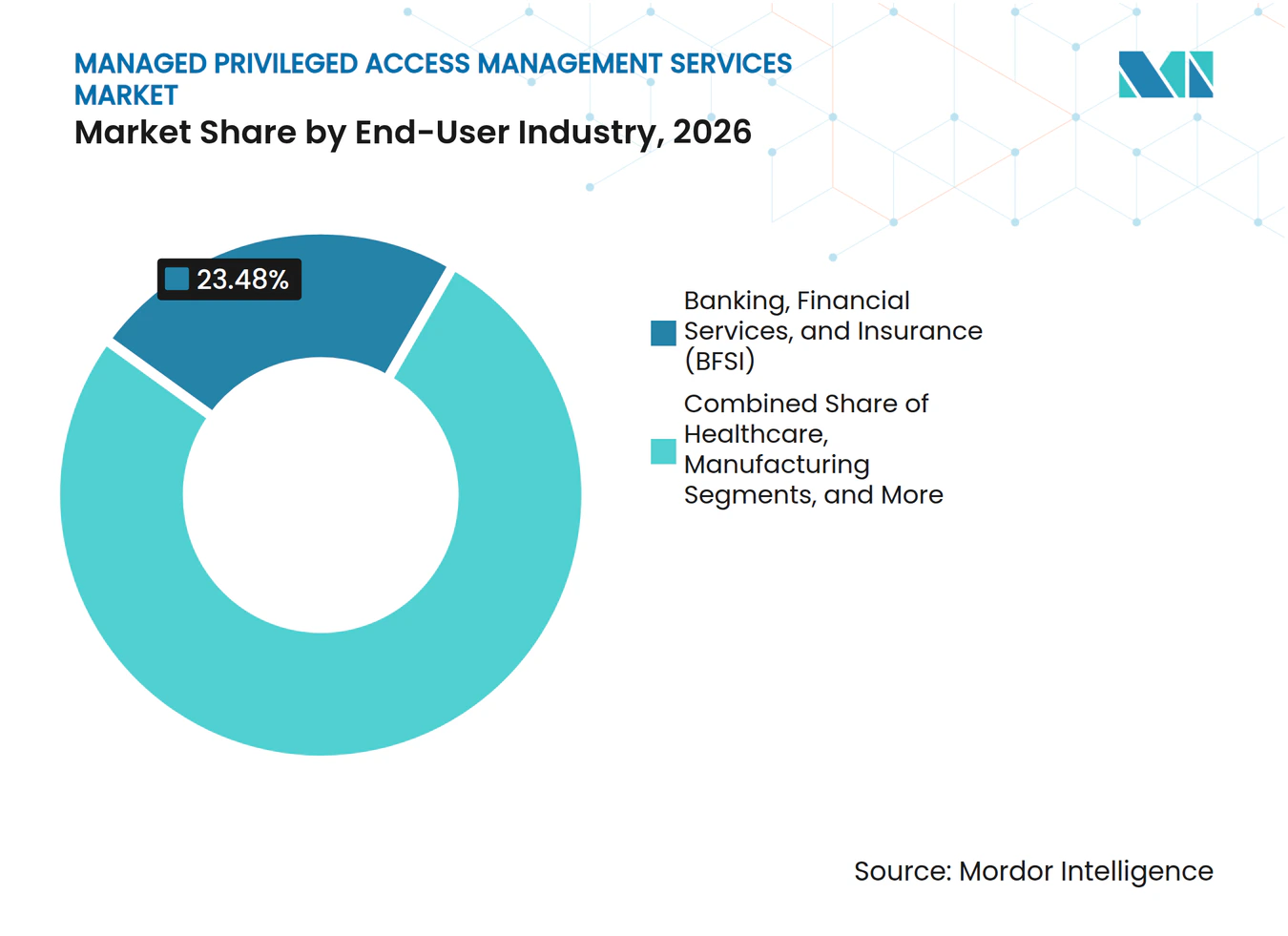
- By end-user industry, BFSI held 23.48% of revenue in 2026, while Government and Defense is projected to expand at a 13.94% CAGR through 2032.
- By access-control type, Shared and Privileged Account Management held 20.45% of revenue in 2026, while Cloud and SaaS Privilege Management is projected to expand at a 13.18% CAGR through 2032.
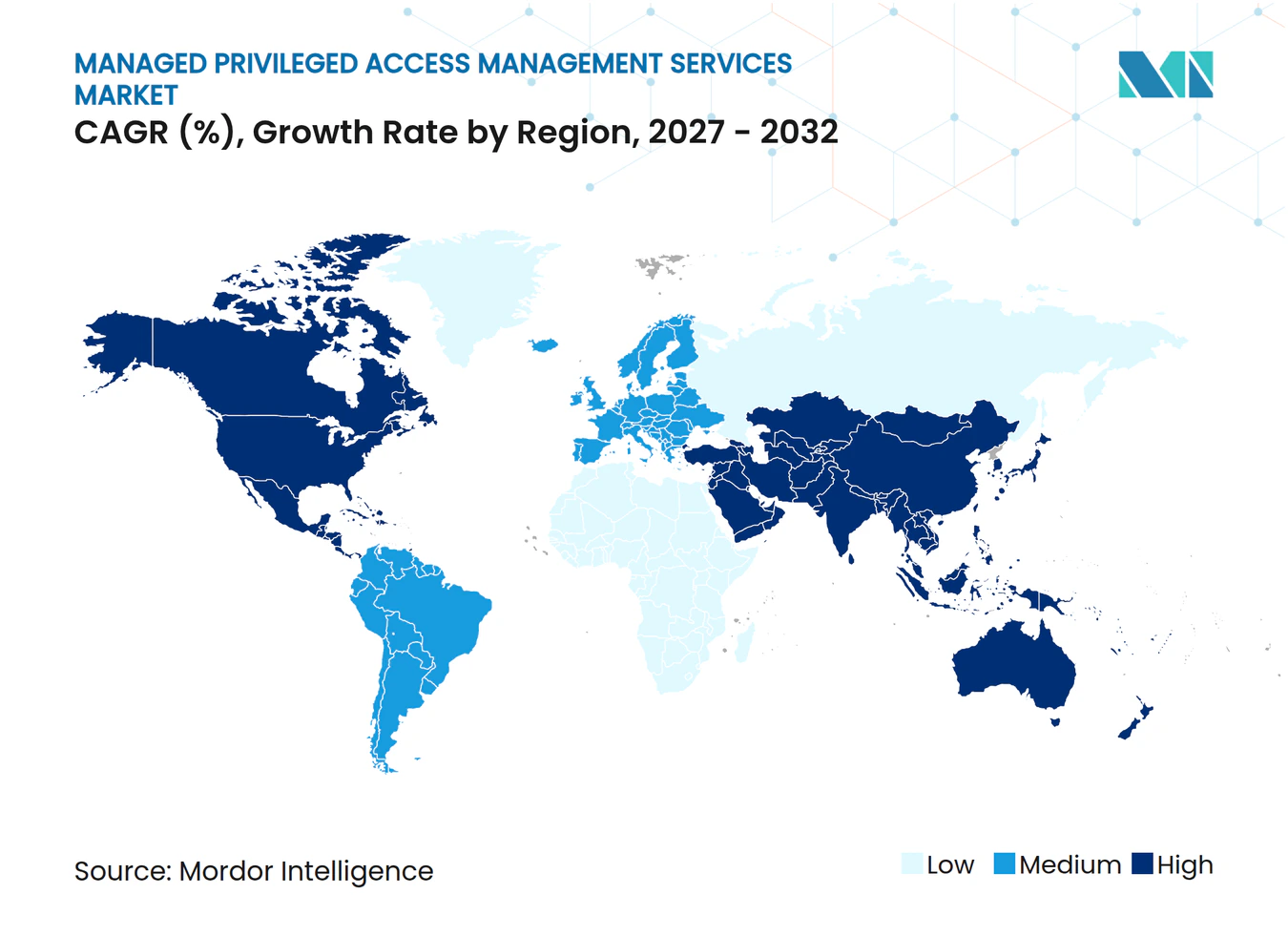
- By geography, North America held 39.02% of global revenue in 2026, while Asia-Pacific is projected to expand at a 13.29% CAGR through 2032.
Note: Market numbers in this report are based on Mordor Intelligence's proprietary estimation framework, which combines nine months of actuals with Q4 projections for base year 2026.
Market Trends and Insights
Drivers Impact Analysis of Managed Privileged Access Management Services Market*
| Driver | (~) % Impact on CAGR Forecast | Geographic Relevance | Impact Timeline |
|---|---|---|---|
| Rising Identity and Access Security Requirements | +3.8% | Global | Medium term (2-4 years) |
| Zero-Trust Adoption and Elimination of Standing Privileges | +3.2% | North America and Europe | Short term (≤ 2 years) |
| Hybrid-Cloud and Multi-Cloud Complexity | +2.4% | Global, with Asia-Pacific core and spill-over to Middle East | Medium term (2-4 years) |
| Cybersecurity Skills Shortages and 24/7 Monitoring Needs | +1.9% | Global | Short term (≤ 2 years) |
| Machine and AI-Agent Identity Proliferation | +1.4% | North America and Asia-Pacific | Medium term (2-4 years) |
| Managed PAM Evidence Packs for Sovereign and Critical-Infrastructure Tenders | +0.8% | Middle East and Europe | Long term (≥ 4 years) |
| Source: Mordor Intelligence | |||
Rising Identity and Access Security Requirements
Identity-related incidents have raised demand for services that govern and record the use of powerful accounts. The Identity Defined Security Alliance reported that 90% of organizations experienced an identity-related incident in the prior year, while 84% reported a direct business effect.[1] These events make continuous session oversight more relevant for organizations without a dedicated identity security team. Cyber-insurance reviews can require evidence of privileged-access controls before a policy is written or renewed. This requirement shifts the discussion from a security preference toward a financial and risk-management decision. The managed privileged access management services market therefore has support from longer service relationships built around evidence, review, and renewal needs.
Zero-Trust Adoption and Elimination of Standing Privileges
Zero-trust programs place greater attention on removing standing privileges and approving access only when it is needed. The Digital Operational Resilience Act has applied since January 2025 and requires financial entities to maintain ICT risk-management controls.Session recording, access approval, and third-party access review can support the documentation required by these control programs. This makes packaged compliance records important in buying decisions for regulated organizations. The managed privileged access management services market gains when providers can present approval logs, rotation records, and session evidence in a consistent format. These requirements also make the quality and availability of operational evidence as important as the underlying access-control platform.
Hybrid-Cloud and Multi-Cloud Complexity
Hybrid and multi-cloud environments add privileged accounts across applications, infrastructure, and deployment tools. Credential governance must extend across cloud workloads, containers, development pipelines, and older systems. Keeper Security expanded KeeperPAM to support native Google Cloud credential management and rotation in February 2026. The release addressed a need for consistent governance across AWS, Azure, and Google Cloud. Each new cloud account adds another set of permissions that must be reviewed and controlled. The managed privileged access management services market can therefore benefit from workload expansion after an initial cloud migration is complete.
Cybersecurity Skills Shortages and 24/7 Monitoring Needs
Privileged access governance requires skills in identity systems, policy design, incident response, and compliance records. SANS Institute reported in 2026 that 60% of organizations identified skills gaps as their main workforce challenge, while 27% linked security breaches to capability shortfalls.[2] Such gaps make continuous monitoring difficult for organizations that rely only on internal staff. The same report found that regulatory directives affected hiring for 95% of respondents. Providers can address this pressure by supplying operators who monitor sessions, maintain policies, and prepare audit evidence. The managed privileged access management services market is supported where organizations need this operating capacity immediately rather than after a lengthy hiring cycle.
Restraints Impact Analysis of Managed Privileged Access Management Services Market*
| Restraint | (~) % Impact on CAGR Forecast | Geographic Relevance | Impact Timeline |
|---|---|---|---|
| Brownfield Integration with Legacy and OT Environments | -2.0% | Global, with concentration in manufacturing, energy, and utilities | Long term (≥ 4 years) |
| Implementation and Lifecycle Governance Skills Gap | -1.5% | Global | Medium term (2-4 years) |
| Customer Resistance to Privileged-Workflow Friction | -1.0% | North America and Europe | Short term (≤ 2 years) |
| Data-Residency and Cross-Border Session-Recording Constraints | -0.6% | Europe and Asia-Pacific | Medium term (2-4 years) |
| Source: Mordor Intelligence | |||
Brownfield Integration with Legacy and OT Environments
Older operational technology environments have different technical requirements from enterprise IT systems. Protocols such as Modbus, DNP3, and OPC Unified Architecture may not carry user identity information in the way modern access platforms expect. Xona Systems documented a chemicals manufacturer deployment that cost USD 765,000, exceeded its budget by 80%, and reached 12 of 42 sites after 18 months.[3] Identity context can be lost when protocol translation occurs at a network boundary. This complicates the control evidence expected under industrial security requirements. The managed privileged access management services market remains constrained in these settings because providers need industrial expertise as well as identity-security capability.
Implementation and Lifecycle Governance Skills Gap
Provider capacity can be limited by the same shortage that leads customers to outsource access management. A managed service team needs experience with access platforms, governance procedures, and regulated client environments. SANS Institute found that expert-level cybersecurity roles took at least 6 months to fill for 55% of organizations in 2026. Clients must also take part in entitlement reviews, access policy updates, and credential rotation decisions. Fortinet reported that 71% of organizations considered the cybersecurity skills shortage an active organizational risk. Service quality can decline when either the provider or the customer lacks the required governance maturity.
*Our forecasts treat driver/restraint impacts as directional, not additive. The impact forecasts reflect baseline growth, mix effects, and variable interactions.
Managed Privileged Access Management Services Market Segment Analysis
By Component:
Managed Services Lead Revenue While Platform Access Expands FasterManaged PAM Services held 64.06% of the managed privileged access management services market share in 2026. Buyers use these services for continuous monitoring, compliance records, and 24/7 alerts rather than for a software license alone. This preference reflects the operational burden of governing high-risk accounts across a large organization. Providers can also use the service relationship to support recurring policy reviews and access changes. The category is particularly relevant where a customer needs a clear accountability model for sensitive sessions.
Managed PAM Software and Platform Access is projected to expand at a 13.91% CAGR through 2032. Platform access is increasingly included within a recurring service subscription rather than purchased as a separate capital item. The managed privileged access management services market size for this sub-segment is supported by SaaS delivery and metered access models. This approach can simplify buying decisions for smaller organizations that want one commercial agreement. Providers that separate platform and service pricing too sharply may face pressure from bundled offerings.


By Service Type:
Monitoring Leads While Just-in-Time Access Accelerates24/7 Monitoring and Managed Detection accounted for 19.70% of revenue in 2026. Continuous monitoring is difficult to replicate without dedicated security operations staffing. It gives organizations visibility into sensitive administrator activity at all hours. This service also provides a foundation for alert escalation and compliance reporting. For buyers in the managed privileged access management services market, it is the clearest operational reason to use an external privileged access provider.
Managed Just-in-Time Access and Privilege Elevation is projected to expand at a 13.62% CAGR through 2032. The approach grants elevated access for a limited period instead of leaving privileges available continuously. Managed Credential Vaulting and Rotation, Managed Privileged Session Management, Managed Reporting and Compliance, and Managed Incident Response and Threat Hunting broaden the service portfolio as identity programs mature. Privileged-session data can also support investigations of lateral movement that endpoint tools may not capture. In the managed privileged access management services market, Keeper Security introduced Keeper Workflow in May 2026 with time-bound, approval-gated access policies in KeeperPAM.
By Delivery Model:
SaaS Extends Its Lead Across Deployment ModelsSaaS-Delivered Managed PAM held 46.97% of revenue in 2026 and is projected to expand at a 13.86% CAGR through 2032. This delivery model leads both current adoption and forecast expansion. It reduces the infrastructure work required from the customer and supports faster implementation. Subscription pricing also fits operating-expense budgets used for many enterprise technology services. The managed privileged access management services market share held by SaaS delivery shows broad buyer preference for externally operated access controls.
Customer-Hosted Managed PAM remains important in energy, government, and financial services where policy restricts the movement of session records outside client infrastructure. Hybrid Managed PAM supports organizations that must retain on-premises vaults for mainframe or air-gapped operational assets while using SaaS policy tools for cloud workloads. These arrangements can remain in place for extended migration periods. Data volume is a practical consideration as scope expands to machine identities and AI agents. The managed privileged access management services market must account for larger volumes of session and identity telemetry that could challenge storage assumptions within existing subscriptions.


By Organization Size:
Large Enterprises Lead While SMEs Add VolumeLarge Enterprises held 78.95% of revenue in 2026. Their identity environments often span several jurisdictions, business units, and infrastructure types. They also face complex compliance requirements and manage a large number of administrator accounts. These conditions sustain demand for services that combine platform control with regular operating support. The managed privileged access management services market receives large enterprise demand through detailed governance records and tailored delivery arrangements.
SMEs are projected to expand at a 13.49% CAGR through 2032. SaaS delivery reduces the cost and administrative barriers that once limited managed PAM adoption to large organizations. Cyber-insurance requirements can further encourage smaller buyers to adopt controls that demonstrate secure privileged access. ManageEngine, a Zoho Corporation product, uses PAM360 with a simplified administrative interface and pricing positioned below enterprise managed-service thresholds. For the managed privileged access management services market, this opportunity favors providers that can offer a clear service scope without excessive deployment work.
By End-User Industry:
BFSI Leads Spending While Government and Defense AcceleratesBFSI held 23.48% of revenue in 2026. Banks and financial institutions manage high-value administrator accounts across core banking, payment, and trading systems. They also operate under demanding access-control and operational-resilience obligations. This combination supports continued use of session records, account rotation, and third-party governance in the managed privileged access management services market.
Government and Defense is projected to expand at a 13.94% CAGR through 2032. Defense organizations and their suppliers face formal zero-trust and compliance requirements that extend through the supply chain. In the managed privileged access management services market, healthcare, manufacturing, energy and utilities, retail and e-commerce, information technology and telecommunications, and other end users make up the remaining demand base. Healthcare faces audit expectations, while manufacturing and utilities must address integration challenges in older operational technology estates.
By Access-Control Type:
Shared Accounts Lead While Cloud Privileges ExpandShared and Privileged Account Management held 20.45% of revenue in 2026. Shared root accounts, service accounts, and domain administrator credentials remain core targets for governance. These accounts can create high exposure when their use is not tied to an identifiable person or controlled workflow. Organizations therefore need policies for secure storage, controlled release, and accountable use.
Cloud and SaaS Privilege Management is projected to expand at a 13.18% CAGR through 2032. Multi-cloud environments increase the number of identities, credentials, and permissions that require frequent review. Application-to-Application Password Management, Endpoint Privilege Management, Secrets Management, and Privileged Remote and Third-Party Access address related control needs. BeyondTrust released NHI Governance in July 2026 for service accounts, API keys, OAuth clients, workload identities, and AI agents. This reflects increased provider attention to non-human identities across cloud, SaaS, endpoint, and on-premises environments in the managed privileged access management services market.
Geography Analysis
North America Managed Privileged Access Management Services Market
North America held 39.02% of global revenue in 2026. Federal zero-trust requirements, a developed managed-security channel, and a high concentration of regulated enterprises support demand in the region. The managed privileged access management services market size in North America is supported by federal work to reduce standing privileges. The region also has a mature set of buyers that can procure managed security services through established channels.
Europe Managed Privileged Access Management Services Market
Europe is the second-largest regional market. DORA has applied from January 2025, adding operational-resilience obligations for financial entities. NIS2 adds cybersecurity obligations across covered organizations and reinforces the need for access evidence. The managed privileged access management services market responds when providers have local delivery capacity and compliance-ready records for customers with sovereignty requirements. Data-residency conditions may still increase the complexity and cost of multinational engagements.
APAC, South America and Africa Managed Privileged Access Management Services Market
Asia-Pacific is projected to expand at a 13.29% CAGR through 2032. China, India, Japan, and South Korea are adding cloud infrastructure and digital services, while Southeast Asian economies are creating new privilege surfaces through digitalization programs. BeyondTrust expanded its Pathfinder Platform to India, Singapore, South Africa, and the United Arab Emirates in January 2026, citing machine identities, agentic AI, and regional compliance requirements. South America and Africa remain developing areas where banking expansion and multinational compliance programs create demand. Brazil leads South American adoption, while South Africa, Nigeria, and Kenya are key African locations as digital financial infrastructure and data-protection rules develop.
Competitive Landscape
Market Concentration
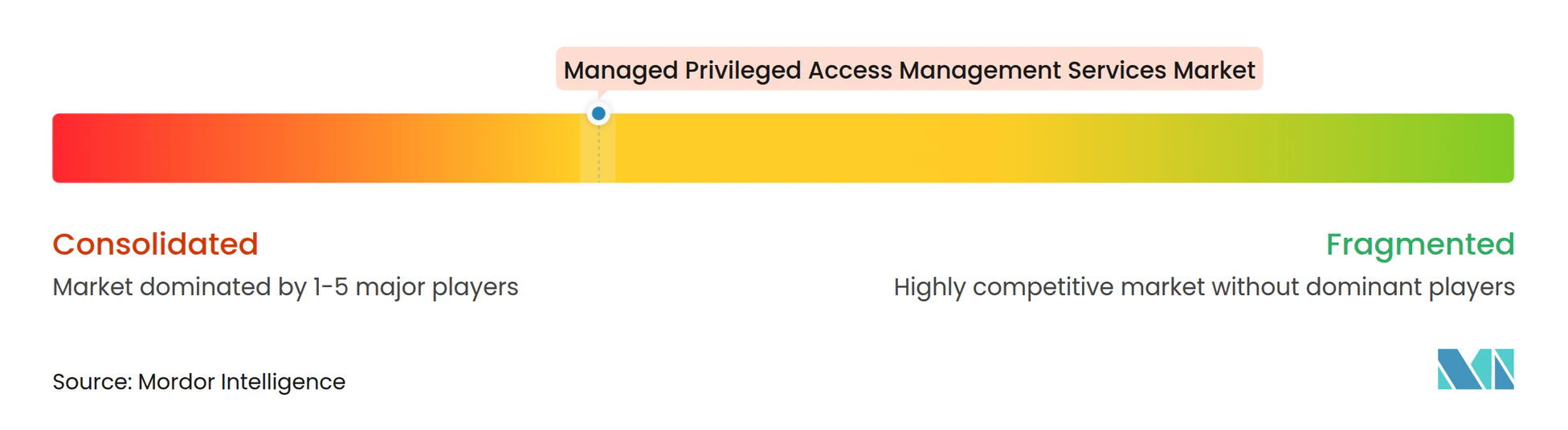
The managed privileged access management services market is moderately concentrated, with major platform vendors competing alongside specialists that emphasize deployment speed, sector knowledge, and accessible pricing. The acquisition of CyberArk by Palo Alto Networks was completed in February 2026. The transaction gave Palo Alto Networks an identity security offering that can be presented with its wider security platform. It also reduces the number of large independent privileged access vendors available to buyers.
Delinea completed its acquisition of StrongDM in March 2026, extending its offering into runtime just-in-time authorization and DevOps-focused access management. BeyondTrust released PathfinderAI in April 2026 to support natural-language investigation of identity risk. It followed with NHI Governance in July 2026, extending controls to service accounts, API keys, OAuth clients, workload identities, and AI agents. These moves show that vendors are treating non-human identity management as a major area for platform development.
Cloud Security Alliance research published in 2026 stated that machine and AI-agent identities outnumber human users by 45 to 1 on average and by 144 to 1 in cloud-native settings. The same research found that 31% of organizations had formal AI-agent governance policies. This leaves a substantial area for providers to address through discovery, policy enforcement, and operating support. WALLIX uses data sovereignty and NIS2 alignment to compete for European accounts.The competitive picture is consistent with a market in which a few major platforms lead, while regional and specialized providers retain defined positions.
Managed Privileged Access Management Services Industry Leaders
-
Palo Alto Networks
-
BeyondTrust Corporation
-
Delinea Inc.
-
One Identity LLC
-
ManageEngine - Zoho Corporation Pvt. Ltd.
- *Disclaimer: Major Players sorted in no particular order
Managed Privileged Access Management Services Market Companies Covered in this Report
- Palo Alto Networks
- BeyondTrust Corporation
- Delinea Inc.
- One Identity LLC
- ManageEngine - Zoho Corporation Pvt. Ltd.
- WALLIX Group SA
- ARCON TechSolutions Pvt. Ltd.
- Hitachi ID Systems Inc.
- Netwrix Corporation
- Teleport Inc.
- Opal Security Inc.
- Keeper Security Inc.
- Saviynt Inc.
- StrongDM Inc.
- Fudo Security Sp. z o.o.
- Ekran System Inc.
- Quest Software Inc.
- Bravura Security Inc.
- Segura Inc.
- Securden Inc.
Recent Industry Developments in Managed Privileged Access Management Services Market
- September 2026: Keeper Security and SailPoint announced a formal integration linking SailPoint's identity governance and administration platform directly to KeeperPAM. The connector enables SailPoint to govern provisioning, deprovisioning, and entitlements of Keeper users and managed resources, eliminating the manual reconciliation gap between identity governance and privileged access management that has historically required separate operational workflows.
- July 2026: BeyondTrust released NHI Governance on the Pathfinder Platform, extending discovery, governance, and enforcement to non-human identities, service accounts, API keys, OAuth clients, workload identities, and AI agents, across cloud, SaaS, endpoint, and on-premises environments. US general availability is planned for Fall 2026.
- July 2026: Keeper Security launched Keeper Privileged Cloud within KeeperPAM, delivering just-in-time access and zero-standing-privilege enforcement across AWS IAM, Azure Entra ID, Google Cloud Platform, Okta, and Active Directory, with privileged credentials automatically revoked at session end.
- April 2026: BeyondTrust launched PathfinderAI and the Pathfinder MCP Server, enabling natural-language identity risk investigation and allowing external AI systems, including Microsoft Copilot, OpenAI, and Claude, to access BeyondTrust privilege intelligence via the open Model Context Protocol.
Global Managed Privileged Access Management Services Market Report Scope
The Managed Privileged Access Management (PAM) Services Market refers to the industry encompassing outsourced and managed services that help organizations secure, monitor, govern, and control privileged accounts, administrator credentials, service accounts, and elevated access across on-premises, cloud, hybrid, and multi-cloud environments.
The Managed Privileged Access Management Services Market Report is Segmented by Component (Managed PAM Software and Platform Access, and Managed PAM Services), Service Type (24/7 Monitoring and Managed Detection, Managed Credential Vaulting and Rotation, Managed Privileged Session Management, Managed Just-in-Time Access and Privilege Elevation, Managed Reporting, Compliance, and Governance, and Managed Incident Response and Threat Hunting), Delivery Model (SaaS-Delivered Managed PAM, Customer-Hosted Managed PAM, and Hybrid Managed PAM), Organization Size (Large Enterprises, Small and Medium-Sized Enterprises), End-User Industry (BFSI, IT and Telecom, Government and Defense, Healthcare, Manufacturing, Energy and Utilities, Retail, Other End-User Industries), Access-Control Type (Shared and Privileged Account Management, Application-to-Application Password Management, Endpoint Privilege Management, Cloud and SaaS Privilege Management, Secrets Management, and Privileged Remote and Third-Party Access), and Geography (North America, South America, Europe, Asia-Pacific, Middle East, and Africa). The Market Forecasts are Provided in Terms of Value (USD).
Segmentation Overview
| Managed PAM Software and Platform Access |
| Managed PAM Services |
| 24/7 Monitoring and Managed Detection |
| Managed Credential Vaulting and Rotation |
| Managed Privileged Session Management |
| Managed Just-in-Time Access and Privilege Elevation |
| Managed Reporting, Compliance, and Governance |
| Managed Incident Response and Threat Hunting |
| SaaS-Delivered Managed PAM |
| Customer-Hosted Managed PAM |
| Hybrid Managed PAM |
| Large Enterprises |
| Small and Medium-Sized Enterprises |
| Banking, Financial Services, and Insurance (BFSI) |
| Information Technology and Telecommunications |
| Government and Defense |
| Healthcare |
| Manufacturing |
| Energy and Utilities |
| Retail and E-Commerce |
| Other End-User Industries |
| Shared and Privileged Account Management |
| Application-to-Application Password Management |
| Endpoint Privilege Management |
| Cloud and SaaS Privilege Management |
| Secrets Management |
| Privileged Remote and Third-Party Access |
| North America | United States |
| Canada | |
| Mexico | |
| South America | Brazil |
| Argentina | |
| Chile | |
| Rest of South America | |
| Europe | United Kingdom |
| Germany | |
| France | |
| Italy | |
| Spain | |
| Rest of Europe | |
| Asia-Pacific | China |
| Japan | |
| India | |
| South Korea | |
| Australia | |
| Singapore | |
| Malaysia | |
| Rest of Asia-Pacific | |
| Middle East | Saudi Arabia |
| United Arab Emirates | |
| Turkey | |
| Rest of Middle East | |
| Africa | South Africa |
| Nigeria | |
| Kenya | |
| Rest of Africa |
| By Component | Managed PAM Software and Platform Access | |
| Managed PAM Services | ||
| By Service Type | 24/7 Monitoring and Managed Detection | |
| Managed Credential Vaulting and Rotation | ||
| Managed Privileged Session Management | ||
| Managed Just-in-Time Access and Privilege Elevation | ||
| Managed Reporting, Compliance, and Governance | ||
| Managed Incident Response and Threat Hunting | ||
| By Delivery Model | SaaS-Delivered Managed PAM | |
| Customer-Hosted Managed PAM | ||
| Hybrid Managed PAM | ||
| By Organization Size | Large Enterprises | |
| Small and Medium-Sized Enterprises | ||
| By End-User Industry | Banking, Financial Services, and Insurance (BFSI) | |
| Information Technology and Telecommunications | ||
| Government and Defense | ||
| Healthcare | ||
| Manufacturing | ||
| Energy and Utilities | ||
| Retail and E-Commerce | ||
| Other End-User Industries | ||
| By Access-Control Type | Shared and Privileged Account Management | |
| Application-to-Application Password Management | ||
| Endpoint Privilege Management | ||
| Cloud and SaaS Privilege Management | ||
| Secrets Management | ||
| Privileged Remote and Third-Party Access | ||
| By Geography | North America | United States |
| Canada | ||
| Mexico | ||
| South America | Brazil | |
| Argentina | ||
| Chile | ||
| Rest of South America | ||
| Europe | United Kingdom | |
| Germany | ||
| France | ||
| Italy | ||
| Spain | ||
| Rest of Europe | ||
| Asia-Pacific | China | |
| Japan | ||
| India | ||
| South Korea | ||
| Australia | ||
| Singapore | ||
| Malaysia | ||
| Rest of Asia-Pacific | ||
| Middle East | Saudi Arabia | |
| United Arab Emirates | ||
| Turkey | ||
| Rest of Middle East | ||
| Africa | South Africa | |
| Nigeria | ||
| Kenya | ||
| Rest of Africa | ||
Key Questions Answered in the Report
What is the managed privileged access management services market size?
The managed privileged access management services market is valued at USD 2.64 billion in 2026 and is projected to reach USD 5.41 billion by 2032 at a 12.47% CAGR.
What is driving demand for managed privileged access management services?
Identity-related incidents, zero-trust programs, multi-cloud complexity, and shortages of skilled security staff are supporting demand.
Which component leads revenue in managed privileged access management services?
Managed PAM Services leads with 64.06% of 2026 revenue because many organizations need continuous monitoring and operational support.
Which delivery model is expanding fastest for managed PAM?
SaaS-Delivered Managed PAM is projected to expand at a 13.86% CAGR through 2032 and held 46.97% of revenue in 2026.
Which end-user sector is expected to expand fastest?
Government and Defense is projected to expand at a 13.94% CAGR through 2032, supported by zero-trust and defense compliance requirements.
Which region is expected to expand fastest for managed PAM services?
Asia-Pacific is projected to expand at a 13.29% CAGR through 2032 as cloud and digital service deployment increases.