
Access Management Software Market Size and Share
Market Overview
| Study Period | 2021 - 2032 |
|---|---|
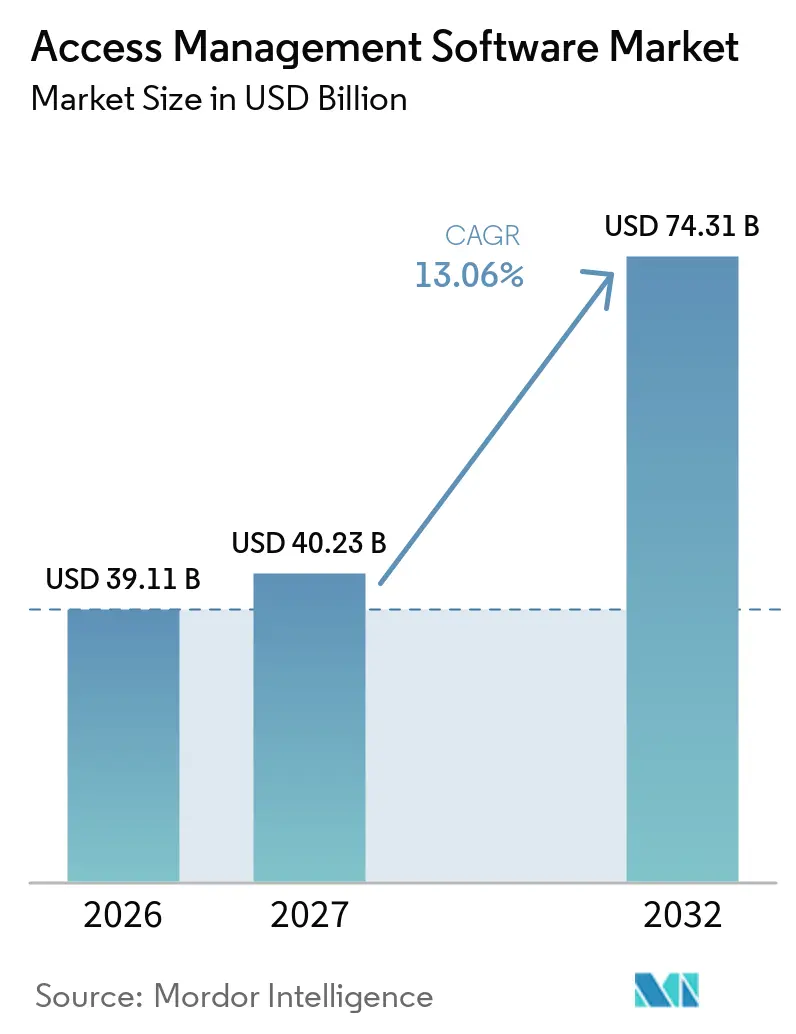
| Market Size (2027) | USD 40.23 Billion |
| Market Size (2032) | USD 74.31 Billion |
| Growth Rate (2027 - 2032) | 13.06 % |
| Fastest Growing Market | Asia-Pacific |
| Largest Market | North America |
| Market Concentration | Low |
Major Players *Disclaimer: Major Players sorted in no particular order Image © Mordor Intelligence. Reuse requires attribution under CC BY 4.0. | |
Access Management Software Market Analysis by Mordor Intelligence
The access management software market size is projected to expand from USD 39.11 billion in 2026 and USD 43.77 billion in 2027 to USD 74.31 billion by 2032, registering a CAGR of 13.06% between 2027 to 2032. Demand reflects the widening identity perimeter across cloud workloads, software-as-a-service applications, remote users, and AI agents that interact with sensitive business systems and data across organizational boundaries. Regulatory requirements are making access control, privileged-account governance, and multifactor authentication more central to security planning, particularly where regulated data and critical operational systems are involved. The access management software market is also benefiting from organizations that want fewer disconnected identity tools and clearer evidence of compliance across internal systems, cloud applications, partner environments, and customer-facing services. Vendors are responding by combining access management, identity governance, privileged access, and threat detection in broader platforms that can reduce the administrative burden of managing several separate security products. Opportunities are strongest where businesses must manage AI agents and other machine identities without losing control of user access, policy enforcement, approval processes, and the evidence needed for internal and external reviews.
Key Report Takeaways
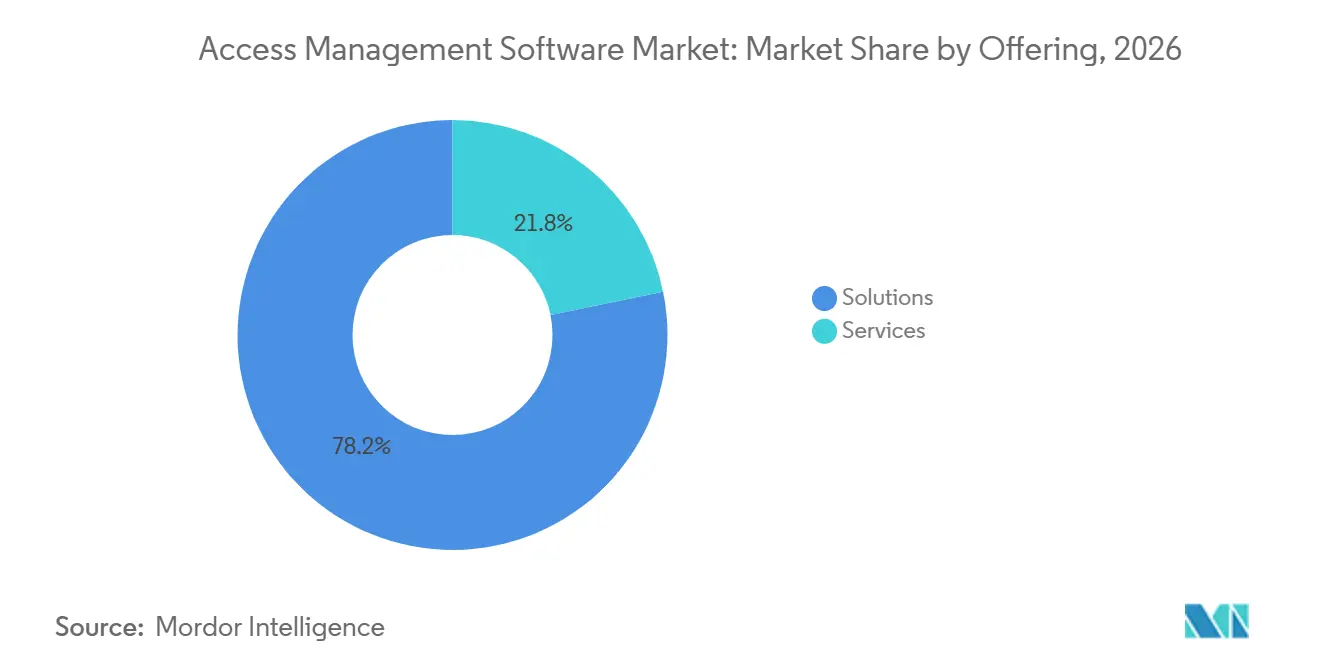
- By offering, Solutions held 78.22% of the access management software market share in 2026, while Identity Governance and Administration within Solutions is projected to expand at a 13.44% CAGR through 2032.
- By technology, Access Management accounted for 43.56% of the access management software market share in 2026, while Identity Governance and Administration is projected to expand at a 13.84% CAGR through 2032.
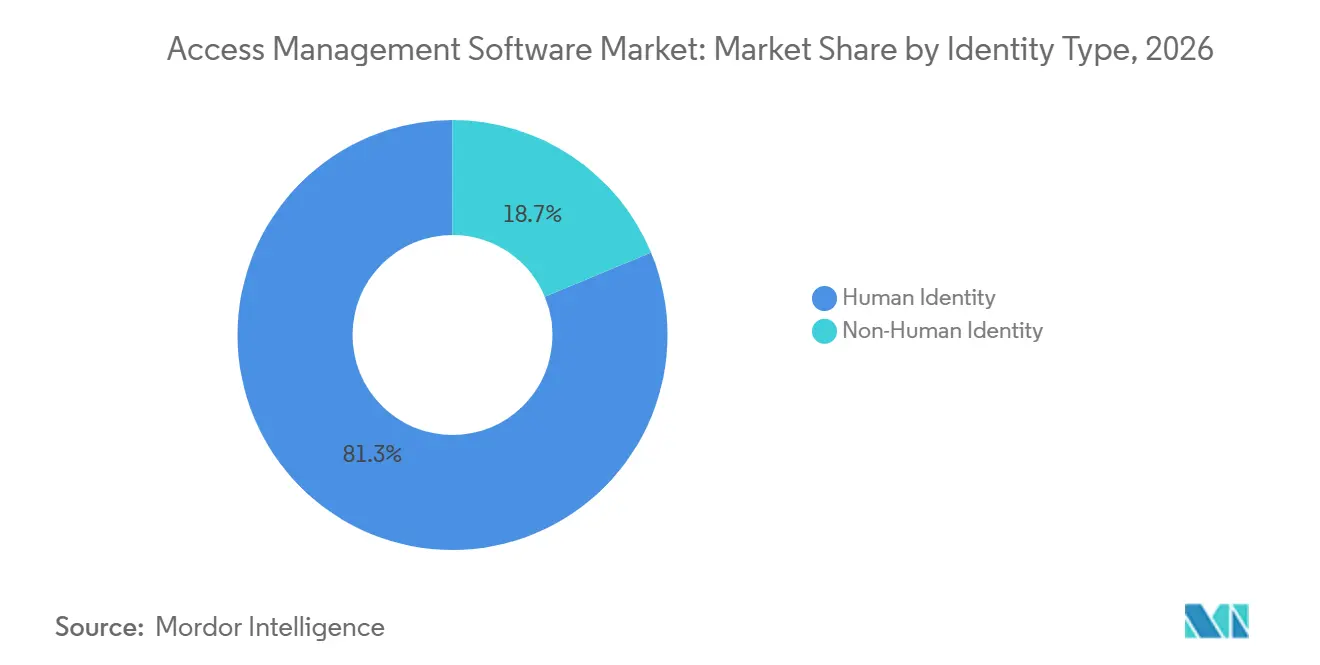
- By identity type, Human Identity held 81.26% share in 2026, while Non-Human Identity is projected to expand at a 14.14% CAGR through 2032.
- By deployment model, Cloud accounted for 56.68% share in 2026 and is projected to expand at a 13.93% CAGR through 2032.
- By organization size, Large Enterprises held 70.97% share in 2026, while Small and Medium Enterprises are projected to expand at a 13.81% CAGR through 2032.
- By end-use industry, BFSI accounted for 21.68% share in 2026, while Healthcare and Life Sciences is projected to expand at a 14.11% CAGR through 2032.
- By geography, North America held 38.92% share in 2026, while Asia-Pacific is projected to expand at a 13.77% CAGR through 2032.
Note: Market numbers in this report are based on Mordor Intelligence's proprietary estimation framework, which combines nine months of actuals with Q4 projections for base year 2026.
Global Access Management Software Market Trends and Insights
Drivers Impact Analysis*
| Driver | (~) % Impact on CAGR Forecast | Geographic Relevance | Impact Timeline |
|---|---|---|---|
| Rising Identity Fraud and Account Takeover Attempts | +3.2% | Global, most acute in North America and Asia-Pacific | Short term (≤ 2 years) |
| Expansion of Zero Trust Access Architectures | +2.8% | North America and EU, with spillover to Asia-Pacific | Medium term (2-4 years) |
| Cloud and SaaS Sprawl Across Hybrid Enterprises | +2.4% | Global | Short term (≤ 2 years) |
| Remote, Hybrid, and Third-Party Workforce Access | +1.8% | North America and Europe | Medium term (2-4 years) |
| AI Agent and Non-Human Identity Lifecycle Management | +1.6% | Global, with early gains in the United States and Western Europe | Long term (≥ 4 years) |
| SAP Identity Management Retirement and Migration Demand | +0.6% | Europe and North America, with Asia-Pacific spillover | Short term (≤ 2 years) |
| Source: Mordor Intelligence | |||
Rising Identity Fraud and Account Takeover Attempts
Account takeover has become an operational concern across far more than financial services. The access management software market is responding to this higher priority for identity protection. LexisNexis Risk Solutions reported a 216% year-over-year increase in global login-layer attack rates in 2025, based on more than 116 billion online transactions. The same report recorded a 59% increase in malicious bot volumes and found that synthetic identity fraud represented 11% of global fraud incidents.[1] These patterns make access management software market buyers place more weight on behavioral risk scoring and continuous session checks, rather than relying only on the initial user login decision. The Federal Trade Commission received more than 1.3 million identity-theft reports in 2025, and reported financial losses reached USD 15.86 billion.[2] The resulting scrutiny favors identity threat detection and response capabilities that work alongside authentication and governance controls, because teams increasingly need to identify suspicious access behavior after a credential has already been accepted.
Expansion of Zero Trust Access Architectures
Zero Trust is becoming an operational framework in regulated and cloud-intensive organizations. The access management software market gains from the identity controls required to put this framework into practice. NIST published SP 1800-35 in June 2025, documenting 19 example implementations for Zero Trust Architecture with commercially available products.[3] The guidance gives security teams more concrete implementation paths than high-level policy statements alone, which can help translate broad security objectives into operational architecture and deployment work. The access management software market benefits because identity assurance is a central element of verifying each access request. Comprehensive governance, privileged controls, and continuous authentication are needed when users, applications, and machines operate across several environments, particularly when a single business process moves between cloud services, internal systems, and external partners. This typically extends procurement beyond a first deployment of single sign-on or multifactor authentication, since the same program must address policy enforcement, entitlement review, and privileged access over time.
Cloud and SaaS Sprawl Across Hybrid Enterprises
Cloud-first organizations often hold entitlements across directory services, business applications, developer tools, and cloud platforms at the same time. The access management software market serves the need to manage these permissions from a more unified control point. This creates access reviews that can become outdated as applications and user roles change, which makes it harder to establish a reliable record of who can access business resources at a particular time. Departmental software purchases may create accounts that central IT teams cannot consistently discover or govern, especially when procurement, user provisioning, and application administration happen in separate business functions. The access management software market is therefore shifting toward tools that provide visibility across software-as-a-service, on-premises, and cloud-native environments. Okta introduced 48-Hour Integrations in September 2026 to reduce the delivery time for new connectors from a manual process of 2 to 3 months to 48 hours. Faster connector delivery can reduce the coverage gaps caused by a fast-changing application estate.
Remote, Hybrid, and Third-Party Workforce Access
Hybrid work has made network location a weaker basis for deciding who should receive access. Contractors, partners, and suppliers often need temporary access to internal systems and data, but their access requirements, sponsors, and periods of engagement can change quickly. Organizations are replacing shared accounts and poorly governed guest access with request workflows, time-bound entitlements, and automated offboarding. These requirements make governance features more relevant to organizations that previously treated them as large-enterprise tools, because even smaller programs need reliable approval trails and timely removal of temporary access. The access management software market also faces a higher need for policies that can assess external identities without creating unnecessary friction for legitimate users. NIST describes Zero Trust as an approach that does not grant implicit trust based on network location or asset ownership.
Restraints Impact Analysis*
| Restraint | (~) % Impact on CAGR Forecast | Geographic Relevance | Impact Timeline |
|---|---|---|---|
| Legacy Directory and Application Integration Complexity | -1.8% | Global, more acute in Europe and North America | Medium term (2-4 years) |
| High Cost of Enterprise-Scale IAM Modernization | -1.4% | Global | Medium term (2-4 years) |
| Access Policy Drift Across AI Agents and Machine Identities | -0.8% | Global, with early impact in United States hyperscaler-heavy enterprises | Long term (≥ 4 years) |
| Shortage of Identity Governance and Entitlement Engineering Skills | -0.6% | Global | Long term (≥ 4 years) |
| Source: Mordor Intelligence | |||
Legacy Directory and Application Integration Complexity
Organizations with 15 to 20 years of identity infrastructure can face substantial integration debt. The access management software market must address this constraint through flexible integration and phased migration support. Older applications may depend on LDAP, custom connectors, or nonstandard SAML implementations, requiring teams to understand dependencies before they change authentication or federation paths. Discovery work can reveal dependencies that were not visible when a modernization program began. Those findings can expand project scope and extend migration schedules, since teams may need to build or test new interfaces before a legacy authentication process can be retired. This restraint can lead some businesses to renew incumbent tools while they plan a phased migration. Accenture acquired Canadian identity and access management specialist IAMConcepts in September 2025, showing the value that delivery capability can hold in complex programs.
High Cost of Enterprise-Scale IAM Modernization
Modernization spending includes more than software licenses. The access management software market can benefit when delivery models reduce the cost and complexity of change. Integration, connector development, change management, and compliance mapping can form a large share of the multi-year cost, especially when an organization must align policies and evidence requirements across several control owners. A business using separate tools for single sign-on, privileged access, governance, and cloud permissions can also carry ongoing coordination costs, including the effort to align policies, reporting, and administrative ownership across those separate tools. Software-as-a-service licensing across many applications can add costs that are not clear from a headline license price. These costs can slow platform migration among small and mid-sized organizations. Managed services, consumption-based pricing, and accelerated deployment tools can lower that barrier for the access management software market.
*Our forecasts treat driver/restraint impacts as directional, not additive. The impact forecasts reflect baseline growth, mix effects, and variable interactions.
Segment Analysis
By Offering: Solutions Lead Spending While Services Support Delivery
Solutions held 78.22% of the sector in 2026. This category includes platforms for access management, identity governance and administration, privileged access management, and passwordless authentication, which together support the authentication, authorization, and oversight needs of enterprise identity programs. Its share reflects the central role of software platforms in enterprise identity programs, where a consistent system of record can make access decisions, approvals, and audit activity easier to manage. Identity Governance and Administration within Solutions is projected to expand at a 13.44% CAGR through 2032. Automated certifications and dynamic entitlement controls support this demand by helping organizations verify that users retain only the permissions required for their responsibilities. Organizations also need governance that can cover AI agent identities alongside workforce accounts.
Services represented the remaining 21.78% of revenue in 2026. Integration and deployment services help customers connect identity tools with established applications, including systems that may have their own roles, directories, and authentication standards. Support, maintenance, consulting, and managed IAM can remain important after the initial software implementation. Managed IAM can be attractive to mid-sized businesses that do not have dedicated identity engineering teams, allowing them to use specialized operational support without building a large in-house identity function. The NIS2 framework places attention on periodic access-right reviews and privileged-account policies. SailPoint introduced Success Acceleration services in October 2026, combining expert roadmaps, deployment accelerators, and continuous compliance support. This approach ties services more closely to long-term platform adoption, including the continuing work of connecting applications, updating policies, and demonstrating that controls are operating as intended.
By Technology: Access Management Remains Largest While Governance Advances
Access Management held 43.56% of the sector in 2026. The category covers authentication, authorization, credential services, directory services, session management, and federation, which are fundamental functions for controlled access across employee, partner, and customer environments. Its position reflects the established use of single sign-on, multifactor authentication, and directory services, which many organizations already use as the core interface between users and their business applications. Identity Governance and Administration is projected to expand at a 13.84% CAGR through 2032. Joiner-mover-leaver processes and access certification campaigns are central use cases. AI-assisted policy engines may reduce manual work in entitlement management by helping administrators identify access patterns that warrant review or policy updates.
Privileged Access Management is being evaluated more often with governance and cloud-permission tools rather than as a separate product. Palo Alto Networks completed its acquisition of CyberArk for USD 25 billion in February 2026. The transaction reinforced the importance of a unified approach to human, machine, and agentic identities. Fraud and risk analytics are also moving closer to real-time access decisions, enabling organizations to evaluate context and behavior as part of access policy enforcement rather than only after an incident. The OpenID Foundation paper on agentic AI identifies limitations in current identity protocols for multi-agent systems. This creates a need for authorization methods that can manage complex machine-to-machine interactions, including cases where several agents act on behalf of different systems, users, or organizational roles, and where permissions must be revised as tasks, data sensitivity, and the level of human oversight change during a workflow. The access management software market can therefore see technology competition shift toward broader control planes.
By Identity Type: Human Identity Leads While Non-Human Identity Accelerates
Human Identity held 81.26% share of the access management software market size in 2026. This position follows long-standing investment in workforce and customer identity systems. Human identity programs are built around hiring, role changes, customer access, and employee departure, using predictable life-cycle events to drive access provisioning and removal. Non-Human Identity is projected to expand at a 14.14% CAGR through 2032. It includes service accounts, devices, cloud workloads, APIs, bots, and AI agents. Its faster pace reflects the widening scope of credentials that need oversight, since machine accounts can be created and used far more frequently than conventional workforce accounts.
The World Economic Forum stated in 2025 that machine identities outnumber human identities by 20 to 1 in enterprise environments. That imbalance can increase as organizations use more autonomous software. The Cloud Security Alliance has argued that adapting established IAM protocols alone is not sufficient for multi-agent systems. It points to decentralized identifiers, verifiable credentials, and fine-grained controls as relevant building blocks. SailPoint announced real-time agent behavioral risk detection and agent lifecycle controls in October 2026. These capabilities show how vendors are addressing a governance category that traditional platforms did not originally serve, with controls that can monitor agent behavior and intervene when risk or policy concerns arise.
By Deployment Model: Cloud Leads as Sovereign Requirements Influence Choices
Cloud held 56.68% of the sector in 2026. It is projected to expand at a 13.93% CAGR through 2032. Consumption-based licensing, connector ecosystems, and integration with cloud identity services support this position, giving buyers a way to extend identity functions without maintaining every component on their own infrastructure. Cloud delivery can also make updates and new connections easier to deploy, which is relevant when identity teams must maintain coverage as business applications are added, changed, or removed. These benefits matter to organizations managing many applications and distributed workers. The access management software market continues to support cloud adoption where centralized administration is needed.
On-premises systems remain relevant in government, defense, and critical infrastructure settings. Data residency and air-gap requirements can limit the use of public cloud services in these environments, where the location, handling, and isolation of data may be subject to formal operational constraints. Hybrid deployments can allow enterprises to continue modernization while keeping selected systems under local control. The European Commission proposed targeted NIS2 amendments in January 2026 to simplify compliance for 28,700 companies, including 6,200 small and medium-sized enterprises. SailPoint has stated that it is preparing for EU Sovereign Cloud, FedRAMP High, and PCI DSS 4.0 requirements. Such preparation can become a differentiator when buyers require proof of local and sector-specific controls.
By Organization Size: Large Enterprises Hold Revenue While SMEs Add Demand
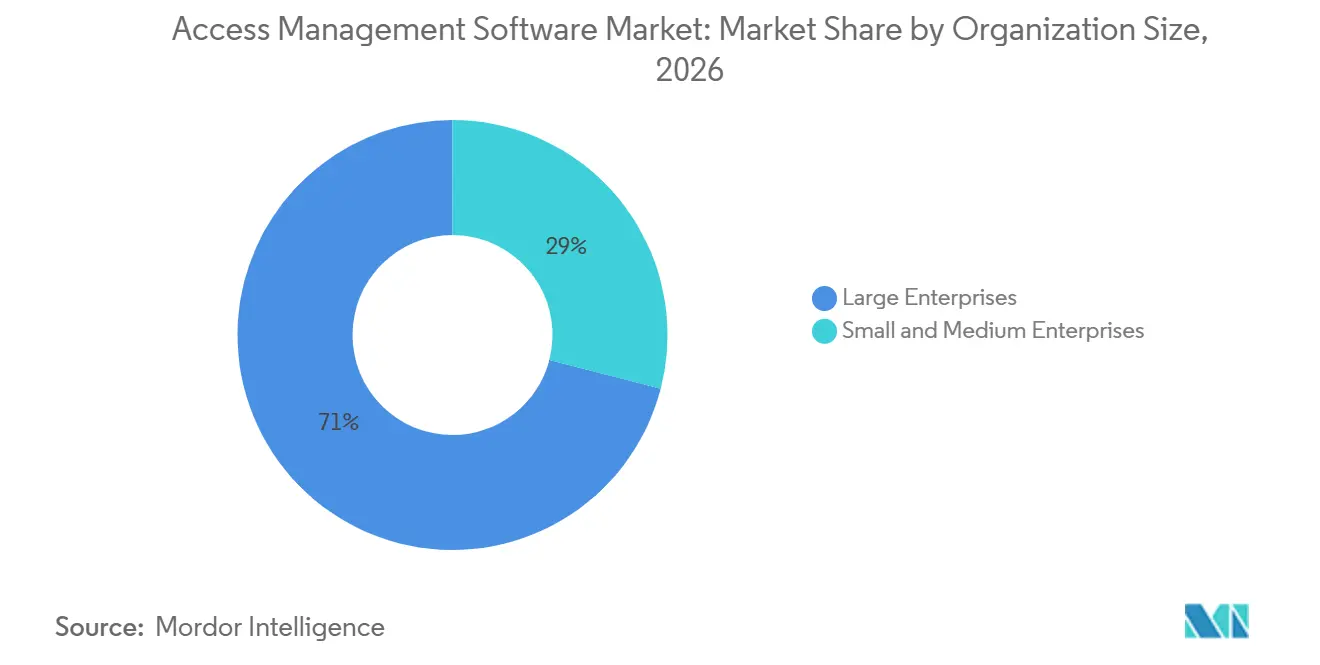
Large Enterprises held 70.97% share of the access management software market size in 2026. Large programs can cover workforce identities, privileged accounts, and access across many applications, with policies that must work across departments, locations, and different technology environments. Their needs often span several countries, business units, and regulatory frameworks. Small and Medium Enterprises are projected to expand at a 13.81% CAGR through 2032. Cloud-native managed IAM can reduce the operating burden for these organizations by shifting routine administration and platform upkeep away from smaller internal technology teams. This delivery model can make governance more accessible without a large internal specialist team, while still giving customers access to tools for user onboarding, access requests, reviews, offboarding, reporting, policy maintenance, routine administration, and evidence collection for recurring compliance activities across complex organizations.
The approaching retirement of SAP Identity Management is creating migration decisions for existing users. Mainstream maintenance for SAP Identity Management ends on December 31, 2027. This can encourage customers to assess tools that offer structured onboarding and migration support. Vendors that simplify discovery, integration, and policy mapping may have an advantage with smaller customers. Large enterprises will still retain importance because their identity estates are broader and more complex. The access management software market thus serves two distinct buying patterns, large platform programs and lower-complexity managed deployments.
By End-Use Industry: BFSI Leads While Healthcare and Life Sciences Advance
BFSI held 21.68% of the sector in 2026. Financial services organizations face strict authentication expectations and often manage high volumes of sensitive customer interactions, making reliable identity verification and authorization integral to both security and customer service. Open-banking access and fraud risk add to their need for robust identity controls, because external connections and customer-facing services create more situations where identities and permissions must be verified. Healthcare and Life Sciences is projected to expand at a 14.11% CAGR through 2032. The sector manages sensitive health information and a changing workforce, including employees, contractors, and care providers who may need different levels of system access. These conditions make reliable access termination and regular control testing important.
The US Department of Health and Human Services proposed changes to the HIPAA Security Rule in January 2025. The proposal includes access termination within 1 hour after a workforce member leaves and annual testing of access-control procedures. Government, information technology and telecommunications, and manufacturing also face compliance programs that sustain access control updates. Each vertical has different system environments and risk priorities, which affects how it configures approval workflows, authentication methods, audit records, and privileged access safeguards. This supports demand for configurations that fit sector-specific workflows in the access management software market.
Geography Analysis
North America held 38.92% of the sector in 2026. The region has a high concentration of BFSI and technology deployments. It also has a large base of access management vendors and federal cybersecurity activity, which strengthens local expertise, customer demand, and the availability of implementation support. The United States is the largest national market in the region, supported by the scale of its enterprise technology, financial services, and public-sector security requirements. Federal Zero Trust direction gives agencies a structured basis for identity modernization. CISA describes its Zero Trust Maturity Model as a roadmap for agencies to move toward a Zero Trust architecture.
Canada is an additional growth area for identity services. Accenture acquired Toronto-based IAMConcepts in September 2025 to expand its cybersecurity capability in Canada. The company serves banks, insurers, and critical infrastructure organizations. A shortage of identity-governance and entitlement-engineering specialists can make managed IAM and policy automation more attractive, since they can help organizations operate complex access programs with fewer specialized internal resources. Europe is shaped by overlapping regulatory requirements. NIS2 requires risk-management measures across essential and important entities in 18 critical sectors. This includes a clear focus on authentication, access control, and cybersecurity accountability.
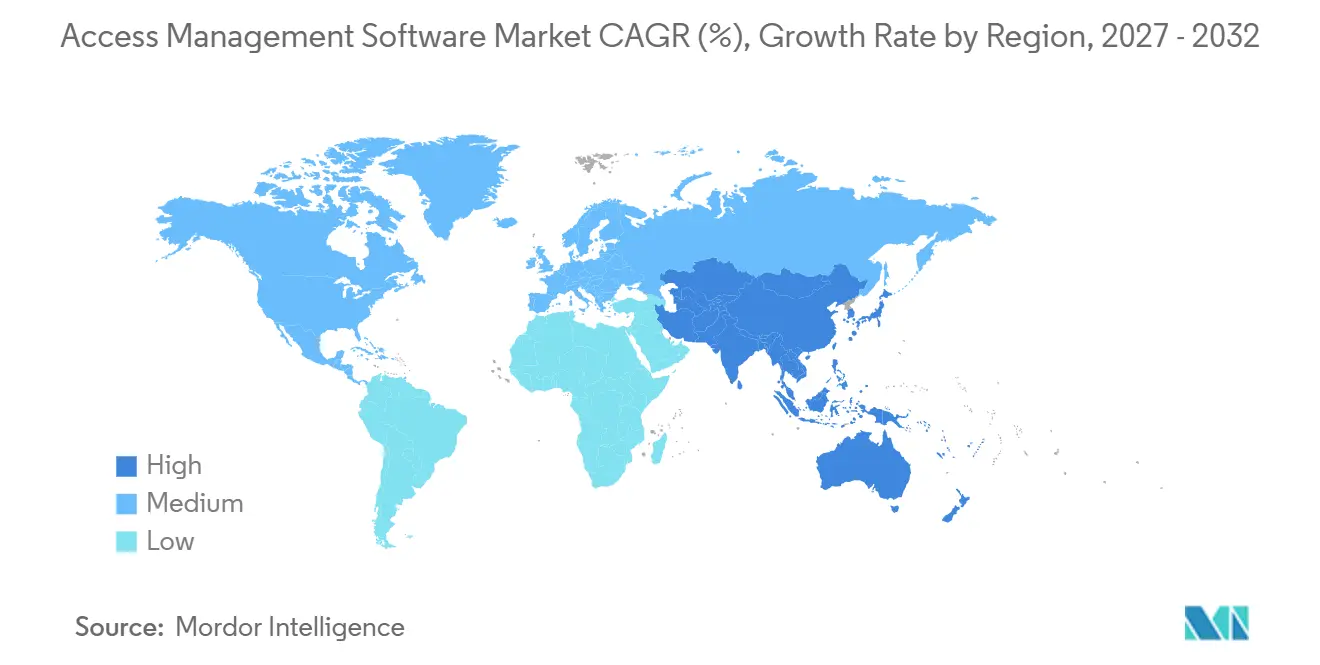
Asia-Pacific is projected to expand at a 13.77% CAGR through 2032. Digital transformation, mobile use, and rising identity fraud create varied requirements across the region, as countries differ in their regulatory approaches, deployment preferences, and adoption of cloud-based business services. India, China, and Southeast Asian countries are important markets because of their digital service growth. Japan also has demand for identity governance, privileged access management, and identity-as-a-service solutions, reflecting requirements across large organizations that manage sophisticated business and technology estates. South America, the Middle East, and Africa are smaller but developing opportunities. Brazil's financial sector and digital-government programs in Saudi Arabia and the United Arab Emirates support regional adoption, while South Africa and Nigeria are early African opportunities.
Competitive Landscape
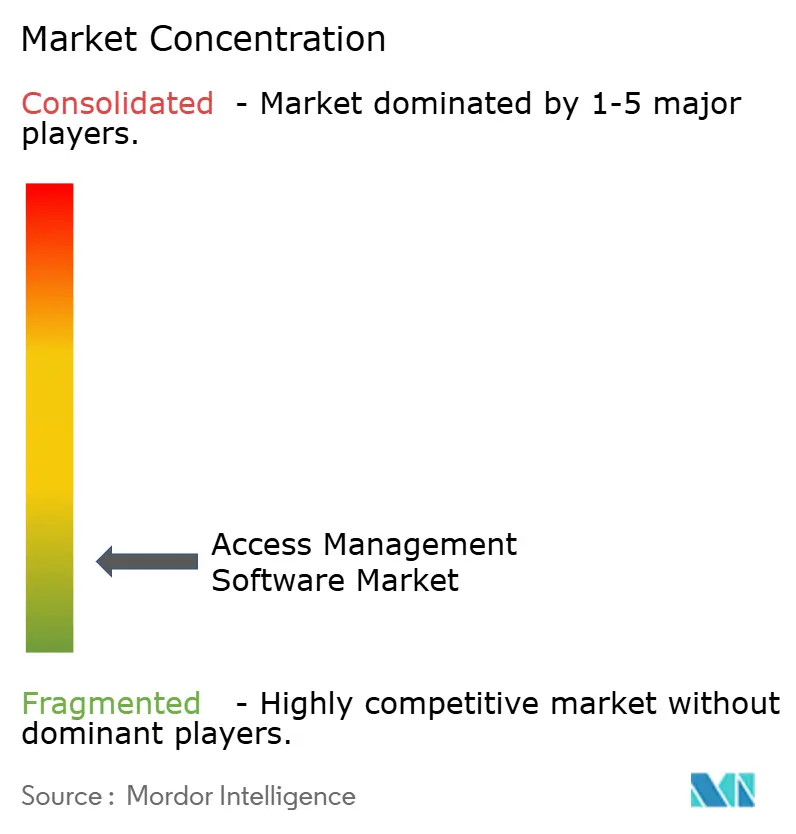
The access management software market is moderately concentrated among enterprise platforms and fragmented across mid-market and specialist suppliers. The access management software market is shaped by platform vendors and specialized providers that serve different buyer needs. Microsoft, Okta, and Palo Alto Networks, following its acquisition of CyberArk, compete through broader security platforms. Each seeks to combine identity management with governance, privileged access, and threat detection, offering customers a broader set of controls through fewer primary security platforms. Microsoft can bundle Entra ID capabilities with its existing enterprise software estate, which can influence buyer decisions where organizations already use its productivity, cloud, and endpoint-management services. Okta continues to promote an open ecosystem and a large integration catalog. These choices create pressure on standalone suppliers that compete mainly on a single identity function.
Palo Alto Networks completed the CyberArk acquisition for USD 25 billion in February 2026. The combined offer spans privileged access, identity security, and AI-era threat detection. Okta announced governance, privileged-access, and threat-detection updates in September 2026 following its acquisition of Permiso Security. It also introduced an AI-assisted integration capability intended to shorten connector delivery. SailPoint introduced its Agentic Fabric platform and Autonomous Identity Security Posture Management capabilities in October 2026.
These moves show a competition pattern centered on platform breadth and governance for AI agents, rather than only the established categories of user authentication and directory administration. White space remains in non-human identity lifecycle management and controls for regulated industries. NIS2 and the proposed HIPAA updates can prompt organizations to replace legacy directory-centered access approaches. Cloud-native managed IAM providers can address these organizations if they reduce deployment time and produce compliance evidence. Specialized vendors also have room where buyers need controls for AI agents or machine credentials, especially if they require focused capabilities that are not yet fully available in a broader platform offering. The available information does not provide a combined share for leading companies, so a market concentration score cannot be assigned under the required share-based method without creating unsupported data. The qualitative description of moderate concentration at the enterprise tier cannot substitute for the combined-share thresholds required to distinguish scores on the requested 1-10 scale.
Access Management Software Industry Leaders
-
Microsoft Corporation
-
Okta, Inc.
-
The International Business Machines Corporation
-
CyberArk Software Ltd.
-
Amazon Web Services, Inc.
- *Disclaimer: Major Players sorted in no particular order
Recent Industry Developments
- October 2026: SailPoint unveiled its Agentic Fabric platform and autonomous AI security agents at Navigate 2026, introducing A-ISPM, real-time behavioral risk detection for AI agents, and one-click agent lifecycle kill switches, addressing an AI governance gap where 79% of enterprises run agents in production but only 2% have purpose-built security controls. The company simultaneously launched IdentityIQ 9.0 and announced preparation for EU Sovereign Cloud, FedRAMP High, and PCI DSS 4.0 certifications, signaling expansion into regulated government and European markets.
- September 2026: Okta announced a series of product innovations at Oktane 2026, including AI-powered Intelligent Request Recommendations, Automated Drift Detection and Remediation within Okta Identity Governance, Unified Database Security and Dynamic Kubernetes Protection within Okta Privileged Access, and expanded identity threat detection and response capabilities following its acquisition of Permiso Security. Okta also introduced 48-Hour Integrations, using AI to deliver new governance and privileged access connectors in under 48 hours, down from a manual process requiring 2 to 3 months.
- September 2026: Okta, together with Amazon Web Services, CrowdStrike, Databricks, Google Cloud, Salesforce, ServiceNow, Wiz, and Zscaler, announced the formation of the Blueprint Alliance, a cross-industry coalition advancing an open, multi-vendor reference architecture for securing agentic AI stacks, built on interoperability standards including MCP, OCSF, SSF, and CAEP.
- July 2026: Microsoft began rolling out passkeys as the default authentication experience in Microsoft Entra ID, with SMS and voice multifactor authentication scheduled for retirement on February 1, 2027. The transition affects all Entra ID tenants globally and represents the largest enterprise-scale shift to phishing-resistant authentication in the platform's history.
Global Access Management Software Market Report Scope
The Access Management Software Market comprises software solutions that control, authenticate, and govern user access to digital resources, applications, and data across an organization’s IT environment.
The Access Management Software Market Report is Segmented by Offering (Solutions, and Services), Technology (Access Management, Identity Governance and Administration, Privileged Access Management, and Fraud and Risk Analytics), Identity Type (Human Identity, and Non-Human Identity), Deployment Model (Cloud, On-Premises, and Hybrid), Organization Size (Large Enterprises, and Small and Medium Enterprises), End-Use Industry (BFSI, Healthcare and Life Sciences, Government, IT and Telecommunications, Retail and E-commerce, Manufacturing, and Energy and Utilities), and Geography (North America, South America, Europe, Asia-Pacific, and Middle East, and Africa). The Market Forecasts are Provided in Terms of Value (USD).
| Solutions | Access Management Software |
| Identity Governance and Administration Software | |
| Privileged Access Management Software | |
| Passwordless and Biometric Authentication Software | |
| Services | Integration and Deployment Services |
| Support and Maintenance Services | |
| Consulting Services | |
| Managed IAM Services |
| Access Management | Authentication and Access Control |
| Credential and Directory Services | |
| Authorization | |
| Session Management and Identity Federation | |
| Identity Governance and Administration | |
| Privileged Access Management | |
| Fraud and Risk Analytics | |
| Other Access Management Technologies |
| Human Identity | |
| Non-Human Identity | Service Accounts |
| Device Identities | |
| Cloud Workloads | |
| APIs and Bots | |
| AI Agents |
| Cloud |
| On-Premises |
| Hybrid |
| Large Enterprises |
| Small and Medium Enterprises |
| Banking, Financial Services, and Insurance |
| Healthcare and Life Sciences |
| Government and Public Administration |
| IT and Telecommunications |
| Retail and E-commerce |
| Manufacturing |
| Energy and Utilities |
| Education and Research Institutions |
| Transportation and Logistics |
| Travel, Tourism, and Hospitality |
| Other End-Use Industries |
| North America | United States |
| Canada | |
| Mexico | |
| South America | Brazil |
| Argentina | |
| Rest of South America | |
| Europe | Germany |
| United Kingdom | |
| France | |
| Italy | |
| Spain | |
| Russia | |
| Rest of Europe | |
| Asia-Pacific | China |
| India | |
| Japan | |
| South Korea | |
| Australia | |
| Rest of Asia-Pacific | |
| Middle East | Saudi Arabia |
| United Arab Emirates | |
| Turkey | |
| Rest of the Middle East | |
| Africa | South Africa |
| Nigeria | |
| Rest of Africa |
| By Offering | Solutions | Access Management Software |
| Identity Governance and Administration Software | ||
| Privileged Access Management Software | ||
| Passwordless and Biometric Authentication Software | ||
| Services | Integration and Deployment Services | |
| Support and Maintenance Services | ||
| Consulting Services | ||
| Managed IAM Services | ||
| By Technology | Access Management | Authentication and Access Control |
| Credential and Directory Services | ||
| Authorization | ||
| Session Management and Identity Federation | ||
| Identity Governance and Administration | ||
| Privileged Access Management | ||
| Fraud and Risk Analytics | ||
| Other Access Management Technologies | ||
| By Identity Type | Human Identity | |
| Non-Human Identity | Service Accounts | |
| Device Identities | ||
| Cloud Workloads | ||
| APIs and Bots | ||
| AI Agents | ||
| By Deployment Model | Cloud | |
| On-Premises | ||
| Hybrid | ||
| By Organization Size | Large Enterprises | |
| Small and Medium Enterprises | ||
| By End-Use Industry | Banking, Financial Services, and Insurance | |
| Healthcare and Life Sciences | ||
| Government and Public Administration | ||
| IT and Telecommunications | ||
| Retail and E-commerce | ||
| Manufacturing | ||
| Energy and Utilities | ||
| Education and Research Institutions | ||
| Transportation and Logistics | ||
| Travel, Tourism, and Hospitality | ||
| Other End-Use Industries | ||
| By Geography | North America | United States |
| Canada | ||
| Mexico | ||
| South America | Brazil | |
| Argentina | ||
| Rest of South America | ||
| Europe | Germany | |
| United Kingdom | ||
| France | ||
| Italy | ||
| Spain | ||
| Russia | ||
| Rest of Europe | ||
| Asia-Pacific | China | |
| India | ||
| Japan | ||
| South Korea | ||
| Australia | ||
| Rest of Asia-Pacific | ||
| Middle East | Saudi Arabia | |
| United Arab Emirates | ||
| Turkey | ||
| Rest of the Middle East | ||
| Africa | South Africa | |
| Nigeria | ||
| Rest of Africa | ||
Key Questions Answered in the Report
What is the access management software market size?
The access management software market is projected to be USD 43.77 billion in 2027 and reach USD 74.31 billion by 2032, at a 13.06% CAGR. Its expansion reflects the need to secure access across applications, cloud workloads, distributed users, and emerging AI agents.
What is driving demand for access management software?
Identity fraud, Zero Trust adoption, software-as-a-service sprawl, and the management of AI agents and other machine identities are key demand factors. Regulatory requirements also raise the importance of access reviews, privileged-account policies, and multifactor authentication.
Which access management software deployment model leads?
Cloud led with 56.68% share in 2026 and is projected to expand at a 13.93% CAGR through 2032. Consumption-based licensing, connector availability, and integration with cloud identity services support its adoption.
Which end-use sector has the largest share?
BFSI led with 21.68% share in 2026, supported by authentication requirements, fraud exposure, and customer identity needs. Healthcare and Life Sciences is the fastest-growing end-use sector at a 14.11% CAGR through 2032.
Why are non-human identities important for enterprise security?
Service accounts, APIs, cloud workloads, bots, and AI agents require lifecycle controls that many earlier identity programs did not address. Non-Human Identity is the fastest-growing identity type, with a projected 14.14% CAGR through 2032.
Which region is expanding fastest?
Asia-Pacific is projected to expand at a 13.77% CAGR through 2032, supported by digital transformation and rising identity-security requirements. India, China, Japan, and Southeast Asian markets contribute to this demand through growing digital service activity.