
Cloud and SaaS Privilege Management Market Size and Share
Market Overview
| Study Period | 2027 - 2032 |
|---|---|
| Market Size (2027) | USD 3.38 Billion |
| Market Size (2032) | USD 8.71 Billion |
| Growth Rate (2027 - 2032) | 20.84 % |
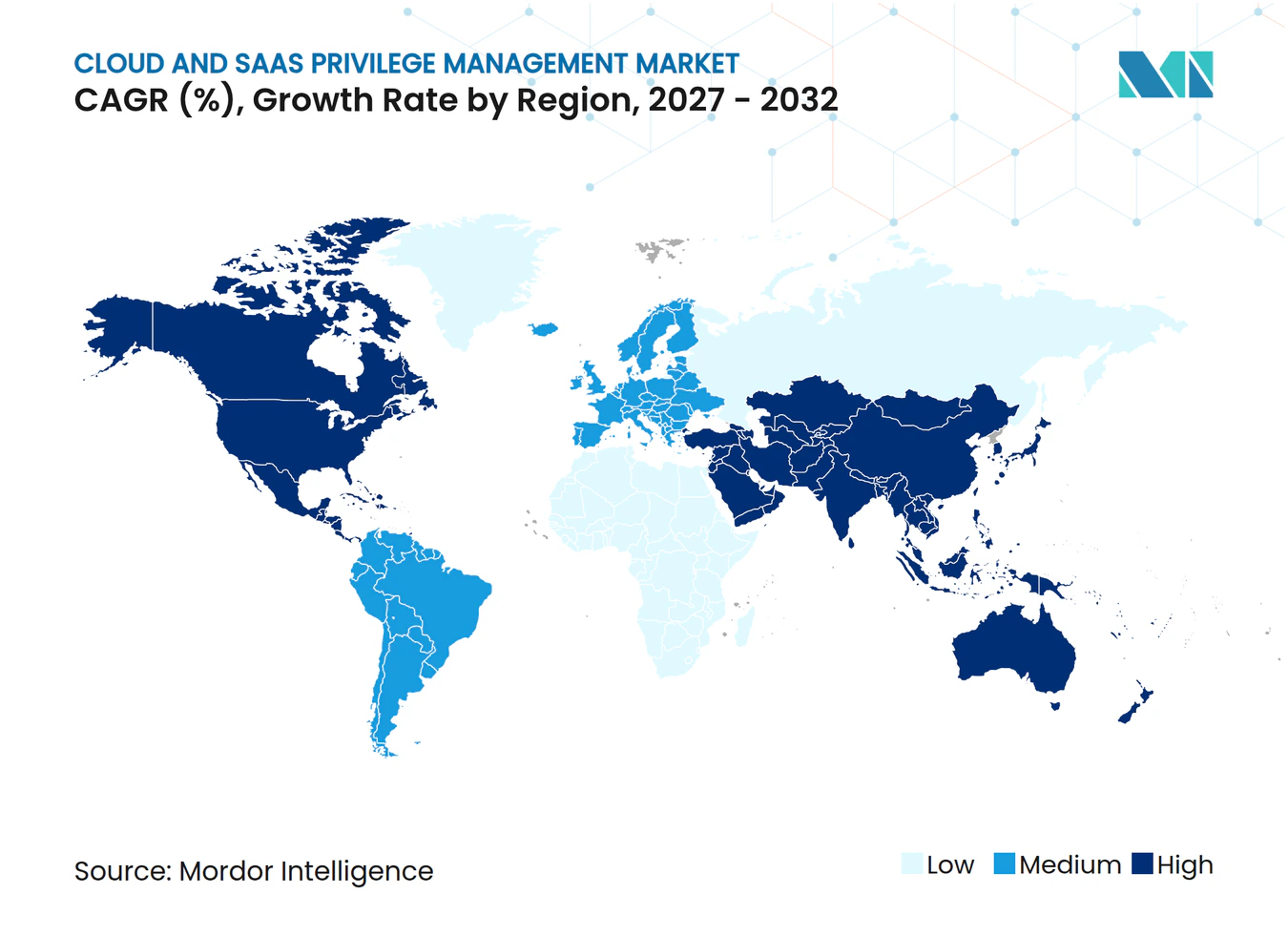
| Fastest Growing Market | Asia-Pacific |
| Largest Market | North America |
| Market Concentration | Medium |
Major Players *Disclaimer: Major Players sorted in no particular order Image © Mordor Intelligence. Reuse requires attribution under CC BY 4.0. | |
Cloud and SaaS Privilege Management Market Analysis by Mordor Intelligence
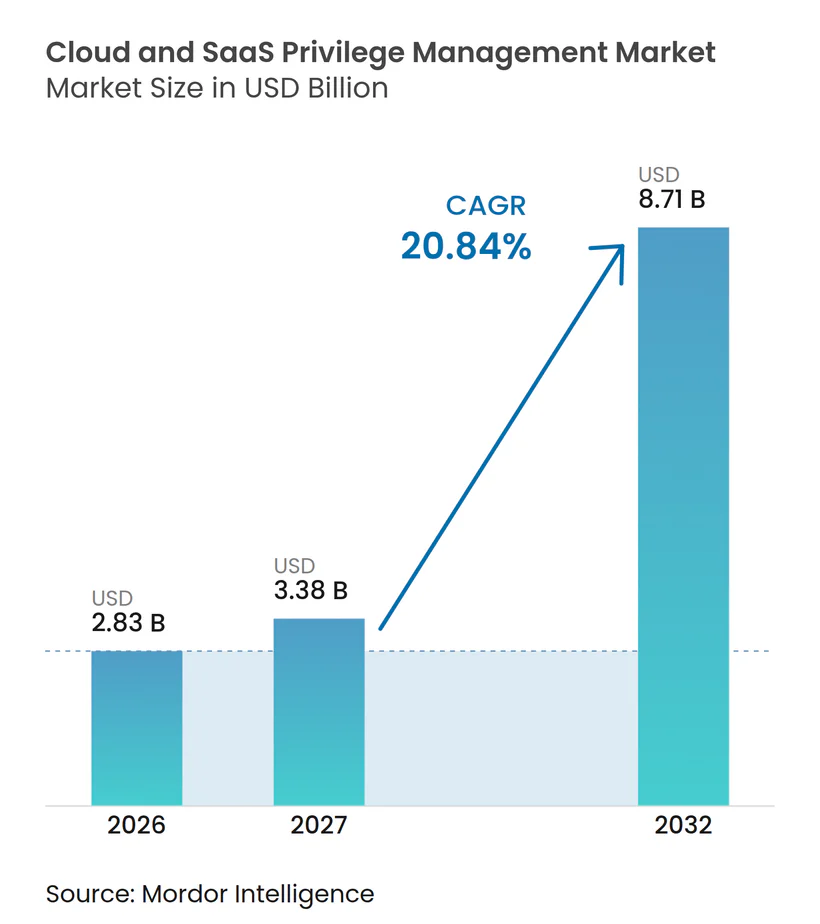
The cloud and SaaS privilege management market size is projected to expand from USD 2.83 billion in 2026 and USD 3.38 billion in 2027 to USD 8.71 billion by 2032, registering a CAGR of 20.84% between 2027 to 2032. Organizations are moving critical workloads into multi-cloud and SaaS environments, which increases the number of human and non-human privileged identities that must be governed. This shift exposes the limits of legacy on-premises vaulting tools and raises demand for unified controls across cloud environments. Federal zero-trust direction in the United States and European operational resilience requirements have made continuous privilege governance a more visible compliance priority. Vendors are responding by combining vaulting, session controls, identity threat detection, cloud entitlement governance, and AI-agent identity controls in broader platforms. The cloud and SaaS privilege management market therefore presents opportunities for providers that can reduce fragmented administration without adding friction to access workflows.
Key Report Takeaways
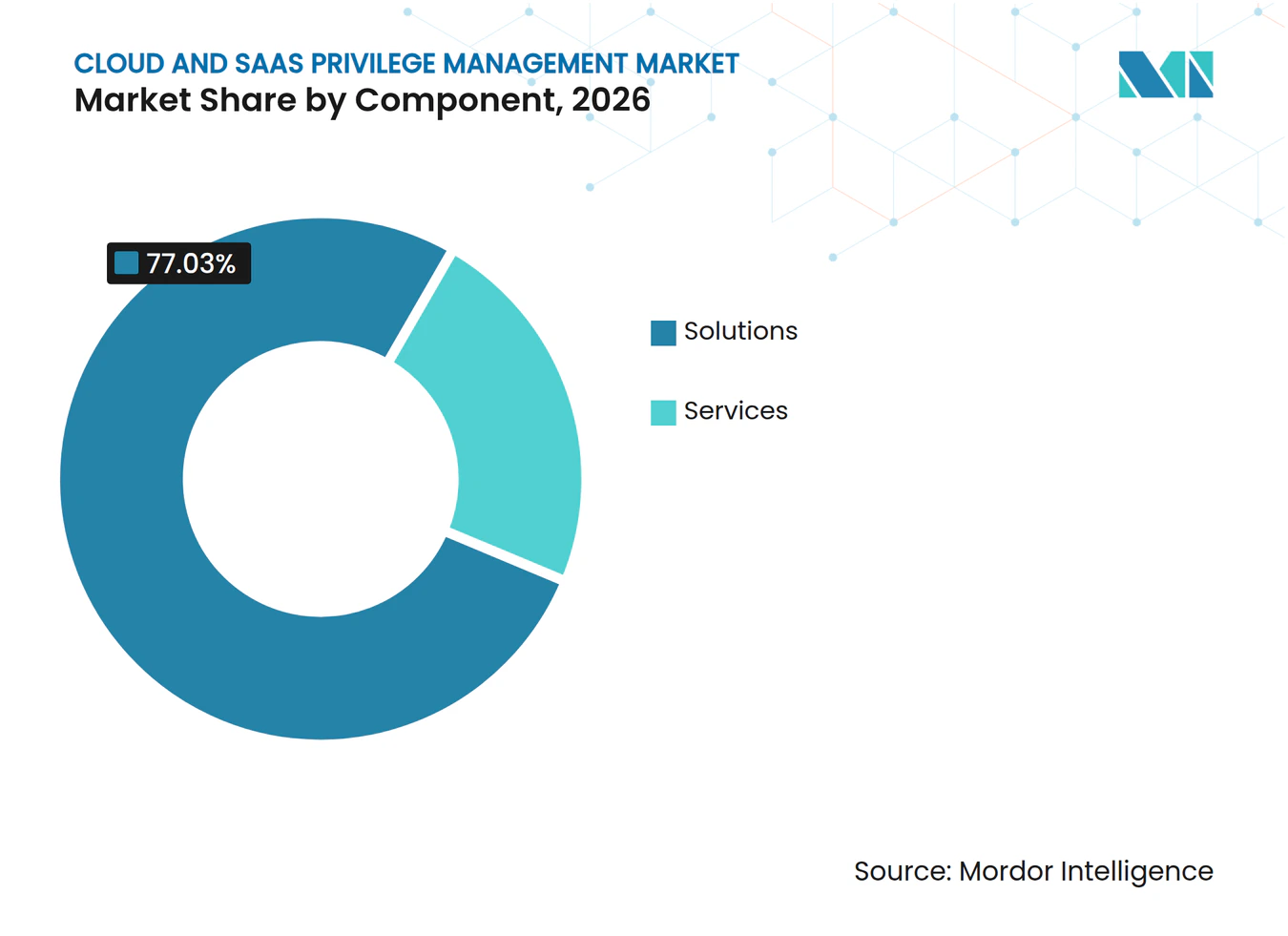
- By component, solutions held 77.03% of the cloud and SaaS privilege management market share in 2026 and are projected to expand at a 21.09% CAGR through 2032.
- By solution type, Privileged Credential and Secrets Management held 27.03% of the market in 2026, while Identity Threat Detection and Response is projected to expand at a 21.92% CAGR through 2032.
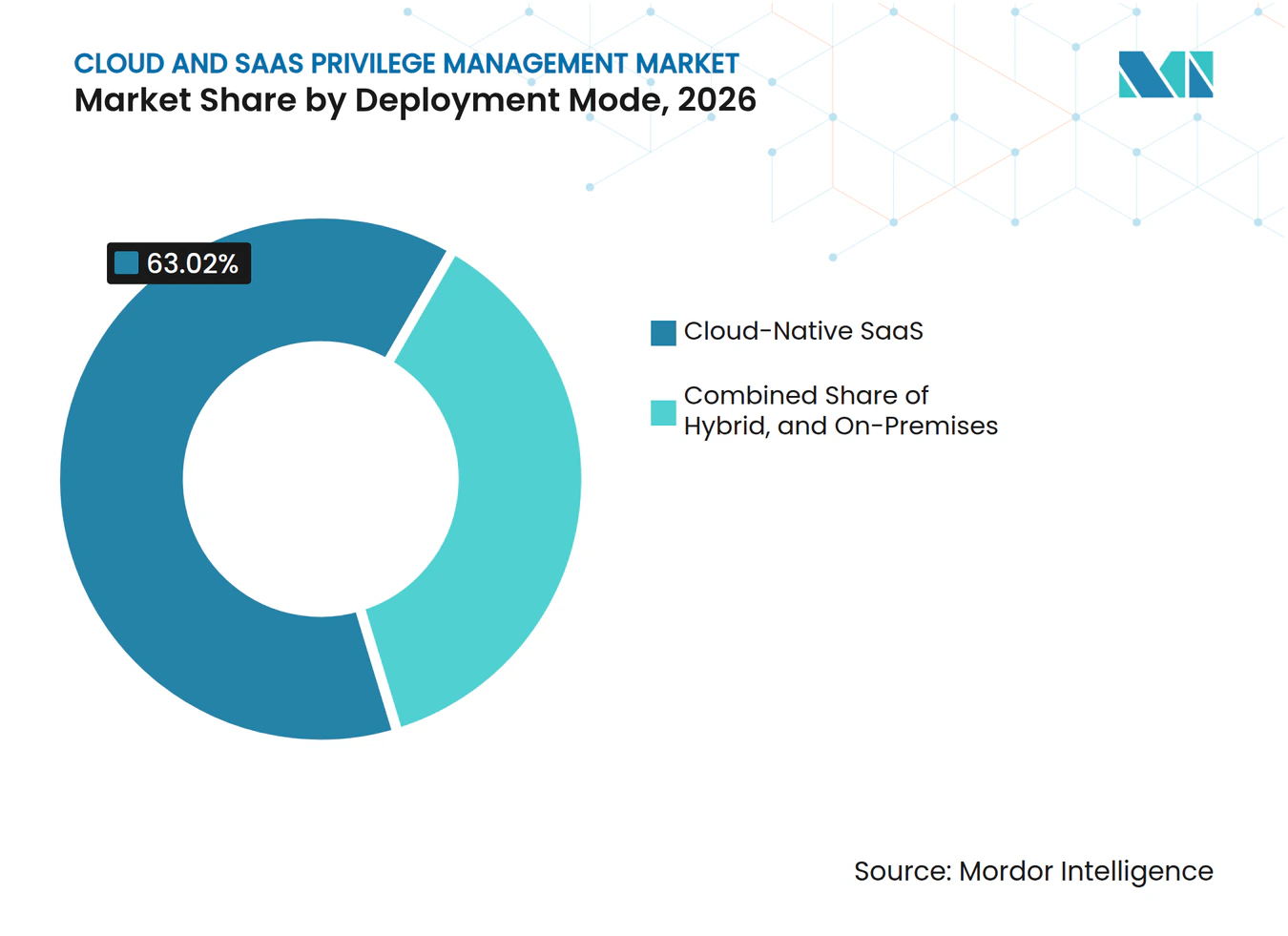
- By deployment mode, Cloud-Native SaaS held 63.02% of the market in 2026 and is expected to expand at a 21.62% CAGR through 2032.
- By organization size, large enterprises held 76.01% of the market in 2026, while SMEs are projected to expand at a 21.46% CAGR through 2032.
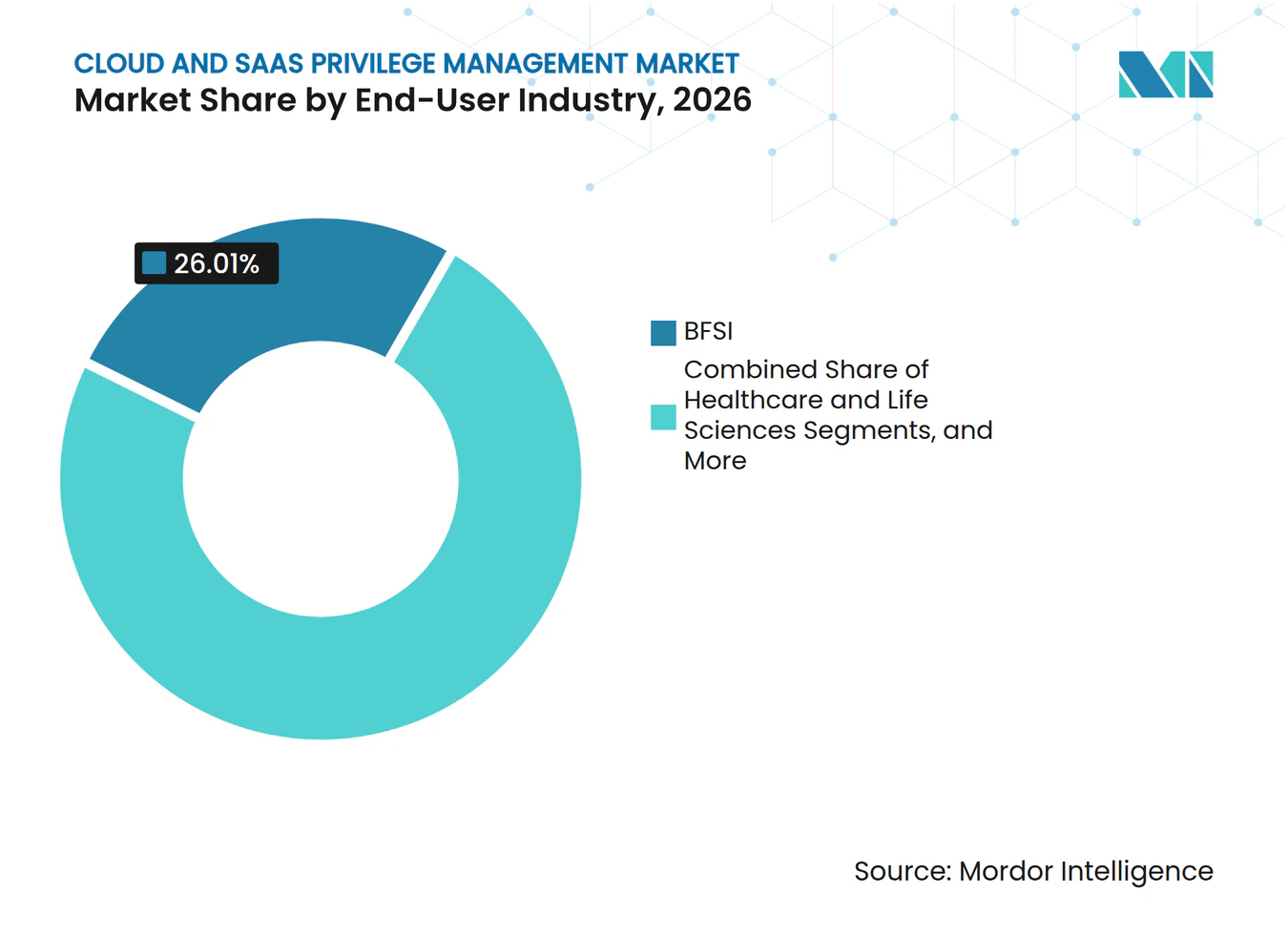
- By end-user industry, BFSI held 26.01% of the market in 2026, while Healthcare and Life Sciences is projected to expand at a 22.07% CAGR through 2032.
- By geography, North America held 46.03% of the market in 2026, while Asia-Pacific is expected to expand at a 21.72% CAGR through 2032.
Note: Market numbers in this report are based on Mordor Intelligence's proprietary estimation framework, which combines nine months of actuals with Q4 projections for base year 2026.
Market Trends and Insights
Drivers Impact Analysis of Cloud and SaaS Privilege Management Market*
| Driver | (~) % Impact on CAGR Forecast | Geographic Relevance | Impact Timeline |
|---|---|---|---|
| Identity-Based Attacks and Credential Compromise | +5.8% | Global | Short term (≤ 2 years) |
| Expansion of Multi-Cloud and SaaS Administrative Surfaces | +4.5% | Global, Asia-Pacific and North America core | Medium term (2-4 years) |
| Zero-Trust and Just-in-Time Access Mandates | +3.2% | North America and EU, spill-over to Asia-Pacific | Short term (≤ 2 years) |
| Machine, Workload and AI-Agent Identity Sprawl | +3.1% | Global | Medium term (2-4 years) |
| Regulatory Pressure for Continuous Privilege Governance | +2.6% | EU, North America, Asia-Pacific core | Medium term (2-4 years) |
| Policy-as-Code Control for Cloud-Native Delivery Pipelines | +1.8% | North America and EU, spill-over to Asia-Pacific | Long term (≥ 4 years) |
| Source: Mordor Intelligence | |||
Identity-Based Attacks and Credential Compromise
Identity compromise is becoming a more significant security issue as attackers use techniques that go beyond direct credential theft. Verizon reported that third-party-involved breaches represented 48% of confirmed breaches in 2025, after increasing 60% during the year.[1] IBM reported that phishing emails delivering infostealers increased 180% compared with 2023. RSA found that 69% of surveyed organizations experienced an identity-related breach during the previous 3 years, and 24% reported breach costs above USD 10 million.[2] Attackers are also using session-token hijacking, MFA fatigue, and browser-based compromise, which can bypass a vault-only approach. The cloud and SaaS privilege management market benefits when platforms provide behavioral analytics, just-in-time sessions, and immediate access revocation after suspicious activity.
Expansion of Multi-Cloud and SaaS Administrative Surfaces
Multi-cloud adoption has created permission models that native identity tools do not govern across every environment. Enterprises must manage roles, OAuth grants, APIs, and privileged accounts across cloud providers and SaaS applications. Each additional application can introduce its own access logic and standing third-party permissions. These permissions can remain active after the original business need has ended if reviews are inconsistent. The cloud and SaaS privilege management market gains from the demand for a single policy engine that spans cloud entitlements and traditional privileged access. This need is encouraging vendors to place cloud infrastructure entitlement management within their broader privilege platforms rather than sell it as a separate point product.
Zero-Trust and Just-in-Time Access Mandates
Executive Order 14144 directed United States federal civilian agencies to adopt phishing-resistant authentication and advance identity and access management capabilities.[3] The order also required technical controls for least-privilege and role-based access to endpoint telemetry. NIST published 19 practical zero-trust architecture implementation examples with 24 industry collaborators in June 2025. DORA has applied across EU member states since January 17, 2025, increasing attention on service-account inventories, multifactor authentication, and privileged access reviews. The cloud and SaaS privilege management market is supported as just-in-time access shifts from an architectural objective to a procurement requirement for public and commercial buyers.
Machine, Workload, and AI-Agent Identity Sprawl
Non-human identities include service accounts, API keys, OAuth tokens, workload certificates, and AI-agent credentials. The Cloud Security Alliance reported that these identities outnumber human users by an average of 45 to 1 in enterprises and 144 to 1 in cloud-native environments. SANS found that 76% of organizations report active non-human identity growth, while 92% do not rotate most non-human credentials on a 90-day cycle. AI agents can obtain permissions at runtime, create sub-agents, and call external APIs, which expands the effect of a compromised credential. The cloud and SaaS privilege management market is responding with platforms that discover, govern, and revoke machine credentials at a pace suited to automated environments. The area remains important because no single control is widely used for all non-human identities.
Restraints Impact Analysis of Cloud and SaaS Privilege Management Market*
| Restraint | (~) % Impact on CAGR Forecast | Geographic Relevance | Impact Timeline |
|---|---|---|---|
| Brownfield Integration with Legacy Directories and Applications | -3.5% | Global, most acute in Europe and North America | Medium term (2-4 years) |
| Shortage of Cloud Privilege Governance Skills | -2.8% | Global | Short term (≤ 2 years) |
| Data Residency and Sovereign-Cloud Constraints | -1.9% | EU, Middle East, Asia-Pacific, China and India | Long term (≥ 4 years) |
| Workflow Friction from Least-Privilege Enforcement | -1.2% | Global | Short term (≤ 2 years) |
| Source: Mordor Intelligence | |||
Brownfield Integration with Legacy Directories and Applications
Many enterprise estates still use on-premises Active Directory domains, mainframe credential stores, and LDAP directories that were not designed for modern SaaS policy engines. Connecting these systems to cloud-native privilege management often requires middleware, schema changes, and application-level work. The effort can extend deployment schedules from weeks to quarters. Financial institutions and industrial manufacturers with air-gapped operational technology networks face an added difficulty because their credential stores may not offer REST-based integration points. Custom connectors can be required for each brownfield asset, which adds cost and delivery risk. This restrains the cloud and SaaS privilege management market because the organizations with the largest privilege estates may have the slowest implementation path.
Shortage of Cloud Privilege Governance Skills
Cloud privilege governance requires identity engineering, cloud architecture, DevSecOps automation, and policy-as-code capabilities. Few practitioners combine all of these skills. SANS found that 38% of organizations identify budget constraints as their leading barrier to identity threat detection and response deployment. Programs can remain in proof-of-concept stages when teams cannot configure just-in-time policies, tune behavioral baselines, or connect detection telemetry to existing security operations. Asia-Pacific and the Middle East are particularly exposed because specialized expertise has historically been concentrated in North America and Europe. This shortage is contributing to greater interest in managed services and services-attached deals, which can limit near-term platform margin expansion.
*Our forecasts treat driver/restraint impacts as directional, not additive. The impact forecasts reflect baseline growth, mix effects, and variable interactions.
Cloud and SaaS Privilege Management Market Segment Analysis
By Component:
Solutions Lead Platform ConsolidationSolutions held 77.03% of the cloud and SaaS privilege management market in 2026 and are projected to expand at a 21.09% CAGR through 2032. The combined leadership indicates that enterprise buyers are directing the majority of spend toward platform software instead of adding separate point tools for each privilege task. Procurement teams want a single control plane that covers credential vaulting, privileged session management, identity threat detection, and cloud entitlement governance across their growing mix of cloud and on-premises systems. Multiple products can create operational risk when policies, identity records, and audit evidence do not align, particularly after a security incident requires teams to reconstruct access activity. The cloud and SaaS privilege management market benefits when providers can connect legacy controls and cloud controls through common policies, because customers increasingly prioritize administrative consistency over a larger collection of disconnected tools.
Services represented the remaining 22.97% of the market in 2026, and their role remains important even though their percentage expansion is slower than that of solutions. Brownfield migrations often require directory integration, schema mapping, and custom connectors, while AI-agent onboarding can require policy design before automated controls can be applied. Multi-cloud entitlement certification audits add a further source of professional-services demand where customers must document permissions and prove that access reviews have been performed. Managed detection engagements are becoming more relevant for customers that lack specialist staff to operate identity threat detection or tune just-in-time access policies. Incumbent vendors and systems integrators are competing for this work because it supports platform deployment, sustained customer relationships, and a pipeline that extends beyond an initial software license.



By Solution Type:
Secrets Management Leads While ITDR Gains PriorityPrivileged Credential and Secrets Management held 27.03% of the cloud and SaaS privilege management market size in 2026. Credential vaulting is a common first deployment because enterprises need to identify, store, rotate, and control the release of credentials before they can govern how those credentials are used across people, applications, and machines. Privileged Session Management and Cloud Entitlement Governance are established adjacent categories, since session recording supports audit obligations and entitlement governance supports recurring reviews of elevated permissions. The leading position of secrets management reflects its practical role in a broader privilege program and its relevance to organizations that are only beginning to replace unmanaged administrator credentials. Foundational credential controls therefore remain important even as the cloud and SaaS privilege management market shifts toward continuous detection, automated reviews, and more dynamic access enforcement.
Identity Threat Detection and Response is projected to expand at a 21.92% CAGR through 2032, the highest rate among solution types. SANS found that 85% of organizations deploy identity threat detection and response tools, while 55% still experienced identity-related unauthorized access during the preceding 12 months. The result shows that deployment alone does not assure effective coverage, leading buyers to seek detection that operates with session controls and access enforcement rather than as a separate alerting layer. Just-in-Time Access and Zero-Standing Privilege is also gaining attention as persistent administrative accounts are replaced with scope-limited credentials that expire automatically, while Endpoint Privilege Management and Cloud Entitlement Governance address cloud-connected devices and excessive permissions at scale. These capabilities reflect a move away from preventive vaulting alone toward continuous detection, access review, and response across diverse administrative environments.
By Deployment Mode:
SaaS Delivery Reshapes Control ArchitectureCloud-Native SaaS held 63.02% of the cloud and SaaS privilege management market share in 2026 and is expected to expand at a 21.62% CAGR through 2032. This deployment model lowers hardware procurement needs and allows providers to update policy engines and threat detection models without a customer-managed upgrade cycle. SaaS platforms can also use pre-built integrations for AWS IAM, Azure Entra ID, and Google Cloud IAM, which reduces the work required to apply consistent access controls across public cloud environments. Administrators can implement new controls more quickly when these connections are available, an important advantage for organizations whose adoption of SaaS applications has moved faster than the expansion of their identity teams. The cloud and SaaS privilege management market favors this architecture as buyers seek a common interface for distributed workloads and consistent policy operation across changing cloud estates.
Hybrid deployment is the second-largest approach and helps enterprises govern both cloud workloads and on-premises resources while they complete phased migration programs. SaaS policy orchestration can operate through connectors in mixed estates, allowing customers to maintain existing directories or applications where immediate retirement would be impractical. On-Premises Control Plane with Cloud Integrations remains relevant for government organizations and critical infrastructure operators that require sovereign data residency or processing in classified environments. These buyers may use cloud connections while retaining selected control functions close to internal systems, which preserves a place for hybrid and on-premises models during the transition period. The longer-term direction still favors SaaS delivery because vendors are moving identity threat detection and behavioral analytics toward cloud-resident AI inference pipelines, which may also influence historically conservative buyers.

By Organization Size:
Large Enterprises Anchor Demand While SMEs AccelerateLarge enterprises held 76.01% of the cloud and SaaS privilege management market size in 2026. Their position reflects the close link between technology-estate complexity and the urgency of privilege management, since a global manufacturer or multinational bank can operate 3 cloud providers, more than 30 SaaS applications, and hundreds of thousands of identities. These environments require systematic platform-based controls rather than manual access processes, especially where payment systems, customer data, operational systems, and third-party connections all carry their own audit expectations. Large organizations can also support the integrated platforms and implementation services needed to connect complex directories, cloud entitlements, and session policies across their estates. The cloud and SaaS privilege management market remains strongly anchored in large accounts, which provide a testing ground for capabilities that vendors may later adapt for smaller organizations.
SMEs are projected to expand at a 21.46% CAGR through 2032, making them the fastest-growing organization-size segment. SaaS-delivered platforms, consumption-based pricing, and agentless deployment reduce the former requirement for dedicated identity engineering teams and can make adoption more attainable for organizations with lean technology functions. Compliance needs create demand beyond a firm's existing security maturity because fintech, healthcare technology, and legal services businesses can face the same DORA, HIPAA, and PCI-DSS obligations as larger organizations in their verticals. The pattern is visible in Asia-Pacific, where challenger financial institutions and SaaS-native manufacturers are adopting cloud privilege management at earlier stages of organizational development than comparable firms did in earlier cycles. Vendors that simplify policy management while preserving control quality can address this group without depending on extensive internal identity expertise.
By End-User Industry:
BFSI Leads While Healthcare and Life Sciences AccelerateBFSI held 26.01% of the cloud and SaaS privilege management market in 2026. Real-time payment infrastructure and trading systems create a high need for controlled administrative access, while financial institutions must document who can reach sensitive systems and when access is used. DORA also increases attention on service-account inventories and periodic privileged access reviews in relevant European operations, which supports continued platform demand among banks, insurers, and other financial services providers. The sector has long used privileged access controls, but multi-cloud adoption increases the number of environments requiring consistent oversight and audit-ready records. The cloud and SaaS privilege management market serves these requirements with tools that can enforce least-privilege policies and document activity across financial workloads where administrative consistency is critical.
Healthcare and Life Sciences is projected to expand at a 22.07% CAGR through 2032, the fastest rate among end-user industries. Ransomware exposure, expanding electronic health record connectivity, and audit expectations are increasing the need for privilege governance, while connected medical devices add further access pathways that health systems must monitor. HIPAA-related requirements reinforce the value of least-privilege and session monitoring controls in healthcare environments that have a large number of users, applications, and connected systems. Information Technology and Telecommunications remains important because it builds and operates the cloud infrastructure used across the economy, while Industrial Manufacturing, Energy and Utilities are becoming more material as operational technology and information technology connect to cloud monitoring platforms. Government and Defense are advancing procurement to meet zero-trust timelines, and Retail, E-Commerce, Media and Entertainment are prioritizing API credential governance across payment and logistics integrations.
Geography Analysis
North America Cloud and SaaS Privilege Management Market
North America held 46.03% of the cloud and SaaS privilege management market in 2026. The region combines the highest concentration of SaaS vendors, cloud-native enterprises, and federal buyers operating under zero-trust requirements, which supports a deep customer and partner ecosystem. CyberArk, BeyondTrust, Delinea, and Keeper Security have significant North American operations or revenue exposure, creating substantial competition on product scope, pricing, and platform integration. Canada and Mexico are contributing as enterprises connect to cross-border cloud supply chains and use platform standards developed in the United States. The July 2025 acquisition agreement between Palo Alto Networks and CyberArk raised the strategic importance of identity security across the region and reshaped platform roadmaps and partner relationships.
APAC Cloud and SaaS Privilege Management Market
Asia-Pacific is projected to expand at a 21.72% CAGR through 2032, the fastest regional rate in the cloud and SaaS privilege management market. China, India, Japan, and South Korea are the main growth markets, supported by rising cloud infrastructure investment and evolving cybersecurity frameworks. India's SaaS expansion and changing national cybersecurity policy are leading IT services companies to demonstrate privilege governance to international clients. Australia and South Korea offer further deployment opportunities for integrations built around hyperscaler environments, while cloud-delivered implementations in China are becoming more relevant as enterprise cloud footprints broaden. Regional demand also reflects organizations adopting modern cloud applications without extensive legacy privilege infrastructure, although the shortage of specialist talent continues to channel some demand toward managed service providers.
EMEA and South America Cloud and SaaS Privilege Management Market
Europe is shaped by DORA and NIS2 compliance priorities, which encourage BFSI and critical-infrastructure buyers to require audit-ready entitlement reporting and defined access-review practices. DORA has applied to EU member states since January 17, 2025, and Germany published its NIS2 implementing act in December 2025. WALLIX Group has developed a European digital sovereignty position that aligns with public-sector and defense demand for EU-resident data processing. South America is developing through cloud-first fintech and agribusiness technology adopters in Brazil and Argentina, while Saudi Arabia and the UAE are advancing government-backed deployments linked to sovereign cloud initiatives. Africa remains at an earlier stage, with multinational and financial-sector requirements in South Africa, Nigeria, and Egypt providing the principal near-term demand.
Competitive Landscape
Market Concentration
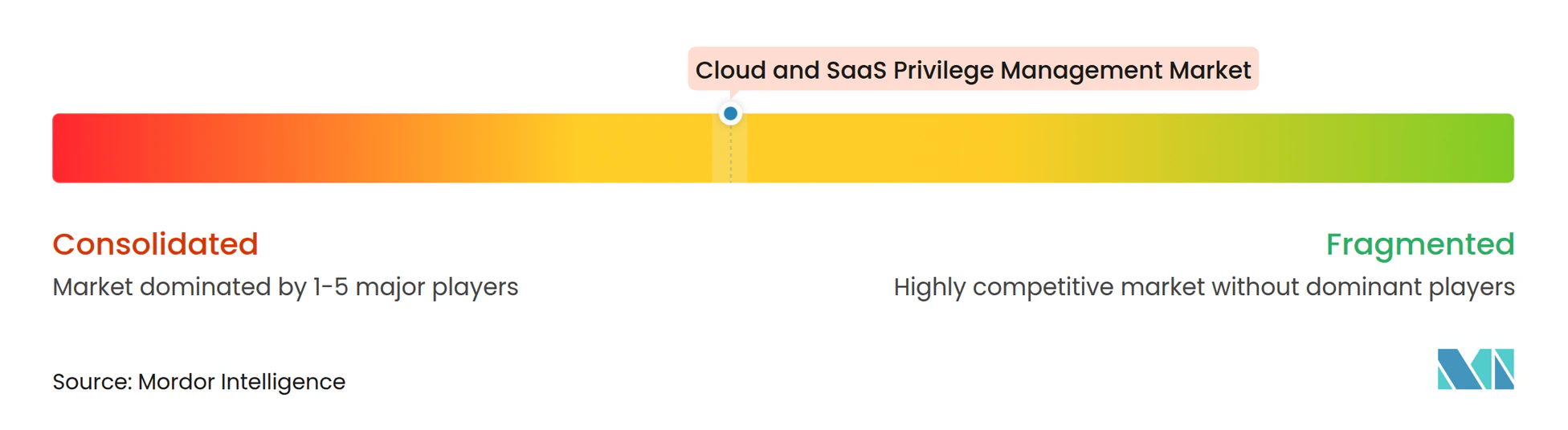
The cloud and SaaS privilege management market is moderately concentrated. CyberArk, BeyondTrust, Delinea, and Microsoft have substantial positions in enterprise accounts, while Keeper Security, Saviynt, Sonrai Security, and other cloud-native specialists are gaining traction in specific parts of the market. The competitive focus is shifting toward platforms that connect privilege governance, threat detection, cloud entitlement management, and AI-agent identity controls in a unified control environment. Palo Alto Networks announced an agreement to acquire CyberArk in July 2025 for an equity value of USD 25 billion, demonstrating that identity security has become a core platform capability rather than a standalone product category.
Vendors are extending their product scope through acquisitions, internal development, and integration partnerships. Delinea announced its combination with StrongDM in January 2026 to bring just-in-time runtime authorization for DevOps and AI-driven environments into its enterprise privileged access platform. BeyondTrust released PathfinderAI and a secure Model Context Protocol server in April 2026 to govern autonomous AI-agent actions with an audit trail. These actions target machine and AI-agent identity governance, an area where control coverage remains incomplete, while vendors also embed analytics within privilege workflows instead of relying entirely on external security information and event management tools. Developer-friendly just-in-time access is becoming more important because providers must strengthen control without slowing engineering activity.
Zscaler joined Microsoft's Entra Agent ID partner ecosystem in November 2025 to apply Zero Trust access controls to AI-agent identities through Microsoft identity services. CyberArk expanded capabilities for human, AI, and machine identities in April 2025, including just-in-time access controls and enhanced machine identity discovery, while Keeper Security added native Google Cloud Platform support to KeeperPAM in February 2026, extending governance coverage across AWS, Azure, and Google Cloud Platform. These moves show that cloud interoperability and AI-agent control are increasingly material competitive factors. The cloud and SaaS privilege management market will retain competition between broad enterprise platforms and specialized cloud-focused providers.
Cloud and SaaS Privilege Management Industry Leaders
-
BeyondTrust Corporation
-
Delinea Inc.
-
Microsoft Corporation
-
Palo Alto Networks, Inc.
-
Broadcom Inc.
- *Disclaimer: Major Players sorted in no particular order
Cloud and SaaS Privilege Management Market Companies Covered in this Report
- BeyondTrust Corporation
- Delinea Inc.
- Microsoft Corporation
- Palo Alto Networks, Inc.
- Broadcom Inc.
- IBM Corporation
- One Identity LLC
- Saviynt Inc.
- ManageEngine, a division of Zoho Corporation Pvt. Ltd.
- SailPoint Technologies, Inc.
- WALLIX Group SA
- ARCON TechSolutions Pvt. Ltd.
- Keeper Security, Inc.
- Hitachi ID Systems, Inc.
- Thales Group
- SSH Communications Security Corporation
- Akeyless Security Ltd.
- StrongDM, Inc.
- Teleport, Inc.
- Netwrix Corporation
- Imprivata, Inc.
Recent Industry Developments in Cloud and SaaS Privilege Management Market
- July 2026: SailPoint expanded PAM application discovery in Identity Security Cloud with instance-level CyberArk connector enhancements and new BeyondTrust Password Safe Cloud and Delinea Secret Server discovery connectors, improving cross-platform identity governance accuracy.
- April 2026: BeyondTrust launched PathfinderAI and a secure MCP server in Early Access, delivering production-ready identity security controls for AI-agent coworkers within the Pathfinder Platform and enabling organizations to govern autonomous AI-agent actions through a standards-based orchestration layer with full audit trail.
- February 2026: Keeper Security added native Google Cloud Platform support to KeeperPAM, extending privileged access governance to a third major cloud control plane alongside existing AWS and Azure integrations, enabling consistent policy enforcement in multi-cloud environments.
- January 2026: Delinea and StrongDM announced a definitive merger agreement to combine Delinea's enterprise PAM platform with StrongDM's JIT runtime authorization for DevOps and AI-driven environments. The combined platform, anchored by Delinea's USD 400 million annual recurring revenue, targets a zero-standing-privilege architecture spanning traditional credential management and ephemeral, event-driven access for cloud-native workloads.
Global Cloud and SaaS Privilege Management Market Report Scope
The Cloud and SaaS Privilege Management Report is Segmented by Component (Solutions, Services), Solution Type (Cloud Entitlement Governance, Privileged Credential and Secrets Management, Privileged Session Management, Just-in-Time Access and Zero-Standing Privilege, Endpoint Privilege Management for Cloud-Connected Devices, Identity Threat Detection and Response), Deployment Mode (Cloud-Native SaaS, Hybrid, On-Premises Control Plane with Cloud Integrations), Organization Size (Large Enterprises, Small and Medium-Sized Enterprises), End-User Industry (BFSI, Healthcare and Life Sciences, Information Technology and Telecommunications, Retail and E-Commerce, Industrial Manufacturing, Energy and Utilities, Government and Defense, Media and Entertainment, and Other End-user Industries), and Geography (North America, South America, Europe, Asia-Pacific, Middle East, Africa). Value (USD).
Segmentation Overview
| Solutions |
| Services |
| Cloud Entitlement Governance |
| Privileged Credential and Secrets Management |
| Privileged Session Management |
| Just-in-Time Access and Zero-Standing Privilege |
| Endpoint Privilege Management for Cloud-Connected Devices |
| Identity Threat Detection and Response |
| Cloud-Native SaaS |
| Hybrid |
| On-Premises Control Plane with Cloud Integrations |
| Large Enterprises |
| Small and Medium-Sized Enterprises |
| BFSI |
| Healthcare and Life Sciences |
| Information Technology and Telecommunications |
| Retail and E-Commerce |
| Industrial Manufacturing |
| Energy and Utilities |
| Government and Defense |
| Media and Entertainment |
| Other End-user Industries |
| North America | United States |
| Canada | |
| Mexico | |
| South America | Brazil |
| Argentina | |
| Rest of South America | |
| Europe | Germany |
| United Kingdom | |
| France | |
| Italy | |
| Spain | |
| Russia | |
| Rest of Europe | |
| Asia-Pacific | China |
| India | |
| Japan | |
| South Korea | |
| Australia | |
| Rest of Asia-Pacific | |
| Middle East | Saudi Arabia |
| United Arab Emirates | |
| Turkey | |
| Rest of Middle East | |
| Africa | South Africa |
| Egypt | |
| Nigeria | |
| Rest of Africa |
| By Component | Solutions | |
| Services | ||
| By Solution Type | Cloud Entitlement Governance | |
| Privileged Credential and Secrets Management | ||
| Privileged Session Management | ||
| Just-in-Time Access and Zero-Standing Privilege | ||
| Endpoint Privilege Management for Cloud-Connected Devices | ||
| Identity Threat Detection and Response | ||
| By Deployment Mode | Cloud-Native SaaS | |
| Hybrid | ||
| On-Premises Control Plane with Cloud Integrations | ||
| By Organization Size | Large Enterprises | |
| Small and Medium-Sized Enterprises | ||
| By End-User Industry | BFSI | |
| Healthcare and Life Sciences | ||
| Information Technology and Telecommunications | ||
| Retail and E-Commerce | ||
| Industrial Manufacturing | ||
| Energy and Utilities | ||
| Government and Defense | ||
| Media and Entertainment | ||
| Other End-user Industries | ||
| By Geography | North America | United States |
| Canada | ||
| Mexico | ||
| South America | Brazil | |
| Argentina | ||
| Rest of South America | ||
| Europe | Germany | |
| United Kingdom | ||
| France | ||
| Italy | ||
| Spain | ||
| Russia | ||
| Rest of Europe | ||
| Asia-Pacific | China | |
| India | ||
| Japan | ||
| South Korea | ||
| Australia | ||
| Rest of Asia-Pacific | ||
| Middle East | Saudi Arabia | |
| United Arab Emirates | ||
| Turkey | ||
| Rest of Middle East | ||
| Africa | South Africa | |
| Egypt | ||
| Nigeria | ||
| Rest of Africa | ||
Key Questions Answered in the Report
What is the size of the cloud and SaaS privilege management market?
The cloud and SaaS privilege management market is projected to expand from USD 2.83 billion in 2026 and USD 3.38 billion in 2027 to USD 8.71 billion by 2032, at a 20.84% CAGR.
What is driving demand for cloud and SaaS privilege management?
Identity-based attacks, expanding multi-cloud access surfaces, zero-trust requirements, and non-human identity sprawl are the main demand factors.
Which component holds the largest share of cloud and SaaS privilege management spending?
Solutions held 77.03% of spending in 2026 and are projected to expand at a 21.09% CAGR through 2032.
Which deployment model is most widely used for privilege management?
Cloud-Native SaaS held 63.02% of spending in 2026 and is expected to expand at a 21.62% CAGR through 2032.
Which end-user industry has the highest cloud and SaaS privilege management demand?
BFSI held 26.01% of spending in 2026 because payment systems, trading infrastructure, and audit obligations require strong privileged access controls.
Which region is expected to expand fastest through 2032?
Asia-Pacific is expected to expand at a 21.72% CAGR, supported by cloud investment and cybersecurity adoption across China, India, Japan, and South Korea.