
Privileged Session Monitoring Market Size and Share
Market Overview
| Study Period | 2021 - 2032 |
|---|---|
| Market Size (2027) | USD 2.13 Billion |
| Market Size (2032) | USD 4.79 Billion |
| Growth Rate (2027 - 2032) | 17.57 % |
| Fastest Growing Market | Asia-Pacific |
| Largest Market | North America |
| Market Concentration | Medium |
Major Players *Disclaimer: Major Players sorted in no particular order Image © Mordor Intelligence. Reuse requires attribution under CC BY 4.0. | |
Privileged Session Monitoring Market Analysis by Mordor Intelligence
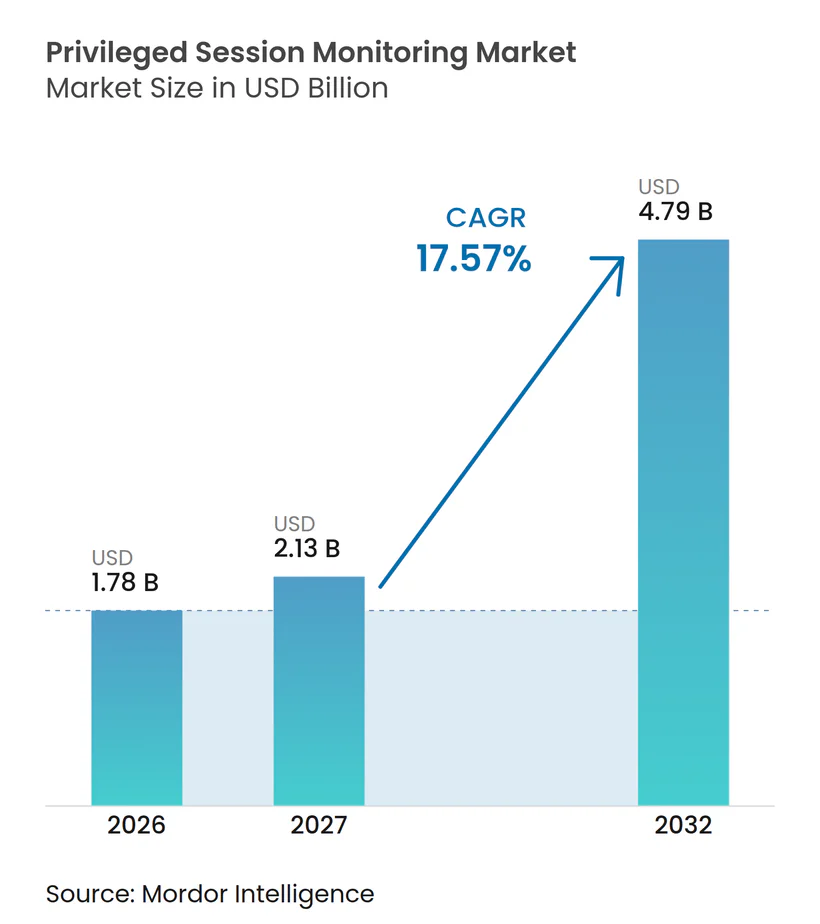
The Privileged Session Monitoring Market size is projected to expand from USD 1.78 billion in 2026 to USD 4.79 billion by 2032, registering a CAGR of 17.57% between 2027 and 2032. Identity-based attacks, credential theft, and session-cookie abuse are raising the importance of controls that can observe activity after authentication. Regulatory requirements are also moving session recording from a preferred security measure to an operational requirement for regulated organizations and their technology suppliers. Zero-trust programs are extending the scope of privileged access management toward continuous verification, while cloud migration is creating more short-lived and non-human access events to oversee. These conditions favor platforms that combine recording, analytics, real-time alerts, and forensic search, while creating opportunities for providers that can address data sovereignty, industrial technology, and smaller organizations with limited security staff.
Key Report Takeaways
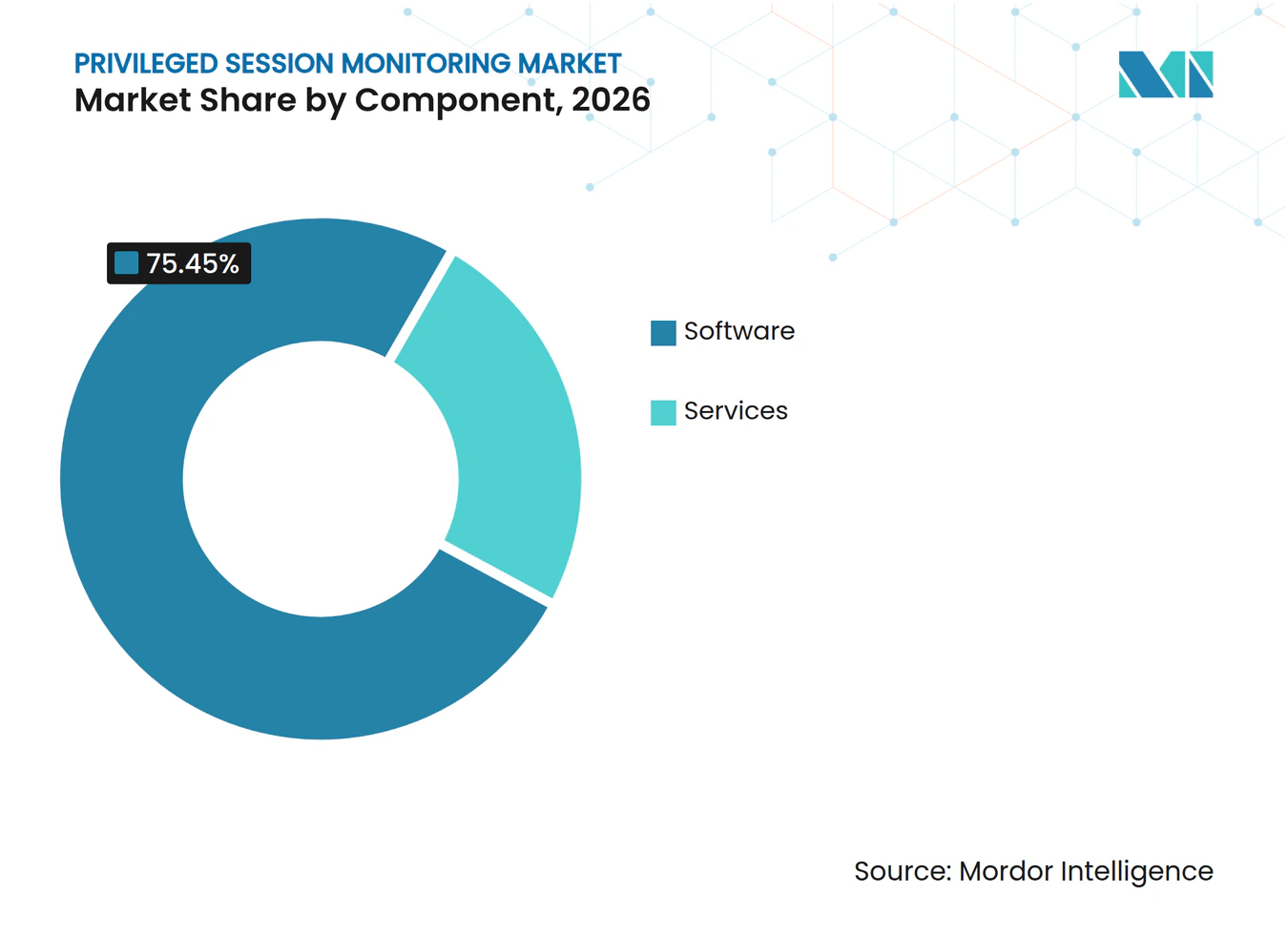
- By component, software held 75.45% of Privileged Session Monitoring Market revenue in 2026.
- By deployment mode, cloud held 51.34% of revenue in 2026 and is projected to expand at an 18.65% CAGR through 2032.
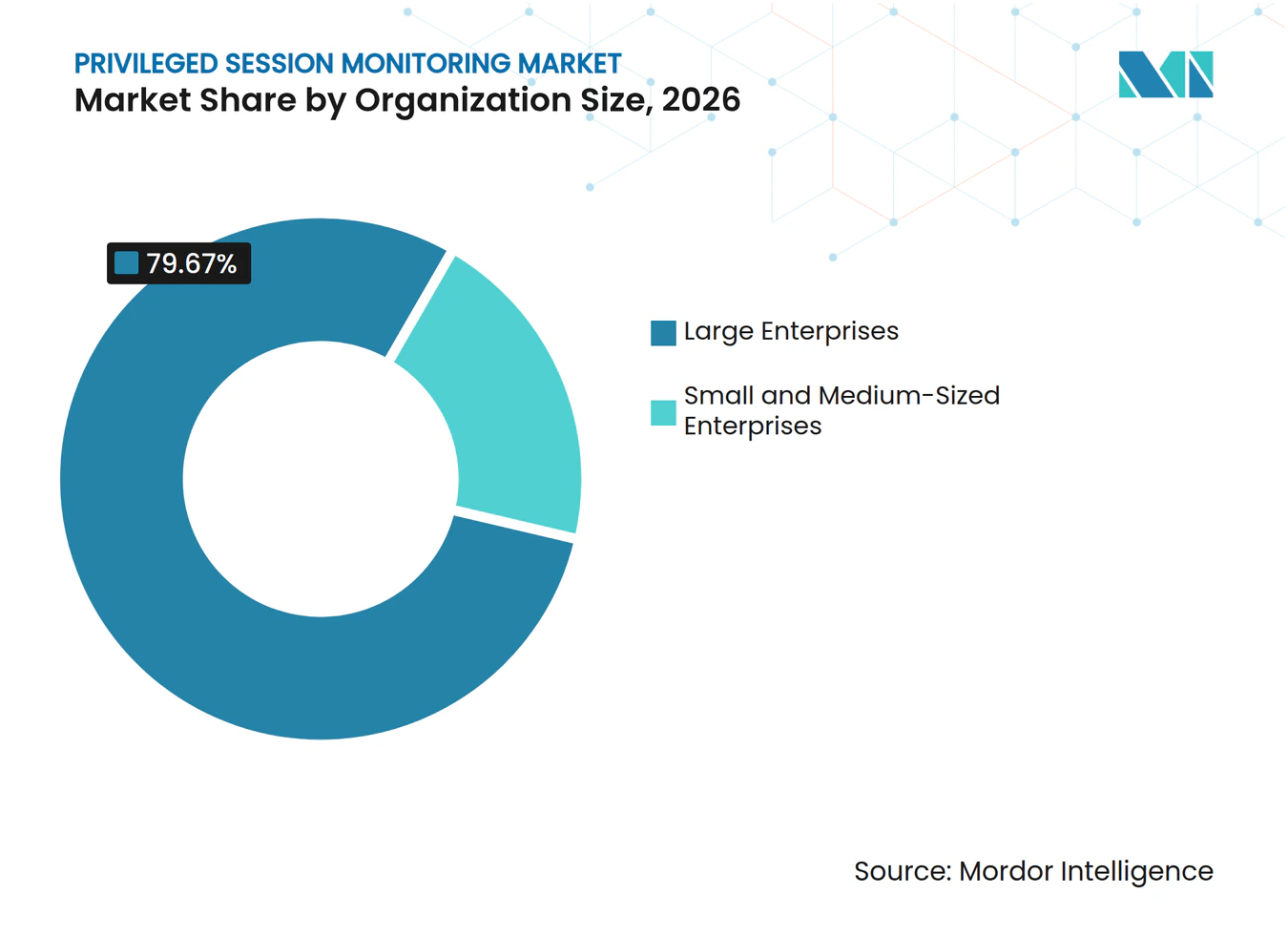
- By organization size, large enterprises held 79.67% of revenue in 2026, while small and medium-sized enterprises are projected to expand at an 18.96% CAGR through 2032.
- By end-user industry, BFSI held 24.54% of revenue in 2026, while IT and telecommunications are projected to expand at an 18.89% CAGR through 2032.
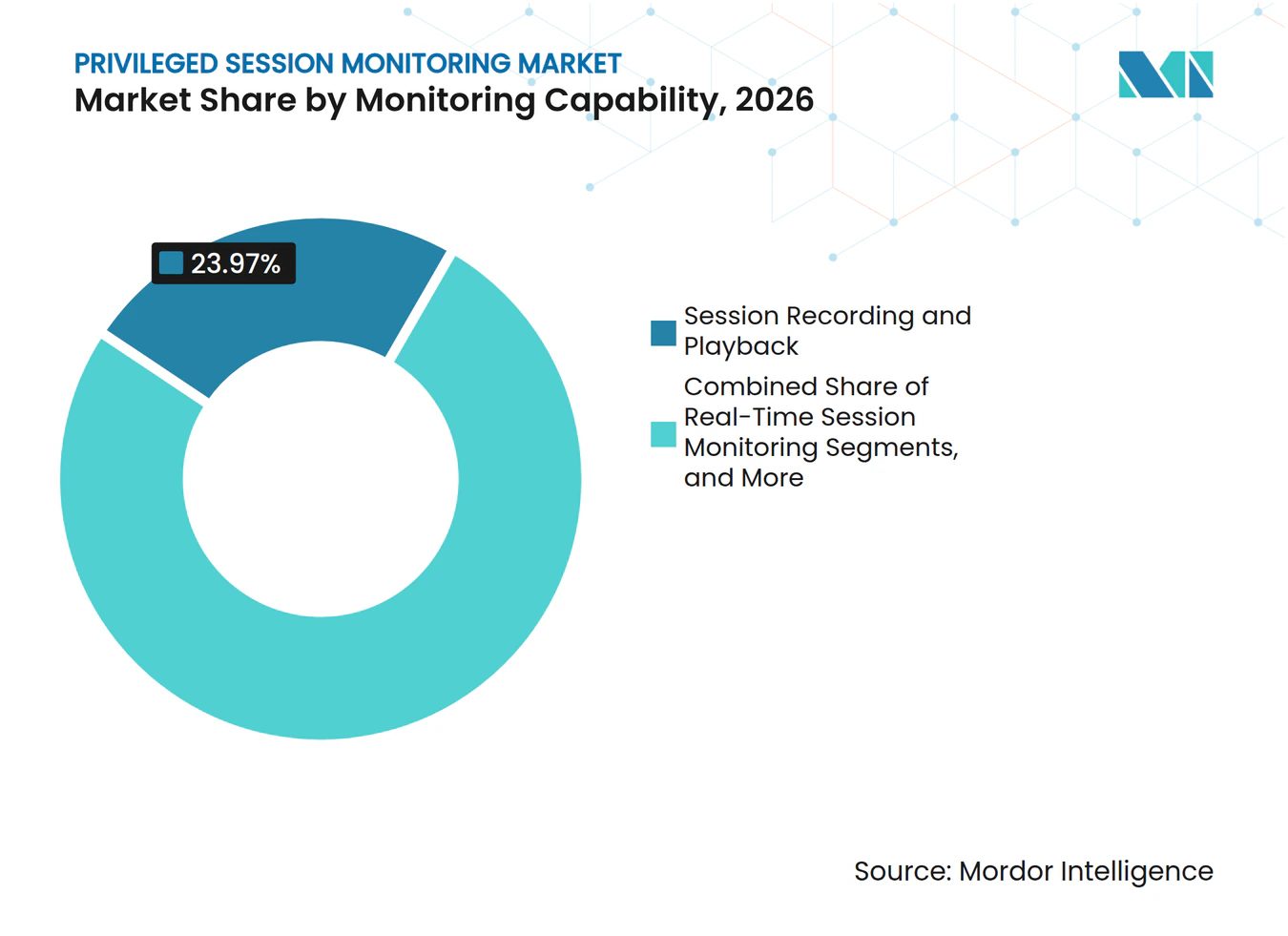
- By monitoring capability, session recording and playback held 23.97% of revenue in 2026, while behavioral analytics and anomaly detection are projected to expand at an 18.67% CAGR through 2032.
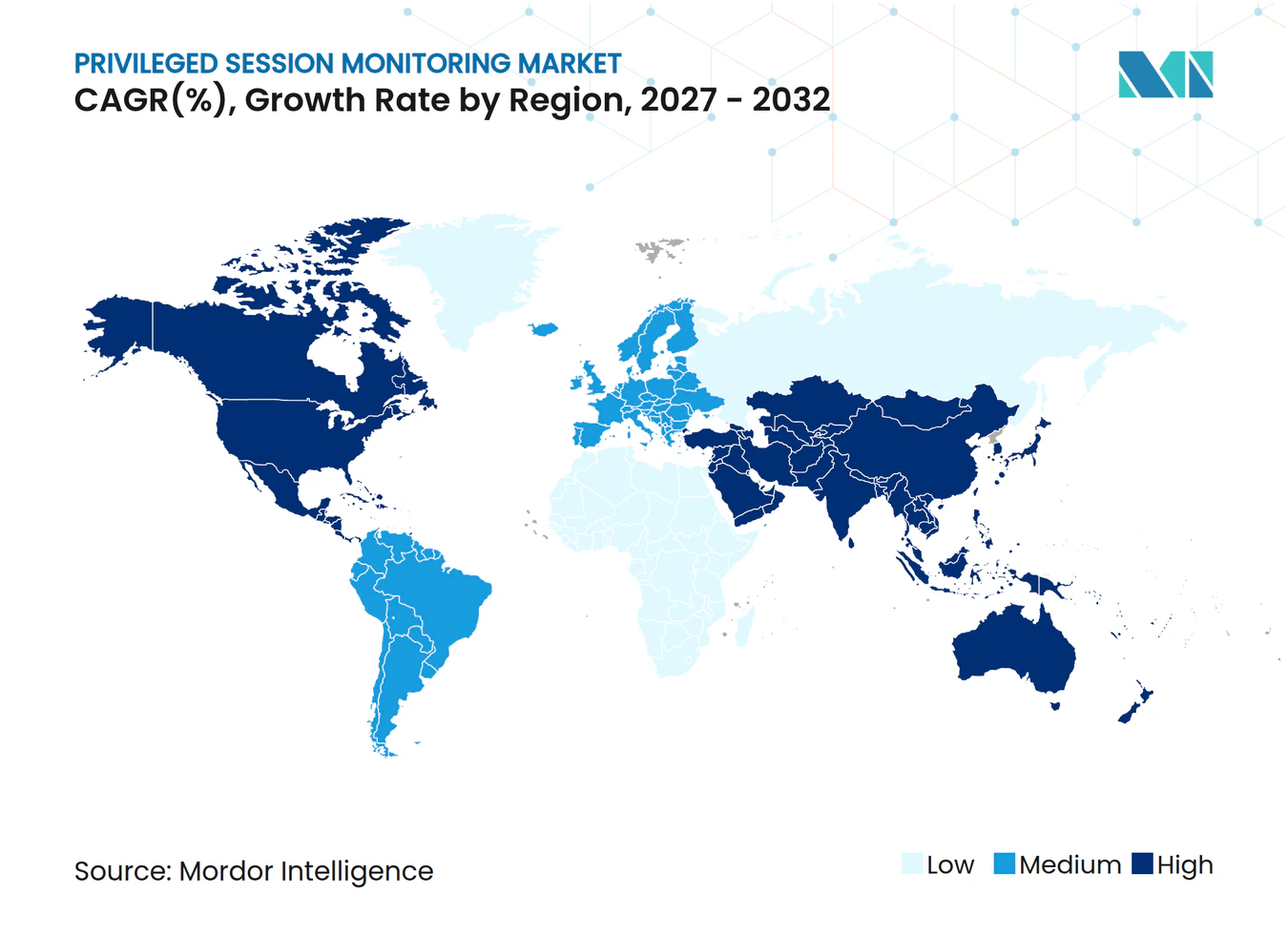
- By geography, North America held 41.73% of the Privileged Session Monitoring Market share in 2026, while Asia-Pacific is projected to expand at an 18.78% CAGR through 2032.
Note: Market numbers in this report are based on Mordor Intelligence's proprietary estimation framework, which combines nine months of actuals with Q4 projections for base year 2026.
Market Trends and Insights
Drivers Impact Analysis of Privileged Session Monitoring Market*
| Driver | (~) % Impact on CAGR Forecast | Geographic Relevance | Impact Timeline |
|---|---|---|---|
| Rising Identity-Based Attacks on Privileged Accounts | +4.3% | Global, concentrated in North America and Europe | Short term (≤ 2 years) |
| Zero-Trust Adoption and Privileged-Session Isolation | +3.5% | North America and Europe, expanding to Asia-Pacific core | Medium term (2-4 years) |
| Cloud-Native PAM and DevSecOps Integration | +2.8% | North America and Asia-Pacific core, spill-over to Middle East and Africa | Medium term (2-4 years) |
| Compliance Requirements for Session Recording and Auditability | +2.4% | Europe and North America, expanding globally | Short term (≤ 2 years) |
| AI-Assisted Detection of Abnormal Privileged Behavior | +2% | Global, led by North America | Medium term (2-4 years) |
| Machine Identity and Non-Human Session Expansion | +1.6% | Global, concentrated in cloud-heavy environments | Long term (≥ 4 years) |
| Source: Mordor Intelligence | |||
Rising Identity-Based Attacks on Privileged Accounts
Privileged accounts remain valuable targets because their compromise enables lateral movement across systems. Cisco Talos observed identity compromises in more than 60% of investigated cases and in 70% of ransomware engagements. SpyCloud reported that attackers use administrator session cookies with other identity data to develop targeted account-takeover profiles.[1] SANS Institute stated that compromised privileged credentials were involved in 70% to 80% of corporate breaches. Sygnia described attack paths that combine permission gaps, privilege escalation, and compromised service accounts.[2] The Privileged Session Monitoring Market therefore benefits when organizations need evidence of suspicious activity after access controls have failed.
Zero-Trust Adoption and Privileged-Session Isolation
Zero-trust programs require continuous verification of access events, including elevated access. The Cloud Security Alliance has called for a shift from persistent privileges to zero standing privileges, where just-in-time access is issued for a defined task and removed when the session ends. Each temporary session still requires monitoring and documentation when it involves privileged actions. ISC2 noted that large-scale just-in-time deployments require process changes and stakeholder alignment in addition to technical changes. Organizations may reduce standing privileges without extending visibility to short-lived elevated sessions. This gap supports demand in the Privileged Session Monitoring Market for controls that verify and record privileged activity during the session.
Cloud-Native PAM and DevSecOps Integration
Multi-cloud environments distribute privileged credentials across Kubernetes secrets, CI/CD service accounts, and API keys. The Cloud Security Alliance identifies short-lived tokens, managed identities, and automated secret rotation as core cloud-native PAM controls. DevSecOps teams need access controls that fit delivery workflows without interrupting them. This requirement increases the value of API-first and agentless session capture for cloud infrastructure. In March 2026, BeyondTrust released a unified privileged identity solution covering human users, workloads, and AI agent coworkers. The Privileged Session Monitoring Market is consequently shifting beyond traditional RDP and SSH monitoring toward cloud and automation environments.
Compliance Requirements for Session Recording and Auditability
DORA requires EU financial entities to maintain documented ICT risk management frameworks and audit-ready logs from January 17, 2025. NIS2 extends cybersecurity obligations across critical sectors and their suppliers. Third-party risk provisions can extend a financial institution's governance requirements to many technology partners. ISO/IEC 27001:2022 Annex A controls 8.15 and 8.16 require documentable logging controls. Acronis reported that session recording is becoming a standard managed service provider offering in regulated sectors. These requirements support the Privileged Session Monitoring Market by tying session evidence to compliance reviews.
Restraints Impact Analysis of Privileged Session Monitoring Market*
| Restraint | (~) % Impact on CAGR Forecast | Geographic Relevance | Impact Timeline |
|---|---|---|---|
| Brownfield Integration Across Hybrid Legacy Estates | -2.5% | Global, most acute in North America and Europe | Medium term (2-4 years) |
| High Implementation and Operating Costs for SMEs | -1.8% | Global, concentrated in South America, Middle East and Africa, and Asia-Pacific emerging markets | Long term (≥ 4 years) |
| Session-Recording Data Sovereignty and Privacy Exposure | -1.2% | Europe and Asia-Pacific, expanding to Middle East and Africa | Medium term (2-4 years) |
| Monitoring Blind Spots in Encrypted, Ephemeral and Agentless Sessions | -0.8% | Global, most acute in cloud-native environments | Long term (≥ 4 years) |
| Source: Mordor Intelligence | |||
Brownfield Integration Across Hybrid Legacy Estates
Many industrial, utility, and government organizations use systems that predate modern session-brokering designs. Mainframes, proprietary industrial control systems, and end-of-life operating systems can require network segmentation changes, protocol translation, or upgrades before session capture is possible. Security teams may also lack the application knowledge required to establish dependable behavioral baselines for legacy administrators. Production environments make organizations reluctant to introduce controls that could disrupt system availability. A partial deployment can prolong procurement, raise professional services requirements, and reduce margins on complex engagements. These conditions can slow Privileged Session Monitoring Market adoption in legacy technology estates.
High Implementation and Operating Costs for SMEs
For many smaller organizations, licensing, professional services, infrastructure, and alert-triage capacity can exceed the identity security budget. Enterprise products often assume dedicated staff who can configure behavioral rules and respond to detections. NIS2 expands the compliance responsibilities of mid-sized essential and important entities, even where security resources remain limited. In September 2025, WALLIX launched WALLIX One PAM Core for SMEs and mid-caps responding to NIS2 requirements.[3] Recurring SaaS costs can still approach on-premises deployment totals across a multiyear period. The affordability gap remains a restraint on the Privileged Session Monitoring Market, despite rising regulatory exposure.
*Our forecasts treat driver/restraint impacts as directional, not additive. The impact forecasts reflect baseline growth, mix effects, and variable interactions.
Privileged Session Monitoring Market Segment Analysis
By Component:
Software Supports Platform ConsolidationSoftware held 75.45% of Privileged Session Monitoring Market revenue in 2026. Buyers favor unified platforms that bring session recording, behavioral analytics, real-time alerts, and forensic search into one policy-led environment. This approach reduces dependence on hardware-focused proxy appliances. It also allows the same platform to operate across cloud, on-premises, and hybrid environments. The Privileged Session Monitoring Market size for software benefits as organizations cover more varied infrastructure from a single codebase.
Behavioral analytics has become an important software upsell because it adds anomaly scoring to audit-led deployments. This can move customers from periodic evidence collection to ongoing monitoring. The Cloud Security Alliance states that just-in-time and zero-standing-privilege models require software capabilities that reshape workflows across cloud platforms and CI/CD pipelines. Services remain important for complex brownfield implementations. Professional services can determine whether a deployment produces usable security outcomes or remains at the proof-of-concept stage. The Privileged Session Monitoring Market combines software scale with services needed for difficult environments.


By Deployment Mode:
Cloud Delivery Becomes the DefaultCloud deployment held 51.34% of revenue in 2026 and is projected to expand at an 18.65% CAGR through 2032. This represented the first year in which cloud-delivered PSM formed the majority of global new deployments. Cloud delivery broadens access for mid-market organizations with limited infrastructure teams. It also matches the operational needs of organizations using cloud services and distributed workloads. Cloud has become the standard delivery approach for a growing part of the Privileged Session Monitoring Market.
ISC2 stated that cloud-native just-in-time access requires platforms that can monitor sessions lasting only seconds. Legacy full-session recording proxies were not designed for every latency requirement in cloud environments. Hybrid deployments retain a role where data classification rules limit the use of third-party cloud storage for session recordings. On-premises deployment is still necessary for air-gapped defense, critical national infrastructure, and selected government settings. Deployment choices in the Privileged Session Monitoring Market remain shaped by operating needs and data residency restrictions.
By Organization Size:
Large Enterprises Lead While SMEs AdvanceLarge enterprises held 79.67% of revenue in 2026, while SMEs are projected to expand at an 18.96% CAGR through 2032. Large organizations operate broad and complex environments that require extensive privileged-session coverage. They also commonly purchase session monitoring within PAM platforms that include credential vaulting, secrets management, and endpoint privilege management. This bundled buying model produces larger contract values. It also concentrates the Privileged Session Monitoring Market share within the enterprise tier.
Small and medium-sized enterprises face new demand from NIS2 compliance schedules. Many of these organizations are implementing PSM for the first time. Their demand is tempered by limited internal capacity to triage alerts and act on findings. Where the operational response is weak, buyers may receive less security value from the deployment. This constraint can affect renewal decisions even when regulatory pressure remains. Providers in the Privileged Session Monitoring Market that combine the platform with managed monitoring services may be better aligned with this need.

By End-User Industry:
BFSI Leads While IT and Telecommunications AdvancesBFSI held 24.54% of revenue in 2026, while IT and telecommunications are projected to expand at an 18.89% CAGR through 2032. Financial institutions require traceable administrator actions across trading, payment, and core banking systems. SOX, PCI DSS, GLBA, and DORA support this requirement for documented access activity. Keeper Security stated that real-time session monitoring can help banks detect session-level fraud before transaction manipulation or data exfiltration is completed. The Privileged Session Monitoring Market size in BFSI reflects the importance of auditability and rapid investigation.
IT and telecommunications providers are increasingly using continuous privileged access controls to meet customer requirements. This is different from a purchase driven mainly by sector regulation. Healthcare demand is also increasing as ransomware changes security budget priorities and access controls for electronic health records and connected devices receive more attention. Energy and utilities are becoming more relevant as OT and IT systems converge. Government and public-sector adoption continues to be supported by national cybersecurity mandates. These sectors broaden the Privileged Session Monitoring Market beyond financial services.
By Monitoring Capability:
Analytics Adds Active DetectionSession recording and playback held 23.97% of revenue in 2026, while behavioral analytics and anomaly detection are projected to expand at an 18.67% CAGR through 2032. Recording provides retrievable and tamper-evident session archives for audits and forensic investigation. Acronis reported that session recording is becoming a standard managed service provider offering in regulated sectors. Behavioral analytics shifts the focus from retained evidence to active detection. The Privileged Session Monitoring Market share held by recording shows that compliance remains the foundation for deployment.
Vendors are adding language-model capabilities to classify commands by risk, create encrypted forensic summaries, and end high-risk sessions automatically. In November 2025, Keeper Security launched KeeperAI with risk classifications and configurable session termination. Real-time monitoring, automated alerting, suspension, and termination are increasingly linked to behavioral analytics. Audit reporting and forensic search also compete through natural-language interfaces that make session evidence easier to retrieve. These developments are changing session monitoring from a passive archive into a more active control.

Geography Analysis
North America Privileged Session Monitoring Market
North America held 41.73% of the Privileged Session Monitoring Market share in 2026. The United States contains regulated financial institutions, federal agencies operating under Office of Management and Budget zero-trust requirements, and technology companies with contractual PSM responsibilities. These factors support a broad enterprise buyer base. Cybersecurity insurance can reinforce this lead when insurers connect policy renewal and premiums to documented access controls.
Europe Privileged Session Monitoring Market
Europe is the second-largest revenue region. DORA enforcement applies to more than 22,000 financial entities from January 2025, while NIS2 covers organizations across energy, transport, healthcare, and digital infrastructure. National certifications can shape procurement decisions in government and critical infrastructure. In October 2025, WALLIX received BSI BSZ certification in Germany and recognition from France's ANSSI. The Privileged Session Monitoring Market in Europe is consequently influenced by both compliance coverage and national trust requirements.
APAC, MEA and South America Privileged Session Monitoring Market
Asia-Pacific is projected to expand at an 18.78% CAGR through 2032. Digital government initiatives in India and Singapore, cloud infrastructure expansion, and country-specific cybersecurity rules support adoption. Singapore's Cyber Trust Mark includes privileged access controls as a required element, creating demand in financial services, healthcare, and technology. India's Digital Personal Data Protection Act and National Cybersecurity Strategy support adoption in BFSI and IT services where global delivery operations require auditable access. South America, the Middle East, and Africa remain earlier-stage areas, with Brazil's LGPD, Gulf Cooperation Council Vision 2030 programs, and South Africa's POPIA supporting adoption among regulated organizations and multinational subsidiaries.
Competitive Landscape
Market Concentration
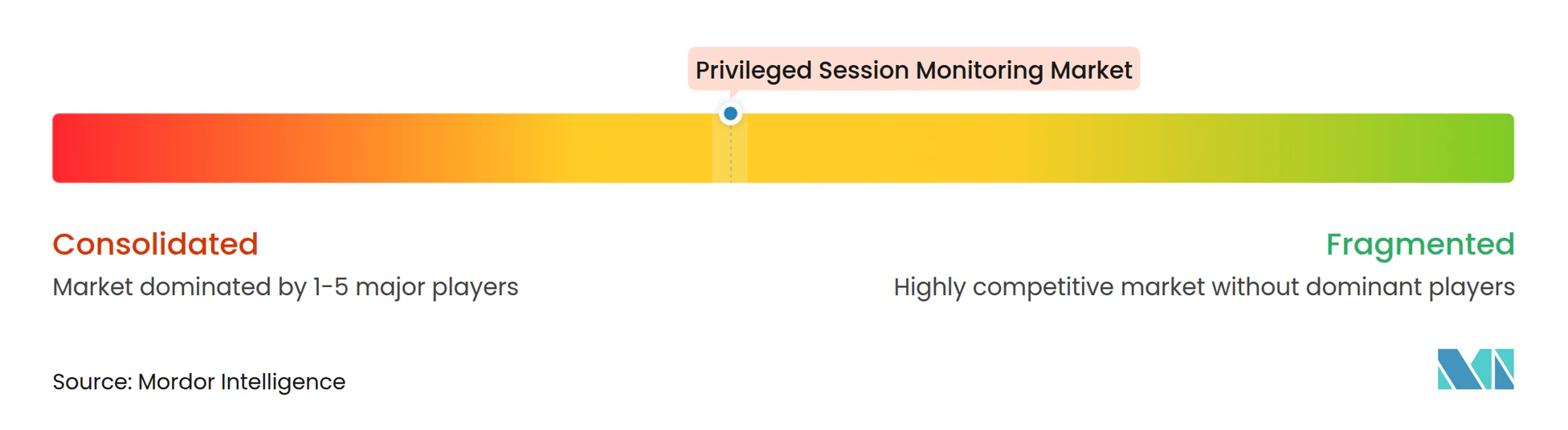
The Privileged Session Monitoring Market is moderately consolidated in the enterprise tier. Pal alto networks, BeyondTrust, and Delinea hold significant revenue through multi-module platform sales. The mid-market and specialist segments remain more fragmented. WALLIX focuses on European data sovereignty and operational technology coverage. ARCON TechSolutions and Sectona Technologies address the Indian mid-market, while Fudo Security and Ekran System focus on behavioral analytics and insider-threat monitoring.
Competition centers on AI-led session intelligence, non-human identity governance, and cloud-native agentless delivery. In March 2026, BeyondTrust released a unified privileged identity platform for AI agent coworkers and workloads across endpoints, cloud infrastructure, and SaaS environments. In April 2026, BeyondTrust launched PathfinderAI and the Pathfinder MCP Server for AI agent platforms. In July 2026, Delinea introduced runtime authorization for AI agents to enforce policy over agent actions within a session. These moves extend privileged controls to autonomous workloads as well as human administrators.
White space remains in mid-market cloud-native deployments and managed services that include alert triage. OT and industrial control system monitoring also remains an opportunity because many providers rely on connectors rather than native industrial protocol coverage. Providers that simplify deployment for smaller organizations may address the gap between compliance needs and operating capacity. AI-agent governance releases also place pressure on incumbents to build or acquire new capabilities. No provider has definitive global leadership across every buyer group. Market concentration score: 4 out of 10, because the leading enterprise platforms have meaningful revenue positions but the supplied information shows no top-player or top-five combined share that would support a higher concentration score.
Privileged Session Monitoring Industry Leaders
-
Palo Alto Networks
-
BeyondTrust Corporation
-
Delinea Inc.
-
One Identity LLC
-
WALLIX Group SA
- *Disclaimer: Major Players sorted in no particular order
Privileged Session Monitoring Market Companies Covered in this Report
- Palo Alto Networks
- BeyondTrust Corporation
- Delinea Inc.
- One Identity LLC
- WALLIX Group SA
- ARCON TechSolutions Pvt. Ltd.
- Zoho Corporation Pvt. Ltd.
- Hitachi ID Systems, Inc.
- MT4 Tecnologia Ltda.
- Keeper Security, Inc.
- Fudo Security Sp. z o.o.
- Ekran System, Inc.
- Saviynt, Inc.
- SSH Communications Security Corporation
- Bravura Security, Inc.
- Securden, Inc.
- Sectona Technologies Private Limited
- Devolutions Inc.
- Iraje Software Inc.
- Kron Tech, Inc.
Recent Industry Developments in Privileged Session Monitoring Market
- October 2026: WALLIX launched WALLIX Sovereign Identity Access, an identity and access management offering addressing digital sovereignty requirements under increasing regulatory and geopolitical constraints. The solution integrates privileged access management with sovereign cloud compatibility, targeting national security-sensitive and critical infrastructure procurement where trusted European provenance carries explicit regulatory advantage.
- September 2026: WALLIX added Deloitte Germany to its Global GSI Alliances program, strengthening go-to-market reach across Germany, Austria, and Switzerland. The partnership targets industrial enterprises and critical infrastructure operators requiring NIS2-compliant privileged session monitoring deployments.
- August 2026: BeyondTrust showcased native Pathfinder platform capabilities at Black Hat USA 2026, including Non-Human Identity Governance, extending privileged access management to service accounts, API keys, OAuth clients, workload identities, and AI agents. The release enables organizations to establish ownership and automate lifecycle management for non-human identities that numerically outnumber employees across enterprise estates.
- July 2026: Delinea released runtime authorization for AI agents, becoming the first PAM platform vendor to enforce policy on what autonomous AI agents do inside a session before they act, moving governance from access-time to session-time controls.
Global Privileged Session Monitoring Market Report Scope
The Privileged Session Monitoring Market is Segmented by Component (Software, Services), Deployment Mode (Cloud, On-Premises, Hybrid), Organization Size (Large Enterprises, Small and Medium-Sized Enterprises), End-User Industry (Banking, Financial Services and Insurance,Information Technology and Telecommunications, Government and Public Sector, Healthcare, Retail and E-Commerce, Manufacturing, Energy and Utilities, and Other End-User Industries), Monitoring Capability (Session Recording, Real-Time Session Monitoring, Behavioral Analytics and Anomaly Detection, Automated Alerting, Suspension and Termination, and Audit Reporting and Forensic Search), and Geography (North America, South America, Europe, Asia-Pacific, Middle East, and Africa). The Market Forecasts are Provided in Terms of Value (USD).
Segmentation Overview
| Software |
| Services |
| Cloud |
| On-Premises |
| Hybrid |
| Large Enterprises |
| Small and Medium-Sized Enterprises |
| Banking, Financial Services and Insurance |
| Information Technology and Telecommunications |
| Government and Public Sector |
| Healthcare |
| Retail and E-Commerce |
| Manufacturing |
| Energy and Utilities |
| Other End-User Industries |
| Session Recording and Playback |
| Real-Time Session Monitoring |
| Behavioral Analytics and Anomaly Detection |
| Automated Alerting, Suspension and Termination |
| Audit Reporting and Forensic Search |
| North America | United States |
| Canada | |
| Mexico | |
| Rest of North America | |
| South America | Brazil |
| Argentina | |
| Chile | |
| Rest of South America | |
| Europe | United Kingdom |
| Germany | |
| France | |
| Italy | |
| Spain | |
| Russia | |
| Rest of Europe | |
| Asia-Pacific | China |
| Japan | |
| India | |
| South Korea | |
| Australia | |
| Singapore | |
| Rest of Asia-Pacific | |
| Middle East | Saudi Arabia |
| United Arab Emirates | |
| Turkey | |
| Israel | |
| Rest of Middle East | |
| Africa | South Africa |
| Nigeria | |
| Kenya | |
| Rest of Africa |
| By Component | Software | |
| Services | ||
| By Deployment Mode | Cloud | |
| On-Premises | ||
| Hybrid | ||
| By Organization Size | Large Enterprises | |
| Small and Medium-Sized Enterprises | ||
| By End-User Industry | Banking, Financial Services and Insurance | |
| Information Technology and Telecommunications | ||
| Government and Public Sector | ||
| Healthcare | ||
| Retail and E-Commerce | ||
| Manufacturing | ||
| Energy and Utilities | ||
| Other End-User Industries | ||
| By Monitoring Capability | Session Recording and Playback | |
| Real-Time Session Monitoring | ||
| Behavioral Analytics and Anomaly Detection | ||
| Automated Alerting, Suspension and Termination | ||
| Audit Reporting and Forensic Search | ||
| By Geography | North America | United States |
| Canada | ||
| Mexico | ||
| Rest of North America | ||
| South America | Brazil | |
| Argentina | ||
| Chile | ||
| Rest of South America | ||
| Europe | United Kingdom | |
| Germany | ||
| France | ||
| Italy | ||
| Spain | ||
| Russia | ||
| Rest of Europe | ||
| Asia-Pacific | China | |
| Japan | ||
| India | ||
| South Korea | ||
| Australia | ||
| Singapore | ||
| Rest of Asia-Pacific | ||
| Middle East | Saudi Arabia | |
| United Arab Emirates | ||
| Turkey | ||
| Israel | ||
| Rest of Middle East | ||
| Africa | South Africa | |
| Nigeria | ||
| Kenya | ||
| Rest of Africa | ||
Key Questions Answered in the Report
What is the size of the privileged session monitoring market?
The Privileged Session Monitoring Market is projected to expand from USD 1.78 billion in 2026 to USD 4.79 billion by 2032 at a 17.57% CAGR.
Which component accounts for the largest share of privileged session monitoring revenue?
Software held 75.45% of revenue in 2026 because buyers favor platforms that combine recording, analytics, alerting, and search.
Why are organizations adopting privileged session monitoring?
Identity-based attacks, zero-trust programs, and audit requirements are increasing the need to observe and document privileged activity.
Which deployment model is expanding fastest for privileged session monitoring?
Cloud deployment held 51.34% of revenue in 2026 and is projected to expand at an 18.65% CAGR through 2032.
Which end-user sector leads demand for privileged session monitoring?
BFSI held 24.54% of revenue in 2026, supported by requirements for traceable actions across payment, trading, and core banking systems.