
Managed Print Security Services Market Size and Share
Market Overview
| Study Period | 2021 - 2032 |
|---|---|
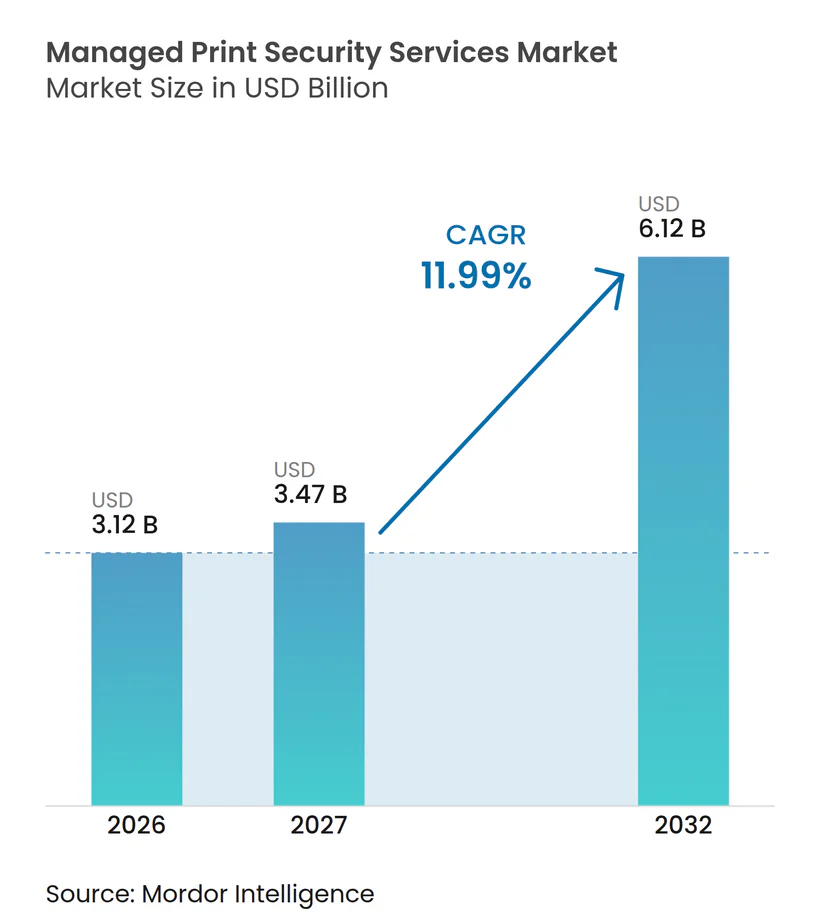
| Market Size (2027) | USD 3.47 Billion |
| Market Size (2032) | USD 6.12 Billion |
| Growth Rate (2027 - 2032) | 11.99 % |
| Fastest Growing Market | Asia-Pacific |
| Largest Market | North America |
| Market Concentration | Medium |
Major Players *Disclaimer: Major Players sorted in no particular order Image © Mordor Intelligence. Reuse requires attribution under CC BY 4.0. | |
Managed Print Security Services Market Analysis by Mordor Intelligence
The Managed Print Security Services Market size was valued at USD 3.12 billion in 2026 and estimated to expand from USD 3.47 billion in 2027 to reach USD 6.12 billion by 2032, at a CAGR of 11.99% during the forecast period 2027-2032. The managed print security services market is being shaped by the treatment of networked printers and multifunction devices as enterprise endpoints rather than peripheral equipment. Enterprises are placing greater weight on continuous monitoring, firmware control, identity verification, and documented response processes. Regulatory requirements in financial services, healthcare, government, and critical infrastructure are also bringing print devices into wider security and audit programs. Providers are responding through cloud-delivered services, vendor-neutral tools, and channel partnerships that extend security coverage across mixed fleets. The managed print security services market therefore has scope for providers that can combine device expertise, security operations, and compliance reporting without disrupting established print environments.
Key Report Takeaways
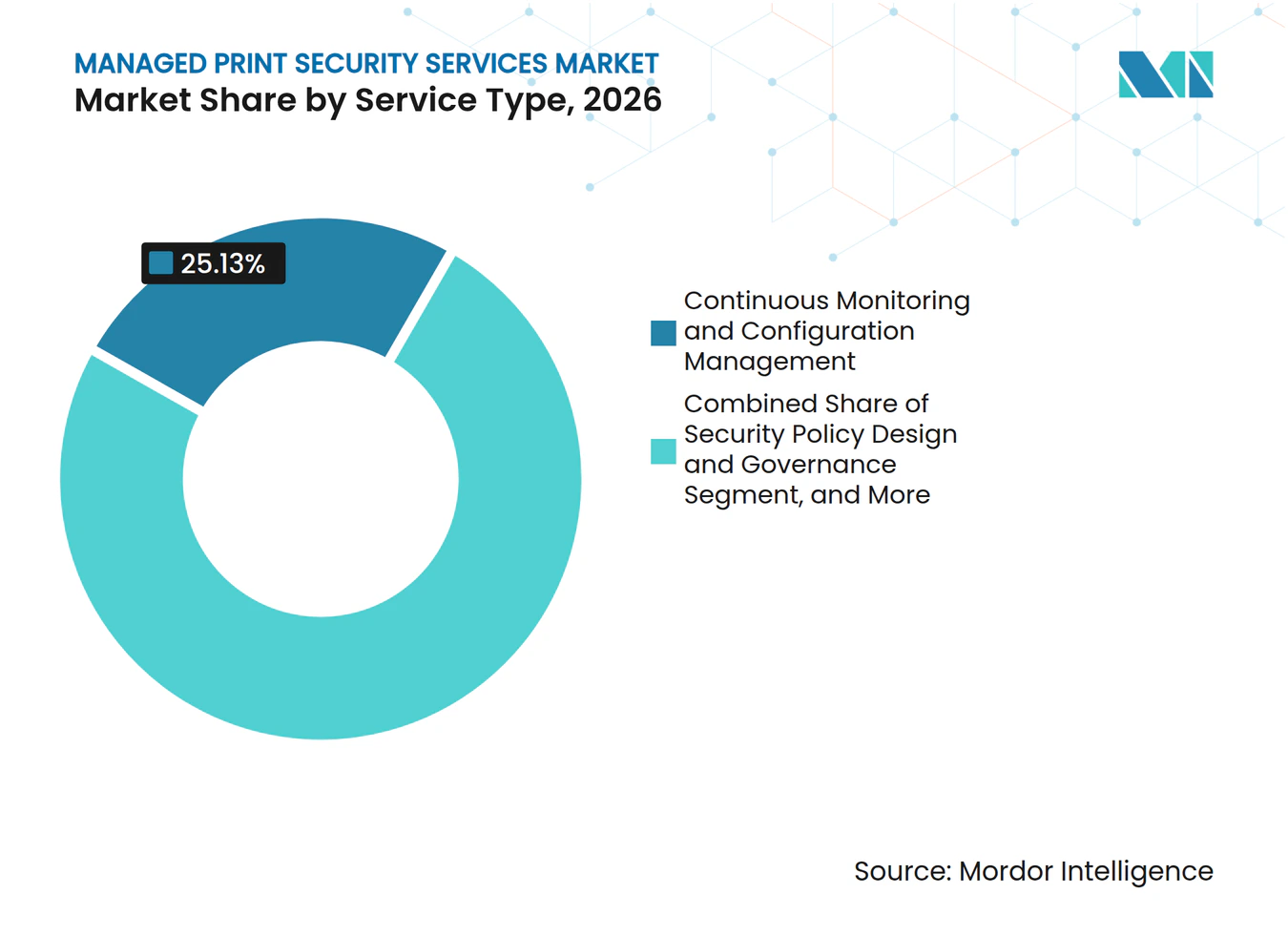
- By service type, Continuous Monitoring and Configuration Management held 25.13% of the managed print security services market share in 2026, while Firmware, Patch, and Certificate Management is projected to expand at a 13.19% CAGR through 2032.
- By deployment model, On-Premises held 46.47% of revenue in 2026, while Cloud-Based deployment is projected to expand at a 12.58% CAGR through 2032.
- By organization size, Large Enterprises held 74.38% of revenue in 2026, while SMEs are projected to expand at a 12.41% CAGR through 2032.
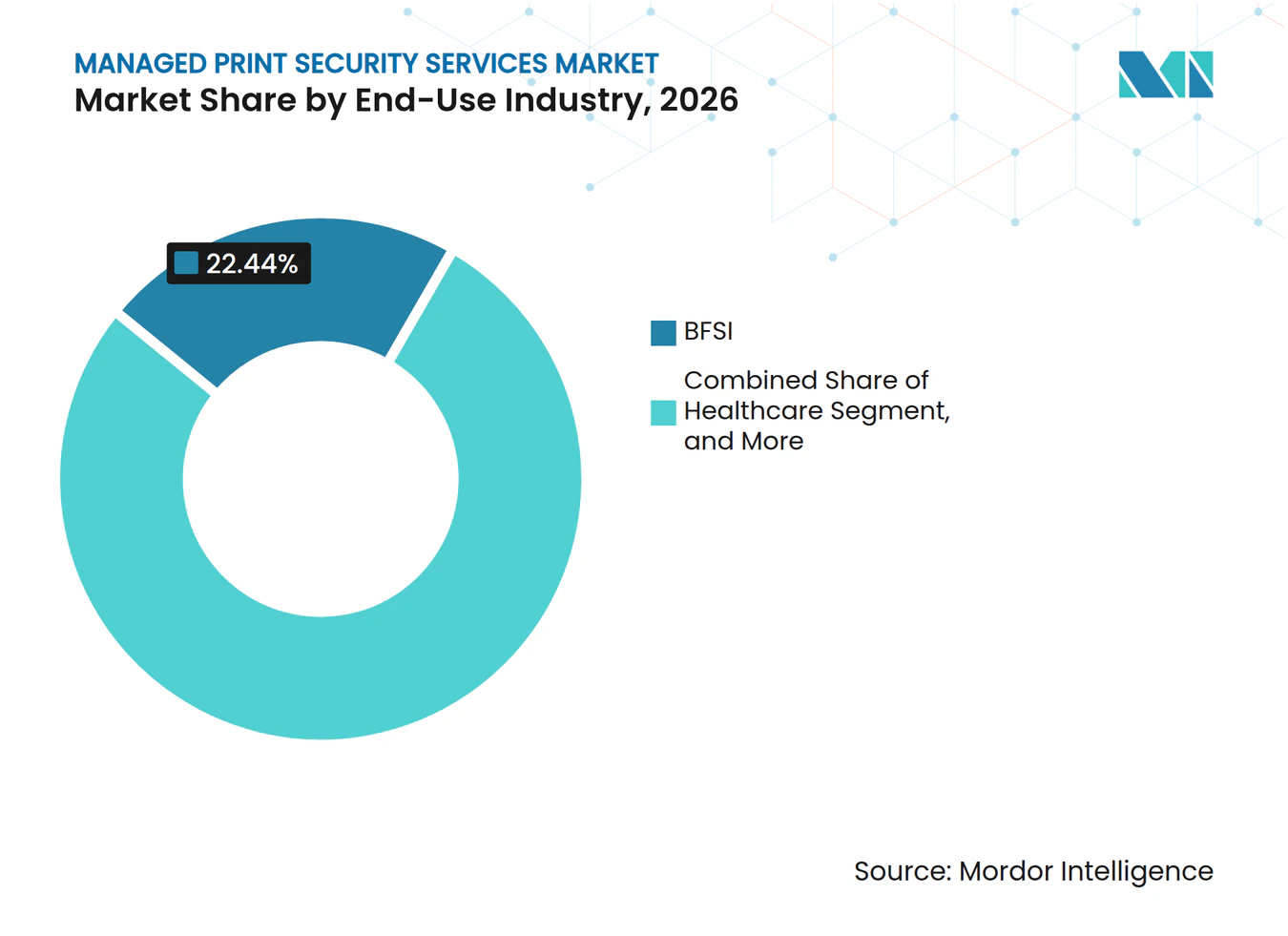
- By end-use industry, BFSI held 22.44% of revenue in 2026, while Other End-Use Industries are projected to expand at a 13.38% CAGR through 2032.
- By channel type, MPS Providers and Dealers held 44.87% of revenue in 2026, while System Integrators and IT Service Providers are projected to expand at a 12.57% CAGR through 2032.
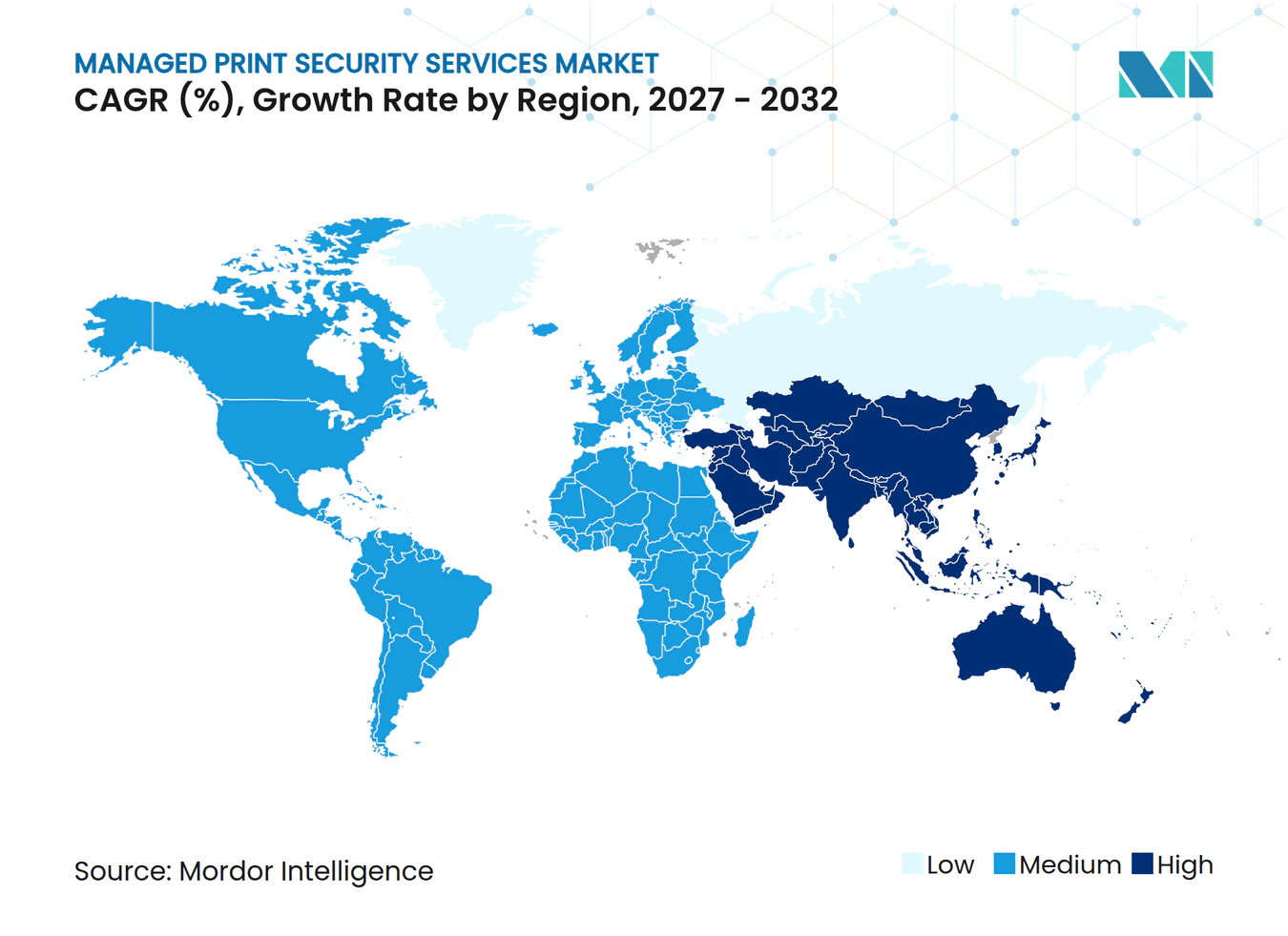
- By geography, North America held 41.03% of revenue in 2026, while Asia-Pacific is projected to expand at a 12.94% CAGR through 2032.
Note: Market numbers in this report are based on Mordor Intelligence's proprietary estimation framework, which combines nine months of actuals with Q4 projections for base year 2026.
Market Trends and Insights
Drivers Impact Analysis of Managed Print Security Services Market*
| Driver | (~) % Impact on CAGR Forecast | Geographic Relevance | Impact Timeline |
|---|---|---|---|
| Increasing Exposure of Networked Printers as Enterprise Endpoints | +2.8% | Global, concentrated in North America and Europe | Short term (≤ 2 years) |
| Expansion of Hybrid and Zero-Trust Work Environments | +2.5% | North America and Europe, spill-over to Asia-Pacific | Medium term (2-4 years) |
| Rising Regulatory Accountability for Printed Data | +1.8% | Europe, North America, and core Asia-Pacific markets | Medium term (2-4 years) |
| Growth of Heterogeneous and Legacy Print Fleets | +1.3% | Global, highest among large enterprises in North America and Europe | Long term (≥ 4 years) |
| Shortage of Specialized Print-Cybersecurity Skills | +0.9% | Global, acute in Asia-Pacific and South America | Medium term (2-4 years) |
| Shift Toward Outcome-Based Per-Device Security Services | +0.6% | North America, Western Europe, and maturing Asia-Pacific markets | Long term (≥ 4 years) |
| Source: Mordor Intelligence | |||
Increasing Exposure of Networked Printers as Enterprise Endpoints
Printers and multifunction devices can account for 20-30% of enterprise network endpoints, yet many remain outside standard endpoint detection and response programs. This leaves security teams with less visibility into configuration changes, firmware status, and suspicious hardware activity. HP found that only 32% of surveyed IT and security decision-makers could detect hardware-level security events on printers, while 35% could identify vulnerable devices after firmware vulnerabilities were published. The managed print security services market benefits when customers need sustained monitoring rather than a one-time fleet review. CVE-2025-26506, a network-reachable remote code execution issue affecting HP LaserJet printers, also showed why patching and device management must be part of broader enterprise security practice. Managed monitoring, remediation, and incident response services address the operational gap created by under-managed printer fleets.
Expansion of Hybrid and Zero-Trust Work Environments
Hybrid work has changed where sensitive information is printed and how organizations control access to print infrastructure. Home and remote locations can sit outside familiar office controls, while zero-trust programs require devices and users to be verified before access is granted. The US Office of Management and Budget has directed federal agencies to use zero-trust principles and secure cloud adoption in their modernization programs. The managed print security services market gains relevance as identity controls, device posture checks, and secure print release become part of enterprise procurement requirements. Pharos describes zero-trust print environments as those that use authenticated sessions, least-privilege access, and policy enforcement for print activity. These requirements support recurring services that connect print security to identity and access management.
Rising Regulatory Accountability for Printed Data
Printed information can contain personal, financial, health, and operational records that are subject to the same governance expectations as digital data. The managed print security services market is supported by customers who need device inventories, audit trails, controlled access, and documented response procedures. Germany published its NIS2 implementation law in December 2025, increasing cybersecurity obligations for organizations in covered sectors. The German Federal Office for Information Security includes printers and multifunction devices within its IT-Grundschutz guidance for office environments. Such frameworks encourage customers to treat print assets as governed systems with formal security controls. Providers with credible certification, local delivery, and usable compliance evidence are better placed in regulated procurement processes.
Growth of Heterogeneous and Legacy Print Fleets
Large organizations often operate devices from several manufacturers and across several firmware generations. This makes a uniform security policy harder to apply because each device may have different administrative interfaces, update cycles, and certificate capabilities. HP reported that only 34% of its surveyed decision-makers could track unauthorized changes to printer hardware. The managed print security services market is therefore supported by assessment, patch coordination, certificate management, and policy governance that work across vendor boundaries. HP also reported that 86% of respondents considered data security a barrier to printer reuse or recycling. Legacy devices and uncertain ownership can leave organizations with an extended remediation workload that managed service providers can address over time.
Restraints Impact Analysis of Managed Print Security Services Market*
| Restraint | (~) % Impact on CAGR Forecast | Geographic Relevance | Impact Timeline |
|---|---|---|---|
| Declining Office Print Volumes and Digital Substitution | -1.8% | Global, most acute in Western Europe and North America | Medium term (2-4 years) |
| Security and Data-Sovereignty Concerns in Outsourced Print Operations | -1.2% | Europe and North America | Medium term (2-4 years) |
| Fragmented Legacy Fleets and Difficult Device Integration | -0.8% | Global, highest impact in large multi-site enterprises | Long term (≥ 4 years) |
| Unclear Ownership Between IT, Security, and Workplace Operations | -0.6% | Global | Short term (≤ 2 years) |
| Source: Mordor Intelligence | |||
Declining Office Print Volumes and Digital Substitution
Lower office print volumes can constrain per-device economics for providers that rely on active device populations. The effect is stronger in document-light sectors adopting paperless processes, while regulated sectors continue to have a greater need for print workflows. The managed print security services market must therefore show value through risk reduction, governance, and operational efficiency rather than print volume alone. BFSI, healthcare, and legal users continue to require controlled print output because their workflows involve sensitive or regulated records. Providers can limit the impact of declining volumes by using service models that focus on device security outcomes rather than only on printing activity.
Security and Data-Sovereignty Concerns in Outsourced Print Operations
Managed service delivery can require access to device telemetry, configuration logs, and print-related metadata. Customers in privacy-sensitive sectors may limit where these records are stored, which personnel can access them, and how long they may be retained. The managed print security services market can face longer sales cycles when customers require in-region data storage and detailed contractual controls. A ransomware incident involving a printing vendor serving DBS Bank and Bank of China affected data belonging to more than 11,000 customers, raising awareness of supplier risk. Providers that offer auditable residency controls, strong access management, and recognized security attestations can better address these concerns. The issue does not remove demand, but it raises the delivery standards needed to win regulated accounts.
*Our forecasts treat driver/restraint impacts as directional, not additive. The impact forecasts reflect baseline growth, mix effects, and variable interactions.
Managed Print Security Services Market Segment Analysis
By Service Type:
Continuous Monitoring Leads While Firmware Management AcceleratesContinuous Monitoring and Configuration Management accounted for 25.13% of the managed print security services market share in 2026. Its position reflects the need to identify configuration drift, maintain device telemetry, and provide evidence for internal control programs. Continuous coverage can connect printer events with wider security operations, rather than leaving each fleet managed in isolation. It also allows organizations to identify changes before they become a wider network issue. This service is especially relevant for customers with many locations or devices from several manufacturers.
Firmware, Patch, and Certificate Management is projected to expand at a 13.19% CAGR through 2032, the highest rate among service types. HP found that only 36% of surveyed IT and security decision-makers applied printer firmware updates promptly. The service addresses a practical backlog in update validation, certificate renewal, and exception handling. Fleet Security Assessment and Discovery, along with Security Policy Design and Governance, create the initial inventory and control framework. Secure Print Release and User Authentication support identity-based workflows. Incident Response, Compliance Reporting, and Remediation turn device information into documented action for audit and recovery needs.



By Deployment Model:
On-Premises Retains Control While Cloud Adoption ExpandsOn-Premises deployment accounted for 46.47% of revenue in 2026. Financial services, government, and other sensitive users can prefer local control over logs, configurations, and print workflows. Existing print-server infrastructure and long service contracts also slow replacement decisions. The managed print security services market size for on-premises delivery remains material because many enterprises must meet strict data-residency requirements. On-premises models can also suit organizations with established internal teams for endpoint security and print operations.
Cloud-Based deployment is projected to expand at a 12.58% CAGR through 2032. Microsoft describes Windows Protected Print Mode as a Windows printing approach that improves security by using a modern print stack and removing dependencies on legacy third-party drivers. Celiveo made its secure cloud print offering available through the Microsoft Azure Marketplace in August 2025 with per-user-per-month billing. Cloud delivery can reduce server administration and simplify distribution across dispersed users. Hybrid deployments remain relevant when an organization must separate high-sensitivity workloads from less-restricted printing. This mixed model can, in turn, increase the need for unified policy and governance.
By Organization Size:
Large Enterprises Hold Revenue While SMEs Gain AccessLarge Enterprises accounted for 74.38% of revenue in 2026. Multi-site fleets, varied device estates, and dedicated security budgets make this group the largest buyer base. These customers frequently need controls that apply across regions, departments, and manufacturer platforms. The large-enterprise position reflects the operational complexity of managing broad print estates. Their procurement teams also increasingly involve IT, security, workplace operations, and compliance personnel, which keeps the managed print security services market relevant to cross-functional purchasing decisions.
SMEs are projected to expand at a 12.41% CAGR through 2032. Subscription platforms can reduce the need for local print servers and specialized in-house administration. PaperCut stated that its Hive and Pocket cloud platform had reached more than 70,000 organizations by 2025. Cyber-insurance and customer assurance requirements can also motivate smaller firms to show endpoint coverage. Y Soft launched SAFEQ Cloud Breeze in September 2025 for smaller organizations, with simplified setup and automated device discovery. These offerings make managed print controls more accessible to buyers without large print or security teams.
By End-Use Industry:
BFSI Provides the Largest Revenue BaseBFSI accounted for 22.44% of revenue in 2026. The sector manages customer records, payment information, and compliance documentation that require controlled print output and traceable processes. FINRA, SEC, PCI DSS, and the GLBA Safeguards Rule support a disciplined approach to access, recordkeeping, and security controls. The managed print security services market has a strong role in this sector because printers can be part of financial data workflows. Vendor incidents also make supply-chain oversight a practical concern for security leaders.
Other End-Use Industries are projected to expand at a 13.38% CAGR through 2032. Professional services, legal, logistics, and manufacturing are broadening their focus on printer security as connected devices become part of wider business operations. Healthcare requires controls for protected health information and for print queues linked to electronic health records. Government buyers are aligning print controls with zero-trust and critical infrastructure obligations. Manufacturing users may have production-floor printers that sit near both information technology and operational technology environments. Retail and education may have lower print intensity, but still need user authentication and data protection for sensitive documents.

By Channel Type:
MPS Providers Lead While Integrators Build Security RolesMPS Providers and Dealers accounted for 44.87% of channel revenue in 2026. Their installed fleet relationships and device-level knowledge give them a strong position for adding security services to existing contracts. This channel can combine supplies, maintenance, fleet monitoring, and security controls through a familiar customer relationship. The managed print security services market benefits from this route because many customers already purchase print support through these providers. It can also reduce the effort needed to discover and document the fleet before a security service begins.
System Integrators and IT Service Providers are projected to expand at a 12.57% CAGR through 2032. These firms can include print assets within endpoint, zero-trust, and managed security operations projects. Marco adopted MPS Monitor's Print-Aware platform in October 2025, extending fleet monitoring across clients in 18 U.S. states. ISVs and security specialists contribute vendor-neutral orchestration, data loss prevention, and certificate-management capabilities. Symphion launched a vendor-agnostic managed endpoint cybersecurity operations program for printers and connected IoT in June 2026. This channel convergence increases the number of routes through which enterprise buyers can source print security services.
Geography Analysis
North America Managed Print Security Services Market
North America accounted for 41.03% of revenue in 2026, the largest regional contribution to the managed print security services market. Dense enterprise fleets, mature managed security service ecosystems, and strict requirements in BFSI, healthcare, and government support demand. The United States is the principal country market in the region. Buyers often connect printer monitoring to existing security information and event management and managed security operations processes. This encourages providers to position print controls as part of endpoint coverage rather than a stand-alone print purchase.
EMEA and South America Managed Print Security Services Market
Europe is the second-largest geography and is shaped by regulatory accountability for data and critical infrastructure. Germany’s NIS2 implementation law and the BSI’s guidance for printer and scanner environments provide clear support for formal controls. Kyocera Document Solutions introduced its AKI PrinTaurus Security Suite for European critical infrastructure organizations and public institutions in January 2026. South America, the Middle East, and Africa remain in earlier stages. Brazil’s LGPD framework and Gulf cybersecurity programs support demand from government and financial services buyers.
APAC Managed Print Security Services Market
Asia-Pacific is projected to expand at a 12.94% CAGR through 2032, making it the fastest-growing geography. Enterprise digitalization in China, India, Japan, and South Korea is expanding the addressable base of connected print devices. HP Japan reported in September 2025 that 40% of Japanese IT decision-makers promptly applied firmware updates, leaving a substantial share that did not. Brother Industries introduced Security Print Advance in Japan in November 2025, using IC card authentication for controlled print release. India’s enterprise technology buildout, South Korea’s privacy requirements, and Australia’s breach notification obligations support varied demand across the region.
Competitive Landscape
Market Concentration
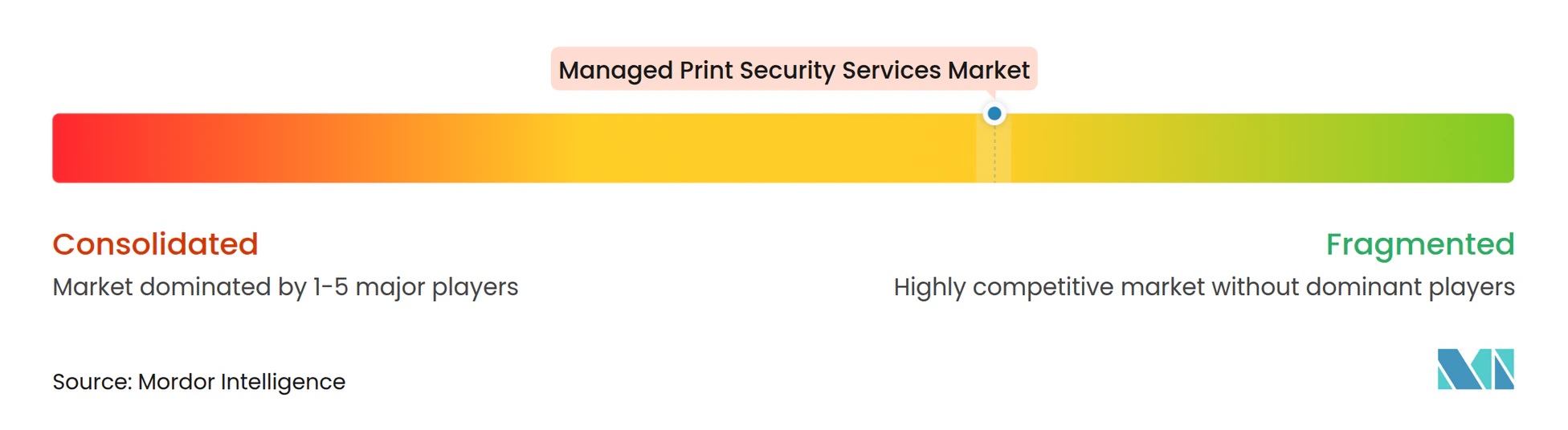
The managed print security services market is moderately fragmented, with OEM-aligned providers operating alongside vendor-neutral software companies and security specialists. Competition in the managed print security services market centers on cloud delivery, integration with zero-trust architectures, real-time monitoring, and the ability to work across mixed device fleets. Larger print providers have established customer access and device knowledge. Specialist providers can differentiate through policy orchestration, certificate lifecycle management, and security operations integration. The managed print security services industry also requires providers to satisfy enterprise expectations for secure data handling and documented controls.
Celiveo signed a worldwide master distribution agreement with Xerox-Lexmark in February 2026, giving Xerox-Lexmark global resale rights for Celiveo 365 SaaS and Celiveo 8 on-premises platforms. Symphion launched its vendor-agnostic Managed Endpoint Cybersecurity Operations Program for printers and connected IoT in June 2026. Kyocera’s January 2026 launch targeted European critical infrastructure users with a security suite built for that environment. These actions show how channel access, vendor-neutral governance, and compliance-specific products are becoming distinct strategic positions. Microsoft’s Protected Print Mode also raises the technical baseline for vendors building cloud-connected Windows print workflows.
Cross-OEM certificate lifecycle management remains important for customers with large mixed fleets. Content inspection at print-job submission and reporting that maps device telemetry to compliance evidence are additional areas of provider focus. Canon announced the integration of endpoint detection and response technology into office multifunction printers and laser printers in October 2026. NIKKEI.COM This move brings detection and response functions closer to the hardware layer. It can increase pressure on independent monitoring providers to show broader interoperability and service value. The managed print security services industry is likely to reward providers that combine credible security operations with local data controls and practical support for diverse devices.
Managed Print Security Services Industry Leaders
-
PaperCut Software Pty Ltd
-
Y Soft Corporation, a.s.
-
Pharos Systems International, Inc.
-
Celiveo Pte Ltd
-
MyQ, spol. s r.o.
- *Disclaimer: Major Players sorted in no particular order
Managed Print Security Services Market Companies Covered in this Report
- PaperCut Software Pty Ltd
- Y Soft Corporation, a.s.
- Pharos Systems International, Inc.
- Celiveo Pte Ltd
- MyQ, spol. s r.o.
- NT-ware Systemprogrammierungs-GmbH
- OPTIMIDOC s.r.o.
- ThinPrint GmbH
- Vasion, Inc.
- Levi, Ray & Shoup, Inc.
- Tungsten Automation Corporation
- Tricerat, Inc.
- Plus Technologies LLC
- PriApps, Inc.
- K-iS Systemhaus GmbH
- MPS Monitor S.r.l.
- Symphion, Inc.
- Fasoo Co., Ltd.
- Ringdale Limited
- AKI GmbH
Recent Industry Developments in Managed Print Security Services Market
- October 2026: Canon announced the integration of EDR technology into office multifunction printers and laser printers, as reported by Nikkei on October 13, 2026. The move embeds detection and response capabilities natively into print hardware, entering the monitoring layer previously occupied by third-party ISVs.
- June 2026: Symphion, Inc. launched The Symphion Managed Endpoint Cybersecurity Operations Program for Printers and Connected IoT on June 9, 2026. The vendor-agnostic program delivers hourly inventory refresh, twice-daily drift detection, same-day remediation, and certificate lifecycle governance across mixed-brand fleets.
- February 2026: Celiveo signed a worldwide master distribution agreement with Xerox-Lexmark on February 2, 2026, granting Xerox-Lexmark global resale rights to Celiveo's Celiveo 365 SaaS and Celiveo 8 on-premises platforms.
- January 2026: Symphion launched the Print Fleet Security Certificate Deployment and Management Service on January 26, 2026, automating the complete certificate lifecycle, discovery, PKI coordination, deployment, validation, and renewal, across printer fleets of any OEM, model, or firmware version, addressing the gap created by shorter TLS certificate lifetimes in zero-trust environments.
Global Managed Print Security Services Market Report Scope
The Managed Print Security Services Market is defined as the market for specialized services that protect enterprise printing environments, multifunction printers, document workflows, and associated network infrastructure against cybersecurity threats, unauthorized access, data breaches, and information leakage. These services help organizations identify security vulnerabilities across print fleets, continuously monitor devices, manage configurations, maintain firmware and security patches, and enforce secure print release through user authentication and access control.
The Managed Print Security Services Report is Segmented by Service Type (Print Fleet Security Assessment and Discovery, Continuous Monitoring and Configuration Management, Firmware, Patch, and Certificate Management, Secure Print Release User Authentication and Access Control, Document Security and Encryption, Network Security Management, and Incident Response, Compliance Reporting, and Remediation), Deployment Model (On-Premises, Cloud-Based, and Hybrid), Organization Size (Large Enterprises and Small and Medium-Sized Enterprises), End-Use Industry (BFSI, Healthcare, Government and Public Sector, Education, Manufacturing, Retail and Consumer Goods and Other End-Use Industries), Channel Type (ISVs and Security Specialists, MPS Providers and Dealers, and System Integrators and IT Service Providers), and Geography (North America, Europe, Asia-Pacific, South America, Middle East, and Africa). The Market Forecasts are Provided in Terms of Value (USD).
Segmentation Overview
| Print Fleet Security Assessment and Discovery |
| Security Policy Design and Governance |
| Continuous Monitoring and Configuration Management |
| Firmware, Patch, and Certificate Management |
| Secure Print Release and User Authentication |
| Incident Response, Compliance Reporting, and Remediation |
| On-Premises |
| Cloud-Based |
| Hybrid |
| Large Enterprises |
| Small and Medium-Sized Enterprises |
| BFSI |
| Healthcare |
| Government and Public Sector |
| Education |
| Manufacturing |
| Retail and Consumer Goods |
| Other End-Use Industries |
| ISVs and Security Specialists |
| MPS Providers and Dealers |
| System Integrators and IT Service Providers |
| North America | United States |
| Canada | |
| Mexico | |
| South America | Brazil |
| Argentina | |
| Rest of South America | |
| Europe | Germany |
| United Kingdom | |
| France | |
| Italy | |
| Russia | |
| Rest of Europe | |
| Asia-Pacific | China |
| Japan | |
| India | |
| South Korea | |
| Australia | |
| Rest of Asia-Pacific | |
| Middle East | United Arab Emirates |
| Saudi Arabia | |
| Turkey | |
| Rest of Middle East | |
| Africa | South Africa |
| Rest of Africa |
| By Service Type | Print Fleet Security Assessment and Discovery | |
| Security Policy Design and Governance | ||
| Continuous Monitoring and Configuration Management | ||
| Firmware, Patch, and Certificate Management | ||
| Secure Print Release and User Authentication | ||
| Incident Response, Compliance Reporting, and Remediation | ||
| By Deployment Model | On-Premises | |
| Cloud-Based | ||
| Hybrid | ||
| By Organization Size | Large Enterprises | |
| Small and Medium-Sized Enterprises | ||
| By End-Use Industry | BFSI | |
| Healthcare | ||
| Government and Public Sector | ||
| Education | ||
| Manufacturing | ||
| Retail and Consumer Goods | ||
| Other End-Use Industries | ||
| By Channel Type | ISVs and Security Specialists | |
| MPS Providers and Dealers | ||
| System Integrators and IT Service Providers | ||
| By Geography | North America | United States |
| Canada | ||
| Mexico | ||
| South America | Brazil | |
| Argentina | ||
| Rest of South America | ||
| Europe | Germany | |
| United Kingdom | ||
| France | ||
| Italy | ||
| Russia | ||
| Rest of Europe | ||
| Asia-Pacific | China | |
| Japan | ||
| India | ||
| South Korea | ||
| Australia | ||
| Rest of Asia-Pacific | ||
| Middle East | United Arab Emirates | |
| Saudi Arabia | ||
| Turkey | ||
| Rest of Middle East | ||
| Africa | South Africa | |
| Rest of Africa | ||
Key Questions Answered in the Report
What is the managed print security services market size?
The managed print security services market is valued at USD 3.12 billion in 2026 and is forecast to reach USD 6.12 billion by 2032, at an 11.99% CAGR from 2027 to 2032.
Which service type leads managed print security services?
Continuous Monitoring and Configuration Management leads with 25.13% of service-type revenue in 2026.
What is driving cloud-based print security adoption?
Cloud-Based deployment is projected to expand at a 12.58% CAGR through 2032 as buyers seek lower server dependency and easier management across dispersed users.
Why do large enterprises buy managed print security services?
Large Enterprises held 74.38% of revenue in 2026 because their multi-site, multi-vendor fleets require ongoing monitoring, policy governance, and remediation.
Which end-use sector has the largest share?
BFSI holds 22.44% of revenue in 2026, supported by the need to secure financial records, payment information, and auditable print workflows.
Which region is expanding fastest?
Asia-Pacific is projected to expand at a 12.94% CAGR through 2032 as enterprise digitalization and cybersecurity obligations increase across major countries.