
Managed Cloud Print Services Market Size and Share
Market Overview
| Study Period | 2021 - 2032 |
|---|---|
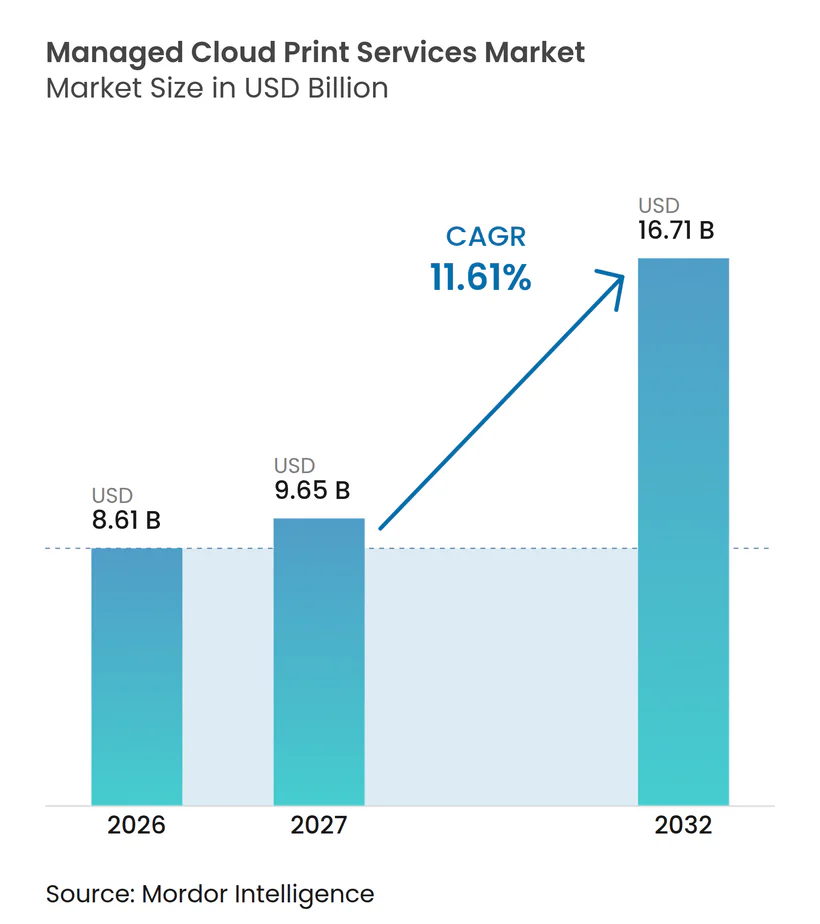
| Market Size (2027) | USD 9.65 Billion |
| Market Size (2032) | USD 16.71 Billion |
| Growth Rate (2027 - 2032) | 11.61 % |
| Fastest Growing Market | Asia-Pacific |
| Largest Market | North America |
| Market Concentration | Medium |
Major Players *Disclaimer: Major Players sorted in no particular order Image © Mordor Intelligence. Reuse requires attribution under CC BY 4.0. | |
Managed Cloud Print Services Market Analysis by Mordor Intelligence
The managed cloud print services market size is valued at USD 8.61 billion in 2026 and is forecast to reach USD 16.71 billion by 2032, expanding at a CAGR of 11.61% during 2027-2032. Organizations are replacing on-premises print servers with cloud-based systems that combine secure release, fleet oversight, and document workflows. Hybrid work has made centralized control more important because print devices now operate across offices, home locations, and smaller sites. Subscription purchasing also gives buyers a way to align spending with active users instead of maintaining server infrastructure and hardware-focused contracts. Providers are responding by combining print management with security controls, analytics, and workflow automation. The managed cloud print services market also faces lower office print volumes and data-residency requirements, which favor providers that offer flexible pricing and isolated cloud architectures.
Key Report Takeaways
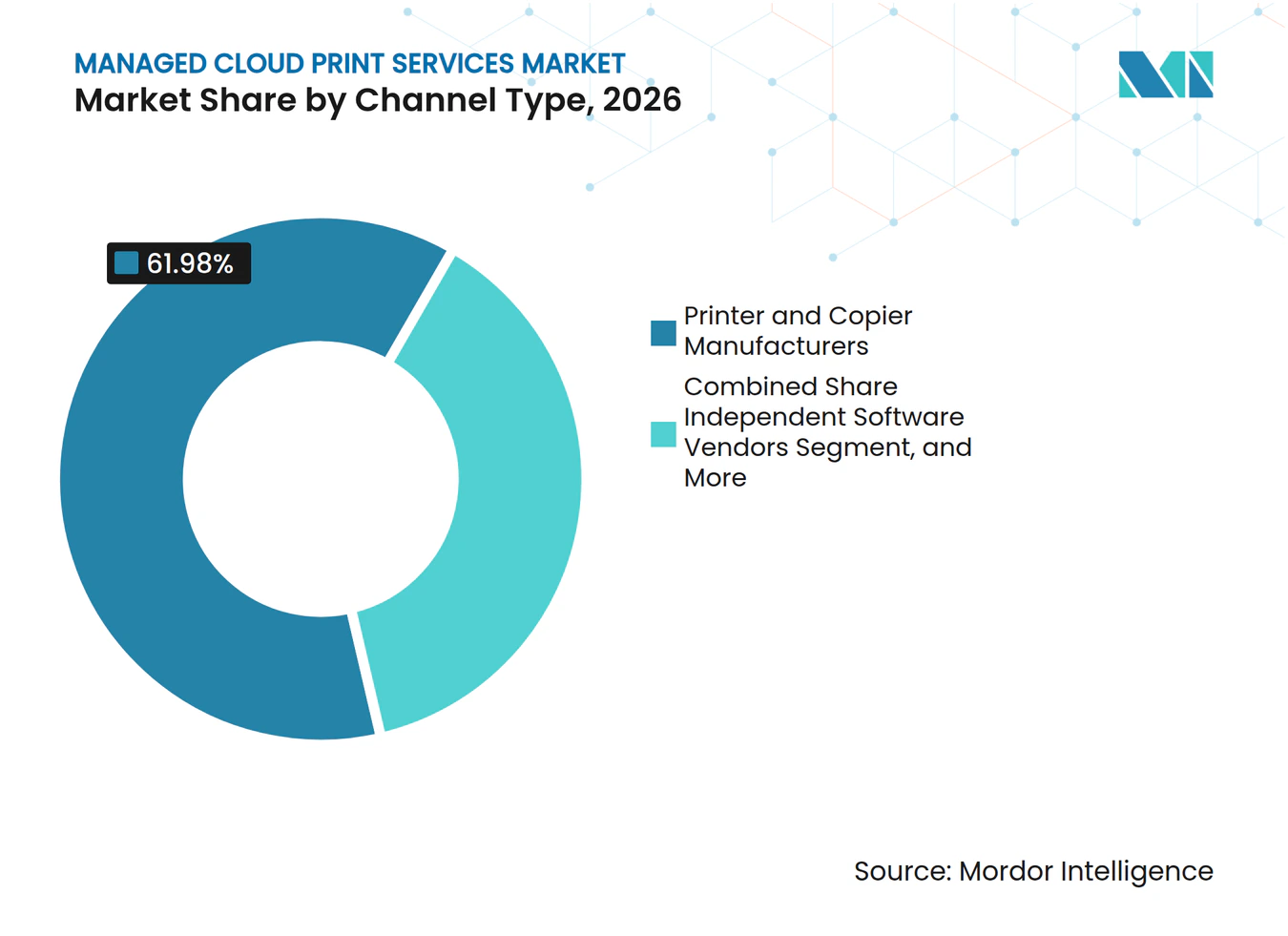
- By channel type, printer and copier manufacturers held 61.98% of the managed cloud print services market share in 2026, while independent software vendors are projected to expand at a CAGR of 12.28% through 2032.
- By service type, managed print operations accounted for 32.09% of the managed cloud print services market size in 2026, while cloud print services are projected to expand at a CAGR of 12.45% through 2032.
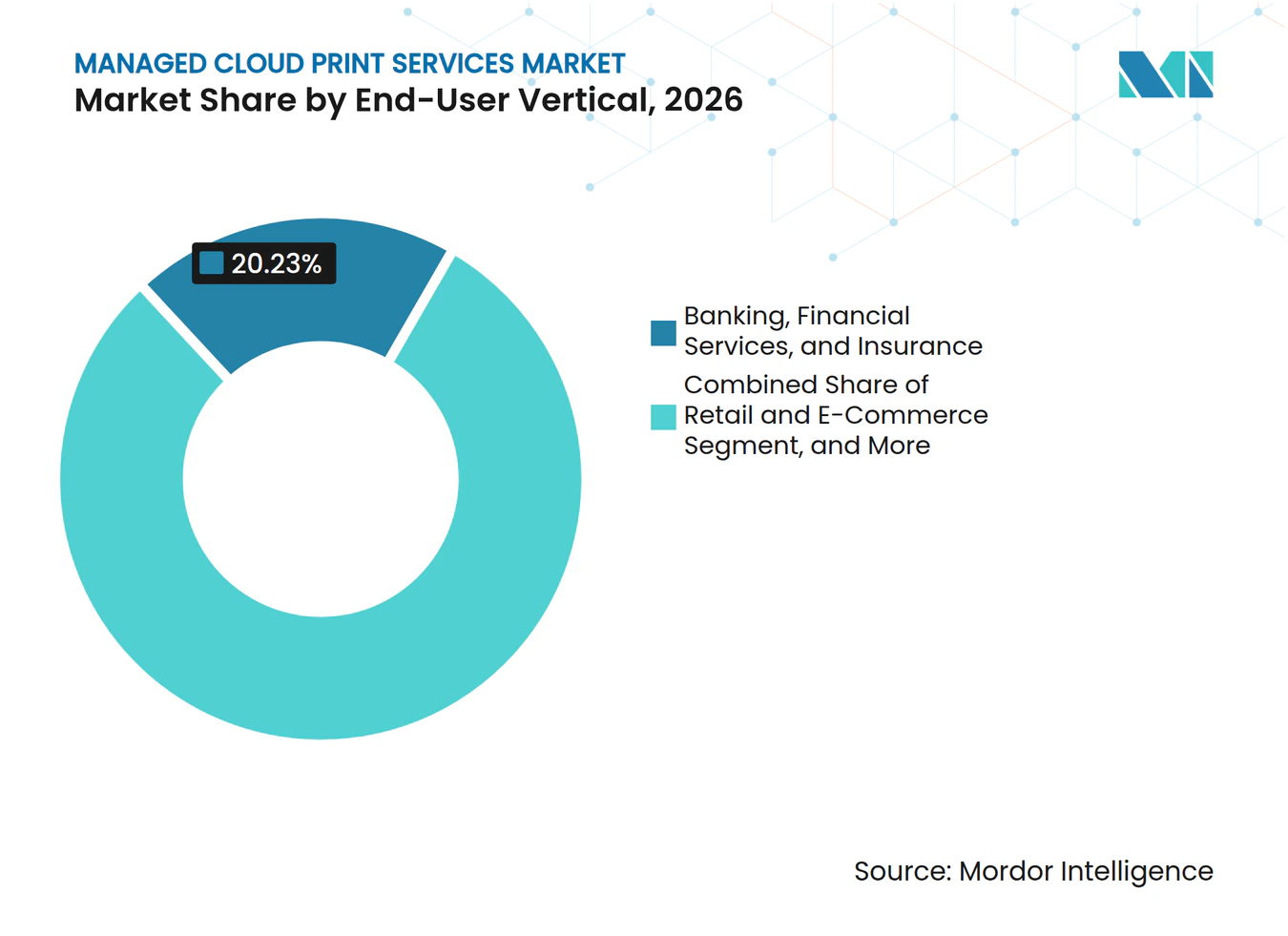
- By end-user vertical, banking, financial services, and insurance held 20.23% of revenue in 2026, while healthcare is projected to expand at a CAGR of 12.15% through 2032.
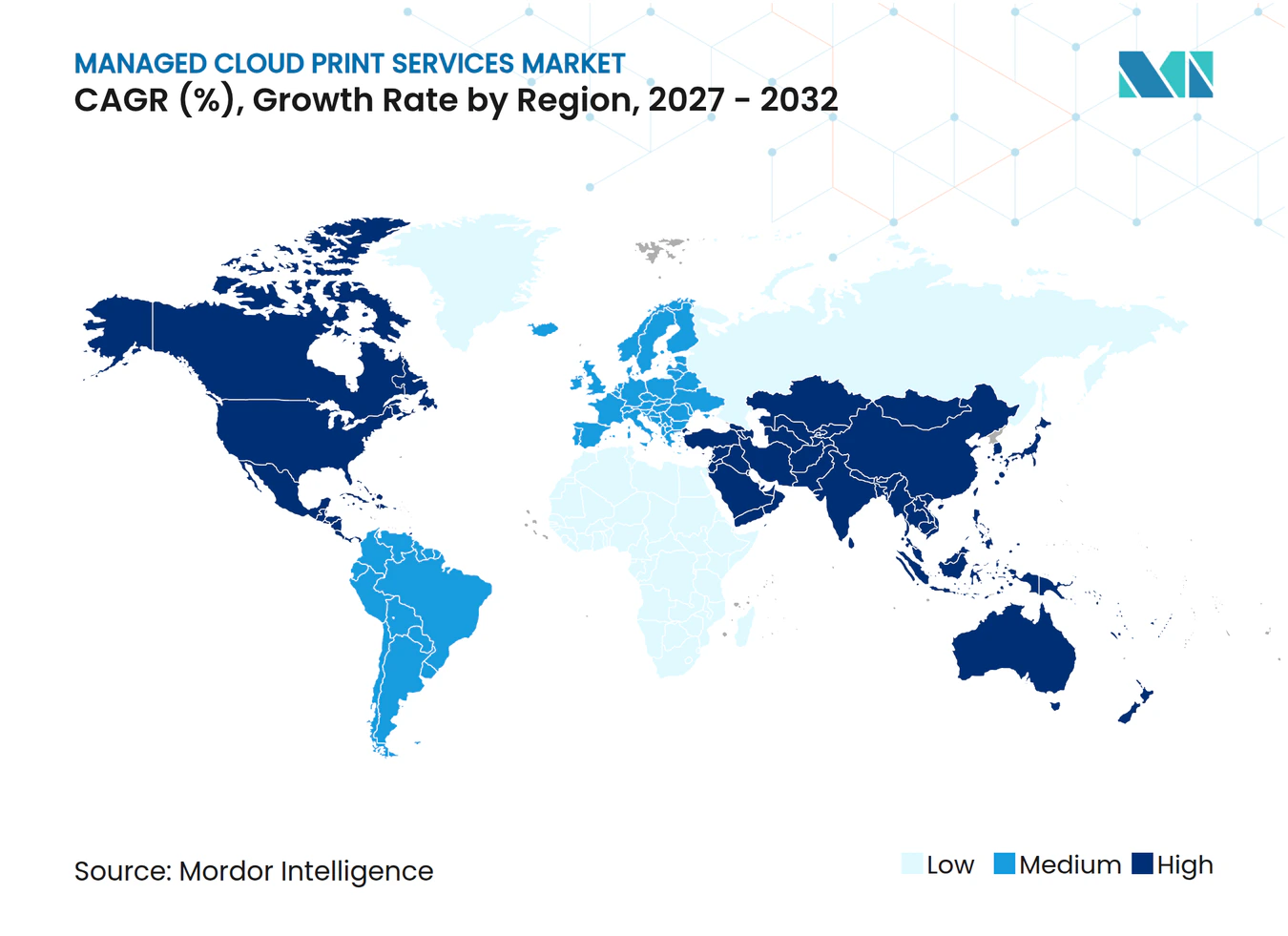
- By geography, North America held 38.02% of revenue in 2026, while Asia-Pacific is projected to expand at a CAGR of 12.65% through 2032.
Note: Market numbers in this report are based on Mordor Intelligence's proprietary estimation framework, which combines nine months of actuals with Q4 projections for base year 2026.
Global Managed Cloud Print Services Market Trends and Insights
Drivers Impact Analysis*
| Driver | (~) % Impact on CAGR Forecast | Geographic Relevance | Impact Timeline |
|---|---|---|---|
| Hybrid and Remote Work Print Infrastructure Modernization | +2.8% | Global, concentrated in North America and Western Europe | Short term (≤ 2 years) |
| Cloud Migration and Serverless Print Management | +2.4% | Global, led by North America, United Kingdom, and Western Europe | Short term (≤ 2 years) |
| Print Security and Compliance Requirements in Regulated Industries | +2.1% | Global, with highest intensity in North America, Europe, and Asia-Pacific financial hubs | Medium term (2–4 years) |
| Subscription-Based IT and Managed-Service Adoption Among SMEs | +1.8% | Global, accelerating in Asia-Pacific, South America, and Middle East | Medium term (2–4 years) |
| Device Telemetry, AI Analytics, and Predictive Maintenance | +1.4% | Global, led by North America and Western Europe | Medium term (2–4 years) |
| Sustainability Reporting and Page-Level Carbon Accounting | +0.9% | Western Europe and North America, with growing relevance in Asia-Pacific | Long term (≥ 4 years) |
| Source: Mordor Intelligence | |||
Hybrid and Remote Work Print Infrastructure Modernization
Distributed workforces have changed print environments from office-centered fleets to networks that include home offices and satellite locations. IT teams need consistent access policies and device oversight across those locations. Microsoft Universal Print removes the need for print servers by using cloud infrastructure already used with Microsoft 365 services. Universal Print Anywhere became generally available in June 2025 and enabled secure pull printing without on-premises infrastructure. Microsoft updated Universal Print to the Mopria 1.2 standard in March 2026, supporting broader compatibility with certified printers and reducing driver deployment needs.[1] Managed cloud print services market contracts can become more durable when customers depend on continuing security policy updates, service-level oversight, and device telemetry.
Cloud Migration and Serverless Print Management
Serverless printing removes a remaining on-premises dependency for many enterprises. It can reduce the operational burden of maintaining print servers while providing a centralized way to manage users and devices. The managed cloud print services market benefits when buyers link print modernization to document capture, output automation, and analytics projects. Vasion offers a cloud platform that combines serverless printing, output automation, and document workflows, while Pharos emphasizes cloud-based management and security controls for distributed environments. Vendors without multi-tenant or flexible cloud architectures may face more difficulty in tenders where buyers treat cloud deployment as a basic requirement.
Print Security and Compliance Requirements in Regulated Industries
Financial services, healthcare, and government organizations must treat print devices as part of their wider security controls. Unmanaged device firmware, user authentication, and print queues can create gaps when responsibility is divided across operational and security teams. The HIPAA Security Rule requires covered entities and business associates to use safeguards for electronic protected health information, including access controls, audit controls, and transmission security. Mopria-certified devices give organizations a more standardized base for device compatibility and secure mobile printing. Buyers in regulated sectors increasingly require time-stamped logs, controlled release, and cloud security practices before they consider a provider.
Subscription-Based IT and Managed-Service Adoption Among SMEs
Smaller organizations often lack the internal resources needed to maintain servers, firmware updates, and diverse device fleets. User-based subscriptions can align costs with changing workforce levels more closely than device-linked contracts. This approach can be useful for organizations with seasonal employment or multiple small sites. Konica Minolta made KPAX multi-brand fleet management available to its dealer network in January 2025, allowing dealers to support centralized programs across different printer brands.[2] Simple onboarding, self-service administration, and flexible commercial terms can help providers reach smaller customers without replicating large-enterprise sales processes.
Restraints Impact Analysis*
| Restraint | (~) % Impact on CAGR Forecast | Geographic Relevance | Impact Timeline |
|---|---|---|---|
| Structural Decline in Office Print Volumes | -2.8% | Global, most pronounced in North America and Western Europe | Short term (≤ 2 years) |
| Data Sovereignty and Cross-Border Print-Job Governance | -1.5% | Europe, North America, and regulated Asia-Pacific markets | Medium term (2–4 years) |
| Vendor Lock-In and Multi-Year Contract Complexity | -1.0% | Global, primarily enterprise segments in North America and Europe | Medium term (2–4 years) |
| Heterogeneous Fleet Interoperability and Zero-Trust Edge Complexity | -0.7% | Global, with highest impact in large enterprise multi-vendor environments | Long term (≥ 4 years) |
| Source: Mordor Intelligence | |||
Structural Decline in Office Print Volumes
Office print volumes continue to face pressure as organizations use electronic signatures, digital forms, scan-to-cloud processes, and workflow platforms. This directly affects contracts priced on a per-page basis. A 2025 study found that frequent use of scan-to-cloud and e-signature tools reduced monthly printing and waste pages, showing that the shift is linked to process digitization.[3] Providers that retain page-linked pricing carry more exposure to declining volumes. Seat-based, device-based, and outcome-based subscriptions can preserve service value even where printed output falls.
Data Sovereignty and Cross-Border Print-Job Governance
Data residency rules can limit the use of centrally shared cloud systems for sensitive documents. European organizations may need to consider international data-transfer rules when print content, metadata, or audit logs cross borders. The European Commission's Cloud Sovereignty Framework describes assurance considerations for cloud services used by European public administrations and regulated users. Tenant-isolated systems and regional hosting can help meet local requirements, but they may carry higher infrastructure costs. These constraints can slow standard cloud migration among price-sensitive organizations while creating demand for privacy-focused services.
*Our forecasts treat driver/restraint impacts as directional, not additive. The impact forecasts reflect baseline growth, mix effects, and variable interactions.
Segment Analysis
By Channel Type: OEM Scale Faces ISV Platform Expansion
Printer and copier manufacturers held 61.98% of the managed cloud print services market share in 2026. Their position reflects embedded management software, established service networks, and long-standing relationships with enterprise fleet buyers. These factors can reduce the perceived risk of a move to cloud-based print management. Buyers still value a single provider that can manage devices, supplies, support, and security policy. The managed cloud print services market size associated with this channel remains supported by large installed bases and existing managed print agreements.
Independent software vendors are projected to expand at a CAGR of 12.28% through 2032. Their appeal is strongest in mixed-fleet environments where buyers want management that is not tied to one hardware brand. System integrators and resellers also have an important role because they can combine devices, cloud platforms, and local support for mid-market organizations. Konica Minolta entered an exclusive North American distribution agreement with Square 9 Softworks in April 2025 through BlueIrisIQ. The agreement added AI-powered information management and workflow automation capabilities to its channel offering.



By Service Type: Managed Operations Lead as Cloud Services Advance
Managed print operations accounted for 32.09% of the managed cloud print services market size in 2026. These contracts transfer responsibility for uptime, consumables, patching, and service-level management to one provider. Large enterprises and public institutions continue to use this model because they need consistent oversight across complex fleets. Print infrastructure assessment remains useful when organizations are mapping a fleet before a cloud migration. Its value may face pressure where software tools reduce the amount of manual site assessment required.
Cloud print services are projected to expand at a CAGR of 12.45% through 2032. Serverless deployment enables centralized management without retaining print servers at each location. Device and fleet management services also benefit from telemetry that can identify maintenance needs and supply requirements before they disrupt operations. Ricoh Predictive Insight uses device performance data to help identify maintenance and consumable needs, supporting remote resolution where possible.
By End-User Vertical: Financial Services Lead While Healthcare Expands
Banking, financial services, and insurance held 20.23% of the managed cloud print services market share in 2026. Financial organizations process trade confirmations, customer statements, and compliance records through workflows that require access control and detailed audit trails. This demand supports secure release, encrypted transmission, and role-based authentication. Government and education are also stable customer groups because their contracts can cover large numbers of devices and users. The United Kingdom government awarded a managed print framework with a value of up to GBP 900 million, equivalent to USD 1,144.8 million using the 2025 Internal Revenue Service average GBP/USD rate of 1.272, which shows the scale of public-sector procurement.
Healthcare is projected to expand at a CAGR of 12.15% through 2032. Hospitals, outpatient sites, and administrative facilities require controlled printing for patient documentation across distributed locations. Authenticated pull printing and audit logging can help organizations manage those environments. Retail and e-commerce users are extending managed services to labels, receipts, and promotional materials. Industrial manufacturers use cloud-managed print for production records, quality documents, and supply chain paperwork.

Geography Analysis
North America held 38.02% of the managed cloud print services market share in 2026. The United States has mature managed print programs across financial services, healthcare, and government organizations. Federal procurement frameworks and health information requirements support structured replacement cycles. Canada follows similar enterprise adoption patterns, particularly in public-sector and financial-services organizations.
South America is moving through early-to-mid-stage adoption, led by Brazil. Enterprise IT modernization and manufacturing activity support demand for cloud-hosted fleet management. Argentina and other South American countries have earlier adoption of subscription models, where predictable operating costs can be more attractive than capital-intensive hardware ownership. Europe has varied adoption patterns because data-residency concerns and legacy infrastructure differ by country. The managed cloud print services market size in Europe is supported by large markets in Germany, the United Kingdom, and France, but deployments often require hybrid or sovereign operating models.
Asia-Pacific is projected to expand at a CAGR of 12.65% through 2032. China, India, Japan, South Korea, Australia, and Singapore are advancing enterprise digitalization and cloud-managed workplace services. Japan and Australia have established outsourcing programs, while China and India are adding commercial infrastructure that supports larger procurement volumes. Ricoh and Global Vision Multimedia Group entered full-scale strategic partnership negotiations in February 2026 after signing a memorandum of understanding in August 2025. The Middle East is advancing through national digital government programs, while Africa remains an early-stage opportunity for subscription-based services that avoid on-premises server investment.
Competitive Landscape
Market Concentration
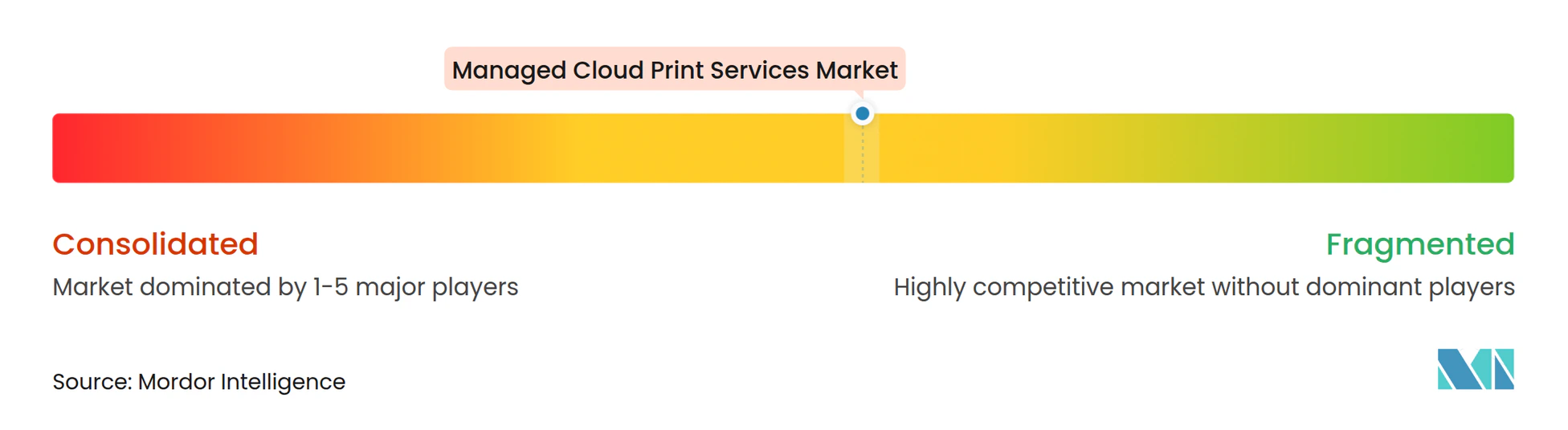
The managed cloud print services market is moderately consolidated among Xerox, HP, Ricoh, Canon, and Konica Minolta. These companies combine broad service networks, established enterprise relationships, device portfolios, and cloud management capabilities. Xerox completed its USD 1.5 billion acquisition of Lexmark in July 2025. The combined business serves more than 200,000 clients across 170 countries and brought together cloud, analytics, IoT, and device capabilities.
Competition also comes from software providers that support device-agnostic cloud printing. Vasion, Pharos, PaperCut, and Tungsten Automation's Printix compete through open platforms, automation, and the ability to manage mixed fleets. OEMs are responding by adding workflow automation and intelligent document capabilities to their managed service offers. Toshiba America Business Solutions acquired Youmebee in October 2025 and continued its directprint.io product as Coreza Print, a vendor-agnostic cloud service. Canon launched Connected Value Platform in October 2026, combining generative AI and Canon imaging technologies for home printers and office multifunction devices.
European privacy requirements create an opportunity for providers that keep document content out of shared cloud environments. Regional hosting, encrypted metadata, and tenant-isolated systems can help providers address the needs of regulated customers. Patent activity also indicates interest in AI-supported maintenance that uses device data to anticipate failures. These capabilities can reduce on-site service activity and support premium service models.
Managed Cloud Print Services Industry Leaders
-
Xerox Holdings Corporation
-
Ricoh Company, Ltd.
-
HP Inc.
-
Canon Inc.
-
Konica Minolta, Inc.
- *Disclaimer: Major Players sorted in no particular order
Recent Industry Developments
- October 2026: Canon Inc. launched Connected Value Platform, a cloud-based feature enhancement service combining generative AI and Canon imaging technologies to deliver new capabilities across home printers and office multifunction devices, marking Canon's first commercially available AI-embedded cloud print enhancement platform and signaling a strategic pivot toward software-defined print value.
- June 2026: The Mopria Alliance convened a member roundtable confirming that Mopria-certified devices now span more than 10,000 models across 24 printer companies, establishing a standardized, consistent compliance foundation for print audit trails under HIPAA, GDPR, SOX, and PCI DSS regulatory frameworks, significantly reducing the fragmentation that previously made fleet-wide compliance auditing a vendor-by-vendor exercise.
- April 2026: Canon's uniFLOW Online cloud print management platform expanded its multi-vendor ecosystem to include HP Workpath devices starting April 1, 2026, enabling a unified secure pull-print workflow and 360-degree cost analytics across mixed Canon and HP fleets from a single SaaS platform, removing a longstanding hardware-boundary barrier in enterprise mixed-fleet cloud print management.
- February 2026: Ricoh and Global Vision Multimedia Group entered full-scale strategic partnership negotiations toward potential capital ties from January 2026, aiming to expand managed workplace services across multiple Asia-Pacific markets. The companies had signed a memorandum of understanding in August 2025, reflecting Ricoh's prioritization of Asia-Pacific as a primary growth geography.
Global Managed Cloud Print Services Market Report Scope
The Managed Cloud Print Services Market refers to the ecosystem of outsourced, cloud-delivered print management solutions and services that enable organizations to centrally administer, secure, monitor, optimize, and maintain printing infrastructure through cloud-based platforms rather than on-premises print servers.
The Managed Cloud Print Services Market Report is Segmented by Channel Type (Printer and Copier Manufacturers, System Integrators and Resellers, and Independent Software Vendors), Service Type (Print Infrastructure Assessment, Managed Print Operations, Device and Fleet Management, Document Workflow Optimization, and Cloud Print Services), End-User Vertical (Banking, Financial Services, and Insurance, Healthcare, Government, Education, Retail and E-Commerce, Industrial Manufacturing, and Other End-User Verticals), and Geography (North America, South America, Europe, Asia-Pacific, Middle East, and Africa). The Market Forecasts are Provided in Terms of Value (USD).
| Printer and Copier Manufacturers |
| System Integrators and Resellers |
| Independent Software Vendors |
| Print Infrastructure Assessment |
| Managed Print Operations |
| Device and Fleet Management |
| Document Workflow Optimization |
| Cloud Print Services |
| Banking, Financial Services, and Insurance |
| Healthcare |
| Government |
| Education |
| Retail and E-Commerce |
| Industrial Manufacturing |
| Other End-User Verticals |
| North America | United States |
| Canada | |
| Mexico | |
| South America | Brazil |
| Argentina | |
| Rest of South America | |
| Europe | Germany |
| United Kingdom | |
| France | |
| Italy | |
| Spain | |
| Rest of Europe | |
| Asia-Pacific | China |
| Japan | |
| India | |
| South Korea | |
| Australia | |
| Singapore | |
| Rest of Asia-Pacific | |
| Middle East | Turkey |
| Saudi Arabia | |
| United Arab Emirates | |
| Qatar | |
| Rest of Middle East | |
| Africa | South Africa |
| Nigeria | |
| Rest of Africa |
| By Channel Type | Printer and Copier Manufacturers | |
| System Integrators and Resellers | ||
| Independent Software Vendors | ||
| By Service Type | Print Infrastructure Assessment | |
| Managed Print Operations | ||
| Device and Fleet Management | ||
| Document Workflow Optimization | ||
| Cloud Print Services | ||
| By End-User Vertical | Banking, Financial Services, and Insurance | |
| Healthcare | ||
| Government | ||
| Education | ||
| Retail and E-Commerce | ||
| Industrial Manufacturing | ||
| Other End-User Verticals | ||
| By Geography | North America | United States |
| Canada | ||
| Mexico | ||
| South America | Brazil | |
| Argentina | ||
| Rest of South America | ||
| Europe | Germany | |
| United Kingdom | ||
| France | ||
| Italy | ||
| Spain | ||
| Rest of Europe | ||
| Asia-Pacific | China | |
| Japan | ||
| India | ||
| South Korea | ||
| Australia | ||
| Singapore | ||
| Rest of Asia-Pacific | ||
| Middle East | Turkey | |
| Saudi Arabia | ||
| United Arab Emirates | ||
| Qatar | ||
| Rest of Middle East | ||
| Africa | South Africa | |
| Nigeria | ||
| Rest of Africa | ||
Key Questions Answered in the Report
What is the size of the managed cloud print services market?
The managed cloud print services market is valued at USD 8.61 billion in 2026 and is forecast to reach USD 16.71 billion by 2032, growing at a CAGR of 11.61%. The forecast reflects a shift toward serverless administration, secure release, and workflow-linked services across varied customer sites.
What is driving adoption of cloud print services?
Hybrid work, retirement of on-premises print servers, security requirements, and subscription procurement are supporting adoption. These needs make centralized administration and consistent access controls more important for distributed, regulated workplace fleets.
Which channel leads managed cloud print services?
Printer and copier manufacturers lead with a 61.98% market share in 2026, supported by installed fleet relationships and device management capabilities. Independent software vendors are expanding faster in mixed-fleet settings.
Which service area is expanding fastest through 2032?
Cloud print services are projected to expand at a CAGR of 12.45% through 2032 because serverless deployment removes print server overhead. Managed print operations remain the largest service category, holding a 32.09% market share in 2026.
Which end-user group is expanding fastest?
Healthcare is projected to expand at a CAGR of 12.15% through 2032. Health systems require authenticated printing and audit records across hospitals, outpatient facilities, and administrative locations.
Which region is projected to expand fastest?
Asia-Pacific is projected to expand at a CAGR of 12.65% through 2032, supported by enterprise digitalization and subscription adoption. China, India, Japan, South Korea, Australia, and Singapore contribute significantly to regional demand.