
Managed Mobile Printing Services Market Size and Share
Market Overview
| Study Period | 2021 - 2032 |
|---|---|
| Market Size (2027) | USD 2.62 Billion |
| Market Size (2032) | USD 5.33 Billion |
| Growth Rate (2027 - 2032) | 15.25 % |
| Fastest Growing Market | Asia-Pacific |
| Largest Market | North America |
| Market Concentration | Medium |
Major Players *Disclaimer: Major Players sorted in no particular order Image © Mordor Intelligence. Reuse requires attribution under CC BY 4.0. | |
Managed Mobile Printing Services Market Analysis by Mordor Intelligence
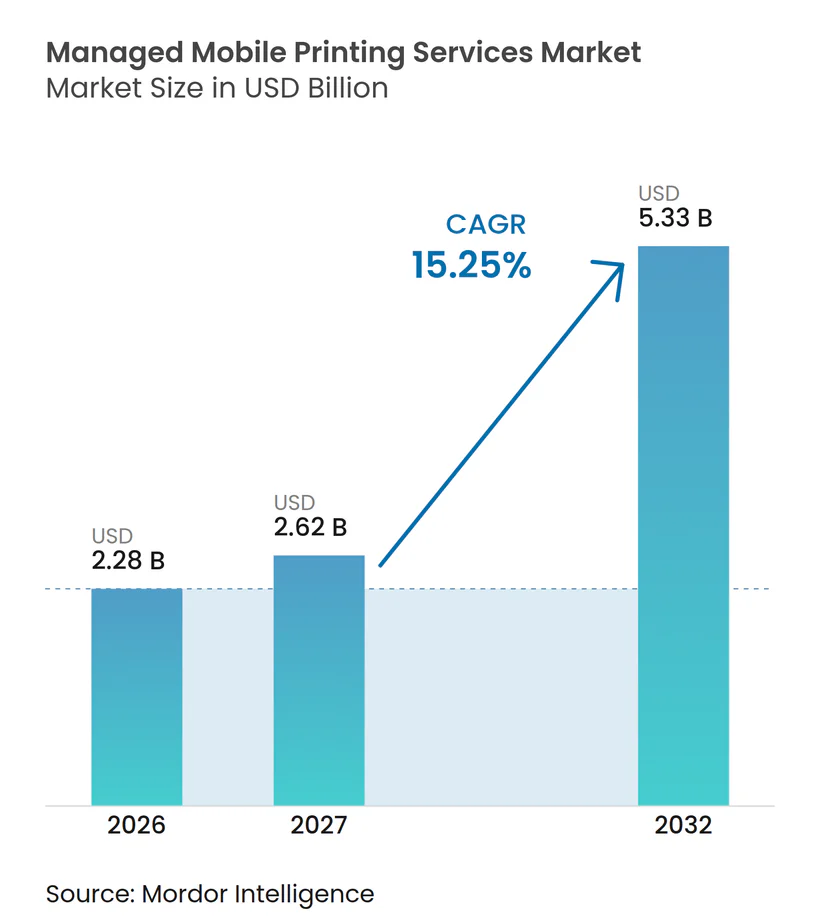
The Managed Mobile Printing Services Market size is projected to expand from USD 2.28 billion in 2026 to USD 2.62 billion in 2027, and to USD 5.33 billion by 2032, registering a CAGR of 15.25% between 2027 and 2032. The managed mobile printing services market is being shaped by work patterns in which employees move between offices, home locations, and temporary workspaces. This requires users to access printing via verified identities rather than a fixed network location. Providers are responding with services that combine access control, device management, job routing, reporting, and policy enforcement. The shift toward cloud administration also enables organizations to manage distributed fleets without maintaining the same level of local server infrastructure. Security requirements remain central because mobile workflows can expose documents when release controls, encryption, or audit records are not consistently applied. Competition therefore depends on the ability to support mixed fleets, integrate with enterprise identity systems, and offer recurring service capabilities that remain useful as page volumes decline.
Key Report Takeaways
- By function, Mobile Print Routing and Delivery led with 57.12% of the managed mobile printing services market share in 2026, while Mobile Print Security and Compliance is projected to expand at a 16.31% CAGR through 2032.
- By deployment mode, On-Premise held 68.19% of the managed mobile printing services market revenue in 2026, while Cloud-Based deployment is projected to expand at a 16.67% CAGR through 2032.
- By organization size, Large Enterprises accounted for 71.22% of the managed mobile printing services market size in 2026, while SMEs are projected to expand at a 16.95% CAGR through 2032.
- By end-user industry, Government and Public Administration accounted for 29.11% of the managed mobile printing services market in 2026, while Education and Research Institutions are projected to expand at a 15.76% CAGR through 2032.
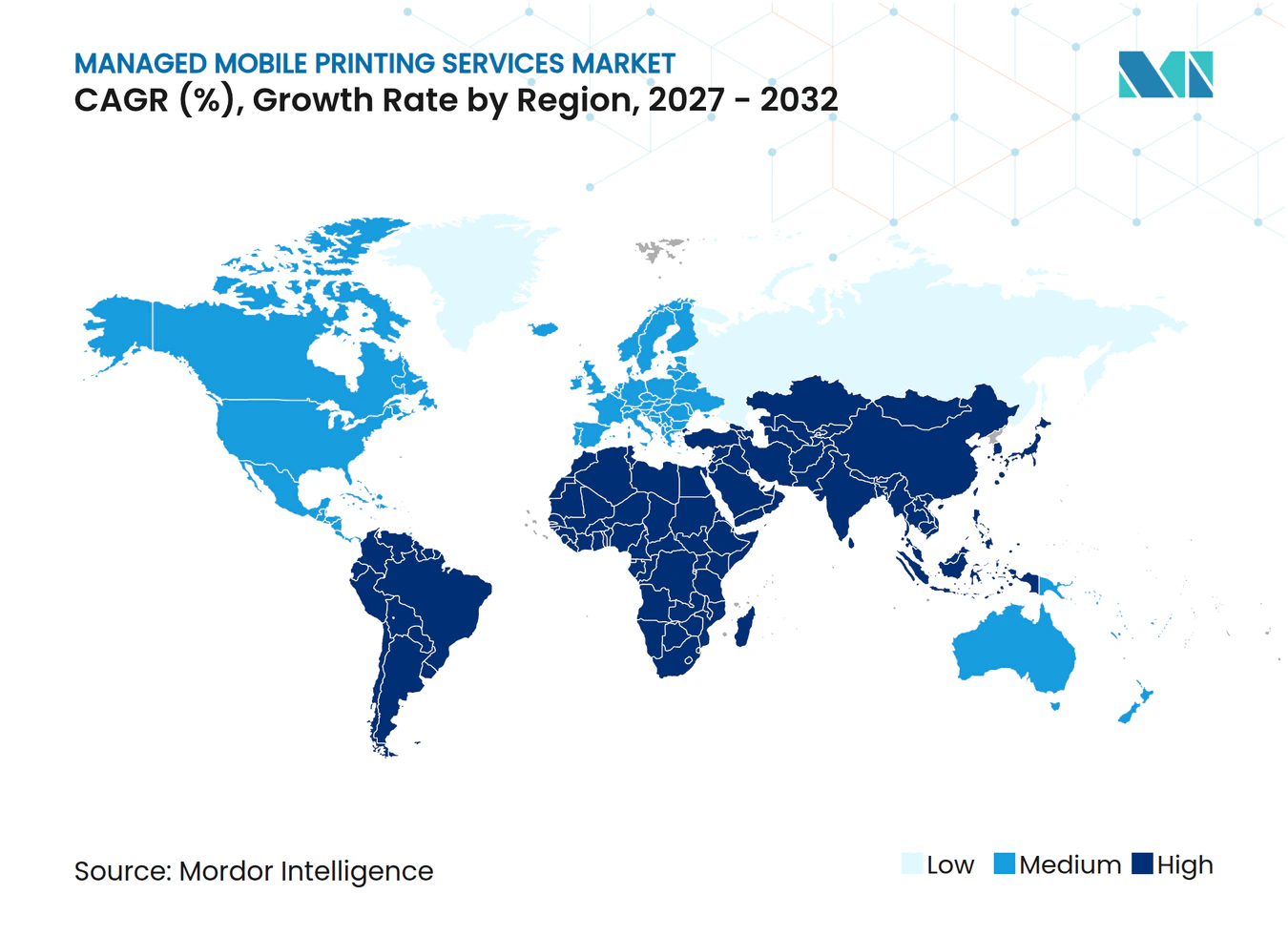
- By geography, North America accounted for 36.16% of the managed mobile printing services market in 2026, while Asia-Pacific is projected to expand at a 16.04% CAGR through 2032.
Note: Market numbers in this report are based on Mordor Intelligence's proprietary estimation framework, which combines nine months of actuals with Q4 projections for base year 2026.
Market Trends and Insights
Drivers Impact Analysis of Managed Mobile Printing Services Market*
| Driver | (~) % Impact on CAGR Forecast | Geographic Relevance | Impact Timeline |
|---|---|---|---|
| Expansion of Hybrid and Distributed Workforces | +4.2% | Global, concentrated in North America and Europe | Short term (≤ 2 years) |
| Rising Demand for Cloud-Based Print Management | +3.6% | Global, with early leadership in North America and Asia-Pacific | Medium term (2-4 years) |
| Increasing Print Security and Compliance Requirements | +2.8% | North America and Europe, with spillover to Asia-Pacific and the Middle East | Medium term (2-4 years) |
| Growth of Bring Your Own Device and Mobile-First Workflows | +2.2% | Global, strongest in Asia-Pacific and North America | Short term (≤ 2 years) |
| QR-Code and Touchless Release for Guest and Temporary Users | +1.4% | Global, with early use in healthcare and education-dense locations | Short term (≤ 2 years) |
| Mobile Print Telemetry as a New Source of Workflow Intelligence | +0.8% | North America, Europe, and Asia-Pacific | Long term (≥ 4 years) |
| Source: Mordor Intelligence | |||
Expansion of Hybrid and Distributed Workforces
Hybrid work changes the practical problem of print access because employees use several locations during a normal workweek. A service must connect permission to the person and their identity, not only to a desktop computer or a specific office network. The managed mobile printing services market benefits when organizations replace building-based print rules with consistent access policies across sites. Mobile authentication, held queues, and central administration help staff retrieve documents without leaving them exposed at an output tray. This need favors managed platforms that can apply the same controls to home-office, branch, and main-office users. It also directs procurement toward service layers that can sit above existing printer fleets rather than toward additional hardware.
Rising Demand for Cloud-Based Print Management
Cloud-based management reduces dependence on locally maintained print servers and provides IT teams with a single management layer for dispersed devices. Microsoft’s Universal Print Pull Print capability lets authorized users release held jobs at a registered printer, which supports secure printing from a cloud queue. This capability supports the managed mobile printing services market because distributed users need a consistent release process as they move between locations. Cloud platforms can also make policy updates, device visibility, and reporting more manageable for organizations with multi-site fleets. HP introduced Managed Print Cloud Services with integration to Microsoft Universal Print, showing how providers are aligning their service offers with cloud-to-cloud authentication and device administration. The main opportunity is not simply moving print jobs to the cloud, but combining cloud administration with dependable control of access, devices, and user experience.
Increasing Print Security and Compliance Requirements
Printing remains sensitive in organizations that handle government records, financial information, health documents, research material, and confidential business files. Mobile workflows introduce security considerations because users may initiate jobs on personal devices or from locations outside a corporate network. The managed mobile printing services market is gaining importance where organizations need authenticated release, controlled device access, and activity records. Microsoft’s Pull Print function addresses one part of this requirement by holding a job until the user authenticates at a registered printer. Ricoh’s cloud-ready intelligent MFP platform supports its CloudStream and Streamline NX offerings, reflecting vendor efforts to pair device infrastructure with cloud-based management and analytics.[1] Compliance needs can lengthen procurement reviews, but they also make security-focused service capabilities more valuable once a deployment proceeds.
Growth of Bring Your Own Device and Mobile-First Workflows
Bring-your-own-device policies increase the number of phones, tablets, and personal laptops that can print documents. Organizations then need a common policy layer that can manage access without assuming every device is corporate-owned. The Mopria Alliance describes mobile printing as a cross-device environment supported by a broad group of printer and software participants, which makes interoperability important for users and IT teams. QR-based release, web upload, and authenticated email-to-print methods can help organizations apply controls to both personal and managed devices. Y Soft expanded its cloud portfolio with SAFEQ Cloud Pro and SAFEQ Cloud Breeze, separating enterprise and SME needs while emphasizing cloud-native print and scan workflows. These workflows create opportunities for providers to extend an initial access-management deployment to include broader services for reporting, security, and chargebacks.
Restraints Impact Analysis of Managed Mobile Printing Services Market*
| Restraint | (~) % Impact on CAGR Forecast | Geographic Relevance | Impact Timeline |
|---|---|---|---|
| Cybersecurity and Data-Privacy Risks in Mobile Print Workflows | -0.8% | Global, acute in regulated industries in North America and Europe | Short term (≤ 2 years) |
| Declining Office Print Volumes and Digital Substitution | -0.6% | Global, most pronounced in Europe and advanced Asia-Pacific locations | Medium term (2-4 years) |
| Integration Complexity Across Mixed Printer Fleets | -0.4% | Global, with the highest friction in large enterprises with legacy infrastructure | Medium term (2-4 years) |
| Inconsistent Mobile Print Experience Across Guest Networks and Legacy Devices | -0.3% | Global, with greater impact in SME and education segments | Long term (≥ 4 years) |
| Source: Mordor Intelligence | |||
Cybersecurity and Data-Privacy Risks in Mobile Print Workflows
The same mobility that improves user access can create exposure when print jobs travel across Wi-Fi, cellular, Bluetooth, or guest networks. A mobile device may not have the same security controls as an organization-managed endpoint. Weak identity verification can also leave confidential documents waiting at an unattended printer. These risks can delay deployments as security teams review network design, user authentication, encryption, and audit requirements. The managed mobile printing services market must therefore demonstrate clear controls rather than treating security as an optional add-on. Services that support held printing and authenticated release can reduce one important source of document exposure.
Declining Office Print Volumes and Digital Substitution
Digital forms, electronic receipts, document collaboration, and digital communication reduce the need for some printed material. This places pressure on service models that depend heavily on the number of pages printed. The restraint is most significant where providers continue to price contracts primarily by page volume. The managed mobile printing services market can respond by placing more value on access control, reporting, policy management, and workflow support. These capabilities remain relevant even when an organization prints fewer pages, because users still need secure handling of documents that must be printed. Providers that also support related scan and document workflows can reduce their dependence on a single volume-based revenue source.
*Our forecasts treat driver/restraint impacts as directional, not additive. The impact forecasts reflect baseline growth, mix effects, and variable interactions.
Managed Mobile Printing Services Market Segment Analysis
By Function:
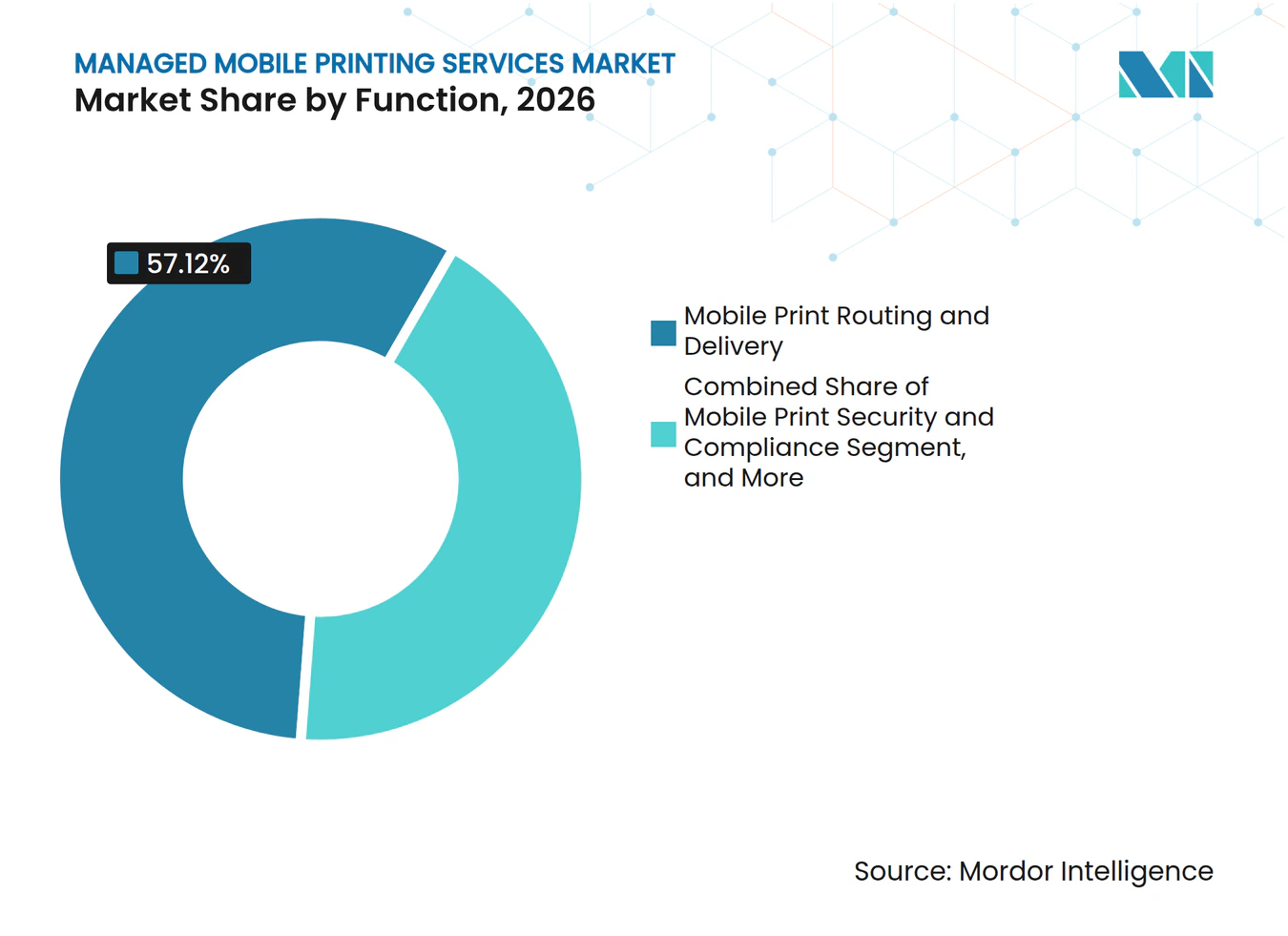
Print Routing Supports Core Demand While Security Services AccelerateMobile Print Routing and Delivery accounted for 57.12% of the managed mobile printing services market in 2026. This leading position reflects the role of routing, device discovery, and queue management in nearly every mobile print workflow. Before an organization can apply sophisticated controls, it must direct a user’s job to the right available device. A centralized routing service can also help users work across different offices without having to learn a separate local printing process at each location. The function is therefore foundational for organizations moving from device-specific printing to a managed service model. Print access and authentication are important related capabilities because users need to verify their identity before a job is released. Badge, PIN, QR code, and other release methods allow organizations to link the print job to a permitted user. Policy enforcement and other functions complete the portfolio by applying rules for devices, documents, and user groups. Routing tools can reduce uncertainty for users who encounter different printers across several buildings. They can also help administrators assign jobs according to device availability, location, or policy. These operational benefits keep routing central to the managed mobile printing services market.
Mobile Print Security and Compliance is projected to expand at a 16.31% CAGR through 2032. The category is becoming more important as organizations assess print infrastructure as part of broader information protection responsibilities. It supports services such as monitoring, audit record management, and controlled release rather than a one-time software feature alone. Ricoh’s cloud-ready intelligent MFP platform links its print hardware with CloudStream, Streamline NX, and managed print services, illustrating how vendors are combining device, management, and analytics capabilities. This combination gives providers a basis for ongoing subscriptions and service agreements. The managed mobile printing services industry also benefits when security features work across a mixed fleet instead of requiring a single printer brand. Organizations can then strengthen controls without undertaking a complete fleet replacement. This helps security services remain relevant even as the number of pages printed changes over time.



By Deployment Mode:
On-Premise Control Coexists With Cloud MigrationOn-Premise deployment held 68.19% of total revenue in 2026. Large organizations in government, BFSI, and healthcare often retain local infrastructure to maintain direct operational control over systems and sensitive job data. Their preference can reflect both established IT processes and a rejection of cloud technology. Many organizations use a hybrid approach that keeps selected hardware or data handling on site while moving management, reporting, or policy tasks to cloud systems. This approach lets IT teams modernize gradually while preserving controls that are already embedded in internal processes. It also makes the managed mobile printing services market relevant to customers at different stages of their infrastructure transition. Mixed deployment can support legacy devices while new applications are introduced in a controlled way. For providers, the ability to operate across local and cloud environments is a practical requirement for serving complex enterprise accounts. Local deployment also allows customers to determine where sensitive jobs are stored and processed. That control can remain important when internal policy limits the transfer of document information outside the organization. The managed mobile printing services market must therefore support transition paths rather than treating cloud and on-premise delivery as mutually exclusive choices.
Cloud-Based deployment is projected to expand at a 16.67% CAGR through 2032. Cloud delivery supports organizations seeking to reduce local server maintenance and manage distributed fleets through a single interface. Microsoft’s Pull Print feature makes a held job available for authenticated release at registered printers, providing cloud-managed print workflows with a direct security function. HP’s Managed Print Cloud Services also signaled vendor support for cloud-based administration through integration with Microsoft Universal Print.[2] The transition does not remove the need for local devices, network planning, or reliable user support. Instead, it changes where management and policy functions are administered. Cloud-based offers are particularly useful for organizations with multiple sites, limited local IT resources, or a need for consistent settings across offices. Their adoption depends on whether providers can satisfy security, interoperability, and data-handling requirements. Centralized administration can make it easier to apply a policy change across a dispersed printer fleet. It can also provide service teams with a single view of device status and user activity. These advantages reinforce the role of cloud delivery in the managed mobile printing services market.
By Organization Size:
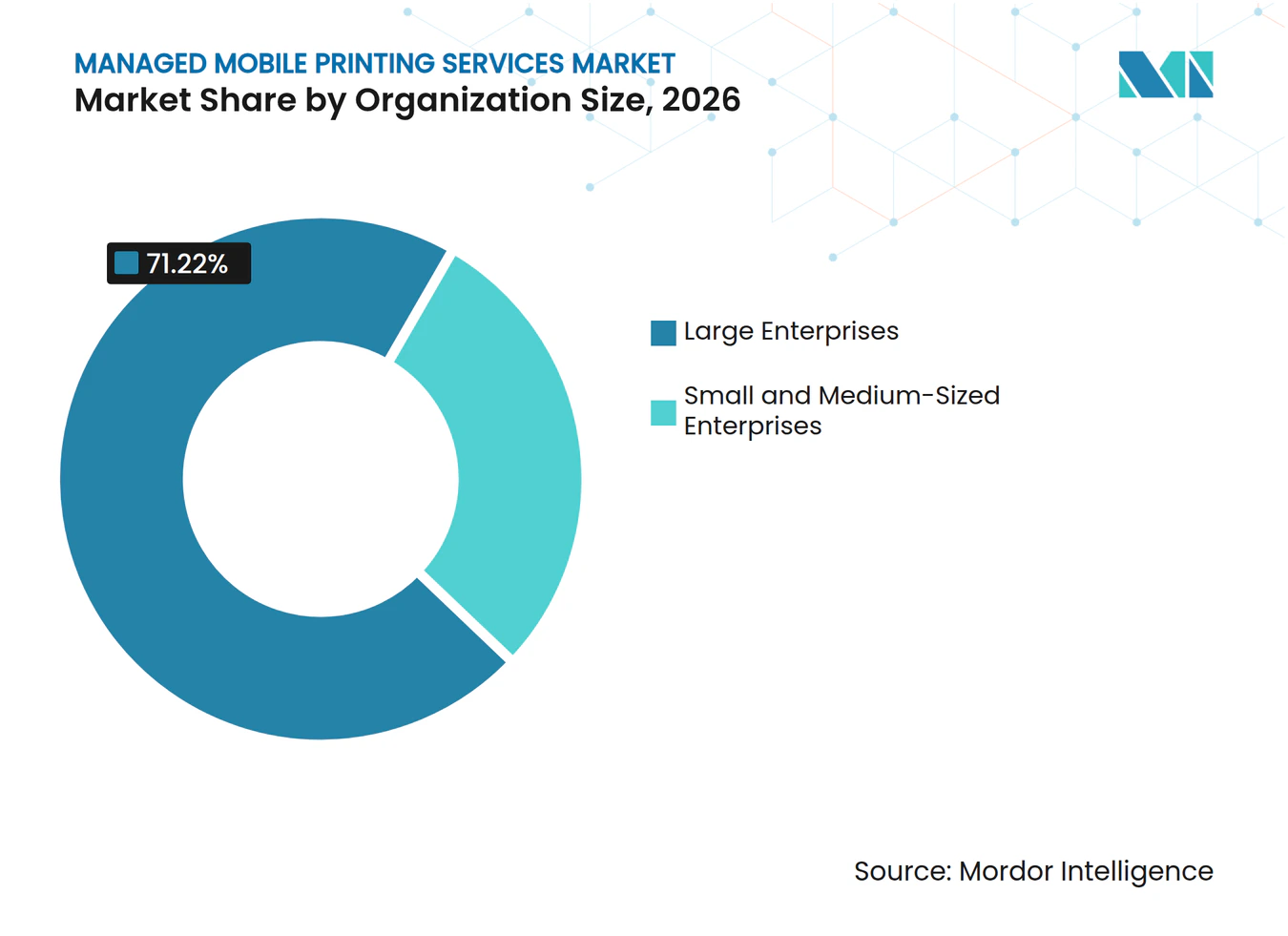
Large Enterprises Remain Established Customers as SMEs Adopt Cloud ServicesLarge Enterprises accounted for 71.22% of total revenue in 2026. Their share reflects long-standing managed print contracts, sizable fleets, distributed office networks, and the complexity of connecting print access with identity systems. Enterprise deployments often require coordination across security, facilities, procurement, and IT teams. This makes a managed platform valuable when it can offer a consistent process across dozens or hundreds of locations. Large organizations also have more legacy equipment that must be supported during modernization. Ricoh renewed a 5-year managed print services agreement with the University of California system in January 2026, covering 10 campuses, 6 health centers, and Lawrence Berkeley National Laboratory. The agreement illustrates the multi-location scope and long contract periods that can characterize this customer group. For the managed mobile printing services market, these accounts provide an installed base for security, mobility, and analytics upgrades over time. Enterprise customers also need a clear division of responsibility between internal teams and service providers. This makes implementation support, user training, and ongoing reporting important parts of a managed contract. Providers that can support these requirements without disrupting current operations can maintain durable customer relationships.
SMEs are projected to expand at a 16.95% CAGR through 2032. Small and medium-sized organizations have historically faced high costs because print management required local servers, specialized integration work, and ongoing administration. Cloud-native services can reduce that burden by offering centralized management with less infrastructure to maintain. Y Soft launched SAFEQ Cloud Pro and SAFEQ Cloud Breeze to address the distinct needs of large enterprises and SMEs, with Breeze focused on simpler workflows such as printer auto-discovery, updates, and one-touch scanning. These designs make managed services easier for organizations with smaller IT teams to consider. Subscription models can also spread costs over time rather than requiring extensive upfront deployment. The managed mobile printing services industry has an opportunity to serve SMEs when its offerings remain simple and do not require deep technical knowledge to operate. Success still depends on reliable support, clear pricing, and compatibility with existing devices. Smaller organizations often prefer a service that can be activated without extended disruption to staff routines. Straightforward onboarding can improve adoption when users have limited time for training. This supports a broader customer base for the managed mobile printing services market.

By End-User Industry:
Government Demand Leads While Education Gains MomentumGovernment and Public Administration accounted for 29.11% of total revenue in 2026. Public agencies often manage sensitive records and work across headquarters, regional offices, service centers, and field locations. Those conditions create a need for verified access, traceable activity, and consistent policy enforcement. Government deployments can also involve detailed procurement requirements that make service reliability and compliance capability central to vendor selection. The University of California agreement, renewed by Ricoh in 2026, covered 10 campuses, 6 health centers, and a national laboratory, showing the scale of complex public-sector and public-institution print environments. BFSI, healthcare and life sciences, and IT and telecommunications are important secondary customer groups because they also handle documents that require secure, authenticated processing. Each group has different workflow and compliance needs, which increases the value of configurable services. This diversity means providers must offer controls that can be adapted without having to rebuild the system for each account. Public agencies may also need to accommodate staff who work at service counters, regional sites, and temporary locations. A common print policy can help maintain consistent access practices across those settings. The managed mobile printing services market is useful where a central team must supervise many locations while keeping service available to local users.
Education and Research Institutions are projected to expand at a 15.76% CAGR through 2032. Universities and research centers have large populations of students, faculty, visitors, and researchers using personal devices. They also handle examination papers, research data, financial information, and administrative records that require appropriate controls. North Carolina State University announced improvements to its WolfPrint service in October 2025, demonstrating continued attention to the student print experience. The sector needs a model that provides self-service access while limiting the administrative workload for IT teams. Mobile release and quota management can help institutions support shared printer environments without leaving documents at the device. The managed mobile printing services market can also support campus users who move across libraries, residence halls, laboratories, and teaching buildings. Retail and e-commerce, industrial manufacturing, and other industries remain smaller customer groups but require specialized policies aligned with their own operational workflows. Their needs can range from employee document handling to distributed location management. Campus environments also require services that work for users with different levels of technical familiarity. Clear release instructions and dependable device availability can matter as much as underlying software capability. These needs make education a relevant area of expansion for the managed mobile printing services market.
Geography Analysis
North America Managed Mobile Printing Services Market
North America accounted for 36.16% of total revenue in 2026. The region combines mature enterprise IT environments, widespread use of managed print services, and substantial demand from government, BFSI, and healthcare organizations. The United States is an important national market because large organizations operate across extensive office, branch, campus, and field networks. These users need mobile access that can be managed consistently without relying on a single physical location. Government and BFSI remain important sources of demand because secure document handling and auditable access are critical in their workflows. Ricoh’s 2026 renewal with the University of California system shows the value of long-term, multi-site managed service relationships in the region. Canada and Mexico add to regional demand as organizations consider cloud administration within wider IT modernization programs. Providers in the region can build on an established base of enterprise print fleets and managed service contracts. The managed mobile printing services market can further develop as customers add mobile access and security controls to existing managed print arrangements.
Europe and South America Managed Mobile Printing Services Market
Europe is a significant region for the managed mobile printing services market because organizations place strong emphasis on data protection, secure systems, and workplace modernization. Germany, the United Kingdom, and France are central national markets within the region. Vendors that can support mixed fleets and meet local expectations for data handling are well positioned. Konica Minolta announced support for Windows Protected Print mode across Workplace Pure, YSOFT SAFEQ Cloud, and YSOFT SAFEQ solutions in February 2025.[3] This support helps organizations move toward a modern print stack without automatically replacing existing management software. South America is an emerging opportunity where cloud-native platforms can reduce reliance on local print servers. Ricoh launched CloudStream in South America in July 2025 as a serverless, multi-brand cloud printing platform for enterprise organizations. The offer combines centralized management and remote monitoring across Ricoh and non-Ricoh printer fleets.
APAC and MEA Managed Mobile Printing Services Market
Asia-Pacific is projected to expand at a 16.04% CAGR through 2032. Japan provides examples of innovation in cloud-connected and mobile printing for retail and enterprise settings. SATO introduced its Mobile Management System in April 2025 for centralized remote management of mobile terminals, including printers. India and South Korea are modernizing print infrastructure as large enterprises and government organizations support distributed workforces. China is a large opportunity because its manufacturing and service organizations operate extensive distributed networks. The Middle East also has high-value opportunities in public administration and hospitality settings where digital transformation programs are modernizing services. Africa remains at an earlier stage, with South Africa serving as a key location for vendor and channel activity. The managed mobile printing services market can advance in these regions where cloud platforms simplify deployment, and local partners can provide dependable support.
Competitive Landscape
Market Concentration
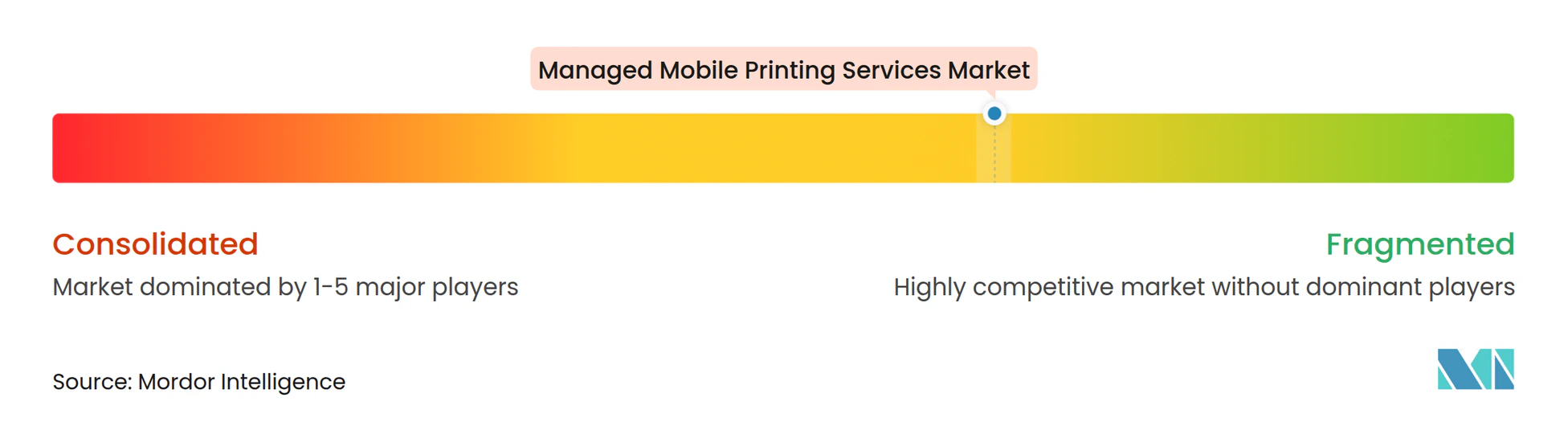
The managed mobile printing services market is moderately fragmented. Hardware OEMs and independent software vendors compete with different approaches to the same customer requirement. HP Inc., Ricoh Company Ltd., Canon Inc., Konica Minolta Inc., and Xerox Corporation can combine printers, fleet services, supply support, and mobile authentication within integrated offerings. PaperCut Software International Pty Ltd, Y Soft Corporation, and ThinPrint GmbH focus more strongly on software that can operate across mixed printer fleets. The choice often depends on whether a customer values close hardware integration or a device-agnostic management layer. Mixed fleets are common in large organizations, creating a role for platforms that enforce consistent access policies across multiple printer brands. The managed mobile printing services industry, therefore, competes on interoperability as well as on device features. Providers also need to show that security, reporting, and administration remain effective as customers move from local servers to cloud-managed systems.
The strongest opening areas include SME deployments, guest printing, education campuses, and enterprise users in emerging regions. SMEs need simpler deployment, lower administration requirements, and clear subscription terms. Guest and campus settings need user access that is convenient without sacrificing authentication and held release controls. Microsoft’s Universal Print provides a cloud print foundation for eligible Microsoft 365 environments and makes Pull Print available for authenticated release.[4] This can put pressure on providers whose offerings are limited to basic routing. It also expands the number of organizations familiar with cloud print management. Suppliers can differentiate through advanced mobile authentication, multi-vendor device management, detailed reporting, chargeback, and service support. These capabilities address operational needs that go beyond sending a document to a printer.
Strategic moves indicate an effort to more closely integrate hardware, cloud management, and workflow services. HP launched Managed Print Cloud Services in April 2025, featuring cloud-to-cloud integration with Microsoft Universal Print. Ricoh launched CloudStream in South America in July 2025, positioning it as a secure, serverless platform for a multi-brand fleet. Y Soft launched SAFEQ Cloud Pro and SAFEQ Cloud Breeze in September 2025, tailoring cloud-native offers to enterprise and SME requirements. Konica Minolta added Windows Protected Print support to several print solutions in February 2025, helping customers adopt the modern print stack while retaining their existing management environment. These moves support a competitive environment where vendors seek recurring service revenue and stronger integration with workplace identity and cloud platforms.
Managed Mobile Printing Services Industry Leaders
-
Xerox Corporation
-
HP Inc.
-
Canon Inc.
-
Ricoh Company, Ltd.
-
Konica Minolta, Inc.
- *Disclaimer: Major Players sorted in no particular order
Managed Mobile Printing Services Market Companies Covered in this Report
- Xerox Corporation
- HP Inc.
- Canon Inc.
- Ricoh Company, Ltd.
- Konica Minolta, Inc.
- Brother Industries, Ltd.
- Epson (Seiko Epson Corporation)
- Kyocera Document Solutions Inc.
- Sharp Corporation
- Toshiba Tec Corporation
- Lexmark International, Inc.
- Fujifilm Business Innovation Corp.
- OKI Electric Industry Co., Ltd.
- Zebra Technologies Corporation
- Honeywell International Inc.
- Star Micronics Co., Ltd.
- BIXOLON Co., Ltd.
- PaperCut Software International Pty Ltd
- ThinPrint GmbH
- Y Soft Corporation, a.s.
Recent Industry Developments in Managed Mobile Printing Services Market
- June 2026: Sharp Europe launched Synappx Manage, a cloud-based, real-time print fleet management solution that enables centralized administration of distributed devices, remote maintenance, automated workflow configuration, and sustainability reporting from a single cloud interface, without additional hardware. The launch extended Sharp's Synappx ecosystem to include full fleet visibility for hybrid work environments.
- April 2026: Ricoh USA launched the RICOH IM Series, from IM 2510 through IM 7010, a cloud-ready intelligent A3 MFP platform supporting RICOH CloudStream, RICOH Streamline NX, and RICOH Intelligent Managed Print Services, a modular, analytics-driven managed print framework covering multi-vendor fleet environments.
- January 2026: Ricoh USA renewed a 5-year UC-wide managed print services agreement with the University of California system, encompassing 10 campuses, 6 health centers, and the Lawrence Berkeley National Laboratory, confirming the long-cycle, high-value contract dynamics of managed mobile printing services in the education sector.
- September 2025: Y Soft Corporation launched SAFEQ Cloud Pro and SAFEQ Cloud Breeze, expanding its zero-trust cloud-native print platform to address both large enterprises and SMEs. Both products became commercially available in October 2025.
Global Managed Mobile Printing Services Market Report Scope
The Managed Mobile Printing Services Market comprises outsourced services that enable, secure, monitor, manage, and optimize printing from mobile devices, including smartphones, tablets, laptops, and other portable endpoints, across enterprise environments. These services include mobile print authentication, print routing, policy enforcement, secure print release, compliance management, monitoring, and administration of mobile printing workflows across on-premise, cloud, and hybrid infrastructures.
The Managed Mobile Printing Services Market Report is Segmented by Function (Mobile Print Access and Authentication, Mobile Print Routing and Delivery, Mobile Print Security and Compliance, Mobile Device Print Policy Enforcement, and Other Functions), Deployment Mode (On-Premise, Cloud-Based, and Hybrid), Organization Size (Large Enterprises, and Small and Medium-Sized Enterprises), End-User Industry (Banking, Financial Services, and Insurance [BFSI], Government and Public Administration, Healthcare and Life Sciences, IT and Telecommunication, Industrial Manufacturing, Retail and E-commerce, Education and Research Institutions, and Other End-User Industries), and Geography (North America, South America, Europe, Asia-Pacific, Middle East, and Africa). The Market Forecasts are Provided in Terms of Value (USD).
Segmentation Overview
| Mobile Print Access and Authentication |
| Mobile Print Routing and Delivery |
| Mobile Print Security and Compliance |
| Mobile Device Print Policy Enforcement |
| Other Functions |
| On-Premise |
| Cloud-Based |
| Hybrid |
| Large Enterprises |
| Small and Medium-Sized Enterprises |
| Banking, Financial Services, and Insurance (BFSI) |
| Government and Public Administration |
| Healthcare and Life Sciences |
| IT and Telecommunication |
| Industrial Manufacturing |
| Retail and E-commerce |
| Education and Research Institutions |
| Other End-User Industries |
| North America | United States |
| Canada | |
| Mexico | |
| South America | Brazil |
| Argentina | |
| Rest of South America | |
| Europe | Germany |
| United Kingdom | |
| France | |
| Italy | |
| Russia | |
| Rest of Europe | |
| Asia-Pacific | China |
| Japan | |
| India | |
| South Korea | |
| Rest of Asia-Pacific | |
| Middle East | Saudi Arabia |
| United Arab Emirates | |
| Rest of Middle East | |
| Africa | South Africa |
| Nigeria | |
| Rest of Africa |
| By Function | Mobile Print Access and Authentication | |
| Mobile Print Routing and Delivery | ||
| Mobile Print Security and Compliance | ||
| Mobile Device Print Policy Enforcement | ||
| Other Functions | ||
| By Deployment Mode | On-Premise | |
| Cloud-Based | ||
| Hybrid | ||
| By Organization Size | Large Enterprises | |
| Small and Medium-Sized Enterprises | ||
| By End-User Industry | Banking, Financial Services, and Insurance (BFSI) | |
| Government and Public Administration | ||
| Healthcare and Life Sciences | ||
| IT and Telecommunication | ||
| Industrial Manufacturing | ||
| Retail and E-commerce | ||
| Education and Research Institutions | ||
| Other End-User Industries | ||
| By Geography | North America | United States |
| Canada | ||
| Mexico | ||
| South America | Brazil | |
| Argentina | ||
| Rest of South America | ||
| Europe | Germany | |
| United Kingdom | ||
| France | ||
| Italy | ||
| Russia | ||
| Rest of Europe | ||
| Asia-Pacific | China | |
| Japan | ||
| India | ||
| South Korea | ||
| Rest of Asia-Pacific | ||
| Middle East | Saudi Arabia | |
| United Arab Emirates | ||
| Rest of Middle East | ||
| Africa | South Africa | |
| Nigeria | ||
| Rest of Africa | ||
Key Questions Answered in the Report
What is the managed mobile printing services market size?
The managed mobile printing services market is projected to expand from USD 2.28 billion in 2026 and USD 2.62 billion in 2027 to USD 5.33 billion by 2032, at a 15.25% CAGR.
What is driving demand for managed mobile printing services?
Hybrid work, cloud-based print management, mobile device use, and requirements for authenticated document release are supporting demand.
Which function has the largest share of managed mobile printing services?
Mobile Print Routing and Delivery held 57.12% in 2026 because routing, fleet discovery, and queue management are central to mobile print workflows.
Which deployment model is expanding fastest?
Cloud-Based deployment is projected to expand at a 16.67% CAGR through 2032 as organizations seek central management and lower local server reliance.
Which end-user group leads spending on managed mobile printing services?
Government and Public Administration accounted for 29.11% in 2026, supported by secure document handling needs across distributed operations.
Which region is expanding fastest for managed mobile printing services?
Asia-Pacific is projected to expand at a 16.04% CAGR through 2032 as enterprises and public organizations modernize print infrastructure.