
Managed Network Detection and Response Market Size and Share
Market Overview
| Study Period | 2021 - 2032 |
|---|---|
| Market Size (2027) | USD 8.86 Billion |
| Market Size (2032) | USD 22.58 Billion |
| Growth Rate (2027 - 2032) | 20.58 % |
| Fastest Growing Market | Asia-Pacific |
| Largest Market | North America |
| Market Concentration | Medium |
Major Players *Disclaimer: Major Players sorted in no particular order Image © Mordor Intelligence. Reuse requires attribution under CC BY 4.0. | |
Managed Network Detection and Response Market Analysis by Mordor Intelligence
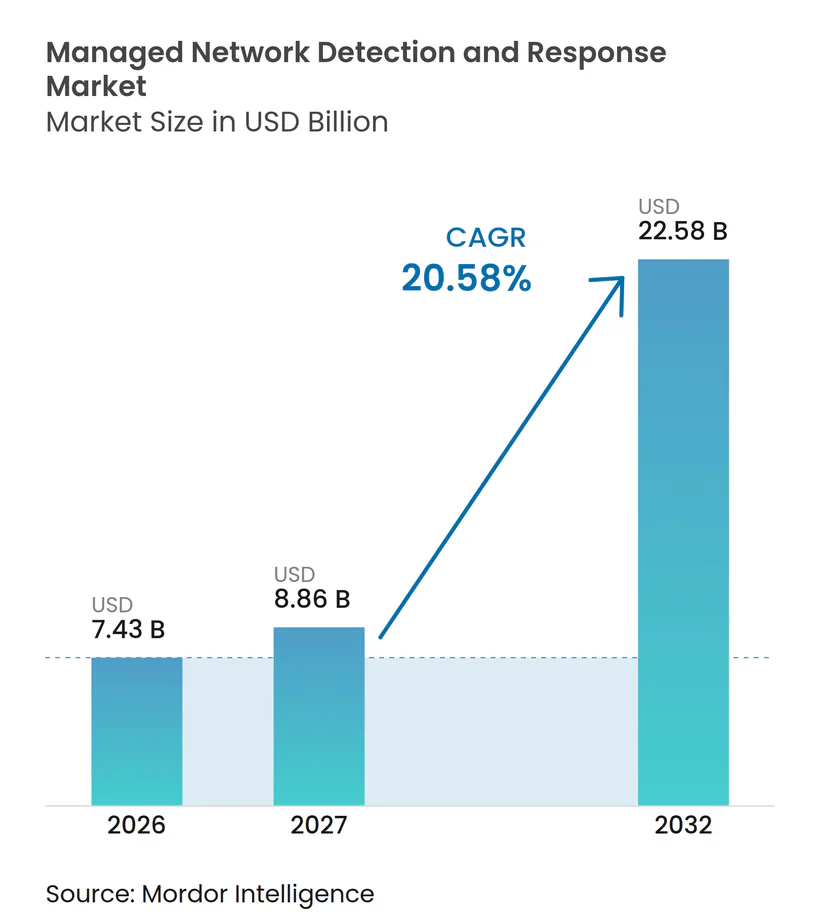
The managed network detection and response market size is projected to expand from USD 7.43 billion in 2026 to USD 8.86 billion in 2027, and to USD 22.58 billion by 2032, registering a CAGR of 20.58% from 2027 to 2032. Rising breach costs and the need for continuous monitoring have moved managed detection from a discretionary technology purchase to an operational requirement. IBM reported an average global breach cost of USD 4.99 million in 2026, while organizations that extensively use security AI and automation reported an average cost of USD 4.00 million, compared with USD 5.93 million for organizations without those capabilities. The managed network detection and response market is also benefiting from increased attacks against public-facing applications, ransomware activity, and a larger volume of disclosed vulnerabilities. Buyers increasingly evaluate providers on analyst capability, response reliability, and the ability to use automation while retaining clear oversight. This places established providers with broad telemetry, credible service delivery, and compliance-ready operating models in a stronger position.
Key Report Takeaways
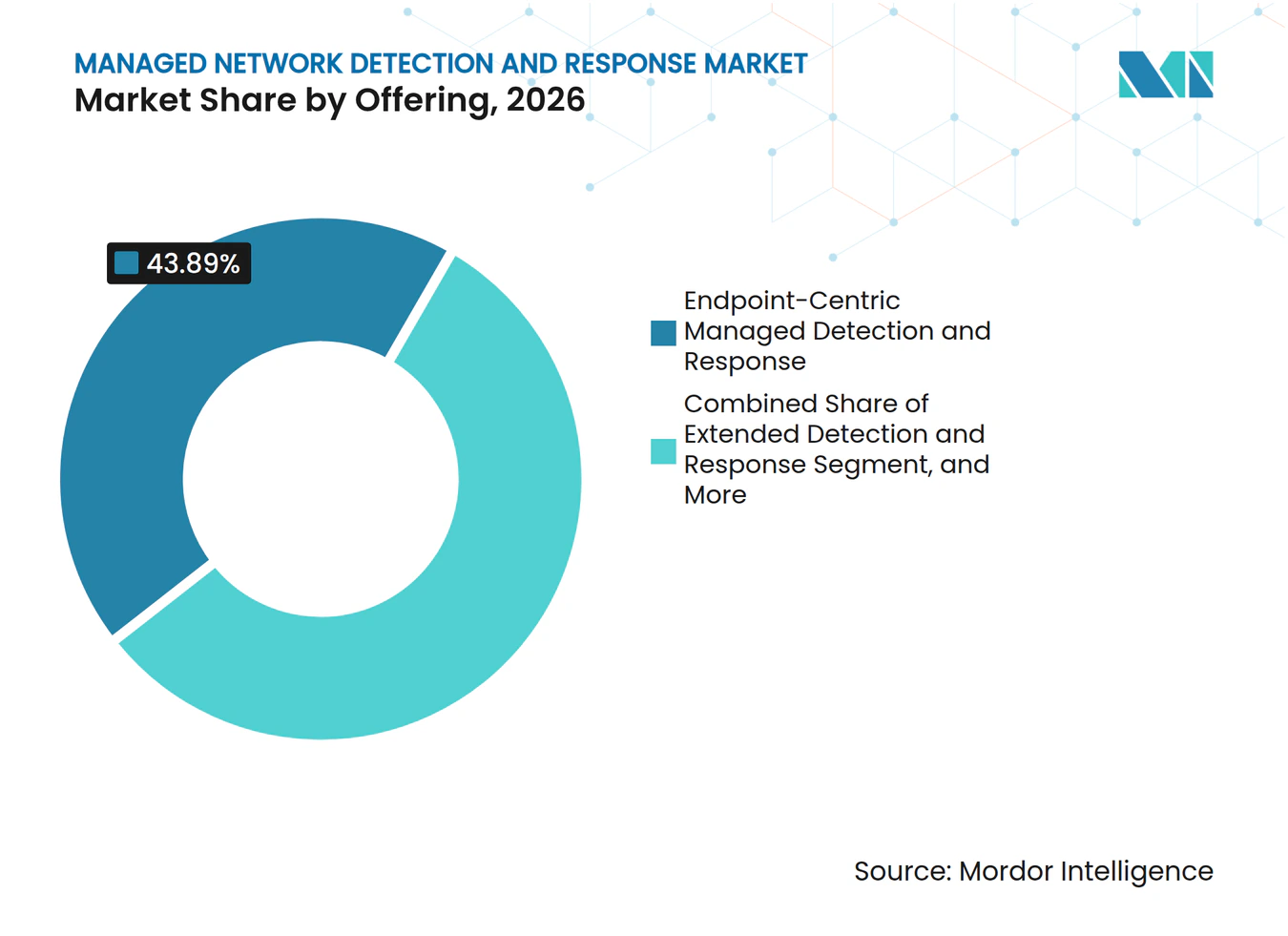
- By offering, Endpoint-Centric managed detection and response held 43.89% of the managed network detection and response market share in 2026, while Managed XDR is projected to expand at a 21.06% CAGR through 2032.
- By service model, Fully Managed Services held 38.64% revenue share in 2026, while Co-Managed Services are projected to grow at a CAGR of 21.13% through 2032.
- By deployment mode, cloud-based deployment accounted for 66.38% of revenue in 2026 and is projected to expand at a 21.22% CAGR through 2032.
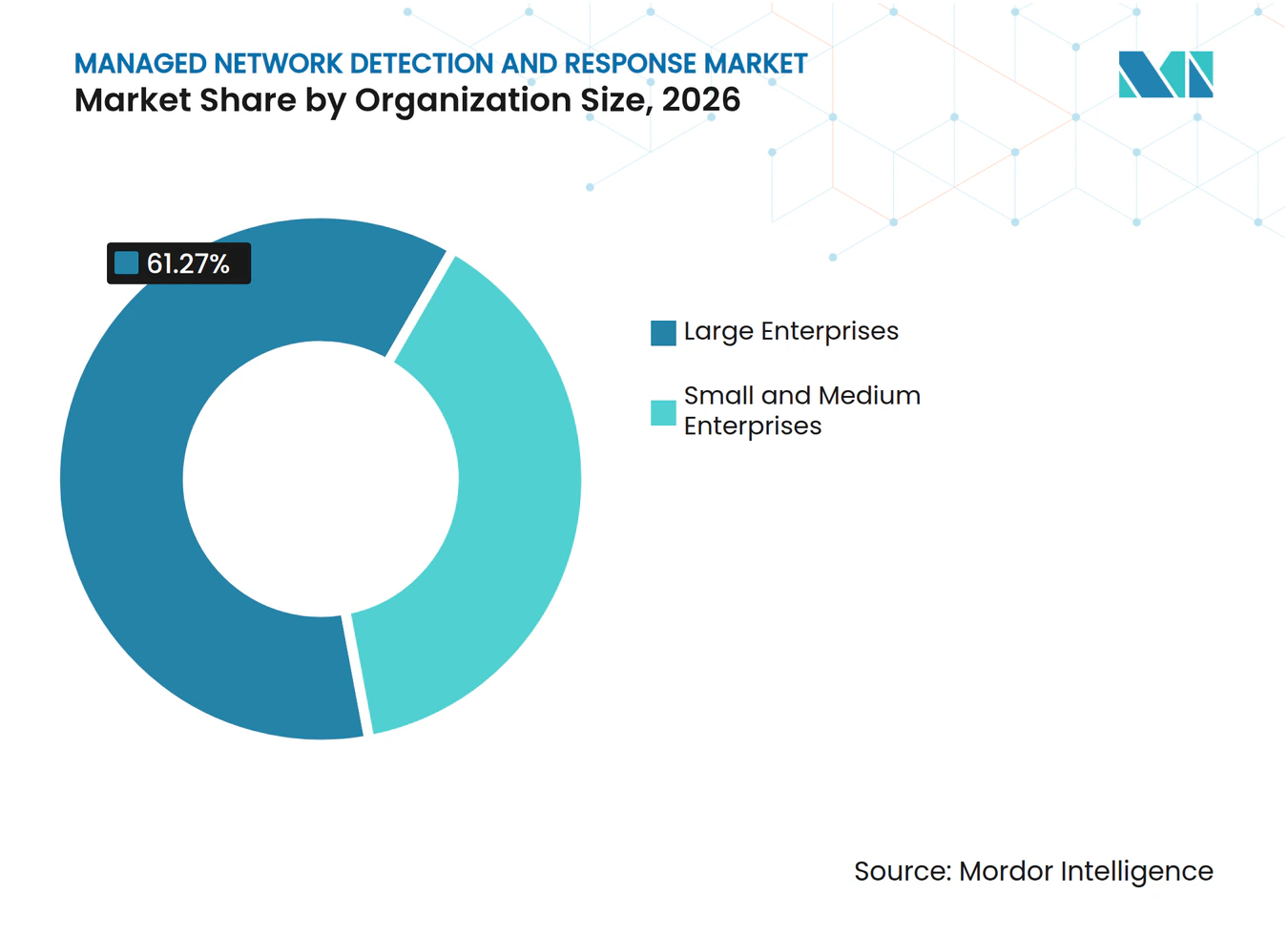
- By organization size, large enterprises held 61.27% revenue share in 2026, while small and medium enterprises are projected to expand at a 21.79% CAGR through 2032.
- By end-user industry, BFSI held 22.46% revenue share in 2026, while healthcare is projected to expand at a 21.27% CAGR through 2032.
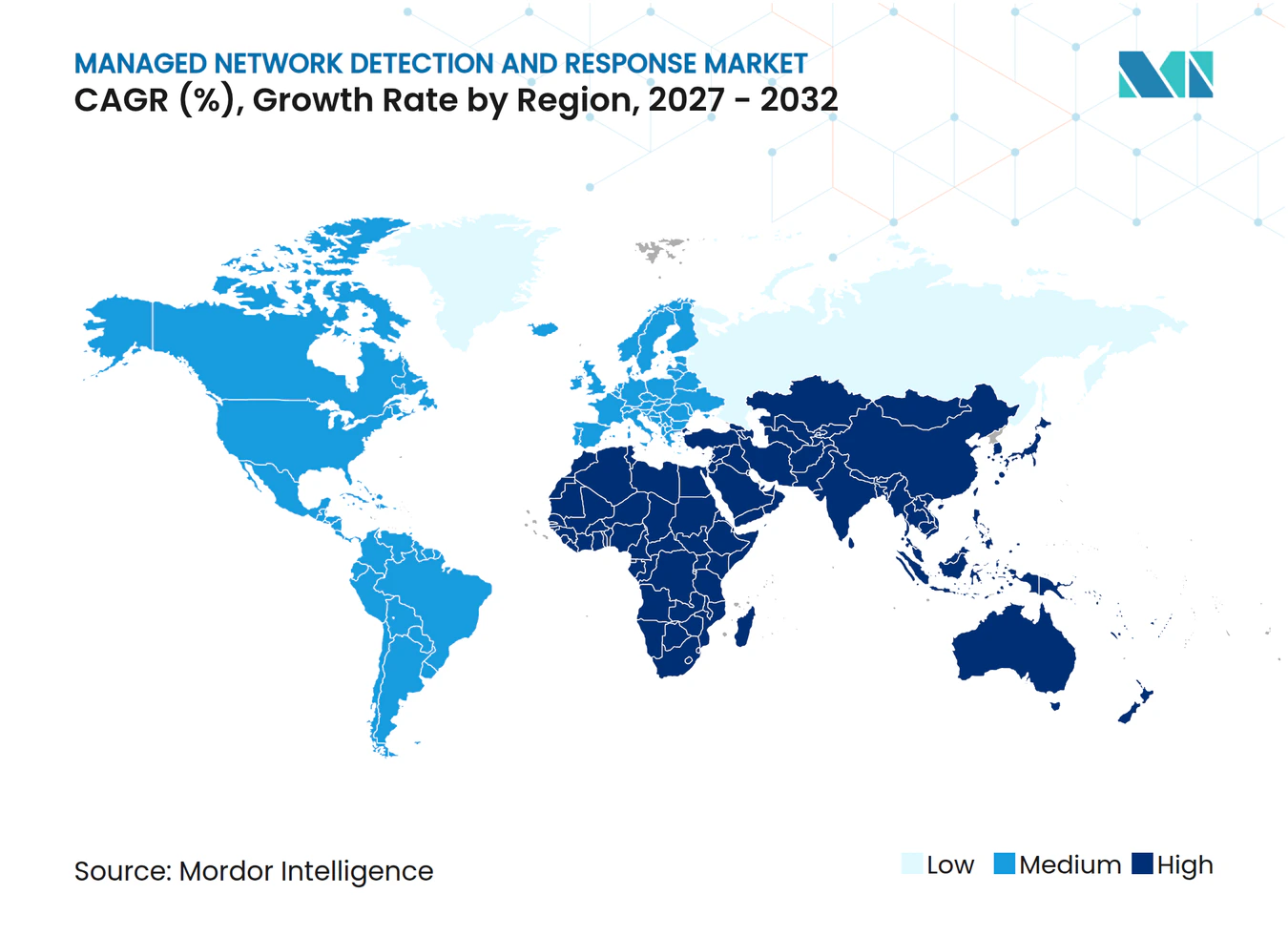
- By geography, North America held 47.38% revenue share in 2026, while Asia-Pacific is projected to expand at a 21.93% CAGR through 2032.
Note: Market numbers in this report are based on Mordor Intelligence's proprietary estimation framework, which combines nine months of actuals with Q4 projections for base year 2026.
Market Trends and Insights
Drivers Impact Analysis of Managed Network Detection and Response Market*
| Driver | (~) % Impact on CAGR Forecast | Geographic Relevance | Impact Timeline |
|---|---|---|---|
| Escalating Sophistication of Cyberattacks | +5.5% | Global | Short term (≤ 2 years) |
| Cybersecurity Talent Shortage | +4.8% | Global, most acute in Asia-Pacific and Middle East and Africa | Medium term (2-4 years) |
| Expanding Regulatory Compliance Mandates | +4.2% | North America and Europe, spill-over to Asia-Pacific | Medium term (2-4 years) |
| Cyber-Insurance Requirements and Premium Credits | +3.1% | North America and Europe | Short term (≤ 2 years) |
| OT and IoT Convergence Expanding the Attack Surface | +2.2% | Asia-Pacific and North America, spill-over to Middle East and Africa | Medium term (2-4 years) |
| AI-Enabled SOC Automation Lowering the Entry Barrier | +1.9% | Global | Long term (≥ 4 years) |
| Source: Mordor Intelligence | |||
Escalating Sophistication of Cyberattacks
Threat actors are using AI to speed reconnaissance, test weaknesses, and coordinate ransomware activity. IBM reported a 44% increase in attacks exploiting public-facing application vulnerabilities in 2025, highlighting how quickly a weakness can become an active exposure. IBM also reported that active ransomware groups increased 49% year over year during 2025. These conditions shorten the time available for internal teams to identify, investigate, and contain an incident. The managed network detection and response market benefits because providers can maintain continuous monitoring and structured response processes that many organizations cannot staff internally. Providers that can combine automated triage with accountable analyst review are better placed to support customers facing rapid and persistent threats.
Cybersecurity Talent Shortage
The shortage of cybersecurity professionals remains a direct driver for outsourced monitoring and response. The managed network detection and response market addresses this need by providing customers with access to trained analysts and established operating procedures, without requiring every organization to build a full internal security operations center. This can be especially relevant for organizations that need round-the-clock coverage but cannot support multiple specialist shifts. Service providers must still compete for the same skilled people, which increases the value of efficient workflows and analyst retention.
Expanding Regulatory Compliance Mandates
Regulatory requirements are increasing the need for continuous detection, documented response, and clear third-party oversight. The European Union’s Digital Operational Resilience Act took effect on January 17, 2025, and establishes digital operational resilience requirements for financial entities. These requirements make continuous security monitoring more relevant for financial organizations that need evidence of controls and incident-handling processes. The managed network detection and response market benefits from this demand, as providers can offer monitoring, incident support, reporting, and retained records within a defined service model. Buyers also need to assess whether their provider’s operations meet applicable data residency and third-party risk requirements. Contracts that include audit support and reporting can provide more predictable revenue than short-term security projects.
Cyber-Insurance Requirements and Premium Credits
Cyber-insurance underwriting is making security controls a more direct part of purchasing decisions. Delinea reported that 53% of cyber insurance policies required a formal threat detection and incident response plan in 2025, up from 40% the previous year.[1] This requirement supports adoption among organizations that might otherwise postpone investments in continuous monitoring. A managed detection service can help an applicant show that it has a defined process for identifying and handling threats. The commercial effect is strongest when insurers review the presence of endpoint detection, managed detection, or extended detection controls during underwriting. This shifts part of the purchase rationale from voluntary improvement toward eligibility and risk management.
Restraints Impact Analysis of Managed Network Detection and Response Market*
| Restraint | (~) % Impact on CAGR Forecast | Geographic Relevance | Impact Timeline |
|---|---|---|---|
| High Total Cost of Ownership for Small and Medium Enterprises | -1.5% | Global, most pronounced in South America and Southeast Asia | Short term (≤ 2 years) |
| Cross-Border Data-Sovereignty Constraints | -1.0% | Europe, Asia-Pacific core, spill-over to Middle East and Africa | Medium term (2-4 years) |
| False Positives and Alert-Fatigue Risk | -0.8% | Global | Short term (≤ 2 years) |
| Unmanaged IoT and Medical-Device Blind Spots | -0.5% | Asia-Pacific and North America | Long term (≥ 4 years) |
| Source: Mordor Intelligence | |||
High Total Cost of Ownership for Small and Medium Enterprises
Small and medium enterprises often recognize the value of managed detection but face tight technology budgets. Monthly service fees compete with staffing, software, compliance, and operating costs, even where the organization has clear exposure to cyber risk. The managed network detection and response market can therefore face slower adoption among organizations with fewer than 50 employees. The service may cost less than establishing a full internal security operations center, but procurement decisions are often based on immediate monthly spending. Buyers may also have difficulty comparing service tiers when vendors use different coverage, response, and endpoint pricing models. This creates a need for transparent offers that explain what continuous monitoring and remediation support include.
Cross-Border Data-Sovereignty Constraints
Data residency requirements can limit how providers collect, store, and analyze security telemetry across borders. Regulated customers may need assurance that logs, incident records, and supporting data remain within specific jurisdictions. This can increase infrastructure and staffing needs for providers that serve multiple regions. The managed network detection and response market must therefore adapt to local hosting, local response operations, and customer-specific data handling practices. The issue is particularly relevant in Europe and parts of the Asia-Pacific, where sovereignty requirements influence vendor selection. It can reduce the number of providers able to compete for regulated accounts.
*Our forecasts treat driver/restraint impacts as directional, not additive. The impact forecasts reflect baseline growth, mix effects, and variable interactions.
Managed Network Detection and Response Market Segment Analysis
By Offering:
Endpoint Telemetry Anchors Revenue as XDR Widens ScopeEndpoint-Centric managed detection and response held 43.89% of the offering-segment revenue in 2026. Endpoint telemetry remains central because it helps analysts reconstruct activity on devices where many attacks begin or leave evidence. It can show suspicious processes, persistent activity, credential use, and attempts to move laterally. Network-Centric managed detection and response addresses visibility gaps that endpoint-only coverage can leave open, particularly where unusual traffic patterns need investigation. Cloud-centric managed detection is gaining relevance as organizations move more workloads and data to cloud environments. OT and IoT managed detection serves a smaller but important role where operational systems connect with corporate networks.
Managed XDR is projected to expand at a 21.06% CAGR from 2027 to 2032. It combines signals from endpoints, networks, cloud platforms, identities, and email systems within a coordinated managed service. This can reduce the practical burden of investigating separate alerts across several security tools. CISA highlighted the need to reduce exposure of internet-facing systems after malicious activity affected more than 100 U.S. water and wastewater sector entities in July 2026.[2] The event illustrates why organizations with operational technology need visibility that extends beyond conventional endpoints. Providers that can relate these data sources in an understandable investigation are likely to be more relevant for complex customer environments.



By Service Model:
Fully Managed Leads While Co-Managed Captures GrowthFully Managed Services accounted for 38.64% of the service-model segment in 2026. This model is useful for organizations that need an external team to run monitoring, investigation, and response processes when internal security capacity is limited. It is particularly relevant for mid-market organizations that must manage technology, compliance, and incident response with small teams. Managed Threat Hunting adds an active search capability for buyers concerned about threats that may have avoided initial detection. Managed Incident Response and Remediation focuses on the period after a threat is validated, when the organization must contain it and restore operations. Managed SOC as a Service provides the managed network detection and response market with an outsourced operating structure for organizations that prefer subscription-based security operations.
Co-Managed Services are projected to expand at a 21.13% CAGR from 2027 to 2032. Large organizations often retain established internal teams but need help with off-hours coverage, specialized investigations, or periods of high incident volume. This arrangement allows the customer to keep existing tools and internal accountability while adding external capacity. It also makes service quality and integration important because the provider must work within the customer’s operating processes. Strong handoffs, shared case management, and clear escalation procedures are necessary for this model to work well. The managed network detection and response market will continue to reward providers that can support both full outsourcing and collaborative operating models.
By Deployment Mode:
Cloud Dominance Sustained by Architecture and Intelligence AdvantagesCloud-based deployment held 66.38% of the deployment-mode segment in 2026. Cloud delivery reduces the need for customers to buy and maintain dedicated on-premises security infrastructure. It can also make it easier to add coverage for new users, devices, and workloads as an organization changes. Hybrid environments remain important for companies that operate legacy systems alongside cloud applications. On-premises deployments continue to matter for defense, central banking, critical infrastructure, and other settings where air-gapped systems or data controls limit the transfer of logs to external systems. In the managed network detection and response market, deployment decisions remain tied to architecture, regulatory obligations, and risk tolerance.
Cloud-based deployment is projected to expand at a 21.22% CAGR from 2027 to 2032. Providers can use cloud platforms to improve services across a large customer base, including through shared operational learning and updated detection content. This does not remove the need for customer-specific controls, since each environment has different systems, users, and business risks. Cloud delivery is most attractive when the provider can show reliable security, clear data handling, and rapid implementation. For buyers, the value is often tied to ongoing access to improvements rather than a one-time platform installation. This gives cloud-based services a strong position as organizations add cloud workloads and seek simpler operating models.
By Organization Size:
Large Enterprises Anchor Revenue as SMEs AccelerateLarge enterprises held 61.27% of the organization-size segment in 2026. Their managed detection requirements are often broad because they operate multi-cloud environments, large device fleets, complex identity systems, and regulated business units. These buyers may combine monitoring with threat intelligence, vulnerability management, and incident response retainers within longer service agreements. Their need for audit trails and tailored operating procedures also supports higher-value engagements. Large enterprises can fund more extensive coverage, but they may require integration with internal teams and existing security platforms. This makes technical interoperability and service governance important selection criteria.
Small and medium enterprises are projected to expand at a 21.79% CAGR from 2027 to 2032. Insurance requirements and a limited supply of specialist talent can make outsourced monitoring more relevant for this group. The model can provide smaller organizations with continuous coverage without requiring a full internal security operations center. However, the service must remain affordable and easy to implement to reach a wider customer base. Providers need to limit onboarding complexity, explain the scope of response support, and maintain reliable service at lower price points. The managed network detection and response market has a material opportunity in this group when providers match standardized delivery with useful human support.

By End-User Industry:
BFSI Commands Share as Healthcare AcceleratesBFSI held 22.46% of the end-user industry segment in 2026. Financial institutions handle valuable data and face both financially motivated threats and regulatory oversight, which makes continuous monitoring a core security requirement. Their environments often include payment systems, customer-facing applications, third-party connections, and privileged access that require close control. They also need evidence that they can identify and respond to material incidents in accordance with defined procedures. This supports demand for managed detection services that can provide continuous analysis, investigation, reporting, and support during an incident. The segment remains important for providers with financial services knowledge and mature compliance practices.
Healthcare is projected to expand at a 21.27% CAGR from 2027 to 2032. Trellix reported 54.7 million detections across healthcare customers in its 2025 report and stated that healthcare remained the most expensive sector for data breaches for the 15th consecutive year. The report also documented a 29% increase in inpatient mortality rates at hospitals affected by cyberattacks. These risks make detection and response relevant to both patient safety and information security. Manufacturing, government, defense, retail, energy, utilities, transportation, and education also require managed coverage tailored to their specific systems and regulatory obligations. Energy and utilities have an added need for OT-aware monitoring as operational and enterprise networks become more connected.
Geography Analysis
North America Managed Network Detection and Response Market
North America held 47.38% of the managed network detection and response market share in 2026. IBM identified North America as the most-attacked region globally in 2025, accounting for 29% of total X-Force cases, up from 24% the previous year. The United States is the region’s main demand center because regulated sectors require continuous visibility and structured incident processes. Financial services, healthcare, critical infrastructure, and technology firms also have mature security purchasing practices.
Europe Managed Network Detection and Response Market
Europe remains a significant managed network detection and response market opportunity because regulatory requirements are translating security obligations into daily operating needs. DORA applies to covered financial entities across the European Union, while NIS2 establishes risk management and incident reporting responsibilities for covered organizations. The region requires providers to manage data residency, third-party oversight, and customer reporting with care. These conditions can favor providers with local operations and established compliance practices.
APAC, MEA and South America Managed Network Detection and Response Market
Japan is important within the Asia-Pacific as businesses seek managed support for security operations and detection programs. National policy activity and enterprise investment in security operations are supporting broader demand for managed services.[3] The Middle East, Africa, and South America remain smaller markets but offer scope for cloud-delivered services where local demand is developing. Saudi Arabia and the UAE are supported by major digitization programs, while South Africa, Egypt, Nigeria, Brazil, and Argentina are emerging opportunities with varied maturity levels. Providers that can meet local data and service expectations without requiring major upfront customer infrastructure can improve their position in these regions.
Competitive Landscape
Market Concentration
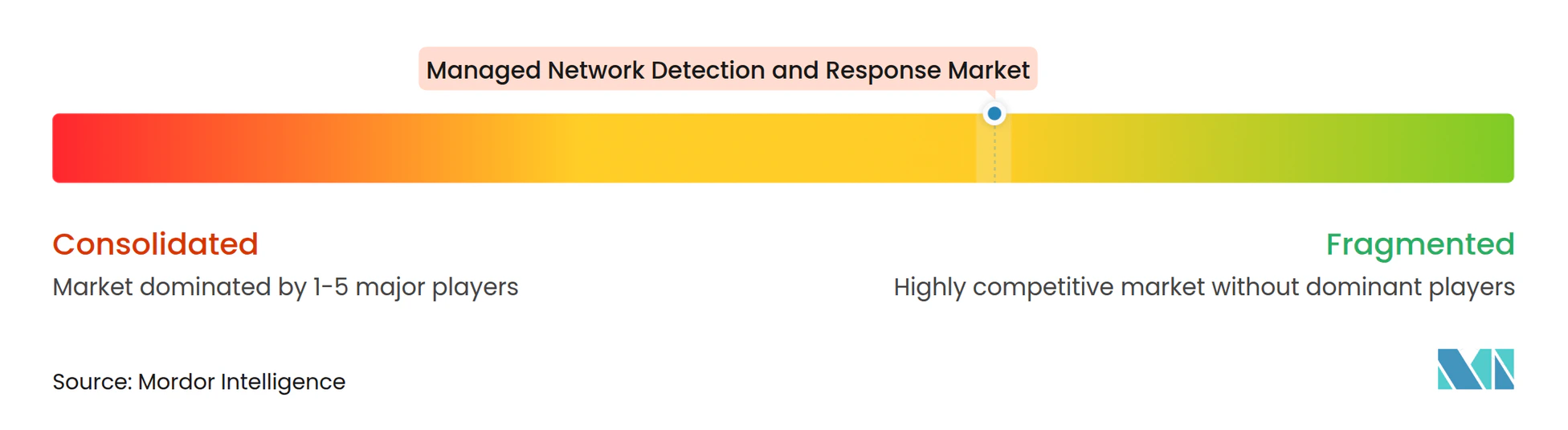
The managed network detection and response market is moderately fragmented. Pure-play providers, integrated platform vendors, technology services groups, and telecom-affiliated suppliers compete across overlapping customer groups. Arctic Wolf Networks, eSentire, Expel, Red Canary, and Deepwatch compete through analyst capability and response speed. CrowdStrike, SentinelOne, and Sophos use their endpoint and security platforms to support managed offerings. IBM, Google’s Mandiant, Accenture, Deloitte, NTT Security Holdings, AT&T Cybersecurity, and Verizon Business compete where delivery reach, governance, or integrated network operations are material customer requirements.
Providers are increasingly focusing on AI-supported security operations, but customer confidence depends on whether the service remains auditable and accountable. SentinelOne launched Singularity Agentic Detection and Response in October 2026 to provide runtime detection and governance for AI agents. Rapid7 acquired Kenzo Security in March 2026 to strengthen preemptive, AI-powered security operations. eSentire acquired an AI security startup in September 2026 to add AI observability and control capabilities to the Atlas platform. These actions show that competitors are seeking to improve alert handling, investigation, and response without removing human oversight.
Opportunity areas include OT and IoT-aware managed detection, sovereign-cloud-compatible services, and co-managed programs that support internal teams. OT and IoT coverage is important for industrial operators that cannot rely only on conventional endpoint monitoring, while data sovereignty creates demand for regional operations and localized infrastructure among regulated buyers. Co-managed services can appeal to enterprises that want support for routine cases and faster escalation while keeping decision authority for serious incidents. The ACM review of AI use in security operations found that 65% of the reviewed research focused on detection automation, while recovery and explainability received less attention, leaving room for providers that connect faster triage with clear evidence and practical recovery support.
Managed Network Detection and Response Industry Leaders
-
Arctic Wolf Networks, Inc.
-
CrowdStrike Holdings, Inc.
-
Rapid7, Inc.
-
eSentire Inc.
-
SentinelOne, Inc.
- *Disclaimer: Major Players sorted in no particular order
Managed Network Detection and Response Market Companies Covered in this Report
- Arctic Wolf Networks, Inc.
- CrowdStrike Holdings, Inc.
- Rapid7, Inc.
- eSentire Inc.
- SentinelOne, Inc.
- Secureworks, Inc.
- Red Canary, Inc.
- Expel, Inc.
- ReliaQuest, LLC
- Kroll, LLC
- Proficio, Inc.
- Trustwave Holdings, Inc.
- Binary Defense Systems, Inc.
- NTT Security Holdings Corporation
- NCC Group plc
- Sophos Group plc
- Palo Alto Networks, Inc.
- IBM Corporation
- Deloitte Touche Tohmatsu Ltd.
- Accenture plc
- Optiv Security Inc.
- KPMG International Ltd.
- PwC Advisory Services LLP
- AT&T Cybersecurity
- Verizon Business Group
- Bitdefender
- Deepwatch, Inc.
- Huntress Labs Incorporated
Recent Industry Developments in Managed Network Detection and Response Market
- October 2026: SentinelOne launched Singularity Agentic Detection and Response (ADR), providing runtime detection and governance of AI agents across endpoints, cloud, and enterprise environments, with in-line prevention of prompt injection, jailbreaks, and credential exfiltration. The product extends managed detection coverage to the AI system attack surface, responding to enterprise demand driven by widespread agentic AI adoption.
- October 2026: Rapid7 launched Rapid7 Intelligence, a threat data platform aggregating and operationalizing threat intelligence across MDR and exposure management workflows, strengthening proactive detection context for managed service customers.
- September 2026: eSentire acquired a stealth-mode AI security startup to embed AI observability and control capabilities into its Atlas platform, expanding managed detection to encompass AI-model behavior monitoring alongside traditional endpoint, network, and cloud threat signals.
- May 2026: Arctic Wolf announced the Aurora Agentic SOC at RSAC 2026, built on the Aurora Superintelligence Platform combining a proprietary knowledge graph with swarm-agent architecture. The system processes over 10 trillion cybersecurity events per week across more than 10,000 customers, enabling autonomous SOC workflow execution at scale.
Global Managed Network Detection and Response Market Report Scope
The managed network detection and response market comprises third-party cybersecurity services that continuously monitor, detect, investigate, and respond to threats across an organization's network infrastructure. These services use advanced analytics, threat intelligence, automation, and security expertise to identify suspicious activities, detect known and emerging threats, and support rapid incident containment and remediation. Managed network detection and response providers typically offer 24/7 monitoring and help organizations strengthen network security, reduce threat response times, and address cybersecurity skill gaps without maintaining an extensive in-house security operations center.
The Managed Network Detection and Response Market Report is Segmented by Offering (Endpoint-Centric Managed Detection and Response, Network-Centric Managed Detection and Response, Cloud-Centric Managed Detection and Response, OT and IoT Managed Detection and Response, and Managed Extended Detection and Response), Service Model (Fully Managed Services, Co-Managed Services, Managed Threat Hunting, Managed Incident Response and Remediation, and Managed Security Operations Center as a Service), Deployment Mode (Cloud-Based, On-Premises, and Hybrid), Organization Size (Small and Medium Enterprises and Large Enterprises), End-User Industry (Information Technology and Telecommunications, BFSI, Healthcare, Retail and E-Commerce, Manufacturing, Government and Defense, and Other End-User Industries), and Geography (North America, South America, Europe, Asia-Pacific, Middle East, and Africa). The Market Forecasts are Provided in Terms of Value (USD).
Segmentation Overview
| Endpoint-Centric Managed Detection and Response |
| Network-Centric Managed Detection and Response |
| Cloud-Centric Managed Detection and Response |
| OT and IoT Managed Detection and Response |
| Extended Detection and Response |
| Fully Managed Services |
| Co-Managed Services |
| Managed Threat Hunting |
| Managed Incident Response and Remediation |
| Managed Security Operations Center as a Service |
| Cloud-Based |
| On-Premises |
| Hybrid |
| Small and Medium Enterprises |
| Large Enterprises |
| Information Technology and Telecommunications |
| BFSI |
| Healthcare |
| Retail and E-Commerce |
| Manufacturing |
| Government and Defense |
| Other End-User Industries |
| North America | United States |
| Canada | |
| Mexico | |
| South America | Brazil |
| Argentina | |
| Rest of South America | |
| Europe | Germany |
| United Kingdom | |
| France | |
| Italy | |
| Spain | |
| Russia | |
| Rest of Europe | |
| Asia-Pacific | China |
| India | |
| Japan | |
| South Korea | |
| Australia | |
| Rest of Asia-Pacific | |
| Middle East | Saudi Arabia |
| United Arab Emirates | |
| Turkey | |
| Rest of Middle East | |
| Africa | South Africa |
| Egypt | |
| Nigeria | |
| Rest of Africa |
| By Offering | Endpoint-Centric Managed Detection and Response | |
| Network-Centric Managed Detection and Response | ||
| Cloud-Centric Managed Detection and Response | ||
| OT and IoT Managed Detection and Response | ||
| Extended Detection and Response | ||
| By Service Model | Fully Managed Services | |
| Co-Managed Services | ||
| Managed Threat Hunting | ||
| Managed Incident Response and Remediation | ||
| Managed Security Operations Center as a Service | ||
| By Deployment Mode | Cloud-Based | |
| On-Premises | ||
| Hybrid | ||
| By Organization Size | Small and Medium Enterprises | |
| Large Enterprises | ||
| By End-User Industry | Information Technology and Telecommunications | |
| BFSI | ||
| Healthcare | ||
| Retail and E-Commerce | ||
| Manufacturing | ||
| Government and Defense | ||
| Other End-User Industries | ||
| By Geography | North America | United States |
| Canada | ||
| Mexico | ||
| South America | Brazil | |
| Argentina | ||
| Rest of South America | ||
| Europe | Germany | |
| United Kingdom | ||
| France | ||
| Italy | ||
| Spain | ||
| Russia | ||
| Rest of Europe | ||
| Asia-Pacific | China | |
| India | ||
| Japan | ||
| South Korea | ||
| Australia | ||
| Rest of Asia-Pacific | ||
| Middle East | Saudi Arabia | |
| United Arab Emirates | ||
| Turkey | ||
| Rest of Middle East | ||
| Africa | South Africa | |
| Egypt | ||
| Nigeria | ||
| Rest of Africa | ||
Key Questions Answered in the Report
What is the managed network detection and response market size?
The managed network detection and response market is projected to increase from USD 7.43 billion in 2026 and USD 8.86 billion in 2027 to USD 22.58 billion by 2032, at a 20.58% CAGR.
What is driving demand for managed detection and response services?
Higher attack activity, cybersecurity staffing gaps, compliance obligations, and insurance requirements are increasing demand for continuous monitoring and response support.
Which offering is growing fastest?
Managed XDR is projected to expand at a 21.06% CAGR through 2032 as organizations seek unified coverage across endpoints, networks, cloud, identity, and email.
Why are small and medium enterprises adopting managed detection services?
Small and medium enterprises are projected to grow at a 21.79% CAGR as they seek round-the-clock coverage without building a full internal security operations center.
Which end-user sector has the strongest growth outlook?
Healthcare is projected to expand at a 21.27% CAGR through 2032 because cyber incidents can disrupt care delivery and create significant security and patient-safety risks.
Which region is expected to grow fastest?
Asia-Pacific is projected to expand at a 21.93% CAGR through 2032, supported by cloud adoption, rising cyber risk, and a limited supply of cybersecurity professionals.