
Managed Cloud Detection and Response Services Market Size and Share
Market Overview
| Study Period | 2021 - 2032 |
|---|---|
| Market Size (2027) | USD 3.76 Billion |
| Market Size (2032) | USD 8.52 Billion |
| Growth Rate (2027 - 2032) | 17.77 % |
| Fastest Growing Market | Asia-Pacific |
| Largest Market | North America |
| Market Concentration | Medium |
Major Players *Disclaimer: Major Players sorted in no particular order Image © Mordor Intelligence. Reuse requires attribution under CC BY 4.0. | |
Managed Cloud Detection and Response Services Market Analysis by Mordor Intelligence
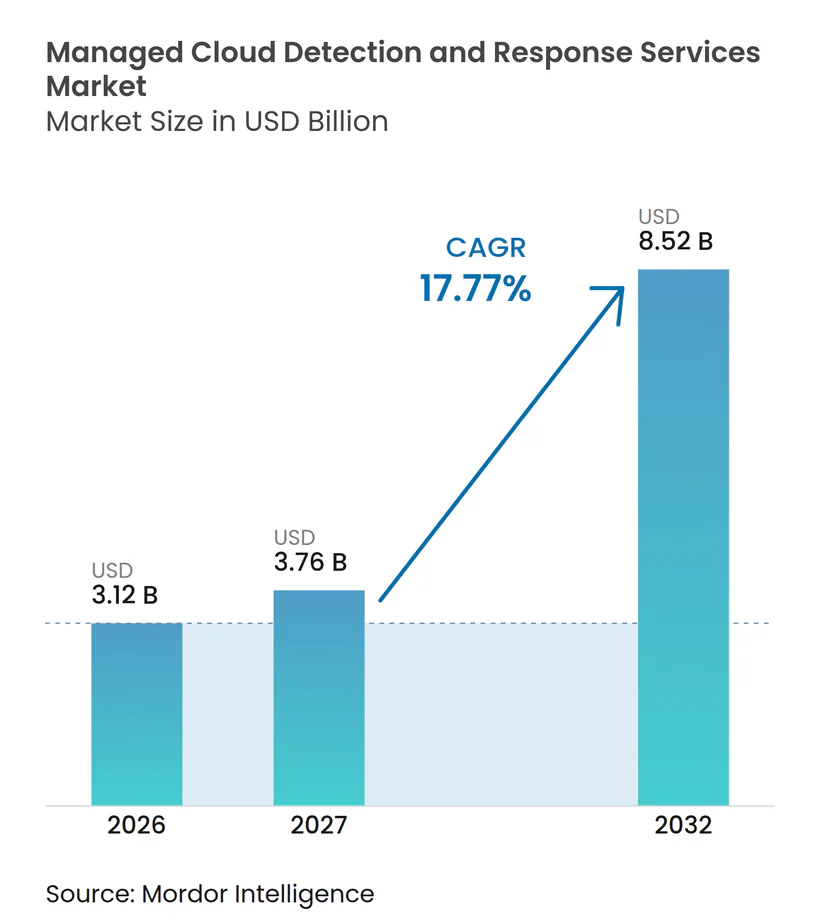
The Managed cloud detection and response services market size is projected to expand from USD 3.12 billion in 2026 and USD 3.76 billion in 2027 to USD 8.52 billion by 2032, registering a CAGR of 17.77% between 2027 to 2032. Enterprises are moving from perimeter-focused security toward continuous monitoring of cloud workloads, identities, and runtime activity. Multi-cloud adoption adds separate tools, policies, and telemetry streams that internal security teams must coordinate. Identity-based intrusions and compliance obligations make continuous detection a more important operational requirement. The managed cloud detection and response services market also benefits when organizations cannot hire enough cloud-security staff to operate internal programs at scale. Providers are responding through automation, identity coverage, and bundled security platforms that bring monitoring and response into the same service.
Key Report Takeaways
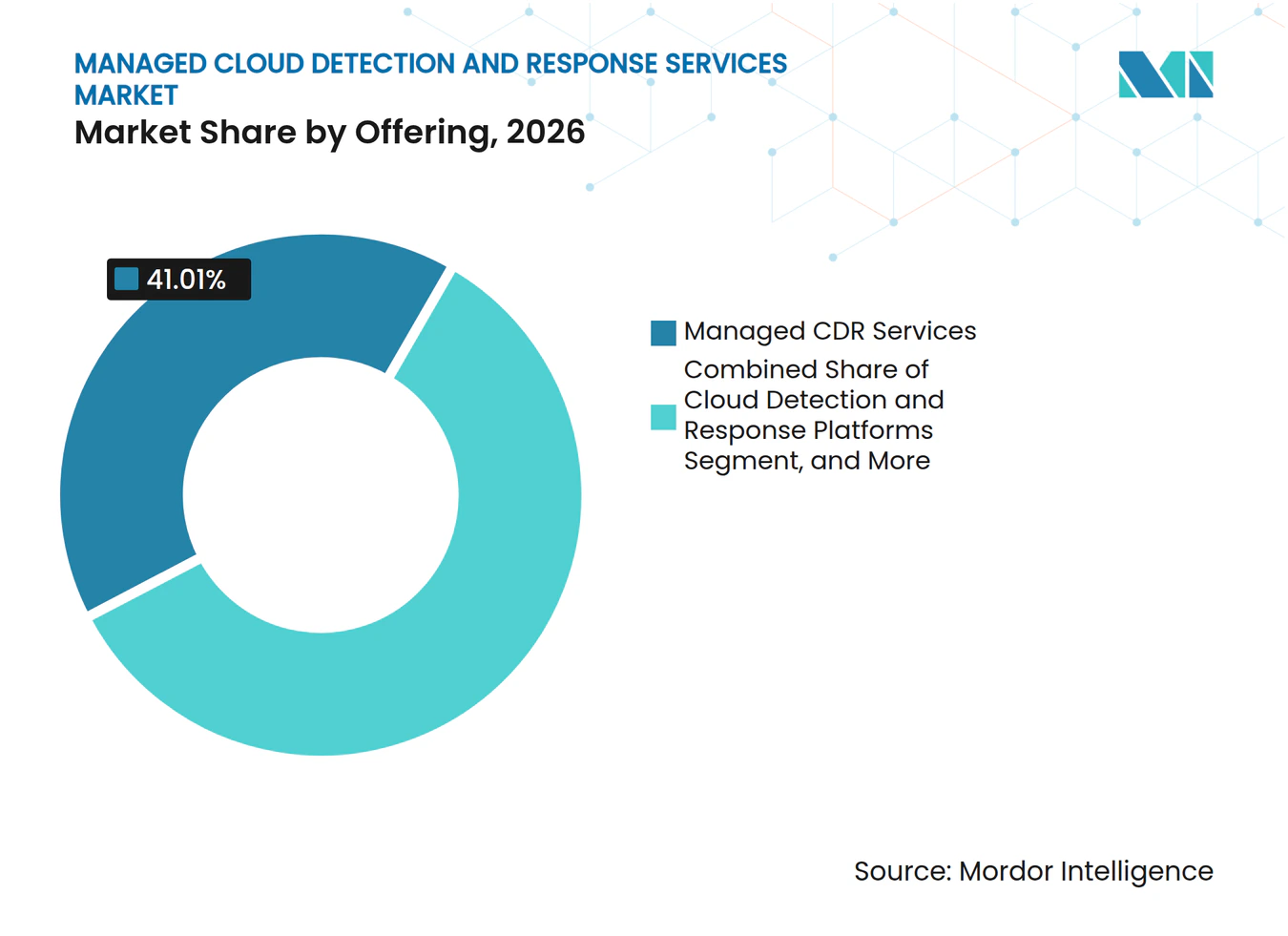
- By offering, Managed CDR Services held 41.01% of the Managed cloud detection and response services market share in 2026.
- By service model, Fully Managed CDR held 59.63% revenue share in 2026, while Co-Managed CDR is projected to expand at a 20.03% CAGR through 2032.
- By deployment mode, Public Cloud held 55.84% revenue share in 2026, while Hybrid and Multi-Cloud is projected to expand at a 19.86% CAGR through 2032.
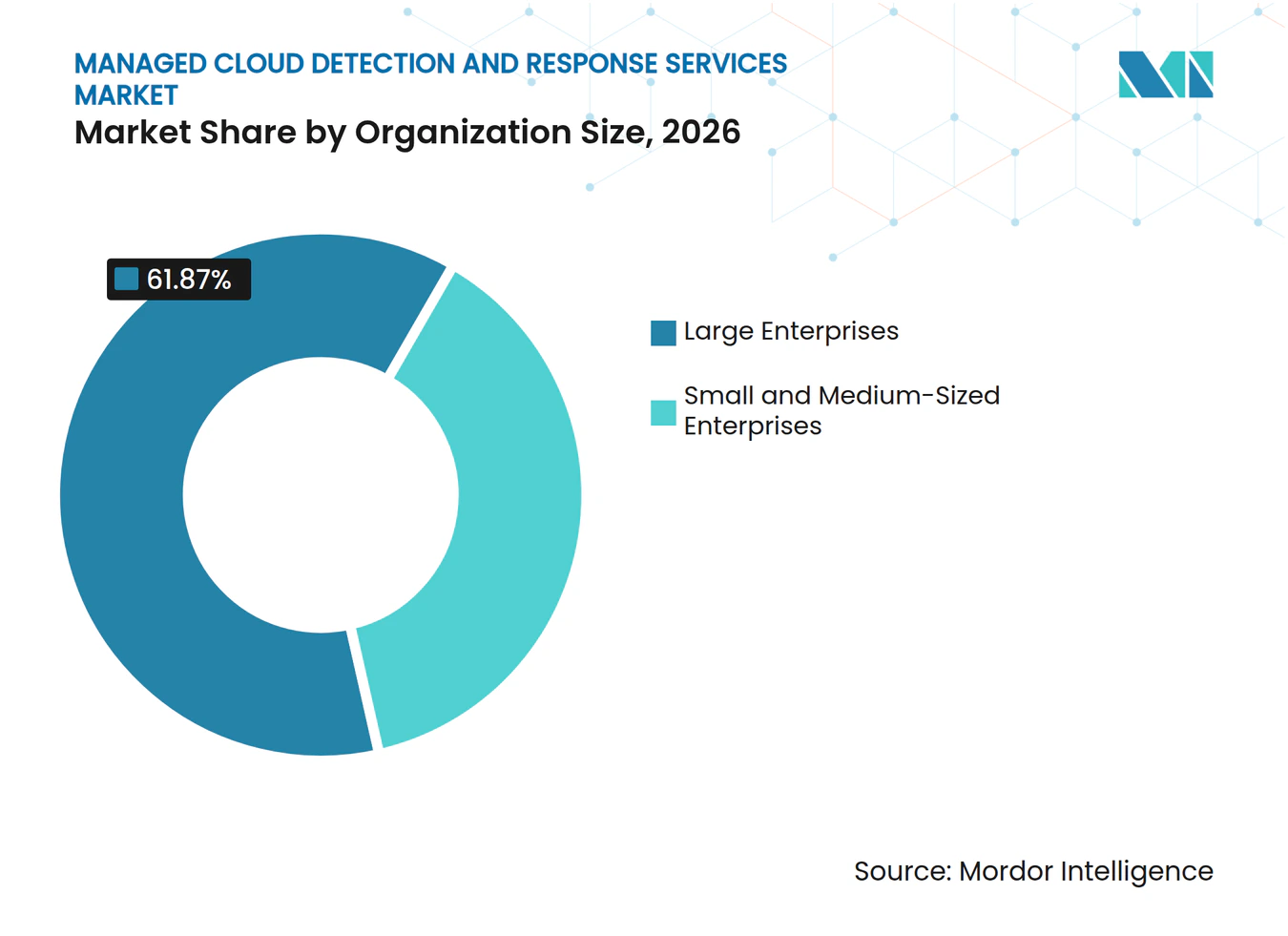
- By organization size, Large Enterprises held 61.87% revenue share in 2026, while SMEs are projected to expand at a 19.91% CAGR through 2032.
- By industry vertical, BFSI held 23.47% revenue share in 2026, while Healthcare and Life Sciences is projected to expand at a 20.12% CAGR through 2032.
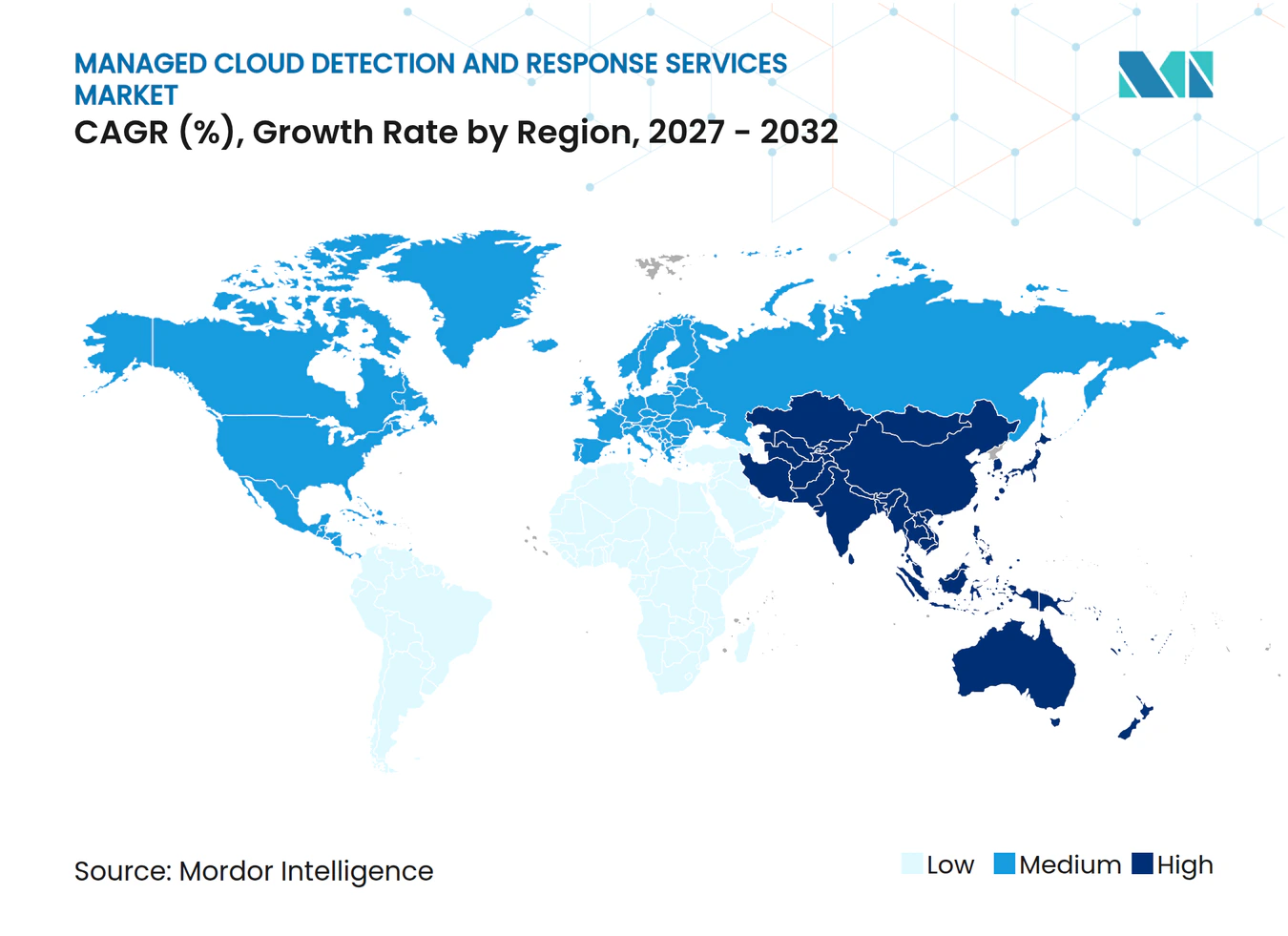
- By geography, North America held 41.28% revenue share in 2026, while Asia-Pacific is projected to expand at a 19.04% CAGR through 2032.
Note: Market numbers in this report are based on Mordor Intelligence's proprietary estimation framework, which combines nine months of actuals with Q4 projections for base year 2026.
Market Trends and Insights
Drivers Impact Analysis of Managed Cloud Detection and Response Services Market*
| Driver | (~) % Impact on CAGR Forecast | Geographic Relevance | Impact Timeline |
|---|---|---|---|
| Cloud and Multi-Cloud Workload Expansion | +4.5% | Global | Short term (≤ 2 years) |
| Identity-First Cloud Attack Growth | +3.8% | Global, particularly North America and Europe | Short term (≤ 2 years) |
| Regulatory and Cyber-Insurance Control Requirements | +3.2% | North America and EU, spill-over to Asia-Pacific | Medium term (2-4 years) |
| Cloud-Native Application and DevSecOps Adoption | +2.5% | Global, early gains in North America and Asia-Pacific core | Medium term (2-4 years) |
| Ephemeral Workload Telemetry Gaps Creating Demand for Agentless Detection | +1.8% | Asia-Pacific core, spill-over to Middle East and Africa | Long term (≥ 4 years) |
| Runtime Security for AI Workloads and Autonomous Agents | +1.4% | Global | Long term (≥ 4 years) |
| Source: Mordor Intelligence | |||
Cloud and Multi-Cloud Workload Expansion
Organizations increasingly operate workloads across more than 1 cloud provider, which makes consistent security monitoring harder to maintain. The SANS 2025 Multicloud Survey found that 91% of respondents used Azure and 86% used AWS, while 63% identified complexity as their main security challenge.[1] Separate identity structures, policies, and event records must be reconciled as cloud-native development creates and changes services more frequently. The Cloud Native Computing Foundation reported that 56% of backend developers were cloud native in Q3 2025, compared with 49% in Q1 2025.[2] The managed cloud detection and response services market supports organizations that need 1 response process across diverse environments without disrupting software delivery. Providers that collect telemetry from multiple clouds and apply unified response playbooks can reduce the operational burden on enterprise security teams.
Identity-First Cloud Attack Growth
Identity security is central to cloud defense because attackers can use legitimate credentials, service accounts, API tokens, OAuth grants, and workload credentials to move through connected systems. The Cloud Security Alliance found that 59% of organizations named insecure identities and risky permissions as their top cloud risk in 2025.[3] Organizations face significant difficulties managing identities and entitlements across multiple cloud providers. Identity-related incidents have increased in recent years. The managed cloud detection and response services market is supported by demand for monitoring that identifies unusual privilege use, lateral movement, and suspicious activity in federated directories. Providers that connect cloud, directory, and access telemetry can investigate these patterns and contain compromised access without disrupting legitimate applications.
Regulatory and Cyber-Insurance Control Requirements
Regulatory requirements are increasing the need for documented and continuous monitoring of information and communications technology risk. The European Union's Digital Operational Resilience Act requires covered financial entities to maintain ICT risk management arrangements and report major incidents. The managed cloud detection and response services market can address this need by providing ongoing monitoring and response records across multiple cloud services. The U.S. Securities and Exchange Commission requires public companies to disclose material cybersecurity incidents within a defined period after determining that an incident is material. Delinea reported that an increasing share of policies requires a documented threat detection and incident response plan. These requirements encourage procurement across financial services, healthcare, and public companies that need stronger operational evidence.
Cloud-Native Application and DevSecOps Adoption
Cloud-native development creates workloads that can start, change, and stop before conventional security processes capture enough evidence. Snyk reported that a large majority of production workloads were deployed as containers or serverless applications. Datadog reported that many AWS organizations used Terraform for infrastructure-as-code provisioning. The managed cloud detection and response services market is supported by demand for agentless and runtime-level observation across cloud accounts, container platforms, and application services. Managed providers can align response coverage with deployment velocity without asking every development team to operate a separate security function. This capability brings managed detection into application and infrastructure procurement decisions.
Restraints Impact Analysis of Managed Cloud Detection and Response Services Market*
| Restraint | (~) % Impact on CAGR Forecast | Geographic Relevance | Impact Timeline |
|---|---|---|---|
| Security Tool Sprawl and Integration Complexity | -2.1% | Global | Short term (≤ 2 years) |
| Cloud-Security Skills Shortage | -1.7% | Global, most acute in North America and Europe | Medium term (2-4 years) |
| Data Sovereignty and Cross-Border Telemetry Restrictions | -1.2% | Asia-Pacific core, EU, Middle East and Africa | Medium term (2-4 years) |
| Short-Lived Workloads and Sparse Evidence Increasing False Negatives | -0.8% | Global | Long term (≥ 4 years) |
| Source: Mordor Intelligence | |||
Security Tool Sprawl and Integration Complexity
Security tool sprawl can lengthen sales cycles because customers must connect several products before a managed provider can establish useful coverage. Trend Micro found that organizations identified tool sprawl as a major compliance barrier and faced difficulties executing a unified response across cloud providers. A customer with several security products and multiple clouds requires integration work before incident data can be normalized. This can delay time to value and add delivery costs. Platform-native providers have an advantage when they own or closely integrate the underlying detection tools. Specialist managed service providers remain exposed where their delivery depends on customer-selected security products.
Cloud-Security Skills Shortage
The shortage of cloud-security professionals pushes organizations toward outsourcing while making it harder for providers to hire and retain analysts. Fortinet found that many organizations faced challenges recruiting cybersecurity talent, while ISACA reported that security teams were often understaffed and had unfilled positions. NIST recorded a substantial number of open cybersecurity positions in the United States, alongside a large employed workforce. These shortages raise compensation costs and can limit expansion into countries that require local analyst coverage. Providers are investing in automation to reduce repetitive investigation work and extend analyst capacity.
*Our forecasts treat driver/restraint impacts as directional, not additive. The impact forecasts reflect baseline growth, mix effects, and variable interactions.
Managed Cloud Detection and Response Services Market Segment Analysis
By Offering:
Managed CDR Services Anchor Cloud Security OutsourcingManaged CDR Services held 41.01% of the Managed Cloud Detection and Response (CDR) Services market share in 2026, making it the largest offering category. Buyers use this model when they need continuous monitoring, investigation, and response, but do not operate a dedicated cloud security operations center. Highly regulated organizations can also have lean internal security teams despite detailed reporting obligations. Fully outsourced delivery provides coverage without requiring an internal program from the beginning. The offering is closely linked to the shortage of experienced cloud-security personnel.
Cloud Detection and Response Platforms remain relevant for organizations that retain more direct operational control. Professional Services and Support help customers implement controls and prepare documentation for frameworks such as SOC 2 Type II. Red Canary reported annual recurring revenue above USD 140 million in FY2025 and stated that its AI-driven platform handled 97% of investigations autonomously. Automation can help managed providers support more customers without matching growth in analyst headcount. Large system integrators that bundle CDR with cloud-managed services validate the category while complicating enterprise positioning for pure-play providers.



By Service Model:
Fully Managed Delivery Dominates, Co-Managed Gains GroundFully Managed CDR held 59.63% of revenue in 2026, showing that many buyers prefer to delegate the detection function. This model suits organizations that need continuous coverage but lack staff to validate threats and coordinate remediation. It is particularly relevant in sectors with demanding incident-reporting obligations. Buyers can use an external provider to operate monitoring while internal teams focus on governance and business decisions.
Co-Managed CDR is projected to expand at a 20.03% CAGR through 2032, the fastest rate among service models. Mature security teams use it when they want external expertise while retaining selected investigation and remediation decisions. Incident-Response Retainer and On-Demand CDR provide assured response capacity without continuous coverage. Organizations that initially select fully managed delivery may move toward co-managed arrangements as internal capability develops.
By Deployment Mode:
Public Cloud Leads as Hybrid Deployments AcceleratePublic Cloud held 55.84% of revenue in 2026, supported by mature telemetry from major hyperscalers and established detection content. The segment benefits when cloud providers make more native event data available for security monitoring. Public cloud customers may still use more than 1 provider, so unified monitoring remains necessary. The leading position reflects the scale of workloads already deployed in public cloud environments.
Hybrid and Multi-Cloud is projected to expand at a 19.86% CAGR through 2032, making it the fastest-growing deployment mode. Enterprises require monitoring across public cloud, private cloud, and on-premises systems when workloads are distributed. Private cloud remains relevant for sovereign-cloud use cases where data residency limits telemetry transfers. Fortinet reported that 97% of respondents preferred unified cloud security platforms with centralized dashboards. This preference supports providers that coordinate multiple environments through a single service.
By Organization Size:
Enterprises Drive Revenue as SME Adoption SurgesLarge Enterprises held 61.87% of revenue in 2026, supported by large cloud estates and formal security operations infrastructure. These organizations often enter multi-year managed service agreements with higher annual contract values. They operate across more users, applications, and cloud accounts, which increases the need for continuous detection. Their established budgets and complex environments explain why they remain the largest revenue group.
SMEs are projected to expand at a 19.91% CAGR through 2032 as automation and managed service provider channels make managed detection more accessible. Smaller organizations often cannot fund an internal security operation that provides 24-hour coverage. Insurance requirements strengthen demand because 53% of policies required a documented threat detection and incident response plan in 2025. SME buyers may accept more automated response playbooks when analyst validation would increase service cost. This can improve delivery economics for providers targeting smaller customers.

By Industry Vertical:
BFSI Dominates Spend as Healthcare Rapidly ExpandsBFSI held 23.47% of revenue in 2026, the largest share among the industry verticals. Financial institutions manage sensitive customer data, high-value transactions, and detailed regulatory obligations. DORA increases the need for continuous ICT risk management across covered entities. These conditions support spending on managed detection, documented response, and continuous evidence collection.
Healthcare and Life Sciences is projected to expand at a 20.12% CAGR through 2032, the fastest rate among verticals. Healthcare organizations face continued exposure to data breaches and network server intrusions. The U.S. Department of Health and Human Services focused its 2025 enforcement initiative on risk analysis under the HIPAA Security Rule. IT and Telecommunications, Government and Defense, Manufacturing, Retail and E-Commerce, and Energy and Utilities also create demand through distinct operational and compliance requirements.
Geography Analysis
North America Managed Cloud Detection and Response Services Market
North America held 41.28% of global revenue in 2026, the largest regional contribution to the Managed Cloud Detection and Response (CDR) services market size. The region combines a high concentration of cloud-native enterprises with demanding disclosure rules. The U.S. Securities and Exchange Commission requires public companies to report material cybersecurity incidents within 4 business days after determining materiality. This supports demand for continuous detection and reliable escalation processes.
North America and APAC Managed Cloud Detection and Response Services Market
Canada offers further opportunities through cloud-first digitization and cross-border supply chain security needs. Mexico remains an earlier-stage opportunity as nearshore manufacturing expands. Asia-Pacific is projected to expand at a 19.04% CAGR through 2032, the fastest regional rate. Hyperscaler expansion in India, Japan, South Korea, and Australia is increasing cloud workloads that require monitoring.
APAC, EMEA and South America Managed Cloud Detection and Response Services Market
Australia’s Essential Eight framework and Japan’s cybersecurity guidance strengthen the need for structured security controls. China follows a more separate path because sovereign-cloud requirements favor local providers. Europe is shaped by DORA, GDPR, and NIS2 requirements. The European Central Bank’s 2025 cloud outsourcing guidance requires supervised institutions to monitor cloud-provider security arrangements continuously. South America is supported by Brazil’s banking technology investment, while the Middle East and Africa benefit from cloud development and cloud-governance expectations.
Competitive Landscape
Market Concentration
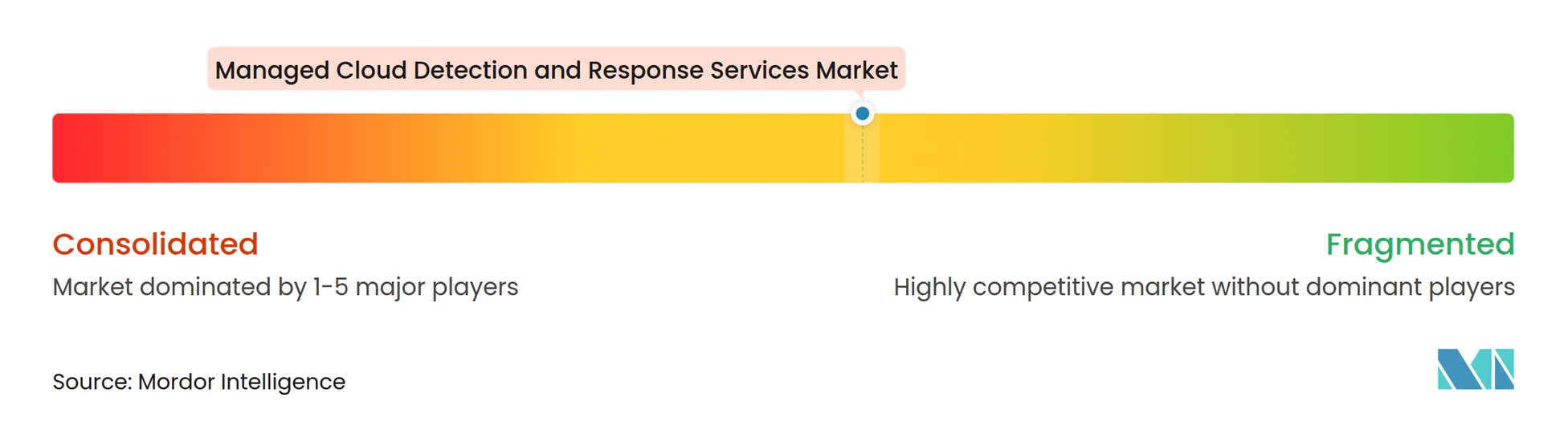
The managed cloud detection and response services market has moderate concentration. CrowdStrike, Palo Alto Networks, Arctic Wolf Networks, Microsoft, and SentinelOne have strong positions in enterprise managed CDR contracts. Specialist and regional providers continue to compete for mid-market customers. Competitive strategies focus on automation, acquisitions, and stronger identity security capabilities.
CrowdStrike agreed to acquire Pangea in September 2025 for USD 260 million to add security guardrails for generative AI applications. It also agreed to acquire Onum in August 2025 for USD 290 million to strengthen telemetry ingestion for Falcon Next-Gen SIEM. Arctic Wolf launched Aurora Agentic SOC in March 2026, using a proprietary knowledge graph and AI agents to support detection, prioritization, and response. These moves extend platform capabilities around data pipelines, AI workload security, and automated delivery.
There is an opportunity in SME-grade managed CDR below USD 50,000 annually and in sovereign-cloud detection for sectors with data residency restrictions. SOC 2 Type II compliance and ISO 27001 certification are important procurement requirements. ReliaQuest raised more than USD 500 million in March 2025 at a USD 3.4 billion valuation to support international expansion and agentic AI-powered security operations automation. AI-native providers can challenge established vendors by building automation into delivery from the start. The Managed Cloud Detection and Response (CDR) services market will remain shaped by reliable delivery and broad cloud, identity, and application visibility.
Managed Cloud Detection and Response Services Industry Leaders
-
Arctic Wolf Networks, Inc.
-
CrowdStrike Holdings, Inc.
-
Palo Alto Networks, Inc.
-
Microsoft Corporation
-
SentinelOne, Inc.
- *Disclaimer: Major Players sorted in no particular order
Managed Cloud Detection and Response Services Market Companies Covered in this Report
- Arctic Wolf Networks, Inc.
- CrowdStrike Holdings, Inc.
- Palo Alto Networks, Inc.
- Microsoft Corporation
- SentinelOne, Inc.
- eSentire, Inc.
- Expel, Inc.
- Red Canary, Inc.
- Rapid7, Inc.
- Sophos Limited
- ReliaQuest Holdings, LLC
- IBM Corporation
- Cisco Systems, Inc.
- Fortinet, Inc.
- Check Point Software Technologies Ltd.
- Trend Micro Incorporated
- Secureworks Corp.
- Deepwatch, Inc.
- Critical Start, Inc.
- WithSecure Corporation
- Mandiant, Inc.
Recent Industry Developments in Managed Cloud Detection and Response Services Market
- September 2026: Quorum Cyber acquired Ontinue, a managed detection and response provider for Microsoft security customers. The acquisition extended Quorum Cyber's Microsoft-aligned managed CDR capability into North America, adding scale to its delivery of cloud detection built on Microsoft Defender and Sentinel.
- August 2026: South Korean telecom operator LG Uplus acquired Pago Networks, a domestic MDR specialist. The deal positioned LG Uplus to deliver managed cloud detection natively to its enterprise base ahead of anticipated South Korean critical infrastructure security mandates.
- April 2026: ServiceNow closed its USD 7.75 billion acquisition of Armis, a connected asset visibility platform. Combining Armis' cloud and OT asset intelligence with ServiceNow's workflow layer created an integrated asset-to-remediation pipeline spanning cloud, endpoint, and industrial environments.
- March 2026: Google, Alphabet, closed its USD 32 billion acquisition of Wiz, inserting Wiz's CNAPP and CSPM capabilities into the Google Cloud security stack. The deal created a vertically integrated cloud detection and posture offering, intensifying competitive pressure on standalone CDR platform providers.
Global Managed Cloud Detection and Response Services Market Report Scope
The Managed Cloud Detection and Response (CDR) Services Market comprises outsourced security services that provide 24/7 monitoring, threat detection, investigation, and rapid response specifically for cloud-native environments, including public cloud IaaS/PaaS, containers, serverless functions, cloud identities, APIs, and SaaS applications.
The Managed Cloud Detection and Response Services Market Report is Segmented by Offering (CDR Platforms, Managed CDR Services, and Professional Services and Support), Service Model (Fully Managed, Co-Managed, and Incident-Response Retainer and On-Demand CDR), Deployment Mode (Public, Private, Hybrid and Multi-Cloud), Organization Size (Large Enterprises, and SMEs), Industry Vertical (Banking, Financial Services, and Insurance, Healthcare and Life Sciences, IT and Telecommunications, Government and Defense, Manufacturing, Retail and E-Commerce, and Energy and Utilities), and Geography (North America, South America, Europe, Asia-Pacific, and Middle East and Africa). The Market Forecasts are provided in Terms of Value (USD).
Segmentation Overview
| Cloud Detection and Response Platforms |
| Managed CDR Services |
| Professional Services and Support |
| Fully Managed CDR |
| Co-Managed CDR |
| Incident-Response Retainer and On-Demand CDR |
| Public Cloud |
| Private Cloud |
| Hybrid and Multi-Cloud |
| Large Enterprises |
| Small and Medium-Sized Enterprises |
| Banking, Financial Services, and Insurance |
| Healthcare and Life Sciences |
| IT and Telecommunications |
| Government and Defense |
| Manufacturing |
| Retail and E-Commerce |
| Energy and Utilities |
| Other Industry Verticals |
| North America | United States |
| Canada | |
| Mexico | |
| South America | Brazil |
| Argentina | |
| Chile | |
| Rest of South America | |
| Europe | Germany |
| United Kingdom | |
| France | |
| Italy | |
| Spain | |
| Russia | |
| Rest of Europe | |
| Asia-Pacific | China |
| Japan | |
| India | |
| South Korea | |
| Australia | |
| Rest of Asia-Pacific | |
| Middle East and Africa | Saudi Arabia |
| United Arab Emirates | |
| South Africa | |
| Egypt | |
| Rest of Middle East and Africa |
| By Offering | Cloud Detection and Response Platforms | |
| Managed CDR Services | ||
| Professional Services and Support | ||
| By Service Model | Fully Managed CDR | |
| Co-Managed CDR | ||
| Incident-Response Retainer and On-Demand CDR | ||
| By Deployment Mode | Public Cloud | |
| Private Cloud | ||
| Hybrid and Multi-Cloud | ||
| By Organization Size | Large Enterprises | |
| Small and Medium-Sized Enterprises | ||
| By Industry Vertical | Banking, Financial Services, and Insurance | |
| Healthcare and Life Sciences | ||
| IT and Telecommunications | ||
| Government and Defense | ||
| Manufacturing | ||
| Retail and E-Commerce | ||
| Energy and Utilities | ||
| Other Industry Verticals | ||
| By Geography | North America | United States |
| Canada | ||
| Mexico | ||
| South America | Brazil | |
| Argentina | ||
| Chile | ||
| Rest of South America | ||
| Europe | Germany | |
| United Kingdom | ||
| France | ||
| Italy | ||
| Spain | ||
| Russia | ||
| Rest of Europe | ||
| Asia-Pacific | China | |
| Japan | ||
| India | ||
| South Korea | ||
| Australia | ||
| Rest of Asia-Pacific | ||
| Middle East and Africa | Saudi Arabia | |
| United Arab Emirates | ||
| South Africa | ||
| Egypt | ||
| Rest of Middle East and Africa | ||
Key Questions Answered in the Report
What is the managed cloud detection and response services market size?
The managed cloud detection and response services market is valued at USD 3.12 billion in 2026 and is projected to reach USD 8.52 billion by 2032, at a 17.77% CAGR from 2027 to 2032.
What is driving demand for managed cloud detection and response services?
Multi-cloud complexity, identity-based attacks, cloud-native applications, and continuous monitoring requirements are strengthening demand for managed services.
Which service model is expanding fastest in cloud detection and response?
Co-Managed CDR is projected to expand at a 20.03% CAGR through 2032 as security teams seek external expertise while retaining selected response decisions.
Which deployment mode is expanding fastest for managed CDR?
Hybrid and Multi-Cloud is projected to expand at a 19.86% CAGR through 2032 because enterprises need coordinated detection across cloud and on-premises systems.
Which customer group is adopting managed CDR most quickly?
SMEs are projected to expand at a 19.91% CAGR through 2032 as automation and managed service provider programs make continuous coverage more accessible.
Which region has the fastest projected demand for managed CDR services?
Asia-Pacific is projected to expand at a 19.04% CAGR through 2032, supported by cloud expansion and cybersecurity requirements across India, Japan, South Korea, and Australia.