
Encrypted Traffic Analysis Market Size and Share
Market Overview
| Study Period | 2021 - 2032 |
|---|---|
| Market Size (2027) | USD 1.34 Billion |
| Market Size (2032) | USD 2.71 Billion |
| Growth Rate (2027 - 2032) | 15.13 % |
| Fastest Growing Market | Asia-Pacific |
| Largest Market | North America |
| Market Concentration | Medium |
Major Players *Disclaimer: Major Players sorted in no particular order Image © Mordor Intelligence. Reuse requires attribution under CC BY 4.0. | |
Encrypted Traffic Analysis Market Analysis by Mordor Intelligence
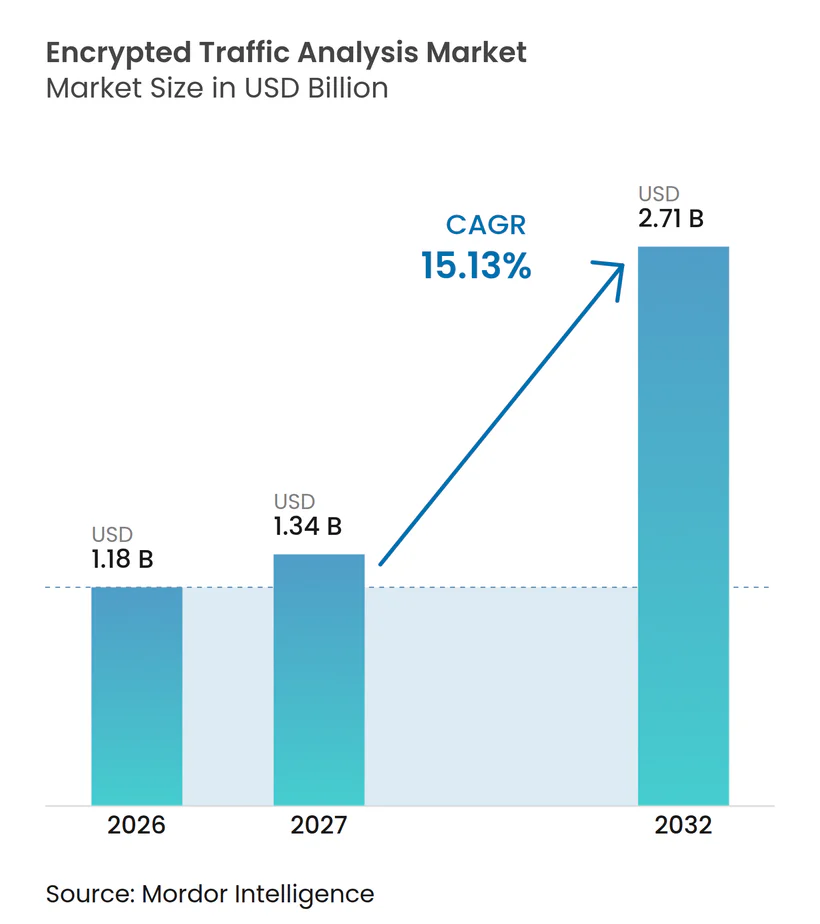
The encrypted traffic analysis market size is projected to be USD 1.18 billion in 2026, USD 1.34 billion in 2027, and reach USD 2.71 billion by 2032, growing at a CAGR of 15.13% from 2027 to 2032. The Encrypted traffic analysis market is being shaped by the need to identify threats in encrypted network flows without routinely exposing their contents. The Encrypted traffic analysis market also benefits from the move toward zero-trust access and cloud-delivered security, which places network inspection closer to remote users and applications. Privacy requirements and data-residency rules limit decryption in some settings, making metadata and behavioral analysis more important. The Encrypted traffic analysis market offers vendors an opportunity to integrate threat detection, traffic classification, and cryptographic visibility into broader security platforms. Competition is increasingly determined by detection quality, integration with operational workflows, and support for both cloud and on-premises environments.
Key Report Takeaways
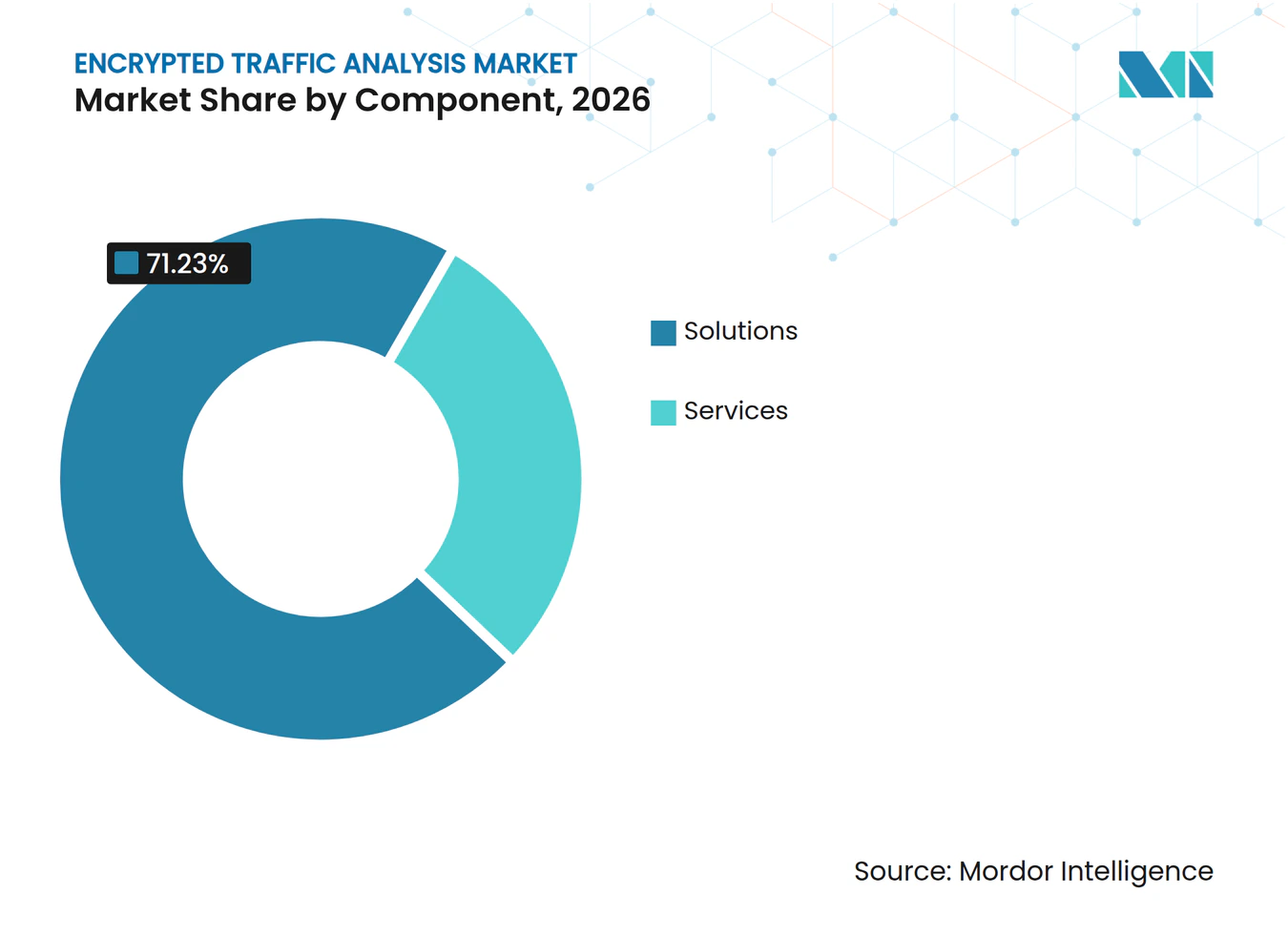
- By component, solutions held 71.23% of the encrypted traffic analysis market share in 2026, while services are projected to expand at a 19.06% CAGR through 2032.
- By deployment mode, cloud accounted for 68.93% of the encrypted traffic analysis market size in 2026 and is projected to expand at a 17.62% CAGR through 2032.
- By application, threat detection and network security accounted for 34.61% of the encrypted traffic analysis market share in 2026, while encrypted data exfiltration detection is projected to expand at an 18.29% CAGR through 2032.
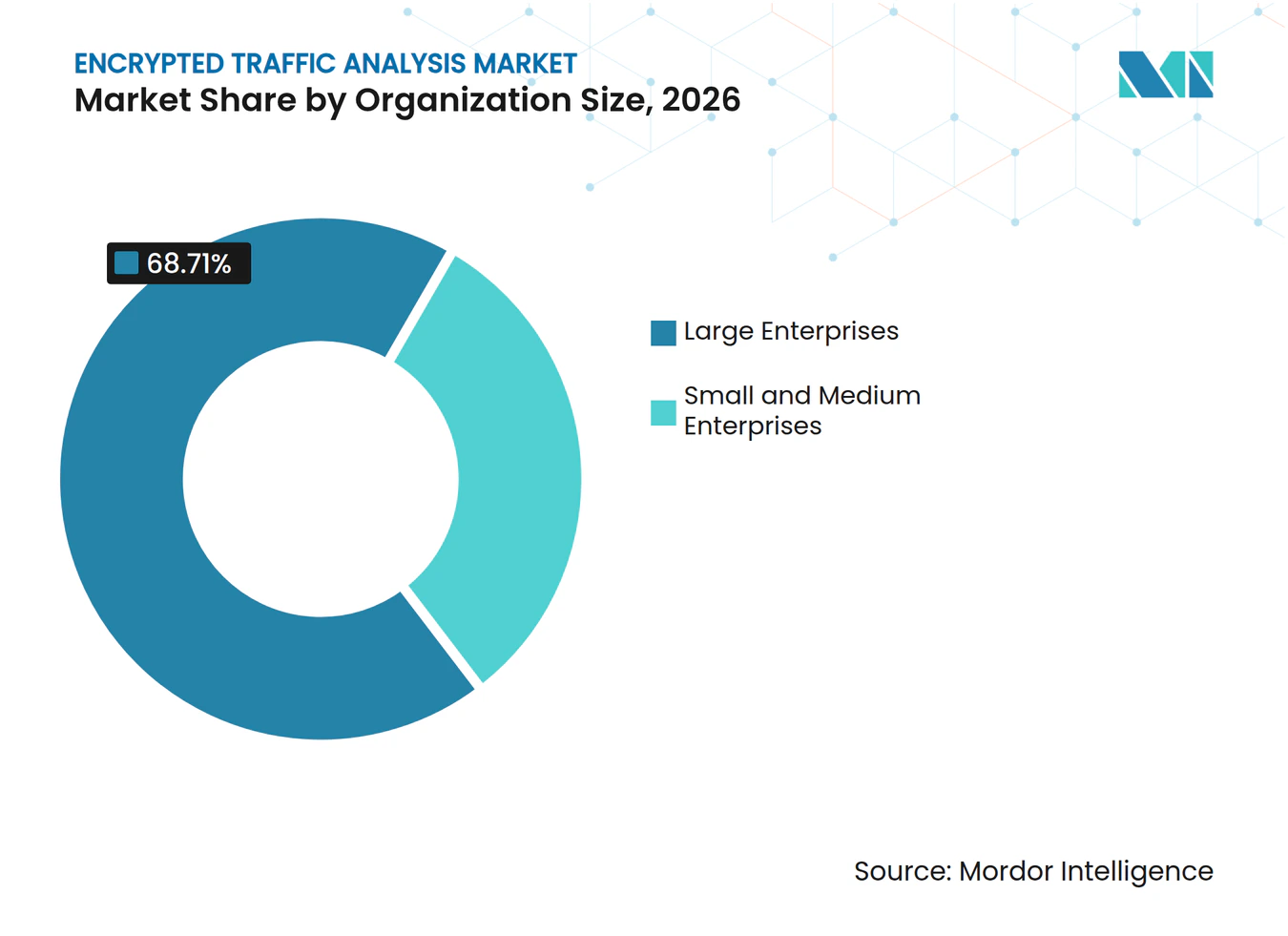
- By organization size, large enterprises accounted for 68.71% of the market in 2026, while small and medium enterprises are projected to expand at a 17.29% CAGR through 2032.
- By end user, BFSI held 29.84% of the market in 2026, while healthcare and life sciences are projected to expand at a 19.37% CAGR through 2032.
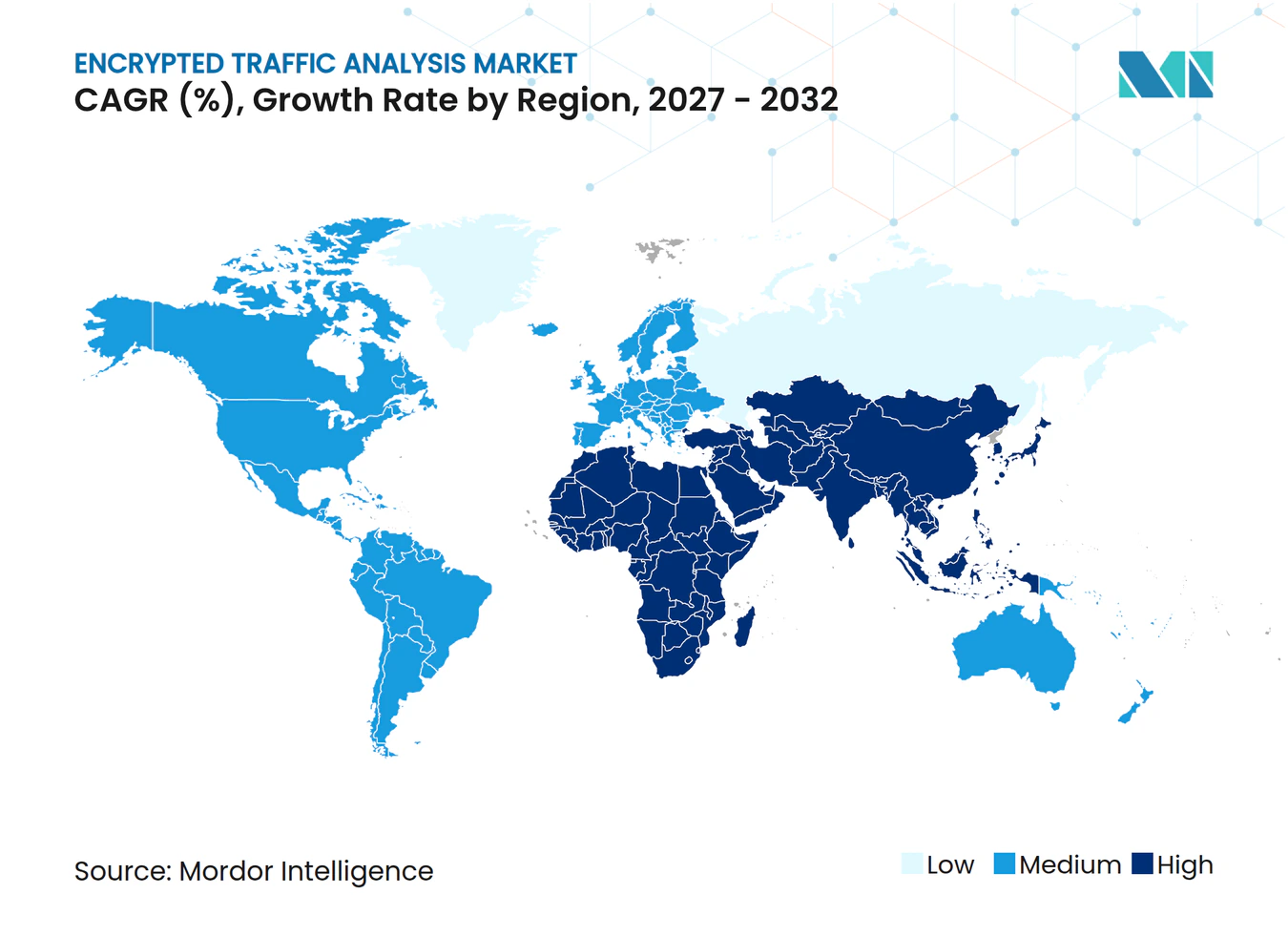
- By geography, North America accounted for 38.66% of the market in 2026, while Asia-Pacific is projected to expand at an 18.22% CAGR through 2032.
Note: Market numbers in this report are based on Mordor Intelligence's proprietary estimation framework, which combines nine months of actuals with Q4 projections for base year 2026.
Global Encrypted Traffic Analysis Market Trends and Insights
Drivers Impact Analysis*
| Driver | (~) % Impact on CAGR Forecast | Geographic Relevance | Impact Timeline |
|---|---|---|---|
| Rising Encrypted Traffic Volumes Across Hybrid Networks | +3.0% | Global | Short term (≤ 2 years) |
| Expansion of Zero-Trust and SASE Architectures | +2.5% | North America and Europe | Medium term (2-4 years) |
| Escalation of Malware and Command-and-Control Activity Over TLS | +2.2% | Global | Short term (≤ 2 years) |
| Regulatory Demand for Continuous Security Visibility | +1.8% | North America, Europe, and Asia-Pacific | Medium term (2-4 years) |
| Cloud, 5G, IoT, and East-West Traffic Growth | +1.4% | Asia-Pacific core, with spillover to Middle East and Africa | Long term (≥ 4 years) |
| AI-Based Behavioral Detection for Payload-Blind Security | +1.0% | Global | Medium term (2-4 years) |
| Source: Mordor Intelligence | |||
Rising Encrypted Traffic Volumes Across Hybrid Networks
The encrypted traffic analysis market addresses a growing visibility gap as encryption covers more web and internal network traffic. Hybrid environments now use encryption not only for internet access but also for east-west connections between microservices, AI endpoints, and database clusters. Gigamon reported that 1 in 3 surveyed security and IT leaders saw network traffic more than double during the previous 2 years because of AI workloads. The same survey found that 55% of respondents said their current tools struggled to detect changing threats within encrypted traffic. Log-focused security tools do not provide the same network-level view when payload inspection is unavailable. This supports investment in dedicated tools across the encrypted traffic analysis market that can examine flow timing, handshake features, and other non-payload signals.
Expansion of Zero-Trust and SASE Architectures
Zero-trust and secure access service edge architectures create a practical route for encrypted-traffic analysis to be deployed with access controls. These architectures route user and application traffic through cloud-delivered enforcement points, where traffic can be assessed without relying on a traditional network perimeter. The encrypted traffic analysis market benefits when analytics are embedded in a wider security platform rather than bought as a separate product. Consolidation may reduce the addressable space for isolated point products, but it increases the reach of vendors with integrated SASE and security service edge portfolios. Encrypted-traffic telemetry can also identify shadow AI use, application issues, and possible data-sovereignty violations. This broader operational value supports platform adoption beyond the original threat-detection use case.
Escalation of Malware and Command-and-Control Activity Over TLS
Attackers continue to use encrypted channels to conceal delivery, command-and-control activity, and lateral movement. The encrypted traffic analysis market therefore depends on behavioral methods that can identify suspicious patterns without requiring access to payload content. A joint advisory from CISA, NSA, FBI, and international partners documented the use of encrypted covert channels by Salt Typhoon for lateral movement across affected organizations.[1] The advisory showed why network metadata remains relevant when signatures or payload inspection do not expose an attack. Vendors that connect flow patterns with investigative workflows can provide a useful control for security teams facing this condition.
Regulatory Demand for Continuous Security Visibility
Regulatory requirements are making encrypted network monitoring a more clearly defined procurement need for healthcare, government, and other regulated users. The U.S. Department of Health and Human Services proposed updates to the HIPAA Security Rule in January 2025 that would make encryption of electronic protected health information in transit a required specification.[2] CISA also states in its TIC 3.0 SASE guidance that TLS break-and-inspect is not universally recommended and discusses AI-based analysis as an alternative for encrypted traffic. These positions reinforce the use of high-fidelity telemetry instead of indiscriminate decryption. NIST provides implementation guidance for TLS certificate-based authentication to help organizations consider encrypted connections in a risk-based security design. This regulatory direction supports the encrypted traffic analysis market in sectors that need controlled, continuous security visibility.
Restraints Impact Analysis*
| Restraint | (~) % Impact on CAGR Forecast | Geographic Relevance | Impact Timeline |
|---|---|---|---|
| Privacy and Data-Residency Constraints on Traffic Inspection | -0.9% | Europe and Asia-Pacific | Medium term (2-4 years) |
| TLS 1.3 Forward Secrecy Reducing Passive Decryption Options | -0.7% | Global | Long term (≥ 4 years) |
| Shortage of Network Security Analytics Skills | -0.5% | Global | Medium term (2-4 years) |
| Performance, Latency, and Total-Cost Trade-Offs | -0.4% | North America and Europe | Short term (≤ 2 years) |
| Source: Mordor Intelligence | |||
Privacy and Data-Residency Constraints on Traffic Inspection
Privacy and data-residency rules limit the use of decryption-based inspection in many environments. Employee browsing, clinical information, and payment flows can be subject to specific handling restrictions that constrain which traffic can be decrypted. NIST describes deployment approaches that use TLS certificate-based authentication and risk management for encrypted communications. The encrypted traffic analysis market must therefore support analysis in a customer jurisdiction, cloud tenancy, or controlled environment when required. This can create an advantage for platforms that combine metadata analysis with locally controlled inspection. It can also lengthen implementation and procurement cycles for organizations with limited security resources.
TLS 1.3 Forward Secrecy Reducing Passive Decryption Options
TLS 1.3 uses forward secrecy, so recorded traffic cannot normally be decrypted later with a server's private key. The protocol specification defines the TLS 1.3 security model and its key-establishment process. RFC 9849 standardized Encrypted Client Hello in March 2026, which protects the client hello name indication and narrows the information available to passive observers.[3] The encrypted traffic analysis market must rely more heavily on characteristics such as packet length, timing, flow direction, and connection behavior. Peer-reviewed research published in Scientific Reports found that a hybrid GCN-LSTM approach can effectively classify encrypted malicious traffic without access to the payload. Vendors without mature behavioral models or sufficient traffic data may find it harder to maintain detection quality as passive decryption becomes less practical.
*Our forecasts treat driver/restraint impacts as directional, not additive. The impact forecasts reflect baseline growth, mix effects, and variable interactions.
Segment Analysis
By Component: Solutions Lead Revenue While Services Address the Analytics Skills Gap
Solutions held 71.23% of the encrypted traffic analysis market size for components in 2026. Platform software is commonly integrated with security information and event management, security orchestration, and observability tools. This integration can increase switching costs because customers integrate the platform into their established incident-response processes. Recurring licensing also supports stable revenue for vendors with broad security portfolios. Solutions are particularly relevant for large users who want direct control over traffic data and detection policies. The Encrypted traffic analysis industry uses these platforms to combine network visibility with other security controls.
Services are projected to expand at a 19.06% CAGR from 2027 to 2032. Many organizations lack the network, security, and data-analysis skills needed to operate encrypted-traffic analytics internally. Managed detection and response providers can package specialist staff with the required technology. Scientific Reports described a hybrid GCN-LSTM model for detecting encrypted malicious traffic, highlighting the technical complexity that can arise when models must be maintained in production. Service providers can help customers tune detections and investigate anomalies without building a large internal team. This role creates a distinct opportunity in the encrypted traffic analysis market. As automation improves, service contracts may place greater value on measurable detection outcomes than on manual monitoring activity.


By Deployment Mode: Cloud Leads While On-Premises Supports Regulated Workloads
Cloud accounted for 68.93% of the encrypted traffic analysis market size in 2026 and is projected to expand at a 17.62% CAGR through 2032. Cloud delivery fits the shift toward SASE and security service edge deployments. It allows analytics to be embedded with access and inspection controls for users, branch sites, and cloud applications. Organizations can activate these capabilities without first installing dedicated appliances at every location. This model also supports faster updates to detection content and policy controls. The encrypted traffic analysis market is therefore increasingly delivered as part of an integrated security subscription.
On-premises deployment remains important where sovereignty requirements, isolated networks, or operational needs prevent traffic from being sent to a cloud service. Defense contractors, central banks, and critical infrastructure operators may require locally deployed visibility tools. ExtraHop introduced a 400 Gbps RevealX sensor in August 2026 for data-center traffic analysis at line rate.[4] The announcement reflects demand for continuous coverage of high-volume encrypted east-west traffic. Large enterprises can use local sensors for core data centers while using cloud inspection for remote sites and user access. Cloud and on-premises deployments can therefore operate as complementary parts of the same security design.
By Application: Threat Detection Leads While Exfiltration Detection Expands Faster
Threat detection and network security held 34.61% of the application segment in 2026. This use case covers command-and-control activity, lateral movement, and intrusion patterns that are hidden within encrypted connections. It remains central because conventional intrusion detection tools may not see payload content in modern environments. Network-derived signals allow teams to identify unusual timing, destinations, protocol behavior, and traffic volumes. The encrypted traffic analysis market share held by this application reflects its role in core security operations. It also provides a base for related functions such as investigation and performance assurance.
Encrypted data exfiltration detection is projected to grow at an 18.29% CAGR from 2027 to 2032. This need is linked to employees' use of external AI services and the transfer of sensitive information via encrypted sessions. ExtraHop stated in March 2026 that its platform update supports visibility into AI agent traffic to identify unauthorized movement and privilege escalation. Gigamon added cryptographic inventory and deprecated cipher-suite identification in its GigaVUE 6.12 release without requiring traffic decryption.[5] These capabilities support compliance monitoring alongside exfiltration detection. Vendors are increasingly packaging classification, investigation, and cryptographic posture features under a single license.
By Organization Size: Large Enterprises Lead While SMEs Gain Access Through Cloud Delivery
Large enterprises accounted for 68.71% of the organization-size segment in 2026. Their network volume, multicloud operations, and compliance obligations make continuous visibility a material security requirement. These organizations also have the resources to connect encrypted-traffic analytics with broader detection and response programs. Large user environments generate more telemetry for establishing normal traffic patterns. This can improve the effectiveness of behavioral monitoring when detection models are calibrated carefully. The Encrypted traffic analysis industry remains strongly anchored in this customer group.
Small and medium enterprises are projected to expand at a 17.29% CAGR from 2027 to 2032. Cloud-native platforms reduce the appliance investment and specialized staffing that previously made advanced network analytics harder to adopt. Bundled SASE subscriptions can provide encrypted-traffic capabilities with remote-access security. This reduces the need for a separate procurement process. Smaller organizations may still have limited traffic baselines, which can complicate the calibration of behavioral models. Managed services can provide a more suitable option where the customer cannot operate the technology independently. This expands access to the encrypted traffic analysis market for smaller buyers.

By End User: BFSI Anchors Demand While Healthcare and Life Sciences Advance Fastest
BFSI accounted for 29.84% of end-user revenue in 2026. Financial institutions process large volumes of sensitive transactions and must maintain resilience against fraud, intrusion, and data loss. Continuous monitoring supports PCI DSS obligations and broader operational-resilience practices. This makes encrypted network visibility a compliance and security requirement rather than a discretionary feature. BFSI buyers also use the technology to protect privileged access and cloud-connected applications. The segment provides a stable demand base for the encrypted traffic analysis market.
The healthcare and life sciences industry is projected to expand at a 19.37% CAGR from 2027 to 2032. The January 2025 HIPAA Security Rule proposal placed additional focus on encryption of electronic protected health information in transit. Healthcare providers and associated organizations must balance security monitoring with the protection of clinical and personal information. Government agencies have a related need for high-fidelity encrypted traffic telemetry in line with federal zero-trust guidance. IT and telecommunications users monitor infrastructure management traffic and privileged access over encrypted channels. Retail and manufacturing users are also adopting these tools as encrypted command-and-control traffic becomes a more common security concern.
Geography Analysis
North America accounted for 38.66% of the encrypted traffic analysis market share in 2026. The region has a high concentration of regulated financial institutions, federal agencies, cloud infrastructure, and large security buyers. CISA guidance on SASE and TIC 3.0 discusses AI-based encrypted-traffic analysis as an alternative when TLS break-and-inspect is not suitable. This provides a clear public-sector reference point for security programs that need visibility without universal decryption. North American vendors also benefit from local relationships with government agencies and large enterprises.
Asia-Pacific is projected to expand at an 18.22% CAGR from 2027 to 2032. Regional demand is supported by 5G traffic, cloud expansion, and data-localization requirements that favor in-jurisdiction analysis. India presents an opportunity as organizations in healthcare, financial services, and e-commerce increase their focus on protected data flows. China’s Cryptography Law and cybersecurity requirements also influence how encrypted-traffic tools are deployed. Japan’s active cyber-defense policy creates another institutional setting for security monitoring. These requirements differ from the SASE-led adoption pattern, which is more prevalent in North America.
Europe is shaped by NIS2 requirements for security monitoring and timely incident reporting among critical-infrastructure operators. Privacy rules make local control, transparency, and selective inspection important product features. Zscaler stated in September 2026 that German BSI requirements informed additional TLS inspection certificate options in its platform.[6] This shows how regional compliance requirements can influence platform design. The Middle East is building cybersecurity capacity alongside digital-infrastructure programs and national AI strategies. South America, Africa, and smaller markets remain at an earlier stage, where financial-sector regulators and telecom providers are likely to be important buyers as cloud density and security requirements increase. These conditions broaden the addressable base for the encrypted traffic analysis market.
Competitive Landscape
Market Concentration
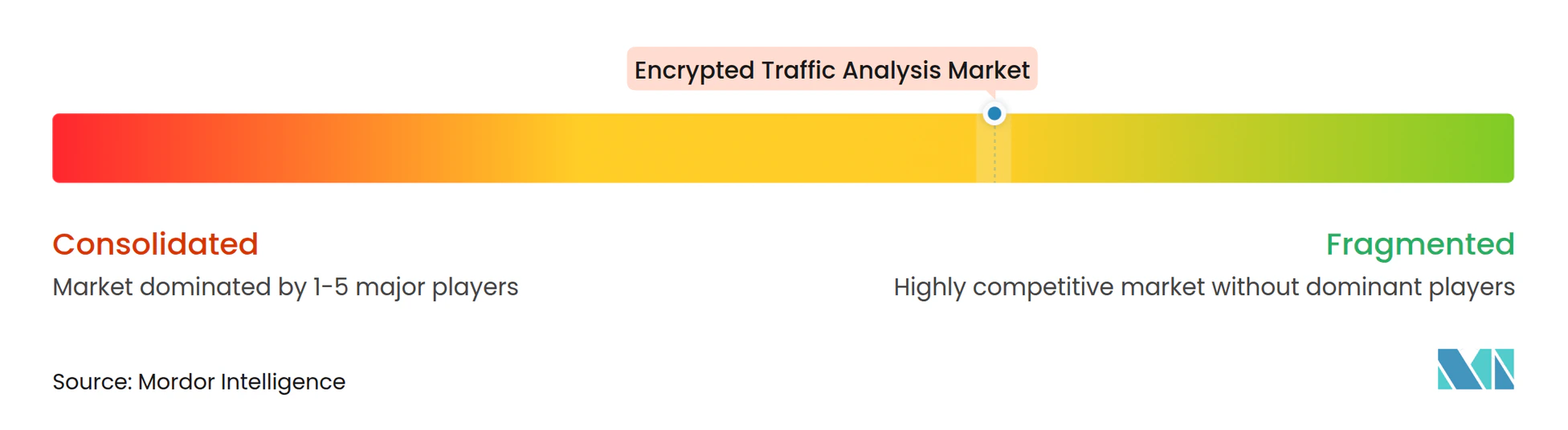
The encrypted traffic analysis market is moderately fragmented because no single vendor leads across all deployment model and applications. Cisco, Palo Alto Networks, and Fortinet compete with network detection and response specialists such as ExtraHop, Vectra AI, Corelight, and Gigamon. Zscaler and other cloud-delivered security providers incorporate analytics within wider zero-trust access platforms. This structure gives customers a choice between integrated security suites and specialist network visibility tools. The main competitive question is shifting toward behavioral detection, workflow integration, and deployment flexibility.
ExtraHop’s August 2026 400 Gbps sensor for RevealX is an example of vendors addressing line-rate visibility for high-volume data-center traffic. Gigamon’s GigaVUE 6.12 release added cryptographic inventory, deprecated cipher-suite identification, and post-quantum cryptography validation without decryption. Zscaler added post-quantum TLS inspection in beta and JA4 fingerprinting for endpoints that cannot be decrypted in September 2026. These moves combine higher traffic coverage, payload-blind detection, and cryptographic awareness. They also make integration with security operations center workflows more important when selecting vendors.
Privacy-preserving monitoring is an important requirement in the encrypted traffic analysis market, particularly in European regulated sectors. Operational technology and medical devices are another opportunity because they may not support certificate-based inspection. Post-quantum cryptographic posture monitoring is gaining relevance as organizations identify weak ciphers and prepare for protocol transitions. The encrypted traffic analysis market can favor providers with large labeled traffic datasets and mature AI models, and this advantage is strongest when vendors can present clear evidence, fit existing response processes, and give customers appropriate control over where sensitive traffic metadata is processed.
Encrypted Traffic Analysis Industry Leaders
-
Cisco Systems, Inc.
-
Gigamon Inc.
-
NETSCOUT Systems, Inc.
-
Keysight Technologies, Inc.
-
Palo Alto Networks, Inc.
- *Disclaimer: Major Players sorted in no particular order
Recent Industry Developments
- September 2026: Zscaler introduced post-quantum cryptography TLS inspection in beta at ZenithLive 2026, supporting hybrid ML-KEM and DH key exchange with real-time inspection and policy enforcement across PQC-to-PQC, classical-to-PQC, and PQC-to-classical traffic. The update also added JA4 encrypted-traffic fingerprinting for endpoints that cannot be decrypted, including OT controllers and medical devices, enabling behavioral alerting without plaintext access, and made NDR integrations with ExtraHop and Vectra AI generally available for AWS S3 environments.
- August 2026: ExtraHop debuted the 400 Gbps sensor for RevealX, the first NDR platform to analyze enterprise data-center traffic at line rate. The sensor continuously analyzes dense encrypted east-west flows to expose lateral movement and living-off-the-land activity, and structures traffic into a live semantic map addressable by agentic SOC tooling via open APIs.
- June 2026: CISA published The Journey to Zero Trust, Using Secure Access Service Edge in a Modern TIC 3.0 Solution, formally declaring TLS/SSL break-and-inspect no longer a universally recommended solution and endorsing AI-based and ML-based encrypted traffic analysis as the federal standard, requiring civilian executive branch agencies to maintain high-fidelity telemetry inclusive of encrypted traffic metadata.
- March 2026: Encrypted Client Hello was standardized as RFC 9849, encrypting the SNI field in TLS 1.3 handshakes. NGINX 1.29.4 shipped native ECH support in February 2026, and OpenSSL announced ECH for its upcoming 4.0 release, narrowing observable metadata available to passive encrypted-traffic inspection tools and accelerating adoption of AI-inference-based detection.
Global Encrypted Traffic Analysis Market Report Scope
The encrypted traffic analysis Market includes security software, platforms, and services that monitor and analyze encrypted network traffic to identify threats, anomalous behavior, policy violations, and potential data exfiltration without necessarily decrypting the underlying content. Such solutions commonly apply traffic metadata, behavioral analytics, artificial intelligence, and machine learning to improve visibility across encrypted TLS/SSL and other network flows.
The Encrypted Traffic Analysis Market Report is Segmented by Component (Solutions, and Services), Deployment Mode (On-Premises, and Cloud), Application (Threat Detection and Network Security, Encrypted Data-Exfiltration Detection, Application and Traffic Classification, Network Performance and Application Assurance, Cryptographic Posture and Compliance Monitoring, Threat Investigation and Forensics, and Other Applications), Organization Size (Large Enterprises, and Small and Medium-Sized Enterprises), End User (Banking, Financial Services, and Insurance (BFSI), Healthcare and Lifesciences, Government and Public Administration, IT and Telecommunications, and Other End Users), and Geography (North America, South America, Europe, Asia-Pacific, Middle East, and Africa). The Market Forecasts are Provided in Terms of Value (USD).
| Solutions |
| Services |
| On-Premises |
| Cloud |
| Threat Detection and Network Security |
| Encrypted Data-Exfiltration Detection |
| Application and Traffic Classification |
| Network Performance and Application Assurance |
| Cryptographic Posture and Compliance Monitoring |
| Threat Investigation and Forensics |
| Other Applications |
| Large Enterprises |
| Small and Medium Enterprises |
| Banking, Financial Services, and Insurance (BFSI) |
| Healthcare and Lifesciences |
| Government and Public Administration |
| IT and Telecommunications |
| Other End Users |
| North America | United States |
| Canada | |
| Mexico | |
| South America | Brazil |
| Rest of South America | |
| Europe | Germany |
| United Kingdom | |
| France | |
| Italy | |
| Russia | |
| Rest of Europe | |
| Asia-Pacific | China |
| Japan | |
| South Korea | |
| India | |
| Rest of Asia-Pacific | |
| Middle East | Saudi Arabia |
| United Arab Emirates | |
| Rest of Middle East | |
| Africa | South Africa |
| Nigeria | |
| Rest of Africa |
| By Component | Solutions | |
| Services | ||
| By Deployment Mode | On-Premises | |
| Cloud | ||
| By Application | Threat Detection and Network Security | |
| Encrypted Data-Exfiltration Detection | ||
| Application and Traffic Classification | ||
| Network Performance and Application Assurance | ||
| Cryptographic Posture and Compliance Monitoring | ||
| Threat Investigation and Forensics | ||
| Other Applications | ||
| By Organization Size | Large Enterprises | |
| Small and Medium Enterprises | ||
| By End User | Banking, Financial Services, and Insurance (BFSI) | |
| Healthcare and Lifesciences | ||
| Government and Public Administration | ||
| IT and Telecommunications | ||
| Other End Users | ||
| By Geography | North America | United States |
| Canada | ||
| Mexico | ||
| South America | Brazil | |
| Rest of South America | ||
| Europe | Germany | |
| United Kingdom | ||
| France | ||
| Italy | ||
| Russia | ||
| Rest of Europe | ||
| Asia-Pacific | China | |
| Japan | ||
| South Korea | ||
| India | ||
| Rest of Asia-Pacific | ||
| Middle East | Saudi Arabia | |
| United Arab Emirates | ||
| Rest of Middle East | ||
| Africa | South Africa | |
| Nigeria | ||
| Rest of Africa | ||
Key Questions Answered in the Report
What is the encrypted traffic analysis market size?
The encrypted traffic analysis market size was valued at USD 1.18 billion in 2026 and is estimated to grow from USD 1.34 billion in 2027 to reach USD 2.71 billion by 2032, at a CAGR of 15.13% during the forecast period (2027-2032).
What is driving demand for encrypted traffic analysis?
Higher encrypted traffic volumes, zero-trust adoption, cloud security deployment, and the need to detect threats without routine decryption are supporting demand.
Which component leads encrypted traffic analysis revenue?
Solutions lead the component segment with a 71.23% share in 2026, supported by platform licensing and integration with security operations tools.
Which deployment model is most widely used for encrypted traffic analysis?
Cloud deployment holds 68.93% in 2026 and is projected to expand at a 17.62% CAGR through 2032.
Which end-user segment has the strongest projected expansion?
Healthcare and life sciences are projected to expand at a 19.37% CAGR through 2032, supported by security and compliance requirements.
Which region has the fastest projected expansion?
Asia-Pacific is projected to expand at an 18.22% CAGR through 2032, supported by 5G traffic, cloud investment, and data-localization requirements.