
Data Detection and Response Market Size and Share
Market Overview
| Study Period | 2020 - 2031 |
|---|---|
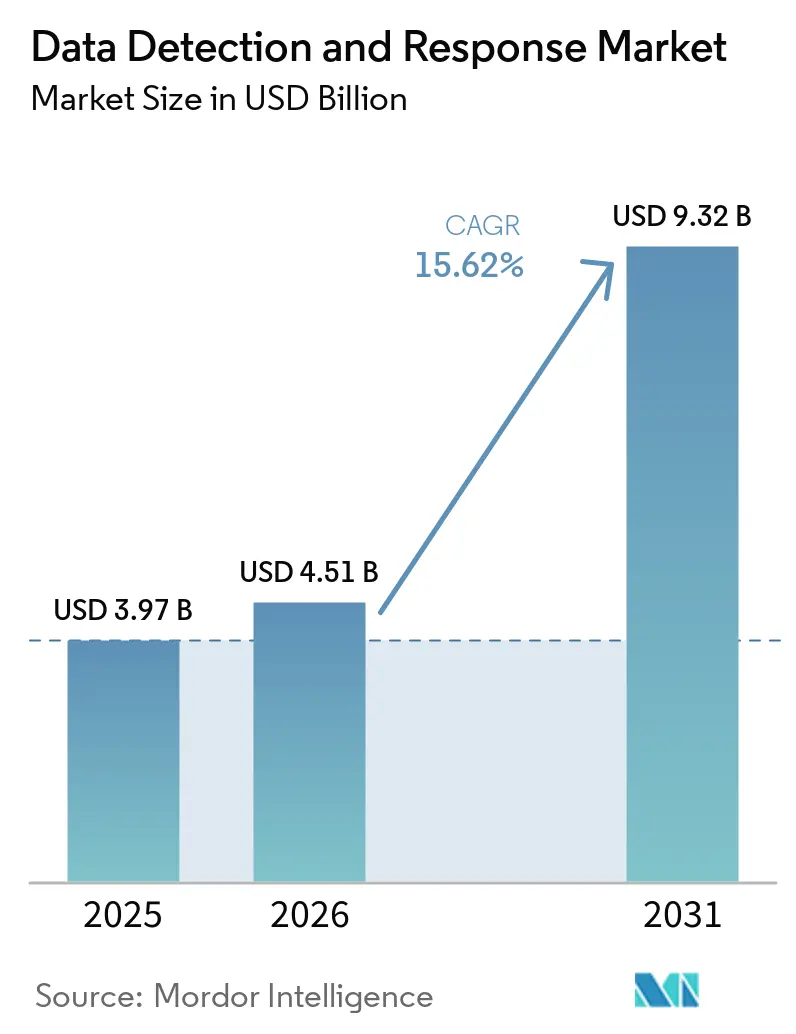
| Market Size (2026) | USD 4.51 Billion |
| Market Size (2031) | USD 9.32 Billion |
| Growth Rate (2026 - 2031) | 15.62 % |
| Fastest Growing Market | Asia-Pacific |
| Largest Market | North America |
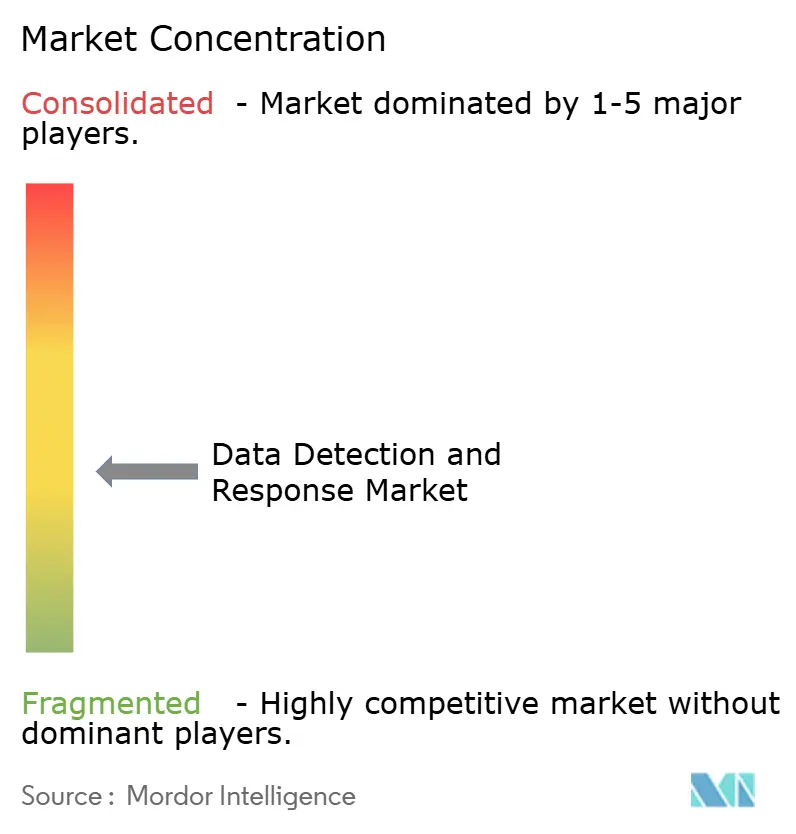
| Market Concentration | Medium |
Major Players *Disclaimer: Major Players sorted in no particular order Image © Mordor Intelligence. Reuse requires attribution under CC BY 4.0. | |
Data Detection and Response Market Analysis by Mordor Intelligence
The data detection and response market size was valued at USD 3.97 billion in 2025 and is estimated to grow from USD 4.51 billion in 2026 to reach USD 9.32 billion by 2031, at a CAGR of 15.62% during the forecast period (2026-2031). Enterprises are managing information across cloud repositories, SaaS applications, AI workflows, and on-premises systems simultaneously. This environment increases the need for continuous visibility into data access and movement. Unmanaged AI agents are becoming a practical concern because they can query or transfer sensitive information without direct human review. The Cloud Security Alliance reported in May 2026 that 53% of organizations had experienced AI agents exceeding intended data-access permissions. Compliance obligations and cyber-insurance requirements are also shifting data detection and response from periodic assessments to continuous monitoring.
Key Report Takeaways
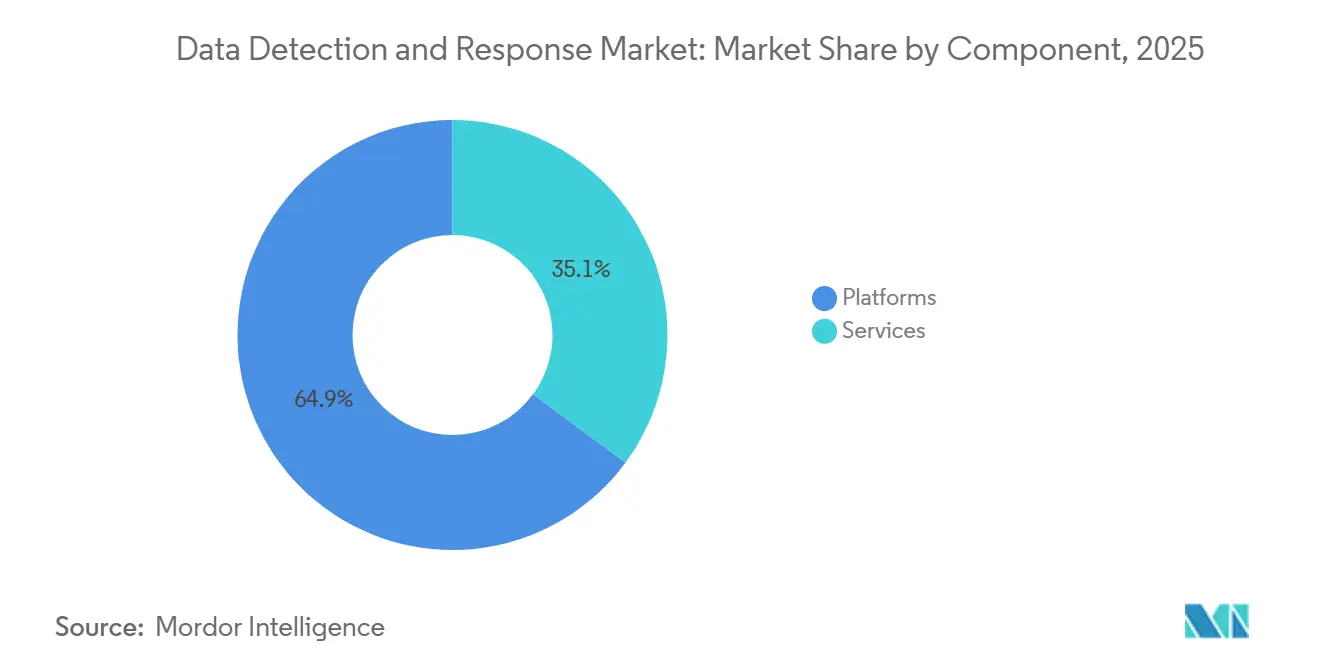
- By component, platforms held 64.89% of the data detection and response market revenue in 2025, while services are projected to expand at a 27.11% CAGR through 2031.
- By security function, data activity monitoring held 31.83% of revenue in 2025, while incident detection, response, and automated remediation is projected to expand at a 29.43% CAGR through 2031.
- By deployment mode, cloud held 39.86% of revenue in the data detection and response market in 2025, while hybrid deployment is projected to expand at a 26.19% CAGR through 2031.
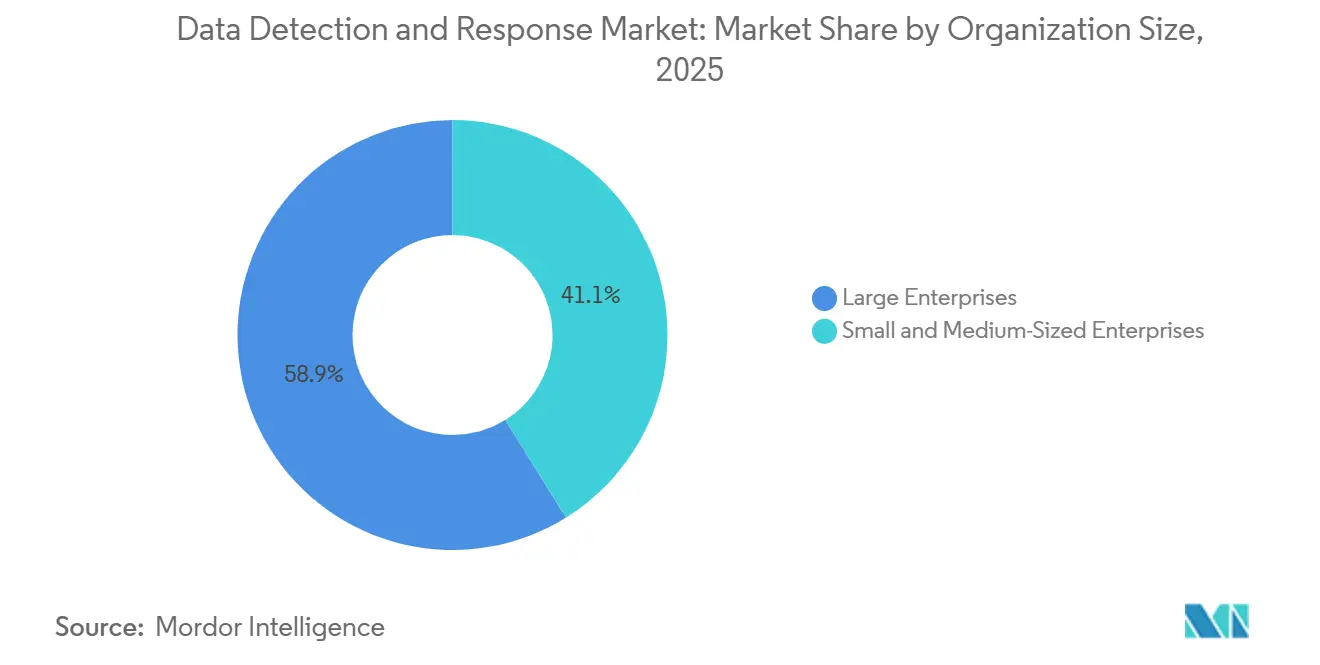
- By organization size, large enterprises held 58.86% of revenue in 2025, while small and medium-sized enterprises are projected to expand at a 27.23% CAGR through 2031.
- By industry vertical, banking, financial services, and insurance held 24.71% of revenue in the data detection and response market in 2025, while healthcare and life sciences are projected to expand at a 23.68% CAGR through 2031.
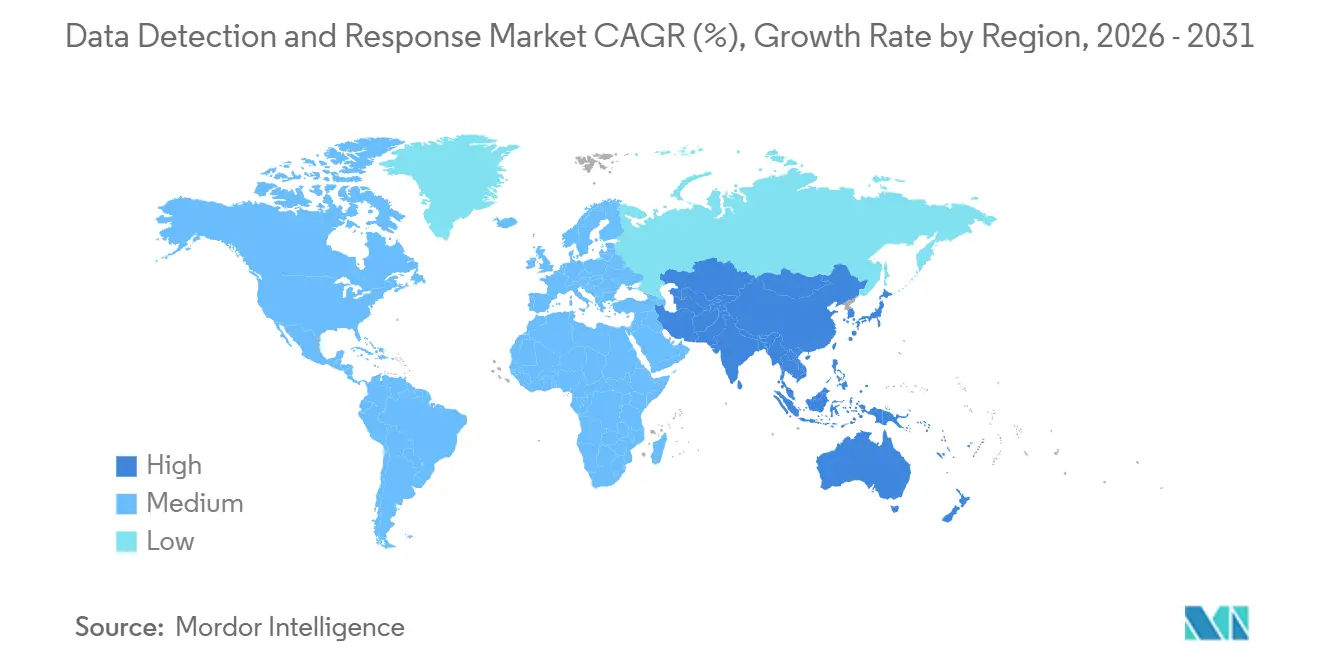
- By geography, North America held 41.39% of revenue in 2025, while Asia-Pacific is projected to expand at a 19.57% CAGR through 2031 in the data detection and response market.
Note: Market size and forecast figures in this report are generated using Mordor Intelligence’s proprietary estimation framework, updated with the latest available data and insights as of January 2026.
Global Data Detection and Response Market Trends and Insights
Drivers Impact Analysis*
| DRIVER | (~) % IMPACT ON CAGR FORECAST | GEOGRAPHIC RELEVANCE | IMPACT TIMELINE |
|---|---|---|---|
| Real-Time Sensitive-Data Monitoring Demand Drives Platform Evolution | +3.8% | Global, most acute in North America and Europe | Short term (≤ 2 years) |
| Cloud and SaaS Data Sprawl Outpaces Conventional DLP Controls | +3.1% | Global, fastest uptake in Asia-Pacific | Medium term (2-4 years) |
| Breach-Disclosure and Data-Protection Mandates Create Compliance-Driven Procurement | +2.5% | Europe, North America, and global AI regulation | Short term (≤ 2 years) |
| Security-Operations Tool Consolidation Redirects Budget Toward Integrated Platforms | +1.8% | Global, concentrated in large enterprises | Medium term (2-4 years) |
| Data-Lineage Coverage for AI Agents and Shadow Analytics | +1.5% | Global, accelerating in North America and Asia-Pacific | Short term (≤ 2 years) |
| Cyber-Insurance Evidence Requirements for Data Exfiltration | +1.0% | North America and Europe | Short term (≤ 2 years) |
| Source: Mordor Intelligence | |||
Real-Time Sensitive-Data Monitoring Demand Drives Platform Evolution
Organizations increasingly need systems that can identify and contain suspicious access events in near real time. IBM reported a 247-day median detection timeline among organizations with high levels of unmonitored AI usage in its 2025 breach report. The pressure is strongest in banking, financial services, insurance, healthcare, and life sciences, where a data exfiltration event can create regulatory, legal, and reputational exposure. Behavioral baselines help teams separate normal employee activity from bulk downloads, lateral movement, and AI-agent transfers. CrowdStrike introduced Falcon Data Security in March 2026 to discover, classify, and stop data theft across endpoints, SaaS, cloud, and AI workflows through one console.[1]CrowdStrike, “CrowdStrike Introduces Falcon Data Security to Stop Data Theft Across the Agentic Enterprise,” CrowdStrike, crowdstrike.com Synthetic data and AI-supported social engineering further reduce the value of signature-only controls.
Cloud and SaaS Data Sprawl Outpaces Conventional DLP Controls
SaaS applications and AI tools have weakened the traditional enterprise data perimeter. The Cloud Security Alliance cited Netskope data showing more than 1,550 GenAI SaaS applications by mid-2025, compared with 317 at the beginning of that year. Rule-based data loss prevention systems cannot readily identify behavior anomalies in unsanctioned AI pipelines or fragmented information across cloud tenants. Sensitive records can move between models, chat histories, and workspaces, which makes data lineage harder to reconstruct without continuous event tracking. ESET identified cloud security as the second-highest planned cybersecurity investment priority among small and medium-sized businesses globally in 2026.[2]ESET, “ESET SMB Cyber Readiness Index 2026: From AI to Phishing, Cyber Confidence Is Growing in the Age of Constant Attacks,” ESET, eset.com This extends demand for cloud-native and SaaS-delivered tools beyond large enterprises in the data detection and response market.
Breach-Disclosure and Data-Protection Mandates Create Compliance-Driven Procurement
New and strengthened obligations require enterprises to improve the speed and quality of incident evidence collection. Article 23 of the NIS2 Directive requires covered entities to provide a 24-hour early warning and a 72-hour incident notification. Germany's NIS2 implementation law took effect on December 6, 2025, and the German Federal Office for Information Security stated that 29,000 companies fell within scope. ENISA's June 2025 guidance said monitoring should be automated and continuous where feasible. NIS2, GDPR, HIPAA, DORA, and the EU AI Act impose different requirements for evidence, retention, and notification. These overlapping obligations support purchases of platforms that can centralize monitoring and audit records.
Security-Operations Tool Consolidation Redirects Budget Toward Integrated Platforms
Enterprises were operating between 45 and 83 cybersecurity tools in 2025, creating isolated telemetry and higher integration costs. Security leaders are consolidating data security posture management, data loss prevention, detection and response, and AI governance capabilities in fewer platforms. CrowdStrike positioned Falcon Data Security as an alternative to separate data security posture management and data loss prevention tools in March 2026. Consolidation can reduce integration work and provide a more consistent view of data activity. It can also shift detection work from separate managed detection and response and security information and event management layers into data-focused platforms. The data detection and response market, therefore, benefits when buyers favor unified architectures.
Restraints Impact Analysis*
| RESTRAINT | (~) % IMPACT ON CAGR FORECAST | GEOGRAPHIC RELEVANCE | IMPACT TIMELINE |
|---|---|---|---|
| Integration Complexity Across Heterogeneous Data Sources Extends Deployment Timelines | -1.5% | Global, highest severity in Middle East and Africa and South America | Medium term (2-4 years) |
| Specialist Skills and Continuous Tuning Requirements Constrain Operational Scalability | -1.1% | Global, most acute in Asia-Pacific and SME segments | Long term (≥ 4 years) |
| Privacy and Employee-Monitoring Governance | -0.7% | Europe and North America | Medium term (2-4 years) |
| Incomplete Telemetry from Legacy and Unsanctioned Environments | -0.5% | Global, most pronounced in industrial and government segments | Medium term (2-4 years) |
| Source: Mordor Intelligence | |||
Integration Complexity Across Heterogeneous Data Sources Extends Deployment Timelines
DDR platforms must collect and correlate records from cloud storage, databases, SaaS APIs, endpoint agents, and on-premises warehouses. Each source can use a different schema, access-log format, and authentication method. Multi-cloud organizations can also maintain separate audit formats across AWS, Microsoft Azure, Google Cloud, and SaaS applications. Complex deployments may require 6 to 12 months of normalization work before behavioral baselines can be used. Legacy infrastructure without native APIs adds further work in Southeast Asia, Sub-Saharan Africa, and South America. Governance decisions for HR and ERP systems also require agreement among IT, legal, and data-protection teams, which can slow mid-market adoption.
Specialist Skills and Continuous Tuning Requirements Constrain Operational Scalability
Behavioral models require ongoing tuning as workforce patterns, access norms, and AI workloads change. VikingCloud reported in 2026 that 34% of small and medium-sized businesses considered their security tools outdated, while 32% had security analyst development programs.[3]VikingCloud, “VikingCloud 2026 SMB Threat Landscape Report: Cyber Risk Rises and the Human Cost Grows,” VikingCloud, vikingcloud.com Organizations that do not invest in training can face more false positives and reduced confidence in alerts. Vendors are responding with managed DDR services and AI-supported alert triage. High annual contract values for managed services can still limit adoption among smaller organizations and businesses in emerging regions. This situation favors vendors that offer more autonomous classification and response with less manual tuning.
*Our forecasts treat driver/restraint impacts as directional, not additive. The impact forecasts reflect baseline growth, mix effects, and variable interactions.
Segment Analysis
By Component: Managed Services Reshape Revenue Mix
Platforms accounted for 64.89% of the data detection and response market share in 2025. Buyers have favored integrated architectures that correlate access events across endpoints, cloud services, and SaaS applications via a single management console. The scale of the platform segment reflects a continuing move away from disconnected detection tools. CrowdStrike introduced Falcon Data Security in March 2026 as a unified offering for data discovery, classification, and theft prevention. This type of integration has become a central purchase consideration for large security teams.
The services segment is projected to grow at a 27.11% CAGR through 2031. Organizations are seeking managed data detection and response (DDR), advisory, implementation, and analyst-support services to reduce their internal workload. The need is pronounced when teams lack specialized data security skills. Pure-play vendors are adding analyst-assisted response within subscription packages to shorten deployment time and improve retention. Platform providers and service firms are also increasingly combining their offerings. This will make the boundary between platform revenue and service revenue less distinct over the forecast period.


By Security Function: Activity Monitoring Leads, Response Automation Accelerates
Data activity monitoring held 31.83% of the data detection and response market revenue in 2025. Organizations need a clear record of who accessed data, when the access occurred, and where it originated before they can apply more advanced controls. Data discovery and classification establish a sensitivity context for the rest of the workflow. Data behavior analytics helps identify actions that depart from expected use patterns. Data loss and exfiltration prevention applies controls when activity creates a material risk.
Incident detection, response, and automated remediation are projected to grow at a 29.43% CAGR through 2031 in the data detection and response market. Security teams increasingly recognize that monitoring without containment can still leave a long period of exposure. Varonis introduced Agent Intent-Based Access Control in August 2026 to evaluate AI-agent intent and block policy-violating actions in real time. The capability includes inline redaction and human approval options for some actions. As vendors combine all 5 functions, the data detection and response market can see fewer boundaries between subcategories. This can support further M&A activity among specialized vendors through 2031.
By Deployment Mode: Hybrid Architectures Bridge Cloud and On-Premises Controls
Cloud deployment accounted for 39.86% of revenue in the data detection and response market in 2025. Enterprises can connect many cloud workloads to audit APIs without deploying additional endpoint agents. On-premises deployment remains important for government organizations, regulated financial institutions, and critical infrastructure operators with data residency requirements. The UK Government Business Data Survey 2026 found that 31% of businesses used public cloud, 19% used private cloud, and 27% used on-premises data infrastructure.[4]UK Government, “UK Business Data Survey 2026,” GOV.UK, gov.uk These figures show that mixed environments remain common.
Hybrid deployment is projected to grow at a 26.19% CAGR through 2031. Enterprises need a consistent view of information moving between on-premises databases, cloud storage, and SaaS systems. Hybrid architectures avoid separating visibility by infrastructure location. Cyberhaven stated that its unified platform tracks data lineage across cloud, on-premises, and endpoint environments. Persistent hybrid estates will continue to shape platform design and integration priorities. This deployment pattern creates an opportunity for vendors that can normalize telemetry across different environments.
By Organization Size: Enterprise Scale Contrasts With SME Momentum
Large enterprises held 58.86% of the data detection and response market revenue in 2025. Their data estates can include thousands of endpoints, many cloud accounts, and multiple SaaS tenants. These organizations also face obligations across more jurisdictions and have larger security operations budgets. Their deployments often include platform licenses, professional services, and managed response. The scale and complexity of these environments support demand for purpose-built data detection and response capabilities.
Small and medium-sized enterprises are projected to grow at a 27.23% CAGR through 2031. SaaS-delivered products and managed tiers are making data detection and response more accessible to these buyers. ESET reported that 71% of small and medium-sized businesses globally had adopted cyber insurance in 2026. Documentation requirements at renewal can prompt evaluations of continuous monitoring controls. VikingCloud identified cybersecurity as the leading operational concern for small and medium-sized businesses in 2026. This demand is expanding the customer base beyond established enterprise buyers.
By Industry Vertical: BFSI Anchors Demand, Healthcare Accelerates Adoption
Banking, financial services, and insurance held 24.71% of the data detection and response market revenue in 2025. These institutions process high volumes of sensitive transaction and customer data every day. Financial regulators and breach consequences have encouraged mature data-monitoring programs. Migration of core banking systems to cloud environments can create new visibility gaps. These gaps are especially relevant for digital banking services and AI-supported trading workflows.
The healthcare and life sciences segment is projected to grow at a 23.68% CAGR through 2031. The U.S. Department of Health and Human Services Office for Civil Rights required 4 healthcare entities to pay a combined USD 1,165,000 and implement 2-year corrective action plans after ransomware breaches in April 2026.[5]U.S. Department of Health and Human Services Office for Civil Rights, “Breach Portal: Notice to the Secretary of HHS Breach of Unsecured Protected Health Information,” HHS OCR, ocrportal.hhs.gov Government and public administration, IT and telecommunication, and retail and e-commerce also create demand. Government buyers face NIS2 requirements, while retail organizations must monitor cardholder data under PCI-DSS. Industrial manufacturing, energy and utilities, oil and gas, and media and entertainment are earlier-stage adopters. Education and research institutions need to protect intellectual property, student data, and federally funded research records.
Geography Analysis
North America held 41.39% of the data detection and response market share in 2025. Data-intensive enterprises, an established cyber-insurance environment, and overlapping federal and state privacy rules support regional demand. The United States remains the largest national market, shaped by HIPAA, the NYDFS Cybersecurity Regulation Part 500, and state privacy laws. Canada and Mexico add demand in financial services and government as cloud migration creates data-visibility gaps. South America is emerging, led by Brazil, where the LGPD requires data protection and breach notification. Argentina and other South American countries remain early-stage markets, although cross-border finance and digital investment are increasing the need for monitoring.
Europe is the second-largest region in the data detection and response market. Germany, the United Kingdom, and France lead adoption, particularly among financial institutions and critical infrastructure operators. Germany's NIS2 implementation law expanded the number of companies within scope to 29,000 in December 2025. BENELUX is emerging as a growth area because many European multinational headquarters must maintain centralized, auditable access records. ENISA stated in June 2025 that automated and continuous monitoring should be used where feasible. This guidance aligns procurement criteria across regulated European sectors with core DDR functions.
Asia-Pacific is projected to grow at a 19.57% CAGR through 2031. Cloud adoption in China, India, Japan, South Korea, and Australia is occurring alongside more detailed national data-protection requirements. India, China, and Singapore have established frameworks that raise attention to data accountability. Japan's Financial Services Agency and Bank of Japan issued 2026 guidance on frontier AI threats and data security in AI-integrated financial systems.[6]Amazon Web Services Japan, “Preparing for Frontier AI Threats: FSA and Bank of Japan Requests and AWS Services,” Amazon Web Services, aws.amazon.com The Middle East and Africa remains at an earlier adoption stage, with the United Arab Emirates and Saudi Arabia acting as key growth centers. Nigeria, South Africa, and Egypt are expanding digital financial services, which will build monitored enterprise data estates over time.

Competitive Landscape
The data detection and response market is moderately fragmented. Integrated vendors include CrowdStrike, Microsoft, Palo Alto Networks, IBM, and Fortinet, which place data detection and response capabilities within broader security operations suites. Specialized vendors include Varonis, Cyberhaven, Cyera, BigID, Nightfall AI, and Securiti. These firms offer deeper data lineage, behavioral analytics, and AI-agent governance capabilities. Competition increasingly centers on combining data security posture management, data loss prevention, insider risk management, data detection and response, and AI governance in unified architectures.
Cyera completed a USD 600 million Series G round at a USD 12 billion valuation in June 2026. Varonis reported that SaaS ARR excluding conversions increased 25%, while new-logo SaaS ARR grew by more than 20% in the second quarter of 2026. Cyera completed 5 acquisitions in the 18 months preceding its June 2026 funding round. Forcepoint acquired Getvisibility, and Veeam acquired Securiti in early 2026. These transactions reflect continued consolidation among providers of data security, privacy, and AI governance capabilities.
Opportunity areas include sovereign and federated data detection and response for strict data-residency requirements, managed services for small and medium-sized enterprises, and controls for non-human AI-agent access. CrowdStrike expanded Project QuiltWorks in August 2026 and added 12 ecosystem partners to Falcon Next-Gen SIEM. It also introduced Falcon IQ to automate more than 50 security workflows. Varonis launched Atlas in May 2026 as an AI security platform that includes inventory, posture management, testing, runtime controls, compliance mapping, and detection and response. Vendors with enterprise relationships in banking, financial services, insurance, and healthcare are positioned for compliance-led demand, while managed-service programs can widen access in later forecast years.
Data Detection and Response Industry Leaders
IBM Corporation
Forcepoint LLC
Microsoft Corporation
Palo Alto Networks, Inc.
CrowdStrike Holdings, Inc.
- *Disclaimer: Major Players sorted in no particular order

Recent Industry Developments
- August 2026: CrowdStrike expands Project QuiltWorks at Fal.Con 2026, integrating 12 ecosystem partners, including Netskope, Rubrik, and Zscaler, into Falcon Next-Gen SIEM, and simultaneously launches Falcon IQ, an AI-agent orchestration layer automating more than 50 security workflows spanning assessment, prioritization, and remediation. The expansion strengthens CrowdStrike's data-security position by unifying telemetry across a broad sensor network.
- August 2026: Varonis Systems introduces Agent Intent-Based Access Control as a new capability within Varonis Atlas, using an LLM evaluator to verify AI agent intent in real time and block policy-violating data-access actions including inline redaction and human-in-the-loop approval workflows.
- June 2026: Cyera closes a USD 600 million Series G at a USD 12 billion valuation, quadrupling valuation over 18 months, led by Evolution Equity Partners with participation from Accel, AT&T Ventures, Blackstone, Coatue, and Temasek, funding acceleration of its convergent DSPM, DLP, DDR, and AI governance trust layer.
- March 2026: CrowdStrike introduces Falcon Data Security at RSA 2026, converging DSPM and DLP with real-time adversary intelligence to discover, classify, and stop data theft across endpoints, browsers, SaaS, cloud, and AI workflows from one unified console.


Global Data Detection and Response Market Report Scope
The data detection and response (DDR) market comprises security solutions that continuously monitor, detect, and respond to data-centric threats across enterprise environments by analyzing data access patterns, user behavior, and data movement in real time. These platforms employ machine learning, behavioral analytics, and automated response capabilities to identify anomalous data access, insider threats, data exfiltration attempts, and unauthorized data sharing across cloud applications, databases, data lakes, and hybrid infrastructure, enabling organizations to prevent data breaches, enforce data protection policies, and rapidly contain security incidents through automated actions such as access revocation, session termination, data quarantine, or alert escalation to security operations teams.
The Data Detection and Response Market Report is Segmented by Component (Platforms, and Services), Security Function (Data Discovery and Classification, Data Activity Monitoring, Data Behavior Analytics, Data Loss and Exfiltration Prevention, and Incident Detection, Response and Automated Remediation), Deployment Mode (Cloud, On-Premises, and Hybrid), Organization Size (Large Enterprises, and Small and Medium-Sized Enterprises), Industry Vertical (Government and Public Administration, Industrial Manufacturing, Retail and E-Commerce, Transportation and Logistics, Energy and Utilities, Oil and Gas, IT and Telecommunication, Media and Entertainment, Education and Research Institutions, Healthcare and Life Sciences, Banking, Financial Services, and Insurance (BFSI), and Other Industry Verticals), and Geography (North America, South America, Europe, Asia-Pacific, and Middle East and Africa). The Market Forecasts are Provided in Terms of Value (USD).
| Platforms |
| Services |
| Data Discovery and Classification |
| Data Activity Monitoring |
| Data Behavior Analytics |
| Data Loss and Exfiltration Prevention |
| Incident Detection, Response and Automated Remediation |
| Cloud |
| On-Premises |
| Hybrid |
| Large Enterprises |
| Small and Medium-Sized Enterprises |
| Government and Public Administration |
| Industrial Manufacturing |
| Retail and E-Commerce |
| Transportation and Logistics |
| Energy and Utilities |
| Oil and Gas |
| IT and Telecommunication |
| Media and Entertainment |
| Education and Research Institutions |
| Healthcare and Life Sciences |
| Banking, Financial Services, and Insurance (BFSI) |
| Other Industry Verticals |
| North America | United States | |
| Canada | ||
| Mexico | ||
| South America | Brazil | |
| Argentina | ||
| Rest of South America | ||
| Europe | Germany | |
| United Kingdom | ||
| France | ||
| Italy | ||
| BENELUX | ||
| Rest of Europe | ||
| Asia-Pacific | China | |
| Japan | ||
| India | ||
| South Korea | ||
| Australia | ||
| Rest of Asia-Pacific | ||
| Middle East and Africa | Middle East | United Arab Emirates |
| Saudi Arabia | ||
| Rest of Middle East | ||
| Africa | South Africa | |
| Nigeria | ||
| Egypt | ||
| Rest of Africa | ||
| By Component | Platforms | ||
| Services | |||
| By Security Function | Data Discovery and Classification | ||
| Data Activity Monitoring | |||
| Data Behavior Analytics | |||
| Data Loss and Exfiltration Prevention | |||
| Incident Detection, Response and Automated Remediation | |||
| By Deployment Mode | Cloud | ||
| On-Premises | |||
| Hybrid | |||
| By Organization Size | Large Enterprises | ||
| Small and Medium-Sized Enterprises | |||
| By Industry Vertical | Government and Public Administration | ||
| Industrial Manufacturing | |||
| Retail and E-Commerce | |||
| Transportation and Logistics | |||
| Energy and Utilities | |||
| Oil and Gas | |||
| IT and Telecommunication | |||
| Media and Entertainment | |||
| Education and Research Institutions | |||
| Healthcare and Life Sciences | |||
| Banking, Financial Services, and Insurance (BFSI) | |||
| Other Industry Verticals | |||
| By Geography | North America | United States | |
| Canada | |||
| Mexico | |||
| South America | Brazil | ||
| Argentina | |||
| Rest of South America | |||
| Europe | Germany | ||
| United Kingdom | |||
| France | |||
| Italy | |||
| BENELUX | |||
| Rest of Europe | |||
| Asia-Pacific | China | ||
| Japan | |||
| India | |||
| South Korea | |||
| Australia | |||
| Rest of Asia-Pacific | |||
| Middle East and Africa | Middle East | United Arab Emirates | |
| Saudi Arabia | |||
| Rest of Middle East | |||
| Africa | South Africa | ||
| Nigeria | |||
| Egypt | |||
| Rest of Africa | |||


Key Questions Answered in the Report
What is the size of the data detection and response market?
The data detection and response market size was valued at USD 3.97 billion in 2025 and is estimated to grow from USD 4.51 billion in 2026 to reach USD 9.32 billion by 2031, at a CAGR of 15.62% during the forecast period (2026-2031).
What is driving demand for data detection and response platforms?
Demand is supported by AI-agent governance needs, cloud and SaaS data sprawl, data-protection obligations, and the need for real-time monitoring evidence.
Which component leads data detection and response spending?
Platforms held 64.89% of revenue in 2025 because buyers favor integrated monitoring architectures. Services is the faster-growing component at a 27.11% CAGR.
Which security function is growing fastest?
Incident detection, response and automated remediation is projected to grow at a 29.43% CAGR through 2031 as organizations seek faster containment.
Which region is growing fastest for data detection and response?
Asia-Pacific is projected to grow at a 19.57% CAGR through 2031, supported by cloud adoption and stronger data-protection frameworks.
What challenges can limit data detection and response (DDR) adoption?
Integration across varied data sources and the need for continuous model tuning can extend deployment timelines and raise operating requirements.
Page last updated on:





