
Managed Network-as-a-Service Operations Market Size and Share
Market Overview
| Study Period | 2021 - 2032 |
|---|---|
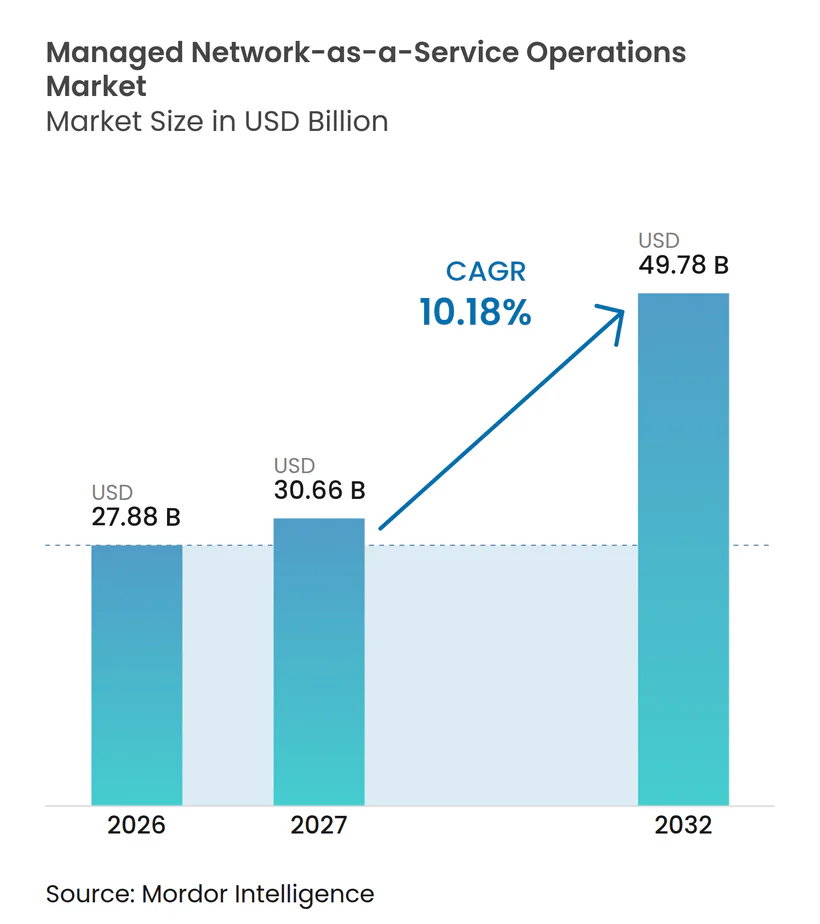
| Market Size (2027) | USD 30.66 Billion |
| Market Size (2032) | USD 49.78 Billion |
| Growth Rate (2027 - 2032) | 10.18 % |
| Fastest Growing Market | Asia-Pacific |
| Largest Market | North America |
| Market Concentration | Medium |
Major Players *Disclaimer: Major Players sorted in no particular order Image © Mordor Intelligence. Reuse requires attribution under CC BY 4.0. | |
Managed Network-as-a-Service Operations Market Analysis by Mordor Intelligence
The Managed Network-as-a-Service Operations market size is projected to expand from USD 27.88 billion in 2026 to USD 49.78 billion by 2032, registering a CAGR of 10.18% between 2027 to 2032. The Managed Network-as-a-Service Operations market is supported by enterprises that need to run cloud, edge, security, and site networks as connected operating environments. Hybrid work, multicloud applications, and distributed devices are raising the effort required to manage performance and security with internal teams alone. Providers are responding with integrated SD-WAN, SASE, network observability, and automated operations under service-level agreements. This shifts competition toward providers that can combine network management, security controls, and flexible commercial terms. The Managed Network-as-a-Service Operations market also faces adoption constraints where customers need direct operational visibility, portability between platforms, and compliance with local data requirements.
Key Report Takeaways
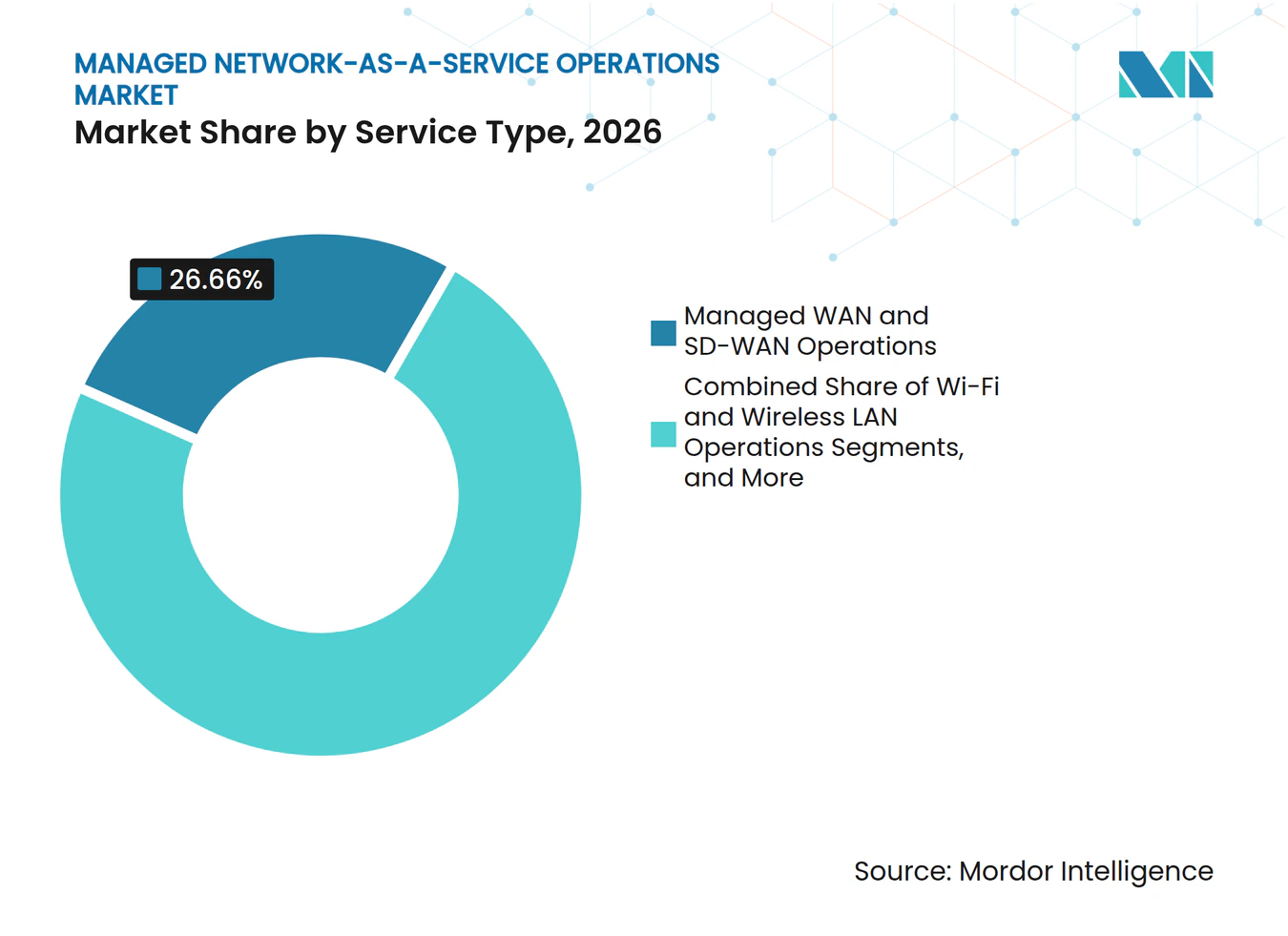
- By service type, Managed WAN and SD-WAN Operations held 26.66% of the Managed Network-as-a-Service Operations market share in 2026, while Managed Private 5G and Edge Network Operations is projected to expand at an 11.04% CAGR through 2032.
- By delivery model, Fully Managed Services held 42.11% of revenue in 2026, while Consumption-Based Network Services is projected to expand at a 10.99% CAGR through 2032.
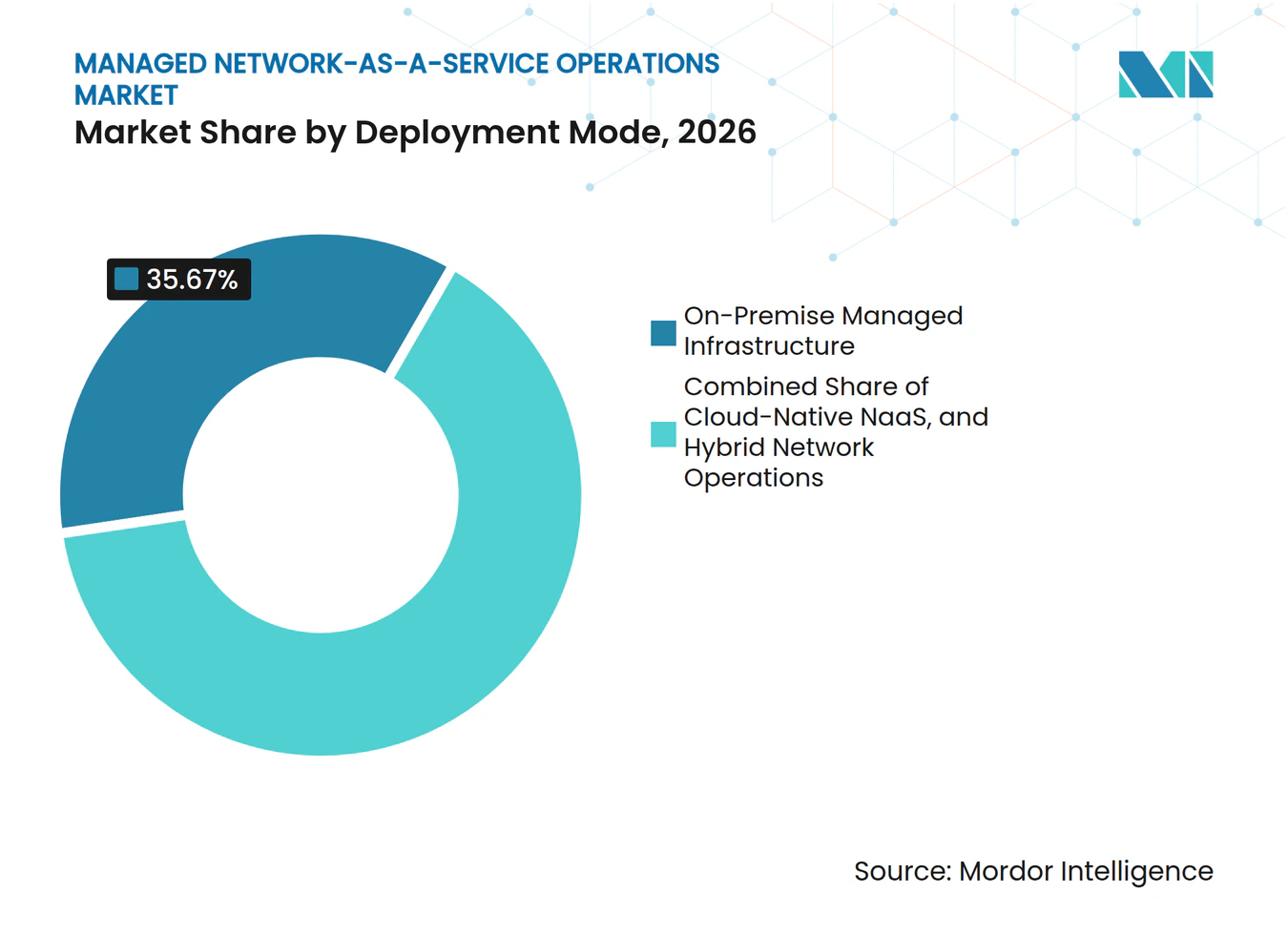
- By deployment mode, On-Premise Managed Infrastructure held 35.67% of revenue in 2026, while Cloud-Native NaaS is projected to expand at a 10.88% CAGR through 2032.
- By organization size, Large Enterprises held 70.88% of revenue in 2026, while SMEs are projected to expand at a 10.67% CAGR through 2032.
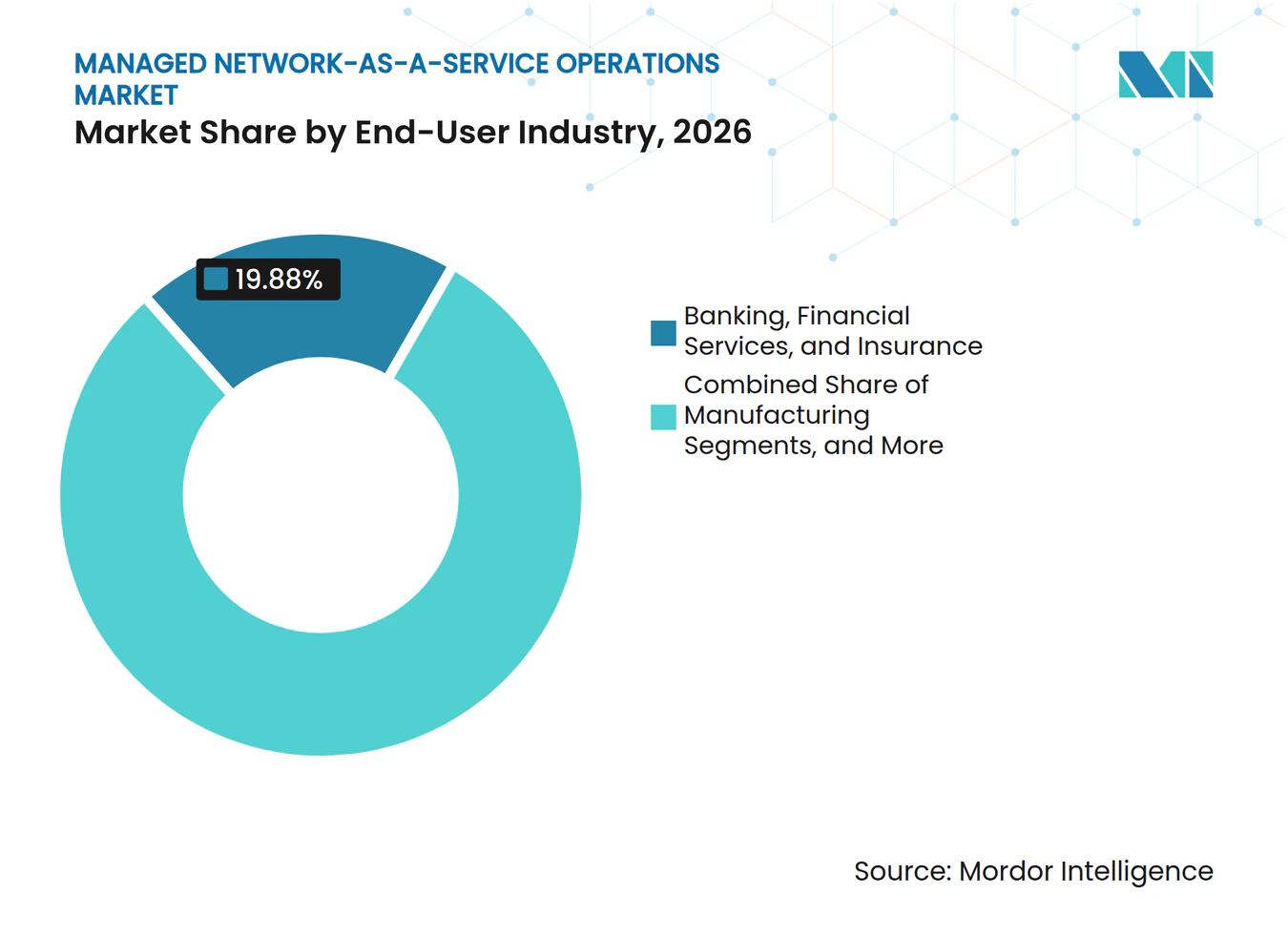
- By end-user industry, Banking, Financial Services, and Insurance held 19.88% of revenue in 2026, while Manufacturing is projected to expand at a 10.56% CAGR through 2032.
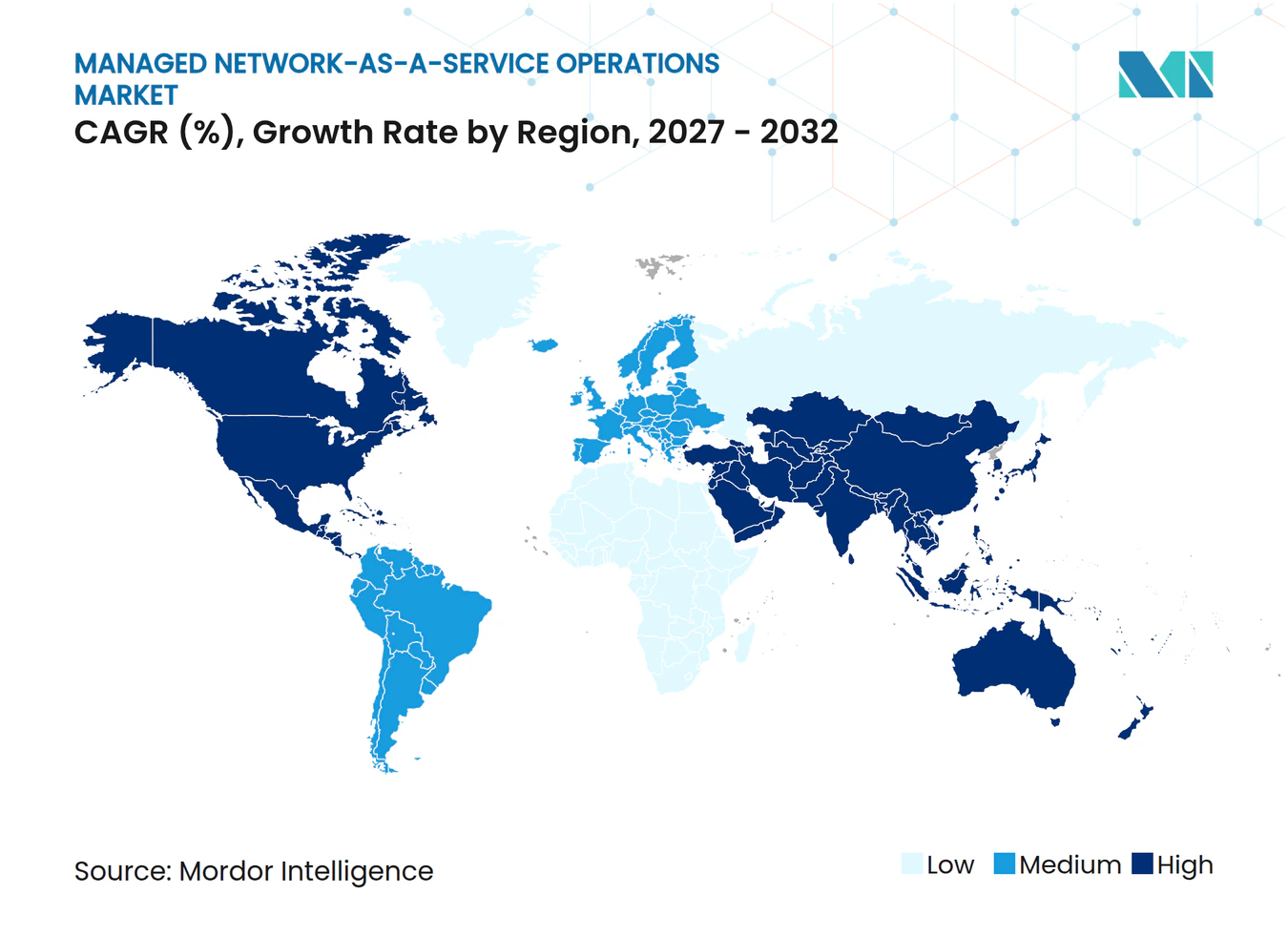
- By geography, North America held 36.64% of revenue in 2026, while Asia-Pacific is projected to expand at a 10.77% CAGR through 2032.
Note: Market numbers in this report are based on Mordor Intelligence's proprietary estimation framework, which combines nine months of actuals with Q4 projections for base year 2026.
Global Managed Network-as-a-Service Operations Market Trends and Insights
Drivers Impact Analysis*
| Driver | (~) % Impact on CAGR Forecast | Geographic Relevance | Impact Timeline |
|---|---|---|---|
| Hybrid and Multicloud Network Complexity | +2.1% | Global | Short term (≤ 2 years) |
| Shift From CapEx Ownership to Subscription Consumption | +1.8% | Global | Medium term (2-4 years) |
| AI-Driven Network Assurance and Automated Remediation | +1.6% | North America and Europe, spill-over to Asia-Pacific | Medium term (2-4 years) |
| Enterprise Cybersecurity and Zero-Trust Requirements | +1.4% | North America and EU | Medium term (2-4 years) |
| Scarcity of Specialized Network Operations Talent | +1.0% | Global | Long term (≥ 4 years) |
| Private 5G, IoT, and Edge Network Expansion | +0.9% | Asia-Pacific core, spill-over to North America and Europe | Long term (≥ 4 years) |
| Source: Mordor Intelligence | |||
Hybrid and Multicloud Network Complexity
Organizations are running applications and data across private data centers, public clouds, edge sites, and remote locations. This creates a larger operating burden for teams that must manage routing, access, performance, and security across separate environments. The Managed Network-as-a-Service Operations market benefits when customers need a single operating model for these connected domains. AI workloads at edge locations also add traffic between cloud and edge sites. Traditional hub-and-spoke MPLS designs can be difficult to adapt to these traffic patterns. Providers with SD-WAN orchestration and full-stack observability can support the transition to software-defined network overlays.
Shift From CapEx Ownership to Subscription Consumption
Enterprise customers are moving technology spending toward recurring service models that can be treated as operating expenditure. The Managed Network-as-a-Service Operations market gains from this shift because subscribers can obtain network capabilities without a large upfront hardware purchase. Deloitte and HPE offer NaaS that combines strategy, architecture, deployment, operations, monitoring, and lifecycle management through a subscription model. Flexible services can also give customers clearer cost visibility as network capacity changes. Continuous service delivery gives providers operational data that can support predictive lifecycle management. Faster provisioning and automated scaling can make these models more suitable for organizations with changing site and application needs.
AI-Driven Network Assurance and Automated Remediation
Network operations platforms are increasingly designed to identify faults, diagnose their causes, and complete selected remediation tasks with limited manual intervention. Microsoft reported that its Falcon Agent handled 60% of incident volume and saved 10-15 minutes per ticket in its internal deployment.[1] The Managed Network-as-a-Service Operations market is supported when providers use these tools to reduce response time and improve operational consistency. Mavenir introduced an Agentic Service Assurance Framework in June 2026 that captures network operations knowledge from live environments for automation workflows.[2] These systems can develop through repeated use as new operating cases are incorporated. Providers that combine automation with accountable human oversight can improve their position with customers that require reliable incident handling.
Enterprise Cybersecurity and Zero-Trust Requirements
Security requirements are making network operations and access control more closely connected. Customers with distributed workforces and multicloud systems need managed services that can enforce consistent policy across users, devices, applications, and sites. AT&T and Cisco launched AT&T SASE with Cisco in August 2025, combining SD-WAN, secure service edge controls, zero-trust security, path optimization, and multicloud connectivity in one managed offering.[3] AT&T and Palo Alto Networks made AT&T Dynamic Defense and AT&T SASE with Palo Alto Networks generally available in July 2026 for distributed multicloud environments. These launches show how security services can become the starting point for wider managed network contracts. The Managed Network-as-a-Service Operations market therefore rewards providers that can unite network visibility, threat protection, and access policy.
Restraints Impact Analysis*
| Restraint | (~) % Impact on CAGR Forecast | Geographic Relevance | Impact Timeline |
|---|---|---|---|
| Third-Party Risk and Control Concerns in Mission-Critical Networks | -1.2% | Global | Short term (≤ 2 years) |
| Vendor Lock-In and Limited Portability Across Orchestrators | -0.9% | North America and Europe | Medium term (2-4 years) |
| Data Sovereignty and Cross-Border Operations Constraints | -0.7% | Europe and Asia-Pacific | Medium term (2-4 years) |
| Complex Migration From Legacy MPLS and Bespoke Networks | -0.6% | North America and Europe | Long term (≥ 4 years) |
| Source: Mordor Intelligence | |||
Third-Party Risk and Control Concerns in Mission-Critical Networks
Customers in banking, healthcare, and government must consider the risk of assigning operational control to an outside provider. Their concern includes outage response, access to sensitive telemetry, and the ability to review decisions made inside the network environment. The Managed Network-as-a-Service Operations market can face longer sales cycles when customers need detailed governance terms before approving a fully managed model. Responsibility for service availability and regulatory compliance remains with the customer even when operations are outsourced. This can limit adoption in highly regulated workloads. Providers can reduce this constraint through auditable operating platforms, transparent reporting, and co-managed controls that retain customer visibility.
Vendor Lock-In and Limited Portability Across Orchestrators
Proprietary orchestration layers can make a platform difficult to replace once a customer has configured network intent, policies, and workflows. The risk is higher for organizations operating across jurisdictions with different performance and compliance needs. The Managed Network-as-a-Service Operations market can be affected when customers delay decisions until they receive clear exit rights and interoperability commitments. Limited portability can increase the cost of moving to another provider at contract renewal. TM Forum technical specifications IG1251 and IG1453 set out architectures for autonomous networks and related operational systems. Wider use of open standards could reduce switching barriers, although customers still need contract terms that cover data, interfaces, and transition support.
*Our forecasts treat driver/restraint impacts as directional, not additive. The impact forecasts reflect baseline growth, mix effects, and variable interactions.
Segment Analysis
By Service Type: SD-WAN Anchors Revenue While Private 5G Scales Across Industrial Sites
Managed WAN and SD-WAN Operations held 26.66% of the Managed Network-as-a-Service Operations market share in 2026. The service has a broad installed base among enterprises that have moved from fixed MPLS networks to software-defined overlays. These overlays support cloud applications and changing traffic patterns across distributed sites. Managed Network Security and SASE Operations, plus network monitoring and NOC operations, are important adjacent services. Together, these lines encourage customers to consolidate formerly separate operational contracts.
Managed Private 5G and Edge Network Operations is projected to expand at an 11.04% CAGR through 2032. Manufacturing, logistics, and energy sites need dependable low-latency connectivity for robotics, automated guided vehicles, and real-time safety monitoring. NTT DATA and Ericsson formed a multiyear partnership in February 2026 to deliver private 5G as a fully managed global service with edge AI capabilities. The offering reflects demand for standardized private wireless design, operations, and security across multiple sites. Providers must show that their services can work safely with industrial systems and local operating processes.



By Delivery Model: Fully Managed Services Lead as Consumption Models Reshape Procurement
Fully Managed Services accounted for 42.11% of the Managed Network-as-a-Service Operations market size in 2026. This model provides one point of accountability for hardware, software, connectivity, and daily operations. It is relevant to large enterprises that want to limit internal resources for global network governance. Co-Managed Services allow customers to retain selected policy and governance responsibilities. Self-Managed NaaS With Provider-Assisted Operations suits organizations building internal capability with external support.
Consumption-Based Network Services is projected to expand at a 10.99% CAGR through 2032. Customers can align spending with changing demand rather than buying capacity years before it is used. Subscription models can reduce the initial barrier for mid-sized organizations seeking advanced network capabilities. This approach supports the broader move toward cloud and software subscriptions. Clear pricing, capacity rules, and service levels will remain important to adoption.
By Deployment Mode: On-Premise Infrastructure Persists as Cloud-Native NaaS Accelerates
On-Premise Managed Infrastructure held 35.67% of revenue in 2026. Large organizations in regulated sectors continue to keep infrastructure on site where data residency and local control requirements are important. The Managed Network-as-a-Service Operations market size includes provider-managed operations even when equipment remains at customer locations. Hybrid Network Operations bridges site infrastructure with cloud-based management and analytics. This model supports modernization without replacing every existing system at once.
Cloud-Native NaaS is projected to expand at a 10.88% CAGR through 2032. Greenfield sites and zero-touch provisioning enable remote configuration with less local technical work. Alcatel-Lucent Enterprise introduced AerFlex in July 2026, an access-point-only architecture that removes the need for on-site servers and rack infrastructure. Simpler physical designs can complement cloud-managed operations. Physical infrastructure may remain on site, but management functions can increasingly move to software platforms.

By Organization Size: Large Enterprises Anchor Revenues as SMEs Emerge as Key Growth Driver
Large Enterprises held 70.88% of revenue in 2026. Their global footprints often combine SD-WAN, private 5G, campus Wi-Fi, data center interconnect, and security controls. The scale and complexity of these environments support long-duration managed services contracts. Customers also require centralized reporting and consistent performance across cloud, core, and edge networks. This makes full-scope delivery models particularly relevant to their needs.
SMEs are projected to expand at a 10.67% CAGR through 2032. Cloud-native platforms and consumption-based contracts can reduce the expertise and capital needed for enterprise-grade connectivity. Deutsche Telekom expanded its LogicMonitor partnership across DACH, Benelux, and the Nordic region in May 2026 to support predictive resilience in distributed enterprise environments. Automation can help providers serve smaller customers at lower operating cost. Simplified tiers, transparent pricing, and faster activation will be important in this customer group.
By End-User Industry: BFSI Holds the Largest Share as Manufacturing Reconfigures Networks
Banking, Financial Services, and Insurance held 19.88% of revenue in 2026. The sector depends on continuous connectivity, tight security controls, and clear accountability for service performance. These needs support recurring demand for managed WAN, security, monitoring, and incident-response capabilities. IT and Telecommunications also invests in managed operations for hybrid cloud and edge environments. Healthcare, government, and retail have their own requirements for secure access and reliable site connectivity.
Manufacturing is projected to expand at a 10.56% CAGR through 2032. Private 5G, industrial IoT sensors, robotics, and automated guided vehicles need low-latency connectivity in dense industrial settings. NTT DATA offers private 5G for manufacturing, automotive, transportation, and energy customers under a NaaS commercial model. The Managed Network-as-a-Service Operations market needs providers that can operate information technology and operational technology networks without interrupting production. Industrial customers will evaluate partners on uptime, local support, and site-specific requirements.
Geography Analysis
North America held 36.64% of the Managed Network-as-a-Service Operations market share in 2026. The region has established enterprise technology infrastructure, deep provider competition, and strong demand from regulated sectors and government. Compliance requirements can shape managed connectivity procurement. North America remains an important revenue base as enterprises adopt SASE and consumption-based network services. The United States leads the region, while Canada and Mexico benefit from cross-border business activity and nearshoring investment.
Europe is the second-largest regional contributor in 2026. Data sovereignty, compliance, and long-term security planning are important considerations for enterprise buyers. Germany, the United Kingdom, and France lead regional adoption. South America is led by Brazil, where financial services and retail modernization support managed connectivity demand. The Middle East and Africa is supported by Saudi Arabia and the UAE, where smart infrastructure and industrial projects require managed network services.
Asia-Pacific is projected to expand at a 10.77% CAGR through 2032. Manufacturing digitalization, 5G deployment, and a wider provider presence across China, India, South Korea, Japan, and Australia support demand. India has a growing need for managed network services as enterprise digitization, manufacturing parks, and 5G expansion advance. NTT DATA and Ericsson identified manufacturing, transportation, ports, and smart cities as priority areas for their private 5G managed service partnership. Australia and South Korea are important regional enterprise NaaS locations.
Competitive Landscape
Market Concentration
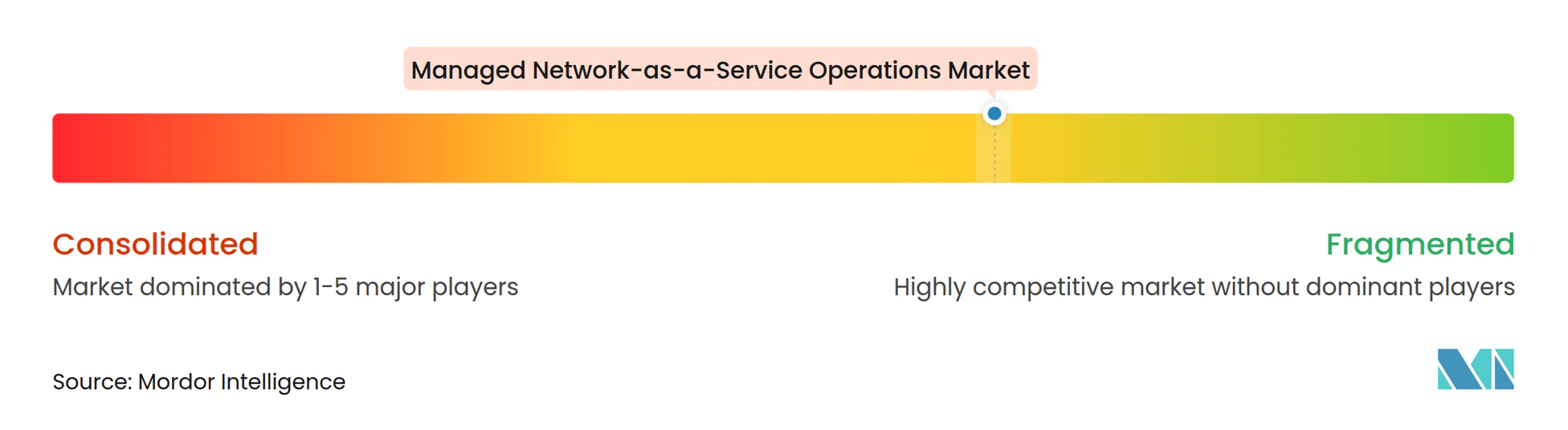
The Managed Network-as-a-Service Operations market is moderately consolidated. Global telecom operators include AT&T, Verizon, Deutsche Telekom, Orange Business, BT Group, and Vodafone. Large managed service providers include NTT DATA, Kyndryl, HCL Technologies, and Tata Communications. Specialist providers include Aryaka Networks, GTT Communications, and Colt Technology Services. These companies compete through service coverage, automation capabilities, regional presence, and contract flexibility.
Partnerships are an important route for providers to extend their service portfolios. AT&T and Cisco introduced a single-vendor SASE offer in August 2025 that combines networking and security functions in one managed service. AT&T and Palo Alto Networks expanded their collaboration in July 2026 with AI-driven network-integrated threat protection and managed SASE. Deutsche Telekom expanded its LogicMonitor integration in May 2026 to strengthen predictive resilience across European markets. These moves show how providers use partner ecosystems to add security, analytics, and automation capabilities.
Opportunities remain in SME-focused subscription plans, managed private 5G for industrial sites, and quantum-safe network services for regulated customers. Aryaka Networks and Colt Technology Services compete with telecom-led providers through software-defined managed WAN services and flexible commercial models. Mavenir released its Agentic Service Assurance Framework in June 2026 to support closed-loop network monitoring and operations. Providers that reduce incident resolution time and support data and sovereignty needs can improve renewals and expansions. Customer demand for measurable performance and governance control leaves room for large providers and specialists with defined strengths.
Managed Network-as-a-Service Operations Industry Leaders
-
Cisco Systems, Inc.
-
AT&T Inc.
-
Verizon Communications Inc.
-
NTT DATA Group Corporation
-
International Business Machines Corporation
- *Disclaimer: Major Players sorted in no particular order
Recent Industry Developments
- July 2026: AT&T Business and Palo Alto Networks announced the general availability of AT&T Dynamic Defense with Palo Alto Networks and AT&T SASE with Palo Alto Networks, delivering AI-driven network-integrated threat protection and a fully managed SASE solution for distributed multicloud enterprise environments. The expansion addresses the growing complexity of securing enterprises against AI-driven cyber threats and offers a practical path to quantum resilience across both offerings.
- July 2026: Alcatel-Lucent Enterprise announced the general availability of its updated Private 5G offer incorporating AerFlex, a new access-point-only deployment architecture that eliminates on-site servers and custom cabling for multi-site industrial environments. The update responds to demand from manufacturing, logistics, transportation, and energy customers deploying robotics, automated guided vehicles, and IoT sensors requiring deterministic wireless connectivity.
- May 2026: Deutsche Telekom expanded its partnership with LogicMonitor to extend predictive resilience capabilities across European markets including DACH, Benelux, and the Nordic region, building on prior operational deployment in the United Kingdom. The integration enhances Deutsche Telekom's managed services portfolio with earlier fault detection and proactive operational control for increasingly distributed enterprise IT environments.
- February 2026: NTT DATA and Ericsson announced a multiyear strategic partnership to deliver private 5G as a fully managed global service with consistent architecture, operations, and security worldwide, and to embed NTT DATA edge AI agents on Ericsson enterprise edge platforms for real-time intelligence and autonomous decision-making at the site of data generation.
Global Managed Network-as-a-Service Operations Market Report Scope
The Managed NaaS Operations Market encompasses provider-managed network infrastructure, connectivity, security, monitoring, and optimization services across WAN, LAN, wireless, SD-WAN, SASE, private 5G, and cloud-based enterprise environments globally. The market is Segmented by Service Type (Managed WAN and SD-WAN Operations, Managed LAN and Campus Network Operations, Managed Wi-Fi and Wireless LAN Operations, Managed Network Security and SASE Operations, Network Monitoring, Observability, and NOC Operations, and Managed Private 5G and Edge Network Operations), Delivery Model (Fully Managed Services, Co-Managed Services, Self-Managed NaaS With Provider-Assisted Operations, and Consumption-Based Network Services), Deployment Mode (On-Premise Managed Infrastructure, Cloud-Native NaaS, and Hybrid Network Operations), Organization Size (Large Enterprises, and Small and Medium-Sized Enterprises), End-User Industry (Banking, Financial Services, and Insurance, IT and Telecommunications, Manufacturing, Retail and E-Commerce, Healthcare and Life Sciences, Government and Public Sector, and Other End-User Industries), and Geography (North America, Europe, Asia-Pacific, South America, and Middle East and Africa). The Market Forecasts are Provided in Terms of Value (USD).
| Managed WAN and SD-WAN Operations |
| Managed LAN and Campus Network Operations |
| Managed Wi-Fi and Wireless LAN Operations |
| Managed Network Security and SASE Operations |
| Network Monitoring, Observability, and NOC Operations |
| Managed Private 5G and Edge Network Operations |
| Fully Managed Services |
| Co-Managed Services |
| Self-Managed NaaS With Provider-Assisted Operations |
| Consumption-Based Network Services |
| On-Premise Managed Infrastructure |
| Cloud-Native NaaS |
| Hybrid Network Operations |
| Large Enterprises |
| Small and Medium-Sized Enterprises |
| Banking, Financial Services, and Insurance |
| IT and Telecommunications |
| Manufacturing |
| Retail and E-Commerce |
| Healthcare and Life Sciences |
| Government and Public Sector |
| Other End-User Industries |
| North America | United States |
| Canada | |
| Mexico | |
| South America | Brazil |
| Argentina | |
| Rest of South America | |
| Europe | United Kingdom |
| Germany | |
| France | |
| Italy | |
| Rest of Europe | |
| Asia-Pacific | China |
| Japan | |
| India | |
| South Korea | |
| Australia | |
| Rest of Asia-Pacific | |
| Middle East and Africa | Saudi Arabia |
| United Arab Emirates | |
| South Africa | |
| Egypt | |
| Rest of Middle East and Africa |
| By Service Type | Managed WAN and SD-WAN Operations | |
| Managed LAN and Campus Network Operations | ||
| Managed Wi-Fi and Wireless LAN Operations | ||
| Managed Network Security and SASE Operations | ||
| Network Monitoring, Observability, and NOC Operations | ||
| Managed Private 5G and Edge Network Operations | ||
| By Delivery Model | Fully Managed Services | |
| Co-Managed Services | ||
| Self-Managed NaaS With Provider-Assisted Operations | ||
| Consumption-Based Network Services | ||
| By Deployment Mode | On-Premise Managed Infrastructure | |
| Cloud-Native NaaS | ||
| Hybrid Network Operations | ||
| By Organization Size | Large Enterprises | |
| Small and Medium-Sized Enterprises | ||
| By End-User Industry | Banking, Financial Services, and Insurance | |
| IT and Telecommunications | ||
| Manufacturing | ||
| Retail and E-Commerce | ||
| Healthcare and Life Sciences | ||
| Government and Public Sector | ||
| Other End-User Industries | ||
| By Geography | North America | United States |
| Canada | ||
| Mexico | ||
| South America | Brazil | |
| Argentina | ||
| Rest of South America | ||
| Europe | United Kingdom | |
| Germany | ||
| France | ||
| Italy | ||
| Rest of Europe | ||
| Asia-Pacific | China | |
| Japan | ||
| India | ||
| South Korea | ||
| Australia | ||
| Rest of Asia-Pacific | ||
| Middle East and Africa | Saudi Arabia | |
| United Arab Emirates | ||
| South Africa | ||
| Egypt | ||
| Rest of Middle East and Africa | ||
Key Questions Answered in the Report
What is the Managed Network-as-a-Service Operations market size?
The Managed Network-as-a-Service Operations market is valued at USD 27.88 billion in 2026 and is projected to reach USD 49.78 billion by 2032 at a 10.18% CAGR. Demand is tied to unified operations for cloud, edge, security, and site networks.
Which service type leads managed NaaS operations?
Managed WAN and SD-WAN Operations leads with a 26.66% revenue share in 2026. Managed Private 5G and Edge Network Operations is the fastest service type, with an 11.04% CAGR forecast through 2032.
Which delivery model is expanding fastest?
Consumption-Based Network Services is projected to expand at a 10.99% CAGR through 2032. This model lets customers align network capacity and spending with changing business demand.
Why are enterprises adopting managed network operations?
Enterprises use these services to manage hybrid cloud, security, site connectivity, and network performance in an integrated model. Automation, observability, and managed access controls can reduce the burden on internal teams.
Which end-user sector has the highest share?
Banking, Financial Services, and Insurance leads with a 19.88% share in 2026 because of its requirements for uptime, security, and accountability. Manufacturing is the fastest-growing end-user segment, with a 10.56% CAGR through 2032.
Which region is expected to expand fastest?
Asia-Pacific is projected to expand at a 10.77% CAGR through 2032, supported by manufacturing digitalization, 5G deployment, and wider access to managed services. North America has the largest regional share at 36.64% in 2026.