
Network Access Control As A Service Market Size and Share
Market Overview
| Study Period | 2021 - 2032 |
|---|---|
| Market Size (2027) | USD 2.22 Billion |
| Market Size (2032) | USD 6.06 Billion |
| Growth Rate (2027 - 2032) | 22.24 % |
| Fastest Growing Market | Asia-Pacific |
| Largest Market | North America |
| Market Concentration | Medium |
Major Players *Disclaimer: Major Players sorted in no particular order Image © Mordor Intelligence. Reuse requires attribution under CC BY 4.0. | |
Network Access Control As A Service Market Analysis by Mordor Intelligence
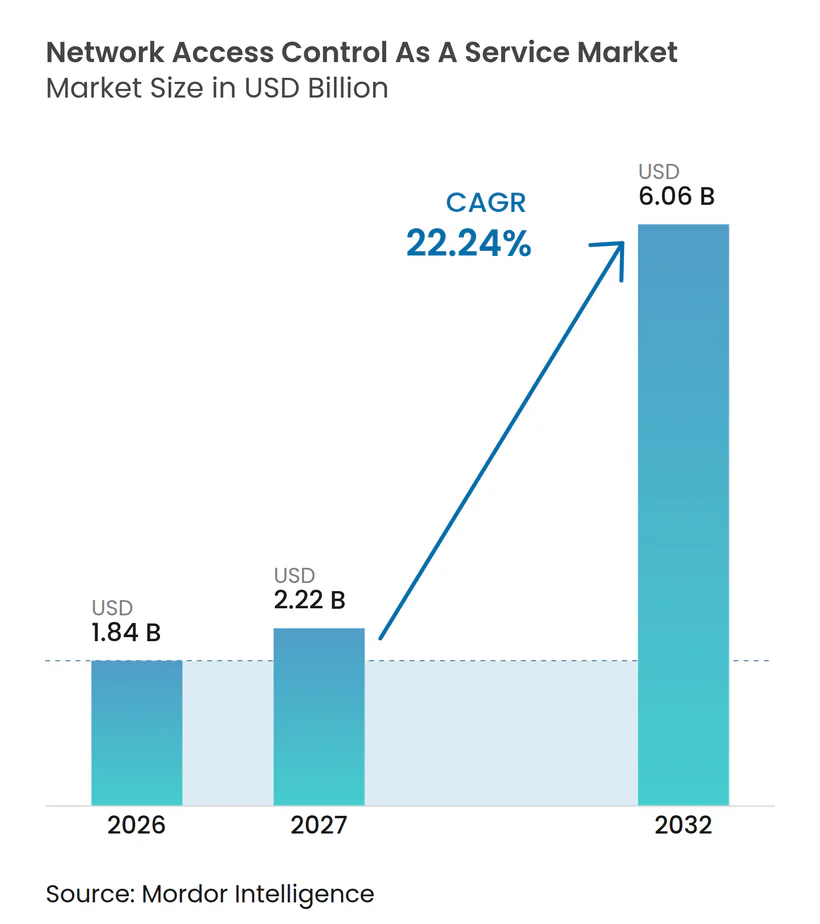
The network access control as a service market size was valued at USD 1.84 billion in 2026 and is estimated to grow from USD 2.22 billion in 2027 to reach USD 6.06 billion by 2032, at a CAGR of 22.24% during the forecast period (2027-2032). The Network Access Control as a Service market is shifting from appliance-based deployments toward subscription delivery as enterprises seek centralized policy management across sites and endpoints. Buyers are moving spending toward operating expenses and away from hardware refresh cycles, while managed and unmanaged devices are increasingly governed from a single policy plane. Cloud-native providers are gaining traction in environments where legacy identity services and hardware controllers cannot meet multi-site requirements. The Network Access Control as a Service market also benefits when companies integrate acquired networks faster, because centralized policies can shorten the reconciliation of inherited access rules. Data residency requirements in India, China, and Europe are increasing the value of regionally isolated cloud architectures and favoring vendors with compliant distributed infrastructure.
Key Report Takeaways
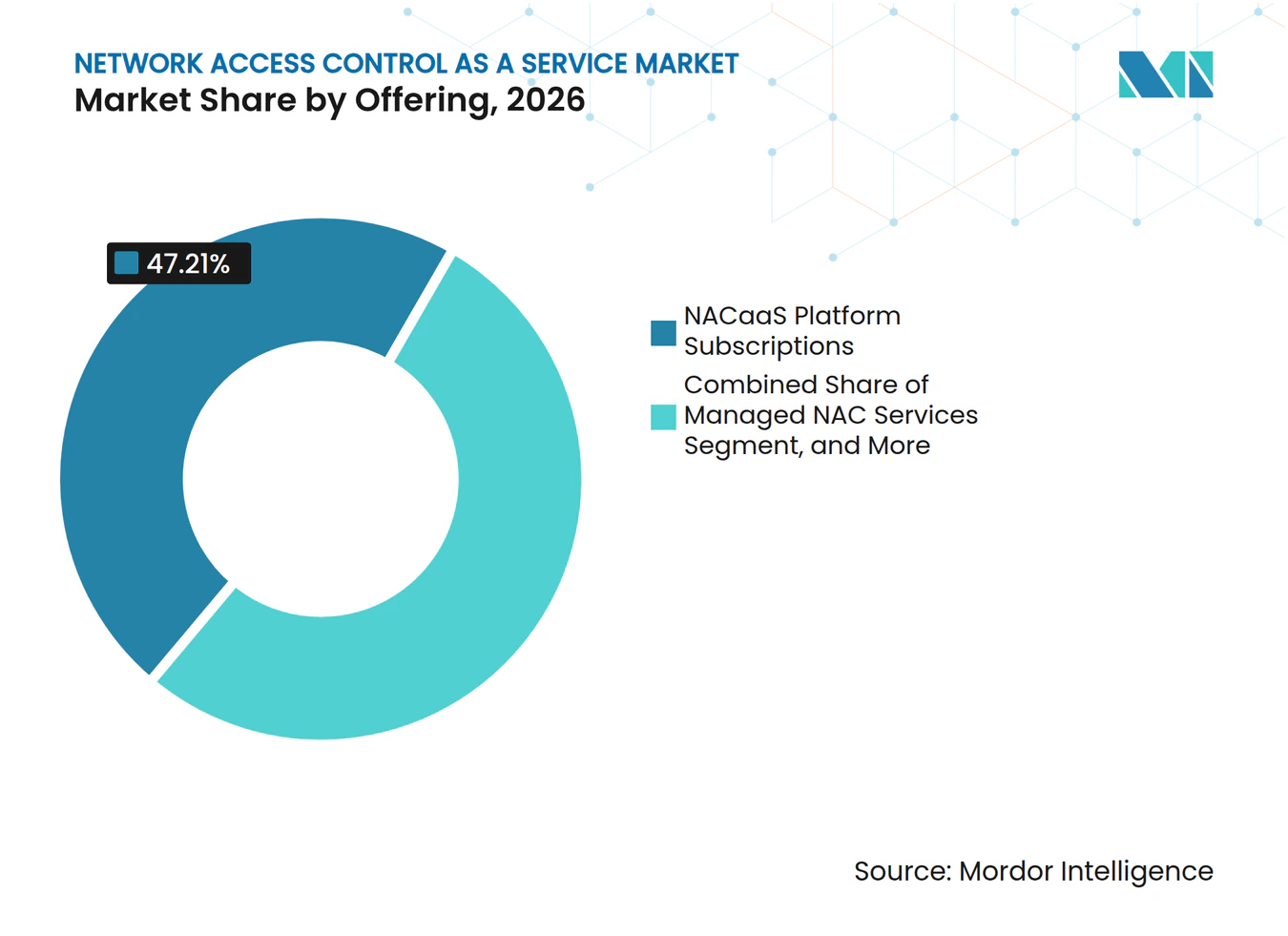
- By offering, NACaaS platform subscriptions held 47.21% of network access control as a service market revenue in 2026, while Managed NAC Services are projected to expand at a 24.56% CAGR through 2032.
- By service delivery model, public/multi-tenant cloud NACaaS accounted for 61.37% of revenue in 2026, while hybrid cloud NACaaS is projected to expand at a 25.63% CAGR through 2032.
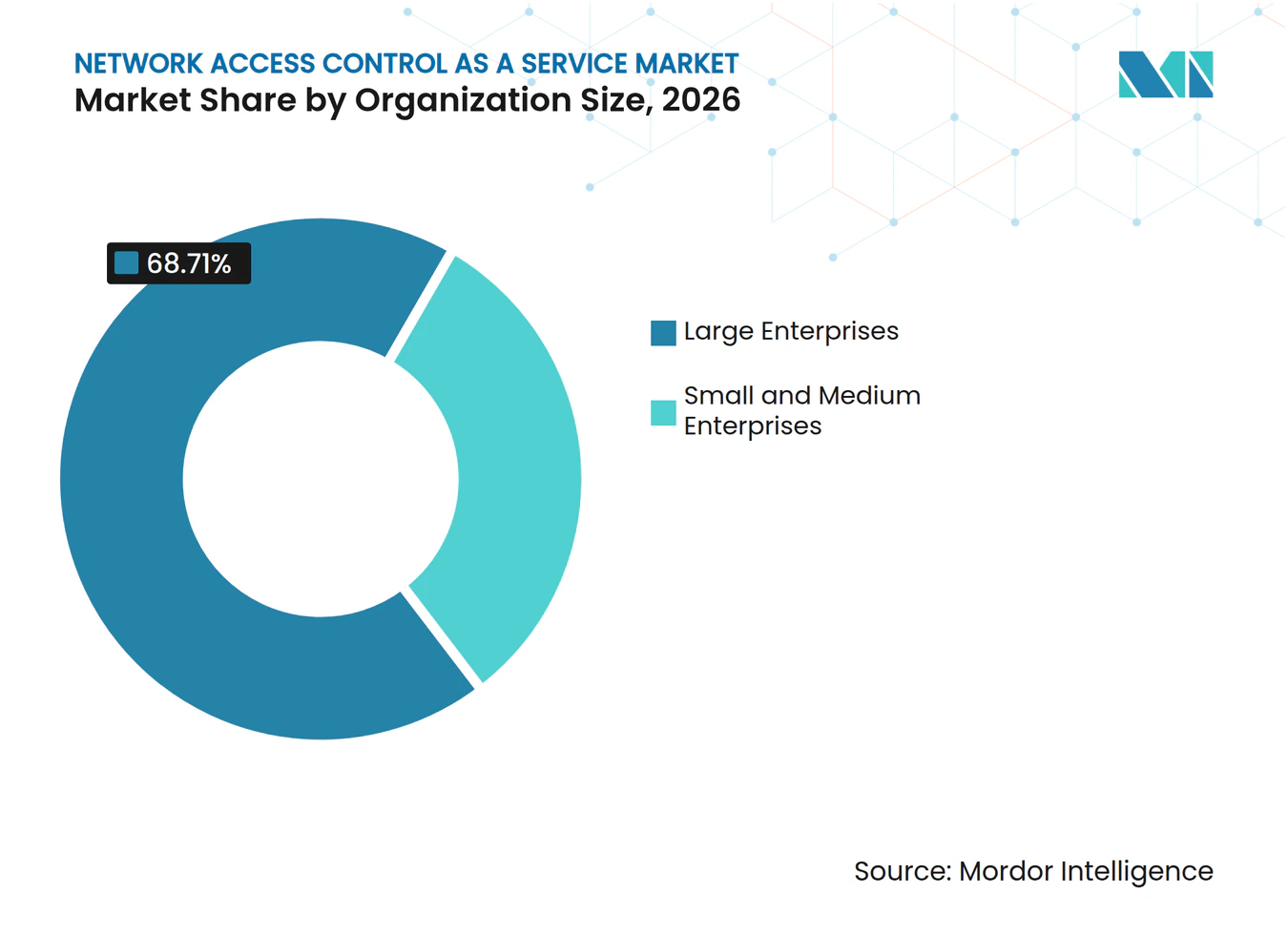
- By organization size, large enterprises accounted for 68.71% of revenue in 2026, while SMEs are projected to expand at a 24.33% CAGR through 2032.
- By end-user industry, BFSI accounted for 31.24% of revenue in 2026 in the network access control-as-a-service market, while the IT and telecommunications industry is projected to expand at a 25.71% CAGR through 2032.
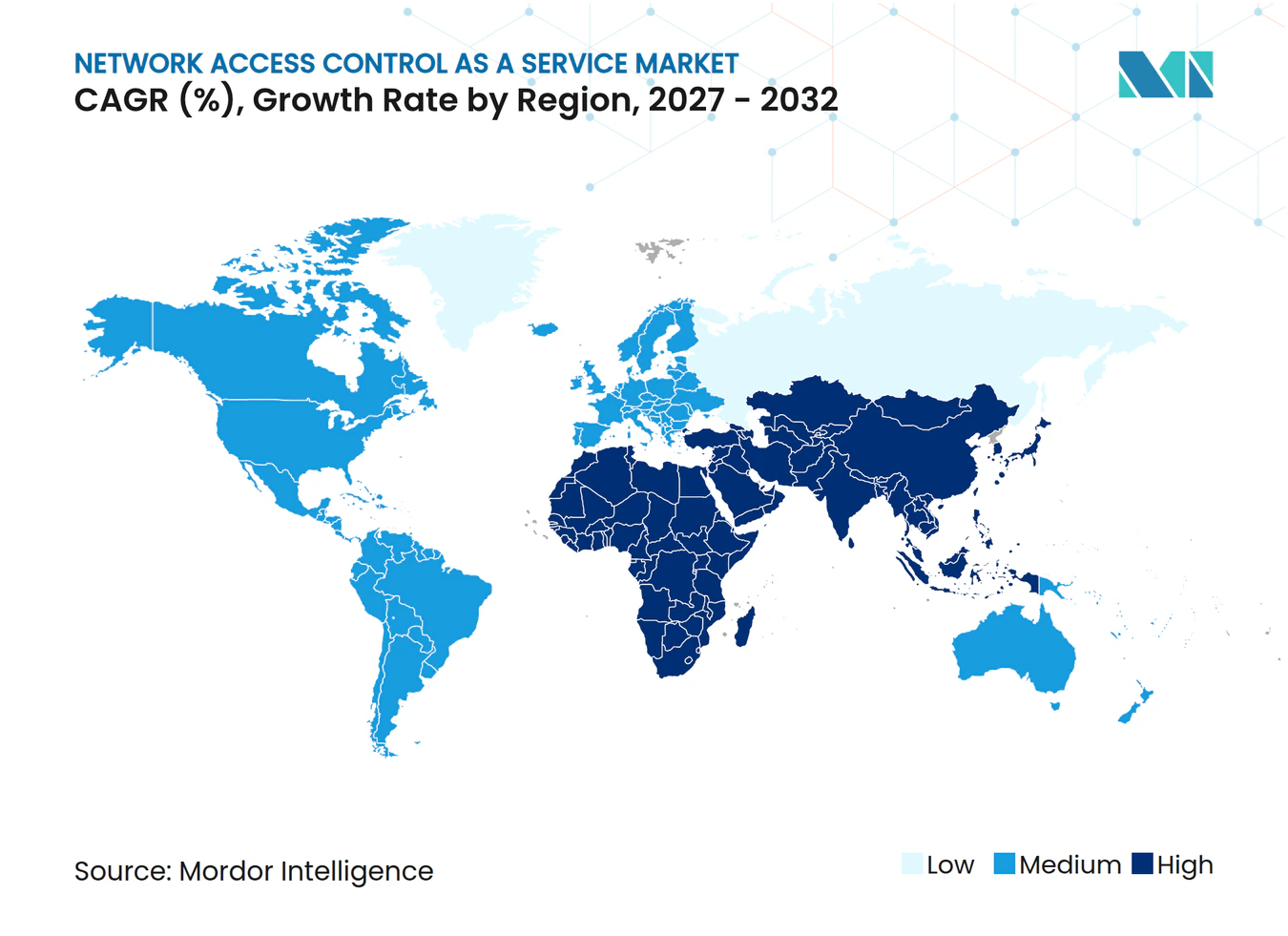
- By geography, North America accounted for 34.66% of revenue in the network access control-as-a-service market in 2026, while Asia-Pacific is projected to expand at a 26.72% CAGR through 2032.
Note: Market numbers in this report are based on Mordor Intelligence's proprietary estimation framework, which combines nine months of actuals with Q4 projections for base year 2026.
Global Network Access Control As A Service Market Trends and Insights
Drivers Impact Analysis*
| Driver | (~) % Impact on CAGR Forecast | Geographic Relevance | Impact Timeline |
|---|---|---|---|
| Zero Trust Architecture Adoption | +4.5% | Global | Medium term (2-4 years) |
| Proliferation of Unmanaged and IoT Endpoints | +3.8% | North America and Europe, Asia-Pacific growing rapidly | Short term (≤ 2 years) |
| Hybrid Work and BYOD Expansion | +3.2% | Global, strongest in North America and Europe | Short term (≤ 2 years) |
| Regulatory and Cyber-Insurance Compliance Requirements | +2.9% | Europe, North America, India, Southeast Asia | Short term (≤ 2 years) |
| SaaS NAC Simplifies Multi-Site Policy Operations | +2.4% | North America, Europe, Asia-Pacific mid-market | Medium term (2-4 years) |
| Cloud NAC Enables Faster Post-Merger Network Integration | +1.8% | North America, Western Europe | Medium term (2-4 years) |
| Source: Mordor Intelligence | |||
Zero Trust Architecture Adoption
The network access control as a service market is supported by the gap between organizations that recognize Zero Trust as essential and those that have completed deployment. A 2026 survey of 851 IT and cybersecurity professionals found that 82% viewed Universal Zero Trust Network Access as essential, but only 17% had fully implemented it. Device and network enforcement was a core Zero Trust pillar for 64% of respondents, and 56% already used AI or machine learning for adaptive policy automation.[1] CISA's federal SASE guidance links NAC functions to progress under the Zero Trust Maturity Model, placing access controls within compliance-led procurement processes. This requirement supports demand from government agencies and regulated supply chains that need continuous verification. It also shifts the purchase case from a discrete network project to a broader security architecture decision.
Proliferation of Unmanaged and IoT Endpoints
The network access control as a service market is gaining traction as the number of devices operating outside direct IT management increases. Palo Alto Networks analyzed more than 27 million connected devices across 1,803 enterprise networks and found that 32.5% of corporate network devices were unmanaged. The same research found poor segmentation in 77.74% of networks and identified high-risk IoT devices in 48.2% of IoT-to-corporate IT connections.[2] Many IoT devices lack the 802.1X supplicant software and certificate stores required by traditional authentication. Agentless MAC-bypass policies, therefore, become important for controlling devices that cannot carry an agent. NIST describes trusted network-layer onboarding and lifecycle management as a foundational control for IoT devices
Hybrid Work and BYOD Expansion
Hybrid work has made access control a session-level verification issue rather than a perimeter-only task. Cloud Security Alliance guidance states that continuous device health verification is necessary across VDI and DaaS, per-application ZTNA, and local secure enclave access patterns. This requirement creates demand for cloud platforms that can assess device posture without requiring the installation of managed agents on personal equipment. Conditional access can assess operating system version, encryption status, and patch currency before allowing access to individual applications. The network access control as a service market gains relevance where contractors and employees use non-corporate devices to reach critical systems. These conditions also make policy consistency across remote and office locations more important for enterprise security teams.
Regulatory and Cyber-Insurance Compliance Requirements
The Digital Operational Resilience Act became enforceable on January 17, 2025, and requires financial entities to segment networks and limit ICT access to what each function needs. Its access-control requirements align with continuous device posture monitoring and behavioral analysis in cloud NAC platforms. The Reserve Bank of India issued the Commercial Banks Cybersecurity, Technology Risk, Resilience and Assurance Framework Directions in July 2026, which require multifactor authentication for privileged and telework access. These requirements make verifiable access controls relevant to banking procurement in India. The network access control as a service market can also benefit when insurers require evidence of segmentation and identity-based controls. The combined regulatory environment makes audit records and policy enforcement part of the operating requirement for regulated entities.
Restraints Impact Analysis*
| Restraint | (~) % Impact on CAGR Forecast | Geographic Relevance | Impact Timeline |
|---|---|---|---|
| Legacy 802.1X and PKI Integration Complexity | -2.8% | Global, most acute in large multi-vendor enterprise environments | Medium term (2-4 years) |
| Shortage of NAC, PKI, and Policy-Engineering Skills | -2.1% | Global | Long term (≥ 4 years) |
| Inconsistent Device Telemetry Across OT and IoT Fleets | -1.4% | Asia-Pacific core, industrial regions of North America and Europe | Medium term (2-4 years) |
| Data Residency and Cross-Border Inspection Constraints | -0.9% | Asia-Pacific, Europe, Middle East | Short term (≤ 2 years) |
| Source: Mordor Intelligence | |||
Legacy 802.1X and PKI Integration Complexity
Legacy 802.1X and PKI environments can delay deployment even after a buyer has selected a cloud platform. EAP-TLS requires certificate authorities, enrollment systems, and lifecycle management capabilities before enforcement can start. A large multi-vendor network can require parallel RADIUS operations and phased enforcement to avoid interrupting authentication during a migration. Cisco ISE, HPE Aruba ClearPass, and Fortinet FortiNAC are often most effective within their own vendor environments, which can complicate interoperability. These projects may extend a migration by 6 to 12 months beyond the initial plan. The constraint affects deployment speed and revenue timing rather than the underlying need for access control.
Shortage of NAC, PKI, and Policy-Engineering Skills
Skills shortages limit organizations' ability to design, tune, and maintain access policies. ISC2 surveyed 16,029 practitioners and found that 59% reported critical or significant skills gaps in 2025, while 88% had experienced a significant organizational consequence from those deficiencies.[3] ISACA reported that 55% of cybersecurity teams were understaffed and 65% had unfilled roles in 2025. The shortage can slow policy engineering and increase the chance that network segments remain under-secured. It also increases the appeal of managed service models, but the capacity gap remains a constraint on customer-side implementation. The network access control as a service market must therefore compete on simpler deployment, automation, and service support as well as on security functionality.
*Our forecasts treat driver/restraint impacts as directional, not additive. The impact forecasts reflect baseline growth, mix effects, and variable interactions.
Segment Analysis
By Offering: Managed Services Narrow the Gap Against Platform Subscriptions
NACaaS Platform Subscriptions held 47.21% of the Network Access Control as a Service market in 2026. The model lets organizations retain policy ownership while delegating infrastructure management, platform upkeep, and routine service availability to the vendor. This approach aligns with enterprise demand for cloud-managed policy engines rather than physical controller hardware, local maintenance cycles, and separate controller capacity planning. It also supports centralized administration across distributed sites, remote users, and a mix of managed and unmanaged devices that need consistent access decisions. Platform providers compete on policy depth, integrations, reporting, and the ability to simplify day-to-day operational management for internal security and network teams.
Managed NAC Services are projected to expand at a 24.56% CAGR from 2027 to 2032. The Network Access Control as a Service industry attracts mid-market buyers that do not maintain dedicated NAC teams, certificate specialists, or full-time policy engineers. ISC2's finding that skills gaps created organizational consequences for 88% of respondents illustrates why outsourced policy authoring and administration are relevant. Providers can address this need with recurring operational support, guided policy development, ongoing monitoring, and documented processes for access exceptions and onboarding. Within the Network Access Control as a Service market, this model reduces the internal staffing burden, but buyers still need clear accountability for access decisions, escalation paths, and the quality of outsourced policy administration.


By Service Delivery Model: Hybrid Architecture Becomes the Enterprise Default
Public/Multi-Tenant Cloud NACaaS held 61.37% of the Network Access Control as a Service market size in 2026. Its position reflects the maturity of cloud-native delivery for organizations with predominantly modern IT infrastructure, distributed branch locations, and established cloud security practices. The model can centralize policy management without requiring enterprises to operate local controller infrastructure, maintain hardware capacity, or coordinate upgrades at every site. It is particularly suitable for distributed branches and cloud-connected environments with common security requirements, repeatable device groups, and centrally managed identity services. Private or dedicated cloud deployments remain relevant where organizations require separate infrastructure for telemetry inspection, stronger isolation, and specific internal governance controls.
Hybrid Cloud NACaaS is projected to expand at a 25.63% CAGR from 2027 to 2032. Large enterprises use hybrid architectures to apply consistent policy across branches, data centers, cloud-connected environments, and locations where local continuity is operationally important. Operational technology systems can require local enforcement when authentication latency could affect time-sensitive production work, equipment availability, or safety-related operational processes. Forescout introduced Vistaro in March 2026 with cloud-native agentless segmentation for hybrid IT, OT, IoT, and IoMT environments.[4] HPE also presented a unified policy approach across Aruba Networking and Juniper Networking portfolios in 2026.
By Organization Size: SME Channel Growth Reshapes the Demand Engine
Large enterprises held 68.71% of 2026 revenue in the Network Access Control as a Service market. Their spending reflects complex environments, higher per-seat requirements, extensive device inventories, and multi-year contracts in regulated sectors with formal security reviews. Vendors serving this group differentiate through identity store connectivity, SIEM and XDR interoperability, OT-aware device classification, and certificate automation. The buying decision often includes the ability to manage tens of thousands of endpoints across many sites, identities, network types, and operational teams from one control plane. These requirements favor platforms that integrate into existing identity and security operations, while reducing duplicate administration across networking and cybersecurity functions.
SMEs are projected to expand at a 24.33% CAGR from 2027 to 2032. Many smaller organizations enter through MSP and MSSP channels that package NAC policies with managed security services, standardized onboarding, and routine policy maintenance. NETGEAR launched an Exium-powered SASE and NAC solution for SMEs and MSP partners in October 2025 through a single cloud interface.[5] In the Network Access Control as a Service market, this approach reduces deployment friction for teams with limited specialist resources, limited time for integrations, and fewer internal staff dedicated to network security. It also gives service providers a way to standardize access control across their customer base while retaining the flexibility to apply customer-specific policies and device groups.

By End-User Industry: BFSI Anchors Demand While Telecommunications Extends Adoption
BFSI held 31.24% of 2026 revenue in the Network Access Control as a Service market. Financial institutions operate under detailed access and resilience requirements, including DORA, the RBI Directions, and SWIFT's Customer Security Program, which increase the need for evidence of control operation. These requirements emphasize auditable network access records and segmentation. The sector also has large endpoint estates, sensitive systems, and a low tolerance for unauthorized lateral movement between user networks and high-value applications. The Network Access Control as a Service market is therefore aligned with a compliance-led security purchasing process in this end-user group, where auditability and operational resilience influence investment priorities.
The IT and telecommunications industry is projected to expand at a 25.71% CAGR from 2027 to 2032. Operators can manage hundreds of network segments across dozens of countries, making policy centralization an operational and security issue in complex, changing service environments. Healthcare and life sciences also require agentless enforcement for connected medical devices that cannot support 802.1X software, particularly where device availability and clinical workflows constrain changes. NIST's IoT onboarding guidance supports the need for controlled network-layer onboarding for such equipment. These end users extend demand beyond conventional office networks to device-rich and distributed operating environments where access control must account for different risk and availability needs.
Geography Analysis
North America held 34.66% of the Network Access Control as a Service market share in 2026. The region has a dense base of cloud providers and mature enterprise security procurement processes. Federal Zero Trust programs and CISA SASE guidance support demand from agencies and regulated supply chains. Appgate announced work with the US Air Force Next Generation Network program for Zero Trust modernization in 2026.[6] Public-sector programs reinforce a sustained regional procurement pipeline.
Europe has demand shaped by GDPR, DORA, and national data-sovereignty rules. The Network Access Control as a Service market must accommodate regional requirements for inspection, storage, and policy control. DORA requires access controls and segmentation that can be demonstrated in regulatory reviews. Cisco received a German BSI C5 attestation for Meraki Cloud and Secure Access, underscoring the role of sovereign cloud compliance in vendor selection. The Network Access Control as a Service market in Europe is therefore shaped by the need to connect cloud delivery with local compliance expectations.
Asia-Pacific is projected to expand at a 26.72% CAGR from 2027 to 2032. India's Digital Personal Data Protection Rules and the RBI Directions place greater emphasis on access governance for banking and fintech organizations. The Network Access Control as a Service market is supported by digitalization, 5G deployment, and expanding regulatory attention in India and China. Managed services can reduce the specialist capacity and deployment barriers facing organizations in these regions.
Competitive Landscape
Market Concentration
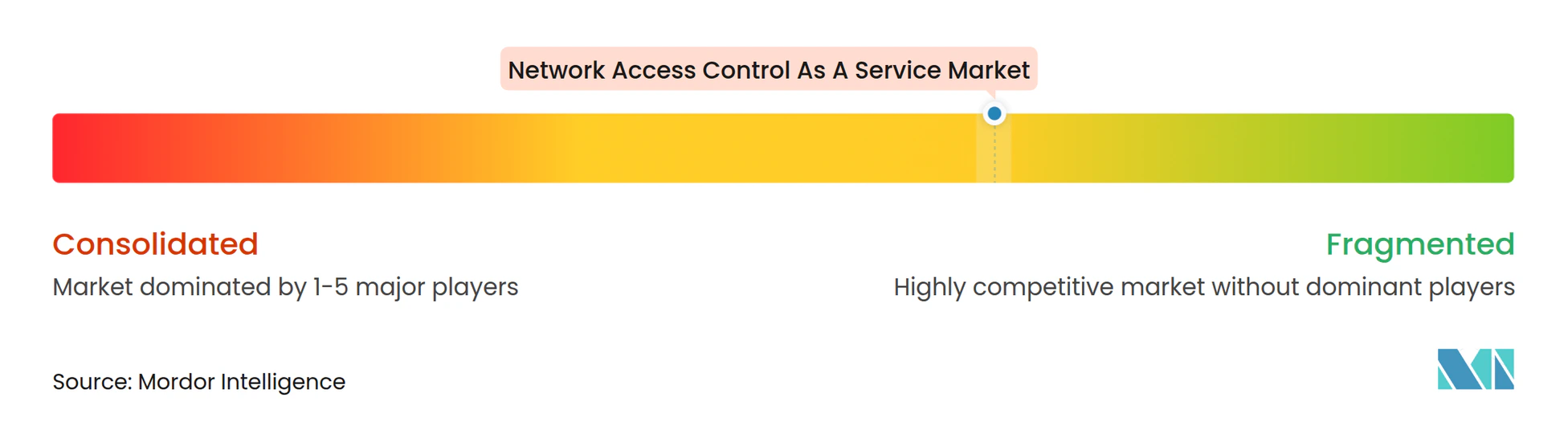
The network access control as a service market is moderately fragmented, with established vendors with large appliance installed bases and a fragmented group of cloud-native providers. Cisco, HPE, and Fortinet retain advantages in enterprise accounts through existing infrastructure relationships. Cloud-native challengers are targeting displacement where buyers need simpler cloud delivery and policy control across managed and unmanaged endpoints. Platform convergence is a central competitive response, as vendors combine NAC, ZTNA, SASE, firewall controls, and security operations. This expands the value of vendor consolidation but can make integration depth a key differentiator.
Cisco extended Zero Trust Access capabilities for AI agents into Duo IAM and Cisco Secure Access in March 2026. HPE is integrating ZTNA, NAC, firewall controls, and AI-powered operations across its Aruba and Juniper portfolios. Forescout introduced agentless segmentation for hybrid IT, OT, IoT, and IoMT environments through Vistaro. These moves focus competition on unified policy enforcement and coverage of devices that cannot run traditional security agents. Hybrid OT and IT environments remain a meaningful opportunity because they require security policies that span different device classes.
AI-driven policy automation is also becoming a key area of differentiation in the Network Access Control as a Service market. Check Point released its AI Network Firewall through R82.20 in July 2026, extending governance to agent actions and prompt-based attacks without new hardware. Portnox added Shadow AI detection in September 2026 to identify unauthorized generative AI applications on managed endpoints. Arista also introduced AI-driven Edge Threat Management for VeloCloud SD-WAN in July 2026. SASE-oriented vendors compete on broader networking consolidation, while NAC specialists compete on access policy depth and device-level enforcement.
Network Access Control As A Service Industry Leaders
-
Cisco Systems, Inc.
-
Hewlett Packard Enterprise Company
-
Fortinet, Inc.
-
Forescout Technologies, Inc.
-
Portnox Security, Inc.
- *Disclaimer: Major Players sorted in no particular order
Recent Industry Developments
- September 2026: Portnox launched Shadow AI visibility and control capabilities, enabling IT teams to detect unauthorized generative AI applications on managed devices and automatically restrict or quarantine unapproved AI agents on detection, addressing the governance gap created by AI adoption outpacing IT oversight.
- August 2026: Portnox completed a three-partner enforcement layer through integrations with Microsoft Defender, CrowdStrike, and SentinelOne, creating a network-level capability to convert AI-generated risk signals into automatic access enforcement for human and non-human identities including AI agents.
- July 2026: Check Point Software Technologies launched the Check Point AI Network Firewall as part of firewall software release R82.20, extending AI traffic governance, covering agent actions and prompt-based attacks, to existing firewall infrastructure without requiring new hardware or network rearchitecting.
- June 2026: Check Point Software Technologies and Illumio expanded their strategic partnership to integrate Check Point firewall policy with Illumio's workload segmentation model across hybrid and multi-cloud environments, targeting coordinated lateral movement defense against AI-powered attacks operating at machine speed.
Global Network Access Control As A Service Market Report Scope
The network access control as a service market consists of cloud-delivered NAC solutions that authenticate users and devices, assess device security posture, and enforce policies governing access to enterprise networks and network resources. Delivered through a subscription or managed-service model, these offerings enable organizations to allow, block, quarantine, or segment employees, guests, BYOD endpoints, and IoT devices without relying solely on on-premises NAC infrastructure.
The Network Access Control as a Service Market Report is Segmented by Offering (NACaaS Platform Subscriptions, Managed NAC Services, and Professional Services), Service Delivery Model (Public / Multi-Tenant Cloud NACaaS, Private / Dedicated Cloud NACaaS, and Hybrid Cloud NACaaS), Organization Size (Large Enterprises, and Small and Medium-Sized Enterprises), End-User Industry (Banking, Financial Services, and Insurance (BFSI), IT and Telecommunications, Healthcare and Lifesciences, Government and Public Administration, Industrial Manufacturing, and Other End Users), and Geography (North America, South America, Europe, Asia-Pacific, Middle East, and Africa). The Market Forecasts are Provided in Terms of Value (USD).
| NACaaS Platform Subscriptions |
| Managed NAC Services |
| Professional Services |
| Public / Multi-Tenant Cloud NACaaS |
| Private / Dedicated Cloud NACaaS |
| Hybrid Cloud NACaaS |
| Large Enterprises |
| Small and Medium Enterprises |
| Banking, Financial Services, and Insurance (BFSI) |
| IT and Telecommunications |
| Healthcare and Life Sciences |
| Government and Public Administration |
| Industrial Manufacturing |
| Other End-User Industries |
| North America | United States |
| Canada | |
| Mexico | |
| South America | Brazil |
| Rest of South America | |
| Europe | Germany |
| United Kingdom | |
| France | |
| Italy | |
| Rest of Europe | |
| Asia-Pacific | China |
| Japan | |
| India | |
| South Korea | |
| Rest of Asia-Pacific | |
| Middle East | Saudi Arabia |
| United Arab Emirates | |
| Rest of Middle East | |
| Africa | South Africa |
| Nigeria | |
| Rest of Africa |
| By Offering | NACaaS Platform Subscriptions | |
| Managed NAC Services | ||
| Professional Services | ||
| By Service Delivery Model | Public / Multi-Tenant Cloud NACaaS | |
| Private / Dedicated Cloud NACaaS | ||
| Hybrid Cloud NACaaS | ||
| By Organization Size | Large Enterprises | |
| Small and Medium Enterprises | ||
| By End-User Industry | Banking, Financial Services, and Insurance (BFSI) | |
| IT and Telecommunications | ||
| Healthcare and Life Sciences | ||
| Government and Public Administration | ||
| Industrial Manufacturing | ||
| Other End-User Industries | ||
| By Geography | North America | United States |
| Canada | ||
| Mexico | ||
| South America | Brazil | |
| Rest of South America | ||
| Europe | Germany | |
| United Kingdom | ||
| France | ||
| Italy | ||
| Rest of Europe | ||
| Asia-Pacific | China | |
| Japan | ||
| India | ||
| South Korea | ||
| Rest of Asia-Pacific | ||
| Middle East | Saudi Arabia | |
| United Arab Emirates | ||
| Rest of Middle East | ||
| Africa | South Africa | |
| Nigeria | ||
| Rest of Africa | ||
Key Questions Answered in the Report
What is the size of the Network Access Control as a Service market?
The network access control as a service market size was valued at USD 1.84 billion in 2026 and is estimated to grow from USD 2.22 billion in 2027 to reach USD 6.06 billion by 2032, at a CAGR of 22.24% during the forecast period (2027-2032).
What is driving adoption of cloud-delivered network access control?
Zero Trust programs, unmanaged IoT devices, hybrid work, and compliance requirements are increasing demand for continuous access policies. These needs center on consistent checks across users, devices, and locations.
Which offering leads revenue?
NACaaS Platform Subscriptions held 47.21% of 2026 revenue, while Managed NAC Services are projected to expand at a 24.56% CAGR through 2032. Managed services address organizations that lack dedicated policy specialists.
Which deployment approach is expanding fastest?
Hybrid Cloud NACaaS is projected to expand at a 25.63% CAGR through 2032 as enterprises apply policy across cloud, branch, data center, and OT settings. It can retain local enforcement for sensitive operational systems.
Which customer group is expected to expand fastest?
IT and Telecommunications is projected to expand at a 25.71% CAGR through 2032, supported by complex networks across many locations. Central policy management can reduce the operational burden of these environments.
Which region is expected to expand fastest?
Asia-Pacific is projected to expand at a 26.72% CAGR through 2032, supported by digitalization and access-governance requirements. Banking and fintech requirements are significant demand factors in India.