
Consumption-Based Managed Services Market Size and Share
Market Overview
| Study Period | 2021 - 2032 |
|---|---|
| Market Size (2027) | USD 49.86 Billion |
| Market Size (2032) | USD 111.80 Billion |
| Growth Rate (2027 - 2032) | 17.53 % |
| Fastest Growing Market | Asia-Pacific |
| Largest Market | North America |
| Market Concentration | Medium |
Major Players *Disclaimer: Major Players sorted in no particular order Image © Mordor Intelligence. Reuse requires attribution under CC BY 4.0. | |
Consumption-Based Managed Services Market Analysis by Mordor Intelligence
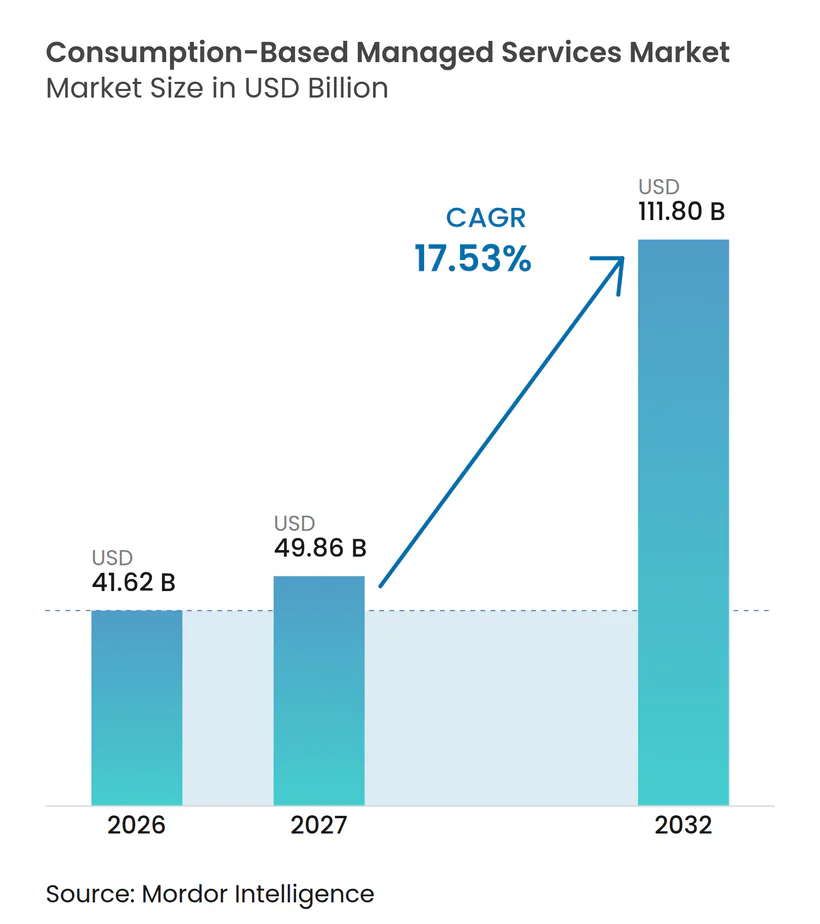
The Consumption-Based Managed Services Market size is projected to expand from USD 41.62 billion in 2026 to USD 111.80 billion by 2032, registering a CAGR of 17.53% between 2027 to 2032. The consumption-based managed services market combines variable billing with ongoing operational responsibility, which distinguishes it from conventional outsourcing and standalone cloud subscriptions. Enterprise demand is centered on managing hybrid environments, controlling technology costs, and gaining access to specialized skills without building every capability internally. Providers are responding by combining infrastructure management, security operations, automation, and commercial models tied to business outcomes. North America remains the largest revenue base, while Asia-Pacific offers the strongest growth outlook as multicloud deployment and capability gaps widen. Competition increasingly depends on the ability to provide transparent usage terms, localized operations, and reliable service delivery across complex environments.
Key Report Takeaways
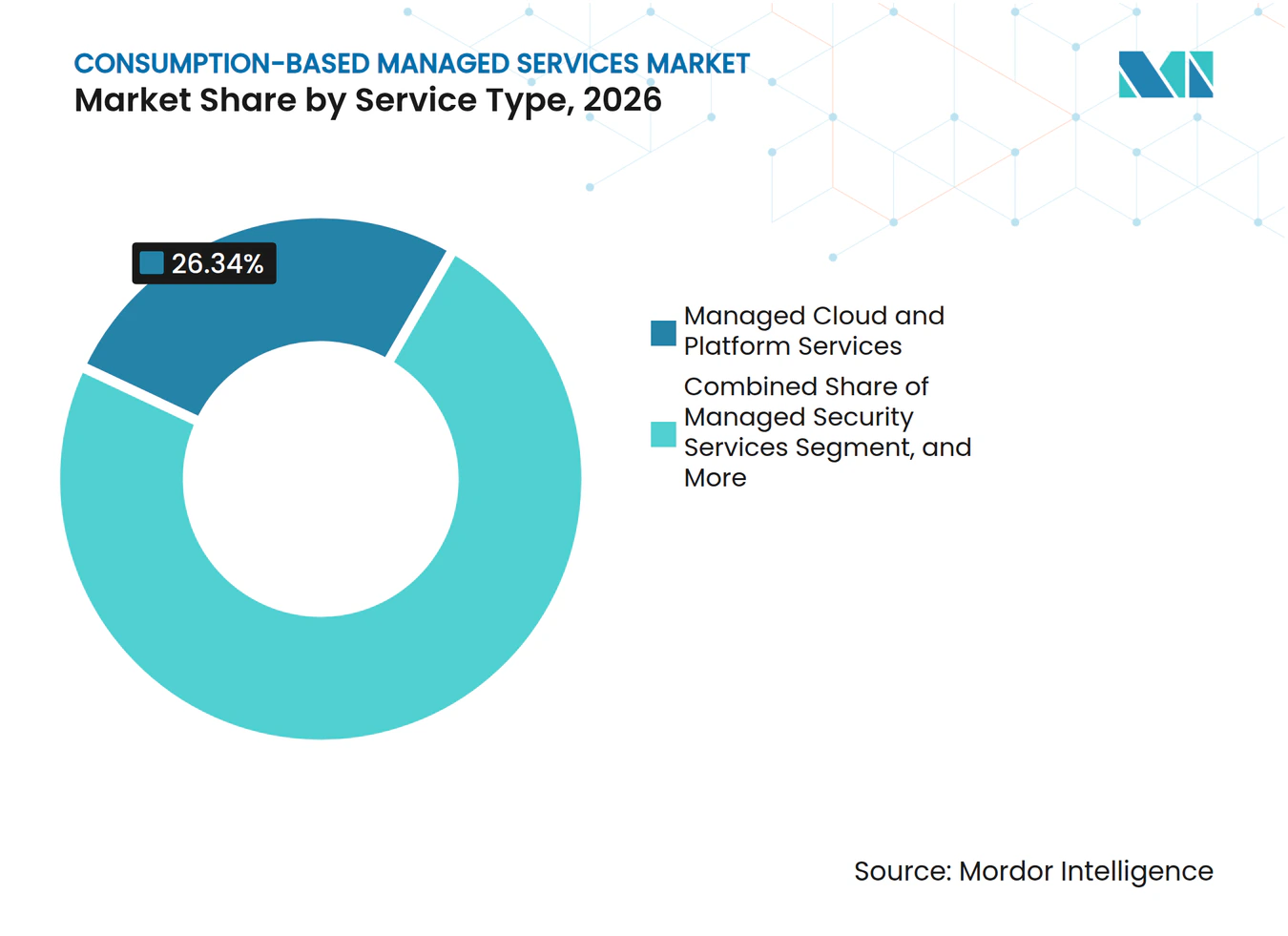
- By service type, Managed Cloud and Platform Services held 26.34% of revenue in 2026, while Managed Security Services is projected to expand at a 18.26% CAGR through 2032.
- By delivery model, Fully Managed Consumption Services accounted for 38.57% of revenue in 2026, while Outcome-Based Managed Services is projected to expand at a 18.09% CAGR through 2032.
- By infrastructure layer, Compute and Virtualization accounted for 28.37% of revenue in 2026, while Database and Data Platforms are projected to expand at a 18.58% CAGR through 2032.
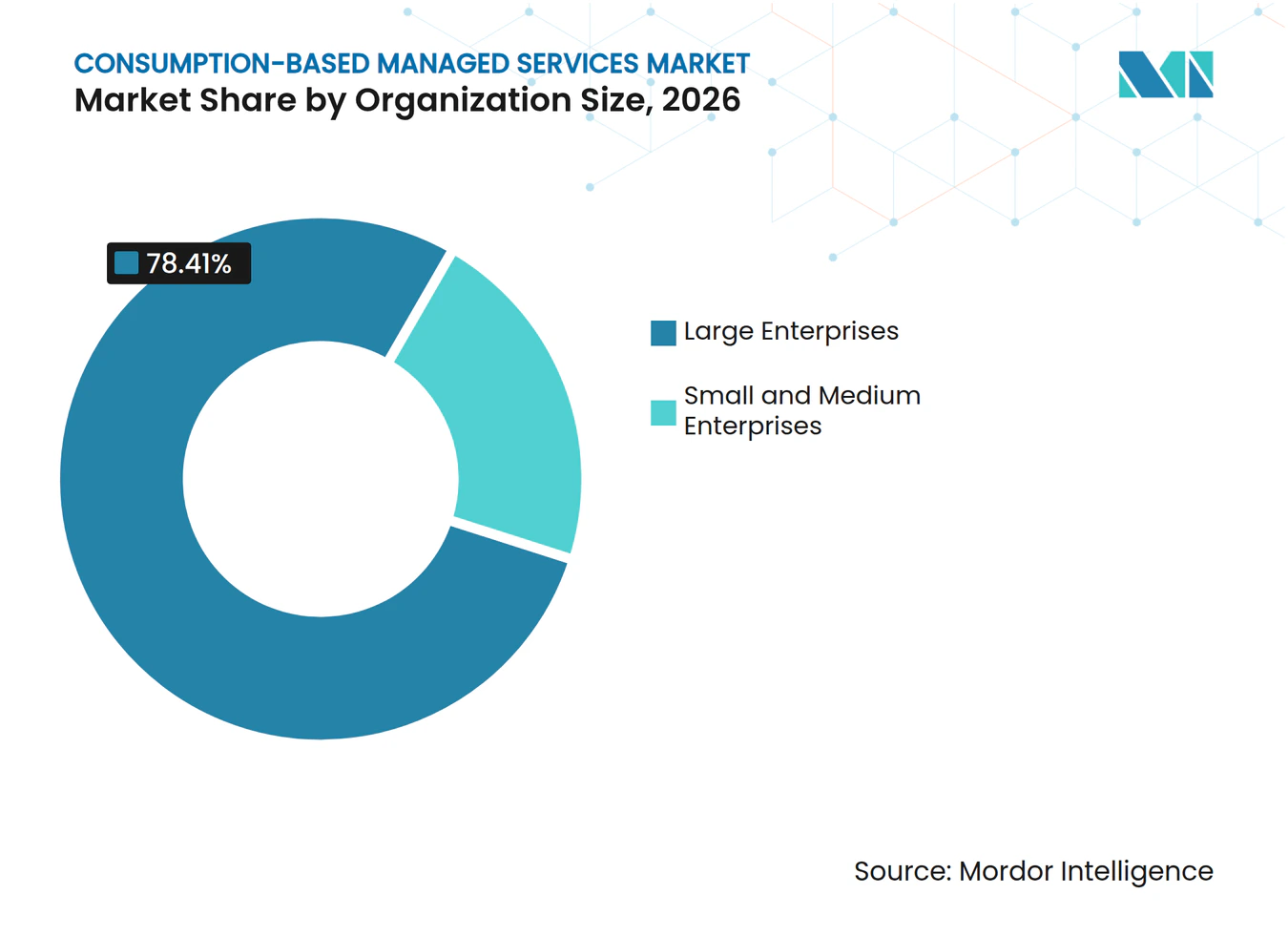
- By organization size, Large Enterprises held 78.41% of revenue in 2026, while Small and Medium Enterprises are projected to expand at a 18.63% CAGR through 2032.
- By end-user industry, IT and Telecommunications accounted for 25.69% of revenue in 2026, while Healthcare and Life Sciences are projected to expand at a 18.71% CAGR through 2032.
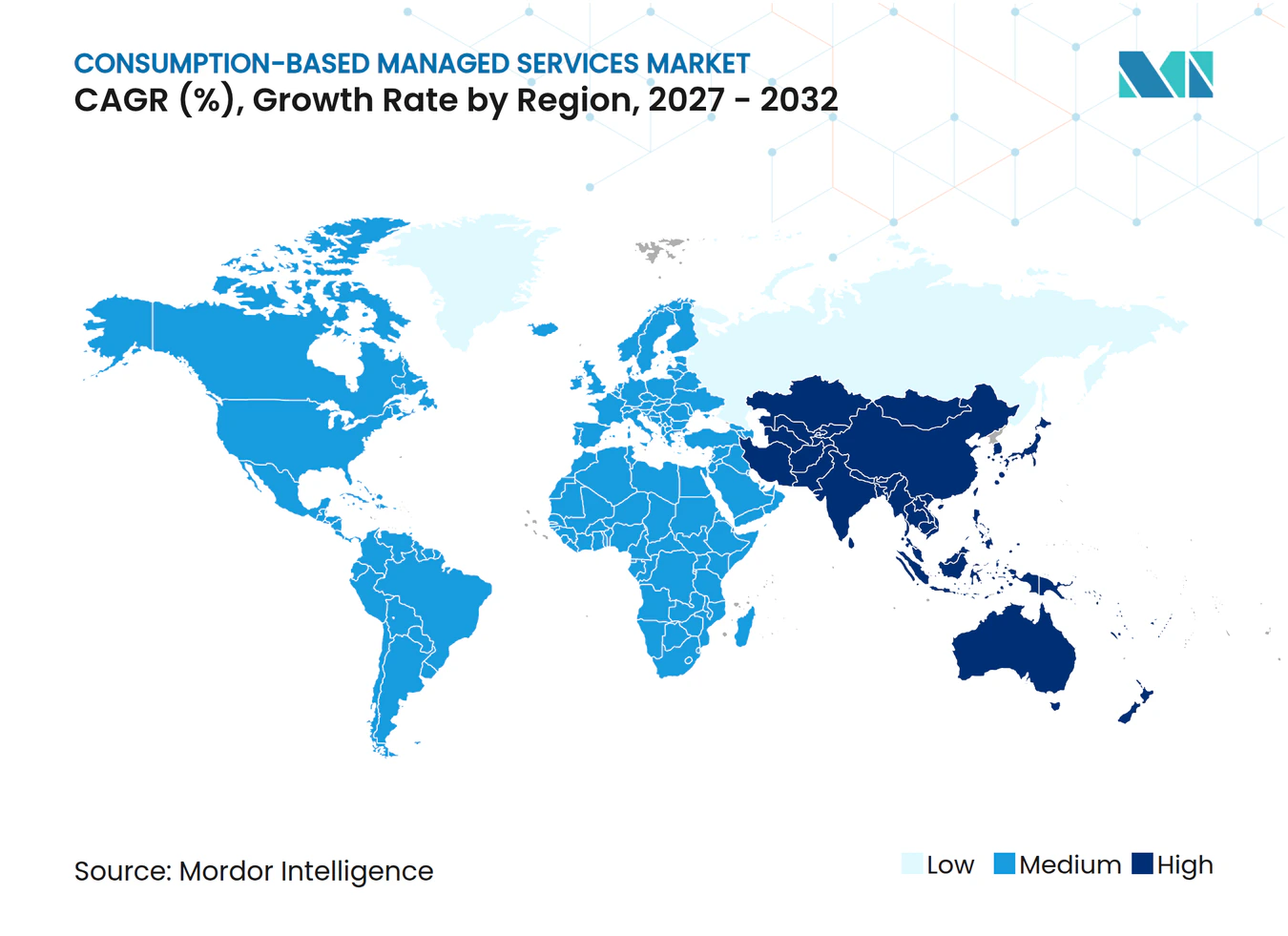
- By geography, North America held 43.24% of the consumption-based managed services market share in 2026, while Asia-Pacific is projected to expand at a 19.36% CAGR through 2032.
Note: Market numbers in this report are based on Mordor Intelligence's proprietary estimation framework, which combines nine months of actuals with Q4 projections for base year 2026.
Market Trends and Insights
Drivers Impact Analysis of Consumption-Based Managed Services Market*
| Driver | (~) % Impact on CAGR Forecast | Geographic Relevance | Impact Timeline |
|---|---|---|---|
| Hybrid and Multicloud Operating Complexity | +3.8% | Global, concentrated in North America and Europe | Medium term (2-4 years) |
| Shift From Capital Expenditure to Variable Operating Expenditure | +3.2% | Global, most pronounced in Asia-Pacific and South America | Medium term (2-4 years) |
| AI-Driven Infrastructure Monitoring and Remediation | +2.8% | Global, led by North America with expansion in Asia-Pacific and Europe | Short term (≤ 2 years) |
| Cybersecurity and Compliance Outsourcing | +2.5% | Global, particularly North America and Europe | Short term (≤ 2 years) |
| Shortage of Cloud, Security, and Platform Operations Talent | +2.1% | Global, with greater pressure in Asia-Pacific and the Middle East | Long term (≥ 4 years) |
| Metered Infrastructure for AI and Edge Workloads | +1.5% | Asia-Pacific, with spillover to the Middle East and Africa | Medium term (2-4 years) |
| Source: Mordor Intelligence | |||
Hybrid and Multicloud Operating Complexity
Hybrid and multicloud operations are a central driver of demand for the consumption-based managed services market. Enterprises must coordinate identity, security, cost controls, applications, and data across on-premises systems and multiple cloud environments. This work becomes harder as each additional platform introduces its own operating rules and management tools. Providers can reduce the burden by operating a common layer for integration, monitoring, and automation. Data residency requirements also lead some organizations to use local or sovereign environments alongside global cloud services. This creates a broader role for managed providers, enabling them to keep these environments connected without forcing clients to maintain every specialist capability internally, thereby strengthening the consumption-based managed services market.
Shift From Capital Expenditure to Variable Operating Expenditure
The shift toward variable operating expenditure supports the consumption-based managed services market because it lets buyers align some technology costs with actual demand. Organizations can redirect capital that would have been committed to equipment toward modernization, security, or data programs. This approach also shifts part of the capacity-planning burden to the provider. Buyers still need clear terms for minimum commitments, overage charges, and service scope before they can rely on a variable-cost model. The commercial appeal is strongest when a provider can pair flexible use with predictable governance and operational accountability. As a result, financial control and speed of deployment are central to buyer decisions in the consumption-based managed services market.
AI-Driven Infrastructure Monitoring and Remediation
AI-enabled monitoring is changing how providers identify faults and manage infrastructure in the consumption-based managed services market. Lenovo introduced Premier Support Plus for Servers in February 2026 with predictive monitoring, Call Home automation, preventative maintenance, and a 4-hour on-site response objective for critical cases. HPE launched GreenLake Intelligence in June 2025 to apply AI agents across storage, networking, compute, virtualized resources, and hybrid cloud cost operations.[1] These offerings move service delivery toward earlier detection and guided remediation rather than post-incident response. They can shorten the time needed to establish operating baselines and begin optimization. The quality of operational data and the provider’s ability to apply it to a client’s environment will increasingly separate similar service offerings.
Cybersecurity and Compliance Outsourcing
Cybersecurity has become a core operating requirement for organizations that depend on distributed applications, data, and cloud infrastructure. Managed security providers can combine continuous monitoring, incident response, control management, and compliance support in a single operating arrangement. This model is relevant to regulated sectors where a security failure can create operational and legal exposure. Wipro’s agreement with HanesBrands uses the WINGS Operations AI platform for predictive and preventative cybersecurity operations as part of a broader technology transformation. The example shows that security services are increasingly delivered as part of a broader managed environment rather than as a standalone service. This supports recurring demand when companies seek consistent controls across infrastructure, applications, and user access. Cybersecurity has become a core operating requirement for organizations that depend on distributed applications, data, and cloud infrastructure. Managed security providers can combine continuous monitoring, incident response, control management, and compliance support in a single operating arrangement. This model is relevant to regulated sectors where a security failure can create operational and legal exposure.
Restraints Impact Analysis of Consumption-Based Managed Services Market*
| Restraint | (~) % Impact on CAGR Forecast | Geographic Relevance | Impact Timeline |
|---|---|---|---|
| Minimum Commitments and Uncertain Total Cost of Ownership | -2.8% | Global, most acute in North America and Europe | Short term (≤ 2 years) |
| Data Sovereignty and Cross-Border Operations Constraints | -2.1% | Europe and Asia-Pacific, with spillover to the Middle East | Medium term (2-4 years) |
| Vendor Lock-In and Limited Workload Portability | -1.7% | Global, with elevated concern in BFSI and government | Long term (≥ 4 years) |
| Inconsistent Metering, Service Definitions, and Contract Comparability | -1.3% | Global, particularly early-adoption markets in the Middle East and Africa | Medium term (2-4 years) |
| Source: Mordor Intelligence | |||
Minimum Commitments and Uncertain Total Cost of Ownership
Consumption contracts can combine flexible pricing with minimum commitments, leaving clients paying for capacity they do not use. This creates a cost structure that may be difficult to compare with fixed-fee outsourcing or direct infrastructure ownership. Usage spikes, auto-scaling rules, and separate charges for tools or data movement can further weaken budget predictability. Large enterprises can build internal financial operations practices to monitor these variables, but smaller buyers may not have the same resources. Providers that explain consumption rules clearly and offer detailed cost controls can reduce this barrier. Contract transparency, therefore, remains essential to the continued adoption of the consumption-based managed services market.
Data Sovereignty and Cross-Border Operations Constraints
Data sovereignty can limit the use of a single global delivery model in the consumption-based managed services market. Many organizations must consider where information is stored, who operates the environment, and which authorities may seek access to it. A provider may need separate service instances and local operating capabilities to meet these obligations. That requirement can reduce the scale benefits normally associated with pooled infrastructure. It can also lengthen provider selection and contract approval cycles for regulated buyers. Localized architecture and clear data-control commitments can therefore become a competitive requirement rather than a secondary feature.
*Our forecasts treat driver/restraint impacts as directional, not additive. The impact forecasts reflect baseline growth, mix effects, and variable interactions.
Consumption-Based Managed Services Market Segment Analysis
By Service Type:
Security Growth Builds on Cloud OperationsManaged Cloud and Platform Services held 26.34% of revenue in 2026. The segment benefits from ongoing work to migrate applications, integrate hybrid environments, and optimize cloud platforms. Clients often require ongoing administration after a migration is complete, supporting recurring service demand in the consumption-based managed services market. Managed Infrastructure and Data Center Services remain relevant because many organizations operate legacy systems alongside cloud-native workloads. Managed Data, Backup, and Disaster Recovery Services also gain relevance as distributed data environments create more recovery and retention obligations.
Managed Security Services is projected to expand at an 18.26% CAGR through 2032. Cloud adoption creates more identities, integration points, and data paths that need active protection. Managed Network and Connectivity Services is also supported by software-defined wide area network modernization, hybrid work, and edge deployments. Managed Applications and Business Services completes the portfolio for clients seeking operational support beyond core infrastructure. NTT DATA’s October 2025 agreement with the Texas Department of Information Resources covers AWS, Azure, Google Cloud, and Oracle Cloud Infrastructure under a multicloud managed services model, showing how buyers can combine multiple platforms and services in one long-term procurement structure in the consumption-based managed services market.



By Delivery Model:
Accountability Shapes Contract SelectionFully Managed Consumption Services accounted for 38.57% of revenue in 2026. Large organizations use this model when they want a provider to take responsibility for broad operational activity. It can release internal teams to focus on product, customer, and governance priorities. Co-Managed Consumption Services remains relevant when clients want to keep direct control of selected domains. This is particularly important where internal oversight is required for security, data, or regulated business processes in the consumption-based managed services market.
Outcome-Based Managed Services is projected to expand at an 18.09% CAGR through 2032. These contracts evaluate performance against business results such as resilience, cost control, application performance, or risk reduction. They differ from traditional arrangements based primarily on service inputs or technical availability measures. Modular Consumption Services can suit mid-market buyers who want to add or remove defined services as operating needs change. The consumption-based managed services industry is therefore moving toward contract structures that align provider accountability with client outcomes, with the final choice depending on the buyer’s internal skills, risk tolerance, and ability to measure results consistently.
By Infrastructure Layer:
Data Platforms Gain Strategic ImportanceCompute and Virtualization held 28.37% of revenue in 2026. It is a natural entry point because organizations have long used external support for servers, virtual machines, and data center operations. Storage and data protection gain importance as data volumes rise and retention obligations become more demanding. Networking and connectivity are being reshaped by secure access service edge, private 5G, and software-defined networking. End-User Computing and Devices also remain important for organizations managing distributed workforces and device estates in the consumption-based managed services market.
Database and Data Platforms are projected to expand at an 18.58% CAGR through 2032. Buyers are becoming more willing to delegate the management of data platforms that were once viewed as too sensitive for external operation. This reflects a need for specialist skills across cloud-native databases, access controls, and resilience planning. In May 2025, Nutanix and Pure Storage announced an integrated solution for mission-critical virtual workloads.[2] Such alliances can simplify operations across compute and storage, although they may also deepen reliance on a smaller group of technology partners in the consumption-based managed services market.
By Organization Size:
SMEs Turn to Specialized Operating SupportLarge Enterprises accounted for 78.41% of revenue in 2026. Their broad IT estates, multiple locations, and regulatory obligations support demand for multi-domain managed services. These buyers often have established outsourcing relationships and formal procurement processes. They also need providers that can coordinate across business units and geographies. Their scale makes fully managed models and customized service agreements more practical in the consumption-based managed services market.
Small and Medium Enterprises are projected to expand at an 18.63% CAGR through 2032. Smaller firms face a greater challenge hiring cloud, security, and data specialists because those roles are expensive and difficult to retain. Managed cloud operations, cybersecurity, and endpoint protection are likely to remain their priority service areas. More complex modernization and outcome-based contracts are still concentrated among larger buyers. The United Kingdom’s SME Digital Adoption Taskforce reported that skills shortages were pushing more small and medium enterprises toward external digital support, and providers can address this need in the consumption-based managed services market with clear, modular packages rather than a full enterprise service scope.

By End-User Industry:
Healthcare Expands Its Use of Managed ServicesIT and Telecommunications held 25.69% of revenue in 2026. Telecommunications operators both use managed services internally and sell network and connectivity services to other enterprises. Their technology estates require continuous management across infrastructure, customer platforms, and security operations. BFSI is also a major buyer group because it must support resilient operations and meet strict control requirements. Retail and e-commerce customers use managed cloud and security services to handle demand changes without making large fixed infrastructure commitments.
Healthcare and Life Sciences are projected to expand at a 18.71% CAGR through 2032. Health systems are under pressure to manage the complexity of electronic health records, interoperability efforts, privacy requirements, and AI readiness. Managed service arrangements can provide access to skills that are difficult to maintain internally. Manufacturing and industrial organizations are another emerging source of demand as operational technology and IT environments become more connected. Sector-specific controls and workflow knowledge will matter more as clients look beyond generic packages, giving the consumption-based managed services market room to serve regulated healthcare, financial services, and public-sector environments.
Geography Analysis
North America Consumption-Based Managed Services Market
North America held 43.24% of the consumption-based managed services market share in 2026. The United States accounts for most of the regional revenue base because it has a large concentration of technology-intensive enterprises and an established managed services procurement. Security, compliance, and vendor consolidation remain important drivers for buyers across regulated sectors. Large bundled transactions can help organizations simplify provider portfolios while redirecting resources toward AI and data programs, and Canada and Mexico are also expanding their use of managed services through enterprise and public-sector digital programs.
APAC Consumption-Based Managed Services Market
Asia-Pacific is projected to expand at a 19.36% CAGR through 2032. The region has a distinct demand profile because cloud adoption, multicloud deployment, and skills constraints vary widely by country. China is supported by domestic AI infrastructure development, while India combines growing enterprise demand with a large offshore delivery base. Japan’s modernization needs, South Korea’s technology-intensive industries, and Australia’s government and financial services requirements add further demand. The regional outlook for the consumption-based managed services market will depend on how providers localize delivery and data governance for each national setting.
EMEA and South America Consumption-Based Managed Services Market
Europe remains a substantial regional opportunity, led by Germany, the United Kingdom, and France. Regulatory obligations increase demand for managed security, compliance, and data-control capabilities across the region. South America is led by Brazil and Argentina, where financial services, energy, and e-commerce are key demand centers. The Middle East is concentrated in the Gulf Cooperation Council states, where national digitization programs support cloud and infrastructure contracts. Africa remains at an earlier adoption stage, although Nigeria, South Africa, and Egypt offer longer-term opportunities for managed connectivity and security services.
Competitive Landscape
Market Concentration
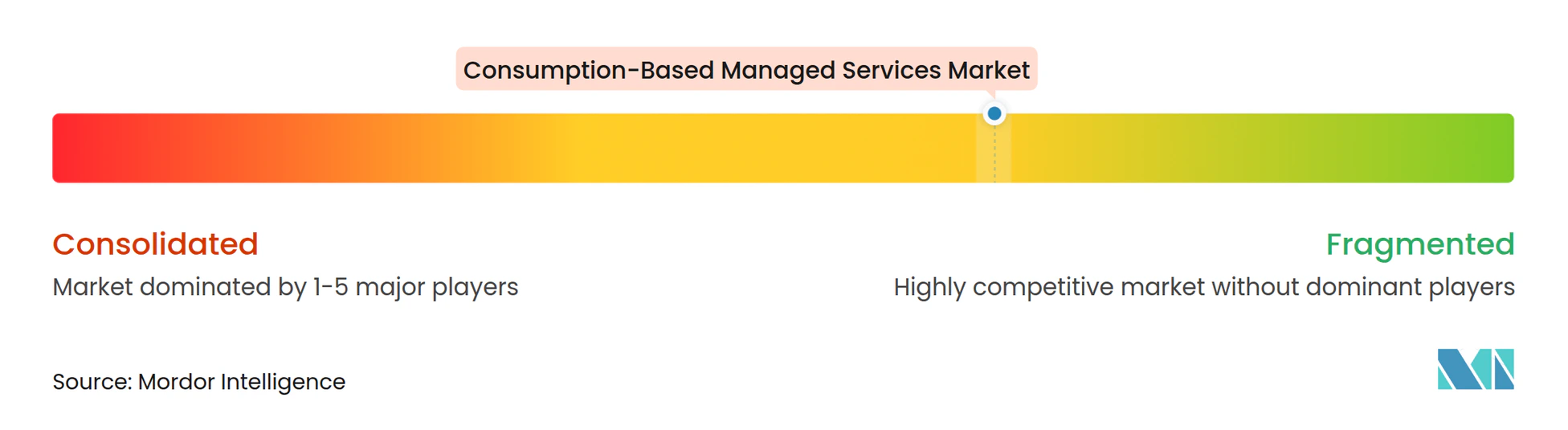
The consumption-based managed services market is fragmented across global systems integrators, infrastructure specialists, cloud ecosystem partners, and regional providers. IBM, Kyndryl, Accenture, Capgemini, TCS, Infosys, HCL Technologies, and Wipro compete through scale, broad service coverage, and delivery capabilities. HPE, Pure Storage, NetApp, Dell Technologies, and Hitachi Vantara focus more directly on consumption-based infrastructure and hardware-linked service models. These groups increasingly overlap as integrators deepen their infrastructure partnerships and technology providers expand managed operations. Regulated verticals create an opening for providers capable of delivering sector-specific controls, workflow integrations, and local compliance capabilities.
AI-enabled operations are becoming an important basis for competition in the consumption-based managed services market. Kyndryl launched Agentic Service Management in April 2026 with assessments, implementation blueprints, and governance frameworks for AI-native workflows. HPE’s GreenLake Intelligence extends this approach across hybrid IT operations through AI agents for infrastructure and cost management. NTT DATA signed a multiyear collaboration agreement with AWS in January 2026 to support cloud modernization, industry cloud solutions, AI-driven managed services, and digital sovereignty. These moves show that providers are investing in automation, cloud partnerships, and operating models that can be reused across clients.
Infrastructure partnerships also shape the competitive position of the consumption-based managed services industry. Nutanix and Pure Storage announced an integrated solution for mission-critical virtual workloads in May 2025. Kyndryl introduced managed secure access service edge services with Palo Alto Networks in February 2025.[3] Providers must balance standardization with the ability to meet individual client requirements, and strong data governance, service transparency, and integration capability can matter as much as scale in competitive bids.
Consumption-Based Managed Services Industry Leaders
-
International Business Machines Corporation
-
Microsoft Corporation
-
Amazon Web Services, Inc.
-
Accenture plc
-
Hewlett Packard Enterprise Company
- *Disclaimer: Major Players sorted in no particular order
Consumption-Based Managed Services Market Companies Covered in this Report
- International Business Machines Corporation
- Microsoft Corporation
- Amazon Web Services, Inc.
- Accenture plc
- Hewlett Packard Enterprise Company
- Dell Technologies Inc.
- Kyndryl Holdings, Inc.
- Cisco Systems, Inc.
- Fujitsu Limited
- Lenovo Group Limited
- Oracle Corporation
- NVIDIA Corporation
- Capgemini SE
- Tata Consultancy Services Limited
- Infosys Limited
- Wipro Limited
- HCL Technologies Limited
- NTT DATA Group Corporation
- NetApp, Inc.
- Pure Storage, Inc.
- Hitachi Vantara LLC
- Nutanix, Inc.
- Huawei Technologies Co., Ltd.
Recent Industry Developments in Consumption-Based Managed Services Market
- May 2026: Kyndryl and DPD Portugal announced an expanded partnership to modernize DPD’s mission-critical hybrid IT environments, encompassing IT infrastructure monitoring, platform management, backup and recovery, and storage, with Kyndryl Private Cloud supporting an enhanced disaster recovery model.
- May 2026: Lenovo launched Premier Support Plus for Servers, a premium AI-driven support service for enterprise server environments delivering proactive and predictive monitoring through Call Home automation, preventative maintenance, and a 4-hour onsite response objective, available across more than 75 markets globally.
- January 2026: NTT DATA signed a multiyear Strategic Collaboration Agreement with AWS to accelerate enterprise cloud and agentic AI adoption, targeting large-scale cloud transformation, industry cloud solutions on AWS, AI-driven managed services, and digital sovereignty on the AWS European Sovereign Cloud.
- November 2025: Wipro signed a multiyear strategic agreement with HanesBrands to power a GenAI-led IT 2.0 transformation using the Wipro Intelligence WINGS Operations AI platform, covering IT infrastructure, cybersecurity operations, and regulatory compliance optimization.
Global Consumption-Based Managed Services Market Report Scope
The consumption-based managed services market comprises outsourced IT services that organizations procure and pay for based on actual usage or consumption rather than fixed, long-term contracts.
The Consumption-Based Managed Services Market Report is Segmented by Service Type (Managed Infrastructure and Data Center Services, Managed Network and Connectivity Services, Managed Security Services, Managed Cloud and Platform Services, Managed Data, Backup, and Disaster Recovery Services, and Managed Applications and Business Services), Delivery Model (Fully Managed Consumption Services, Co-Managed Consumption Services, Modular Consumption Services, and Outcome-Based Managed Services), Infrastructure Layer (Compute and Virtualization, Storage and Data Protection, Networking and Connectivity, Database and Data Platforms, and End-User Computing and Devices), Organization Size (Large Enterprises and Small and Medium Enterprises), End-User Industry (IT and Telecommunications, BFSI, Healthcare and Life Sciences, Retail and E-Commerce, Manufacturing and Industrial IoT, Media and Entertainment, Government and Public Sector, Education, Energy, Utilities and Smart Infrastructure, and Other End-User Industries), and Geography (North America, South America, Europe, Asia-Pacific, Middle East, and Africa). The Market Forecasts are Provided in Terms of Value (USD).
Segmentation Overview
| Managed Infrastructure and Data Center Services |
| Managed Network and Connectivity Services |
| Managed Security Services |
| Managed Cloud and Platform Services |
| Managed Data, Backup, and Disaster Recovery Services |
| Managed Applications and Business Services |
| Fully Managed Consumption Services |
| Co-Managed Consumption Services |
| Modular Consumption Services |
| Outcome-Based Managed Services |
| Compute and Virtualization |
| Storage and Data Protection |
| Networking and Connectivity |
| Database and Data Platforms |
| End-User Computing and Devices |
| Large Enterprises |
| Small and Medium Enterprises |
| IT and Telecommunications |
| BFSI |
| Healthcare and Life Sciences |
| Retail and E-Commerce |
| Manufacturing and Industrial IoT |
| Media and Entertainment |
| Government and Public Sector |
| Education |
| Energy, Utilities and Smart Infrastructure |
| Other End-User Industries |
| North America | United States |
| Canada | |
| Mexico | |
| South America | Brazil |
| Argentina | |
| Rest of South America | |
| Europe | Germany |
| United Kingdom | |
| France | |
| Italy | |
| Spain | |
| Russia | |
| Rest of Europe | |
| Asia-Pacific | China |
| India | |
| Japan | |
| South Korea | |
| Australia | |
| Rest of Asia-Pacific | |
| Middle East | Saudi Arabia |
| United Arab Emirates | |
| Turkey | |
| Rest of Middle East | |
| Africa | South Africa |
| Egypt | |
| Nigeria | |
| Rest of Africa |
| By Service Type | Managed Infrastructure and Data Center Services | |
| Managed Network and Connectivity Services | ||
| Managed Security Services | ||
| Managed Cloud and Platform Services | ||
| Managed Data, Backup, and Disaster Recovery Services | ||
| Managed Applications and Business Services | ||
| By Delivery Model | Fully Managed Consumption Services | |
| Co-Managed Consumption Services | ||
| Modular Consumption Services | ||
| Outcome-Based Managed Services | ||
| By Infrastructure Layer | Compute and Virtualization | |
| Storage and Data Protection | ||
| Networking and Connectivity | ||
| Database and Data Platforms | ||
| End-User Computing and Devices | ||
| By Organization Size | Large Enterprises | |
| Small and Medium Enterprises | ||
| By End-User Industry | IT and Telecommunications | |
| BFSI | ||
| Healthcare and Life Sciences | ||
| Retail and E-Commerce | ||
| Manufacturing and Industrial IoT | ||
| Media and Entertainment | ||
| Government and Public Sector | ||
| Education | ||
| Energy, Utilities and Smart Infrastructure | ||
| Other End-User Industries | ||
| By Geography | North America | United States |
| Canada | ||
| Mexico | ||
| South America | Brazil | |
| Argentina | ||
| Rest of South America | ||
| Europe | Germany | |
| United Kingdom | ||
| France | ||
| Italy | ||
| Spain | ||
| Russia | ||
| Rest of Europe | ||
| Asia-Pacific | China | |
| India | ||
| Japan | ||
| South Korea | ||
| Australia | ||
| Rest of Asia-Pacific | ||
| Middle East | Saudi Arabia | |
| United Arab Emirates | ||
| Turkey | ||
| Rest of Middle East | ||
| Africa | South Africa | |
| Egypt | ||
| Nigeria | ||
| Rest of Africa | ||
Key Questions Answered in the Report
What is the projected value of consumption-based managed services by 2032?
The consumption-based managed services market is projected to grow from USD 41.62 billion in 2026 to USD 111.80 billion by 2032, at a 17.53% CAGR.
What is driving demand for consumption-based managed services?
Hybrid and multicloud complexity, variable-cost requirements, AI-enabled operations, cybersecurity needs, and skills shortages are the main drivers of demand.
Which service type leads consumption-based managed services?
Managed Cloud and Platform Services leads with 26.34% revenue in 2026, while Managed Security Services has the fastest projected growth at an 18.26% CAGR through 2032.
Which delivery model is growing fastest?
Outcome-Based Managed Services is projected to grow at an 18.09% CAGR through 2032 as buyers seek contracts linked to business results.
Which region has the highest growth outlook?
Asia-Pacific is projected to grow at a 19.36% CAGR through 2032, supported by multicloud adoption and demand for specialized operating skills.
Which organizations are increasing adoption most quickly?
Small and Medium Enterprises are projected to grow at an 18.63% CAGR through 2032 because many need external cloud, security, and data expertise.