
Managed Mobile Risk Analytics Services Market Size and Share
Market Overview
| Study Period | 2021 - 2032 |
|---|---|
| Market Size (2027) | USD 1.46 Billion |
| Market Size (2032) | USD 3.24 Billion |
| Growth Rate (2027 - 2032) | 17.28 % |
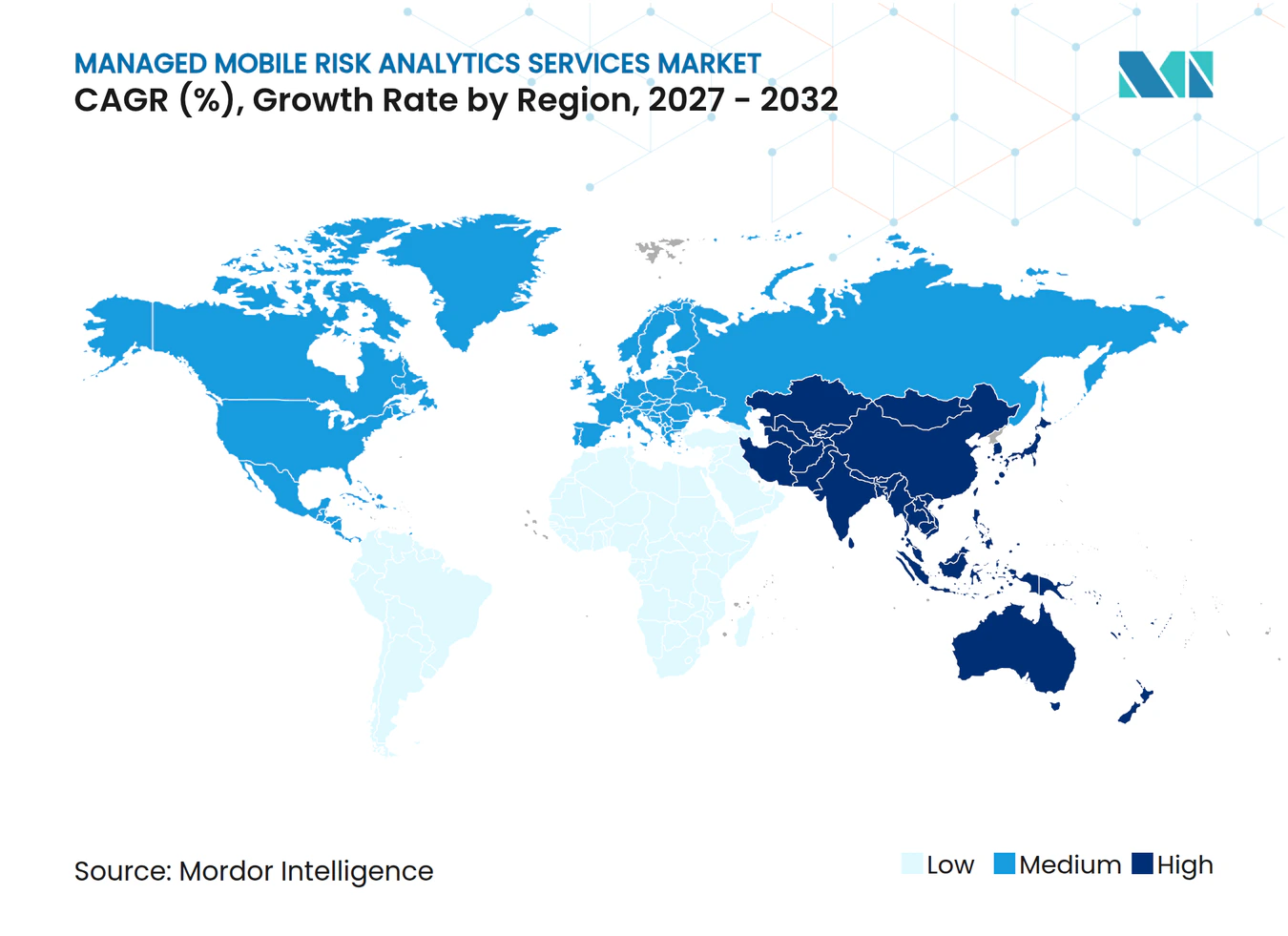
| Fastest Growing Market | Asia-Pacific |
| Largest Market | North America |
| Market Concentration | Medium |
Major Players *Disclaimer: Major Players sorted in no particular order Image © Mordor Intelligence. Reuse requires attribution under CC BY 4.0. | |
Managed Mobile Risk Analytics Services Market Analysis by Mordor Intelligence
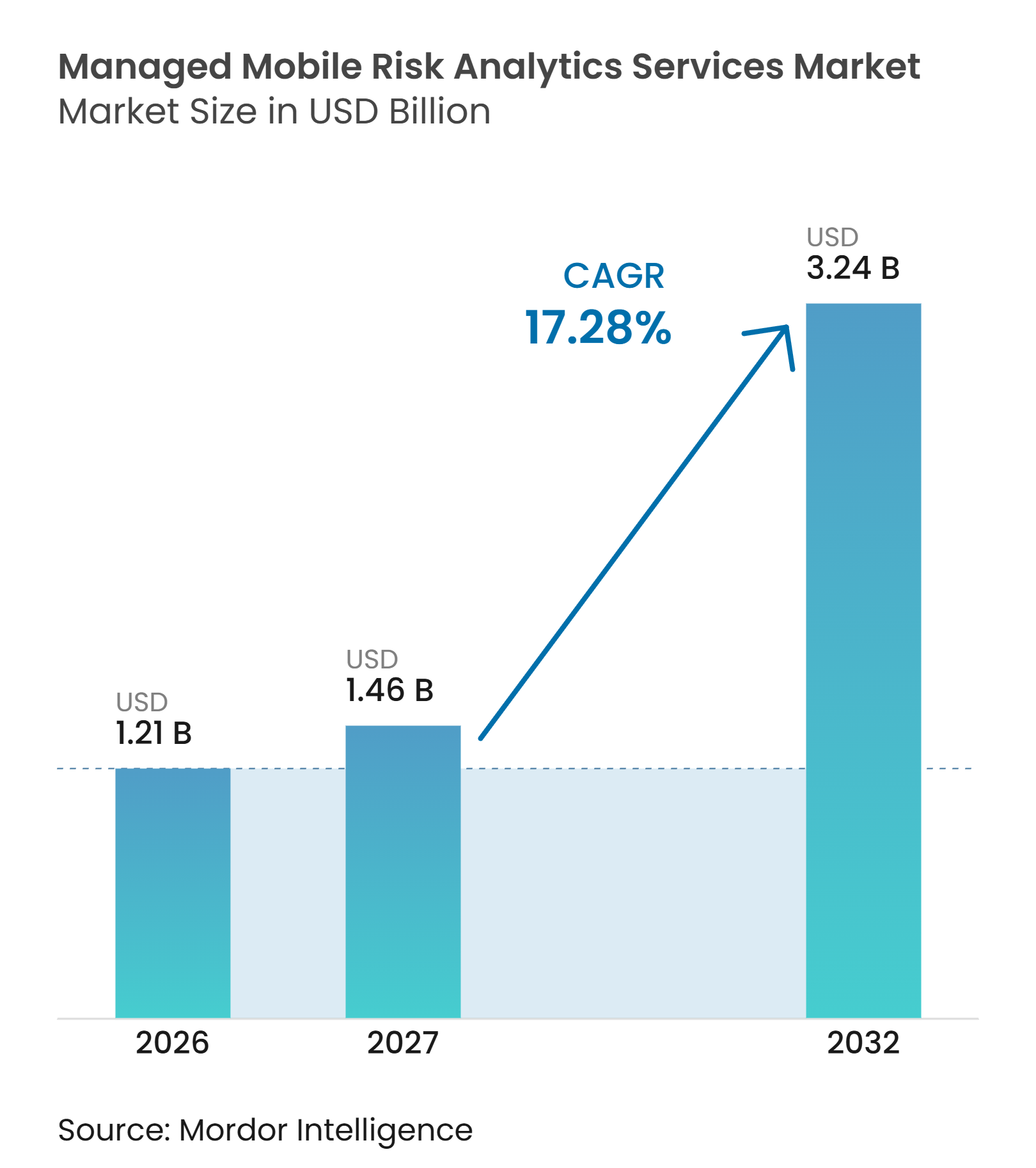
The managed mobile risk analytics services market size is projected to expand from USD 1.21 billion in 2026 and USD 1.46 billion in 2027 to USD 3.24 billion by 2032, registering a CAGR of 17.28% between 2027 to 2032. Mobile devices now support access, payments, and work processes, which has widened the enterprise attack surface across device, application, network, identity, and transaction layers. Organizations are moving beyond isolated device-management tools because they need continuous detection, triage, and response across those layers. The managed mobile risk analytics services market benefits as security teams face a shortage of mobile-specific expertise and need analyst-backed services that can fit into existing security operations. Vendor strategy increasingly centers on linking mobile telemetry with SIEM, SOAR, XDR, and zero-trust policy tools, rather than asking customers to manage a separate console. Budget limits in mid-sized firms and difficult legacy-system integration remain material constraints, even as AI-enabled phishing raises the cost of leaving mobile risk unmanaged.
Key Report Takeaways
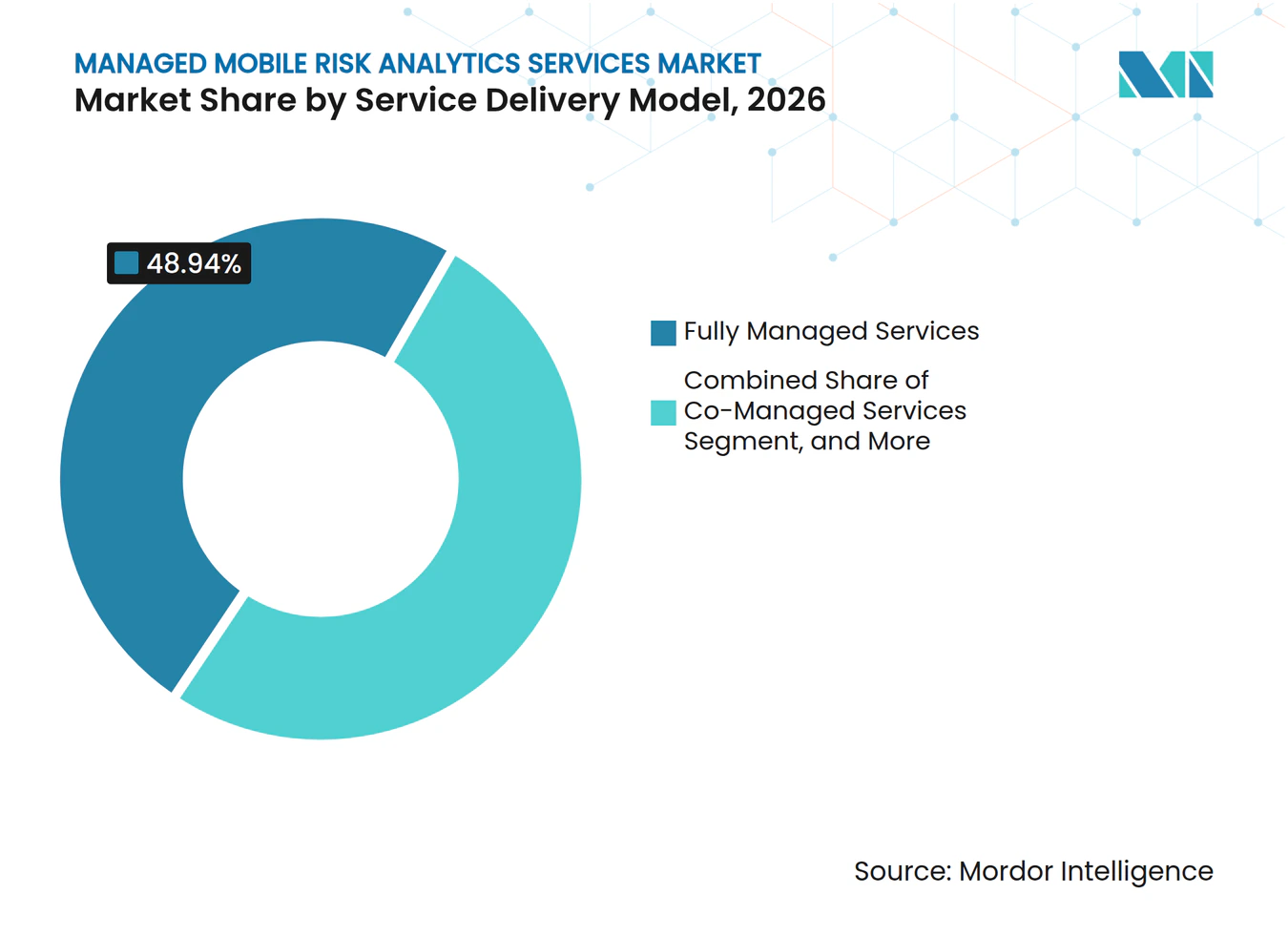
- By service delivery model, Fully Managed Services held 48.94% of revenue in 2026, and it is projected to expand at a 17.24% CAGR through 2032 in the managed mobile risk analytics services market.
- By analytics capability, Device and OS Risk Analytics accounted for 23.47% of revenue in 2026, while Transaction and Account-Takeover Risk Analytics is projected to expand at a 17.46% CAGR through 2032 in the managed mobile risk analytics services market.
- By end-user industry, BFSI accounted for 17.64% of revenue in 2026, and it is projected to expand at a 17.88% CAGR through 2032.
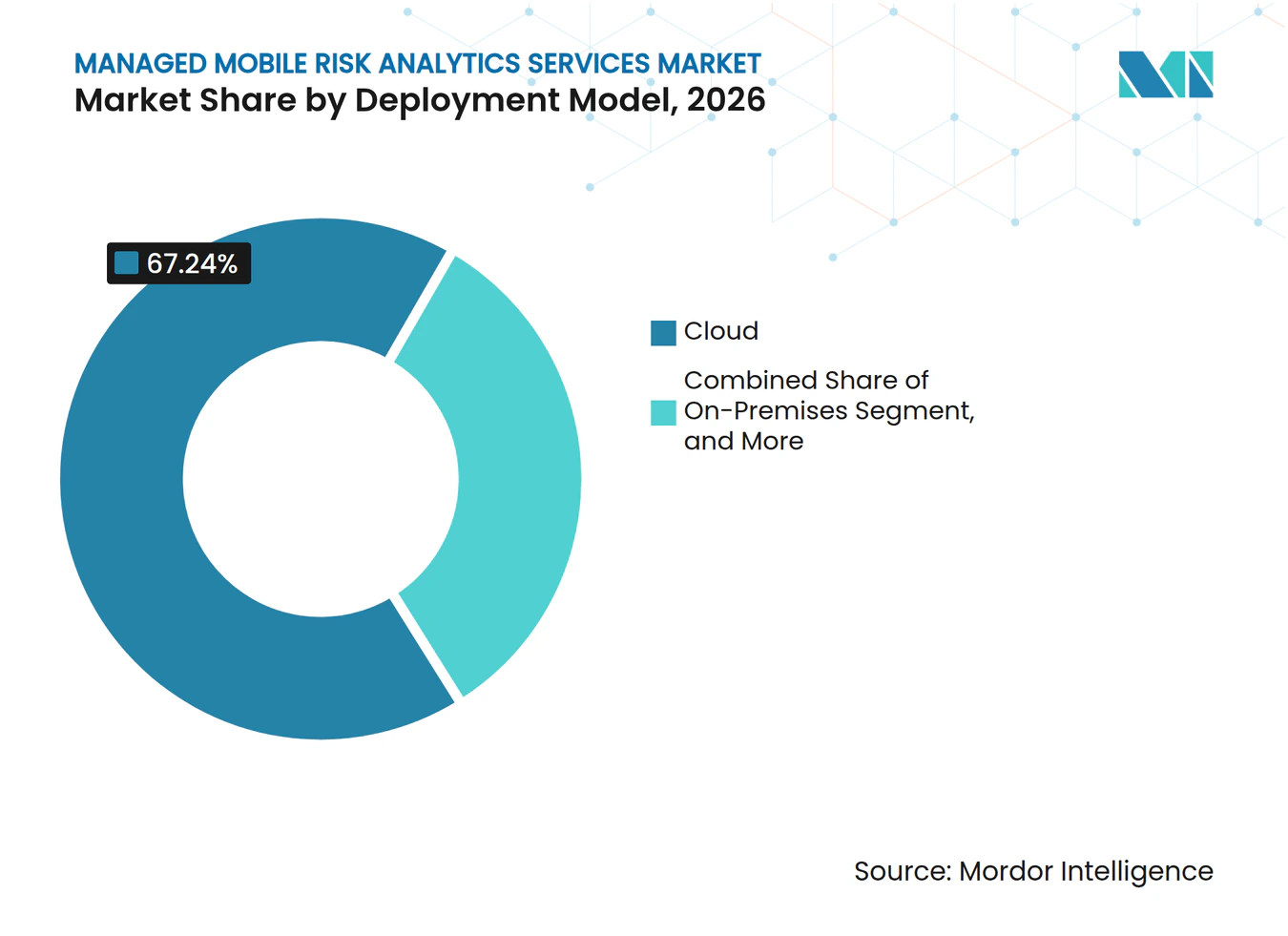
- By deployment model, Cloud accounted for 67.24%, and is projected to expand at a 17.57% CAGR through 2032.
- By threat and risk use case, Mobile Phishing and Smishing accounted for 21.26% of revenue and is projected to expand at a 17.64% CAGR through 2032.
- By geography, North America accounted for 43.77% of revenue in 2026, while Asia-Pacific is projected to expand at a 17.66% CAGR through 2032.
Note: Market numbers in this report are based on Mordor Intelligence's proprietary estimation framework, which combines nine months of actuals with Q4 projections for base year 2026.
Market Trends and Insights
Drivers Impact Analysis of Managed Mobile Risk Analytics Services Market*
| Driver | (~) % Impact on CAGR Forecast | Geographic Relevance | Impact Timeline |
|---|---|---|---|
| Escalating Mobile Cyber-Threat Landscape | +3.8% | Global | Short term (≤ 2 years) |
| BYOD and Remote-Work Proliferation | +3.2% | North America and Europe, with growing Asia-Pacific spill-over | Short term (≤ 2 years) |
| Tightening Privacy and Sector Compliance Mandates | +2.5% | North America, EU, Asia-Pacific core | Medium term (2-4 years) |
| Zero-Trust Integration for Mobile Endpoints | +2.0% | Global, with early leadership in North America and EU | Medium term (2-4 years) |
| Mobile Risk Telemetry Blind Spot in Existing SOCs | +1.5% | Global | Short term (≤ 2 years) |
| Privacy-Preserving On-Device Analytics for BYOD | +1.0% | North America, EU | Long term (≥ 4 years) |
| Source: Mordor Intelligence | |||
Escalating Mobile Cyber-Threat Landscape
AI-assisted mobile phishing across SMS, voice, and QR channels has become a continuing enterprise security issue because an employee can encounter a malicious prompt while outside the protection of a corporate network. Zimperium reported a 380% increase in phishing events on employee mobile devices since January 2025. The same report stated that smishing represented 39% of mobile threat vectors and QR-based quishing rose 146% quarter over quarter in Q1 2026.[1] Lookout recorded a global phishing click rate of 12.88% across 4 consecutive quarters in 2025, which points to steady exposure rather than an isolated campaign cycle.[2] The managed mobile risk analytics services market gains recurring demand because these attacks require detection that adapts to changing messages, links, device behavior, and the sequence of actions that can lead to a compromise. Employee awareness remains useful, but it does not replace continuously managed controls against highly personalized campaigns that are designed to appear legitimate in a familiar business context.
BYOD and Remote-Work Proliferation
The gap between formal BYOD policies and employee behavior creates a persistent mobile risk surface because personal devices often connect to business applications without undergoing the same inspection as corporate equipment. Verizon found that BYOD use remains common among IT workers, while fewer organizations formally allow it. Among organizations that prohibit BYOD, compliance remains limited. Ivanti reported that employees often ignore BYOD bans and that many IT professionals lack adequate visibility into devices connecting to corporate networks. This gap supports demand for services that monitor mobile access without relying on internal teams to identify every device or manually confirm its security condition. MDM-agnostic options are particularly relevant where an organization needs governance but has incomplete device enrollment and cannot require every worker to use a company-managed phone.
Tightening Privacy and Sector Compliance Mandates
Financial institutions face more specific mobile-security expectations as mobile banking becomes central to customer activity and as fraud controls must work across the full customer journey. The Central Bank of the UAE required certain controls for mobile banking applications in May 2025, including detection of screen sharing, active calls, and malware, and it did not allow SMS OTP as the only authentication method. ITU-T Recommendation X.1456, issued in April 2025, set security guidance for digital financial service applications covering authentication, encryption, and real-time threat detection.[3] These requirements make audit-ready mobile controls more important for financial service providers because they need evidence that controls are operating in day-to-day customer interactions. Managed providers can translate rules into monitoring and response workflows when internal teams do not have dedicated mobile compliance specialists or the capacity to continually update control logic. This pressure is especially relevant to BFSI, which is the largest end-user category in the managed mobile risk analytics services market.
Zero-Trust Integration for Mobile Endpoints
Mobile endpoints are becoming a more important part of zero-trust security programs because an access decision can be weakened when it does not account for the security state of the device involved. Many organizations have adopted zero-trust frameworks, although adoption remains comparatively lower in industries such as manufacturing and energy. The remaining deployment gap leaves many organizations without continuous mobile posture checks tied to access decisions. Device posture scoring can supply an additional signal before an application or transaction is allowed, rather than relying solely on a user’s identity credentials. Providers that connect those signals with identity platforms and zero-trust policy engines can make mobile data part of the existing security workflow, enabling the same team to use device information when it investigates identity, application, and transaction-related events. This approach helps the managed mobile risk analytics services market move from a point security tool toward a service embedded in enterprise access control, where a security policy needs to respond promptly to changes in device condition.
Restraints Impact Analysis of Managed Mobile Risk Analytics Services Market*
| Restraint | (~) % Impact on CAGR Forecast | Geographic Relevance | Impact Timeline |
|---|---|---|---|
| Integration Complexity With Legacy IT Stacks | -1.8% | Global, most acute in North America and EU | Medium term (2-4 years) |
| Budget Constraints for Mid-Sized Enterprises | -1.4% | Global, concentrated in Asia-Pacific and South America | Short term (≤ 2 years) |
| Cross-Tenant Data Isolation and Sovereignty Requirements | -0.9% | EU, Asia-Pacific core, Middle East and Africa | Long term (≥ 4 years) |
| Mobile Risk-Scoring Explainability and User-Trust Friction | -0.6% | Global | Medium term (2-4 years) |
| Source: Mordor Intelligence | |||
Integration Complexity With Legacy IT Stacks
Legacy infrastructure can slow the adoption of managed mobile analytics services, especially where a company has several generations of systems running in parallel. Cloud-native agents need ongoing API connections and real-time telemetry flows into SIEM and SOAR systems, which older environments may not support well. Organizations using aging authentication protocols and on-premises systems often need middleware and data transformation layers before a mobile service can operate effectively. These additions can lengthen implementation schedules by 12 to 18 months, and they can require coordination between security, infrastructure, and application teams. During that period, the organization retains its predeployment risk while also spending on the new service. Providers can reduce this friction by beginning with network-level detection that does not require immediate changes to legacy applications, which gives technology teams time to plan more extensive changes without delaying all initial protection.
Budget Constraints for Mid-Sized Enterprises
Mid-sized companies often face meaningful mobile exposure but lack the budget structure of large enterprises, particularly when security spending must compete with core operational priorities. Verizon reported that SMBs experienced notable mobile-attack-related system downtime in 2025. Fully managed contracts commonly depend on enterprise seat volumes and strict service-level commitments that mid-market buyers may not be able to fund. Co-managed services and analyst add-on models can lower entry costs, but they may leave coverage gaps compared with full outsourcing. Consumption-based pricing tied to the active mobile fleet could make services more accessible to this buyer group and give customers a clearer connection between use and cost. This limitation can slow the managed mobile risk analytics services market in Asia-Pacific and South America, where price sensitivity is more pronounced and procurement decisions can depend on visible operational savings as well as risk reduction.
*Our forecasts treat driver/restraint impacts as directional, not additive. The impact forecasts reflect baseline growth, mix effects, and variable interactions.
Managed Mobile Risk Analytics Services Market Segment Analysis
By Service Delivery Model:
Fully Managed Services Supports Near-Term RevenueFully Managed Services accounted for 48.94% of the managed mobile risk analytics services market share in 2026. This format leads because many enterprises do not have specialists who can manage mobile risk scoring, alert triage, policy remediation, and escalation decisions across a varied mobile device fleet. Jamf identified the organizational cost of security gaps that result when mobile security leadership is absent. Full outsourcing, therefore, addresses a practical staffing constraint as well as a technology need, particularly when internal teams already have wider responsibilities across cloud, network, and endpoint security. Providers can also apply threat intelligence drawn from multiple customers, giving them visibility that a single enterprise deployment may not achieve, while still requiring that providers isolate customer data and respect relevant privacy obligations.
Co-Managed Services allows organizations with an existing SOC to add mobile coverage without replacing established workflows or forcing security teams to abandon their existing incident-response process. This option can suit mid-tier financial institutions and healthcare systems that retain internal security teams but need help with mobile-specific analysis. Managed Platform with Analyst Add-On gives technology firms more direct platform control with periodic human support. Outcome-based contracts shift responsibility for detection service levels from the customer to the provider and establish clearer expectations for investigation and remediation. That arrangement favors full management where the cost and availability of qualified mobile security analysts remains a concern, particularly when a company cannot dedicate staff to 24-hour alert monitoring and rapid remediation.



By Analytics Capability:
Transaction Risk Analytics Leads the Growth WaveTransaction and Account-Takeover Risk Analytics is projected to expand at a 17.46% CAGR through 2032. Mobile banking, digital wallets, and super-apps place high-value transactions on the same device profiles used for everyday activity, which increases the importance of checking risk at the moment a transaction is requested. Enterprises that began with device checks are adding behavioral and transaction-layer controls to protect revenue-generating actions. Zimperium stated that AI use in mobile applications rose 14 times on Android and 7 times on iOS in 2025. This change expands the behavioral anomaly surface that transaction analytics must assess and makes static device checks less sufficient on their own when a legitimate account can be used in an unusual or manipulated transaction.
Device and OS Risk Analytics held 23.47% of revenue in 2026, making it the largest analytics capability. Device health and operating-system integrity must be established before application and transaction data can be relied on, especially when the same device may be used for both work and personal activity. Application and Runtime Risk Analytics addresses changing application behavior and data-governance risks created by AI-enabled mobile applications. Cross-Endpoint and XDR Correlation Analytics can connect mobile telemetry with security signals from email, firewall, and cloud systems, which can help teams view a multi-stage incident in one workflow. Network and Web Risk Analytics remains useful when employee devices operate beyond the reach of corporate network monitoring, including when users connect through home, public, or cellular networks during routine work activity.
By End-User Industry:
BFSI Establishes Detection Requirements Across VerticalsBFSI accounted for 27.21% of revenue in 2026 and is projected to expand at a CAGR of 17.88% through 2032. The sector combines extensive mobile banking use, costly account-takeover incidents, and specific requirements for mobile security controls that can be applied consistently across customer-facing channels. Financial institutions need controls that can support both security operations and audit preparation. Managed analytics providers can configure monitoring and detection workflows around those requirements, including alerts that allow teams to investigate suspicious device and transaction activity. This gives the sector a central role in determining the features that providers prioritize, from access protection through incident investigation and the evidence required after a suspicious event is identified.
Healthcare and Life Sciences also require secure handling of data on mobile devices and clinical applications, where users may access sensitive information outside traditional workplaces. BYOD use in this setting increases the concern around unauthorized data transfer. Government and Defense may need air-gapped or on-premises service designs that differ from cloud-based BFSI deployments. Retail and e-commerce faces account takeover and loyalty credential theft through mobile commerce applications, where a stolen account can affect both revenue and customer confidence. Manufacturing has a lower level of zero-trust adoption, and its greater use of mobile-connected operational technology can create a larger future requirement for managed coverage, particularly as operational processes become more connected to mobile tools and remote workers.
By Deployment Model:
Cloud Delivery Expands While Hybrid Remains RelevantCloud accounted for 67.24%, and is projected to expand at a 17.57% CAGR through 2032. Elastic telemetry collection, multi-tenant analytics, and rapid service-level responses align with cloud delivery, particularly for customers that operate across several locations and need consistent coverage. The managed mobile risk analytics services market can use cloud scale to process signals from large and dispersed device fleets without requiring each customer to build a separate analytics infrastructure. Cloud services can also support shared intelligence across customers while keeping operational management centralized. These attributes make cloud deployment the primary route for many managed service contracts, while retaining the ability to apply a common operating model across customers in different locations.
On-premises deployment remains relevant in government, defense, and heavily regulated financial institutions with strict data-residency requirements. Hybrid models keep sensitive telemetry processing within the customer environment while using cloud resources for threat intelligence coordination. This structure can balance sovereignty needs with the operational benefits of a broader intelligence network and allow customers to adopt cloud capability in stages. Cross-tenant isolation remains an important technical and regulatory consideration in European and Asia-Pacific deployments. Providers that demonstrate strong isolation and country-specific data residency can be better positioned in regulated settings where a customer must understand where mobile data is processed and retained.

By Threat and Risk Use Case:
Phishing Remains the Largest Managed Detection NeedMobile Phishing and Smishing accounted for 21.26% of revenue and is projected to expand at a 17.64% CAGR through 2032. Lookout reported that the global phishing click rate remained consistently high over an extended period in 2025. This consistency supports the need for continuously updated detection rather than detection applied only during a campaign, as employees can encounter fraudulent messages during routine mobile use. Lookout launched Smishing AI in September 2025 to assess message context and intent instead of relying only on URL reputation or sender identification. The product approach reflects a broader shift toward analyzing suspicious message behavior and determining whether the language seeks to prompt an unsafe action.
Malware and Ransomware, together with Device Compromise and Jailbreak Detection, need mobile telemetry that many enterprises cannot collect across mixed iOS and Android fleets. Credential Theft, Account Takeover, Data Exfiltration, and Privacy Risk can follow phishing incidents within the same attack chain, which makes it important to connect related signals instead of treating them as separate events. Network and Man-in-the-Middle Attacks remain relevant in BYOD settings because corporate network tools may not cover devices away from the workplace. Malicious Applications and Grayware addresses sideloading exposure, especially where third-party app stores are widely used. These related use cases allow providers to extend coverage after an organization begins with phishing protection and to bring a broader set of mobile risks into managed monitoring, allowing the service relationship to develop as the customer’s mobile security priorities become broader.
Geography Analysis
North America Managed Mobile Risk Analytics Services Market
North America accounted for 43.77% of the managed mobile risk analytics services market size in 2026. The region combines regulated enterprises, high BYOD use, and an established managed security services ecosystem that gives buyers experience with outsourced security operations and established processes for evaluating provider service levels. Verizon found that 80% of organizations in the United States faced mobile phishing attempts targeting employees in 2025. Samsung released Knox Asset Intelligence for Microsoft Sentinel as a generally available product in September 2025. It allows SOC teams to bring Samsung Galaxy security telemetry into Microsoft Sentinel investigations across more than 65 security events, giving analysts a wider mobile data set when they investigate a potential incident.
Europe Managed Mobile Risk Analytics Services Market
Europe has a regulatory environment that affects both vendor design and customer requirements, especially for providers supporting customers across more than 1 country. Data minimization and cross-border data transfer rules make EU-resident telemetry pipelines important for some customers, as does clarity on how information is isolated between tenants. This creates a barrier for providers without regional infrastructure or a clear approach to sovereignty requirements, which can influence provider selection even when broader security capabilities are similar. Pradeo and 7P formed a partnership in April 2026 to deliver an EU-compliant mobile security offering aimed at organizations with digital sovereignty requirements, which can influence provider selection even when broader security capabilities are similar. The partnership indicates that regional compliance capability is a competitive consideration in the managed mobile risk analytics services market.
APAC, MEA and South America Managed Mobile Risk Analytics Services Market
Asia-Pacific is projected to expand at a 17.66% CAGR through 2032. 5G deployment, mobile payments, and stricter financial-services security requirements support demand across the region, where mobile channels have an important role in everyday customer activity. China had deployed more than 4.5 million 5G base stations by May 2025. Zimperium reported 12 new banking customers in Asia-Pacific during FY25. South America and Middle East and Africa remain earlier-stage markets, with demand centered on BFSI and government users that must protect public-facing mobile applications and sensitive information, while providers continue to adapt delivery models to the local requirements of each region.
Competitive Landscape
Market Concentration
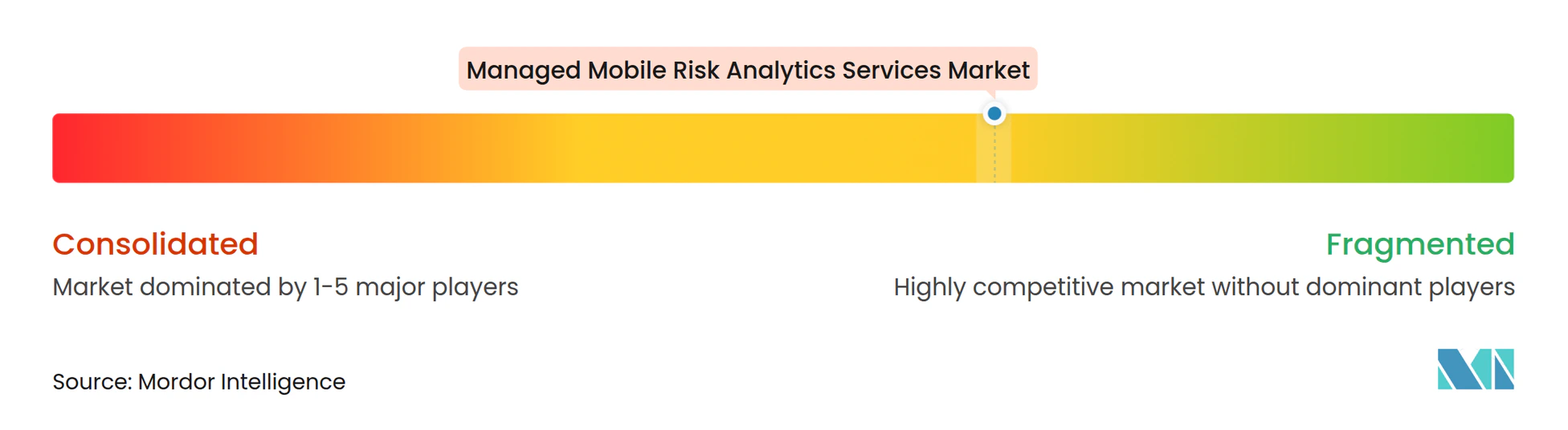
The managed mobile risk analytics services market is moderately fragmented. Specialist vendors such as Zimperium and Lookout compete through mobile-specific threat intelligence and AI-assisted triage. CrowdStrike, Palo Alto Networks, and Microsoft can use their wider XDR and SIEM relationships to embed mobile analytics in existing security agreements. Procurement increasingly favors providers that send mobile telemetry into existing SIEM, SOAR, and zero-trust policy tools, because customers can investigate mobile events beside signals from other parts of the environment. This integration model can reduce the need for a separate mobile security console and simplify how security teams assign and track response activity, which can be important when mobile alerts need to be prioritized alongside a larger volume of security notifications.
Zimperium expanded its CrowdStrike relationship in March 2025 through an integration with CrowdStrike Falcon Next-Gen SIEM. The integration made mobile threat events available in CrowdStrike’s detection environment with MITRE ATT&CK mapping. Samsung’s September 2025 Microsoft Sentinel release provides another example of vendors bringing mobile data into established SOC workflows in the managed mobile risk analytics services market, where it can be considered alongside enterprise security information. Zimperium launched Mobile SOC Agent in May 2026 to help teams identify, prioritize, and remediate mobile threats with AI-assisted investigation support, reflecting the need to shorten response cycles when security teams must examine events across many devices.
Emerging vendors such as iVerify seek differentiation through MDM-less mobile endpoint detection and response for BYOD environments, where enforcing a standard device-management approach may be difficult. Lookout’s Smishing AI release illustrates the move toward message-context analysis for mobile phishing protection in the managed mobile risk analytics services market, where employees need protection regardless of their location or device ownership. Providers with larger telemetry networks can improve their threat intelligence by observing anonymized patterns across multiple customers, provided they maintain appropriate data separation. That network advantage can be difficult for point-tool vendors to match without comparable deployment scale, because the quality of threat intelligence can improve as more relevant mobile signals are assessed over time.
Managed Mobile Risk Analytics Services Industry Leaders
-
Microsoft Corporation
-
IBM Corporation
-
Lookout, Inc.
-
Zimperium, Inc.
-
Ivanti, Inc.
- *Disclaimer: Major Players sorted in no particular order
Managed Mobile Risk Analytics Services Market Companies Covered in this Report
- Accenture plc
- Microsoft Corporation
- International Business Machines Corporation
- Lookout, Inc.
- Zimperium, Inc.
- Ivanti, Inc.
- Check Point Software Technologies Ltd.
- BlackBerry Limited
- Cisco Systems, Inc.
- Broadcom Inc.
- Sophos Limited
- Jamf Holding Corp.
- Cybereason Inc.
- Pradeo SAS
- CrowdStrike Holdings, Inc.
- Palo Alto Networks, Inc.
- Trend Micro Incorporated
- ESET, spol. s r.o.
- Kaspersky Lab
- International Business Machines Corporation MaaS360
- SAP SE
Recent Industry Developments in Managed Mobile Risk Analytics Services Market
- September 2026: Pradeo integrates Mobile Threat Defense with Fence (Norway). Pradeo's MTD solution was embedded into Fence's managed security services stack, extending SOC operations and endpoint detection and response to cover mobile fleet protection for European enterprise clients. The partnership addresses the mobile coverage gap common to MSSPs with robust laptop and server detection but no equivalent mobile analytics layer.
- May 2026: Zimperium launches Mobile SOC Agent. Zimperium introduced an agentic AI solution layered onto its Mobile Threat Defense platform, enabling SOC teams to identify, prioritize, and remediate mobile threats in minutes rather than hours by correlating threats across iOS and Android attack surfaces, generating MITRE ATT&CK-mapped attack narratives with confidence scores, and delivering step-by-step remediation guidance.
- April 2026: Pradeo and 7P announce sovereign mobile security partnership. The 2 European vendors partnered to deliver a 100% EU-compliant mobile security solution combining 7P's MDM platform with Pradeo's MTD, targeting enterprises requiring digital sovereignty and full NIS2 compliance, signaling a structural competitive shift in European managed mobile security markets.
- March 2026: NowSecure and iVerify announced a partnership to integrate mobile application security data into the iVerify Enterprise administration portal. The integration adds application-level risk intelligence to mobile endpoint security workflows, helping enterprises assess threats across both mobile applications and devices.
Global Managed Mobile Risk Analytics Services Market Report Scope
The Managed Mobile Risk Analytics Services Market comprises outsourced services that continuously monitor, assess, and mitigate security and compliance risks across mobile devices, applications, and networks, covering BYOD, corporate-owned, and IoT-connected endpoints.
The Managed Mobile Risk Analytics Services Market Report is Segmented by Service Delivery Model (Fully Managed Services, Co-Managed Services, and Managed Platform With Analyst Add-On), Analytics Capability (Device and OS Risk Analytics, Application and Runtime Risk Analytics, Network and Web Risk Analytics, Identity, User and Behavioral Risk Analytics, Transaction and Account-Takeover Risk Analytics, and Cross-Endpoint and XDR Correlation Analytics), End-User Industry (Banking, Financial Services and Insurance, Healthcare and Life Sciences, IT and Telecom, Government and Defense, Retail and E-Commerce, Manufacturing, and Other End-User Industries), Deployment Model (Cloud, On-Premises, and Hybrid), Threat and Risk Use Case (Mobile Phishing and Smishing, Malware and Ransomware, Device Compromise and Jailbreak Detection, Malicious Applications and Grayware, Network and Man-in-the-Middle Attacks, Credential Theft and Account Takeover, and Data Exfiltration and Privacy Risk), and Geography (North America, South America, Europe, Asia-Pacific, and Middle East and Africa). The Market Forecasts are Provided in Terms of Value (USD).
Segmentation Overview
| Fully Managed Services |
| Co-Managed Services |
| Managed Platform With Analyst Add-On |
| Device and OS Risk Analytics |
| Application and Runtime Risk Analytics |
| Network and Web Risk Analytics |
| Identity, User and Behavioral Risk Analytics |
| Transaction and Account-Takeover Risk Analytics |
| Cross-Endpoint and XDR Correlation Analytics |
| Banking, Financial Services and Insurance |
| Healthcare and Life Sciences |
| IT and Telecom |
| Government and Defense |
| Retail and E-Commerce |
| Manufacturing |
| Other End-User Industries |
| Cloud |
| On-Premises |
| Hybrid |
| Mobile Phishing and Smishing |
| Malware and Ransomware |
| Device Compromise and Jailbreak Detection |
| Malicious Applications and Grayware |
| Network and Man-in-the-Middle Attacks |
| Credential Theft and Account Takeover |
| Data Exfiltration and Privacy Risk |
| North America | United States |
| Canada | |
| Mexico | |
| South America | Brazil |
| Argentina | |
| Rest of South America | |
| Europe | United Kingdom |
| Germany | |
| France | |
| Italy | |
| Spain | |
| Rest of Europe | |
| Asia-Pacific | China |
| India | |
| Japan | |
| South Korea | |
| Rest of Asia-Pacific | |
| Middle East and Africa | Saudi Arabia |
| United Arab Emirates | |
| South Africa | |
| Egypt | |
| Rest of Middle East and Africa |
| By Service Delivery Model | Fully Managed Services | |
| Co-Managed Services | ||
| Managed Platform With Analyst Add-On | ||
| By Analytics Capability | Device and OS Risk Analytics | |
| Application and Runtime Risk Analytics | ||
| Network and Web Risk Analytics | ||
| Identity, User and Behavioral Risk Analytics | ||
| Transaction and Account-Takeover Risk Analytics | ||
| Cross-Endpoint and XDR Correlation Analytics | ||
| By End-User Industry | Banking, Financial Services and Insurance | |
| Healthcare and Life Sciences | ||
| IT and Telecom | ||
| Government and Defense | ||
| Retail and E-Commerce | ||
| Manufacturing | ||
| Other End-User Industries | ||
| By Deployment Model | Cloud | |
| On-Premises | ||
| Hybrid | ||
| By Threat and Risk Use Case | Mobile Phishing and Smishing | |
| Malware and Ransomware | ||
| Device Compromise and Jailbreak Detection | ||
| Malicious Applications and Grayware | ||
| Network and Man-in-the-Middle Attacks | ||
| Credential Theft and Account Takeover | ||
| Data Exfiltration and Privacy Risk | ||
| By Geography | North America | United States |
| Canada | ||
| Mexico | ||
| South America | Brazil | |
| Argentina | ||
| Rest of South America | ||
| Europe | United Kingdom | |
| Germany | ||
| France | ||
| Italy | ||
| Spain | ||
| Rest of Europe | ||
| Asia-Pacific | China | |
| India | ||
| Japan | ||
| South Korea | ||
| Rest of Asia-Pacific | ||
| Middle East and Africa | Saudi Arabia | |
| United Arab Emirates | ||
| South Africa | ||
| Egypt | ||
| Rest of Middle East and Africa | ||
Key Questions Answered in the Report
What is the managed mobile risk analytics services market size?
The market size is projected to increase from USD 1.21 billion in 2026 to USD 3.24 billion by 2032, at a 17.28% CAGR from 2027 to 2032.
What is driving demand for managed mobile risk analytics services?
The managed mobile risk analytics services market is supported by rising mobile phishing, unmanaged BYOD use, regulatory requirements, and the need to link device posture to zero-trust decisions. These factors increase the need for continuous detection and response rather than isolated device checks, while allowing enterprises to bring device, identity, network, application, and transaction signals into an established SOC workflow for investigation and response, even when users work across remote locations and devices.
Which service delivery model leads managed mobile risk analytics services?
Fully Managed Services led with 48.94% of revenue in 2026. The managed mobile risk analytics services market favors this model where organizations lack in-house staff for alert triage, policy remediation, and ongoing mobile threat analysis.
Which mobile risk analytics capability is expanding fastest?
Transaction and Account-Takeover Risk Analytics is projected to expand at a 17.46% CAGR through 2032 as mobile payments and banking use increase. The managed mobile risk analytics services market uses this capability to assess the risk of high-value actions on a device.
Which region is expanding fastest for managed mobile risk analytics services?
Asia-Pacific is projected to expand at a 17.66% CAGR through 2032, supported by 5G deployment, mobile payments, and financial-services security requirements. The managed mobile risk analytics services market is also supported by new demand from financial institutions in the region.
Why are phishing and smishing important to enterprise mobile security?
Mobile Phishing and Smishing held 21.26% of revenue in 2026, and a 12.88% phishing click rate in 2025 showed persistent exposure.