
Managed Mobile Threat Defense Services Market Size and Share
Market Overview
| Study Period | 2021 - 2032 |
|---|---|
| Market Size (2027) | USD 1.22 Billion |
| Market Size (2032) | USD 2.98 Billion |
| Growth Rate (2027 - 2032) | 19.56 % |
| Fastest Growing Market | Asia-Pacific |
| Largest Market | North America |
| Market Concentration | Medium |
Major Players *Disclaimer: Major Players sorted in no particular order Image © Mordor Intelligence. Reuse requires attribution under CC BY 4.0. | |
Managed Mobile Threat Defense Services Market Analysis by Mordor Intelligence
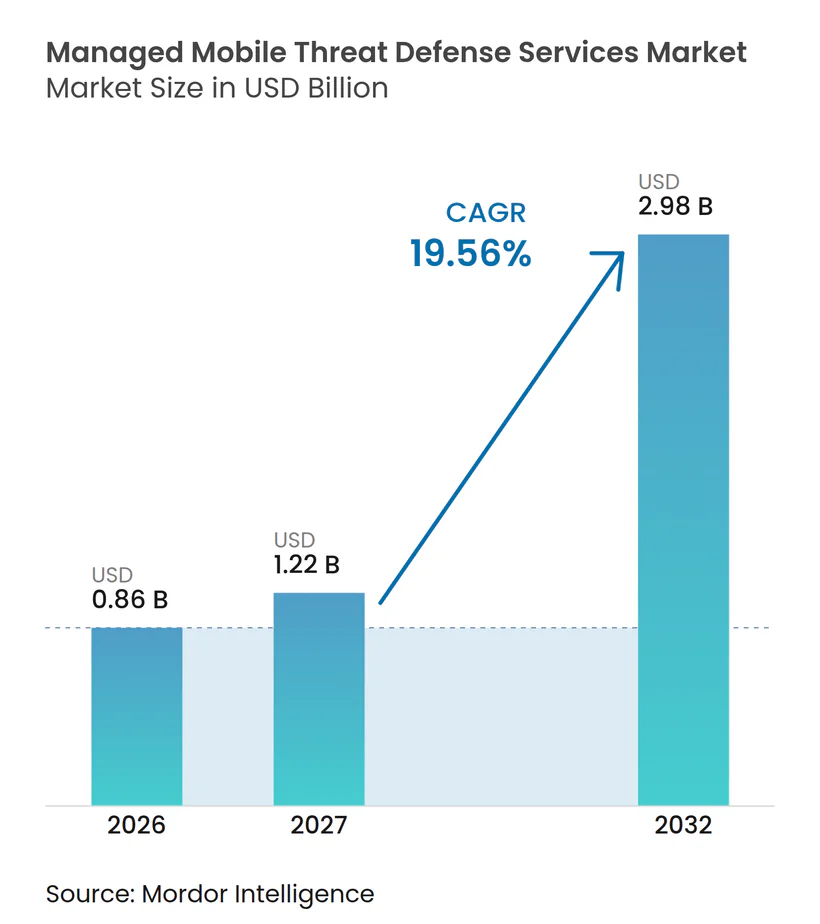
The managed mobile threat defense services market size was valued at USD 0.86 billion in 2026 and is estimated to grow from USD 1.22 billion in 2027 to reach USD 2.98 billion by 2032, at a CAGR of 19.56% during the forecast period (2027-2032). Mobile phishing, malware, QR code phishing, and AI-enabled social engineering are pushing security programs beyond email and conventional endpoint controls. Enterprises are increasingly using specialized providers to ensure continuous visibility across SMS, messaging applications, browsers, and mobile applications. Compliance requirements and shortages of experienced security staff are also moving spending toward managed outcomes rather than separate tools. Providers that combine privacy-aware telemetry, managed response, and clear evidence of faster detection can build stronger, longer-term client relationships. The managed mobile threat defense services market remains constrained by privacy concerns on personal devices and by overlapping budgets for unified endpoint management, endpoint detection and response, and mobile security.
Key Report Takeaways
- By service type, Managed Detection and Monitoring held 31.28% of the managed mobile threat defense services market revenue in 2026, while Managed Threat Intelligence and Hunting is projected to expand at a 21.73% CAGR through 2032.
- By delivery model, Fully Managed held 43.39% of revenue in 2026, while Co-Managed is projected to expand at a 22.61% CAGR through 2032.
- By operating system, Android accounted for 48.52% of revenue in 2026, while ChromeOS Mobile Endpoints is projected to expand at a 21.92% CAGR through 2032.
- By organization size, Large Enterprises accounted for 71.54% of revenue in the managed mobile threat defense services market in 2026, while Small and Medium-Sized Enterprises are projected to expand at a 21.82% CAGR through 2032.
- By end-use industry, BFSI accounted for 26.69% of revenue in 2026, while the healthcare and life sciences industry is projected to expand at a 22.54% CAGR through 2032.
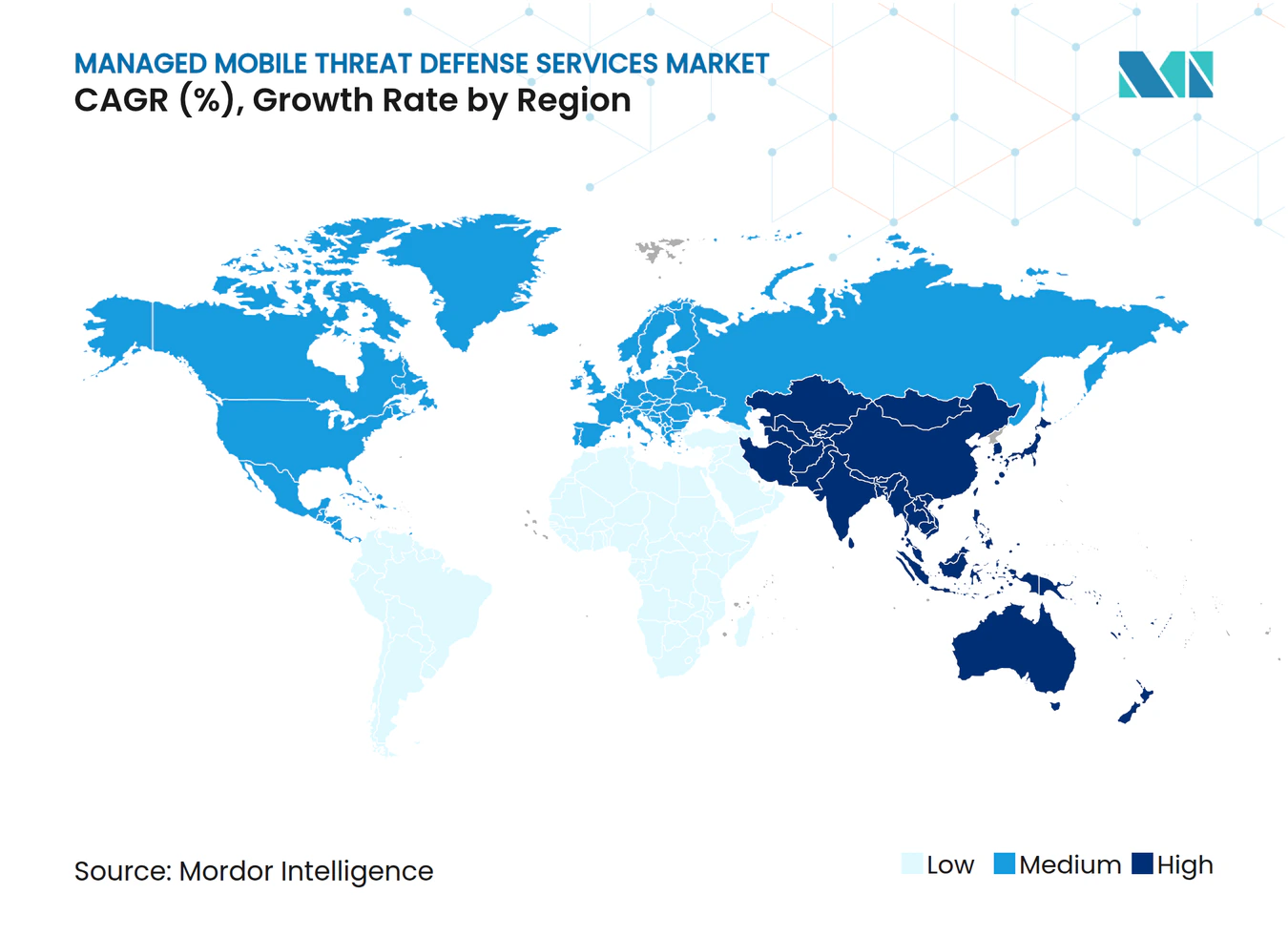
- By geography, North America held 41.64% of revenue in the managed mobile threat defense services market in 2026, while Asia-Pacific is projected to expand at a 23.86% CAGR through 2032.
Note: Market numbers in this report are based on Mordor Intelligence's proprietary estimation framework, which combines nine months of actuals with Q4 projections for base year 2026.
Market Trends and Insights
Drivers Impact Analysis of Managed Mobile Threat Defense Services Market*
| Driver | (~) % Impact on CAGR Forecast | Geographic Relevance | Impact Timeline |
|---|---|---|---|
| Growing Mobile Phishing and Malware Exposure | +3.5% | Global | Short term (≤ 2 years) |
| Expansion of BYOD and Mobile-First Work | +3.2% | Global | Medium term (2-4 years) |
| Zero Trust and Conditional Access Adoption | +2.8% | North America and Europe | Medium term (2-4 years) |
| Regulatory and Data Protection Requirements | +2.4% | Europe and North America | Medium term (2-4 years) |
| Mobile SOC Skills Gap in Mid-Market Organizations | +2.1% | Global, with acute gains in South Asia and Asia-Pacific | Long term (≥ 4 years) |
| Shadow AI and QR-Code Attack Surface on Managed Fleets | +1.8% | Global | Short term (≤ 2 years) |
| Source: Mordor Intelligence | |||
Growing Mobile Phishing and Malware Exposure
Mobile phishing is changing how enterprises define their security perimeter. Zimperium reported more than 2.5 million phishing attacks on employee devices during a 12-month period, while phishing events rose 380% from January 2025. Smishing accounted for 39% of mobile threats, and QR code phishing increased 146% quarter over quarter in the first quarter of 2026.[1] These attacks often bypass email gateways by reaching users via text messages, messaging applications, browser links, and QR codes. The managed mobile threat defense services market benefits when buyers need monitoring that integrates device, application, network, and web signals into a single response process. Persistent spyware is especially serious because it can support credential theft over an extended period, making continuous managed analysis more valuable than occasional device checks. Lookout found that nearly 13% of enterprise devices encountered phishing or malicious web content in the third quarter of 2025. The same report said that 22% of Android devices had applications sourced outside official application stores. These findings show why policy enforcement alone may not be sufficient when users work across personal and corporate applications. The managed mobile threat defense services market can examine risky behavior and device posture without relying only on a single operating system control.
Expansion of BYOD and Mobile-First Work
Personal devices have become a major part of the enterprise technology estate. Ivanti reported that 75% of IT workers used BYOD regularly in 2025, yet only 1 in 3 employers had implemented Zero Trust Network Access for remote workers.[2] This gap gives the managed mobile threat defense services market a broader pool of organizations that need external support to apply access controls consistently. The issue is not limited to device loss because credential theft and message-based phishing can compromise a user even when a phone remains physically secure. Managed providers can cover those gaps by assessing access risk, advising on policy, and responding when suspicious activity appears. Their role becomes more important where internal teams must protect a mixed fleet of personal and corporate devices.
Zero Trust and Conditional Access Adoption
Zero Trust is becoming a practical requirement for mobile access, but adoption remains uneven. Ivanti reported Zero Trust adoption among 47% of enterprises and 38% of smaller businesses in 2025. This leaves many organizations without a mature process for continuous verification of device posture and user access. The managed mobile threat defense services market can address that gap through ongoing configuration, monitoring, and policy adjustment. This is particularly relevant where Android, iOS, and ChromeOS fleets have different patch levels and policy needs. A managed team can maintain conditional access rules while internal teams focus on broader security responsibilities.
Regulatory and Data Protection Requirements
Compliance is expanding the need for managed mobile security, especially in Europe and in financial services. The NIS2 Directive requires covered entities to manage cybersecurity risks across their information and communication technology estate. Mobile devices used for authentication and corporate communication are part of that estate. The European Commission proposed amendments in January 2026 to simplify NIS2 compliance for 28,700 organizations, including 6,200 micro and small enterprises. The wider regulatory reach creates a practical reason for mid-sized organizations to evaluate outside monitoring and incident support.DORA adds incident detection, ICT risk management, and reporting obligations for financial entities and relevant technology suppliers. Mobile incidents require the same disciplined response that buyers expect for network and cloud events. Data protection rules also limit how providers can collect and process personal-device information. This constraint favors local processing, careful data minimization, and transparent consent practices.
Restraints Impact Analysis of Managed Mobile Threat Defense Services Market*
| Restraint | (~) % Impact on CAGR Forecast | Geographic Relevance | Impact Timeline |
|---|---|---|---|
| BYOD Privacy and Employee Surveillance Concerns | -2.2% | Europe and North America | Medium term (2-4 years) |
| Integration and Budget Overlap with UEM and EDR | -1.8% | Global | Short term (≤ 2 years) |
| Telemetry Gaps on Personal Devices | -1.4% | Global, with acute impact in Asia-Pacific | Medium term (2-4 years) |
| Network-Delivered Protection Cannibalization by Bundled Carrier Tariffs | -1.0% | Asia-Pacific core, with spillover to Middle East and Africa | Long term (≥ 4 years) |
| Source: Mordor Intelligence | |||
BYOD Privacy and Employee Surveillance Concerns
Privacy concerns limit how deeply a provider can inspect personal devices. Hypori found that 47% of organizations identified employee privacy violations as a leading risk, while only 36% were taking action to address the issue. It also found that 69% believed existing security controls reduced employee productivity. These concerns can make leaders hesitant to expand mobile monitoring, even when the threat level is clear. European data protection rules and national employment laws add further limits on behavioral telemetry from personal devices. The result is a narrower security signal for managed security operations centers. Restricted telemetry can reduce confidence in mobile threat correlation and can increase false positives. That weakens the value argument for premium services when procurement teams already question separate mobile security budgets. Privacy-sensitive deployment models can reduce this restraint by limiting data collection to corporate activity and risk indicators. Clear explanations of the data boundary are important for employee acceptance. The Mobile Managed Security Services Market will need these safeguards as BYOD becomes more common. Providers that can demonstrate protection without excessive surveillance are more likely to retain organizations with mixed device fleets.
Integration and Budget Overlap with UEM and EDR
Mobile security services can overlap with spending on unified endpoint management and endpoint detection and response. Different internal teams may own those budgets, which can slow decisions and create competing priorities. Microsoft, CrowdStrike, and Palo Alto Networks already offer broader security platforms, so some customers consider mobile protection an incremental capability rather than a new managed requirement. CrowdStrike made Falcon Zero Trust Assessment for iOS and Android generally available in May 2025 within Falcon for Mobile. This development illustrates why specialist providers must show clear gaps in mobile coverage and response depth. Restricted telemetry can reduce confidence in mobile threat correlation and can increase false positives. That weakens the value argument for premium services when procurement teams already question separate mobile security budgets. Privacy-sensitive deployment models can reduce this restraint by limiting data collection to corporate activity and risk indicators. Clear explanations of the data boundary are important for employee acceptance. The Mobile Managed Security Services Market will need these safeguards as BYOD becomes more common. Providers that can demonstrate protection without excessive surveillance are more likely to retain organizations with mixed device fleets.
*Our forecasts treat driver/restraint impacts as directional, not additive. The impact forecasts reflect baseline growth, mix effects, and variable interactions.
Managed Mobile Threat Defense Services Market Segment Analysis
By Service Type:
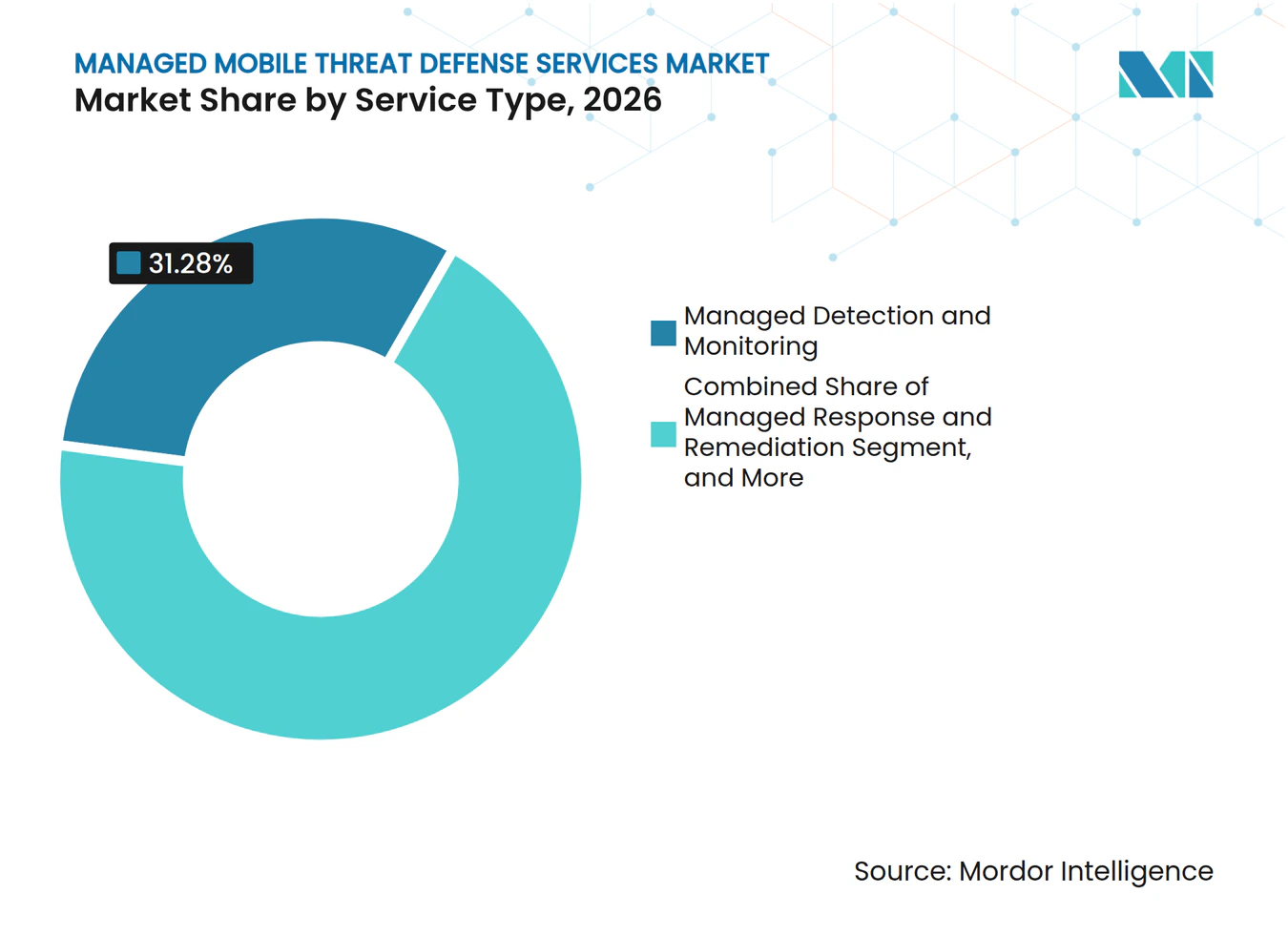
Proactive Hunting Reshapes the Managed Mobile PortfolioManaged Detection and Monitoring held 31.28% of the managed mobile threat defense services market share in 2026. It is the starting point for many buyers because it provides persistent observation of mobile activity and device risk. Clients often begin with monitoring before they delegate higher-impact containment decisions. Managed Threat Intelligence and Hunting is projected to expand at a 21.73% CAGR through 2032. This service responds to a need for context rather than a stream of isolated alerts. It uses threat information to identify patterns across mobile devices, applications, network traffic, and web activity. The shift favors providers that can explain adversary behavior and recommend actions that an internal team can apply quickly.
Zimperium launched its Mobile SOC Agent in May 2026 to correlate device, application, network, and web telemetry and to provide remediation guidance mapped to MITRE ATT&CK. This type of automation can help managed teams handle more incidents without adding analysts at the same rate. Managed Response and Remediation is also gaining relevance as enterprises give providers authority to quarantine devices and contain threats. Managed Deployment and Policy Administration remains important because conditional access rules need regular maintenance across several operating systems. Professional Services supports onboarding, maturity reviews, and changes between delivery models. Together, these offerings allow the managed mobile threat defense services market to serve organizations at different stages of security maturity.



By Delivery Model:
Co-Managed Model Gains Ground Among Security-Mature EnterprisesFully managed accounted for 43.39% of revenue in 2026. Organizations that lack a deep security operations center often choose this model because it transfers routine monitoring, investigation, and response work to a specialist. The model is particularly useful when teams need coverage outside business hours or do not have mobile-specific analysts. It also gives smaller security teams a defined service structure and a single accountability point. Fully managed contracts can include policy administration and reporting, which reduces the operational burden on the customer. This explains why the model continues to lead the managed mobile threat defense services market.
Co-managed is projected to expand at a 22.61% CAGR through 2032. It appeals to mid-sized and large enterprises that retain internal security analysts but need help with advanced mobile threat hunting and policy orchestration. These buyers may want visibility into provider activity and approval rights for sensitive remediation actions. Hybrid Managed delivery can meet similar needs in BFSI and healthcare, where auditability is important. On-Demand and Retainer-Based engagements usually support incident readiness, assessments, and project work rather than replacing a continuing contract. The different models give providers a way to serve customers that vary in security resources, compliance exposure, and willingness to outsource response decisions.
By Operating System:
Android Anchors the Market as ChromeOS Reaches an Inflection PointAndroid accounted for 48.52% of revenue in 2026. Its broad presence in enterprise fleets and its higher exposure to sideloaded applications support ongoing demand for monitoring and policy enforcement. Lookout reported that 22% of Android devices had applications installed from sources outside official application stores in the third quarter of 2025.[3] This behavior creates risks that cannot be addressed through patch status alone. The managed mobile threat defense services market can examine application behavior, phishing attempts, and network connections alongside device posture. Android, therefore, remains central to the managed mobile threat defense services market, even as buyers standardize controls across several operating systems.
iOS and iPadOS present a different security profile because attackers often use identity-focused phishing against executive users rather than relying solely on malware. Lookout reported phishing encounter rates of 16.07% for iOS and 7.78% for Android in the third quarter of 2025. ChromeOS Mobile Endpoints is projected to expand at a 21.92% CAGR through 2032 as deployments increase in education, public sector, and frontline environments. Its cloud-first design reduces malware exposure to some extent but leaves policy administration and phishing management as important concerns. Lookout joined the Android Enterprise Device Trust partner program in September 2026, adding hardware-verified patch telemetry to its platform. Windows Mobile and legacy systems remain operationally important in industrial settings where ruggedized devices and proprietary applications require tailored monitoring.
By Organization Size:
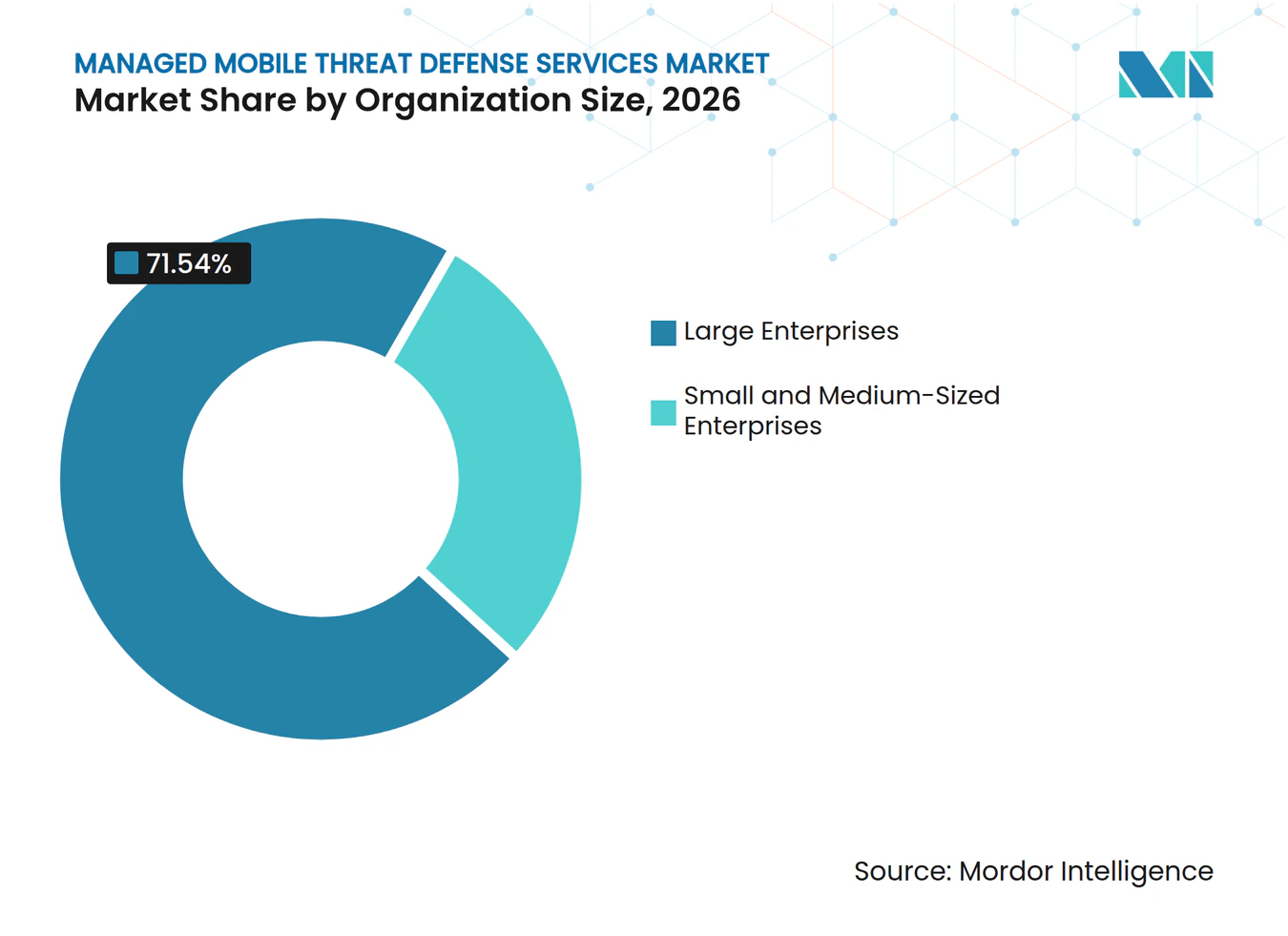
Large Enterprise Anchor, SME Inflection ApproachingLarge Enterprises accounted for 71.54% of revenue in 2026. Their large device fleets, operations across multiple countries, and compliance requirements allow providers to assign dedicated teams with mobile expertise. These organizations also have complex access policies that need sustained administration. The scale of their contracts supports a broad range of managed services, from detection to incident response. Large companies are likely to remain an important revenue base for the managed mobile threat defense services market. Their demand also helps providers invest in automation, specialized analysts, and operating system integrations.
Small and Medium-Sized Enterprises are projected to expand at a 21.82% CAGR through 2032. These organizations often cannot justify the cost of a full internal security operations center, but they still face the same phishing, credential, and personal-device risks. Sophos reported that organizations with fewer than 500 employees ranked in-house cybersecurity skill shortages as their second-highest risk.[4] SentinelOne partnered with Pax8 in September 2025 to offer Managed AI Defense through managed service providers for small and mid-sized businesses. Automation and channel packaging can lower per-client delivery costs and make sustained monitoring more accessible to smaller contracts.

By End-Use Industry:
BFSI Leads, but Healthcare and Life Sciences Trajectory Signals Structural UrgencyBFSI accounted for 26.69% of revenue in 2026. Financial services rely heavily on mobile applications and face direct exposure to phishing, fraud, and malware targeting customer and employee activity. Zimperium identified 34 active malware families targeting 1,243 financial brands in 90 countries during 2025. It also reported that 50% of financial services mobile applications examined in 2026 lacked device trust or fraud detection mechanisms. These gaps make continuous monitoring and rapid response useful for financial organizations with demanding regulatory obligations.
The healthcare and life sciences industry is projected to expand at 22.54% CAGR through 2032. Mobile access to electronic health records, telemedicine, and clinical applications expands the attack surface faster than many internal teams can secure it. Zscaler reported a 224% increase in cyberattacks targeting mobile devices in healthcare and said that 89% of healthcare organizations were concerned that a mobile breach could seriously affect patient care. IT and Telecommunications organizations serve both as buyers and delivery partners for managed services. Government and Public Sector buyers are adding mobile risk controls as part of national cybersecurity programs. Manufacturing, retail, e-commerce, and other sectors often begin with managed deployment and policy administration before adopting fully managed threat monitoring.
Geography Analysis
North America Managed Mobile Threat Defense Services Market
North America held 41.64% of revenue in 2026. The United States supports this position through high cybersecurity spending and recurring requirements in defense, financial services, and healthcare. Verizon found that 86% of financial services organizations believed cybercriminals viewed them as more lucrative targets than other industries. Zscaler identified the United States as the second-largest target country for mobile attack volume globally in 2025. These conditions support renewal demand and account expansion for managed providers. Canada is advancing co-managed adoption among financial institutions and energy companies as hybrid-work controls become more formal.
APAC Managed Mobile Threat Defense Services Market
Asia-Pacific is projected to expand at a 23.86% CAGR through 2032. The region combines rapid 5G deployment, a growing enterprise base, and limited availability of internal mobile security specialists. Kaspersky recorded 18,187 mobile threat detections in India in the first quarter of 2026 and 15,163 detections in Indonesia. China recorded nearly twice as many mobile detections as in the corresponding period a year earlier. These threat patterns make managed monitoring more relevant across South Asia and Southeast Asia. In April 2025, Rakuten Mobile and Cloudflare introduced a fully managed Zero Trust and network security offering for Japanese corporate clients. The offering bundled implementation, configuration, and maintenance for customers that had previously lacked access to enterprise-managed security.
EMEA, Oceania and South America Managed Mobile Threat Defense Services Market
Europe has a material revenue position because NIS2, GDPR, and DORA extend mobile risk management expectations across the information and communication technology estate. The January 2026 NIS2 proposal signals that compliance duties may reach more mid-sized organizations, not fewer. Australia is adding demand through the Essential Eight framework, which includes patch management and application controls. The Middle East is supported by digital infrastructure programs in Saudi Arabia and the UAE. South America and Africa remain at an earlier adoption stage, with Brazil and South Africa showing initial demand among banks and telecommunications operators. The managed mobile threat defense services market can advance in these regions when local partners combine managed delivery with regional data-processing and compliance needs.
Competitive Landscape
Market Concentration
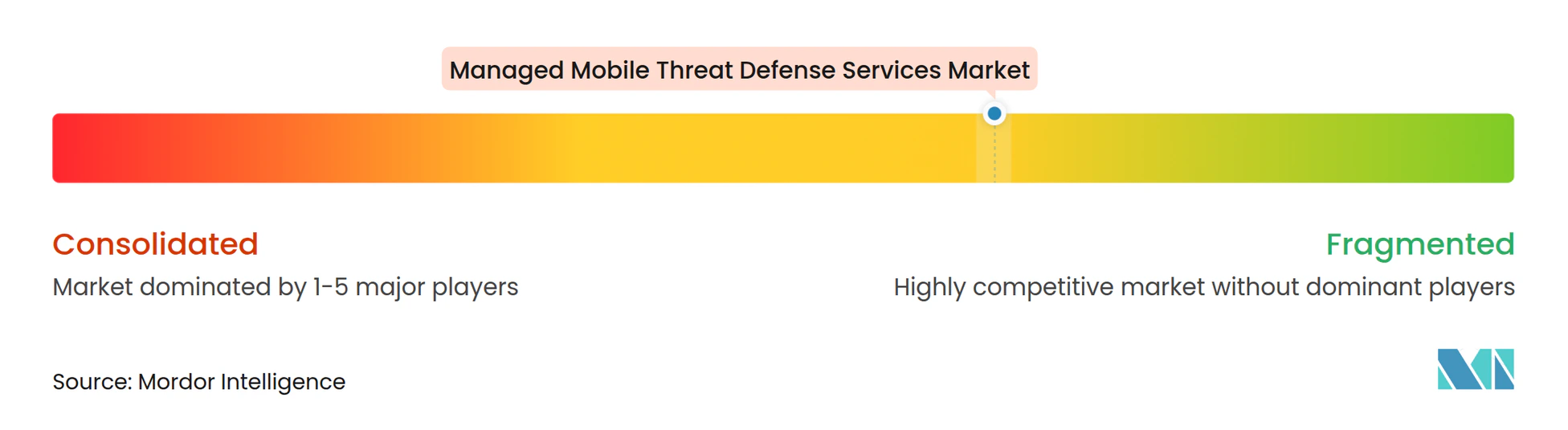
The managed mobile threat defense services market is moderately fragmented. Broad platform vendors such as Microsoft, CrowdStrike, and Palo Alto Networks compete through integrated security coverage. CrowdStrike combines mobile Zero Trust assessment and Android device trust signals within its Falcon platform. These vendors can appeal to customers who want fewer consoles and existing platform relationships. Their challenge is to demonstrate mobile depth equal to that of specialized providers. Mobile-native companies compete by focusing on device-, application-, network-, and web-level mobile signals.
Lookout provides software bills of materials for compiled iOS and Android application binaries and links them to CISA-known exploited vulnerabilities. Zimperium introduced its Mobile SOC Agent in May 2026 to automate alert investigation and deliver MITRE ATT&CK-mapped remediation guidance. These moves aim to reduce investigation time and improve the economics of managed response. Lookout introduced AI Visibility and Governance in April 2026 for identifying sanctioned and unsanctioned AI applications on corporate and BYOD devices. The product supports alignment with the EU AI Act, NIST AI RMF, and ISO/IEC 42001. This places mobile providers closer to the emerging need for AI governance in enterprise device fleets.
Carrier-led providers add a different competitive model through network-level visibility. Rakuten Mobile's managed service partnership with Cloudflare is an example of a carrier using its position to offer implementation and ongoing operations. U Mobile signed an MoU with Palo Alto Networks in March 2026 to develop network-embedded Security-as-a-Service in Malaysia. These approaches can expand access to managed security but may be limited by national coverage and by customer concerns around carrier inspection. Opportunities remain in co-managed services for smaller organizations, ChromeOS endpoint protection, and mobile AI governance. Differentiation will depend on whether providers can deliver meaningful coverage, faster response, and responsible data handling.
Managed Mobile Threat Defense Services Industry Leaders
-
Microsoft Corporation
-
Lookout, Inc.
-
Zimperium, Inc.
-
Check Point Software Technologies Ltd.
-
CrowdStrike Holdings, Inc.
- *Disclaimer: Major Players sorted in no particular order
Managed Mobile Threat Defense Services Market Companies Covered in this Report
- Microsoft Corporation
- Lookout, Inc.
- Zimperium, Inc.
- Check Point Software Technologies Ltd.
- CrowdStrike Holdings, Inc.
- SentinelOne, Inc.
- Palo Alto Networks, Inc.
- Broadcom Inc.
- Cisco Systems, Inc.
- IBM Corporation
- Jamf Holding Corp.
- Ivanti, Inc.
- Sophos Limited
- Trend Micro Incorporated
- BlackBerry Limited
- Trellix, Inc.
- Pradeo Security Systems SAS
- Corrata Ltd.
- Guardsquare NV
- Verizon Communications Inc.
Recent Industry Developments in Managed Mobile Threat Defense Services Market
- September 2026: Lookout integrates Android Device Trust APIs from Google into its Mobile AI Security Platform, joining the Android Enterprise Device Trust partner program and enabling hardware-verified patch telemetry to eliminate mobile software exposure risk across managed and BYOD Android fleets by correlating OS patch levels and firmware variances against CISA Known Exploited Vulnerabilities.
- May 2026: Zimperium launches Mobile SOC Agent, an agentic AI solution integrated into its Mobile Threat Defense platform that automatically investigates alerts, correlates mobile telemetry across device, application, network, and web signals into a single incident view, and delivers MITRE ATT&CK-mapped remediation guidance, reducing analyst investigation time from hours or days to minutes.
- April 2026: Lookout extends its platform with AI Visibility and Governance, providing enterprises with a real-time inventory of sanctioned and unsanctioned AI applications on corporate and BYOD devices, with automated compliance alignment to the EU AI Act, NIST AI RMF, and ISO/IEC 42001, positioning the company at the intersection of mobile security and AI governance.
- March 2026: U Mobile signs an MoU with Palo Alto Networks to develop network-embedded Security-as-a-Service integrated into its 5G network infrastructure in Malaysia, targeting real-time protection against malware, phishing, command-and-control threats, and zero-day attacks at the carrier network level, targeting deployment across both 5G and 4G networks.
Global Managed Mobile Threat Defense Services Market Report Scope
The managed mobile threat defense (MTD) services market comprises outsourced cybersecurity offerings that protect corporate and BYOD mobile devices from threats such as malware, phishing, malicious networks, device compromise, and unsafe applications. Providers deploy and operate MTD technology, monitor mobile risk signals, investigate alerts, and support incident response across iOS, Android, and related enterprise mobility environments.
The Managed Mobile Threat Defense Services Market Report is Segmented by Service Type (Managed Detection and Monitoring, Managed Response and Remediation, Managed Threat Intelligence and Hunting, Managed Deployment and Policy Administration, and Other Service Types), Delivery Model (Fully Managed, Co-Managed, On-Demand and Retainer-Based, and Hybrid Managed), Operating System (Android, iOS and iPadOS, Windows Mobile and Legacy Mobile Operating Systems, and ChromeOS Mobile Endpoints), Organization Size (Large Enterprises, and Small and Medium Enterprises), End User Industry (Banking, Financial Services and Insurance (BFSI), IT and Telecommunications, Healthcare and Life Sciences, Government and Public Sector, Industrial Manufacturing, Retail and E-Commerce, and Other End-User Industries), and Geography (North America, South America, Europe, Asia-Pacific, Middle East, and Africa). The Market Forecasts are Provided in Terms of Value (USD).
Segmentation Overview
| Managed Detection and Monitoring |
| Managed Response and Remediation |
| Managed Threat Intelligence and Hunting |
| Managed Deployment and Policy Administration |
| Other Service Types |
| Fully Managed |
| Co-Managed |
| On-Demand and Retainer-Based |
| Hybrid Managed |
| Android |
| iOS and iPadOS |
| Windows Mobile and Legacy Mobile Operating Systems |
| ChromeOS Mobile Endpoints |
| Large Enterprises |
| Small and Medium-Sized Enterprises |
| Banking, Financial Services and Insurance (BFSI) |
| IT and Telecommunications |
| Healthcare and Life Sciences |
| Government and Public Sector |
| Industrial Manufacturing |
| Retail and E-Commerce |
| Other End-User Industries |
| North America | United States |
| Canada | |
| Mexico | |
| South America | Brazil |
| Argentina | |
| Rest of South America | |
| Europe | Germany |
| United Kingdom | |
| France | |
| Italy | |
| Spain | |
| Russia | |
| Rest of Europe | |
| Asia-Pacific | China |
| Japan | |
| India | |
| South Korea | |
| Southeast Asia | |
| Australia | |
| Rest of Asia-Pacific | |
| Middle East | Saudi Arabia |
| United Arab Emirates | |
| Turkey | |
| Israel | |
| Rest of Middle East | |
| Africa | South Africa |
| Nigeria | |
| Egypt | |
| Rest of Africa |
| By Service Type | Managed Detection and Monitoring | |
| Managed Response and Remediation | ||
| Managed Threat Intelligence and Hunting | ||
| Managed Deployment and Policy Administration | ||
| Other Service Types | ||
| By Delivery Model | Fully Managed | |
| Co-Managed | ||
| On-Demand and Retainer-Based | ||
| Hybrid Managed | ||
| By Operating System | Android | |
| iOS and iPadOS | ||
| Windows Mobile and Legacy Mobile Operating Systems | ||
| ChromeOS Mobile Endpoints | ||
| By Organization Size | Large Enterprises | |
| Small and Medium-Sized Enterprises | ||
| By End User Industry | Banking, Financial Services and Insurance (BFSI) | |
| IT and Telecommunications | ||
| Healthcare and Life Sciences | ||
| Government and Public Sector | ||
| Industrial Manufacturing | ||
| Retail and E-Commerce | ||
| Other End-User Industries | ||
| By Geography | North America | United States |
| Canada | ||
| Mexico | ||
| South America | Brazil | |
| Argentina | ||
| Rest of South America | ||
| Europe | Germany | |
| United Kingdom | ||
| France | ||
| Italy | ||
| Spain | ||
| Russia | ||
| Rest of Europe | ||
| Asia-Pacific | China | |
| Japan | ||
| India | ||
| South Korea | ||
| Southeast Asia | ||
| Australia | ||
| Rest of Asia-Pacific | ||
| Middle East | Saudi Arabia | |
| United Arab Emirates | ||
| Turkey | ||
| Israel | ||
| Rest of Middle East | ||
| Africa | South Africa | |
| Nigeria | ||
| Egypt | ||
| Rest of Africa | ||
Key Questions Answered in the Report
What is the size of the managed mobile threat defense services market?
The managed mobile threat defense services market size was valued at USD 0.86 billion in 2026 and is estimated to grow from USD 1.22 billion in 2027 to reach USD 2.98 billion by 2032, at a CAGR of 19.56% during the forecast period (2027-2032).
What is driving demand for managed mobile security services?
Rising phishing, malware, BYOD use, Zero Trust deployment, and compliance needs are increasing demand for continuous mobile monitoring and response.
Which service type is expected to expand the fastest?
Managed Threat Intelligence and Hunting is projected to expand at a 21.73% CAGR through 2032.
Which organizations are adopting these services most rapidly?
Small and Medium-Sized Enterprises are projected to expand at a 21.82% CAGR as automation and managed service provider channels improve affordability.
Which end-use sector has the strongest growth outlook?
Healthcare and Life Sciences is projected to expand at a 22.54% CAGR through 2032 as mobile clinical access broadens the security exposure.
Which region has the strongest growth outlook?
Asia-Pacific is projected to expand at a 23.86% CAGR through 2032, supported by mobile threat activity, 5G deployment, and demand for external expertise.