
Managed Machine and Non-Human Identity Security Services Market Size and Share
Market Overview
| Study Period | 2021 - 2032 |
|---|---|
| Market Size (2027) | USD 6.48 Billion |
| Market Size (2032) | USD 14.08 Billion |
| Growth Rate (2027 - 2032) | 16.79 % |
| Fastest Growing Market | Asia-Pacific |
| Largest Market | North America |
| Market Concentration | Medium |
Major Players *Disclaimer: Major Players sorted in no particular order Image © Mordor Intelligence. Reuse requires attribution under CC BY 4.0. | |
Managed Machine and Non-Human Identity Security Services Market Analysis by Mordor Intelligence
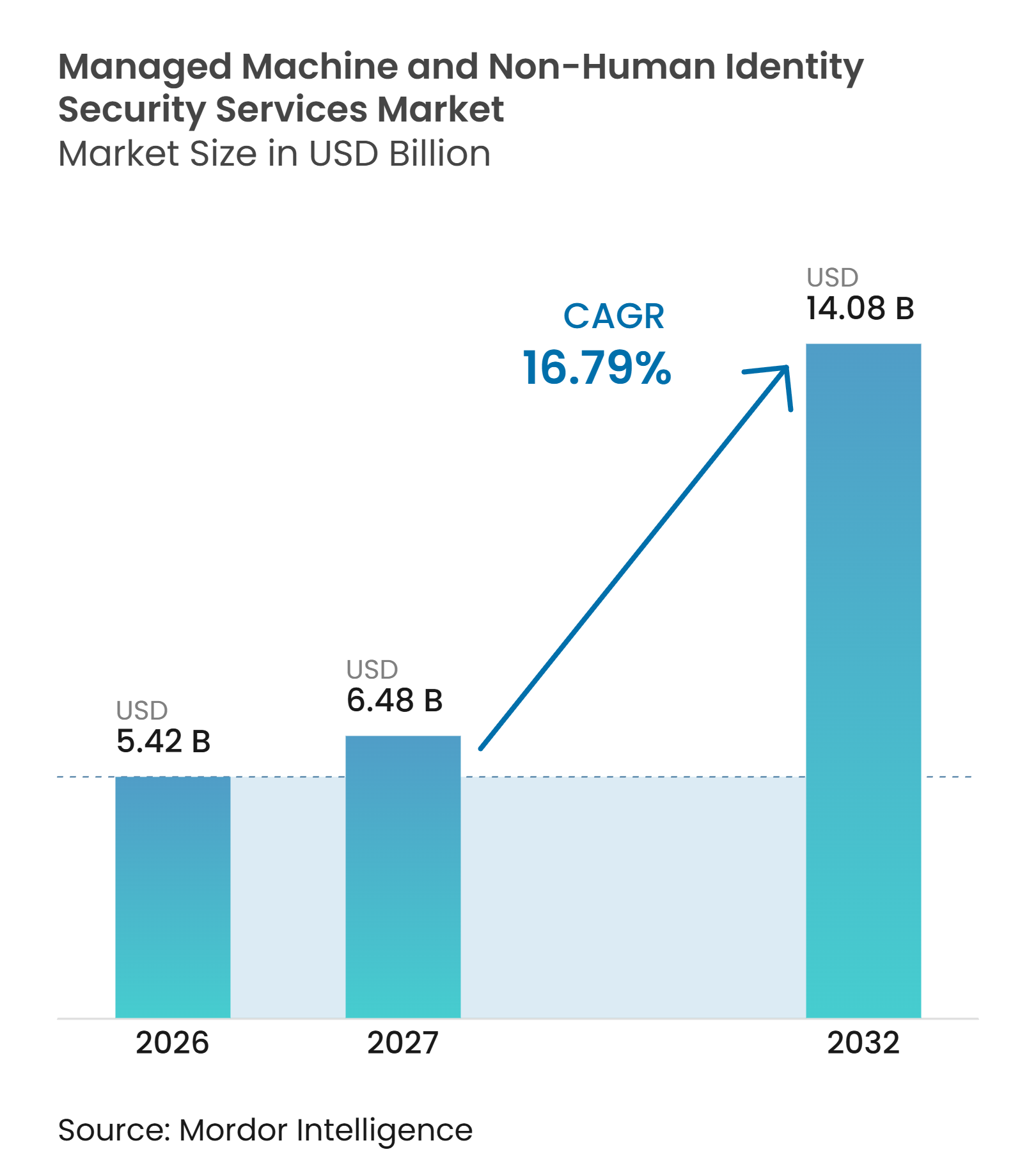
The Managed Machine and Non-Human Identity Security Services Market size is projected to expand from USD 5.42 billion in 2026 and USD 6.48 billion in 2027 to USD 14.08 billion by 2032, registering a CAGR of 16.79% between 2027 to 2032. The Managed Machine and Non-Human Identity Security Services Market is being shaped by the increasing number of service accounts, API keys, certificates, tokens, and workload credentials used across cloud environments. Enterprise teams are moving from manual credential oversight toward continuous discovery, rotation, revocation, and policy enforcement. Shorter TLS certificate validity periods make automation essential because renewal activity can no longer be handled consistently through manual processes. AI agents also introduce a separate identity class that needs traceability, verified access, and clear removal processes when automated work ends. Providers that combine lifecycle automation with ongoing operational support are positioned to address security, compliance, and skills constraints in the Managed Machine and Non-Human Identity Security Services Market.
Key Report Takeaways
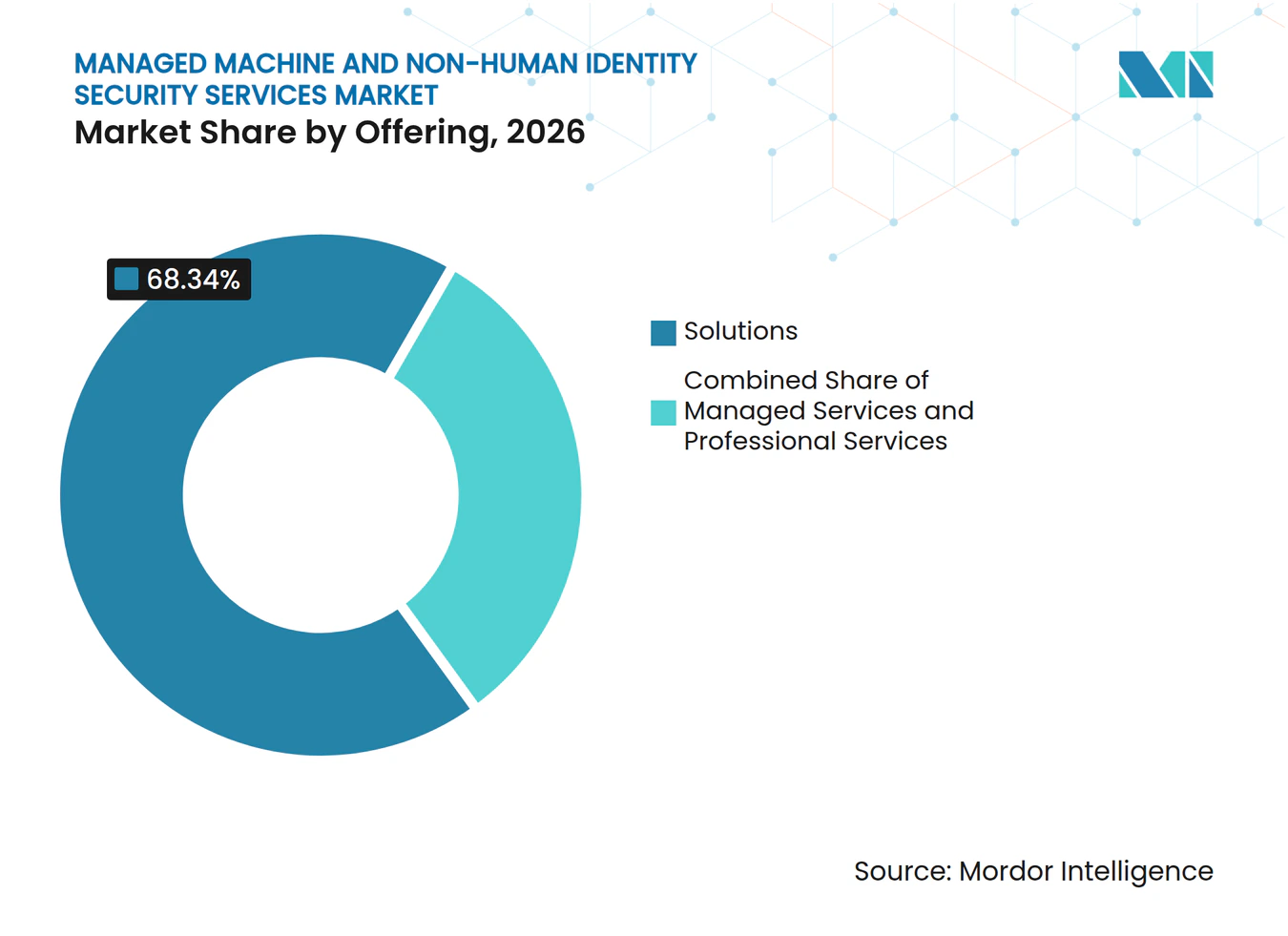
- By offering, solutions held 68.34% of the Managed Machine and Non-Human Identity Security Services Market share in 2026, while managed services are projected to expand at a 17.81% CAGR through 2032.
- By identity type, application and service identities held 24.55% of the total market in 2026, while AI agent identities are projected to expand at a 17.87% CAGR through 2032.
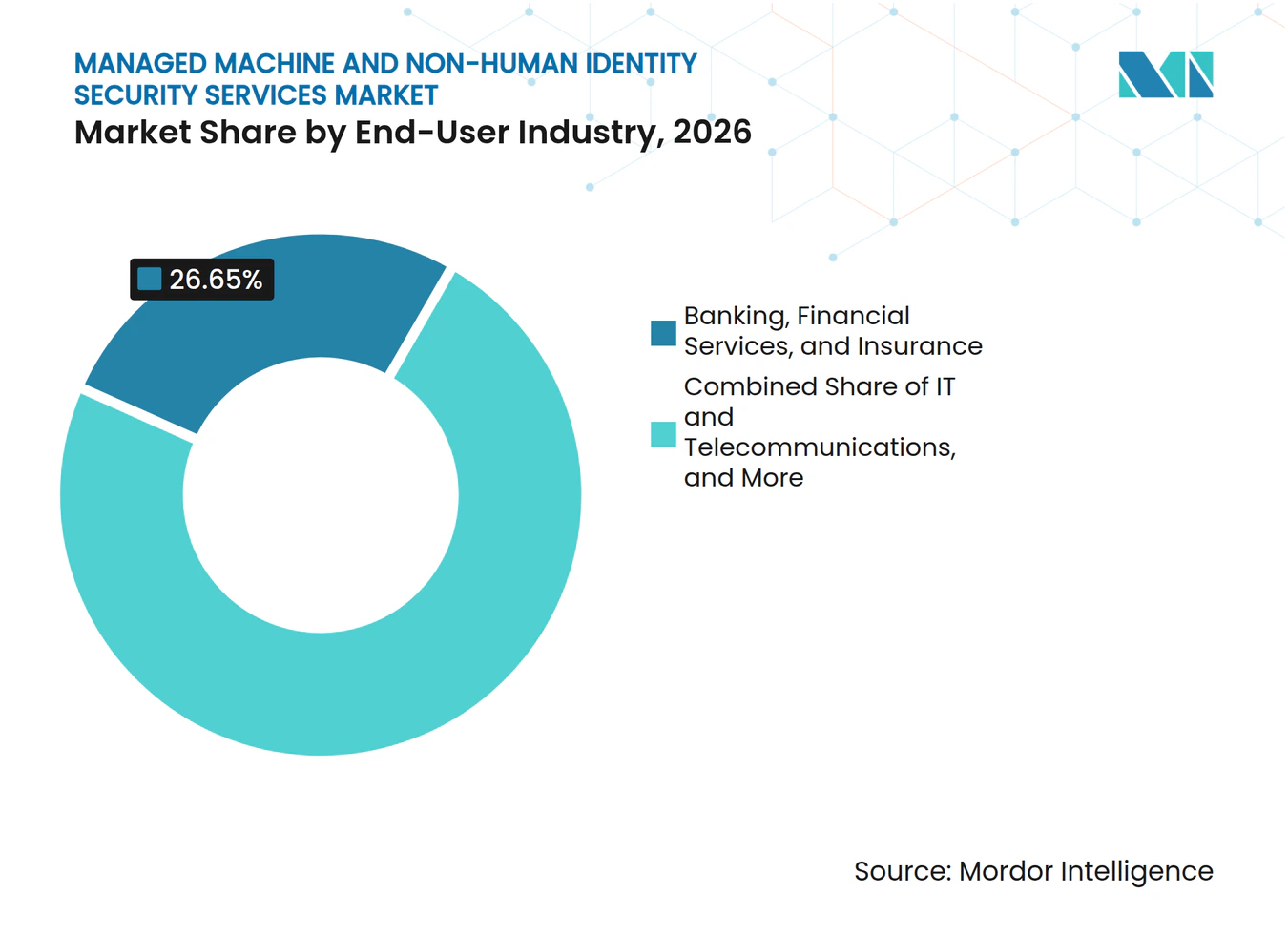
- By end-user industry, BFSI accounted for 26.65% of the total market in 2026, while IT and telecommunications are projected to expand at a 17.78% CAGR through 2032.
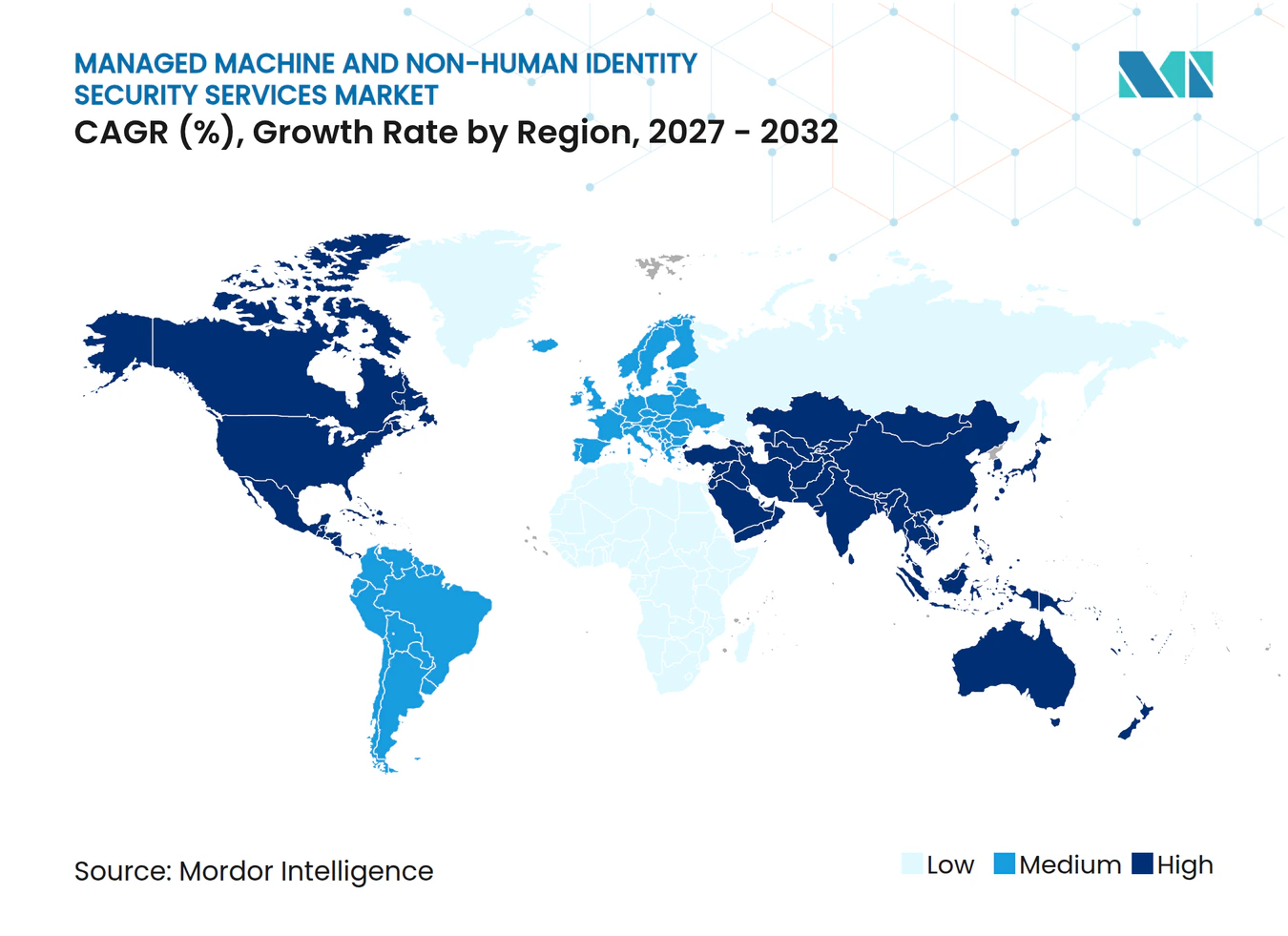
- By geography, North America held 41.63% of the global market in 2026, while Asia-Pacific is projected to expand at a 17.69% CAGR through 2032.
Note: Market numbers in this report are based on Mordor Intelligence's proprietary estimation framework, which combines nine months of actuals with Q4 projections for base year 2026.
Market Trends and Insights
Drivers Impact Analysis of Managed Machine and Non-Human Identity Security Services Market*
| Driver | (~) % Impact on CAGR Forecast | Geographic Relevance | Impact Timeline |
|---|---|---|---|
| Expansion of Cloud-Native Workloads, APIs, and Service Accounts | +4.8% | Global, concentrated in North America, Asia-Pacific, and Western Europe | Short term (≤ 2 years) |
| AI Agent and Autonomous Workflow Adoption | +3.9% | Global, with North America and Asia-Pacific as early adoption centers | Short term (≤ 2 years) |
| Shortening TLS Certificate Lifespans and Crypto-Agility Requirements | +2.6% | Global, with compliance urgency highest in North America and Europe | Short term (≤ 2 years) |
| Zero Trust and Regulatory Accountability for Machine Access | +2.0% | North America, Europe, and Asia-Pacific regulatory centers | Medium term (2-4 years) |
| Software Supply Chain Attestation and Workload Provenance | +1.2% | North America and Europe, with spillover to Asia-Pacific defense and critical infrastructure | Medium term (2-4 years) |
| Outsourcing Pressure From Scarce PKI and Machine Identity Specialists | +0.9% | Global, concentrated in mid-market and government sectors | Long term (≥ 4 years) |
| Source: Mordor Intelligence | |||
Expansion of Cloud-Native Workloads, APIs, and Service Accounts
Cloud-native estates use microservices, Kubernetes clusters, serverless functions, and third-party API connections, each of which can require its own credential. Cloud Security Alliance research states that cloud-native environments can have 144 machine identities for every human user. The same research reported 44% year-over-year growth in machine identities between 2024 and 2025, which places pressure on teams that manage certificates and secrets manually.[1] CyberArk reported that 79% of security leaders expected machine identities to increase by as much as 150% over the following year. It also found that 72% of respondents had experienced a certificate-related outage in the prior 12 months. This scale makes discovery, rotation, and revocation a continuous operating requirement for the Managed Machine and Non-Human Identity Security Services Market.
AI Agent and Autonomous Workflow Adoption
AI agents need identities that are separate from the service accounts used to carry out a transaction. Each agent needs a recorded sponsor, verified credentials, defined permissions, and removal controls when its work ends. The IETF WIMSE draft on AI agent identity describes a framework for establishing and verifying agent identity in distributed systems. A Cloud Security Alliance survey commissioned by Oasis Security found that 78% of organizations did not have formal processes for creating or removing AI-related identities. It also found that 92% lacked confidence in their existing IAM systems for managing AI-driven access risk.[2] AWS published a reference architecture in October 2026 that uses Keyfactor EJBCA, X.509 certificates, OAuth token binding, and OCSP revocation for multi-agent workloads.
Shortening TLS Certificate Lifespans and Crypto-Agility Requirements
The CA/Browser Forum approved a reduction in maximum TLS certificate validity from 398 days to 200 days by March 15, 2026. The validity period will fall further to 100 days by March 15, 2027, and 47 days by March 15, 2029.[3] An organization with 10,000 TLS certificates must therefore manage 18,250 annual renewal events at the 200-day limit, compared with 9,100 under the prior 398-day limit. This renewal volume makes automated certificate lifecycle management necessary for large certificate estates. The Managed Machine and Non-Human Identity Security Services Market also benefits because lifecycle automation supports future cryptographic changes within controlled processes. The same operational discipline can help organizations plan for post-quantum cryptography transitions without relying on disconnected manual actions.
Zero Trust and Regulatory Accountability for Machine Access
NIST Special Publication 1800-35 provides 19 example implementations of zero trust architecture developed with 24 industry collaborators. The publication addresses identity, credential, and access management for non-human workloads. The U.S. Department of Defense finalized its CMMC Program rule on September 10, 2025, with the rule becoming effective on November 10, 2025. These requirements increase the need to document and control access across defense supply chains. Machine access must be continuously validated rather than treated as permanently trusted. Managed providers can support this need by maintaining behavioral baselines, reviewing anomalies, and preserving evidence for audits and contractual reviews.
Restraints Impact Analysis of Managed Machine and Non-Human Identity Security Services Market*
| Restraint | (~) % Impact on CAGR Forecast | Geographic Relevance | Impact Timeline |
|---|---|---|---|
| Fragmented Legacy PKI, Secrets, and Identity Tooling | -2.1% | Global, most acute in manufacturing, government, and regulated industries | Long term (≥ 4 years) |
| Unclear Ownership Across Security, Platform Engineering, and Application Teams | -1.4% | Global | Medium term (2-4 years) |
| Native Hyperscaler Controls Reduce Incremental Platform Spend | -0.9% | North America and Asia-Pacific hyperscaler-heavy environments | Medium term (2-4 years) |
| Ephemeral Identity Discovery, Attribution, and False-Positive Burden | -0.6% | Global, concentrated in container-heavy and multi-cloud environments | Short term (≤ 2 years) |
| Source: Mordor Intelligence | |||
Fragmented Legacy PKI, Secrets, and Identity Tooling
Many enterprises operate certificates, keys, and secrets across on-premises security modules, cloud secret managers, developer-managed vaults, and CI/CD systems. Each environment may have separate policies, inventories, and lifecycle controls. A 2025 industry survey found that 68% of respondents described management of cryptographic assets as extremely or very difficult, citing fragmented systems, incomplete inventories, and unclear ownership. A provider cannot apply consistent policy until it has completed discovery and established a reliable inventory. That discovery phase can absorb substantial time before an organization sees the expected operational benefit. Manufacturing, energy, and government organizations face added constraints because legacy operational technology may use certificate stores that do not work with standard lifecycle-management integrations.
Unclear Ownership Across Security, Platform Engineering, and Application Teams
CyberArk found that responsibility for preventing machine identity compromise was divided among security teams, development teams, and platform teams. Security teams accounted for 53% of this responsibility, development teams for 28%, and platform teams for 14%. This division can delay remediation when a provider detects an expired or over-privileged credential. The affected workload must be identified, the responsible team must approve the action, and the credential must be rotated without interrupting dependent services. Development, infrastructure, and security teams have different priorities and may use different tools. Providers that define escalation routes and fit controls into established development workflows are better placed to reduce this barrier.
*Our forecasts treat driver/restraint impacts as directional, not additive. The impact forecasts reflect baseline growth, mix effects, and variable interactions.
Managed Machine and Non-Human Identity Security Services Market Segment Analysis
By Offering:
Solutions Lead Adoption, While Managed Services Expand FastestSolutions held 68.34% of total revenue in 2026, making them the largest offering category. This position reflects initial buyer demand for tools that discover certificates, API keys, and secrets across a distributed estate. Enterprises commonly start with a software control plane before transferring sustained operating tasks to an external provider. In the Managed Machine and Non-Human Identity Security Services Market, these platforms are used to consolidate asset discovery, credential rotation, policy control, and lifecycle reporting. BFSI and IT buyers prioritize tools that create one view across application certificates, API credentials, and secret stores. Keyfactor, DigiCert, and AppViewX have established installed bases in certificate lifecycle management and related identity operations.
Managed services are projected to expand at a 17.81% CAGR through 2032, the fastest rate within the offering segmentation. Organizations that have deployed a platform still need specialists to tune policies, investigate anomalies, manage renewal queues, and maintain compliance. This work requires continuous attention rather than an initial implementation alone. The Managed Machine and Non-Human Identity Security Services industry benefits when internal security teams have limited PKI knowledge or lack round-the-clock coverage. Professional services remain relevant for implementation planning, governance design, and crypto-agility assessments. They support organizations that need to establish policies and technical foundations before platform procurement or managed operations can begin.



By Identity Type:
Application and Service Identities Lead, While AI Agents Advance FastestApplication and service identities held 24.55% of the Managed Machine and Non-Human Identity Security Services Market share in 2026. These identities include service accounts and application certificates that have been used widely for longer than newer machine identity categories. Their mature procurement patterns and existing management tools support their leading position. Application-to-application and API identities follow closely because microservices architectures create credentials at each service connection. Workload and container identities are also becoming more important as Kubernetes environments use short-lived credentials instead of static secrets. CNCF supply-chain guidance identifies workload cryptographic identity as a baseline control for cloud-native software environments.
AI agent identities are projected to expand at a 17.87% CAGR through 2032, the fastest pace among the identity types. Autonomous workflows need distinct identities because their actions must be attributable and their access must be controlled. Machine and device identities extend the opportunity to IoT and operational technology environments, where connected assets have varied life cycles. Cryptographic access identities, including SSH keys and code-signing certificates, remain difficult to govern when they are long-lived or poorly inventoried. IBM introduced Machine Identity Management in 2026 with a focus on AI agent credential life cycles, treating this identity category as a distinct enterprise need. The Managed Machine and Non-Human Identity Security Services Market therefore covers established credentials as well as newer agent-based access patterns.
By End-User Industry:
BFSI Holds the Largest Share, While IT and Telecommunications Lead GrowthBFSI accounted for 26.65% of total revenue in 2026, making it the leading end-user category. Financial organizations depend on machine-to-machine authentication across trading systems, payment APIs, and core banking integrations. Their operating environment is shaped by requirements including NYDFS Part 500, DORA, PCI DSS 4.0, and NIS2. Palo Alto Networks stated that financial institutions need identity controls that work across these overlapping requirements. These obligations make informal machine identity practices difficult to sustain. The combination of sensitive transactions and audit needs supports demand for documented credential controls and ongoing oversight.
IT and telecommunications are projected to expand at a 17.78% CAGR through 2032. Telecom operators manage 5G network slicing, API-driven services, and multi-tenant infrastructure that create large machine identity estates. Healthcare and life sciences also present a high-priority use case as cloud-connected medical devices and AI diagnostic tools operate under HIPAA access controls. A 2025 peer-reviewed paper proposed a layered zero-trust identity architecture for non-human identities in healthcare cloud settings. Manufacturing connects previously isolated operational technology to enterprise networks and brings new lifecycle-management needs. Government, retail and e-commerce, and energy and utilities require controls for compliance, API commerce, and critical infrastructure protection.

Geography Analysis
North America Managed Machine and Non-Human Identity Security Services Market
North America held 41.63% of global revenue in 2026, the largest regional position. The region has a high concentration of cloud-native enterprises and a mature managed security services ecosystem. Federal policy and supply-chain requirements have moved machine identity security into executive-level planning for many government agencies and suppliers. Keyfactor achieved FedRAMP certification status in 2026, enabling federal and government-adjacent customers to procure cloud-based certificate lifecycle automation under existing authorization approaches. Keyfactor also stated that managed PKI certificates had increased by more than 200% since 2025 and that 50% of the largest U.S. and European banks were customers. Canada and Mexico contribute through financial-sector oversight and energy modernization programs that increasingly align with U.S. machine identity practices.
Europe Managed Machine and Non-Human Identity Security Services Market
Europe is the second-largest regional market, supported by an enforcement-focused regulatory setting. The NIS2 Directive, DORA, and GDPR together require organizations to manage and document access controls across critical digital operations. DORA became applicable to financial entities in January 2025. Germany, the United Kingdom, France, and the Netherlands are leading adoption countries because critical infrastructure operators are strengthening identity lifecycle programs. These requirements make certificate management, access records, and demonstrable control of non-human service paths more important. Russia remains largely served by domestic vendors because sanctions and regulatory barriers constrain the involvement of international providers.
APAC, MEA and South America Managed Machine and Non-Human Identity Security Services Market
Asia-Pacific is projected to expand at a 17.69% CAGR through 2032, the strongest regional rate. India, South Korea, Japan, China, and Australia are expanding cloud infrastructure and creating larger estates of certificates, secrets, and workload credentials. The Managed Machine and Non-Human Identity Security Services Market size in the region benefits where domestic teams need specialist support for continuous identity operations. Japan’s Digital Agency guidance and India’s CERT-In requirements raise the focus on cybersecurity and machine access controls. South Korea’s banking environment has also increased attention to API security. The Middle East is supported by Saudi Arabia’s Vision 2030 and the UAE’s National Cybersecurity Strategy, while Brazil leads South America through open banking and LGPD-related compliance needs. Africa remains at an earlier adoption stage, with South Africa and Nigeria supported by financial-services digitization.
Competitive Landscape
Market Concentration
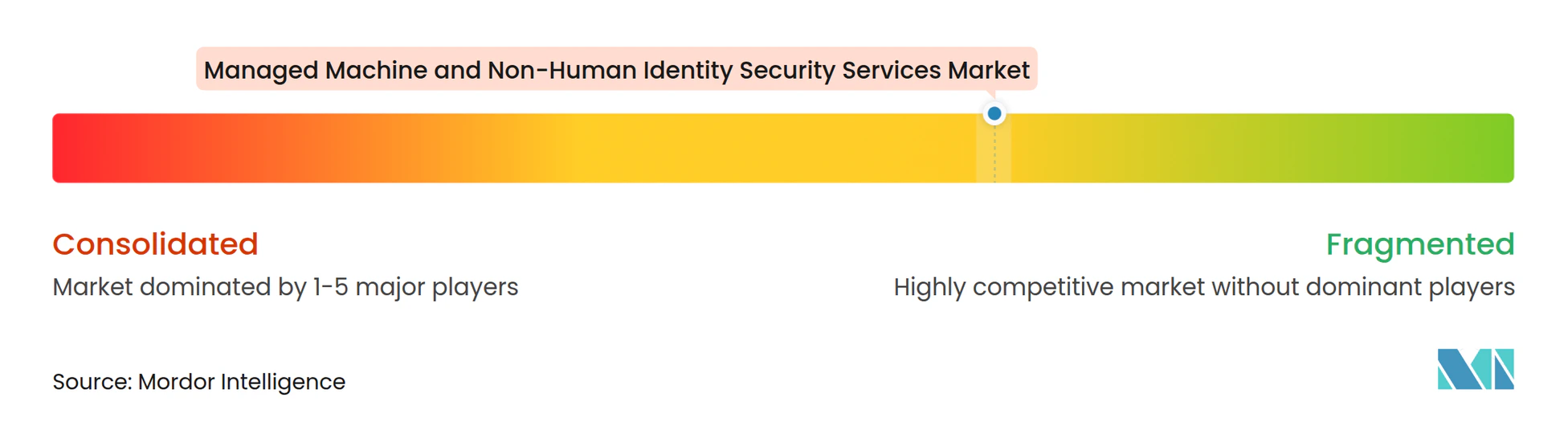
The Managed Machine and Non-Human Identity Security Services Market is moderately fragmented. Purpose-built non-human identity providers compete with established security platforms and managed service offerings from systems integrators. Keyfactor, AppViewX, Akeyless, and Aembit address focused needs across certificate management, secrets, workload identity, and agent governance. Larger providers compete by adding machine identity functions to broader security and identity portfolios. Competitive outcomes depend on the ability to discover credentials, manage their full life cycle, and create evidence for compliance. The category also requires interoperability across cloud environments, legacy systems, developer tooling, and certificate authorities.
A central strategy is to combine certificate lifecycle management, secrets governance, and AI agent identity in one operating model. AppViewX acquired Eos in March 2026, adding an AI-native identity control plane for AI agents and autonomous workloads to its certificate lifecycle and PKI capabilities. The transaction also placed Eos co-founder Archit Lohokare in the AppViewX chief executive role. Entrust launched its Unified Cryptographic Security Platform in April 2025 to bring keys, secrets, and certificates together within a single governance model. In April 2026, Entrust and IBM announced a joint solution that combines the Entrust Cryptographic Security Platform with IBM Consulting’s quantum-safe transformation services.
Keyfactor and IBM Consulting launched a joint solution in January 2026 for cryptographic discovery, PKI lifecycle automation, quantum-safe readiness, AI-based risk scoring, and cryptographic bill of materials generation. Vendors are also participating in technical standards work on AI agent identity through IETF WIMSE drafts. This creates competition around standards implementation as well as product capabilities. The mid-market remains an important opening because compliance demands are increasing while many organizations cannot operate complex identity platforms internally. Regional managed service providers can compete where they offer practical implementation, monitoring, escalation, and governance support. Available source material does not provide combined market share for leading vendors, so the competitive narrative does not assume a concentrated supplier structure.
Managed Machine and Non-Human Identity Security Services Industry Leaders
-
Keyfactor, Inc.
-
DigiCert, Inc.
-
Sectigo Limited
-
Smallstep Labs, Inc.
-
Akeyless Security Ltd.
- *Disclaimer: Major Players sorted in no particular order
Managed Machine and Non-Human Identity Security Services Market Companies Covered in this Report
- Keyfactor, Inc.
- DigiCert, Inc.
- Sectigo Limited
- AppViewX, Inc.
- Smallstep Labs, Inc.
- Akeyless Security Ltd.
- Aembit, Inc.
- Astrix Security, Inc.
- Entro Security Ltd.
- GitGuardian SAS
- Clutch Security, Inc.
- Oasis Security Ltd.
- Token Security Ltd.
- P0 Security, Inc.
- Permiso Security, Inc.
- SPIRL, Inc.
- Corsha, Inc.
- Teleport, Inc.
- Cofide, Inc.
- Veza, Inc.
Recent Industry Developments in Managed Machine and Non-Human Identity Security Services Market
- October 2026: AppViewX expanded its Agent Identity Security capabilities to include Shadow AI visibility, a runtime kill switch for rogue agents, and quantum-resilient agent identity issuance. The AI Bill of Materials now covers browser-based and script-based shadow agents, giving security teams centralized visibility over every sanctioned and unsanctioned agent, its models, MCP tools, and credentials.
- September 2026: Keyfactor surpassed USD 200 million in ARR at the beginning of Q3 2026, representing more than 35% year-over-year growth. Certificates automated through Keyfactor Command increased 207% since 2024. The company also confirmed a strategic investment exceeding USD 1 billion from Summit Partners and its intent to acquire Cofide to extend workload and AI agent identity capabilities.
- April 2026: Entrust and IBM announced a joint solution combining the Entrust Cryptographic Security Platform with IBM Consulting’s Quantum Safe Transformation Services, delivering enterprise-wide cryptographic discovery, risk-based PQC migration planning, and managed lifecycle governance ahead of regulatory deadlines.
- March 2026: AppViewX acquired Eos, an AI-native Identity Control Plane for AI agents and autonomous enterprise workloads, combining AppViewX’s CLM and PKI platform with Eos’s agentic governance and privileged access control. Archit Lohokare, Eos co-founder and former CyberArk SVP, was appointed AppViewX CEO.
Global Managed Machine and Non-Human Identity Security Services Market Report Scope
The Managed Machine and Non-Human Identity Security Services Market refers to the industry focused on outsourced and managed services that secure, monitor, govern, and lifecycle-manage non-human identities used by machines, applications, workloads, APIs, containers, microservices, robotic process automation (RPA) bots, IoT devices, service accounts, and cloud-native infrastructure across enterprise environments.
The Managed Machine and Non-Human Identity Security Services Market Report is Segmented by Offering (Solutions, Managed Services, Professional Services), Identity Type (Application and Service Identities, Application-to-Application and API Identities, Workload and Container Identities, Machine and Device Identities, Cryptographic Access Identities, AI Agent Identities, Bots and Robotic Process Automation Identities), End-User Industry (Banking, Financial Services, and Insurance, IT and Telecommunications, Healthcare and Life Sciences, Manufacturing and Industrial, Government and Public Sector, Retail and E-Commerce, Energy and Utilities, Other End-User Industries), and Geography (North America [United States, Canada, Mexico], South America [Brazil, Argentina, Rest of South America], Europe [Germany, United Kingdom, France, Italy, Spain, Russia, Rest of Europe], Asia-Pacific [China, India, Japan, South Korea, Australia, Rest of Asia-Pacific], Middle East [Saudi Arabia, United Arab Emirates, Turkey, Rest of Middle East], Africa [South Africa, Nigeria, Rest of Africa]). The Market Forecasts are Provided in Terms of Value (USD).
Segmentation Overview
| Solutions |
| Managed Services |
| Professional Services |
| Application and Service Identities |
| Application-to-Application and API Identities |
| Workload and Container Identities |
| Machine and Device Identities |
| Cryptographic Access Identities |
| AI Agent Identities |
| Bots and Robotic Process Automation Identities |
| Banking, Financial Services, and Insurance |
| IT and Telecommunications |
| Healthcare and Life Sciences |
| Manufacturing and Industrial |
| Government and Public Sector |
| Retail and E-Commerce |
| Energy and Utilities |
| Other End-User Industries |
| North America | United States |
| Canada | |
| Mexico | |
| South America | Brazil |
| Argentina | |
| Rest of South America | |
| Europe | Germany |
| United Kingdom | |
| France | |
| Italy | |
| Spain | |
| Russia | |
| Rest of Europe | |
| Asia-Pacific | China |
| India | |
| Japan | |
| South Korea | |
| Australia | |
| Rest of Asia-Pacific | |
| Middle East | Saudi Arabia |
| United Arab Emirates | |
| Turkey | |
| Rest of Middle East | |
| Africa | South Africa |
| Nigeria | |
| Rest of Africa |
| By Offering | Solutions | |
| Managed Services | ||
| Professional Services | ||
| By Identity Type | Application and Service Identities | |
| Application-to-Application and API Identities | ||
| Workload and Container Identities | ||
| Machine and Device Identities | ||
| Cryptographic Access Identities | ||
| AI Agent Identities | ||
| Bots and Robotic Process Automation Identities | ||
| By End-User Industry | Banking, Financial Services, and Insurance | |
| IT and Telecommunications | ||
| Healthcare and Life Sciences | ||
| Manufacturing and Industrial | ||
| Government and Public Sector | ||
| Retail and E-Commerce | ||
| Energy and Utilities | ||
| Other End-User Industries | ||
| By Geography | North America | United States |
| Canada | ||
| Mexico | ||
| South America | Brazil | |
| Argentina | ||
| Rest of South America | ||
| Europe | Germany | |
| United Kingdom | ||
| France | ||
| Italy | ||
| Spain | ||
| Russia | ||
| Rest of Europe | ||
| Asia-Pacific | China | |
| India | ||
| Japan | ||
| South Korea | ||
| Australia | ||
| Rest of Asia-Pacific | ||
| Middle East | Saudi Arabia | |
| United Arab Emirates | ||
| Turkey | ||
| Rest of Middle East | ||
| Africa | South Africa | |
| Nigeria | ||
| Rest of Africa | ||
Key Questions Answered in the Report
What is the size of the Managed Machine and Non-Human Identity Security Services market?
The Managed Machine and Non-Human Identity Security Services market is projected to grow from USD 5.42 billion in 2026 and USD 6.48 billion in 2027 to USD 14.08 billion by 2032, registering a CAGR of 16.79% during the forecast period.
What is driving demand for managed machine identity security services?
Demand is being driven by the rapid expansion of cloud-native workloads, APIs, service accounts, machine credentials, shorter TLS certificate lifecycles, and AI agents, all of which increase the need for automated identity discovery, credential rotation, certificate management, and governance.
Which offering category leads the managed machine and non-human identity security services market?
Solutions led the market with 68.34% revenue share in 2026, as organizations prioritize platform-based identity discovery, lifecycle management, certificate automation, and policy enforcement before expanding managed service engagements.
Why are AI agent identities important for enterprise security?
AI Agent Identities are becoming critical because autonomous agents require verifiable authentication, controlled permissions, activity traceability, and secure deprovisioning. Many traditional IAM platforms were not designed to manage large numbers of dynamic, non-human identities effectively.
Which end-user sector has the largest demand for these services?
BFSI accounted for 26.65% of market revenue in 2026, driven by stringent security, compliance, auditability, and operational resilience requirements across banking, payments, insurance, and financial transaction systems.
Which region is expanding the fastest for managed identity security services?
Asia-Pacific is projected to be the fastest-growing region, with a 17.69% CAGR through 2032, supported by accelerating cloud adoption, digital transformation initiatives, growing machine identity volumes, and strengthening cybersecurity regulations.