
Non-Human Identity (NHI) Security and Governance Market Size and Share
Market Overview
| Study Period | 2020 - 2031 |
|---|---|
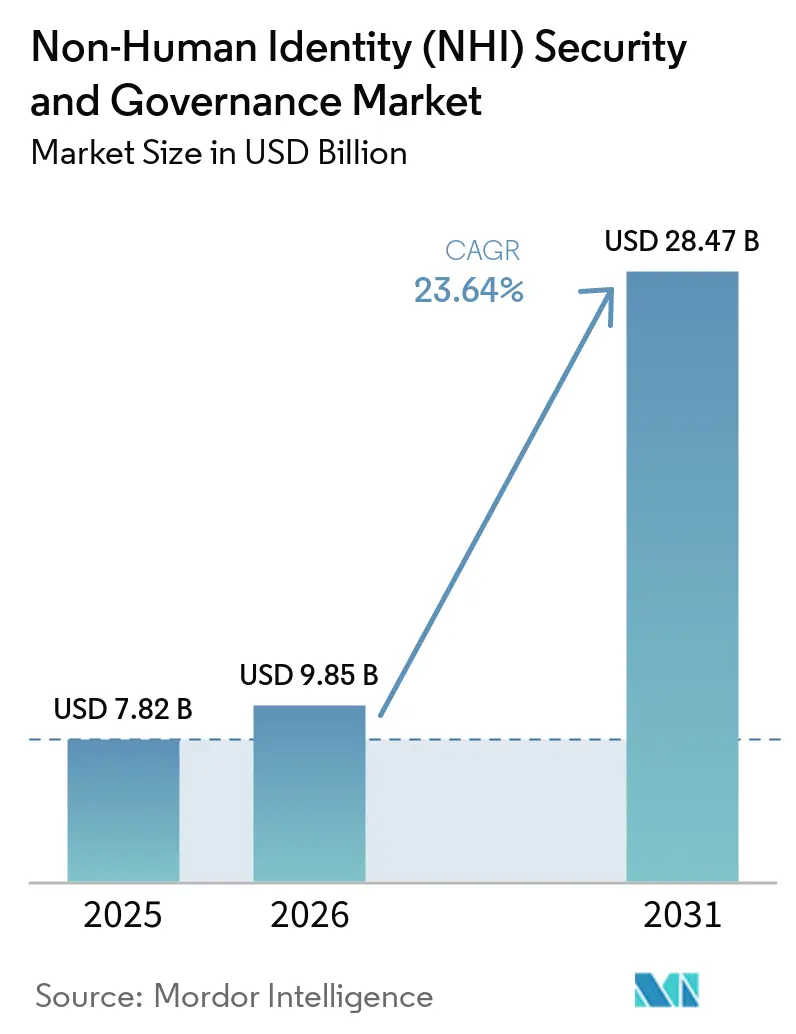
| Market Size (2026) | USD 9.85 Billion |
| Market Size (2031) | USD 28.47 Billion |
| Growth Rate (2026 - 2031) | 23.64 % |
| Fastest Growing Market | Asia-Pacific |
| Largest Market | North America |
| Market Concentration | Medium |
Major Players *Disclaimer: Major Players sorted in no particular order Image © Mordor Intelligence. Reuse requires attribution under CC BY 4.0. | |
Non-Human Identity (NHI) Security and Governance Market Analysis by Mordor Intelligence
The Non-Human Identity (NHI) security and governance market size is projected to expand from USD 7.82 billion in 2025 to USD 9.67 billion in 2026, and to USD 28.47 billion by 2031, registering a CAGR of 23.65% between 2026 and 2031. Larger machine identity estates across cloud workloads, APIs, software delivery pipelines, and automated business processes are shaping the NHI security market. Enterprise adoption of AI agents is shortening the time available to identify credentials, define ownership, and limit access. Demand is moving beyond credential discovery toward lifecycle controls, runtime authorization, and automated rotation. Regulatory requirements in financial services and critical sectors are making documented machine-identity controls increasingly important during security reviews. The Non-Human Identity (NHI) security and governance market also faces pressure from native cloud identity tools, especially when organizations operate primarily on a single cloud platform.
Key Report Takeaways
- By identity type, System Integrators and Technology-Service Providers held 26.58% of the Non-Human Identity (NHI) security and governance market share in 2025, while AI Agent Identities are projected to expand at a 25.05% CAGR through 2031.
- By offering, Solutions accounted for 61.24% of the Non-Human Identity (NHI) security and governance market size in 2025, while Services are projected to expand at a 24.05% CAGR through 2031.
- By deployment, Cloud-Native models held 53.72% of the NHI security and governance market share in 2025, while Hybrid deployment is expected to expand at a 24.25% CAGR through 2031.
- By organization size, Large Enterprises held 31.69% of revenue in 2025, while Small and Medium-sized Enterprises are projected to expand at a 24.06% CAGR through 2031.
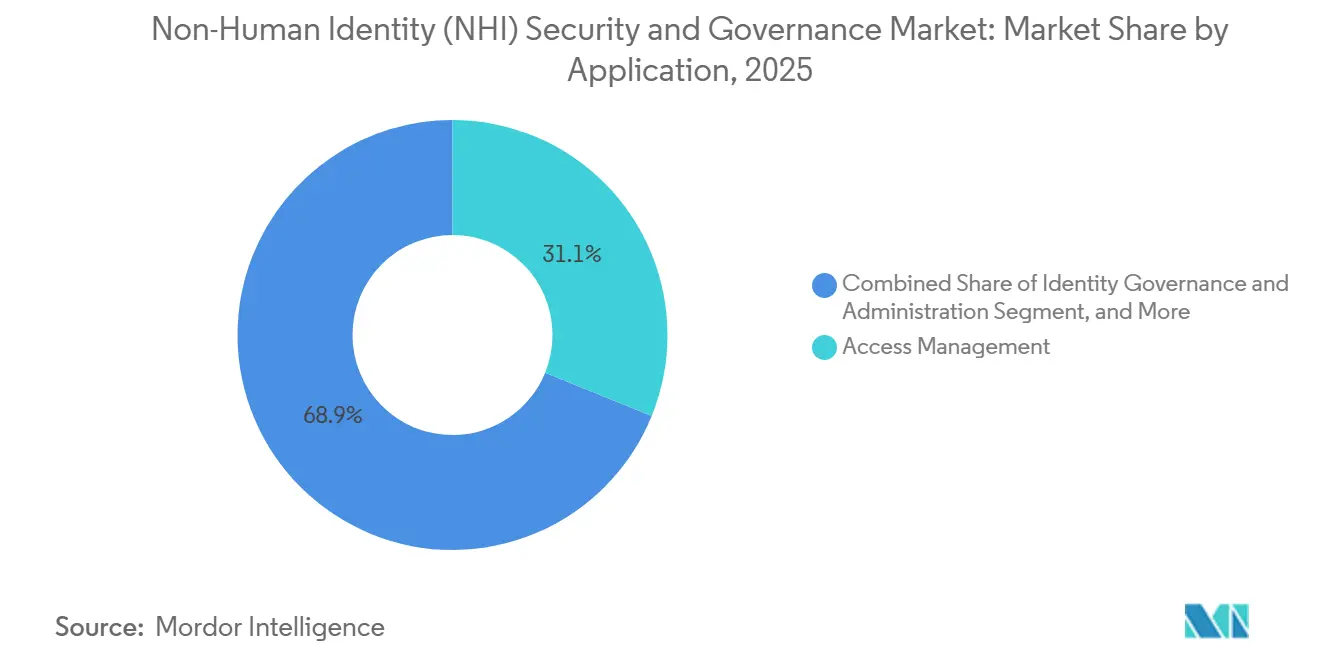
- By application, Access Management accounted for 31.14% of revenue in 2025, while Secrets Management and Rotation are expected to expand at a 24.85% CAGR through 2031.
- By end user, BFSI held 28.48% of revenue in 2025, while Information Technology and Telecommunications are projected to expand at a 25.24% CAGR through 2031.
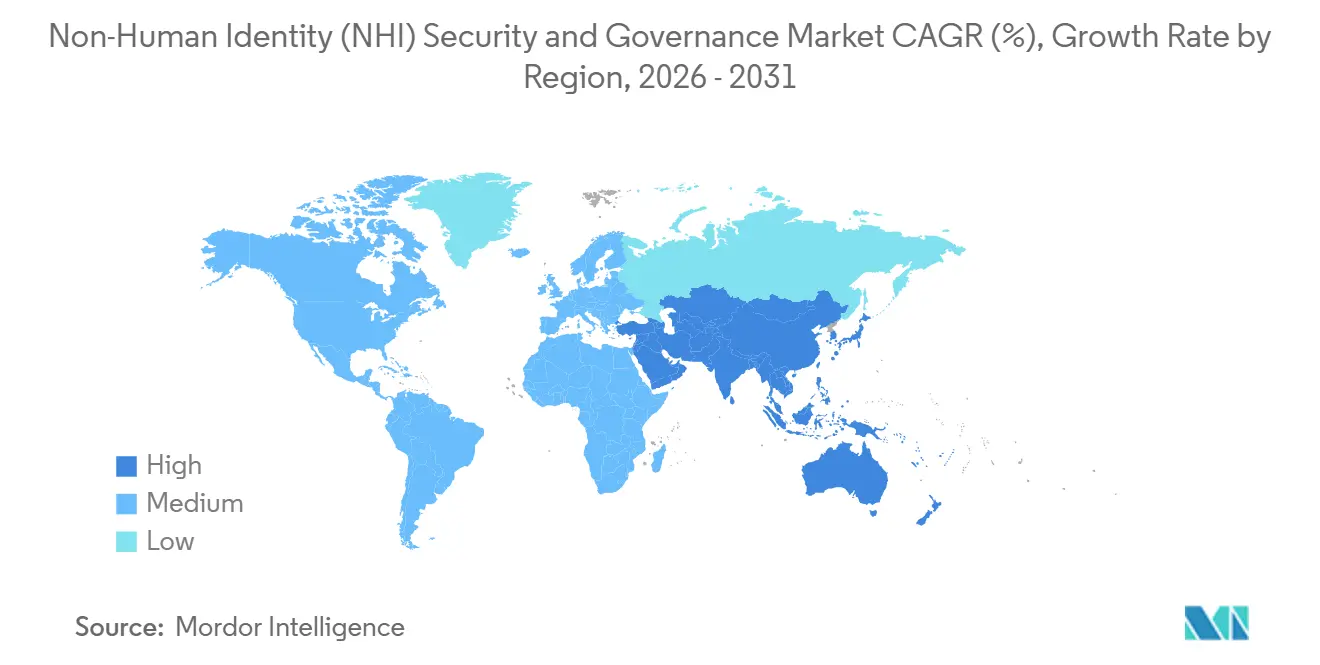
- By geography, North America accounted for 41.37% of revenue in 2025, while Asia-Pacific is projected to expand at a 24.21% CAGR through 2031.
Note: Market size and forecast figures in this report are generated using Mordor Intelligence’s proprietary estimation framework, updated with the latest available data and insights as of January 2026.
Global Non-Human Identity (NHI) Security and Governance Market Trends and Insights
Drivers Impact Analysis*
| Driver | (~) % Impact on CAGR Forecast | Geographic Relevance | Impact Timeline |
|---|---|---|---|
| Cloud-Native Workload and API Expansion | +7.8% | Global, concentrated in North America and Asia-Pacific core | Short term (≤ 2 years) |
| AI Agent and Autonomous Workflow Adoption | +7.2% | Global, with early gains in North America and Europe | Short term (≤ 2 years) |
| Zero Trust and Regulatory Enforcement | +4.1% | North America and Europe, with spillover to Asia-Pacific and Middle East and Africa | Medium term (2-4 years) |
| Secretless Access and Ephemeral Credential Rotation | +2.5% | Global, with deepest adoption in North America | Medium term (2-4 years) |
| NHI Attack Surface Quantification by Identity Graphs | +0.9% | North America and Europe | Medium term (2-4 years) |
| Identity-Bound Software Supply Chain Attestation | +0.7% | North America, Europe, and Asia-Pacific | Long term (≥ 4 years) |
| Source: Mordor Intelligence | |||
Cloud-Native Workload and API Expansion
APIs have become a major attack surface in cloud-native environments, increasing the need to govern the credentials associated with each endpoint. Akamai reported 258 daily API attacks per organization in 2025, a 113% increase from the prior year, while 87% of surveyed organizations reported an API-related security incident. Every additional API endpoint can introduce an associated service account, token, or key that requires inventory and policy control. The Non-Human Identity (NHI) security and governance market benefits when organizations treat authenticated API activity as a machine identity event rather than only a network event. Salt Security found that 47% of respondents reported API expansion of 51%-100% over the prior year, and 47% delayed a production release due to security concerns about APIs exposed to autonomous systems. Controls at the API gateway can limit the reach of a compromised credential by assessing each request against an identity policy.
AI Agent and Autonomous Workflow Adoption
AI agents create identity risks that differ from those associated with static service accounts. These agents can consume credentials at runtime, create sub-agents, call external APIs, and carry out actions across multiple systems. OWASP identifies identity and privilege abuse as a material risk for agentic applications. NIST's National Cybersecurity Center of Excellence published a February 2026 concept paper on identity and authorization practices for software agents and agentic AI applications.[1]National Institute of Standards and Technology, “Accelerating the Adoption of Software and Artificial Intelligence Agent Identity and Authorization,” NIST Computer Security Resource Center, csrc.nist.gov The Non-Human Identity (NHI) security and governance market is therefore moving toward controls that verify an agent's identity, requested scope, and authorization at the point of tool use. The Cloud Security Alliance reported that more than 16% of organizations did not track the creation of AI-related identities, leaving a gap in oversight.
Zero Trust and Regulatory Enforcement
Zero Trust programs increasingly include non-human identities, particularly in regulated sectors. The Digital Operational Resilience Act has applied to European Union financial entities since January 17, 2025, and requires that records of ICT third-party arrangements be maintained under Article 28. These records can encompass vendor API keys and service accounts that connect to regulated systems. Germany's NIS2 Implementation Act entered into force in December 2025, with a mandatory BSI registration deadline in April 2026 for organizations in scope. PCI DSS 4.0 also brings privileged system and application accounts into audit attention within payment environments. The Non-Human Identity (NHI) security and governance market presents an opportunity for vendors to provide evidence of ownership, access control, and credential lifecycle actions for these reviews.
Secretless Access and Ephemeral Credential Rotation
The move from static secrets to workload-attested credentials is changing how organizations build machine identity controls. GitGuardian identified 28.65 million newly exposed hardcoded secrets in public GitHub commits during 2025, representing a 34% year-over-year increase. The same research found that commits co-authored by AI coding assistants were twice as likely to expose secrets. Frameworks such as SPIFFE and SPIRE enable services to authenticate through cryptographic runtime attestation rather than long-lived API keys. The CA/Browser Forum approved Ballot SC-081v3 in April 2025, reducing TLS certificate validity from 398 days to 200 days in March 2026, 100 days in March 2027, and 47 days in March 2029. The NHI security and governance market benefits from shorter certificate cycles, making automated lifecycle management increasingly necessary.
Restraints Impact Analysis*
| Restraint | (~) % Impact on CAGR Forecast | Geographic Relevance | Impact Timeline |
|---|---|---|---|
| Fragmented Ownership Across Engineering and Security Teams | -3.2% | Global | Short term (≤ 2 years) |
| Native Hyperscaler Identity Features Reduce Incremental Spend | -2.1% | North America and Asia-Pacific core | Medium term (2-4 years) |
| Ephemeral Identity Discovery and Attribution Gaps | -1.4% | Global | Medium term (2-4 years) |
| Secret Zero and Legacy Protocol Dependence | -0.9% | Global, concentrated in industrial and government sectors | Long term (≥ 4 years) |
| Source: Mordor Intelligence | |||
Fragmented Ownership Across Engineering and Security Teams
Machine identity governance is often slowed by divided accountability between engineering and security teams. Engineering teams can create credentials in CI/CD pipelines, Kubernetes clusters, SaaS integrations, and AI workflows without a formal security ownership process. The Cloud Security Alliance found that 15% of organizations were highly confident in their ability to prevent NHI-based attacks, and 5.7% had full visibility into service accounts.[2]Cloud Security Alliance, “The Non-Human Identity Governance Vacuum,” CSA Labs, labs.cloudsecurityalliance.org Human identity processes do not map cleanly to a service account created at deployment and removed when an infrastructure instance is recycled. Discovery tools can identify risk, but remediation is delayed when no team has the authority to make the needed change. This issue is more severe in large enterprises with many engineering teams and varied delivery practices.
Native Hyperscaler Identity Features Reduce Incremental Spend
AWS IAM Roles, Azure Managed Identities, and Google Cloud Workload Identity Federation provide native, policy-based credential services. These capabilities can reduce the need for a separate NHI tool in a single-cloud environment. Microsoft Entra Agent ID reached general availability in April 2026 and provides identity and access management capabilities for AI agents within the Azure ecosystem. Organizations with limited exposure to multi-cloud environments may see less value in adding a dedicated platform. The Non-Human Identity (NHI) security and governance market remains more compelling for buyers who need a common policy and visibility across cloud, SaaS, and on-premises environments. Specialized vendors must demonstrate value beyond the controls offered by an existing cloud provider to avoid longer sales cycles.
*Our forecasts treat driver/restraint impacts as directional, not additive. The impact forecasts reflect baseline growth, mix effects, and variable interactions.
Segment Analysis
By Identity Type: AI Agent Identities Increase Credential Complexity
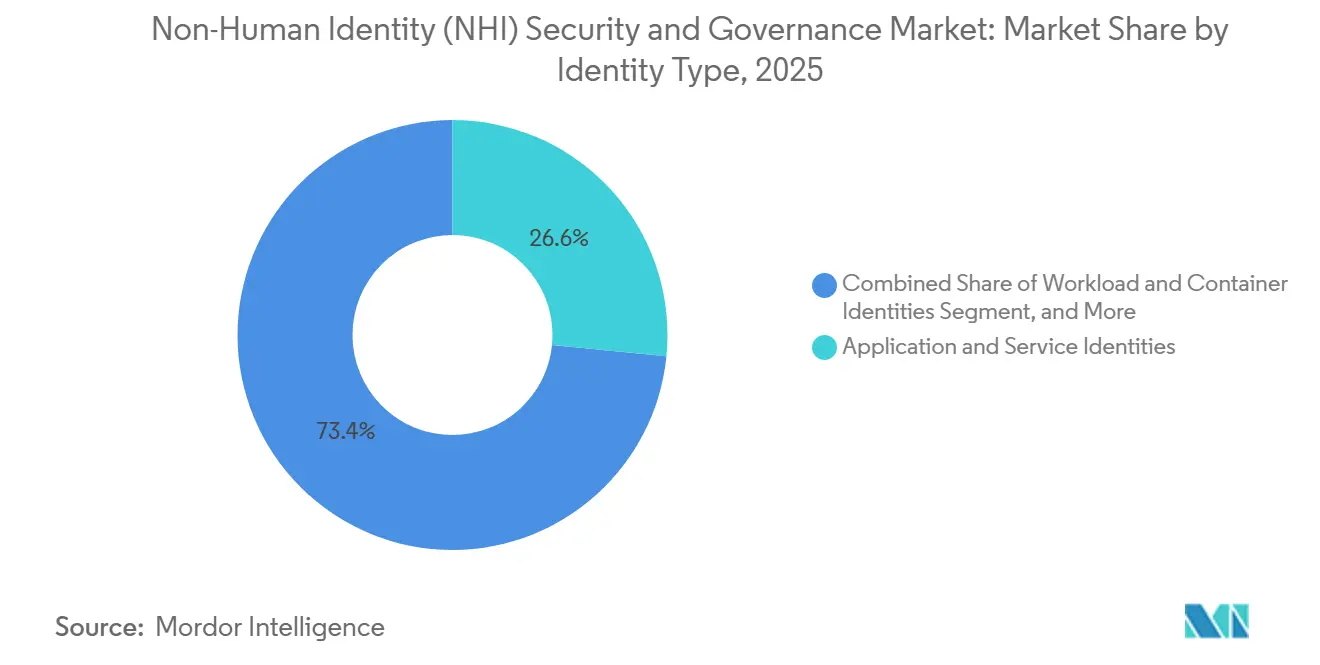
Application and Service Identities represented 26.58% of revenue in 2025. This category had the largest revenue share because managed service providers deploy governance controls across broad enterprise environments. These deployments can cover on-premises service accounts, SaaS OAuth grants, and cloud workload tokens. AI Agent Identities are projected to expand at a 25.05% CAGR through 2031. NHI security and governance market demand for AI Agent Identities is supported by the need to govern agents that use credentials at runtime. OWASP lists tool misuse and identity privilege abuse among key risks for agentic systems. This risk profile raises demand for access controls that can assess an agent before it uses a connected tool. It also shifts attention from periodic review toward continuous authorization.
Workload and Container Identities, Application-to-Application and API Identities, and Machine and Device Identities provide material demand across the category. The adoption of microservices and connected device fleets increases the volume and diversity of these identities. Cryptographic Identities remain important where certificates establish trusted application and device communications. Bots and RPA Identities are also relevant as older automation programs connect with newer governance platforms. The CA/Browser Forum's planned reductions in certificate validity increase the operational burden of cryptographic identity management. Automation becomes more valuable as renewal intervals shorten. ISO/IEC 27001 and NIST SP 800-57 provide technical guidance that supports cryptographic identity lifecycle practices.



By Offering: Solutions Lead Revenue While Services Gain Importance
Solutions accounted for 61.24% of revenue in 2025. This position reflects demand for discovery engines, access governance, secrets vaulting, and certificate lifecycle capabilities. Early buyers often prioritize platforms because they have internal security teams able to configure them. Services are projected to expand at a 24.05% CAGR through 2031. Non-Human Identity (NHI) security and governance market demand for Services is driven by customers who need help with ownership models, inventory management, and remediation procedures. As programs mature, boards and security leaders seek documented governance outcomes rather than evidence of tool deployment alone. Managed services and implementation support address gaps in internal capability.
Solutions and Services are commercially complementary rather than substitutes. A customer may buy a platform but still needs assistance to establish accountable owners and workable operating processes. Advisory support can also help align controls with compliance requirements. SailPoint launched Machine Identity Security QuickStart in March 2026 with a structured 4-week deployment framework. Such frameworks can reduce the time between initial discovery and practical remediation. Vendors that build advisory methods into implementation can reduce adoption barriers. This approach also helps customers apply the platform across diverse credential types.
By Deployment: Cloud-Native Models Lead While Hybrid Deployments Expand
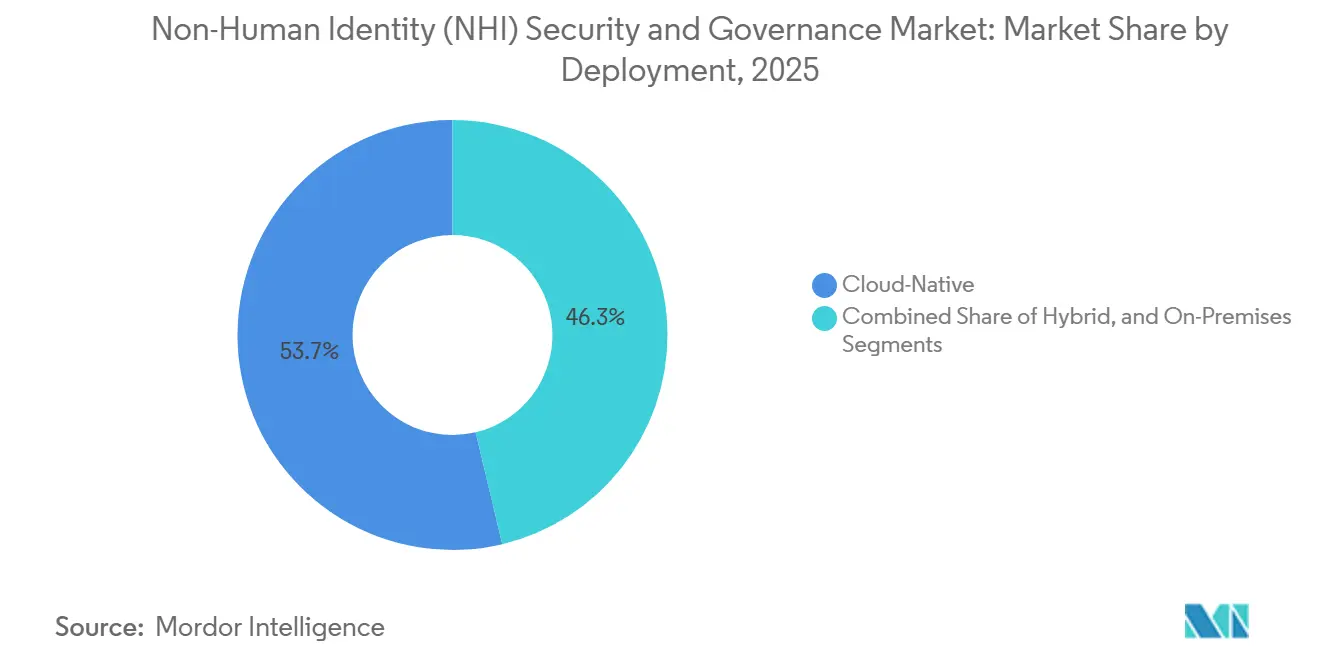
Cloud-Native deployment accounted for 53.72% of revenue in 2025. It held the largest revenue share because workload identity federation and API-first controls align with containerized and serverless environments. These environments can issue short-lived tokens and enforce least-privilege policies at scale. Hybrid deployment is projected to expand at a 24.25% CAGR through 2031. Many enterprises retain infrastructure that cannot move fully to cloud-native architecture during the forecast period. The Non-Human Identity (NHI) security and governance market requires identity policies to span cloud IAM systems, service accounts, and on-premises protocols. These connections can create material visibility gaps.
Sysdig reported a 25-fold year-over-year expansion in AI-specific packages within cloud workloads in its 2026 report. This expansion adds identity and authorization demands to already complex cloud environments. On-Premises deployments remain relevant in defense, critical infrastructure, and some government settings. Data sovereignty and network isolation requirements can limit the use of cloud-resident identity services. Vendors with hybrid-aware designs can apply policy across cloud and on-premises systems. Their value rests on consistent visibility without requiring a full infrastructure migration. This capability is central to the demand for NHI security and governance in mixed enterprise environments.
By Organization Size: Large Enterprises Anchor Revenue While SMEs Increase Adoption
Large Enterprises held 31.69% of revenue in 2025. They manage complex identity estates across multi-cloud systems, SaaS applications, CI/CD pipelines, and AI deployments. Their larger contract values make them important buyers for platform vendors. CyberArk reported that 82% of surveyed organizations experienced a certificate-related failure during the past year. The cited causes included visibility gaps and scattered ownership. Long-lived, over-privileged accounts can result from accounts created for a limited use and never decommissioned. This creates a persistent operational and security concern for large organizations.
Small and Medium-sized Enterprises are projected to expand at a 24.06% CAGR through 2031. These organizations increasingly rely on cloud applications, APIs, and SaaS integrations, but often lack dedicated identity security teams. Simpler deployment, managed operations, and outcome-based pricing can reduce adoption barriers. The Non-Human Identity (NHI) security and governance market can reach this customer group through packaged services that do not require substantial internal engineering resources. Aembit and Netskope announced a partnership at RSA 2026 that combined workload identity with content inspection for multi-cloud buyers. Such offerings can make machine identity controls easier to deploy in resource-constrained environments. SME demand broadens the customer base beyond large enterprises.
By Application: Access Management Leads While Secrets Management Changes Priorities
Access Management represented 31.14% of revenue in 2025. It led the category because controlling which systems a machine identity can reach is often the first governance step. These controls include just-in-time provisioning, least-privilege enforcement, and runtime authorization. Secrets Management and Rotation is projected to expand at a 24.85% CAGR through 2031. The ongoing exposure of secrets supports demand for this application. GitGuardian reported 28.65 million hardcoded secrets in public GitHub commits in 2025, along with an 81% increase in leaked AI service credentials. These disclosures support a clear need for automated discovery, rotation, and remediation.
Identity Governance and Administration supports auditable ownership records and access reviews for machine accounts. Certificate Lifecycle Management is becoming more urgent as TLS validity periods decline. Compliance Management is also gaining importance, where DORA, NIS2, and PCI DSS 4.0 require evidence of controlled access. The category is moving from vault-stored credentials toward access that depends on workload attestation. This model reduces reliance on credentials that exist in durable form. Vendors that support this approach can address both security and operational requirements. The resulting architecture can change how buyers evaluate product capabilities.
By End User: BFSI Anchors Demand While Technology Firms Lead Expansion
BFSI accounted for 28.48% of revenue in 2025. This sector has payment APIs, open banking connections, treasury automation, algorithmic trading systems, and fraud detection workflows. The revenue position in BFSI reflects the high concentration of regulated machine-to-machine activity. DORA requires European Union financial entities to maintain a register of ICT third-party arrangements. This requirement brings vendor integrations and associated access credentials into governance processes. For financial institutions, identity control failures can also affect operational resilience. These factors sustain procurement in the Non-Human Identity (NHI) security and governance market for machine identity controls.
Information Technology and Telecommunications is projected to expand at a 25.24% CAGR through 2031. Technology companies manage dense machine identity estates because developers create secrets frequently across broad SaaS and cloud environments. AI agent deployments add another layer of credential activity. Healthcare and Life Sciences also require controls for service accounts and API connections that exchange protected health information. Government and Public Sector, Retail and E-Commerce, Industrial Manufacturing, and Energy and Utilities each create distinct demand areas. Energy and Utilities is gaining attention as operational technology connects with IT-style API and workload identity practices. These sectors require controls that fit both modern applications and legacy systems.
Geography Analysis
North America held 41.37% of global revenue in 2025. The Non-Human Identity (NHI) security and governance market in the region benefits from early adoption of cloud-native technologies, a high concentration of dedicated vendors, and strong activity in regulated industries. Financial services, healthcare, and defense have compliance requirements that support recurring investment in identity controls. The US government has reinforced software supply chain practices by issuing updated minimum elements for SBOMs, jointly by the NSA and CISA in 2026. These practices can increase demand for identity-bound software supply chain attestation. Canada and Mexico also contribute through cloud adoption and manufacturing automation.
Europe represents a strategically important part of the NHI security and governance market. DORA established a common operational resilience framework for financial entities and critical ICT providers from January 2025.[3]European Union, “Regulation (EU) 2022/2554 on Digital Operational Resilience,” EUR-Lex, eur-lex.europa.eu Germany's NIS2 Implementation Act brought an estimated 29,000 organizations under BSI supervision in December 2025. France continued its NIS2 transposition process during the period supplied. The EU AI Act adds obligations for high-risk AI systems through 2026 and 2027. These measures make auditable machine identity governance more relevant across regulated European deployments.
Asia-Pacific is projected to expand at a 24.21% CAGR through 2031. China held the largest regional revenue share in 2025, supported by cloud infrastructure expansion and domestic cybersecurity priorities. India is the fastest-growing country in the region because of fintech expansion, IT services activity, and high volumes of API credentials from outsourced software development. Japan, South Korea, and Australia support demand through cloud adoption and automation programs. South America is at an earlier stage, with Brazil leading regional uptake through financial services digitization and cloud-native development. Middle East digital transformation programs create opportunities in BFSI and telecommunications, while South Africa and Nigeria show early demand linked to mobile financial services and the development of the technology sector. Vendors that offer cloud-managed or partner-delivered services can address markets with limited local security engineering capacity.

Competitive Landscape
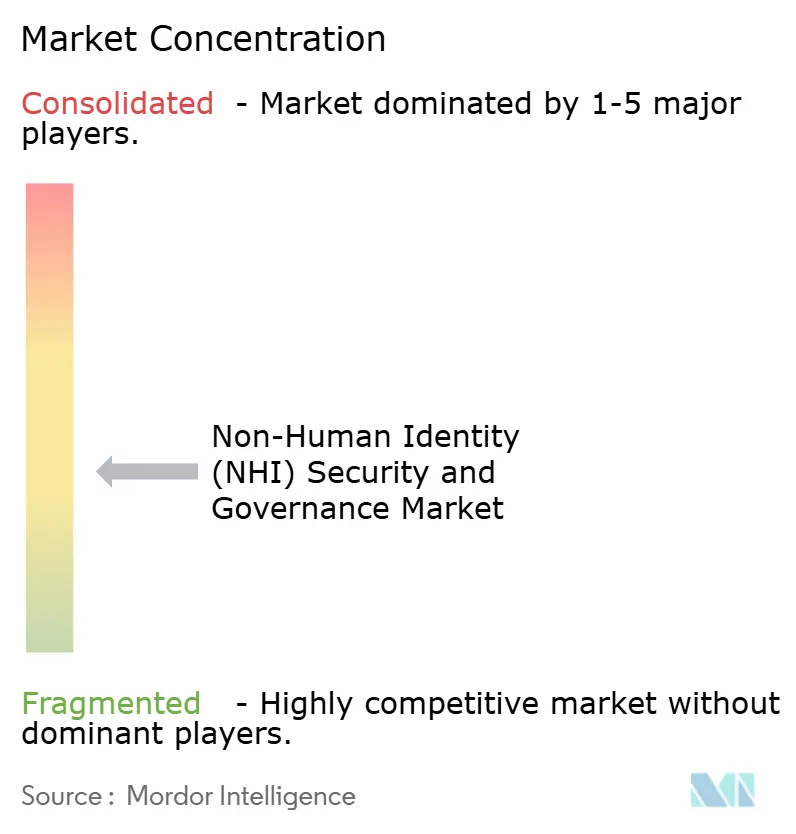
The Non-Human Identity (NHI) security and governance market is moderately fragmented, but consolidation is increasing. Purpose-built specialists include CyberArk, Silverfort, Akeyless Security, Aembit, Entro Security, GitGuardian, Clutch Security, Permiso Security, and Token Security. These firms compete with larger security and identity platforms that are adding NHI capabilities through acquisition. Cisco completed its acquisition of Astrix Security in June 2026 for USD 400 million. The transaction adds NHI discovery, lifecycle management, and threat detection capabilities to Cisco Identity Intelligence, Duo, Secure Access, and Splunk. This creates broader distribution for controls that were previously offered as point products.
CrowdStrike announced its acquisition of SGNL for USD 740 million in January 2026. The transaction extends dynamic, real-time authorization for human, non-human, and AI agent identities within its identity security offering. Cyera announced its acquisition of Oasis Security in July 2026 for USD 1 billion. This transaction combines data classification with agentic access management. BeyondTrust launched NHI Governance on Pathfinder in July 2026 and planned US general availability for fall 2026. The offering applies privileged-access practices to service accounts, API keys, workload identities, OAuth clients, and AI agents. These moves show that Non-Human Identity (NHI) security and governance market controls are being positioned within broader identity, data, and cloud security platforms.
Snowflake's planned acquisition of Natoma in May 2026 and the July 2026 launch of its Cortex AI Gateway brought identity-aware controls to AI agents accessing enterprise applications and tools. Platform expansion can intensify competition in the Non-Human Identity (NHI) security and governance market for standalone vendors. There remains an opportunity in runtime authorization, where controls assess whether a request matches the identity's approved purpose at execution. There is also demand for visibility across complex multi-cloud and SaaS estates. Hyperscaler-native services create a limitation for dedicated vendors serving single-cloud customers.
Non-Human Identity (NHI) Security and Governance Industry Leaders
Keyfactor, Inc.
BeyondTrust Corporation
Delinea, Inc.
Aembit, Inc.
Palo Alto Networks
- *Disclaimer: Major Players sorted in no particular order

Recent Industry Developments
- August 2026: BeyondTrust added AI identity controls to its Pathfinder platform, expanding the PathfinderAI and MCP Server capabilities alongside NHI Governance and a new Workload Credentials tool. The additions are designed to help organizations discover, prioritize, govern, and protect privileged access across human users, machines, workloads, and AI agents from a single platform.
- July 2026: Cyera announced the acquisition of Oasis Security in a deal valued at USD 1 billion, combining data security classification with agentic access management. The acquisition followed Oasis's USD 120 million Series B close in March 2026 and positions Cyera to address identity-data governance as a unified control surface.
- July 2026: BeyondTrust launched NHI Governance on its Pathfinder platform, extending privileged-access controls to service accounts, API keys, workload identities, OAuth clients, and AI agents across cloud, SaaS, endpoint, and on-premises environments. US general availability is planned for fall 2026.
- July 2026: Snowflake launched Cortex AI Gateway, built on its acquisition of Natoma, providing a governance and execution layer that applies identity-aware policies and cost controls across first- and third-party AI agents operating in enterprise environments.


Global Non-Human Identity (NHI) Security and Governance Market Report Scope
The Non-Human Identity (NHI) Security and Governance market comprises software solutions and associated services designed to discover, identify, secure, govern, monitor, and manage non-human identities throughout their lifecycle. Non-human identities are digital identities used by applications, services, workloads, machines, devices, APIs, cryptographic systems, AI agents, bots, and robotic process automation (RPA) systems to authenticate and communicate with other systems and access organizational resources. NHI security and governance platforms help organizations establish ownership, enforce least-privilege access, automate credential and identity lifecycle processes, detect anomalous activity, and reduce risks associated with excessive, unmanaged, compromised, or improperly governed machine access.
The Non-Human Identity (NHI) Security and Governance Market Report is Segmented by Identity Type (Cryptographic Identities, Application and Service Identities, Application-to-Application and API Identities, Workload and Container Identities, Machine and Device Identities, AI Agent Identities, and Bots and Robotic Process Automation Identities), Offering (Solutions, and Services), Deployment (Cloud-Native, Hybrid, and On-Premises), Organization Size (Large Enterprises, and Small and Medium-Sized Enterprises), Application (Access Management, Identity Governance and Administration, Secrets Management and Rotation, Certificate Lifecycle Management, Compliance Management, and Other Applications), End User (BFSI, Healthcare and Life Sciences, Information Technology and Telecommunications, Government and Public Sector, Retail and E-Commerce, Industrial Manufacturing, Energy and Utilities, and Other End Users), and Geography (North America, South America, Europe, Asia-Pacific, Middle East, and Africa). The Market Forecasts are Provided in Terms of Value (USD).
| Application and Service Identities |
| Application-to-Application and API Identities |
| Workload and Container Identities |
| Machine and Device Identities |
| Cryptographic Identities |
| AI Agent Identities |
| Bots and Robotic Process Automation Identities |
| Solutions |
| Services |
| Cloud-Native |
| Hybrid |
| On-Premises |
| Large Enterprises |
| Small and Medium-Sized Enterprises |
| Access Management |
| Identity Governance and Administration |
| Secrets Management and Rotation |
| Certificate Lifecycle Management |
| Compliance Management |
| Other Applications |
| BFSI |
| Healthcare and Life Sciences |
| Information Technology and Telecommunications |
| Government and Public Sector |
| Retail and E-Commerce |
| Industrial Manufacturing |
| Energy and Utilities |
| Other End Users |
| North America | United States |
| Canada | |
| Mexico | |
| South America | Brazil |
| Argentina | |
| Rest of South America | |
| Europe | Germany |
| United Kingdom | |
| France | |
| Russia | |
| Rest of Europe | |
| Asia-Pacific | China |
| Japan | |
| India | |
| South Korea | |
| Australia | |
| Rest of Asia-Pacific | |
| Middle East | Saudi Arabia |
| United Arab Emirates | |
| Turkey | |
| Rest of Middle East | |
| Africa | South Africa |
| Nigeria | |
| Rest of Africa |
| By Identity Type | Application and Service Identities | |
| Application-to-Application and API Identities | ||
| Workload and Container Identities | ||
| Machine and Device Identities | ||
| Cryptographic Identities | ||
| AI Agent Identities | ||
| Bots and Robotic Process Automation Identities | ||
| By Offering | Solutions | |
| Services | ||
| By Deployment | Cloud-Native | |
| Hybrid | ||
| On-Premises | ||
| By Organization Size | Large Enterprises | |
| Small and Medium-Sized Enterprises | ||
| By Application | Access Management | |
| Identity Governance and Administration | ||
| Secrets Management and Rotation | ||
| Certificate Lifecycle Management | ||
| Compliance Management | ||
| Other Applications | ||
| By End User | BFSI | |
| Healthcare and Life Sciences | ||
| Information Technology and Telecommunications | ||
| Government and Public Sector | ||
| Retail and E-Commerce | ||
| Industrial Manufacturing | ||
| Energy and Utilities | ||
| Other End Users | ||
| By Geography | North America | United States |
| Canada | ||
| Mexico | ||
| South America | Brazil | |
| Argentina | ||
| Rest of South America | ||
| Europe | Germany | |
| United Kingdom | ||
| France | ||
| Russia | ||
| Rest of Europe | ||
| Asia-Pacific | China | |
| Japan | ||
| India | ||
| South Korea | ||
| Australia | ||
| Rest of Asia-Pacific | ||
| Middle East | Saudi Arabia | |
| United Arab Emirates | ||
| Turkey | ||
| Rest of Middle East | ||
| Africa | South Africa | |
| Nigeria | ||
| Rest of Africa | ||


Key Questions Answered in the Report
What is the Non-Human Identity (NHI) security market size?
The Non-Human Identity (NHI) security market is projected to expand from USD 9.67 billion in 2026 to USD 28.47 billion by 2031 at a 23.65% CAGR.
What is driving demand for non-human identity security?
Cloud workloads, expanding API use, AI agents, secrets exposure, and compliance requirements are increasing demand for machine identity controls.
Which Non-Human Identity (NHI) security application is the largest?
Access Management led revenue with 31.14% in 2025, supported by demand for least-privilege controls and runtime authorization.
Which deployment model is expanding fastest?
Hybrid deployment is projected to expand at a 24.25% CAGR through 2031 because many enterprises must govern both cloud and on-premises systems.
Why do AI agents require dedicated identity controls?
AI agents can use credentials at runtime, invoke external tools, and operate across several systems, which increases the need for continuous authorization.
Which region is projected to expand fastest?
Asia-Pacific is projected to expand at a 24.21% CAGR through 2031, supported by fintech activity, cloud investment, and technology services growth.
Page last updated on:





