
Managed Identity Security Services Market Size and Share
Market Overview
| Study Period | 2021 - 2032 |
|---|---|
| Market Size (2027) | USD 17.93 Billion |
| Market Size (2032) | USD 32.28 Billion |
| Growth Rate (2027 - 2032) | 12.48 % |
| Fastest Growing Market | Asia-Pacific |
| Largest Market | North America |
| Market Concentration | Medium |
Major Players *Disclaimer: Major Players sorted in no particular order Image © Mordor Intelligence. Reuse requires attribution under CC BY 4.0. | |
Managed Identity Security Services Market Analysis by Mordor Intelligence
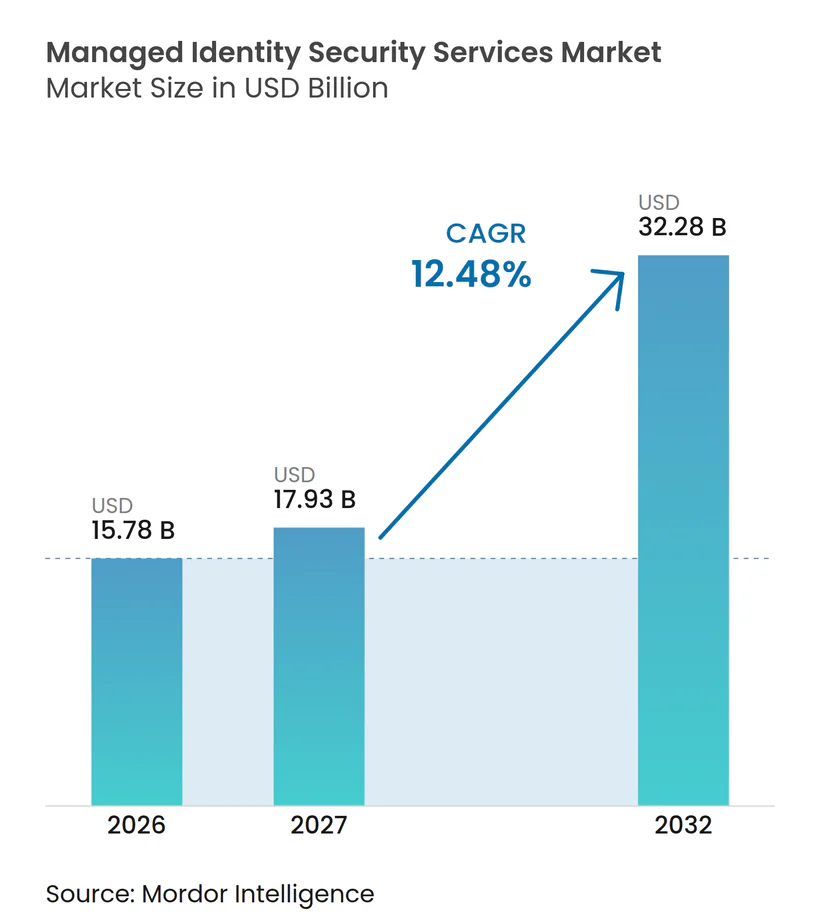
The Managed Identity Security Services Market size is projected to expand from USD 15.78 billion in 2026 and USD 17.93 billion in 2027 to USD 32.28 billion by 2032, registering a CAGR of 12.48% between 2027 to 2032. The managed identity security services market is benefiting as identity controls become central to security operations rather than a separate administrative function. Credential theft, cloud adoption, and the expansion of machine identities are increasing the need for continuous monitoring and governance. Enterprises are using external providers when internal teams cannot sustain specialist coverage across complex identity estates. Platform vendors are also widening their capabilities through acquisitions and product development, which is raising competition for broader service contracts. Cost, legacy integration issues, and a shortage of experienced identity professionals continue to slow adoption, especially among smaller organizations.
Key Report Takeaways
- By solution type, Managed Identity and Access Management held 23.96% of the managed identity security services market share in 2026, while Managed Non-Human Identity Security is projected to expand at a 13.68% CAGR through 2032.
- By service type, Managed Monitoring and Operations held 34.35% of the managed identity security services market share in 2026 and is projected to expand at a 13.47% CAGR through 2032.
- By deployment mode, cloud-based deployment accounted for 62.48% of the Managed Identity Security Services Market size in 2026 and is projected to expand at a 13.07% CAGR through 2032.
- By identity type, Workforce Identity accounted for 35.55% of revenue in 2026, while Non-Human Identity is projected to grow at a 13.43% CAGR through 2032.
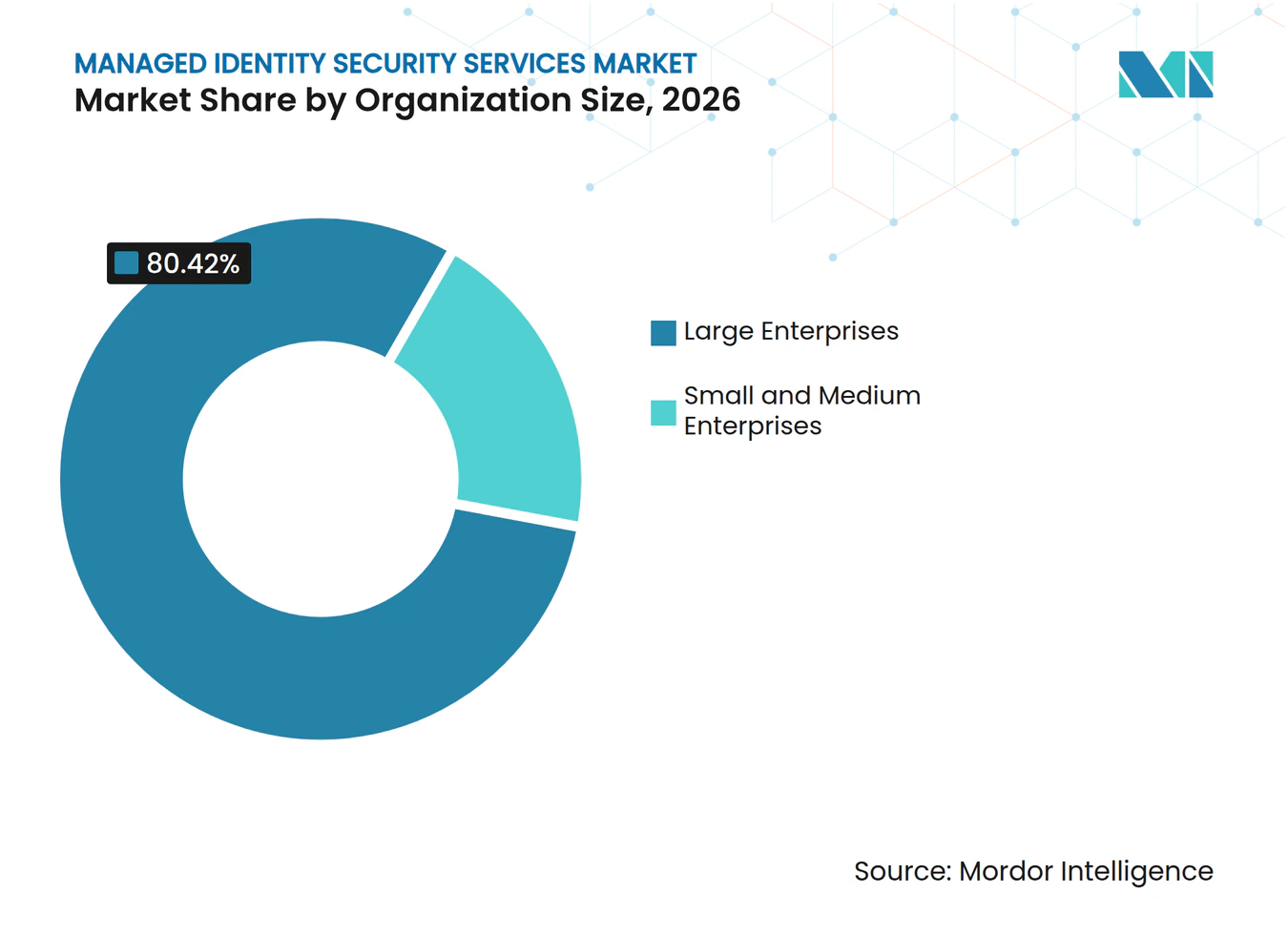
- By organization size, large enterprises accounted for 80.42% of revenue in 2026, while small and medium enterprises are projected to expand at a 12.86% CAGR through 2032.
- By end-user vertical, BFSI held 24.97% of revenue in 2026, while Healthcare and Life Sciences are projected to expand at a 13.84% CAGR through 2032.
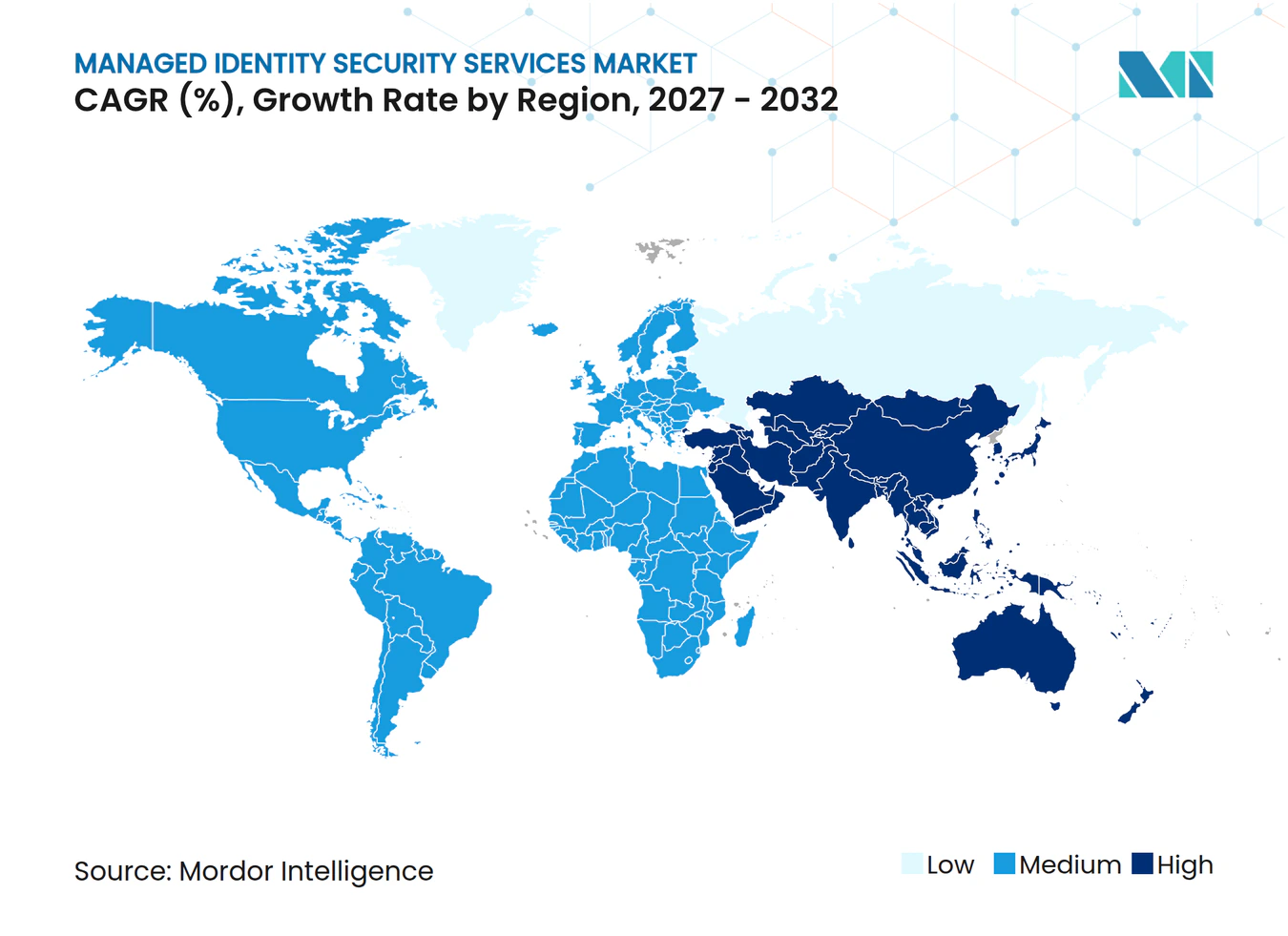
- By geography, North America held 47.01% of revenue in 2026, while Asia-Pacific is projected to expand at a 13.46% CAGR through 2032.
Note: Market numbers in this report are based on Mordor Intelligence's proprietary estimation framework, which combines nine months of actuals with Q4 projections for base year 2026.
Market Trends and Insights
Drivers Impact Analysis of Managed Identity Security Services Market*
| Driver | (~) % Impact on CAGR Forecast | Geographic Relevance | Impact Timeline |
|---|---|---|---|
| Rising Identity-Based Attacks and Credential Theft | +2.5% | Global, with highest breach density in North America, UK, and Australia | Short term (≤ 2 years) |
| Expansion of Cloud and Hybrid-Work Identity Estates | +2.2% | Global, led by North America and Western Europe, Asia-Pacific accelerating | Medium term (2-4 years) |
| Regulatory Mandates for Continuous Access Governance | +1.8% | EU, North America, and Asia-Pacific sector-specific requirements | Medium term (2-4 years) |
| Zero Trust and Continuous Authorization Programs | +1.6% | North America and EU early adopters, Asia-Pacific and Middle East accelerating | Long term (≥ 4 years) |
| Explosion of Machine Identities and AI Agents | +1.5% | Global, concentrated in cloud-native environments in North America and EU | Medium term (2-4 years) |
| Passwordless and Phishing-Resistant Authentication Adoption | +1.2% | Global, with federal momentum in North America and policy-led uptake in EU | Medium term (2-4 years) |
| Source: Mordor Intelligence | |||
Rising Identity-Based Attacks and Credential Theft
Credential theft has become a central security concern for organizations that rely on digital systems and distributed workforces. Sophos reported that 71% of surveyed organizations experienced an identity-related breach during the previous 12 months, with affected organizations averaging 3 attacks and USD 1.64 million in remediation costs per event. Verizon found that credential abuse appeared in 39% of breach instances across the attack progression. SpyCloud recorded 4,514 breaches in 2025 that exposed 5.3 billion credential pairs, including 18.1 million non-human identity credentials. These incidents require monitoring that can identify misuse before it becomes a larger compromise. The managed identity security services market, therefore, gains when security teams need ongoing detection but cannot build and operate that capability internally.
Expansion of Cloud and Hybrid-Work Identity Estates
Cloud and software-as-a-service adoption have spread identities across directories, applications, and policy engines. Microsoft notes that organizations moving from on-premises Active Directory to Microsoft Entra ID must maintain interoperability with legacy Kerberos and LDAP while extending modern access policies to cloud applications. Remote employees, contractors, and personal devices have added further access paths to this environment. The managed identity security services market benefits because few internal teams have the cross-platform experience needed to govern both cloud and legacy systems. Regulated organizations can face long migration periods, which preserves demand for hybrid governance services. Providers that support both environments can remain involved during migration and after cloud adoption is complete.
Regulatory Mandates for Continuous Access Governance
Access governance is increasingly tied to formal compliance duties in financial services, healthcare, and other regulated settings. The US Department of Health and Human Services proposed a 2025 HIPAA Security Rule update that would make multifactor authentication and encryption required safeguards for electronic protected health information.[1] This direction encourages health systems to improve authentication and access certification before any final rule takes effect. Financial institutions also face continuing expectations for auditable controls over privileged access and user entitlements. These requirements favor service models that maintain evidence, enforce policies, and conduct recurring reviews. The managed identity security services market is supported when buyers regard identity governance as a recurring operating responsibility rather than a one-time project.
Zero Trust and Continuous Authorization Programs
Zero Trust programs rely on regular verification of identities, access rights, and risk conditions. Okta reported that fewer than 47% of surveyed security executives could identify all AI agents in their environment, while fewer than 46% could centrally control the resources those agents access. These visibility gaps make continuous authorization difficult for internal teams that depend on static rules and periodic access reviews. Providers can deliver monitoring, entitlement certification, and just-in-time access practices as a continuing service. The managed identity security services market gains from this shift because Zero Trust requires operating discipline after a technology deployment. Organizations also need help applying these controls consistently across human, workload, and agent identities.
Restraints Impact Analysis of Managed Identity Security Services Market*
| Restraint | (~) % Impact on CAGR Forecast | Geographic Relevance | Impact Timeline |
|---|---|---|---|
| High Implementation, Integration, and Managed-Service Costs | -0.9% | Global, most acute among mid-market organizations in North America, Europe, and Asia-Pacific | Short term (≤ 2 years) |
| Legacy Directory and Application Interoperability Gaps | -0.8% | Global, concentrated in banking, healthcare, and manufacturing | Medium term (2-4 years) |
| Shortage of Skilled Identity Security Professionals | -0.7% | Global, most severe in Asia-Pacific and Middle East and Africa | Medium term (2-4 years) |
| Privacy, Data Residency, and Monitoring-Consent Constraints | -0.4% | EU, Asia-Pacific, and Middle East | Long term (≥ 4 years) |
| Source: Mordor Intelligence | |||
High Implementation, Integration, and Managed-Service Costs
Cost is an immediate obstacle when a managed program must connect privileged access tools, governance systems, human resources data, and several cloud environments. Large deployments can require extensive integration work before organizations receive operational value. RSA reported that operational complexity and legacy tool dependencies were leading reasons organizations delayed the replacement of inadequate authentication methods.[2] This can extend procurement decisions and delay returns beyond the first year. The managed identity security services market remains more accessible to larger enterprises that can absorb onboarding costs. Modular deployments can provide providers with a practical way to serve cost-sensitive organizations without requiring a full program at the outset.
Legacy Directory and Application Interoperability Gaps
Legacy systems make it harder to apply a consistent governance model across an enterprise. Microsoft explains that Kerberos, LDAP, and Group Policy Objects do not directly translate into cloud directory models, which require synchronization and hybrid connectors. These arrangements can increase the credential surface and reduce visibility over access. Banking, healthcare, manufacturing, and utilities often face the longest transition periods because critical applications remain tied to older directories. This complexity increases the cost of onboarding managed services and can put pressure on provider margins. It also reinforces the need for providers capable of managing identity controls across both old and new environments.
*Our forecasts treat driver/restraint impacts as directional, not additive. The impact forecasts reflect baseline growth, mix effects, and variable interactions.
Managed Identity Security Services Market Segment Analysis
By Solution Type:
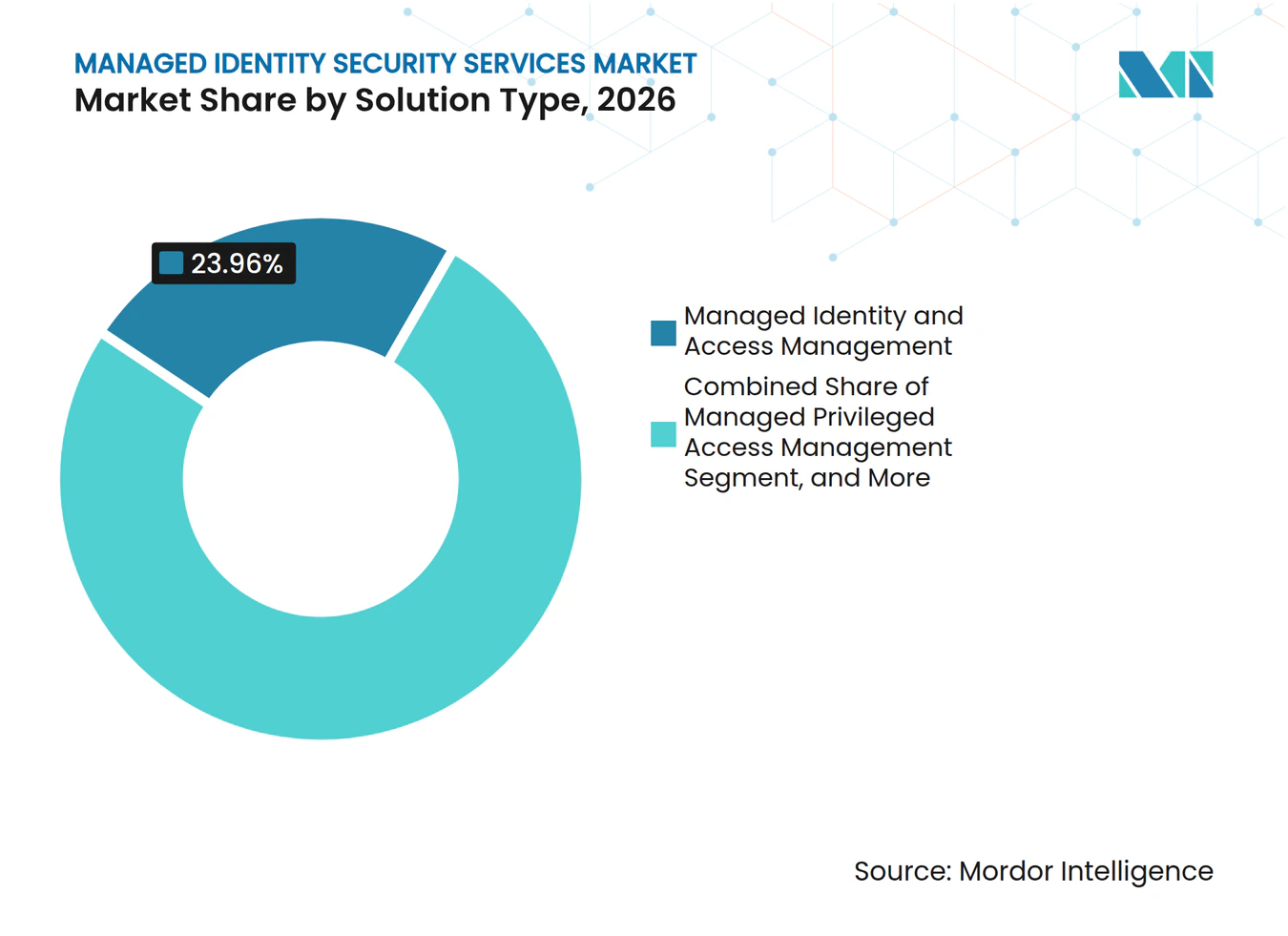
IAM Leads While Non-Human Security AdvancesManaged Identity and Access Management accounted for 23.96% of the managed identity security services market share in 2026. It is often the first managed identity service adopted because it combines provisioning, single sign-on, and access policy management across varied applications. Managed Privileged Access Management remains important to financial services and critical infrastructure, where administrators have elevated access to sensitive systems. Managed Identity Governance and Administration supports access certification and entitlement reviews that auditors expect organizations to maintain. These service types give providers a broad opening to establish operating relationships with clients. An initial IAM service can also reveal where permissions are inconsistent across applications. That visibility can identify further needs for privileged access controls and governance reviews. The Managed Identity Security Services Market size for IAM can expand as customers add connected applications and cloud systems to an existing service scope. Providers that connect these functions can simplify service delivery for customers with several identity tools. This position makes managed IAM an important commercial entry point because a provider can use day-to-day access operations to understand business roles, application dependencies, and policy gaps before proposing related governance, privileged access, or threat detection services.
Managed Non-Human Identity Security is projected to expand at a 13.68% CAGR through 2032, the highest rate among solution types. The Cloud Security Alliance reported that non-human identities increased 44% between 2024 and 2025. GitGuardian found 28.65 million hardcoded secrets added to public GitHub repositories in 2025, including an 81% increase in AI-service credentials. Managed Identity Threat Detection and Response is still developing as a service category, leaving room for early providers to set delivery standards. Managed Authentication and Access Management is also gaining importance as organizations replace passwords with more resilient authentication methods. The service challenge differs from workforce identity because machine credentials are often created outside formal user lifecycle processes. Providers must therefore identify, classify, and monitor identities that may not have an assigned owner. Microsoft planned to make passkeys the default option in Entra ID from September 2026, which reinforces the shift to stronger authentication. Together, these needs are widening the service scope beyond conventional workforce access management. Providers that can combine discovery, ownership assignment, secrets oversight, and access controls can help customers move from reacting to exposed credentials toward a more consistent operating model for machines and AI agents.



By Service Type:
Monitoring Forms the Core of DeliveryManaged Monitoring and Operations held 34.35% of the managed identity security services market share in 2026. It also has the highest projected service-type CAGR at 13.47% through 2032. Organizations need continuous visibility into suspicious sign-ins, privilege changes, and identity-related alerts. SANS found that 27% of organizations experienced breaches connected to security capability gaps, while 60% identified skills gaps as their main workforce challenge. This combination supports external monitoring where internal teams cannot operate a 24-hour program. Monitoring provides recurring revenue and can give providers detailed knowledge of a client’s identity environment. It also allows providers to identify changes that could affect policy enforcement or access risk. This creates a service base from which providers can recommend governance and response work. Customers gain ongoing oversight without having to maintain the full specialist team internally. Monitoring services are especially valuable where access events must be interpreted across cloud services, legacy applications, privileged accounts, and machine identities, because no single internal team may have the capacity to investigate the full set of identity signals.
Consulting and Advisory Services often begin the engagement by helping customers select an architecture and establish priorities. These assignments can lead to longer operational contracts when organizations decide they need continuing support. Integration, Migration, and Deployment Services are important during cloud moves, acquisitions, and compliance programs, although demand is tied to individual projects. Compliance, Audit, and Access Certification Services assist organizations that must review entitlements more frequently. Support, Optimization, and Training Services address capability gaps after a tool is deployed. Each service type can support the others because an implementation often needs advisory work and later operational support. Regular audit activity can also reveal a need to improve monitoring or entitlement design. The Managed Identity Security Services Market size tied to operations is strengthened when initial monitoring contracts progress into governance, optimization, and advisory work. Providers with capabilities spanning this sequence can maintain longer relationships with clients. This breadth matters when organizations want a partner that can support planning, implementation, daily operation, audit preparation, and improvement without transferring responsibility between several service firms.
By Deployment Mode:
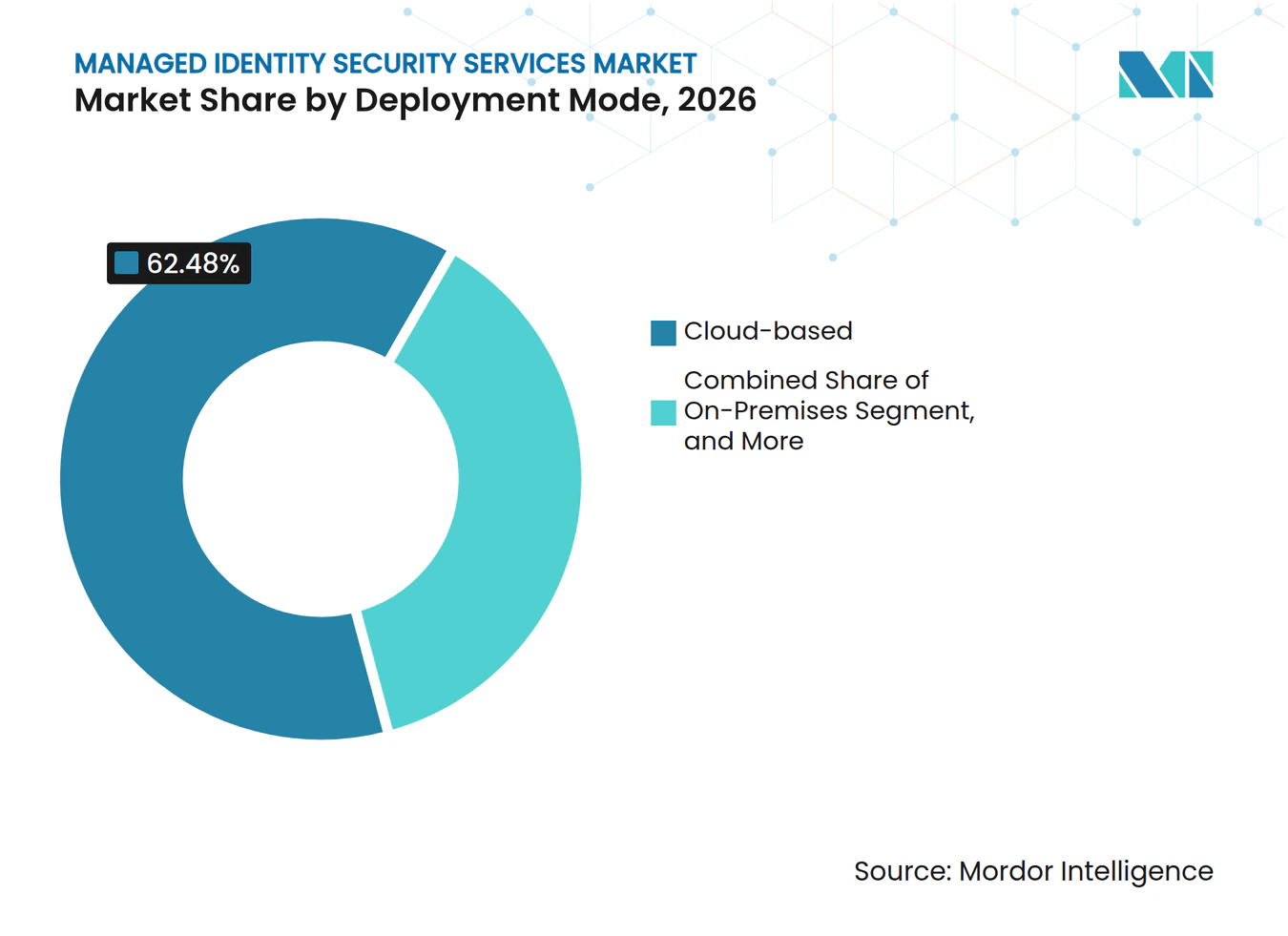
Cloud Delivery Leads, Hybrid Delivery Adds ComplexityCloud-based deployment accounted for 62.48% of the managed identity security services market share in 2026 and is projected to expand at a 13.07% CAGR through 2032. Cloud delivery supports real-time policy enforcement, behavioral analysis, and data sharing across environments. Okta reported that phishing-resistant and passwordless authentication rose from 8.6% to 14.0% of users in 1 year, a 63% increase. Such controls depend on identity orchestration that cloud environments can provide at scale. This has made cloud services the main deployment choice for organizations modernizing access control. It also supports a consistent policy approach across distributed users and applications. The managed identity security services market benefits when cloud identity is integrated into broader security operations. Providers can use this setting to apply monitoring and access policies without relying on a single physical network. That capability is particularly relevant for organizations with remote teams and multiple cloud applications. Cloud delivery can also provide providers with a practical way to update policies and authentication methods as risks evolve, without requiring separate changes at each location or for each application.
On-premises delivery remains necessary for air-gapped systems, classified networks, and organizations with strict data sovereignty rules. Managed providers can operate services against locally hosted infrastructure for customers that cannot move all identity functions to the cloud. Hybrid deployment is relevant to enterprises that are still connecting legacy Active Directory environments to cloud applications. These deployments require a governance layer that can manage policies across both settings. They are more difficult to deliver but can create longer contracts because providers become embedded in a complex environment. They also require careful coordination to prevent inconsistent access decisions between environments. Customers may retain on-premises systems while adopting cloud services for new workloads. This work supports retention because changing a provider can create operational and security risks for the client. Providers that can manage this transition can remain involved as the client’s deployment model changes. The value of hybrid support lies in maintaining consistent visibility and entitlement decisions as the organization moves at a pace dictated by application constraints, regulatory requirements, and the readiness of critical business systems.

By Identity Type:
Workforce Identity Holds the Largest PositionWorkforce Identity held 35.55% market share in the managed identity security services market in 2026. Enterprises use workforce services to manage joiner, mover, and leaver processes, role-based access, and periodic entitlement certification. Established tools and mature processes make this identity type a dependable foundation for managed programs. Privileged Identity is also important because a compromised administrator account can lead to broad exposure across financial services, healthcare, and critical infrastructure. Customer and Citizen Identity continues to support large digital services with external users. Third-Party and Partner Identity is gaining relevance as organizations assess the access granted to vendors, contractors, and supply chain participants. These identity groups have different lifecycle events and risk patterns. A managed provider must apply policies that reflect those differences while maintaining a consolidated view of access. This gives workforce identity a continuing role even as other identity types receive more attention. It also allows providers to connect everyday employee access processes with broader controls for administrators, external users, and partners, so organizations can identify excessive or inconsistent permissions across the full identity estate.
Non-Human Identity is projected to expand at a 13.43% CAGR through 2032. SailPoint reported that 79% of enterprises had AI agents in production, but only 2% had deployed identity security tools designed to govern them. The gap exposes service accounts, application credentials, and AI agents to inconsistent governance. SpyCloud recovered 18.1 million non-human identity credentials from underground sources in 2025. Providers are responding with monitoring and controls designed for workload identities rather than user accounts. Machine identities can operate at scale and may retain access for long periods without the review processes used for employees. They also require controls that account for application dependencies and automated tasks. This demand can change the scope of managed identity programs as organizations place machine credentials under the same operating model as workforce access. It gives managed providers a role in locating credentials that teams may not know exist. Effective delivery must also distinguish between identities that require ongoing access to production services and those that remain active only because ownership, purpose, or removal processes are unclear.
By Organization Size:
Large Enterprises Lead, SMEs Offer Expansion PotentialLarge enterprises accounted for 80.42% of the managed identity security services market share in 2026. They manage broad application portfolios, complex entitlement structures, and higher volumes of privileged access. Their security teams also face risks that are too extensive to govern fully with internal resources. Large organizations can fund integration projects and maintain formal vendor procurement processes. This makes them the central revenue base for established managed service providers. Competition for these accounts is high because identity specialists and larger security service providers target the same buyers. These customers also need services that work across varied regions, applications, and regulatory settings. Their scale can make a phased approach more practical than a single transformation project. Providers that can coordinate this work across multiple teams may gain broader service roles. Large organizations are also more likely to require detailed reporting, recurring access reviews, and documented operating procedures, which can make a specialist-managed service relationship more durable after the initial deployment work is complete.
Small and medium enterprises are projected to expand at a 12.86% CAGR through 2032. Their need is rising as phishing and ransomware campaigns increasingly target organizations with limited security staffing. Per-user cloud identity platforms and packaged monitoring services are reducing earlier costs and implementation barriers. The FIDO Alliance found that organizations deploying passkeys reported fewer password reset tickets, fewer phishing incidents, and faster employee login times. These outcomes are tangible for smaller buyers who must balance security, cost, and administration. Smaller organizations are less likely to have dedicated identity teams, so a managed model can reduce operational pressure. Standardized service packages can also shorten the time needed to begin using stronger access controls. Providers that package governance and monitoring in manageable service tiers can broaden adoption in this segment. The opportunity depends on maintaining a clear scope and affordable onboarding for these buyers. A provider that explains the operational value in practical terms, including reduced credential support workload and stronger access control, can make managed identity services easier for smaller organizations to adopt.
By End-User Vertical:
BFSI Leads While Healthcare and Life Sciences AccelerateBFSI accounted for 24.97% of the managed identity security services market share in 2026. Financial institutions manage privileged access to systems that support transactions, customer records, and market operations. A compromised administrative account can expose an institution to fraud, ransomware, and supervisory action. This makes managed privileged access and continuous monitoring core procurement priorities. Financial organizations also face recurring requirements to document access controls and maintain audit trails. The managed identity security services market remains supported by regular renewal needs in this vertical, even when broader technology budgets are constrained. Third-party and partner access is an important area because institutions depend on core banking vendors, contractors, and API partners. These relationships create access paths that must be governed without delaying routine operations. Providers with financial-sector experience can address this need within a continuing service model. They can also help institutions apply access reviews and monitoring to external relationships that may otherwise be managed separately from workforce and administrator identity processes.
Healthcare and Life Sciences are projected to expand at a 13.84% CAGR through 2032. The vertical is managing more electronic patient data, telehealth services, and remote monitoring systems. The HHS proposal to require multifactor authentication and encryption for electronic protected health information has increased attention on access controls. AWS has stated that healthcare organizations are treating the proposed requirements as an important factor in new cloud deployments. IT and Telecom, Government and Defense, Retail and E-Commerce, Energy and Utilities, and other verticals also sustain demand through cloud adoption and sector-specific data protection duties. Healthcare systems need to manage access for employees, clinical partners, and technology systems without interrupting care delivery. This creates demand for reliable authentication, access reviews, and monitoring. The combination of patient safety, sensitive records, and the growing adoption of digital service delivery makes healthcare a high-priority opportunity for providers. It also supports a need for services that can meet stringent operational and privacy requirements. Providers that understand clinical workflows can make identity controls more practical by aligning access administration and monitoring with the people, applications, and connected systems involved in delivering care.
Geography Analysis
North America Managed Identity Security Services Market
North America held 47.01% of the managed identity security services market share in 2026. The United States leads regional revenue because cloud-focused enterprises use managed identity as part of ongoing security operations. Canada is building demand in financial services and government, while Mexico is expanding through BFSI and manufacturing. The regional shortage of identity specialists supports outsourcing, particularly as organizations struggle to control access to AI agents. Mature procurement practices make the region the largest market for providers with broad delivery capability.
APAC Managed Identity Security Services Market
Asia-Pacific is projected to expand at a 13.46% CAGR through 2032. India, South Korea, Japan, Australia, and Southeast Asian economies are moving from fragmented access systems to managed identity programs. India’s fintech activity and government digitization are creating large identity estates, while South Korea is increasing attention to operational technology identity security. China’s domestic cloud growth operates under sovereignty constraints, and Australia maintains an established base in financial services and government. SailPoint’s South Korean data center reflects providers’ response to regional data residency requirements.
EMEA and South America Managed Identity Security Services Market
Europe is the second-largest regional market in 2026, supported by strict data governance and established access lifecycle management. The United Kingdom has an active managed security services environment, while Germany is extending controls into automotive and manufacturing technology. South America is developing through digitization in BFSI and retail, led by Brazil and Argentina. The Middle East and Africa are earlier in adoption but are building demand through sovereign cloud, public digital transformation, banking modernization, and mobile-first services. Providers must adapt data residency and partner approaches to these differing regional conditions.
Competitive Landscape
Market Concentration
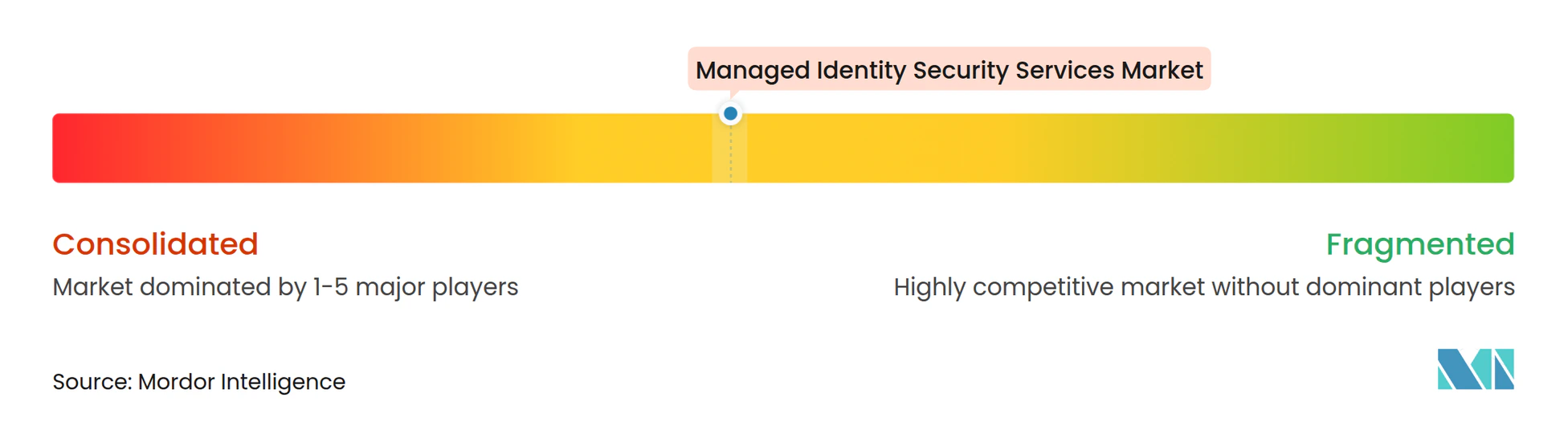
The managed identity security services market is moderately concentrated. Identity specialists who once focused on IAM, PAM, or IGA are expanding into related capabilities. Large enterprises often choose providers with deep expertise in their primary risk area, such as entitlement governance, administrator control, or behavioral detection. Mid-market customers more often obtain identity monitoring as part of a broader managed security service. This gives scale advantages to providers that can combine identity operations with security monitoring.
Okta acquired Permiso Security in September 2026 and introduced governance and privileged access capabilities for AWS entitlements, drift detection and remediation, and Kubernetes protection. SailPoint introduced autonomous identity security functions in October 2026 for policy enforcement, shadow AI discovery, and zero-standing-privilege. BeyondTrust introduced CrowdStrike Falcon Next-Gen SIEM integrations in September 2026 to link identity intelligence with threat telemetry.[3] These moves show a shift toward coordinated controls across identity, privilege, and security operations. They raise expectations for managed providers that depend on these platforms.
Non-human identity security for mid-market organizations remains open to providers with an affordable, focused service. Enterprise platforms can be difficult to deploy for smaller organizations with limited security resources. Providers that combine secrets governance, monitoring, and remediation may address this gap. Innovation is centered on controls for AI agents and machine identities rather than human authentication alone.
Managed Identity Security Services Industry Leaders
-
SailPoint Technologies Holdings, Inc.
-
Okta, Inc.
-
BeyondTrust Corporation
-
Delinea, Inc.
-
Palo Alto Networks
- *Disclaimer: Major Players sorted in no particular order
Managed Identity Security Services Market Companies Covered in this Report
- SailPoint Technologies Holdings, Inc.
- Okta, Inc.
- CyberArk Software Ltd.
- BeyondTrust Corporation
- Delinea, Inc.
- One Identity LLC
- Saviynt, Inc.
- Ping Identity Corporation
- ForgeRock, Inc.
- Silverfort, Inc.
- Veza Technologies, Inc.
- Semperis Inc.
- PlainID Ltd.
- Strata Identity, Inc.
- Radiant Logic, Inc.
- Fischer Identity, Inc.
- Omada A/S
- Aembit, Inc.
- Permiso Security, Inc.
- AuthMind, Inc.
- Oort, Inc.
- ConductorOne, Inc.
- Akeyless Security Ltd.
- Transmit Security, Inc.
Recent Industry Developments in Managed Identity Security Services Market
- October 2026: SailPoint launched SailPoint Agentic Fabric at Navigate 2026 on October 6, 2026, introducing autonomous AI agents for real-time identity policy enforcement, shadow AI discovery, and zero standing privilege across human, machine, and AI-agent identities. The company also released IdentityIQ 9.0, announced a new South Korean data center, and commenced preparation for FedRAMP High, PCI DSS 4.0, and EU Sovereign Cloud certifications.
- September 2026: BeyondTrust announced new integrations between its Pathfinder Platform and CrowdStrike Falcon Next-Gen SIEM on September 23, 2026, enabling correlation of identity and privilege intelligence with CrowdStrike threat telemetry to accelerate investigation and response across human, non-human, and AI-agent identities.
- September 2026: Okta acquired Permiso Security and unveiled new Okta Identity Governance and Okta Privileged Access capabilities, including Advanced Entitlement Management for AWS, Automated Drift Detection and Remediation, and Dynamic Kubernetes Protection. Okta also introduced AI-enabled 48-Hour Integrations, reducing new application onboarding from a multi-month manual process to 2 days.
- August 2026: BeyondTrust showcased the first wave of native Pathfinder Platform capabilities at Black Hat USA 2026 on August 3, 2026, including non-human identity governance covering service accounts, API keys, OAuth clients, and workload identities.
Global Managed Identity Security Services Market Report Scope
The managed identity security services market comprises the revenue generated from the provision of outsourced and managed solutions and services that help organizations secure, manage, monitor, and govern digital identities and their access to applications, systems, networks, data, and other digital resources. The market includes managed identity and access management (IAM), identity governance and administration (IGA), privileged access management (PAM), authentication and access services, identity threat detection and response, and non-human identity security, including the ongoing monitoring, administration, integration, deployment, compliance, optimization, and support of identity security environments.
The Managed Identity Security Services Report is Segmented by Solution Type (Managed Identity and Access Management, Managed Identity Governance and Administration, Managed Privileged Access Management, Managed Authentication and Access Services, Managed Identity Threat Detection and Response, and Managed Non-Human Identity Security), Service Type (Managed Monitoring and Operations, Consulting and Advisory Services, Integration, Migration, and Deployment Services, Compliance, Audit, and Access Certification Services, and Support, Optimization, and Training Services), Deployment Mode (Cloud-Based, On-Premises, and Hybrid), Identity Type (Workforce Identity, Privileged Identity, Customer and Consumer Identity, Third-Party and Partner Identity, and Non-Human Identity), Organization Size (Large Enterprises and Small and Medium Enterprises), End-user Vertical (BFSI, IT and Telecom, Government and Defense, Healthcare and Life Sciences, Retail and E-Commerce, Energy and Utilities, and Other End-User Verticals), and Geography (North America, South America, Europe, Asia-Pacific, Middle East, and Africa). The Market Forecasts are Provided in Terms of Value (USD).
Segmentation Overview
| Managed Identity and Access Management |
| Managed Identity Governance and Administration |
| Managed Privileged Access Management |
| Managed Authentication and Access Management |
| Managed Identity Threat Detection and Response |
| Managed Non-Human Identity Security |
| Managed Monitoring and Operations |
| Consulting and Advisory Services |
| Integration, Migration, and Deployment Services |
| Compliance, Audit, and Access Certification Services |
| Support, Optimization, and Training Services |
| Cloud-Based |
| On-Premises |
| Hybrid |
| Workforce Identity |
| Privileged Identity |
| Customer and Citizen Identity |
| Third-Party and Partner Identity |
| Non-Human Identity |
| Large Enterprises |
| Small and Medium Enterprises |
| BFSI |
| IT and Telecom |
| Government and Defense |
| Healthcare and Life Sciences |
| Retail and E-Commerce |
| Energy and Utilities |
| Other End-User Verticals |
| North America | United States |
| Canada | |
| Mexico | |
| South America | Brazil |
| Argentina | |
| Rest of South America | |
| Europe | United Kingdom |
| Germany | |
| France | |
| Italy | |
| Spain | |
| Rest of Europe | |
| Asia-Pacific | China |
| Japan | |
| India | |
| South Korea | |
| Australia | |
| Rest of Asia-Pacific | |
| Middle East | Saudi Arabia |
| United Arab Emirates | |
| Turkey | |
| Rest of Middle East | |
| Africa | South Africa |
| Egypt | |
| Rest of Africa |
| By Solution Type | Managed Identity and Access Management | |
| Managed Identity Governance and Administration | ||
| Managed Privileged Access Management | ||
| Managed Authentication and Access Management | ||
| Managed Identity Threat Detection and Response | ||
| Managed Non-Human Identity Security | ||
| By Service Type | Managed Monitoring and Operations | |
| Consulting and Advisory Services | ||
| Integration, Migration, and Deployment Services | ||
| Compliance, Audit, and Access Certification Services | ||
| Support, Optimization, and Training Services | ||
| By Deployment Mode | Cloud-Based | |
| On-Premises | ||
| Hybrid | ||
| By Identity Type | Workforce Identity | |
| Privileged Identity | ||
| Customer and Citizen Identity | ||
| Third-Party and Partner Identity | ||
| Non-Human Identity | ||
| By Organization Size | Large Enterprises | |
| Small and Medium Enterprises | ||
| By End-User Vertical | BFSI | |
| IT and Telecom | ||
| Government and Defense | ||
| Healthcare and Life Sciences | ||
| Retail and E-Commerce | ||
| Energy and Utilities | ||
| Other End-User Verticals | ||
| By Geography | North America | United States |
| Canada | ||
| Mexico | ||
| South America | Brazil | |
| Argentina | ||
| Rest of South America | ||
| Europe | United Kingdom | |
| Germany | ||
| France | ||
| Italy | ||
| Spain | ||
| Rest of Europe | ||
| Asia-Pacific | China | |
| Japan | ||
| India | ||
| South Korea | ||
| Australia | ||
| Rest of Asia-Pacific | ||
| Middle East | Saudi Arabia | |
| United Arab Emirates | ||
| Turkey | ||
| Rest of Middle East | ||
| Africa | South Africa | |
| Egypt | ||
| Rest of Africa | ||
Key Questions Answered in the Report
What is the size of the Managed Identity Security Services Market?
The market is projected to increase from USD 15.78 billion in 2026 and USD 17.93 billion in 2027 to USD 32.28 billion by 2032, at a 12.48% CAGR.
What is driving demand for managed identity security services?
Credential abuse, cloud and hybrid identity environments, compliance duties, Zero Trust programs, and the increase in non-human identities are expanding demand.
Which deployment model leads managed identity security services?
Cloud-based deployment led with 62.48% revenue share in 2026 and is projected to expand at a 13.07% CAGR through 2032.
Which end-user vertical is expanding fastest?
Healthcare and Life Sciences is projected to expand at a 13.84% CAGR through 2032 as patient data, telehealth, and access control needs increase.
Why are non-human identities important to security programs?
AI agents, service accounts, application credentials, and workload identities require governance because they can hold persistent access to sensitive systems.
Which region offers the strongest expansion outlook?
Asia-Pacific is projected to expand at a 13.46% CAGR through 2032, supported by digital transformation and cloud adoption across major regional economies.