
Managed Linux Server Services Market Size and Share
Market Overview
| Study Period | 2021 - 2032 |
|---|---|
| Market Size (2027) | USD 13.66 Billion |
| Market Size (2032) | USD 24.73 Billion |
| Growth Rate (2027 - 2032) | 12.61 % |
| Fastest Growing Market | Asia-Pacific |
| Largest Market | North America |
| Market Concentration | Medium |
Major Players *Disclaimer: Major Players sorted in no particular order Image © Mordor Intelligence. Reuse requires attribution under CC BY 4.0. | |
Managed Linux Server Services Market Analysis by Mordor Intelligence
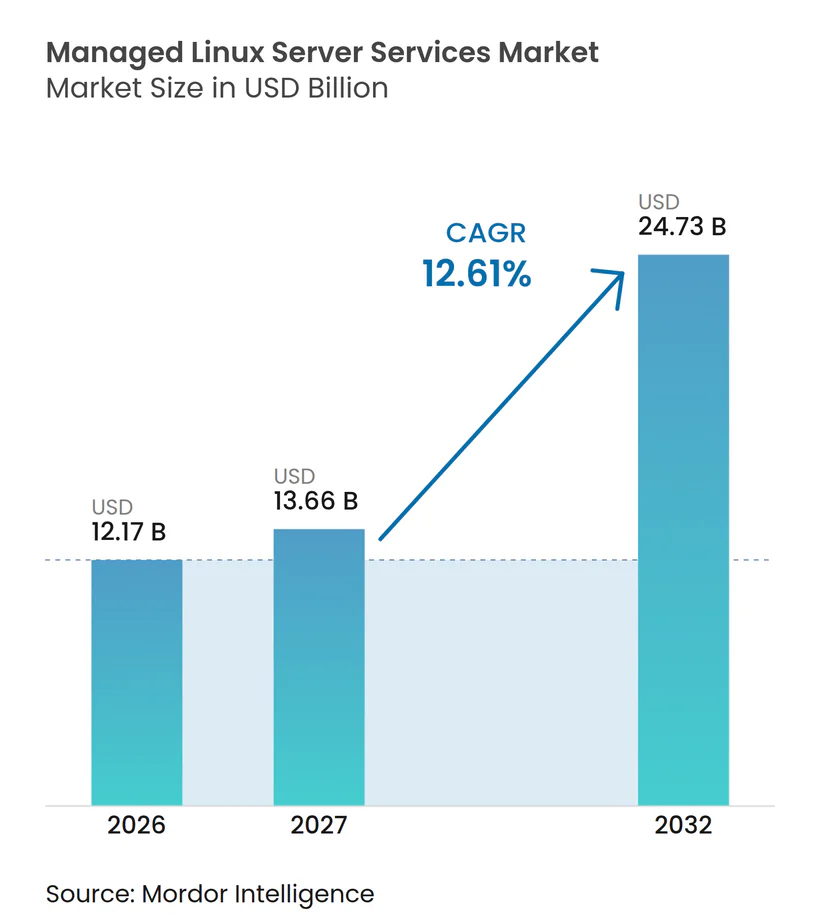
The Managed Linux server services market size is projected to expand from USD 12.17 billion in 2026 and USD 13.66 billion in 2027 to USD 24.73 billion by 2032, registering a CAGR of 12.61% between 2027 to 2032. The Managed Linux server services market is gaining support as organizations treat Linux infrastructure as an operating layer that requires specialized oversight. Hybrid environments make routine configuration, patching, backup, and monitoring work harder to manage internally. Providers can address this need through unified management across private infrastructure and cloud workloads. Security requirements are also widening the scope of managed contracts, especially where regulated data must remain available and protected. Competition is centered on automation, compliance features, regional infrastructure, and service models that work for both enterprise and smaller buyers.
Key Report Takeaways
- By service type, hosting and infrastructure management held 47.12% of the Managed Linux server services market share in 2026, while security and compliance management is projected to expand at a 13.97% CAGR through 2032.
- By deployment mode, on-premise held 66.33% of the Managed Linux server services market share in 2026, while cloud deployment is projected to expand at a 14.31% CAGR through 2032.
- By organization size, large enterprises held 70.16% of the Managed Linux server services market share in 2026, while SMEs are projected to expand at a 14.59% CAGR through 2032.
- By end-user industry, IT and telecommunications held 29.41% of the Managed Linux server services market share in 2026, while healthcare and life sciences is projected to expand at a 13.36% CAGR through 2032.
- By geography, North America held 35.51% of the Managed Linux server services market share in 2026, while Asia-Pacific is projected to expand at a 13.68% CAGR through 2032.
Note: Market numbers in this report are based on Mordor Intelligence's proprietary estimation framework, which combines nine months of actuals with Q4 projections for base year 2026.
Global Managed Linux Server Services Market Trends and Insights
Drivers Impact Analysis*
| Driver | (~) % Impact on CAGR Forecast | Geographic Relevance | Impact Timeline |
|---|---|---|---|
| Enterprise Cloud and Hybrid Infrastructure Adoption | +3.1% | Global, with early intensity in North America and Western Europe | Short term (≤ 2 years) |
| Rising Cybersecurity and Compliance Requirements | +2.5% | North America and EU, with spillover to Asia-Pacific and the Middle East | Short term (≤ 2 years) |
| AI, Edge, and Data-Intensive Workloads Requiring Tuned Linux Environments | +2.0% | Global, most pronounced in North America, China, and India | Medium term (2-4 years) |
| SME Outsourcing of Linux Administration | +1.5% | Global, strongest velocity in Asia-Pacific core and South America | Medium term (2-4 years) |
| Shorter Recovery-Time Objectives for Digital Services | +1.0% | Global, with elevated intensity in BFSI and healthcare | Short term (≤ 2 years) |
| Demand for Sovereign and Regionally Managed Infrastructure | +0.8% | Europe, the Middle East, and Asia-Pacific government segments | Long term (≥ 4 years) |
| Source: Mordor Intelligence | |||
Enterprise Cloud and Hybrid Infrastructure Adoption
The Managed Linux server services market benefits from hybrid Linux environments becoming a durable operating model rather than a temporary transition. Organizations do not simply move all workloads to a single destination because application dependencies, data sensitivity, performance needs, and internal operating practices may require both private and public environments. Red Hat reported that 73% of organizations use a hybrid strategy, while 63% of Linux systems remain on private infrastructure, leaving providers responsible for managing different operating environments, toolsets, and security practices simultaneously. The same research found that hybrid deployments increased by 4% between 2024 and 2026, indicating that the operating model is becoming more established in enterprise technology planning. Cloud-based Linux workloads are expected to rise from 37% to 45%, but private infrastructure remains relevant for controlled workloads, including systems where location, latency, or integration requirements limit rapid migration. Providers that can offer one service model across these environments can simplify accountability for customers, reduce handoffs between teams, and create more consistent monitoring and support processes. Rackspace launched an AI-enabled cloud management platform in August 2025 that supports hybrid and multicloud environments under a consumption-based model, showing how unified management has become part of provider differentiation.
Rising Cybersecurity and Compliance Requirements
Security and compliance requirements expand the scope of work covered in managed Linux contracts and make operational discipline more important for service providers. The HIPAA Security Rule requires safeguards for electronic protected health information, including access controls, audit controls, integrity measures, and transmission security. CIS Controls provide a recognized framework for protecting enterprise assets and data through safeguards that support continuous security operations, including asset awareness, secure configuration, access management, and incident response. These requirements make hardened configurations, vulnerability management, audit logging, documented change control, and incident response more valuable to buyers without large internal teams or dedicated security operations. They also mean that a managed provider must show how it maintains evidence, assigns responsibilities, and responds when a security issue affects a customer environment. Industrial users operating under IEC 62443 requirements and government contractors facing cybersecurity obligations may require specialized operational support because their systems are subject to more formal security expectations. U.S. defense contracting rules finalized in September 2025 reinforced the need for contractors to document cybersecurity implementation.
AI, Edge, and Data-Intensive Workloads Requiring Tuned Linux Environments
AI and edge workloads require Linux configurations tailored to specific processors, storage, network, accelerators, containers, and data-handling needs. These workloads can be more sensitive to configuration choices than conventional business applications because performance often depends on the relationship between compute resources, data movement, runtime settings, and hardware drivers. Red Hat found that 32% of generative AI applications require specialized hardware, and these applications are being deployed in public cloud and on-premise settings at similar rates.[1] This creates demand for providers that can manage GPU driver updates, container runtimes, storage performance, kernel settings, capacity availability, and secure access as part of routine operations. The Linux Foundation reported that Project EVE reached the LF Edge Impact Stage in March 2025 and added multi-node clustering to enable resilient edge deployments. A provider that lacks these capabilities may be suitable for basic hosting but less relevant when customers need stable, tuned environments for AI inference, distributed applications, or data-intensive processing. The Managed Linux server services market can therefore benefit as buyers seek a single operating model that covers specialized workloads alongside traditional Linux infrastructure.
SME Outsourcing of Linux Administration
SMEs increasingly seek managed Linux support when a small internal team can no longer maintain availability, security, performance, backup, and user access across a growing server estate. The Managed Linux server services market offers these buyers a way to shift routine administration to a specialized provider while retaining attention for product delivery, customer relationships, and internal business systems. The risk of relying on a single administrator has become a broader operational concern because the departure or absence of a single person can disrupt patching, incident response, and knowledge of the server environment. Managed support can also create more consistent documentation and escalation procedures, which are important when smaller firms need to demonstrate control to customers, partners, or regulators. Providers are responding with simplified control tools and regional service options that make managed environments more accessible to organizations with limited technical depth. This opportunity is strongest when providers can clearly distinguish essential operational services from optional premium features and explain the value of each part of the contract.
Restraints Impact Analysis*
| Restraint | (~) % Impact on CAGR Forecast | Geographic Relevance | Impact Timeline |
|---|---|---|---|
| Premium Managed-Service Total Cost of Ownership | -1.8% | Global, most acute in price-sensitive South America, Southeast Asia, and SME segments | Short term (≤ 2 years) |
| Vendor Lock-In and Workload Portability Friction | -1.2% | North America and Europe, where multicloud strategies are actively pursued | Medium term (2-4 years) |
| Shortage of Linux, Cloud, and Cybersecurity Specialists | -1.0% | Global, most severe in North America and Western Europe | Medium term (2-4 years) |
| Power, Cooling, and Data-Center Capacity Constraints | -0.6% | North America and Europe, emerging in dense Asia-Pacific urban markets | Long term (≥ 4 years) |
| Source: Mordor Intelligence | |||
Premium Managed-Service Total Cost of Ownership
Premium managed service pricing can delay adoption among mid-market organizations that have not completed a total cost of ownership review. Basic managed support can become more expensive when buyers add compliance controls, high-availability systems, overnight response requirements, tested disaster recovery, and specialized application support. A buyer with a limited server estate may compare the subscription fee against the cost of part-time internal administration rather than against the full cost of outage risk, delayed patching, poor documentation, and security exposure. This comparison can be particularly difficult when the impact of downtime has not been formally measured or when different internal teams own infrastructure, security, and purchasing decisions. Flexible terms, transparent service definitions, and the ability to start with a limited scope are therefore important in the Managed Linux server services market. IONOS introduced Cloud Savings Plans in February 2026, offering up to 47% savings for 1- or 3-year commitments while preserving CPU and RAM flexibility. Such offers show that providers are trying to reduce the cost barrier without removing the value of managed operations, while still encouraging customers to commit to a defined service relationship.
Vendor Lock-In and Workload Portability Friction
Workload portability is a procurement concern when multiyear contracts embed proprietary automation tools, custom monitoring agents, and vendor-specific integrations in the daily operation of a Linux environment. Red Hat found that 54% of organizations prefer Linux distributions optimized for cross-platform portability. Migration becomes harder when operational processes depend on a provider’s interfaces, deployment templates, identity settings, support procedures, and undocumented configuration decisions. Buyers can also face a difficult transition when the provider controls the only complete operational record for a complex environment. Rackspace introduced OpenStack Business in July 2025 as an option positioned around openness and reduced dependence on hyperscaler platforms. ISO/IEC 27001 supports formal information security management practices, which can include structured supplier and service transition controls. Clear exit provisions, documented configurations, and portable deployment designs can therefore matter as much as the quality of day-to-day support in the Managed Linux server services market.
*Our forecasts treat driver/restraint impacts as directional, not additive. The impact forecasts reflect baseline growth, mix effects, and variable interactions.
Segment Analysis
By Service Type: Security Becomes the Fastest-Growing Management Layer
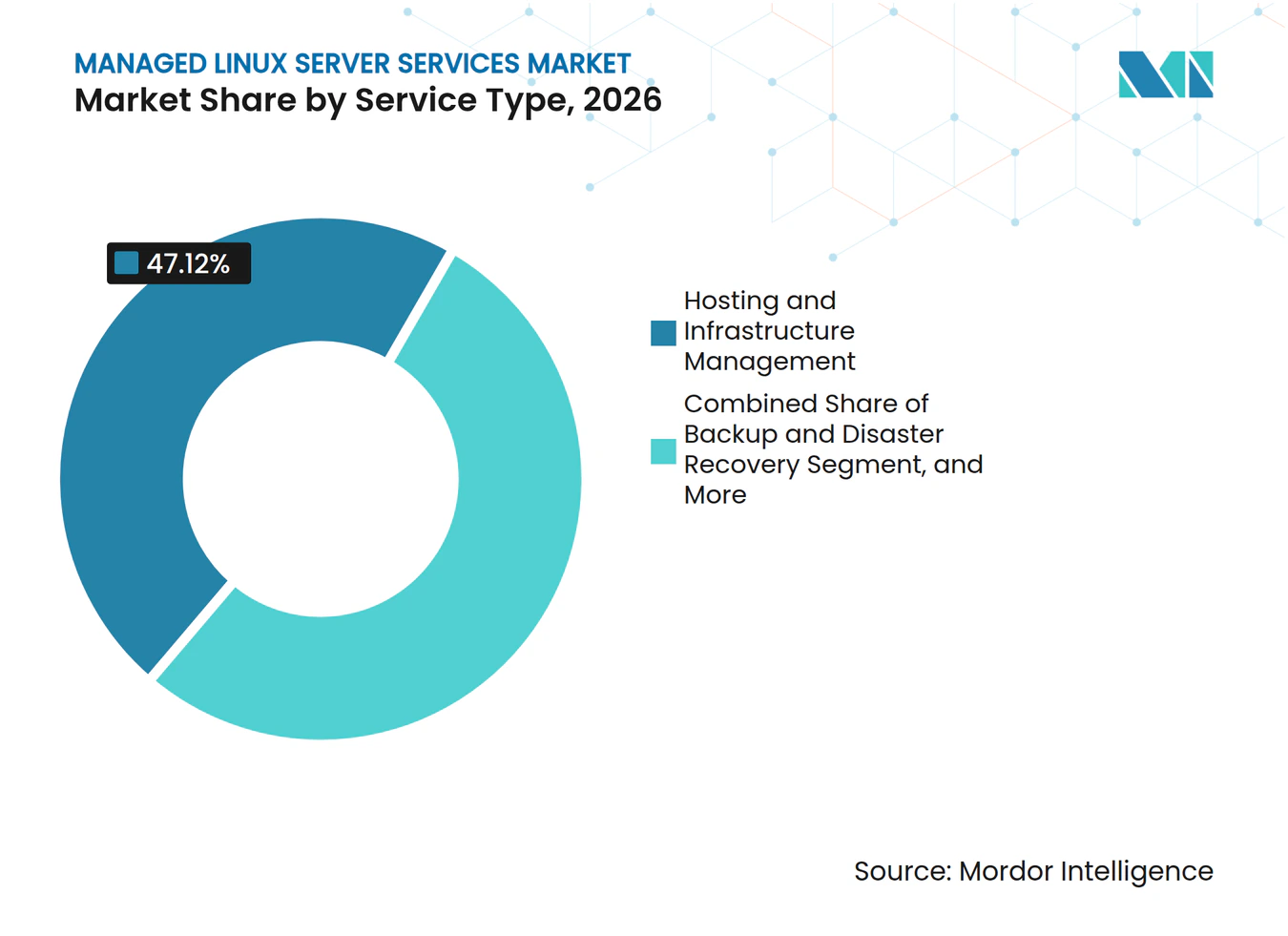
Hosting and infrastructure management accounted for 47.12% of the Managed Linux server services market size in 2026. It remains the usual starting point because many organizations first outsource server provisioning, capacity planning, uptime monitoring, operating system updates, and infrastructure administration. The work is practical and continuous, making it easier for buyers to define service levels for availability, response time, backup completion, and routine maintenance. System administration, performance management, and backup and disaster recovery also remain central to operational continuity when internal teams need assistance across a mixed server estate. Enterprises often enter into multiyear agreements for these services because a provider that understands the operating environment can handle recurring changes with less disruption. This supports recurring demand across the Managed Linux server services market, particularly where infrastructure has accumulated over several years.
Security and compliance management is projected to expand at a 13.97% CAGR through 2032. Buyers increasingly expect providers to include hardening, vulnerability scanning, patching, access controls, audit support, and documented recovery procedures in their managed service scope. CIS Controls provide a recognized set of safeguards that can support this delivery model and help providers organize security tasks in a repeatable way. Security capabilities are particularly important in healthcare and financial services, where operational records, administrator access, and system changes must be controlled and available for review. Providers can use these services to move beyond basic hosting into broader operational support without requiring customers to coordinate separate infrastructure and security vendors. Migration consulting and disaster recovery as a service represent smaller service categories, but they create useful cross-sell opportunities for providers with established accounts.



By Deployment Mode: On-Premise Contracts Persist as Cloud Usage Expands
On-premises deployment accounted for 66.33% in 2026. The segment reflects the retention of sensitive workloads in controlled facilities for data residency, latency, security, application compatibility, and regulatory reasons. Red Hat found that 71% of business-critical Linux workloads span the data center and public cloud, underscoring the ongoing need to manage both environments. Managed on-premise contracts commonly cover hardware lifecycle work, patching, compliance maintenance, security monitoring, backup coordination, and support for applications that cannot be moved quickly. These requirements are especially relevant where workloads depend on legacy integrations, specialized equipment, or internal control over physical infrastructure.
Cloud deployment is projected to expand at a 14.31% CAGR through 2032. The expected rise in cloud-based Linux workloads from 37% to 45% supports this shift. Cloud contracts often use consumption-based billing and require providers to demonstrate value quickly through controlled cost, stable performance, and responsive support. Providers must also manage identity settings, network configuration, workload portability, and operational visibility as resource levels change. Hybrid deployment remains important because it integrates cloud capacity with controlled local infrastructure under a single operating model. Data residency rules, including GDPR requirements and financial-sector resilience obligations in Europe, can shape contract terms, technical design, and the location of managed workloads.
By Organization Size: Large Enterprises Anchor Revenue as SMEs Add Demand
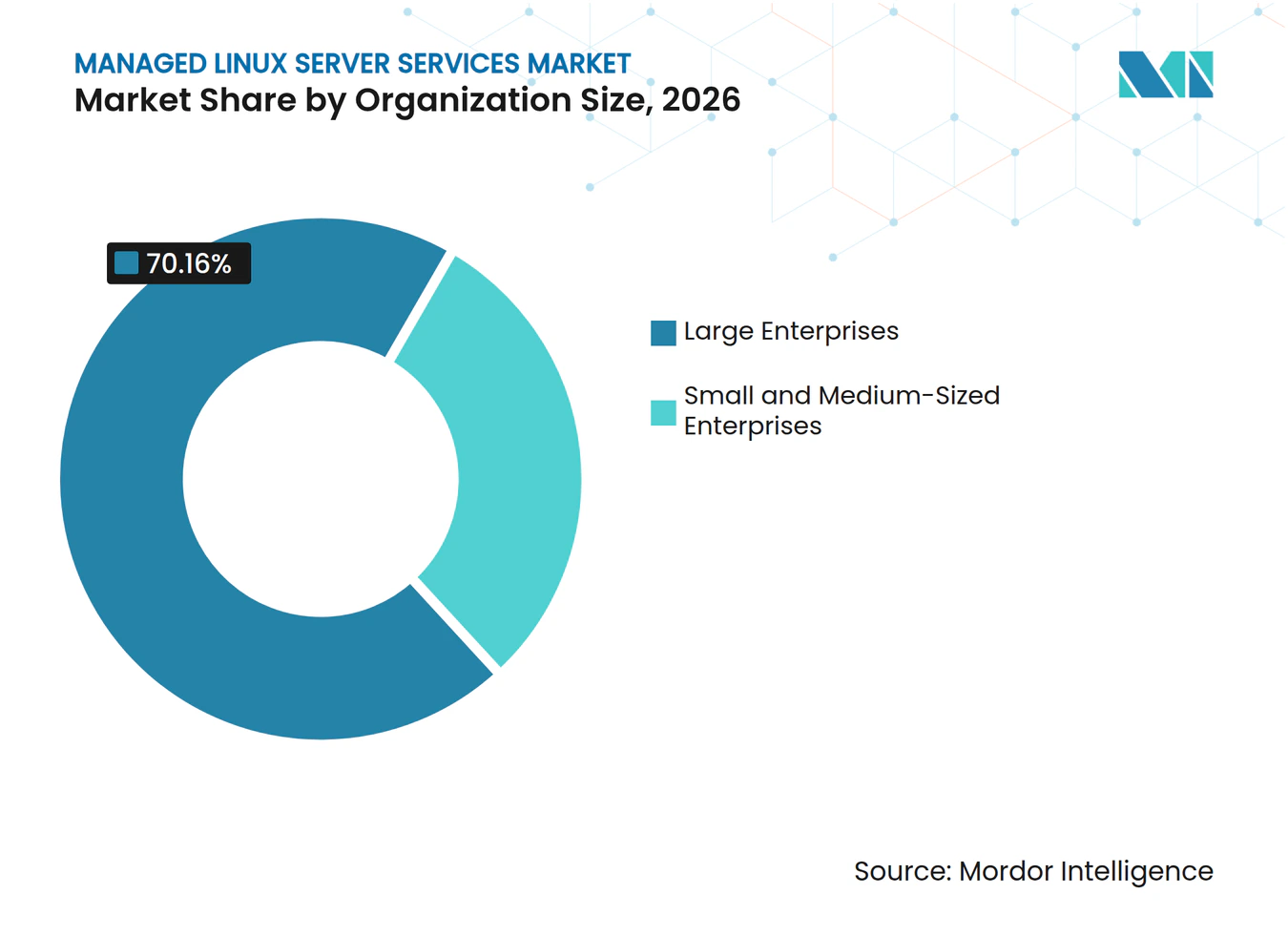
Large enterprises accounted for 70.16% of the Managed Linux server services market in 2026. Their Linux estates often require performance management, security operations, compliance reporting, backup, disaster recovery testing, and 24/7 support across many servers and operating teams. Dedicated sourcing teams and formal procurement processes tend to favor providers with documented capabilities, established escalation procedures, and the capacity to support broad contracts. These customers also need observability and AIOps tools when manual administration is no longer practical across geographically distributed or hybrid environments. The scale of these estates enables large enterprises to consolidate several service categories and establish common standards across business units.
SMEs are projected to expand at a 14.59% CAGR through 2032. Smaller firms tend to seek outside support as a generalist administrator can no longer manage security, uptime, performance, backup, and user requests at the required level. As their digital operations become more important, an outage or security weakness can directly affect customer service and internal productivity. AI-assisted control panels can lower the operational barrier for smaller buyers who previously found advanced Linux configuration difficult to manage. Data protection obligations can further encourage SMEs to use managed compliance services rather than relying solely on self-managed virtual servers. Providers that offer clear pricing and responsive support are better placed to serve this group, as it adds infrastructure capacity.

By End-User Industry: IT and Telecommunications Lead While Healthcare Accelerates
IT and telecommunications accounted for 29.41% in 2026. The sector relies heavily on Linux in high-availability, low-latency environments that require continuous support, controlled release processes, and fast incident response. BFSI is another significant user because payment security, operational resilience, audit requirements, and third-party technology oversight are central requirements. Government, manufacturing, retail and e-commerce, and education users also rely on managed infrastructure for digital platforms, operational technology integration, transaction systems, public services, and research computing. Each of these groups has a different operating profile, but all depend on a stable infrastructure that can be monitored and updated without unnecessary downtime.
Healthcare and life sciences are projected to expand at a 13.36% CAGR through 2032. EHRs, telehealth, clinical data platforms, and connected care systems underscore the importance of secure, available Linux environments. The HIPAA Security Rule establishes safeguard requirements for covered entities and business associates that handle electronic protected health information. Atlantic.Net offers HIPAA-focused hosting with encrypted storage, intrusion prevention, multifactor authentication, and other managed protections.[2] Healthcare buyers need a provider that can support technical controls while also maintaining the evidence needed for internal reviews and external audits. These integrated capabilities can make managed contracts better suited to healthcare procurement requirements.
Geography Analysis
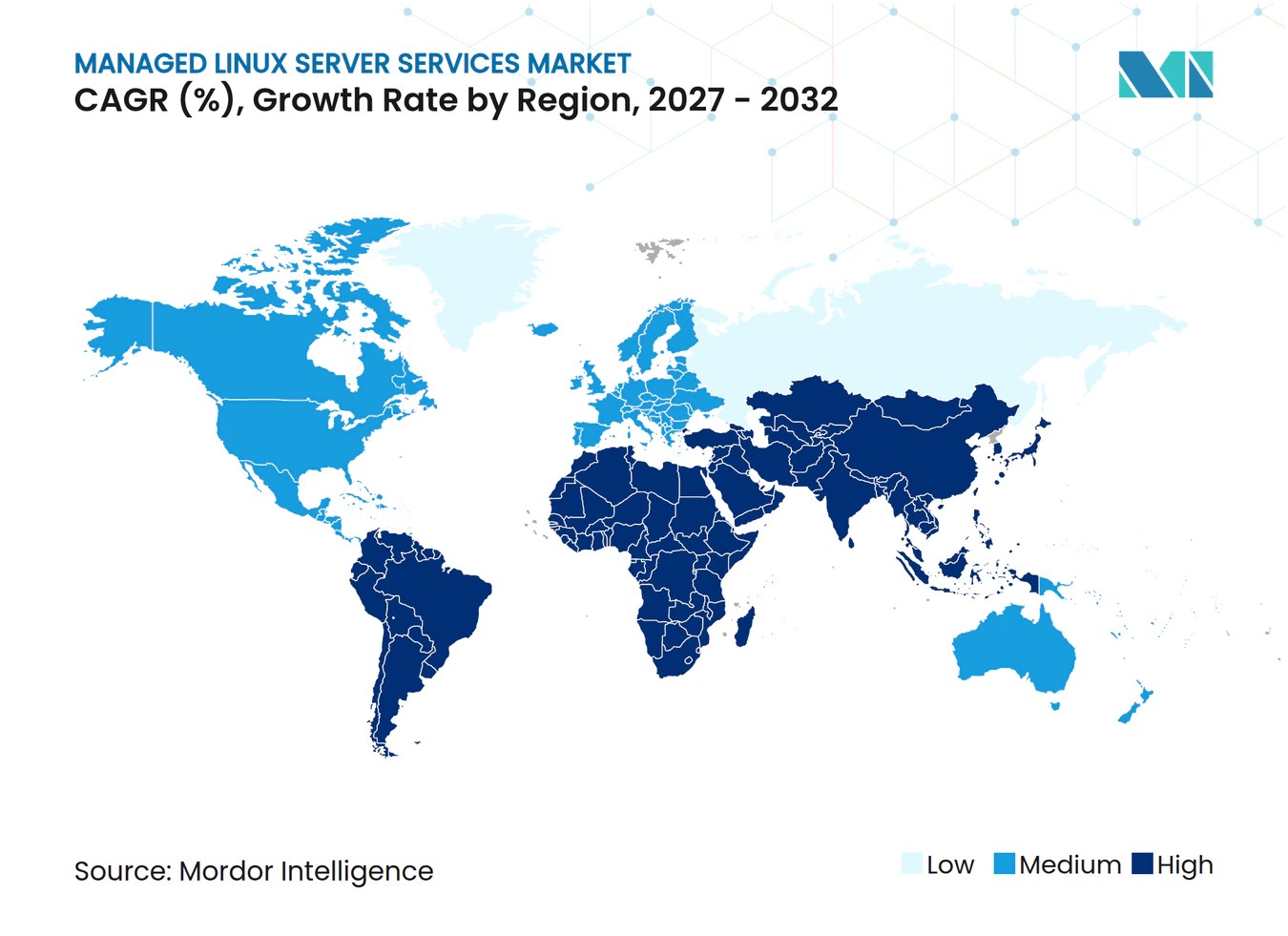
North America held 35.51% of the Managed Linux server services market in 2026, supported by a large base of enterprise Linux installations, cloud infrastructure, managed service providers, and buyers in technology, healthcare, financial services, and public-sector operations. Demand is also supported by organizations that need operating support across private data centers, public cloud environments, and distributed applications. U.S. defense contracting rules finalized in September 2025 require contractors to document the implementation of cybersecurity requirements, which adds importance to managed security support. Canada supports demand for managed hosting that meets privacy expectations, while Mexico presents an SME-led opportunity tied to nearshore digital services.
Asia-Pacific is projected to expand at a 13.68% CAGR through 2032, supported by digital government programs in India, South Korea, and ASEAN, cloud adoption in China, and enterprise modernization in Japan. The scale and diversity of the region mean that providers must adapt their infrastructure, service hours, and compliance support to local customer needs. China is distinct because the Cybersecurity Law and Multi-Level Protection Scheme set security expectations for organizations handling classified information. South Korea’s cloud-first public-sector approach can also encourage migration to managed infrastructure. Providers need regional capacity, local operating knowledge, and suitable compliance practices to compete effectively in this varied environment.
Europe remains important because GDPR and sovereign cloud requirements make data location, operational control, and supplier accountability central buying factors. Leaseweb participated in the EU IPCEI-CIS initiative in March 2025, supporting open-API sovereign cloud infrastructure and independent container platforms.[3] OVHcloud opened its 44th data center in Milan in May 2025, adding a 3-availability-zone architecture in Lombardy and supporting regional data residency capacity. The Middle East is supported by digital sovereignty programs in Saudi Arabia and the UAE, while demand in Africa is centered on financial services and mobile-first platforms in markets including South Africa and Nigeria. These regions offer different entry points, but in each case, local infrastructure and trusted operational support can matter more than a standardized global service offer.
Competitive Landscape
Market Concentration
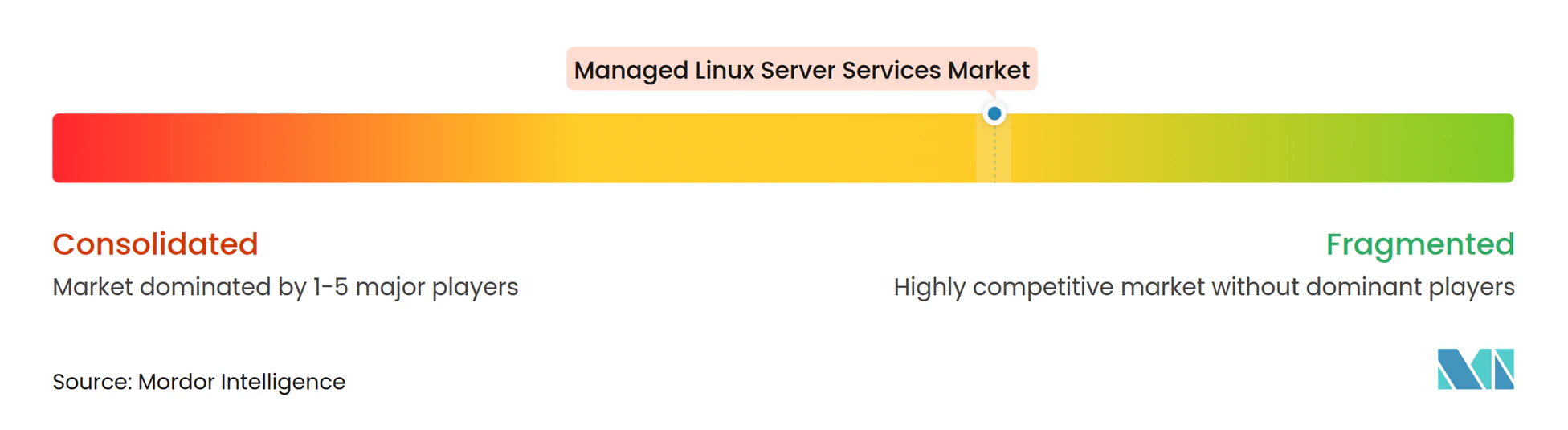
The Managed Linux server services market is moderately fragmented, with no provider holding a dominant position across all geographies and service categories. Rackspace Technology competes through enterprise service levels, multicloud operations, and AI-enabled cloud management. OVHcloud and Leaseweb focus on infrastructure capacity, cost-performance, data residency commitments, and European operating coverage. Liquid Web, Hostinger, IONOS, and Akamai address different buyer needs through managed hosting, compliance support, service automation, and distributed cloud capacity. The Managed Linux server services market, therefore, rewards firms that combine reliable infrastructure with focused operational expertise.
Technology is a key competitive tool in the Managed Linux server services market. Providers use automated patching, AIOps-driven monitoring, self-healing systems, managed Kubernetes services, and standardized control panels to improve availability and response times. IONOS introduced Intel Xeon 6 dedicated servers in June 2026 for high-density virtualization, AI analytics, and scientific workloads in its DSGVO-compliant data centers. Akamai launched its Managed Container Service in February 2025 across more than 700 cities and 4,300 points of presence, providing a distributed option for data-intensive workloads.[4] These moves reflect the need to manage applications closer to users while retaining consistent operational control, security policies, and support procedures.
Partnerships and service integration also shape positioning in the Managed Linux server services market. Canonical announced Ubuntu and Ubuntu Pro as launch partners for AWS European Sovereign Cloud in January 2026, supporting European Linux deployments with EU-resident infrastructure. SUSE and evroc announced a partnership in December 2025 to combine SUSE Linux Enterprise, SUSE Linux Micro, and SUSE Rancher Prime on a European cloud platform. Smaller specialists, such as Atlantic.Net, can compete by offering narrowly focused compliance offerings, including HIPAA-oriented Linux hosting. This mix of broad platforms, regional infrastructure providers, and compliance specialists supports the view that the field remains fragmented.
Managed Linux Server Services Industry Leaders
-
Akamai Technologies, Inc.
-
Atlantic.Net, Inc.
-
Contabo GmbH
-
OVH Groupe S.A.
-
Hostwinds, LLC
- *Disclaimer: Major Players sorted in no particular order
Recent Industry Developments
- August 2026: Rackspace Technology launched Rackspace Cloud, a fully managed multitenant cloud platform built on VMware Cloud Foundation 9.1, initially available in Dallas with planned expansion to Northern Virginia and Chicago. The platform delivers elastic capacity for virtual machines, Kubernetes, and GPU workloads under a governed enterprise framework targeting regulated industries seeking to offload VMware infrastructure operations.
- May 2026: Rackspace Technology and AMD signed a Memorandum of Understanding to create a new category of governed enterprise AI infrastructure that embeds AMD Instinct GPUs and EPYC CPUs into a fully managed, governed operational stack. The partnership targets regulated enterprises and sovereign workloads where security, governance, and accountability are non-negotiable, with Rackspace owning the managed operating model.
- April 2026: Liquid Web integrated into Nexcess, combining Liquid Web's managed hosting expertise with Nexcess's cloud capabilities and Servers.com's global bare-metal infrastructure into a unified platform. The integration expanded managed service capabilities and global redundancy for 185,000+ customers without service disruption.
- March 2026: IONOS launched the IP4-50 GPU server with NVIDIA Blackwell RTX PRO 6000 architecture and 96 GB of VRAM as part of its Momentum AI ecosystem, providing DSGVO-compliant high-performance computing for AI model training and inference across European data centers. The launch marked IONOS's strategic entry into AI-infrastructure managed services for European SME and mid-market buyers.
Global Managed Linux Server Services Market Report Scope
The Managed Linux Server Services Market comprises outsourced services that support the deployment, administration, performance optimization, security, compliance, backup, disaster recovery, hosting, and infrastructure management of Linux-based server environments across enterprise and cloud infrastructures.
The Managed Linux Server Services Market Report is Segmented by Service Type (System Administration and Performance Management, Security and Compliance Management, Backup and Disaster Recovery, Hosting and Infrastructure Management, and Other Service Types), Deployment Mode (On-Premise, Cloud, and Hybrid), Organization Size (Small and Medium-Sized Enterprises, and Large Enterprises), End-User Industry (Banking, Financial Services, and Insurance [BFSI], Government and Public Administration, Healthcare and Life Sciences, IT and Telecommunication, Industrial Manufacturing, Retail and E-commerce, Education and Research Institutions, and Other End-User Industries), and Geography (North America, South America, Europe, Asia-Pacific, Middle East, and Africa). The Market Forecasts are Provided in Terms of Value (USD).
| System Administration and Performance Management |
| Security and Compliance Management |
| Backup and Disaster Recovery |
| Hosting and Infrastructure Management |
| Other Service Types |
| On-Premise |
| Cloud |
| Hybrid |
| Small and Medium-Sized Enterprises |
| Large Enterprises |
| Banking, Financial Services, and Insurance (BFSI) |
| Government and Public Administration |
| Healthcare and Life Sciences |
| IT and Telecommunication |
| Industrial Manufacturing |
| Retail and E-commerce |
| Education and Research Institutions |
| Other End-User Industries |
| North America | United States |
| Canada | |
| Mexico | |
| South America | Brazil |
| Argentina | |
| Rest of South America | |
| Europe | Germany |
| United Kingdom | |
| France | |
| Italy | |
| Russia | |
| Rest of Europe | |
| Asia-Pacific | China |
| Japan | |
| India | |
| South Korea | |
| Rest of Asia-Pacific | |
| Middle East | Saudi Arabia |
| United Arab Emirates | |
| Rest of Middle East | |
| Africa | South Africa |
| Nigeria | |
| Rest of Africa |
| By Service Type | System Administration and Performance Management | |
| Security and Compliance Management | ||
| Backup and Disaster Recovery | ||
| Hosting and Infrastructure Management | ||
| Other Service Types | ||
| By Deployment Mode | On-Premise | |
| Cloud | ||
| Hybrid | ||
| By Organization Size | Small and Medium-Sized Enterprises | |
| Large Enterprises | ||
| By End-User Industry | Banking, Financial Services, and Insurance (BFSI) | |
| Government and Public Administration | ||
| Healthcare and Life Sciences | ||
| IT and Telecommunication | ||
| Industrial Manufacturing | ||
| Retail and E-commerce | ||
| Education and Research Institutions | ||
| Other End-User Industries | ||
| By Geography | North America | United States |
| Canada | ||
| Mexico | ||
| South America | Brazil | |
| Argentina | ||
| Rest of South America | ||
| Europe | Germany | |
| United Kingdom | ||
| France | ||
| Italy | ||
| Russia | ||
| Rest of Europe | ||
| Asia-Pacific | China | |
| Japan | ||
| India | ||
| South Korea | ||
| Rest of Asia-Pacific | ||
| Middle East | Saudi Arabia | |
| United Arab Emirates | ||
| Rest of Middle East | ||
| Africa | South Africa | |
| Nigeria | ||
| Rest of Africa | ||
Key Questions Answered in the Report
What is the Managed Linux server services market size?
The Managed Linux server services market is projected to increase from USD 13.66 billion in 2027 to USD 24.73 billion by 2032, at a 12.61% CAGR. The forecast reflects demand for outsourced support across hybrid environments, security operations, and regulated workloads.
Which service type holds the largest share?
Hosting and infrastructure management leads service types with 47.12% in 2026. Within the Managed Linux server services market, this service provides the daily operational base that covers provisioning, availability, maintenance, and server administration.
Which deployment model is expanding fastest?
Cloud deployment is projected to expand at a 14.31% CAGR through 2032, ahead of other deployment models. The Managed Linux server services market still retains a substantial on-premise base because many workloads require controlled infrastructure and clear data-location arrangements.
Why do organizations use managed Linux services?
Organizations use these services to manage hybrid environments, improve security operations, support compliance needs, and reduce internal administration workloads. The Managed Linux server services market also helps organizations bring patching, monitoring, incident response, and backup work into a defined service model.
Which organizations create the largest revenue base?
Large enterprises account for 70.16% of revenue in 2026 because their Linux environments commonly require broad, multiyear service coverage. Their role in the Managed Linux server services market is supported by complex estates that often span performance management, security, compliance, and 24/7 support.
Which region is expanding fastest?
Asia-Pacific is projected to expand at a 13.68% CAGR through 2032, supported by digital government activity and enterprise cloud adoption. The Managed Linux server services market in the region also benefits from China’s cloud demand, Japan’s modernization activity, and public-sector technology programs in India, South Korea, and ASEAN.