
Managed Bare Metal Services Market Size and Share
Market Overview
| Study Period | 2021 - 2032 |
|---|---|
| Market Size (2027) | USD 7.42 Billion |
| Market Size (2032) | USD 14.88 Billion |
| Growth Rate (2027 - 2032) | 14.93 % |
| Fastest Growing Market | Asia-Pacific |
| Largest Market | North America |
| Market Concentration | Medium |
Major Players *Disclaimer: Major Players sorted in no particular order Image © Mordor Intelligence. Reuse requires attribution under CC BY 4.0. | |
Managed Bare Metal Services Market Analysis by Mordor Intelligence
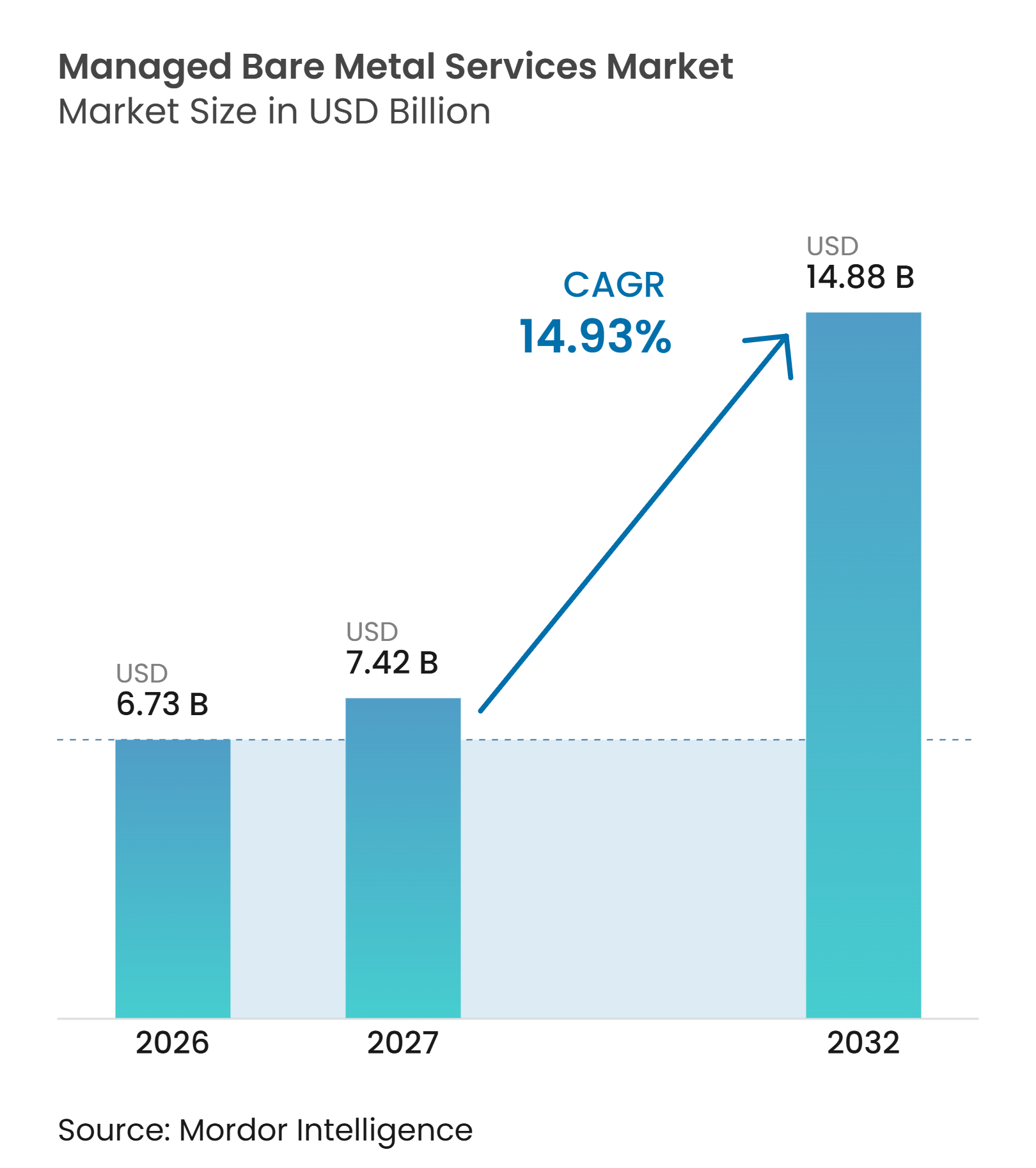
The managed bare metal services market size was valued at USD 6.73 billion in 2026 and is estimated to grow from USD 7.42 billion in 2027 to USD 14.88 billion by 2032, registering a CAGR of 14.93% during the forecast period (2027-2032). The managed bare metal services market is gaining relevance as enterprises deploy AI training, real-time financial processing, and large database workloads. Dedicated infrastructure avoids hypervisor overhead and provides direct access to physical compute resources. Demand is therefore moving beyond a narrow infrastructure niche into a broader enterprise procurement priority. Regulated businesses also value the clear control and auditability of dedicated systems. Providers are responding with managed operations, specialized accelerators, and hybrid deployment options.
Key Report Takeaways
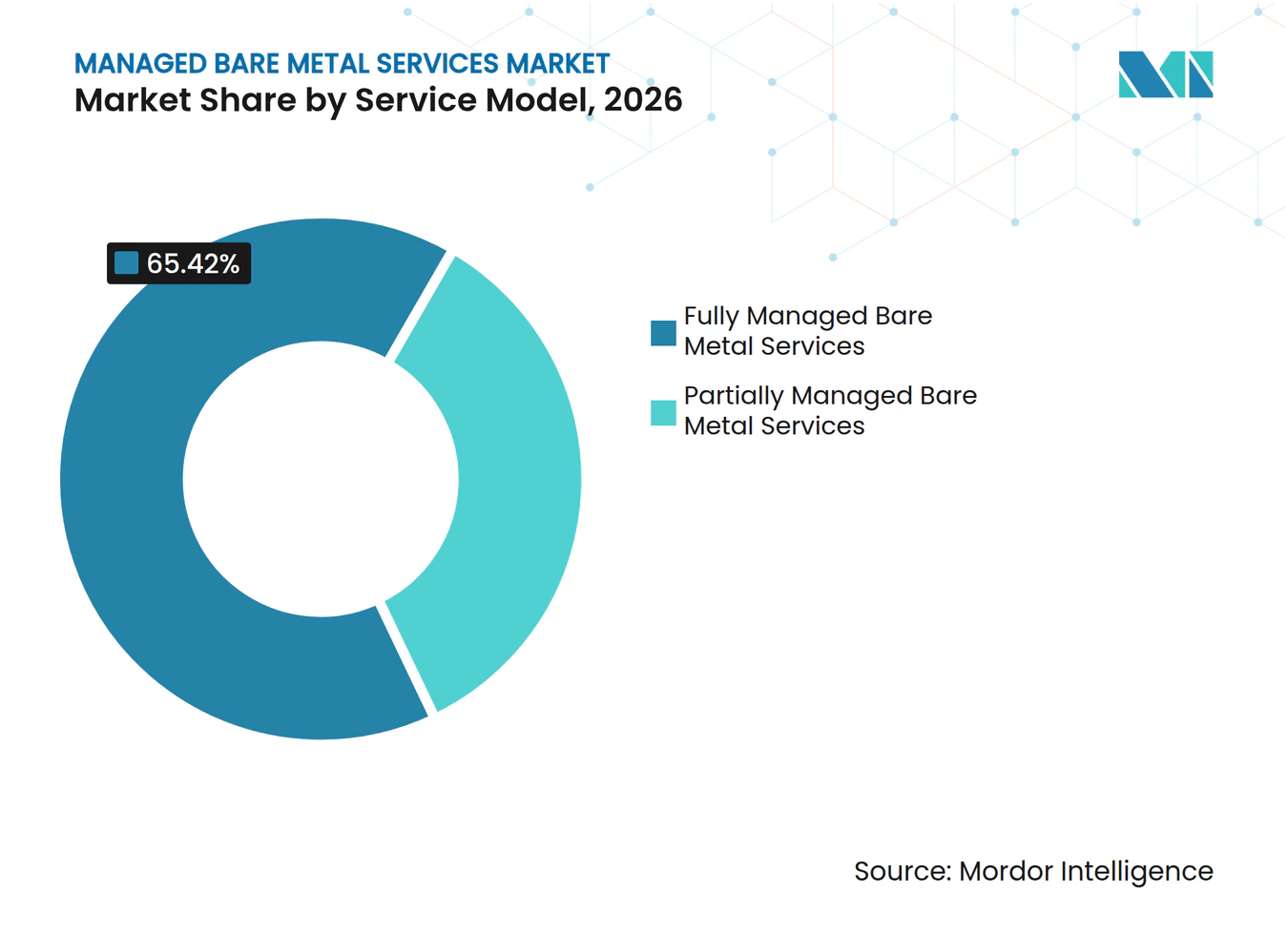
- By service model, the fully managed bare metal services segment held 65.42% of the managed bare metal services market share in 2026, and is projected to register a CAGR of 15.27% during the forecast period (2027-2032).
- By application and workload, the AI and machine learning segment held 27.22% share in 2026, and is projected to expand at a CAGR of 15.14% through 2032.
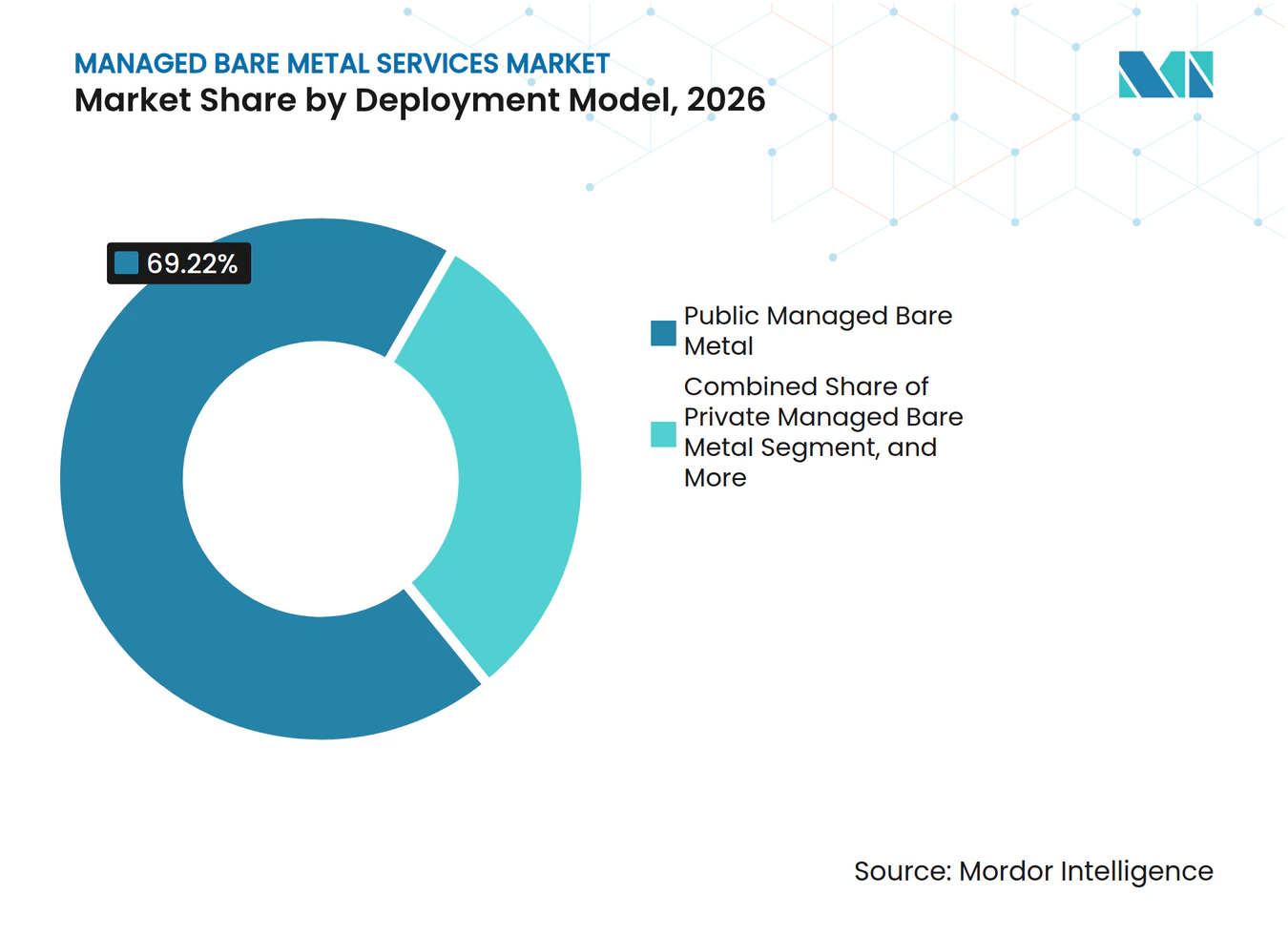
- By deployment model, public managed bare metal held 69.22% of the managed bare metal services market share in 2026, while hybrid managed bare metal is projected to expand at a CAGR of 15.22% through 2032.
- By organization size, large enterprises held 82.14% share in 2026, while SMEs are projected to expand at a CAGR of 15.63% through 2032.
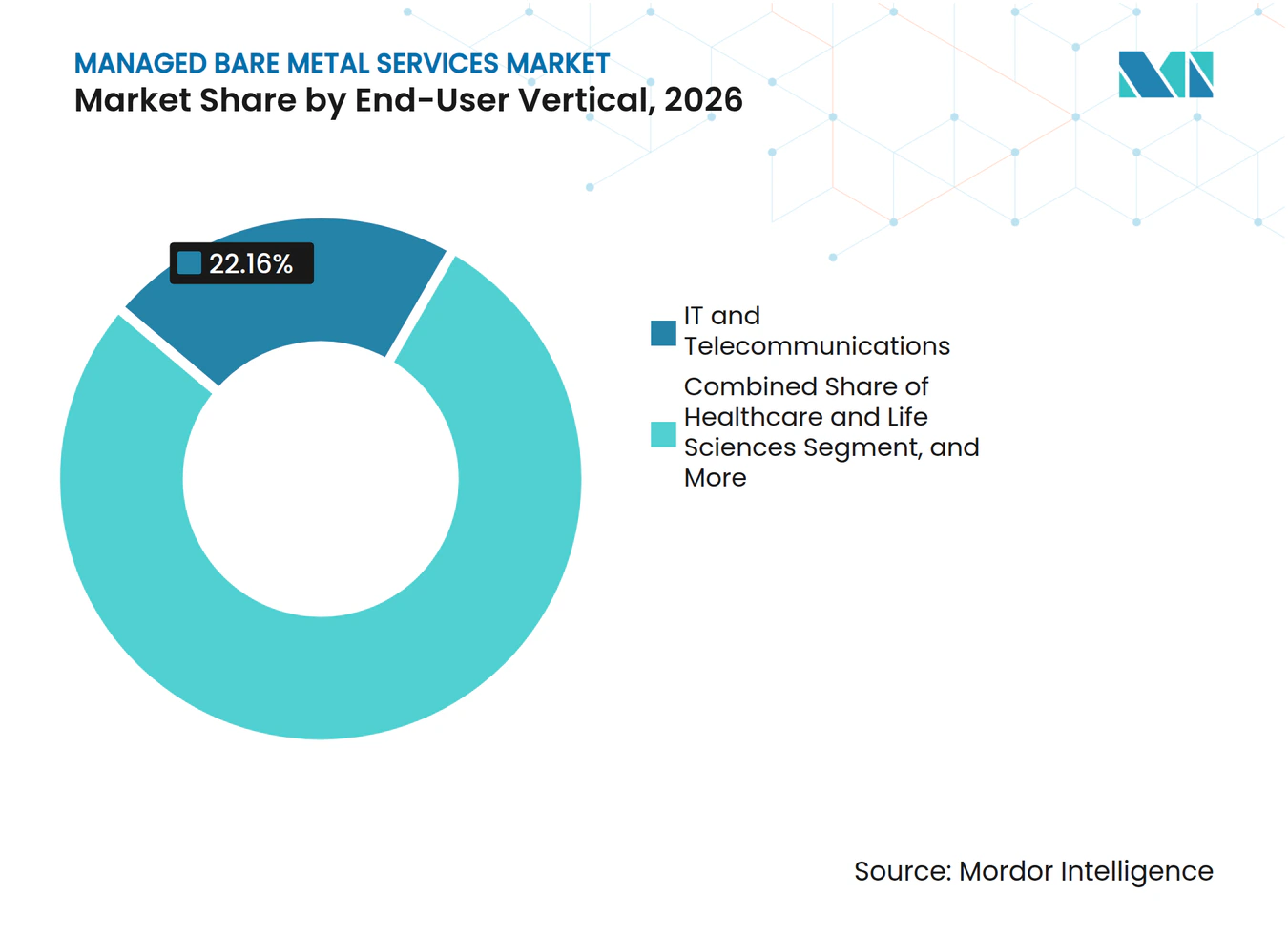
- By end-user vertical, the IT and Telecommunications segment held 22.16% share in 2026, while healthcare and life sciences are projected to expand at a CAGR of 15.43% through 2032.
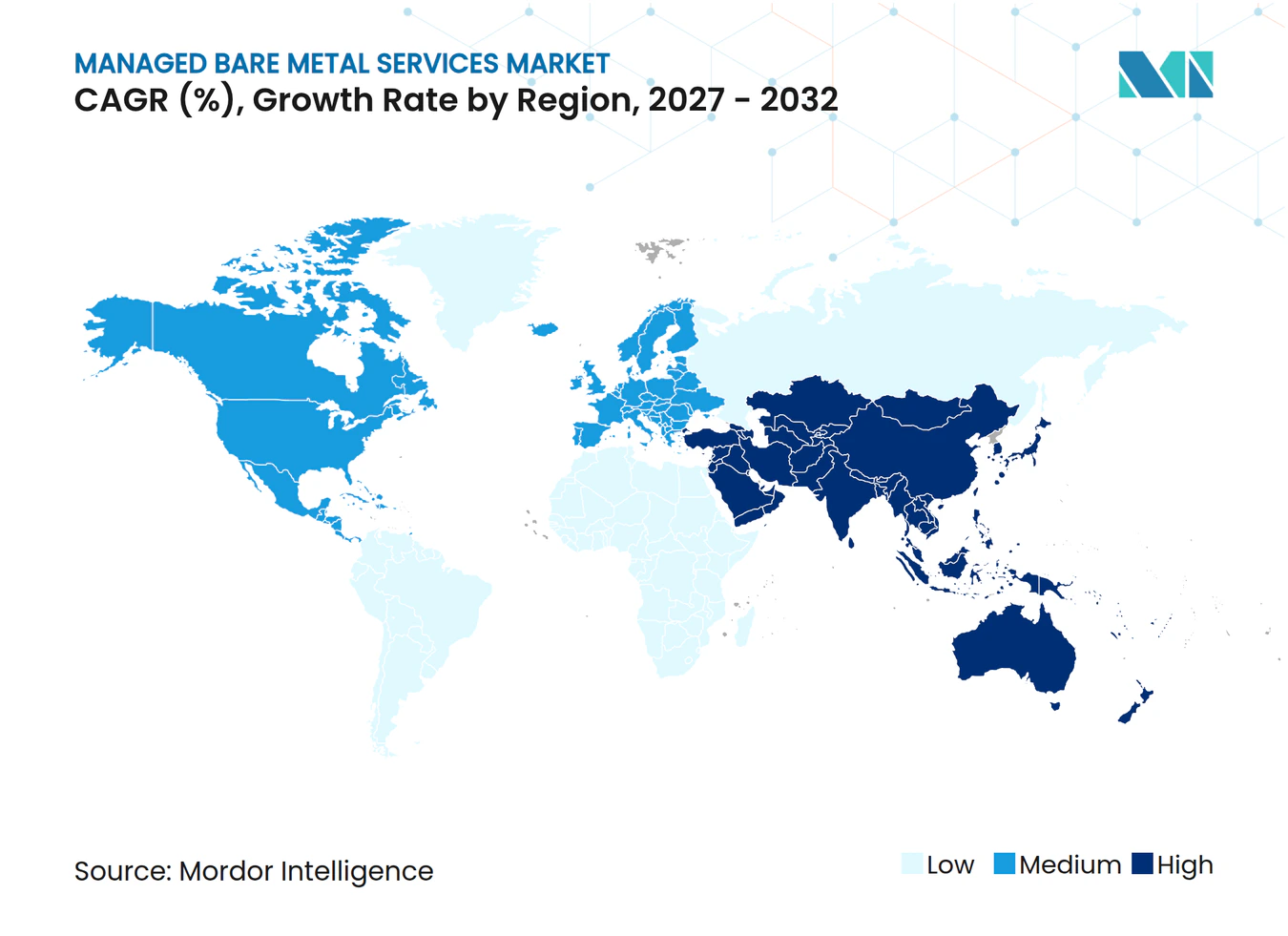
- By geography, North America held 40.66% of the managed bare metal services market share in 2026, while Asia-Pacific is projected to expand at a CAGR of 15.62% through 2032.
Note: Market numbers in this report are based on Mordor Intelligence's proprietary estimation framework, which combines nine months of actuals with Q4 projections for base year 2026.
Global Managed Bare Metal Services Market Trends and Insights
Drivers Impact Analysis*
| Driver | (~) % Impact on CAGR Forecast | Geographic Relevance | Impact Timeline |
|---|---|---|---|
| AI and HPC Workloads Requiring Predictable Bare Metal Performance | +4.1% | Global, with highest intensity in North America and Asia-Pacific | Short term (≤ 2 years) |
| Demand for Dedicated Security and Data Sovereignty | +3.0% | EU, Middle East and Africa, and Asia-Pacific core | Medium term (2-4 years) |
| Hybrid Cloud Modernization of Legacy Enterprise Workloads | +2.4% | North America and EU, with spill-over to Asia-Pacific | Medium term (2-4 years) |
| Custom Hardware and GPU Capacity for Data-Intensive Applications | +1.9% | Global, with North America and Asia-Pacific leading adoption | Short term (≤ 2 years) |
| Edge-Proximate Deployment for Latency-Sensitive Services | +1.3% | Asia-Pacific, North America, and Middle East and Africa | Long term (≥ 4 years) |
| Managed Control Planes Reduce Bare Metal Operations Burden | +0.9% | Global, with concentration in North America and Europe | Medium term (2-4 years) |
| Source: Mordor Intelligence | |||
AI and HPC Workloads Require Predictable Bare Metal Performance
AI model training and high-performance computing require sustained access to GPU memory and network capacity. Hypervisor scheduling can interrupt throughput and introduce latency that affects demanding workloads. The managed bare metal services market benefits when buyers require consistent processing conditions for training, simulations, and data analysis. CoreWeave reported that its GPU cloud economics depend heavily on high utilization, which supports dedicated capacity for persistent workloads.[1] AWS introduced Outposts instances in June 2026 with up to 800 Gbps accelerated network bandwidth. The offering shows that physical infrastructure remains important for enterprise workloads needing high throughput.
Demand for Dedicated Security and Data Sovereignty
Data sovereignty requirements increasingly affect where organizations place regulated workloads. Dedicated systems give customers clearer control over hardware, data placement, and operational records. The managed bare metal services market is well-positioned, where buyers must demonstrate physical separation and jurisdictional control. OVHcloud received the SecNumCloud qualification for its Bare Metal Pod in October 2025. This qualification supports customers who need independently reviewed controls for sensitive workloads. Providers can use similar governance features to serve financial services, public-sector, and healthcare customers.
Hybrid Cloud Modernization of Legacy Enterprise Workloads
Many enterprises retain performance-critical applications while modernizing other parts of their technology environment. ERP platforms, databases, and transaction engines often need consistent latency and traceable operations. The managed bare metal services market supports hybrid designs that pair dedicated systems with public cloud capacity. Rackspace reported USD 235 million in private cloud revenue for the first quarter of 2026. The result indicates continuing demand for managed private infrastructure alongside public cloud services. This approach lets customers retain control of stable workloads while using flexible resources elsewhere.
Custom Hardware and GPU Capacity for Data-Intensive Applications
Data-intensive workloads can require custom network cards, high-bandwidth storage, and specific accelerator configurations. Standard virtual instance catalogs may not offer the required combination of hardware and predictable performance. The managed bare metal services market benefits from buyers seeking dedicated GPU clusters for drug discovery, risk modeling, and simulation. AWS introduced bmn-cx3a Outposts instances with 256 cores and 1.5 TB of memory. The design supports high-throughput analytics and hybrid deployments with dedicated hardware. Providers that simplify access to these configurations can lower deployment barriers for specialized workloads.
Restraints Impact Analysis*
| Restraint | (~) % Impact on CAGR Forecast | Geographic Relevance | Impact Timeline |
|---|---|---|---|
| Higher Total Cost Than Virtualized Cloud Alternatives | -1.9% | Global, with most acute impact in emerging markets and SME segments | Short term (≤ 2 years) |
| Slower Elastic Scaling and Capacity-Planning Requirements | -1.4% | Global, especially North America and EU where cloud-native architectures are mature | Medium term (2-4 years) |
| Hardware Availability and Accelerator Refresh Risk | -0.8% | Global, with concentration in markets dependent on NVIDIA and AMD allocations | Short term (≤ 2 years) |
| Limited Portability Across Provider-Specific Management Stacks | -0.5% | Global, with highest exposure in enterprises using multiple managed bare metal vendors | Long term (≥ 4 years) |
| Source: Mordor Intelligence | |||
Higher Total Cost Than Virtualized Cloud Alternatives
Managed bare metal has a higher starting cost than comparable virtualized cloud resources. Buyers must account for reserved hardware, management services, and periodic refresh commitments. This cost structure can slow adoption among SMEs and organizations with volatile demand patterns. The constraint is more pronounced where upfront budgets carry greater weight in procurement decisions. It also limits use cases where workloads cannot maintain steady utilization. Providers are addressing this issue through shorter commitments and configurations designed for predictable baseline demand.
Slower Elastic Scaling and Capacity-Planning Requirements
Physical infrastructure cannot scale as quickly as virtualized cloud resources during sudden demand spikes. Buyers can either reserve capacity that remains unused or procure extra resources at short notice. This planning requirement creates a practical limit for batch, event-driven, and seasonal workloads. The managed bare metal services market therefore fits stable workloads more readily than unpredictable demand peaks. Automation can reduce provisioning time and improve the customer experience. It cannot remove the need to secure physical hardware before a workload begins.
*Our forecasts treat driver/restraint impacts as directional, not additive. The impact forecasts reflect baseline growth, mix effects, and variable interactions.
Segment Analysis
By Service Model: Full Management Reflects Enterprise Preference
Fully managed bare metal services held 65.42% of the managed bare metal services market share in 2026, and are projected to expand at a 15.27% CAGR through 2032. Customers use this model when they want a single provider responsible for provisioning and operating the environment. The provider can manage operating system images, patches, firmware, monitoring, and routine maintenance. This model is useful for regulated organizations that need clear responsibility across infrastructure operations. It also reduces the internal staffing requirement for organizations without deep infrastructure teams. The managed bare metal services market increasingly competes on operational accountability rather than hardware access alone. Buyers assess who will resolve failures, document changes, and maintain the server estate over its full operating cycle. This expectation favors service models that make ownership of routine infrastructure tasks clear. Customers can use defined service boundaries to align technical responsibilities with business requirements. This supports clearer evaluation of operational risk, cost control, and performance expectations. It also makes support quality and operational reporting important purchasing criteria.
Partially managed services serve technical buyers who want isolated hardware but retain software-layer control. These customers often include DevOps-focused organizations and infrastructure providers with in-house operational capability. Their teams can configure applications and policies while the provider supports the physical environment. However, the economics can change as workloads scale and internal operations costs rise. API-driven control planes make the boundary between partial and full management less rigid. Rackspace and AMD signed a May 2026 memorandum to develop governed enterprise AI infrastructure under a single service-level agreement. The proposal joined compute, managed operations, and inference services in a coordinated offering. It reflected customer interest in retaining application control without taking on every infrastructure task. Partially managed models remain relevant where teams have clear internal responsibilities and established automation practices. Customers can use defined service boundaries to align technical responsibilities with business requirements. This supports clearer evaluation of operational risk, cost control, and performance expectations.


By Application and Workload: AI Workloads Reshape Infrastructure Demand
The AI and machine learning segment held 27.22% share in 2026 and is projected to expand at a CAGR of 15.14% through 2032. Large language model training, inference, and reinforcement learning need direct access to GPUs and high-speed networking. These workloads can lose performance when memory bandwidth is shared or when scheduling becomes inconsistent. Providers are responding with liquid-cooled clusters, fast NVMe storage, and high-bandwidth interconnects. The managed bare metal services market is extending beyond traditional scientific computing as cloud-native companies build inference capacity. Dedicated configurations help customers match infrastructure to the performance profile of their models. Training workloads can require sustained processing over long periods, while inference deployments need consistent response times. These differences make workload planning central to configuration choices. Providers can differentiate by translating these technical needs into clear capacity and operations commitments. Customers can use defined service boundaries to align technical responsibilities with business requirements. This supports clearer evaluation of operational risk, cost control, and performance expectations.
High-performance computing and scientific simulation remain important workload categories. Molecular dynamics, finite-element analysis, and climate modeling often move from on-premise clusters to managed environments. Databases and analytics also use bare metal where direct processor visibility supports performance and licensing decisions. AWS introduced Amazon RDS for Oracle bare metal instances in September 2025 at 25% lower pricing than equivalent virtualized instances. Gaming, media, streaming, enterprise applications, web platforms, and telecom functions broaden the workload base. Telecom use increases where operators deploy 5G network functions on dedicated servers. Customers also consider storage behavior, database requirements, and network paths when selecting an operating environment. A dedicated design is most useful where a workload has known and durable performance requirements. This expands the relevant workload mix without making dedicated servers appropriate for every application. Customers can use defined service boundaries to align technical responsibilities with business requirements. This supports clearer evaluation of operational risk, cost control, and performance expectations.
By Deployment Model: Public Infrastructure Leads While Hybrid Use Expands
Public managed bare metal commanded 69.22% of the market in 2026. Provider-hosted infrastructure offers broad geographic availability and simplifies large-scale hardware procurement. This model gives customers access to capacity without operating their own facilities. It is particularly relevant where clients need dedicated compute across several regions. Public configurations can also be paired with surrounding cloud services for development and data workflows. The managed bare metal services market benefits from providers that can combine this reach with clear performance commitments. Customers also need predictable provisioning processes when projects span more than one location. Regional availability can reduce the operational work required to place workloads close to users or data sources. These practical factors help explain the continuing role of provider-hosted dedicated systems. Customers can use defined service boundaries to align technical responsibilities with business requirements. This supports clearer evaluation of operational risk, cost control, and performance expectations.
Hybrid managed bare metal is projected to expand at a CAGR of 15.22% through 2032. Enterprises use hybrid designs when sensitive, stable workloads need dedicated systems and variable activity needs public cloud resources. The model helps teams separate core processing from applications with fluctuating demand. Private managed bare metal remains relevant for sovereign and regulated deployments with strict jurisdictional requirements. OVHcloud's qualified Bare Metal Pod illustrates how independent compliance controls can be built into private infrastructure.[2] ISO 27001 and BSI C5 requirements also align with the physical control offered by dedicated configurations. Hybrid designs can prevent teams from treating dedicated and public resources as mutually exclusive choices. They instead allocate applications according to stability, sensitivity, and expected demand variation. This approach can preserve control for core processes while maintaining flexibility for adjacent workloads. Customers can use defined service boundaries to align technical responsibilities with business requirements. This supports clearer evaluation of operational risk, cost control, and performance expectations.


By Organization Size: Large Enterprises Anchor Revenue While SMEs Expand
Large enterprises accounted for 82.14% of the managed bare metal services market in 2026. Banks, pharmaceutical companies, and telecom operators can absorb minimum commitments and governance requirements. Their workloads often need physical isolation, reliable performance, and detailed audit records. Many are moving from self-managed colocation to externally managed dedicated environments. This shift can reduce operational overhead that does not directly differentiate the business. It also gives buyers a clearer operating model for infrastructure refreshes and compliance tasks. Large enterprises often have formal procurement, security, and risk teams that can evaluate long-term commitments. Their established processes make it easier to define service levels and responsibilities with providers. This supports the segment’s leading position within the managed bare metal services market. Customers can use defined service boundaries to align technical responsibilities with business requirements. This supports clearer evaluation of operational risk, cost control, and performance expectations.
SMEs are projected to expand at a CAGR of 15.63% through 2032. Shorter commitments and API-provisioned infrastructure are reducing the minimum order size for dedicated compute. Preconfigured compliance options can help smaller organizations meet customer and regulatory expectations. Stable and highly utilized workloads are more suitable than rapidly changing workloads. The segment's development broadens demand beyond the largest traditional buyers. Providers that offer straightforward pricing and deployment can improve access for these organizations. Smaller teams still need to assess whether utilization is steady enough to justify dedicated capacity. They also need support that reduces the need for specialist infrastructure staff. Service designs that address these conditions can widen participation among smaller buyers. Customers can use defined service boundaries to align technical responsibilities with business requirements. This supports clearer evaluation of operational risk, cost control, and performance expectations.
By End-User Vertical: Technology Services Lead While Healthcare Advances
Software, IT services, and telecommunications accounted for 22.16% of the managed bare metal services market size in 2026. SaaS platforms use dedicated systems to support predictable latency for critical applications. Telecom operators also use them for network functions that require consistent performance. Banking, financial services, and insurance follow because risk calculations and low-latency activity require dependable infrastructure. Manufacturing and automotive organizations are using dedicated GPU systems for quality inspection and digital-twin workloads. These uses support demand across industries that combine computing intensity with operational sensitivity. The managed bare metal services market is especially relevant when an application’s results depend on timely and consistent processing. Buyers also value a direct path for resolving issues that affect critical operational systems. These requirements are shared by several verticals, even though their workloads differ. Customers can use defined service boundaries to align technical responsibilities with business requirements. This supports clearer evaluation of operational risk, cost control, and performance expectations.
Healthcare and life sciences is projected to expand at a CAGR of 15.43% through 2032. Genomics, medical imaging, and clinical decision support can require advanced GPU configurations. Healthcare organizations must also protect sensitive information through transparent custody and audit processes. The U.S. Department of Health and Human Services states that cloud providers handling protected health information may be HIPAA business associates.[3]Government demand is developing alongside healthcare as sovereign compute requirements gain attention. These applications favor environments where responsibility for the physical layer is explicit. Healthcare buyers must balance data safeguards with the processing needs of complex clinical and research systems. Government entities face a related need for clear authority over sensitive workloads. Providers that document controls and support processes can address both sets of requirements. Customers can use defined service boundaries to align technical responsibilities with business requirements. This supports clearer evaluation of operational risk, cost control, and performance expectations.
Geography Analysis
North America held 40.66% of the managed bare metal services market share in 2026. The region has a concentration of hyperscaler capacity and a large base of enterprise technology buyers. It also has substantial demand from AI development, financial services, and enterprise databases. AWS introduced Oracle RDS bare metal instances in September 2025 at 25% lower pricing than equivalent virtualized instances. Canada contributes a sovereignty-focused demand for managed dedicated infrastructure. Mexico is gaining activity as nearshoring investments increase demand for factory analytics infrastructure. The region’s installed cloud and network capacity gives large providers a foundation for dedicated offerings. Enterprise customers can use those offerings for workloads that require tighter performance control than shared resources provide. This mix of demand supports continued supplier attention to North American deployment options. Customers can use defined service boundaries to align technical responsibilities with business requirements. This supports clearer evaluation of operational risk, cost control, and performance expectations.
Asia-Pacific is projected to expand at a CAGR of 15.62% through 2032. China, Japan, South Korea, and India are investing in AI infrastructure and digital services. Data location and physical control requirements strengthen the case for locally hosted dedicated systems. Microsoft committed USD 3 billion over 2 years to expand cloud and AI infrastructure in India, including new datacenter regions in India and Taiwan.[4]This investment supports a broader infrastructure base for managed services. The region also combines large digital populations with rising enterprise AI activity. Local hosting can be important when customers must align infrastructure choices with domestic requirements. Providers therefore need capacity as well as local operating support and compliance capabilities. These conditions make the region relevant to global and regional managed service providers. Customers can use defined service boundaries to align technical responsibilities with business requirements. This supports clearer evaluation of operational risk, cost control, and performance expectations.
Europe has demand shaped by privacy rules, security obligations, and national sovereignty strategies. OVHcloud's qualified Bare Metal Pod provides an example of compliance-led positioning for sensitive workloads. The Middle East and Africa is emerging through sovereign compute needs linked to government and smart-city programs. Vultr launched high-performance cloud compute for public-sector customers in October 2025 with sovereign options as a design consideration. South America is supported by Brazil, where data protection requirements encourage investment in dedicated infrastructure. These regions create opportunities for providers that combine local presence with governance capabilities. Customer demand differs across these markets, but control over placement and operations is a shared consideration. Providers can tailor their approach through local facilities, certification support, and managed services. This leaves room for specialists alongside larger global operators. Customers can use defined service boundaries to align technical responsibilities with business requirements. This supports clearer evaluation of operational risk, cost control, and performance expectations.
Competitive Landscape
Market Concentration
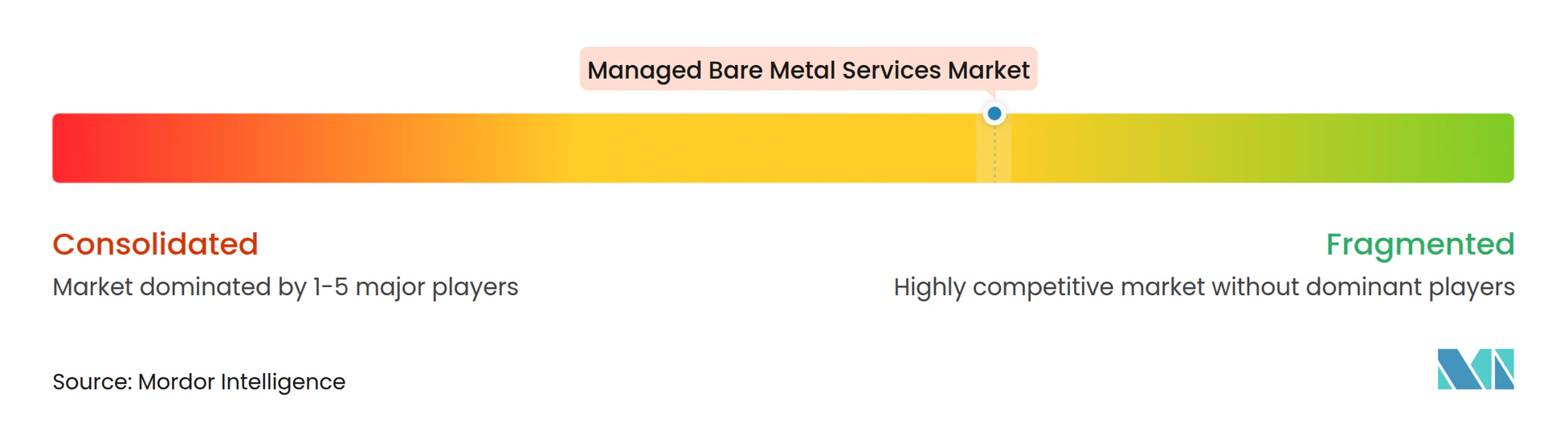
The managed bare metal services market includes global hyperscalers, managed specialists, and regional providers. The managed bare metal services market rewards providers that link physical capacity with dependable operations and clear customer accountability. Amazon Web Services, Microsoft, Google, Oracle, and IBM have procurement scale and extensive network coverage. Their broader cloud agreements can make dedicated infrastructure easier to adopt for existing enterprise customers. Rackspace Technology and OVH Groupe SA compete through managed operations and sovereignty-oriented capabilities. Vultr, DigitalOcean, phoenixNAP, and Hivelocity address customers seeking accessible provisioning and competitive infrastructure options. The competitive structure reflects differences in geographic reach, governance requirements, and workload specialization. Some buyers prioritize large-scale procurement and integration with broader cloud tools. Others place greater weight on local delivery, direct accountability, or specialized support. The managed bare metal services market accommodates each of these competitive approaches. Customers can use defined service boundaries to align technical responsibilities with business requirements. This supports clearer evaluation of operational risk, cost control, and performance expectations.
Hyperscalers can bundle bare metal with storage, databases, networking, and surrounding cloud services. Specialist providers can differentiate through more direct operating accountability and focused compliance support. The managed bare metal services market therefore does not compete only on server capacity or price. Providers also compete on the depth of their control planes, operational support, and ability to meet local requirements. Nutanix introduced NKP Metal in April 2026 to extend its Kubernetes platform to bare-metal infrastructure.[5] The product shows how platform vendors are seeking value above raw infrastructure capacity. Managed orchestration can make dedicated systems easier to deploy and operate for application teams. It also helps providers present physical infrastructure as part of a broader platform experience. This shift can narrow operational differences between dedicated systems and more familiar cloud services. Customers can use defined service boundaries to align technical responsibilities with business requirements. This supports clearer evaluation of operational risk, cost control, and performance expectations.
Industry-specific stacks remain an opportunity where ISO 27001, SOC 2 Type II, and HIPAA controls are necessary for customer qualification. Government and defense workloads also require stronger physical and jurisdictional isolation than many commercial offerings provide. Red Hat and Netris announced a May 2026 collaboration for multi-tenant networking on sovereign AI clouds and neoclouds. The collaboration combines API-based management with hardware-enforced isolation for dedicated servers. DigitalOcean reported that its AI customer annual recurring revenue increased 221% year over year in the first quarter of 2026. This shows continued provider interest in integrated AI infrastructure services. Buyers can benefit when these elements are designed to work together across deployment, operation, governance, and ongoing workload support for customers. Providers are seeking to combine compute, networking, management, and developer-facing tools in a single offer. That strategy can help customers avoid managing separate infrastructure components. It also increases the importance of software and service delivery in competitive differentiation. Customers can use defined service boundaries to align technical responsibilities with business requirements. This supports clearer evaluation of operational risk, cost control, and performance expectations.
Managed Bare Metal Services Industry Leaders
-
Amazon Web Services, Inc.
-
Microsoft Corporation
-
International Business Machines Corporation
-
Google LLC
-
Oracle Corporation
- *Disclaimer: Major Players sorted in no particular order
Recent Industry Developments
- September 2026: IBM Cloud Bare Metal added SLES 16.0 support for SAP HANA and SAP applications on its classic infrastructure, extending the enterprise ERP workload portfolio supported on dedicated bare metal servers.
- April 2026: Cycle.io and Cherry Servers announced a native infrastructure integration allowing Cycle customers to provision and manage Cherry Servers bare metal directly through Cycle's control plane, simplifying bare metal orchestration on European dedicated infrastructure.
- May 2026: Rackspace Technology and AMD signed a memorandum of understanding to develop a governed Enterprise AI Cloud for regulated industries, proposing 4 integrated capabilities from Bare Metal AMD Instinct compute through a fully managed Enterprise Inference Engine under a single SLA targeting sovereignty, compliance, and performance accountability.
- May 2026: Red Hat and Netris announced a collaboration delivering hardware-enforced multi-tenant networking isolation for sovereign AI clouds and neoclouds, with the Netris NAAM platform providing cloud-grade API management for physical bare metal infrastructure and enabling VPC-equivalent networking on dedicated servers.
- February 2026: OVHcloud unveiled its Bare Metal 2026 server generation on AMD EPYC 9005 and Ryzen Zen 5 processors, with the Scale 2026 range supporting AMD SEV confidential computing, 384 cores, 3 TB DDR5 ECC memory, and 92 TB NVMe storage in 3-AZ configurations across Europe, Canada, the United States, and Asia-Pacific.
Global Managed Bare Metal Services Market Report Scope
The managed bare metal services market encompasses dedicated physical servers managed by service providers, including hardware provisioning, configuration, monitoring, maintenance, and technical support. These services deliver high-performance computing, security, and workload control for enterprise applications, AI workloads, databases, and other demanding computing environments.
The Managed Bare Metal Services Market Report is Segmented by Service Model (Fully Managed Bare Metal Services, and Partially Managed Bare Metal Services), Application and Workload (AI and Machine Learning, High-Performance Computing and Scientific Simulation, Databases and Data Analytics, Enterprise Applications and Virtualization, Gaming, Media, and Streaming, Telecom, Edge, and Network Functions, and General-Purpose Web and SaaS Infrastructure), Deployment Model (Public Managed Bare Metal, Private Managed Bare Metal, and Hybrid Managed Bare Metal), Organization Size (Large Enterprises, and Small and Medium-Sized Enterprises), End-User Vertical (IT and Telecommunications, Banking, Financial Services, and Insurance (BFSI), Healthcare and Life Sciences, Manufacturing and Automotive, Media and Entertainment, Government and Public Sector, and Other End-User Verticals), and Geography (North America, South America, Europe, Asia-Pacific, and Middle East and Africa). The Market Forecasts are Provided in Terms of Value (USD).
| Fully Managed Bare Metal Services |
| Partially Managed Bare Metal Services |
| AI and Machine Learning |
| High-Performance Computing and Scientific Simulation |
| Databases and Data Analytics |
| Enterprise Applications and Virtualization |
| Gaming, Media, and Streaming |
| Telecom, Edge, and Network Functions |
| General-Purpose Web and SaaS Infrastructure |
| Public Managed Bare Metal |
| Private Managed Bare Metal |
| Hybrid Managed Bare Metal |
| Large Enterprises |
| Small and Medium-Sized Enterprises |
| IT and Telecommunications |
| Banking, Financial Services, and Insurance |
| Healthcare and Life Sciences |
| Manufacturing and Automotive |
| Media and Entertainment |
| Government and Public Sector |
| Other End User Verticals |
| North America | United States |
| Canada | |
| Mexico | |
| South America | Brazil |
| Argentina | |
| Rest of South America | |
| Europe | Germany |
| United Kingdom | |
| France | |
| Italy | |
| Rest of Europe | |
| Asia-Pacific | China |
| Japan | |
| India | |
| South Korea | |
| Rest of Asia-Pacific | |
| Middle East and Africa | Saudi Arabia |
| United Arab Emirates | |
| South Africa | |
| Egypt | |
| Rest of Middle East and Africa |
| By Service Model | Fully Managed Bare Metal Services | |
| Partially Managed Bare Metal Services | ||
| By Application and Workload | AI and Machine Learning | |
| High-Performance Computing and Scientific Simulation | ||
| Databases and Data Analytics | ||
| Enterprise Applications and Virtualization | ||
| Gaming, Media, and Streaming | ||
| Telecom, Edge, and Network Functions | ||
| General-Purpose Web and SaaS Infrastructure | ||
| By Deployment Model | Public Managed Bare Metal | |
| Private Managed Bare Metal | ||
| Hybrid Managed Bare Metal | ||
| By Organization Size | Large Enterprises | |
| Small and Medium-Sized Enterprises | ||
| By End User Vertical | IT and Telecommunications | |
| Banking, Financial Services, and Insurance | ||
| Healthcare and Life Sciences | ||
| Manufacturing and Automotive | ||
| Media and Entertainment | ||
| Government and Public Sector | ||
| Other End User Verticals | ||
| By Geography | North America | United States |
| Canada | ||
| Mexico | ||
| South America | Brazil | |
| Argentina | ||
| Rest of South America | ||
| Europe | Germany | |
| United Kingdom | ||
| France | ||
| Italy | ||
| Rest of Europe | ||
| Asia-Pacific | China | |
| Japan | ||
| India | ||
| South Korea | ||
| Rest of Asia-Pacific | ||
| Middle East and Africa | Saudi Arabia | |
| United Arab Emirates | ||
| South Africa | ||
| Egypt | ||
| Rest of Middle East and Africa | ||
Key Questions Answered in the Report
What is the size of the managed bare metal services market?
The managed bare metal services market size was valued at USD 6.73 billion in 2026 and is estimated to grow from USD 7.42 billion in 2027 to USD 14.88 billion by 2032, registering a CAGR of 14.93% during the forecast period (2027-2032).
What is driving demand for managed bare metal services?
AI training, high-performance computing, data-intensive applications, security requirements, and hybrid modernization are supporting demand for dedicated infrastructure.
Which deployment model leads managed bare metal services?
Public managed bare metal held 69.22% share in 2026, while hybrid managed bare metal is projected to expand at a CAGR of 15.22% through 2032.
Which customer group is expanding fastest for managed bare metal services?
SMEs are projected to expand at a CAGR of 15.63% through 2032 as shorter commitments and API-based provisioning improve access to dedicated infrastructure.
Which end-user vertical is projected to expand fastest?
Healthcare and life sciences is projected to expand at a CAGR of 15.43% through 2032, supported by genomics, imaging, and clinical decision support requirements.
Which region is projected to expand fastest?
Asia-Pacific is projected to expand at a CAGR of 15.62% through 2032, supported by AI infrastructure investment and demand for locally hosted systems.