
Managed LAN Automation Services Market Size and Share
Market Overview
| Study Period | 2021 - 2032 |
|---|---|
| Market Size (2027) | USD 5.01 Billion |
| Market Size (2032) | USD 11.03 Billion |
| Growth Rate (2027 - 2032) | 17.09 % |
| Fastest Growing Market | Asia-Pacific |
| Largest Market | North America |
| Market Concentration | Low |
Major Players *Disclaimer: Major Players sorted in no particular order Image © Mordor Intelligence. Reuse requires attribution under CC BY 4.0. | |
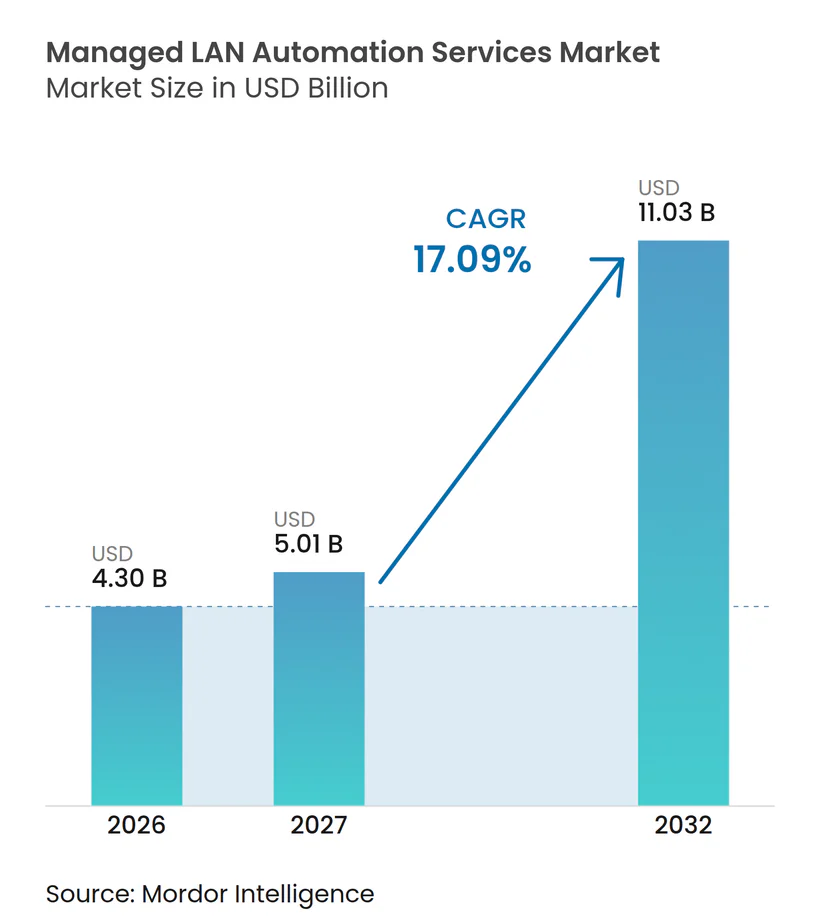
Managed LAN Automation Services Market Analysis by Mordor Intelligence
The managed LAN automation services market size is projected to expand from USD 4.30 billion in 2026 and USD 5.01 billion in 2027 to USD 11.03 billion by 2032, registering a CAGR of 17.09% between 2027 to 2032. The managed LAN automation services market is being shaped by enterprise networks that connect campus switching, wireless access, edge sites, and public cloud services. Organizations are replacing manual configuration work with policy-based processes because distributed users, SaaS traffic, IoT devices, and edge workloads create more operational dependencies. Security rules also affect buying decisions, especially where NIS2, FISMA, and zero-trust requirements require stronger control over configuration and access. Providers are responding by combining orchestration, telemetry analysis, validation, and managed operations within the same service model. Data sovereignty, older network estates, and incomplete telemetry remain important limits, but sovereign infrastructure investment, Wi-Fi 7 upgrades, and intent-based policy management continue to support demand in the managed LAN automation services market.
Key Report Takeaways
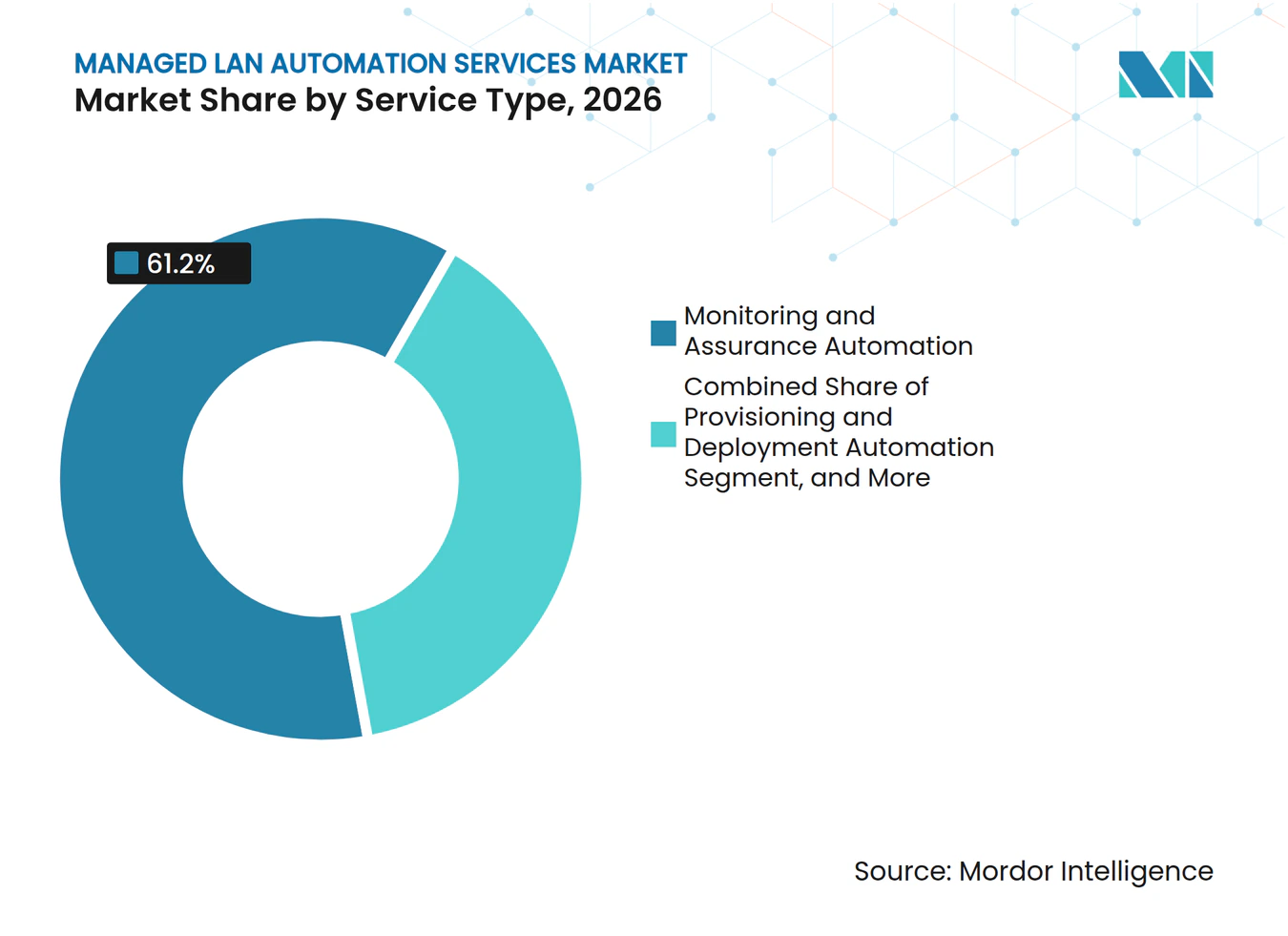
- By service type, Monitoring and Assurance Automation held 61.20% of the managed LAN automation services market share in 2026, while Closed-Loop Remediation and Self-Healing is projected to expand at an 18.23% CAGR through 2032.
- By deployment mode, On-Premises accounted for 68.22% of the managed LAN automation services market share in 2026, while Cloud is projected to expand at an 18.56% CAGR through 2032.
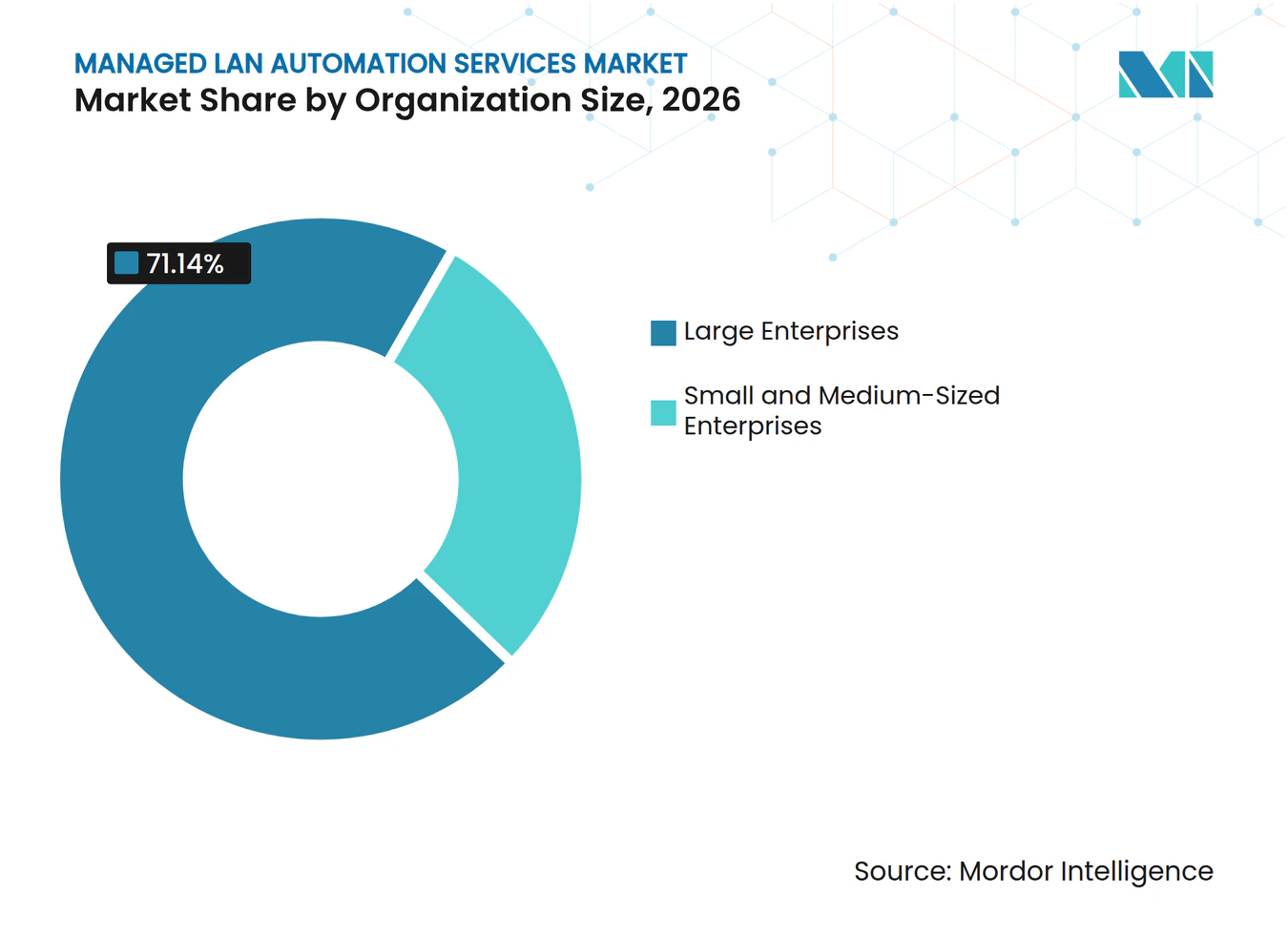
- By organization size, Large Enterprises held 71.14% of the managed LAN automation services market revenue share in 2026, while SMEs are projected to expand at an 18.78% CAGR through 2032.
- By end-user industry, IT and Telecommunication accounted for 29.11% of the managed LAN automation services market share in 2026, while Government and Public Administration is projected to expand at a 17.45% CAGR through 2032.
- By geography, North America held 36.41% share in 2026, while Asia-Pacific is projected to expand at a 17.88% CAGR through 2032.
Note: Market numbers in this report are based on Mordor Intelligence's proprietary estimation framework, which combines nine months of actuals with Q4 projections for base year 2026.
Global Managed LAN Automation Services Market Trends and Insights
Drivers Impact Analysis*
| Driver | (~) % Impact on CAGR Forecast | Geographic Relevance | Impact Timeline |
|---|---|---|---|
| Cloud and Hybrid Work Network Complexity | +4.2% | Global | Short term (≤ 2 years) |
| AI-Enabled Monitoring and Auto-Remediation | +3.8% | Global | Medium term (2-4 years) |
| Cybersecurity and Regulatory Assurance Demand | +3.1% | North America and Europe | Medium term (2-4 years) |
| Campus IoT and High-Density Wireless Expansion | +2.4% | Asia-Pacific core, spillover to North America | Long term (≥ 4 years) |
| Intent-to-Policy Translation for Brownfield Estates | +1.9% | North America and Europe | Medium term (2-4 years) |
| Experience-Level SLA Monetization for Managed LAN | +1.2% | Global | Long term (≥ 4 years) |
| Source: Mordor Intelligence | |||
Cloud and Hybrid-Work Network Complexity Is Compressing Automation Procurement Cycles
Hybrid work has redistributed enterprise traffic across SaaS applications, SASE environments, office networks, remote users, and IoT-connected facilities. Static VLAN structures and manual command-line changes are less effective when these flows change frequently across campuses and branches. Cisco introduced AgenticOps in November 2025 to apply a domain-specific network model across Meraki, Catalyst Center, and ISE, supporting faster campus and branch provisioning. The managed LAN automation services market benefits when an infrastructure refresh forces organizations to redesign network operations within a limited project window. Buyers increasingly seek governance, change control, and rollback features together with automated provisioning. This requirement favors managed offerings that can operate across cloud-managed and locally managed network environments.
AI-Enabled Monitoring and Auto-Remediation Is Moving From Pilot to Production
Organizations are moving beyond dashboards that identify issues to platforms that can recommend and perform controlled remediation. This transition depends on clear workflow limits, auditable decisions, and human approval for actions that could affect production services. Network teams remain cautious when an automated process changes a configuration, modifies access rules, or responds to an unfamiliar fault condition. The managed LAN automation services market, therefore, places more value on governed execution than on AI model capability alone. Providers that pair anomaly detection with validation and policy controls can address the operational concerns that delay the wider adoption of automation. This approach makes autonomous remediation more practical after enterprises have established trusted assurance processes.
Cybersecurity and Regulatory Assurance Demand Elevates Continuous Compliance Automation
Configuration drift can weaken an organization’s intended security posture when device settings change outside approved standards, the selection of automation tools, and the procurement of services. NIST zero-trust guidance, NIS2 requirements, and FedRAMP Moderate considerations influence automation tool selection and service procurement in regulated environments. Cisco launched its Sovereign Critical Infrastructure portfolio for Europe in September 2025 for air-gapped, customer-managed environments and Common Criteria alignment.[1] The managed LAN automation services market gains traction from services that continuously track configuration compliance rather than only during scheduled audits. Regulatory deadlines can preserve automation budgets even when broader IT spending is reviewed. Providers also need to demonstrate how their service architecture maintains control, evidence, and secure access throughout the operating lifecycle.
Campus IoT and High-Density Wireless Expansion Drives Zero-Touch Provisioning Demand
Campus networks now support industrial sensors, building systems, user devices, and wireless services that require consistent policy across large site estates. These environments increase the operational burden of onboarding devices, updating configurations, and diagnosing faults at scale. Arista introduced VESPA in December 2025 for wireless roaming domains with more than 500,000 clients and sub-second failover, showing the scale expected from campus mobility architectures. Allied Telesis also introduced Allied OneConnect in Japan in November 2025, combining wired and wireless LAN, WAN, assurance, and zero-touch provisioning into a single cloud-managed platform. The managed LAN automation services market is driven by this convergence, as customers increasingly expect a common policy framework for wired and wireless operations. Zero-touch workflows become more important as each additional endpoint raises the cost and risk of manual deployment.
Restraints Impact Analysis*
| Restraint | (~) % Impact on CAGR Forecast | Geographic Relevance | Impact Timeline |
|---|---|---|---|
| Data Sovereignty and Third-Party Control Concerns | -2.8% | Europe, Asia-Pacific, Middle East | Short term (≤ 2 years) |
| Legacy Estate Integration and Change-Window Risk | -2.3% | North America and Europe | Medium term (2-4 years) |
| Telemetry Quality and Network-Source-of-Truth Gaps | -1.6% | Global | Medium term (2-4 years) |
| Opaque Exit, Asset Ownership, and Automation Portability | -1.1% | Global | Long term (≥ 4 years) |
| Source: Mordor Intelligence | |||
Data Sovereignty and Third-Party Control Concerns Constrain Managed Service Adoption
Delegating LAN configuration authority to a managed provider can create legal and operational concerns for regulated organizations. Remote changes, provider-hosted telemetry, and multi-tenant policy engines may require detailed review before a service contract is approved. GDPR, Germany’s BSI C5 framework, France’s SecNumCloud program, and public procurement rules across Asia-Pacific affect which delivery architectures customers can use. Organizations may require locally managed, air-gapped, or customer-controlled deployment models when network data or administrative access cannot cross jurisdictional boundaries. These requirements can lengthen sales cycles and increase service customization costs in the managed LAN automation services market. They also reward providers that can show clear jurisdictional controls, defined accountability, and well-documented boundaries for third-party access.
Legacy Estate Integration and Change-Window Risk Slows Full Automation Deployments
Large enterprise LAN estates commonly include devices from several hardware generations, multiple operating systems, and inconsistent API coverage. Automation teams must resolve these differences before a closed-loop process can make reliable changes across the full estate. Network operators often begin with read-only monitoring because a misconfiguration can disrupt users, applications, or security controls. This concern limits the initial scope of the managed LAN automation services market in older environments. A 2025 case study from IF-Tech reported a 97% automation success rate across 200 enterprise switches, with legacy devices accounting for the remaining exceptions. Providers must therefore combine discovery, testing, staged deployment, and rollback planning before asking customers to expand automation into critical network changes.
*Our forecasts treat driver/restraint impacts as directional, not additive. The impact forecasts reflect baseline growth, mix effects, and variable interactions.
Segment Analysis
By Service Type: Assurance Automation Anchors Revenue While Self-Healing Extends Service Scope
Monitoring and Assurance Automation accounted for 61.20% of the managed LAN automation services market share in 2026 because continuous telemetry and anomaly correlation are baseline requirements for managed services. Providers use this layer to collect operational information from switching, wireless, and related network environments. It creates the visibility needed to identify abnormal behavior before an issue reaches users or disrupts a service. Customers also rely on assurance tools to understand whether the policy is being applied consistently across sites and vendors. Provisioning and Deployment Automation usually follow when teams want to standardize new site openings, equipment replacements, and routine device onboarding. Configuration and Compliance Automation becomes increasingly relevant as organizations seek to enforce approved device settings consistently. These service layers help reduce manual work but also improve the evidence available for governance and audit activities. The managed LAN automation services market remains anchored in assurance because higher-value automation depends on accurate and complete operational information. Vendors that can normalize telemetry across mixed estates have a stronger basis for expanding within existing customer accounts. They can use the same assurance foundation to show customers how recurring monitoring, alert investigation, compliance reporting, and network health reviews are connected, rather than presenting each activity as a separate operational service with its own tools, datasets, and support processes.
Closed-Loop Remediation and Self-Healing is projected to expand at an 18.23% CAGR through 2032. This service category shifts the operating model from issue detection toward diagnosis, planning, validation, and controlled execution. Organizations generally adopt it after assurance workflows have demonstrated reliable visibility and sound operational governance. Gluware introduced version 5.8 in February 2026 with its Titan intent-based automation platform and DIAL validation, which checks expected device behavior before an action is executed. This type of validation directly addresses customer concerns about errors in automated change activities. The commercial opportunity is often an expansion of an existing managed service relationship rather than a separate customer acquisition effort. Providers can add remediation functions once they understand a customer’s policies, network dependencies, and approval rules. The managed LAN automation services industry benefits when this progression is tied to clearly governed service tiers. It also gives customers a practical path from monitoring to more autonomous operations without requiring a sudden shift in their control model. This staged approach allows service teams to define which faults can be addressed automatically, which changes require approval, and which events should remain under direct customer control until the operating process has proven reliable over time.



By Deployment Mode: On-Premises Leads While Hybrid Architectures Support Transition
On-Premises accounted for 68.22% of the managed LAN automation services share in 2026, reflecting the installed base of enterprise switching infrastructure. Many organizations cannot move all network management functions to the cloud without replacing hardware or upgrading network operating systems. Financial institutions, healthcare systems, and public agencies also retain local automation tools to maintain direct control over data, latency, and compliance processes. Their decisions often reflect specific internal rules for administrative access and network evidence. On-premises services can support these customers by operating within established security boundaries. They can also work with existing change-management systems that have been built around local network teams. This deployment mode remains relevant where the network estate has significant legacy equipment or a limited tolerance for remote administration. The managed LAN automation services market continues to serve these environments through platforms that automate routine tasks without requiring immediate architectural changes. Providers must show that local control does not prevent consistent monitoring, policy enforcement, or service reporting. They also need to demonstrate that locally operated workflows can still provide enterprise-wide visibility when customers have separate business units, geographically distributed sites, and different technical teams responsible for daily changes.
Cloud is projected to expand at an 18.56% CAGR through 2032 as cloud-native management platforms make automation more accessible for mid-market customers and SMEs. A cloud service can reduce the need to operate and maintain a dedicated local automation stack. It may also allow managed service providers to oversee multiple customer sites through a common service platform. This model is particularly relevant where in-house technical resources are limited, and customers prefer recurring subscription costs. The managed LAN automation services market can use cloud delivery to extend standardized monitoring, policy, and lifecycle management to smaller organizations. Hybrid deployments provide a bridge for customers who want cloud-based policy definition but local configuration execution. These designs can retain customer control over sensitive processes while still using centralized service workflows. The balance between cloud control planes and local execution will remain important where network requirements differ by site, jurisdiction, or device type. Providers that support all 3 deployment approaches can align their operating model with a customer’s existing estate and future modernization plans. This flexibility matters because a customer may retain local execution for critical locations, use hybrid controls for regulated sites, and adopt cloud management for smaller offices under the same managed service relationship.
By Organization Size: Large Enterprises Sustain Revenue While SMEs Expand Adoption
Large Enterprises held 71.14% of revenue in 2026 because network scale creates a clearer financial case for automation. An organization operating 10,000 switching ports across 50 campus locations has more repetitive tasks and greater potential for configuration inconsistencies than a smaller site estate. Large organizations also face greater exposure to operational disruption when network policies are applied unevenly. Compliance obligations in BFSI, healthcare, and government increase the value of reliable automated reporting and control. These buyers often seek fewer automation platforms that can operate across several domains and vendor environments. This preference can lead to larger contracts for providers that demonstrate broad integration capabilities. The managed LAN automation services market benefits from this concentration of demand because large customers require ongoing design, operations, governance, and support. Providers still need to adapt each deployment to specific device estates, internal controls, and change processes. The managed LAN automation services industry, therefore, combines recurring service revenue with substantial requirements for customer-specific operational design. Service providers must translate the network's scale into practical operating rules, including approval paths, site priorities, escalation procedures, maintenance windows, and reporting formats for internal network, security, and compliance teams.
SMEs are projected to expand at an 18.78% CAGR through 2032 as cloud-managed platforms, network-as-a-service offerings, and packaged managed services reduce entry barriers. Smaller organizations often lack the staff needed to build and maintain a dedicated automation framework. A subscription model can provide them with access to monitoring, policy management, and lifecycle support without the same upfront operational burden. Managed service providers become especially important in this segment because they may control the automation toolchain on the customer's behalf. That relationship shifts the offering toward recurring managed outcomes rather than a customer-operated software deployment. It also makes clear reporting, defined service levels, and simple onboarding central to service adoption. The managed LAN automation services market can reach more SMEs when providers offer standard configurations that still accommodate customer security needs. Growth in this segment does not eliminate the need for governance, as small organizations can face similar exposure to outages or security failures. Instead, it increases the importance of service designs that make those controls understandable and practical for customers with limited internal resources. Providers need straightforward onboarding, repeatable configuration patterns, transparent support responsibilities, and reporting that explains the status of devices, policies, service requests, and corrective work without requiring customers to operate a complex automation platform themselves.

By End-User Industry: IT and Telecommunication Leads While Government Adoption Accelerates
IT and Telecommunication accounted for 29.11% of the managed LAN automation services market size in 2026. Service providers operate complex network estates and also package managed automation capabilities for enterprise customers. This dual position gives them an operational reason to invest in automation and a commercial reason to turn that capability into a service offering. Juniper Networks and ServiceNow integrated Mist AI with Telecom Service Management in May 2025 to support provisioning, deployment, and day-2 operations across wired, wireless, and SD-WAN environments.[2] BFSI, healthcare, and life sciences also maintain strong demand because both sectors require availability, security, and documented operational controls. Their network teams manage many sites, user groups, and policy requirements that are difficult to sustain through manual changes. Industrial manufacturing, retail and e-commerce, and education and research institutions represent additional demand pools. These sectors use automation to coordinate campus activity where devices, applications, and users change regularly. The managed LAN automation services market supports these customers through managed visibility, policy enforcement, configuration workflows, and ongoing support. The service proposition is stronger when those functions are coordinated across wired access, wireless networks, and related WAN connections, because isolated tools can leave customers with incomplete operational evidence and slower fault resolution.
Government and Public Administration is projected to expand at a 17.45% CAGR through 2032. Federal modernization requirements encourage agencies to replace fragmented network processes with more consistent management and security controls. Government buyers often require evidence that a provider can meet procurement, data control, and authorization requirements. Itential partnered with Carahsoft in November 2025 to make its hybrid cloud automation platform available through NASA SEWP V, ITES-SW2, NASPO ValuePoint, and OMNIA Partners procurement vehicles. These channels can help public-sector buyers access automation services through familiar contracting routes. Hospitals, outpatient clinics, research facilities, and educational campuses also drive demand for large-site networks that must support high device density and sensitive data. Government adoption can have a wider effect because service providers need to build controls suitable for high-assurance environments. The managed LAN automation services market gains when those controls can later be applied to other regulated customers. This segment rewards vendors that combine technical automation with a clear approach to accountability, auditability, and long-term support. Suppliers must be prepared to show how service activities are recorded, how operational decisions are approved, and how the customer retains oversight when a managed provider operates important parts of the network environment.
Geography Analysis
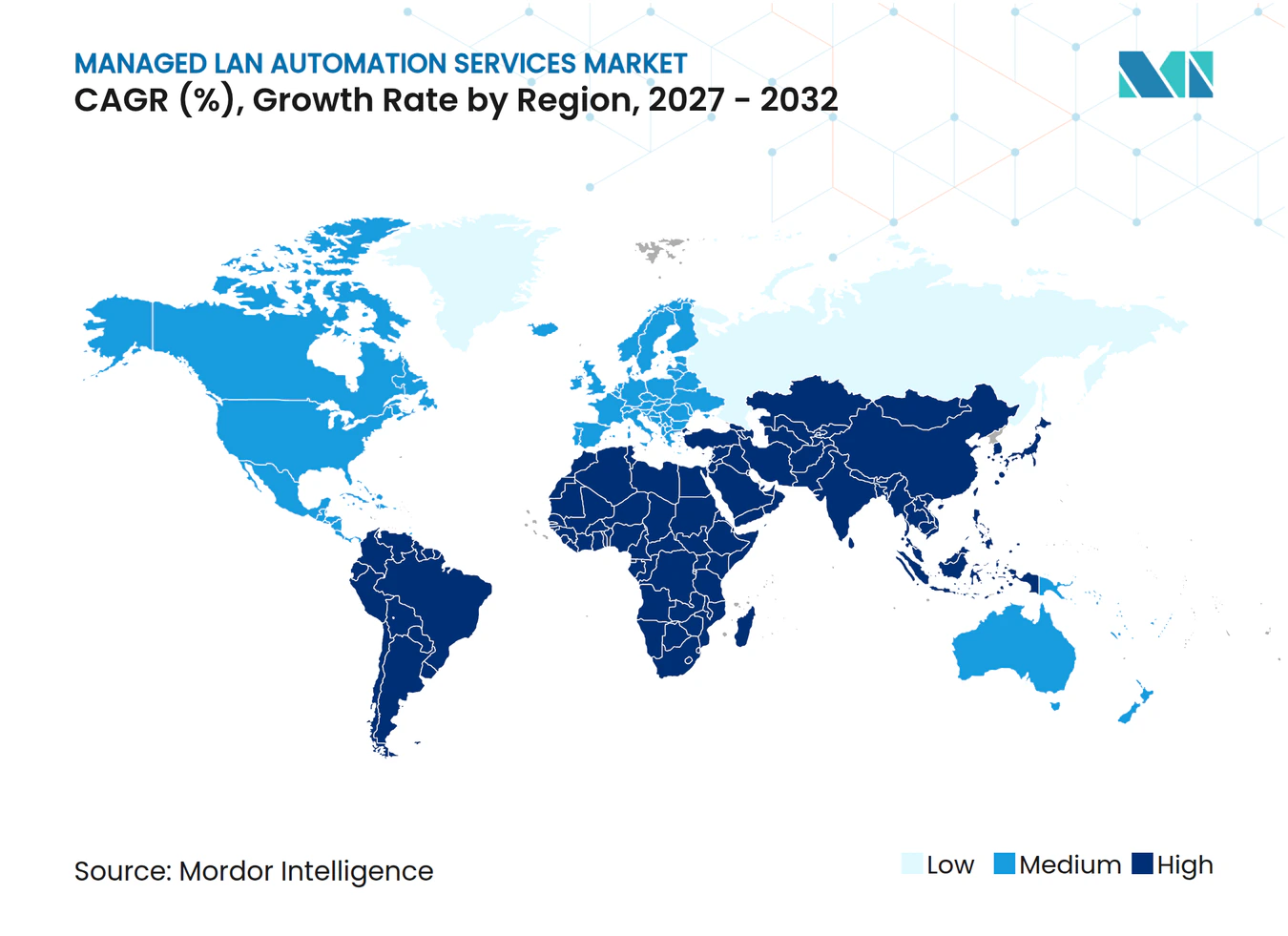
North America accounted for 36.41% of the managed LAN automation services market share in 2026, supported by mature managed service provider ecosystems and a large base of Global 2000 organizations with complex multi-site estates. U.S. federal procurement frameworks set clear expectations for security, authorization, operating accountability, and support documentation. FISMA, FedRAMP, and NIST guidance shape the zero-trust and continuous-compliance functions vendors must demonstrate for federal work. Large buyers in financial services, telecommunications, healthcare, and technology have the network scale to support continued investment in automation. Canada’s financial services and telecommunications sectors add demand, while Mexico’s manufacturing expansion creates needs for resilient industrial campus networks.
Asia-Pacific is projected to expand at a 17.88% CAGR through 2032, making it the fastest-growing region in the managed LAN automation services market. Digitalization programs across China, India, Japan, South Korea, and Southeast Asia are expanding LAN infrastructure and managed automation requirements together. Allied Telesis introduced Allied OneConnect in Japan in November 2025, illustrating regional interest in unified wired and wireless management. South Korean conglomerates are expanding campus capacity for AI workloads and high-density industrial IoT, while India’s public digital infrastructure programs are creating automation-related contracts in Tier-1 and Tier-2 cities. Providers must accommodate differing regulatory expectations, deployment models, and levels of operational maturity across these countries.
Europe has a varied adoption profile, with Germany, the United Kingdom, and France more mature than Central and Eastern European markets. The UK Government Property Agency issued a September 2026 market engagement for an enterprise LAN serving more than 500,000 civil service users, with automation, zero-touch provisioning, and self-healing routines specified as procurement requirements. Germany’s BSI IT-Grundschutz and NIS2 requirements support automation that connects network operations with continuous compliance reporting. South America, led by Brazil and Argentina, sees adoption concentrated in financial services and energy, while the Middle East is developing demand through smart-city investment, and Africa remains at an earlier stage of infrastructure development.
Competitive Landscape
Market Concentration
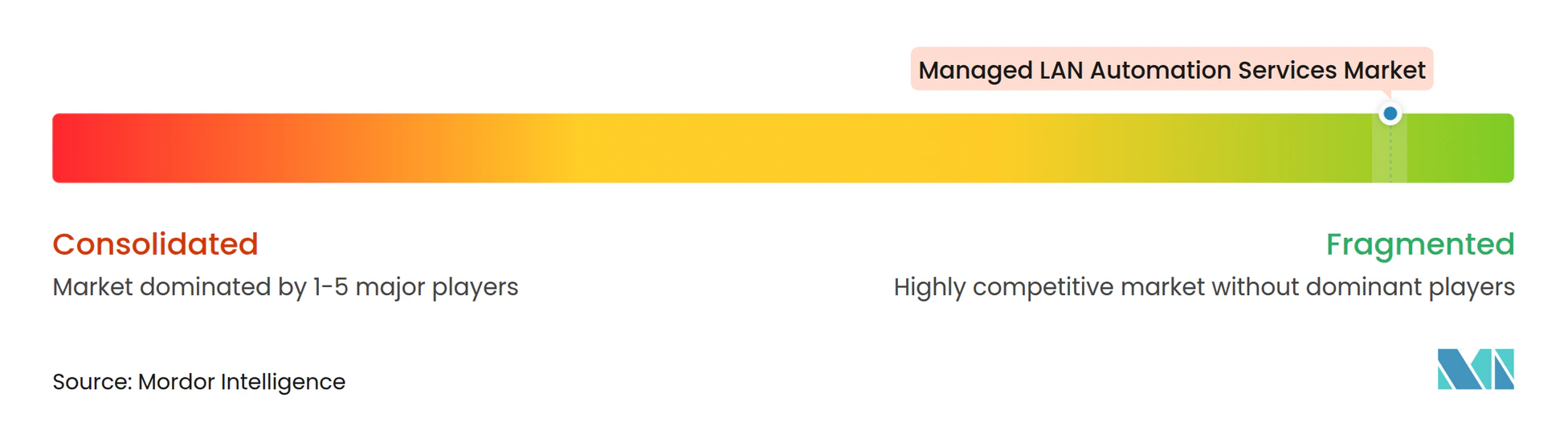
The managed LAN automation services market is fragmented across pure-play automation providers, broad networking vendors, and observability specialists. Pure-play vendors include Gluware, Itential, NetBrain Technologies, Forward Networks, BackBox Software, IP Fabric, and Anuta Networks, while broad-portfolio vendors combine automation with switching, wireless, security, and cloud-management products. Kentik Technologies, LogicMonitor, and Auvik Networks focus on visibility but are also extending their offerings with configuration automation tools. This diverse supplier base prevents a single provider from setting prices across the full service lifecycle. Interoperability remains important because enterprise customers commonly operate equipment from several manufacturers.
Gluware expanded its platform in February 2026 with Titan, DIAL validation, exposure management, and added multi-vendor support for HPE Aruba, Cisco Meraki, and Fortinet FortiManager.[3] Cisco’s AgenticOps launch shows how established networking vendors are embedding more automation into existing network management products. Itential made its hybrid cloud automation platform available to public-sector buyers through Carahsoft and major procurement vehicles. These moves focus on product capability, deployment confidence, and access to regulated customer groups. Vendors that offer validation, audit trails, and policy enforcement can reduce the perceived risk of automated changes without removing customer accountability.
White space remains between basic monitoring and configuration enforcement, especially where customers have not moved to autonomous remediation. This gap creates an opportunity for expansion for providers that already manage a customer’s telemetry and incident workflows. SolarWinds and Riverbed continue to address mid-market and WAN-adjacent needs, while PathSolutions and racksnet GmbH serve brownfield needs with lower-entry-cost options. FedRAMP authorization and ISO/IEC 27001 alignment can strengthen vendor positions in regulated procurement.
Managed LAN Automation Services Industry Leaders
-
Gluware, Inc.
-
Itential, Inc.
-
Forward Networks, Inc.
-
Pica8, Inc.
-
Dorado Software, Inc.
- *Disclaimer: Major Players sorted in no particular order
Recent Industry Developments
- June 2026: Helient Technologies launched a fully managed network service powered by Extreme Platform ONE, offering subscription-based multi-vendor switching, wireless, fabric, and SD-WAN management to enterprises across healthcare, legal, government, and education verticals.
- February 2026: Gluware released platform version 5.8, introducing Gluware Titan, an AI-powered, intent-based network automation platform with DIAL validation, Gluware Titan Exposure Management for agentic vulnerability detection, and expanded multi-vendor support, including HPE Aruba, Cisco Meraki, and Fortinet FortiManager.
- December 2025: Arista Networks introduced Arista VESPA for large-scale WLAN mobility, enabling campus deployments with over 500,000 clients and sub-second failover, and expanded Arista AVA agentic AI for campus AIOps operations.
- November 2025: Gluware announced Gluware Titan, entering Early Field Trials. The intent-based agentic AI platform, with an Intelligent MCP Server and a DIAL-powered validation engine, was planned for general availability in early 2026.
Global Managed LAN Automation Services Market Report Scope
The Managed LAN Automation Services Market comprises outsourced services that automate the provisioning, configuration, monitoring, compliance management, and remediation of enterprise local area network (LAN) environments. These services leverage orchestration platforms, policy automation, AI-driven operations, and self-healing capabilities to improve network performance, operational efficiency, and security.
The Managed LAN Automation Services Market Report is Segmented by Service Type (Provisioning and Deployment Automation, Configuration and Compliance Automation, Monitoring and Assurance Automation, and Closed-Loop Remediation and Self-Healing), Deployment Mode (On-Premises, Cloud, and Hybrid), Organization Size (Small and Medium-Sized Enterprises, and Large Enterprises), End-User Industry (Banking, Financial Services, and Insurance [BFSI], Government and Public Administration, Healthcare and Life Sciences, IT and Telecommunication, Industrial Manufacturing, Retail and E-commerce, Education and Research Institutions, and Other End-User Industries), and Geography (North America, South America, Europe, Asia-Pacific, Middle East, and Africa). The Market Forecasts are Provided in Terms of Value (USD).
| Provisioning and Deployment Automation |
| Configuration and Compliance Automation |
| Monitoring and Assurance Automation |
| Closed-Loop Remediation and Self-Healing |
| On-Premises |
| Cloud |
| Hybrid |
| Small and Medium-Sized Enterprises |
| Large Enterprises |
| Banking, Financial Services, and Insurance (BFSI) |
| Government and Public Administration |
| Healthcare and Life Sciences |
| IT and Telecommunication |
| Industrial Manufacturing |
| Retail and E-commerce |
| Education and Research Institutions |
| Other End-User Industries |
| North America | United States |
| Canada | |
| Mexico | |
| South America | Brazil |
| Argentina | |
| Rest of South America | |
| Europe | Germany |
| United Kingdom | |
| France | |
| Italy | |
| Russia | |
| Rest of Europe | |
| Asia-Pacific | China |
| Japan | |
| India | |
| South Korea | |
| Rest of Asia-Pacific | |
| Middle East | Saudi Arabia |
| United Arab Emirates | |
| Rest of Middle East | |
| Africa | South Africa |
| Nigeria | |
| Rest of Africa |
| By Service Type | Provisioning and Deployment Automation | |
| Configuration and Compliance Automation | ||
| Monitoring and Assurance Automation | ||
| Closed-Loop Remediation and Self-Healing | ||
| By Deployment Mode | On-Premises | |
| Cloud | ||
| Hybrid | ||
| By Organization Size | Small and Medium-Sized Enterprises | |
| Large Enterprises | ||
| By End-User Industry | Banking, Financial Services, and Insurance (BFSI) | |
| Government and Public Administration | ||
| Healthcare and Life Sciences | ||
| IT and Telecommunication | ||
| Industrial Manufacturing | ||
| Retail and E-commerce | ||
| Education and Research Institutions | ||
| Other End-User Industries | ||
| By Geography | North America | United States |
| Canada | ||
| Mexico | ||
| South America | Brazil | |
| Argentina | ||
| Rest of South America | ||
| Europe | Germany | |
| United Kingdom | ||
| France | ||
| Italy | ||
| Russia | ||
| Rest of Europe | ||
| Asia-Pacific | China | |
| Japan | ||
| India | ||
| South Korea | ||
| Rest of Asia-Pacific | ||
| Middle East | Saudi Arabia | |
| United Arab Emirates | ||
| Rest of Middle East | ||
| Africa | South Africa | |
| Nigeria | ||
| Rest of Africa | ||
Key Questions Answered in the Report
What is the managed LAN automation services market size?
The managed LAN automation services market is projected to reach USD 11.03 billion by 2032 from USD 5.01 billion in 2027, at a 17.09% CAGR.
Which service type leads managed LAN automation services?
Monitoring and Assurance Automation led with 61.20% share in 2026 because visibility and anomaly detection are core managed service requirements.
Which deployment approach is expanding fastest?
Cloud deployment is projected to expand at an 18.56% CAGR through 2032, supported by cloud-managed platforms and subscription models.
Why are large enterprises important buyers of managed LAN automation services?
Large Enterprises held 71.14% share in 2026 because their scale, compliance needs, and multi-site networks strengthen the case for automation.
Which end-user group has the strongest projected expansion?
Government and Public Administration is projected to expand at a 17.45% CAGR through 2032, supported by modernization and security requirements.
Which region is projected to expand fastest?
Asia-Pacific is projected to expand at a 17.88% CAGR through 2032 as digitalization programs extend LAN infrastructure and managed service demand.