
Managed Wi-Fi Services Market Size and Share
Market Overview
| Study Period | 2021 - 2032 |
|---|---|
| Market Size (2027) | USD 22.66 Billion |
| Market Size (2032) | USD 40.29 Billion |
| Growth Rate (2027 - 2032) | 12.19 % |
| Fastest Growing Market | Asia-Pacific |
| Largest Market | North America |
| Market Concentration | Medium |
Major Players *Disclaimer: Major Players sorted in no particular order Image © Mordor Intelligence. Reuse requires attribution under CC BY 4.0. | |
Managed Wi-Fi Services Market Analysis by Mordor Intelligence
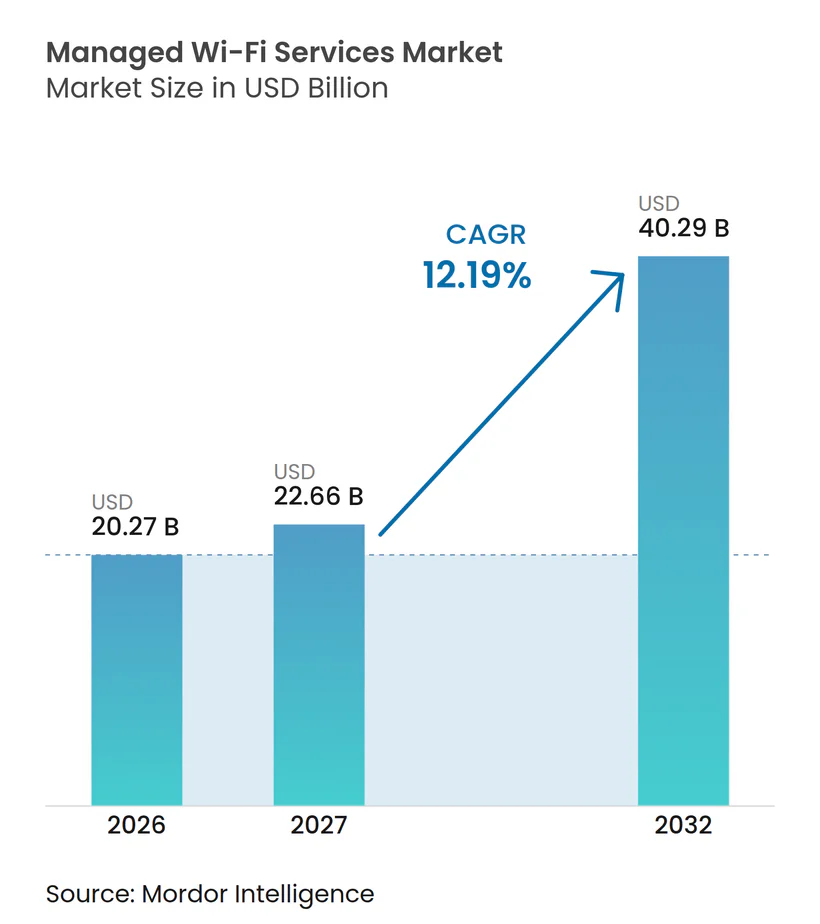
The managed Wi-Fi services market size is projected to expand from USD 20.27 billion in 2026 to USD 22.66 billion in 2027, and to USD 40.29 billion by 2032, registering a CAGR of 12.19% between 2027 and 2032. Demand is moving toward outsourced platforms because organizations need consistent wireless coverage, security controls, and support across offices, campuses, branches, and temporary sites. Hybrid work, larger connected-device estates, and Wi-Fi 7 upgrades are raising the importance of centralized network operations. Providers are responding by combining monitoring, security, configuration, and troubleshooting in subscription contracts that can spread upgrade costs over time. The managed Wi-Fi services market also faces compliance costs and integration challenges where customers use mixed generations of access points or require locally managed data. These conditions favor providers that can support cloud, on-premises, and hybrid operating models while maintaining clear service commitments.
Key Report Takeaways
- By service type, Network Monitoring and Performance Management held 42.78% of the managed Wi-Fi services market revenue in 2026, while Security and Access Control Management is projected to expand at a 13.14% CAGR through 2032.
- By deployment, On-Premises held 67.18% the managed Wi-Fi services market revenue in 2026, while Cloud is projected to expand at a 13.45% CAGR through 2032.
- By organization size, Large Enterprises accounted for 70.56% the managed Wi-Fi services market demand in 2026, while SMEs are projected to expand at a 13.76% CAGR through 2032.
- By end-user industry, IT and Telecommunication held 28.19% the managed Wi-Fi services market revenue in 2026, while Government and Public Administration is projected to expand at a 12.56% CAGR through 2032.
- By geography, North America accounted for 36.18% of the managed Wi-Fi services market revenue in 2026, while Asia-Pacific is projected to expand at a 12.82% CAGR through 2032.
Note: Market numbers in this report are based on Mordor Intelligence's proprietary estimation framework, which combines nine months of actuals with Q4 projections for base year 2026.
Global Managed Wi-Fi Services Market Trends and Insights
Drivers Impact Analysis*
| Driver | (~) % Impact on CAGR Forecast | Geographic Relevance | Impact Timeline |
|---|---|---|---|
| Cloud-Based Centralized Management and Remote Troubleshooting | +3.5% | Global, strongest uptake in North America and Europe | Short term (≤ 2 years) |
| Distributed Sites and Hybrid Work Increase Wireless Complexity | +2.8% | Global, concentrated in North America and Asia-Pacific enterprise hubs | Medium term (2-4 years) |
| IoT, BYOD and High-Density Device Proliferation | +2.2% | Global, highest density in Asia-Pacific manufacturing and North American campuses | Medium term (2-4 years) |
| Subscription Shift from CapEx to OpEx | +1.8% | Global, accelerating in SME segments across Asia-Pacific and Europe | Medium term (2-4 years) |
| Wi-Fi 7, 6 GHz and AI-Assisted Network Assurance | +1.4% | North America and Europe initially, expanding to Asia-Pacific by 2028 | Short term (≤ 2 years) |
| OpenRoaming and Wi-Fi-5G Convergence | +0.9% | Global, with early deployments in North America, Asia-Pacific, and Western Europe | Long term (≥ 4 years) |
| Source: Mordor Intelligence | |||
Cloud-Based Centralized Management and Remote Troubleshooting
Cloud management is becoming a standard requirement in enterprise wireless procurement. Centralized platforms let teams update firmware, change configurations, and respond to alerts across many access points without sending staff to each site. This model is especially relevant to the managed Wi-Fi services market because it provides service providers with a practical way to support dispersed customers from a single operations center, even when locations have different access conditions. AI-assisted troubleshooting can reduce the number of advanced support tickets by identifying recurring faults and unusual network behavior before they become wider service problems. Cloud platforms also collect more operational data than stand-alone controllers, which supports maintenance planning, predictive failure detection, regular reporting, and a clearer record of configuration changes. This depth of data can make a provider relationship harder to replace after the initial contract, because the service team has an established view of how the customer’s network operates.
Distributed Sites and Hybrid Work Increase Wireless Complexity
Hybrid work has broadened the physical scope of enterprise wireless needs. Organizations are extending network standards from central campuses to branches, temporary locations, and some home-office environments, rather than treating each site as an independent network. These locations need common security rules, traffic prioritization, and service commitments even when local conditions, user volumes, and equipment differ. The managed Wi-Fi services market benefits when internal teams cannot keep pace with frequent site changes, varied equipment, and requests for a consistent employee experience. Providers with established automation processes can apply common configurations, check performance remotely, and bring new locations under existing operational rules. The shift converts organizations that handled wireless operations internally into buyers of managed support and gives providers a larger recurring service scope.
IoT, BYOD and High-Density Device Proliferation
The number and variety of devices connected to workplace networks are challenging earlier capacity plans. The Wi-Fi Alliance reported 3.9 billion Wi-Fi device shipments in 2025, including 1.6 billion Wi-Fi IoT devices, and 23.3 billion active Wi-Fi-capable devices worldwide. Personal phones, sensors, medical devices, industrial equipment, and building systems often need different access and security settings, even when they operate on the same physical network. Some older devices cannot use current authentication methods, which makes segmentation and separate network access more important. Managed providers can supply device onboarding, identity-based controls, and real-time traffic prioritization that are difficult for lean internal teams to maintain as device inventories change. As device density rises, the managed Wi-Fi services market has more opportunities to replace fragmented in-house processes with consistent policies, clearer asset visibility, faster support, and less manual work across the network.
Subscription Shift from CapEx to OpEx
Subscription contracts move wireless refresh planning away from separate hardware purchases and toward recurring operating commitments. This can make service quality more predictable because agreements often include upgrade obligations, defined service levels, and recurring reviews of network performance. The Wireless Broadband Alliance found that 62% of respondents were more confident in Wi-Fi investment than they were 12 months earlier, and most often identified Wi-Fi 7 as the technology likely to be deployed in 2026. Providers can include Wi-Fi 7 hardware refreshes in multiyear agreements, reducing the pressure of a large one-time purchase and allowing customers to plan site changes against a known service cost. This structure can help smaller organizations use enterprise-grade management tools without building specialist teams, while larger organizations can align wireless operations with wider network service contracts. The managed Wi-Fi services market can also benefit from lower re-tendering because the provider remains responsible for operations, scheduled refreshes, reporting, and measurable service commitments over the life of the agreement.
Restraints Impact Analysis*
| Restraint | (~) % Impact on CAGR Forecast | Geographic Relevance | Impact Timeline |
|---|---|---|---|
| Data Residency, Privacy and Cybersecurity Exposure | -1.5% | Europe, China, and global managed service providers | Medium term (2-4 years) |
| Legacy Network Integration and Hardware Refresh Costs | -1.2% | Global, most acute in large enterprises and public-sector environments | Medium term (2-4 years) |
| Shortage of Wireless Network Engineering Skills | -0.9% | Global, most severe in North America and emerging Asia-Pacific markets | Long term (≥ 4 years) |
| Inconsistent Spectrum and Interoperability Conditions Across Countries | -0.6% | Asia-Pacific, Middle East, Africa, and South America | Long term (≥ 4 years) |
| Source: Mordor Intelligence | |||
Data Residency, Privacy and Cybersecurity Exposure
Rules governing network data are becoming more demanding for providers operating across borders. The EU NIS2 Directive requires affected providers to meet incident reporting, supply chain review, and technical security obligations that must be reflected in their customer operations. China’s Network Data Security Regulation has restricted the cross-border handling of certain network data since January 2025. These obligations can require separate data processing, audit support, and reporting arrangements for customers in regulated locations. The managed Wi-Fi services market may therefore see higher delivery costs for providers that need country-specific service designs and locally supported compliance processes. The EU Radio Equipment Directive EN 18031 also adds cybersecurity certification requirements for relevant Wi-Fi equipment, which can be harder for smaller suppliers to meet quickly.[1] Additionally, increasing regulatory fragmentation across jurisdictions is raising compliance complexity and operational costs, as providers must accommodate requirements related to incident reporting, cross-border data handling, cybersecurity certification, localized data processing, audit support, and country-specific service delivery models.
Legacy Network Integration and Hardware Refresh Costs
Many large organizations operate Wi-Fi 5, Wi-Fi 6, and Wi-Fi 6E equipment within the same estate. These systems use different management interfaces and security capabilities, which can force teams to maintain parallel workflows and make organization-wide policy enforcement more difficult. The result weakens the efficiency case for a single managed platform until the network is refreshed. Wi-Fi 7 access points also require new spending when older hardware is replaced, even where the customer wants the operational benefits of centralized control. Providers that accept refresh risk within a managed contract can face margin pressure and longer payback periods. These barriers can delay decisions even where a managed service would improve visibility, security, and day-to-day operational control.
*Our forecasts treat driver/restraint impacts as directional, not additive. The impact forecasts reflect baseline growth, mix effects, and variable interactions.
Segment Analysis
By Service Type: Security Services Support the Next Revenue Cycle
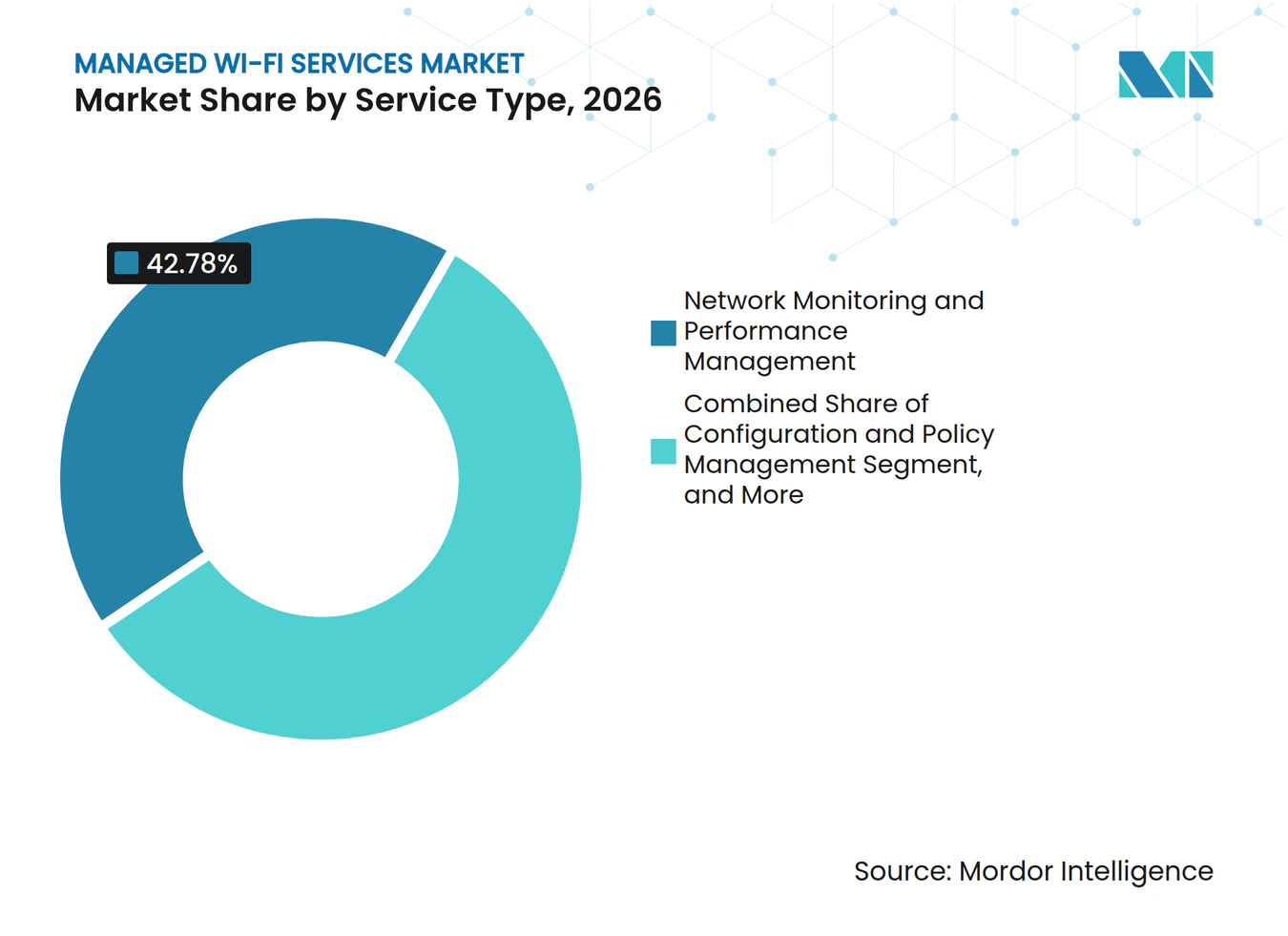
Network Monitoring and Performance Management accounted for 42.78% of the managed Wi-Fi services market size in 2026. Customers need continuous visibility before delegating sensitive network functions to an outside provider. Monitoring provides data on availability, capacity, application traffic, and performance issues across the wireless estate, giving both parties a shared view of service conditions. It often initiates a broader contract because it provides the operational data needed for configuration, incident handling, and security work. Configuration and Policy Management, along with Troubleshooting and Incident Management, are commonly bundled with monitoring at scale.
Security and Access Control Management is projected to expand at a 13.14% CAGR through 2032. Wireless networks are becoming the direct access layer for enterprise applications, including campus locations that previously relied more heavily on wired connections. This makes access control a core security boundary because it governs how users and devices reach organizational systems. The Wireless Broadband Alliance reported that 76% of Wi-Fi stakeholders considered network security and privacy their highest business priority.[2] Managed security offerings can incorporate audit logs, device identification, microsegmentation, and the routine checks needed to apply security policies consistently across locations.



By Deployment: On-Premises Scale Meets Faster Cloud Adoption
On-premises deployment accounted for 67.18% of revenue in 2026. It remains important for financial institutions, government agencies, and healthcare systems with data residency obligations or substantial infrastructure investments that cannot be moved quickly. These organizations retain direct control over management systems and data handling, while still relying on external teams for defined operational tasks. They need providers that can operate inside established security, governance, and audit requirements. On-premises delivery remains relevant where regulated customers require local processing. It also allows customers to keep established internal controls while using external expertise for daily monitoring, maintenance, and problem resolution.
Cloud deployment is projected to expand at a 13.45% CAGR through 2032. Multi-tenant management provides providers with a consistent way to monitor and support multiple customer locations through a common operating interface. New Wi-Fi 7 sites can use cloud-based controllers instead of separate on-site appliances, which reduces the amount of local infrastructure that has to be maintained. This supports SMEs that need centralized policy management and analytics without the need for local specialists. Hybrid delivery remains useful when equipment remains on-site while a central platform manages it. The model gives providers a way to align central operations with different local technology, security, and data-handling needs.
By Organization Size: SMEs Gain Access to Managed Wireless Capabilities
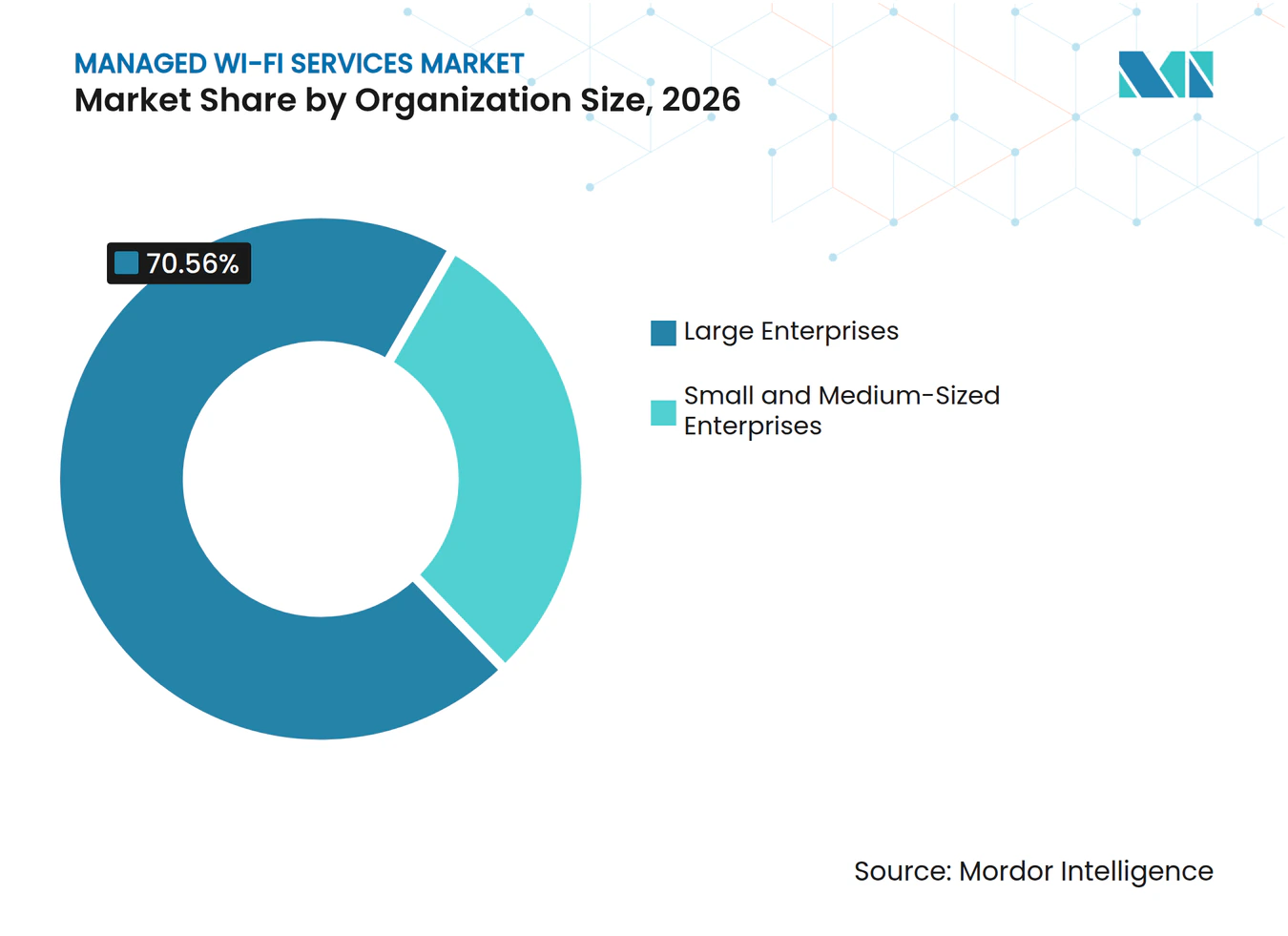
Large Enterprises accounted for 70.56% of organizational demand in 2026. Their networks can include hundreds of access points across campuses, branch offices, and data centers, often with different local conditions and traffic demands. Managing these environments requires firmware work, performance baselining, change control, capacity planning, and security policy enforcement. Managed providers can deliver this operating depth without requiring each customer to maintain a large, dedicated team at every location. Their scale makes them the largest source of demand in the managed Wi-Fi services market. Multi-site requirements also make consistent reporting, coordinated incident response, and shared operating standards central elements of the service relationship.
SMEs are projected to expand at a 13.76% CAGR through 2032. Per-location pricing, zero-touch provisioning, and bundled security lower the barriers to using managed wireless tools by reducing the technical work required before a site becomes operational. These arrangements help organizations without specialist staff or the budget for an internal network operations function. Network engineering skills shortages add to the pressure on smaller organizations, especially when they need to support multiple sites without a local IT presence. Telecom operators package managed Wi-Fi within broader service agreements, giving SMEs access to management and security functions used by larger enterprises. This can reduce the operational burden of supporting new sites as the business adds locations, staff, devices, and customer-facing services.

By End-User Industry: Public Procurement Expands Managed-Service Demand
IT and Telecommunications accounted for 28.19% of managed Wi-Fi service revenue in 2026. The sector is a direct user of wireless networks and a channel for managed services to other customer groups, which gives it a dual role in the adoption of outsourced operations. It deploys Wi-Fi across network operations centers, enterprise offices, and service provider environments where availability and fault response are closely monitored. BFSI, Healthcare and Life Sciences, and Industrial Manufacturing have compliance-focused needs that support managed contracts. Retail and E-commerce, Education and Research Institutions, and manufacturers need reliable support for dispersed, high-volume, and connected operating environments. Their requirements include stable access, predictable performance, and fast resolution when service problems affect staff, visitors, production processes, or customer-facing services.
Government and Public Administration is projected to expand at a 12.56% CAGR through 2032. Public-sector buyers increasingly procure Wi-Fi, SD-WAN, and secure access services under multiyear arrangements that define common responsibilities across technology teams and sites. In January 2025, Boingo Wireless received a US General Services Administration Multiple Award Schedule contract, allowing eligible agencies and organizations to procure its managed 5G, DAS, and Wi-Fi services through the program. The City of London Corporation’s 2025 procurement for a cloud-first and Wi-Fi-first network across more than 120 sites shows the broader scope of public managed-network requirements. These contracts combine wireless access, security, and centralized support, which simplifies accountability across complex public estates.
Geography Analysis
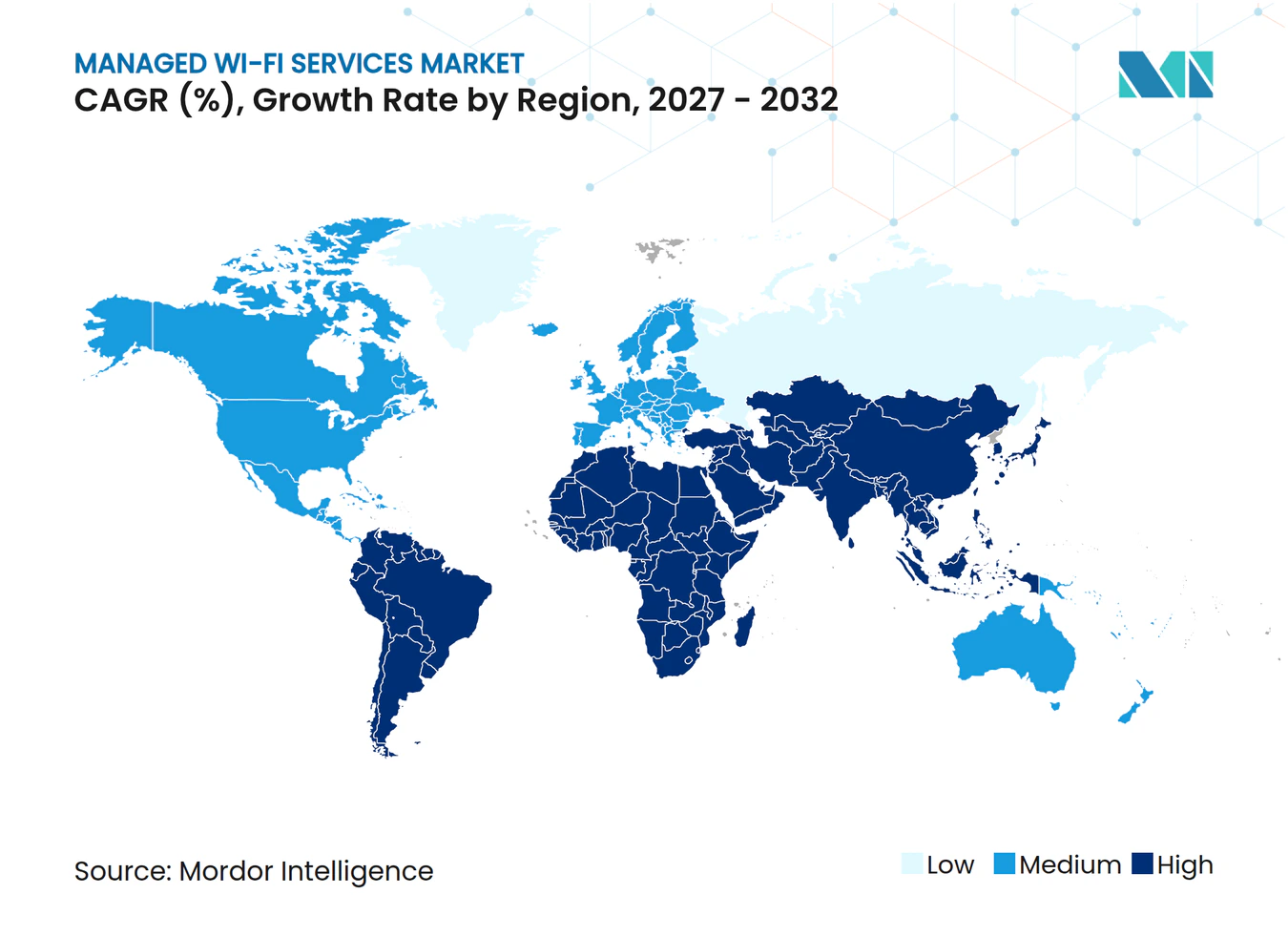
North America held 36.18% of the managed Wi-Fi services market share in 2026. The region has a large installed base of enterprise wireless networks, including extensive campus and branch environments that need regular modernization. It also has a mature managed service provider ecosystem. Large enterprises adopted cloud-managed platforms early and have experience using outside partners for network delivery. Many are familiar with operating-expense service models that link ongoing support, management tools, and equipment refresh planning.
The United States has government procurement channels that support managed Wi-Fi alongside 5G and DAS services. Boingo’s 2025 inclusion in the GSA Multiple Award Schedule shows one route available to public buyers.[3] Canada’s financial services and healthcare sectors show strong managed service adoption because these settings need dependable access and closely governed operations. Mexico remains at an earlier stage. Europe is an important geography for the managed Wi-Fi services market, led by Germany, the United Kingdom, and France.
Enterprise refresh activity is creating demand for new wireless equipment and managed operations in Europe. NIS2 requirements give affected organizations another reason to seek providers that can embed security controls and incident processes within routine network management. Some European customers also need deployment and data-handling arrangements tailored to national requirements, particularly when network telemetry is centrally monitored. South America is at an earlier stage of adoption than North America and Europe. Brazil and Argentina are its main sources of enterprise demand in financial services and retail. Asia-Pacific is projected to expand at a 12.82% CAGR through 2032. Greenfield projects in India and Southeast Asia can select wireless-first designs, while China, Japan, South Korea, the Middle East, and Africa add regional demand through enterprise and public-sector projects.
Competitive Landscape
Market Concentration
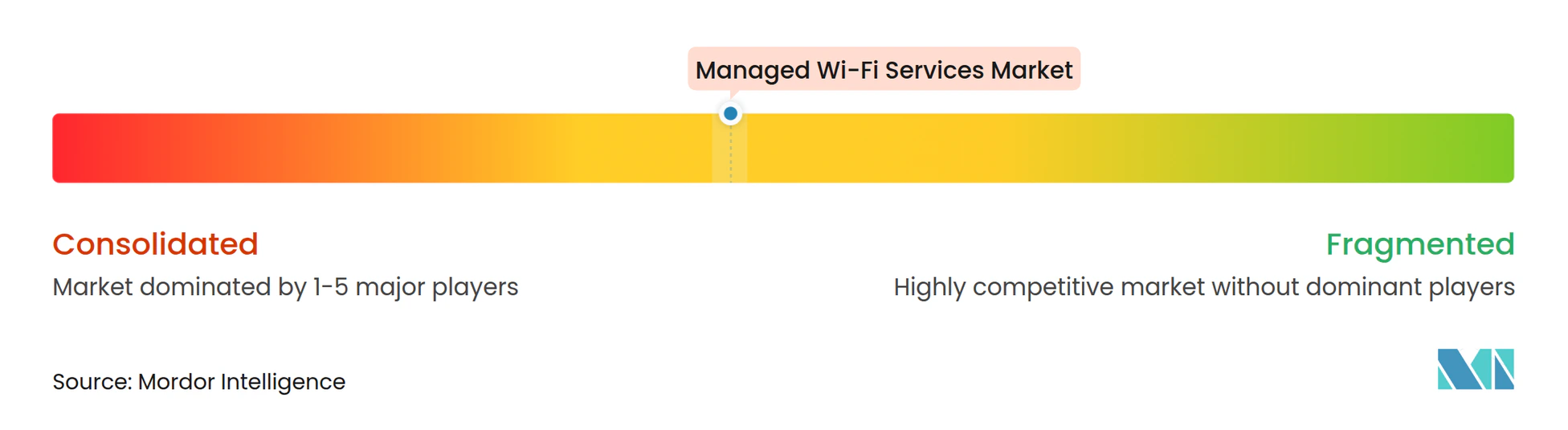
The managed Wi-Fi services market is moderately concentrated in platform and infrastructure supply, while service delivery remains fragmented among managed service providers, telecom operators, and specialist firms. Cisco held 39.0% of enterprise WLAN revenue in 2Q26, supported by its scale, campus relationships, and Meraki and Catalyst Center portfolios. HPE held 17.2% after its July 2025 acquisition of Juniper Networks. Together, the 2 companies held 56.2% of the enterprise WLAN platform revenue reported in the draft. Local providers still compete through service coverage, industry knowledge, customer support, and the ability to tailor operating models to local sites and sector-specific requirements.
Plume, Airties, and Cloud4Wi address service-provider and SME use cases with cloud-native platforms designed for simpler operations. Competition is shifting from access-point hardware to AI-supported assurance and integrated security management, as customers place greater value on rapid diagnosis and consistent oversight. Cisco has expanded Meraki AIOps features, including an AI Assistant for troubleshooting and AI-driven Radio Resource Management. HPE has stated that Aruba Central and Juniper Mist will remain separate platforms while sharing the Marvis AI engine and common hardware. Extreme Networks has introduced Platform One, which manages selected third-party devices and includes wireless security and asset-management functions for organizations with mixed equipment.
Belden completed its USD 1.85 billion acquisition of Ruckus Networks in July 2026, changing ownership of a platform used in high-density hospitality, education, and large-venue settings. The transaction may strengthen competition in markets where capacity and reliability are central buying criteria, because those customers often depend on stable service during periods of peak use. EN 18031 certification favors vendors able to manage cybersecurity compliance at scale and document the controls applied to connected equipment. Smaller suppliers can still compete where customers value focused service, direct support, and simpler deployment. The managed Wi-Fi services market offers opportunities in security-as-a-service for SMEs, OpenRoaming-enabled multi-venue connectivity, and the development of government procurement programs.
Managed Wi-Fi Services Industry Leaders
-
Cisco Systems, Inc.
-
CommScope, Inc.
-
Fortinet, Inc.
-
Huawei Technologies Co., Ltd.
-
Arista Networks, Inc.
- *Disclaimer: Major Players sorted in no particular order
Recent Industry Developments
- July 2026: Belden completed its USD 1.85 billion acquisition of Ruckus Networks from Vistance Networks, placing a high-density enterprise and hospitality Wi-Fi platform under new ownership and creating a restructured competitive entity in the enterprise wireless hardware supply chain.
- September 2025: Wifinity was awarded a UK central government connectivity contract under the Crown Commercial Service Network Services 3 Framework (RM6116) for the design, supply, installation, and managed support of a Wi-Fi 7 network at a government department’s London headquarters, incorporating GovWifi integration and National Cyber Security Center-compliant edge security.
- August 2025: Plume Design and Advanced Media Technologies launched SuperPod, an exclusive Wi-Fi 7 offering for National Cable Television Cooperative members, combining Plume’s cloud-based AI management platform with Wi-Fi 7 hardware for broadband service providers.
- January 2025: Boingo Wireless was awarded a Multiple Award Schedule contract by the US General Services Administration, enabling federal, state, and local government agencies, tribal organizations, and eligible contractors to procure its managed 5G, DAS, and Wi-Fi connectivity solutions through a streamlined federal procurement vehicle.
Global Managed Wi-Fi Services Market Report Scope
The Managed Wi-Fi Services Market comprises outsourced services for designing, deploying, monitoring, securing, optimizing, and supporting wireless local area network (WLAN) environments across enterprise, public-sector, and commercial locations. These services include wireless performance management, security administration, policy enforcement, troubleshooting, analytics, and ongoing operational support.
The Managed Wi-Fi Services Market Report is Segmented by Service Type (Network Monitoring and Performance Management, Security and Access Control Management, Configuration and Policy Management, Troubleshooting and Incident Management, and Other Service Types), Deployment (On-Premises, Cloud, and Hybrid), Organization Size (Large Enterprises, and Small and Medium-Sized Enterprises), End-User Industry (Banking, Financial Services, and Insurance [BFSI], Government and Public Administration, Healthcare and Life Sciences, IT and Telecommunication, Industrial Manufacturing, Retail and E-commerce, Education and Research Institutions, and Other End-User Industries), and Geography (North America, South America, Europe, Asia-Pacific, Middle East, and Africa). The Market Forecasts are Provided in Terms of Value (USD).
| Network Monitoring and Performance Management |
| Security and Access Control Management |
| Configuration and Policy Management |
| Troubleshooting and Incident Management |
| Other Service Types |
| On-Premises |
| Cloud |
| Hybrid |
| Large Enterprises |
| Small and Medium-Sized Enterprises |
| Banking, Financial Services, and Insurance (BFSI) |
| Government and Public Administration |
| Healthcare and Life Sciences |
| IT and Telecommunication |
| Industrial Manufacturing |
| Retail and E-commerce |
| Education and Research Institutions |
| Other End-User Industries |
| North America | United States |
| Canada | |
| Mexico | |
| South America | Brazil |
| Argentina | |
| Rest of South America | |
| Europe | Germany |
| United Kingdom | |
| France | |
| Italy | |
| Russia | |
| Rest of Europe | |
| Asia-Pacific | China |
| Japan | |
| India | |
| South Korea | |
| Rest of Asia-Pacific | |
| Middle East | Saudi Arabia |
| United Arab Emirates | |
| Rest of Middle East | |
| Africa | South Africa |
| Nigeria | |
| Rest of Africa |
| By Service Type | Network Monitoring and Performance Management | |
| Security and Access Control Management | ||
| Configuration and Policy Management | ||
| Troubleshooting and Incident Management | ||
| Other Service Types | ||
| By Deployment | On-Premises | |
| Cloud | ||
| Hybrid | ||
| By Organization Size | Large Enterprises | |
| Small and Medium-Sized Enterprises | ||
| By End-User Industry | Banking, Financial Services, and Insurance (BFSI) | |
| Government and Public Administration | ||
| Healthcare and Life Sciences | ||
| IT and Telecommunication | ||
| Industrial Manufacturing | ||
| Retail and E-commerce | ||
| Education and Research Institutions | ||
| Other End-User Industries | ||
| By Geography | North America | United States |
| Canada | ||
| Mexico | ||
| South America | Brazil | |
| Argentina | ||
| Rest of South America | ||
| Europe | Germany | |
| United Kingdom | ||
| France | ||
| Italy | ||
| Russia | ||
| Rest of Europe | ||
| Asia-Pacific | China | |
| Japan | ||
| India | ||
| South Korea | ||
| Rest of Asia-Pacific | ||
| Middle East | Saudi Arabia | |
| United Arab Emirates | ||
| Rest of Middle East | ||
| Africa | South Africa | |
| Nigeria | ||
| Rest of Africa | ||
Key Questions Answered in the Report
What is the size of the managed Wi-Fi services market?
The managed Wi-Fi services market is projected to increase from USD 20.27 billion in 2026 to USD 40.29 billion by 2032, at a 12.19% CAGR from 2027 to 2032.
Which service type has the largest share of managed Wi-Fi services revenue?
Network Monitoring and Performance Management led with a 42.78% share in 2026.
Which managed Wi-Fi service is expanding fastest?
Security and Access Control Management is projected to expand at a 13.14% CAGR through 2032.
Why are organizations adopting managed Wi-Fi services?
Organizations use managed services to centralize monitoring, security, troubleshooting, and support across dispersed locations and connected devices.
Which deployment model is expanding fastest?
Cloud deployment is projected to expand at a 13.45% CAGR through 2032. It supports centralized, multi-tenant management and reduces the need for separate controller infrastructure at every customer site.
Which region is expanding fastest for managed Wi-Fi services?
Asia-Pacific is projected to expand at a 12.82% CAGR through 2032. Greenfield enterprise projects in India and Southeast Asia support wireless-first deployments, while China, Japan, and South Korea add large established revenue pools.