
Closed-Loop Network Automation Software Market Size and Share
Market Overview
| Study Period | 2020 - 2031 |
|---|---|
| Market Size (2026) | USD 5.29 Billion |
| Market Size (2031) | USD 10.33 Billion |
| Growth Rate (2026 - 2031) | 14.32 % |
| Fastest Growing Market | Asia-Pacific |
| Largest Market | North America |
| Market Concentration | Medium |
Major Players *Disclaimer: Major Players sorted in no particular order Image © Mordor Intelligence. Reuse requires attribution under CC BY 4.0. | |
Closed-Loop Network Automation Software Market Analysis by Mordor Intelligence
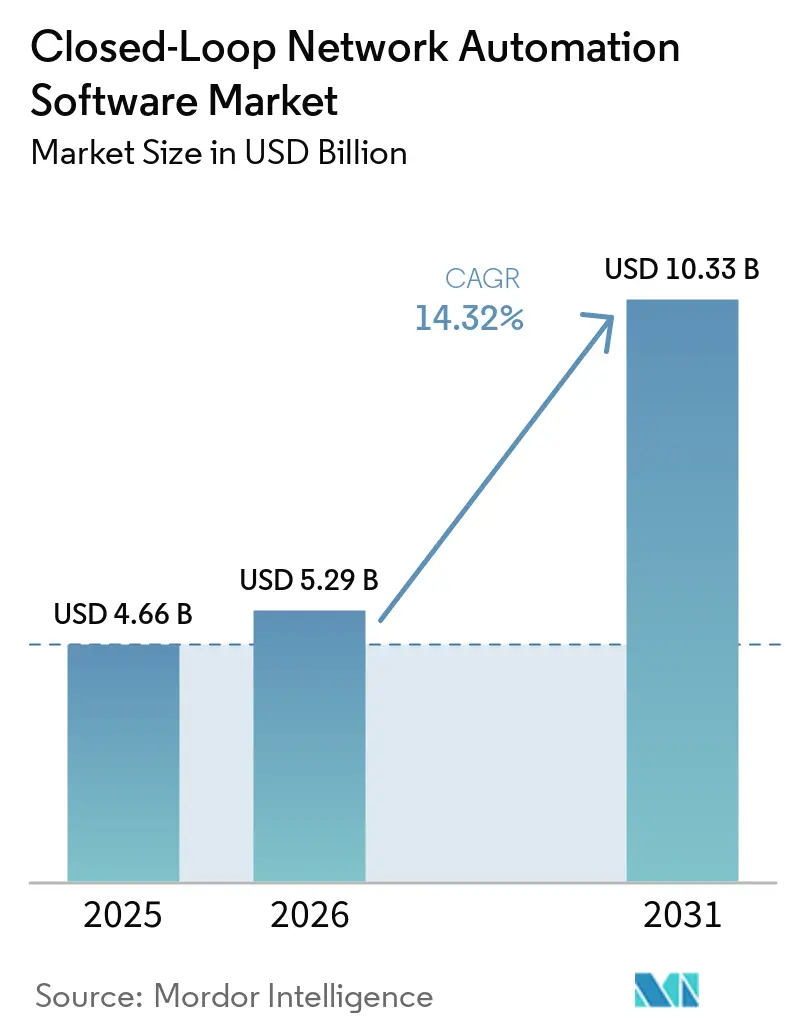
The Closed-loop network automation software market size is projected to be USD 4.66 billion in 2025, USD 5.29 billion in 2026, and reach USD 10.33 billion by 2031, growing at a CAGR of 14.32% from 2026 to 2031. The closed-loop network automation software market is being shaped by hybrid and multicloud operations, which have become increasingly difficult for network teams to manage through manual processes alone. AI-based operations platforms are moving beyond event detection and can support policy-based remediation, which changes the value placed on orchestration software. The ongoing rollout of 5G standalone networks also generates telemetry and service management requirements that favor automated decision-making across network domains. In the closed-loop network automation software market, vendors are responding with platforms that combine intent management, policy orchestration, analytics, and validation rather than relying on hardware refresh cycles. The need for traceable changes and controlled automation is likely to strengthen demand for platforms that can explain actions and validate proposed changes before deployment.
Key Report Takeaways
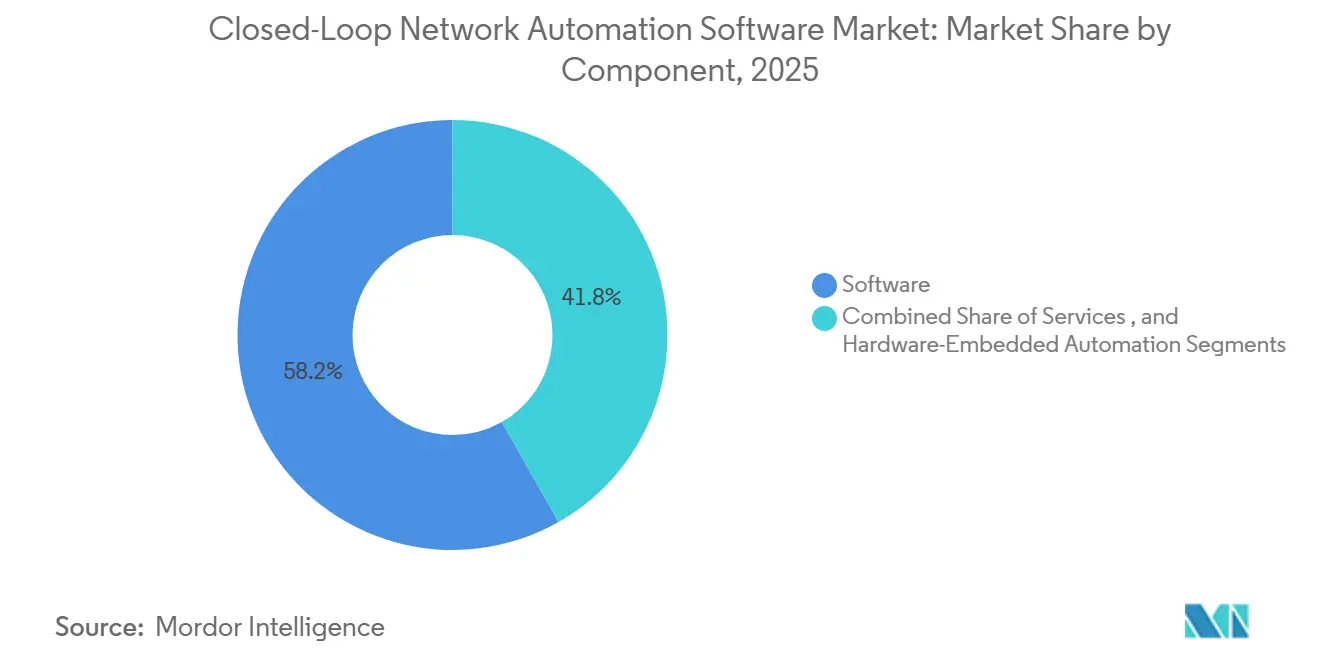
- By component, software held 58.21% revenue share in 2025, while software is projected to expand at a 15.54% CAGR through 2031.
- By deployment, cloud accounted for 45.44% of revenue in 2025 in the closed-loop network automation software market, while hybrid deployment is projected to expand at a 16.54% CAGR through 2031.
- By network infrastructure, physical infrastructure held 33.21% revenue share in 2025, while cloud-native infrastructure is projected to expand at a 15.76% CAGR through 2031.
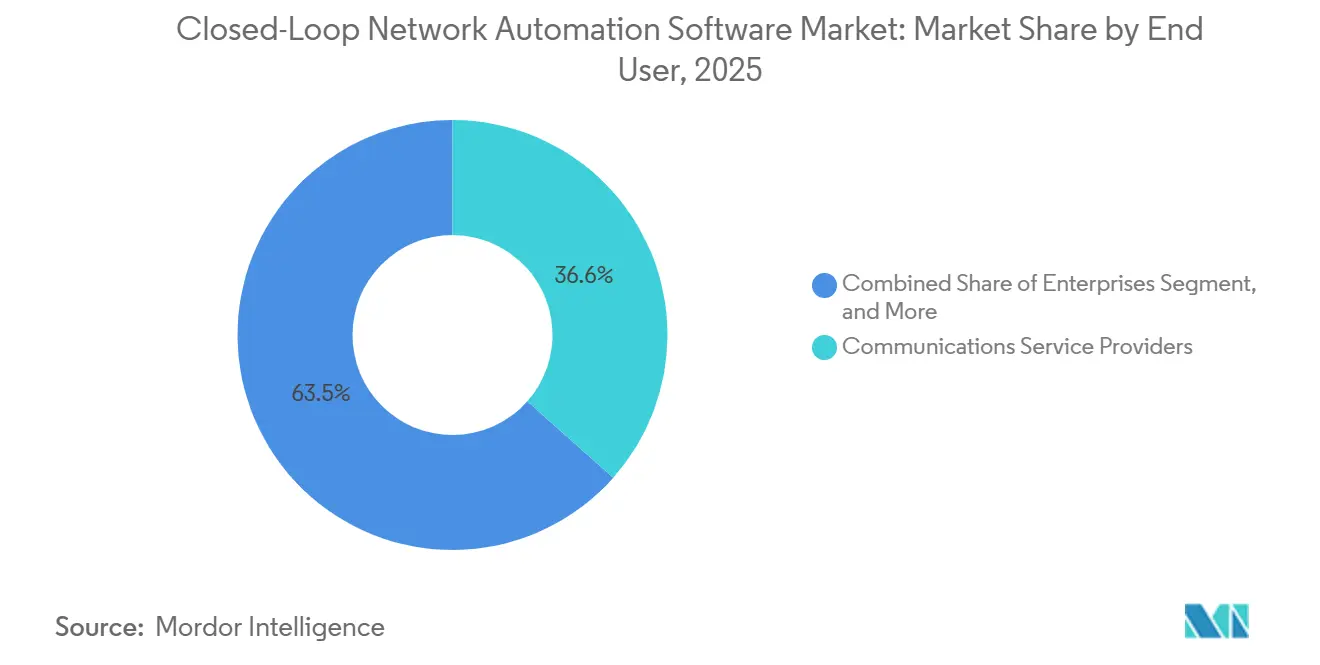
- By end user, communications service providers held 36.55% revenue share in 2025, while managed service providers and cloud service providers are projected to expand at a 16.11% CAGR through 2031 in the closed-loop network automation software market.
- By organization size, large enterprises held 68.76% revenue share in 2025, while small and medium-sized enterprises are projected to expand at a 15.98% CAGR through 2031.
- By geography, North America held 33.32% revenue share in 2025, while Asia-Pacific is projected to expand at a 16.54% CAGR through 2031 in the closed-loop network automation software market
Note: Market size and forecast figures in this report are generated using Mordor Intelligence’s proprietary estimation framework, updated with the latest available data and insights as of January 2026.
Global Closed-Loop Network Automation Software Market Trends and Insights
Drivers Impact Analysis*
| DRIVER | (~) % IMPACT ON CAGR FORECAST | GEOGRAPHIC RELEVANCE | IMPACT TIMELINE |
|---|---|---|---|
| Rising Hybrid and Multicloud Network Complexity | +3.5% | Global | Short term (≤ 2 years) |
| AI-Driven Predictive Operations and Network Analytics | +3.2% | Global | Short term (≤ 2 years) |
| Expansion of 5G, Network Slicing, and Programmable Connectivity | +2.6% | Asia-Pacific, North America, Europe | Medium term (2-4 years) |
| Demand for Zero-Touch Provisioning and Lower Operational Costs | +2.1% | Global | Short term (≤ 2 years) |
| Network-as-Code Monetization by Communications Service Providers | +1.4% | North America and Europe, spillover to the Asia-Pacific | Medium term (2-4 years) |
| Trustworthy Agentic Automation With Digital Twin Validation | +1.1% | Global, with early gains in North America and Europe | Long term (≥ 4 years) |
| Source: Mordor Intelligence | |||
Rising Hybrid and Multicloud Network Complexity
Organizations increasingly operate several cloud environments alongside legacy sites, edge nodes, and distributed applications, making routine changes harder to coordinate. The closed-loop network automation software market addresses this operational burden by linking network state, policies, and automated actions across separate environments. Network teams often work across multiple monitoring and management consoles when automation is not consolidated, slowing investigations and creating inconsistent operating practices. Microsoft described a 2025 internal program that changed hybrid-cloud integration from a months-long manual process into a one-day automated workflow using an AI orchestration agent.[1]Microsoft, “Reinventing Hybrid Cloud Integration at Microsoft, From Months to One Day,” Microsoft Inside Track, microsoft.com Cisco introduced Multicloud Fabric in 2026 to provide an automated site-to-cloud and cloud-to-cloud fabric through Cisco Cloud Control.[2]Cisco Systems, “Cisco Unveils Multicloud Fabric in Cloud Control, Network Ready for the AI Era,” Cisco Blogs, cisco.com Each new cloud or network domain increases the operational value of a shared control framework, particularly when teams must preserve security and service policies across those domains.
AI-Driven Predictive Operations and Network Analytics
AI-driven operations are moving from basic anomaly identification to systems that can recommend or perform routine corrective actions under defined policy controls. The closed-loop network automation software market benefits when operators seek faster fault handling and lower manual work in network operations centers. Nokia and Indosat Ooredoo Hutchison described autonomous-network work in 2026 that used validated automation capabilities for network operations.[3]Nokia Corporation, “Nokia and AWS Showcase Industry-First Agentic AI-Powered Network Slicing With du and Orange,” Nokia Newsroom, nokia.com The shift also changes workforce needs, as policy design, data quality, model governance, and multivendor integration require skills that differ from those of traditional network administration. Vendors therefore compete on explainability, data management, and safeguards around autonomous actions, not only on the speed of analytics. As core AI capabilities become more common, platforms that connect AI recommendations to auditable operational workflows can hold a clearer position with regulated operators and enterprises.
Expansion of 5G, Network Slicing, and Programmable Connectivity
5G standalone architectures introduce network slicing, dynamic resource allocation, and analytics interfaces that require rapid, software-based control. This change supports the closed-loop network automation software market because physical operations teams cannot manually manage every slice policy or service adjustment in real time. 3GPP specifies the Network Data Analytics Function through TS 29.520, providing a standards foundation for analytics-led network functions. Nokia and AWS demonstrated agentic AI-powered intent-based 5G network slicing with du and Orange at MWC 2026. ETSI released OpenSlice 2026Q2 with an IETF RFC 9543-aligned network slice service controller that supports standardized customer-facing slicing management and transport orchestration.[4]ETSI, “ETSI OpenSlice 2026Q2 Advances Open Network Automation and Expands Ecosystem for Future Digital Services,” ETSI Newsroom, etsi.org Standards-based interfaces can reduce dependence on proprietary integrations and give specialized automation suppliers greater access to multivendor deployments.
Demand for Zero-Touch Provisioning and Lower Operational Costs
Zero-touch provisioning has become a practical operational requirement for organizations that manage large, distributed device estates. The closed-loop network automation software market gains relevance when provisioning, configuration checks, and assurance can be handled through a coordinated process rather than separate manual tasks. Secure device onboarding provides a foundation for remote deployment where technicians cannot repeatedly visit sites for initial configuration or routine updates. IETF RFC 8572 describes bootstrapping mechanisms for secure remote key infrastructure and zero-touch provisioning.[5]IETF, “Bootstrapping Remote Secure Key Infrastructure,” IETF, ietf.org NEC demonstrated agentic AI-based autonomous management of the 5G core user plane function lifecycle with AWS in 2026, including automated anomaly detection and self-healing operations. Lower field activity and shorter configuration cycles can make closed-loop systems especially relevant for communications service providers operating extensive 5G radio and edge-device estates.
Restraints Impact Analysis*
| RESTRAINT | (~) % IMPACT ON CAGR FORECAST | GEOGRAPHIC RELEVANCE | IMPACT TIMELINE |
|---|---|---|---|
| High Integration Costs Across Legacy and Multivendor Environments | -2.3% | Global | Short term (≤ 2 years) |
| Shortage of Network Automation and AI Operations Skills | -1.6% | Global | Medium term (2-4 years) |
| Limited Explainability and Governance of Autonomous Changes | -0.9% | Europe and North America | Medium term (2-4 years) |
| Data Quality and State-Synchronization Gaps Across Operational Systems | -0.7% | Global | Long term (≥ 4 years) |
| Source: Mordor Intelligence | |||
High Integration Costs Across Legacy and Multivendor Environments
Legacy operational support systems, network-management platforms, and multivendor equipment often lack consistent interfaces for programmatic control. This makes integration effort a central barrier to adoption in the closed-loop network automation software market, even when the software license itself is affordable. Routing, switching, SD-WAN, security, and radio networks can use different APIs, configuration models, and data structures. These differences require connectors and testing before an automated workflow can operate safely across the full environment. Nokia and Ericsson announced interoperability work in 2026, including cooperation between Nokia's SMO Marketplace and Ericsson's rApp Ecosystem. Wider use of standards-compliant management interfaces can reduce this friction, but mixed installed equipment will continue to slow fully automated deployments.
Shortage of Network Automation and AI Operations Skills
Effective closed-loop operations require people who can combine policy design, AI governance, multivendor integration, security controls, and automated delivery methods. The closed-loop network automation software market can therefore face slower implementation even when organizations recognize the business case for automation. Many teams still have limited automation coverage, which leaves them with fewer internal examples and less operational confidence for broader deployments. The need is most pronounced where cloud, security, and network automation responsibilities meet in the same operating model. Cisco's learning programs and Ericsson's OSS and BSS value-pathway programs show that vendors view workforce enablement as part of customer transformation. Training can reduce the constraint, although talent development will take longer than a basic software installation or a single pilot project.
*Our forecasts treat driver/restraint impacts as directional, not additive. The impact forecasts reflect baseline growth, mix effects, and variable interactions.
Segment Analysis
By Component: Software Anchors Revenue as Intelligence Replaces Infrastructure Spend
Software accounted for 58.21% of the closed-loop network automation software market share in 2025 and is projected to grow at a CAGR of 15.54% through 2031. This position reflects operators’ shift from capital-intensive hardware renewals toward continuous investment in intelligence and orchestration layers. Software includes intent-based networking engines, policy-driven automation, analytics, and control functions that operate across multiple infrastructure domains. These capabilities enable teams to move from isolated configuration tasks to a more coordinated operating model.
Hardware-embedded automation remains relevant for greenfield deployments and functions directly linked to network operating systems or controllers. However, it is expanding more slowly as orchestration logic shifts to vendor-neutral software layers. Services also remain important, as implementation, integration, and managed operations can reduce adoption barriers for customers without in-house automation teams. The component mix indicates that commercial value is increasingly concentrated in the software layer rather than in a single physical device category. This trend benefits suppliers that can continuously update capabilities as customer requirements evolve. It also increases the value of platforms that operate across existing equipment rather than requiring customers to replace installed hardware.



By Deployment: Hybrid Models Outpace Cloud on Forward Growth Rate
Cloud deployment accounted for 45.44% of revenue in 2025, while hybrid deployment is projected to grow at a 16.54% CAGR through 2031. Cloud-delivered OSS, BSS, and orchestration platforms can reduce implementation barriers for organizations adopting automation for the first time. They also make analytics and centralized policy management more accessible across distributed sites. Hybrid deployment addresses a different requirement by allowing customers to use cloud-based analytics while retaining sensitive traffic, audit data, or change execution in controlled environments. This model is particularly relevant for healthcare, BFSI, energy and utilities, government, and other regulated end users.
On-premises deployment remains important for defense, public-sector, and sovereign operators, where data-residency requirements limit the use of hosted orchestration platforms. Therefore, deployment choices reflect operational and compliance requirements rather than technology preferences alone. Hybrid models enable customers to benefit from cloud agility without immediately moving all operational control to a public cloud. As a result, hybrid deployment provides an important transition path for organizations progressing cautiously toward higher levels of autonomy.
By Network Infrastructure: Physical Base Persists as Cloud-Native Claims the Growth Frontier
Physical infrastructure accounted for 33.21% of revenue in 2025, while cloud-native infrastructure is projected to grow at a 15.76% CAGR through 2031. The physical infrastructure segment reflects the large installed base of switches, routers, and radio access equipment that continues to require assurance and automated management. Fault management, configuration-drift detection, and zero-touch onboarding remain high-volume automation use cases for these assets. Virtual infrastructure includes network functions running on commercial servers and represents a more mature stage of network virtualization. Its role remains significant as operators manage virtual network functions across existing environments.
Cloud-native infrastructure differs in that it uses containerized functions, service meshes, and microservices-based network architectures. These architectures provide programmatic interfaces that can support policy-based actions and agentic control. Therefore, the closed-loop network automation software market must support physical, virtual, and cloud-native environments simultaneously. Most large operators are not replacing every legacy layer at once. Instead, they are combining these layers within a single operational framework during an extended transition period.
By End User: CSPs Anchor Revenue While MSPs Claim the Fastest Growth Trajectory
Communications service providers accounted for 36.55% of revenue in 2025, while managed service providers and cloud service providers are projected to grow at a CAGR of 16.11% through 2031. CSPs operate 5G, fiber, and wireless networks, where fault handling, provisioning, and capacity management occur at a scale that favors automation. Mobile network operators show high adoption intensity because 5G densification and network slicing services increase operational demands. Fixed-line, cable, and broadband operators also use automation for subscriber provisioning and service assurance. Internet service providers can use zero-touch processes to manage edge devices and repetitive configuration tasks.
Managed service providers and cloud service providers represent a distinct buyer group because they use automation internally and can offer it as a service to enterprise customers. Ciena stated in 2026 that Lumen Technologies was adopting AI agents built on Blue Planet AI Studio across its network operations. This model enables providers to improve internal operations while developing capabilities for managed automation services. It is particularly relevant for enterprises that require automation outcomes but lack a comprehensive in-house NetDevOps function.
By Organization Size: Large Enterprises Dominate Spend While SMEs Enter at Pace
Large enterprises accounted for 68.76% of revenue in 2025, while small and medium-sized enterprises (SMEs) are projected to grow at a CAGR of 15.98% through 2031. Large organizations typically operate multisite wide-area networks and complex physical, virtual, and cloud environments. Their regulatory obligations and high-availability requirements increase the value of automated documentation, rollback, and assurance capabilities. BFSI institutions, major healthcare systems, and energy utilities represent prominent users, as network failures can disrupt essential or highly regulated operations.
SMEs are gaining access to closed-loop network automation software through SaaS delivery models, simplified onboarding, and vendor-managed implementation. These approaches reduce the in-house DevOps capabilities that previously constrained adoption among smaller organizations. This shift creates opportunities for providers that offer prebuilt workflows instead of lengthy custom service engagements. SME buyers may prioritize ease of deployment, predictable subscription costs, and a focused set of automation outcomes. However, they still require assurance, policy control, and secure configuration management across branch locations, cloud connections, and edge devices.
Geography Analysis
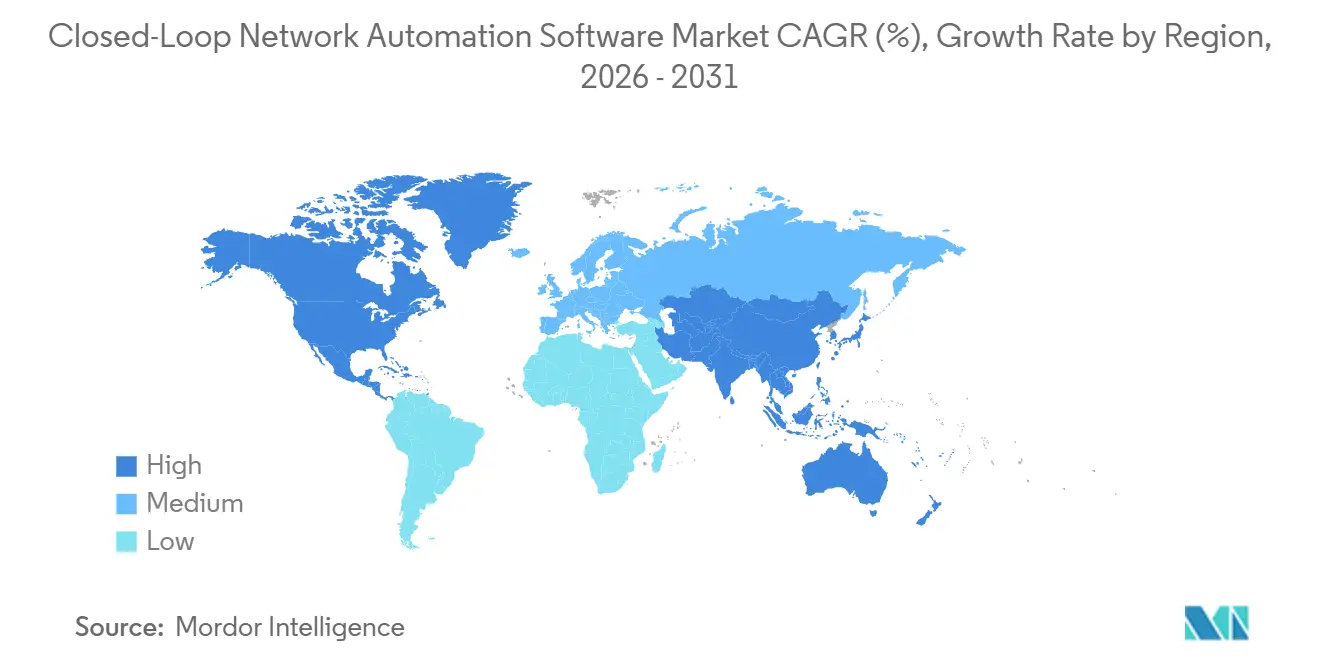
North America is expected to hold a 33.32% share of the closed-loop network automation software market in 2025. The region benefits from strong enterprise technology spending, active 5G initiatives, and the presence of major cloud and network platform providers. AI infrastructure buildouts are creating traffic patterns and operational requirements that increase the need for dynamic network management. Financial services and healthcare organizations represent significant enterprise adopters because they require reliable, secure, and auditable network services. Canada is generating demand from users in the financial services and natural resources sectors, while Mexico presents an emerging CSP opportunity as operators rationalize their networks. Cisco is set to unveil Multicloud Fabric and its AgenticOps model at Cisco Live 2026 in Las Vegas. These developments reflect the region’s focus on integrating cloud connectivity, security, and automation within a unified operating environment.
Asia-Pacific is projected to expand at a CAGR of 16.54% through 2031, making it the fastest-growing region. China is expected to deploy more than 4 million 5G base stations by early 2026, creating substantial automation requirements across radio, core, and transport networks. India is advancing its digital and 5G infrastructure, encouraging operators to adopt AI-based optimization as subscriber demand rises. Japan and South Korea are also driving demand through network slicing and private 5G initiatives. NTT DOCOMO and NEC are expected to launch Japan’s first commercial 5G core on AWS in 2026. Indonesia, Malaysia, and Vietnam are adopting automated provisioning as their 5G networks expand. Malaysia has emerged as an early example of validated advanced autonomy in an emerging operator market. The closed-loop network automation software market benefits from these deployments, which require repeatable, standards-based operations across large-scale networks.
Europe remains an important market, as Deutsche Telekom, Orange, Vodafone, and Telefónica continue to invest in open RAN-aligned automation and slicing orchestration. Orange and Ericsson are collaborating on automated 5G service creation for enterprise and subscriber use cases across European operations. South America is developing through CSP automation initiatives in Brazil and Argentina, with early adoption focused on provisioning and fault management. The Middle East is gaining momentum through infrastructure programs in Saudi Arabia and 5G-Advanced deployments in the UAE. Nokia selected du as an early adopter of agentic AI-powered network slicing at MWC 2026. Africa remains at an earlier stage of adoption, although operators in South Africa and Nigeria are exploring autonomous network approaches. Huawei documented Level 4 autonomous network deployments with MTN in South Africa and MasOrange in Spain during 2025. These regional differences create varied opportunities for suppliers, ranging from foundational provisioning tools to broader intent-based orchestration platforms.

Competitive Landscape
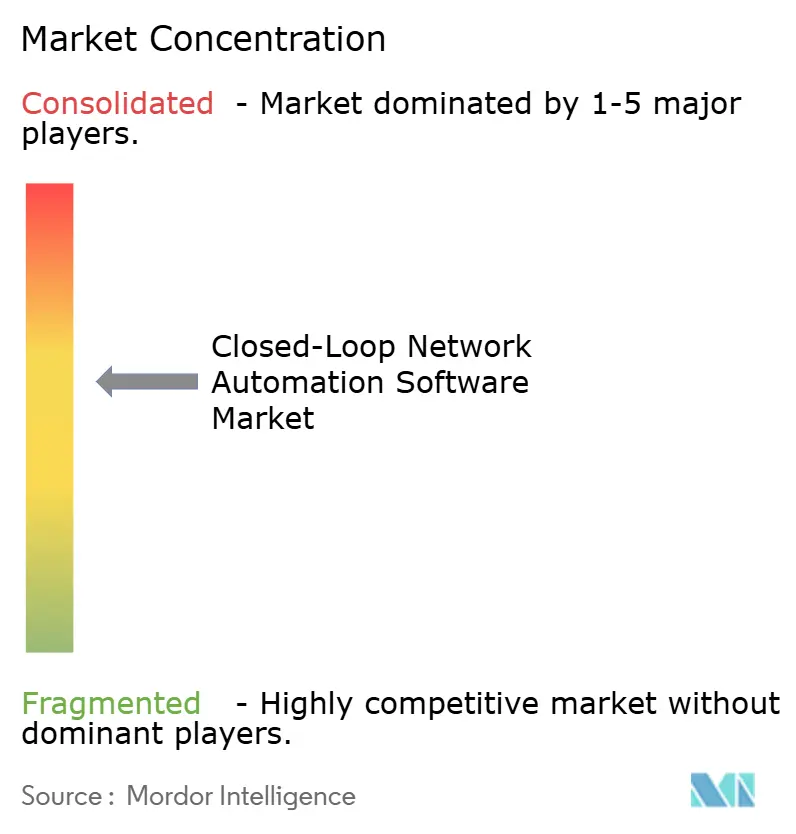
The closed-loop network automation software market is expected to be moderately consolidated at the platform layer in 2026. Cisco, Nokia, Ericsson, Huawei, Ciena, IBM through Red Hat, and Arista Networks offer broad portfolios that combine orchestration, analytics, network integration, and validation capabilities. Their scale provides access to large CSP and enterprise accounts with complex installed environments. Their strategies also address customer concerns regarding vendor lock-in and the costs of integrating multivendor networks. Participation in open standards, RApp ecosystems, ETSI Zero-touch Network and Service Management initiatives, and TM Forum APIs can help suppliers mitigate these concerns. Nokia is expected to announce an Autonomous Networks Agent Library and expand the agentic AI capabilities of its Network Services Platform in 2026. This approach enables customers to adopt modular AI capabilities without replacing an entire operating platform at once. Major suppliers are also using cloud-based delivery models to serve mid-market customers that may not have the resources to support complex on-premises deployments.
Ciena is expected to introduce Blue Planet Configuration and Change Management in 2026 for device configuration, network changes, lifecycle management, drift detection, and compliance validation. The offering addresses governance requirements associated with autonomous changes, including the need to assess potential effects before implementing changes in production systems. Arista acquired Broadcom’s VeloCloud SD-WAN portfolio in 2025, extending its automation capabilities across distributed enterprise WAN and branch networks. Huawei is expected to launch AUTINOps at MWC 2026, featuring specialized AI agents for fault remediation and proactive risk management. These developments demonstrate that competition is shifting toward integrated, AI-based operational platforms with more specific controls for change management and assurance. Platform suppliers can use their broad portfolios to serve large accounts across multiple network domains. However, they must demonstrate that their systems can operate across non-native equipment and established operational processes. Competitive advantage increasingly depends on trusted execution and comprehensive feature coverage.
Specialists, including Itential, Forward Networks, NetBrain Technologies, and Gluware, compete by addressing focused operational requirements. Their offerings support multivendor change management, mathematical network verification, digital twin-based validation, and accessible automation workflow design. This positioning enables them to win customers who require specific capabilities without undertaking a full platform replacement. The closed-loop network automation software market also presents opportunities for subscription-based offerings that reduce reliance on extensive professional services. Explainability tools represent another area of differentiation for customers who require audit records for AI-driven actions. Nokia and Ericsson’s interoperability agreement in 2026 also signals the growing importance of open interfaces in mixed-vendor environments. Competition is therefore divided between full-stack suppliers and specialized providers with deep expertise in specific use cases.
Closed-Loop Network Automation Software Industry Leaders
Cisco Systems, Inc.
Hewlett Packard Enterprise Company
Huawei Technologies Co., Ltd.
Nokia Corporation
IBM Corporation
- *Disclaimer: Major Players sorted in no particular order

Recent Industry Developments
- July 2026: Nokia signed a 5G expansion agreement with Taiwan Mobile to accelerate the adoption of AI-native mobile network architecture by deploying AirScale, MantaRay SON closed-loop assurance, and Predictive Hardware Analytics.
- June 2026: Nokia released its Autonomous Networks Agent Library and upgraded agentic AI capabilities at DTW 2026, including an agentic AI framework for IP network operations within its Network Services Platform.
- June 2026: Ericsson launched AI in RAN software as a commercial subscription and reported up to 20% higher downlink throughput and up to 10% better spectral efficiency across more than 15 live deployments.
- June 2026: Cisco unveiled Cloud Control at Cisco Live 2026, a unified agentic platform that combines networking, security, compute, and observability under a single data layer.


Global Closed-Loop Network Automation Software Market Report Scope
The Closed-Loop Network Automation Software Report is Segmented by Component (Software, Hardware-Embedded Automation, and Services), Deployment (Cloud, On-Premises, and Hybrid), Network Infrastructure (Physical Network Infrastructure, Virtual Network Infrastructure, Cloud-Native Network Infrastructure, and Hybrid Network Infrastructure), End User (Communications Service Providers[Mobile Network Operators, Fixed-Line Operators, Cable and Broadband Providers, Internet Service Providers], Enterprises [Banking, Financial Services, and Insurance, Manufacturing, Healthcare, Energy and Utilities, Government and Public Sector, Retail and E-Commerce, Media and Entertainment, Transportation and Logistics], and Managed Service Providers and Cloud Service Providers), Organization Size (Large Enterprises, and SMEs), and Geography (North America, South America, Europe, Asia-Pacific, Middle East and Africa). The Market Forecasts are Provided in Terms of Value (USD).
| Software |
| Hardware-Embedded Automation |
| Services |
| Cloud |
| On-Premises |
| Hybrid |
| Physical Network Infrastructure |
| Virtual Network Infrastructure |
| Cloud-Native Network Infrastructure |
| Hybrid Network Infrastructure |
| Communications Service Providers | Mobile Network Operators |
| Fixed-Line Operators | |
| Cable and Broadband Providers | |
| Internet Service Providers | |
| Enterprises | Banking, Financial Services, and Insurance |
| Manufacturing | |
| Healthcare | |
| Energy and Utilities | |
| Government and Public Sector | |
| Retail and E-Commerce | |
| Media and Entertainment | |
| Transportation and Logistics | |
| Managed Service Providers and Cloud Service Providers |
| Large Enterprises |
| Small and Medium-Sized Enterprises |
| North America | United States |
| Canada | |
| Mexico | |
| South America | Brazil |
| Argentina | |
| Rest of South America | |
| Europe | United Kingdom |
| Germany | |
| France | |
| Italy | |
| Rest of Europe | |
| Asia-Pacific | China |
| India | |
| Japan | |
| South Korea | |
| Rest of Asia-Pacific | |
| Middle East | Saudi Arabia |
| United Arab Emirates | |
| Rest of Middle East | |
| Africa | South Africa |
| Nigeria | |
| Rest of Africa |
| By Component | Software | |
| Hardware-Embedded Automation | ||
| Services | ||
| By Deployment | Cloud | |
| On-Premises | ||
| Hybrid | ||
| By Network Infrastructure | Physical Network Infrastructure | |
| Virtual Network Infrastructure | ||
| Cloud-Native Network Infrastructure | ||
| Hybrid Network Infrastructure | ||
| By End User | Communications Service Providers | Mobile Network Operators |
| Fixed-Line Operators | ||
| Cable and Broadband Providers | ||
| Internet Service Providers | ||
| Enterprises | Banking, Financial Services, and Insurance | |
| Manufacturing | ||
| Healthcare | ||
| Energy and Utilities | ||
| Government and Public Sector | ||
| Retail and E-Commerce | ||
| Media and Entertainment | ||
| Transportation and Logistics | ||
| Managed Service Providers and Cloud Service Providers | ||
| By Organization Size | Large Enterprises | |
| Small and Medium-Sized Enterprises | ||
| By Geography | North America | United States |
| Canada | ||
| Mexico | ||
| South America | Brazil | |
| Argentina | ||
| Rest of South America | ||
| Europe | United Kingdom | |
| Germany | ||
| France | ||
| Italy | ||
| Rest of Europe | ||
| Asia-Pacific | China | |
| India | ||
| Japan | ||
| South Korea | ||
| Rest of Asia-Pacific | ||
| Middle East | Saudi Arabia | |
| United Arab Emirates | ||
| Rest of Middle East | ||
| Africa | South Africa | |
| Nigeria | ||
| Rest of Africa | ||


Key Questions Answered in the Report
What is the projected size of the Closed-Loop Network Automation Software Market?
The Closed-loop network automation software market size is projected to be USD 4.66 billion in 2025, USD 5.29 billion in 2026, and reach USD 10.33 billion by 2031, growing at a CAGR of 14.32% from 2026 to 2031.
What is driving the adoption of closed-loop network automation software?
Hybrid and multicloud complexity, 5G standalone networks, AI-based operations, and zero-touch provisioning are supporting adoption.
Which component leads revenue?
Software led with 58.21% revenue share in 2025 and is projected to expand at a 15.54% CAGR through 2031.
Which deployment model is expanding fastest?
Hybrid deployment is projected to expand at a 16.54% CAGR through 2031 because it combines cloud agility with controlled execution.
Which end users are major buyers?
Communications service providers led revenue with 36.55% share in 2025, while managed and cloud service providers are projected to expand fastest.
Which region is expanding fastest?
Asia-Pacific is projected to expand at a 16.54% CAGR through 2031, supported by 5G deployment and the adoption of automation.
Page last updated on:





