
Managed LAN Services Market Size and Share
Market Overview
| Study Period | 2021 - 2032 |
|---|---|
| Market Size (2027) | USD 17.39 Billion |
| Market Size (2032) | USD 24.93 Billion |
| Growth Rate (2027 - 2032) | 7.47 % |
| Fastest Growing Market | Asia-Pacific |
| Largest Market | North America |
| Market Concentration | Medium |
Major Players *Disclaimer: Major Players sorted in no particular order Image © Mordor Intelligence. Reuse requires attribution under CC BY 4.0. | |
Managed LAN Services Market Analysis by Mordor Intelligence
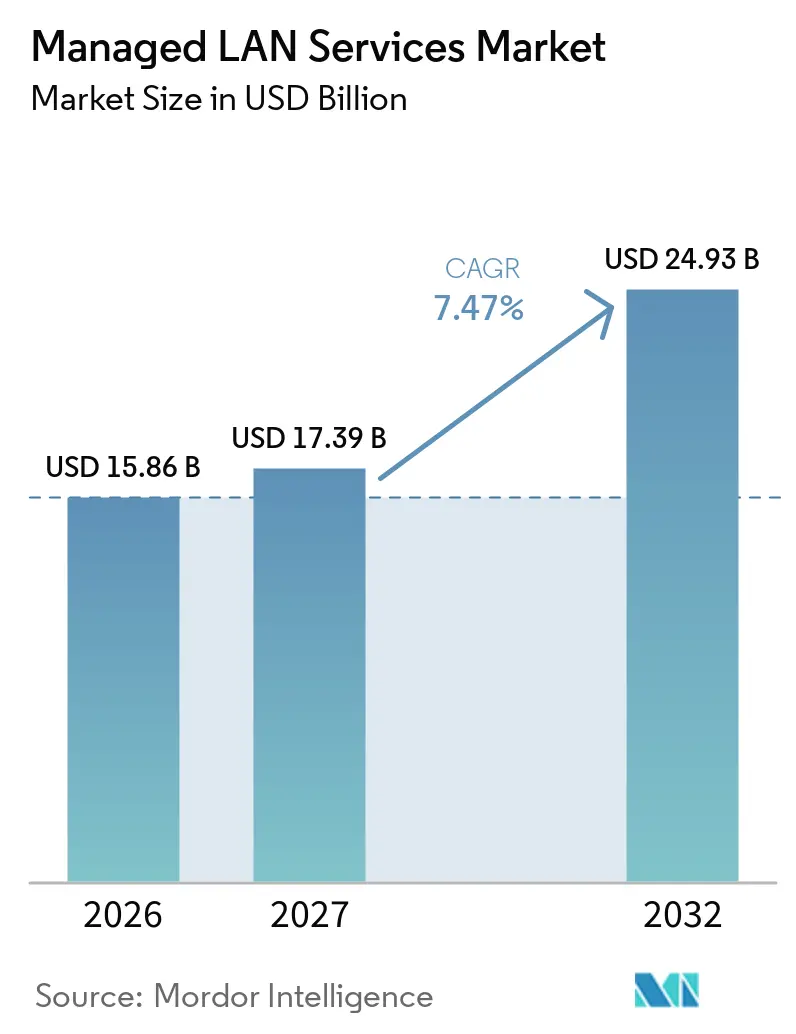
The Managed LAN Services Market size is projected to expand from USD 15.86 billion in 2026 and USD 17.39 billion in 2027 to USD 24.93 billion by 2032, registering a CAGR of 7.47% between 2027 and 2032. Enterprises are moving network operations to managed service providers as cloud workloads, hybrid work, and connected devices make campus and branch networks harder to operate with internal teams alone. Providers combine wired, wireless, and software-defined LAN capabilities under one contract, which can simplify operations and provide access to specialized skills. Regulation is also affecting provider selection, especially where financial institutions must manage third-party ICT risk and retain auditability. Competition combines global network service providers, carriers, IT services firms, and LAN-as-a-service specialists, so enterprise buyers must balance automation, geographic reach, service control, and exit options. The Managed LAN Services Market, therefore, favors providers that can support complex sites while offering clear lifecycle pricing and co-managed delivery.
Key Report Takeaways
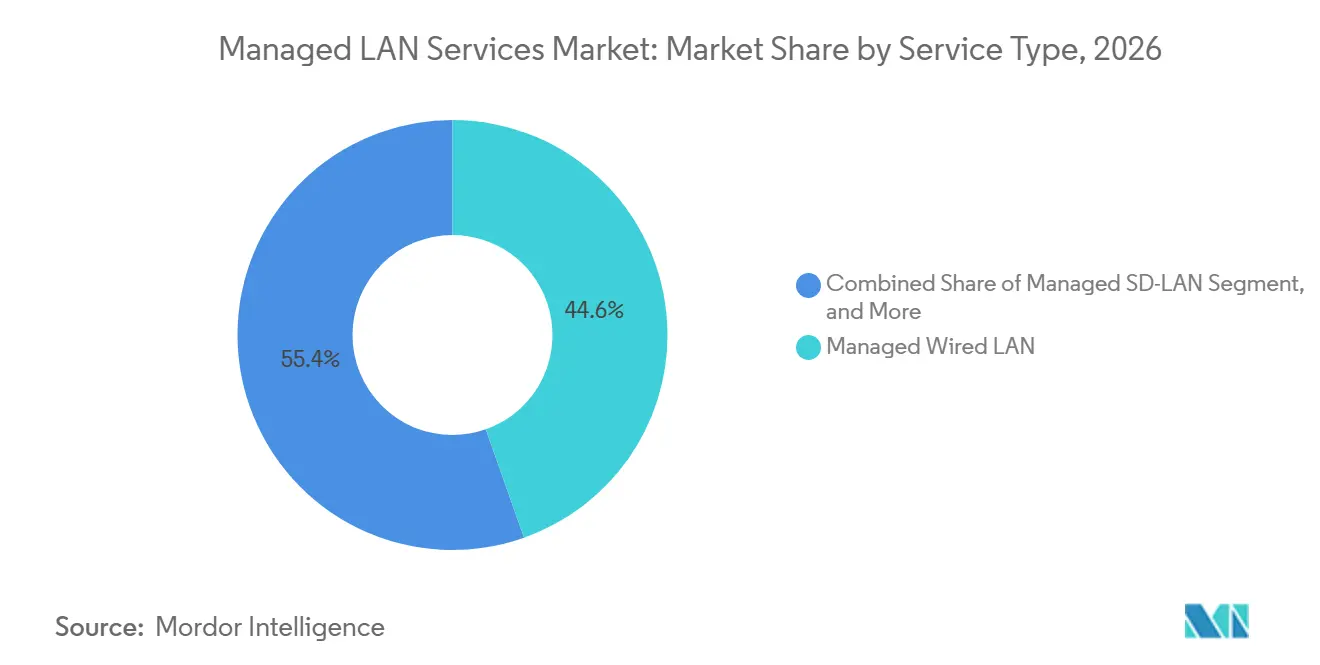
- By service type, Managed Wired LAN held 44.60% of the Managed LAN Services Market share in 2026, while Managed SD-LAN is projected to expand at a 9.82% CAGR through 2032.
- By delivery architecture, on-premises managed LAN accounted for 46.17% of the Managed LAN Services Market share in 2026, while cloud-managed delivery is expected to expand at an 8.97% CAGR through 2032.
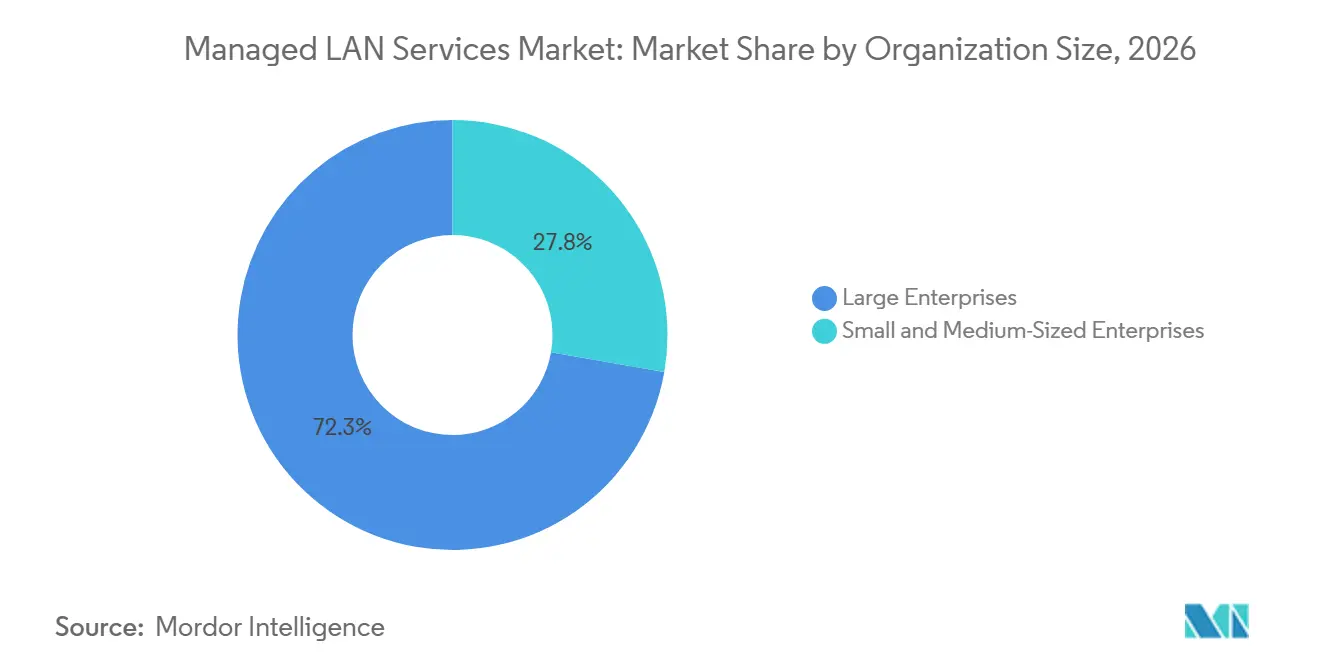
- By organization size, large enterprises commanded 72.25% of the Managed LAN Services Market size in 2026, while SMEs are projected to expand at a 9.57% CAGR through 2032.
- By end-user vertical, BFSI accounted for 21.09% of the Managed LAN Services Market size in 2026, while healthcare and life sciences are forecast to expand at an 8.73% CAGR through 2032.
- By geography, North America held 36.07% of the Managed LAN Services Market share in 2026, while Asia-Pacific is projected to expand at a 10.07% CAGR through 2032.
Note: Market numbers in this report are based on Mordor Intelligence's proprietary estimation framework, which combines nine months of actuals with Q4 projections for base year 2026.
Global Managed LAN Services Market Trends and Insights
Drivers Impact Analysis*
| Driver | (~) % Impact on CAGR Forecast | Geographic Relevance | Impact Timeline |
|---|---|---|---|
| Cloud and Hybrid-Work Network Complexity | +2.0% | Global | Short term (≤ 2 years) |
| Cybersecurity and Regulatory Assurance Demand | +1.5% | Global, with heightened focus in EU and North America | Medium term (2-4 years) |
| AI-Enabled Monitoring and Auto-Remediation | +1.3% | North America and Europe, spreading to Asia-Pacific | Medium term (2-4 years) |
| Shortage of Enterprise Network Operations Talent | +1.2% | Global | Medium term (2-4 years) |
| Campus IoT and High-Density Wireless Expansion | +0.9% | Asia-Pacific core, spillover to North America and Europe | Long term (≥ 4 years) |
| Private 5G and Edge-Campus Convergence | +0.7% | Asia-Pacific and North America, early gains in manufacturing hubs | Long term (≥ 4 years) |
| Source: Mordor Intelligence | |||
Cloud and Hybrid-Work Network Complexity
Cloud workloads, cloud-delivered security, and hybrid work create traffic patterns that older hub-and-spoke LAN designs do not always handle reliably. The Managed LAN Services Market benefits when enterprises need help coordinating diverse sites, device types, and application paths. Providers can operate wired, wireless, and software-defined networks through a single service model, reducing the need for separate internal teams. This need is strongest for organizations with large numbers of cloud-connected locations because they also require local support at campuses and branches. The move toward managed delivery reflects an operating challenge rather than a conventional outsourcing cycle.
Cybersecurity and Regulatory Assurance Demand
Network security now depends on controls at the device, port, and session level rather than only at the network perimeter. Managed LAN providers are therefore expected to deliver access control, segmentation, and continuous device visibility as core service elements. The Digital Operational Resilience Act became applicable on January 17, 2025, and it places stronger attention on ICT third-party arrangements in financial services. ESMA issued revised cloud outsourcing guidance in July 2025, reinforcing the need for auditability and contractual exit capability in outsourcing relationships. The Managed LAN Services Market can gain from this demand, where providers can create usable logs, change records, and incident-response evidence for regulated customers.
Shortage of Enterprise Network Operations Talent
Network teams need skills across legacy switching, cloud platforms, automation, security, and wireless operations. This combination is difficult to maintain internally, particularly when enterprises operate equipment from multiple vendors. The Managed LAN Services Market offers an alternative for organizations that need continuous operations without expanding specialist staff for every site. The issue is broader than staffing levels because newer engineers may have cloud and automation skills but limited experience running mixed-generation campus estates. Managed providers can use centralized operations centers and repeatable runbooks to cover this gap across many clients.
AI-Enabled Monitoring and Auto-Remediation
AI operations tools are changing the cost and service model for managed LAN delivery. In August 2025, HPE introduced agentic AI functions for Juniper Mist, including a Generalized Large Experience Model, automated remediation in Marvis Actions, and Marvis Minis that simulate user experience. Extreme Networks stated in 2025 that its Platform ONE could reduce manual network-management work and speed issue resolution for adopting customers.[1] The Managed LAN Services Market is affected as cloud-managed providers use these capabilities to reduce operational effort and improve service consistency. Providers limited to on-premises management may find it harder to match the automation depth available through cloud-native platforms.
Restraints Impact Analysis*
| Restraint | (~) % Impact on CAGR Forecast | Geographic Relevance | Impact Timeline |
|---|---|---|---|
| Data Sovereignty and Third-Party Control Concerns | -1.1% | EU, with spillover to Asia-Pacific and Middle East | Medium term (2-4 years) |
| Vendor Lock-In and Opaque Lifecycle Pricing | -0.8% | Global | Short term (≤ 2 years) |
| Legacy Estate Integration and Change-Window Risk | -0.6% | North America and Europe | Medium term (2-4 years) |
| Energy and Carbon Costs of Always-On Network Operations | -0.4% | EU core, emerging in Asia-Pacific | Long term (≥ 4 years) |
| Source: Mordor Intelligence | |||
Data Sovereignty and Third-Party Control Concerns
Data localization requirements can limit full managed LAN outsourcing in regulated sectors and jurisdictions. When a provider manages the LAN, telemetry such as device identities, traffic patterns, and user behavior records can move through infrastructure outside the customer’s country. The European Commission’s Cloud Sovereignty Framework sets tiers for data and AI sovereignty that providers need to address for regulated European customers. The European Central Bank’s cloud outsourcing guide asks supervised institutions to assess lock-in, cost predictability, and auditability when using cloud services.[2] These requirements can lengthen procurement cycles and increase compliance work for providers serving banking, government, and healthcare customers.
Vendor Lock-In and Opaque Lifecycle Pricing
Long managed LAN contracts can be difficult to exit when they bundle hardware, software, management platforms, and service-level commitments. Proprietary management tools can make it harder for customers to introduce competing technology or move to another provider. The Managed LAN Services Market faces a restraint when buyers cannot clearly separate the cost of connectivity, hardware lifecycle services, management software, and operations. Regulatory guidance also makes contractual exit planning more important for financial institutions using cloud providers. Providers that offer clear price components, open interfaces, and defined exit paths can address a major buyer concern.
*Our forecasts treat driver/restraint impacts as directional, not additive. The impact forecasts reflect baseline growth, mix effects, and variable interactions.
Segment Analysis
By Service Type: Wired Infrastructure Anchors Demand While SD-LAN Changes Delivery
Managed Wired LAN held 44.60% of the Managed LAN Services Market share in 2026, reflecting the extensive installed base of structured cabling, Power-over-Ethernet switching, and campus routing. The segment remains relevant because dense wireless environments still need reliable wired backhaul. Wi-Fi 7 deployments, connected devices, and unified communications systems also increase the demand for high-capacity switching. Managed wireless LAN is the second-largest service category, serving customers who need centralized support for access points and wireless policy. Other managed LAN services include co-managed and LAN-as-a-service packages for organizations that want shared operational responsibility.
Managed SD-LAN is projected to expand at a 9.82% CAGR through 2032, making it the fastest-growing service type in the Managed LAN Services Market. It brings switching, wireless access, and security policy into software-defined control planes. This structure supports intent-based provisioning and zero-touch deployment across distributed locations. Versa’s Secure SD-LAN combines zero-trust security, automated device identification, AI-driven issue resolution, and micro-segmentation in one management layer.[3] Providers can package these functions into outcome-based agreements that charge by device rather than by hardware unit.

By Delivery Architecture: On-Premises Models Lead While Cloud Management Advances
On-premises managed LAN accounted for 46.17% of the Managed LAN Services Market share in 2026. The model remains important for regulated organizations and high-security environments that cannot route management telemetry through public cloud infrastructure. Banks, defense contractors, and manufacturers operating operational technology networks may treat local management as a compliance requirement. Hybrid delivery divides control between on-premises appliances and cloud orchestration. It appeals to enterprises that seek cloud agility while keeping selected controls within their own environment.
Cloud-managed delivery is projected to expand at an 8.97% CAGR from 2027 to 2032, ahead of the overall Managed LAN Services Market. Its subscription model can combine hardware, operations, and AI-enabled monitoring without a major upfront customer investment. Nile launched its NXI generative AI engine in June 2025, describing a capability to detect, diagnose, and resolve wired and wireless network issues through Softbots. This delivery model can help providers offer automation alongside continuous service. The architecture also changes vendor competition because cloud platforms can create long-term control-plane dependencies.
By Organization Size: Large Enterprises Anchor Revenue While SME Demand Accelerates
Large enterprises commanded 72.25% of the Managed LAN Services Market size in 2026. Global corporations with many sites need 24/7 network operations, hardware lifecycle management, and compliance reporting. HCLTech offers vendor-agnostic managed wired and wireless LAN services across Cisco, Aruba, and Juniper equipment. Healthcare and manufacturing customers add complexity through connected devices and operational technology. Their requirements often include segmentation and real-time device visibility that standard contracts may not address completely.
SMEs are projected to expand at a 9.57% CAGR from 2027 to 2032. Per-device and per-site subscription prices can make enterprise-grade management accessible without the same capital commitment as an internally owned deployment. Small and medium-sized businesses are also seeking managed security and monitoring alongside network operations. Their purchasing decisions can therefore depend on operational control and protection rather than price alone. The Managed LAN Services Market gives platform-focused providers an opportunity when they can make advanced functions simple to deploy and operate.
By End-User Vertical: BFSI Leads While Healthcare Requirements Expand
BFSI accounted for 21.09% of the Managed LAN Services Market size in 2026, the largest vertical share. Financial institutions need resilient connectivity across branches and trading locations, where failures can carry direct operational and compliance consequences. DORA requires financial entities to strengthen digital operational resilience and manage risks associated with ICT third-party service providers. These requirements make audit trails, incident logging, and rapid restoration important elements of a managed LAN agreement. IT and telecommunications is the second-largest vertical because technology firms and carriers also operate extensive campus and edge-office networks.
Healthcare and life sciences are forecast to expand at an 8.73% CAGR through 2032. Connected medical devices, electronic health records, real-time patient monitoring, and robotic systems increase the performance and availability required from hospital LANs. Healthcare organizations need to isolate medical-device traffic from general IT traffic, which makes micro-segmentation important. Spectrum Enterprise provides a healthcare managed network offering using Cisco Meraki to combine switching, SD-WAN, and wireless under one contract. Manufacturing, retail, government, and utilities also contribute through needs related to operational continuity, physical security, and connected operations.
Geography Analysis
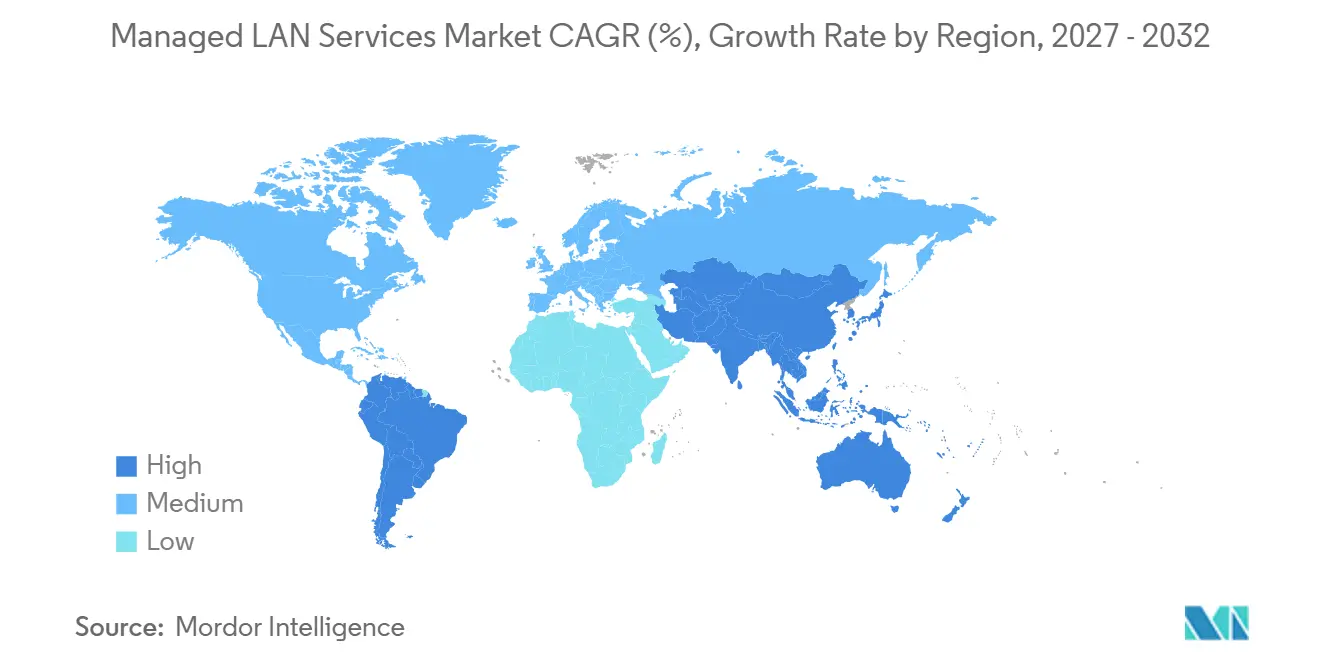
North America held 36.07% of the Managed LAN Services Market share in 2026, with the United States as the largest national contributor. The region has mature IT outsourcing practices, dense multi-campus estates, and a competitive supplier base. In August 2025, AT&T Business and Cisco launched AT&T SASE with Cisco, combining SD-WAN, zero-trust security, threat intelligence, and centralized policy enforcement in a cloud-native offering that illustrates the closer connection between LAN, WAN, and security management. Canada and Mexico are also contributing as retailers and manufacturers adopt cloud-managed platforms for distributed locations.
Europe is the second-largest regional market, led by Germany, the United Kingdom, and France. Data sovereignty and outsourcing oversight are central factors in European procurement, and the Commission’s sovereignty framework is particularly relevant to providers competing for government and banking contracts where data residency cannot be compromised. The Managed LAN Services Market in Europe also benefits from demand for provider expertise and automation. South America, the Middle East, and Africa remain developing but important areas, with smart-city programs supporting demand in Saudi Arabia and the UAE and network modernization contributing in Brazil and Argentina.
Asia-Pacific is projected to expand at a 10.07% CAGR from 2027 to 2032, the highest regional rate in the Managed LAN Services Market. China and India are major national contributors because of enterprise campus construction, public digitization programs, and rising IT spending. Manufacturing and automotive environments in Japan also require real-time network visibility for connected operations. In October 2026, Macquarie Telecom and Netskope expanded their Australian partnership to add Netskope SD-WAN to a single-vendor managed SASE framework.[4] South Korea’s technology sector and Australia’s enterprise base add further regional demand.
Competitive Landscape
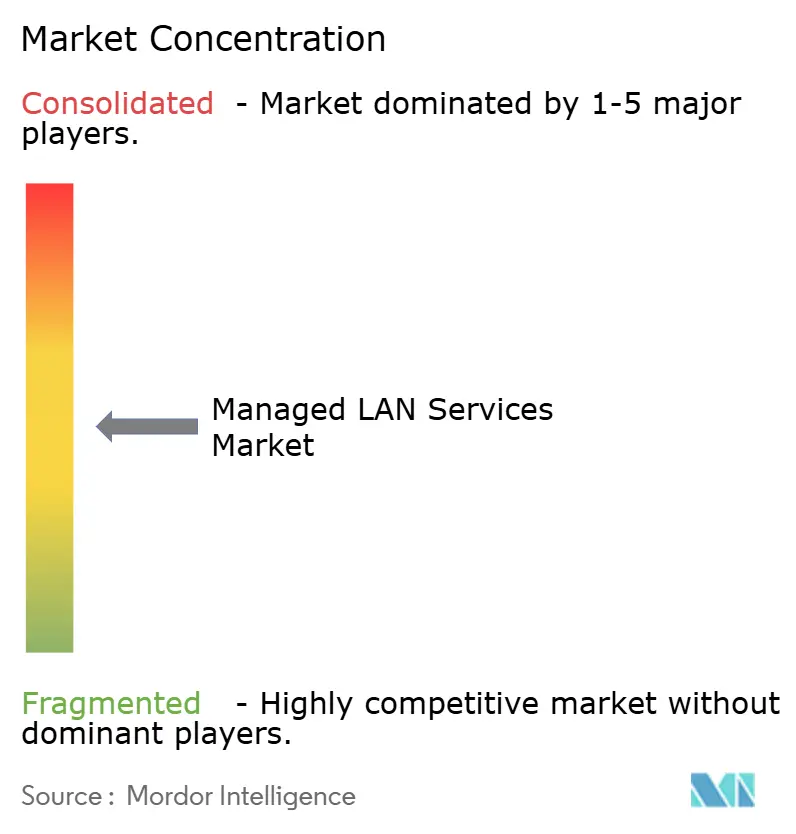
The Managed LAN Services Market is moderately concentrated globally but fragmented by geography, customer needs, and service specialization. NTT DATA, Kyndryl, Accenture, and Orange Business offer managed LAN, WAN, and security within broader managed network portfolios. Regional carriers use ownership of connectivity infrastructure to support their managed service economics, while campus LAN-as-a-service vendors focus on automation and flexible subscription pricing. NTT DATA stated that it was recognized as a Leader in the 2026 Gartner Magic Quadrant for Managed Network Services, citing AI-centered innovation, security-led delivery, and service quality.
Technology-led integrators such as HPE, Cisco, and Kyndryl compete through platform intelligence and AI operations. Network-native carriers, including AT&T, Deutsche Telekom, Orange Business, and Tata Communications, build managed LAN offers on their connectivity footprint. IT service firms such as Accenture, Capgemini, and Wipro compete through vertical knowledge and wider transformation work. Cisco published architecture guidance in 2025 for integrating private 5G with campus LAN management through Catalyst Center and Meraki. This approach shows how platform control can shift from hardware toward software management layers.
Co-managed LAN is important where enterprises retain policy control and operational visibility while the provider handles daily operations. Nile, Meter, and Join Digital are pursuing mid-market customers with utility-style offers that bundle hardware, management, and AI monitoring into a monthly subscription. In June 2026, BT Group and Verizon announced plans for a 50:50 joint venture combining their international enterprise wireline and managed network service operations. The planned business is expected to serve more than 3,000 enterprise customers in 180 countries and have USD 4 billion in combined annual revenue. This transaction can alter the options available to multinational buyers of the Managed LAN Services Market.
Managed LAN Services Industry Leaders
-
AT&T Inc.
-
Cisco Systems, Inc.
-
NTT DATA Group Corporation
-
Orange S.A.
-
Verizon Communications Inc.
- *Disclaimer: Major Players sorted in no particular order
Recent Industry Developments
- October 2026: Pure IP, a BCM One company, announced the expansion of its Managed SD-WAN offering with voice-optimized intelligence capabilities, including application-aware routing, dynamic path selection, and load balancing for cloud communications and AI-enabled voice applications, built on more than 8 years of managed network delivery for enterprise customers.
- October 2026: Macquarie Telecom and Netskope expanded their strategic SASE partnership in Australia to incorporate Netskope SD-WAN, delivering a complete single-vendor SASE framework for Australian mid-market and enterprise customers, managed through Macquarie’s enterprise managed service capabilities.
- August 2025: AT&T Business and Cisco launched AT&T SASE with Cisco, a cloud-delivered networking and security solution that integrates SD-WAN, zero-trust security, predictive path optimization, real-time threat intelligence, and multi-cloud connectivity for enterprise customers.
- June 2025: Nile launched Nile Experience Intelligence, a generative AI engine designed to autonomously detect, diagnose, and resolve enterprise LAN and wireless issues through large language model-powered Softbots.
Global Managed LAN Services Market Report Scope
Managed LAN is a service that refers to the support operations, controls costs, and maintains network reliability without the users having to dedicate their own resources. A managed LAN service providers solely optimizes users' network environment.
The Managed LAN Services Market Report is Segmented by (Service Type (Managed Wired LAN, Managed Wireless LAN, Managed SD-LAN, and Other Managed LAN Services), Delivery Architecture (Cloud-Managed, On-Premises, and Hybrid), Organization Size (Large Enterprises and Small and Medium-Sized Enterprises), End-User Vertical (Banking, Financial Services and Insurance [BFSI], IT and Telecommunications, Healthcare and Life Sciences, Retail and E-Commerce, Manufacturing and Industrial, Media and Entertainment, Government and Utilities, and Other End-User Verticals), and Geography (North America, South America, Europe, Asia-Pacific, Middle East, and Africa). The Market Forecasts are Provided in Terms of Value (USD).
| Managed Wired LAN |
| Managed Wireless LAN |
| Managed SD-LAN |
| Other Managed LAN Services |
| Cloud-Managed |
| On-Premises |
| Hybrid |
| Small and Medium-Sized Enterprises |
| Large Enterprises |
| Banking, Financial Services and Insurance (BFSI) |
| IT and Telecommunications |
| Healthcare and Life Sciences |
| Retail and E-Commerce |
| Manufacturing and Industrial |
| Media and Entertainment |
| Government and Utilities |
| Other End-User Verticals |
| North America | United States |
| Canada | |
| Mexico | |
| South America | Brazil |
| Argentina | |
| Rest of South America | |
| Europe | United Kingdom |
| Germany | |
| France | |
| Italy | |
| Spain | |
| Russia | |
| Rest of Europe | |
| Asia-Pacific | China |
| Japan | |
| India | |
| South Korea | |
| Australia | |
| Rest of Asia-Pacific | |
| Middle East | Saudi Arabia |
| United Arab Emirates | |
| Turkey | |
| Rest of Middle East | |
| Africa | South Africa |
| Egypt | |
| Nigeria | |
| Rest of Africa |
| By Service Type | Managed Wired LAN | |
| Managed Wireless LAN | ||
| Managed SD-LAN | ||
| Other Managed LAN Services | ||
| By Delivery Architecture | Cloud-Managed | |
| On-Premises | ||
| Hybrid | ||
| By Organization Size | Small and Medium-Sized Enterprises | |
| Large Enterprises | ||
| By End-User Vertical | Banking, Financial Services and Insurance (BFSI) | |
| IT and Telecommunications | ||
| Healthcare and Life Sciences | ||
| Retail and E-Commerce | ||
| Manufacturing and Industrial | ||
| Media and Entertainment | ||
| Government and Utilities | ||
| Other End-User Verticals | ||
| By Geography | North America | United States |
| Canada | ||
| Mexico | ||
| South America | Brazil | |
| Argentina | ||
| Rest of South America | ||
| Europe | United Kingdom | |
| Germany | ||
| France | ||
| Italy | ||
| Spain | ||
| Russia | ||
| Rest of Europe | ||
| Asia-Pacific | China | |
| Japan | ||
| India | ||
| South Korea | ||
| Australia | ||
| Rest of Asia-Pacific | ||
| Middle East | Saudi Arabia | |
| United Arab Emirates | ||
| Turkey | ||
| Rest of Middle East | ||
| Africa | South Africa | |
| Egypt | ||
| Nigeria | ||
| Rest of Africa | ||
Key Questions Answered in the Report
What is the Managed LAN Services Market size?
The Managed LAN Services Market is projected at USD 17.39 billion in 2027 and USD 24.93 billion by 2032, with a 7.47% CAGR during 2027 to 2032.
What is driving demand for managed LAN services?
Cloud workloads, hybrid work, connected devices, network security needs, and shortages in network operations talent are raising demand for managed LAN support.
Which managed LAN service type is expanding fastest?
Managed SD-LAN is projected to expand at a 9.82% CAGR through 2032 as enterprises adopt software-defined control, automation, and policy-based operations.
Why do enterprises use cloud-managed LAN delivery?
Cloud-managed delivery combines subscription pricing, AI-enabled monitoring, and ongoing management, helping organizations avoid major upfront operating commitments.
Which customer group accounts for the largest share of demand?
Large enterprises accounted for 72.25% in 2026 because they operate complex multi-site environments that need continuous support and lifecycle management.
Which region is expected to expand fastest?
Asia-Pacific is projected to expand at a 10.07% CAGR through 2032, supported by campus construction, public digitization programs, and enterprise IT spending.