
Managed Hardware Refresh Planning Services Market Size and Share
Market Overview
| Study Period | 2021 - 2032 |
|---|---|
| Market Size (2027) | USD 4.43 Billion |
| Market Size (2032) | USD 8.56 Billion |
| Growth Rate (2027 - 2032) | 14.07 % |
| Fastest Growing Market | Asia-Pacific |
| Largest Market | North America |
| Market Concentration | Medium |
Major Players *Disclaimer: Major Players sorted in no particular order Image © Mordor Intelligence. Reuse requires attribution under CC BY 4.0. | |
Managed Hardware Refresh Planning Services Market Analysis by Mordor Intelligence
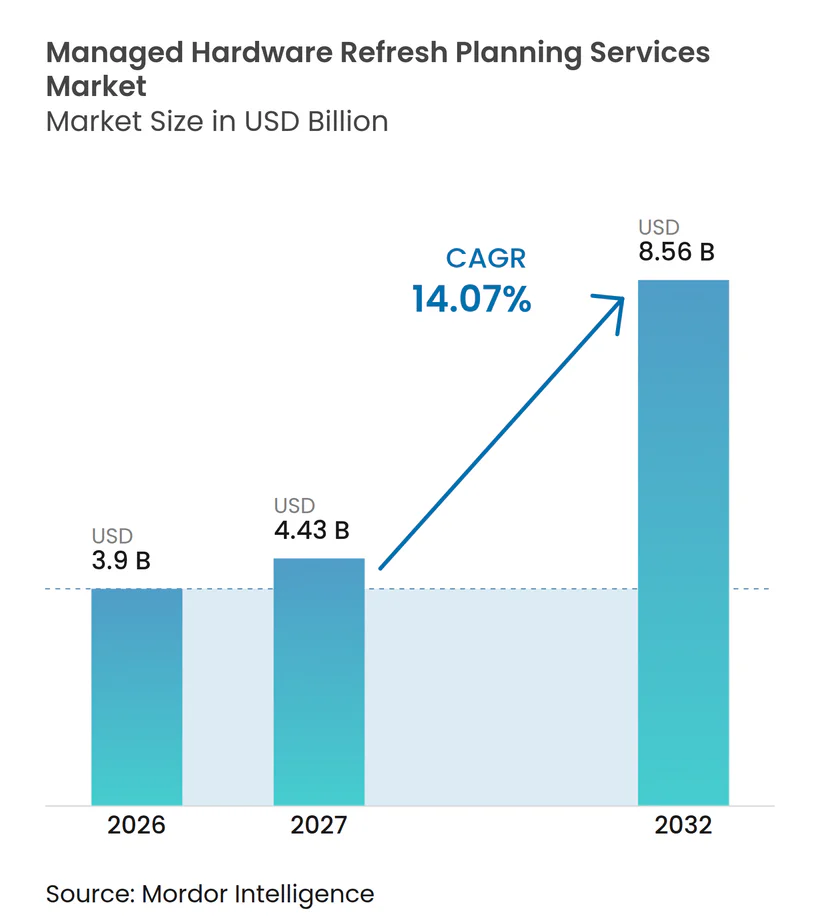
The managed hardware refresh planning services market size is projected to expand from USD 3.90 billion in 2026 to USD 4.43 billion in 2027, and to USD 8.56 billion by 2032, registering a CAGR of 14.07% between 2027 and 2032. The managed hardware refresh planning services market is moving away from calendar-based replacement toward lifecycle programs that use asset records, device condition, support dates, and security requirements to set priorities. Windows 10 support ended on October 14, 2025, requiring organizations to review endpoint readiness, replacement needs, retirement schedules, and the practical cost of continued support. The managed hardware refresh planning services market is also being shaped by higher specifications for AI-capable PCs and by the need to coordinate mixed-brand device fleets across office and remote locations. Providers are combining planning, procurement support, deployment, data handling, recovery services, and clear audit records to offer a more complete operating model. Hardware availability and unreliable asset records can delay execution, giving an advantage to providers that pair procurement planning with certified refurbished devices, up-to-date fleet information, and clear processes for handling returned equipment.
Key Report Takeaways
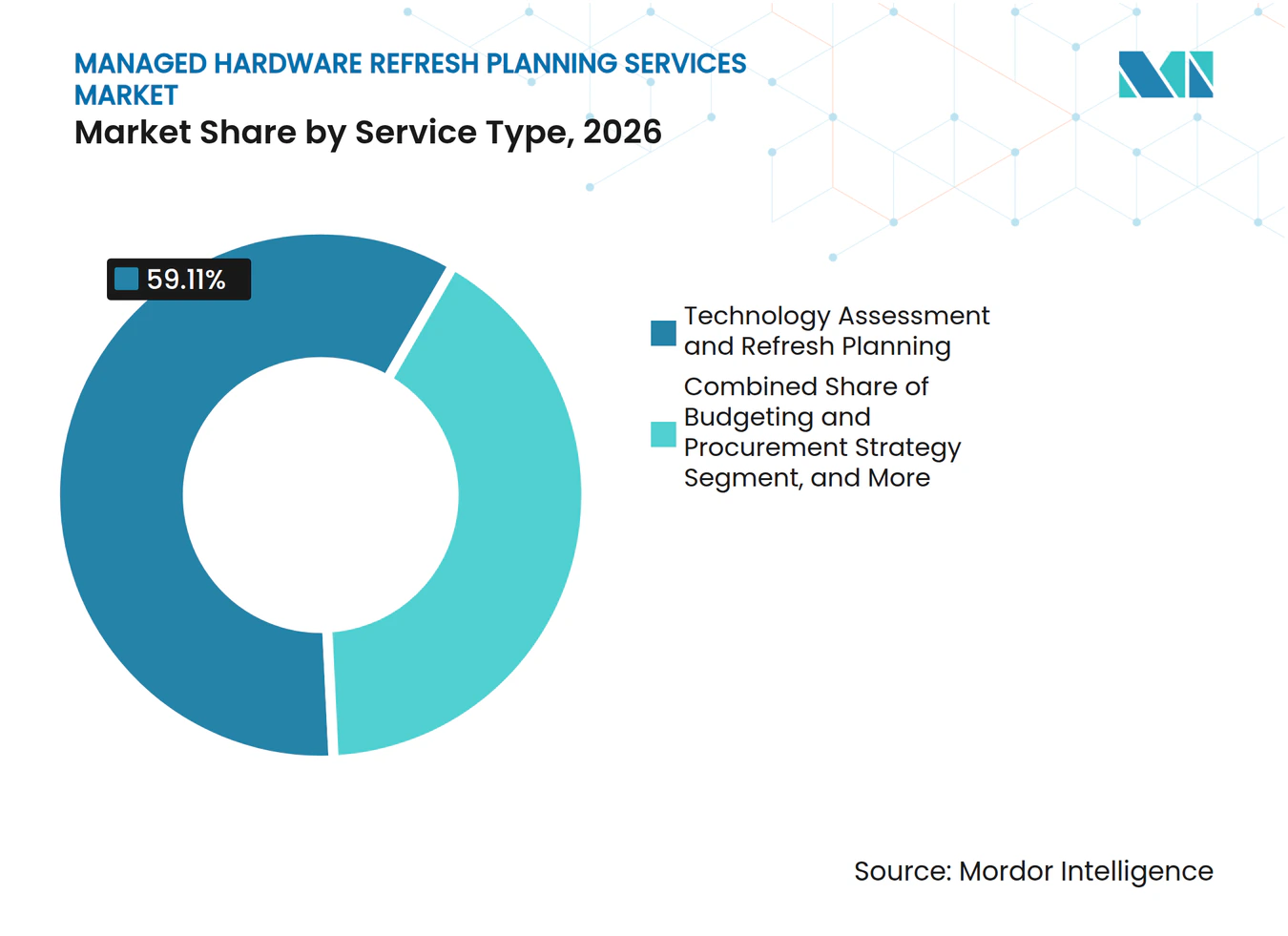
- By service type, Technology Assessment and Refresh Planning held 59.11% of the managed hardware refresh planning services market share in 2026, while Refresh Execution and Transition Management is projected to expand at a 15.34% CAGR through 2032.
- By deployment mode, On-Premise held 67.19% of the managed hardware refresh planning services market revenue in 2026, while Cloud deployment is projected to expand at a 15.66% CAGR through 2032.
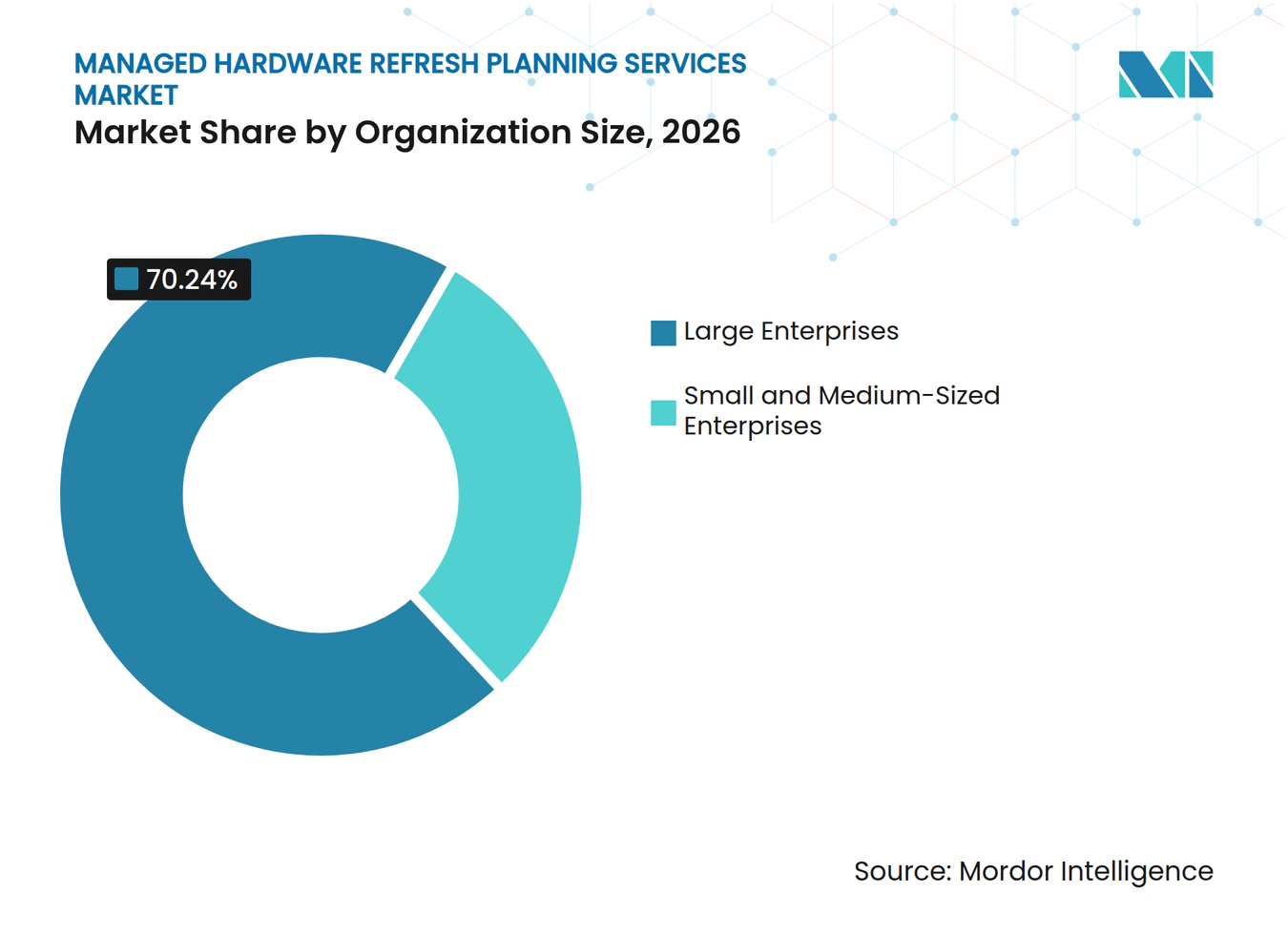
- By organization size, Large Enterprises held 70.24% of the managed hardware refresh planning services market revenue in 2026, while SMEs are projected to expand at a 15.89% CAGR through 2032.
- By end-user industry, IT and Telecommunications accounted for 30.09% of the managed hardware refresh planning services market revenue in 2026, while Government and Public Administration is projected to expand at a 14.56% CAGR through 2032.
- By geography, North America held 38.14% of the managed hardware refresh planning services market revenue in 2026, while Asia-Pacific is projected to expand at a 14.91% CAGR through 2032.
Note: Market numbers in this report are based on Mordor Intelligence's proprietary estimation framework, which combines nine months of actuals with Q4 projections for base year 2026.
Global Managed Hardware Refresh Planning Services Market Trends and Insights
Drivers Impact Analysis*
| Driver | (~) % Impact on CAGR Forecast | Geographic Relevance | Impact Timeline |
|---|---|---|---|
| Windows and Endpoint Security Support Deadlines Trigger Refresh Waves | +3.5% | North America and Europe primarily, with spillover to Asia-Pacific | Short term (≤ 2 years) |
| AI-Enabled Fleet Telemetry Improves Refresh Timing | +2.8% | Global, strongest in North America and Western Europe | Medium term (2-4 years) |
| Hybrid Workforce Dispersion Increases Lifecycle Coordination Needs | +2.2% | Global | Medium term (2-4 years) |
| Circular IT and Residual-Value Recovery Raise Outsourcing Demand | +1.6% | Global, strongest in Europe and North America | Long term (≥ 4 years) |
| AI-PC Adoption Accelerates Device Specification Reassessment | +1.4% | Global | Long term (≥ 4 years) |
| Multi-Vendor Asset Complexity Favors Managed Refresh Programs | +1.0% | Global, concentrated in large enterprises | Long term (≥ 4 years) |
| Source: Mordor Intelligence | |||
Windows and Endpoint Security Support Deadlines Trigger Refresh Waves
Microsoft ended Windows 10 support on October 14, 2025, extending endpoint reviews and replacement activity into the forecast period. Organizations that defer replacement can use Extended Security Updates, which cost USD 61 per device in the first year and then double in each of the next 2 years. This rising cost makes a longer deferral harder to justify, when older devices also fail to meet Windows 11 hardware requirements, require more support, or cannot meet current security expectations. The managed hardware refresh planning services market benefits because assessment is required before organizations can separate devices suitable for migration, upgrade, extended use, and retirement. Windows Server 2016 support will end in October 2026, adding another lifecycle deadline for infrastructure teams to address.[1] Providers that connect endpoint assessment, procurement timing, user communications, deployment capacity, and disposal records can turn externally set deadlines into planned programs.
AI-Enabled Fleet Telemetry Improves Refresh Timing
The managed hardware refresh planning services market is increasingly using telemetry to determine when a device should be replaced. Device age, warranty status, performance information, software needs, and user experience data can identify systems that need attention before a failure affects work. Intel positions Intel vPro as a platform for remote management and hardware-based security across business PC fleets. This information can replace a fixed replacement calendar with a priority list based on operational condition, risk, user role, and each device's remaining useful life. Providers that manage the observability layer gain a continuing view of device behavior, service needs, warranty status, and recurring failure patterns across the customer fleet. That operating knowledge can make a provider more difficult to replace after the first refresh cycle, particularly in large, distributed estates with complex asset histories.
Hybrid Workforce Dispersion Increases Lifecycle Coordination Needs
Hybrid work has made device lifecycle management a distributed logistics task rather than a centralized IT activity. Employees may receive, use, return, and replace devices from different locations, often without direct access to an IT office or a local support team. The managed hardware refresh planning services market addresses this issue through kitting, direct shipment, device setup, data migration, collection, certified decommissioning, and status communications for employees. HP offers managed workplace services that combine device lifecycle support with remote management capabilities. Dispersed fleets also create inconsistencies in asset records when devices move across locations, change users, or remain uncollected at the end of use. Providers with regional logistics coverage and automated return communications can therefore reduce administrative work, missed returns, unclear ownership, and missing-device risk in the managed hardware refresh planning services market.
Circular IT and Residual-Value Recovery Raise Outsourcing Demand
The managed hardware refresh planning services market is seeing demand from organizations seeking to recover value from retired devices while reducing disposal risk. Certified refurbishment, resale, asset recovery, and secure processing can reduce the net cost of a refresh program when they are managed within the same contract. Lenovo introduced TruScale Device as a Service for Sustainability in 2025, with carbon reporting, refurbished-device options, offset services, and asset recovery. The service model makes lifecycle reporting part of procurement, finance, operations, and IT decisions rather than a separate disposal exercise at the end of a device's useful life. The EU Corporate Sustainability Reporting Directive has also increased attention to value chain emissions reporting among affected companies. Providers with auditable recovery and decommissioning processes can support equipment recovery, reporting requirements, resale decisions, and consistent treatment of devices across the managed hardware refresh planning services market.
Restraints Impact Analysis*
| Restraint | (~) % Impact on CAGR Forecast | Geographic Relevance | Impact Timeline |
|---|---|---|---|
| Budget Deferrals Extend Device Lifecycles | -1.2% | Global, pronounced in SME segments | Medium term (2-4 years) |
| Secure Data Erasure and Chain-of-Custody Requirements Increase Execution Cost | -0.9% | Global, most acute in regulated industries | Medium term (2-4 years) |
| Hardware Lead-Time Volatility Disrupts Refresh Roadmaps | -0.7% | Global, concentrated in North America and Europe | Short term (≤ 2 years) |
| Fragmented Asset Data Weakens Forecast Accuracy | -0.5% | Global | Long term (≥ 4 years) |
| Source: Mordor Intelligence | |||
Budget Deferrals Extend Device Lifecycles
Budget pressure can cause organizations to delay hardware replacement while they fund security, cloud, and AI infrastructure programs. Older equipment can often remain in service for some time, even as performance, energy use, user experience, and support needs worsen. This can make demand for refreshes uneven across fiscal periods and complicate resource planning, hardware allocation, and staffing for managed providers. The managed hardware refresh planning services market still has a countervailing factor because Extended Security Update charges increase with each year of deferral. Microsoft lists a first-year commercial Extended Security Update price of USD 61 per device, with the annual price doubling. Organizations that delay into later years may face higher security maintenance costs while retaining older equipment, which can reduce savings from postponement. A managed plan that sequences replacement and avoids late security charges can therefore remain economically relevant in the managed hardware refresh planning services market, even when capital spending is constrained.
Secure Data Erasure and Chain-of-Custody Requirements Increase Execution Cost
Certified data sanitization adds cost and operational steps to high-volume device refresh work. NIST issued Special Publication 800-88 Revision 2 in September 2025 to update media sanitization guidance and align it with current standards. The guidance focuses on an enterprise sanitization program that documents policies, roles, verification activities, and media handling throughout the process. Regulated organizations need serial-level asset records, custody evidence, certificates showing that data has been sanitized, and reliable proof that devices were processed as required. These requirements can increase execution costs, planning time, and coordination needs, especially when thousands of devices are processed simultaneously. Providers with established compliance processes can reduce this burden for customers in the managed hardware refresh planning services market, while smaller providers may struggle to meet tender requirements.
*Our forecasts treat driver/restraint impacts as directional, not additive. The impact forecasts reflect baseline growth, mix effects, and variable interactions.
Segment Analysis
By Service Type: Planning Leads Revenue While Execution Services Lead Growth
Technology Assessment and Refresh Planning held 59.11% of revenue in 2026. This service is often the first engagement because organizations need a defensible view of device inventory, support status, risk, location, and sequencing before committing funding. The work includes reviewing asset records, identifying refresh candidates, ranking risks, and aligning replacement timing with security and business needs. It also gives internal teams a framework for comparing purchase, lease, refurbishment, and extended-use options, as well as the costs of delayed action. The managed hardware refresh planning services market relies on this planning layer because execution contracts need an accurate starting inventory, clear priorities, and a practical schedule.
Refresh Execution and Transition Management is projected to expand at a 15.34% CAGR through 2032. Demand rises as organizations move from assessment work to delivery, which includes logistics, staging, deployment, migration, decommissioning, user communications, and post-deployment support. Maintech reported that a global media customer improved annual refresh completion from 47% to 150% of target and reduced hardware failure tickets from 180 to 46 per month after adopting a managed, health-prioritized approach. Budgeting and Procurement Strategy and Lifecycle Extension and Optimization help customers control cost, extend useful device life, and manage constrained supply while replacement orders are pending. Other service types include subscription-based hardware and device-as-a-service arrangements that combine planning, procurement, refresh, and recovery within a recurring per-device fee.



By Deployment Mode: On-Premise Leads While Cloud Delivery Expands
On-premises deployment accounted for 67.19% of the managed hardware refresh planning services market size in 2026. Large organizations in banking, health care, and government often retain locally managed systems because their asset records and audit processes were built around on-premise infrastructure. Data residency, custody records, and internal governance also influence deployment decisions. These organizations may use local systems for core asset data even where they adopt cloud tools for specific workflows. This installed base continues to support on-premise demand in the managed hardware refresh planning services industry.
Cloud deployment is projected to expand at a 15.66% CAGR through 2032. Cloud-based portals can enable providers to serve mid-market customers and SMEs without the volume thresholds associated with more customized programs. Cegeka launched its Modern Workplace service in March 2026, using HP ProConnect Workplace-as-a-Service, which covers device selection, provisioning, support, lifecycle management, and end-of-life processing. Hybrid delivery combines local asset systems with cloud-based analytics and orchestration, providing a transitional option for enterprises in the managed hardware refresh planning services market that want modern delivery while keeping selected records within existing environments. European data rules also require providers to clearly address how employee device information is managed when telemetry moves through third-party platforms.
By Organization Size: Large Enterprises Lead Revenue While SMEs Expand Faster
Large Enterprises accounted for 70.24% of the managed hardware refresh planning services market size in 2026. Their device fleets are often spread across multiple countries, hardware vendors, and support teams, which makes coordinated refresh planning difficult to manage internally. They need logistics capacity, vendor-neutral coordination, service-level governance, and documented controls across the lifecycle. Multi-year contracts and the operational cost of changing providers during a lifecycle program support continued demand from this group. The scale of these estates also makes a complete asset inventory necessary before equipment can be replaced or retired.
SMEs are projected to expand at a 15.89% CAGR through 2032. Cloud-native service portals and subscription structures make managed lifecycle programs more accessible to organizations with small IT teams and limited in-house logistics capacity. Lenovo Japan launched its Modern PC Lifecycle Management Package in November 2025 at JPY 1,000 per device per month, equivalent to USD 6.50 at November 2025 exchange rates, for organizations with limited IT staffing.[2] The offering includes procurement, deployment, security, and disposal in a single service package. SMEs can use these models to obtain specialist support for decommissioning, fleet coordination, endpoint oversight, replacement communications, and compliance documentation without having to build comparable internal capabilities.

By End-User Industry: IT and Telecommunication Lead While Government Expands Fastest
IT and Telecommunication accounted for 30.09% of revenue in 2026. High device density, frequent technology changes, around-the-clock operations, and multi-vendor estates support demand for structured refresh planning in this sector. Firms need endpoint availability while maintaining security standards across employee, technical support, and field service teams. The sector also has a continuing requirement to standardize fleets that support distributed employees, customer-facing operations, and rapid replacement needs. These needs make assessment, deployment, and governance services, as well as accurate asset records, central to the managed hardware refresh planning services market.
Government and Public Administration is projected to expand at a 14.56% CAGR through 2032. Public organizations face security deadlines, formal procurement rules, and large device populations that can move through framework-based buying processes. Ontario's OECM introduced its third-generation End-User Computing Products and Related Services Agreement in January 2025, covering 11 supplier partners and including lifecycle management as one of the available service categories. Banking, financial services, and insurance also require rigorous documentation because of data sensitivity and distributed workforces. Health care, life sciences, manufacturing, retail, e-commerce, and education have different operating needs, but each faces practical reasons to use managed device planning as public procurement cycles extend the time needed to prepare and award refresh programs.
Geography Analysis
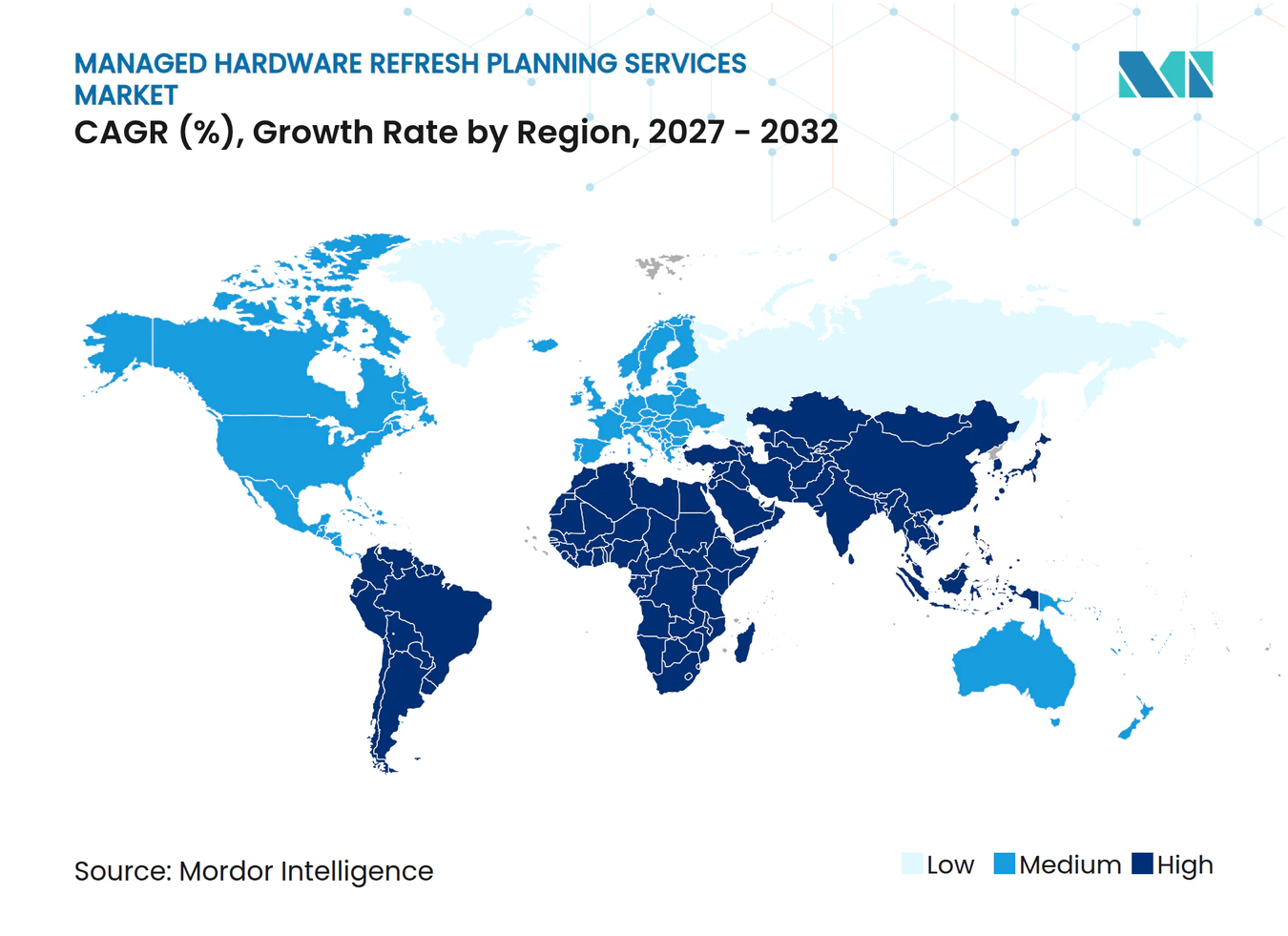
North America held 38.14% of the managed hardware refresh planning services market share in 2026. The region has established managed service providers, mature procurement processes, and strong expectations for documented custody and secure disposal of retired devices. The United States supports demand through large technology-sector fleets and public-sector refresh activity, while Canada contributes through procurement arrangements that include lifecycle management. Ontario's OECM agreement, launched in January 2025, included Dell, HP, Lenovo, Cisco, NetApp, and Pure Storage among its suppliers. Security requirements, AI-capable PC specifications, and recovery reporting support demand after the initial Windows 10 replacement period.
Europe is a major regional cluster, with Germany, the United Kingdom, and France representing important centers of enterprise demand. Data governance requirements increase the value of certified erasure and documented device decommissioning across cross-border fleets, particularly where employee data is present. The General Data Protection Regulation sets requirements for processing personal data, including information collected through endpoint management tools.[3] The region also shows interest in refurbished equipment and circular procurement, while the Corporate Sustainability Reporting Directive has increased attention to value-chain reporting for companies within scope.
Asia-Pacific is projected to expand at a 14.91% CAGR through 2032. Japan has an active interest in outsourced PC lifecycle management and subscription services for organizations with limited IT staff. Lenovo Japan has used lifecycle packages to combine procurement, deployment, security, and disposal for smaller organizations. China presents opportunities for device-as-a-service models among SMEs, while India supports demand through public-sector and education technology programs. South Korea and Australia add to demand through enterprise digital modernization and managed workplace adoption, while the Middle East and Africa, and South America, remain smaller opportunities, supported by technology modernization, expanding fleets, and digital services investment.
Competitive Landscape
Market Concentration
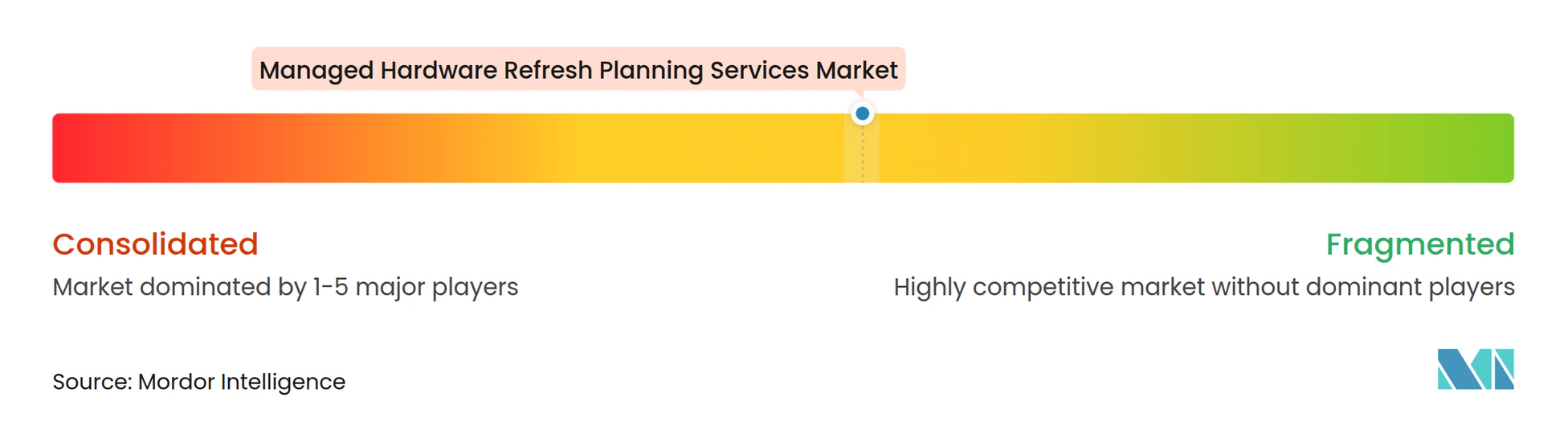
The managed hardware refresh planning services market is moderately fragmented. Dell Technologies, HP Inc., Lenovo Group, Hewlett Packard Enterprise, and Cisco Systems combine hardware positions with managed service offerings, while managed service providers, IT asset disposition specialists, and channel platforms compete on neutrality, data handling, and geographic coverage. Dell uses SupportAssist capabilities to provide device support and predictive issue detection for commercial customers. HP expanded managed device services through channel partners in June 2025 and introduced remote out-of-band diagnosis and remediation for more business PC issues.[4] These approaches link support data, service operations, and recurring lifecycle contracts in the managed hardware refresh planning services market.
Lenovo expanded its TruScale Device as a Service sustainability offering in 2025 to include carbon reporting, asset recovery, and refurbished-device options. Cegeka's March 2026 Modern Workplace launch on HP ProConnect illustrates cloud-based service delivery for mid-sized organizations. Itochu Commercial Systems and GetIT announced a capital and business alliance in July 2026 after an April agreement to develop circular IT lifecycle management in Japan. The alliance combines procurement, third-party maintenance, asset disposition, and device remarketing, showing how companies are adding value through integrated services.
A market opening remains among organizations with 500 to 5,000 endpoints that need more capability than consumer-style support but may not qualify for customized OEM programs. Modular, compliance-ready services can address this group if they provide practical pricing, multi-brand management, and documented controls. Specialist platforms can compete by providing one interface for provisioning, telemetry, and decommissioning across device brands. NIST guidance is also raising expectations for sanitization evidence in regulated procurement, which favors providers with documented processes and established logistics networks. The managed hardware refresh planning services market has room for integrated OEM models and independent lifecycle providers that offer a neutral operating approach.
Managed Hardware Refresh Planning Services Industry Leaders
-
Dell Technologies Inc.
-
Lenovo Group Limited
-
Cisco Systems, Inc.
-
Samsung Electronics Co., Ltd.
-
NEC Corporation
- *Disclaimer: Major Players sorted in no particular order
Recent Industry Developments
- October 2026: Monks Technology Services became an authorized Cisco reseller and managed service provider, enabling single-contract delivery of Cisco hardware, software, cloud subscriptions, and full lifecycle support for enterprise network modernization programs across North America. The partnership creates a unified procurement and support model that reduces vendor coordination overhead for clients undergoing infrastructure refresh.
- July 2026: Itochu Commercial Systems and GetIT signed a capital business alliance in April 2026, publicly announced in July 2026, to jointly develop an end-to-end "circular IT lifecycle management" capability. The partnership integrates hardware procurement, third-party maintenance, IT asset disposition, and device remarketing into a single service chain, targeting Japanese enterprise demand for sustainable, managed IT infrastructure lifecycle solutions.
- March 2026: Cegeka introduced the Cegeka Modern Workplace in March 2026, a fully managed digital workspace for mid-market organizations built on HP's ProConnect Workplace-as-a-Service platform. The solution bundles device selection, provisioning, support, lifecycle management, and certified end-of-life processing under a single contract, extending enterprise-grade lifecycle governance to organizations that previously lacked access to these capabilities.
- September 2025: NIST released SP 800-88 Revision 2 on September 26, 2025, updating media sanitization requirements to align with IEEE 2883 and ISO/IEC 27040 and shifting the compliance focus from individual device decisions to enterprise-level sanitization programs with formal vendor-qualification obligations. The revision raises the bar for documentation for managed refresh providers serving regulated industries, establishing certified data erasure as a prerequisite for compliant hardware decommissioning.
Global Managed Hardware Refresh Planning Services Market Report Scope
The Managed Hardware Refresh Planning Services Market comprises outsourced advisory, planning, optimization, and execution services that help organizations assess, prioritize, budget, schedule, and manage hardware refresh cycles across IT assets and infrastructure. These services support technology modernization, lifecycle planning, procurement optimization, and transition management.
The Managed Hardware Refresh Planning Services Market Report is Segmented by Service Type (Technology Assessment and Refresh Planning, Budgeting and Procurement Strategy, Lifecycle Extension and Optimization, Refresh Execution and Transition Management, and Other Service Types), Deployment Mode (On-Premise, Cloud, and Hybrid), Organization Size (Large Enterprises, and Small and Medium-Sized Enterprises), End-User Industry (Banking, Financial Services, and Insurance [BFSI], Government and Public Administration, Healthcare and Life Sciences, IT and Telecommunication, Industrial Manufacturing, Retail and E-commerce, Education and Research Institutions, and Other End-User Industries), and Geography (North America, South America, Europe, Asia-Pacific, Middle East, and Africa). The Market Forecasts are Provided in Terms of Value (USD).
| Technology Assessment and Refresh Planning |
| Budgeting and Procurement Strategy |
| Lifecycle Extension and Optimization |
| Refresh Execution and Transition Management |
| Other Service Types |
| On-Premise |
| Cloud |
| Hybrid |
| Large Enterprises |
| Small and Medium-Sized Enterprises |
| Banking, Financial Services, and Insurance (BFSI) |
| Government and Public Administration |
| Healthcare and Life Sciences |
| IT and Telecommunication |
| Industrial Manufacturing |
| Retail and E-commerce |
| Education and Research Institutions |
| Other End-User Industries |
| North America | United States |
| Canada | |
| Mexico | |
| South America | Brazil |
| Argentina | |
| Rest of South America | |
| Europe | Germany |
| United Kingdom | |
| France | |
| Italy | |
| Russia | |
| Rest of Europe | |
| Asia-Pacific | China |
| Japan | |
| India | |
| South Korea | |
| Rest of Asia-Pacific | |
| Middle East | Saudi Arabia |
| United Arab Emirates | |
| Rest of Middle East | |
| Africa | South Africa |
| Nigeria | |
| Rest of Africa |
| By Service Type | Technology Assessment and Refresh Planning | |
| Budgeting and Procurement Strategy | ||
| Lifecycle Extension and Optimization | ||
| Refresh Execution and Transition Management | ||
| Other Service Types | ||
| By Deployment Mode | On-Premise | |
| Cloud | ||
| Hybrid | ||
| By Organization Size | Large Enterprises | |
| Small and Medium-Sized Enterprises | ||
| By End-User Industry | Banking, Financial Services, and Insurance (BFSI) | |
| Government and Public Administration | ||
| Healthcare and Life Sciences | ||
| IT and Telecommunication | ||
| Industrial Manufacturing | ||
| Retail and E-commerce | ||
| Education and Research Institutions | ||
| Other End-User Industries | ||
| By Geography | North America | United States |
| Canada | ||
| Mexico | ||
| South America | Brazil | |
| Argentina | ||
| Rest of South America | ||
| Europe | Germany | |
| United Kingdom | ||
| France | ||
| Italy | ||
| Russia | ||
| Rest of Europe | ||
| Asia-Pacific | China | |
| Japan | ||
| India | ||
| South Korea | ||
| Rest of Asia-Pacific | ||
| Middle East | Saudi Arabia | |
| United Arab Emirates | ||
| Rest of Middle East | ||
| Africa | South Africa | |
| Nigeria | ||
| Rest of Africa | ||
Key Questions Answered in the Report
What is the size of the managed hardware refresh planning services market?
The managed hardware refresh planning services market size is USD 4.43 billion in 2027 and is projected to reach USD 8.56 billion by 2032 at a 14.07% CAGR.
What is driving demand for managed hardware refresh planning services?
Windows support deadlines, AI-capable PC requirements, distributed workforces, and the need for secure device recovery are supporting adoption.
Which service type holds the largest share?
Technology Assessment and Refresh Planning held 59.11% of revenue in 2026, reflecting the need to assess fleet condition before executing replacement programs.
Which deployment mode is expected to expand the fastest?
Cloud deployment is projected to expand at a 15.66% CAGR through 2032 as providers use cloud portals to serve SMEs and mid-sized organizations.
Which organization size presents the fastest expansion opportunity?
SMEs are projected to expand at a 15.89% CAGR through 2032 as subscription offerings make lifecycle management accessible to smaller IT teams.
Which region is expected to expand the fastest?
Asia-Pacific is projected to expand at a 14.91% CAGR through 2032, supported by managed lifecycle adoption across advanced and developing economies.