
Managed Insider Risk Management Services Market Size and Share
Market Overview
| Study Period | 2021 - 2032 |
|---|---|
| Market Size (2027) | USD 1.79 Billion |
| Market Size (2032) | USD 4.12 Billion |
| Growth Rate (2027 - 2032) | 18.14 % |
| Fastest Growing Market | Asia-Pacific |
| Largest Market | North America |
| Market Concentration | Medium |
Major Players *Disclaimer: Major Players sorted in no particular order Image © Mordor Intelligence. Reuse requires attribution under CC BY 4.0. | |
Managed Insider Risk Management Services Market Analysis by Mordor Intelligence
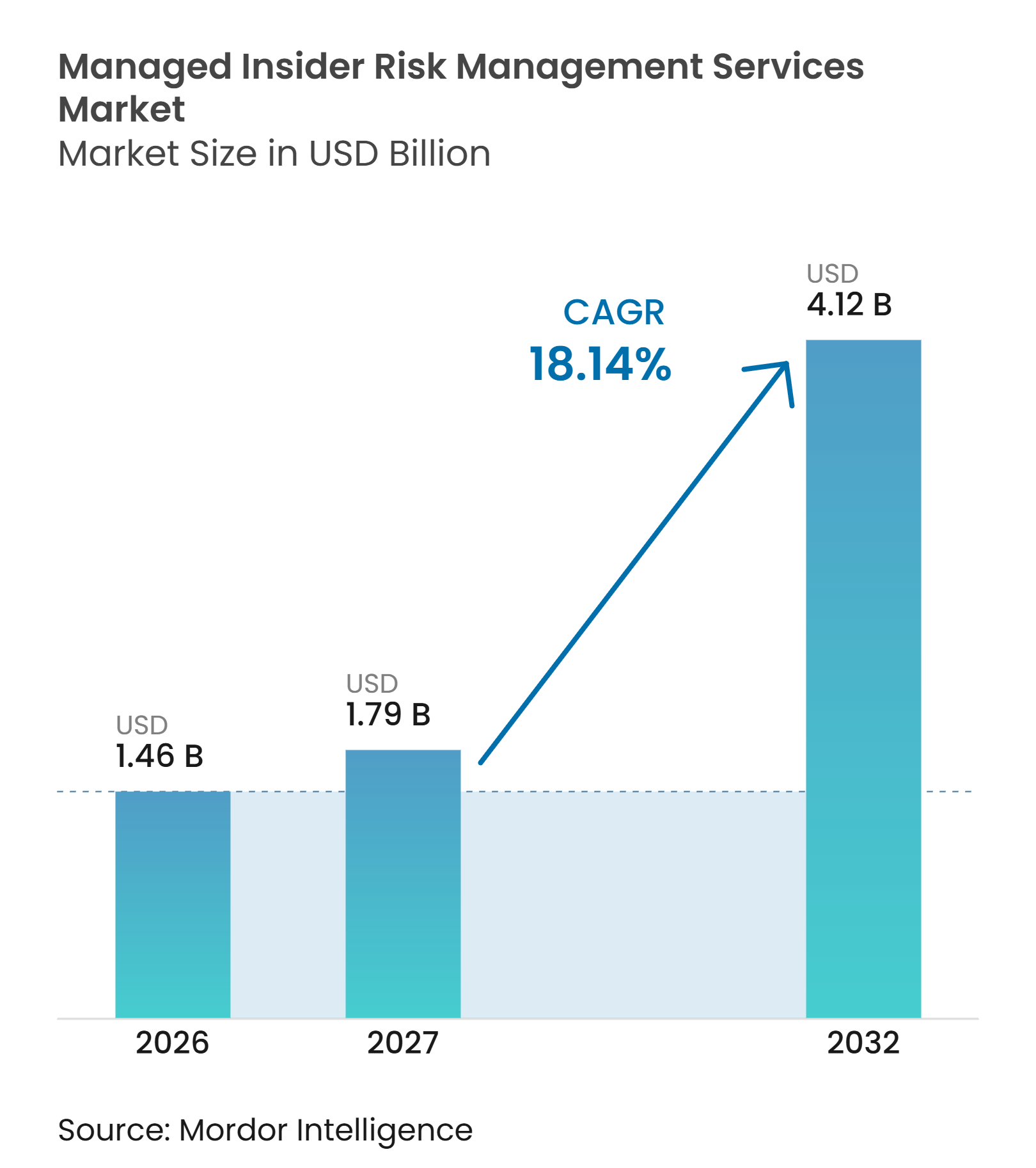
The managed insider risk management services market size was valued at USD 1.46 billion in 2026 and is estimated to grow from USD 1.79 billion in 2027 to reach USD 4.12 billion by 2032, at a CAGR of 18.14% during the forecast period (2027-2032). The managed insider risk management services market is gaining traction because many established security programs were designed to identify outside attacks rather than misuse by people with valid access. Credential theft has become particularly costly, while lengthy containment periods increase the operational burden after an incident. Providers are responding with behavioral analysis, AI-enabled detection, and continuous analyst coverage that internal teams may struggle to operate at the same scale. Cloud applications, hybrid work, and broader GenAI use have widened the amount of data and activity that requires oversight. The managed insider risk management services market also benefits from regulatory expectations and insurance requirements that place greater emphasis on demonstrable controls.
Key Report Takeaways
- By service type, managed insider risk monitoring and triage held 31.28% revenue share in the managed insider risk management services market in 2026, while managed insider incident response and containment is projected to expand at a 19.73% CAGR through 2032.
- By delivery model, fully managed delivery accounted for 43.39% revenue share in 2026, while co-managed delivery is projected to expand at a 22.61% CAGR through 2032.
- By deployment mode, cloud-based deployment accounted for 68.58% of the managed insider risk management services market's revenue share in 2026 and is projected to expand at an 18.92% CAGR through 2032.
- By organization size, large enterprises accounted for 71.54% revenue share in 2026, while SMEs are projected to expand at a 21.82% CAGR through 2032.
- By end-use industry, BFSI held 26.69% revenue share in 2026, while the healthcare and life sciences industry is projected to expand at an 18.54% CAGR through 2032.
- By geography, North America accounted for 41.64% revenue share in the managed insider risk management services market in 2026, while Asia-Pacific is projected to expand at a 21.86% CAGR through 2032.
Note: Market numbers in this report are based on Mordor Intelligence's proprietary estimation framework, which combines nine months of actuals with Q4 projections for base year 2026.
Market Trends and Insights
Drivers Impact Analysis of Managed Insider Risk Management Services Market*
| Driver | (~) % Impact on CAGR Forecast | Geographic Relevance | Impact Timeline |
|---|---|---|---|
| Hybrid Work and Unmanaged-Device Visibility Gaps | +4.2% | Global | Short term (≤ 2 years) |
| Cloud, SaaS, and Generative AI Data Expansion | +3.8% | Global | Medium term (2-4 years) |
| Privacy and Critical-Infrastructure Compliance Requirements | +3.1% | North America and EU | Medium term (2-4 years) |
| Cyber-Insurance and Board-Level Risk Quantification | +2.9% | Global | Short term (≤ 2 years) |
| Cross-Domain Correlation of Identity, Data, and Behavior Signals | +2.1% | North America, Asia-Pacific core, spillover to EU | Long term (≥ 4 years) |
| Departing-Employee and Contractor Risk Automation | +1.8% | Global | Short term (≤ 2 years) |
| Source: Mordor Intelligence | |||
Hybrid Work and Unmanaged-Device Visibility Gaps
Hybrid work has created visibility gaps that internal teams cannot always close quickly or at a reasonable cost. Fortinet reported that 52% of respondents viewed SaaS and hybrid-environment monitoring as the main barrier to maturing insider-risk programs, ahead of tool complexity at 49% and staffing shortages at 46%.[1] CyberArk found that 75% of CISOs believed mobile device management did not fully protect managed devices. The managed insider risk management services market can address this gap through continuous behavioral monitoring across devices and locations. CISA's 2026 guide identified hybrid work and AI-enabled manipulation as newer insider-threat vectors that organizations need to consider. This places value on providers that can review activity without relying on a single device-management layer.
Cloud, SaaS, and Generative AI Data Expansion
Enterprise data now moves across cloud software, SaaS applications, and GenAI tools faster than many access-governance practices can adapt. The Cloud Security Alliance described EchoLeak, CVE-2025-32711, with a CVSS score of 9.3, as an exposure that could allow a malicious email to direct a Microsoft 365 Copilot user toward data exfiltration from OneDrive, SharePoint, and Teams.[2] Netskope found that source code accounted for 42% of GenAI data-policy violations, making it the most common data type transferred to GenAI platforms in violation of internal policy. These exposures are often not visible through perimeter-focused controls. The managed insider risk management services market, therefore, requires monitoring that considers prompts, workflows, identity activity, and data movement together. This requirement becomes more pressing where autonomous agents operate with broad enterprise credentials.
Privacy and Critical-Infrastructure Compliance Requirements
Compliance obligations are moving insider risk management from a policy discussion to a funded operational requirement. DORA entered into application on January 17, 2025, and applies digital operational resilience requirements across 20 categories of European financial entities. Article 9(4)(c) includes human-centric awareness provisions that make ongoing workforce-risk programs more relevant to financial institutions. France's ACPR began reinforced DORA supervision in January 2026, raising the need for documented and auditable programs. The U.S. Department of Health and Human Services settled a HIPAA Security Rule investigation with BayCare Health System for USD 800,000 in May 2025 after unauthorized access to patient records by a malicious insider. The managed insider risk management services market is well placed, where organizations need regular evidence that controls, access management, and workforce training are in place.
Cyber-Insurance and Board-Level Risk Quantification
Cyber-insurance review is increasingly tied to evidence of access controls, behavioral alerting, and orderly offboarding. Delinea noted that insurers are seeking documented proof of privileged access management, anomaly alerting, and formal offboarding before coverage is bound. The Ponemon Institute reported average costs of USD 14.2 million when incidents were contained within 30 days, compared with USD 21.9 million when containment exceeded 90 days. It also reported an average USD 6.1 million saving per incident associated with privileged access management. These figures give boards a financial basis for evaluating managed monitoring and response contracts. The managed insider risk management services market can benefit when risk teams need to show insurers and directors how incidents will be identified and contained.
Restraints Impact Analysis of Managed Insider Risk Management Services Market*
| Restraint | (~) % Impact on CAGR Forecast | Geographic Relevance | Impact Timeline |
|---|---|---|---|
| Privacy, Works-Council, and Employee-Trust Constraints | -1.9% | EU and UK, with early gains in Germany, France, and Italy | Medium term (2-4 years) |
| Legacy SIEM, DLP, and IAM Overlap | -1.5% | Global, mature enterprise markets | Short term (≤ 2 years) |
| Shortage of Skilled Insider-Risk Investigators | -1.1% | Global | Long term (≥ 4 years) |
| High-Fidelity Data Access and Integration Costs | -0.8% | South America, Middle East, and Africa price-sensitive markets | Short term (≤ 2 years) |
| Source: Mordor Intelligence | |||
Privacy, Works-Council, and Employee-Trust Constraints
European labor rules can slow implementation because specialist providers must work within local employee-rights requirements. Research on worker data rights reported that 45% of German workers are covered by a works council, which creates different requirements across enterprise subsidiaries. GDPR data-minimization and transparency principles require monitoring to be necessary and proportionate. Fortinet found that 38% of insider-risk teams cited privacy concerns as an operational obstacle and 23% reported direct user pushback. This can restrict the amount of telemetry a program is able to collect. The managed insider risk management services market must therefore support transparent controls, local consultation, and a narrowly defined purpose for monitoring.
Legacy SIEM, DLP, and IAM Overlap
Existing SIEM, DLP, and IAM investments can delay new contracts when security leaders assume their current tools cover insider risk. ENISA identified technical and process integration challenges as major obstacles to managed security service adoption. Traditional SIEM platforms were built to correlate external threat indicators and can produce excess false positives when applied to behavioral activity. DLP tools concentrate on content classification and egress policies, while IAM tools center on identity permissions. Neither approach alone consistently identifies unusual access frequency, off-hours staging, or changing behavior around sensitive information. The managed insider risk management services market depends on providers' ability to integrate these systems without adding alert fatigue or disrupting established security operations.
*Our forecasts treat driver/restraint impacts as directional, not additive. The impact forecasts reflect baseline growth, mix effects, and variable interactions.
Managed Insider Risk Management Services Market Segment Analysis
By Service Type:
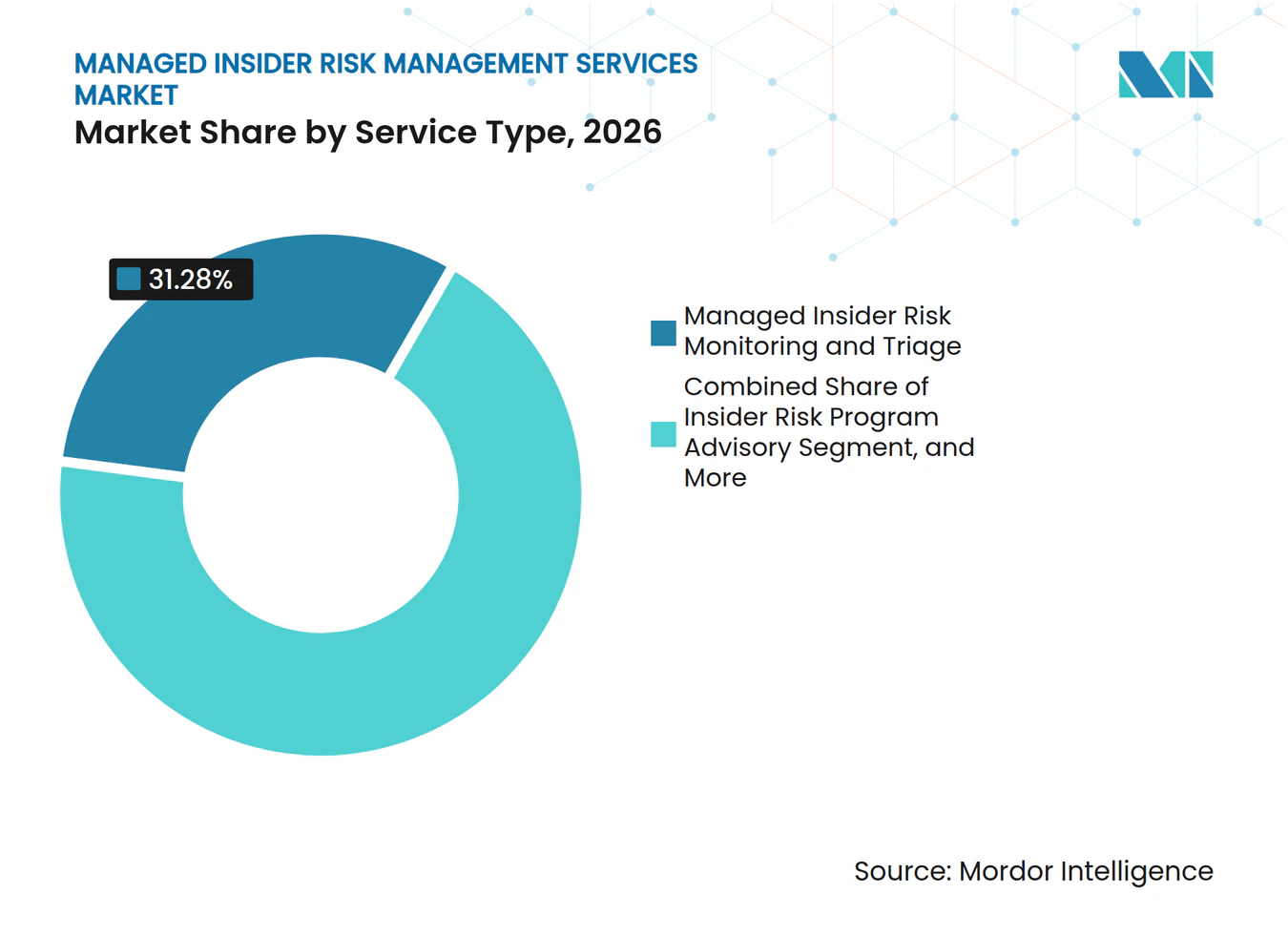
Monitoring Leads While Response Services Gain MomentumManaged insider risk monitoring and triage held 31.28% of the managed insider risk management services market share in 2026. The service provides the continuous observation and initial alert review that most outsourced programs require. Organizations often start with this work because providers can establish behavioral baselines and validate alerts before a case becomes disruptive. Managed insider risk detection and investigation adds deeper case analysis where an alert suggests a credible risk. Advisory and governance services support organizations that are developing multiyear insider-risk programs and internal accountability structures.
Managed insider incident response and containment is projected to expand at a 19.73% CAGR through 2032. This pattern indicates that buyers are moving beyond receiving alerts and want providers to support active remediation. Response services can help coordinate evidence review, access actions, and containment during a live case. Assessments, red teaming, and training programs remain relevant because they help test procedures before a serious event occurs. DTEX reported 101% year-over-year expansion in new annual contract value in February 2026, which supports the shift toward multiyear and multi-service contracts.



By Delivery Model:
Fully Managed Takes the Lead, Co-Managed AcceleratesFully managed delivery accounted for 43.39% revenue share in 2026. It transfers program operations, monitoring, alert triage, and routine reporting to an outside provider. Fortinet found that 46% of insider-risk teams named staffing shortages as a primary challenge. Those constraints make a fully managed service particularly relevant to organizations that require continuous coverage but cannot build a large internal team. On-demand and retainer arrangements also serve specific events, such as executive departures and merger-related access reviews.
Co-managed delivery is projected to expand at a 22.61% CAGR through 2032. Large enterprises and regulated financial institutions often retain internal investigative responsibility while using a partner to add capacity and technology. This model allows internal leaders to keep control of sensitive decisions and regulatory reporting. It also gives them access to specialist analysis when the case volume or technical scope exceeds internal resources. The faster expansion of co-managed programs suggests that sophisticated security functions are looking for a partner rather than a replacement.
By Deployment Mode:
Cloud Centricity Reshapes Service DeliveryCloud-based deployment accounted for 68.58% of the managed insider risk management services market size in 2026 and is projected to expand at an 18.92% CAGR through 2032. Native cloud monitoring can reduce data-completeness and timing issues that arise when logs are exported from many separate systems. This can improve the quality of behavioral signals available to analysts. Proofpoint introduced Data Security Complete in September 2025, combining DLP, insider-threat management, and data-security posture management across email, cloud, web, and endpoints. Its claimed reduction of administration costs by up to 58% also shows the operational focus of unified cloud-oriented platforms.
On-premises deployment remains important for defense contractors, government agencies, and critical infrastructure operators that face data-sovereignty or classified-environment requirements. These organizations may be unable to transmit sensitive telemetry to a cloud platform. Hybrid and multicloud configurations are also emerging for organizations working across countries with conflicting data-residency rules. Providers need to make cloud services interoperable with these environments rather than treat on-premises systems as irrelevant. The managed insider risk management services market will continue to require deployment choices that match each customer's legal and operational limits.
By Organization Size:
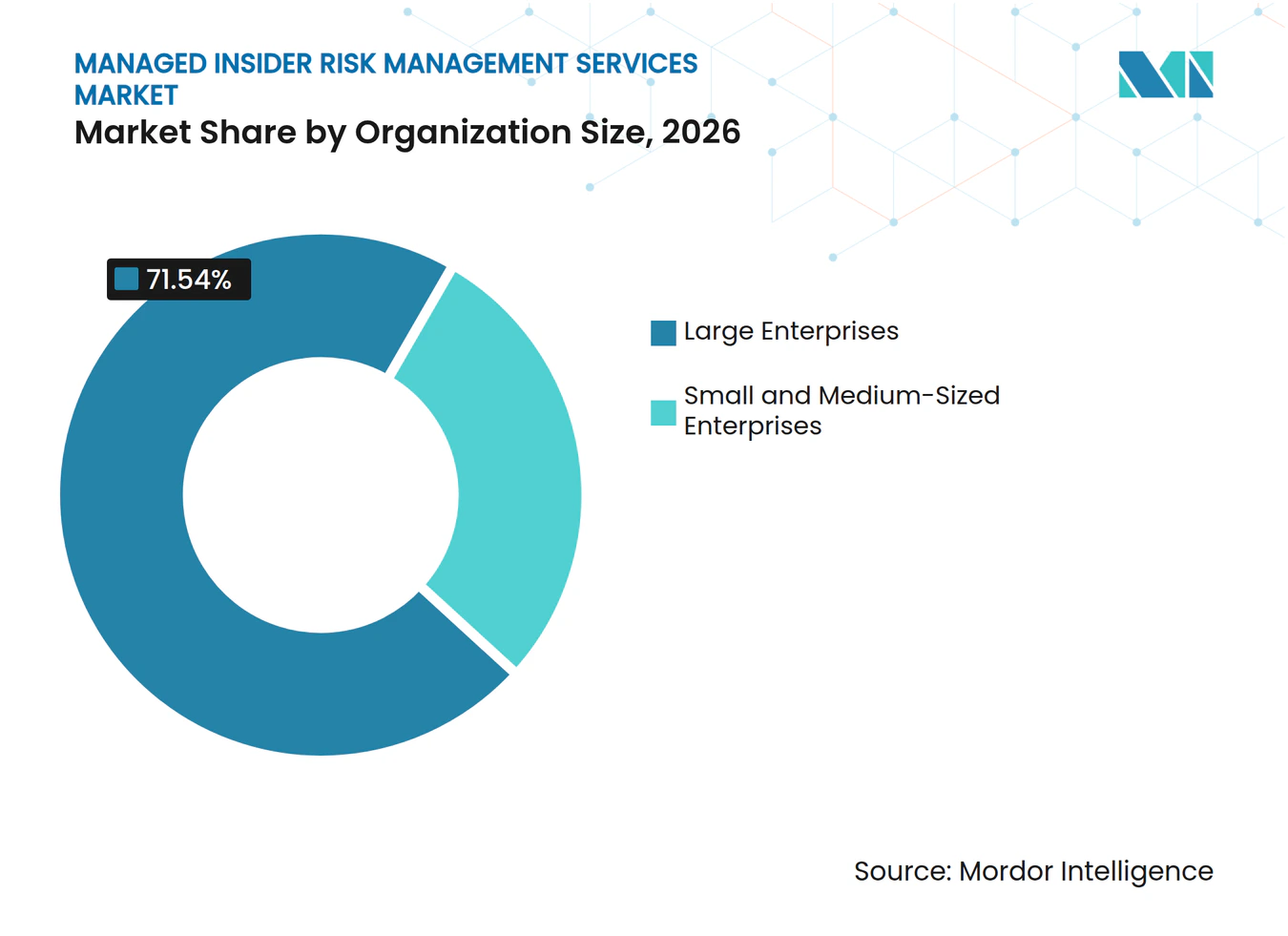
Enterprise Stronghold Gives Way to SME SurgeLarge enterprises accounted for 71.54% revenue share in 2026. They commonly face complex access environments, substantial regulatory exposure, and greater ability to support multiyear service agreements. Their programs often need to consider large workforces, third parties, cloud applications, and sensitive intellectual property. Large organizations also have more internal stakeholders involved in privacy, human resources, legal, and security decisions. This can favor providers that offer structured governance alongside technical monitoring.
SMEs are projected to expand at a 21.82% CAGR through 2032 as consumption-based pricing makes managed services more accessible. OpenText found that 71% of SMBs preferred integrated prevention, detection, and response bundles.[3] Broad employee access in smaller organizations can make the loss of customer information or intellectual property more consequential. A 2026 study found that synchronized HR and IT offboarding reduced data-exposure windows by at least 72% compared with sequential processes. The managed insider risk management services market has room to serve this group with focused offboarding, monitoring, and incident-response packages.

By End-Use Industry:
BFSI Anchors Demand While Healthcare OutpacesBFSI accounted for 26.69% of the managed insider risk management services market share in 2026. Financial institutions manage high-value financial and personal information, which raises the cost of misuse and the need for clear evidence of oversight. DORA further strengthens the case for documented operational resilience programs across European financial entities. Nordic Financial CERT documented criminal recruitment attempts aimed at Nordic financial employees, adding focus on hiring and access-provisioning pathways.[4] Board oversight and cyber-insurance conditions can reinforce that requirement.
The healthcare and life sciences industry is projected to expand at an 18.54% CAGR through 2032. IBM X-Force reported that more than 70% of the healthcare breaches it analyzed were associated with insider activity. The BayCare settlement provided a recent enforcement example involving unauthorized access to patient records. This puts greater attention on workforce access, patient data protections, and evidence that safeguards are being maintained. IT and telecommunications, government and public sector, industrial manufacturing, and retail and e-commerce represent additional demand.
Geography Analysis
North America Managed Insider Risk Management Services Market
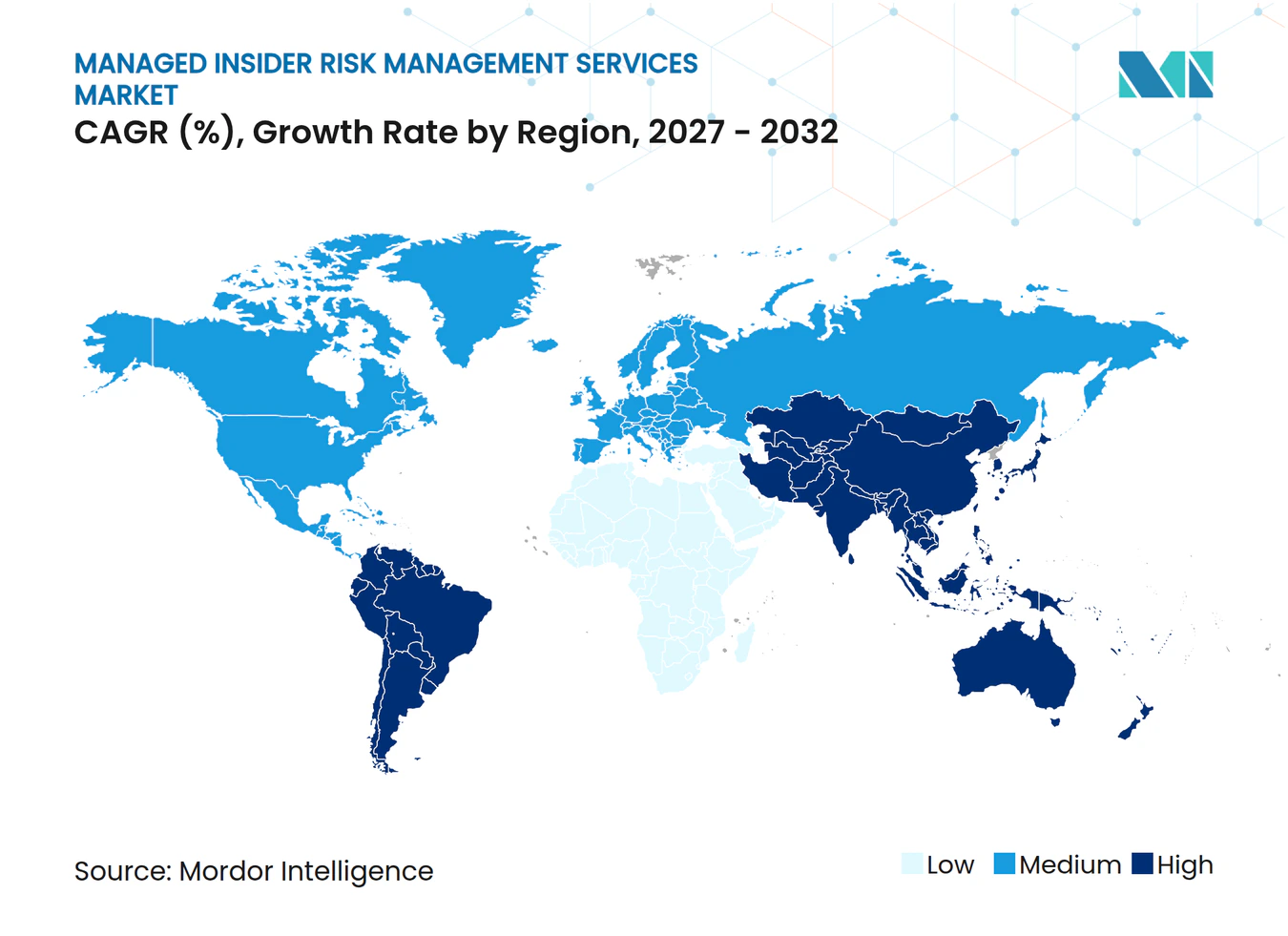
North America accounted for 41.64% of the managed insider risk management services market size in 2026. The region has mature enterprise security budgets, a broad managed service provider ecosystem, and established insider-risk guidance. CISA's September 2026 guide recognized that hybrid work and AI-enabled manipulation have changed the insider-threat environment. Federal contractors and critical infrastructure operators can use that guidance, while U.S. insurance criteria can reinforce documented monitoring and access-management controls. Canada and Mexico contribute additional demand, although managed service penetration is lower than in the United States.
Europe and South America Managed Insider Risk Management Services Market
Europe has a different demand profile because compliance needs operate alongside privacy and works council limits. DORA, NIS2, and national implementation of the EU AI Act are supporting procurement among financial entities, critical infrastructure operators, and technology companies. France's reinforced DORA supervision from January 2026 increases demand for auditable evidence trails, while Germany's works council model can extend sales cycles. South America remains at an earlier stage, where Brazil's LGPD and regulatory modernization in Argentina and Chile support initial demand from financial services and government organizations. Budget and infrastructure limits still constrain the sophistication of programs in the near term.
APAC and MEA Managed Insider Risk Management Services Market
Asia-Pacific is projected to expand at a 21.86% CAGR through 2032, the fastest regional pace in the managed insider risk management services market. Digital transformation, GenAI adoption, and emerging sector-specific rules support this momentum. Japan's managed security services sector expanded 15.5% in fiscal year 2024 and 13.6% in fiscal year 2025, with identity security, SIEM, CASB, SASE, SWG, EDR, and XDR showing strong activity. India has a strong opportunity through fintech expansion and Reserve Bank of India cybersecurity requirements, while the Middle East benefits from Vision 2030 programs and Africa is led by South Africa and Nigeria.
Competitive Landscape
Market Concentration
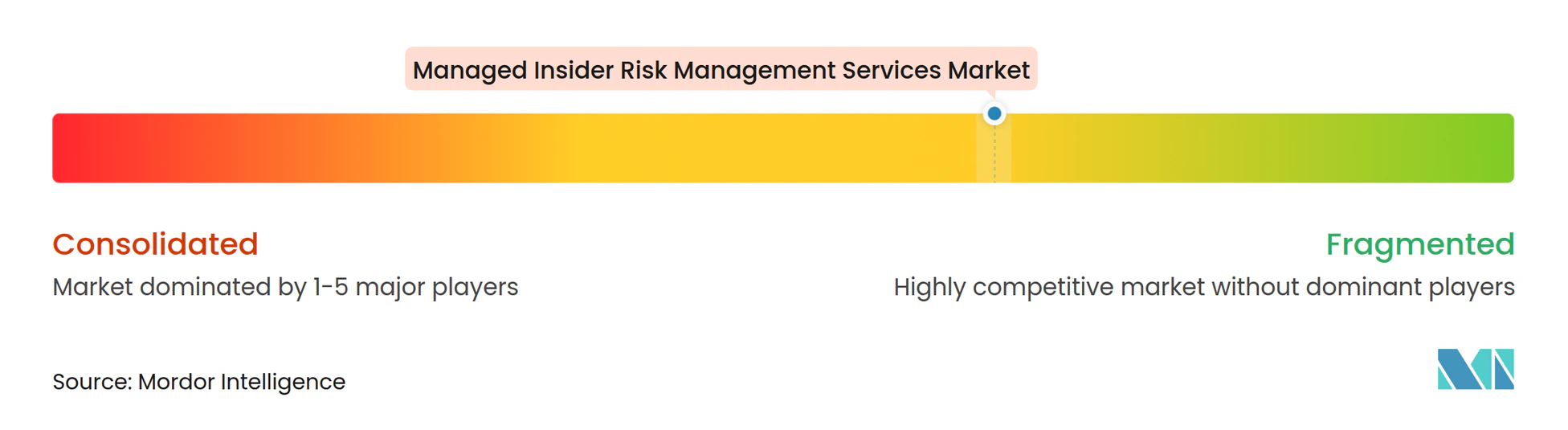
The managed insider risk management services market has a moderately fragmented leading group. IBM, Accenture, NTT DATA, and Deloitte offer broad managed service engagements that can bundle insider risk needs with broader security operations. DTEX Systems, Securonix, Varonis, and Cyberhaven compete through behavioral analytics and specialized detection capabilities. Providers are seeking to combine identity, data, behavioral, and endpoint records in shared operating environments. The managed insider risk management services market raises the standard for vendors that focus only on a single data source.
Accenture collaborated with Microsoft in March 2026 to add agentic AI capabilities to its Adaptive MxDR platform, including Microsoft Sentinel, Microsoft Defender for Endpoint, and Security Copilot. CrowdStrike and IBM expanded their collaboration in March 2026 by integrating Charlotte AI with IBM's Autonomous Threat Operations Machine and extending Falcon into IBM Consulting-managed threat detection and response services. The managed insider risk management services market needs faster investigation and coordinated response as workloads become more automated. Proofpoint expanded AI-powered investigations to Microsoft 365 in September 2026, focusing on visibility into AI-related activity. The managed insider risk management services market is becoming more competitive as providers extend their coverage across cloud collaboration, endpoints, and identity systems.
There is still room in the mid-market and in sector-specific programs for healthcare, industrial manufacturing, and government contractors because these customers often need data classifications and operating processes that generic service packages do not address. DTEX received U.S. Patent No. 12,423,428 in 2025 for a method and system that infers document sensitivity. The managed insider risk management services market depends on operational integration, sector fit, and the ability to manage AI-related data risks. Providers that meet privacy expectations while offering meaningful response support can strengthen their position with complex enterprise buyers.
Managed Insider Risk Management Services Industry Leaders
-
IBM Corporation
-
Accenture plc
-
NTT DATA Corporation
-
Deloitte Touche Tohmatsu Limited
-
Optiv Security Inc.
- *Disclaimer: Major Players sorted in no particular order
Managed Insider Risk Management Services Market Companies Covered in this Report
- IBM Corporation
- Accenture plc
- NTT DATA Corporation
- Deloitte Touche Tohmatsu Limited
- Optiv Security Inc.
- eSentire, Inc.
- Secureworks Corp.
- LevelBlue, Inc.
- Orange Cyberdefense International
- Sophos Limited
- CrowdStrike Holdings, Inc.
- Microsoft Corporation
- Proofpoint, Inc.
- Forcepoint LLC
- DTEX Systems, Inc.
- Varonis Systems, Inc.
- Netskope, Inc.
- Securonix, Inc.
- Palo Alto Networks, Inc.
- Cyberhaven, Inc.
Recent Industry Developments in Managed Insider Risk Management Services Market
- August 2026: Accenture agreed to acquire CyberXC, a cybersecurity services provider, on August 14, 2026, in Accenture's largest cybersecurity acquisition to date, designed to bolster its cybersecurity presence across Asia-Pacific, subject to customary regulatory approvals.
- March 2026: CrowdStrike and IBM announced an expansion of their strategic collaboration at RSA Conference 2026 on March 25, 2026, integrating CrowdStrike Charlotte AI with IBM's Autonomous Threat Operations Machine, ATOM, for machine-speed investigation and containment, and extending the Falcon platform into IBM Consulting's global managed Threat Detection and Response services.
- March 2026: Accenture collaborated with Microsoft on March 19, 2026 to introduce agentic AI capabilities into its Adaptive MxDR platform, integrating Microsoft Sentinel, Microsoft Defender for Endpoint, and Security Copilot to enhance insider threat and broader cyber-threat visibility across hybrid environments.
- September 2025: Proofpoint launched Data Security Complete on September 23, 2025, a unified platform integrating multichannel DLP, insider threat management, ITM, and data security posture management, DSPM, across email, cloud, web, and endpoints, with claimed administration cost reductions of up to 58%.
Global Managed Insider Risk Management Services Market Report Scope
Managed insider risk management services are outsourced solutions that help organizations identify, investigate, and mitigate risks arising from employees, contractors, partners, or other trusted insiders, whether intentional, negligent, or accidental. Typical activities include monitoring risky behavior, detecting data leakage and policy violations, supporting investigations, and coordinating response while balancing security, privacy, and compliance needs.
The Managed Insider Risk Management Services Market Report is Segmented by Service Type (Managed Insider Risk Monitoring and Triage, Managed Insider Risk Detection and Investigation, Managed Insider Incident Response and Containment, Insider Risk Program Advisory and Governance, Insider Risk Assessments, Exercises, and Red Teaming, and Insider Risk Training and Workforce Enablement), Delivery Model (Fully Managed, Co-Managed, On-Demand and Retainer-Based, and Hybrid Managed), Deployment Mode (Cloud-Based, On-Premises, and Hybrid and Multicloud), Organization Size (Large Enterprises, and Small and Medium Enterprises), End-User Industry (Banking, Financial Services and Insurance (BFSI), IT and Telecommunications, Healthcare and Life Sciences, Government and Public Sector, Industrial Manufacturing, Retail and E-Commerce, and Other End-User Industries), and Geography (North America, South America, Europe, Asia-Pacific, Middle East, and Africa). The Market Forecasts are Provided in Terms of Value (USD).
Segmentation Overview
| Managed Insider Risk Monitoring and Triage |
| Managed Insider Risk Detection and Investigation |
| Managed Insider Incident Response and Containment |
| Insider Risk Program Advisory and Governance |
| Insider Risk Assessments, Exercises, and Red Teaming |
| Insider Risk Training and Workforce Enablement |
| Fully Managed |
| Co-Managed |
| On-Demand and Retainer-Based |
| Hybrid Managed |
| Cloud-Based |
| On-Premises |
| Hybrid and Multicloud |
| Large Enterprises |
| Small and Medium-Sized Enterprises |
| Banking, Financial Services and Insurance (BFSI) |
| IT and Telecommunications |
| Healthcare and Life Sciences |
| Government and Public Sector |
| Industrial Manufacturing |
| Retail and E-Commerce |
| Other End-User Industries |
| North America | United States |
| Canada | |
| Mexico | |
| South America | Brazil |
| Argentina | |
| Chile | |
| Rest of South America | |
| Europe | United Kingdom |
| Germany | |
| France | |
| Italy | |
| Rest of Europe | |
| Asia-Pacific | China |
| Japan | |
| India | |
| South Korea | |
| Rest of Asia-Pacific | |
| Middle East | Saudi Arabia |
| United Arab Emirates | |
| Rest of Middle East | |
| Africa | South Africa |
| Nigeria | |
| Rest of Africa |
| By Service Type | Managed Insider Risk Monitoring and Triage | |
| Managed Insider Risk Detection and Investigation | ||
| Managed Insider Incident Response and Containment | ||
| Insider Risk Program Advisory and Governance | ||
| Insider Risk Assessments, Exercises, and Red Teaming | ||
| Insider Risk Training and Workforce Enablement | ||
| By Delivery Model | Fully Managed | |
| Co-Managed | ||
| On-Demand and Retainer-Based | ||
| Hybrid Managed | ||
| By Deployment Mode | Cloud-Based | |
| On-Premises | ||
| Hybrid and Multicloud | ||
| By Organization Size | Large Enterprises | |
| Small and Medium-Sized Enterprises | ||
| By End-Use Industry | Banking, Financial Services and Insurance (BFSI) | |
| IT and Telecommunications | ||
| Healthcare and Life Sciences | ||
| Government and Public Sector | ||
| Industrial Manufacturing | ||
| Retail and E-Commerce | ||
| Other End-User Industries | ||
| By Geography | North America | United States |
| Canada | ||
| Mexico | ||
| South America | Brazil | |
| Argentina | ||
| Chile | ||
| Rest of South America | ||
| Europe | United Kingdom | |
| Germany | ||
| France | ||
| Italy | ||
| Rest of Europe | ||
| Asia-Pacific | China | |
| Japan | ||
| India | ||
| South Korea | ||
| Rest of Asia-Pacific | ||
| Middle East | Saudi Arabia | |
| United Arab Emirates | ||
| Rest of Middle East | ||
| Africa | South Africa | |
| Nigeria | ||
| Rest of Africa | ||
Key Questions Answered in the Report
What is the size of the managed insider risk management services market?
The managed insider risk management services market size was valued at USD 1.46 billion in 2026 and is estimated to grow from USD 1.79 billion in 2027 to reach USD 4.12 billion by 2032, at a CAGR of 18.14% during the forecast period (2027-2032).
Which service type leads managed insider risk management services?
Managed insider risk monitoring and triage leads with a 31.28% share in 2026, reflecting the need for ongoing behavioral monitoring and alert review.
What delivery model is expanding the fastest?
Co-managed delivery is projected to expand at a 22.61% CAGR through 2032 because regulated organizations often want external capacity while retaining internal accountability.
Why is cloud deployment important for insider-risk programs?
Cloud-based deployment held 68.58% in 2026 because core business data and user activity increasingly sit within cloud and SaaS applications.
Which end-use sector has the largest share?
BFSI held 26.69% in 2026 because financial organizations face high-value data risks and extensive regulatory requirements.
Which region has the fastest projected expansion?
Asia-Pacific is projected to expand at a 21.86% CAGR through 2032, supported by digital transformation, GenAI adoption, and evolving sector-specific rules.