
Managed UEBA Services Market Size and Share
Market Overview
| Study Period | 2021 - 2032 |
|---|---|
| Market Size (2027) | USD 2.22 Billion |
| Market Size (2032) | USD 4.63 Billion |
| Growth Rate (2027 - 2032) | 15.84 % |
| Fastest Growing Market | Asia-Pacific |
| Largest Market | North America |
| Market Concentration | Medium |
Major Players *Disclaimer: Major Players sorted in no particular order Image © Mordor Intelligence. Reuse requires attribution under CC BY 4.0. | |
Managed UEBA Services Market Analysis by Mordor Intelligence
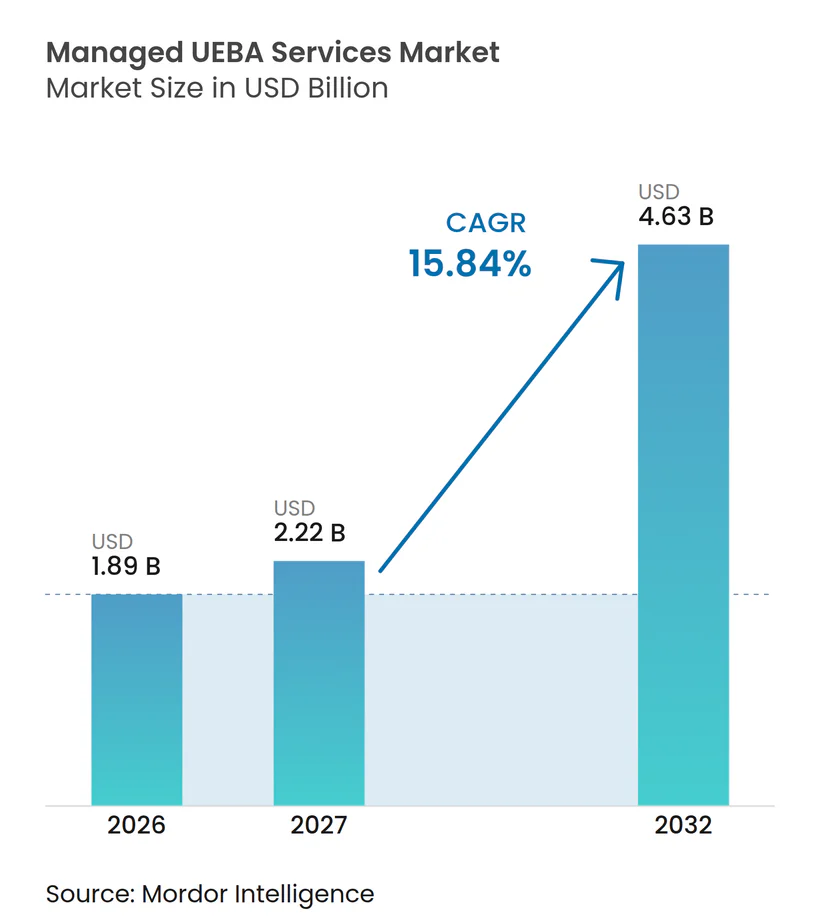
The Managed UEBA services market size is projected to expand from USD 1.89 billion in 2026 and USD 2.22 billion in 2027 to USD 4.63 billion by 2032, registering a CAGR of 15.84% between 2027 and 2032. Identity compromise has moved ahead of perimeter breach as a central enterprise security concern, which has increased demand for continuous behavioral monitoring. Red Canary reported in 2025 that 83% of security leaders believe adversaries log in rather than break in, placing greater weight on detecting unusual account behavior. The Managed UEBA services market is therefore moving beyond its early concentration in financial services and government toward a wider group of buyers that need managed detection capability. Providers are packaging behavioral analytics within broader managed detection, extended detection, and managed SIEM services, which can simplify purchasing decisions for customers. Demand also depends on a provider's ability to handle identity data across cloud, software-as-a-service, remote-work, and legacy environments.
Key Report Takeaways
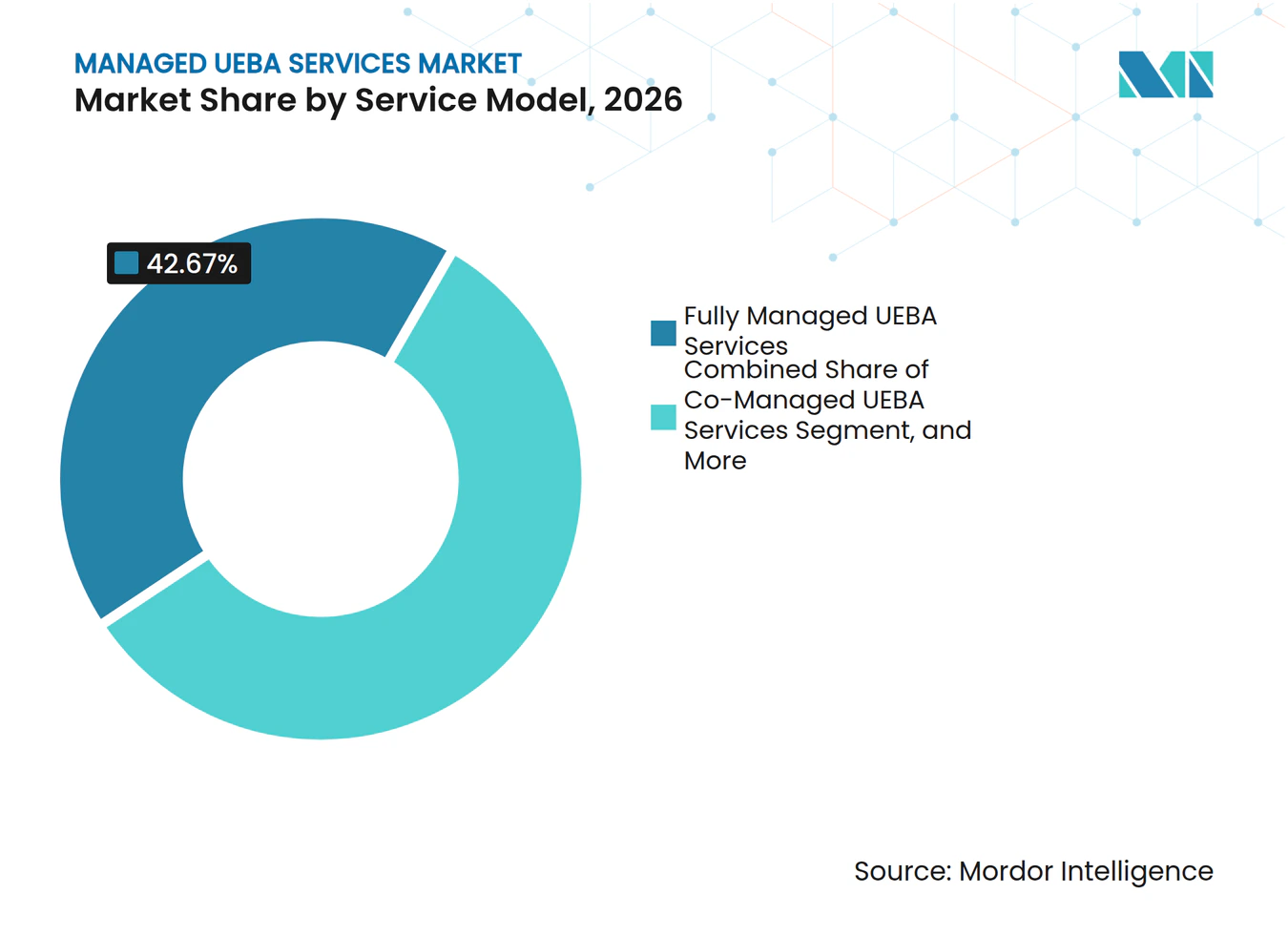
- By service model, Fully Managed UEBA Services held 42.67% of the Managed UEBA services market share in 2026, while Managed UEBA Embedded in MDR, MXDR, or Managed SIEM is projected to expand at a 17.23% CAGR through 2032.
- By delivery component, Continuous Monitoring and Alert Triage held 36.76% revenue share in 2026, while Content Engineering, Tuning, and Optimization is projected to expand at a 17.49% CAGR through 2032.
- By deployment mode, Cloud-Native deployment held 59.41% of the Managed UEBA services market share in 2026 and is projected to expand at a 17.88% CAGR through 2032.
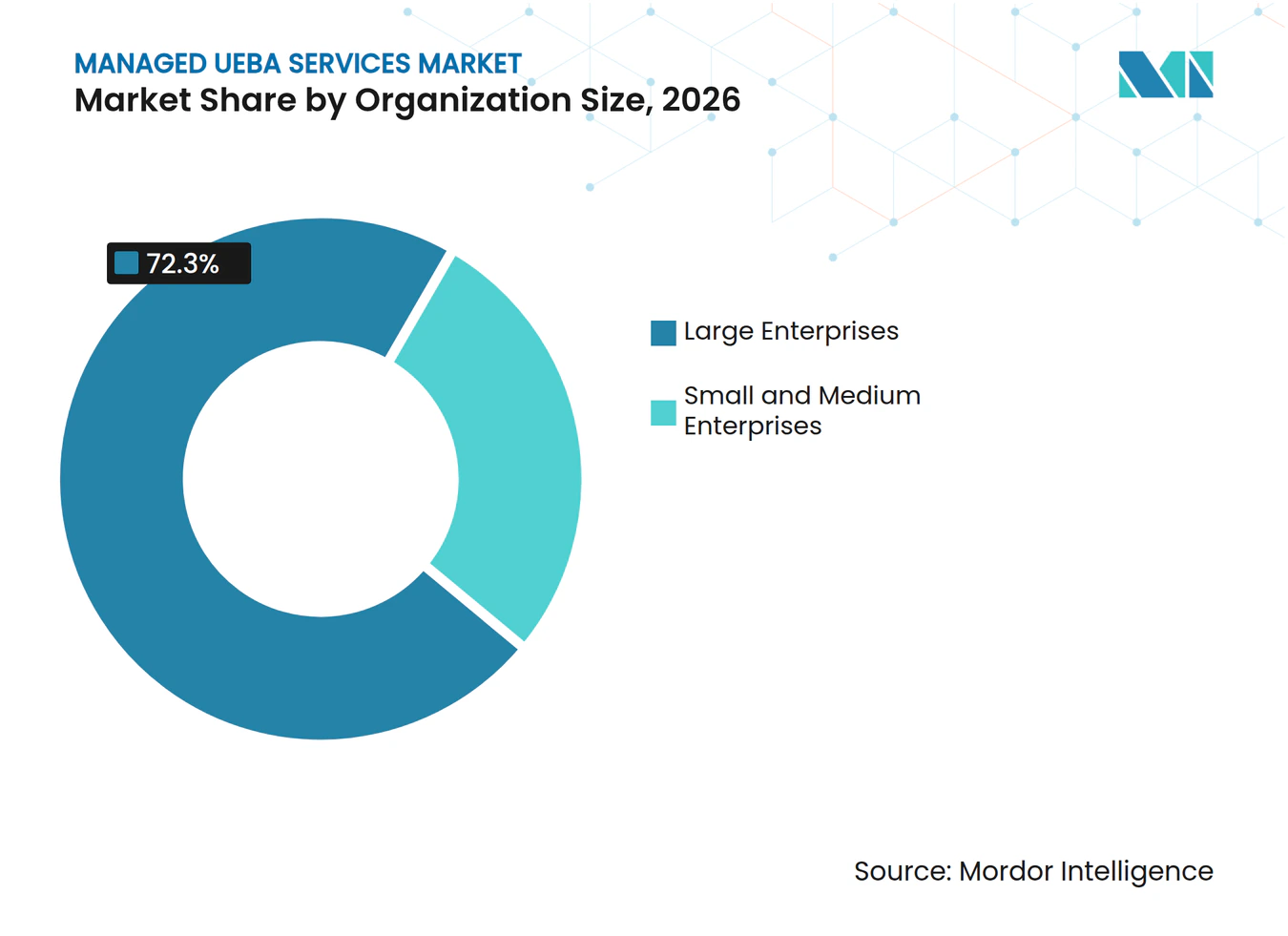
- By organization size, Large Enterprises held 72.30% revenue share in 2026, while Small and Medium Enterprises are projected to expand at an 18.48% CAGR through 2032.
- By end-user vertical, BFSI held 26.67% revenue share in 2026, while Healthcare and Life Sciences are projected to expand at a 19.12% CAGR through 2032.
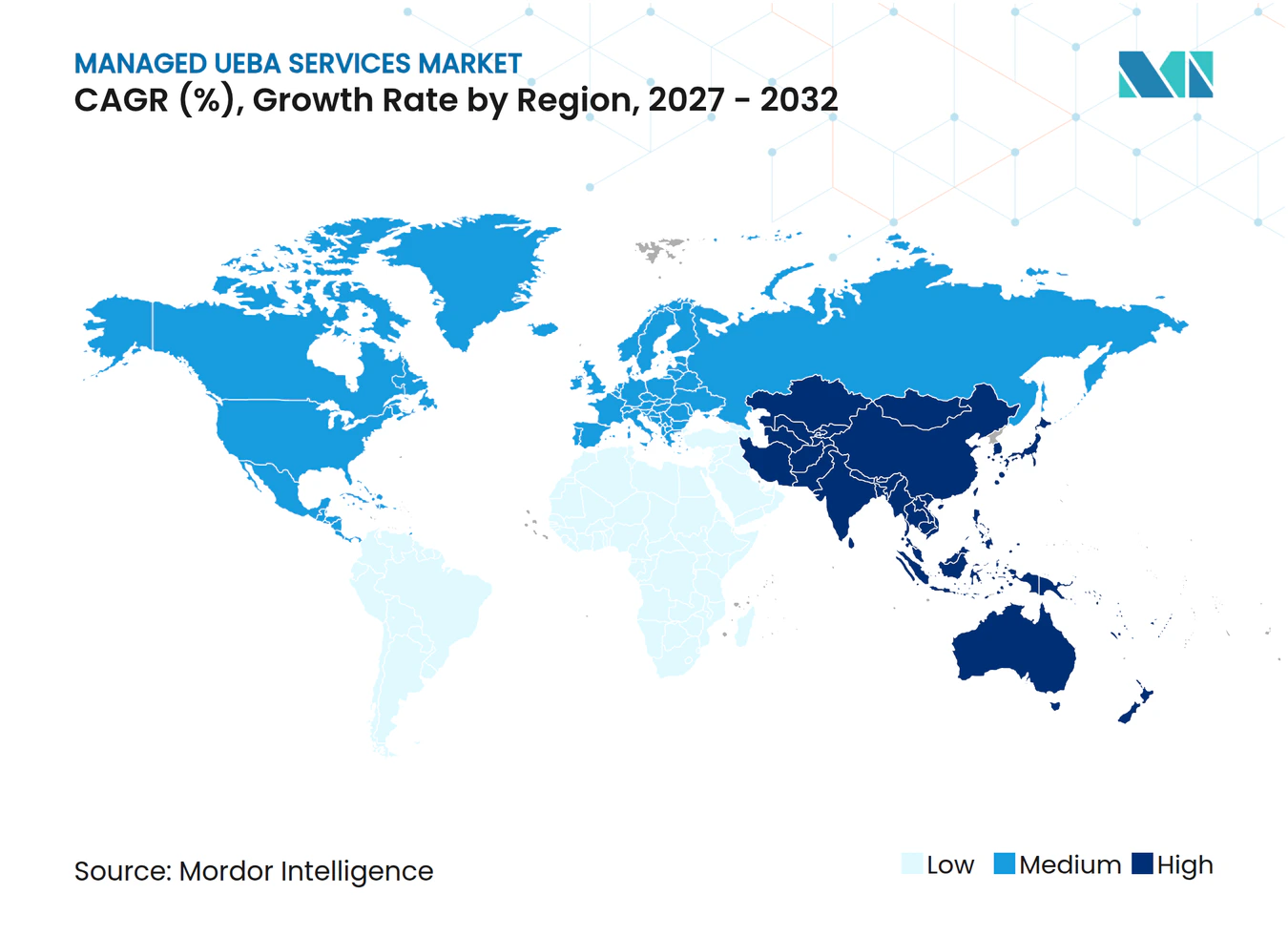
- By geography, North America held 36.21% revenue share in 2026, while Asia-Pacific is projected to expand at a 19.77% CAGR through 2032.
Note: Market numbers in this report are based on Mordor Intelligence's proprietary estimation framework, which combines nine months of actuals with Q4 projections for base year 2026.
Market Trends and Insights
Drivers Impact Analysis of Managed UEBA Services Market*
| Driver | (~) % Impact on CAGR Forecast | Geographic Relevance | Impact Timeline |
|---|---|---|---|
| Rising Identity-Centric Attacks and Insider Threat Exposure | +4.2% | Global, highest intensity in North America, Europe, and Asia-Pacific financial centers | Short term (≤ 2 years) |
| Shortage of Skilled Security Operations Personnel | +3.5% | Global, acute in Asia-Pacific and Middle East and Africa, where domestic SOC talent pools are thinnest | Short term (≤ 2 years) |
| Expansion of Cloud, SaaS, Remote Work, and Connected Entities | +3.1% | Global, fastest demand in Asia-Pacific cloud-first markets and European hybrid-work environments | Medium term (2-4 years) |
| Regulatory Pressure for Continuous Monitoring and Evidence-Based Response | +2.4% | North America and Europe, with spillover to Asia-Pacific through multinational compliance chains | Medium term (2-4 years) |
| MSSP Margin Expansion Through Reusable Behavioral Analytics Content | +1.6% | Global MSSP ecosystem, with strongest density in North America and Western Europe | Long term (≥ 4 years) |
| Cross-Tenant Baseline Transfer and Privacy-Preserving Entity Modeling | +1.1% | North America and Europe, constrained by data-residency rules in Asia-Pacific and Middle East and Africa | Long term (≥ 4 years) |
| Source: Mordor Intelligence | |||
Rising Identity-Centric Attacks and Insider Threat Exposure Drive Adoption
Credential misuse and insider-led data access have changed how organizations prioritize behavioral monitoring. The Managed UEBA services market benefits because organizations need to identify activity that appears legitimate at the point of login but becomes unusual when examined over time. HHS Office for Civil Rights settled a HIPAA Security Rule investigation with BayCare Health System in May 2025 for USD 800,000 following impermissible access to electronic protected health information by a former workforce member. This case reinforced the value of access records and monitoring controls when organizations investigate employee activity. NTT Security Japan identifies insider-risk monitoring as a core element of its managed UEBA service, including the analysis of user behavior across enterprise systems. The Managed UEBA services market is supported by demand for monitoring that can cover employees, former employees, privileged users, and other identity-bearing entities.
Shortage of Skilled Security Operations Personnel Accelerates Managed Outsourcing
The shortage of security operations personnel is pushing organizations to procure managed behavioral analytics rather than build dedicated internal teams. ISACA reported in 2025 that 55% of cybersecurity teams were understaffed, while 65% had unfilled positions. ISC2 found that 95% of respondents reported at least 1 skills gap, with AI security and cloud security among the most frequently identified areas. These gaps affect the ability to build baselines, investigate anomalies, and maintain detection content over time. Managed services can provide continuous operations without requiring each customer to recruit and retain dedicated UEBA specialists. This driver extends the Managed UEBA services market into mid-sized organizations and public-sector bodies that may not have a large security operations center.
Expansion of Cloud, SaaS, Remote Work, and Connected Entities Widens the Monitoring Surface
Cloud workloads, SaaS applications, remote endpoints, and connected identities create more activity that requires behavioral context. Each environment can produce different authentication, access, and device records, which increases the work needed to build a consistent profile of normal behavior. Microsoft added new entity behavior analytics experiences in its Defender portal in January 2026, making UEBA context available within analyst workflows.[1] The change reflects the need to connect behavioral context with operational alerts rather than treat it as a separate process. DTEX integrated its UEBA platform with AWS Security Hub in December 2025 to combine behavioral telemetry with cloud security findings. As these environments expand, the Managed UEBA services market gains from provider expertise in maintaining integrations and interpreting data across systems.
Regulatory Pressure for Continuous Monitoring and Evidence-Based Response Creates Sustainable Demand
Regulatory requirements create demand for monitoring, log retention, and evidence that can be reviewed after a security event. The European Union Agency for Cybersecurity documented in June 2025 that Regulation 2025/37 defines managed security services and incorporates them into European cybersecurity certification arrangements. The same report showed that ISO/IEC 27001 certification was held by 92% of supply-side respondents in its European managed security services assessment. Buyers increasingly assess whether a provider can retain logs, document response actions, and explain risk scores. This favors services with formal operating processes over basic alert forwarding. The Managed UEBA services market can benefit where compliance teams and security teams require the same audit-ready evidence.
Restraints Impact Analysis of Managed UEBA Services Market*
| Restraint | (~) % Impact on CAGR Forecast | Geographic Relevance | Impact Timeline |
|---|---|---|---|
| High Data-Onboarding and Identity-Normalization Complexity | -2.1% | Global, most acute in organizations with multi-vendor legacy directory infrastructure in North America and Europe | Short term (≤ 2 years) |
| Privacy, Employee-Monitoring, and Data-Residency Constraints | -1.7% | Europe and Asia-Pacific markets with data-localization rules, with spillover to multinationals with European operations | Medium term (2-4 years) |
| False-Positive Risk and Customer Distrust of Opaque Models | -1.2% | Global, heightened in North America and Europe where alert fatigue is a persistent concern | Medium term (2-4 years) |
| Limited Willingness to Share High-Value Telemetry With Third-Party Providers | -0.9% | Global, concentrated in government, defense, and critical infrastructure sectors | Long term (≥ 4 years) |
| Source: Mordor Intelligence | |||
High Data-Onboarding and Identity-Normalization Complexity Extends Deployment Timelines
The central deployment challenge is often the preparation of data rather than the detection model itself. Organizations can operate Active Directory, Okta, Microsoft Entra ID, cloud platforms, SaaS applications, and older directories at the same time. These sources use different formats and may represent the same person or service account in inconsistent ways. Providers need to normalize records and resolve identities before they can establish reliable behavior baselines. NTT Security Japan presents managed UEBA as a service that integrates and analyzes security data to support detection and investigation across customer environments.[2] Long onboarding periods can delay perceived value and increase contract risk, especially for smaller buyers. The Managed UEBA services market, therefore, favors providers with reusable connectors, clear discovery processes, and proof-of-concept work using historical records.
Privacy, Employee-Monitoring, and Data-Residency Constraints Limit Behavioral Context
Behavioral analytics may depend on detailed records of file access, application use, authentication patterns, and communication metadata. Those records can raise employee privacy and data-protection concerns when they are transferred to a third-party provider. ENISA reported that technical integration challenges affected 38% of demand-side respondents in its 2025 managed security services analysis. Data-residency rules can require regional processing infrastructure and limit the scope for centralized multi-tenant delivery. The provider may need to restrict collection, apply localized processing, or adapt the operating model to customer requirements. These conditions increase cost and can reduce the behavioral context available to the service. They also create a clear need for transparent governance, local infrastructure, and controls that explain how personal data is handled.
*Our forecasts treat driver/restraint impacts as directional, not additive. The impact forecasts reflect baseline growth, mix effects, and variable interactions.
Managed UEBA Services Market Segment Analysis
By Service Model:
Embedded Integration Reshapes Service ArchitectureFully Managed UEBA Services held 42.67% of the Managed UEBA services market in 2026. The model addresses customers who do not have the engineering capacity or staffing required to operate a UEBA platform continuously. It is especially relevant for financial services institutions, healthcare systems, and government organizations that need persistent monitoring and defined service coverage. Providers take responsibility for monitoring, alert triage, investigation support, and the maintenance of behavioral analytics content. The structure can reduce the burden on internal teams, but it also makes the provider's operational quality central to customer value in Managed UEBA services market contracts.
Managed UEBA Embedded in MDR, MXDR, or Managed SIEM is projected to expand at a 17.23% CAGR through 2032. Buyers are increasingly choosing a consolidated detection stack rather than purchasing behavioral analytics as an isolated service. CrowdStrike launched its Services Partner Program in March 2025, enrolling Deloitte, EY, eSentire, and Wipro as certified Falcon Next-Gen SIEM delivery partners.[3] This approach puts behavioral context within the same operating model as managed detection, response, and SIEM services. It can simplify accountability and enable analysts to use the same case-management process for multiple alert types.



By Delivery Component:
Monitoring Scale Masks an Engineering InflectionContinuous Monitoring and Alert Triage held 36.76% of the Managed UEBA services market size in 2026. This component remains the foundation of a managed service because it supports real-time anomaly detection and analyst escalation. Organizations need a consistent process for reviewing alerts that involve unusual account activity, access patterns, or entity behavior. Continuous monitoring is more useful when it connects detection with a documented response path. It can also provide a starting point for threat hunting, incident response, and compliance reporting across the Managed UEBA services market.
Content Engineering, Tuning, and Optimization is projected to expand at a 17.49% CAGR through 2032. Customers increasingly recognize that default detection content may not reflect their systems, users, or risk thresholds. Tuning reduces the risk that analysts spend time on alerts that are not relevant to the customer's environment. Exabeam introduced AI-assisted investigation, governance reporting, and non-human entity monitoring in its October 2026 New-Scale update. The update shows how providers are extending the scope of content that must be engineered and maintained.
By Deployment Mode:
Cloud Architecture Leads on Both Share and GrowthCloud-Native deployment held 59.41% of the Managed UEBA services market size in 2026. It is also projected to expand at a 17.88% CAGR through 2032. Cloud-native architectures can allow a provider to deliver managed services across multiple customers while maintaining common infrastructure and detection content. This structure can support quicker onboarding and make it easier to scale data processing as event volumes increase. Securonix documented a 2026 Redington DigiGlass deployment that scaled from 750 to 15,000 events per second.
On-Premises deployment remains relevant for air-gapped environments and customers with strict data-sovereignty requirements. Government buyers in the United States, Germany, and Japan may limit the transfer of behavioral telemetry to shared cloud infrastructure. Hybrid deployment also remains important for enterprises that are moving from on-premises identity systems to cloud identity providers in stages. Palo Alto Networks added UEBA 2.0 capabilities to Strata Cloud Manager in July 2026, including aggregation across 6 data loss prevention enforcement vectors. The availability of cloud features does not eliminate the need to maintain coherent profiles across mixed environments.
By Organization Size:
SME Adoption Accelerates Beyond the Enterprise CoreLarge Enterprises held 72.30% of the Managed UEBA services market in 2026. These organizations often have complex identity estates, multi-cloud environments, and formal compliance responsibilities that justify larger managed service contracts. Financial services and healthcare are prominent buyers because they handle sensitive data and require durable records of access activity. Large customers commonly procure UEBA through a wider security operations agreement rather than as a single product. They also seek connections between behavioral analytics, incident response, and broader threat detection from Managed UEBA services market providers.
Small and Medium Enterprises are projected to expand at an 18.48% CAGR through 2032. Pooled-tenant licensing can lower entry barriers by allowing managed service providers to spread platform costs across smaller customers. Smaller organizations may not be able to employ a dedicated analyst for behavioral monitoring, even when their exposure to identity-related threats is meaningful. They need simpler onboarding, standard detection content, and reporting that can be understood without a large internal security team. Managed service providers need service designs that lower minimum contract requirements while retaining useful coverage.

By End-User Vertical:
Healthcare Gains Ground on BFSIBFSI held 26.67% of the Managed UEBA services market in 2026. Financial institutions have sustained exposure to privileged-access misuse, data exfiltration, transaction anomalies, and insider risk. These organizations also operate under security and compliance requirements that make activity monitoring a continuing priority. Behavioral analytics can support the review of unusual user activity across systems that hold sensitive financial information. BFSI customers tend to seek services that can integrate with established security operations and provide evidence for internal governance.
Healthcare and Life Sciences are projected to expand at a 19.12% CAGR through 2032. Healthcare providers manage high volumes of electronic health record access by clinical and administrative staff, which can make it difficult to distinguish legitimate work from improper access. The U.S. Department of Health and Human Services proposed HIPAA Security Rule updates in January 2025 that addressed cybersecurity protections for electronic protected health information. The BayCare enforcement action in May 2025 also showed the consequences of insufficient access controls. Healthcare buyers need monitoring that recognizes the legitimate but varied access patterns of clinical work.
Geography Analysis
North America Managed UEBA Services Market
North America held 36.21% of the Managed UEBA services market in 2026. The United States generated substantial demand from financial services, healthcare, and government organizations that operate under formal security and reporting requirements, while Canada and Mexico also contribute through financial institutions and public-sector organizations. HIPAA enforcement and proposed security-rule changes keep access monitoring relevant for healthcare buyers.[4] CrowdStrike and IBM expanded their collaboration in March 2026 to integrate Charlotte AI with IBM's Autonomous Threat Operations Machine. The collaboration reflects continued investment in managed security architectures that combine automation and analyst workflows.
Europe Managed UEBA Services Market
Europe has demand shaped by NIS2, DORA, GDPR, and the European Union Cyber Solidarity Act, which create monitoring and evidence requirements, while data-residency conditions can limit how a provider processes customer telemetry. ENISA stated that Regulation 2025/37 integrated managed security services into European cybersecurity certification schemes. Providers with regional processing infrastructure and credible certifications may have an advantage in this setting, particularly in Germany, the United Kingdom, and France, which have large enterprise bases and active security compliance environments. The Managed UEBA services market in Europe must balance broad behavioral visibility with rules governing employee data and cross-border data transfer.
APAC, MEA and South America Managed UEBA Services Market
Asia-Pacific is projected to expand at a 19.77% CAGR through 2032. Financial services, manufacturing, and government organizations support demand as they digitize operations and seek greater security coverage, while NTT Security Japan positions managed UEBA as a way to help organizations detect and respond to incidents using behavior analysis. KDDI and LAC began a full-scale global rollout of security solutions in July 2025, combining LAC security operations expertise with KDDI's international footprint. Japan presents a need for services that can address insider risk alongside broader cybersecurity concerns. South America, the Middle East, and Africa represent smaller volumes, but regional managed security providers are adding UEBA-enabled offerings as digital resilience programs expand.
Competitive Landscape
Market Concentration
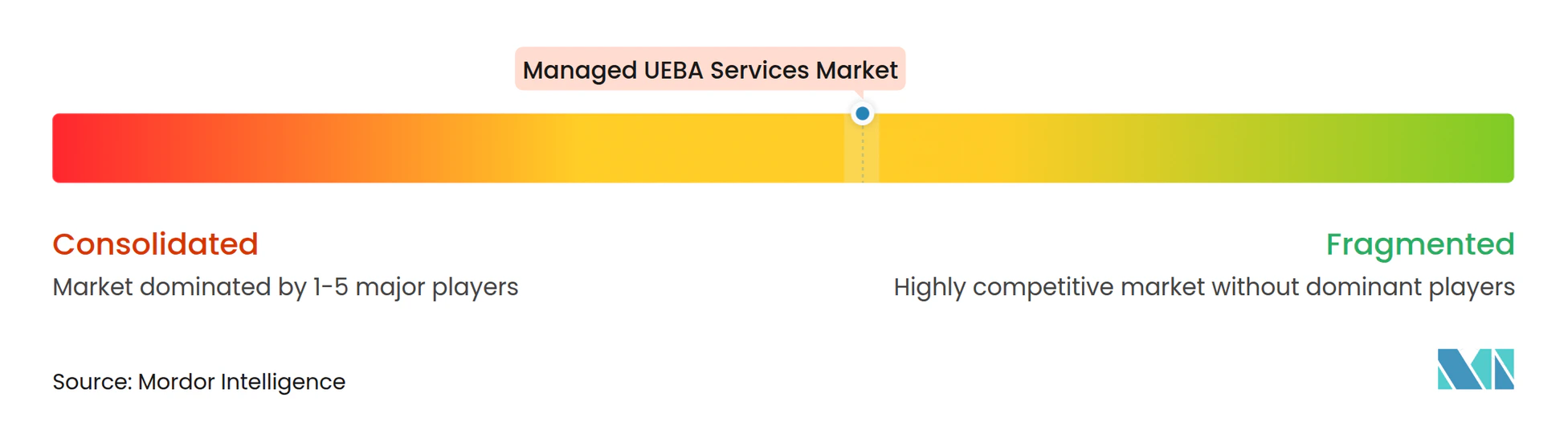
The Managed UEBA services market is moderately fragmented around platform-scale vendors and specialist behavioral analytics providers. IBM, Microsoft, Palo Alto Networks, and CrowdStrike use managed security portfolios that can bundle behavioral analytics within MDR, MXDR, and managed SIEM agreements. Securonix, Exabeam, Varonis, and Secureworks provide platforms that can support managed service provider delivery, including multi-tenant deployment models. Competition centers on the ability to combine data ingestion, detection content, investigation workflows, and managed operations. Larger platform vendors benefit from their installed security product base and broad partner networks, while specialists compete through behavioral analytics depth, flexible deployment, and service-provider-focused licensing.
Partner programs are becoming an important route to market for the Managed UEBA services market. CrowdStrike's March 2025 Services Partner Program brought Deloitte, EY, eSentire, and Wipro into its Falcon Next-Gen SIEM delivery ecosystem. Securonix introduced Advanced Behavioral Analytics in October 2026 and announced ISO/IEC 42001:2023 certification for its AI management system. These moves show that vendors are seeking scale through partners while addressing demand for governed behavioral analytics. Providers also need to demonstrate that automation remains understandable and subject to human oversight.
Opportunities remain in managed services for small and medium enterprises, sovereign or regional cloud deployments, and behavioral monitoring for non-human identities. Palo Alto Networks introduced explainable risk scoring and multi-channel data loss prevention correlation in its July 2026 UEBA update. Varonis completed its acquisition of SlashNext in September 2025 to connect phishing detection with its data-centric security platform, extending coverage from credential compromise through data exfiltration. These developments indicate that providers are broadening behavioral monitoring into a larger set of identity, data, and email-security workflows.
Managed UEBA Services Industry Leaders
-
IBM Corporation
-
Microsoft Corporation
-
Rapid7, Inc.
-
Accenture plc
-
Tata Communications Limited
- *Disclaimer: Major Players sorted in no particular order
Managed UEBA Services Market Companies Covered in this Report
- IBM Corporation
- Microsoft Corporation
- Arctic Wolf Networks, Inc.
- Sophos Limited
- Rapid7, Inc.
- Accenture plc
- Tata Communications Limited
- NTT Ltd.
- Cisco Systems, Inc.
- Palo Alto Networks, Inc.
- CrowdStrike Holdings, Inc.
- eSentire, Inc.
- Securonix, Inc.
- Exabeam, Inc.
- Fortinet, Inc.
- Trustwave Holdings, Inc.
- Kyndryl Inc.
- Atos SE
- Wipro Limited
- Capgemini SE
- ESET, spol. s r.o.
- SentinelOne, Inc.
- Secureworks Corp.
- Varonis Systems, Inc.
Recent Industry Developments in Managed UEBA Services Market
- October 2026: Securonix launched Advanced Behavioral Analytics (ABA), combining Agent and Entity Behavior Analytics with UEBA to monitor human and AI-agent activity simultaneously, and achieved ISO/IEC 42001:2023 certification, the world's first AI management system standard, providing independent validation of governed behavioral analytics.
- October 2026: Exabeam released its New-Scale October 2026 update with an Agentic SOC plugin for Claude Code and OpenAI Codex, direct Claude Enterprise log ingestion for behavioral baselining, and Nova AI conversational context across investigation workflows, extending machine-speed behavioral investigation to non-human entity monitoring at production scale.
- June 2026: NEC Australia and Exabeam expanded their strategic partnership to embed UEBA and Agent Behavior Analytics across NEC's managed security practice in Australia, enabling detection of insider threats and AI-agent anomalies across complex hybrid and cloud-native enterprise environments.
- March 2026: CrowdStrike and IBM expanded their strategic collaboration to integrate Charlotte AI with IBM's Autonomous Threat Operations Machine for machine-speed SOC investigation and containment, extending the Falcon platform into IBM Consulting's managed Threat Detection and Response services and global X-Force Cyber Range.
Global Managed UEBA Services Market Report Scope
Managed User and Entity Behavior Analytics (UEBA) Services are outsourced cybersecurity solutions where a specialized third-party provider assumes 24/7/365 operational responsibility for monitoring, analyzing, and intercepting anomalous activities tied to human users and non-human entities.
The Managed UEBA Services Market Report is Segmented by Service Model (Fully Managed UEBA Services, Co-Managed UEBA Services, and Managed UEBA Embedded in MDR, MXDR, or Managed SIEM), Delivery Component (Continuous Monitoring and Alert Triage, Threat Hunting and Behavioral Investigation, Incident Response and Containment, Content Engineering, Tuning, and Optimization, and Compliance Reporting and Risk Advisory), Deployment Mode (Cloud-Native, On-Premises, and Hybrid), Organization Size (Large Enterprises and Small and Medium Enterprises), End-User Verticals (BFSI, Healthcare and Life Sciences, Government and Defense, IT and Telecommunications, Manufacturing and Industrial, Energy and Utilities, and Other End-User Verticals), and Geography (North America, South America, Europe, Asia-Pacific, Middle East, and Africa). The Market Forecasts are Provided in Terms of Value (USD).
Segmentation Overview
| Fully Managed UEBA Services |
| Co-Managed UEBA Services |
| Managed UEBA Embedded in MDR, MXDR, or Managed SIEM |
| Continuous Monitoring and Alert Triage |
| Threat Hunting and Behavioral Investigation |
| Incident Response and Containment |
| Content Engineering, Tuning, and Optimization |
| Compliance Reporting and Risk Advisory |
| Cloud-Native |
| On-Premises |
| Hybrid |
| Large Enterprises |
| Small and Medium Enterprises |
| BFSI |
| Healthcare and Life Sciences |
| Government and Defense |
| IT and Telecommunications |
| Manufacturing and Industrial |
| Energy and Utilities |
| Other End-User Verticals |
| North America | United States |
| Canada | |
| Mexico | |
| South America | Brazil |
| Argentina | |
| Rest of South America | |
| Europe | Germany |
| United Kingdom | |
| France | |
| Italy | |
| Rest of Europe | |
| Asia-Pacific | China |
| Japan | |
| India | |
| South Korea | |
| Rest of Asia-Pacific | |
| Middle East | Saudi Arabia |
| United Arab Emirates | |
| Rest of Middle East | |
| Africa | South Africa |
| Nigeria | |
| Rest of South Africa |
| By Service Model | Fully Managed UEBA Services | |
| Co-Managed UEBA Services | ||
| Managed UEBA Embedded in MDR, MXDR, or Managed SIEM | ||
| By Delivery Component | Continuous Monitoring and Alert Triage | |
| Threat Hunting and Behavioral Investigation | ||
| Incident Response and Containment | ||
| Content Engineering, Tuning, and Optimization | ||
| Compliance Reporting and Risk Advisory | ||
| By Deployment Mode | Cloud-Native | |
| On-Premises | ||
| Hybrid | ||
| By Organization Size | Large Enterprises | |
| Small and Medium Enterprises | ||
| By End-User Vertical | BFSI | |
| Healthcare and Life Sciences | ||
| Government and Defense | ||
| IT and Telecommunications | ||
| Manufacturing and Industrial | ||
| Energy and Utilities | ||
| Other End-User Verticals | ||
| By Geography | North America | United States |
| Canada | ||
| Mexico | ||
| South America | Brazil | |
| Argentina | ||
| Rest of South America | ||
| Europe | Germany | |
| United Kingdom | ||
| France | ||
| Italy | ||
| Rest of Europe | ||
| Asia-Pacific | China | |
| Japan | ||
| India | ||
| South Korea | ||
| Rest of Asia-Pacific | ||
| Middle East | Saudi Arabia | |
| United Arab Emirates | ||
| Rest of Middle East | ||
| Africa | South Africa | |
| Nigeria | ||
| Rest of South Africa | ||
Key Questions Answered in the Report
What is the projected value of managed UEBA services?
The Managed UEBA services market size is projected to expand from USD 1.89 billion in 2026 and USD 2.22 billion in 2027 to USD 4.63 billion by 2032, at a 15.84% CAGR. The forecast reflects sustained demand for outsourced behavioral monitoring across complex identity environments, where security teams need continuous coverage and documented investigation support.
What is driving demand for managed UEBA services?
Identity-focused attacks, insider-risk concerns, cloud expansion, and a shortage of security operations personnel are increasing demand for managed behavioral monitoring. Compliance obligations also make audit-ready monitoring records more important for many organizations, especially where access to sensitive data must be reviewed and explained.
Which service model leads managed UEBA adoption?
Fully Managed UEBA Services held 42.67% revenue share in 2026, supported by demand from organizations that need continuous operations without a dedicated internal UEBA team. This model can combine monitoring, investigation support, and ongoing detection-content maintenance under a defined managed service arrangement.
Which deployment model is expanding fastest?
Cloud-Native deployment held 59.41% revenue share in 2026 and is projected to expand at a 17.88% CAGR through 2032. It supports shared infrastructure, scalable processing capacity, and service delivery across multiple customer environments while reducing reliance on dedicated on-premises infrastructure.
Which organizations are adopting managed UEBA services fastest?
Small and Medium Enterprises are projected to expand at an 18.48% CAGR through 2032 as pooled-tenant models lower barriers to managed behavioral analytics. These buyers often need streamlined onboarding, standardized detection content, and simple reporting that does not depend on a large internal security operations team.
Why is healthcare adopting managed UEBA services?
Healthcare and Life Sciences is projected to expand at a 19.12% CAGR through 2032 because providers need better oversight of electronic health record access and stronger security controls. Managed monitoring can help organizations review varied staff access patterns without interrupting care delivery or relying on fully manual access reviews across clinical environments.