
Managed Hybrid Cloud Operations Services Market Size and Share
Market Overview
| Study Period | 2021 - 2032 |
|---|---|
| Market Size (2027) | USD 130.46 Billion |
| Market Size (2032) | USD 217.31 Billion |
| Growth Rate (2027 - 2032) | 10.74 % |
| Fastest Growing Market | Asia-Pacific |
| Largest Market | North America |
| Market Concentration | Medium |
Major Players *Disclaimer: Major Players sorted in no particular order Image © Mordor Intelligence. Reuse requires attribution under CC BY 4.0. | |
Managed Hybrid Cloud Operations Services Market Analysis by Mordor Intelligence
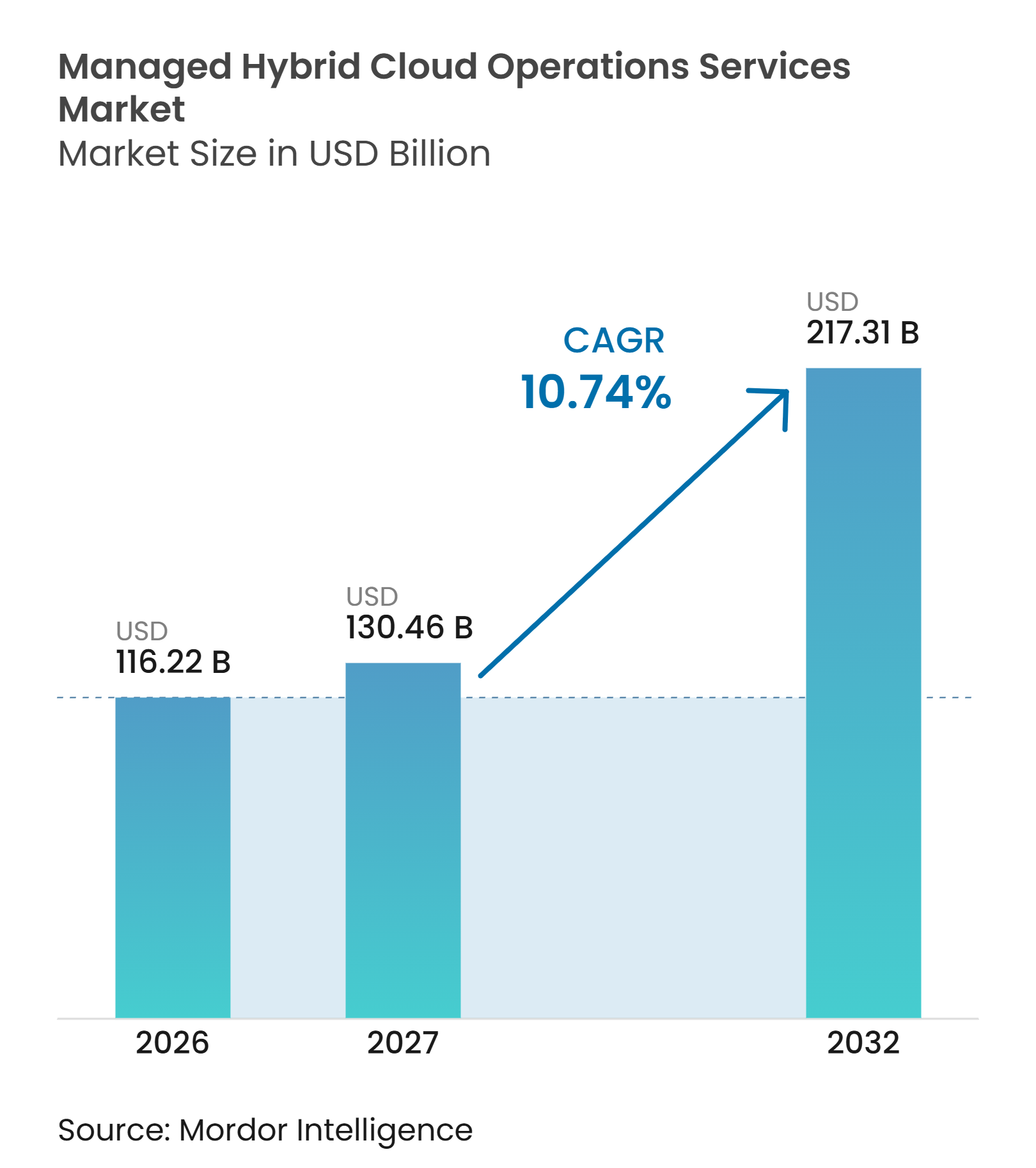
The managed hybrid cloud operations services market size is projected to expand from USD 116.22 billion in 2026 and USD 130.46 billion in 2027 to USD 217.31 billion by 2032, registering a CAGR of 10.74% between 2027 to 2032. The managed hybrid cloud operations services market is supported by enterprise estates that combine private data centers, public clouds, sovereign environments, and edge locations. This operating model increases the need for unified oversight across infrastructure, applications, security controls, and costs. The managed hybrid cloud operations services market is increasingly shaped by this need for coordinated oversight across technical and organizational boundaries. It also requires service teams to coordinate routine changes without disrupting workloads that have different location, performance, and governance needs. Providers are responding with integrated delivery models that combine daily operations with automation and compliance support. The managed hybrid cloud operations services market also benefits from demand that is tied to long-term operating requirements rather than a single cloud migration project. Customers can therefore evaluate providers on the durability of their delivery model as well as initial implementation capability. This favors service designs that link routine operations, governance, and continuous improvement over the full contract period. It can also support clearer responsibility when changes affect systems that run in several locations.
Key Report Takeaways
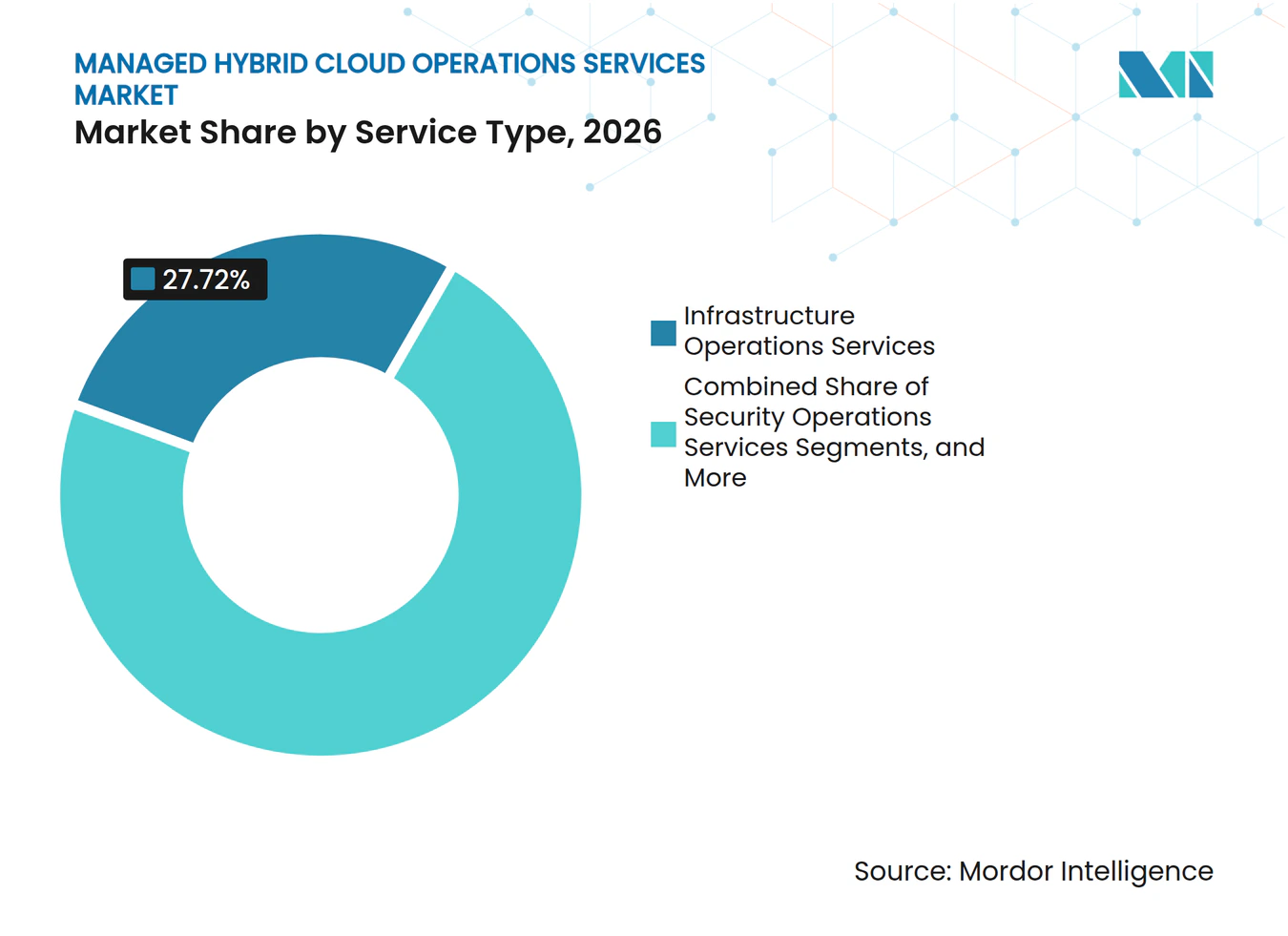
- By service type, infrastructure operations services held 27.72% of revenue in 2026, while FinOps and cloud cost management services are projected to expand at an 11.26% CAGR through 2032.
- By deployment model, public cloud integrated operations accounted for 30.76% of revenue in 2026, while edge and distributed cloud operations are projected to expand at an 11.33% CAGR through 2032.
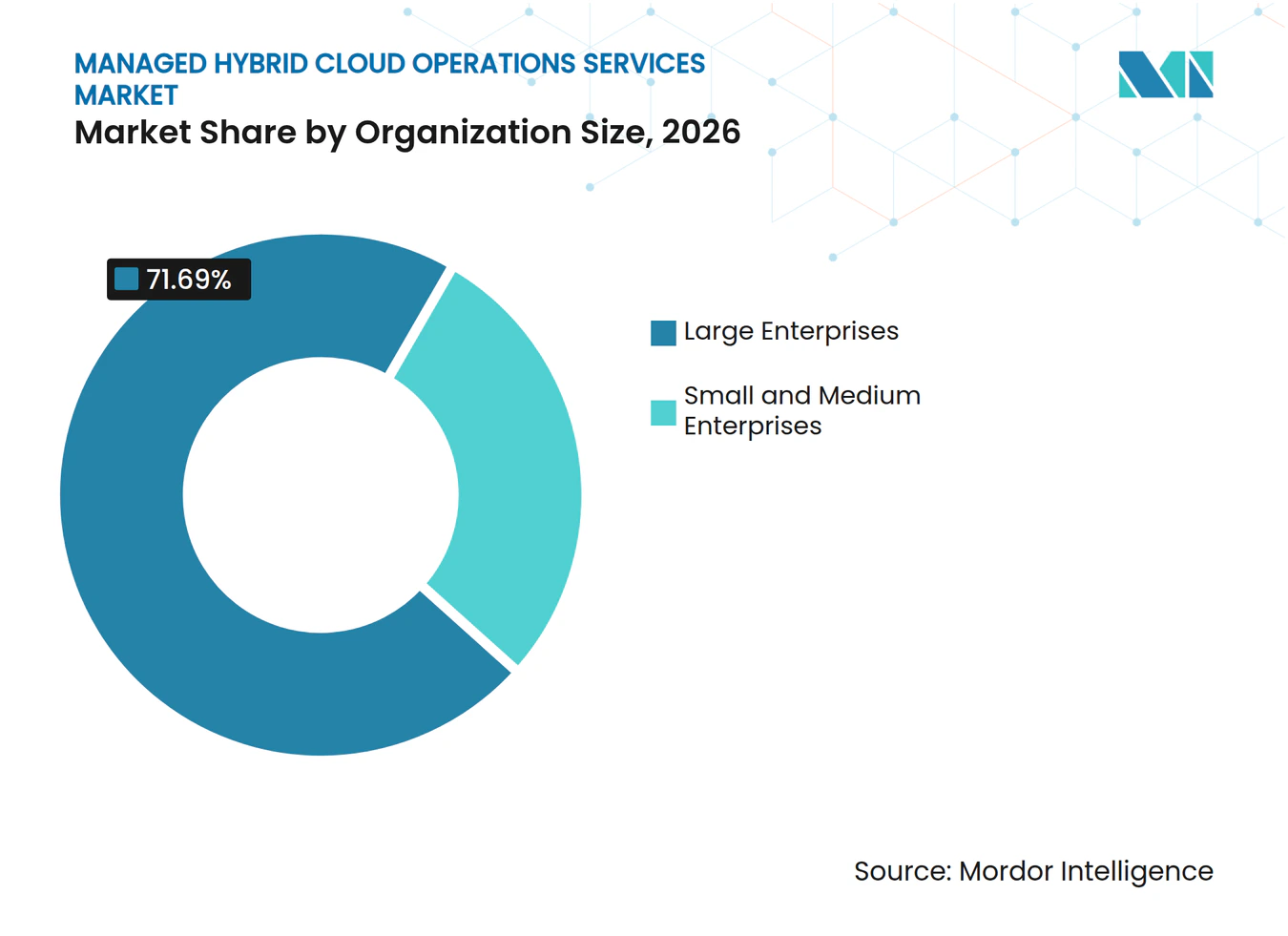
- By organization size, large enterprises held 71.69% of revenue in 2026, while small and medium enterprises are projected to expand at an 11.21% CAGR through 2032.
- By end-user industry, banking, financial services, and insurance accounted for 23.77% of revenue in 2026, while healthcare and life sciences are projected to expand at a 10.98% CAGR through 2032.
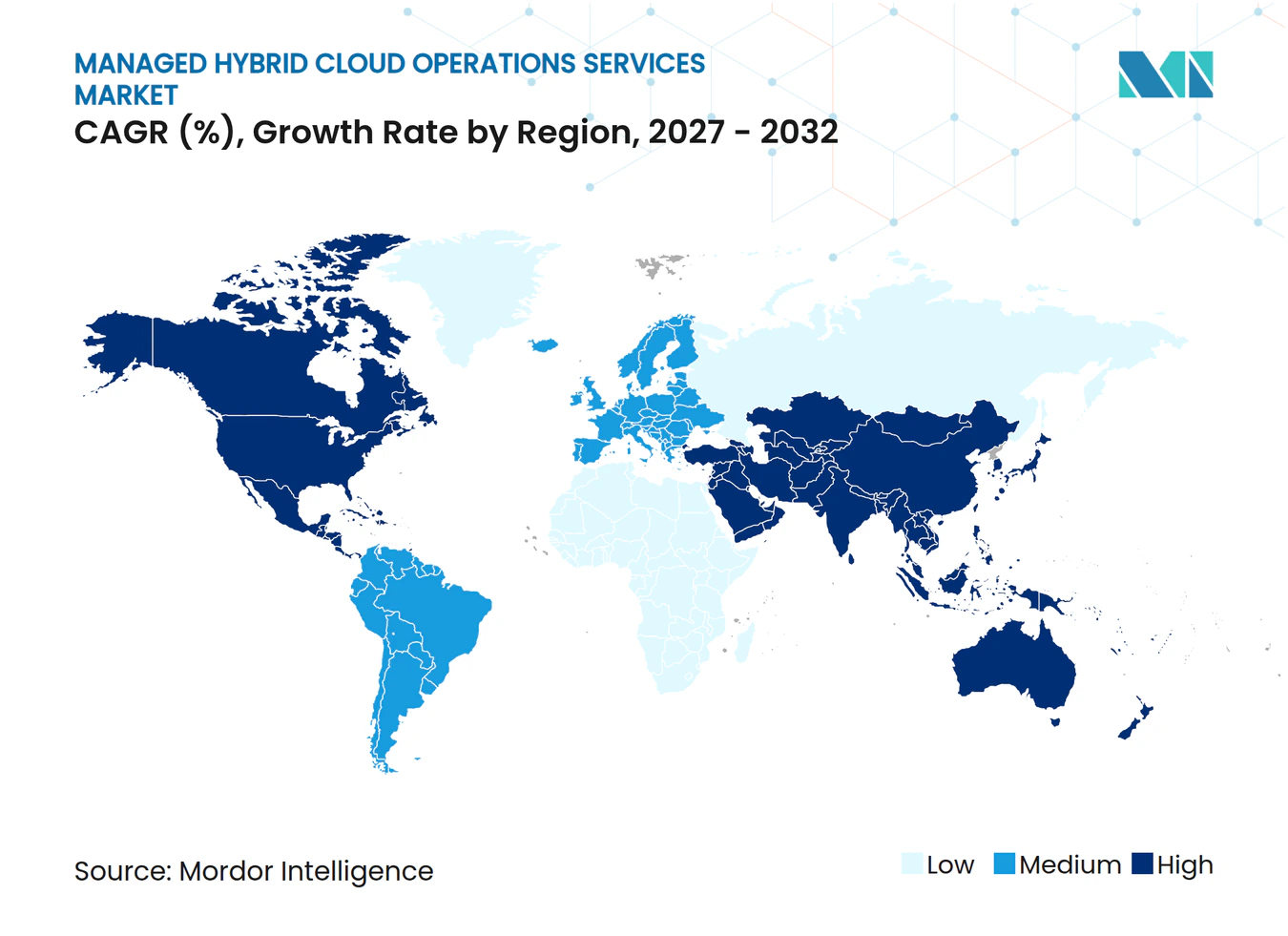
- By geography, North America held 41.99% of the managed hybrid cloud operations services market in 2026, while Asia-Pacific is projected to expand at an 11.66% CAGR through 2032.
Note: Market numbers in this report are based on Mordor Intelligence's proprietary estimation framework, which combines nine months of actuals with Q4 projections for base year 2026.
Global Managed Hybrid Cloud Operations Services Market Trends and Insights
Drivers Impact Analysis*
| Driver | (~) % Impact on CAGR Forecast | Geographic Relevance | Impact Timeline |
|---|---|---|---|
| Multi-Cloud and Hybrid Complexity | +2.8% | Global, concentrated in North America and Western Europe | Short term (≤ 2 years) |
| Cyber-Risk and Compliance Demand for Continuous Operations | +2.1% | Global, highest in North America, Europe, and regulated Asia-Pacific markets | Short term (≤ 2 years) |
| Cloud Skills Shortage and Specialized Operations Expertise | +1.9% | Global, acute in Europe and South America | Medium term (2-4 years) |
| AI Workload Operationalization Across Hybrid Estates | +1.6% | North America and Asia-Pacific, with expansion into Europe and the Middle East and Africa | Medium term (2-4 years) |
| FOCUS-Aligned Hybrid Cost Data and FinOps Governance | +1.0% | North America, with expansion across Europe and Asia-Pacific | Medium term (2-4 years) |
| Sovereign Cloud and Data-Residency Operating Requirements | +0.8% | Europe, the Middle East, India, and Southeast Asia | Long term (≥ 4 years) |
| Source: Mordor Intelligence | |||
Multi-Cloud and Hybrid Complexity Sustaining Managed Operations Demand
The managed hybrid cloud operations services market is shaped by enterprises that now treat multi-cloud use as an ongoing operating model. Tenable reported that 63% of organizations used more than 1 cloud provider, with an average of 2.7 environments, which increases the challenge of applying common controls across platforms. This issue requires careful communication during contract design and service transition.[1] Different application programming interfaces, identity tools, security policies, and monitoring systems create operational work that internal teams must coordinate every day. Providers can address this burden by standardizing access management, patching, incident response, and service reporting across on-premises and cloud resources. The value of this approach increases when customers must operate sensitive workloads in private environments while retaining public cloud capacity for flexible workloads. The managed hybrid cloud operations services market benefits when this coordination reduces duplicate operating processes across platforms. This supports contracts that cover continuous operations rather than temporary migration assistance, including planning, monitoring, remediation, and reporting under one accountable provider relationship. The service model can simplify governance when client teams need a single operating view. The managed hybrid cloud operations services market can benefit when providers reduce handoffs between infrastructure, security, and application teams.
Cyber-Risk and Compliance Demand Driving Continuous Operations Services
Cybersecurity requirements are becoming integral to managed operations contracts across the managed hybrid cloud operations services market. The Cloud Security Alliance stated that rapid provisioning in hybrid environments can move faster than change-management controls, which can create gaps that attackers may exploit.[2] Inconsistent controls and limited visibility can make it difficult to identify configuration changes across more than 1 environment. Managed service teams can bring together security posture monitoring, threat detection, remediation workflows, and audit evidence. This is especially relevant in banking, healthcare, and public-sector environments with formal reporting and resilience obligations. Service providers must connect technical monitoring with the evidence that risk and compliance teams expect to review. That connection can make security operations more useful to business leaders responsible for risk decisions. Continuous security coverage therefore becomes part of the core operating service rather than an optional add-on, especially where customers need evidence that controls are applied consistently. Clear evidence also helps customers assess whether their operating model meets internal governance expectations. This can make operational reporting an important part of renewal discussions.
Cloud Skills Shortage Creating Durable Managed Operations Demand
The managed hybrid cloud operations services market benefits from a persistent gap between required cloud skills and internal staffing capacity. The World Economic Forum reported that demand for digital skills is rising faster than education and training systems can meet it, particularly for emerging technologies.[3] Cloud operations requires staff who can manage infrastructure, security, data controls, automation, and application dependencies at the same time. Smaller teams often cannot recruit or retain this full range of expertise internally. Managed providers can spread specialized staff and tooling across several customer environments, which changes the cost and availability equation for clients. The need for dependable expertise can also support multi-year contracts when organizations rely on external teams for critical operations, service continuity, and knowledge of their particular systems. Service delivery also becomes more valuable when clients need consistent coverage outside their core business hours. Managed teams can provide repeatable processes for routine work as well as response during operational disruptions. This delivery model can reduce the disruption caused by turnover in scarce technical roles. It also allows customers to retain institutional knowledge through documented operating practices.
AI Workload Operationalization Reshaping Managed Services Scope
AI workloads are expanding the operational scope of the managed hybrid cloud operations services market. The managed hybrid cloud operations services market is also affected by the need to make new AI services fit established security and operations practices. IBM describes hybrid cloud management as a lifecycle challenge that spans models, applications, data pipelines, and related tools. Production deployments require reliable data access, controlled model updates, capacity planning, and clear service objectives for inference. Teams must also coordinate data access rules with infrastructure capacity so that production workloads remain reliable. Operational teams must balance performance needs against the controls that protect sensitive data and model inputs. These requirements are harder to meet when data is distributed across data centers, public clouds, and edge sites. IBM also identifies hybrid approaches as important where organizations need flexibility over placement and control of workloads. Providers that can operate model infrastructure alongside traditional applications may be better placed to support customers as AI moves from pilots into business processes and requires predictable day-to-day performance. The managed hybrid cloud operations services market can therefore extend beyond basic infrastructure monitoring as AI use becomes operational. This makes reliable integration between data, infrastructure, and application teams increasingly important.
Restraints Impact Analysis*
| Restraint | (~) % Impact on CAGR Forecast | Geographic Relevance | Impact Timeline |
|---|---|---|---|
| Hybrid Security Misconfiguration and Shared-Responsibility Gaps | -1.0% | Global, most material in North America and Europe regulated sectors | Short term (≤ 2 years) |
| Vendor Lock-In and Switching-Cost Concerns | -0.7% | Global, with high sensitivity among large enterprises in North America and Europe | Medium term (2-4 years) |
| AI Workload Power, Cooling, and Capacity Constraints | -0.5% | North America and Europe, with spillover to constrained Asia-Pacific data center markets | Medium term (2-4 years) |
| Fragmented Sovereignty Rules and Cross-Border Operating Friction | -0.4% | Europe, the Middle East and Africa, Southeast Asia, and India | Long term (≥ 4 years) |
| Source: Mordor Intelligence | |||
Hybrid Security Misconfiguration and Shared-Responsibility Gaps
Security misconfiguration creates demand for specialist support, but it can also increase the delivery burden for providers in the managed hybrid cloud operations services market. Tenable found that 82% of surveyed organizations operated hybrid environments and identified misconfiguration as a common cloud security challenge. Responsibility boundaries can differ between public cloud services, private infrastructure, and customer-managed applications. Providers must define those boundaries clearly before assuming responsibility for detection or remediation. Customers may also expect automated controls and audit-ready records across every environment. Those expectations can increase staffing, tooling, and liability requirements before a provider can deliver a service at scale. Clear operating boundaries can also reduce disagreement when systems are updated or responsibilities change. Careful service design is needed to avoid unclear obligations when incidents cross several platforms. That documentation can support resilience planning and more informed change decisions.
Vendor Lock-In and Switching-Cost Concerns
Customers may hesitate when operating workflows become closely tied to one provider's proprietary platform services. Monitoring tools, automation scripts, data pipelines, and access policies often need redesign when a customer changes platforms or suppliers. The risk is greater when operating knowledge is embedded in undocumented configurations and individual staff practices. This can make procurement teams favor services that support portability and documented transition processes. Microsoft outlines sovereignty implementation practices that include control over data, operations, and technical dependencies, showing why governance requirements can influence platform choices. Managed service providers must balance deep integration with a customer’s selected environment against the need to preserve practical exit options. This issue can slow decisions where enterprise buyers have experienced previous migration costs or need to meet strict resilience requirements. Providers that explain integration choices and exit processes can reduce this concern during procurement. Customers can then evaluate service quality without assuming that a long-term relationship eliminates practical choice. A documented transition plan can improve confidence without changing the customer’s chosen architecture.
*Our forecasts treat driver/restraint impacts as directional, not additive. The impact forecasts reflect baseline growth, mix effects, and variable interactions.
Segment Analysis
By Service Type: Infrastructure Operations Anchors Spending While FinOps Accelerates
Infrastructure operations services held 27.72% of the managed hybrid cloud operations services market share in 2026. The segment covers the daily management of compute, storage, networks, capacity, and related infrastructure across private and public environments. They also provide the operational foundation for security, application, and recovery services that depend on stable infrastructure. This work often involves coordination between network, storage, compute, and platform specialists who may use different management systems. These functions are foundational because nearly every hybrid deployment requires stable infrastructure before higher-level application or security services can perform effectively. Infrastructure teams also support the extension of public cloud platforms into customer sites, including deployments that keep selected workloads close to local systems. Security operations, application and platform operations, and backup and disaster recovery services complement the core infrastructure role. They are important for clients that need formal recovery objectives, reliable connectivity, or continuous oversight of complex workloads. Capacity planning and observability are also important because infrastructure problems can affect several business applications at once. Clear escalation paths help clients understand how incidents will be handled across shared environments.
FinOps and cloud cost management services are projected to expand at an 11.26% CAGR through 2032. The FinOps Foundation reported that 98% of practitioners managed AI spending in 2026, up from 63% in 2025, as organizations faced a wider range of cloud and AI cost decisions. This service area supports allocation, forecasting, usage visibility, and accountability across teams that share cloud resources. FOCUS can help organizations work toward more consistent cost and usage information across providers. This can help customers identify whether resource decisions are aligned with technical demand and business priorities. It can also help teams recognize cost changes before they become difficult to explain in budgeting cycles. The managed hybrid cloud operations services industry can use FinOps delivery to combine cost governance with operational oversight, rather than treating cost control as a separate task. The need is most evident when customers operate workloads across several billing models and cannot build a large internal specialist team. FinOps services can also give technology and finance leaders a shared view of responsibility for cloud use. The discipline can also improve conversations about budget ownership and technical efficiency.



By Deployment Model: Public Cloud Leads Share While Edge Registers Fastest Expansion
Public cloud integrated operations accounted for 30.76% of revenue in 2026. This position reflects the large installed base of workloads that enterprises run on hyperscale platforms and the operating services needed to support them. Providers can use this installed base to offer operating support that respects the customer’s existing platform commitments. Service relationships can become more durable when providers understand the applications and policies tied to those commitments. Marketplace purchasing and partner programs can also simplify the packaging of multi-year managed services. Hybrid cloud operations form a closely related category because many customers keep some sensitive, legacy, or latency-sensitive workloads outside the public cloud. On-premises and private cloud integrated operations remain relevant where organizations need direct control over data placement and local infrastructure. The managed hybrid cloud operations services market therefore spans several deployment patterns instead of requiring customers to choose a single architecture. This flexibility allows operations teams to align workload placement with performance, governance, and commercial requirements. It also permits gradual modernization of older systems without forcing a single migration deadline.
Edge and distributed cloud operations are projected to expand at an 11.33% CAGR through 2032. Edge deployments can support use cases where applications need local processing, including clinical workflows, computer-vision inspection, and fraud detection. These environments require a different operating approach because locations may have limited local technical staff and must connect reliably to central systems. Local conditions can make standardized deployment, maintenance, and incident processes more important than in centralized facilities. Providers must coordinate device, network, security, and software management across many sites. The fastest expansion in this category reflects the need for reliable distributed operations as organizations place more workloads closer to users and physical assets. Service providers must also design remote support processes that work when local sites have limited technical coverage. These needs can increase the value of standardized remote monitoring and response processes.
By Organization Size: Large Enterprises Drive Revenue While Small and Medium Enterprises Accelerate
Large enterprises held 71.69% of revenue in 2026, which gave this group the largest revenue position among organization categories. Their IT estates commonly span multiple clouds, many applications, legacy systems, business units, and countries. This combination creates a need for managed integration that is broader than basic infrastructure support. Large customers also tend to require formal service levels, observability, automated remediation, and reporting for senior technology and risk leaders. Long-term contracts are well suited to these requirements because providers can build familiarity with the client’s systems and operating policies. Such familiarity can improve change management when several teams must approve changes to shared technology services. These processes can reduce uncertainty when applications and infrastructure are updated in parallel. The segment remains important because the cost of disruption rises when critical processes rely on interconnected hybrid environments. Providers can create value by documenting dependencies that are difficult for internal teams to map across several platforms.
Small and medium enterprises are projected to expand at an 11.21% CAGR through 2032. Subscription-based service models can make advanced operational capabilities available without requiring customers to own a large technical team. This can help organizations shift infrastructure management from uneven capital purchases toward recurring operating costs. Smaller firms may also need support with security controls, data protection, and resilience expectations that have become more demanding. As their technology use expands, these firms can face the same control expectations as larger organizations without comparable internal resources. External service teams can help these clients adopt documented methods without requiring every capability to be built internally. The World Economic Forum has identified broad digital skill shortages, a condition that can be especially challenging for organizations with limited specialist staffing. Managed delivery gives these clients access to shared expertise, tools, and documented practices that would be difficult to sustain alone. Standardized operating procedures can help smaller organizations achieve more consistent delivery across routine activities. This can improve service consistency as smaller organizations add more cloud applications.

By End-User Industry: BFSI Holds Dominance While Healthcare Leads Growth
Banking, financial services, and insurance accounted for 23.77% of revenue in 2026. This segment operates core systems that often combine long-standing internal platforms with cloud-based analytics, customer services, and data tools. Operational continuity, auditability, data protection, and interoperability are central requirements for these environments. Managed providers can help clients coordinate controls across systems that were adopted at different times and run in different locations. This creates demand for service providers that understand both the business process and the technical dependencies behind it. This can be important where availability, auditability, and customer service are all affected by the same underlying systems. Rackspace Technology noted that hybrid cloud users in financial services reported strong operational efficiency outcomes, which supports the role of hybrid architecture in the sector. Information technology and telecommunications also remains a significant end-user area, while manufacturing, government, retail, and automotive organizations adopt services for their own distributed operations. These industries need operating teams that can connect business requirements with infrastructure and application support. Their requirements can vary by location, which reinforces the need for adaptable delivery practices.
Healthcare and life sciences are projected to expand at a 10.98% CAGR through 2032. Healthcare organizations frequently need to keep sensitive data under defined controls while using cloud resources for analytics, applications, and service delivery. This makes hybrid operations relevant to clinical, administrative, and research workloads that cannot all follow the same deployment model. Providers can support security, availability, backup, and compliance workflows across these environments. The combination of AI-enabled clinical uses and privacy requirements can increase the need for teams that understand both operational delivery and regulated data handling. Providers must align operating practices with the reliability needs of clinicians, researchers, and administrative teams. Providers may need to work closely with internal clinical and privacy groups when handling sensitive operational changes. The managed hybrid cloud operations services market can therefore find opportunities where healthcare organizations need scalable technology without giving up governance over sensitive information. This makes managed operations relevant where organizations must improve access to computing resources while protecting patient and research data. Operational teams must also coordinate changes carefully when applications affect clinical or laboratory workflows.
Geography Analysis
North America held 41.99% of the managed hybrid cloud operations services market share in 2026. The region combines a large enterprise technology base with major public cloud providers and extensive partner networks. Banking, healthcare, and government customers have sustained demand for outsourced operations with documented controls. The United States remains the leading country contributor because organizations are modernizing complex estates while retaining critical legacy systems. Federal cloud requirements create continuing demand for providers that can support controlled deployments and clear operating records. Organizations in the region may also choose managed operations to address the scale of long-running modernization programs. This can favor providers that combine technical delivery with strong program management and security practices. Canada also presents demand for services that support local data residency and regional cloud connections. Providers also benefit from established alliances that can simplify the deployment of managed services across complex client estates. This capability can be significant where national and sector-specific requirements overlap.
Europe depends on hybrid operations to manage demanding requirements for data protection, resilience, and supply-chain oversight. Organizations need ongoing support to document controls, respond to incidents, and manage local operating requirements across several environments. This can make coordinated monitoring and documented service processes more valuable than isolated support tools. Providers that can integrate local infrastructure with cloud services may be better aligned with the needs of established enterprises. Germany is important because industrial, financial, and public-sector users often maintain a substantial base of internal infrastructure. Providers can differentiate through local delivery capacity, security practices, and support for client policies across borders. These requirements can raise the operational threshold for market participation and make trusted delivery relationships important. Clients can favor providers that understand both technical controls and local expectations for service accountability. Local experience can therefore be as important as global scale in selected accounts.
Asia-Pacific is projected to expand at an 11.66% CAGR through 2032. The managed hybrid cloud operations services market size in the region is supported by modernization programs, AI deployment, and data-localization requirements. China, India, Japan, and Southeast Asian countries have different technology and regulatory settings, which increases the value of locally informed delivery models. AI applications also require dependable infrastructure, skilled operations teams, and disciplined data controls. Regional providers can differentiate by helping clients translate these requirements into everyday operational routines. Local knowledge can also help service teams plan changes around national requirements and customer operating practices. The market relies on skilled operations teams, and disciplined data controls across their lifecycle. Sovereign cloud investment in the Middle East and Africa creates related demand where national programs require local processing for critical workloads. Providers with regional partnerships can address these varied needs while maintaining common service standards. The managed hybrid cloud operations services market can gain from service models that accommodate country-level needs without fragmenting delivery. This balance can help providers serve multinational customers with diverse local obligations.
Competitive Landscape
Market Concentration
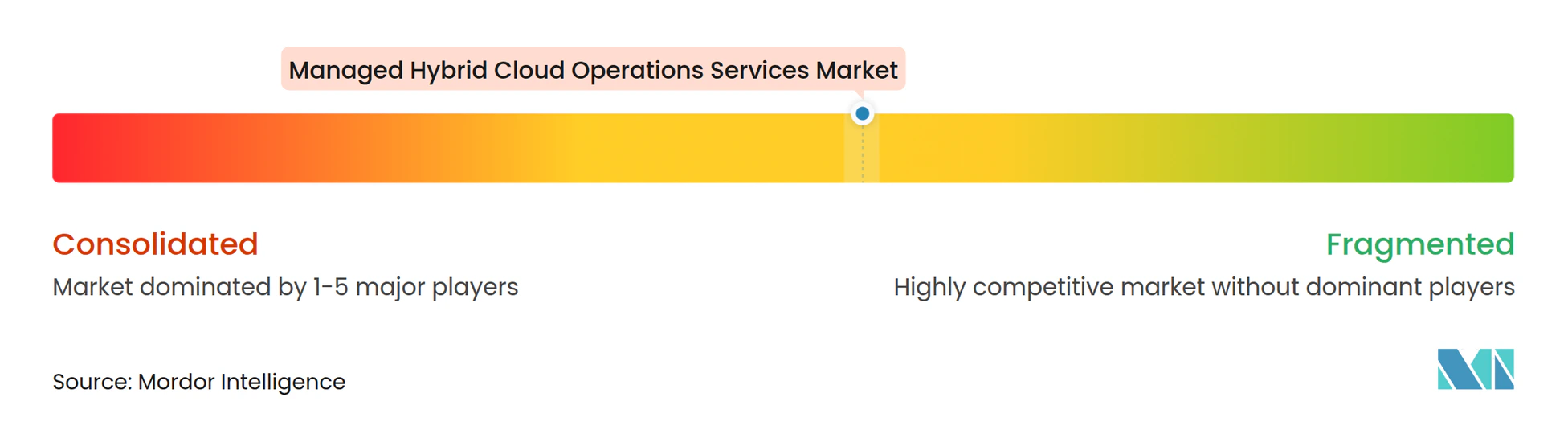
The managed hybrid cloud operations services market has moderate concentration among leading providers and a broad group of regional competitors. Amazon Web Services, Microsoft, and Google Cloud shape the platform environment and work with integrators that deliver enterprise operations services. IBM, Accenture, Kyndryl, TCS, Infosys, HCLTech, Capgemini, Wipro, Cognizant, and NTT DATA compete through expertise, delivery scale, security capabilities, and automation tools. Mid-tier providers such as Rackspace Technology, DXC Technology, and Fujitsu hold positions in selected customer groups and service areas. Their specialized relationships can be valuable where customers require continuity with established applications and infrastructure. These providers can compete where knowledge of a client’s environment is more valuable than standardized global scale. Clients assess compliance support, operating maturity, and the ability to manage complex existing environments alongside technical capability. The managed hybrid cloud operations services market remains competitive because many customers maintain more than 1 supplier relationship. This makes transparent coordination between platform vendors and operations providers important.
AI-enabled operations and cost governance are central areas of competitive activity. IBM and Google Cloud announced a strategic partnership in June 2026 that combined IBM Consulting Advantage with the Gemini Enterprise Agent Platform. Kyndryl expanded its Amazon Web Services alliance in February 2026 after achieving competencies in Mainframe Modernization, AI, and Digital Sovereignty. Accenture and Google Cloud launched the Accenture Gemini Enterprise Business Group in September 2026 to scale Gemini Enterprise outcomes across enterprise environments. These actions position AI delivery as part of managed operations rather than a separate advisory offer. This approach links modernization programs with the practical need to operate the resulting systems after deployment. It also raises the value of teams that understand both new AI tools and established enterprise systems.
Opportunities include managed FinOps services for mid-market customers, AI operations for regulated inference-heavy workloads, and sovereign cloud operations in developing regions. The FinOps Foundation’s 2026 findings show why AI cost accountability is becoming a wider operations concern. Cost visibility can also support practical discussions about which workloads are appropriate for each environment. This can link financial accountability with capacity planning, application performance, and resource governance. Providers may also differentiate by supporting portability, transparent service boundaries, and transition planning for clients concerned about lock-in. Compliance obligations can increase delivery costs for small providers that must support several jurisdictions. Established governance processes and regional infrastructure relationships can favor larger providers in these settings. The managed hybrid cloud operations services market can reward firms that offer consistent controls across regions while allowing practical local adaptation. Firms that maintain this balance can compete for contracts that span sovereign, private, and public environments.
Managed Hybrid Cloud Operations Services Industry Leaders
-
Microsoft Corporation
-
Amazon Web Services, Inc.
-
International Business Machines Corporation
-
Accenture plc
-
Kyndryl, Inc.
- *Disclaimer: Major Players sorted in no particular order
Recent Industry Developments
- September 2026: Accenture and Google Cloud launched the Accenture Gemini Enterprise Business Group, a global program dedicated to scaling Gemini Enterprise agentic AI outcomes across enterprise hybrid cloud environments, formalizing AI-powered managed operations as a distinct business line and signaling deep integration of cloud operations with AI delivery at scale.
- July 2026: Kyndryl expanded its sovereignty solutioning capabilities through a collaboration with Microsoft, combining Kyndryl Sovereignty Solutioning with Microsoft Sovereign Cloud to help organizations design and operate hybrid cloud architectures aligned with GDPR, DORA, and NIS2 data-residency requirements, targeting government and regulated-industry customers requiring workloads within national boundaries.
- June 2026: IBM and Google Cloud announced a strategic partnership for AI-powered hybrid cloud modernization, launching a new global Google Cloud Practice supported by thousands of certified consultants and describing the collaboration as a multi-billion-dollar managed services opportunity combining IBM Consulting Advantage with Google Cloud's Gemini Enterprise Agent Platform.
- March 2026: Kyndryl made its Cloud Uplift service available in Microsoft Canadian data center regions, enabling Canadian enterprises to migrate mission-critical IBM Power workloads to Microsoft Azure while maintaining PIPEDA-compliant Canadian data residency, with Canada becoming the 14th Microsoft data center region where the service operates.
Global Managed Hybrid Cloud Operations Services Market Report Scope
The Managed Hybrid Cloud Operations Services Market encompasses outsourced management, monitoring, optimization, security, and maintenance of infrastructure, networks, applications, and cloud environments across on-premises, private, public, hybrid, and distributed deployments globally. The market is Segmented by Service Type (Infrastructure Operations Services, Network and Connectivity Operations Services, Security Operations Services, Application and Platform Operations Services, Backup and Disaster Recovery Operations Services, FinOps and Cloud Cost Management Services, and Other Service Types), Deployment Model (On-Premises and Private Cloud Integrated Operations, Public Cloud Integrated Operations, Hybrid Cloud Operations, and Edge and Distributed Cloud Operations), Organization Size (Large Enterprises, and Small and Medium Enterprises), End-User Industry (Banking, Financial Services, and Insurance, Information Technology and Telecommunications, Healthcare and Life Sciences, Manufacturing and Automotive, Government and Public Sector, Retail and Consumer Goods, and Other End-User Industries), and Geography (North America, South America, Europe, Asia-Pacific, and Middle East and Africa). The Market Forecasts are Provided in Terms of Value (USD).
| Infrastructure Operations Services |
| Network and Connectivity Operations Services |
| Security Operations Services |
| Application and Platform Operations Services |
| Backup and Disaster Recovery Operations Services |
| FinOps and Cloud Cost Management Services |
| Other Sevice Types |
| On-Premises and Private Cloud Integrated Operations |
| Public Cloud Integrated Operations |
| Hybrid Cloud Operations |
| Edge and Distributed Cloud Operations |
| Large Enterprises |
| Small and Medium Enterprises |
| Banking, Financial Services, and Insurance |
| Information Technology and Telecommunications |
| Healthcare and Life Sciences |
| Manufacturing and Automotive |
| Government and Public Sector |
| Retail and Consumer Goods |
| Other End-User Industries |
| North America | United States |
| Canada | |
| Mexico | |
| South America | Brazil |
| Argentina | |
| Rest of South America | |
| Europe | United Kingdom |
| Germany | |
| France | |
| Italy | |
| Spain | |
| Russia | |
| Rest of Europe | |
| Asia-Pacific | China |
| India | |
| Japan | |
| South Korea | |
| Australia | |
| Southeast Asia | |
| Rest of Asia-Pacific | |
| Middle East and Africa | Saudi Arabia |
| United Arab Emirates | |
| South Africa | |
| Egypt | |
| Rest of Middle East and Africa |
| By Service Type | Infrastructure Operations Services | |
| Network and Connectivity Operations Services | ||
| Security Operations Services | ||
| Application and Platform Operations Services | ||
| Backup and Disaster Recovery Operations Services | ||
| FinOps and Cloud Cost Management Services | ||
| Other Sevice Types | ||
| By Deployment Model | On-Premises and Private Cloud Integrated Operations | |
| Public Cloud Integrated Operations | ||
| Hybrid Cloud Operations | ||
| Edge and Distributed Cloud Operations | ||
| By Organization Size | Large Enterprises | |
| Small and Medium Enterprises | ||
| By End-User Industry | Banking, Financial Services, and Insurance | |
| Information Technology and Telecommunications | ||
| Healthcare and Life Sciences | ||
| Manufacturing and Automotive | ||
| Government and Public Sector | ||
| Retail and Consumer Goods | ||
| Other End-User Industries | ||
| By Geography | North America | United States |
| Canada | ||
| Mexico | ||
| South America | Brazil | |
| Argentina | ||
| Rest of South America | ||
| Europe | United Kingdom | |
| Germany | ||
| France | ||
| Italy | ||
| Spain | ||
| Russia | ||
| Rest of Europe | ||
| Asia-Pacific | China | |
| India | ||
| Japan | ||
| South Korea | ||
| Australia | ||
| Southeast Asia | ||
| Rest of Asia-Pacific | ||
| Middle East and Africa | Saudi Arabia | |
| United Arab Emirates | ||
| South Africa | ||
| Egypt | ||
| Rest of Middle East and Africa | ||
Key Questions Answered in the Report
What is the size of managed hybrid cloud operations services?
The category is projected to reach USD 217.31 billion by 2032, from USD 130.46 billion in 2027, at a 10.74% CAGR.
Which service type leads managed hybrid cloud operations services?
Infrastructure operations services led with a 27.72% revenue share in 2026, reflecting the essential role of compute, storage, and network management.
Which deployment model is expanding fastest?
Edge and distributed cloud operations are projected to expand at an 11.33% CAGR through 2032 as organizations operate more workloads across distributed locations.
Which organizations are adopting managed hybrid cloud operations services most rapidly?
Small and medium enterprises are projected to expand at an 11.21% CAGR through 2032 as subscription models provide access to specialist operational expertise.
Which end-user segment has the highest projected expansion?
Healthcare and life sciences are projected to expand at a 10.98% CAGR through 2032 due to the need to support sensitive data, applications, and regulatory obligations.
Which region is expected to expand most rapidly?
Asia-Pacific is projected to expand at an 11.66% CAGR through 2032, supported by cloud modernization, AI deployment, and data-localization requirements.