
Hybrid Cloud AI Workload Orchestration Market Size and Share
Market Overview
| Study Period | 2020 - 2031 |
|---|---|
| Market Size (2026) | USD 7.56 Billion |
| Market Size (2031) | USD 16.72 Billion |
| Growth Rate (2026 - 2031) | 17.21 % |
| Fastest Growing Market | Asia-Pacific |
| Largest Market | North America |
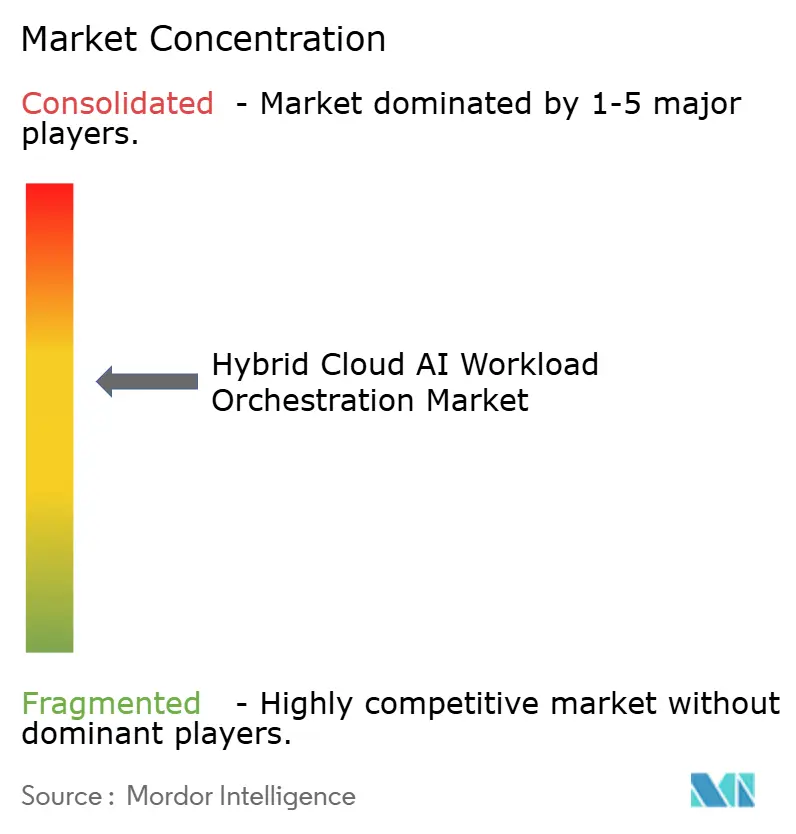
| Market Concentration | Medium |
Major Players *Disclaimer: Major Players sorted in no particular order Image © Mordor Intelligence. Reuse requires attribution under CC BY 4.0. | |
Hybrid Cloud AI Workload Orchestration Market Analysis by Mordor Intelligence
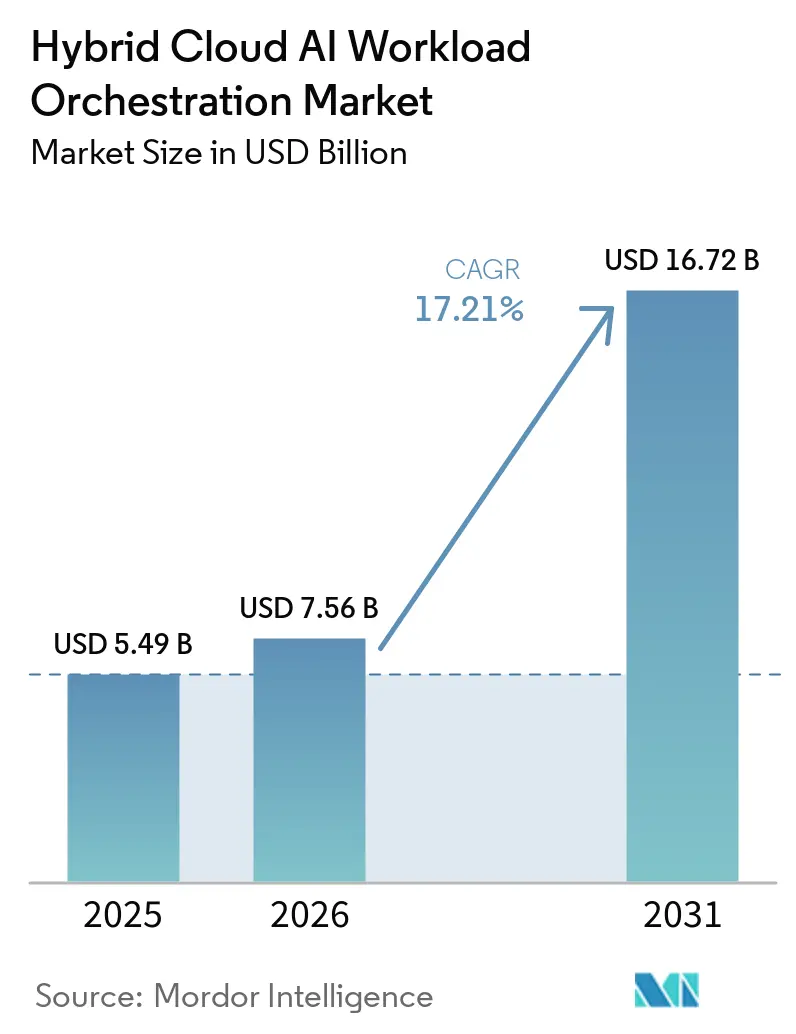
The Hybrid cloud AI workload orchestration market size is expected to increase from USD 5.49 billion in 2025 to USD 7.56 billion in 2026 and reach USD 16.72 billion by 2031, expanding at a CAGR of 17.21% over 2026-2031. Production-scale large language model workloads require scheduling across cloud and on-premises environments, where compute availability, data residency, and governance needs often differ. Enterprises now operate across both deployment models, making a unified control layer a strategic requirement rather than a supporting tool. Expanding GPU infrastructure raises the need for software that can coordinate workloads across varied accelerator fleets and deployment locations. Compliance requirements and infrastructure spending reinforce each other in regulated sectors, where policy enforcement and audit trails affect platform selection. The Hybrid cloud AI workload orchestration market also reflects a split between full-stack providers that bundle orchestration into managed services and specialized vendors that compete through broader hardware support, governance features, and deployment flexibility.
Key Report Takeaways
- By component, software held 62.72% of the Hybrid cloud AI workload orchestration market share in 2025, while services are projected to expand at a CAGR of 17.61% through 2031.
- By deployment environment, cloud accounted for 57.28% of revenue in 2025, while on-premise deployments are projected to expand at a CAGR of 17.59% through 2031.
- By application, GPU scheduling and allocation held 33.18% of revenue in 2025, while governance, multi-tenancy, and policy enforcement are projected to expand at a CAGR of 18.16% through 2031.
- By end user, cloud service providers and GPU-as-a-Service providers accounted for 31.61% of revenue in 2025, while healthcare and life sciences are projected to expand at a CAGR of 18.57% through 2031.
- By organization size, large enterprises held 64.37% of revenue in 2025, while small and medium enterprises are projected to expand at a CAGR of 17.54% through 2031.
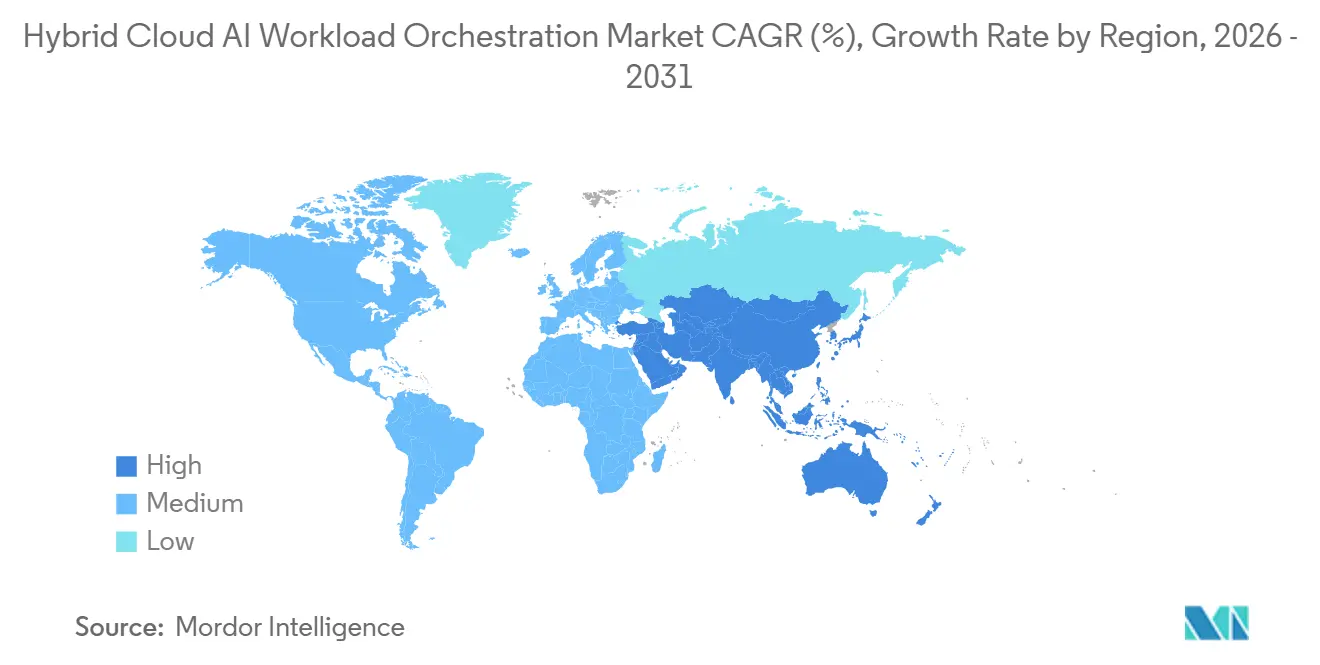
- By geography, North America held 38.92% of revenue in 2025, while Asia-Pacific is projected to expand at a CAGR of 18.23% through 2031.
Note: Market size and forecast figures in this report are generated using Mordor Intelligence’s proprietary estimation framework, updated with the latest available data and insights as of January 2026.
Market Trends and Insights
Drivers Impact Analysis of Hybrid Cloud AI Workload Orchestration Market*
| Driver | (~) % Impact on CAGR Forecast | Geographic Relevance | Impact Timeline |
|---|---|---|---|
| Accelerating LLM Training and Inference Deployment | +5.0% | Global | Short term (≤ 2 years) |
| GPU Utilization and Compute Cost Optimization | +3.8% | Global, with highest intensity in North America and Europe | Short term (≤ 2 years) |
| Hybrid Data Residency and Sovereign AI Requirements | +3.2% | Europe, Asia-Pacific core, spill-over to Middle East | Medium term (2-4 years) |
| Distributed AI Scheduling Across Heterogeneous Accelerators | +2.0% | North America and Asia-Pacific core | Medium term (2-4 years) |
| Agentic AIOps and Policy-Driven Automation Adoption | +1.6% | Global, led by North America and Western Europe | Medium term (2-4 years) |
| Energy-Aware Scheduling and Sustainable AI Infrastructure | +0.9% | Europe, North America, Asia-Pacific | Long term (≥ 4 years) |
| Source: Mordor Intelligence | |||
Accelerating LLM Training and Inference Deployment
Large language model training and inference are changing the operating requirements for hybrid AI infrastructure because production systems are no longer a single model running on a fixed set of servers, but a coordinated sequence of compute, storage, and networking tasks. Production systems must manage prefill nodes, decode nodes, and KV-cache tiers across private and public environments, often with different capacity conditions, performance requirements, and data controls. Static Kubernetes configurations cannot manage these stages efficiently without a dedicated orchestration layer that makes real-time decisions across resources and reflects the actual state of the underlying infrastructure. AWS introduced disaggregated inference capabilities for Amazon SageMaker HyperPod that leverage NVIDIA Dynamo, vLLM, and high-bandwidth KV cache movement across multi-node clusters.[1] Google Cloud reported that Managed Lustre with GKE reduced GPU-hour requirements for Llama-3.3-70B inference by nearly 60% when KV caches were moved to a high-performance parallel file system. These multi-stage architectures broaden the role of the Hybrid cloud AI workload orchestration market from conventional job scheduling to dynamic routing of resource-intensive workload components.
GPU Utilization and Compute Cost Optimization Imperative
GPU utilization has become a central financial concern for organizations operating AI infrastructure at scale because unused accelerator capacity constrains new workloads while generating high fixed costs, whether the hardware is owned locally or consumed through a cloud commitment. Organizations with unused capacity face higher infrastructure costs, slower access to compute, less flexibility to meet changing model requirements, and more difficult internal discussions over where scarce GPU capacity should be allocated. Fujitsu reported that more than 75% of organizations had GPU utilization below 70% at peak load in 2024. Red Hat described an IBM Vela cluster deployment in which Kueue helped improve GPU utilization from a baseline below 30% to nearly 90% under active load. Microsoft stated that NVIDIA Run:ai supports dynamic GPU fractioning and quota sharing for Azure Kubernetes Service deployments. The Hybrid cloud AI workload orchestration market benefits because scheduling platforms are assessed as tools for recovering capacity, controlling spend, and creating fairer access to scarce compute across internal teams and tenants.
Hybrid Data Residency and Sovereign AI Requirements
Data residency rules are making hybrid architectures necessary for governments and regulated enterprises that cannot treat processing location as a secondary infrastructure choice, especially where controls apply to both information and operational records. These organizations need clear visibility into where training data, inference pipelines, model artifacts, and audit records are processed, stored, and accessed, as well as the ability to demonstrate that these controls were applied. The EU AI Act became fully applicable to high-risk AI systems on August 2, 2026, with documentation, oversight, and compliance responsibilities that affect AI deployment practices. IBM introduced Sovereign Core in 2026 to support regional operational independence, governance, and data-residency controls for regulated deployments. The proposed Cloud and AI Development Act created a framework for assessing cloud services against sovereignty, residency, and auditability criteria. These conditions support the Hybrid cloud AI workload orchestration market because platforms can enforce location-specific policies while still using cloud resources for time-sensitive or peak-compute requirements.
Distributed AI Scheduling Across Heterogeneous Accelerators
Enterprise AI estates increasingly include NVIDIA GPUs, AMD Instinct GPUs, AWS Trainium and Inferentia, Google TPUs, and Intel Gaudi accelerators, often acquired at different times for different workload types and business priorities. Each hardware family uses specialized interfaces and communication libraries that favor homogeneous device pools and can complicate common operating practices, resource pooling, and staff training. This creates technical friction when organizations attempt to schedule a distributed workload across more than 1 accelerator architecture, even when varied hardware could improve supply resilience and make use of installed assets. Nutanix added support for AMD GPU-accelerated compute servers in 2026, extending its coverage to AMD Instinct GPUs and Intel AMX acceleration. The development demonstrates why enterprises seek orchestration tools to coordinate diverse hardware while preserving workload performance, policy controls, and operational visibility. The Hybrid cloud AI workload orchestration market is supported by procurement strategies that retain installed infrastructure and reduce dependence on a single accelerator supplier.
Restraints Impact Analysis of Hybrid Cloud AI Workload Orchestration Market*
| Restraint | (~) Impact on CAGR Forecast | Geographic Relevance | Impact Timeline |
|---|---|---|---|
| Heterogeneous Hardware and Cloud API Interoperability Gaps | -2.4% | Global | Short term (≤ 2 years) |
| Shortage of AI Infrastructure Orchestration Specialists | -1.9% | Global, with acute impact in Asia-Pacific and Middle East and Africa | Medium term (2-4 years) |
| Multi-Tenant GPU Security and Isolation Complexity | -1.3% | North America and Europe | Medium term (2-4 years) |
| Migration Friction Across Hybrid Control Planes | -0.8% | Global | Long term (≥ 4 years) |
| Source: Mordor Intelligence | |||
Heterogeneous Hardware and Cloud API Interoperability Gaps
The lack of a shared API layer among GPU vendors, cloud schedulers, and Kubernetes tools increases the cost and complexity of deploying a hybrid AI environment. Multi-cloud AI teams may need distinct integrations for AWS Elastic Fabric Adapter, Google Kubernetes Engine inference tools, and Azure Kubernetes Service with Run:ai, even when the business objective is a single, consistent operating model. These integrations do not provide a common workload abstraction that automatically evaluates availability, cost, carbon intensity, and the specific policy conditions of every possible environment. Vendor-specific communication libraries further complicate distributed use of different accelerator types, because moving data or coordinating jobs across hardware families can require custom implementation work. The constraint can delay adoption of multi-vendor GPU pools, even when those pools are attractive for supply resilience, purchasing flexibility, and cost control. The Hybrid cloud AI workload orchestration market faces added pressure because smaller vendors may lack the engineering resources to maintain integrations across clouds, Kubernetes distributions, accelerator platforms, and shifting provider interfaces.
Shortage of AI Infrastructure Orchestration Specialists
Hybrid AI deployments require expertise in distributed systems, GPU architecture, cloud networking, Kubernetes-based MLOps, security controls, and the operational processes that connect these elements. This combination remains difficult for organizations to recruit and retain, particularly when teams need practical experience with production infrastructure rather than general AI development alone. The OECD’s 2026 D4SME Survey found that time constraints, maintenance costs, and skills gaps hinder AI implementation among small and medium enterprises.[2] The shortage is especially relevant for staff who can configure GPU partitioning, tune KV-cache settings, troubleshoot distributed jobs, and enforce policies across hybrid control planes. Organizations can experience longer deployment periods, higher consulting costs, and a greater preference for managed offerings when these capabilities are unavailable internally. This staffing gap supports managed services but can slow adoption of self-hosted solutions across the Hybrid cloud AI workload orchestration market, especially in environments where secure, multi-environment configurations must be maintained over time.
*Our forecasts treat driver/restraint impacts as directional, not additive. The impact forecasts reflect baseline growth, mix effects, and variable interactions.
Hybrid Cloud AI Workload Orchestration Market Segment Analysis
By Component:
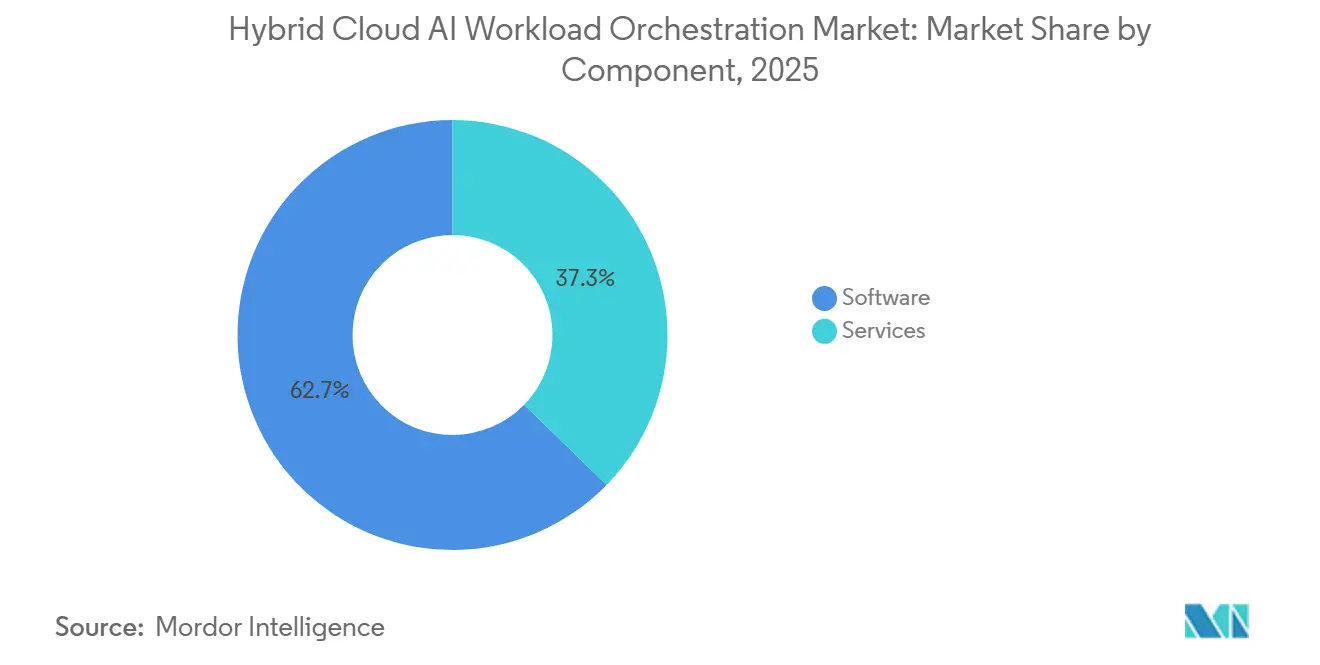
Software Holds the Core Revenue PositionSoftware accounted for 62.72% of revenue in 2025, reflecting the value customers assign to governance, scheduling, and policy enforcement layers above the physical compute environment. Within the Hybrid cloud AI workload orchestration market, these layers bring together functions that would otherwise reside in separate products, including workload admission, accelerator allocation, identity controls, audit records, and the rules governing how tenants use shared infrastructure across cloud and local systems. This integration can limit handoffs between tools and help administrators apply common operating rules to workloads that would otherwise be managed separately. Their recurring license and subscription model is less directly tied to hardware purchasing cycles, which supports a more durable revenue base for platform vendors. Red Hat launched Red Hat AI Enterprise in February 2026 as a unified platform extending from Linux and Kubernetes to governed AI models, agents, and applications.[3] The release shows how providers are consolidating formerly separate infrastructure products into broader agreements, simplifying procurement and increasing software revenue per customer.
Services are projected to expand at a CAGR of 17.61% between 2026 and 2031, driven by implementation and operational requirements that many internal IT teams cannot initially manage on their own. A deployment may require an assessment of data locations, workload profiles, cluster configurations, cloud contracts, access rules, security controls, and ongoing performance requirements before a unified control plane can be put into production. Professional services can establish the architecture and integrate these operating elements, while managed services can maintain performance, cost visibility, and operational discipline after launch. Organizations often start with service-heavy projects while they build internal knowledge, then shift a greater share of spending toward software licenses and platform subscriptions as their teams take on more operational work. The Hybrid cloud AI workload orchestration industry, therefore, combines software pricing power with the continuing demand for external expertise to help customers configure, operate, and improve their environments.
By Deployment Environment:
Cloud Leads While On-Premise Use AcceleratesCloud held 57.28% of revenue in 2025, supported by elastic GPU capacity, broad regional availability, and managed infrastructure services that reduce the need for enterprises to own every part of their AI environment. The Hybrid cloud AI workload orchestration market continues to rely on cloud environments for workloads that require no strict data-residency constraints, temporary capacity needs, and access to large GPU fleets without a major upfront hardware investment. Cloud use can also reduce the time required to scale compute when a project moves from a small pilot to a larger production workload. Hyperscalers also provide managed services that can reduce routine management requirements for customers lacking deep internal expertise in cluster administration or distributed infrastructure. Roche deployed more than 3,500 NVIDIA Blackwell GPUs across hybrid cloud and on-premises environments in the United States and Europe. The deployment illustrates that advanced users do not necessarily choose between cloud and private infrastructure; instead, they may combine them so that workloads can use the location and capacity model that best fits their data, performance, and compliance needs.
On-premises deployments are projected to expand at a CAGR of 17.59% from 2026 to 2031 as regulated users retain greater control over sensitive workloads and remain subject to jurisdictional obligations. Training data, inference pipelines, and audit records may need to remain in a defined location, even when cloud resources are available within the same broader region. Dedicated local infrastructure can also enable buyers to diversify their supply across NVIDIA, AMD, and Intel hardware while retaining control over data preparation, fine-tuning, and sensitive inference tasks. HPE added support for NVIDIA Mission Control software, Run: ai, and NVIDIA Dynamo within its AI Factory portfolio in 2026. The Hybrid cloud AI workload orchestration market is shaped by this paired model, where private control supports residency and governance needs while cloud elasticity addresses peak compute requirements in the same operating estate.
By Application:
GPU Scheduling and Allocation Leads Current DemandGPU scheduling and allocation accounted for 33.18% of the Hybrid cloud AI workload orchestration market in 2025, underscoring that the earliest decision in an AI workload is often the choice of access to scarce compute. In the Hybrid cloud AI workload orchestration market, the segment determines which job receives accelerator resources, when a job can begin, how much capacity it receives, and whether that capacity is available in the location where the workload can legally and operationally run. This makes allocation rules important for both technical performance and the practical availability of compute for business teams. The decision affects enterprise cost control because idle or poorly allocated GPUs are expensive, and it affects cloud providers because GPU capacity is a revenue-generating resource. Workload placement and migration determine where applications execute across environments, while cluster management and autoscaling alter available capacity as usage changes. Monitoring, observability, and cost optimization provide the operational feedback needed to refine scheduling choices over time and help administrators understand how resources are being consumed.
Governance, multi-tenancy, and policy enforcement are projected to grow at a 18.16% CAGR through 2031 as sovereign AI mandates, multi-vendor clusters, and agentic systems introduce stricter execution boundaries. Organizations increasingly need to define which teams, models, workloads, or agents can use a resource, what data they can access, and what evidence must be retained for later review. These controls are especially important when an environment serves several business units, customers, or regulated workloads on shared infrastructure. ClearML introduced its Platform Management Center in 2026 to give administrators per-tenant resource visibility, cost information, and workload governance. IBM presented watsonx Orchestrate as an agentic control plane that applies policy enforcement across different agent sources, showing how suppliers are embedding governance directly within operational orchestration
By End User:
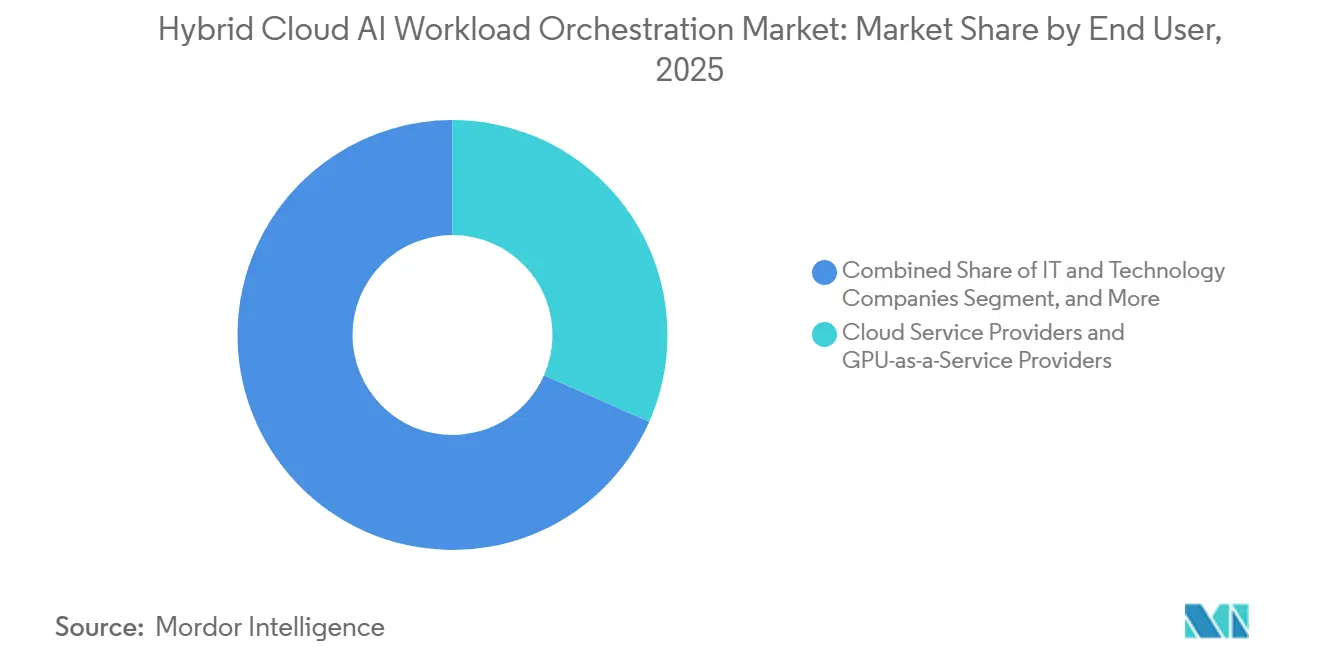
Cloud Providers Lead, While Healthcare and Life Sciences Advances FastestCloud service providers and GPU-as-a-Service providers accounted for 31.61% of revenue in 2025 because they must manage their own accelerator fleets while also delivering managed compute access to customers. Within the Hybrid cloud AI workload orchestration market, their position combines 2 roles, since they are major infrastructure users and an important distribution channel through which enterprise teams obtain GPU capacity without owning all the hardware. Their operating models must balance the needs of internal infrastructure teams with the service expectations of customers that consume capacity on demand. Their platforms must manage resource allocation, tenant separation, pricing visibility, access controls, and workload performance across an expanding set of customers and use cases. IT and technology companies, BFSI, manufacturing and automotive, government, defense and research, and retail, consumer and media make up the remaining demand base. Each group has a different mix of data sensitivity, workload patterns, compliance obligations, and internal operating models, which shape its requirements for scheduling, governance, migration, and visibility functions.
Healthcare and life sciences are projected to expand at a CAGR of 18.57% from 2026 to 2031 because patient data frequently needs to remain within hospital or research networks, while compute-intensive work may require access to larger shared resources. Federated learning structures can preserve those data boundaries while coordinating distributed training or inference activity across private infrastructure and cloud capacity. The model differs from a general enterprise deployment because policy must be applied at the workload level, not only at the storage or application level. Roche used a hybrid AI infrastructure for molecular design, digital manufacturing twins, and diagnostics workloads. The company reported AI use in nearly 90% of eligible small-molecule drug programs at Genentech and a 25% faster design for 1 oncology molecule, while government and defense users similarly favor air-gapped options and immutable audit logs for workloads with stringent control requirements

By Organization Size:
Large Enterprises Lead, While SMEs Gain AccessLarge enterprises accounted for 64.37% of revenue in 2025, reflecting their financial capacity to adopt enterprise platforms and the scale of the operational problems they need to solve. In the Hybrid cloud AI workload orchestration market, environments can include several data centers, cloud commitments, business units, security teams, regional requirements, and accelerator suppliers, making unmanaged AI compute costly and difficult to govern. The resulting operating burden can increase when different teams use separate tools, policies, and visibility practices for resources that must still work together. Coordinating these resources requires shared policies, resource allocation rules, usage visibility, and audit capabilities that work across varied operating teams rather than within a single cluster. Large organizations also face greater costs from underused GPU resources, inconsistent controls, and incomplete compliance records as their AI programs move from pilots to production. Their leading position reflects this immediate need for coordination, rather than a simple preference for a particular deployment model.
Small and medium enterprises are projected to expand at a CAGR of 17.54% through 2031 as GPU-as-a-Service offerings make managed accelerator resources available without dedicated infrastructure ownership. This model can reduce the capital requirement for smaller teams, while managed platforms can reduce the need to assemble every element of a complex AI infrastructure stack internally. The OECD recorded continued growth in SME AI use across 12 countries, with firms moving from off-the-shelf tools toward targeted agentic AI applications. As these uses become more operational, smaller organizations also need repeatable controls for resource access, workload placement, and governance, even when most of their compute is consumed as a service. The Hybrid cloud AI workload orchestration industry can reach a wider buyer base as managed platforms reduce capital and skills barriers without removing the need for policy, cost, and performance management.
Geography Analysis
North America Hybrid Cloud AI Workload Orchestration Market
North America held 38.92% of revenue in 2025, giving the region the leading position in the Hybrid cloud AI workload orchestration market. The region combines hyperscalers, purpose-built GPU cloud providers, research capacity, and enterprise AI programs that are already moving beyond pilot projects into active production. The United States drives most of the demand through large managed GPU fleets operated by AWS, Microsoft Azure, and Google Cloud, as well as specialist infrastructure providers serving intensive AI workloads. NVIDIA invested USD 2 billion in CoreWeave in January 2026, and the companies planned an AI factory capacity exceeding 5 gigawatts by 2030. Canada and Mexico add demand from financial services and manufacturing users that can use cross-border hybrid architectures anchored in the United States hyperscaler infrastructure.
APAC Hybrid Cloud AI Workload Orchestration Market
Asia-Pacific is projected to expand at a CAGR of 18.23% from 2026 to 2031, making it the fastest-expanding regional part of the Hybrid cloud AI workload orchestration market. Government-backed sovereign AI programs, expanding enterprise adoption, and national supercomputing investments are driving demand across China, Japan, India, and South Korea. National data residency policies make hybrid control layers relevant, as public cloud capacity may need to operate alongside domestic infrastructure that retains sensitive workloads. Japan’s AI Strategy and IndiaAI Mission direct public funding toward domestic AI infrastructure operating under national data-residency frameworks. Southeast Asia and Australia add demand from financial services, healthcare, and government organizations that manage local data requirements and seek capacity for both commercial and research workloads.
EMEA and South America Hybrid Cloud AI Workload Orchestration Market
Europe represents a significant share of the Hybrid cloud AI workload orchestration market, led by Germany, France, and the United Kingdom. Pharmaceutical, automotive, and financial services organizations in these countries require controlled AI environments that meet both EU-wide and national data rules. The EU AI Act, General Data Protection Regulation, EU Data Act, and Digital Operational Resilience Act shape procurement toward systems with governance, auditability, and data-residency features. The Middle East is gaining momentum through sovereign AI programs in Saudi Arabia and the United Arab Emirates, while South America and Africa remain early-stage regions with demand centered on Brazil, Colombia, South Africa, and Nigeria.
Competitive Landscape
NVIDIA, AWS, Microsoft, Google, IBM, and Hewlett-Packard Enterprise dominate the Hybrid cloud AI workload orchestration market, and are moderately concentrated. These providers integrate scheduling, allocation, governance, and operational management into broader managed services and AI infrastructure platforms, rather than offering each capability as a separate product. Their scale gives them access to cloud capacity, enterprise sales channels, silicon relationships, and engineering resources for deep integrations across infrastructure layers. NVIDIA Run is available through AWS Marketplace and Azure, bringing GPU scheduling and allocation into hyperscaler procurement channels. This approach can position resource orchestration as a native infrastructure capability and requires specialist suppliers to differentiate themselves through depth of governance, multi-accelerator coverage, or sector-specific compliance functions.
Nutanix, ClearML, Domino Data Lab, Rafay Systems, Platform9, CloudBolt, Flexera, and Scalr form a varied mid-tier within the Hybrid cloud AI workload orchestration market. These providers face consolidation pressure as larger infrastructure vendors add AI platform functions and extend their managed-service portfolios. GPU cloud providers, including CoreWeave, Lambda Labs, Vultr, and RunPod, compete on accelerator availability, price visibility, and developer onboarding, but their production workloads also create demand for the management layer above raw compute. Nutanix expanded coverage to AMD Instinct GPUs and Intel AMX acceleration in April 2026. ClearML introduced a multi-tenant management interface in March 2026 with resource allocation monitoring, per-tenant cost visibility, and workload governance.
The Hybrid cloud AI workload orchestration market retains an opportunity in multi-accelerator scheduling that does not rely on a single hardware vendor’s proprietary software development kit, allowing customers to use existing infrastructure while reducing dependence on a single supplier and avoiding a full replacement of existing resources. Carbon-aware workload routing is another area of opportunity, as placement could reflect real-time grid carbon conditions alongside capacity, performance needs, governance requirements, and the geographic location of available compute. MRS Energy and Sustainability reported that reinforcement-learning-based federated carbon scheduling could reduce cumulative carbon dioxide emissions by up to 45% compared with static allocation and extend fleet life by 12-18 months, providing this approach with both an environmental and a hardware-utilization rationale. IBM’s 2026 Sovereign Core and watsonx Orchestrate announcements illustrate how established providers combine operational control with policy enforcement for regulated and jurisdictionally constrained deployments, an approach that can become more important as buyers seek to reduce separate governance processes
Hybrid Cloud AI Workload Orchestration Industry Leaders
-
NVIDIA Corporation
-
Amazon Web Services, Inc.
-
Microsoft Corporation
-
Google LLC
-
IBM Corporation
- *Disclaimer: Major Players sorted in no particular order
Hybrid Cloud AI Workload Orchestration Market Companies Covered in this Report
- NVIDIA Corporation
- Amazon Web Services, Inc.
- Microsoft Corporation
- Google LLC
- International Business Machines Corporation
- Hewlett Packard Enterprise Company
- Red Hat, Inc.
- Broadcom Inc.
- VMware LLC
- Nutanix, Inc.
- CloudBolt Software, Inc.
- Morpheus Data LLC
- Flexera Software LLC
- Scalr Inc.
- Mirantis, Inc.
- Platform9 Systems, Inc.
- Anyscale, Inc.
- CoreWeave, Inc.
- Rafay Systems, Inc.
- Hopsworks AB
- ClearML Ltd.
- Domino Data Lab, Inc.
- Lambda Labs, Inc.
- RunPod, Inc.
- Vast.ai, Inc.
- Modal Labs, Inc.
- Nscale Limited
- Vultr Holdings Corporation
Recent Industry Developments in Hybrid Cloud AI Workload Orchestration Market
- May 2026: IBM unveiled the next-generation IBM watsonx Orchestrate at Think 2026 as an agentic control plane for multi-agent orchestration with consistent policy enforcement across agent sources, and announced IBM Sovereign Core for operational independence in regulated and jurisdictionally constrained deployments.
- May 2026: Domino Data Lab launched App Hub at its Rev 2026 conference, extending its Enterprise AI Platform to support the full AI application lifecycle from development through governed production deployment, including version control, staged deployment, approval gating, and cross-environment agent governance for the world’s most regulated enterprises.
- April 2026: Nutanix unveiled its Agentic AI solution at the .NEXT Conference in Chicago, in early access with full availability planned for the second half of 2026. The solution integrates compute, storage, networking, and Kubernetes services for building and operating enterprise AI applications on the Nutanix Cloud Platform across hybrid and multicloud environments.
- March 2026: AWS and NVIDIA expanded their strategic collaboration at GTC 2026, committing to deploy more than 1 million NVIDIA Blackwell and Rubin GPUs across AWS global regions, with integrations spanning NVIDIA Dynamo, vLLM, and NIXL for disaggregated LLM inference on Amazon SageMaker HyperPod and Amazon EKS.
Global Hybrid Cloud AI Workload Orchestration Market Report Scope
The Hybrid Cloud AI Workload Orchestration market comprises software solutions and associated services that enable organizations to schedule, deploy, manage, monitor, and optimize artificial intelligence (AI) and machine learning workloads across a combination of public or private cloud environments and on-premises infrastructure. These platforms orchestrate compute resources, particularly GPUs and other AI accelerators, by dynamically matching AI workloads to available infrastructure to improve utilization, performance, scalability, cost efficiency, and operational control.
The Hybrid Cloud AI Workload Orchestration Market Report is Segmented by Component (Software, and Services), Deployment Environment (Cloud, and On-Premise), Application (GPU Scheduling and Allocation, Workload Placement and Migration, Cluster Management and Autoscaling, Governance, Multi-Tenancy and Policy Enforcement, and Monitoring, Observability and Cost Optimization), End User (Cloud Service Providers and GPU-as-a-Service Providers, IT and Technology Companies, BFSI, Healthcare and Life Sciences, Manufacturing and Automotive, Government, Defense and Research, and Retail, Consumer and Media), Organization Size (Large Enterprises, and Small and Medium Enterprises), and Geography (North America, South America, Europe, Asia-Pacific, Middle East, and Africa). The Market Forecasts are Provided in Terms of Value (USD).
Segmentation Overview
| Software |
| Services |
| Cloud |
| On Premise |
| GPU Scheduling and Allocation |
| Workload Placement and Migration |
| Cluster Management and Autoscaling |
| Governance, Multi-Tenancy, and Policy Enforcement |
| Monitoring, Observability, and Cost Optimization |
| Cloud Service Providers and GPU-as-a-Service Providers |
| IT and Technology Companies |
| BFSI |
| Healthcare and Life Sciences |
| Manufacturing and Automotive |
| Government, Defense, and Research |
| Retail, Consumer, and Media |
| Large Enterprises |
| Small and Medium Enterprises |
| North America | United States |
| Canada | |
| Mexico | |
| South America | Brazil |
| Argentina | |
| Colombia | |
| Rest of South America | |
| Europe | Germany |
| United Kingdom | |
| France | |
| Italy | |
| Rest of Europe | |
| Asia-Pacific | China |
| Japan | |
| India | |
| South Korea | |
| Australia | |
| Southeast Asia | |
| Rest of Asia-Pacific | |
| Middle East | Saudi Arabia |
| United Arab Emirates | |
| Turkey | |
| Rest of Middle East | |
| Africa | South Africa |
| Nigeria | |
| Rest of Africa |
| By Component | Software | |
| Services | ||
| By Deployment Environment | Cloud | |
| On Premise | ||
| By Application | GPU Scheduling and Allocation | |
| Workload Placement and Migration | ||
| Cluster Management and Autoscaling | ||
| Governance, Multi-Tenancy, and Policy Enforcement | ||
| Monitoring, Observability, and Cost Optimization | ||
| By End User | Cloud Service Providers and GPU-as-a-Service Providers | |
| IT and Technology Companies | ||
| BFSI | ||
| Healthcare and Life Sciences | ||
| Manufacturing and Automotive | ||
| Government, Defense, and Research | ||
| Retail, Consumer, and Media | ||
| By Organization Size | Large Enterprises | |
| Small and Medium Enterprises | ||
| By Geography | North America | United States |
| Canada | ||
| Mexico | ||
| South America | Brazil | |
| Argentina | ||
| Colombia | ||
| Rest of South America | ||
| Europe | Germany | |
| United Kingdom | ||
| France | ||
| Italy | ||
| Rest of Europe | ||
| Asia-Pacific | China | |
| Japan | ||
| India | ||
| South Korea | ||
| Australia | ||
| Southeast Asia | ||
| Rest of Asia-Pacific | ||
| Middle East | Saudi Arabia | |
| United Arab Emirates | ||
| Turkey | ||
| Rest of Middle East | ||
| Africa | South Africa | |
| Nigeria | ||
| Rest of Africa | ||
Key Questions Answered in the Report
What is the size of the hybrid cloud AI workload orchestration market?
The hybrid cloud AI workload orchestration market size is USD 7.56 billion in 2026 and is forecast to reach USD 16.72 billion by 2031 at a CAGR of 17.21%.
What is driving adoption of hybrid AI workload orchestration?
Large language model workloads, GPU utilization needs, data-residency requirements, and multi-accelerator environments are driving adoption. These requirements make coordinated scheduling, policy enforcement, and workload placement more important when compute resources span cloud and on-premises environments.
Which component holds the largest share?
Software held 62.72% of revenue in 2025 because scheduling, governance, and policy enforcement are central platform functions. These capabilities combine operating controls that enterprises need across shared resources, deployment locations, and workloads with different access and compliance needs. They can also reduce the burden of managing disconnected scheduling, governance, and reporting processes when AI teams use more than 1 infrastructure environment.
Which deployment environment is expanding fastest?
On-premise deployments are projected to expand at a CAGR of 17.59% through 2031 as regulated users require greater control over data and audit records. These deployments can retain sensitive processing within a defined location while allowing organizations to use cloud resources when capacity needs exceed local infrastructure.
Which application is expanding fastest?
Governance, multi-tenancy, and policy enforcement are projected to expand at a CAGR of 18.16% through 2031.
Which region is expanding fastest?
Asia-Pacific is projected to expand at a CAGR of 18.23% through 2031, supported by sovereign AI programs and domestic infrastructure investment. Demand is also linked to national data-residency policies and the need to coordinate domestic infrastructure with commercial cloud capacity.