
Managed Cloud Governance Services Market Size and Share
Market Overview
| Study Period | 2021 - 2032 |
|---|---|
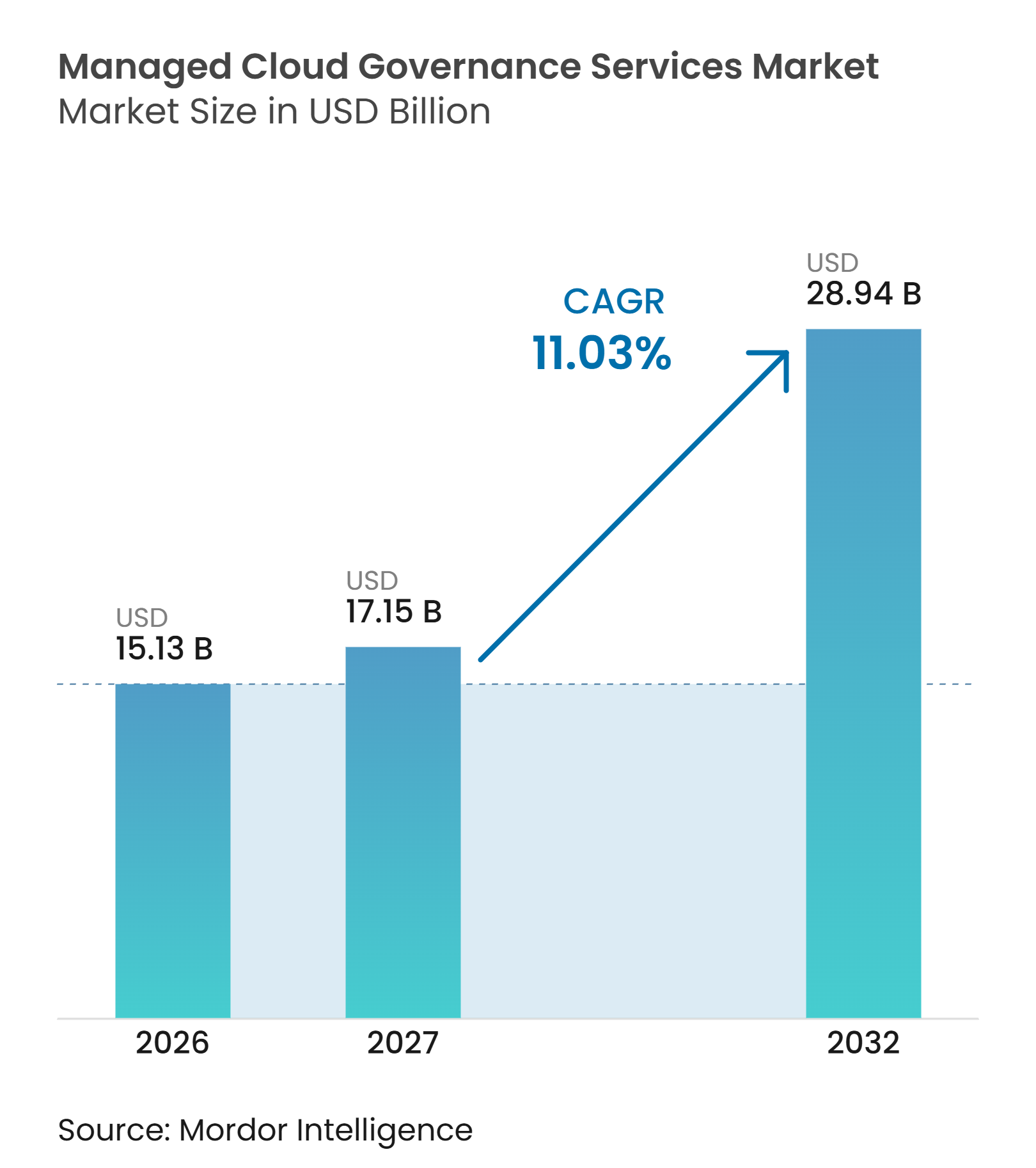
| Market Size (2027) | USD 17.15 Billion |
| Market Size (2032) | USD 28.94 Billion |
| Growth Rate (2027 - 2032) | 11.03 % |
| Fastest Growing Market | Asia-Pacific |
| Largest Market | North America |
| Market Concentration | Medium |
Major Players *Disclaimer: Major Players sorted in no particular order Image © Mordor Intelligence. Reuse requires attribution under CC BY 4.0. | |
Managed Cloud Governance Services Market Analysis by Mordor Intelligence
The Managed cloud governance services market size was valued at USD 15.13 billion in 2026 and estimated to expand from USD 17.15 billion in 2027 to reach USD 28.94 billion by 2032, at a CAGR of 11.03% during the forecast period 2027-2032. The Managed cloud governance services market is shaped by enterprises operating more complex hybrid and multi-cloud estates, where separate providers can use different identity structures, billing records, security tools, and policy controls, creating a practical need to establish common rules and a clear record of who is responsible when a control gap appears. Regulatory obligations are also making cloud oversight a continuing operational requirement rather than an occasional compliance exercise, particularly for organizations handling financial, health, public-sector, or sensitive customer data. Demand is moving beyond security monitoring toward coordinated management of cost, identity, policy, workload controls, audit evidence, and the operational steps needed to correct issues. AI workloads add to this need because they create new spend categories, non-human identities, data-handling requirements, and decisions on where applications and data should run. Providers that combine automation with sector knowledge, clear accountability, and practical remediation support can address a broader set of customer needs in the Managed cloud governance services market, while customers can avoid disconnected governance processes as cloud connectivity, provider interoperability, and sovereign-cloud requirements widen the scope of environments that must be managed under a coherent operating model in the Managed cloud governance services market.
Key Report Takeaways
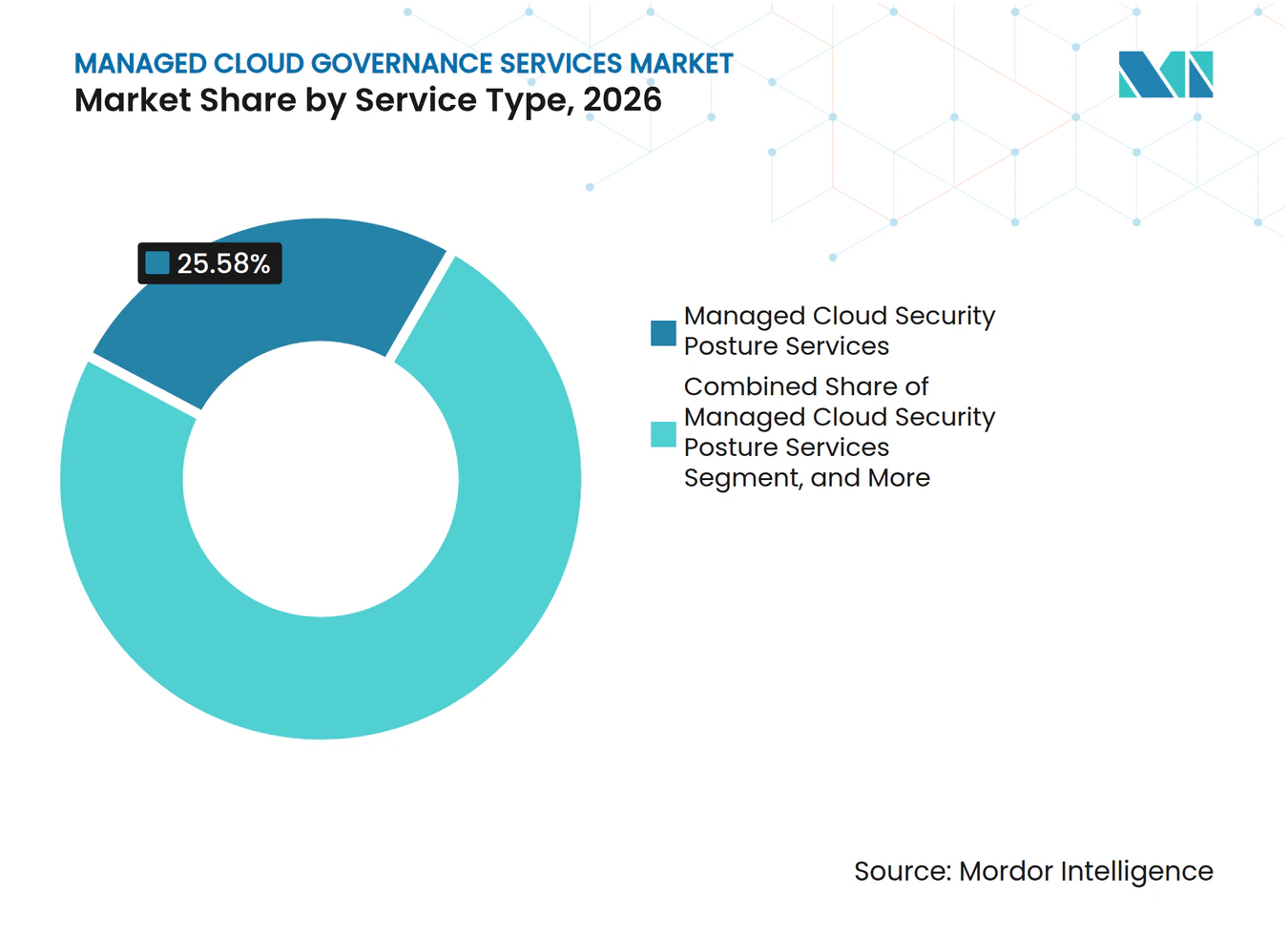
- By service type, Managed Cloud Security Posture Services held 25.58% of the managed cloud governance services market share in 2026, while Managed FinOps and Cost Governance Services are projected to expand at a CAGR of 12.57% through 2032.
- By deployment model, Public Cloud held 41.30% of the Managed cloud governance services market share in 2026, while Hybrid and Multi-Cloud are projected to expand at a CAGR of 13.24% through 2032.
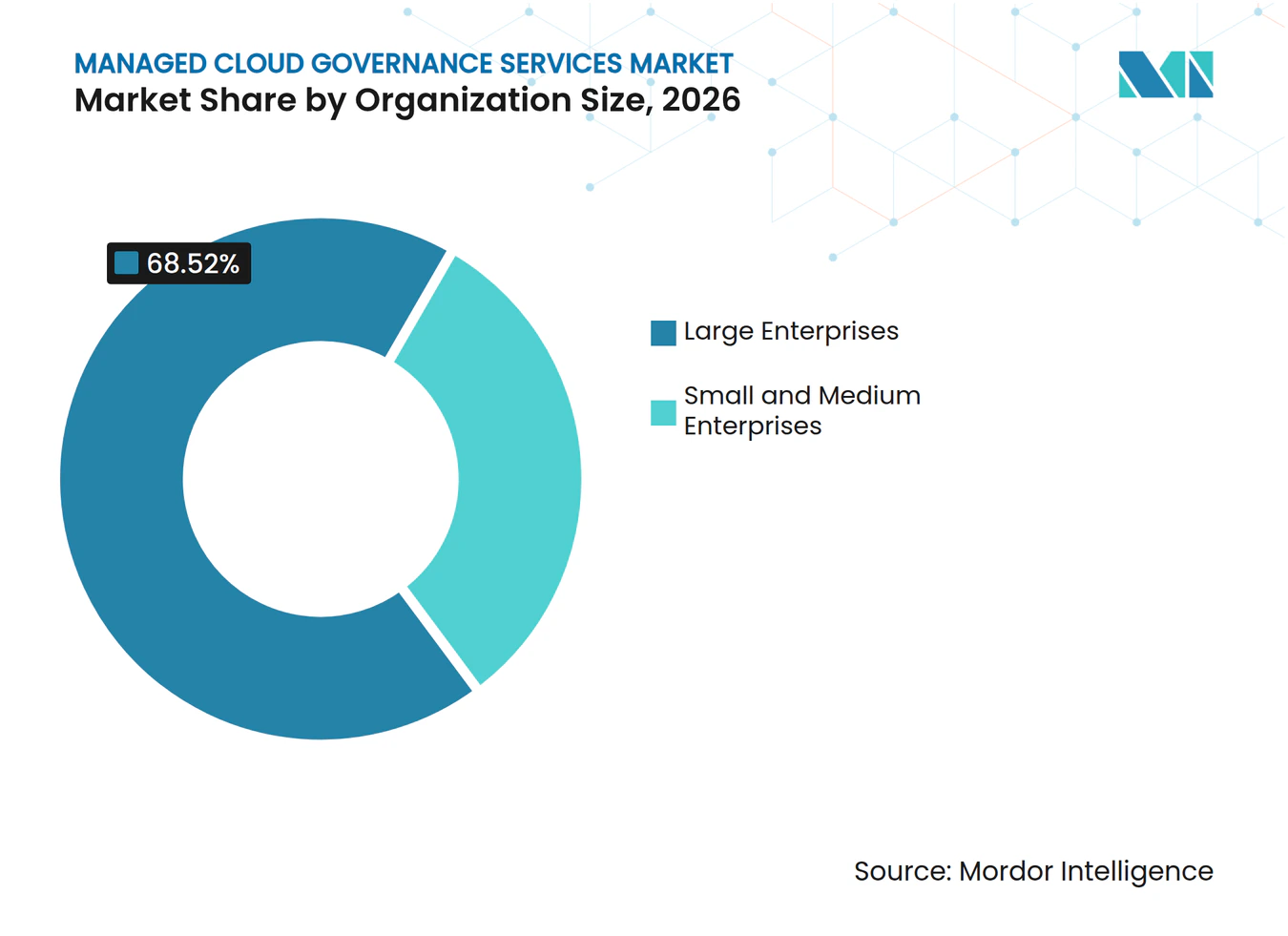
- By organization size, Large Enterprises held 68.52% revenue share in 2026, while Small and Medium Enterprises are projected to expand at a CAGR of 11.95% through 2032.
- By end-use industry, BFSI held 24.87% of the managed cloud governance services market share in 2026, while Healthcare and Life Sciences are projected to expand at a CAGR of 12.27% through 2032.
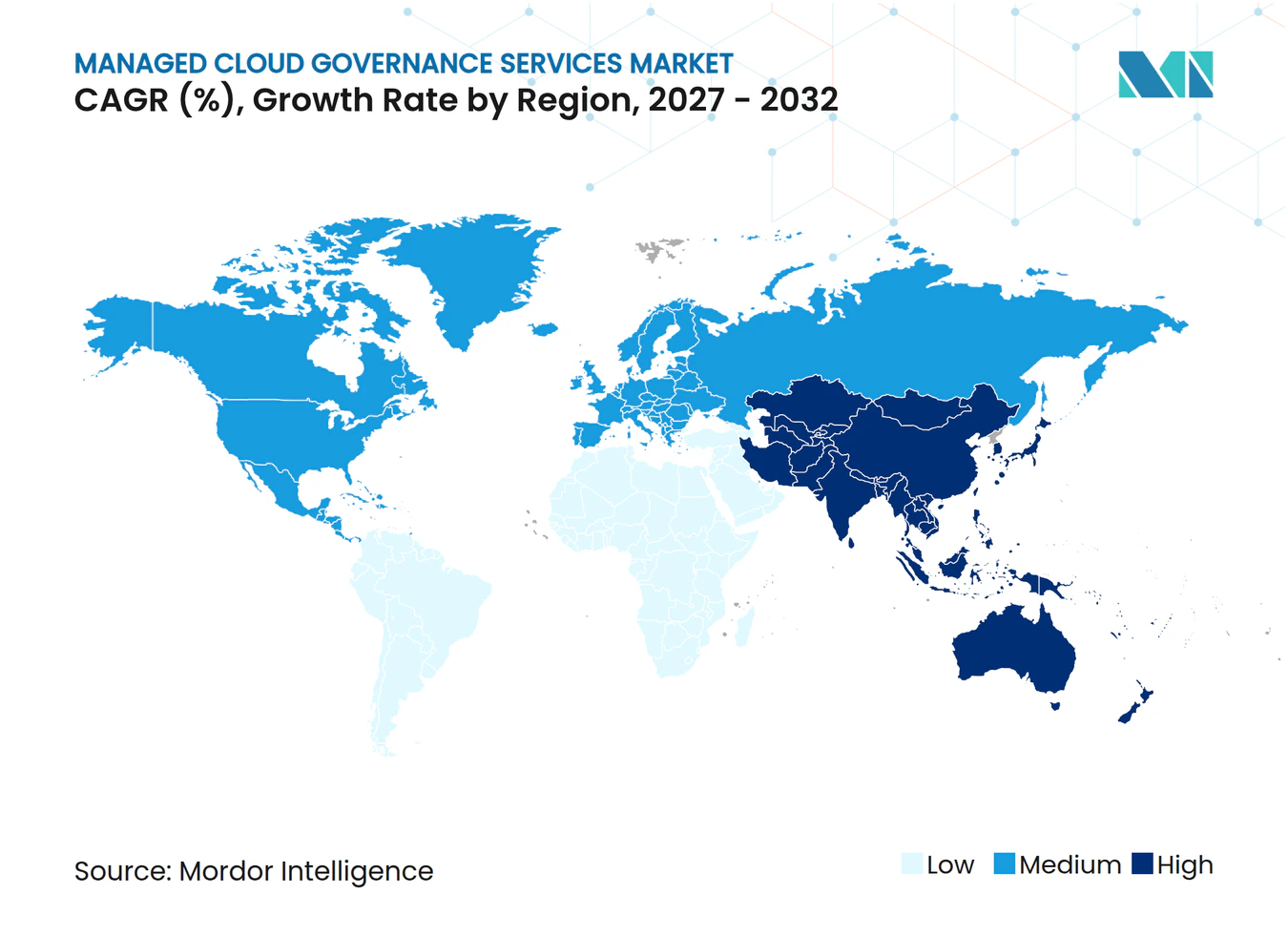
- By geography, North America held 42.16% revenue share in 2026, while Asia-Pacific is projected to expand at a CAGR of 13.17% through 2032.
Note: Market numbers in this report are based on Mordor Intelligence's proprietary estimation framework, which combines nine months of actuals with Q4 projections for base year 2026.
Market Trends and Insights
Drivers Impact Analysis of Managed Cloud Governance Services Market*
| Driver | (~) % Impact on CAGR Forecast | Geographic Relevance | Impact Timeline |
|---|---|---|---|
| Expansion of Hybrid and Multi-Cloud Estates | +2.5% | Global, particularly North America, Europe, and Asia-Pacific core markets | Short term (≤ 2 years) |
| Stricter Cloud Compliance and Data Residency Requirements | +2.0% | Europe, North America, and Asia-Pacific | Medium term (2-4 years) |
| Enterprise Demand for Continuous Cloud Cost Governance | +1.7% | Global, with early gains in North America and Northern Europe | Medium term (2-4 years) |
| Shortage of Cloud Governance and FinOps Expertise | +1.2% | Global, most acute in Germany, India, Southeast Asia, and South America | Long term (≥ 4 years) |
| Policy-as-Code Adoption in Platform Engineering | +1.0% | North America and Europe, with spillover to Asia-Pacific | Medium term (2-4 years) |
| Sovereign Cloud and Workload Control Requirements | +0.8% | Middle East and Africa, Asia-Pacific governments, and regulated European sectors | Long term (≥ 4 years) |
| Source: Mordor Intelligence | |||
Expansion of Hybrid and Multi-Cloud Estates
Enterprises are moving from single-provider deployments toward estates that use several cloud environments with different identity, billing, and policy systems. This creates a wider control surface and makes a consistently managed governance layer more valuable. AWS and Google Cloud introduced connected multicloud services on November 30, 2025, showing that cross-cloud connectivity is becoming part of mainstream infrastructure planning.[1] Interoperability can reduce the practical barriers to using more than 1 provider, but it does not remove the need to manage access, policies, costs, and evidence of control across those environments. The Managed cloud governance services market benefits because customers need controls that work across provider boundaries and can still be administered by accountable operating teams. The Managed cloud governance services market also gains when providers can translate technical connectivity into common operational rules.
Stricter Cloud Compliance and Data Residency Requirements
Cloud compliance obligations are becoming more specific across financial services, healthcare, and public-sector workloads. The EU Data Act places disclosure obligations on providers concerning the jurisdiction of ICT infrastructure, making data location an earlier procurement consideration. Financial institutions in the European Union must meet the Digital Operational Resilience Act requirements that took effect in January 2025. This requirement increases demand for ongoing evidence of third-party and cloud controls rather than a one-time review. The Managed cloud governance services market is supported by service providers that can document policy enforcement, audit rights, and control effectiveness across jurisdictions. ISO/IEC 27001 and SOC 2 Type II remain relevant qualification benchmarks when customers assess governance providers.
Enterprise Demand for Continuous Cloud Cost Governance
Cloud cost management is increasingly tied to decisions on how enterprises fund AI and other digital programs. The FinOps Foundation reported in February 2026 that 98% of respondents manage AI spend, while 90% manage SaaS spend and 64% manage licensing.[2] This broader responsibility makes periodic cost reviews less suitable for organizations with changing workloads. Managed FinOps services can provide ongoing allocation, optimization, and reporting practices that internal teams may not sustain. The Managed cloud governance services market, therefore, has an opportunity to connect cost decisions with security and compliance controls. This linkage is particularly important when AI spending rises faster than governance capacity.
Shortage of Cloud Governance and FinOps Expertise
Cloud governance roles require knowledge of architecture, billing models, control frameworks, and financial reporting. Organizations must also explain cloud decisions to technology leaders and business executives, which makes the required capability difficult to build through a single hire. The FinOps Foundation found that practitioners plan to expand effort across nearly 12 capabilities while reducing effort in only 1 to 2 areas. This widening scope can encourage enterprises to use specialist managed teams alongside internal staff. Providers with credible FinOps and governance talent can differentiate through execution quality, not only software coverage. The Managed cloud governance services market can consequently favor longer engagements where providers are embedded in the customer’s governance process.
Restraints Impact Analysis of Managed Cloud Governance Services Market*
| Restraint | (~) % Impact on CAGR Forecast | Geographic Relevance | Impact Timeline |
|---|---|---|---|
| High Integration and Remediation Complexity | -1.5% | Global, most acute in large multi-cloud enterprises in North America and Europe | Short term (≤ 2 years) |
| Fragmented Accountability Across Cloud Providers and Business Units | -1.0% | Global, most pronounced in decentralized enterprises in North America and Europe | Medium term (2-4 years) |
| Customer Concerns About Third-Party Privileged Access | -0.8% | North America and Europe, especially BFSI, healthcare, and government | Medium term (2-4 years) |
| Hyperscaler-Native Tool Substitution and Vendor Lock-In Risk | -0.6% | Global, particularly mid-market buyers assessing managed-service cost | Long term (≥ 4 years) |
| Source: Mordor Intelligence | |||
High Integration and Remediation Complexity
Governance platforms must connect with identity systems, billing interfaces, security services, and infrastructure-as-code workflows that often differ by cloud and business unit. This work can delay the point at which a customer sees operational value. Detection tools can flag configuration issues quickly, but production changes still require human judgment and coordinated approvals. Kubernetes cost management and complex application environments can make remediation particularly difficult for teams with limited capacity. The Managed cloud governance services market faces a delivery challenge when customers expect automation to remove every operating constraint. At the same time, providers that establish practical remediation processes can turn implementation complexity into a durable service relationship.
Fragmented Accountability Across Cloud Providers and Business Units
Large enterprises often distribute cloud purchasing and administration among business units with separate budgets, tools, and risk tolerances. This structure can prevent a managed provider from applying common policies without clear executive backing. Financial regulators also expect institutions to retain responsibility for cloud risk, even when a third party supports operations. A provider can supply evidence and workflows, but it cannot fully replace the customer’s internal ownership of risk decisions. The Managed cloud governance services market may, therefore, see slower implementation when accountability is unclear. Clear operating models, agreed escalation paths, and transparent cost ownership help reduce this constraint.
*Our forecasts treat driver/restraint impacts as directional, not additive. The impact forecasts reflect baseline growth, mix effects, and variable interactions.
Managed Cloud Governance Services Market Segment Analysis
By Service Type:
Security Posture Leads While Cost Governance AdvancesManaged Cloud Security Posture Services accounted for 25.58% of the managed cloud governance services market size in 2026, reflecting the priority enterprises give to identifying configuration weaknesses across several cloud accounts and workloads. Financial services and critical infrastructure organizations need documented posture management because security and resilience obligations demand evidence that controls are operating as intended. A managed provider can continuously collect findings, organize them by materiality, and present them in a form that security and compliance teams can act upon. This makes the service relevant to customers who see a cloud posture issue as both a technical and regulatory concern.
Managed FinOps and Cost Governance Services is projected to expand at a CAGR of 12.57% through 2032, as AI workloads make cost decisions more visible to senior leadership and operational teams. The FinOps Foundation’s 2026 findings show that AI, SaaS, licensing, and data center costs are now part of a broader scope for many practitioners. Policy and compliance operations are becoming more relevant as organizations move rules from manual checklists into engineering workflows. A 2025 journal article described policy-as-code approaches, including Open Policy Agent and AWS Control Tower, for automated compliance in cloud data platforms.[3] Identity and access governance is also gaining attention because AI agents add non-human identities that need defined permissions and lifecycle controls.



By Deployment Model:
Hybrid and Multi-Cloud Changes Governance RequirementsPublic Cloud held 41.30% of the Managed cloud governance services market size in 2026, supported by enterprise familiarity with AWS, Microsoft Azure, and Google Cloud. Native tools on these platforms offer a baseline for policy, security, and account management, but they are not a complete answer for organizations working across several providers. Managed providers can extend these tools with common reporting, sector-specific controls, and operating support that creates a clearer view across cloud accounts. This capability remains important as customers seek consistent governance without replacing their established public-cloud environment.
Hybrid and Multi-Cloud is projected to expand at a CAGR of 13.24% through 2032, supported by architectures that separate training, data, and serving workloads across on-premises and public cloud infrastructure. AWS Interconnect multicloud was introduced in preview in November 2025 to provide private, high-speed connections between Amazon VPCs and other cloud providers. Google Cloud also extended Cross-Cloud Interconnect to AWS and partner networks in the same month. Private-cloud deployments continue to matter where data sovereignty or tenancy requirements limit the use of shared environments, and Rackspace introduced its OpenStack Business offering in July 2025 for this group.
By Organization Size:
Large Enterprises Sustain Demand While SMEs Expand AccessLarge Enterprises accounted for 68.52% of the Managed cloud governance services market in 2026, because their cloud estates commonly include several accounts, business units, and regulatory requirements. These conditions create a sustained need for managed visibility, policy enforcement, evidence collection, and coordinated remediation support. Moving from 1 governance provider to another can require changes to privileged access, operating processes, and compliance baselines. The resulting transition cost can support customer retention and recurring governance engagements for established providers.
Small and Medium Enterprises are projected to expand at a CAGR of 11.95% through 2032, as consumption-based models lower the initial cost of introducing managed governance practices. CoreStack reported that it had more than 780 customer organizations globally and more than 30% year-over-year annual recurring revenue expansion in October 2025. Smaller organizations face many of the same SaaS, licensing, cloud-spend, and compliance responsibilities as large enterprises, but generally have fewer specialists available to manage them. Managed offerings can provide a practical operating model when an SME cannot create a broad internal FinOps or governance function.

By End-Use Industry:
BFSI Sets the Baseline While Healthcare and Life Sciences AccelerateBFSI held 24.87% of the Managed cloud governance services market in 2026, because financial institutions work under cloud-specific expectations for resilience, third-party oversight, and demonstrable control effectiveness. DORA became applicable in January 2025 and increased the focus on ICT third-party risk among European financial entities. Banking and insurance buyers must also consider supervisory expectations, data-protection obligations, and board-approved risk frameworks. These requirements make managed governance a continuing operating service rather than a limited implementation project.
Healthcare and Life Sciences are projected to expand at a CAGR of 12.27% through 2032, as sensitive health data creates persistent needs for encryption, access control, and audit support across cloud workloads. The January 2025 HIPAA Security Rule notice of proposed rulemaking increased attention on encryption and multi-factor authentication for electronic protected health information. AWS published 2025 technical safeguards guidance that addressed readiness considerations for organizations using its services. Government and public-sector demand also benefits from sovereign-cloud policies and centralized account governance, as shown by Japan’s Digital Agency
Geography Analysis
North America Managed Cloud Governance Services Market
North America held 42.16% of the Managed cloud governance services market in 2026, supported by dense hyperscaler infrastructure and established enterprise cloud operations. The United States supports demand through healthcare, financial services, privacy, and cybersecurity requirements that make clear control of evidence important, while Canada and Mexico offer opportunities as organizations address cross-border data handling and governance obligations. The Managed cloud governance services market is important in the region for providers that can connect security, cost management, compliance operations, and practical remediation in a single service. North America also has mature FinOps practices, which support broader adoption of continuous cloud cost governance.
Europe Managed Cloud Governance Services Market
Europe is the second-largest regional market and is strongly shaped by overlapping obligations under the EU Data Act, DORA, NIS2, and the General Data Protection Regulation. These requirements make data location, operational resilience, and third-party control evidence-related procurement considerations. Germany, the United Kingdom, and France have distinct priorities concerning residency, transfers, and sovereign-cloud assurance. Providers need country-specific delivery approaches while maintaining consistent regional methods and documentation. This environment can favor providers whose teams combine regulatory knowledge with cloud-control expertise.
APAC, MEA and South America Managed Cloud Governance Services Market
Asia-Pacific is projected to expand at a CAGR of 13.17% through 2032, supported by sovereign-cloud requirements and limited internal governance capacity. IIJ launched a Cloud Center of Excellence implementation support and cloud-guideline service in December 2025 for governance across AWS and Microsoft Azure environments.[4] Japan, China, India, and South Korea each have data-protection and policy requirements that influence how enterprises govern cloud workloads. The Middle East also faces rapid hybrid-cloud adoption and related governance needs. South America and Africa remain earlier-stage opportunities, with Brazil and South Africa providing important regulatory reference points. These regions can support longer-term demand as cloud use broadens and control requirements become more formal.
Competitive Landscape
Market Concentration
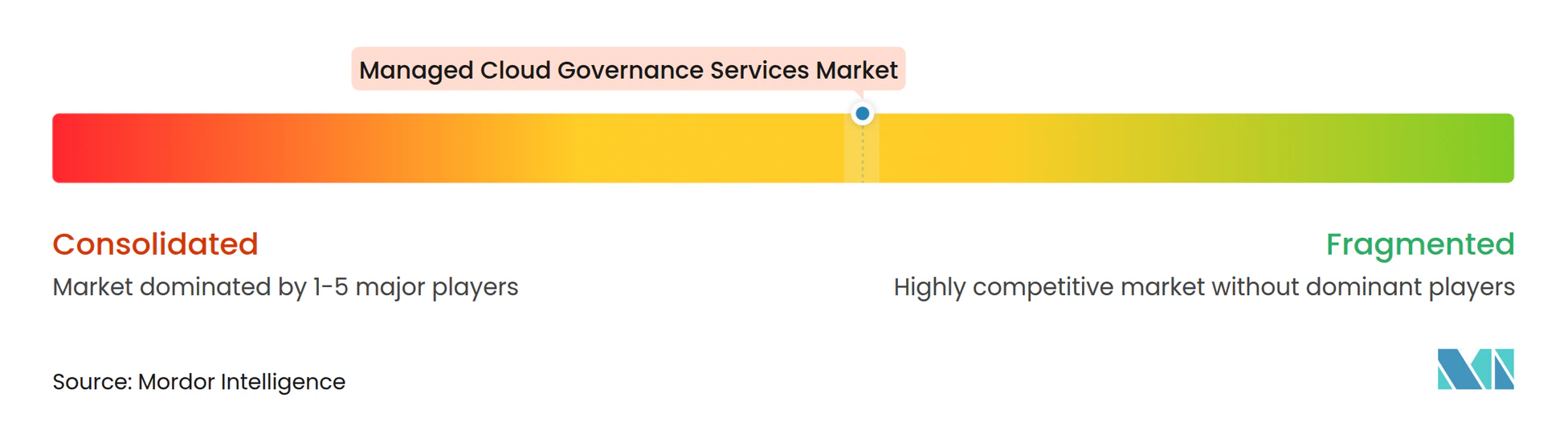
The Managed cloud governance services market is moderately fragmented, with AWS, Microsoft, and Google holding an advantage through native tools embedded in platforms customers already use. Global systems integrators, including Accenture, IBM, Capgemini, and Tata Consultancy Services, compete through delivery scale, compliance experience, and sector knowledge. Other participants, such as CoreStack, Rackspace Technology, Palo Alto Networks, Flexera, Broadcom, Cisco, ServiceNow, Wipro, Cognizant, HCL Technologies, NTT DATA, DXC Technology, Oracle, and IBM, serve different combinations of governance, security, cost, and operations needs, preserving room for platform-native tools, specialist platforms, and independently managed services. Competition depends on the provider’s ability to turn technical controls into a reliable operating service.
The Managed cloud governance services market is moving toward bundles that combine security posture management, FinOps, identity governance, and policy-as-code under a clearer accountability model. CoreStack released Graphion, its AI-native cloud-native application protection platform, in December 2025. ServiceNow and Accenture launched an AI-powered managed security and risk service in June 2026 that uses AI agents for vendor monitoring and regulatory-change automation. These strategic moves show how providers are bringing risk operations and automation together as customers manage more complex environments. Customers may favor providers that can reduce the need to coordinate several separate governance vendors.
AI governance is opening a further area of competition because AI agents require defined identities, permissions, monitoring, and lifecycle management. Providers that extend cloud governance services to agent controls may address requirements that conventional identity frameworks do not fully cover. Government-grade cloud security is another specialized area where authorization requirements can restrict entry. Rackspace launched its Cloud Management Platform in August 2025 with AI-enabled observability, application optimization, and a consumption-based model for hybrid environments. NTT DATA was recognized as a Leader in a Japan assessment of managed hybrid and multi-public cloud services in January 2026, and no company-share data establishes dominance by a small group, consistent with a competitive field of hyperscalers, integrators, and specialist providers.
Managed Cloud Governance Services Industry Leaders
-
Amazon Web Services, Inc.
-
Accenture plc
-
Oracle Corporation
-
Cisco Systems, Inc.
-
ServiceNow, Inc.
- *Disclaimer: Major Players sorted in no particular order
Managed Cloud Governance Services Market Companies Covered in this Report
- Amazon Web Services, Inc.
- Microsoft Corporation
- IBM Corporation
- Accenture plc
- Google LLC
- Oracle Corporation
- Cisco Systems, Inc.
- ServiceNow, Inc.
- Capgemini SE
- Tata Consultancy Services Limited
- Wipro Limited
- Cognizant Technology Solutions Corporation
- HCL Technologies Limited
- NTT DATA Corporation
- DXC Technology Company
- Rackspace Technology, Inc.
- Flexera Software, Inc.
- Broadcom Inc.
- Palo Alto Networks, Inc.
- CoreStack, Inc.
Recent Industry Developments in Managed Cloud Governance Services Market
- October 2026: Microsoft Defender for Cloud expanded multicloud coverage across AWS and Google Cloud environments, extending its unified Cloud-Native Application Protection Platform capabilities for customers managing heterogeneous multi-cloud governance from a single control plane.
- June 2026: ServiceNow and Accenture launched a joint managed security and risk service built on the ServiceNow AI Platform on June 29, 2026, deploying AI agents for vendor monitoring, regulatory-change automation, and OT and IT risk integration. The companies cited U.S. data-breach costs reaching USD 10.22 million per incident in 2025, up 9% year over year, as the primary urgency driver for migrating off legacy risk platforms.
- June 2026: Neurealm expanded its NeuGAIN AI platform with GovernOps enterprise offerings powered by CoreStack, bundling AI-led managed services across CloudOps, FinOps+, and SecOps for enterprises requiring continuous multi-cloud governance with measurable business outcomes.
- March 2026: Japan's Digital Agency confirmed that Sakura Internet's Sakura no Cloud had satisfied all 305 technical requirements to serve as a Government Cloud service provider on March 27, 2026, the first domestic Japanese provider to achieve this designation, opening a managed governance lane for sovereign-cloud deployments across 1,700 municipalities.
Global Managed Cloud Governance Services Market Report Scope
Managed cloud governance services refer to a specialized category of third-party IT offerings where a Managed Service Provider (MSP) takes over the strategy, execution, and continuous monitoring of an organization's cloud frameworks. They enforce specific boundaries, policies, and safeguards to keep an organization's public, private, or multi-cloud environments aligned with enterprise business goals.
The Managed Cloud Governanace Services Market Report is Segmented by Service Type (Managed Policy and Compliance Operations, Managed Cloud Security Posture Services, Managed FinOps and Cost Governance Services, Managed Cloud Operations and Optimization Services, Managed Identity and Access Governance Services, and Other Service Types), Deployment Model (Public Cloud, Private Cloud, and Hybrid/Multi Cloud), Organization Size (Large Enterprises and Small and Medium Enterprises), End-Use Industry (BFSI, IT and Telecommunications, Healthcare and Life Sciences, Government and Public Sector, Retail and E-Commerce, Energy and Utilities, and Other End-Use Industries), and Geography (North America, South America, Europe, Asia-Pacific, Middle East, and Africa). The Market Forecasts are Provided in Terms of Value (USD).
Segmentation Overview
| Managed Policy and Compliance Operations |
| Managed Cloud Security Posture Services |
| Managed FinOps and Cost Governance Services |
| Managed Cloud Operations and Optimization Services |
| Managed Identity and Access Governance Services |
| Other Service Types |
| Public Cloud |
| Private Cloud |
| Hybrid/Multi Cloud |
| Large Enterprises |
| Small and Medium Enterprises |
| BFSI |
| IT and Telecommunications |
| Healthcare and Life Sciences |
| Government and Public Sector |
| Retail and E-Commerce |
| Energy and Utilities |
| Other End-Use Industries |
| North America | United States |
| Canada | |
| Mexico | |
| South America | Brazil |
| Argentina | |
| Rest of South America | |
| Europe | Germany |
| United Kingdom | |
| France | |
| Italy | |
| Rest of Europe | |
| Asia-Pacific | China |
| Japan | |
| India | |
| South Korea | |
| Rest of Asia-Pacific | |
| Middle East | United Arab Emirates |
| Saudi Arabia | |
| Rest of Middle East | |
| Africa | South Africa |
| Nigeria | |
| Rest of Africa |
| By Service Type | Managed Policy and Compliance Operations | |
| Managed Cloud Security Posture Services | ||
| Managed FinOps and Cost Governance Services | ||
| Managed Cloud Operations and Optimization Services | ||
| Managed Identity and Access Governance Services | ||
| Other Service Types | ||
| By Deployment Model | Public Cloud | |
| Private Cloud | ||
| Hybrid/Multi Cloud | ||
| By Organization Size | Large Enterprises | |
| Small and Medium Enterprises | ||
| By End-Use Industry | BFSI | |
| IT and Telecommunications | ||
| Healthcare and Life Sciences | ||
| Government and Public Sector | ||
| Retail and E-Commerce | ||
| Energy and Utilities | ||
| Other End-Use Industries | ||
| By Geography | North America | United States |
| Canada | ||
| Mexico | ||
| South America | Brazil | |
| Argentina | ||
| Rest of South America | ||
| Europe | Germany | |
| United Kingdom | ||
| France | ||
| Italy | ||
| Rest of Europe | ||
| Asia-Pacific | China | |
| Japan | ||
| India | ||
| South Korea | ||
| Rest of Asia-Pacific | ||
| Middle East | United Arab Emirates | |
| Saudi Arabia | ||
| Rest of Middle East | ||
| Africa | South Africa | |
| Nigeria | ||
| Rest of Africa | ||
Key Questions Answered in the Report
What is the size of the managed cloud governance services market?
The managed cloud governance services market is valued at USD 15.13 billion in 2026 and is expected to reach USD 28.94 billion by 2032, at a CAGR of 11.03% from 2027 to 2032.
Which service type has the largest share?
Managed Cloud Security Posture Services holds the largest service-type share at 25.58% in 2026.
Which end-use sector has the highest share?
BFSI holds 24.87% of revenue in 2026 because financial institutions face continuing resilience, third-party oversight, and cloud-control requirements.
Which region is expanding fastest?
Asia-Pacific is projected to expand at a CAGR of 13.17% through 2032, supported by sovereign-cloud requirements and limited internal governance capacity.
Why do companies use managed cloud governance services?
Companies use these services to coordinate security posture, cost governance, identity controls, policy enforcement, compliance evidence, and cloud operations across complex environments.
Which deployment model is expanding fastest?
Hybrid and Multi-Cloud is projected to expand at a CAGR of 13.24% through 2032 as organizations require controls across several environments.