
Managed Hardware Inventory and Configuration Services Market Size and Share
Market Overview
| Study Period | 2021 - 2032 |
|---|---|
| Market Size (2027) | USD 14.80 Billion |
| Market Size (2032) | USD 22.95 Billion |
| Growth Rate (2027 - 2032) | 9.17 % |
| Fastest Growing Market | Asia-Pacific |
| Largest Market | North America |
| Market Concentration | Medium |
Major Players *Disclaimer: Major Players sorted in no particular order Image © Mordor Intelligence. Reuse requires attribution under CC BY 4.0. | |
Managed Hardware Inventory and Configuration Services Market Analysis by Mordor Intelligence
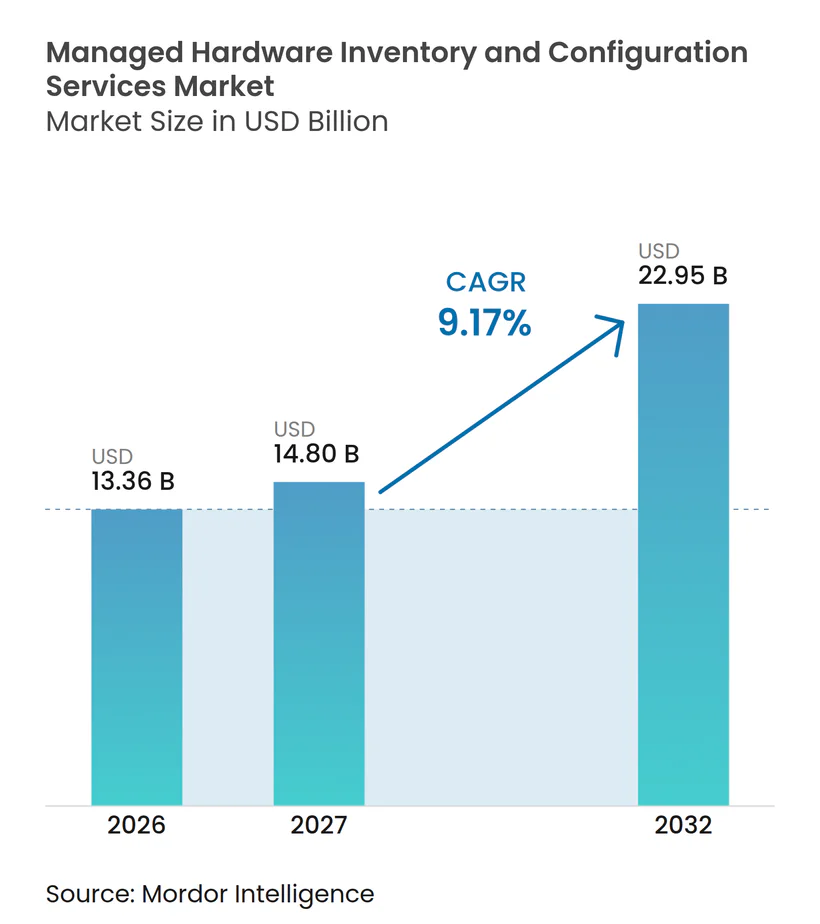
The managed hardware inventory and configuration services market size is projected to expand from USD 13.36 billion in 2026 and USD 14.80 billion in 2027 to USD 22.95 billion by 2032, registering a CAGR of 9.17% between 2027 to 2032. Demand is rising because internal IT teams often cannot maintain accurate records across home offices, branch sites, colocation facilities, and data centers. Edge computing and AI deployments add devices with different accelerators, firmware, operating systems, and local settings. This makes configuration work more difficult as each additional site can introduce a new combination of hardware and software requirements. Compliance and lifecycle obligations are also making traceability, secure retirement, and documented custody more central to technology operations. Providers are responding by combining inventory, configuration, compliance evidence, asset recovery, and residual-value services into longer-term managed contracts.
Key Report Takeaways
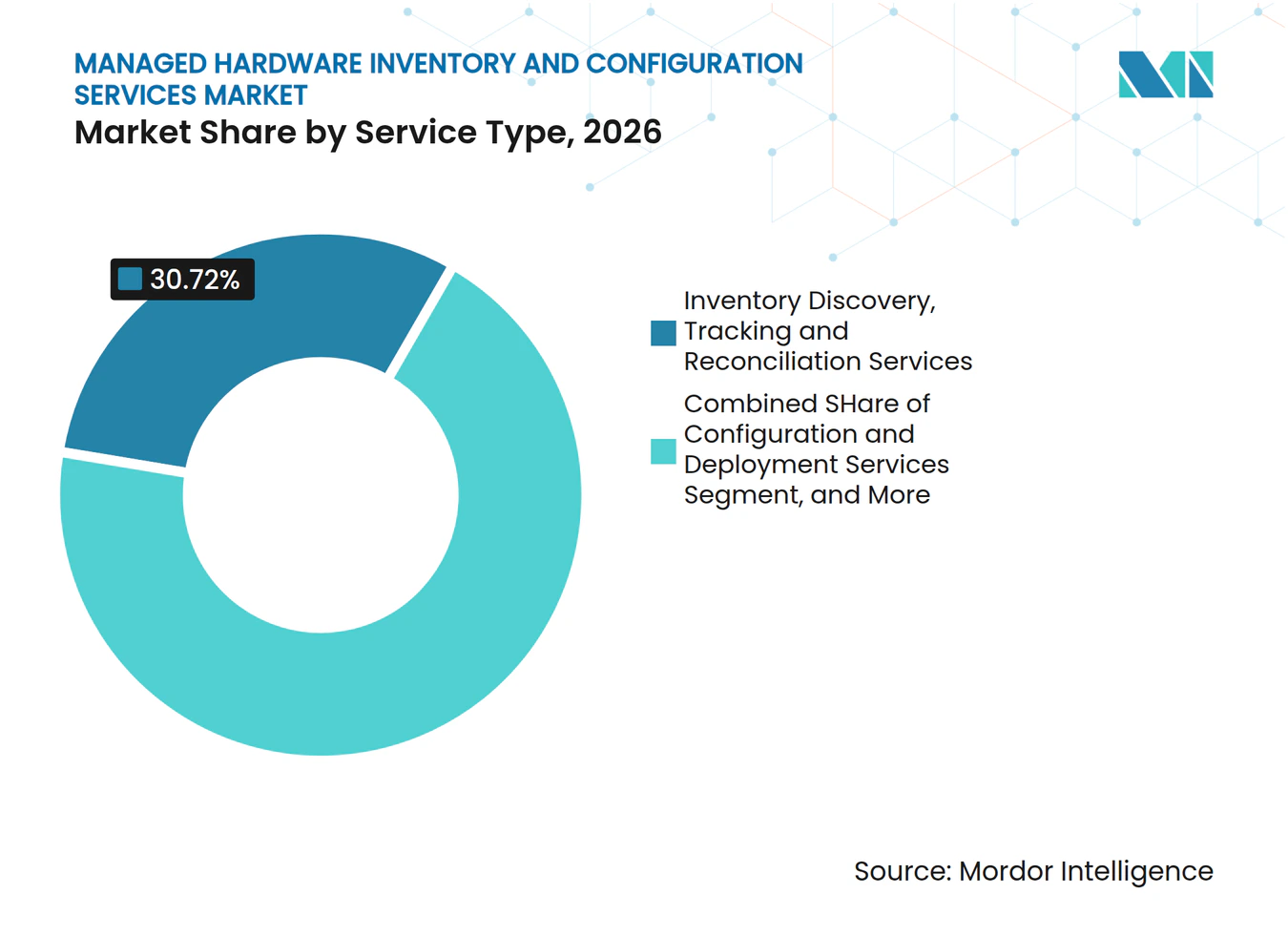
- By service type, inventory discovery, tracking, and reconciliation services held 30.72% of the managed hardware inventory and configuration services market share in 2026, while configuration and deployment services are projected to expand at a 10.23% CAGR through 2032.
- By deployment model, cloud-based deployment held 61.30% of revenue in 2026 and is projected to expand at a 10.79% CAGR through 2032.
- By asset type, servers and data-processing hardware held 35.47% of of the managed hardware inventory and configuration services market share in 2026 and are projected to expand at a 10.31% CAGR through 2032.
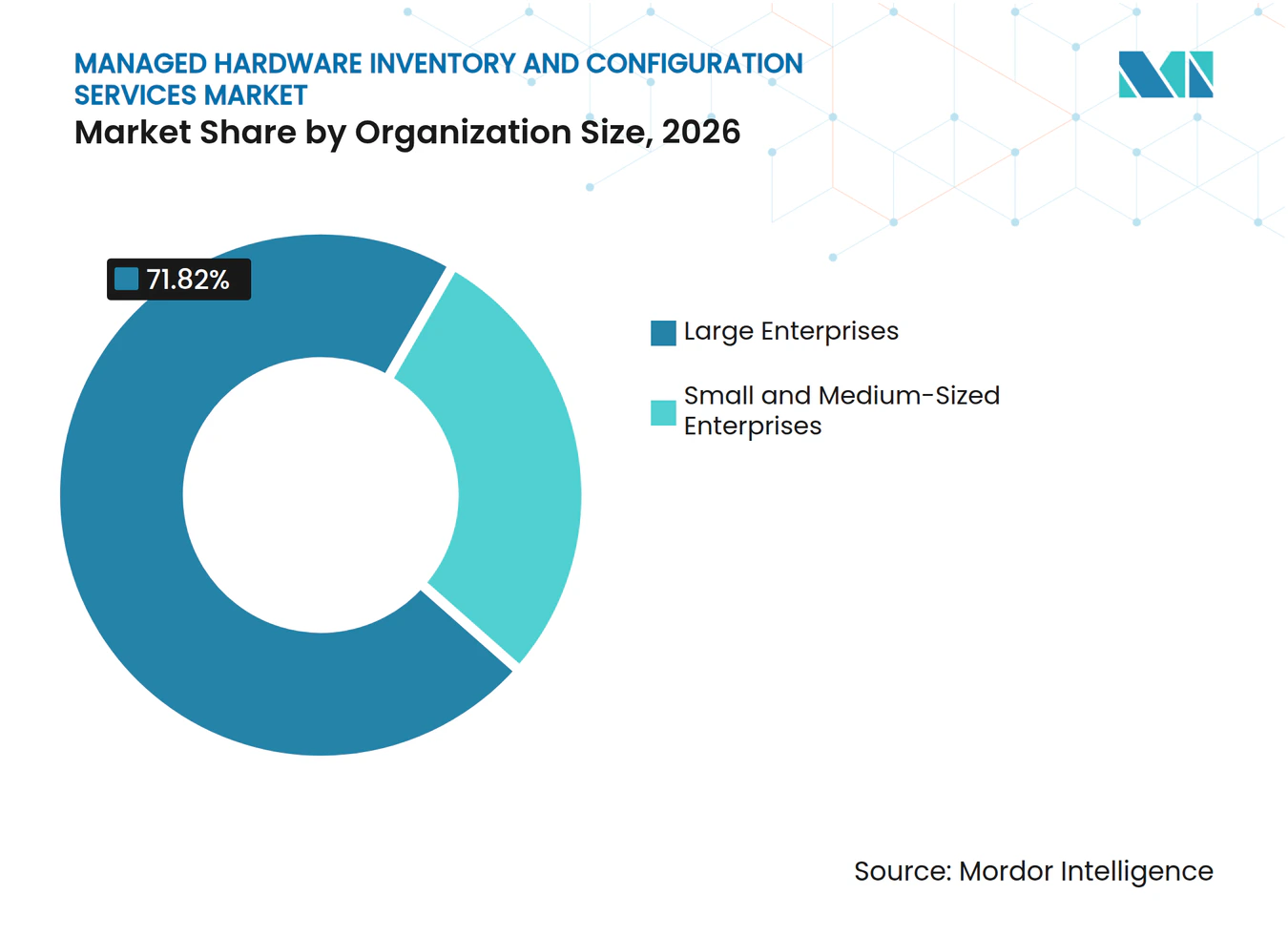
- By organization size, large enterprises held 71.82% of revenue in 2026, while SMEs are projected to expand at a 10.97% CAGR through 2032.
- By end-user industry, IT and telecommunications held 29.58% of of the managed hardware inventory and configuration services market share in 2026, while manufacturing and industrial is projected to expand at an 11.19% CAGR through 2032.
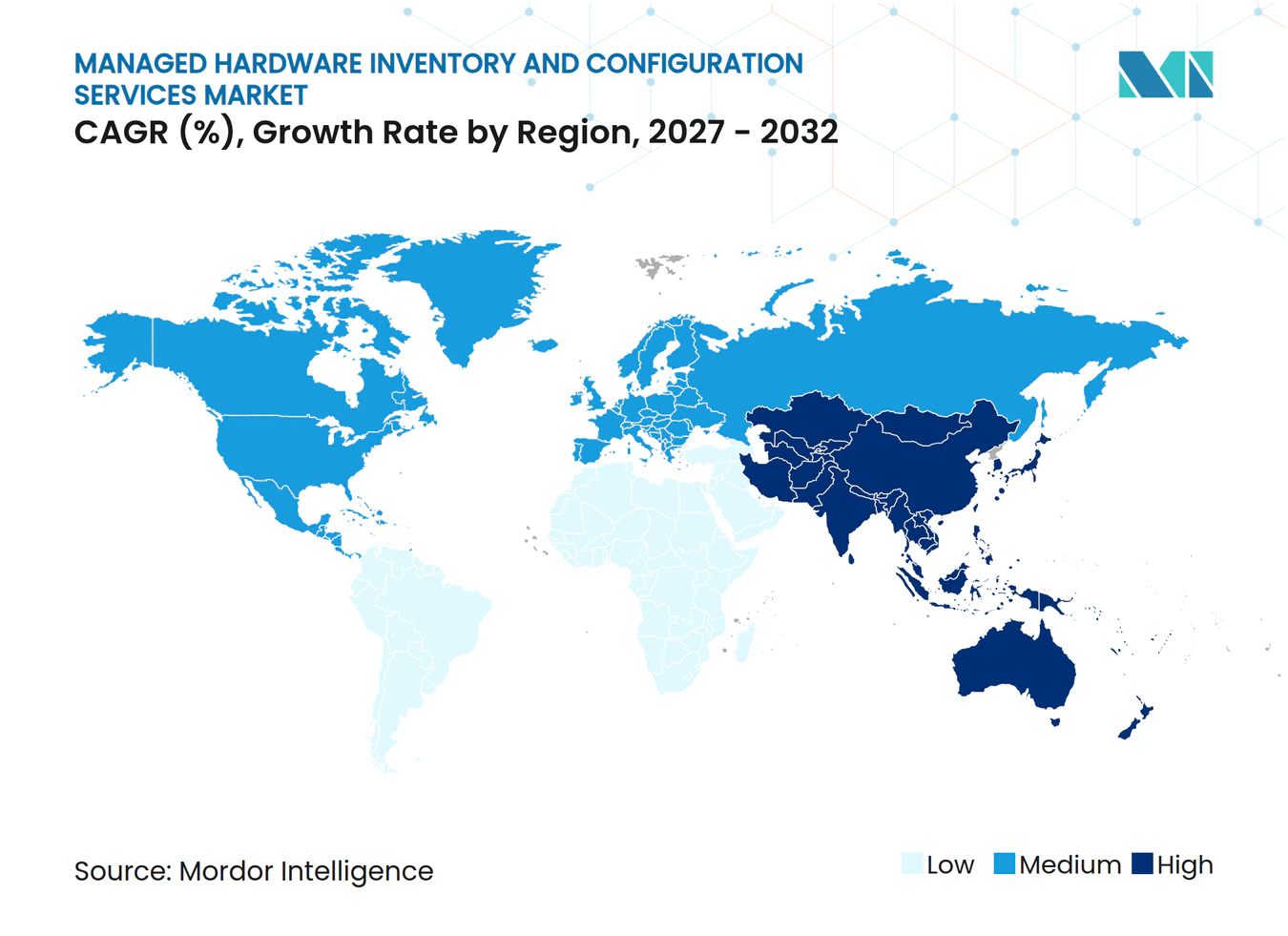
- By geography, North America held 38.17% of revenue in 2026, while Asia-Pacific is projected to expand at an 11.43% CAGR through 2032.
Note: Market numbers in this report are based on Mordor Intelligence's proprietary estimation framework, which combines nine months of actuals with Q4 projections for base year 2026.
Market Trends and Insights
Drivers Impact Analysis of Managed Hardware Inventory and Configuration Services Market*
| Driver | (~) % Impact on CAGR Forecast | Geographic Relevance | Impact Timeline |
|---|---|---|---|
| Hybrid Work Expanding Distributed Hardware Visibility Needs | +2.1% | Global | Short term (≤ 2 years) |
| Hybrid, Edge, and AI Infrastructure Increasing Configuration Complexity | +1.8% | Global, strongest in North America and Asia-Pacific | Medium term (2-4 years) |
| Rising Compliance Requirements for Asset Traceability and Secure Retirement | +1.5% | Global, strongest in Europe and North America | Short term (≤ 2 years) |
| Hardware Lifecycle Extension and Circular-Economy Economics | +1.3% | Global, strongest in Europe and Asia-Pacific | Long term (≥ 4 years) |
| Configuration Drift Across Remote and Multi-Vendor Fleets | +0.9% | Global, strongest in North America and Europe | Medium term (2-4 years) |
| Machine-Readable Asset Records Enabling Faster Zero-Touch Deployment | +0.7% | Global | Long term (≥ 4 years) |
| Source: Mordor Intelligence | |||
Hybrid Work Expanding the Need for Distributed Hardware Visibility
Hybrid work has placed enterprise hardware across far more locations than a conventional office-based inventory process was designed to support. Devices now move between offices, employee homes, storage facilities, and replacement pools, which can leave the record of ownership or location incomplete. Allwhere reported that remote asset management needs become more difficult when devices change locations without corresponding record updates, increasing the risk of duplicate purchasing and missed security actions. The managed hardware inventory and configuration services market benefits because clients need regular tracking rather than a periodic physical count. Global provisioning, collection, onboarding, and offboarding also become more valuable when an employer cannot rely on a single office to manage every device. This supports recurring service arrangements that include visibility, custody, and standardized employee workflows.
Hybrid, Edge, and AI Infrastructure Increasing Configuration Complexity
Edge and AI deployments use a wider mix of processors, operating systems, device drivers, firmware versions, and local network conditions than a homogeneous server environment. An ACM study described edge AI deployments that commonly involve 5 to 10 hardware and operating system combinations, each with separate constraints for upgrades and integration.[1] The managed hardware inventory and configuration services market is therefore supported by demand for teams that can manage settings across more than 1 vendor. A firmware change on 1 device can affect adjacent equipment that relies on a different vendor’s software or interface. Organizations also need consistent records for network appliances, AI inference nodes, IoT gateways, and site-level computing equipment. Managed providers can address this work through standardized configuration baselines, tested deployment steps, and ongoing exception management.
Rising Compliance Requirements for Asset Traceability and Secure Retirement
Regulatory requirements are making hardware records a source of evidence rather than an administrative record. The NIS2 Directive establishes cybersecurity risk-management requirements for covered entities, and DORA sets operational resilience obligations for financial entities that depend on ICT systems. U.S. healthcare rules also require procedures for the movement and disposal of devices and media that contain electronic protected health information. ServiceNow introduced Asset Audit Response in its Zurich release to provide point-in-time asset data, historical comparison, and automated evidence collection for financial services compliance work. These requirements favor current, time-stamped records and documented workflows for allocation, changes, recovery, and retirement. The managed hardware inventory and configuration services market gains relevance in regulated sectors because unmanaged records are less likely to meet audit needs.
Hardware Lifecycle Extension and Circular-Economy Economics
Longer refresh cycles make the condition, location, repair history, and recovery path of each device more important. The ITU L.1071 recommendation provides a methodology for assessing the environmental impact of ICT goods, networks, and services across their life cycle. Lenovo introduced TruScale Device as a Service for Sustainability in August 2025 with carbon reporting, refurbished devices, offset services, and asset recovery options. Lenovo stated that certain deployments showed up to 35% lower device-related IT costs, while the offer also supports responsible device retirement. The managed hardware inventory and configuration services market can benefit where clients require a documented record through refurbishment, resale, recycling, or disposal. Providers that combine device tracking with certified recovery and reporting can make lifecycle management easier to procure as a single service.
Restraints Impact Analysis of Managed Hardware Inventory and Configuration Services Market*
| Restraint | (~) % Impact on CAGR Forecast | Geographic Relevance | Impact Timeline |
|---|---|---|---|
| Legacy-System Integration and Data-Silo Friction | -1.9% | Global | Medium term (2-4 years) |
| OEM Warranty, Tooling, and Data-Access Lock-In | -1.5% | Global, strongest in North America and Europe | Medium term (2-4 years) |
| Shortage of Multi-Vendor Configuration and Field-Service Talent | -1.1% | Global, most acute in North America and Asia-Pacific | Long term (≥ 4 years) |
| Incomplete Chain of Custody for Remote and Secondary-Market Assets | -0.7% | Global, strongest in Asia-Pacific and Middle East and Africa | Long term (≥ 4 years) |
| Source: Mordor Intelligence | |||
Legacy-System Integration and Data-Silo Friction
Many enterprises hold asset records in legacy enterprise resource planning systems, spreadsheets, configuration databases, and separate IT service management platforms. These systems may use different identifiers, update schedules, and data structures. An IEEE conference study found that phased digital transformation can improve monitoring and reporting, but fragmented architectures can still delay the consolidation needed for timely inventory information. The managed hardware inventory and configuration services market faces a longer onboarding process when service providers must reconcile multiple sources before operating a reliable inventory. Integration work can raise initial project costs and postpone operational value. The challenge is particularly significant for large enterprises that have accumulated technology tools over many years.
OEM Warranty, Tooling, and Data-Access Lock-In
OEM warranty terms can limit the work that third parties perform on covered equipment. Dell states that its warranty does not cover problems arising from service not authorized by Dell, while HP publishes warranty conditions that can limit claims after unauthorized changes.[2] OEM management platforms also require managed providers to support separate toolsets or connectors across a mixed fleet. This can add cost, duplicate data flows, and slow the use of a common configuration record. The managed hardware inventory and configuration services market is affected because clients with several OEMs may need providers with specific credentials and warranty-safe processes. Providers that can demonstrate authorized delivery and interoperable workflows are better positioned in formal procurement reviews.
*Our forecasts treat driver/restraint impacts as directional, not additive. The impact forecasts reflect baseline growth, mix effects, and variable interactions.
Managed Hardware Inventory and Configuration Services Market Segment Analysis
By Service Type:
Inventory Discovery Anchors Revenue, Configuration Services Drive GrowthInventory discovery, tracking, and reconciliation services held 30.72% of revenue in 2026, making them the largest service category. The result reflects the need to establish an accurate asset count before configuration, audit, or recovery work can be performed reliably. Clients need to know what equipment exists, where it is deployed, who uses it, and whether it remains operational. This service often forms the initial scope of a managed contract because it provides the record used by downstream teams. Configuration and deployment services are projected to expand at a 10.23% CAGR through 2032 as businesses seek repeatable provisioning and consistent settings. The managed hardware inventory and configuration services industry uses this service to support zero-touch enrollment, edge-device standardization, and multi-vendor fleet controls. A Maintech case study reported that a global media company with 40,000 endpoints increased annual refresh completion from 47% to 150% after adopting a managed provisioning approach. The same case study reported a 74% reduction in hardware failure tickets and a 25% reduction in migration time without additional internal IT headcount.
Audit, compliance, and reporting services are becoming more visible as regulated buyers ask for a defensible history of asset activity. ServiceNow’s Zurich release introduced a dedicated compliance evidence capability for IT asset management in financial services.[3] This helps distinguish compliance work from basic recordkeeping. Lifecycle support and maintenance coordination also gain importance when customers keep devices in service for longer periods. Recovery, remarketing coordination, and certified disposal can extend the provider relationship beyond deployment and active use. These service lines broaden the managed hardware inventory and configuration services market by linking active device management with end-of-life responsibilities. Microsoft Autopilot, Apple Automated Device Enrollment, and Android Zero-Touch Enrollment require enrollment records and policy templates before devices reach users. Service providers can prepare these records at scale for organizations that cannot maintain the process internally. SMEs can also adopt managed configuration services when consistent security settings and remote deployment become more important than ad hoc device setup.



By Deployment Model:
Cloud-Based Architecture Consolidates Market DominanceCloud-based deployment held 61.30% of revenue in 2026 and is projected to expand at a 10.79% CAGR through 2032. This dual position indicates that cloud delivery is already widely used and continues to gain acceptance. Cloud-hosted platforms can deploy discovery agents and manage device records across dispersed locations without requiring customers to maintain local discovery infrastructure. This is useful for organizations with branch offices, remote workers, field staff, and distributed sites. The managed hardware inventory and configuration services market size for cloud-based deployment is supported by the need for centralized visibility across these environments. A Japan Security Summit survey of 1,000 IT professionals found that 89.7% of organizations using or planning to use IT asset management tools chose cloud deployment. The same survey reported that this share was 8.4 percentage points higher than in 2023.
On-premises deployment remains relevant for defense, government, regulated utilities, and other settings with data sovereignty or air-gap requirements. These users may prefer local processing and direct control over the systems that collect inventory data. Hybrid models address this need by combining local discovery or data handling with centralized cloud orchestration and reporting. They can provide enterprise visibility while allowing defined data to remain within a controlled environment. The choice of deployment model is therefore driven by operating conditions rather than a uniform technology preference. The managed hardware inventory and configuration services market needs providers that can support identity controls, local connectivity, and policy-based data routing for customers with strict requirements. Cloud platforms remain attractive because they reduce administrative overhead and can speed deployment across new locations. Hybrid capability remains important because many regulated clients need a practical path between local controls and centralized management.
By Asset Type:
Server Infrastructure at the Center of Managed-Service ContractsServers and data-processing hardware held 35.47% of revenue in 2026 and are projected to expand at a 10.31% CAGR through 2032. This category commands the largest position because server settings often involve firmware, BIOS standards, security modules, operating systems, and application dependencies. High-performance computing and AI inference deployments increase the density of processing equipment at data centers and edge sites. The managed hardware inventory and configuration services market share for servers reflects their higher service complexity relative to many endpoint devices. A configuration error can affect uptime, security settings, and the operation of connected workloads. Server contracts can therefore require closer technical oversight than device-count measures alone suggest. The category also includes work to record configuration status, service history, and approved changes across multiple locations.
Network equipment is a major category because routers, switches, wireless equipment, and SD-WAN appliances require compatible software and carefully controlled configuration changes. Storage devices, desktops, and laptops usually account for higher unit volumes, though their per-device managed-service value can be lower. Desktop and laptop management remains important for employee onboarding, replacement, collection, and secure return processes. Other equipment includes operational technology-adjacent devices, industrial sensors, IoT gateways, and medical hardware. These devices may use specialized interfaces or cannot run a conventional discovery agent. ISO/IEC 27001:2022 addresses information security management requirements that include controls around information assets. The managed hardware inventory and configuration services market therefore requires asset classification practices that distinguish standard endpoints from high-risk or specialized hardware. This creates room for services that link inventory records to device type, operating status, ownership, location, and lifecycle action.
By Organization Size:
Large Enterprises Anchor Revenue, SMEs Emerge as Growth EnginesLarge enterprises held 71.82% of revenue in 2026, supported by the scale of their hardware estates and the number of procurement and lifecycle events they manage. Organizations with 5,000 or more employees often operate across offices, data centers, service depots, and field locations. They may also face different regulatory obligations across national markets. The managed hardware inventory and configuration services market relies heavily on these clients because they need inventory data to connect procurement, human resources, security, and IT service operations. Multi-site refresh programs and audit-ready records can make managed inventory an ongoing operating requirement. Large customers also need services that can support complex approval paths and integrations. Their requirements create demand for platforms and service teams that can coordinate high volumes without losing device-level detail.
SMEs are projected to expand at a 10.97% CAGR through 2032. They often lack the personnel to operate a dedicated IT asset management function or to license and administer a complex enterprise platform. Supply-chain requirements and certification expectations can also bring more formal controls to firms that previously managed devices informally. The NIS2 Directive establishes risk-management and supply-chain cybersecurity obligations for covered entities and relevant ecosystems. The managed hardware inventory and configuration services market gives these providers a route to differentiate through simple onboarding, fixed fees, and connectors for common mid-market software. These customers may value fast setup and clear responsibility more than extensive customization. Remote deployment and secure recovery services are particularly relevant when a small internal team supports employees across many locations. This demand gives providers a route to package discovery, configuration, tracking, and retirement as a manageable subscription.

By End-User Industry:
IT and Telecommunications Lead Revenue, Manufacturing AcceleratesIT and telecommunications held 29.58% of 2026 end-user revenue, making it the largest industry segment. Technology companies and telecommunications operators run dense hardware environments and maintain frequent refresh cycles. Many already work with managed service providers, which supports the use of external inventory and configuration specialists. The managed hardware inventory and configuration services market includes these buyers because their network, endpoint, and data-processing environments require current records. Their operations also face version-specific compatibility issues across a range of devices and platforms. This makes structured change control important alongside basic inventory accuracy. The concentration of hardware procurement and managed service relationships in this sector supports sustained demand for integrated delivery.
Manufacturing and industrial is projected to expand at an 11.19% CAGR through 2032. Factories are adding connected sensors, edge computing equipment, AI-enabled inspection hardware, and conventional IT endpoints. This expands the asset register beyond office devices and data center systems. IT and operational technology teams need visibility that can accommodate production environments and specialized device types. The scope also includes banking, financial services, and insurance, where DORA and audit requirements raise the importance of ICT asset records. Healthcare and life sciences organizations must consider device and media safeguards for hardware that stores electronic protected health information. Retail and e-commerce companies use managed inventory to follow point-of-sale devices, network equipment, and fulfillment-center assets. Each sector requires different deployment practices, but all require clear ownership, location, configuration, and retirement records.
Geography Analysis
North America Managed Hardware Inventory and Configuration Services Market
North America held 38.17% of 2026 revenue, the largest regional position in the managed hardware inventory and configuration services market. The region has a high concentration of large enterprises and a mature ecosystem of managed service providers, OEMs, resellers, and systems integrators. Defense-linked compliance needs and formal security requirements also support documented hardware lifecycle practices. Organizations with complex procurement channels can combine hardware purchasing with managed inventory, configuration, and recovery services. This encourages bundled offerings rather than separate point products. Canadian and Mexican demand is also linked to cross-border operations and the need to track assets supporting near-shored activity. The regional market is competitive because IT resellers and platform providers can add managed inventory services to established procurement, support, and lifecycle relationships.
APAC Managed Hardware Inventory and Configuration Services Market
Asia-Pacific is projected to expand at an 11.43% CAGR through 2032, the fastest regional rate. Manufacturing digitalization in Japan, data center expansion in China and India, and ICT governance needs in South Korea and Southeast Asia support demand. The managed hardware inventory and configuration services market size is also supported by companies that operate extensive electronics, manufacturing, and infrastructure estates. A Japan Security Summit survey found that 57.6% of 1,000 Japanese IT professionals used IT asset management tools in 2025. The same survey found a 2025 preference for cloud-based deployment among 89.7% of organizations using or planning to use those tools. These conditions support providers that can manage dispersed fleets while meeting local operational requirements.
EMEA and South America Managed Hardware Inventory and Configuration Services Market
Europe is shaped by rules that make current ICT asset records more important for financial institutions and critical infrastructure operators. NIS2 and DORA place cybersecurity and operational resilience responsibilities on covered organizations. Bechtle launched Circular IT in July 2025, offering certified data erasure, refurbishment, resale, and recycling services from its Hamburg logistics center.[4] 3stepIT announced an expansion into North America in January 2026, showing that circular technology services can move beyond their original regional base. These regulatory and lifecycle needs give the managed hardware inventory and configuration services market a defined role in European procurement decisions. South America remains an emerging region centered on Brazil, with demand tied to manufacturing and financial services activity. The Middle East is supported by government and infrastructure hardware deployments, while Africa is early-stage and is led by South Africa and Nigeria.
Competitive Landscape
Market Concentration
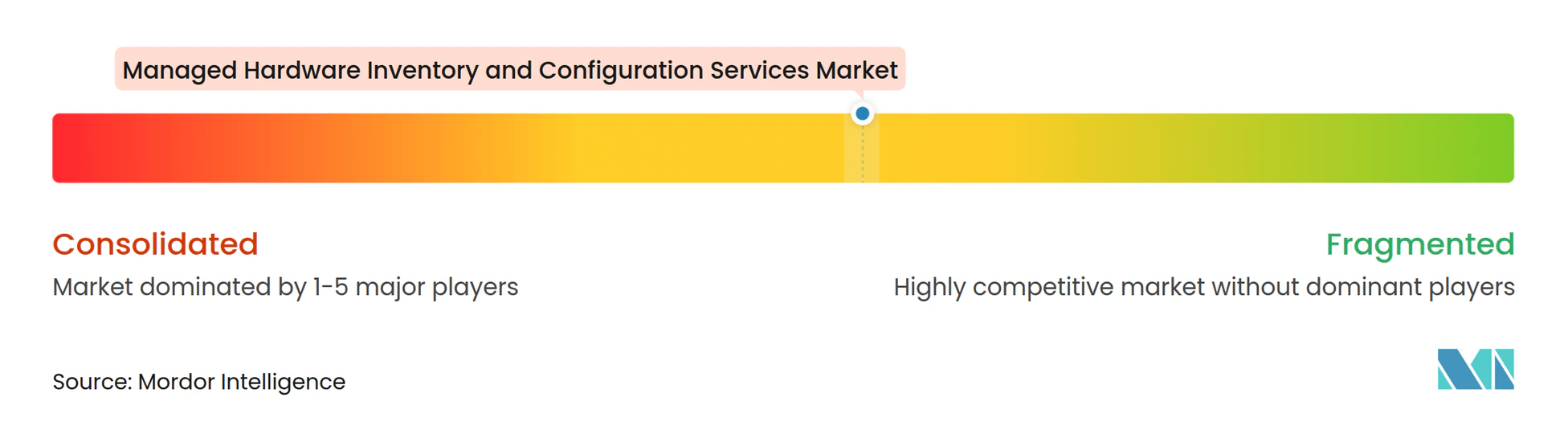
The managed hardware inventory and configuration services market is moderately fragmented. Global IT service providers include IBM, Kyndryl, Unisys, Fujitsu, and Computacenter. OEM-aligned providers include Lenovo, HPE, and Dell Technologies. IT resellers and solutions integrators include CDW, SHI International, and Insight Enterprises. Platform and specialist providers include ServiceNow, Ivanti, Lansweeper, Device42, Oomnitza, InvGate, and Certero. This mix creates different competitive positions across enterprise accounts, mid-market clients, and industry-specific deployments. Large providers can combine services with existing hardware, software, or outsourcing relationships, while smaller specialists can compete through discovery breadth, agentless methods, or simpler commercial terms.
Platform consolidation is becoming more important as customers seek fewer handoffs across the device lifecycle. ServiceNow and Lenovo expanded their multi-year agreement in May 2026 to combine Lenovo’s xIQ Digital Workplace Platform with ServiceNow’s AI Control Tower and Workflow Data Fabric. The companies stated that the collaboration aims for up to 30% lower IT support costs and 50% faster employee onboarding through automated lifecycle workflows. Park Place Technologies launched ParkView Asset Intelligence in April 2026, using telemetry, service history, and parts availability to provide device-level predictive failure scoring across nearly 1 million assets. These examples show that asset data is being connected more closely with operational support and workflow tools. Providers are increasingly differentiating through health scoring, lifecycle automation, and the ability to combine data from different hardware vendors.
Opportunities remain in factory-floor operational technology and IoT assets that cannot use traditional discovery agents. Providers can also address secondary-market traceability through documented custody, data destruction, remarketing, and residual-value recovery. Circular service bundles are gaining relevance because they join recovery, environmental reporting, and retirement management in a single offering. Lenovo expanded Asset Recovery Services across more than 43 markets in April 2025, allowing coverage at different stages of the hardware lifecycle and across device brands. Auvik integrated Network Management with ServiceNow CMDB in June 2025 to synchronize network-device inventory records in both directions The managed hardware inventory and configuration services market rewards providers that deli,ver reliable asset records, support mixed hardware fleets, meet compliance needs, and keep delivery practical for different customer sizes.
Managed Hardware Inventory and Configuration Services Industry Leaders
-
ServiceNow, Inc.
-
IBM Corporation
-
Dell Technologies Inc.
-
Ivanti, Inc.
-
Flexera Software, Inc.
- *Disclaimer: Major Players sorted in no particular order
Managed Hardware Inventory and Configuration Services Market Companies Covered in this Report
- ServiceNow, Inc.
- IBM Corporation
- Hewlett Packard Enterprise Company
- Dell Technologies Inc.
- Lenovo Group Limited
- Ivanti, Inc.
- Flexera Software, Inc.
- BMC Software, Inc.
- Nexthink
- Axonius, Inc.
- OpenText Corporation
- Lansweeper NV
- Device42, Inc.
- Oomnitza, Inc.
- Certero Limited
- InvGate S.R.L.
- Park Place Technologies, LLC
- Service Express, Inc.
- Evernex International SAS
- Computacenter plc
- SHI International Corp.
- Insight Enterprises, Inc.
- CDW Corporation
- Kyndryl, Inc.
- Unisys Corporation
- Fujitsu Limited
Recent Industry Developments in Managed Hardware Inventory and Configuration Services Market
- October 2026: Park Place Technologies launched a redesigned Central Park customer portal, introducing Parkview Asset Intelligence in beta, an AI-powered platform that assigns risk scores and tags to hardware assets using telemetry from nearly 1 million enrolled assets, factors in supply-chain parts availability by geography, and benchmarks scores against comparable devices globally to support proactive IT infrastructure health management.
- October 2026: Accenture, Dragos Inc., and the SANS Institute announced a major initiative to help strengthen cyber defenses for under-resourced U.S. water, electric, and natural gas utilities that provide essential services but often lack resources for adequate protection for their operational technology (OT) environments. In its first phase, the initiative will provide cybersecurity software, hardware, deployment services, and SANS training free of charge to up to 500 under-resourced utilities. Accenture, Dragos, and SANS are making an initial combined commitment of approximately USD 10 million in funding and services.
- May 2026: ServiceNow and Lenovo announced an expanded multi-year strategic agreement at Knowledge 2026, combining Lenovo's xIQ Digital Workplace Platform with ServiceNow's AI Control Tower and Workflow Data Fabric to automate device lifecycle workflows end-to-end. Claimed outcomes include up to 30% lower IT support costs and 50% faster employee onboarding. The collaboration launched commercially across Australia, New Zealand, Hong Kong, Singapore, and Ireland, with broader global expansion planned.
- February 2026: 3stepIT, a circular technology services company managing over 4 million devices, announced a strategic expansion into the North American market, adding a new focus on data center lifecycle services and bringing its circular IT methodology, covering procurement, asset management, responsible decommissioning, and remarketing, to the North American enterprise buyer base.
Global Managed Hardware Inventory and Configuration Services Market Report Scope
Managed hardware inventory and configuration services refer to an outsourced IT model where a third-party provider completely handles the sourcing, setting up, tracking, and maintaining of a company's physical devices (like laptops, servers, and routers). Instead of an internal IT department managing the physical lifecycle of hardware, the managed service provider (MSP) ensures that all equipment is accounted for and ready to use the moment it arrives.
The Managed Hardware Inventory and Configuration Services Market Report is Segmented by Service Type (Inventory Discovery, Tracking and Reconciliation Services, Configuration and Deployment Services, Audit, Compliance and Reporting Services, Lifecycle Support and Maintenance Coordination, and Other Service Types), Deployment Model (Cloud-Based, On-Premises, and Hybrid), Asset Type (Servers and Data-Processing Hardware, Network Equipment, Storage Devices, Desktops and Laptops, and Other Asset Types), Organization Size (Large Enterprises and Small and Medium-Sized Enterprises), End-User Industry (IT and Telecommunications, BFSI, Healthcare and Life Sciences, Manufacturing and Industrial, Retail and E-Commerce, and Other End-User Industries), and Geography (North America, South America, Europe, Asia-Pacific, Middle East, and Africa). The Market Forecasts are Provided in Terms of Value (USD).
Segmentation Overview
| Inventory Discovery, Tracking and Reconciliation Services |
| Configuration and Deployment Services |
| Audit, Compliance and Reporting Services |
| Lifecycle Support and Maintenance Coordination |
| Other Service Types |
| Cloud-Based |
| On-Premises |
| Hybrid |
| Servers and Data-Processing Hardware |
| Network Equipment |
| Storage Devices |
| Desktops and Laptops |
| Other Asset Types |
| Large Enterprises |
| Small and Medium-Sized Enterprises |
| IT and Telecommunications |
| BFSI |
| Healthcare and Life Sciences |
| Manufacturing and Industrial |
| Retail and E-Commerce |
| Other End-User Industries |
| North America | United States |
| Canada | |
| Mexico | |
| South America | Brazil |
| Argentina | |
| Rest of South America | |
| Europe | Germany |
| United Kingdom | |
| France | |
| Italy | |
| Rest of Europe | |
| Asia-Pacific | China |
| Japan | |
| India | |
| South Korea | |
| Rest of Asia-Pacific | |
| Middle East | United Arab Emirates |
| Saudi Arabia | |
| Rest of Middle East | |
| Africa | South Africa |
| Nigeria | |
| Rest of Africa |
| By Service Type | Inventory Discovery, Tracking and Reconciliation Services | |
| Configuration and Deployment Services | ||
| Audit, Compliance and Reporting Services | ||
| Lifecycle Support and Maintenance Coordination | ||
| Other Service Types | ||
| By Deployment Model | Cloud-Based | |
| On-Premises | ||
| Hybrid | ||
| By Asset Type | Servers and Data-Processing Hardware | |
| Network Equipment | ||
| Storage Devices | ||
| Desktops and Laptops | ||
| Other Asset Types | ||
| By Organization Size | Large Enterprises | |
| Small and Medium-Sized Enterprises | ||
| By End-User Industry | IT and Telecommunications | |
| BFSI | ||
| Healthcare and Life Sciences | ||
| Manufacturing and Industrial | ||
| Retail and E-Commerce | ||
| Other End-User Industries | ||
| By Geography | North America | United States |
| Canada | ||
| Mexico | ||
| South America | Brazil | |
| Argentina | ||
| Rest of South America | ||
| Europe | Germany | |
| United Kingdom | ||
| France | ||
| Italy | ||
| Rest of Europe | ||
| Asia-Pacific | China | |
| Japan | ||
| India | ||
| South Korea | ||
| Rest of Asia-Pacific | ||
| Middle East | United Arab Emirates | |
| Saudi Arabia | ||
| Rest of Middle East | ||
| Africa | South Africa | |
| Nigeria | ||
| Rest of Africa | ||
Key Questions Answered in the Report
What is the size of the managed hardware inventory and configuration services market?
The market is projected at USD 14.80 billion in 2027 and is expected to reach USD 22.95 billion by 2032, at a 9.17% CAGR.
What is driving demand for managed hardware inventory services?
Hybrid work, dispersed device estates, edge and AI hardware, compliance needs, and longer device lifecycles are increasing demand for current asset records and managed configuration.
Which service type has the largest revenue position?
Inventory discovery, tracking, and reconciliation services held 30.72% of revenue in 2026 because accurate asset records support later configuration, audit, and recovery work.
Which deployment model is expanding most quickly?
Cloud-based deployment held 61.30% of revenue in 2026 and is projected to expand at a 10.79% CAGR through 2032.
Which customer group is expanding most quickly?
SMEs are projected to expand at a 10.97% CAGR through 2032, supported by outsourcing needs, simpler service packages, and growing compliance expectations.
Which region has the highest projected growth rate?
Asia-Pacific is projected to expand at an 11.43% CAGR through 2032, supported by manufacturing digitalization, data center activity, and ICT governance requirements.