
Managed Desktop Support Services Market Size and Share
Market Overview
| Study Period | 2021 - 2032 |
|---|---|
| Market Size (2027) | USD 37.14 Billion |
| Market Size (2032) | USD 50.97 Billion |
| Growth Rate (2027 - 2032) | 6.54 % |
| Fastest Growing Market | Asia-Pacific |
| Largest Market | North America |
| Market Concentration | Low |
Major Players *Disclaimer: Major Players sorted in no particular order Image © Mordor Intelligence. Reuse requires attribution under CC BY 4.0. | |
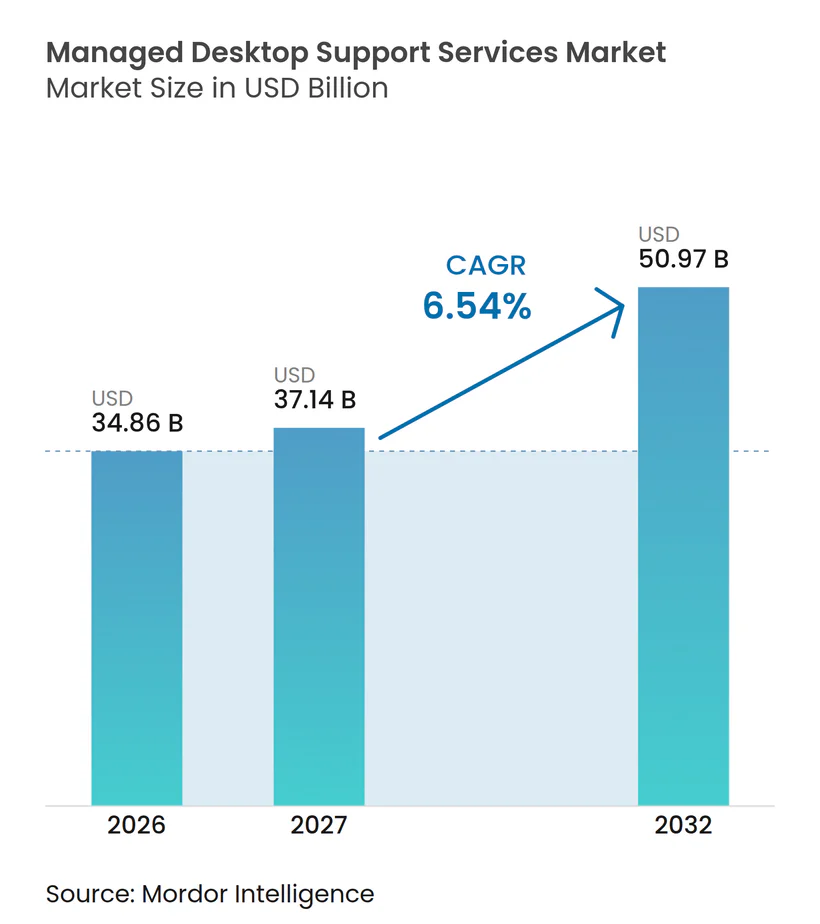
Managed Desktop Support Services Market Analysis by Mordor Intelligence
The Managed Desktop Support Services Market size is projected to expand from USD 34.86 billion in 2026 and USD 37.14 billion in 2027 to USD 50.97 billion by 2032, registering a CAGR of 6.54% between 2027 to 2032. The Managed Desktop Support Services Market is supported by the shift toward distributed computing, which makes endpoint oversight harder for internal IT teams. Hybrid work requires providers to maintain consistent security, device health, and user support across corporate, home, and mobile networks. Cloud-native architectures also bring smaller organizations into outsourced support arrangements that were once limited to large enterprises. Buyers are increasingly combining endpoint monitoring, security, helpdesk, and lifecycle services within broader contracts. Competitive decisions now depend on automation depth, delivery reach, and the ability to price services against outcomes rather than labor inputs.
Key Report Takeaways
- By service type, Helpdesk and User Support Services held 26.27% of the Managed Desktop Support Services Market share in 2026, while Endpoint Security and Threat Protection is projected to expand at a 6.88% CAGR through 2032.
- By delivery model, Hybrid Managed Desktop Support held 41.88% of revenue in 2026, while Cloud-Based Managed Desktop Support is projected to expand at a 6.94% CAGR through 2032.
- By organization size, Large Enterprises accounted for 70.83% of revenue in 2026, while Small and Medium Enterprises are projected to expand at a 6.83% CAGR through 2032.
- By device and endpoint type, Laptops held 35.66% of revenue in 2026, while Virtual Desktops and Cloud PCs are projected to expand at a 7.11% CAGR through 2032.
- By end-user industry, BFSI held 20.77% of revenue in 2026, while Healthcare and Life Sciences are projected to expand at a 7.24% CAGR through 2032.
- By geography, North America held 38.36% of revenue in 2026, while Asia-Pacific is projected to expand at a 7.13% CAGR through 2032.
Note: Market numbers in this report are based on Mordor Intelligence's proprietary estimation framework, which combines nine months of actuals with Q4 projections for base year 2026.
Global Managed Desktop Support Services Market Trends and Insights
Drivers Impact Analysis*
| Driver | (~) % Impact on CAGR Forecast | Geographic Relevance | Impact Timeline |
|---|---|---|---|
| Hybrid and Remote Workforce Endpoint Complexity | +1.50% | Global, with highest intensity in North America and Europe | Short term (≤ 2 years) |
| AI-Enabled Service Desk Automation and Predictive Support | +1.30% | Global, with advanced early adoption in North America and Asia-Pacific | Medium term (2-4 years) |
| Cloud-Based Desktop and Helpdesk Adoption | +1.10% | Global, with fastest progression in Asia-Pacific and Europe | Medium term (2-4 years) |
| Rising Endpoint Security and Compliance Requirements | +1.00% | North America and Europe, with spillover to Asia-Pacific core markets | Short term (≤ 2 years) |
| Invisible Endpoint and Management-Optional Device Proliferation | +0.70% | Global | Long term (≥ 4 years) |
| Lifecycle Intelligence for Sustainable Device Refresh | +0.50% | North America and Europe, with early gains in large Asia-Pacific enterprises | Long term (≥ 4 years) |
| Source: Mordor Intelligence | |||
Hybrid and Remote Workforce Endpoint Complexity Drives Outsourcing Mandates
Hybrid work has changed the way organizations manage devices across many networks and locations. Devices moving between corporate networks, home connections, and mobile data can create gaps in policy enforcement. The 2025 Parallels survey identified excessive IT resource consumption and limited centralized control as key virtual desktop challenges for midmarket organizations.[1] The Managed Desktop Support Services Market therefore benefits when enterprises need consistent oversight regardless of employee location. Providers use remote monitoring and cloud-native policy tools to make service delivery less dependent on on-premises systems. This need is strengthening the relationship between the hybrid workforce scale and managed endpoint contract renewal, especially for employers that must give users comparable support and security controls regardless of where they work.
AI-Enabled Service Desk Automation Restructures Support Economics
AI is changing support from a model centered on reactive tickets to one that identifies and resolves routine issues earlier, including password resets, basic configuration faults, recurring device-performance problems, and common access requests that previously added workload to service desks without requiring advanced technical judgment. The Managed Desktop Support Services Market is affected because providers can use self-healing tools to reduce manual triage, make service-level performance more predictable, and direct specialists toward exceptions that need judgment. Automated onboarding can also standardize device setup and reduce delays for new users. This shift puts pressure on suppliers that rely heavily on first-line and second-line staffing, because their operating costs can remain tied to ticket volumes that automation has reduced for more digitally mature competitors. Buyers now expect automation capability to be part of a credible service proposal, particularly when they compare response-time commitments, workforce costs, the operational consistency of international delivery teams, and the evidence that routine issues can be resolved before users report them.
Cloud-Based Desktop Adoption Alters Endpoint Capital Structure
Cloud desktops change how organizations buy, configure, and support user computing, replacing separate device-level processes with a more centralized operating environment for applications, identities, policies, and user access. They centralize provisioning, patching, and lifecycle administration that previously required more work across physical device estates. The Managed Desktop Support Services Market gains when customers need providers to operate this shared cloud and endpoint environment. Cloud PCs can also be easier to introduce in new deployments because they do not require the same legacy infrastructure decisions, allowing organizations to standardize access, configuration, and support processes before physical device estates become more complex. This creates an opportunity for providers that can support both virtual desktops and physical devices under one operating model, while helping customers decide which employee roles require local computing, virtual desktops, or a blended arrangement. Suppliers must still differentiate their services from workplace management features bundled by large cloud platform providers, often through migration support, specialized governance, integration with existing tools, and accountable daily operations.
Rising Endpoint Security and Compliance Requirements Embed Security Into Core Contracts
Regulatory requirements are making endpoint security a necessary part of managed support contracts, particularly where organizations must demonstrate how they identify vulnerabilities, apply controls, preserve evidence, and respond to incidents. The US Department of Defense rule that takes effect on November 10, 2025, establishes cybersecurity requirements for contractors handling covered federal information.[2] The European Commission regulation on NIS2 risk-management measures includes controls relevant to vulnerability handling, monitoring, and incident response.[3] The Managed Desktop Support Services Market benefits where buyers want security and desktop support delivered through fewer supplier relationships, particularly when consolidated responsibility can simplify governance, contract management, evidence collection, and day-to-day coordination between IT and security teams. Certified providers can use documented patching, detection, and remediation processes to compete for regulated accounts, where procurement teams assess both technical controls and the reliability of the underlying service governance. These requirements also raise the minimum capability expected from smaller providers, which may need to invest in certifications, documented methods, security talent, and technology partnerships before they can bid for regulated work.
Restraints Impact Analysis*
| Restraint | (~) % Impact on CAGR Forecast | Geographic Relevance | Impact Timeline |
|---|---|---|---|
| Shortage of Cloud, Endpoint Security, and AI Operations Skills | -1.30% | Global, most acute in North America and Asia-Pacific growth markets | Short term (≤ 2 years) |
| Enterprise Concerns Over Visibility and Control | -0.90% | Global, strongest in regulated sectors such as BFSI and government | Medium term (2-4 years) |
| Tool Fragmentation Across Operating Systems and Endpoint Types | -0.70% | Global | Medium term (2-4 years) |
| Unpriced Service Complexity in Outcome-Based Contracts | -0.50% | North America and Europe | Long term (≥ 4 years) |
| Source: Mordor Intelligence | |||
IT Skills Scarcity Constrains Provider Scalability
A shortage of professionals with cloud endpoint, security operations, and AI-enabled IT management skills limits delivery capacity, especially when providers need experienced staff to support large, regulated, or multinational customer environments. Buyers review certifications and specialist depth closely when they assess providers for complex contracts. This can extend procurement cycles and reduce the number of suppliers able to meet technical requirements, as customers test practical expertise in cloud management, identity control, incident response, device configuration, and regulated-service delivery before awarding a contract. The Managed Desktop Support Services Market also faces a capacity tradeoff because established providers may not be able to pursue every available opportunity. Scarce skills raise barriers for new entrants but also increase labor and training costs for incumbents. Automation and targeted workforce development remain important ways to manage this constraint, but both require investment before providers can convert new demand into dependable, scalable service capacity.
Enterprise Concerns Over Visibility and Control Slow Full-Scope Outsourcing
Some organizations worry that outsourcing reduces their real-time view of device health, security status, and user experience, particularly when responsibility shifts across a customer team, a service provider, and several technology platforms with different reporting formats. The concern is strongest in BFSI and government settings, where audit evidence must be available on demand. This creates demand for managed services while also making buyers cautious about broad outsourcing commitments. Providers can address the concern with live compliance dashboards and evidence-ready reporting, allowing customer teams to retain visibility into device health, patch status, security actions, and service performance. Clear service governance can turn transparency from a procurement barrier into a differentiator, particularly when customers receive defined escalation routes, shared operating reviews, and practical control over policy decisions.
*Our forecasts treat driver/restraint impacts as directional, not additive. The impact forecasts reflect baseline growth, mix effects, and variable interactions.
Segment Analysis
By Service Type: Security Changes the Managed Service Mix
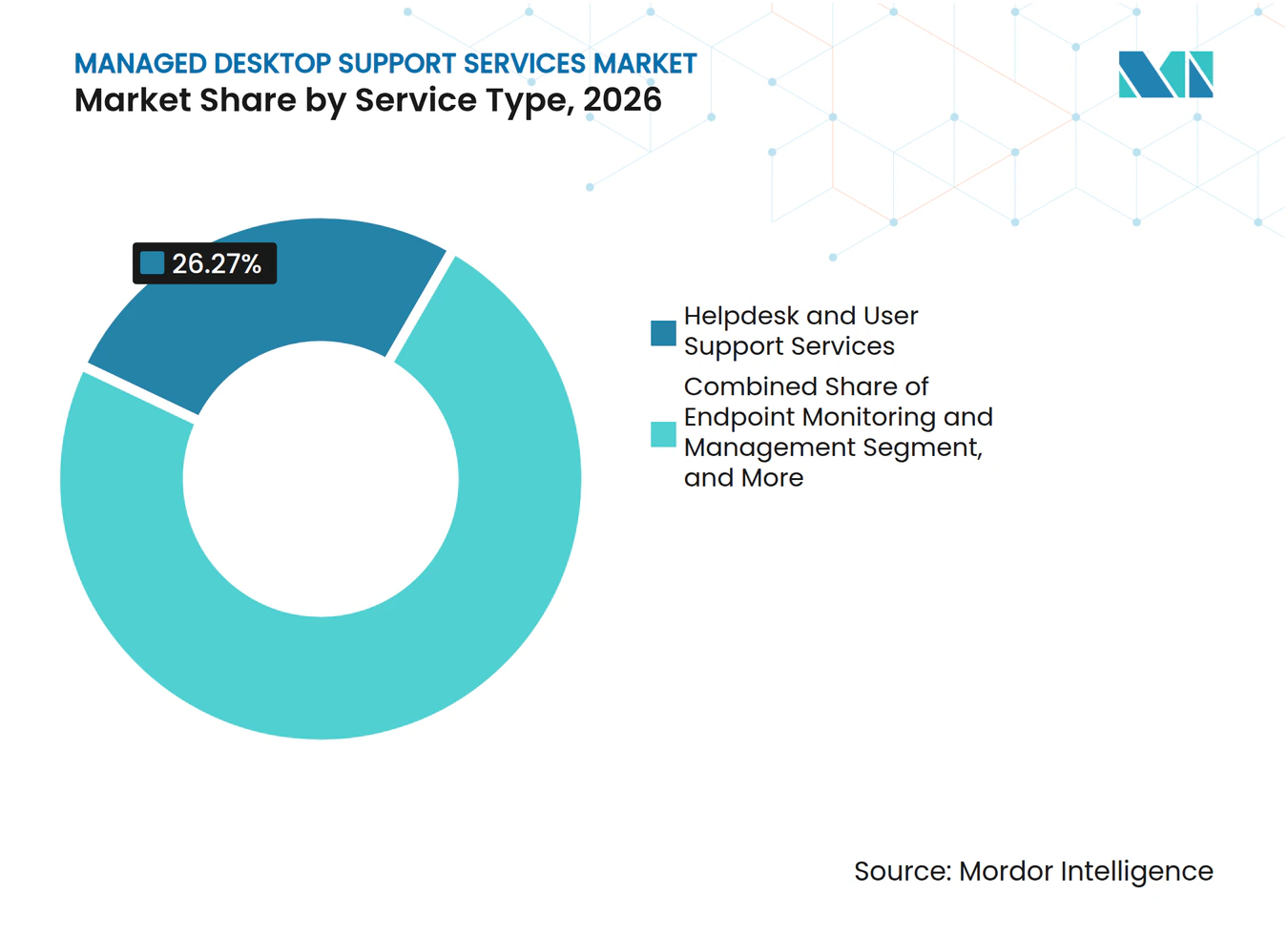
Helpdesk and User Support Services held 26.27% of the Managed Desktop Support Services Market share in 2026. Distributed work continues to create a large volume of endpoint issues that require user assistance. AI-assisted resolution is combining first-line and second-line activities within broader support contracts. Endpoint Security and Threat Protection is projected to expand at a 6.88% CAGR through 2032. The service is becoming part of baseline desktop support in the Managed Desktop Support Services Market instead of a separate purchase.
Patch Management and Operating System Updates remain established service lines with large device volumes. Automation reduces manual work in routine patching and shifts specialists toward exceptions and change governance. Software Deployment and Lifecycle Management helps customers control configuration, licensing, and replacement cycles. Endpoint Monitoring and Management supplies the telemetry needed for proactive support and failure prevention. These services together make the Managed Desktop Support Services Market less dependent on single-ticket support work.



By Delivery Model: Cloud Models Displace Legacy Defaults
Hybrid Managed Desktop Support accounted for 41.88% of delivery-model revenue in 2026. This position reflects lasting risk-management requirements rather than a short transition from on-premises systems. BFSI and government buyers often retain hybrid environments because of data sovereignty, latency, and audit requirements. Cloud-Based Managed Desktop Support is projected to expand at a 6.94% CAGR through 2032. New deployments are supporting this momentum in the Managed Desktop Support Services Market because many small and midmarket buyers have fewer legacy systems to retain.
On-Premises Managed Desktop Support remains necessary in industrial, government, and high-security settings. These settings may require air-gapped systems or locally controlled infrastructure. Flexible per-user billing can help providers serve customers across hybrid and cloud configurations. This flexibility is increasingly important in the Managed Desktop Support Services Market as customer estates become more mixed, geographically distributed, and subject to different operational, security, and budget requirements.
By Organization Size: SMEs Accelerate Managed Endpoint Outsourcing
Large Enterprises accounted for 70.83% of revenue in 2026. Their contracts commonly combine monitoring, helpdesk, security, and lifecycle management across countries and device categories, giving procurement teams one service framework for complex operations and consistent reporting. Large organizations have the procurement scale to use strategic, multi-year outsourcing arrangements. Small and Medium Enterprises are projected to expand at a 6.83% CAGR through 2032. Platform-based delivery can reduce the per-endpoint cost for organizations with fewer than 500 devices.
Small firms often rely on generalist internal staff to manage a growing endpoint base. Managed suppliers can provide compliance documentation and security capabilities that are hard to replicate at similar cost internally. The 2025 Parallels survey found that 89% of midsize companies planned to increase cybersecurity spending, with 41% planning a significant increase. Suppliers that include identity management and zero-trust access can make their offerings more relevant to this buyer group. It also broadens the customer base for the Managed Desktop Support Services Market.
By Device and Endpoint Type: Cloud PCs Redefine the Endpoint Frontier
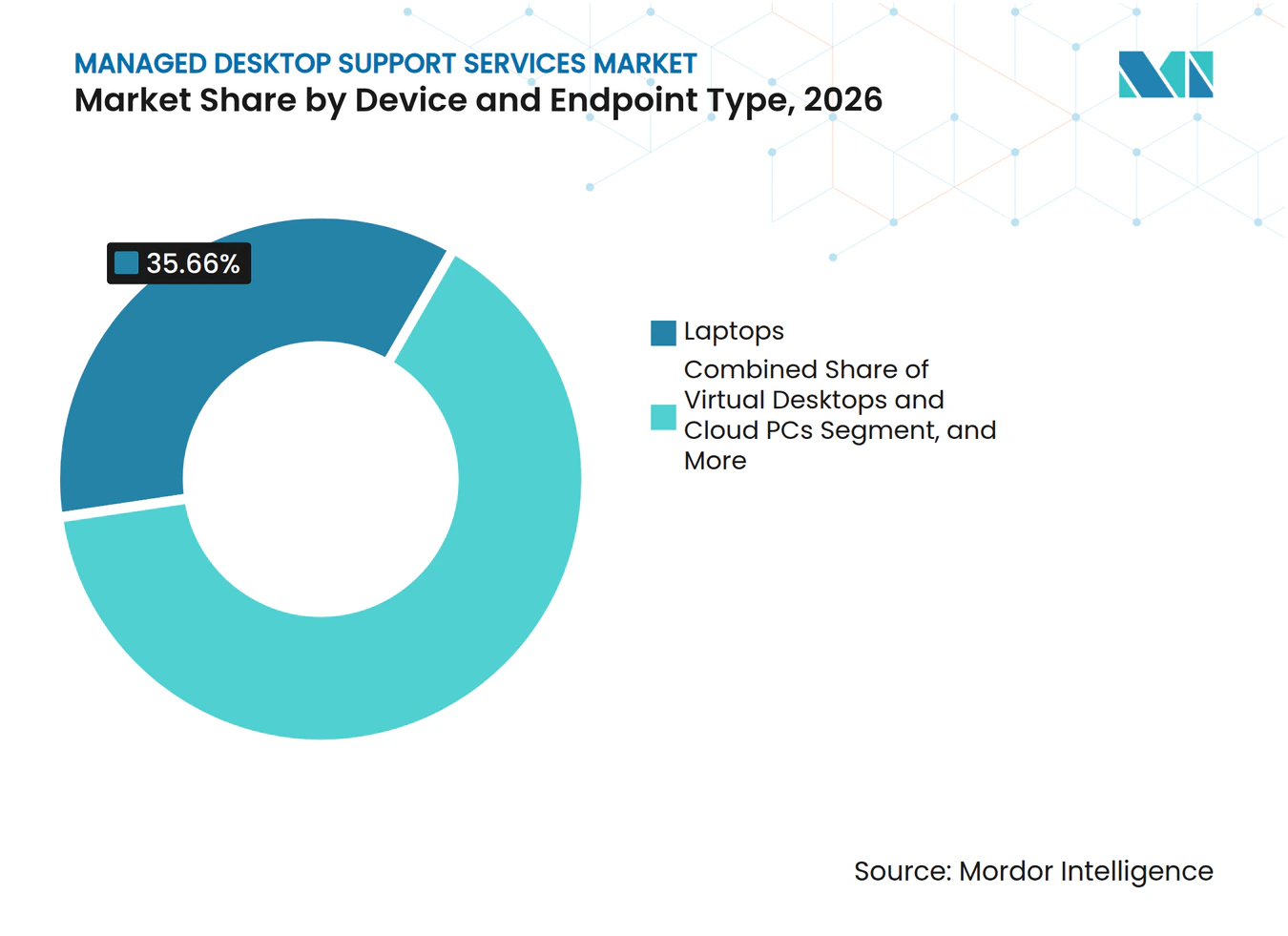
Laptops held 35.66% of revenue in 2026. They remain central to large enterprise device estates and hybrid work arrangements, where organizations need a standard user device that can function across office, home, travel, and customer-site settings. Desktops retain an important role in fixed-workstation settings, including trading floors, nursing stations, and secure government facilities. IoT and specialized endpoints introduce different patching schedules and management interfaces. Virtual Desktops and Cloud PCs are projected to expand at a 7.11% CAGR through 2032.
A 2026 HCLTech case study described total cost-of-ownership reductions of up to 30% in a 25,000-employee manufacturer through cloud-delivered endpoint management. This supports the financial case for managed virtual delivery where customers need centralized administration. Peripherals and collaboration devices are also becoming distinct support categories as hybrid meeting rooms are standardized. Service providers in the Managed Desktop Support Services Market need to support video systems, smart displays, and related hardware alongside employee computers. They also increase the operational importance of unified management platforms.

By End-User Industry: BFSI Anchors Demand While Healthcare Accelerates
BFSI held 20.77% of revenue in 2026. Audit duties, dense branch and advisory networks, and high-value outsourcing contracts support its position, since institutions must keep a clear record of device access, configuration, vulnerability status, and user support activity. Financial institutions operate layered endpoint environments that include trading, branch, and remote advisory systems. Healthcare and Life Sciences is projected to expand at a 7.24% CAGR through 2032. Connected medical devices, electronic health records, and clinical workstations require reliable endpoint operations.
Healthcare providers face strict uptime needs and must protect sensitive patient information. Outsourcing can help organizations manage endpoint complexity when internal IT investment has not kept pace with digital requirements. Information Technology and Telecommunications, Government and Public Sector, Retail and Consumer Goods, and Manufacturing also generate meaningful demand. Government procurement often favors suppliers that meet national compliance requirements. This makes vertical capability a lasting competitive consideration for the Managed Desktop Support Services Market.
Geography Analysis
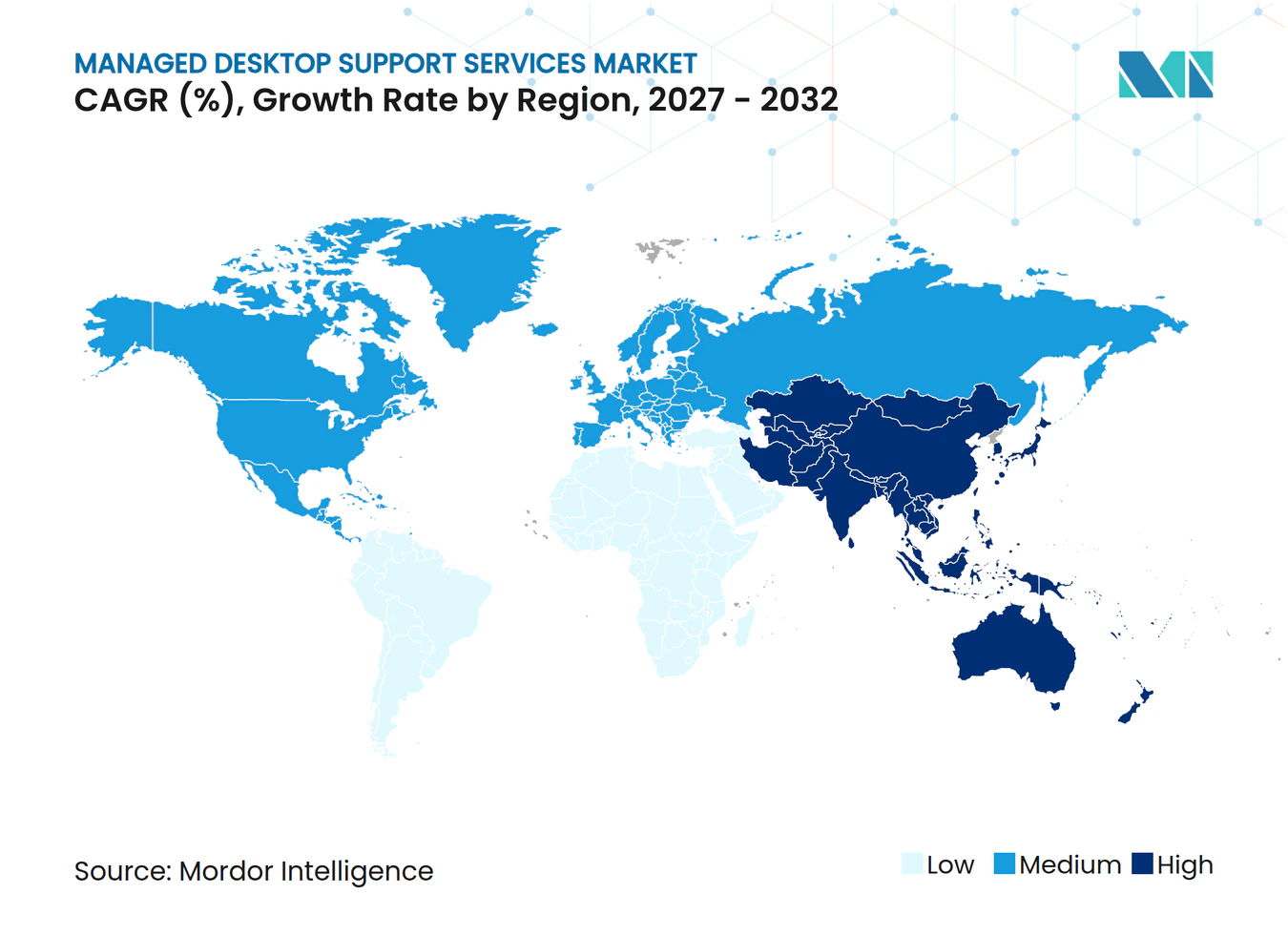
North America held 38.36% of the Managed Desktop Support Services Market share in 2026. The region has a high concentration of large enterprises and mature managed-services procurement practices, which supports comprehensive contracts that integrate endpoint operations, security controls, user support, and reporting obligations. The US Department of Defense cybersecurity rule establishes a compliance-led buying pathway for relevant contractor systems. The United States generates most regional revenue, while Canada benefits from financial services outsourcing and public-sector modernization. Mexico is developing as an onshore location for bilingual technical support.
Europe has persistent demand from GDPR-related data governance and NIS2 security requirements, because buyers must align supplier operations with local data handling, security documentation, and incident-management expectations. At the same time, economic and geopolitical uncertainty can restrain discretionary technology spending. The Managed Desktop Support Services Market is shaped by demand for local hosting and documented security controls. Omnissa partnered with GEMA International in October 2025 to deliver locally hosted unified endpoint management for Germany and Austria. South America, the Middle East, and Africa contribute smaller but developing opportunities, led by Brazil, Saudi Arabia, and the United Arab Emirates.
Asia-Pacific is projected to expand at a 7.13% CAGR through 2032. Its demand is supported by IT outsourcing in BFSI, security needs, and wider hybrid-work adoption, while multinational organizations seek standardized support across offices, global capability centers, and distributed employee populations. India, Japan, China, South Korea, Australia, and Singapore are important markets for managed endpoint services. TCS won Best Buy's India global capability center operations in September 2026, covering data, analytics, AI services, and operations for 600 employees.
Competitive Landscape
Market Concentration
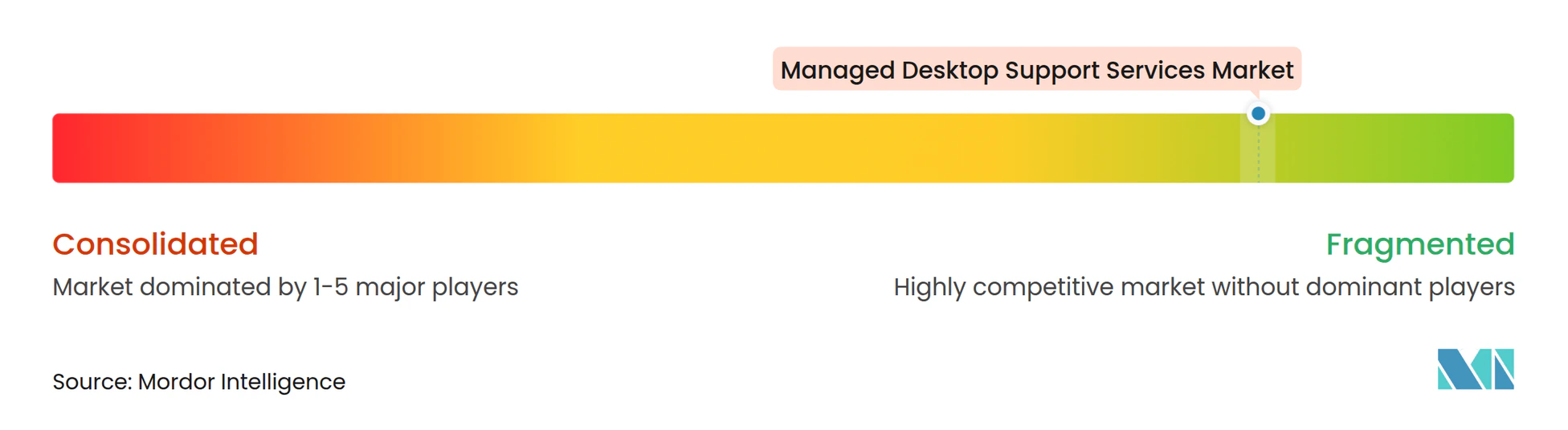
The Managed Desktop Support Services Market has moderate concentration among large global providers, while regional specialists compete actively below that tier. Global systems integrators win contract volume through multi-year arrangements covering monitoring, helpdesk, security, and lifecycle management, particularly when customers want a single supplier accountable for technology modernization and operating results. Contract reallocation remains common when buyers review modernization results and service outcomes. HCLTech secured a five-year digital workplace and enterprise network agreement with Mercedes-Benz in July 2026, valued at USD 1.14 billion. The deal replaced an incumbent provider and shows how large modernization reviews can alter established supplier relationships.
Leading companies are combining endpoint security, helpdesk, and lifecycle services to increase scope per client and reduce vendor complexity. Unisys expanded its Device Subscription Service with Dell Technologies in February 2026 to include AI-driven lifecycle coverage for edge computing and IoT deployments. AI-centered endpoint management platforms are also becoming a more important way to differentiate services beyond conventional PCs. Providers face margin pressure when buyers favor outcome-based pricing over time-and-materials structures.
Suppliers that cannot automate routine activities may have difficulty matching price and service expectations, especially when contracts require predictable response times, transparent reporting, and continuing efficiency improvements through the service term. Opportunities remain in security models tied to cyber-risk reduction, self-service offerings for SMEs, and sovereign desktop delivery for European public-sector buyers. The Managed Desktop Support Services Market does not provide a combined market-share figure for leading suppliers, so a share-based concentration score cannot be assigned without creating unsupported data.
Managed Desktop Support Services Industry Leaders
-
Accenture plc
-
IBM Corporation
-
Tata Consultancy Services Limited
-
Capgemini SE
-
HCL Technologies Limited
- *Disclaimer: Major Players sorted in no particular order
Recent Industry Developments
- October 2026: TCS won Best Buy's India global capability center (GCC) operations in a five-year technology services engagement estimated at INR 20 billion (approximately USD 237 million at 2025 average exchange rates), covering GCC operations, data, analytics, and AI services for approximately 600 employees in Bengaluru.
- July 2026: HCLTech secured a five-year digital workplace and enterprise network services agreement with Mercedes-Benz, valued at approximately USD 1.14 billion, replacing the incumbent provider. The contract covers digital workplace modernization and enterprise network infrastructure, illustrating how delivery reviews and modernization priorities are redistributing major outsourcing mandates.
- June 2026: The Magnum Ice Cream Company named Accenture and HCL as lead technology partners for a global IT carve-out from Unilever. Accenture leads enterprise platform deployment and AI and cybersecurity systems, HCL oversees infrastructure rollout and end-user services. Microsoft provides cloud infrastructure and workplace tools for the program, replacing services covered by Transitional Services Agreements due to expire by 2027.
- March 2026: DXC Technology Deutschland GmbH secured a single-framework managed services agreement with the European Central Bank (ECB) for end user computing and IT infrastructure services, with a maximum value of EUR 410 million (approximately USD 443 million at 2025 average exchange rates) and an initial five-year term extensible to 8 years. Services are delivered exclusively from DXC's European Economic Area delivery centers.
Global Managed Desktop Support Services Market Report Scope
The Managed Desktop Support Services Market comprises outsourced IT services in which a third-party provider delivers ongoing support, maintenance, and management of an organization’s end-user computing environment.
The Managed Desktop Support Services Market Report is Segmented by Service Type (Endpoint Monitoring and Management, Patch Management and Operating System Updates, Software Deployment and Lifecycle Management, Helpdesk and User Support Services, Endpoint Security and Threat Protection, and Asset and Inventory Management), Delivery Model (On-Premises Managed Desktop Support, Cloud-Based Managed Desktop Support, and Hybrid Managed Desktop Support), Organization Size (Small and Medium Enterprises and Large Enterprises), Device and Endpoint Type (Desktops, Laptops, Virtual Desktops and Cloud PCs, Mobile and Remote Workforce Endpoints, Peripherals and Collaboration Devices, and IoT and Specialized Endpoints), End-User Industry (Information Technology and Telecommunications, Banking, Financial Services, and Insurance, Healthcare and Life Sciences, Government and Public Sector, Retail and Consumer Goods, Manufacturing, and Other End-User Industries), and Geography (North America, South America, Europe, Asia-Pacific, and Middle East and Africa). The Market Forecasts Are Provided in Terms of Value (USD).
| Endpoint Monitoring and Management |
| Patch Management and Operating System Updates |
| Software Deployment and Lifecycle Management |
| Helpdesk and User Support Services |
| Endpoint Security and Threat Protection |
| Asset and Inventory Management |
| On-Premises Managed Desktop Support |
| Cloud-Based Managed Desktop Support |
| Hybrid Managed Desktop Support |
| Small and Medium Enterprises |
| Large Enterprises |
| Desktops |
| Laptops |
| Virtual Desktops and Cloud PCs |
| Mobile and Remote Workforce Endpoints |
| Peripherals and Collaboration Devices |
| IoT and Specialized Endpoints |
| Information Technology and Telecommunications |
| Banking, Financial Services, and Insurance |
| Healthcare and Life Sciences |
| Government and Public Sector |
| Retail and Consumer Goods |
| Manufacturing |
| Other End-User Industries |
| North America | United States |
| Canada | |
| Mexico | |
| South America | Brazil |
| Argentina | |
| Rest of South America | |
| Europe | United Kingdom |
| Germany | |
| France | |
| Italy | |
| Rest of Europe | |
| Asia-Pacific | China |
| India | |
| Japan | |
| South Korea | |
| Rest of Asia-Pacific | |
| Middle East and Africa | Saudi Arabia |
| United Arab Emirates | |
| South Africa | |
| Egypt | |
| Rest of Middle East and Africa |
| By Service Type | Endpoint Monitoring and Management | |
| Patch Management and Operating System Updates | ||
| Software Deployment and Lifecycle Management | ||
| Helpdesk and User Support Services | ||
| Endpoint Security and Threat Protection | ||
| Asset and Inventory Management | ||
| By Delivery Model | On-Premises Managed Desktop Support | |
| Cloud-Based Managed Desktop Support | ||
| Hybrid Managed Desktop Support | ||
| By Organization Size | Small and Medium Enterprises | |
| Large Enterprises | ||
| By Device and Endpoint Type | Desktops | |
| Laptops | ||
| Virtual Desktops and Cloud PCs | ||
| Mobile and Remote Workforce Endpoints | ||
| Peripherals and Collaboration Devices | ||
| IoT and Specialized Endpoints | ||
| By End-User Industry | Information Technology and Telecommunications | |
| Banking, Financial Services, and Insurance | ||
| Healthcare and Life Sciences | ||
| Government and Public Sector | ||
| Retail and Consumer Goods | ||
| Manufacturing | ||
| Other End-User Industries | ||
| By Geography | North America | United States |
| Canada | ||
| Mexico | ||
| South America | Brazil | |
| Argentina | ||
| Rest of South America | ||
| Europe | United Kingdom | |
| Germany | ||
| France | ||
| Italy | ||
| Rest of Europe | ||
| Asia-Pacific | China | |
| India | ||
| Japan | ||
| South Korea | ||
| Rest of Asia-Pacific | ||
| Middle East and Africa | Saudi Arabia | |
| United Arab Emirates | ||
| South Africa | ||
| Egypt | ||
| Rest of Middle East and Africa | ||
Key Questions Answered in the Report
What is the Managed Desktop Support Services Market size?
The Managed Desktop Support Services Market is projected to reach USD 50.97 billion by 2032, from USD 37.14 billion in 2027, at a 6.54% CAGR.
Which service type leads managed desktop support demand?
Helpdesk and User Support Services lead with 26.27% share in 2026, while Endpoint Security and Threat Protection has the highest projected CAGR at 6.88% through 2032.
Why are companies outsourcing desktop support?
Hybrid work, endpoint security requirements, and the need for continuous device monitoring are driving demand for outsourced support.
Which delivery model is expanding most quickly?
Cloud-Based Managed Desktop Support is projected to expand at a 6.94% CAGR through 2032 as new deployments adopt cloud endpoints.
Which organizations are adopting managed desktop support most quickly?
Small and Medium Enterprises are projected to expand at a 6.83% CAGR through 2032 as platform delivery lowers the cost per endpoint.
Which region has the highest projected demand growth?
Asia-Pacific is projected to expand at a 7.13% CAGR through 2032, supported by outsourcing, security demand, and hybrid-work adoption.