
Managed Exposure Validation Services Market Size and Share
Market Overview
| Study Period | 2021 - 2032 |
|---|---|
| Market Size (2027) | USD 4.72 Billion |
| Market Size (2032) | USD 10.47 Billion |
| Growth Rate (2027 - 2032) | 17.27 % |
| Fastest Growing Market | Asia-Pacific |
| Largest Market | North America |
| Market Concentration | Low |
Major Players *Disclaimer: Major Players sorted in no particular order Image © Mordor Intelligence. Reuse requires attribution under CC BY 4.0. | |
Managed Exposure Validation Services Market Analysis by Mordor Intelligence
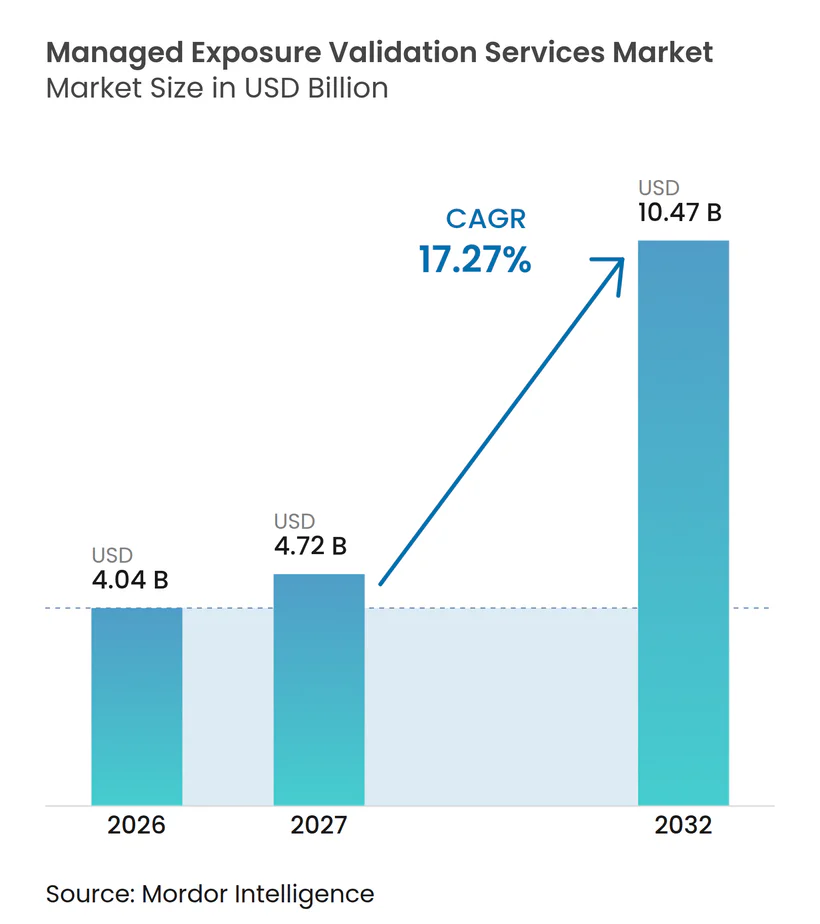
The managed exposure validation services market size is projected to expand from USD 4.04 billion in 2026 to USD 10.47 billion by 2032, registering a CAGR of 17.27% between 2027 and 2032. Demand is moving from periodic testing toward ongoing services that show whether an attacker can exploit a live control gap. Boards, insurers, and auditors increasingly expect repeatable evidence instead of policy statements or theoretical vulnerability scores. Requirements under DORA, NIS2, and SEC S-K Item 106 are making documented control testing more important for regulated organizations. The managed exposure validation services market also benefits from the shorter period between vulnerability disclosure and active exploitation, which leaves less time for manual review. Providers that link discovery, testing, remediation, and retesting in one service are better placed to retain enterprise accounts.
Key Report Takeaways
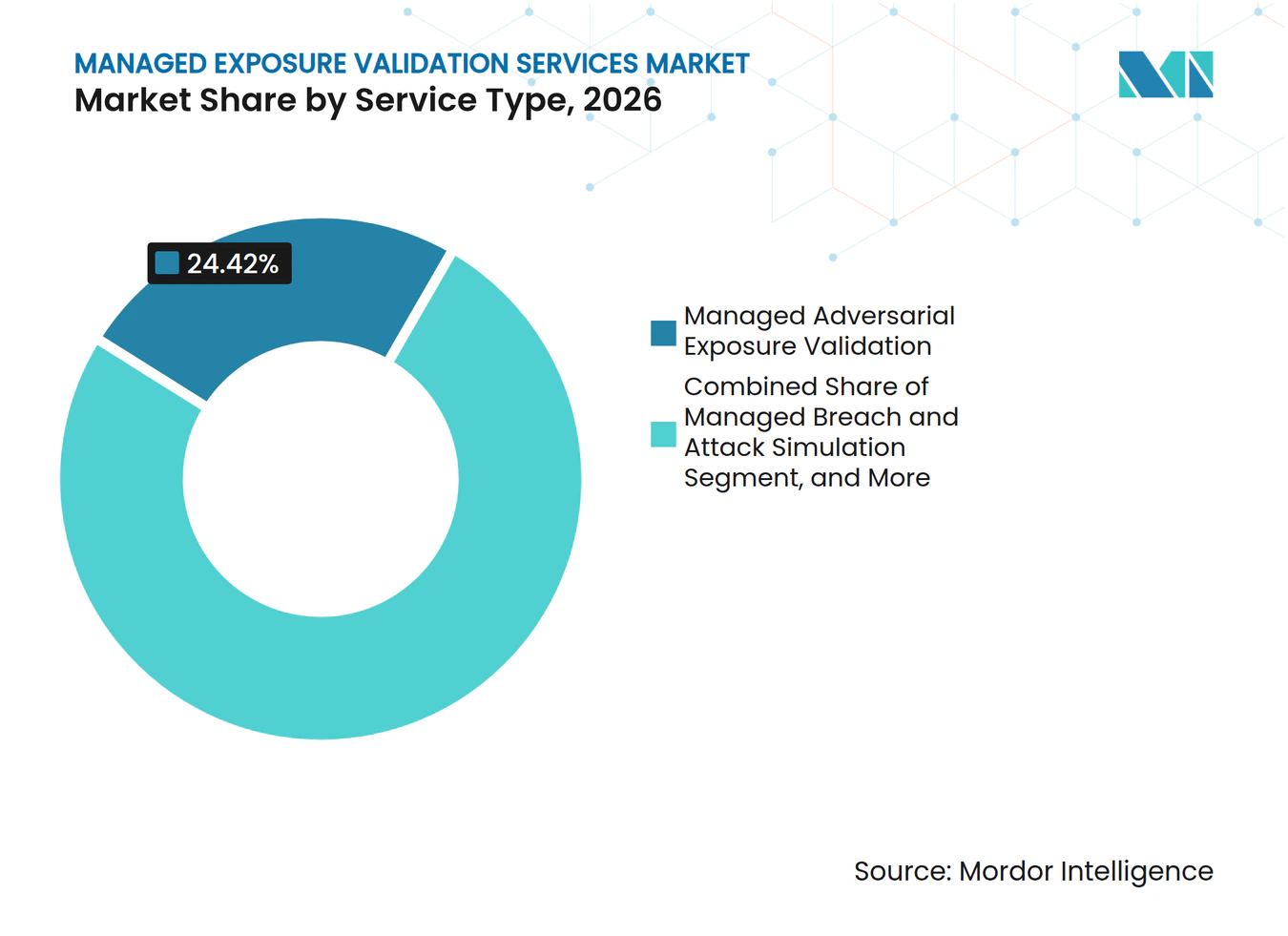
- By service type, Managed Adversarial Exposure Validation accounted for 24.42% of revenue in 2026 in the managed exposure validation services market, and the same segment is projected to expand at a 17.84% CAGR through 2032.
- By deployment model, Fully Managed held 43.68% of revenue in 2026, while Continuous Subscription Service is projected to expand at a 17.92% CAGR through 2032.
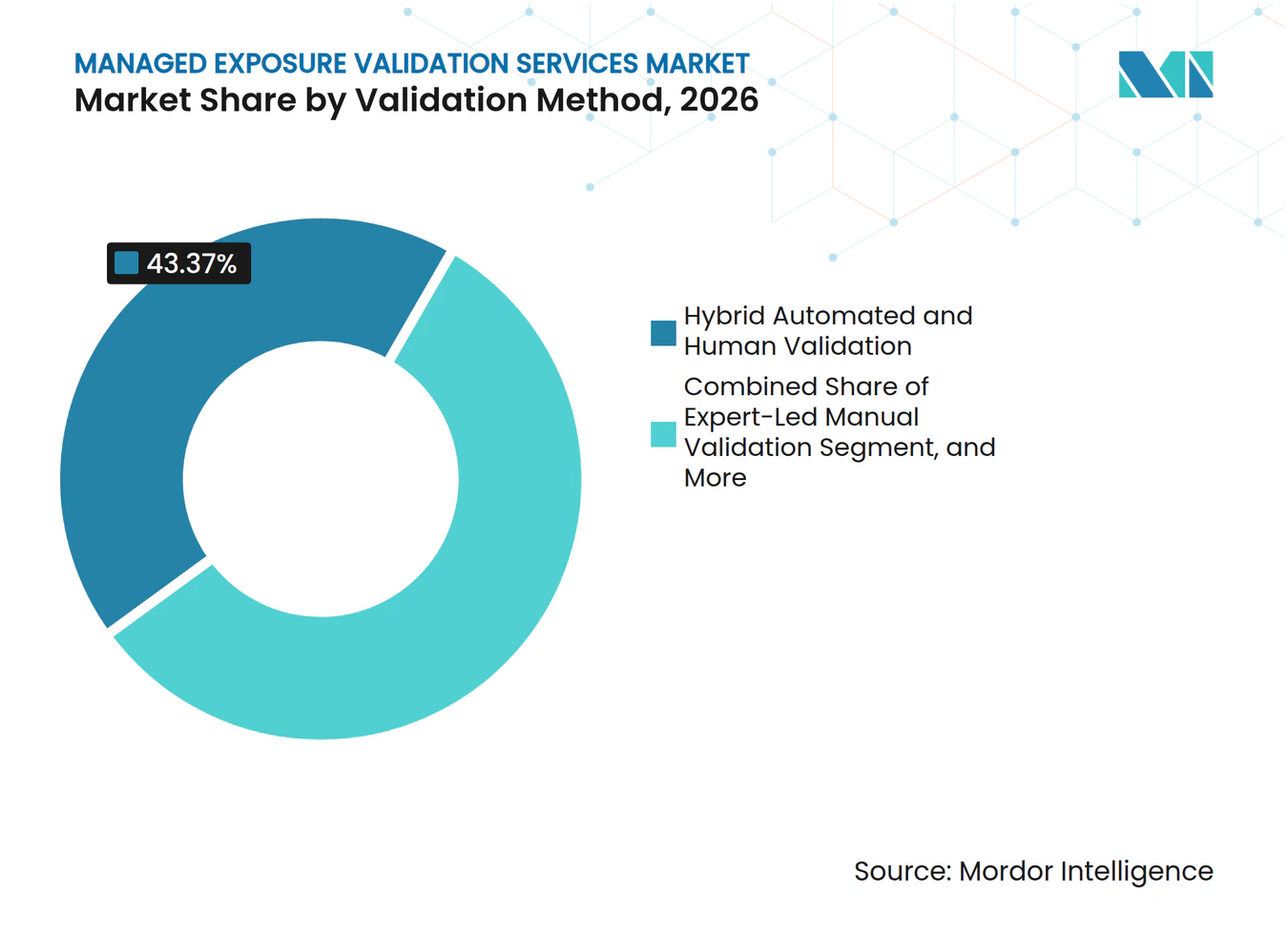
- By validation method, Hybrid Automated and Human Validation accounted for 43.37% of revenue in 2026, managed exposure in the validation services market, while Automated Validation is projected to expand at a 17.94% CAGR through 2032.
- By attack surface, Cloud and SaaS Environments held 23.86% of revenue in 2026, while Identity and Access Infrastructure is projected to expand at an 18.12% CAGR through 2032.
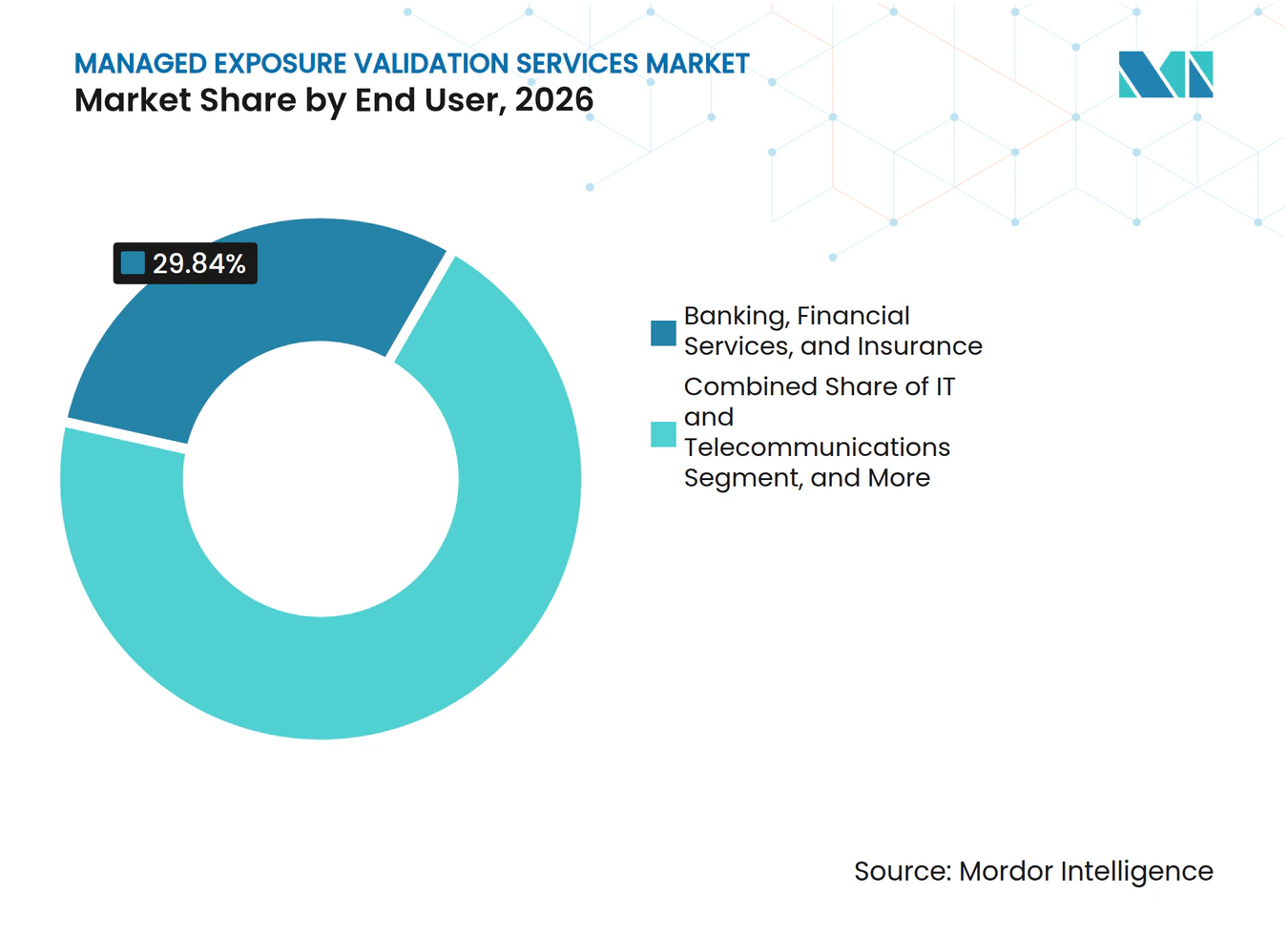
- By end user, BFSI held 29.84% of revenue in 2026, while Healthcare and Life Sciences are projected to expand at a 17.98% CAGR through 2032.
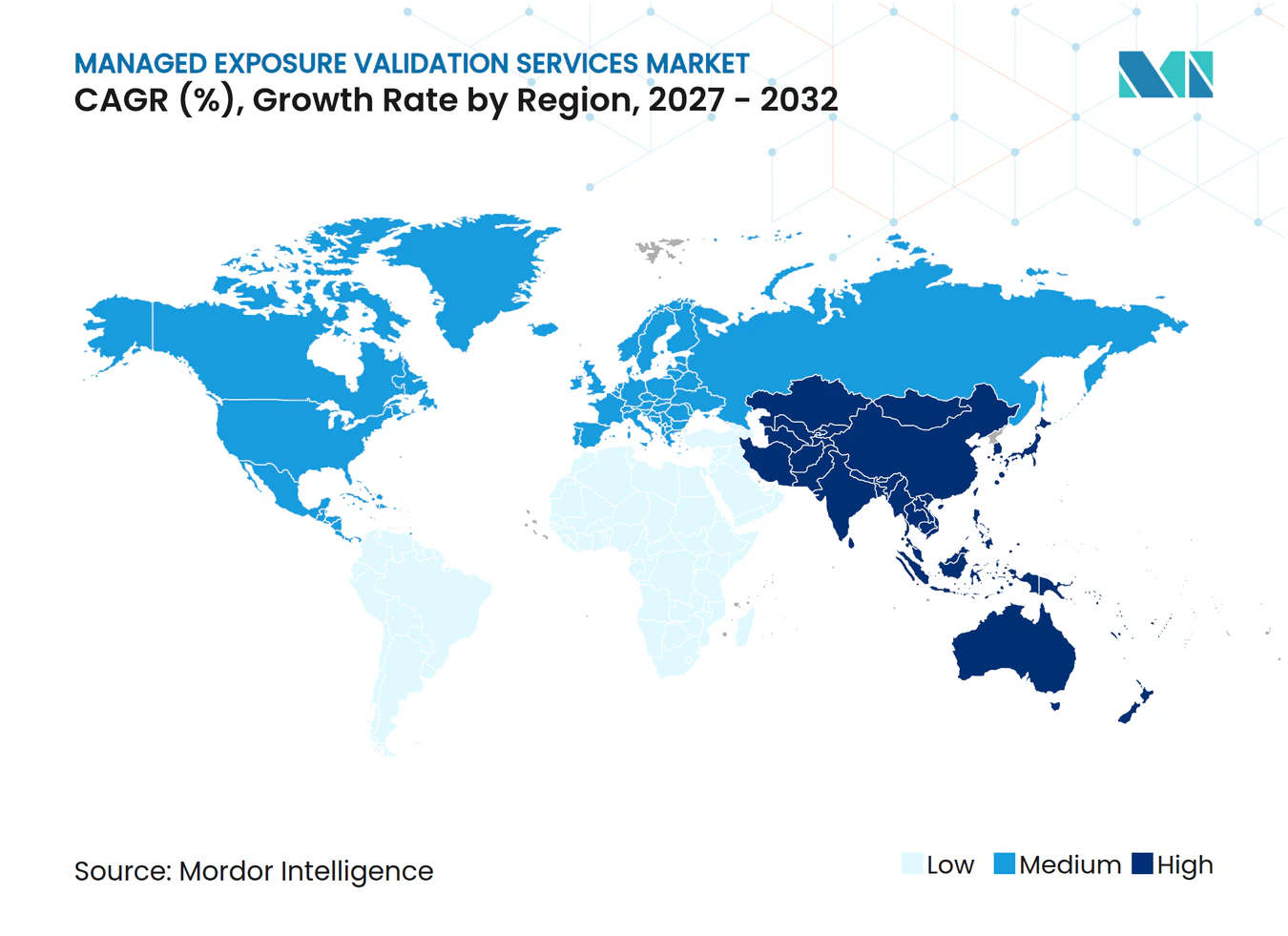
- By geography, North America held 44.38% of the managed exposure validation services market in 2026, while Asia-Pacific is projected to expand at an 18.14% CAGR through 2032.
Note: Market numbers in this report are based on Mordor Intelligence's proprietary estimation framework, which combines nine months of actuals with Q4 projections for base year 2026.
Market Trends and Insights
Drivers Impact Analysis of Managed Exposure Validation Services Market*
| Driver | (~) % Impact on CAGR Forecast | Geographic Relevance | Impact Timeline |
|---|---|---|---|
| Increasing Need to Prove Real-World Exploitability | +3.20% | Global | Short term (≤ 2 years) |
| Expansion of Cloud, Identity, and Hybrid Attack Surfaces | +2.90% | Global, with concentrated demand in North America and Asia-Pacific core | Medium term (2-4 years) |
| Regulatory Demand for Continuous Control Validation | +2.50% | North America and Europe, with spill-over to Asia-Pacific | Short term (≤ 2 years) |
| Convergence of CTEM, ASM, BAS, and Penetration Testing Workflows | +2.10% | Global | Medium term (2-4 years) |
| AI-Accelerated Attack Development and Shorter Time to Exploit | +1.80% | Global | Short term (≤ 2 years) |
| Managed Expertise Shortages in Security Validation Operations | +1.40% | Global, with acute impact in North America and Western Europe | Long term (≥ 4 years) |
| Source: Mordor Intelligence | |||
Increasing Need to Prove Real-World Exploitability
Boards, cyber insurers, and auditors are placing more weight on evidence that an attack path can cross a real environment. IBM reported that 18% of breached organizations had deployed AI agents for vulnerability scanning and management when the breach occurred. This gap makes the quality of control testing more important than the simple presence of security tools. IBM also reported that extensive use of AI and automation in security was associated with an average breach cost 1.93 million USD lower.[1] The managed exposure validation services market responds to this need by providing repeatable test results that can be reviewed by security leaders and outside stakeholders. This evidence can turn validation from an optional technical exercise into part of risk and insurance discussions.
Expansion of Cloud, Identity, and Hybrid Attack Surfaces
Multi-cloud infrastructure and hybrid identity systems are expanding the number of paths that security teams need to test. Semperis disclosed ResetNightmare and KerberLoss in August 2026, two Active Directory vulnerabilities that could allow a low-privileged attacker to obtain full domain control. A joint advisory from the Australian Signals Directorate, CISA, NSA, and allied agencies documented 17 common Active Directory attack techniques in January 2025.[2] IBM identified cloud misconfigurations as a frequent cause of AI-related breaches and noted that fewer than half of organizations were securing non-human identities when a breach occurred. The managed exposure validation services market gives buyers a way to retest identity and cloud controls after changes in configuration or patching. This is important where scheduled penetration tests cannot keep pace with operational changes.
Regulatory Demand for Continuous Control Validation
Regulators are asking organizations to demonstrate that controls work under adverse conditions. DORA became applicable on January 17, 2025, and requires threat-led penetration testing for significant financial entities while setting requirements for ICT risk management.[3] ENISA published technical implementation guidance for NIS2 in June 2025 that set out the cybersecurity risk-management measures expected under the directive. Germany also requires critical infrastructure operators to provide security evidence under its revised BSIG framework. BSI.BUND.DE These obligations favor managed programs that can preserve test records, remediation activity, and retesting results. The managed exposure validation services market is, therefore, gaining a more stable demand base among regulated organizations that lack dedicated red-team capacity.
Convergence of CTEM, ASM, BAS, and Penetration Testing Workflows
Security buyers are seeking fewer disconnected tools and a clearer path from asset discovery to remediation. NetSPI added cyber asset attack surface management, breach and attack simulation as a service, dark web monitoring, and LLM testing to its platform in April 2025. XM Cyber connected external attack surface discovery with internal validation in December 2025, allowing teams to link external exposure with internal attack paths. These changes reflect a buyer preference for evidence that follows an issue through discovery, validation, remediation, and closure. Providers in the managed exposure validation services market can reduce friction when their service fits existing exposure-management and ticketing workflows. The result is a stronger focus on evidence quality and remediation speed rather than the number of scenarios tested.
Restraints Impact Analysis of Managed Exposure Validation Services Market*
| Restraint | (~) % Impact on CAGR Forecast | Geographic Relevance | Impact Timeline |
|---|---|---|---|
| Integration Complexity Across Security Toolchains | -1.80% | Global | Medium term (2-4 years) |
| Budget Competition With Preventive and Detection Controls | -1.40% | Global, with acute pressure in mid-market segments of North America and Europe | Short term (≤ 2 years) |
| Limited Evidence Portability Across Buyers, Auditors, and Insurers | -0.90% | North America and Europe | Medium term (2-4 years) |
| Safe-Testing Constraints in Production and Operational Technology Environments | -0.70% | Asia-Pacific core, with spill-over to Middle East and Africa | Long term (≥ 4 years) |
| Source: Mordor Intelligence | |||
Integration Complexity Across Security Toolchains
Many enterprises operate separate systems for security information and event management, endpoint protection, vulnerability management, and ticketing. A managed program must connect with these systems before its findings can be assigned, fixed, and retested. This work can delay the value that a buyer expects from continuous validation. The issue becomes more difficult when exposure data uses inconsistent asset names, ownership fields, and risk classifications across tools. The managed exposure validation services market must therefore support clear integrations and data normalization if providers want customers to use validation results at the required pace. Organizations with extensive point-tool estates can face a longer first-year implementation period.
Budget Competition With Preventive and Detection Controls
Validation services often compete with detection and response tools for the same security budget. ISACA reported in 2025 that 53% of security professionals considered their cybersecurity budgets underfunded, while 41% expected budget increases. Buyers may prioritize controls that show daily alerts over programs designed to verify whether controls would resist an attack. The managed exposure validation services market is more likely to overcome this pressure when vendors explain how testing improves remediation decisions and supports compliance. Financial evidence tied to breach prevention and audit readiness can make the service easier to defend in budget reviews. Without that connection, validation may be treated as a periodic compliance cost.
*Our forecasts treat driver/restraint impacts as directional, not additive. The impact forecasts reflect baseline growth, mix effects, and variable interactions.
Managed Exposure Validation Services Market Segment Analysis
By Service Type:
Adversarial Validation Leads the Shift to Continuous EvidenceManaged Adversarial Exposure Validation accounted for 24.42% of the managed exposure validation services market share in 2026 and is projected to expand at a 17.84% CAGR through 2032. The service produces timestamped evidence of whether a technique can cross a live environment. It replaces a one-time report with repeated attack simulation, remediation review, and retesting. Pentera reported that it surpassed USD 100 million in annual recurring revenue in January 2026 and that more than 1,200 enterprises in over 60 countries were using its platform.
Managed Breach and Attack Simulation and Managed Automated Penetration Testing are increasingly used within broader adversarial validation services. Managed Continuous External Attack Surface Management addresses exposure from internet-facing assets and shadow IT. Managed Red Teaming and Purple Teaming remain important for financial institutions that need human-directed, threat-led testing. Managed Validation Reporting and Remediation Retesting meets demand for audit-ready records and proof that a fix removed an exploitable path. The managed exposure validation services industry is differentiating providers by the continuity and usefulness of their evidence.



By Deployment Model:
Fully Managed Delivery Addresses Internal Capacity GapsFully managed services held 43.68% of the managed exposure validation services market size in 2026. ISACA found that 65% of organizations had unfilled cybersecurity roles and 55% considered their teams understaffed in 2025. Fortinet reported in 2026 that 71% of organizations saw skills shortages as a risk and 56% struggled to recruit talent. These workforce limits support delegated testing and specialist analysis. Fully managed delivery also gives providers greater control of test cadence and reporting consistency.
Continuous Subscription Service is projected to expand at a 17.92% CAGR through 2032 as customers seek regular validation rather than isolated assignments. Co-Managed models support enterprises that need external adversarial expertise while retaining internal accountability. Project-Based Managed Service still serves organizations meeting set schedules under PCI DSS 4.0.1, ISO 27001, and financial-sector obligations. Recurring contracts can reduce switching once validation records feed into audit workflows. The managed exposure validation services market benefits when ongoing records become part of compliance and insurance documentation.
By Validation Method:
Hybrid Delivery Balances Scale and ExpertiseHybrid Automated and Human Validation held 43.37% of revenue in 2026, the largest share within the managed exposure validation services market. Automation can run repeatable scenarios at scale and identify common control gaps. Human analysts add judgment where attack paths do not follow preset patterns. This combination is useful in multi-cloud, operational technology, and AI-system environments. Pentera received ISO/IEC 42001 certification in 2025, showing why formal AI management matters to regulated buyers.
Automated Validation is projected to expand at a 17.94% CAGR through 2032. AI-assisted attack planning and adaptive payload generation can improve test speed. Expert-Led Manual Validation retains a premium role where tools cannot safely reproduce advanced attacker behavior. Threat-Intelligence-Led Validation aligns scenarios with threats relevant to a buyer’s sector. Providers must still explain the limits of automated tests and where expert oversight is necessary.

By Attack Surface:
Identity Infrastructure Becomes the Fastest-Growing TargetCloud and SaaS Environments held 23.86% of revenue in 2026. Identity and Access Infrastructure is projected to expand at an 18.12% CAGR through 2032. Semperis reported that ResetNightmare and KerberLoss could enable domain compromise through Active Directory weaknesses after patches had become available. These events show why static identity assessments cannot provide the same assurance as repeated testing. The managed exposure validation services market is responding with retesting as privileges, configurations, and patch status change.
External Web and Internet-Facing Infrastructure validation is becoming more connected to external attack surface management. Applications, APIs, and DevOps Pipelines need regular review as releases introduce changes faster than annual tests can cover. Operational Technology, IoT, and Connected Devices are harder to test because production safety constraints require active simulation. NIST identifies operational technology security as a distinct area that requires controls adapted to industrial settings. IEC/TS 62443-6-2:2026 provides a security evaluation methodology for industrial automation and control system components.
By End User:
BFSI Provides the Largest Base While Healthcare AcceleratesBFSI held 29.84% of revenue in 2026, the largest end-user position in the managed exposure validation services market. DORA requires testing by significant financial entities in the European Union. Financial organizations also face close review of ICT risk, third-party exposure, and control documentation. These conditions support managed threat-led testing and evidence retention. BFSI’s leading revenue position reflects the sector’s need to demonstrate both governance and technical control effectiveness.
Healthcare and Life Sciences are projected to expand at a 17.98% CAGR through 2032. The sector faces ransomware risk and must protect clinical operations, patient information, and connected technology. Picus Security reported that Sutter Health reduced validation cycles from weeks to under 1 hour after deploying continuous security validation. Technology and Telecommunications companies are widening testing to cover AI-enabled applications and DevOps workflows. Government and Defense, Manufacturing and Industrial, and Retail and E-Commerce are applying validation to their operational and application risks.
Geography Analysis
North America Managed Exposure Validation Services Market
North America held 44.38% of the managed exposure validation services market share in 2026. The United States has a mature mix of disclosure, payments, and financial-sector cybersecurity requirements. SEC S-K Item 106, NYDFS Part 500, and PCI DSS 4.0.1 place greater attention on proof that controls operate as intended. Canada’s financial institutions also work under OSFI Guideline B-13 for technology and cyber risk.
Europe and South America Managed Exposure Validation Services Market
Europe is shaped by DORA and NIS2 requirements. DORA requires threat-led penetration testing for significant EU financial entities, while ENISA’s 2025 guidance describes cybersecurity risk-management measures under NIS2. Germany and France are important demand centers because of their regulated financial institutions and critical infrastructure. South America is developing from a smaller base as financial services, e-commerce, and multinational compliance programs add early demand.
APAC and MEA Managed Exposure Validation Services Market
Asia-Pacific is projected to expand at an 18.14% CAGR through 2032, the fastest regional rate in the managed exposure validation services market. Singapore’s technology risk guidance, Japan’s financial-sector cybersecurity expectations, and Australia’s Essential Eight model support stronger validation practices. Pentera established a Singapore legal entity in September 2025 to support customers in Japan, India, Taiwan, and Southeast Asia. Middle East and Africa is expanding from a smaller base as Saudi Arabia and the United Arab Emirates strengthen cybersecurity expectations for critical sectors. These frameworks create a clearer opening for third-party managed validation programs.
Competitive Landscape
Market Concentration
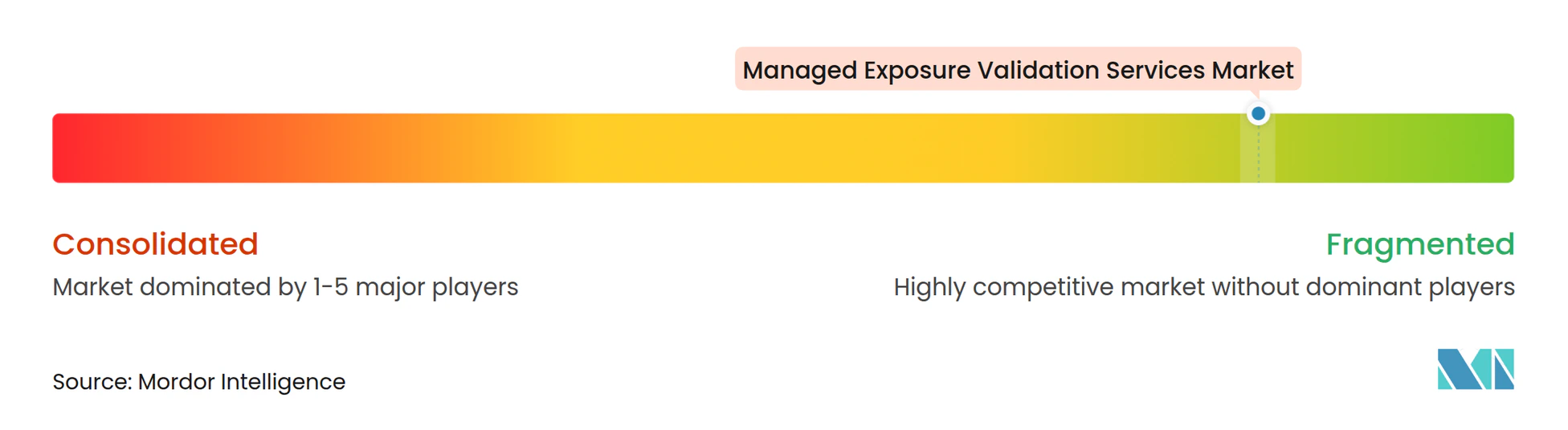
The managed exposure validation services market is moderately fragmented. Pure-play adversarial validation vendors compete on automated exploit execution, test frequency, attack-path depth, and the coverage of their attack libraries. Global IT service firms compete through regulatory knowledge, enterprise account coverage, and capacity for multi-year managed contracts. Providers are adding remediation support because customers want more than a list of findings. Tenable extended continuous security control validation within Tenable One in June 2026 and routed validated findings to its remediation capabilities. This increases competitive pressure on standalone services that cannot fit into established exposure-management programs.
Pentera’s January 2026 milestone of more than USD 100 million in annual recurring revenue showed the commercial traction of adversarial exposure validation. The company strengthened its service model through its October 2025 acquisition of DevOcean, which added AI-powered remediation management and more than 100 SecOps integrations. Rapid7 launched Vector Command Advanced in August 2025, combining continuous red teaming with internal network penetration and segmentation testing. Palo Alto Networks announced an agreement to acquire CyberArk in July 2025, showing the strategic importance of identity security within broader security platforms. These moves raise the standard for providers that rely on a narrow testing offer.
The managed exposure validation services market has an opening in operational technology and industrial environments where safe production testing is difficult. NIST’s operational technology guidance highlights the different security needs of industrial systems. Providers can distinguish themselves by using production-safe testing approaches and by linking results to IEC/TS 62443-6-2:2026 evaluation needs. Direct integration of validation evidence into board reports and insurance submissions can also support contract renewal. Market concentration cannot be assigned reliably because the input does not provide combined market shares for leading providers. The competitive structure remains consistent with a moderate level of fragmentation.
Managed Exposure Validation Services Industry Leaders
-
Deloitte Touche Tohmatsu Limited
-
Tata Consultancy Services Limited
-
Kyndryl Holdings, Inc.
-
Rapid7, Inc.
-
Bishop Fox, Inc.
- *Disclaimer: Major Players sorted in no particular order
Managed Exposure Validation Services Market Companies Covered in this Report
- Deloitte Touche Tohmatsu Limited
- Tata Consultancy Services Limited
- Kyndryl Holdings, Inc.
- Rapid7, Inc.
- Bishop Fox, Inc.
- NetSPI, LLC
- Accenture plc
- IBM Corporation
- Wipro Limited
- Tech Mahindra Limited
- Atos SE
- Unisys Corporation
- Sophos Limited
- Tenable Holdings, Inc.
- Palo Alto Networks, Inc.
- XM Cyber Ltd.
- Pentera Limited
- Picus Security, Inc.
- Cymulate Ltd.
- SafeBreach, Inc.
Recent Industry Developments in Managed Exposure Validation Services Market
- July 2026: Picus launched its Autonomous Exposure Validation Platform, integrating attack-surface validation, exposure validation and security-control testing into an autonomous loop. The platform uses AI to assess whether exposures can actually be exploited and whether existing controls can stop attacks.
- July 2026: Pentera and Recorded Future announced a strategic partnership integrating Recorded Future threat intelligence with Pentera's automated security validation. The integration enables customers to determine whether emerging threats are exploitable in their own environments and prioritize the exposures requiring remediation, directly supporting CTEM workflows.
- May 2026: Check Point launched Agentic Exposure Validation (AEV) within its Exposure Management platform. The AI-agent capability is designed to reason like an attacker, identify exploitable exposures and provide evidence of what attackers can actually compromise rather than relying solely on vulnerability severity.
- March 2026: Cymulate continued expanding its positioning from traditional Breach and Attack Simulation toward exposure management and adversarial exposure validation, combining security-control validation with exposure-management capabilities. The shift reflects BAS vendors' broader move into the managed exposure-validation segment.
Global Managed Exposure Validation Services Market Report Scope
The Managed Exposure Validation Services Market Report is Segmented by Service Type (Managed Adversarial Exposure Validation, Managed Breach and Attack Simulation, Managed Automated Penetration Testing, Managed Continuous External Attack Surface Management, Managed Red Teaming and Purple Teaming, and Managed Validation Reporting and Remediation Retesting), Deployment Model (Fully Managed, Co-Managed, Project-Based Managed Service, and Continuous Subscription Service), Validation Method (Automated Validation, Expert-Led Manual Validation, Hybrid Automated and Human Validation, and Threat-Intelligence-Led Validation), Attack Surface (External Web and Internet-Facing Infrastructure, Cloud and SaaS Environments, Identity and Access Infrastructure, Network, Endpoint, and Email Controls, Applications, APIs, and DevOps Pipelines, and Operational Technology, IoT, and Connected Devices), End User (Banking, Financial Services, and Insurance, IT and Telecommunications, Government and Defense, Healthcare and Life Sciences, Manufacturing and Industrial, Retail and E-Commerce, and Other End User Industries), and Geography (North America, South America, Europe, Asia-Pacific, and Middle East and Africa). The Market Forecasts Are Provided in Terms of Value (USD).
Segmentation Overview
| Managed Adversarial Exposure Validation |
| Managed Breach and Attack Simulation |
| Managed Automated Penetration Testing |
| Managed Continuous External Attack Surface Management |
| Managed Red Teaming and Purple Teaming |
| Managed Validation Reporting and Remediation Retesting |
| Fully Managed |
| Co-Managed |
| Project-Based Managed Service |
| Continuous Subscription Service |
| Automated Validation |
| Expert-Led Manual Validation |
| Hybrid Automated and Human Validation |
| Threat-Intelligence-Led Validation |
| External Web and Internet-Facing Infrastructure |
| Cloud and SaaS Environments |
| Identity and Access Infrastructure |
| Network, Endpoint, and Email Controls |
| Applications, APIs, and DevOps Pipelines |
| Operational Technology, IoT, and Connected Devices |
| Banking, Financial Services, and Insurance |
| IT and Telecommunications |
| Government and Defense |
| Healthcare and Life Sciences |
| Manufacturing and Industrial |
| Retail and E-Commerce |
| Other End User Industries |
| North America | United States |
| Canada | |
| Mexico | |
| South America | Brazil |
| Argentina | |
| Rest of South America | |
| Europe | United Kingdom |
| Germany | |
| France | |
| Russia | |
| Rest of Europe | |
| Asia-Pacific | China |
| Japan | |
| India | |
| Australia | |
| Singapore | |
| Rest of Asia-Pacific | |
| Middle East and Africa | Saudi Arabia |
| United Arab Emirates | |
| South Africa | |
| Egypt | |
| Rest of Middle East and Africa |
| By Service Type | Managed Adversarial Exposure Validation | |
| Managed Breach and Attack Simulation | ||
| Managed Automated Penetration Testing | ||
| Managed Continuous External Attack Surface Management | ||
| Managed Red Teaming and Purple Teaming | ||
| Managed Validation Reporting and Remediation Retesting | ||
| By Deployment Model | Fully Managed | |
| Co-Managed | ||
| Project-Based Managed Service | ||
| Continuous Subscription Service | ||
| By Validation Method | Automated Validation | |
| Expert-Led Manual Validation | ||
| Hybrid Automated and Human Validation | ||
| Threat-Intelligence-Led Validation | ||
| By Attack Surface | External Web and Internet-Facing Infrastructure | |
| Cloud and SaaS Environments | ||
| Identity and Access Infrastructure | ||
| Network, Endpoint, and Email Controls | ||
| Applications, APIs, and DevOps Pipelines | ||
| Operational Technology, IoT, and Connected Devices | ||
| By End User | Banking, Financial Services, and Insurance | |
| IT and Telecommunications | ||
| Government and Defense | ||
| Healthcare and Life Sciences | ||
| Manufacturing and Industrial | ||
| Retail and E-Commerce | ||
| Other End User Industries | ||
| By Geography | North America | United States |
| Canada | ||
| Mexico | ||
| South America | Brazil | |
| Argentina | ||
| Rest of South America | ||
| Europe | United Kingdom | |
| Germany | ||
| France | ||
| Russia | ||
| Rest of Europe | ||
| Asia-Pacific | China | |
| Japan | ||
| India | ||
| Australia | ||
| Singapore | ||
| Rest of Asia-Pacific | ||
| Middle East and Africa | Saudi Arabia | |
| United Arab Emirates | ||
| South Africa | ||
| Egypt | ||
| Rest of Middle East and Africa | ||
Key Questions Answered in the Report
What is the managed exposure validation services market size?
The managed exposure validation services market size is USD 4.04 billion in 2026 and is projected to reach USD 10.47 billion by 2032, at a 17.27% CAGR.
What is driving demand for the managed exposure validation services market?
Buyers need repeatable evidence that security controls can resist real attack paths, particularly as regulatory expectations and cloud and identity risks increase.
Which service type leads managed exposure validation services?
Managed Adversarial Exposure Validation leads with 24.42% of 2026 revenue and is projected to expand at a 17.84% CAGR through 2032.
Which deployment model is most used in the managed exposure validation services market?
Fully Managed delivery held 43.68% of 2026 revenue because many organizations lack the specialist staff needed for continuous validation.
Which end user has the largest demand for these services?
BFSI held 29.84% of revenue in 2026, supported by financial-sector control testing and documentation requirements.
Which region is expanding fastest for the managed exposure validation services market?
Asia-Pacific is projected to expand at an 18.14% CAGR through 2032, supported by stronger cybersecurity frameworks across major regional economies.