
Security Control Validation Market Size and Share
Market Overview
| Study Period | 2021 - 2032 |
|---|---|
| Market Size (2027) | USD 7.10 Billion |
| Market Size (2032) | USD 19.14 Billion |
| Growth Rate (2027 - 2032) | 21.95 % |
| Fastest Growing Market | Asia-Pacific |
| Largest Market | North America |
| Market Concentration | Medium |
Major Players *Disclaimer: Major Players sorted in no particular order Image © Mordor Intelligence. Reuse requires attribution under CC BY 4.0. | |
Security Control Validation Market Analysis by Mordor Intelligence
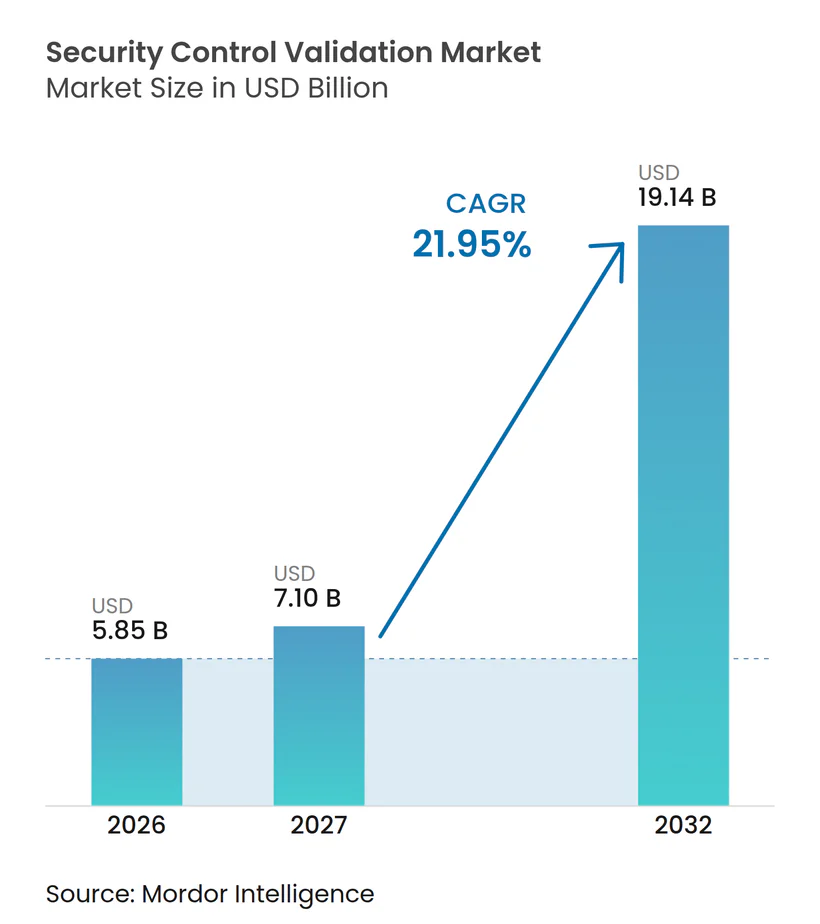
The Security control validation market size was valued at USD 5.85 billion in 2026 and is estimated to grow from USD 7.10 billion in 2027 to reach USD 19.14 billion by 2032, at a CAGR of 21.95% during the forecast period 2027-2032. Rising attack volume is making periodic assessments less suitable for organizations that need current evidence that their controls work in live environments. Buyers are moving toward continuous validation because cloud services, application interfaces, and distributed infrastructure create more routes for attackers to move across systems. Financial services, government organizations, and operators of critical infrastructure are strengthening demand because they face tighter security obligations and high costs when controls fail. Vendors are responding by combining simulation, exposure analysis, automated testing, and managed services instead of selling a single testing tool. The Security control validation market also faces practical constraints because many smaller organizations lack staff to interpret findings, and many large organizations still operate complex security tool stacks.
Key Report Takeaways
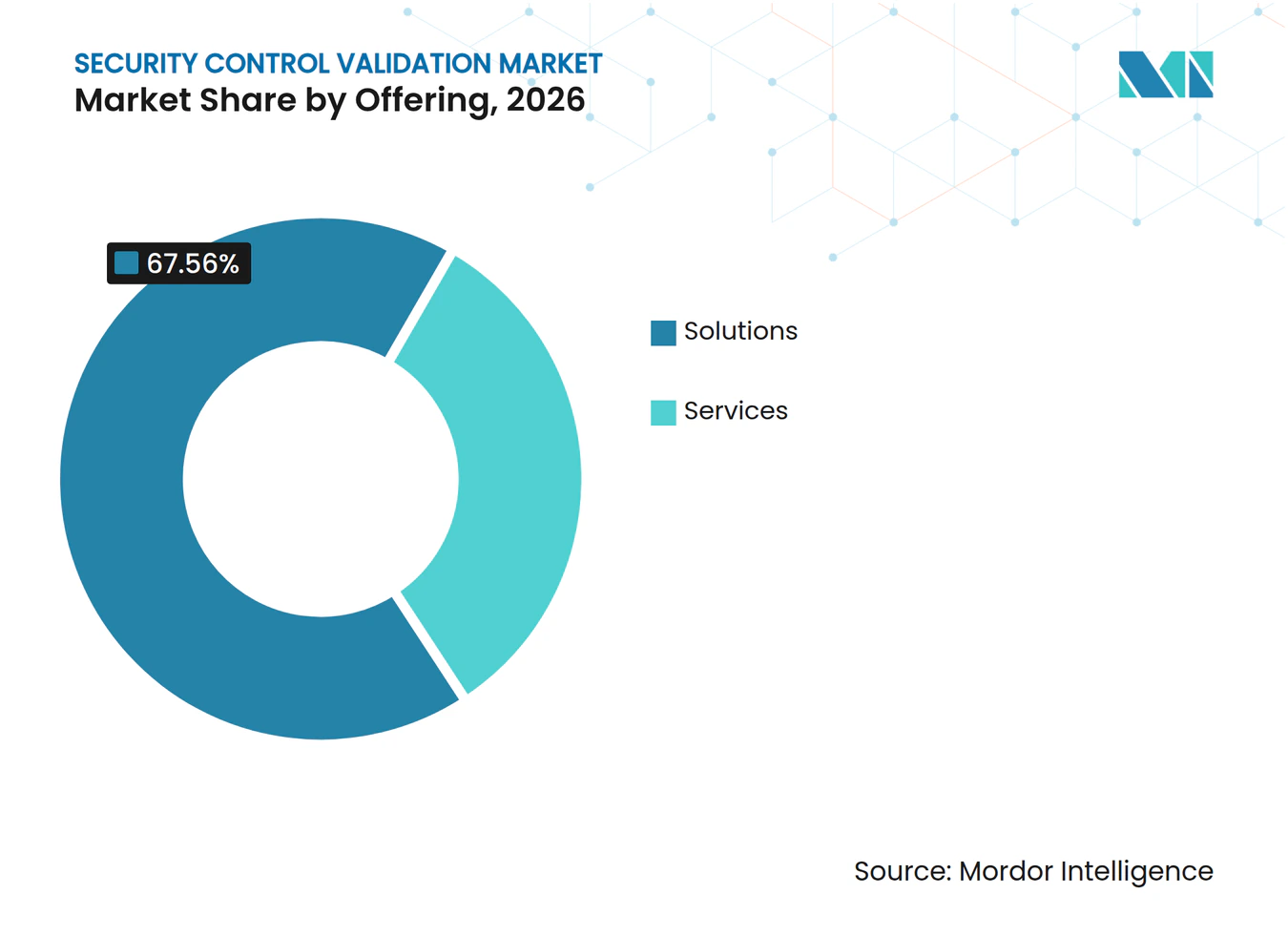
- By offering solutions, it held 67.56% of the Security control validation market share in 2026, while services are projected to expand at a 24.02% CAGR through 2032.
- By deployment mode, on-premises deployment held 70.16% of the Security control validation market share in 2026, while cloud deployment is projected to expand at a 23.68% CAGR through 2032.
- By validation type, breach and attack simulation held 62.18% of the Security control validation market revenue in 2026, while attack-path and exposure validation are projected to expand at a 23.08% CAGR through 2032.
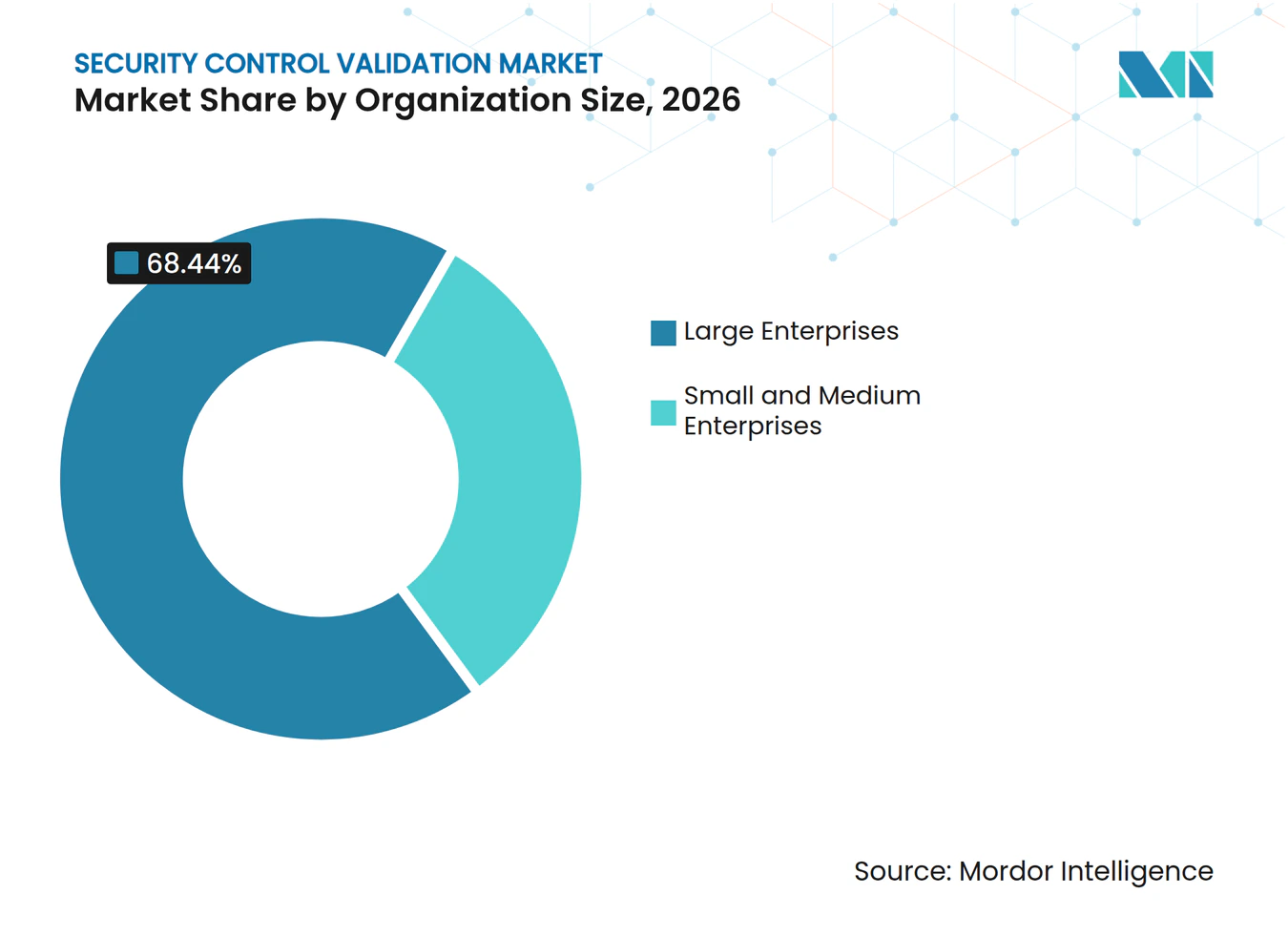
- By organization size, large enterprises held 68.44% of the Security control validation market revenue in 2026, while small and medium enterprises are projected to expand at a 23.39% CAGR through 2032.
- By end-user industry, BFSI accounted for 30.11% of the Security control validation market revenue in 2026, while government and public administration are projected to expand at a 22.36% CAGR through 2032.
- By geography, North America held 37.19% of the Security control validation market revenue in 2026, while Asia-Pacific is projected to expand at a 22.71% CAGR through 2032.
Note: Market numbers in this report are based on Mordor Intelligence's proprietary estimation framework, which combines nine months of actuals with Q4 projections for base year 2026.
Market Trends and Insights
Drivers Impact Analysis of Security Control Validation Market*
| Driver | (~) % Impact on CAGR Forecast | Geographic Relevance | Impact Timeline |
|---|---|---|---|
| Rising Cyberattack Frequency and Sophistication | +5.5% | Global | Short term (≤ 2 years) |
| Tightening Sector-Specific Cybersecurity Compliance | +4.2% | North America and Europe, spill-over to Asia-Pacific | Medium term (2-4 years) |
| Shift From Periodic Testing to Continuous Threat Exposure Management | +3.8% | Global, with concentration in North America and Europe | Medium term (2-4 years) |
| Cloud, SaaS, and Hybrid Attack-Surface Expansion | +3.1% | Asia-Pacific core, spill-over to Middle East and Africa | Short term (≤ 2 years) |
| AI-Accelerated Adversary Modeling and Security Validation | +2.5% | Global, fastest uptake in North America | Medium term (2-4 years) |
| Cyber-Insurance Underwriting Evidence Requirements | +1.8% | North America and Europe | Long term (≥ 4 years) |
| Source: Mordor Intelligence | |||
Rising Cyberattack Frequency and Sophistication
Cyberattack frequency and sophistication are central to demand for the Security control validation market because each advance in attacker capability reduces the acceptable interval between control checks. IBM reported a global average breach cost of USD 4.99 million in 2026, a 12% increase from 2025, while AI-enabled attack incidents increased 56% year over year and added USD 1 million per incident. The 2026 report also found that the mean time to identify and contain a breach was 247 days, reversing 5 years of improvement. Financial services recorded a per-breach cost of USD 6.29 million, which continues to put pressure on control assurance that can be documented throughout the year. This environment favors tools that test whether controls detect and log relevant attacker behavior before a real incident exposes the gap. The Security control validation market is consequently shifting buyer attention from formal attestation toward evidence of current defensive performance.
Tightening Sector-Specific Cybersecurity Compliance
Regulatory requirements are making control validation a more direct purchase requirement for financial institutions and critical infrastructure operators. DORA has been in effect since January 17, 2025, and requires financial entities to manage ICT risks and, where applicable, conduct threat-led penetration testing. PCI DSS 4.0 requirements became effective on March 31, 2025, increasing the importance of repeatable evidence for payment security programs. The EU Cyber Resilience Act introduced reporting obligations for actively exploited vulnerabilities on September 11, 2026. NIS2 also extends cybersecurity obligations across 18 critical sectors through national implementation. Organizations operating across regions can apply their strictest compliance standard more broadly, which supports demand beyond the jurisdiction that introduced the original requirement.
Shift From Periodic Testing to Continuous Threat Exposure Management
The move from annual penetration testing to continuous threat exposure management supports recurring demand in the Security control validation market. Continuous programs combine scoping, discovery, prioritization, and validation with mobilization, with validation confirming whether identified exposures can affect important assets. This approach integrates breach and attack simulation, external attack-surface management, vulnerability management, and threat intelligence into a single operating cycle. AttackIQ launched AVA Agentic OS in July 2026 to coordinate specialized agents across threat intelligence, validation, detection engineering, and control optimization. Vendors can gain more stable subscription revenue by supporting program operations rather than relying on a one-time assessment. Buyers also receive a clearer path from an observed control gap to remediation work.
Cloud, SaaS, and Hybrid Attack-Surface Expansion
Cloud, SaaS, and hybrid environments are expanding the range of assets that organizations must validate and are supporting the adoption of continuous testing. The cloud segment is projected to grow at a 23.68% CAGR through 2032 because cloud-native delivery can connect with application pipelines and reduce deployment work. Hybrid estates combine on-premises systems, public clouds, SaaS interfaces, and containerized services, which creates more dependencies and potential lateral movement paths. Pentera became available through AWS Marketplace in April 2026, allowing customers to procure its validation offering through existing cloud purchasing processes.[1] IBM reported that breaches in hybrid environments averaged USD 5.05 million in 2026, compared with USD 4.01 million for on-premises incidents. The Security control validation market is therefore benefiting from a need to test external interfaces, cloud configurations, and identity relationships that perimeter-focused methods may not cover.
Restraints Impact Analysis of Security Control Validation Market*
| Restraint | (~) % Impact on CAGR Forecast | Geographic Relevance | Impact Timeline |
|---|---|---|---|
| Budget and Skills Constraints Among Small and Medium Enterprises | -1.9% | Global, concentrated in South America, Africa, and smaller Asia-Pacific markets | Short term (≤ 2 years) |
| Interoperability Gaps With Existing Security Operations Technology Stacks | -1.3% | Global | Medium term (2-4 years) |
| Safety and Change-Control Concerns Around Production Simulations | -0.8% | Global, acute in Industrial Manufacturing, Energy, and Utilities sectors | Medium term (2-4 years) |
| Evidence-Quality and Model-Bias Risk in Autonomous Validation | -0.6% | Global, most acute in highly regulated sectors | Long term (≥ 4 years) |
| Source: Mordor Intelligence | |||
Budget and Skills Constraints Among Small and Medium Enterprises
Small and medium enterprises are projected to grow at a 23.39% CAGR through 2032, but staffing constraints can prevent them from fully realizing the value of validation tools. Many organizations with fewer than 2,000 employees lack sufficient detection engineering capacity to translate findings into completed remediation. Licensing affordability alone does not resolve the need for someone to prioritize, own, and verify corrective work. This limits adoption even when a cloud subscription reduces the initial financial commitment. The Security control validation industry is responding with managed offerings that pair software with interpretation and remediation support. That delivery model can help smaller buyers use continuous testing without building a specialized internal team.
Interoperability Gaps With Existing Security Operations Technology Stacks
Security control validation platforms need to integrate with SIEM, SOAR, EDR, firewall management, and IT service management systems for findings to become timely remediation tasks. Legacy security operations centers often rely on proprietary tool combinations, which can leave teams performing manual data normalization. That work can reduce an always-on program to periodic export and review exercises. Picus Security states that its platform has more than 75 integrations, showing why connector coverage is an important product-selection factor. Bidirectional links with IT service management and governance platforms can make follow-up more consistent than one-way data exports. Integration depth will remain important as buyers seek fewer manual steps between testing a control and correcting it.
*Our forecasts treat driver/restraint impacts as directional, not additive. The impact forecasts reflect baseline growth, mix effects, and variable interactions.
Security Control Validation Market Segment Analysis
By Offering:
Solutions Lead While Services Gain GroundSolutions accounted for 67.56% of revenue in 2026, reflecting enterprise demand for software that can run in controlled, data-residency-sensitive environments. The segment includes breach and attack simulation platforms, automated penetration-testing tools, exposure management dashboards, and coordination layers that bring findings together for security teams managing continuous programs. Large financial institutions and government agencies often favor owned deployments because they can manage configuration, access policies, test coverage, and data handling directly. Their requirements commonly include operation in constrained or isolated environments, internal approval procedures, and detailed evidence that can be reviewed by security, audit, and risk teams. The Security control validation market size for solutions is also supported by buyers who need to integrate validation into an established security architecture rather than outsource core testing.
Services in the Security control validation market are projected to expand at a 24.02% CAGR through 2032, outpacing the solutions category. This work includes CTEM program design, red-team support, ongoing interpretation of results, implementation support, and advice on remediation priorities. Managed security service providers can integrate validation platforms into security operations center services and offer customers a continuous outcome rather than a standalone license. That model suits organizations that have limited in-house validation expertise, need help converting findings into action, or want a defined operating process for follow-up. Vendors that do not provide services or partner with providers may face pressure from competitors that can combine technology, operational guidance, and ongoing delivery.


By Deployment Mode:
On-Premises Retains Its Position as Cloud ExpandsOn-premises deployment accounted for 70.16% of revenue in 2026. This position reflects the requirements of federal organizations, tier-1 financial infrastructure, and regulated healthcare networks that mandate local processing or require detailed control over sensitive security data. These buyers may need systems that work without outbound data routing, connect to air-gapped assets, and support specific audit, retention, and access-control requirements. On-premises deployments also remain relevant where legacy infrastructure, internal networks, or operational technology cannot easily be reached by a cloud-delivered service. The Security control validation market continues to serve this installed base because governance requirements can outweigh preferences for simpler deployment.
Cloud deployment in the Security control validation market is projected to expand at a 23.68% CAGR through 2032. Cloud-native services can support always-on monitoring, connect directly with DevSecOps workflows, and reduce the operational work associated with agent deployment and software maintenance. Consumption-based pricing can also reduce the initial commitment required for mid-market customers who want to start with a narrower scope. Cloud delivery reaches SaaS interfaces, external attack surfaces, third-party application programming interfaces, and shadow IT resources that an on-premises agent may not assess well. The change is therefore tied to coverage needs in hybrid and multi-cloud environments, not only to cost and convenience.
By Validation Type:
Breach and Attack Simulation Leads as Exposure Validation AdvancesBreach and attack simulation held 62.18% of the Security control validation market in 2026. Its position reflects long-standing enterprise adoption, alignment with MITRE ATT&CK, and its ability to provide evidence that security controls detect known adversary techniques. BAS platforms test whether SIEM, EDR, firewalls, and web application firewalls identify, alert on, and log simulated activity across a defined set of tactics and techniques. This evidence is useful in compliance reviews and cyber-insurance discussions because it assesses control effectiveness rather than merely confirming that a control is present. The Security control validation industry still relies on BAS as a core method for evaluating defensive coverage and identifying where detection logic needs improvement.
Attack-path and exposure validation is projected to expand at a 23.08% CAGR through 2032. The category assesses whether a chain of vulnerabilities, configuration errors, permission settings, and identity weaknesses can lead to a high-value asset being compromised. Automated penetration testing and continuous automated red teaming add active testing across network, identity, and cloud layers while seeking to avoid operational disruption. Picus Security launched its Autonomous Exposure Validation Platform in July 2026, combining BAS, autonomous penetration testing, and exposure validation in an automated loop. The offering shows how formerly separate product categories are moving toward an integrated workflow in which teams can continuously test, prioritize, and follow up on exposure.
By Organization Size:
Large Enterprises Anchor Demand While SMEs ExpandLarge enterprises held 68.44% of the Security control validation market in 2026. Fortune 500 companies, federal agencies, and tier-1 financial institutions often have layered environments and the budget to sustain continuous programs across multiple business units. Their security teams also face a broader mix of identities, applications, cloud workloads, third-party links, and legacy systems that require repeated checks. Horizon3.ai reported that it protected more than 7,000 organizations, including 4 Fortune 10 companies, while Pentera reported more than 1,100 enterprise customers. These customer figures indicate that continuous testing has gained a place in large-enterprise security programs alongside other security operations tools.
Small and medium enterprises in the Security control validation market are projected to expand at a 23.39% CAGR through 2032. Cloud subscriptions reduce the upfront cost of access and enable smaller buyers to use capabilities that once required a larger security budget and specialized infrastructure. Cyber-insurance requirements for evidence of control effectiveness can also create a purchase trigger outside the usual technology planning cycle. However, these organizations may not have the operational capacity to resolve findings at the pace at which continuous tools generate them or to confirm that corrective actions worked. Growth will depend on vendors pairing their platforms with managed interpretation, remediation assistance, practical prioritization, and reporting that supports a small security team.

By End-User Industry:
BFSI Leads While Government and Public Administration AccelerateBFSI held 30.11% of the Security control validation market in 2026. Its leadership is supported by high regulatory scrutiny, threat-led testing requirements for EU financial entities, and the financial and operational cost of control failures. IBM reported a per-breach cost of USD 6.29 million for financial services in 2026, the second-highest result among sectors.[2] Healthcare and life sciences recorded the highest per-breach cost at USD 6.64 million for the 13th consecutive year. These figures support the demand for documented assurance in sectors where disruption, disclosure, or service unavailability can have significant consequences.
Government and public administration are projected to expand at a 22.36% CAGR through 2032. IT and telecommunications providers, industrial manufacturers, energy utilities, and retailers are also building validation capabilities as digitization increases operational technology, service-delivery, and data exposure. The Defense Information Systems Agency selected AttackIQ in August 2026 for an enterprise-wide adversarial exposure validation platform across military services, combatant commands, and defense agencies. The deployment includes AttackIQ Academy for training and operator proficiency across customized MITRE ATT&CK-aligned learning paths. Government procurement at this scale supports using validation as an enterprise program with consistent processes, rather than as a periodic assessment.
Geography Analysis
The Americas Security Control Validation Market
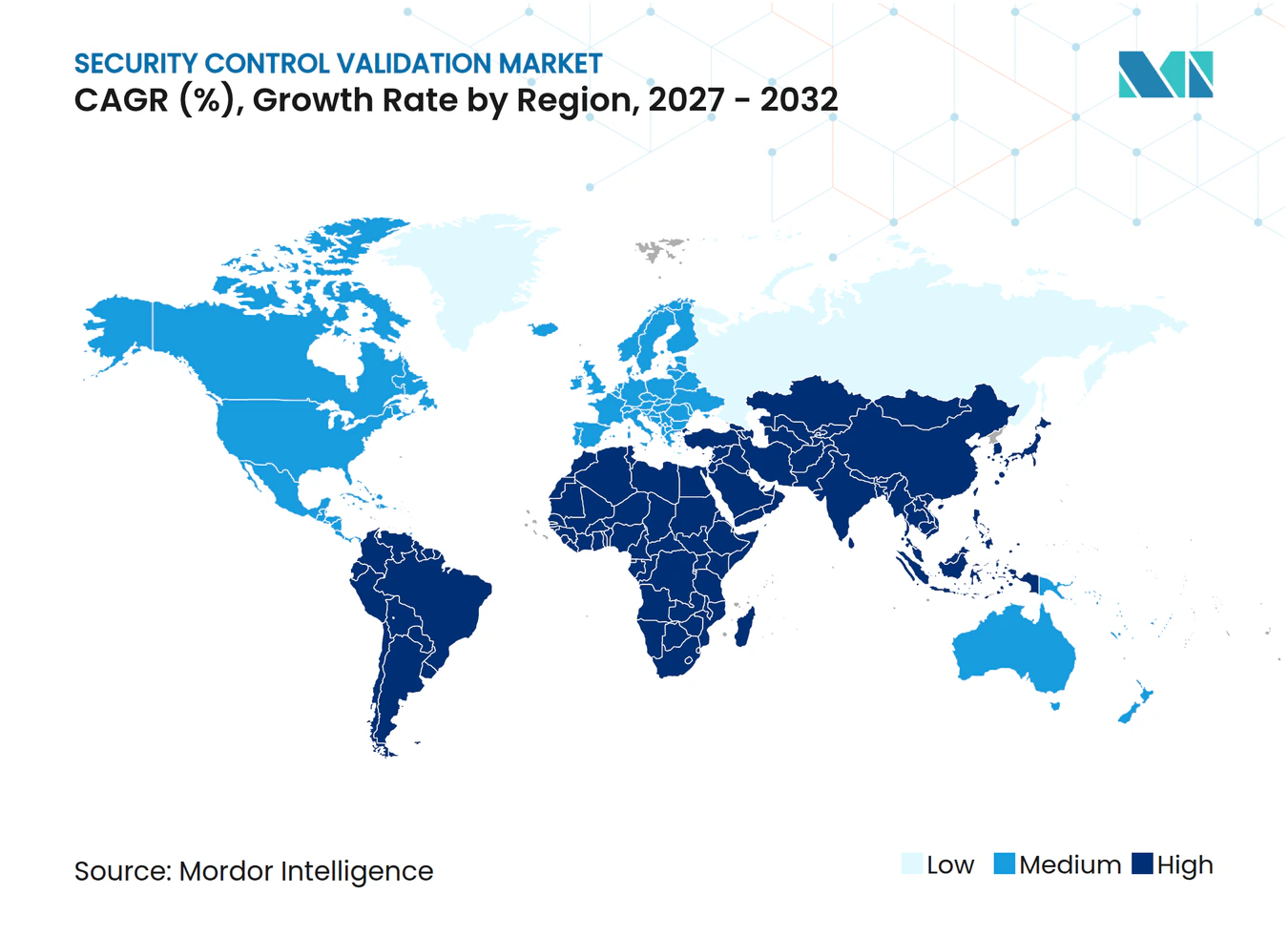
North America held 37.19% of the Security control validation market in 2026. IBM reported that the United States averaged USD 11.5 million per breach in 2026, more than twice the global average and 13% above the prior year. Demand is concentrated in financial services, healthcare, and defense, where organizations face sector-specific requirements and requests for documented evidence of control. The Defense Information Systems Agency's selection of AttackIQ demonstrates the scale of public-sector demand for adversarial exposure validation. South America remains at an earlier stage, with financial services and government organizations driving deployments in Brazil and Argentina.
Europe Security Control Validation Market
Europe is the second-largest region in the Security control validation market. DORA, NIS2, and the Cyber Resilience Act are creating operational demand for repeatable validation across financial services, energy, and critical infrastructure.[3] Germany's IT security market grew by 10.1% in 2025 and is projected to grow significantly in 2026. Germany's Federal Office for Information Security published C5:2026 in April 2026, with 168 criteria across 17 domains for cloud computing compliance. France's national cybersecurity strategy for 2026-2030 prioritizes continuous security validation and control-effectiveness testing.
APAC and MEA Security Control Validation Market
The Asia-Pacific security control validation market is projected to expand at a 22.71% CAGR through 2032, making it the fastest-growing region. Cloud-first digital programs in India, China, Japan, and South Korea are expanding enterprise attack surfaces, while security teams remain constrained by staffing levels. India's digital payments infrastructure and banking security requirements, together with China's localization requirements and sovereign cloud policies, support continuous validation that can operate within data residency constraints. The Middle East and Africa remain early-stage regions where adoption is concentrated among BFSI and government organizations, while Gulf Cooperation Council programs support investment in security testing in Saudi Arabia and the United Arab Emirates.
Competitive Landscape
Market Concentration
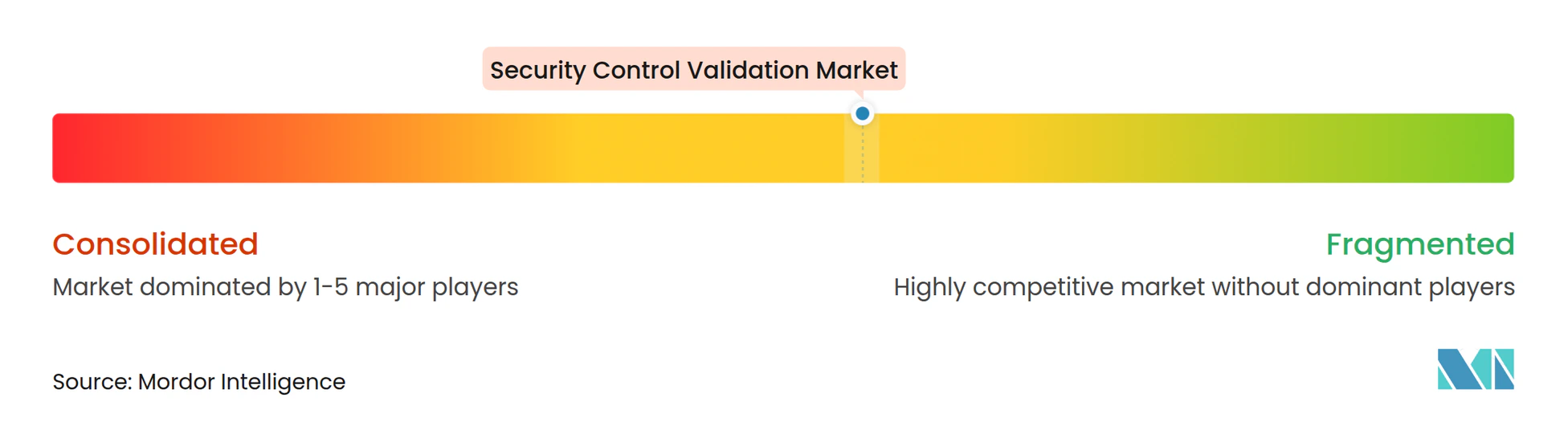
The Security control validation market is moderately concentrated among pure-play specialists, including AttackIQ, Cymulate, Picus Security, SafeBreach, Pentera, and Horizon3.ai. These companies have helped define the category through adversarial simulation, automated penetration testing, and exposure validation capabilities. Broader cybersecurity platforms are also moving into this area, which reduces the space available for standalone offerings. The Security control validation market benefits when vendors connect testing outcomes with detection, response, governance, and remediation processes. Competition is therefore increasingly based on the quality of workflow integration and the ability to validate real operational exposure.
AttackIQ launched AVA Agentic OS in July 2026 to orchestrate AI agents for threat intelligence, validation, detection engineering, and control optimization.[4] Pentera and Recorded Future announced a partnership in July 2026 to connect threat intelligence with exposure validation. Cymulate announced plans to integrate with Bitsight in August 2026 to connect cyber-risk intelligence to its exposure-validation platform. These examples show that vendors aim to help security teams test controls against threats and exposures relevant to their environment. The Security control validation industry is also moving toward shared workflows that route validated gaps into risk-prioritization and remediation processes.
Horizon3.ai positions its automated security testing offering around agentless, production-safe testing to address concerns about disruption during active simulations. Mid-market buyers remain an important competitive opportunity because enterprise platforms often require a level of security operations maturity that smaller organizations lack. Managed exposure validation can bridge that gap when the provider supplies testing, interpretation, documented evidence, and remediation support. Vendors that combine broad integrations, safe testing methods, and a managed service option are better positioned to serve organizations that cannot operate continuous validation in-house.
Security Control Validation Industry Leaders
-
AttackIQ, Inc.
-
Cymulate Ltd.
-
SafeBreach, Inc.
-
Sophos Limited
-
Fortra, LLC
- *Disclaimer: Major Players sorted in no particular order
Security Control Validation Market Companies Covered in this Report
- AttackIQ, Inc.
- Cymulate Ltd.
- Picus Security, Inc.
- SafeBreach, Inc.
- XM Cyber Ltd.
- Pentera Security Ltd.
- Mandiant, Inc.
- Keysight Technologies, Inc.
- Rapid7, Inc.
- Qualys, Inc.
- Sophos Limited
- Skybox Security, Inc.
- Fortra, LLC
- NetSPI, LLC
- MazeBolt Technologies Ltd.
- Safe Security, Inc.
- Horizon3.ai, Inc.
- Scythe, Inc.
- CyCognito, Inc.
- ImmuniWeb SA
Recent Industry Developments in Security Control Validation Market
- August 2026: The Defense Information Systems Agency (DISA) selected AttackIQ as the Department of War's enterprise-wide Adversarial Exposure Validation (AEV) platform, establishing the first DoD-wide continuous security validation capability spanning all Military Services, Combatant Commands, and Defense Agencies. The deployment includes AttackIQ Academy as the enterprise training and operator-proficiency platform for US Cyber Command personnel, delivered through customized MITRE ATT&CK-aligned learning paths.
- August 2026: Cymulate announced a planned integration with Bitsight to connect Bitsight's cyber risk intelligence with Cymulate's exposure validation platform, enabling security teams to automatically test defenses against the specific threat actor TTPs, ransomware campaigns, and CVEs most relevant to their sector and geographic footprint, then route validated gaps back into Bitsight's risk prioritization view.
- July 2026: Pentera and Recorded Future announced a strategic partnership delivering threat-led exposure validation. The integration enables customers to test whether emerging threats identified in live Recorded Future threat intelligence are actively exploitable in their own environments and act on the exposures that carry the highest real-world risk.
- July 2026: AttackIQ launched AVA Agentic OS, described as the industry's first agentic operating system for CTEM, which orchestrates specialized AI agents across threat intelligence, security validation, detection engineering, and control optimization to autonomously operationalize continuous exposure management at scale and deliver real-time cyber-readiness visibility to executive leadership.
Global Security Control Validation Market Report Scope
The Security Control Validation Market comprises software solutions and services that continuously assess, test, and validate the effectiveness of cybersecurity controls against real-world threats, attack techniques, and adversary behaviors. These platforms enable organizations to identify security gaps, evaluate detection and response capabilities, validate remediation efforts, and measure the efficacy of existing security investments. The market includes breach and attack simulation platforms, automated penetration testing solutions, continuous red teaming technologies, attack-path validation platforms, and supporting professional services. Security control validation solutions are widely adopted to strengthen cyber resilience, support regulatory compliance, and improve continuous threat exposure management programs.
The Security Control Validation Market Report is Segmented by Offering (Solutions, and Services), Deployment Mode (On-Premises, and Cloud), Validation Type (Breach and Attack Simulation, Automated Penetration Testing, Continuous Automated Red Teaming, Attack-Path and Exposure Validation, and Other Validation Types), Organization Size (Large Enterprises, and Small and Medium Enterprises), End-User Industry (Banking, Financial Services, and Insurance [BFSI], Government and Public Administration, Healthcare and Life Sciences, IT and Telecommunication, Industrial Manufacturing, Energy and Utilities, Retail and E-Commerce, and Other End-User Industries), and Geography (North America, South America, Europe, Asia-Pacific, Middle East, and Africa). The Market Forecasts are Provided in Terms of Value (USD).
Segmentation Overview
| Solutions |
| Services |
| On-Premises |
| Cloud |
| Breach and Attack Simulation |
| Automated Penetration Testing |
| Continuous Automated Red Teaming |
| Attack-Path and Exposure Validation |
| Other Validation Types |
| Large Enterprises |
| Small and Medium Enterprises |
| Banking, Financial Services, and Insurance (BFSI) |
| Government and Public Administration |
| Healthcare and Life Sciences |
| IT and Telecommunication |
| Industrial Manufacturing |
| Energy and Utilities |
| Retail and E-Commerce |
| Other End-User Industries |
| North America | United States |
| Canada | |
| South America | Brazil |
| Argentina | |
| Mexico | |
| Rest of South America | |
| Europe | Germany |
| United Kingdom | |
| France | |
| Italy | |
| Russia | |
| Rest of Europe | |
| Asia-Pacific | China |
| Japan | |
| India | |
| South Korea | |
| Rest of Asia-Pacific | |
| Middle East | Saudi Arabia |
| United Arab Emirates | |
| Rest of Middle East | |
| Africa | South Africa |
| Nigeria | |
| Rest of Africa |
| By Offering | Solutions | |
| Services | ||
| By Deployment Mode | On-Premises | |
| Cloud | ||
| By Validation Type | Breach and Attack Simulation | |
| Automated Penetration Testing | ||
| Continuous Automated Red Teaming | ||
| Attack-Path and Exposure Validation | ||
| Other Validation Types | ||
| By Organization Size | Large Enterprises | |
| Small and Medium Enterprises | ||
| By End-User Industry | Banking, Financial Services, and Insurance (BFSI) | |
| Government and Public Administration | ||
| Healthcare and Life Sciences | ||
| IT and Telecommunication | ||
| Industrial Manufacturing | ||
| Energy and Utilities | ||
| Retail and E-Commerce | ||
| Other End-User Industries | ||
| By Geography | North America | United States |
| Canada | ||
| South America | Brazil | |
| Argentina | ||
| Mexico | ||
| Rest of South America | ||
| Europe | Germany | |
| United Kingdom | ||
| France | ||
| Italy | ||
| Russia | ||
| Rest of Europe | ||
| Asia-Pacific | China | |
| Japan | ||
| India | ||
| South Korea | ||
| Rest of Asia-Pacific | ||
| Middle East | Saudi Arabia | |
| United Arab Emirates | ||
| Rest of Middle East | ||
| Africa | South Africa | |
| Nigeria | ||
| Rest of Africa | ||
Key Questions Answered in the Report
What is the size of the security control validation market?
The Security control validation market size is estimated at USD 7.10 billion in 2027 and is projected to reach USD 19.14 billion by 2032 at a 21.95% CAGR. Growth reflects the need for more frequent evidence that security controls work across expanding digital environments.
What drives adoption of security control validation platforms?
Rising breach costs, faster AI-enabled attacks, cloud expansion, and compliance requirements are increasing demand for continuous evidence that controls work. Buyers also seek a clearer connection between a tested weakness and a completed remediation action.
Which offering leads demand for security control validation?
Solutions held 67.56% of revenue in 2026, while services are projected to expand faster at a 24.02% CAGR through 2032. Services can help organizations interpret findings and operate an ongoing validation program.
Why are cloud-based validation services growing?
Cloud deployment is projected to expand at a 23.68% CAGR because it supports always-on testing and can reach SaaS, external, and multi-cloud assets. This delivery model can also reduce the initial technical burden for mid-market buyers.
Which end-user sector has the largest share?
BFSI held 30.11% of revenue in 2026, supported by extensive regulatory obligations and a USD 6.29 million average breach cost in the sector. Healthcare and life sciences also face significant exposure because their average breach cost reached USD 6.64 million.
Which region is growing fastest?
Asia-Pacific is projected to expand at a 22.71% CAGR through 2032 as digital transformation and cloud adoption increase security validation needs. India, China, Japan, and South Korea are important regional demand centers.