
Managed Endpoint Exposure Management Services Market Size and Share
Market Overview
| Study Period | 2021 - 2032 |
|---|---|
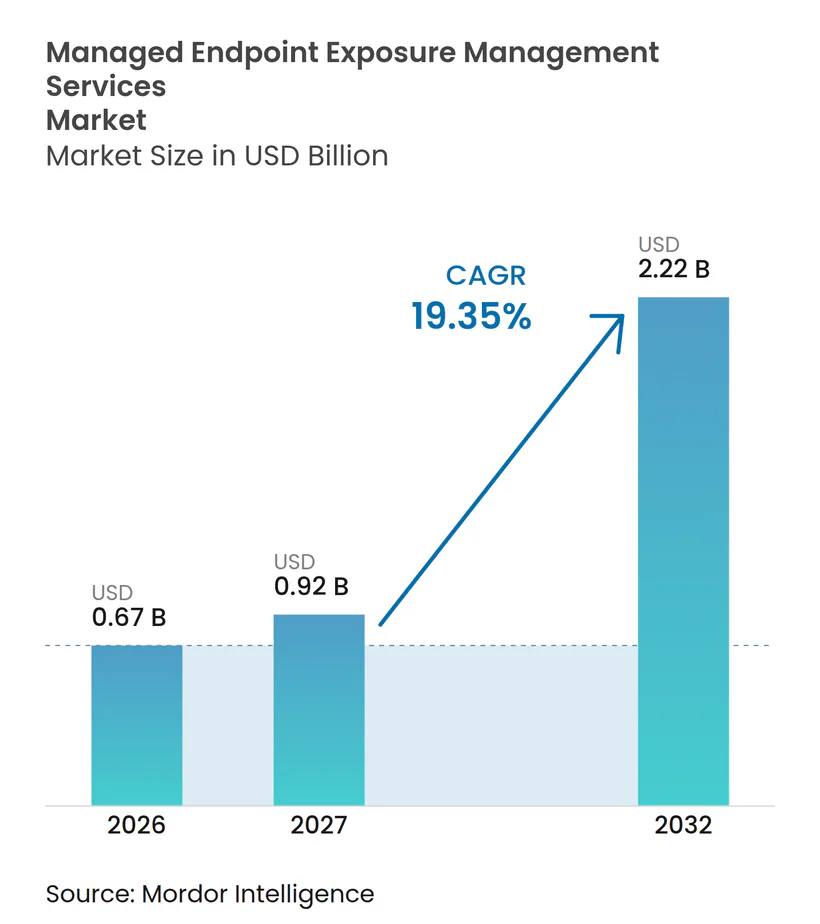
| Market Size (2027) | USD 0.92 Billion |
| Market Size (2032) | USD 2.22 Billion |
| Growth Rate (2027 - 2032) | 19.35 % |
| Fastest Growing Market | Asia-Pacific |
| Largest Market | North America |
| Market Concentration | Medium |
Major Players *Disclaimer: Major Players sorted in no particular order Image © Mordor Intelligence. Reuse requires attribution under CC BY 4.0. | |
Managed Endpoint Exposure Management Services Market Analysis by Mordor Intelligence
The managed endpoint exposure management services market size is projected to expand from USD 0.67 billion in 2026 and USD 0.91 billion in 2027 to USD 2.22 billion by 2032, registering a CAGR of 19.35% between 2027 to 2032. Continuous validation programs are replacing periodic security reviews because point-in-time scanning cannot keep pace with endpoint estates that now span cloud services, SaaS applications, hybrid infrastructure, employee devices, and operational environments. Ransomware, identity compromise, and the shortage of specialist staff are making internally built programs harder to maintain, especially where security teams must coordinate detection, risk assessment, remediation, and executive reporting. DORA, NIS2, and SEC disclosure rules are increasing the value of documented exposure controls, repeatable testing, and formal reporting that can demonstrate how an organization handles material cyber risk. Providers are responding with continuous monitoring, risk prioritization, validation, and compliance evidence services that translate technical findings into workflows for security, infrastructure, and risk teams. The managed endpoint exposure management services market also faces limitations due to integration gaps, implementation workload, and jurisdictional restrictions on processing endpoint telemetry.
Key Report Takeaways
- By service type, Managed Vulnerability Prioritization and Remediation held 32.54% of the managed endpoint exposure management services market share in 2026, while Managed Endpoint Exposure Monitoring is projected to expand at a 25.12% CAGR through 2032.
- By deployment model, cloud-based delivery accounted for 46.15% of the managed endpoint exposure management services market size in 2026 and is projected to expand at a 22.36% CAGR through 2032.
- By organization size, Large Enterprises held 64.18% share in 2026, while SMEs are projected to expand at a 21.89% CAGR through 2032.
- By security operating model, Fully Outsourced Managed Service held 36.48% share in 2026, while Managed Platform With Expert Overlay is projected to expand at a 21.69% CAGR through 2032.
- By end-user industry, BFSI held 26.59% share in 2026, while Manufacturing and Industrial is projected to expand at a 21.78% CAGR through 2032.
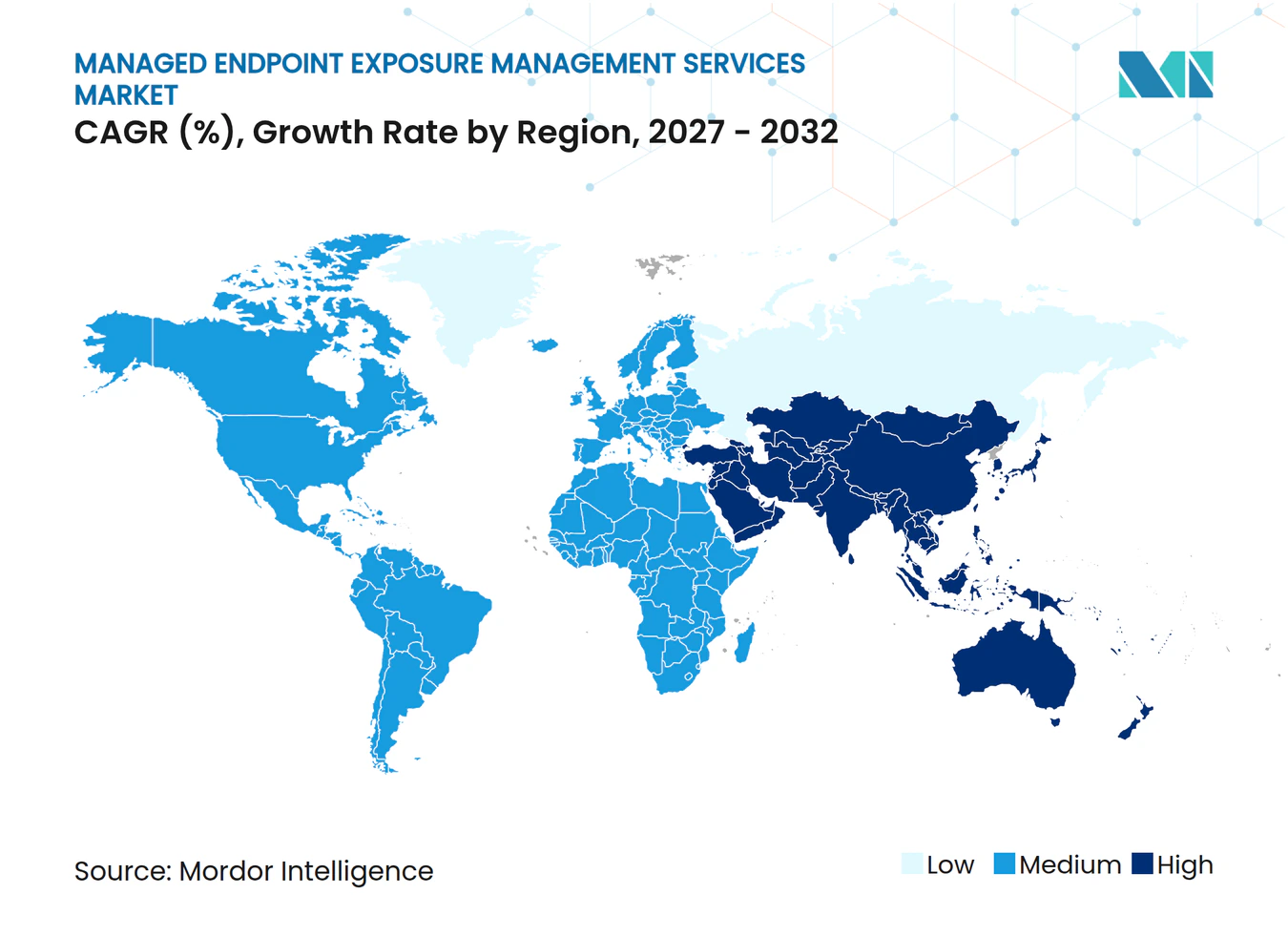
- By geography, North America held 42.74% share in 2026, while Asia-Pacific is projected to expand at a 21.14% CAGR through 2032.
Note: Market size and forecast figures in this report are generated using Mordor Intelligence’s proprietary estimation framework, updated with the latest available data and insights as of 2026.
Market Trends and Insights
Drivers Impact Analysis of Managed Endpoint Exposure Management Services Market*
| Driver | (~) % Impact on CAGR Forecast | Geographic Relevance | Impact Timeline |
|---|---|---|---|
| Escalating Ransomware and Identity-Based Attack Paths | +3.8% | Global, with acute concentration in North America and Europe | Short term (≤ 2 years) |
| Proliferation of Cloud, SaaS, and Hybrid Endpoint Fleets | +3.2% | Global, with highest intensity in Asia-Pacific and North America multi-cloud environments | Medium term (2-4 years) |
| Tightening Cybersecurity Disclosure and Resilience Requirements | +2.6% | North America and the EU, with spillover to Asia-Pacific and the Middle East | Short term (≤ 2 years) |
| Shortage of Endpoint Security and Exposure-Validation Specialists | +2.1% | Global, most acute in Asia-Pacific, with secondary shortfalls in South America and Africa | Long term (≥ 4 years) |
| Shift From CVSS Severity to Exploitability- and Business-Impact-Based Prioritization | +1.8% | Global, with early adoption concentrated in North America and Germany | Medium term (2-4 years) |
| Managed CTEM Adoption Among Resource-Constrained Enterprises | +1.5% | Global, with SME demand concentrated in the UK, India, and Southeast Asia | Medium term (2-4 years) |
| Source: Mordor Intelligence | |||
Escalating Ransomware and Identity-Based Attack Paths
Ransomware and identity misuse are increasingly part of the same attack sequence, underscoring the need for reliable endpoint visibility across user devices, servers, cloud workloads, and privileged access paths. Sophos reported that 67% of investigated incidents in 2026 began with identity-related attacks, indicating that credentials and access relationships can be central to the initial compromise. It also found that 66.5% of ransomware victims identified the ransomware event and initial identity compromise as the same incident, rather than separate security events. Expel reported that every incident handled by its managed SOC involved at least 1 unprotected or rogue endpoint, a finding that links unmanaged assets with operational response pressure. It also found that 96% of incidents involving lateral movement ended in ransomware, highlighting the importance of containing attack movement before it reaches critical systems. These conditions support demand in the managed endpoint exposure management services market for services that connect endpoint status, identity risk, exploitability, remediation ownership, and evidence of completion.[1]
Proliferation of Cloud, SaaS, and Hybrid Endpoint Fleets
Endpoint estates are becoming harder to manage as hybrid work, cloud workloads, SaaS applications, IoT devices, and operational technology converge within the same organization. Tanium-sponsored research found that 72% of surveyed organizations manage at least 1,000 endpoints across Windows, macOS, Linux, iOS, Android, and IoT devices. Each environment can require different coverage, patching practices, telemetry formats, asset records, and operational ownership arrangements. Parallels reported that 50% of surveyed organizations operated multi-cloud workloads, while 32% used a hybrid cloud and on-premises model, adding further variation to security administration. SaaS use adds another layer of exposure when business applications operate outside formal IT visibility and cannot be fully identified by traditional endpoint agents. The managed endpoint exposure management services market, therefore, benefits from services that can identify assets, normalize context, and maintain continuous visibility across fragmented environments.
Tightening Cybersecurity Disclosure and Resilience Requirements
Cybersecurity rules are making exposure management more important for organizations that need to demonstrate that their governance, detection, remediation, and reporting processes operate reliably. DORA entered full enforcement in January 2025 and requires covered financial entities to maintain ICT risk management frameworks, carry out resilience testing, and report major ICT incidents through defined processes. NIS2 has increased the importance of timely detection and reporting for covered entities across the EU, raising the need for dependable technical evidence. The SEC continues to focus on governance and the accuracy of cybersecurity disclosures, which requires executives to understand the status of material cyber risks. These rules make evidence of endpoint posture more relevant for financial institutions, public companies, and critical service providers that must explain how exposure is identified and managed. The managed endpoint exposure management services market can address this need by combining continuous monitoring with traceable reporting, validation records, and remediation documentation.
Shortage of Endpoint Security and Exposure-Validation Specialists
Organizations continue to face staffing gaps in cybersecurity positions that require both technical knowledge and the operational skills needed to manage complex security environments. ISACA reported that 65% of organizations had unfilled cybersecurity positions in 2025, indicating that recruiting challenges affect a large share of employers. Its research identified endpoint security as the second most frequently cited skill need, with 30% of respondents reporting it. ISC2 found that 59% of organizations reported critical or significant cybersecurity skills needs in 2025, compared with 44% in 2024. Persistent shortages make it difficult to operate continuous validation, remediation coordination, and evidence-collection programs internally without creating a burden on existing staff. Managed delivery gives organizations access to specialized skills, defined processes, and recurring coverage without assembling a complete internal team, which supports the adoption of the managed endpoint exposure management services market among organizations with constrained resources.
Restraints Impact Analysis of Managed Endpoint Exposure Management Services Market*
| Restraint | (~) % Impact on CAGR Forecast | Geographic Relevance | Impact Timeline |
|---|---|---|---|
| Interoperability Gaps Across EDR, Vulnerability, SIEM, ITSM, and Identity Tools | -2.4% | Global, most pronounced in multi-vendor security stacks | Medium term (2-4 years) |
| Data Sovereignty and Privacy Constraints on Continuous Endpoint Telemetry | -1.6% | The EU, especially Germany, France, and the Nordics, with spillover to Southeast Asia and Gulf states | Long term (≥ 4 years) |
| High Tuning Burden and False-Positive Fatigue During Early Deployments | -1.1% | Global, particularly in SME and mid-market organizations with limited security staff | Short term (≤ 2 years) |
| Budget Fragmentation Between Security Operations, Infrastructure, and Risk Functions | -0.8% | Global, with greater pressure in manufacturing and the public sector | Medium term (2-4 years) |
| Source: Mordor Intelligence | |||
Interoperability Gaps Across EDR, Vulnerability, SIEM, ITSM, and Identity Tools
Integration gaps can reduce the practical value of continuous endpoint monitoring when findings cannot be integrated into remediation workflows with the context that the infrastructure and security teams need. Sumo Logic reported that 40% of security practitioners identified siloed tools as their largest operational problem in 2026, illustrating the operational cost of disconnected security environments. Endpoint alerts can arrive in high volumes and may lack the normalized information required for automated correlation, prioritization, and routing. EDR tools generate detailed endpoint data, while SIEM platforms hold network and identity information that must be connected for effective analysis of broader attack activity. ITSM integrations can also create confusion when ticket status changes do not clearly indicate which system is authoritative or whether the underlying technical issue has been resolved. The managed endpoint exposure management services market has an advantage in that providers offer standardized connectors across EDR, vulnerability, SIEM, ITSM, and identity platforms, while maintaining a consistent workflow for remediation ownership.
Data Sovereignty and Privacy Constraints on Continuous Endpoint Telemetry
Continuous telemetry can contain sensitive operational data subject to residency, privacy, access, and processing controls across multiple jurisdictions. The EU Data Act applies from September 2025 and has increased attention to the treatment of data services within the EU, including the practical responsibilities associated with cloud-based processing. Data processing location can affect procurement decisions for cloud-based security services when buyers need assurance about the jurisdiction governing logs and other operational records. Providers that centralize telemetry globally may need separate architectures for the EU, Gulf states, and parts of Asia-Pacific, rather than relying on a single common delivery model. These changes can increase delivery costs, introduce additional review stages, and extend enterprise buying cycles before security teams can activate a continuous service. Providers with jurisdiction-aware data handling are better positioned to serve regulated buyers in the managed endpoint exposure management services market, as they can align operational coverage with local processing needs.[2]
*Our forecasts treat driver/restraint impacts as directional, not additive. The impact forecasts reflect baseline growth, mix effects, and variable interactions.
Managed Endpoint Exposure Management Services Market Segment Analysis
By Service Type:
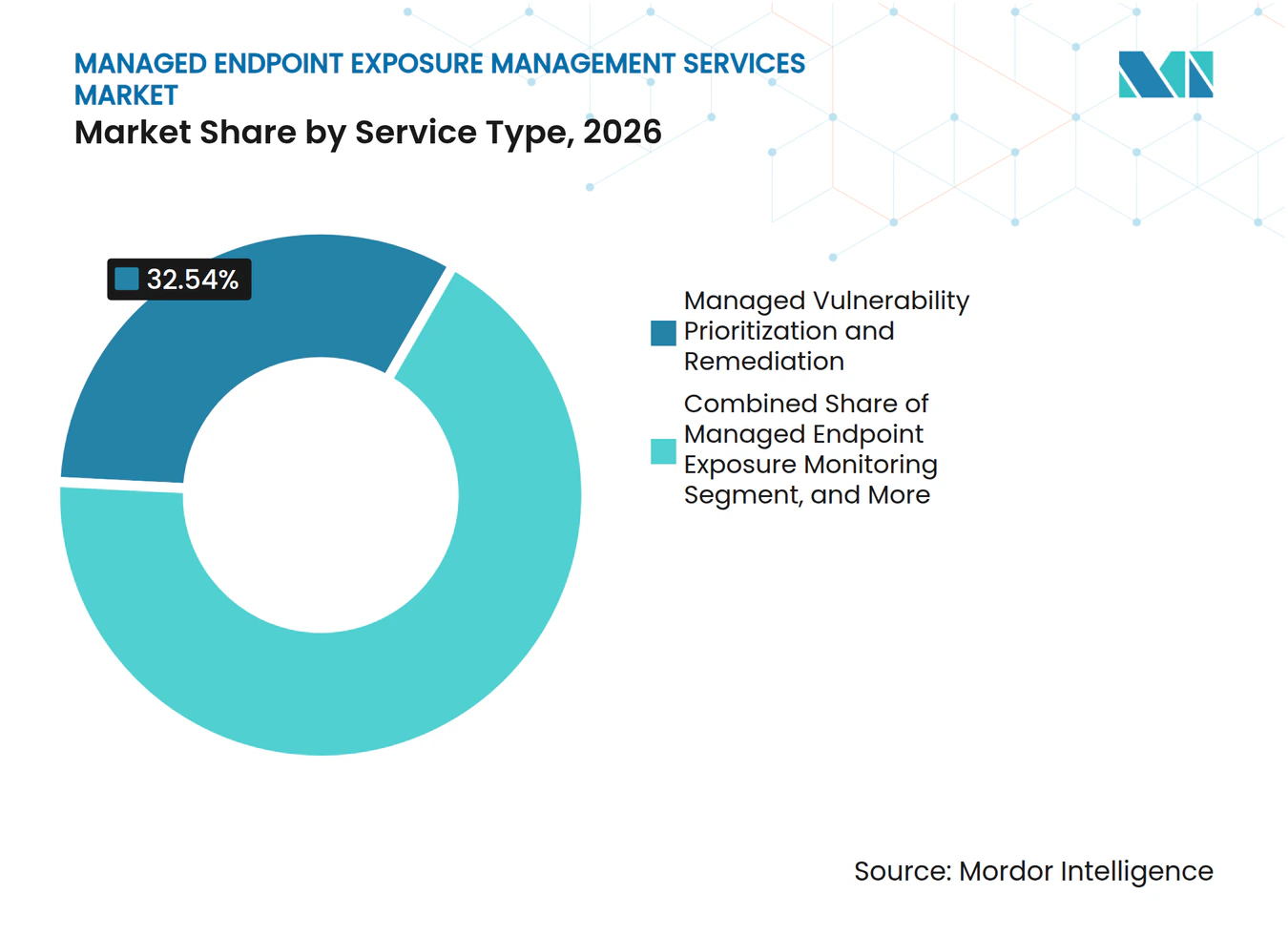
Monitoring Becomes the Primary Growth AreaManaged Vulnerability Prioritization and Remediation held 32.54% of the managed endpoint exposure management services market share in 2026. Organizations use this service to turn raw scanner findings into ordered remediation actions that reflect the business importance of affected systems. The service addresses the practical difficulty of sorting through large volumes of vulnerabilities, where security teams must distinguish urgent exposures from issues that can be scheduled. It helps teams direct scarce operational capacity toward risks that have a meaningful operational impact. Its leading position reflects the long-established need for guided remediation across complex endpoint estates.
Managed Endpoint Exposure Monitoring is projected to expand at a 25.12% CAGR through 2032. Continuous telemetry supports later stages of risk scoring, validation, and reporting because each process depends on a current view of endpoint status. SANS found that 91% of organizations operated some form of exposure management, but only 7% did so continuously with integrated automation. That difference leaves room for providers that deliver monitoring as an ongoing managed service rather than an intermittent technical exercise. Managed Exposure Validation and Breach Simulation provide evidence of exploitability, while Managed Endpoint Attack-Path Analysis connects weaknesses across endpoint, identity, and cloud layers, and Managed Compliance Evidence and Reporting provides records for regulated activity.



By Deployment Model:
Cloud Delivery Leads in Scale and ExpansionCloud-based delivery accounted for 46.15% of the managed endpoint exposure management services market size in 2026. It is also projected to expand at a 22.36% CAGR through 2032. This position reflects lower upfront infrastructure needs and the ability to deliver a managed service without requiring a client to build a dedicated monitoring environment. Cloud delivery can support elastic scaling as organizations add endpoint types, business units, and operating locations. Provider-managed maintenance can reduce the day-to-day burden on smaller security teams without specialized platform staff.
The broader shift toward SaaS delivery supports cloud-based managed exposure services by bringing ongoing capabilities within reach of organizations that could not maintain the same systems internally. A cloud model can help establish continuous visibility without requiring separate infrastructure procurement, deployment, and maintenance at each customer location. Hybrid delivery remains relevant where a portion of telemetry must be processed within a controlled jurisdiction or where sensitive workloads have specific policy requirements. On-premises delivery continues to serve critical infrastructure operators that use air-gapped networks and cannot support cloud telemetry pipelines. The managed endpoint exposure management services market can support cloud-native services while retaining deployment options for regulated and isolated environments.
By Organization Size:
SMEs Increase Adoption Through Subscription DeliveryLarge Enterprises accounted for 64.18% share in 2026. Their position reflects an earlier start in continuous security programs and the greater complexity of their endpoint, cloud, and identity environments. Large organizations also face greater demand for documented governance because their operations often span many business units and geographic locations. Enterprise-focused service portfolios have helped these buyers adopt managed exposure services with tailored operating procedures. Their requirements frequently include advanced compliance evidence, customized service levels, and support for more complex technical integrations.
SMEs are projected to expand at a 21.89% CAGR through 2032. Subscription pricing can lower the cost barrier for organizations that cannot sustain internal CTEM programs or recruit a full team of specialists. SMEs typically generate smaller contract values, but they can provide higher-volume demand and shorter provider sales cycles once the service proposition is clear. Service providers can use tiered offers that align with different levels of security maturity and internal operational capacity. The managed endpoint exposure management services market has room to serve these buyers with continuous monitoring, guided remediation, and a clearer allocation of security responsibility.
By Security Operating Model:
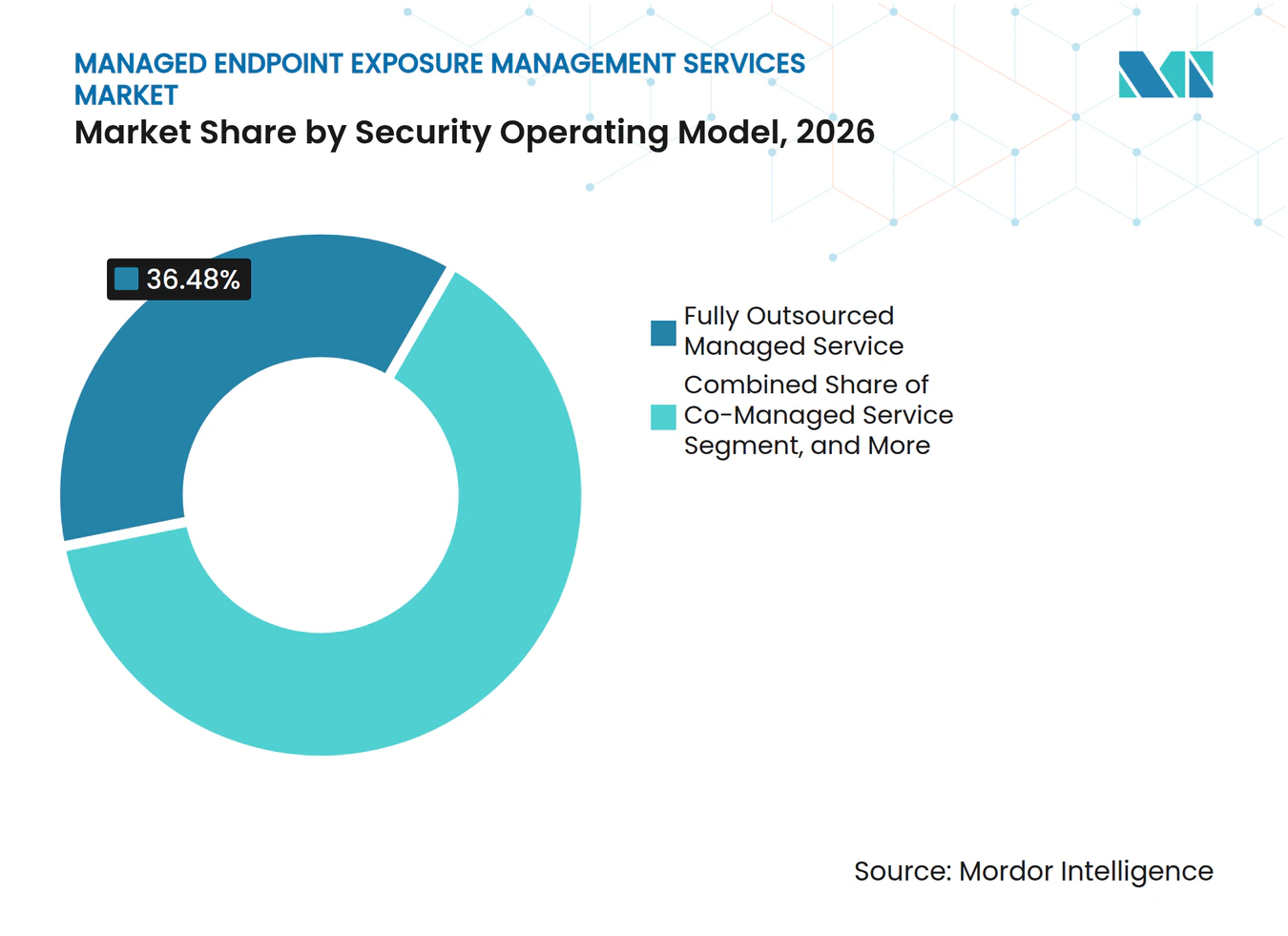
Expert Overlay Gains PreferenceFully Outsourced Managed Service held 36.48% share in 2026. This model appeals to buyers seeking broad operational delegation to a specialist provider capable of running continuous programs without extensive internal involvement. It supports organizations that lack the staff needed to conduct continuous monitoring, validate exposures, coordinate remediation, and handle recurring reporting. The model also provides customers with access to specialized processes while removing much of the operational burden from internal security teams. Its leading position reflects the early stage of many managed exposure deployments and the continued shortage of relevant expertise.
Managed Platform With Expert Overlay is projected to expand at a 21.69% CAGR through 2032. This approach allows CISOs to retain ownership of risk context, business decisions, and communication with boards or regulators. At the same time, it delegates continuous execution to specialist staff and supporting platforms capable of performing recurring operational tasks. Co-managed delivery serves organizations with partial internal capability that need additional depth in breach simulation or attack-path analysis. The managed endpoint exposure management services market is moving toward operating models that balance client oversight with external execution and more scalable platform support.

By End-User Industry:
BFSI Anchors Demand While Manufacturing ExpandsBFSI held 26.59% of the managed endpoint exposure management services market share in 2026. The sector includes trading workstations, ATMs, mobile banking endpoints, customer-facing applications, and hybrid cloud infrastructure, all of which require ongoing security oversight. It also faces stringent governance requirements under DORA and PCI DSS v4.0, which increase the need for clear evidence of posture and remediation activities. These conditions make continuous posture verification relevant for risk, compliance, and security operations teams that need a common operating view. Financial institutions require a transparent record of how identified endpoint issues are prioritized, assigned, resolved, and reported.
Manufacturing and Industrial is projected to expand at a 21.78% CAGR through 2032. IT and OT convergence exposes factory endpoints to risks that once affected mainly conventional IT environments, while production operations can complicate remediation timing. ORDR reported that manufacturing accounted for more than 27% of global cyberattacks in 2025 and that 90% to 95% of manufacturers planned major increases in their cybersecurity budgets in 2026. This creates an opportunity for providers offering unified monitoring across IT and OT settings, with workflows suited to operational environments. Healthcare and Life Sciences, IT and Telecommunications, Government and Defense, and Retail and E-Commerce remain relevant due to exposure to medical devices, infrastructure, communications, and payment security.
Geography Analysis
North America Managed Endpoint Exposure Management Services Market
North America held 42.74% of the managed endpoint exposure management services market share in 2026. The United States anchors demand through mature CTEM programs and a deep base of regulated financial services, public-sector, and critical infrastructure organizations that need consolidated risk visibility. Federal vulnerability-management guidance also favors prioritization that considers asset importance and evidence of exploitation, thereby supporting services that connect endpoint findings to documented remediation. Canada and Mexico add demand through financial services and government organizations that are strengthening cybersecurity governance.
Europe and South America Managed Endpoint Exposure Management Services Market
Europe is shaped by DORA enforcement and NIS2 requirements, which increase the importance of resilience, incident management, and evidence that controls are operating. Germany has strong demand from financial services and automotive manufacturing, where endpoint estates span office, production, and cloud environments. The Netherlands and the Nordic countries have strong demand in the financial sector, while the UK, France, Italy, and Spain support mid-market activity among professional services organizations. Brazil leads South American adoption through financial-sector digitization and LGPD compliance, while Argentina and Chile remain in the early stages of development.[3]
APAC and MEA Managed Endpoint Exposure Management Services Market
Asia-Pacific is projected to expand at a 21.14% CAGR through 2032. India, South Korea, China, and Singapore are important demand centers as digital infrastructure, cloud use, and cybersecurity investment expand. India’s talent supply imbalance encourages reliance on external specialists for ongoing programs. South Korea benefits from government-backed cybersecurity investment. Singapore acts as a regional delivery location for cloud-based managed services. Japan is influenced by financial-sector guidance and an established managed detection presence, while the UAE, Saudi Arabia, South Africa, and Nigeria provide further demand from digital infrastructure, banking, and telecommunications.
Competitive Landscape
Market Concentration
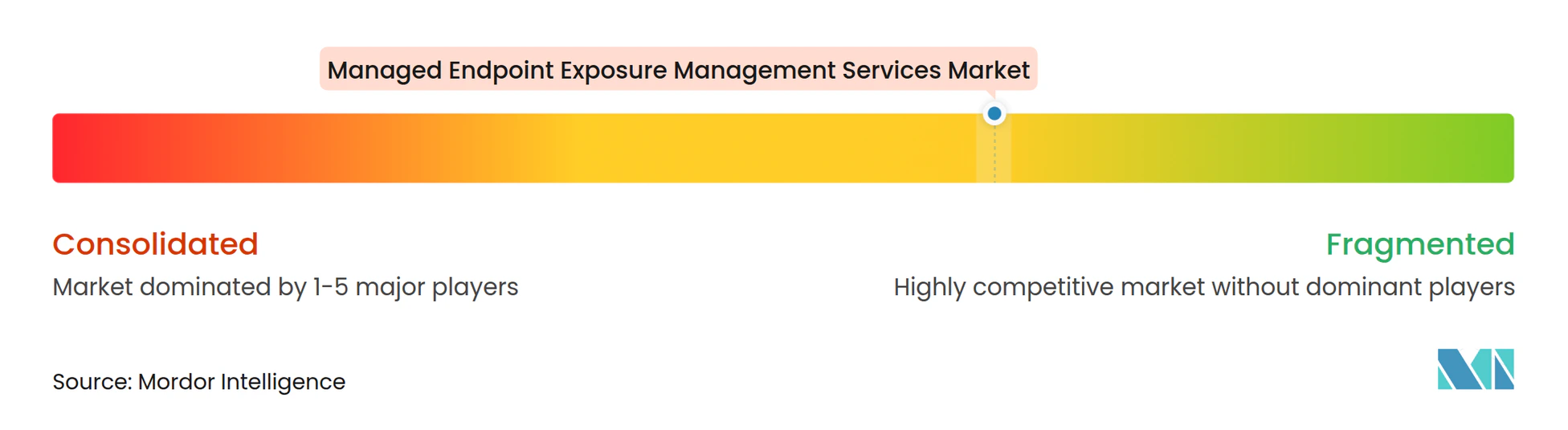
The managed endpoint exposure management services market is moderately fragmented, with more than 2 dozen specialized vendors competing across breach and attack simulation, attack-path analysis, vulnerability prioritization, remediation orchestration, and managed validation. Large security platform vendors are adding exposure management functions to wider security suites, creating direct competition between integrated platforms and focused providers. Pentera reported surpassing USD 100 million in annual recurring revenue in January 2026, demonstrating that adversarial exposure validation has established a meaningful commercial position. Providers compete on their ability to translate technical signals into actions that internal security, infrastructure, and risk teams can execute. The quality of managed delivery, integrations, and evidence for executives remains central to customer choice.
Technology differentiation centers on automated prioritization, remediation routing, attack-path analysis, and compliance evidence that can be used in governance processes. Cymulate launched its unified Exposure Management Platform in August 2025, while Seemplicity released 4 AI agents in October 2025 to support ownership identification, prioritization, and action tracking. Horizon3 expanded NodeZero in September 2025 with Threat Actor Intelligence and Active Directory Tripwires for attack-path and identity-related testing. These product moves seek to reduce the delay between a finding, its validation, and the assignment of an accountable remediation owner. In the managed endpoint exposure management services market, providers that combine these functions can support clients that need continuous validation and a practical route to resolution.
The SME segment remains an opportunity because many competitive investments continue to focus on large enterprise buyers with complex programs and formal compliance needs. Hybrid service models are relevant where buyers want cloud efficiency but must control how and where endpoint telemetry is processed. Horizon3 and Brinqa announced a technology partnership in June 2026, NetSPI and Synack announced a merger agreement in September 2026, and CyCognito added continuous AI pentesting in February 2026. These moves show that product expansion, partnerships, and consolidation are broadening vendor validation and operational capabilities.
Managed Endpoint Exposure Management Services Industry Leaders
-
XM Cyber Ltd.
-
Cycognito Inc.
-
Cymulate Ltd.
-
Pentera Security Ltd.
-
Picus Security Inc.
- *Disclaimer: Major Players sorted in no particular order
Managed Endpoint Exposure Management Services Market Companies Covered in this Report
- XM Cyber Ltd.
- Cycognito Inc.
- IONIX Inc.
- Cymulate Ltd.
- Pentera Security Ltd.
- Picus Security Inc.
- SafeBreach Ltd.
- AttackIQ, Inc.
- Horizon3.ai, Inc.
- Ridge Security, Inc.
- NetSPI LLC
- NopSec Inc.
- Brinqa, LLC
- Seemplicity Security Ltd.
- Outpost24 AB
- SecPod Technologies Inc.
- Securin Inc.
- RedSeal, Inc.
- Panaseer Ltd.
- Validato Security, Inc.
- Safe Security, Inc.
- FireCompass Inc.
Recent Industry Developments in Managed Endpoint Exposure Management Services Market
- September 2026: NetSPI and Synack announced a definitive merger agreement to form a leading offensive cybersecurity platform, the combined entity integrates agentic AI across continuous testing and managed exposure validation at enterprise scale.
- July 2026: Brinqa reported that new logo bookings more than doubled year-over-year in H1 2026 and existing customer deployments expanded 4x, the company simultaneously launched its AI Attribution Agent and AI Deduplication Agent to address exposure ownership challenges.
- June 2026: Horizon3 and Brinqa announced a strategic technology partnership integrating NodeZero's autonomous penetration test findings into Brinqa's exposure management platform to advance attack-path-validated vulnerability prioritization and CTEM operationalization.
- February 2026: CyCognito extended its exposure management platform with continuous AI pentesting capabilities across all externally exposed assets, automating offensive testing to validate active attack vectors.
Global Managed Endpoint Exposure Management Services Market Report Scope
The Managed Endpoint Exposure Management Services Market refers to the market for specialized, outsourced cybersecurity services that help organizations continuously identify, assess, prioritize, validate, and reduce security exposures across their endpoint environments. These services encompass the monitoring of endpoint assets, prioritization and remediation of vulnerabilities, exposure validation and breach simulation, attack-path analysis, and compliance evidence management and reporting. Managed endpoint exposure management services enable organizations to gain continuous visibility into endpoint-related risks, understand potential attack paths, prioritize remediation based on risk and exploitability, and strengthen their overall security posture.
The Managed Endpoint Exposure Management Services Market Report is Segmented by Service Type (Managed Endpoint Exposure Monitoring, Managed Vulnerability Prioritization and Remediation, Managed Exposure Validation and Breach Simulation, Managed Endpoint Attack-Path Analysis, Managed Compliance Evidence and Reporting, and Other Managed Endpoint Exposure Services), Deployment Model (Cloud-based, On-premises, and Hybrid), Organization Size (Large Enterprises and Small and Medium-Sized Enterprises), Security Operating Model (Fully Outsourced Managed Service, Managed Platform With Expert Overlay, and Co-Managed Service), End-User Industry (BFSI, Manufacturing and Industrial, Healthcare and Life Sciences, IT and Telecommunications, Government and Defense, Retail and E-Commerce, and Other End-User Industries), and Geography (North America, South America, Europe, Asia-Pacific, Middle East, and Africa). The Market Forecasts are Provided in Terms of Value (USD).
Segmentation Overview
| Managed Endpoint Exposure Monitoring |
| Managed Vulnerability Prioritization and Remediation |
| Managed Exposure Validation and Breach Simulation |
| Managed Endpoint Attack-Path Analysis |
| Managed Compliance Evidence and Reporting |
| Other Managed Endpoint Exposure Services |
| Cloud-Based |
| Hybrid |
| On-Premises |
| Large Enterprises |
| Small and Medium-Sized Enterprises |
| Fully Outsourced Managed Service |
| Co-Managed Service |
| Managed Platform With Expert Overlay |
| BFSI |
| Healthcare and Life Sciences |
| IT and Telecommunications |
| Government and Defense |
| Retail and E-Commerce |
| Manufacturing and Industrial |
| Other End-User Industries |
| North America | United States |
| Canada | |
| Mexico | |
| South America | Brazil |
| Argentina | |
| Chile | |
| Rest of South America | |
| Europe | Germany |
| United Kingdom | |
| France | |
| Italy | |
| Russia | |
| Spain | |
| Rest of Europe | |
| Asia-Pacific | China |
| Japan | |
| India | |
| South Korea | |
| Australia | |
| Singapore | |
| Rest of Asia-Pacific | |
| Middle East | United Arab Emirates |
| Saudi Arabia | |
| Turkey | |
| Rest of Middle East | |
| Africa | South Africa |
| Nigeria | |
| Kenya | |
| Rest of Africa |
| By Service Type | Managed Endpoint Exposure Monitoring | |
| Managed Vulnerability Prioritization and Remediation | ||
| Managed Exposure Validation and Breach Simulation | ||
| Managed Endpoint Attack-Path Analysis | ||
| Managed Compliance Evidence and Reporting | ||
| Other Managed Endpoint Exposure Services | ||
| By Deployment Model | Cloud-Based | |
| Hybrid | ||
| On-Premises | ||
| By Organization Size | Large Enterprises | |
| Small and Medium-Sized Enterprises | ||
| By Security Operating Model | Fully Outsourced Managed Service | |
| Co-Managed Service | ||
| Managed Platform With Expert Overlay | ||
| By End-User Industry | BFSI | |
| Healthcare and Life Sciences | ||
| IT and Telecommunications | ||
| Government and Defense | ||
| Retail and E-Commerce | ||
| Manufacturing and Industrial | ||
| Other End-User Industries | ||
| By Geography | North America | United States |
| Canada | ||
| Mexico | ||
| South America | Brazil | |
| Argentina | ||
| Chile | ||
| Rest of South America | ||
| Europe | Germany | |
| United Kingdom | ||
| France | ||
| Italy | ||
| Russia | ||
| Spain | ||
| Rest of Europe | ||
| Asia-Pacific | China | |
| Japan | ||
| India | ||
| South Korea | ||
| Australia | ||
| Singapore | ||
| Rest of Asia-Pacific | ||
| Middle East | United Arab Emirates | |
| Saudi Arabia | ||
| Turkey | ||
| Rest of Middle East | ||
| Africa | South Africa | |
| Nigeria | ||
| Kenya | ||
| Rest of Africa | ||
Key Questions Answered in the Report
What is the managed endpoint exposure management services market size?
The managed endpoint exposure management services market size is projected to be USD 0.91 billion in 2027 and USD 2.22 billion by 2032, at a 19.35% CAGR. The forecast reflects demand for ongoing exposure validation rather than periodic endpoint assessment, particularly where organizations operate fragmented cloud, SaaS, and hybrid environments.
What is driving demand for managed endpoint exposure management services?
Ransomware and identity-based attack paths, complex cloud and SaaS estates, compliance demands, and security skills shortages are increasing demand. These factors make continuous visibility and managed remediation more relevant for organizations that need dependable security operations but have limited internal capacity.
Which service category is projected to expand fastest?
Managed Endpoint Exposure Monitoring is projected to expand at a 25.12% CAGR through 2032. Monitoring supports the current endpoint telemetry needed for risk scoring, validation, compliance reporting, follow-up action, and the identification of changes in the endpoint environment.
Which deployment model leads adoption?
Cloud-based delivery held 46.15% share in 2026 and is projected to expand at a 22.36% CAGR through 2032. It can reduce upfront infrastructure requirements, simplify scaling across new endpoint types and operating locations, and shift routine platform maintenance to the service provider.
Which end-user group accounts for the largest share?
BFSI held 26.59% share in 2026 because of its large attack surface and extensive regulatory requirements. Financial institutions need clear evidence showing how endpoint issues are prioritized, assigned, resolved, and reported across complex digital banking and customer-service operations.
Which region is projected to expand fastest?
Asia-Pacific is projected to expand at a 21.14% CAGR through 2032, supported by cybersecurity investment and managed service demand. The managed endpoint exposure management services market is supported by demand centers in India, South Korea, China, and Singapore.