
Managed Enterprise Service Management Operations Market Size and Share
Market Overview
| Study Period | 2021 - 2032 |
|---|---|
| Market Size (2027) | USD 178.54 Billion |
| Market Size (2032) | USD 259.20 Billion |
| Growth Rate (2027 - 2032) | 7.74 % |
| Fastest Growing Market | Asia-Pacific |
| Largest Market | North America |
| Market Concentration | Medium |
Major Players *Disclaimer: Major Players sorted in no particular order Image © Mordor Intelligence. Reuse requires attribution under CC BY 4.0. | |
Managed Enterprise Service Management Operations Market Analysis by Mordor Intelligence
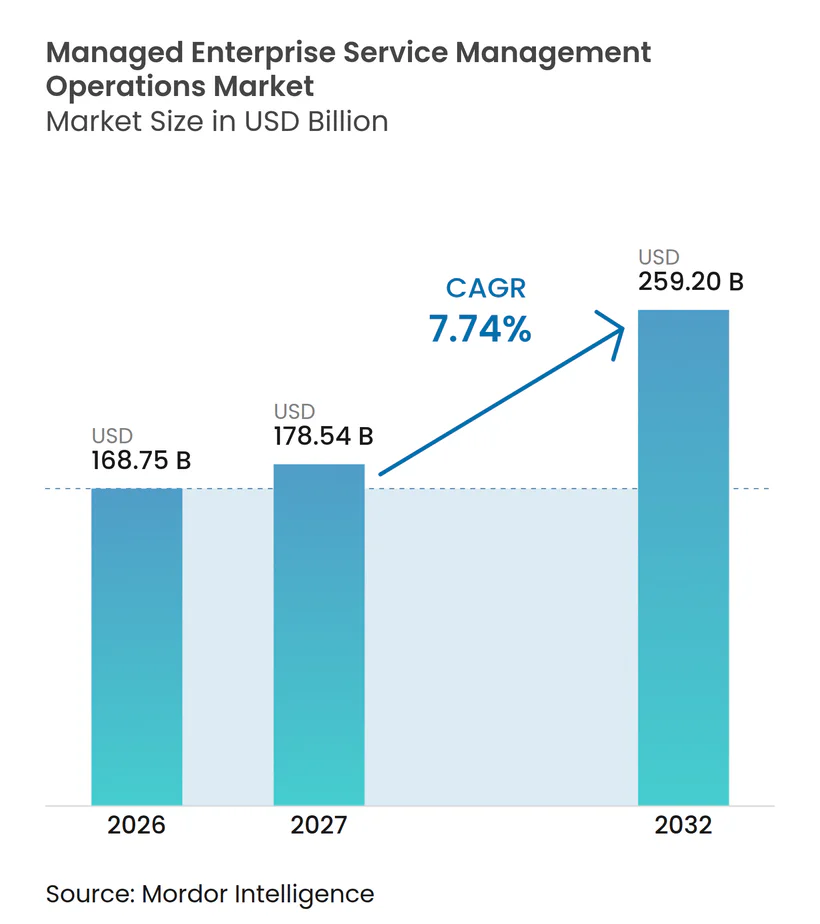
The managed enterprise service management operations market size is projected to expand from USD 168.75 billion in 2026 to USD 259.20 billion by 2032, registering a CAGR of 7.74% between 2027 to 2032. The managed enterprise service management operations market is being shaped by hybrid and multi-cloud operating models that are difficult for internal teams to manage alone. AI-based automation is also changing how providers organize service desks, IT operations, and remediation work. Buyers are placing more weight on consistent service levels, governance, and visibility across distributed technology environments. Providers that can connect automation with operational accountability have a stronger basis for long-term contracts. Regulatory requirements for data residency and AI transparency are also raising the importance of platform controls and documented service processes.
Key Report Takeaways
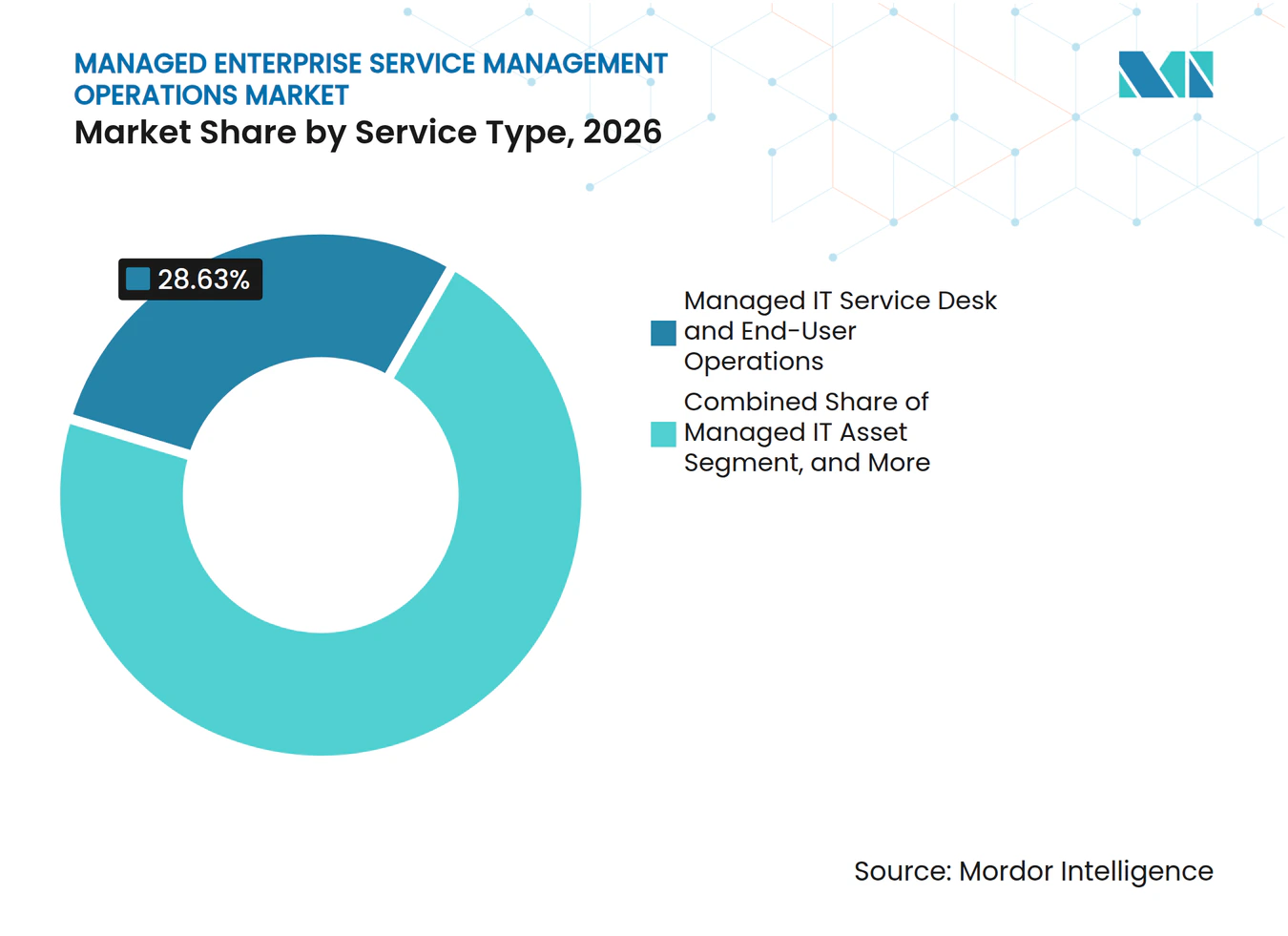
- By service type, Managed IT Service Desk and End-User Operations held 28.63% of the managed enterprise service management operations market share in 2026, while Managed Automation, AIOps, and Observability Operations is projected to expand at an 8.49% CAGR through 2032.
- By delivery model, Fully Managed Services held a 57.37% share in 2026 and is projected to expand at an 8.74% CAGR through 2032.
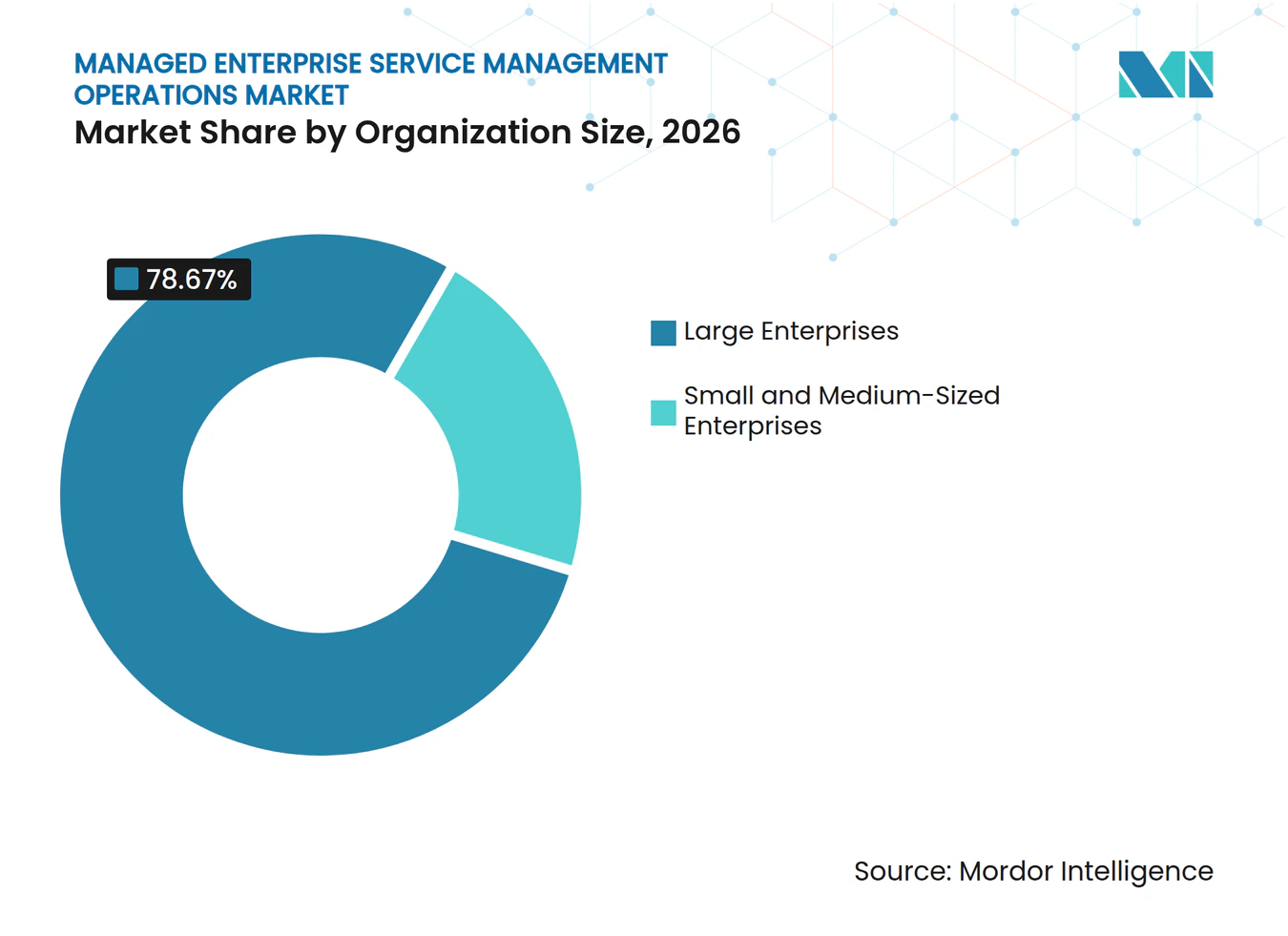
- By organization size, Large Enterprises held 78.67% of revenue in 2026, while Small and Medium-Sized Enterprises is projected to expand at an 8.63% CAGR through 2032.
- By enterprise service domain, Information Technology held 75.28% of revenue in 2026, while Human Resources is projected to expand at an 8.56% CAGR through 2032.
- By geography, North America held 40.58% of revenue in 2026, while Asia-Pacific is projected to expand at an 8.81% CAGR through 2032.
Note: Market numbers in this report are based on Mordor Intelligence's proprietary estimation framework, which combines nine months of actuals with Q4 projections for base year 2026.
Market Trends and Insights
Drivers Impact Analysis of Managed Enterprise Service Management Operations Market*
| Driver | (~) % Impact on CAGR Forecast | Geographic Relevance | Impact Timeline |
|---|---|---|---|
| Hybrid and Multi-Cloud Complexity | +2.1% | Global | Short term (≤ 2 years) |
| AI-Enabled Service Automation and AIOps | +1.8% | North America and Europe, expanding to Asia-Pacific | Medium term (2–4 years) |
| Enterprise Demand for Predictable SLA Performance | +1.4% | Global, most acute in North America and Europe | Short term (≤ 2 years) |
| Expansion of Service Management Beyond IT | +1.1% | North America and Europe, Asia-Pacific emerging | Medium term (2–4 years) |
| Outcome-Based and Experience-Level Agreements | +0.8% | North America and Europe | Medium term (2–4 years) |
| Agentic Runbook Interoperability Across Tool Estates | +0.6% | North America, early momentum in Europe | Long term (≥ 4 years) |
| Source: Mordor Intelligence | |||
Hybrid and Multi-Cloud Complexity Drives Demand for Managed Operations
Hybrid and multi-cloud environments are increasing the operational burden on enterprise technology teams. Flexera reported that 73% of organizations operate hybrid cloud environments, while the figure reached 78% among enterprises with more than 5,000 employees.[1] HashiCorp found that 97% of organizations use multiple tools to manage cloud environments, with 5 tools used on average. The same research identified multi-cloud complexity as the largest infrastructure challenge for 52% of respondents. These conditions support demand in the managed enterprise service management operations market for providers that can apply common governance, remediation, and visibility across separate environments. For many organizations, hybrid complexity has become a lasting operating condition rather than a temporary migration stage.
AI-Enabled Service Automation and AIOps Change Service Delivery Economics
AI-enabled service automation is reducing the amount of manual work required in enterprise operations. ServiceNow reported that Thrive routed more than 315,000 tasks over 6 months through AI automation and achieved 73% first-contact resolution.[2] The implementation reduced time to resolution by 63% and saved 21,000 hours of manual work. These results show why buyers are assessing automation as part of a provider’s delivery model, not as a separate product feature. As AI handles routine Tier 1 and Tier 2 work, providers that rely mainly on labor-intensive delivery models face pressure on their pricing structure. Providers with reliable autonomous remediation can position contracts around service outcomes and response quality.
Enterprise Demand for Predictable SLA Performance Supports Managed Adoption
Service commitments have become more important as technology availability affects daily business operations. Distributed estates across on-premises systems, public clouds, and endpoint devices make consistent service-level performance difficult for internal teams to maintain. ServiceNow’s work with Thrive showed that AI-led workflow routing can support higher first-contact resolution in a managed service setting. The managed enterprise service management operations market benefits when buyers seek providers that can link operating data to defined service commitments. This requirement is especially relevant in regulated sectors where poor service performance can disrupt essential processes. Providers that combine service-level reporting with employee experience telemetry can offer buyers more evidence of service quality.
Service Management Beyond IT Opens Adjacent Revenue Opportunities
Service management tools are moving beyond traditional IT functions into HR, finance, legal, and facilities. This shift replaces email-based requests with tracked workflows, assigned ownership, and defined response standards. A City of Munich tender issued in March 2026 sought an enterprise service management system covering technology management, occupational safety, corporate communications, and medical device safety.[3] The example shows that non-IT departments can become direct stakeholders in platform selection and service delivery. For the managed enterprise service management operations market, broader service scope can make contracts harder to replace because workflows connect multiple departments. Human Resources is projected to be the fastest-expanding service domain at an 8.56% CAGR through 2032.
Restraints Impact Analysis of Managed Enterprise Service Management Operations Market*
| Restraint | (~) % Impact on CAGR Forecast | Geographic Relevance | Impact Timeline |
|---|---|---|---|
| Legacy Workflow and CMDB Migration Complexity | -1.2% | Global, most acute in North America and Europe | Short term (≤ 2 years) |
| Shortage of ITSM, ITOM, and Service Integration Specialists | -0.9% | Global | Short term (≤ 2 years) |
| Data Residency and AI Governance Fragmentation | -0.7% | Europe, Asia-Pacific, emerging in Middle East and Africa | Medium term (2–4 years) |
| Observability Data Volume and Tool-Sprawl Costs | -0.5% | Global | Medium term (2–4 years) |
| Source: Mordor Intelligence | |||
Legacy Workflow and CMDB Migration Complexity Slows Platform Transitions
Technical debt in older service management environments can delay adoption of managed operating models. Large enterprises often have configuration management databases with incomplete records, undocumented relationships, and customized workflow logic. Riverbed reported that 93% of surveyed organizations were willing to switch vendors to consolidate tools. The report also identified data quality and integration complexity as major barriers to making those changes. Complex migrations can require a long period of parallel operations, which raises cost and reduces the appeal of a near-term change. Each cloud workload added without current configuration data can make later transitions more difficult.
Specialist Shortages Limit Delivery Capacity
The supply of experienced service management staff remains a constraint for both buyers and providers. HDI reported that 63% of service management organizations were understaffed, while 77% struggled to secure qualified Tier 1 and Tier 2 service-desk analysts. The gap affects organizations that need people with technical knowledge and strong user support capabilities. Managed providers compete with enterprise IT departments for the same limited pool of skilled staff. They also need to retrain existing teams to work with automated and AI-supported processes. The managed enterprise service management operations market can therefore face delivery limits even where buyer demand remains strong.
*Our forecasts treat driver/restraint impacts as directional, not additive. The impact forecasts reflect baseline growth, mix effects, and variable interactions.
Managed Enterprise Service Management Operations Market Segment Analysis
By Service Type:
AIOps-Led Automation Reshapes the Service PortfolioManaged IT Service Desk and End-User Operations held 28.63% of the managed enterprise service management operations market share in 2026. The segment remains the most frequent point of contact between employees and technology service teams. Its work includes incident reporting, service requests, access issues, and remote device support. Managed IT Operations and Infrastructure Management serves organizations that need continuous oversight across hybrid and multi-cloud environments. Managed Enterprise Service Integration and Management addresses the need to coordinate multiple internal and external service providers. These service categories retain importance because operating failures often involve systems, suppliers, and users at the same time.
Managed Automation, AIOps, and Observability Operations is projected to expand at an 8.49% CAGR through 2032. The category is gaining traction as platforms correlate telemetry and trigger remediation with less manual intervention. Elastic found that 67% of organizations experience unexpected observability-tool costs. Its research also found that 96% of organizations are taking action to reduce those costs. These pressures encourage buyers in the managed enterprise service management operations market to consider managed observability services with consolidated operating and pricing models. Managed Service Continuity and Resilience Operations and Managed IT Asset and Configuration Operations also remain relevant because resilience, asset visibility, and audit readiness are ongoing operating requirements.



By Delivery Model:
Fully Managed Services Lead the Outsourcing ShiftFully Managed Services held 57.37% of revenue in 2026, giving the delivery model the leading position in the managed enterprise service management operations market. The segment is also projected to expand at an 8.74% CAGR through 2032. This combination indicates that some buyers are moving from narrow support engagements to broader transfers of service management responsibility. A full-service arrangement can provide one accountable provider for operations, service performance, and continuous improvement. It can also simplify coordination where an enterprise has several platforms and suppliers. The model is most suitable when internal teams do not want to retain daily responsibility for routine operations.
Co-Managed Services remains relevant where organizations want to keep internal control over critical processes while assigning operational execution to a provider. This approach is common where compliance obligations or internal expertise make full outsourcing less practical. Staff-Augmented and Project-Based Operations can support platform migrations, new-tool deployments, and periods of high demand. Automation is enabling providers to offer more standardized managed services to mid-sized accounts that previously needed more customized co-managed arrangements. That change can reduce delivery complexity for the provider and broaden the range of organizations that can consider a fully managed model. The managed enterprise service management industry is therefore serving both long-term outsourcing programs and shorter capability-based engagements.
By Organization Size:
Enterprise Scale Leads While Smaller Buyers AccelerateLarge Enterprises held 78.67% of revenue in 2026 within the managed enterprise service management operations market. These organizations manage larger IT budgets, more suppliers, and more complex governance demands than smaller businesses. Their operating environments often require formal service management processes and continuous improvement programs. Large contracts also give platform providers broad operational data across teams and workflows. This can help providers improve their service methods and automation models over time. The concentration of enterprise demand supports the leading position of this organization-size segment.
Small and Medium-Sized Enterprises is projected to expand at an 8.63% CAGR through 2032. Flexera reported that 60% of organizations use managed service providers, while utilization among small and medium-sized businesses was 39%. This difference leaves room for providers that can make managed operations accessible to smaller organizations in the managed enterprise service management operations market. Pax8 stated that research cited in its NinjaOne partnership announcement found that 84% of small businesses would trust an external technology advisor to implement AI. Cloud-native platforms and consumption-based pricing can lower entry barriers for buyers that avoid rigid multi-year contracts. Providers can use these models to reach accounts that may not have considered managed services previously.

By Enterprise Service Domain:
IT Remains Central as HR and Finance EmergeInformation Technology held 75.28% of revenue in 2026. IT remains the operational foundation for service management because it links systems, employees, business processes, and external service delivery. The domain includes incident management, change control, asset lifecycle activity, and observability. Its breadth creates opportunities to extend service platforms into other areas that already depend on digital workflows. Customer and Field Service is also gaining relevance where IT availability directly affects the customer experience. This keeps IT at the center of the managed enterprise service management operations market even as service scope becomes broader.
Human Resources is projected to expand at an 8.56% CAGR through 2032. Organizations are applying workflow governance to HR case management, employee onboarding, and benefits inquiries. Finance and Procurement are another area of expansion, particularly for invoice processing and purchase-order approvals with defined service commitments. Facilities and Workplace Services are gaining attention among organizations that manage distributed workforces. Legal and Compliance also attracts investment in regulated sectors where request volumes and documentation needs are substantial. This broadening scope gives the managed enterprise service management operations market more routes into enterprise-wide service programs. Atlassian presented service management capabilities for IT, HR, finance, facilities, legal, and customer service at Team ’26 Europe in March 2026.
Geography Analysis
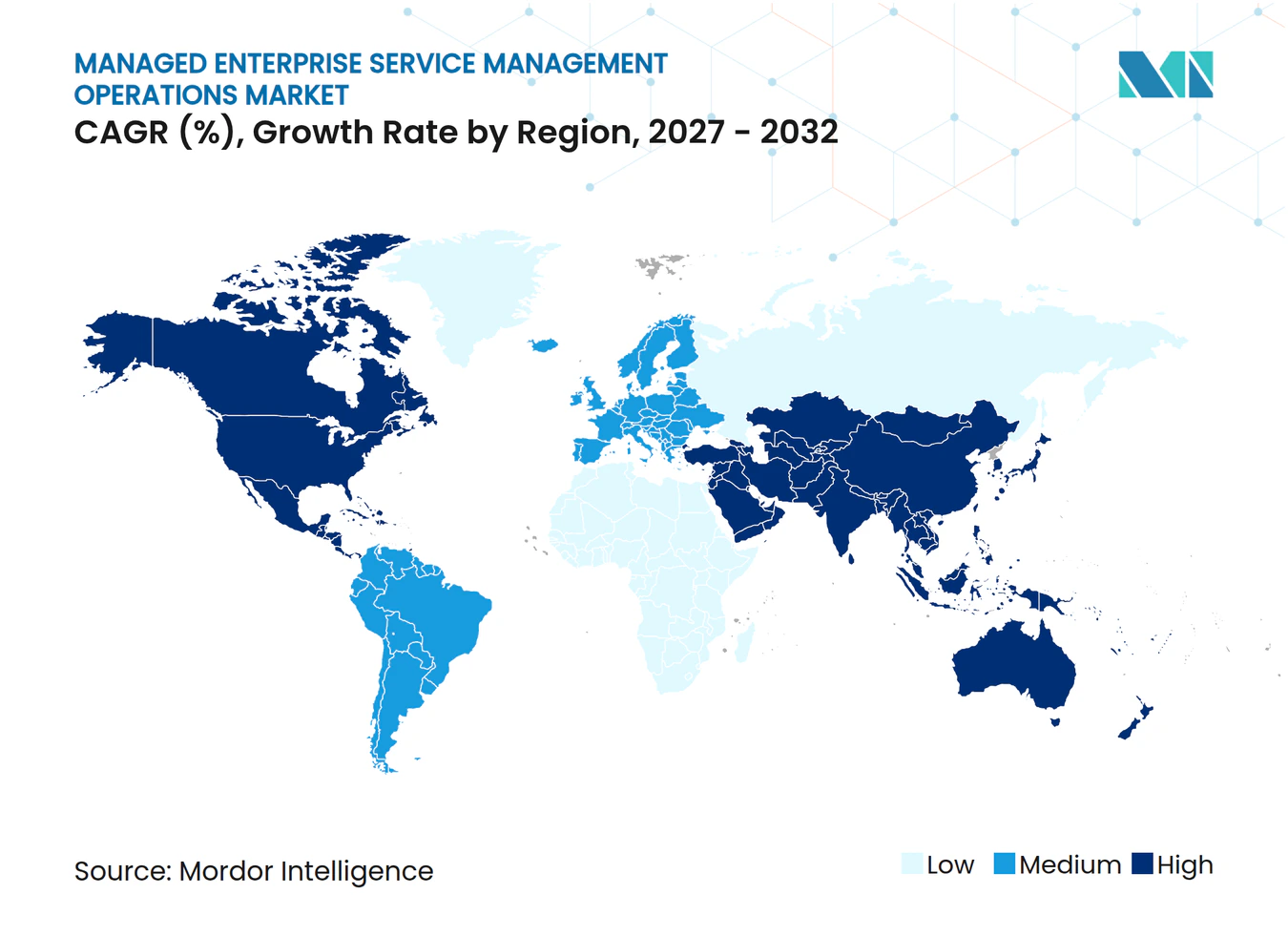
North America held 40.58% of revenue in 2026 in the managed enterprise service management operations market. The region benefits from large enterprise technology budgets, a mature managed services ecosystem, and a concentration of global technology headquarters. Buyers often have complex software, infrastructure, and security environments that require continuous service coordination. These conditions support demand for providers that can manage distributed operations under formal service commitments. North America also remains an important market for automation-led service desk and IT operations programs.
Europe is an established demand center in the managed enterprise service management operations market, where compliance requirements increasingly shape platform selection. Data residency and AI governance requirements can affect how providers design cloud hosting and service processes. Germany remains an important continental market, while the United Kingdom, France, Italy, and the Nordic countries provide established demand centers. ServiceNow has supported deployments on STACKIT, a German-hosted cloud infrastructure, illustrating the importance of local hosting options for some buyers. The Middle East is also developing as digital government and enterprise modernization programs create demand for structured service management. Saudi Arabia and the United Arab Emirates are notable examples of this broader regional activity.
Asia-Pacific is projected to expand at an 8.81% CAGR through 2032 in the managed enterprise service management operations market. Cloud migration, government digitization programs, and service-management skills gaps are supporting outsourcing demand across the region. Japan has a large domestic managed services base, while India is a major source of technology capability and enterprise adoption. Providers must adapt delivery methods to local data, procurement, and workforce requirements across these diverse markets. South Korea, Australia, Singapore, and Southeast Asian markets can also support regional service delivery programs. Africa remains a smaller contributor, but South Africa, Nigeria, and Egypt show early demand as multinational companies strengthen shared-services operations.
Competitive Landscape
Market Concentration
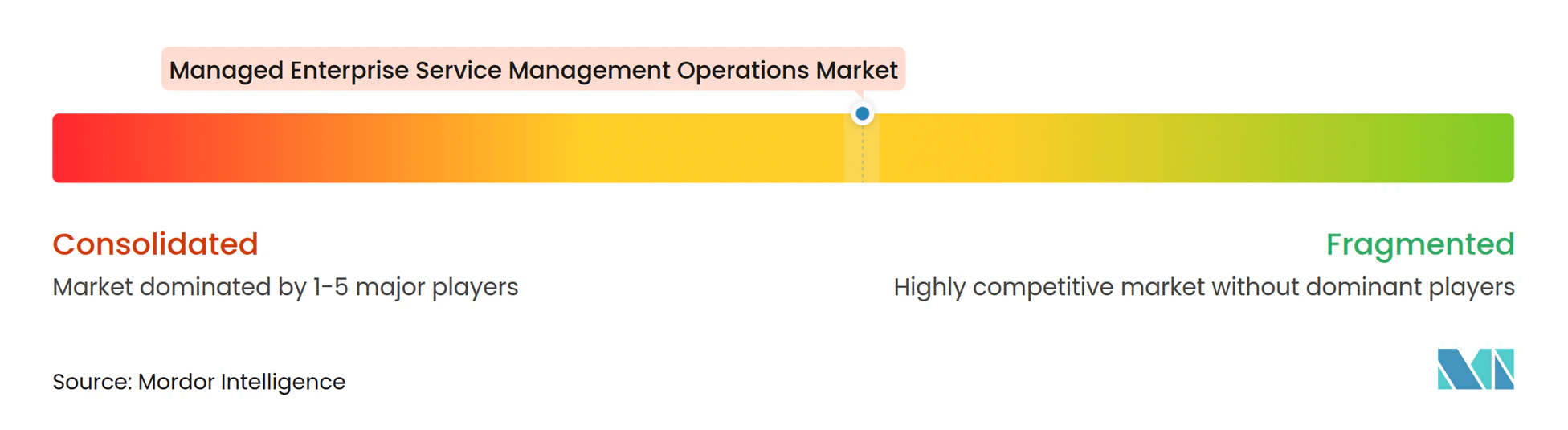
The managed enterprise service management operations market has strong competition among platform providers and managed delivery specialists. ServiceNow and BMC hold important enterprise positions, while Atlassian, Freshworks, Ivanti, and ManageEngine serve different deployment and customer needs. NinjaOne focuses on unified IT operations for managed service providers and smaller businesses. Nexthink specializes in digital employee experience measurement, which gives it a focused role in employee-facing service improvement. TOPdesk provides service management capabilities across IT, facilities, and HR. The provider set includes global platform companies, focused operations vendors, and firms that specialize in particular workflow needs. Buyers can therefore choose between broad suites and narrower products that integrate into existing environments. This mix of providers reflects a market where platform depth, service delivery capability, and customer focus all influence competition.
AI-led operations is becoming an important area of differentiation in the managed enterprise service management operations market. NinjaOne launched Katana AI in October 2026 as an agentic AI technician within its Unified IT Operations Platform. The company stated that the product uses device telemetry, alert history, and activity logs to identify root causes and carry out remediation actions. ServiceNow also reported that its AI-supported work with Thrive handled more than 315,000 tasks in 6 months. TeamViewer integrated endpoint management and digital employee experience capabilities with the ServiceNow AI Platform in July 2026. The integration lets AI agents act on device-level telemetry within ServiceNow-managed remediation sequences. The strategies point to a competitive focus on connecting endpoint data, workflow automation, and accountable operations. Providers that show reliable remediation results can strengthen their position in outcome-based service engagements.
Platform adjacency and integration are also shaping competitive strategy in the managed enterprise service management operations market. Freshworks announced a definitive agreement to acquire Torii, extending Freshservice toward software-spend governance and IT asset intelligence. NinjaOne and ServiceNow announced an integration in July 2026 to synchronize endpoint data with the ServiceNow CMDB and create incidents from NinjaOne alerts. Providers also face higher expectations around data governance, auditability, and AI controls. Smaller providers may find it harder to meet these requirements while maintaining competitive pricing. No combined market-share figure for the leading companies is provided, so a concentration score cannot be assigned under the requested scoring method.
Managed Enterprise Service Management Operations Industry Leaders
-
ServiceNow, Inc.
-
BMC Software, Inc.
-
Atlassian Pty Ltd.
-
Ivanti Software Inc.
-
Freshworks Inc.
- *Disclaimer: Major Players sorted in no particular order
Managed Enterprise Service Management Operations Market Companies Covered in this Report
- ServiceNow, Inc.
- BMC Software, Inc.
- Atlassian Pty Ltd.
- Ivanti Software Inc.
- Freshworks Inc.
- OpenText Corporation
- SolarWinds, Inc.
- NinjaOne LLC
- TOPdesk B.V.
- Zendesk Inc.
- Microsoft Corporation
- Zoho Corporation Pvt. Ltd.
- PagerDuty Inc.
- Datadog, Inc.
- TeamViewer AG
- Tanium Inc.
- Nexthink, Inc.
- Eracent, Inc.
- Flexera Software, Inc.
- ConnectWise LLC
Recent Industry Developments in Managed Enterprise Service Management Operations Market
- October 2026: NinjaOne launched Katana AI, an agentic AI technician embedded into the NinjaOne Unified IT Operations Platform, alongside the NinjaOne MCP Server for governed agentic orchestration across the IT stack. Katana AI analyzes device telemetry, alert history, and activity logs to surface root causes and execute remediation actions, enabling autonomous IT support for common incident types without specialist intervention.
- October 2026: adesso expanded its partnership with ServiceNow to bring the ServiceNow AI Control Tower to market as a managed service across Europe, Middle East, and Africa, with initial focus on the German-speaking region. The offering combines consulting, implementation, and operations from a single source, enabling enterprise clients to centralize AI governance risk management without building dedicated internal teams.
- July 2026: NinjaOne and ServiceNow announced a product integration enabling real-time synchronization of endpoint data into ServiceNow's CMDB and automatic incident creation based on NinjaOne device alerts, allowing service desk engineers to execute device-level remediation without leaving the ServiceNow interface.
- July 2026: TeamViewer integrated its endpoint management and digital employee experience capabilities with the ServiceNow AI Platform to enable end-to-end agentic IT workflows, allowing AI agents to act on device-level telemetry within ServiceNow-orchestrated remediation sequences.
Global Managed Enterprise Service Management Operations Market Report Scope
The Managed Enterprise Service Management (ESM) Operations Market encompasses outsourced, co-managed, and fully managed services that oversee the ongoing operation, administration, optimization, and support of enterprise service management platforms and workflows across both IT and non-IT business functions.
The Managed Enterprise Service Management Operations Market Report is Segmented by Service Type (Managed IT Service Desk and End-User Operations, Managed IT Operations and Infrastructure Management, Managed Enterprise Service Integration and Management, Managed IT Asset and Configuration Operations, Managed Automation, AIOps, and Observability Operations, and Managed Service Continuity and Resilience Operations), Delivery Model (Fully Managed Services, Co-Managed Services, and Staff-Augmented and Project-Based Operations), Organization Size (Large Enterprises and Small and Medium-Sized Enterprises), Enterprise Service Domain (Information Technology, Human Resources, Finance and Procurement, Facilities and Workplace Services, Legal and Compliance, Customer and Field Service, and Other Enterprise Service Domains), and Geography (North America [United States, Canada, Mexico, and Rest of North America], South America [Brazil, Argentina, and Rest of South America], Europe [Germany, United Kingdom, France, Italy, and Rest of Europe], Asia-Pacific [China, India, Japan, South Korea, and Rest of Asia-Pacific], Middle East [Saudi Arabia, United Arab Emirates, Turkey, and Rest of Middle East], and Africa [South Africa, Nigeria, Egypt, and Rest of Africa]). The Market Forecasts are Provided in Terms of Value (USD).
Segmentation Overview
| Managed IT Service Desk and End-User Operations |
| Managed IT Operations and Infrastructure Management |
| Managed Enterprise Service Integration and Management |
| Managed IT Asset and Configuration Operations |
| Managed Automation, AIOps, and Observability Operations |
| Managed Service Continuity and Resilience Operations |
| Fully Managed Services |
| Co-Managed Services |
| Staff-Augmented and Project-Based Operations |
| Large Enterprises |
| Small and Medium-Sized Enterprises |
| Information Technology |
| Human Resources |
| Finance and Procurement |
| Facilities and Workplace Services |
| Legal and Compliance |
| Customer and Field Service |
| Other Enterprise Service Domains |
| North America | United States |
| Canada | |
| Mexico | |
| Rest of North America | |
| South America | Brazil |
| Argentina | |
| Rest of South America | |
| Europe | Germany |
| United Kingdom | |
| France | |
| Italy | |
| Rest of Europe | |
| Asia-Pacific | China |
| India | |
| Japan | |
| South Korea | |
| Rest of Asia-Pacific | |
| Middle East | Saudi Arabia |
| United Arab Emirates | |
| Turkey | |
| Rest of Middle East | |
| Africa | South Africa |
| Nigeria | |
| Egypt | |
| Rest of Africa |
| By Service Type | Managed IT Service Desk and End-User Operations | |
| Managed IT Operations and Infrastructure Management | ||
| Managed Enterprise Service Integration and Management | ||
| Managed IT Asset and Configuration Operations | ||
| Managed Automation, AIOps, and Observability Operations | ||
| Managed Service Continuity and Resilience Operations | ||
| By Delivery Model | Fully Managed Services | |
| Co-Managed Services | ||
| Staff-Augmented and Project-Based Operations | ||
| By Organization Size | Large Enterprises | |
| Small and Medium-Sized Enterprises | ||
| By Enterprise Service Domain | Information Technology | |
| Human Resources | ||
| Finance and Procurement | ||
| Facilities and Workplace Services | ||
| Legal and Compliance | ||
| Customer and Field Service | ||
| Other Enterprise Service Domains | ||
| By Geography | North America | United States |
| Canada | ||
| Mexico | ||
| Rest of North America | ||
| South America | Brazil | |
| Argentina | ||
| Rest of South America | ||
| Europe | Germany | |
| United Kingdom | ||
| France | ||
| Italy | ||
| Rest of Europe | ||
| Asia-Pacific | China | |
| India | ||
| Japan | ||
| South Korea | ||
| Rest of Asia-Pacific | ||
| Middle East | Saudi Arabia | |
| United Arab Emirates | ||
| Turkey | ||
| Rest of Middle East | ||
| Africa | South Africa | |
| Nigeria | ||
| Egypt | ||
| Rest of Africa | ||
Key Questions Answered in the Report
What is the size of the managed enterprise service management operations market?
The managed enterprise service management operations market size is USD 168.75 billion in 2026 and is projected to reach USD 259.20 billion by 2032 at a 7.74% CAGR from 2027 to 2032.
What is driving demand for managed enterprise service management operations?
Hybrid and multi-cloud complexity, automation needs, and demand for predictable service levels are supporting provider adoption.
Which service type leads managed enterprise service management operations?
Managed IT Service Desk and End-User Operations leads with a 28.63% share in 2026. Managed Automation, AIOps, and Observability Operations is projected to have the fastest expansion at an 8.49% CAGR.
Why are fully managed services becoming more important?
Fully Managed Services held 57.37% of revenue in 2026 and is projected to expand at an 8.74% CAGR, reflecting broader outsourcing of service management accountability.
Which region is expanding fastest for managed enterprise service management operations?
Asia-Pacific is projected to expand at an 8.81% CAGR through 2032, supported by cloud migration, digitization programs, and service-management skills gaps.
How is AI affecting enterprise service management operations?
AI can automate task routing, identify likely root causes, and support remediation. ServiceNow reported that Thrive achieved 73% first-contact resolution through AI-supported automation.