
AI-Enabled Managed Service Desk Market Size and Share
Market Overview
| Study Period | 2021 - 2032 |
|---|---|
| Market Size (2027) | USD 8.17 Billion |
| Market Size (2032) | USD 18.62 Billion |
| Growth Rate (2027 - 2032) | 17.91 % |
| Fastest Growing Market | Asia-Pacific |
| Largest Market | North America |
| Market Concentration | Medium |
Major Players *Disclaimer: Major Players sorted in no particular order Image © Mordor Intelligence. Reuse requires attribution under CC BY 4.0. | |
AI-Enabled Managed Service Desk Market Analysis by Mordor Intelligence
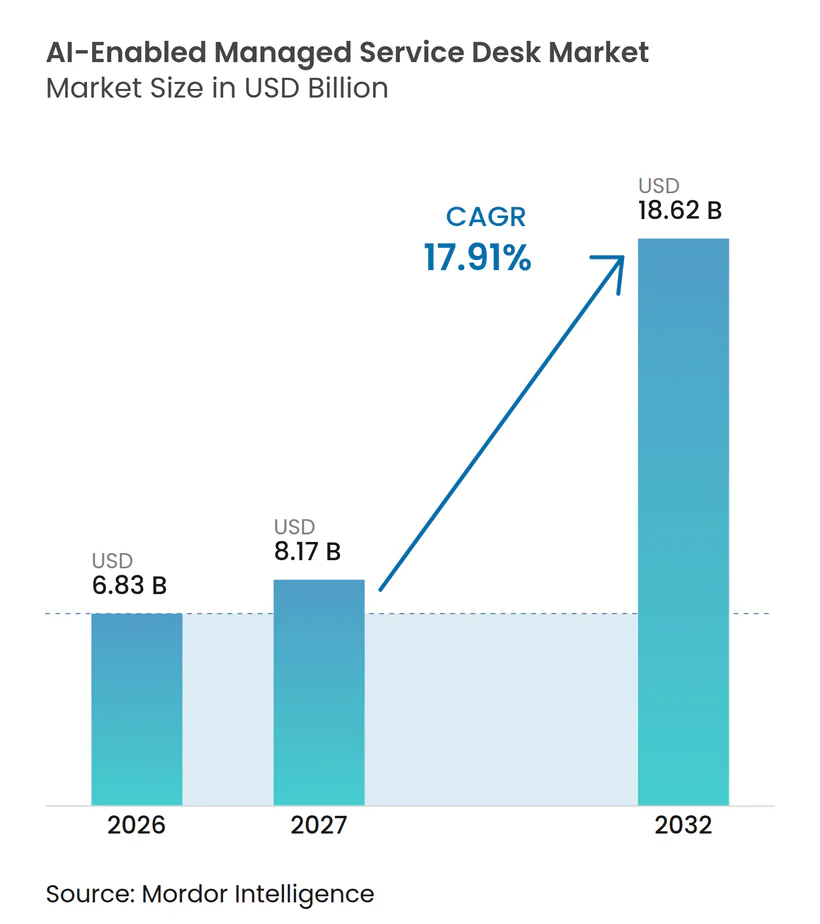
The AI-enabled managed service desk market size is projected to expand from USD 6.83 billion in 2026 and USD 8.17 billion in 2027 to USD 18.62 billion by 2032, registering a CAGR of 17.91% between 2027 to 2032. The AI-enabled managed service desk market is moving from a ticket-routing function toward a service layer that can classify requests, retrieve knowledge, and complete defined actions. Organizations are looking for lower support costs while maintaining service levels across distributed workforces. Providers can use fixed-price service arrangements more effectively when AI handles repetitive work and gives technicians better case context. The opportunity is strongest where providers combine implementation, operating knowledge, and governance rather than selling a standalone tool. Competition is therefore shifting toward the quality of workflow design, data controls, and the ability to run reliable services across cloud and on-premises systems.
Key Report Takeaways
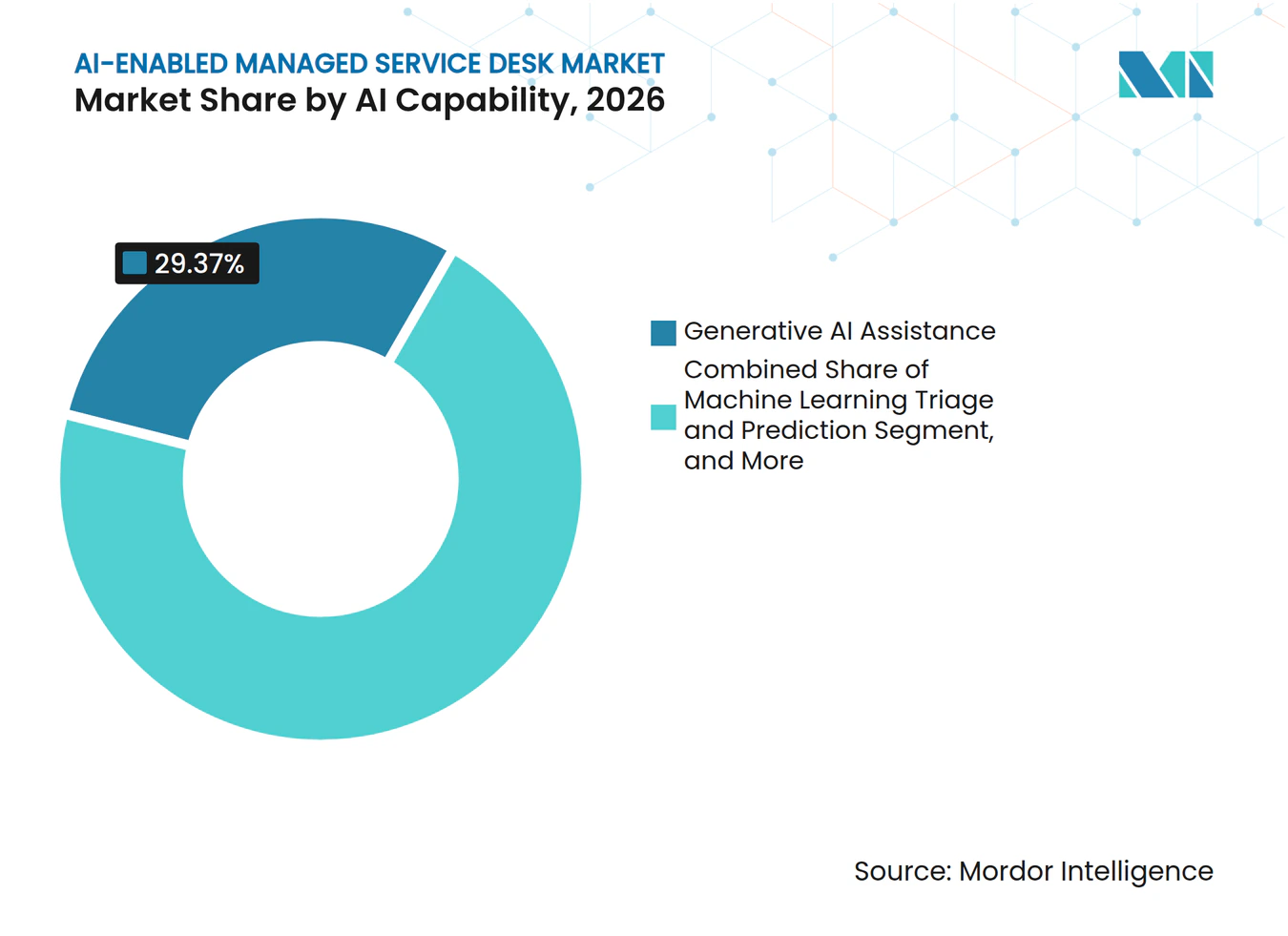
- By AI capability, Generative AI Assistance held 29.37% of the AI-enabled managed service desk market share in 2026, while Agentic AI and Autonomous Resolution are projected to expand at a 18.37% CAGR through 2032.
- By service delivery model, Fully Managed Service Desk held 38.43% of the AI-enabled managed service desk market share in 2026, while AI-Enabled Service Desk Software is expected to expand at a 18.43% CAGR through 2032.
- By enterprise size, Large Enterprises held 67.83% of the AI-enabled managed service desk market share in 2026, while SMEs are projected to expand at a 18.67% CAGR through 2032.
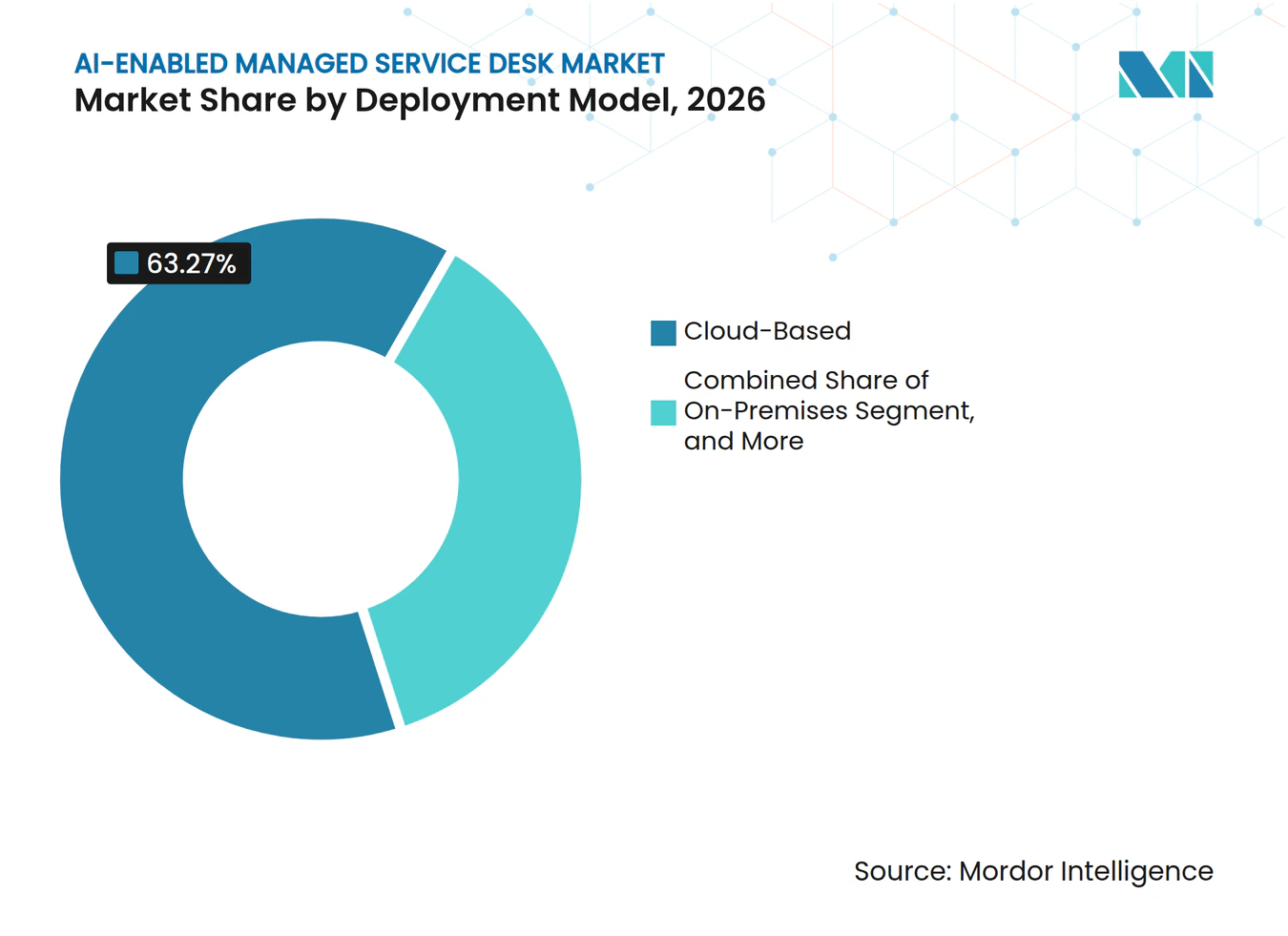
- By deployment model, Cloud-based deployment accounted for 63.27% of the AI-enabled managed service desk market size in 2026, while Hybrid deployment is projected to expand at a 18.13% CAGR through 2032.
- By end-user industry, Information Technology and Telecommunications held 24.17% of the AI-enabled managed service desk market share in 2026, while Healthcare is projected to expand at a 18.87% CAGR through 2032.
- By geography, North America held 37.83% of the AI-enabled managed service desk market share in 2026, while Asia-Pacific is projected to expand at a 18.93% CAGR through 2032.
Note: Market numbers in this report are based on Mordor Intelligence's proprietary estimation framework, which combines nine months of actuals with Q4 projections for base year 2026.
Market Trends and Insights
Drivers Impact Analysis of AI-Enabled Managed Service Desk Market*
| Driver | (~) % Impact on CAGR Forecast | Geographic Relevance | Impact Timeline |
|---|---|---|---|
| AI-Enabled Ticket Triage and Autonomous Resolution | +4.2% | Global | Short term (≤ 2 years) |
| Hybrid and Multicloud Service Complexity | +3.5% | North America and Europe, spill-over to Asia-Pacific | Medium term (2-4 years) |
| Demand for 24/7 Support Across Distributed Workforces | +3.0% | Global | Short term (≤ 2 years) |
| Cloud-Native ITSM Modernization | +2.5% | North America, Europe, and Asia-Pacific | Medium term (2-4 years) |
| Managed-Service Scalability Under Technician Shortages | +1.8% | Global, most acute in North America and Europe | Medium term (2-4 years) |
| AI Governance Services as a New MSP Revenue Pool | +1.2% | Europe and North America | Long term (≥ 4 years) |
| Source: Mordor Intelligence | |||
AI-Enabled Ticket Triage and Autonomous Resolution
The AI-enabled managed service desk market benefits when providers replace manual escalation with systems that classify, prioritize, and resolve repeatable requests before a technician is involved. Automation Anywhere reported that its AI agents resolved more than 80% of employee service requests on average and that participating organizations recorded 50% fewer call volumes. This model also retains resolution knowledge because each completed interaction can strengthen the information available for later tickets. Microsoft Research reported that its StepFly framework achieved a 94% success rate in automating the execution of troubleshooting guides. The same research recorded execution-time reductions of 32.9% to 70.4% for tasks that could run in parallel. This creates demand for providers capable of connecting AI models to trustworthy service catalogs, approval rules, and operational systems.
Hybrid and Multicloud Service Complexity
The AI-enabled managed service desk market is supported by the growing difficulty of managing incidents across public clouds, private infrastructure, and legacy systems. A hybrid estate requires shared visibility and coordinated workflows because an incident may span multiple platforms and ownership teams. IBM describes visibility across hybrid and multicloud environments as a requirement for operating and managing those environments consistently. Managed providers gain relevance when they can combine observability, incident orchestration, and knowledge management across these boundaries. Providers that train operational models on varied telemetry can build service knowledge that is harder to reproduce in a single-environment delivery model.
Demand for 24/7 Support Across Distributed Workforces
The AI-enabled managed service desk market is also shaped by organizations that need continuous Tier 1 support without staffing around the clock. Employees in distributed workforces submit requests for access, devices, applications, and workplaces outside the operating hours of central IT teams. AI-assisted self-service enables routine requests to receive immediate responses while technicians focus on exceptions and higher-risk incidents. Fully managed and co-managed arrangements offer a practical operating model by reducing the customer's internal infrastructure and talent burden. This demand supports services that combine always-on intake, accurate handoffs, and auditable actions rather than simple chatbot deployment.
Cloud-Native ITSM Modernization
Aging IT service management systems can limit the use of AI because fragmented knowledge bases and rigid workflows do not provide dependable inputs for automation. The AI-enabled managed service desk market, therefore, benefits from modernization projects that migrate service workflows and data to cloud-ready platforms. IBM and ServiceNow expanded their collaboration in June 2026 to combine enterprise data, automation, and AI capabilities for modernization and data governance.[1] The collaboration focused on barriers, including legacy application debt and the availability of AI-ready data. Modernization work can lead to longer service contracts because the provider becomes involved in platform configuration, data preparation, and daily operations. Procurement requirements also increasingly favor structured service management practices, which increases the value of providers capable of supporting mature cloud operations.
Restraints Impact Analysis of AI-Enabled Managed Service Desk Market*
| Restraint | (~) % Impact on CAGR Forecast | Geographic Relevance | Impact Timeline |
|---|---|---|---|
| Legacy Integration and Migration Complexity | -1.8% | Global, most acute in large enterprise environments | Medium term (2-4 years) |
| Data Privacy, Residency, and AI Accountability Requirements | -1.4% | Europe and Asia-Pacific core, spill-over to North America | Medium term (2-4 years) |
| AI Maintenance and Knowledge-Currency Burden | -0.9% | Global | Long term (≥ 4 years) |
| Fragmented Customer Environments and Configuration Drift | -0.6% | Global, most acute in SME and multi-vendor environments | Short term (≤ 2 years) |
| Source: Mordor Intelligence | |||
Legacy Integration and Migration Complexity
The AI-enabled managed service desk market faces friction when customers move from established service management platforms to AI-enabled workflows. Migration can require historical ticket data to be prepared, knowledge bases to be reviewed, and approval processes to be rebuilt. Long-running environments often contain undocumented configurations that make the scope difficult to assess before work starts. Providers also face contract risk when fixed fees do not reflect the effort required to integrate old and new systems. Historical ticket records can embed outdated escalation practices, so training automation on unreviewed data may perpetuate inefficient service patterns. These conditions can delay decisions even where customers recognize the need for a more modern operating model.
Data Privacy, Residency, and AI Accountability Requirements
Service desk systems process employee identifiers, ticket narratives, access details, and other operational information that requires careful handling. The European Commission states that the EU AI Act entered into force on August 1, 2024, while its requirements become applicable on a phased schedule. These rules can require documentation, risk controls, and monitoring for relevant AI uses. Providers serving several jurisdictions may need different controls for privacy, data residency, security, and accountability. Smaller providers can find these requirements more demanding because they have fewer dedicated compliance resources. The result is a preference for partners that can demonstrate clear data handling and responsible operating practices.
*Our forecasts treat driver/restraint impacts as directional, not additive. The impact forecasts reflect baseline growth, mix effects, and variable interactions.
AI-Enabled Managed Service Desk Market Segment Analysis
By AI Capability:
Generative AI Leads Current Service OperationsGenerative AI Assistance accounted for 29.37% of the AI-enabled managed service desk market in 2026. Organizations use these tools to summarize tickets, draft knowledge articles, and support technicians during customer interactions. This capability provides teams with an accessible starting point by improving human agents' work before transferring full decision authority to an automated system. Conversational AI and virtual agents handle basic Tier 0 requests such as password resets, access requests, and employee questions. Machine-learning triage and prediction tools provide classification and routing functions beneath several capability types.
Agentic AI and Autonomous Resolution are projected to record an 18.37% CAGR through 2032. This capability executes connected workflows across several systems and can resolve defined cases without a human handoff. ServiceNow made its L1 IT Service Desk AI Specialist generally available in May 2026.[2] ServiceNow said the specialist could resolve assigned IT cases 99% faster than human agents. Robotic process automation remains relevant, but it is increasingly used within broader agentic workflows that connect rules, knowledge, and system actions.



By Service Delivery Model:
Fully Managed Desks Lead While Software ExpandsFully managed service desks accounted for 38.43% of the AI-enabled managed service desk market in 2026. Large organizations often favor this arrangement because one provider assumes responsibility for staffing, service levels, and operational controls for AI. The model allows the customer to transfer a defined service outcome rather than manage several suppliers and internal teams. AI can improve its economics because a provider may handle higher ticket volumes without adding a proportional number of people. This supports fixed-price contracts when the underlying workflows are clear and well governed.
AI-Enabled Service Desk Software is projected to expand at an 18.43% CAGR through 2032. Mid-sized organizations and SMEs can opt for platform-based delivery when full outsourcing does not meet their requirements. Freshworks introduced Freddy AI Agent Studio within Freshservice in May 2026, with a no-code approach for building domain-specific agents. The company said the product supports deploying such agents within weeks and includes integration options for common work applications. The AI-enabled managed service desk industry is therefore seeing software lower the specialist-resource threshold for organizations seeking more control over their service operations.
By Enterprise Size:
Large Enterprises Lead and SMEs Gain AccessLarge Enterprises accounted for 67.83% of the AI-enabled managed service desk market in 2026. They have established provider relationships, larger technology budgets, and operational complexity that can justify investment in AI-based service workflows. Their environments often include numerous applications, locations, and user groups, providing a clear reason to automate ticket classification and resolution. They also have a greater capacity to establish governance, test models, and integrate AI with enterprise systems. These conditions have made them the earliest adopters of advanced managed service desk arrangements.
SMEs are projected to grow at an 18.67% CAGR through 2032. The OECD reported in December 2025 that 40% of large firms used AI, compared with 11.9% of small firms across OECD countries. Cloud-delivered service platforms and consumption-based pricing can reduce the initial infrastructure barrier for smaller organizations. OpenText reported that 92% of managed service providers saw business growth driven by AI interest, though only about half felt ready to guide small and medium-sized customers in adopting AI tools. The AI-enabled managed service desk industry can benefit when providers standardize delivery across many SME customers while keeping their configuration and data needs distinct.
By Deployment Model:
Cloud Leads While Hybrid Addresses Control NeedsCloud-based deployment accounted for 63.27% of the AI-enabled managed service desk market size in 2026. Cloud platforms can support continuous model updates, elastic computing capacity, and service delivery across distributed locations. These characteristics are important when providers need to make changes to current knowledge and workflows available to many customers. On-premises deployments retain a role where customers need direct control over sensitive data or depend on locally managed systems. The choice often reflects data requirements and integration conditions rather than a simple preference for one architecture.
Hybrid deployment is projected to expand at an 18.13% CAGR through 2032. It allows organizations in healthcare, defense, and financial services to retain certain ticket data in on-premises or private environments while using cloud infrastructure for selected AI functions. IDC projected that managed cloud services in Asia-Pacific would increase from USD 10.8 billion in 2023 to USD 22.6 billion by 2028. IDC also reported a 22.1% growth rate for managed public cloud services in its regional outlook. This arrangement creates demand for providers capable of maintaining consistent service management and data governance across cloud and local boundaries.

By End-User Industry:
IT and Telecommunications Lead While Healthcare Grows FastestInformation Technology and Telecommunications accounted for 24.17% of the AI-enabled managed service desk market in 2026. Organizations in this sector operate technology infrastructure and are often early users of the AI tools that they also support or sell. This gives them experience with service management workflows, cloud operations, and automated incident handling. BFSI organizations use AI-enabled service desks to meet internal service-level requirements across distributed operations. Retail and e-commerce organizations use automation to absorb seasonal increases in request volume without matching increases in support staffing.
Healthcare is projected to expand at an 18.87% CAGR through 2032. Clinical IT teams face persistent pressure to reduce technology friction for staff while protecting sensitive systems and data. AI triage can direct routine technical requests away from scarce specialist resources when the workflow has clear controls in place. Manufacturing adoption reflects the closer connection between operational technology and enterprise IT. Government and defense present an additional opportunity in which centralized procurement can award large service contracts to providers that meet required security and compliance standards. The AI-enabled managed service desk market will therefore require sector-specific models rather than generic workflows for highly regulated or operationally critical environments.
Geography Analysis
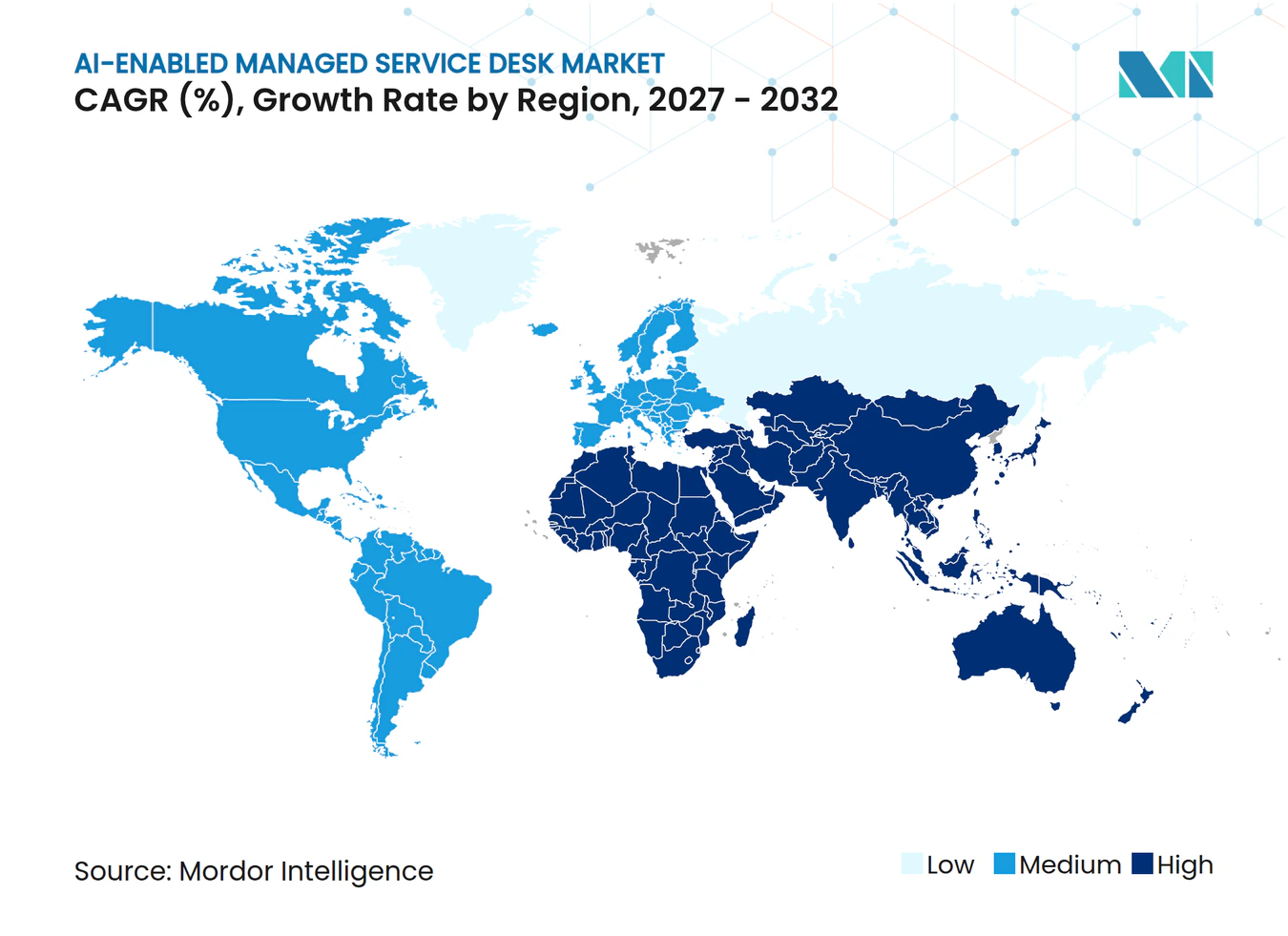
North America accounted for 37.83% of the AI-enabled managed service desk market in 2026. The region has mature enterprise technology infrastructure, a developed managed services ecosystem, and early adoption of cloud-based IT service management platforms. The United States is the main demand center due to workforce dispersion, technician shortages, and enterprise AI readiness, which support the adoption of AI-assisted support services. Providers in the region are moving from using AI tools internally toward offering AI-linked service outcomes to customers. This approach can increase customer switching costs when a provider manages the customer’s workflows, knowledge, and service data.
Europe is shaped by compliance needs as organizations introduce AI into service operations. The European Commission’s framework for the EU AI Act creates a phased set of obligations that influences documentation, oversight, and risk-management decisions.[3] Germany, the United Kingdom, and France remain important demand centers for modernization tied to large industrial and enterprise technology estates. Data residency and accountability requirements can influence the choice of platforms, cloud regions, and managed service partners. The AI-enabled managed service desk market in Europe rewards providers that can combine operational delivery with credible compliance processes.
Asia-Pacific is projected to record an 18.93% CAGR through 2032. The region benefits from expanding enterprise digital infrastructure, public-sector modernization activity, and talent constraints that make scalable support models attractive. India operates as both a growth market and a delivery location for providers serving global customers. TCS reported 13.6% quarter-on-quarter growth in its AI business, while Infosys attributed 8.2% of revenue to its AI-led Topaz platform. South America, the Middle East, and Africa remain earlier-stage opportunity areas, with Saudi Arabia and the United Arab Emirates using sovereign AI investment to support government digital transformation programs.
Competitive Landscape
Market Concentration
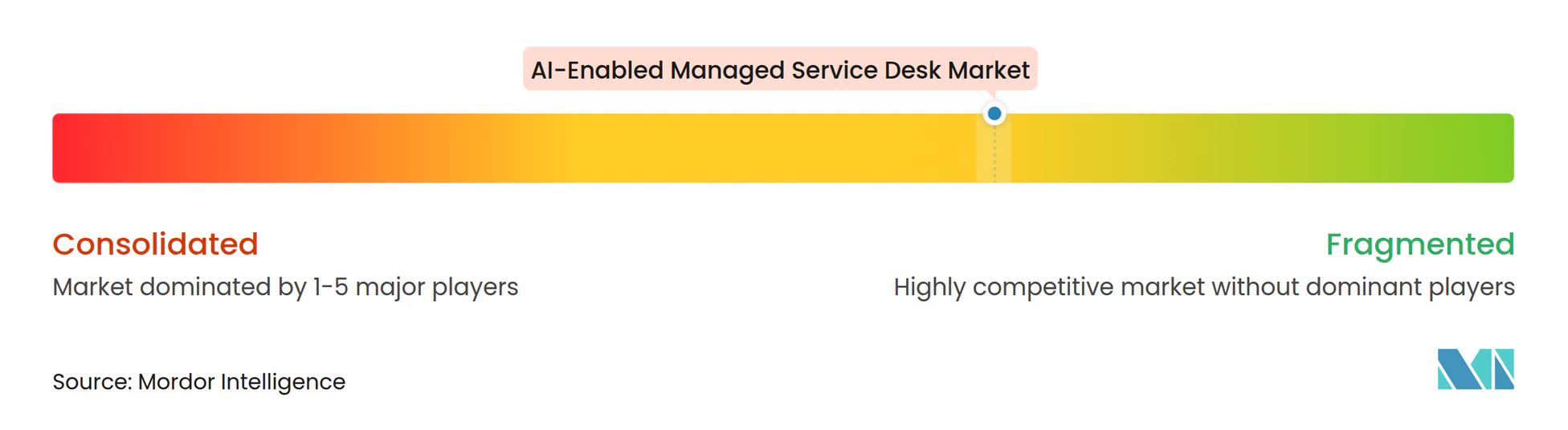
The AI-enabled managed service desk market has a concentrated platform layer and a more fragmented delivery layer. ServiceNow, BMC Software, and Salesforce were identified as leading vendors in the 2026 IT service management platforms assessment cited in the source material. Global delivery firms such as Accenture, Capgemini, Cognizant, Tata Consultancy Services, and Wipro compete with specialized managed service providers. Platform vendors focus on embedded AI capabilities, while delivery firms focus on implementation, integration, and ongoing service accountability. This division means customers often assess both the technology provider and the firm that will operate the workflows.
ServiceNow introduced Flow in October 2026 as a conversational AI-native service desk that the company said can be deployed in a day. The product supports workflow automation through natural-language interaction in existing chat channels. IBM and ServiceNow also expanded their multi-year collaboration in June 2026 across application modernization, enterprise data governance, and autonomous infrastructure operations. Freshworks has pursued a different route by adding a no-code agent-building capability to Freshservice for organizations that need faster platform-based deployment.
Mid-market and sector-specific delivery remain important competitive areas because large enterprise platforms may need extensive configuration. Healthcare, manufacturing, and government customers can require workflows that reflect their own data, approvals, and operational conditions. Smaller providers such as Aisera, SysAid, and InvGate compete through prebuilt agentic IT service management functions and shorter deployment schedules. Large firms are also increasing their AI delivery capability through investment and acquisition, which increases pressure on smaller providers to differentiate through specialization. The AI-enabled managed service desk market remains open to providers that can demonstrate practical service outcomes while meeting governance and integration requirements.
AI-Enabled Managed Service Desk Industry Leaders
-
ServiceNow, Inc.
-
BMC Software, Inc.
-
International Business Machines Corporation
-
Atlassian Corporation Plc
-
Broadcom Inc.
- *Disclaimer: Major Players sorted in no particular order
AI-Enabled Managed Service Desk Market Companies Covered in this Report
- ServiceNow, Inc.
- BMC Software, Inc.
- International Business Machines Corporation
- Atlassian Corporation Plc
- Broadcom Inc.
- Ivanti, Inc.
- Freshworks Inc.
- ManageEngine, a division of Zoho Corporation Pvt. Ltd.
- Microsoft Corporation
- Open Text Corporation
- Salesforce, Inc.
- Zendesk, Inc.
- SolarWinds Corporation
- SysAid Technologies Ltd.
- EasyVista S.A.
- Aisera, Inc.
- InvGate, Inc.
- TeamDynamix Solutions, LLC
- TOPdesk B.V.
- Hornbill Service Management Ltd.
- Matrix42 AG
- Efecte Corporation
- IFS AB
- Capgemini SE
- Cognizant Technology Solutions Corporation
- Tata Consultancy Services Limited
- Wipro Limited
- DXC Technology Company
- Accenture plc
Recent Industry Developments in AI-Enabled Managed Service Desk Market
- October 2026: ServiceNow launched Flow, a conversational AI-native service desk deployable in a day with no infrastructure required, initially targeting North America with EMEA general availability planned for Q4 2026; the product enables teams to automate workflows via natural language in existing chat channels and marks ServiceNow's direct entry into the instant-deployment, SME-accessible segment.
- October 2026: Zendesk introduced Employee Service AI Agents and Advanced Action Flows, designed to resolve complex cross-departmental employee requests end to end, covering IT, HR, and workplace domains, extending its Resolution Platform into the enterprise internal IT service desk category to compete directly with established ITSM vendors.
- June 2026: IBM and ServiceNow formalized a multi-year expanded collaboration combining IBM's AI, data, and automation capabilities with the ServiceNow AI Platform across application modernization, enterprise data governance, and autonomous infrastructure operations integrating Red Hat Ansible, Instana, and HashiCorp Terraform into ServiceNow IT workflows, with joint solutions targeted for H2 2026 availability.
- May 2026: Freshworks unveiled Freddy AI Agent Studio within Freshservice at its Refresh conference, enabling no-code deployment of domain-specific AI agents in weeks, with a Model Context Protocol Gateway for zero-code integration with Workday, Rippling, Notion, and ClickUp, and Experience Level Agreements connecting service performance to employee sentiment outcomes.
Global AI-Enabled Managed Service Desk Market Report Scope
The AI-enabled managed service desk market encompasses outsourced IT support services that use artificial intelligence (AI), machine learning (ML), natural language processing (NLP), automation, and analytics to manage and resolve IT service requests, incidents, and queries. These solutions help organizations improve service desk efficiency, automate routine tasks, enhance user experiences, and reduce resolution times.
The AI-Enabled Managed Service Desk Market Report is Segmented by AI Capability (Generative AI Assistance, Conversational AI and Virtual Agents, Machine Learning Triage and Prediction, Robotic Process Automation, and Agentic AI and Autonomous Resolution), by Service Delivery Model (Fully Managed Service Desk, Co-Managed Service Desk, AI-Enabled Service Desk Software, and Professional Services and Implementation), by Enterprise Size (Large Enterprises and Small and Medium Enterprises), by Deployment Model (On-Premises, Cloud-Based, and Hybrid), by End-User Industry (Information Technology and Telecommunications, BFSI, Healthcare, Retail and E-Commerce, Manufacturing, Government and Defense, and Other End-User Industries), and by Geography (North America, South America, Europe, Asia-Pacific, Middle East, and Africa). The Market Forecasts are Provided in Terms of Value (USD).
Segmentation Overview
| Generative AI Assistance |
| Conversational AI and Virtual Agents |
| Machine Learning Triage and Prediction |
| Robotic Process Automation |
| Agentic AI and Autonomous Resolution |
| Fully Managed Service Desk |
| Co-Managed Service Desk |
| AI-Enabled Service Desk Software |
| Professional Services and Implementation |
| Large Enterprises |
| Small and Medium Enterprises |
| On-Premises |
| Cloud-Based |
| Hybrid |
| Information Technology and Telecommunications |
| BFSI |
| Healthcare |
| Retail and E-Commerce |
| Manufacturing |
| Government and Defense |
| Other End-User Industries |
| North America | United States |
| Canada | |
| Mexico | |
| South America | Brazil |
| Argentina | |
| Rest of South America | |
| Europe | Germany |
| United Kingdom | |
| France | |
| Italy | |
| Spain | |
| Rest of Europe | |
| Asia-Pacific | China |
| India | |
| Japan | |
| South Korea | |
| Rest of Asia-Pacific | |
| Middle East | Saudi Arabia |
| United Arab Emirates | |
| Rest of Middle East | |
| Africa | South Africa |
| Egypt | |
| Rest of Africa |
| By AI Capability | Generative AI Assistance | |
| Conversational AI and Virtual Agents | ||
| Machine Learning Triage and Prediction | ||
| Robotic Process Automation | ||
| Agentic AI and Autonomous Resolution | ||
| By Service Delivery Model | Fully Managed Service Desk | |
| Co-Managed Service Desk | ||
| AI-Enabled Service Desk Software | ||
| Professional Services and Implementation | ||
| By Enterprise Size | Large Enterprises | |
| Small and Medium Enterprises | ||
| By Deployment Model | On-Premises | |
| Cloud-Based | ||
| Hybrid | ||
| By End-User Industry | Information Technology and Telecommunications | |
| BFSI | ||
| Healthcare | ||
| Retail and E-Commerce | ||
| Manufacturing | ||
| Government and Defense | ||
| Other End-User Industries | ||
| By Geography | North America | United States |
| Canada | ||
| Mexico | ||
| South America | Brazil | |
| Argentina | ||
| Rest of South America | ||
| Europe | Germany | |
| United Kingdom | ||
| France | ||
| Italy | ||
| Spain | ||
| Rest of Europe | ||
| Asia-Pacific | China | |
| India | ||
| Japan | ||
| South Korea | ||
| Rest of Asia-Pacific | ||
| Middle East | Saudi Arabia | |
| United Arab Emirates | ||
| Rest of Middle East | ||
| Africa | South Africa | |
| Egypt | ||
| Rest of Africa | ||
Key Questions Answered in the Report
What is the size of the AI-enabled managed service desk market?
The AI-enabled managed service desk market is projected to increase from USD 6.83 billion in 2026 to USD 18.62 billion by 2032, at a 17.91% CAGR from 2027 to 2032.
What is driving demand for AI-enabled managed service desks?
Demand is supported by ticket automation, hybrid and multicloud complexity, continuous support needs, and cloud-native IT service management modernization.
Which AI capability leads service desk adoption?
Generative AI Assistance led with a 29.37% share in 2026, while Agentic AI and Autonomous Resolution is projected to grow at an 18.37% CAGR through 2032.
Why are organizations adopting hybrid service desk deployments?
Hybrid deployments allow organizations to keep sensitive data in private or on-premises environments while using cloud infrastructure for selected AI functions.
Which end-user sector is growing fastest?
Healthcare is projected to grow at an 18.87% CAGR through 2032, supported by clinical IT pressures and the need to reduce routine support work.
Which region will grow fastest through 2032?
Asia-Pacific is projected to record an 18.93% CAGR through 2032, supported by digital infrastructure growth, modernization activity, and service delivery capacity.